Mirror Image Biology: Pushing the Envelope in Designing Biological Systems: Proceedings of a Workshop (2026)
Chapter: 1 Introduction
1
Introduction
OVERVIEW
In December 2024, the journal Science published an article describing concerns held by an international group of scientists about the anticipated human health and environmental risks of creating replication-competent, self-sustaining, mirror-image bacteria. Referencing a longer analysis that included many of the same authors, the journal Science article highlighted risks of immune evasion and subsequent disease in humans, non-human animals, and plants upon exposure to mirror-image bacteria, as well as the risk of ecosystem invasion if mirror bacteria were accidentally or deliberately released into the environment. The Mirror Biology Dialogues Fund (MBDF) asked the National Academies to hold a workshop on mirror biology to discuss the state of the science, risks, benefits, and possible governance of technology milestones leading up to the development of replication-competent, self-sufficient, mirror-image bacteria.
This workshop1 proceedings summarizes the discussions about the current biotechnology regulatory context (Chapter 1); terminology relating to research and development toward mirror life (Chapter 2); current research efforts towards understanding the emergence of chirality in nature (Chapter 2), developing mirror molecules as therapeutics (stable, non-immunogenic drugs), diagnostics and biosensing, and materials science and data storage (Chapter 3); and research aimed at advancing methods for developing synthetic ribosomes and cells and other technologies that may contribute to creating mirror molecules and cells (Chapters 3 and 4). Attendees discussed various types of risk to human health, including off-target effects, toxicity, in vivo functionality, potential for immune evasion or delayed recognition, chronic persistence or pollutant-like behavior, and uncertainty about adaptive immune response effectiveness (Chapters 3 and 4). They also discussed possible ecological risks, including disruption of food webs and nutrient cycles, reduced predation because of chirality mismatch, or potential persistence and spread across ecosystems (Chapter 4). Finally, attendees considered frameworks for evaluating risks and benefits of mirror molecules and living cells in general and within the context of a “slippery slope” framework (Chapter 5).
High-level take-aways from participants are summarized below in Box 1-1 and Box 1-2. A more complete summary of the workshop is provided in Chapters 1-5.
___________________
1 See Appendix B for the workshop agenda and Appendix C for committee member biographical sketches.
BOX 1-1
Attendee-Highlighted Take-Aways
Key take-aways highlighted by attendees are summarized below:
- Mirror molecules offer significant beneficial opportunities and few risks.a,b
- Examples of D-amino acids and D-sugars exist in nature.c,d,e
- Some metabolites that are produced by cells are harmful in the opposite chirality.f
- Cells that can consume achiral molecules (i.e., autotrophs) may be dangerous if they enter the environment.f
- Development of a synthetic, normal-chirality ribosome is a significant technical challenge.d,f
- Development of an artificial cell is a significant technical challenge.f
- Chemical synthesis and cell-free systems provide opportunities for creating natural and mirror-form proteins and ribosomes.d,g
- The taxonomies of precursor technologies, pathways, and mapping of the slippery slope may help in considering clear lines that protect beneficial research and reduce the risks.h
- More precise nomenclature is needed to ensure that discussions about risk and benefit are not vague.f
- Significant evidence to inform threat assessments is lacking. A variety of views exist regarding the threats of self-replicating mirror cells in natural environments, and numerous ecological questions (e.g., competition of mirror organisms with natural cells) exist.i
- Cross-disciplinary work with other fields that have traditionally studied chirality may be needed.j
- Identification of clear, well-defined, unambiguous technical milestones that serve as stopping points is needed, in order to provide time to evaluate the risks and benefits based on available evidence, consistent with the slippery slope framework.k
- Creation of a mirror ribosome might be a red line, because it might be a viable pathway to self-replication of a PURE system via insertion of a self-replicating PURE system into a membranous system.l
- Identification of risk reduction measures requires collective brainstorming and thoughtful analysis of guidelines but is currently premature.b
- Natural barriers may limit progression toward creating a self-replicating mirror organism.m
- A research agenda is needed to narrow the gap in risk assessment among experts.h
- A significant amount of uncertainty exists about mirror biology.m,n
__________________
NOTE: This list is the rapporteurs’ summary of points made by the individual speakers identified, and the statements have not been endorsed or verified by the National Academies of Sciences, Engineering, and Medicine. They are not intended to reflect a consensus among workshop participants.
SOURCES:
a Philip Dawson, Panel 8: Committee Reflections and Key Themes
b Romy Chakraborty, Panel 8: Committee Reflections and Key Themes
c Lynn Rothschild, Panel 8: Committee Reflections and Key Themes
d Neal Devaraj, Panel 8: Committee Reflections and Key Themes
e Gregory Went, Panel 8: Committee Reflections and Key Themes
f Douglas Cameron, Panel 8: Committee Reflections and Key Themes
g Joel Schneider, Panel 8: Committee Reflections and Key Themes
h James Wagstaff, Panel 8: Committee Reflections and Key Themes
i Karl Thompson, Panel 8: Committee Reflections and Key Themes
j Jevgenij Raskatov, Panel 8: Committee Reflections and Key Themes
k James Smith, Panel 8: Committee Reflections and Key Themes
l Andrew Ellington, Panel 8: Committee Reflections and Key Themes
m Nicholas Adams, Panel 8: Committee Reflections and Key Themes
n Harshini Mukundan, Panel 8: Committee Reflections and Key Themes
BOX 1-2
Technical Questions Highlighted by Attendees
Key technical questions highlighted by attendees are summarized below regarding mirror molecules (or mirror biology) versus replication-competent, self-sufficient mirror cells (or mirror life, which currently does not exist):
- What tools and methods (e.g., spectroscopy, nanoparticles, and biosensing), existing or not yet developed, can be used to see or detect the presence of possible achiral molecules?a,b,c
- How would the immune system respond to mirror-image biological components (peptides and proteins) and mirror cells, given the wide range of opinion?d This may involve testing agreed-upon mirror components in animals or organoid systems.e,f
- How quickly would the immune system respond?d,e,f,g
- How would the immune system respond to long-term, repeated exposure?e
- What could be learned about immune responses against chiral molecules from immunological studies in insects and plants?h Insects do not have adaptive immune systems, which may limit the amount of translatable knowledge learned through these studies.d
- What would the host molecular immunology look like after exposure to mirror molecules?i
- Mirror organism fitness:
- What would the dynamics between natural and mirror organisms in accessing and using nutrient resources be?a
- Would mirror organisms be able to survive in natural environments? If so, what mechanisms are involved? If they struggle, why would they be unable to survive?i,j,k,l
- Are mirror organisms vulnerable to natural predation? What does predation look like with mirror organisms in various environments?d,i,k,m,n
- Could mirror organisms evolve in the laboratory and/or in natural environment? How could mirror organisms evolve and what pressures, if any, might drive evolution?d
- Do mirror organisms or hallmarks of mirror organisms exist?c,l This question would inform the issue of survivorship bias.o
- How steep is the slippery slope to achieving a self-replicating mirror organism if a mirror-image ribosome is created? Significant technical hurdles may exist between a mirror ribosome and a self-replicating mirror organism.e
- What would be the next experiment after making a mirror-image ribosome?e
- Beyond a self-replicating PURE system, what technological breakthroughs might shorten the time to achieve self-replicating mirror organisms?c
- How well could a chemically synthesized version of a D-amino-acid-producing ribosome replicate itself in a self-replicating PURE system? How well could a ribosome produced in a self-replicating PURE system replicate itself?c
- What is needed to kickstart a self-replicating cell?c,p
- Could a functional minimal ribosome be made, and how well would it work?p
- How could artificial cells (regardless of chirality) be made to not be dangerous (e.g., engineer in auxotrophy for every amino acid, use an extremophile as the template)?p,q
- What is the baseline composition of soil, freshwater, and oceanic microbiomes and phageome?i
- How might this baseline composition change with introduction of a mirror organism?i
- What is the likelihood of survival of mirror organisms in the environment, recognizing that existing data is on organisms that currently exist (i.e., survivorship bias)? The fossil record is filled with clues about organisms that failed to survive.l,o
- How might self-replicating entities evolve, even in the absence of a cell?p
NOTE: This list is the rapporteurs’ summary of points made by the individual speakers identified, and the statements have not been endorsed or verified by the National Academies of Sciences, Engineering, and Medicine. They are not intended to reflect a consensus among workshop participants.
SOURCES:
a Neha Kamat, Panel 5: Human Health Discussion
b Harshini Mukundan, Panel 8: Committee Reflections and Key Themes
c Neal Devaraj, Panel 8: Committee Reflections and Key Themes
d Andrew Ellington, Panel 8: Committee Reflections and Key Themes
e Joel Schneider, Panel 8: Committee Reflections and Key Themes
f Purvesh Khatri, Panel 8: Committee Reflections and Key Themes
g Jai Rudra, Panel 8: Committee Reflections and Key Themes
h James Smith, Panel 8: Committee Reflections and Key Themes
i Karl Thompson, Panel 8: Committee Reflections and Key Themes
j Michael Jewett, Opening Remarks
k Romy Chakraborty, Panel 8: Committee Reflections and Key Themes
l Lynn Rothschild, Panel 8: Committee Reflections and Key Themes
m Kevin Esvelt, Panel 8: Committee Reflections and Key Themes
n Vaughn Cooper, Panel 6: Environmental Health
o Nicholas Adams, Panel 8: Committee Reflections and Key Themes
p Douglas Cameron, Panel 8: Committee Reflections and Key Themes
q Vincent Noireaux, Panel 8: Committee Reflections and Key Themes
INTRODUCTION
The National Academies of Sciences, Engineering, and Medicine (the National Academies) have been engaged with synthetic biology topics since 2011 (NASEM, 2011; 2013). To build on this work, an ad hoc planning committee,2 under the auspices of the Standing Committee on Advances and National Security Implications of Transdisciplinary Biotechnology at the National Academies, planned a two-day public workshop titled Mirror Image Biology: Pushing the Envelope in Designing Biological Systems.3 A team of experts planned, spoke, and moderated discussions to provide insights on various aspects of mirror biology and potential pathways toward mirror life. This team comprises expertise in multiple life sciences disciplines, including mirror biology-based technologies and therapeutics, spectroscopists, immunologists, environmental and ecosystem biologists, molecular biologists, and computational and theoretical biologists; as well as specialists in artificial intelligence and machine learning, industry representatives, and policy experts. During the workshop discussions, participants considered mirror life to be “the hypothetical anticipation of a synthetic self-replicating organism that is made entirely from molecules of the opposite chirality from natural life.” See Table 2-1: Discussions on Defining Mirror Components for other terms used during the workshop.
At the request of MBDF,4 the National Academies conducted a two-day workshop on September 29 and 30, 2025 in Washington, DC. The workshop consisted of 26 speaker presentations over 8 sessions. During the final session, planning committee members and discussants reflected on the key themes cutting across all the workshop sessions.5
___________________
2 This proceedings has been prepared by the workshop rapporteurs as a factual summary of what occurred at the workshop. The planning committee’s role was limited to planning and convening the workshop. The views contained in the proceedings are those of individual workshop participants and do not necessarily represent the views of all workshop participants, the planning committee, or the National Academies of Sciences, Engineering, and Medicine.
3 See https://www.nationalacademies.org/projects/DELS-BLS-25-03 (accessed April 28, 2026).
4 See Mirror Biology Dialogues Fund https://www.mbdialogues.org/ (accessed February 23, 2026).
5 See Appendix B for the full workshop agenda.
PROJECT ORIGINATION
Most large biological molecules6 are chiral entities that have different structures and functional characteristics in their different enantiomers.7 In nature, biological molecules–specifically DNA, RNA, and the sugars that make up these molecules– most often exist in the right-handed form, and proteins only exist in a left-handed form.8 However, researchers have identified some natural variation of chirality for sugars, proteins, and nucleic acids. The enzymes needed to read, replicate, and degrade DNA, and to produce, read, modify, and degrade RNAs, function on right-handed nucleic acids, but not on left-handed forms (Fan, 2021; Macalpine, 2021).
During the past several years, scientists in the U.S. and internationally have begun synthesizing DNA and RNA and creating longer peptides (or shorter proteins) that can write nucleic acids. Other research has focused on the creation of right-handed proteins9 for medical purposes. This research has been described as “mirror biology” and most recently includes work aimed at creating self-replicating living systems (Rohden et al., 2021). This discovery led to more studies examining left-handed DNA and RNA, particularly associated with this protein and others. Beginning with these advances, and building on parallel efforts in engineering/synthetic biology, scientists have been progressively expanding the repertoire of mirror enzymes, such as DNA and RNA polymerases, in order to unlock their potential for various health-specific and non-health-specific applications (e.g., DNA-based chemical catalysis (Wang et al., 2013), stable therapeutics (Service, 2022a; Xu and Zhu, 2022), and DNA-based information storage). In addition, right-handed amino acids have the potential to improve the stability and durability of protein-based information storage (Zheng et al., 2021).
As scientists continue to develop the molecules needed to create entire mirror-image self-sustaining biological systems, concerns about the risks of such systems have emerged. These concerns stem from the assumption that mirror organisms would resist many immune-recognition and defense mechanisms and would also resist mechanisms like predation and infection that control bacterial populations (Adamala et al., 2024a).
Dr. James Smith, MBDF, presented on the MBDF, a nonprofit founded to support ongoing discussions about mirror life’s potential risks and what might be done to address them.10 In 2024, a working group of 38 researchers from 10 different countries authored a Policy Forum article in Science, “Confronting Risks of Mirror Life” (Adamala et al., 2024a), with the goal of understanding the feasibility of making mirror life, the associated risks, and what could be done about them. Alongside this commentary, a technical report authored by many of the group’s members was released (Adamala et al., 2024b). Eleven authors of the Science article organized as the MBDF Advisory Committee.11
Shortly after these two articles were published, the MBDF engaged the National Academies to facilitate ongoing discourse on mirror biology. The Statement of Task is provided in Box 1-3.
Planning Committee Approach
The planning committee co-chairs, Drs. Nicholas Adams and Harshini Mukundan, outlined the planned workshop format [See Appendix B for the workshop agenda]. The committee structured the first session with a workshop goal overview and identified common definitions. Subsequent sessions for Day 1 focused on defining mirror biology and discussing its building blocks and industry capabilities. Topics included origins of life; advances in exploration of mirror DNA, proteins, aptamers, and ribosomes; pathways and uncertainties around self-replicating mirror cells; and the many applications of mirror biology, including the advances for D-proteins, peptides, and L-DNA. Much of the conversation focused on applications and opportunities for mirror biology,
___________________
6 There are four major types of large biological molecules: carbohydrates (such as sugars), lipids (such as fats), proteins, and nucleic acids (such as DNA and RNA).
7 Enantiomers are stereoisomers that are non-superimposable mirror images. OR Enantiomers are pairs of compounds with exactly the same connectivity but opposite three-dimensional shapes. Enantiomers are not the same as each other; one enantiomer cannot be superimposed on the other. Enantiomers are mirror images of each other.
8 Z-DNA and Z-RNA are discussed in Chapter 3.
9 During the workshop discussions, the participants used ‘peptides’ and ‘proteins’ interchangeably.
10 See Mirror Biology Dialogues Fund https://www.mbdialogues.org (accessed February 23, 2026).
11 See Mirror Biology Dialogues Fund https://www.mbdialogues.org/working-group (accessed February 23, 2026).
BOX 1-3
Statement of Task
Under the auspices of the Standing Committee on Advances and National Security Implications of Transdisciplinary Biotechnology, The National Academies of Sciences, Engineering, and Medicine will convene an ad hoc planning committee to plan and facilitate a workshop on mirror biology, focusing on the state of the science, trends in research and development, risks and benefits of this research, and considerations relating for future governance of relevant enabling technologies. The committee will engage scientists, technologists, policymakers, journalists, biosecurity experts, and ethicists who work in fields associated with the design and development of living systems to discuss the following questions during the workshop:
- What is mirror biology and why is it being studied?
- What is the state of the science in mirror biology and recent milestones in mirror biology?
- What are the scientific and technological hurdles associated with mirror biology? What research is ongoing to overcome these challenges?
- What are the proposed applications for research involving mirror biology and what sectors are anticipated to benefit from such advances?
- What are the risks associated with mirror biology? Which risk assessment methodologies are suitable to assess those risks?
- In what ways can the risks be minimized and benefits be maintained and/or maximized? Are these approaches similar for all relevant sectors (e.g., health, bioeconomy, agriculture, other)?
- What can be done both domestically and internationally to enable responsible innovation in mirror biology and its application to various sectors?
__________________
SOURCE: https://www.nationalacademies.org/projects/DELS-BLS-25-03, accessed February 23, 2026.
such as therapeutics (including de-addiction therapeutics), diagnostics, materials science, and furthering the understanding of life itself.
The second day was structured to advance this discussion to a macro scale that considered larger assemblies and more complex systems, including human health, environmental microbiology, ecological impacts, and future directions. In addition to exploring opportunities related to mirror biology, the Day 2 discussion was designed to enable deeper consideration of the risks related to the development of mirror life.
Adams and Mukundan emphasized that this structure was intentional, with the goal of the workshop being to embrace this continuum of chiral science, mirror biology, and then the risk of enabling mirror life, in a systematic and objective manner.
Mukundan advised participants to maintain lexical clarity during discussions of what is mirror biology and mirror life, and to keep that clarity as the Day 2 conversation shifted from mirror biology at the molecular level across scales and into life. [See Chapter 2, Terminology and Discussions on Mirror Biology vs. Mirror Life.] She encouraged participants to keep the terminology on Day 2 in alignment with that on Day 1 and also to think about the implications for biosecurity and biosafety, especially when discussing the human health and environmental scales.
Mukundan observed that there is always a risk-benefit consideration for any new technology. She advised participants to look at that risk-benefit in as systematic a manner as possible, noting that the presentations would move from current capabilities into hypothetical scenarios when they started considering the science around larger assemblies. She reiterated the workshop’s goal of comprehensively bringing the lessons from Day 1 to Day 2 as the discussion shifted from the current state of the science to the future.
BIOTECHNOLOGY REGULATORY PERSPECTIVES12
Emerging science often is at the crossroads of risk and benefit. Novel technologies, whether realized already or anticipated, often face similar regulatory challenges currently being introduced by the concept of self-replicating mirror life. Dr. Alta Charo, University of Wisconsin-Madison, addressed scientific and technical governance questions, discussing lessons learned from other life sciences developments. Charo referenced her experience co-chairing the consensus study, Human Genome Editing: Science, Ethics, and Governance (National Academies of Sciences, Engineering, and Medicine, 2017). The work of Drs. Jennifer Doudna, Emmanuelle Charpentier, and colleagues in clustered regularly interspaced short palindromic repeats (CRISPR)13 has made genome editing much more efficient. The fact that CRISPR could be used to edit genomes in what people assumed was a directed and precise manner initially raised concerns about safety and security, especially if no hallmarks of editing could be observed. We now know that insertions and deletions occur at the site of the edit and off-target effects also occur, but when security experts were concerned in 2014, no one really knew how precise the tool was. In 2016, gene editing was listed as a weapon of mass destruction (WMD) in the worldwide threat assessment. In subsequent threat assessments, gene editing was listed as an emerging technology to watch, until eventually the annual threat assessments stopped including gene editing altogether. The force of its possible uses prompted a call for some oversight or regulation.
In January 2015, a group of stakeholders, including Charo, Doudna, and Dr. David Baltimore, called for a pause to consider whether certain aspects of CRISPR should be banned and how the rest should be regulated (Baltimore et al., 2015). The scientists discussed the technology’s current applications and future possibilities, and they proposed four recommendations, including a prudent call to convene a global group to further consider the issues and recommend policies. A subsequent article (Botkin, 2020) called for an immediate ban on heritable uses of genome editing, raising the question of regulation versus prohibition. Charo observed the phenomenon of introducing prohibitions, particularly in European countries subject to the Convention on Human Rights and Biomedicine (Oviedo Convention).14 The Oviedo Convention already called for a prohibition on anything that involved making heritable genetic changes.
Regulation versus Prohibition
The first International Summit on Human Genome Editing,15 organized in 2015, was co-hosted by the Chinese Academy of Sciences, the United Kingdom Royal Society, and the U.S. National Academies, said Charo. The summit organizing committee, not the U.S. National Academies, advised implementing a moratorium until a “societal consensus” was reached. The societal consensus was left undefined, effectively creating a call for prohibition, she said.
The first lesson from the summit, said Charo, was the need to define criteria for a decision point at which to stop technological development. Without these criteria, she said, the moratorium is a veiled call for prohibition.
The second lesson from the summit, said Charo, was how much national political and constitutional cultures matter. In the United States, she said, there has historically been a sense that for developing technologies, everything is allowed until forbidding it is justified. The United States accepts a certain level of risk before evaluating whether to ban a technology or scientific area, whereas Europe has a strong cultural penchant for assessing all the risks before proceeding. Different levels of justification may be required, depending on rights that are legally protected versus ordinary liberties. In the United States, she said, the presumption of permissiveness crosses moral, technical, and speech concepts; and a rational and non-arbitrary, non-capricious explanation is needed for a ban.
In less permissive countries, where restrictions are tight or prohibitive until the technology has been specifically identified as permitted, a justification needs articulated benefits, said Charo; otherwise, the technology is
___________________
12 This section is based on the presentation of Alta Charo, Warren P. Knowles Professor Emerita of Law and Bioethics at the University of Wisconsin at Madison.
13 See https://www.synthego.com/learn/crispr/ (accessed February 23, 2026).
14 See https://www.coe.int/en/web/human-rights-and-biomedicine/oviedo-convention (accessed February 23, 2026).
15 See https://www.nationalacademies.org/projects/PGA-STL-15-02/about (accessed February 23, 2026).
simply not permitted by default. The public’s emotional and legal starting points are defined, so early discussions around emerging technology must focus on developing those justifications. Charo paraphrased Donald Ball and Wendell H. McCulloch: “In the United States, everything’s allowed until it’s forbidden…in East Germany everything’s forbidden until it’s allowed…in the Soviet Union, everything is forbidden, especially if it’s allowed, and in Italy everything’s allowed, especially if it’s forbidden.”16
Regulatory Considerations
Charo contrasted calls for moratoria without endpoints to a 2017 National Academies’ report, Human Genome Editing: Science, Ethics, and Governance (National Academies of Sciences, Engineering, and Medicine, 2017), which called instead for tight regulation of heritable gene editing. The report established seven principles for the governance of human genome editing: promoting well-being, transparency, due care, responsible science, respect for persons, fairness, and international cooperation. It recommended using existing regulatory processes for basic laboratory research and somatic genome editing, but permitting clinical research trials for germline (heritable) genome editing only “for compelling purposes of treating serious disease or disability, and only if there is a stringent oversight system able to limit uses to specified criteria,” and not proceeding for other forms of enhancement. At the time of the study, few heritable genome editing cases existed, and the likelihood of multi-generational, potentially very long-term, unintended consequences was unknown. The study called for extensive preclinical work, a demonstration of compelling need, the absence of reasonable alternatives, and limiting gene corrections to restoring organisms (primarily regarding human applications) to what would be considered average or near-average wild-type function. The study also called for wide public engagement. Charo observed the scientific community already understood the regulatory structure for ordinary gene-therapy applications, and the goal of this study was to move the conversation away from the unlikely application possibilities at extreme ends of the standard deviation, such as concerns about using gene editing to create super versions of organisms.
Some scientists argued that the regulations proposed in the report were so strict as to be effectively a prohibition, said Charo, but the study planning committee thought their recommendations represented conservative risk-benefit balancing and promoted responsible innovation in the face of tremendous levels of uncertainty about the benefits. Charo outlined criteria for deciding the best approach. The criteria include clarity of coverage, identifying moral concerns, technological controls, and economic considerations.
Clarity of coverage is absolutely essential, said Charo. Regarding the current workshop, she noted that defining mirror biology is the necessary first step towards identifying the range of coverage if some governance mechanism were to be inserted. Early bans on human cloning in the 1990s often failed to properly define cloning, she said, and they included pure laboratory work as opposed to the reproductive cloning that was the actual source of concern. Early fetal tissue research bans in the 1970s often included embryo research, because they defined fetuses as the product of conception, which started with a fertilized egg. By using poor biological definitions, these bans encompassed entire areas of research for which they were not intended.
The second consideration, said Charo, is whether the prohibition is due to moral outrage, which was true in many cases for cloning and heritable editing, versus fear of detrimental consequences. Human cloning and fetal tissue research raised consequentialist concerns, she said, but a driving force behind bans is moralistic. In contrast, she said, discussions about mirror life have been focused on detrimental consequences (Howell et al., 2020) and have not included any kind of religious concerns regarding the origin of life.
Another question, said Charo, is whether a technological fix is available. For example, the Defense Advanced Research Projects Agency (DARPA) Safe Genes program17 is designed to ensure that gene drives have a built-in technological fix that allows for control by stopping, slowing, or reversing the drive. This approach allows scientists to be a little bit more aggressive using gene drives, she said, because of the built-in controls. She compared the fix to putting nets around a trampoline, allowing for much higher jumping.
___________________
16 Donald Ball and Wendell H. McCulloch, Jr., International Business: Introduction and Essentials, 5th ed. (Homewood, IL: Richard Irwin, 1993), p. 368.
17 See https://www.darpa.mil/research/programs/safe-genes (accessed April 29, 2026).
Is a prohibition necessary to prevent the slippery slope to undesirable uses, or are there intrinsic limiting factors, asked Charo. Although few economists participate in these discussions, market forces may be intrinsically limiting, she said. Preimplantation genetic diagnosis (PGD) caused speculation in the 1990s that it would be widely used only for selecting certain kinds of traits, including frivolous or less serious ones, rather than just for selecting against embryos with a potentially fatal or disabling disorder. However, in vitro fertilization (IVF) was the limiting factor to perform preimplantation diagnosis and IVF is “expensive and unpleasant,” which limited the use of PGD in large numbers. The technology expanded to explore and address solutions for disease. Even the use of PGD for sex selection, the main non-disease use of concern, never became overwhelming. Additional forces in the ecosystem might effectively act as governance mechanisms beyond formal government regulation, suggested Charo. For example, high-risk area liability insurance coverage could control locations and precautions of the work and determine if the work is even possible without insurance.
The regulation approach can be divided into pre-market versus post-market control, said Charo. Using food manufacturing, which adopts a post-market approach, as an example, she noted that that most foods go right to market and are withdrawn only after a problem is found. Post-market controls require careful observation of impacts, distinguishing difficult-to-detect and complex causality signals from a complex background noise, and then acting before people are harmed. Facilitating innovation and new entrants into the food market are advantages, she said, but reaction time is a disadvantage, and harm is not avoided.
In contrast to food, new drugs are subject to pre-market controls, said Charo, with independent entities vetting and approving drugs before they enter the market. While pre-market controls offer the advantage of risk reduction, they have a profound impact on market entry, favoring repeat actors, particularly large companies. Pre-market controls slow innovation, she said, and they profoundly affect which entities receive investments, due to perceptions regarding time-to-market and return on investment.
The decision of whether to exert pre-market or post-market control is fundamental and is based on the underlying technology assessment and the initial level of confidence in its safety, said Charo. Drug development starts with a presumption of danger or uncertainty, while foods carry a presumption of safety and comfort.
Regulatory Levers
Charo discussed the regulatory levers relevant to mirror biology. For federally- and philanthropically-funded work, funding conditions are levers. Before the federal government began regulating embryonic stem cell research, philanthropy applied conditions regarding whose biological materials could be used, under what circumstances, and with what financial support. Ultimately, the federal government adopted many of the same conditions (Institute of Medicine and National Research Council, 2010). As research sees less federal funding, that important lever is lost, she said, not only through loss of the funding opportunity, but also due to federal constitutional limits on regulation in the United States.
Interstate commerce is another regulatory lever, said Charo. States can regulate some areas that the federal government cannot, and they have “police powers” grounded in health and safety concerns. During the early recombinant DNA era in the 1970s, some states, and even some municipalities, regulated or prohibited certain research areas before the federal government did.
Charo suggested considering “carrots as opposed to sticks,” citing the Nuclear Threat Initiative’s global incentive for safer DNA synthesis18 through preferential contracting as one example. That program offers incentives to entities that abide by a set of good DNA synthesis biosecurity housekeeping standards. Much of the human subjects research regulation is similar, she added, noting that when universities abided by a wide range of regulations that did not always apply to them, it ultimately freed the institutions from a lot of bureaucratic headaches.
___________________
18 See https://www.nti.org/about/programs-projects/project/preventing-the-misuse-of-dna-synthesis-technology/ (accessed February 23, 2026).
Transnational Agreements
Regarding transnational regulation, Charo noted that science is intrinsically transnational and the UNESCO International Bioethics Committee19 is already calling, at least in a draft report, for an international precautionary moratorium on the creation of mirror cells, though she also observed that there is no enforcement mechanism for such a moratorium. Working with the World Health Organization (WHO), Charo looked at creating international norms for genome editing but found that, outside the formal conventions, there is very little that can be done. Even the Biological Weapons and Chemical Weapons Conventions have limited compliance assurance. The WHO genome editing group identified the need for a collaboration ecosystem, including national regulators, national academies of science, and professional societies, she said. These organizations could monitor advances within their own jurisdictions and share concerns with one another.
A collaboration ecosystem might have forestalled He Jiankui’s work20 (Normile, 2019) on embryo genome editing, where he implanted gene-edited embryos into women, said Charo. That example really brought home the difficulty of defining what to watch out for, she added.
In summary, said Charo, “when reviewing the science with an eye to whether it’s banned or temporarily halted or regulated, key things are being clear about definitions, figuring out whether the reasons are moralistic or consequential, realistically evaluating consequences, and looking for intrinsic speed bumps on the slippery slope before one tries to develop some enforcement mechanisms that actually regulate.”
Learning from the 2011-2016 Debate on Gain-of-Function Experiments
Mukundan explained that biosecurity has two main focuses: (a) translational threats, specifically preventing the creation of biological organisms that can sustain physiological harm in a real-world environment; and (b) existential threats, which are unprecedented threats to our way of life from the creation of a biological organism. Biosafety aims to prevent infections in biomedical settings or release of organisms into the environment.
Dr. Michael Imperiale, University of Michigan, offered a framework for examining the benefits and risks of mirror technology based on a related debate about gain-of-function experiments,21,22 which demonstrates some parallels to the mirror life discussions. The term “gain-of-function” describes a technique that is widely-used in biology laboratories, particularly those studying microbes, for various purposes, such as producing recombinant proteins in E. coli. Gain-of-function also occurs in nature, for example, when bacteria naturally acquire antibiotic resistance.
Gain-of-function is of particular concern for human pathogens, said Imperiale. For example, since the first human infection with an avian H5N1 influenza virus was reported in 1997, exposures that stemmed from direct contact of a human with a bird have resulted in very high morbidity and mortality (case fatality rate of about 50%),23 far greater than the <1% mortality rate from seasonal flu.24 The scientific and public health community was concerned about the potential consequences, if avian influenza virus acquired the ability to spread between humans with the same level of virulence observed with bird-to-human transmission. Two of the laboratories that studied this managed (through serial passaging) to isolate avian influenza viruses that could be transmitted between
___________________
19 See 43rd UNSECO General Conference. Report by the Director-General on the work of the International Bioethics Committee (IBC) and of the Intergovernmental Bioethics Committee (IGBC) (2024-2025) https://unesdoc.unesco.org/ark:/48223/pf0000395780 (accessed May 4, 2026).
20 See https://www.science.org/content/article/chinese-scientist-who-produced-genetically-altered-babies-sentenced-3-years-jail (accessed April 22, 2026).
21 Institute of Medicine and National Research Council. 2015. Potential Risks and Benefits of Gain-of-Function Research: Summary of a Workshop. Washington, DC: The National Academies Press. DOI: https://doi.org/10.17226/21666 (accessed May 4, 2026).
22 See National Academies of Sciences, Engineering, and Medicine. 2016. Gain-of-Function Research: Summary of the Second Symposium, March 10-11, 2016. Washington, DC: The National Academies Press. DOI: https://doi.org/10.17226/23484 (accessed May 4, 2026).
23 See WHO Avian Influenza Weekly Update Number 970 https://cdn.who.int/media/docs/default-source/wpro---documents/emergency/surveillance/avian-influenza/ai_20241025.pdf (accessed February 23, 2026).
24 See CDC National Center for Health Statistics, Influenza https://www.cdc.gov/nchs/fastats/flu.htm (accessed February 23, 2026).
ferrets by an airborne route.25 The U.S. government became aware of the experiments when the laboratories (one in the U.S. and the other in The Netherlands) submitted their work for publication. The National Science Advisory Board for Biosecurity (NSABB)26, on which Imperiale served at the time, was tasked with evaluating the biosecurity concerns associated with publishing the results. The NSABB recommended publishing the knowledge that this virus can become transmissible from mammal to mammal, but disclosing the exact mutations that conferred this ability only to those individuals who needed it, rather than to a general audience. The authors revised the manuscripts and submitted them to the NSABB for further review. The NSABB ultimately recommended publication of both revised papers,27,28 after consulting with the authors, journals, and public health authorities, including the WHO.29 Imperiale emphasized that this episode in 2011 focused on just one particular experiment and involved a small number of scientists and public health experts.
Concerns about gain-of-function were resurrected during the COVID-19 pandemic, arising from reports that the pandemic may have resulted from a laboratory accident at the Wuhan Institute of Virology and speculation that the virus had been genetically modified. Imperiale said that no credible evidence of genetic modification exists (Alwine et al., 2023), but concerns about gain-of-function nonetheless reemerged in the biosecurity policy discourse. Discussions about gain-of-function during the COVID-19 pandemic lost all distinction between different kinds of experiments (i.e., those that may raise biosecurity concerns, such as the H5N1 experiments described above, versus those for studying biology) and became politicized. Building on this experience, Imperiale stressed the importance of distinguishing between mirror biology (molecules and complexes) and mirror life (self-replicating, mirror-image cells, which represent a narrow and specific part of this field). In considering Charo’s remarks about cloning, embryonic stem cells, and their public implications, he wondered whether use of the term “mirror life” might prompt people to question whether scientists are starting to “play God” by creating life. He cautioned against the use of terminology that could lead to inaccurate perceptions by broader audiences.
Shifting to the issue of risk assessment, Imperiale reminded attendees that scientific research has inherent risks, which can be minimized but not eliminated. Everyday activities carry risk, but the benefits are known so the risk is accepted. In assessing the benefits and risks of research, he said, a concerted effort is needed to carefully identify and assess benefits and risks without assuming that interest holders will understand either, or that scientists always know what is best. To make matters worse, it is difficult, if not impossible, to quantify the benefits and risks of gain-of-function and mirror biology research. Risk estimates for pandemic pathogens resulting from laboratory accidents have long error bars, mainly because of the limited data available to inform quantitative risk assessments. Just to give one example, said Imperiale, we cannot know if all laboratory accidents that have occurred were reported. These issues highlight the difficulties in completing accurate risk assessments that may guide decision-making. Furthermore, it may take years or decades for an experimental result to yield benefits.
Considering these limitations, Imperiale offered some questions that could be asked about high-risk experiments to aid assessment and decision-making:
- Does the experiment address a problem that will clearly benefit humanity? This is the most important question, said Imperiale, acknowledging that the answer may be “no” for a lot of basic research because
___________________
25 The U.S. laboratory created a virus containing the H5 protein in a 2009 H1N1 viral background because the H1N1 influenza virus was shown to be sensitive to Tamiflu. The laboratory in the Netherlands used wildtype H5N1 influenza virus and increased the biocontainment in which the studies were conducted.
26 The NSABB was formed in the wake of the 9/11 and the subsequent anthrax attacks, which led to a heightened concern about biosecurity in the United States. The NSABB was established in 2005. See https://osp.od.nih.gov/wp-content/uploads/NSABB_Meeting_Agenda_JuneJuly_2005.pdf, Implementing the 2004 National Research Council report, Biotechnology Research in an Age of Terrorism.
27 Institute of Medicine and National Research Council. 2013. Perspectives on Research with H5N1 Avian Influenza: Scientific Inquiry, Communication, Controversy: Summary of a Workshop. Washington, DC: The National Academies Press. National Academies of Sciences, Engineering, and Medicine. 2013. Perspectives on Research with H5N1 Avian Influenza: Scientific Inquiry, Communication, Controversy: Summary of a Workshop. Washington, DC: The National Academies Press. https://doi.org/10.17226/10015
28 Yong, E. Mutant-flu paper published. Nature 485, 13–14 (2012). https://doi.org/10.1038/485013a and Yong, E. Second mutant flu paper published. Nature (2012). https://doi.org/10.1038/nature.2012.10875
29 Malakoff, D. 2012. BREAKING: U.S. Accepts NSABB Recommendation to Publish H5N1 Flu Papers. Science. https://www.science.org/content/article/breaking-us-accepts-nsabb-recommendation-publish-h5n1-flu-papers
- clear and imminent effects of the research on humanity are absent. Reflecting on the H5N1 influenza virus gain-of function experiments, Imperiale argued that conducting them was justified due to the importance of the question they addressed, though publishing the data was a separate issue.
- Can the problem be addressed using different approaches that present lower risks while simultaneously answering the scientific question? As part of this consideration, understanding whether a less virulent strain would provide results that accurately reflect those using the original strain, whether an experiment would have to be conducted many more times to address the question adequately, whether the experiment takes considerably longer to conduct, or whether a pressing need for the information exists.
- Can the work be done safely and securely? Although the original gain-of-function debate began as a biosecurity issue, it quickly turned into a biosafety issue30 because of concerns about whether dangerous pathogens could accidentally escape from the laboratory, be transmitted globally, and even cause a pandemic.
Drawing from his experiences, Imperiale highlighted the importance of discussing and reviewing experiments before they are conducted, rather than waiting until the publication stage to understand and manage risks. This review should occur at multiple levels, including the researchers’ colleagues, and experiments associated with very high risks should be scrutinized by a broader body. Current biosafety containment and protocols,31 which have remained unchanged for more than 25 years, need attention, he said. Imperiale offered an analogy to commercial air flight, where pilot error was largely removed by automating much of the flight, which led to a significant drop in crashes. Similarly, automating high and maximum containment laboratories to some degree might reduce human error, he suggested. Most important of all, he said, was the need to take the public, which funds and benefits from basic research, into account. The onus is on researchers, he said, to demonstrate that the conduct of their work is “extra responsible” and to earn public support.
Dr. Gerald Epstein, RAND, noted the insufficiency of Imperiale’s framework “if the risk is credibly ending multicellular life on Earth.” Imperiale concurred, stating that nothing could be beneficial enough if the risk were clearly catastrophic and life-ending. He stressed that his framework was intended to apply not just to mirror life but to the whole spectrum of molecules, complexes, and other systems covered in the workshop. Perhaps the closest approach to assessing existential threats is that used for nuclear weapons and warfare, he said, although different types of controls can be placed on nuclear materials compared to biological materials. Epstein also raised the question of whether researchers are in agreement regarding the scale of concern about mirror biology and mirror life.
MIRROR BIOLOGY DIALOGUES FUND CONCERNS32
Many biological molecules are chiral, possessing left- or right-handedness, and all life on earth uses biological molecules of consistent handedness, allowing for interoperability, said Smith. Louis Pasteur discovered the concept of homochirality in the 1800s and posited the possibility of life forms with reverse handedness, i.e., mirror organisms.
The simplest viable mirror organism might be a mirror bacterium, said Smith, and it would be expected to function largely identically to its natural-chirality counterpart. For example, mirror amino-acid sequences would fold into proteins that were mirror images of natural-chirality proteins. The potential risks of mirror life were highlighted as early as 1992 in Science, when Brewster and Lukowski (Brewster and Laskowski, 1992), commenting on an article titled “Total Chemical Synthesis of a D-Enzyme: The Enantiomers of HIV-1 Protease Show Reciprocal Chiral Substrate Specificity” (Milton et al., 1992), noted the importance of thinking through the implications of mirror life ahead of its creation.
___________________
30 See NIST biosafety and biosecurity definitions https://www.nist.gov/bioscience/nist-bioeconomy-lexicon (accessed February 23, 2026).
31 See National Institutes of Health statement NIH Launches Initiative to Modernize and Strengthen Biosafety Oversight. https://www.nih.gov/about-nih/nih-director/statements/nih-launches-initiative-modernize-strengthen-biosafety-oversight (accessed February 23, 2026).
32 This section is based on the presentation of James Smith, Mirror Biology Dialogues Fund and J. Craig Venter Institute.
The technical report (Adamala et al., 2024b) estimated that mirror bacteria might become possible to make in the next few decades, said Smith. The potential risks articulated in the report are essentially twofold, he said, relating to immunity and evasion of predation.
Immunity
The technical report (Adamala et al., 2024b) noted that many aspects of immunity rely on chiral interactions, which are unlikely to function normally when presented with mirror bacteria, said Smith. For example, the enzymes that cleave proteins into peptides for presentation by major histocompatibility complex (MHC) would not effectively break down mirror proteins, leading to a deficiency in acquired immunity. Deficiencies in pattern recognition needed to activate innate immunity might also be expected, he added. He observed that patients deficient in just one important immune pathway, such as an MHC Class II deficiency, have a poor prognosis and often die early in life, so the impact of deficiencies in multiple pathways might be severe. Noting that aspects of immunity are highly conserved across animals, he suggested that mirror bacteria may act as pathogens across a wide range of species, perhaps even including plants.
Predation Evasion
The ability to evade predation was a second risk highlighted in the technical report, owing to the fact that many of the mechanisms underlying predation are specific to chirality, said Smith. For example, bacteriophage with normal chirality would almost certainly be unable to infect mirror bacteria, he said. Furthermore, he asked, “How could they feed? What would they eat?” The report notes that natural E. coli can grow using a range of achiral nutrients present in many environments and in blood. If those nutrients were insufficient, then mirror bacteria might be engineered to consume common nutrients like D-glucose. Smith raised the interesting case of mirror cyanobacteria, which may be able to grow using just inorganic nutrients and sunlight and might evade much predation. The report’s overall concern was that mirror bacteria might grow and persist in diverse environments, exposing multicellular organisms to repeated risks of exposure and the possibility of infection.
Risk Considerations in the Technical Report
The technical report suggested that creation of medical countermeasures for humans may be feasible, said Smith, but it could be difficult to develop and scale them in a way that could protect everyone and be distributed in all relevant environments. If mirror bacteria were made, the Science article’s authors were unable to identify robust containment measures that could prevent deliberate attempts by malicious actors to circumvent them. This biosecurity challenge underlies a lot of concern, said Smith. The technical report also suggested limited foreseeable practical benefits of mirror life, which did include the manufacturing potential for mirror biomolecules, many of which are currently made through other methods. The report noted uncertainties in many aspects of the authors’ analyses and called for others to examine and build on this work. Given these initial findings, the Science authors recommended next steps.
Call for continued global discussion
The Science article’s key recommendation was a global discussion to evaluate the findings and consider a path forward, said Smith. Among its recommendations, it said that applied work with mirror biomolecules appeared to be safe and should continue, as should ongoing work with natural chirality synthetic cells. Recalling a recent MBDF-sponsored meeting at the University of Manchester,33. Smith added, “I think one clear takeaway for me, at least, was the importance of protecting the potential benefits of ongoing work into mirror therapeutics.”
___________________
33 See University of Manchester. Manchester workshop advances technical understanding of mirror organism precursor technologies https://www.manchester.ac.uk/about/news/manchester-workshop-advances-technical-understanding-of-mirror-organism-precursor-technologies/ (accessed February 23, 2026).
Dr. Smith cited other meetings held in support and partnership with MBDF in 2025, including a Glycobiology conference, an Institut Pasteur meeting,34 and the Manchester Technical Workshop on Mirror Life.35 Independent work on mirror life that did not involve MBDF included a mirror-life roundtable discussion hosted by the U.K. Government Office for Science36 in January 2025, and the UNESCO International Bioethics Committee released a draft report in July 2025 that recommended a precautionary global moratorium on mirror life.37 The German Central Committee on Biological Safety released a comment38 citing the key points of the MBDF Science paper and technical report, said Smith. This comment recognized the potential risks of mirror bacteria and the potential value of continued research to develop mirror molecules for therapeutic purposes,39 and it supported the call for further discussion.
Position on mirror life
Given the current understanding of the science, the Science article’s second recommendation was that mirror bacteria should not be created, due to the potentially unprecedented risks to humans, animals, plants, and ecosystems and the relatively limited potential benefits, said Smith. The article also recommended further research to better understand the risks of mirror bacteria, provided that the research does not itself advance towards creating mirror bacteria and is conducted transparently. A similar point was made for countermeasures, said Smith.
Governance of precursor technologies
The Science article’s final recommendation was that society should consider options for the potential governance of precursor technologies, i.e., those technologies that would be developed on the pathway to making mirror life, said Smith. In response to the Science article, scientists wrote an e-letter proposing an analysis of the role of glycans40 and the possibility that mirror glycans might be recognized by immune systems (Derda et al., 2025).
PLANNING COMMITTEE TECHNICAL FRAMING
The planning committee provided technical framing for the workshop during its opening remarks. Mirror life, if it is even possible, would be conceived of as a living organism formed with all chiral molecules existing in only the mirror form of their natural orientation, said Mukundan, and this living organism would function correctly and be able to replicate on its own. Mirror life, she said, “is the hypothetical anticipation of a synthetic self-replicating organism that is made entirely from molecules of the opposite chirality from natural life.” This hypothetical concept can be difficult to envision. The workshop planning committee asked Janet Iwasa and Rachel Torrez of the University of Utah Animation Lab to illustrate concepts from the workshop. Little is known about whether macrophages of natural chirality could identify mirror bacterial cells as foreign bodies, engulf mirror cells, digest components of mirror cells, or present mirror antigens. Figure 1-1 was commissioned for the workshop and shows a natural endonuclease interacting with natural DNA but unable to interact with reverse chiral DNA. “Each of us has an intrinsic responsibility in how we explore this science because of this uncertainty,” said Mukundan.
___________________
34 See Paris Conference on Risks from Mirror Life. https://www.parismirrorlife.org/ (accessed February 23, 2026).
35 See Mirror Biology Dialogues Fund https://www.mbdialogues.org/events (accessed February 23, 2026).
36 See United Kingdom Government Office for Science. Research and Analysis: Mirror Life https://www.gov.uk/government/publications/mirror-life/mirror-life (accessed February 23, 2026).
37 See 43rd UNSECO General Conference. Report by the Director-General on the work of the International Bioethics Committee (IBC) and of the Intergovernmental Bioethics Committee (IGBC) (2024-2025) https://unesdoc.unesco.org/ark:/48223/pf0000395780 (accessed February 23, 2026).
38 See https://zkbs-online.de/synthetische-biologie/spiegelbakterien#_ftnref1. (accessed February 23, 2026).
39 See German Central Committee on Biological Safety (ZKBS) Comment by the ZKBS on the publication by Adamala et al. (2024) on hazards to humans, animals, plants and the environment from the production of so-called mirror bacteria https://zkbs-online.de/en/synthetic-biology/mirror-bacteria# (accessed February 23, 2026).
40 Glycans are carbohydrates that are made by all organisms and covalently conjugated to other biomolecules. Glycans cover the surface of both human cells and pathogens and are fundamental to defining the identity of a cell or an organism, thereby contributing to discriminating self from non-self. See (Alves et al. (2022) FEBS Lett 596:1485-1502 doi: 10.1002/1873-3468.14347)

NOTE: A schematic of molecular interactions of an endonuclease (an enzyme that cuts DNA) and DNA. The endonuclease pictured in this schematic is EcoR1, and its structure was retrieved from the Protein Data Bank database. The left side of the figure illustrates binding of natural chiral molecules (DNA and endonuclease). The right side of the figure illustrates the inability of the natural form of the endonuclease to bind to the mirror DNA molecule (left-handed DNA).
SOURCES: Presented by Michael C. Jewett on September 29, 2025; created from Iwasa, J. and Torrez, R. University of Utah Animation Lab. 2025. Molecular graphics modified with UCSF ChimeraX v1.7, developed by the Resource for Biocomputing, Visualization, and Informatics at the University of California, San Francisco, with support from National Institutes of Health R01-GM129325 and the Office of Cyber Infrastructure and Computational Biology, National Institute of Allergy and Infectious Diseases. UCSF ChimeraX: Tools for structure building and analysis. Meng EC, Goddard TD, Pettersen EF, Couch GS, Pearson ZJ, Morris JH, Ferrin TE. Protein Sci. 2023 Nov;32(11):e4792. Molecular graphics built with Avogadro: an open-source molecular builder and visualization tool. Version 1.2. http://avogadro.cc/. Marcus D Hanwell, Donald E Curtis, David C Lonie, Tim Vandermeersch, Eva Zurek and Geoffrey R Hutchison; “Avogadro: An advanced semantic chemical editor, visualization, and analysis platform” Journal of Cheminformatics 2012, 4:17.
The scientific community has discussed reasons for pursuing mirror biology research, including realizing the “stealth” benefits of developing life-saving novel therapeutics and developing a better understanding of how life works, said Dr. Michael Jewett, Stanford University. He suggested that the same stealth benefits lead to questions about risks. The committee commissioned an image for the workshop showing schematic interactions between antibodies and natural or mirror cells [Figure 1-2]. Orange Y-shaped antibody molecules interact with their specific target antigen proteins on the natural cell as shown in the left panel, but are unable to interact with their counterpart mirror proteins on the surface of a mirror bacterial cell, which currently does not exist, because of differences in chirality of these surface proteins.
Mirror-image components might allow scientists to probe living systems in unique ways but ultimately could lead mirror cells to lack predators in the environment or have the ability to evade the immune system, said Jewett. Jewett referred to these mirror components as “stealth” features that are being developed as novel therapeutic products or scientific tools used to understand how life works. Figure 1-3 illustrates the possible partial, ineffective recognition of self-replicating bacterial cells by natural macrophages, which are part of the innate immune system. Macrophages may recognize mirror bacteria as foreign but be unable to process their mirror components to target the immune system against them. Jewett asked workshop participants to consider what can be done from a technical perspective to maximize the benefits of mirror biology while minimizing the risks of mirror life; and, considering current technical capabilities, to identify the necessary questions to begin addressing the benefit and risk discussions.
Chapter 2 builds on the committee’s technical framing by defining chirality and other terminology used in the workshop, discussing the origins of chirality, and highlighting questions regarding the origins of life and how evolutionary forces could impact self-replicating mirror life.

NOTE: A schematic of interactions between antibodies, which is part of the adaptive immune system, and proteins on the surface of a bacterial cell. The left side of the figure illustrates interactions of an antibody (orange) with a natural chirality bacterial cell surface protein (orange), but lack of interaction of antibodies that bind to mirror image cell surface proteins (blue). The right side illustrates a self-replicating mirror bacterium cell surface protein binding to antibodies specific to that protein (blue), but not to antibodies that bind to the natural chirality protein (orange). Naturally, antibodies are highly diverse by design, enabling them to be created against a wide variety of antigens, and at least one study suggests that some antibodies preferentially bind left-handed amino acids, whereas others bind right-handed amino acids. These findings raise the possibility of the body creating antibodies that recognize mirror proteins on the surface of self-replicating mirror cells. Experiments to test this possibility have not been conducted.
SOURCE: Presented by Michael C. Jewett, September 29, 2025. Design by Iwasa, J. and Torrez, R. University of Utah Animation Lab. 2025. Molecular graphics modified using UCSF ChimeraX v1.7 (Meng et al., 2023) and Avogadro v1.2 (Hanwell et al., 2012). Illustration by David S. Goodsell, RCSB Protein Data Bank. DOI: 10.2210/rcsb_pdb/goodsell-gallery-042. Updated resources for exploring experimentally-determined PDB structures and Computed Structure Models at the RCSB Protein Data Bank (2025) Nucleic Acids Research, 53: D564–D574 doi: 10.1093/nar/gkae1091. Molecular graphics modified with UCSF ChimeraX v1.7, developed by the Resource for Biocomputing, Visualization, and Informatics at the University of California, San Francisco, with support from National Institutes of Health R01-GM129325 and the Office of Cyber Infrastructure and Computational Biology, National Institute of Allergy and Infectious Diseases. UCSF ChimeraX: Tools for structure building and analysis. Meng EC, Goddard TD, Pettersen EF, Couch GS, Pearson ZJ, Morris JH, Ferrin TE. Protein Sci. 2023 Nov;32(11):e4792.
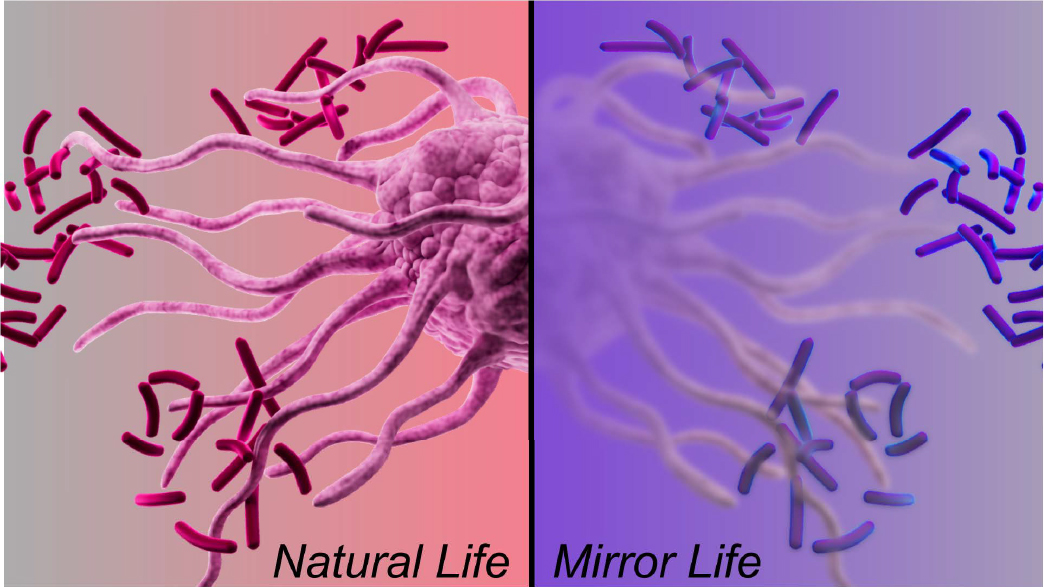
NOTE: A schematic of interactions between bacteria and a macrophage, which is a component of the innate immune system. The left side illustrates interactions with natural chirality bacterial cells, where a macrophage recognizes the bacteria as foreign bodies to engulf, digest, and present antigens to trigger an adaptive immune response. The right side illustrates interactions between a natural-chirality macrophage and self-replicating mirror bacteria. The exact interactions between mirror bacteria and a natural macrophage are not known. While a macrophage may identify mirror cells as foreign bodies, it is not clear to what degree it will be able to engulf the mirror bacteria, digest the mirror components, and present the mirror antigens.
SOURCE: Presented by Dr. Harshini Mukundan on September 29, 2025; created from Iwasa, J. and Torrez, R. University of Utah Animation Lab. 2025. Creation of the macrophage and bacteria in Autodesk Maya (2025.3.1) Creative Commons Attribution-NonCommercial-ShareAlike 3.0 Unported License.


