Advanced Driver Assistance Systems (ADAS) Education and Outreach (2025)
Chapter: 2 Review and Document Current State of ADAS Education and Training
CHAPTER 2
Review and Document Current State of ADAS Education and Training
The research team completed four separate, concurrent tasks to review and document the current state of education and training for ADAS:
- Forming a subject matter expert (SME) panel
- Reviewing and documenting scientific literature that investigated various methods and outcomes of delivering ADAS education and training
- Documenting ongoing activities within SDOs related to ADAS education and training
- Identifying and reviewing ADAS educational and training materials from a wide variety of sources.
2.1 ADAS Selection
The team broadly considered materials that provided information about ADAS without classifying whether the materials were “education” or “training.” These terms are often used interchangeably in scientific literature (Hager & Laurent 1990) and could be considered to represent anchor points on a continuum of learning objectives or aims. Generally, education fosters further development and learning (via intrinsic motivators) whereas training typically has as its objective that learners achieve a specific level of competence or skill (Hermann et al. 1976). The ADAS materials identified from various organizations were considered educational material because they are more general in nature, whereas most of the materials used in research studies identified during the literature review were considered training as they instructed research participants to obtain an expected competence of ADAS use.
Today’s passenger and commercial motor vehicles offer a variety of ADAS, both as standard and optional equipment. After consulting Clearing the Confusion: Common Naming for Advanced Driver Assistance Systems (AAA et al. 2022), created by a coalition of the nation’s leading automotive safety experts, the team decided the review activities would focus on ADAS that warn drivers of potential collisions, provide collision-avoidance (intervention) maneuvers, or provide driving control assistance while the vehicle is moving forward on the roadway. Systems that provide in-vehicle information (like tire pressure monitoring systems), help with parking (e.g., parking assist) or reversing (e.g., rear cross-traffic alert or rear AEB), offer post-collision support (e.g., OnStar), or perform other functions (such as automatic high beams) were excluded. The ADAS and their respective acronyms as shown in Table 1 will be used throughout the report.
| ADAS role | ADAS common name | Description from Clearing the Confusion (AAA et al. 2022) |
|---|---|---|
| Collision warning | Blind spot warning | Detects vehicles in the blind spot while driving and notifies the driver to their presence. Some systems provide an additional warning if the driver activates the turn signal. |
| FCW | Detects a potential collision with a vehicle ahead and alerts the driver. Some systems also provide alerts for pedestrians or other objects. | |
| Lane departure warning (LDW) | Monitors vehicle’s position within the driving lane and alerts driver as the vehicle approaches or crosses lane markers. | |
| Collision intervention | AEB | Detects potential collisions with a vehicle ahead, provides FCW, and automatically brakes to avoid a collision or lessen the severity of impact. Some systems also detect pedestrians or other objects. |
| Automatic emergency steering (AES) | Detects potential collisions with a vehicle ahead and automatically steers to avoid or lessen the severity of impact. Some systems also detect pedestrians or other objects. | |
| LKA | Provides steering support to assist the driver in keeping the vehicle in the lane. The system reacts only when the vehicle approaches or crosses a lane line or road edge. | |
| Driving control assistance | ACC | Cruise control that also assists with acceleration and/or braking to maintain a driver-selected gap to the vehicle in front. Some systems can come to a stop and continue while others cannot. |
| Lane centering assistance (LCA) | Provides steering support to assist the driver in continuously maintaining the vehicle at or near the center of the lane. | |
| Active driving assistance (ADA) | Simultaneous use of LCA and ACC features. The driver must constantly supervise this support feature and maintain responsibility for driving. |
2.2 SME Panel
In collaboration with the BTSCRP-26 project panel, the research team identified individuals with pertinent expertise, insight, and networks from a diverse set of stakeholder groups and invited them to serve as subject matter experts.
The panel included 22 representatives from a variety of sectors:
- standards development organizations,
- driving safety research, policy, education,
- advocacy, rehabilitation, and improvement programs,
- federal agencies and state Departments of Transportation (DOTs) or highway safety offices, and
- disadvantage business enterprises.
A full list of the SME panel can be found in Appendix A.
The experts supported the team by volunteering their time to consult, advise, and provide materials and feedback. During Phase I, the team twice convened virtual meetings with the panel and invited the panel to complete an online survey. During an initial kickoff meeting, the team introduced the project to the panel and requested that they share any ADAS education materials with which they were familiar. Near the end of Phase I, the research team solicited the SME panel’s input about populations who might benefit from ADAS education and training and specific ADAS technologies that should be included in educational materials. Near the end of Phase II, the team provided the SME panel with a summary of the Practitioner Guide contents, highlighting the Process for Providing ADAS Education and Training, and invited them to complete a brief survey and provide targeted feedback.
2.3 Review of Scientific Literature
The scoping literature review synthesized the current state of the literature pertaining to ADAS training, characterized ADAS training and delivery approaches, and detailed the efficacy and effectiveness of ADAS training. The research team devised the search strategy using Population, Intervention, Comparison, Outcomes, and Study design (PICOS) eligibility criteria (Higgins et al. 2019; see Table 2). Key terms, devised by the research team, were used in isolation and in various combinations for the preliminary search in Google Scholar. The different combinations were revised and used to search four different databases: Google Scholar, TRID, EBSCO, and IEEE Explore (see Appendix B).
Table 2. PICOS eligibility criteria.
| PICOS | Eligibility criteria |
|---|---|
| Population | Papers focused on drivers involved in surface transportation. |
| Interventions and context | ADAS education or training must be provided to the participants. |
| Concept | Papers that trained drivers in any ADAS were included. |
| Comparators | N/A (no papers were included or excluded based on comparison or control groups). |
| Outcomes | N/A (no papers were included or excluded based on which outcomes were evaluated). |
| Types of evidence sources | English language, no publication date limit, primary research literature, conference papers, dissertations, theses, reports, trade publications. |
| Study design | Studies include experimental designs, that is, randomized control trials (RCTs), quasi-experimental studies, reviews, and meta-analyses addressing the implementation, feedback, efficacy, or effectiveness of ADAS training or education. |
The first group of search terms included keywords related to training and education (e.g., train*). The second group of search terms detailed potential outcomes of training and education (e.g., understand*). The third group focused on terms commonly used to represent ADAS (e.g., ADA). The researchers used an iterative approach for the fourth group of search terms, which included keywords that were similar to keywords from the first three groups but were not relevant to the scoping review and thus used to exclude papers (e.g., ADAS-COG, machine learning techniques).
To support inter-reviewer agreement, two researchers each screened 20 titles and abstracts and met to review the results prior to completing the title and abstract screening. The same two researchers then screened the remaining study titles and abstracts to determine whether the paper met or could possibly meet the inclusion criteria. The full text of the selected papers was then reviewed by two researchers. A backward
citation search was conducted (i.e., reviewing references cited in the collected papers) in all full-text sources that progressed to the data extraction stage of the review.
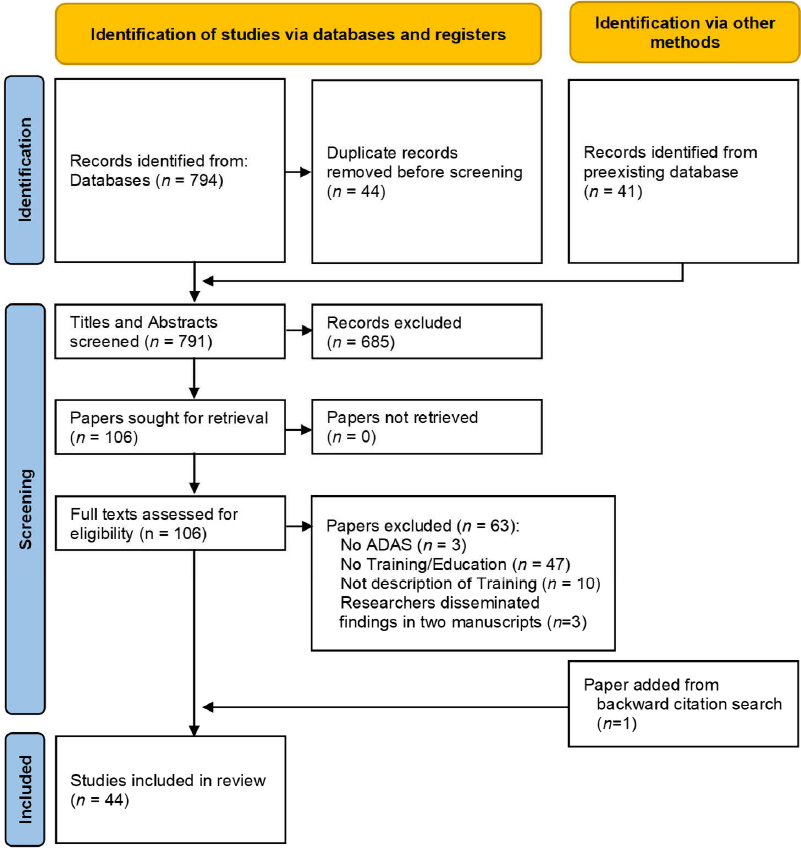
Researchers uploaded a total of 835 publications from Web of Science (n=266), TRID (n=26), EBSCO (n=388), IEEE (n=114), and citations from a preexisting database (n=41) to Covidence.org, a screening tool for conducting scoping reviews. The citations in the preexisting database were aggregated when the research team wrote the proposal for this project. After removing 44 duplicates, the team reviewed 791 papers during the title and abstract screening (see Figure 2 for Preferred Reporting Items for Systematic reviews and Meta-Analyses (PRISMA) flow diagram). During this step, researchers deemed 685 papers to be irrelevant (i.e., did not meet the PICOS eligibility criteria), yielding 106 publications for full-text review. During the full-text review, researchers excluded 63 papers and added one paper via a backward citation search, resulting in the inclusion of 44 papers for this scoping literature review. There were three instances where two journal articles were published from a single experiment. For each pair of articles, researchers combined the outcomes of the experiment to eliminate redundancy and overreporting of the characteristics of interest.
The research team developed a data extraction tool to capture the key characteristics for each of the full-text sources that were included in the scoping literature review. The team used the tool to document the ADAS used in the study, the sample size, and the age of participants in the study, as well as the objectives, the main outcomes (i.e., use of ADAS), the content type, and the delivery mode(s) (e.g., text-based) for the ADAS education or training. Appendix C lists the key study characteristics extracted from literature.
The research team categorized the information provided in ADAS training and education into six types of content, as shown in Table 3. Only 20% of the studies made their training available in the appendix or as a hyperlink. For the other 80%, the research team categorized the content type based on the description of the training provided in the paper.
Table 3. Content types provided in ADAS training and education.
| Content Type | Definition |
|---|---|
| Purpose | What the ADAS does and why someone might choose to use it |
| Function | How the ADAS operates, including what sensors it uses, how it communicates the operational state to the user, and how it provides vehicle control (if applicable) |
| ODD | The prerequisite conditions and context for the ADAS to become available and the requirements for it to continue to be available |
| Limitations | Situations within the ADAS’s ODD that can negatively impact system performance |
| Procedures | What actions the user needs to perform to activate, engage, or disengage the ADAS |
| Responsibility | The actions or duties the user is expected to perform while the ADAS is in use; may include language such as, “The driver is required to,” “the driver must,” “the driver is responsible for,” etc. |
2.3.1 ADAS and Content Types
The studies included in the review covered a range of ADAS and provided various combinations of content in their ADAS training. Nineteen different studies included conditional automated driving (CAD), which is a system that actively performs driving tasks while the driver remains available to take over. If the system can no longer operate, the driver will be prompted to resume all aspects of the driving task. These systems are not currently available in vehicles on the U.S. market. While the team determined that CAD was beyond the scope of this project, they did include studies that trained drivers to use CAD in the literature review to better understand the efficacy and characteristics of ADAS training.
Two studies trained drivers to use ADAS but did not specify the information provided during training. A few studies contained ambiguous descriptions of their ADAS training (e.g., “proper use”) and could not be categorized because multiple types of content could promote “proper use” of ADAS. The descriptions of training material in the literature also described system “functionalities” and “capabilities,” which the team classified under “Function.” Table 4 shows training content types grouped by ADAS.
Over half the studies included content about ADAS functions (81%), procedures (59%), and limitations (53%) in the training materials, whereas less than half included purpose (36%), ODD (29%), and responsibilities (28%).
In 43% of the studies, drivers were trained to use CAD, which was described as the driver being able to disengage from the driving task when the system operated within its ODD. In four of the 19 studies with a CAD system, the comparison group drove with ADA (i.e., the combined use of ACC with LCA) to explore differences in drivers’ understanding of the use of similar system functions that have different ODDs. Among CAD and ADA trainings, the majority focused on system functions but not the ODD. Researchers often exposed the driver to a system malfunction, requiring the driver to complete an unexpected takeover, which is not likely to occur once these systems are deployed on the road. While driving with CAD, a takeover request will be provided to the driver, prior to exiting the ODD, allowing the driver time to resume control of the vehicle.
Table 4. ADAS training content found in the literature.
| ADAS | n | Purpose n (%) |
Function n (%) |
ODD n (%) |
Limitations n (%) |
Procedures n (%) |
Responsibilities n (%) |
|---|---|---|---|---|---|---|---|
| BSW | 2 | 1 (50) | 1 (50) | 0 (0) | 1 (50) | 1 (50) | 0 (0) |
| FCW | 2 | 0 (0) | 2 (100) | 1 (50) | 1 (50) | 1 (50) | 0 (0) |
| LDW | 3 | 0 (0) | 3 (100) | 0 (0) | 1 (50) | 2 (67) | 0 (0) |
| AEB | 2 | 0 (0) | 2 (100) | 0 (0) | 1 (50) | 1 (50) | 0 (0) |
| AES | 1 | 1 (100) | 1 (100) | 1 (100) | 1 (100) | 1 (100) | 0 (0) |
| LKA | 4 | 2 (50) | 3 (75) | 1 (25) | 2 (50) | 2 (50) | 1 (25) |
| ACC | 13 | 6 (46) | 11 (85) | 4 (31) | 7 (54) | 9 (69) | 2 (15) |
| LCA | 0 | - | - | - | - | - | - |
| ADA | 12 | 8 (73) | 9 (82) | 3 (27) | 8 (73) | 4 (36) | 5 (45) |
| CAD | 19 | 3 (16) | 15 (79) | 7 (37) | 9 (47) | 14 (74) | 8 (42) |
| Total | 58 | 21 (36) | 47 (81) | 17 (29) | 31 (53) | 34 (59) | 16 (28) |
Note: Some studies trained drivers to use more than one ADAS. The – indicates not observed.
Informing drivers of the ODD promotes driver understanding and use, especially among driving control assistance systems. To aid information retention and retrieval, training may include a mnemonic device such as an acronym. For instance, Shaw and colleagues (2020) developed a knowledge-based ADAS training intervention that utilized a Check, Assess, and Takeover (CHAT) procedure. The CHAT procedure was developed for a CAD system to improve driver situational awareness (visual attention and situation monitoring) and prepare the driver to take over when the system leaves its ODD.
Participants experienced ADAS via a driving simulator (52%), on-road driving (27%), or video scenarios (14%). A few studies were online experiments (5%) or training application development projects (2%) that did not include any exposure to ADAS. For driving simulator studies where training efficacy was not evaluated, the ADAS training served to, for example, provide participants with the bare essential knowledge needed to interact with the car (and ADAS). This training provided the lowest level of interaction: in fact, the localization of the autonomous driving button was the only active part” (Sportillo et al. 2018). In this instance, researchers observed naïve driving behavior and interactions with ADAS.
2.3.2 Delivery Mode
The studies included 101 training groups, with eight of these groups not receiving any training (i.e., a control group). Of the comparison groups, participants were most commonly provided with a mock owner’s manual that contained text and graphics. Training materials most often included text (49%), followed by
graphics (39%), demonstration (33%), video (24%), and verbal instruction (12%). Researchers often used multimedia or a combination of these delivery methods to strengthen the effect of ADAS training. Given that there are different learning styles (e.g., visual learners), using different delivery methods may enhance the efficacy of training heterogeneous audiences. This can, however, lead to cumbersome training material, increased effort while developing training material, and more difficulty assessing the effect of training content.
Seventeen studies demonstrated ADAS to the driver in a driving simulator and allowed the driver to become familiar with using the system while driving. In some cases, researchers gave drivers reading material (e.g., mock owner’s manual) about the system followed by a demonstration in a driving simulator (6 of 101) or on the road (3 of 101). They also used videos to describe content typically provided in the owner’s manual, with the hopes that this delivery method would be more engaging. Two of the training groups received a video that described content from the owner’s manual followed by a demonstration in a driving simulator or on the road. Providing the drivers with knowledge-based training (e.g., owner’s manual) followed by skill-based training (driving simulator or on-road) and feedback may support drivers’ understanding and use of ADAS. A similar approach could be performed at the dealership, where consumers would have the opportunity to learn prior to using ADAS and could receive feedback during a test drive. Only a few studies explicitly stated whether participants could ask questions during or after completing training. Asking participants follow-up questions is one of the best methods to reinforce learning through retrieval practice (Agarwal & Bain 2019). The ability to ask questions and receive feedback may have an influence on the drivers’ confidence in their understanding and may improve the strength of their mental model or interaction with the system.
2.3.3 Populations
With only a few exceptions, the study samples consisted of licensed drivers ranging from 25 to 55 years of age. None of the studies focused on commercial vehicle drivers, professional drivers, or special driving populations (e.g., drivers with Parkinson’s disease). A few driving populations were targeted by researchers, due to the potential safety benefits of ADAS, specifically for those with a higher risk of being involved in a fatal crash. Four of the 44 studies compared younger and older drivers (Zhou et al. 2021; Zheng et al. 2023) or focused on training only older drivers (Zahabi et al. 2020) or only younger drivers (Panou et al. 2010). Although the four studies that trained younger and older drivers had small sample sizes, the study findings support the use of ADAS training among younger and older drivers. They demonstrated improvements in usage, perceptions, and understanding of ADAS. Other researchers (Pai et al. 2021) focused on drivers (21-55 years of age) that did not have prior experience with ADAS and found that all three of their training groups expressed increased trust and willingness to use ACC. There were no differences between the training groups, which may suggest that training may be particularly beneficial for drivers new to ACC. Based on recommendations from Forster et al. (2019A), providing training to drivers who have not interacted with ADAS may foster mental model development, improve use of ADAS, and mitigate the risk inherent to trial-and-error learning. These recommendations suggest providing training to new ADAS users prior to them driving on the road with ADAS.
2.3.4 Efficacy or Effectiveness of ADAS Education and Training
Distinguishing between efficacy and effectiveness contributes an important aspect to analyzing any body of evidence (Gartlehner et al. 2006). Researchers and policymakers often distinguish between the efficacy and the effectiveness of an intervention. Efficacy (explanatory) trials determine whether an intervention produces the expected result under ideal circumstances. Effectiveness (pragmatic) trials measure the degree of beneficial effect under “real world” clinical settings (Godwin et al. 2003). Efficacy and effectiveness exist on a continuum (Gartlehner et al. 2006). This continuum aligns with a three-stage framework for
developing and disseminating treatments (i.e., ADAS training; Rounsaville et al. 2001). Stage 1 involves addressing feasibility issues and pilot testing the training (e.g., Mersinger et al. 2023), Stage 2 involves randomized control trials (RCTs) to determine whether the treatment is efficacious, and Stage 3 addresses the transportability of efficacious treatments to clinical settings (i.e., generalizability). The current literature assesses the preliminary efficacy of different training approaches rather than effectiveness.
An outcome measure (i.e., dependent variable) is required to assess the efficacy or effectiveness of ADAS training. Researchers assessed outcome variables to determine the efficacy of training, including to calibrate their (a) mental model, (b) use, (c) trust, and/or (d) perceptions of ADAS (see Table 5 for the operationalization of these variables). They categorized the studies based on the outcomes measured in the study. Trust was often detailed as the rationale for training the driver about ADAS and used as an outcome variable, so the team separated it from other perceptions (i.e., perceived usefulness, acceptance, ease of use) that drivers have of ADAS. Use of ADAS was the most frequently recorded outcome variable in the literature, followed by mental models, trust, and perceptions of ADAS. Use of ADAS contained four subcategories: (a) the proportion of time/distance the driver used ADAS during the driving scenario; (b) driving performance (e.g., lateral or longitudinal lane control) while using ADAS; (c) visual attention (i.e., glance behavior) while driving with ADAS; and (d) mental workload while driving with ADAS. A majority (67%) of the studies measured variables that fit two or more study outcomes. All studies reported outcomes that occurred after drivers completed training, but only four of the studies used a pretest–post test design. While there are limitations to using a pretest–post test design, the baseline measurement allows for within-subject comparisons to better understand the effects of training. Lastly, driver mental models, trust, and perceptions were often measured after training and driving with ADAS, making it unclear to what extent the effect was from training, use of the system, or a synergistic effect of providing both training and opportunity to use the system.
Table 5. Operationalization of study outcomes for literature review.
| Study Outcomes | Operationalization | Studies n (%) |
|---|---|---|
| Mental model | Understanding, knowledge, or comprehension were assessed after training | 23 (52%) |
| Use | Use of ADAS was assessed after training. Use included four subcategories: (a) proportion of the drive for which ADAS was used; (b) driving performance (e.g., lane position, time to collision) while using ADAS; (c) visual attention (i.e., glance behavior) while driving with ADAS; and (d) mental workload while driving with ADAS | 29 (66%) |
| Trust | Trust in ADAS was assessed after training | 21 (48%) |
| Perceptions | Perceptions other than trust, such as perceived usefulness, acceptance, and ease of use, were measured after training | 22 (50%) |
Note: Both perceptions and attitudes of ADAS were binned into the category Perceptions. See Pickens (2005) for a detailed comparison of perceptions and attitudes.
During the development of training and educational material, practitioners and researchers may use an iterative design approach to refine training by integrating feedback from their target audience or observing outcome variables after deploying an iteration of training (e.g., Victor et al. 2018). Ten studies collected participant feedback pertaining to the ADAS training. Two of the 10 studies integrated participant feedback and provided several iterations of training (Mersinger et al. 2023; Rukonić et al. 2022). Although this development process can be time intensive, it is important to integrate feedback from the target audience to ensure the training provides its intended effect.
Although not often stated, the ADAS training in most driving simulator studies is relevant to the implementation of ADAS in the driving simulator and may not transfer to on-road systems. For instance, in their ACC training, Carney et al. (2022) informed study participants, “The information presented here outlines the ACC you will be using in the simulator today. Please know this may not reflect ACC systems in the “real” world.” Researchers often do not detail the implementation of ADAS (i.e., ODD, functions, procedural requirements) in driving simulator studies, making it unclear whether the training would transfer from the simulator to using ADAS on the road.
2.3.5 Summary
Based on the current state of the literature, it is unclear when to provide ADAS training (i.e., before, during, or after initial use; after becoming familiarized with the vehicle; or after experiencing edge case scenarios); how long (i.e., duration) or how often (i.e., frequency) to provide it; the effect of providing feedback and answering questions from the participant; or how to organize the training content. The literature review findings revealed significant gaps in training certain driving populations. There were no experiments that tested the effects of ADAS training for novice drivers, commercial vehicle drivers, professional drivers, drivers who often drive for their occupation (e.g., police officers, emergency medical responders), fleet/safety managers, and operators of fleet vehicles.
It is difficult to draw conclusions from the literature due to differences in study design (e.g., pretest–post test design), selection of comparison groups, content of the training material, level of detail provided in the training, and the measurements used to assess study outcomes. Unfortunately, there is no validated mental model assessment. The lack of validated measurement tools makes it difficult to ensure the study results are reliable or valid.
The conceptualization, development, and evaluation of ADAS education or training is informed by practical (e.g., feasibility) and theoretical considerations (e.g., frameworks or conceptual models). Practical considerations should include an overlap between the training protocol and training objectives, consider the intended audience (e.g., driving experience, training preferences), and be feasible to implement based on the availability of resources and environmental demands (Zahabi et al. 2020). Practical considerations can also impact the research methods and study design.
2.4 Review of Standards Development Activities
This task is aimed at documenting ongoing activities within SDOs related to ADAS education and training. Researchers primarily identified relevant SDOs, standards documents, and working parties through web searches. They also provided BTSCRP-26 and SME panel members with information about standards development activities and consulted SME panel members who were involved in standards development activities. As they performed this task, the research team identified and reviewed several information sources that provided guidance (e.g., guidelines, recommended practices) but were not strictly labeled as standards.
Researchers identified SDOs from the U.S. Department of Transportation’s Intelligent Transportation Systems (ITS) Joint Program Office website. These included SAE International, International Organization for Standardization (ISO), American National Standards Institute (ANSI), American Association of State Highway and Transportation Officials, American Public Transportation Association, National Electrical Manufacturers Association, ASTM International, IEEE, and Institute of Transportation Engineers. Other agencies and organizations identified as definitively or potentially being involved in standards development activities included the United Nations Economic Commission for Europe (UNECE) World Forum for Harmonization of Vehicle Regulations (WP.29), National Highway Traffic Safety Administration (NHTSA), Federal Transit Administration, Federal Motor Carrier Safety Administration (FMCSA), Transport Canada, the European New Car Assessment Programme (Euro NCAP), American Association
of Motor Vehicle Administrators (AAMVA), and Association of National Stakeholders in Traffic Safety Education (ANSTSE).
The rest of this section describes the relevant findings from the review of the standards development activities.
2.4.1 SAE International
SAE International has published several standards related to operating characteristics and user interfaces for numerous ADAS (e.g., LKA, LDW, lane change decision aid systems, forward vehicle collision mitigation systems). After first performing a keyword search of the SAE standards, the research team examined the standards drafted by SAE’s ADAS Committee. They found no standards that directly addressed the education or training of ADAS users or other populations and two standards that indirectly mentioned training or education. SAE Standard J2399_202110: Adaptive Cruise Control (ACC) Operating Characteristics and User Interface noted that, at a minimum, drivers shall be informed in the vehicle operator’s instructions or manual (1) if the ACC system does not respond to stationary vehicles, (2) of the system performance capabilities and limitations with respect to longitudinal deceleration, and (3) that the system may not be able to track a forward vehicle through a curve. SAE Standard J3016_202104: Taxonomy and Definitions for Terms Related to Driving Automation Systems for On-Road Motor Vehicles mentioned that, “An ADS feature’s capabilities and limitations are expected to be communicated to prospective users through various means, such as in an owner’s manual, which explains the feature in more detail, such as how it should and should not be used, what limitations exist (if any), and what to do (if anything) in the event of a DDT performance-relevant system failure in the driving automation system or vehicle.”
2.4.2 International Organization for Standardization
A researcher searched the ISO website for standards published by the Intelligent Transport Systems Technical Committee and identified more than a dozen ISO standards related to ADAS. The researcher reviewed the outline of each identified standard (i.e., headings at all levels) and found three standards that refer to manuals. ISO Standard 23375:2023: Intelligent transport systems — Collision evasive lateral manoeuvre systems (CELM) —Requirements and test procedures called for providing a general description of the system functionalities and limitations in the user’s manual. ISO Standard 19638:2018: Intelligent transport systems — Road boundary departure prevention systems (RBDPS) —Performance requirements and test procedures recommended that the driver should be informed through the owner’s manual of the conditions that result in system activation and deactivation, and that operation of the system may be affected by numerous environmental characteristics. In addition, ISO Standard 15623:2013: Intelligent transport systems — Forward vehicle collision warning systems (FCVWS) — Performance requirements and test procedures specified, “System users should be made aware of the system limitations … using appropriate means such as owner’s manual and/or caution label.” Several other ISO standards included requirements to inform drivers of certain types of information related to system performance or limitations, but these requirements were typically organized under headings referring to driver controls and human interface or system functionality.
2.4.3 IEEE
The team also reviewed standards published by the IEEE Vehicular Technology Society. 7001-2021 - IEEE Standard for Transparency of Autonomous Systems defines different levels of users and different levels of transparency requirements for those users, as well as for the general public and bystanders. The standard notes that domain expert users include the “owner-drivers of autonomous vehicles, as they too are
responsible for the autonomous vehicle while its driver assist functions are engaged.” Transparency requirements address different types of information (e.g., expected system behavior, general principles of its operation, degraded modes of operation, sources of bias, learning processes) as well as explanations of recent system activity, documentation, and training materials.
2.4.4 American Society of Safety Professionals
In collaboration with ANSI, the ASSP published technical report Z15.3: Management Practices for the Safe Operation of Partially and Fully Automated Motor Vehicles. Though the document was behind a paywall, an article and a preview document on the ASSP website stated the report included ADAS and addressed topics to be included in driver training, including what driving automation systems can and cannot do, the operational range of each system, how to operate each system, and identifying the modes of system operation.
2.4.5 UNECE World Forum for Harmonization of Vehicle Regulations
The Working Party on Automated/Autonomous and Connected Vehicles (GRVA) is a body within the UNECE World Forum for Harmonization of Vehicle Regulations (WP.29). The GRVA has proposed regulation that will be submitted to WP.29 for adoption in June 2024. Titled Uniform provisions concerning the approval of vehicles with regard to Driver Control Assistance Systems (DCAS), the regulation “stipulates the requirements to the educational materials, messages and signals that the manufacturers of DCAS will need to present to the driver.” It also requires that “the manufacturer shall provide clear and easily accessible information (e.g. documentation, video, website materials) free of charge regarding system operation on the specific vehicle type,” and this information to drivers will be provided via means beyond the user manual. The regulation goes on to list the topics the driver information must cover, including
- reminder of the driver’s responsibilities and appropriate use of the system;
- explaining how and to what extent the systems and its features assist the driver;
- system boundaries, capabilities, and limitations; and
- how to use the human-machine interface to activate and deactivate the system and determine system state.
The research team examined UNECE regulations for several other ADAS features but found no others that consider ADAS education and training.
In 2022, the UNECE World Forum for Harmonization of Vehicle Regulations (WP.29) issued a Framework Document for Automated/Autonomous Vehicles. Its stated purpose is to provide guidance to WP.29’s working parties. The framework lists Consumer Education and Training as an issue considered but not selected as a priority.
2.4.6 National Highway Traffic Safety Administration
A researcher searched NHTSA’s Federal Motor Vehicle Safety Standards for over a dozen ADAS-related key words and found no results. In the summer of 2023, NHTSA issued two notices of proposed rulemaking (NPRM) that would require AEB on both light and heavy vehicles. NHTSA issued the latter in conjunction with the FMCSA. The researcher searched the NPRMs for discussion of key words related to driver or consumer education or training and found no related content. The research team confirmed that the final rule for AEB on light vehicles, which went into effect on July 8, 2024, does not instruct vehicle manufacturers or other parties to provide training or education.
NHTSA also administers the New Car Assessment Program (NCAP). In 2022 the agency sought comments in the Federal Register for ADAS-related updates to the NCAP program, including the addition of four ADAS and the development of a new rating system for ADAS features. While the request for
comments discusses the importance of increasing consumer awareness and understanding of ADAS technologies, doing so was only addressed within the context of the potential new ADAS rating system. In March 2024, the Government Accountability Office (GAO) issued a report to Congress describing its review of NHTSA’s administration of driver assistance technologies. GAO made numerous recommendations, including “that NHTSA finalize its NCAP roadmap, communicate progress on meeting time frames to update NCAP, and provide information to consumers on the limitations of partial driving automation systems on its website.”
2.4.7 Transport Canada
In 2020, Transport Canada sought public comment about potentially updating the regulations to require AEB for a variety of vehicles and about whether to regulate advanced driver assistance features. Though the Transport Canada website includes resources with frameworks and guidelines for connected and automated vehicles (CAV) and automated driving systems (ADS), researchers identified no other standards-related content dedicated to ADAS.
Similar to NHTSA, Transport Canada administers the Canada Motor Vehicle Safety Standard. The team searched CMVSS as well as the Motor Vehicle Safety Regulations (Consolidated Regulations of Canada, chapter 1038) for ADAS-related key words with no positive results.
2.4.8 European Union
In the summer of 2022, updates to the European Union’s Vehicle General Safety Regulation 2019/2144 went into effect. The regulation requires all road vehicles (i.e., cars, vans, trucks, and buses) to be equipped with several advanced technologies. In addition, cars and vans must be equipped with automated braking and lane keeping systems. The research team searched for the text of the regulation for key words associated with consumer education materials and found no results.
2.4.9 Euro NCAP
Though initially modeled after NCAP in the U.S., Euro NCAP is significantly advanced with respect to evaluating ADAS features. Euro NCAP includes evaluation of numerous ADAS features in passenger vehicles, including highway assist and safety assist, with additional tests introduced as recently as 2023. In addition, Euro NCAP is expanding their evaluation of safety technologies in heavy trucks. However, like NCAP in the U.S., standards or ratings for ADAS education seems to be outside the scope of Euro NCAP.
2.4.10 Insurance Institute for Highway Safety
The team reviewed the IIHS website and found that the organization has provided comments and recommendations to the federal government with respect to several advanced vehicle technologies and participated in securing agreement from vehicle manufacturers to voluntarily make AEB standard in new vehicles. IIHS has also implemented a ratings program to evaluate partial driving automation systems. However, the team found no standards, recommendations, or ratings related to ADAS education and training.
2.4.11 Driver Education Standards
While conducting the search for educational materials, the research team identified two sets of standards for driver education. The Novice Teen Driver Education and Training Administrative Standards (NTDETAS) published in 2017 included standards related to ADAS safety features. The standards were
updated in 2023 to include instruction for students “about the use of safety features, the safety benefits, concerns, abilities, and limitations, and how to ADAS for the safety for the vehicle occupants and other road users of the transportation system” (Introduction, p. 63). Classroom Standard Twelve is titled “Understanding Advanced Driver Assistance System (ADAS) Safety Features” and has five components. One component of In-Car Standard Five specifies that students are to be assessed on vehicle safety technology.
The other standard was produced by the Driving School Association of the Americas (DSAA). The 2017 revision of the DSAA Curriculum Content Standards included the addition of Vehicle Technology Systems and Automated Vehicle Systems, and additional updates were made in 2022 (which were appended to the 2023 version of NTDETAS). Classroom Instruction Standard 11 is titled, “Understanding Vehicle Safety Technology Systems.” In addition, mention of vehicle safety technology is distributed through the classroom standards (i.e., 1.1.2.C., 2.1.1.A., 2.1.1.G., 8.1.1.A., 9.1.1.A., and 9.1.5.D.). In-vehicle Instruction Standard 11 addresses Vehicle Safety Technologies.
Though not titled as a standard, the 2017 Model Training Curriculum for the Teaching Task Instructor Preparation Program, produced by ANSTSE in cooperation with NHTSA, specifies that those learning to be driver educators should be instructed about “the role and use of on-board technologies.” “Automatic driving assistance systems” are included in the on-board technologies listed in the curriculum.
Finally, in May 2024, the Automated Vehicles Study Group (S.18) of the American Trucking Associations’ TMC issued a call for experts to join a task force to draft a RP on Optimization of Driver Training for ADAS. At the time of this final report (July 2025), the proposed RP is in the ballot process for voting later this year. If adopted, the RP is expected to be published in the 2026-2027 TMC Manual of Recommended Maintenance Practices.
2.4.12 American Association of Motor Vehicle Administrators
The AAMVA has been providing guidance regarding the testing and deployment of vehicles equipped with driving automation systems, which in their definition include ADAS, since 2018. The organization published the 4th edition of Guidelines for Regulating Vehicles with Automated Driving Systems in March 2024. Among other topics, it provides considerations for training drivers, driver educators, motor vehicle agency examiners, law enforcement, and first responders. In 2019, AAMVA published Guidelines for Testing Drivers in Vehicles with Advanced Driver Assistance Systems. Other agencies (e.g., Austroads in Australia and the Canadian Council of Motor Transport Administrators) have developed guidance for their jurisdictions based on AAMVA’s 2019 guidelines.
2.4.13 Calls for Standardization of ADAS Terminology
As the team reviewed and documented materials, research, and standards related to ADAS education and training, they noted several different organizations have advocated for the standardization of terminology related to ADAS.
Most notably, as mentioned previously in this interim report, six organizations (AAA, Consumer Reports, J.D. Power, National Safety Council, PAVE, and SAE International) have collaborated to recommend common naming for ADAS. Titled Clearing the Confusion, the recommendations were last updated in 2022. SAE standard J3265_202211: Naming Methodology for Driving Automation Systems notes that “Names and accompanying descriptions of driving automation systems are important because they may be the first piece of information users have about a new feature and may be used by users to infer the purpose, function, and capabilities of the feature. Research has demonstrated that the names given to vehicle technologies influence understanding of their capabilities and limitations.” In December 2023, SAE issued standard J3262_202312: Active Safety Systems Sensor Calibration Terms and Definitions. Though the primary audience of the SAE standard seems to be automative technicians, in a statement provided to
Repairer Driven News, Christian Thiele, SAE director of global ground vehicle standards, said the standard might also benefit consumers by helping them better understand ADAS technologies.
These concerns are not limited to only passenger vehicles. In 2022, the TMC issued RP 547: Guidelines for Advanced Driver Assistance System (ADAS) Nomenclature. It aims to “help [commercial trucking] fleet personnel identify, and cross-reference terminology associated with various technologies and their functions.”
2.4.14 Summary
This search yielded only three titled standards or regulations directly related to ADAS education and training. Two are driver education standards in North America, and one is a proposed UNECE regulation for DCAS that includes requirements for driver information materials. There are numerous ADAS-related standards for system performance requirements, test procedures, operating characteristics, and user interfaces; however, they do not mention education or training, outside of a few references to the owner’s manual. Findings indicate few commercial motor vehicle standards and transit standards. Though NHTSA recently issued its final rule that requires new vehicles in the U.S. to be equipped with AEB by 2029 and intends to include more ADAS features in NCAP, the notices published in the Federal Register do not address consumer education and training. AAMVA has produced extensive guidance regarding ADAS for motor vehicle administrators, which has also been adopted by Australia and Canada, and includes training considerations for several unique populations. One theme that emerged across different sectors and organizations was the call for a standardized nomenclature for ADAS. Finally, the team observed that some organizations consider ADAS to fall under the purview of ADS or CAV, or within more generic categories like “vehicle safety technology.” As a result, additional relevant standards might exist but were not identified in the search.
2.5 Review of Educational Materials
The task aimed to document educational content related to ADAS in passenger and commercial vehicles from a variety of sources. To this end, the research team conducted a target search of sources that included, but were not limited to, driver education programs, online resources, passenger vehicle dealerships, passenger vehicle rental companies, insurance companies, SDOs, driving safety advocacy and research associations, and driver improvement programs. The team examined each source to identify content that provided information about ADAS technologies, including the intended audience, text, images, videos, and links to other websites or resources. This section discusses identification and extraction for each material source or type.
2.5.1 Identification of Materials
The research team used several methods to identify educational materials that included information about the nine selected ADAS. The methods included Google searches using key words for various organizations, a Google search of ADAS and state agencies, reviewing vehicle owner’s manuals, making dealership phone calls, making direct contact with organizations, and making requests to members of the SME and BTSCRP-26 panels. The team obtained additional materials through links to other sites provided on the target organizations’ websites, one active University of Iowa Driving Safety Research Institute (DSRI) research study, and additional searches on YouTube. Materials that only mentioned ADAS (e.g., listing ADAS as examples of level 0 or 1 automation) were not classified as ADAS educational materials. The research team identified materials from August 2023 through June 2024.
2.5.1.1 Web Search Terms
The research team primarily searched for materials through Google searches using key words (e.g., “ADAS,” “driver assist”) along with the name of the target organization. In some cases, if the organization’s website included a search feature, the researcher used it to conduct a second search. Additional searches were performed on the YouTube channels of two rental car agencies and three insurance companies. Search terms included “ADAS,” “advanced driver assist,” “vehicle technology,” “blind spot,” “forward collision,” and “lane keeping.”
2.5.1.2 Direct Contacts
The research team also attempted to contact these organizations, either directly or through affiliated individuals:
- Vehicle rental companies: Hertz and Enterprise
- Insurance companies: State Farm, Progressive, and GEICO
- Driver education and rehabilitation organizations: ANSTSE, American Driver and Traffic Safety Education Association, Association for Driver Rehabilitation Specialists (ADED), and American Occupational Therapy Association (AOTA)
- Associations for driving safety advocacy and research: Toyota Collaborative Safety Research Center, National Safety Council, American Safety Council, Insurance Institute for Highway Safety (IIHA), AAA, AAA Foundation for Traffic Safety, AARP, AAMVA, and TMC
- National or international transportation agencies and associations: Transport Canada, NCAP, Euro NCAP, Austroads, FMCSA, NHTSA, SAE International, and ISO.
When making contact, the research team gave a brief overview of the project, described what educational materials had been identified (if any), and inquired whether the organization had any (other) ADAS educational and training materials about which they could tell us.
2.5.1.3 State Agencies
Near the end of the review phase, the research team conducted a search to characterize the information about ADAS provided online by state transportation agencies. The team performed a Google search using “DMV DOT Advanced Driver Assistance” and reviewed the first 50 webpages in the search results. The search yielded 10 webpages for previously reviewed organizations, 19 unique state DOT or Department of Motor Vehicles (DMV) webpages, and 15 webpages from a range of other organization types. If the state agency webpage in the search results did not indicate ADAS education, the team searched the entire agency site for “ADAS,” “advanced driver,” and “driver assist.” In all, this approach identified 10 states that provided some information about ADAS in materials related to CAV, automated vehicles (AV) terminology, driver manuals, news bulletins, and research summaries. Only one of these materials included sufficient information to be included in the review of educational materials.
In addition to this web search, the research team directly contacted seven state agency representatives with a connection to this project (i.e., members of the BTSCRP-26 or SME panels) or with whom they have previously worked on other efforts. This communication was used to verify what the team had found as well as to identify if the contacts were aware of any ADAS-related educational materials within their agencies. This yielded a few ADAS-related training courses for specific populations, including driver licensing personnel and law enforcement.
2.5.1.4 Vehicle Owner’s Manuals
The team selected one vehicle owner’s manual for each automotive manufacturer with at least 10% of the U.S. market share in 2022: General Motors, Toyota Motor Corporation, Ford Motor Company, Stellantis
– FCA and Hyundai Kia Auto Group. The five selected manuals represented two sedans, two SUVs, and one minivan. The research team selected the minivan because it had already been reviewed during the website search. The other four models were among the top-selling vehicles for each manufacturer. Because some manufacturers require the entry of a valid vehicle identification number to access an owner’s manual through their websites, the team downloaded owner’s manuals from ownersman.com.
2.5.1.5 Dealership Phone Calls
The research team attempted to contact salespeople at dealerships via phone calls until 10 salespeople were interviewed. They randomly selected locations from a list of all U.S. zip codes and, for each zip code, randomly assigned one of the five passenger vehicle manufacturers (same as the vehicle owner’s manuals) without replacement. They then used Google Maps to find the dealership for that brand situated closest to that zip code and consulted the dealership’s website to identify a phone number for the sales department. They contacted 26 dealerships and asked salespeople to provide responses about training topics, training methods, the frequency of training, and more. The interview script can be found in Appendix D.
2.5.2 Extraction
The team used an iterative process to develop the data extraction methodology, as shown in Figure 3. After identifying a small number of educational materials, the team developed an initial set of characteristics to extract for each information resource and organized them into a preliminary data extraction spreadsheet. Next, one team member extracted initial data from selected resources representing various organization types. The team met multiple times to review and modify the data extraction chart by adding and refining fields.

Next, the team used Research Electronic Data Capture (REDCap), a secure platform for collecting and managing data (Harris et al. 2009), to develop two forms based on the data extraction chart. The REDCap forms could be easily modified, allowing the team to add new fields or categories as needed. The forms streamlined the data entry and collation processes, allowed multiple users to input data simultaneously, produced a unified dataset, and allowed for the efficient creation of descriptive reports.
One REDCap form collected information at the organization level, and the other collected information for each ADAS in the resource. The research team created the forms to ensure that meaningful information from a variety of educational materials could be documented and gathered for use in subsequent tasks (i.e.,
identifying inaccuracies and gaps and capturing observations related to the design of the materials). Each team member extracted data for the same two resources. The team met to discuss and resolve discrepancies in the extracted data, and the REDCap forms were modified. During data extraction, the team met frequently to discuss and clarify questions. When a team member identified a relevant type of information that was not being captured, the team determined how to capture it and modified the applicable form.
The information collected in the organization-level form included organization name and type, how the search was conducted, whether a resource was identified, the title of the resource(s), the audience(s), and the researcher’s observations about the organization of the material and its readability. Appendix E illustrates the organization-level data extraction with a sample record.
The ADAS-level REDCap form included several variables related to how the resource referred to the ADAS. These included the specific name of the ADAS in the resource, whether the ADAS was described using an umbrella term that might also include other ADAS (e.g., collision warning), and identifying the type of ADAS according to the names in Table 1. Next, the reviewer considered what type of information the resource provided about the ADAS and categorized the content into the six types shown in Table 3. Researchers identified the method of delivery (e.g., text, image, animation, video) and the inaccuracies associated with each content type. They also noted whether the resource advised the learner to consult an owner’s manual and attempted to identify the date when the materials were created or last revised.
When the research team identified multiple sources of information that contained similar content from the same organization, they generally extracted information from all of them as a collective using a single organization entry. However, when an organization had multiple resources intended for different audiences or presented on different platforms (e.g., the manufacturer’s website and the owner’s manual selected for that manufacturer), the researchers created multiple entries.
2.5.3 Educational Materials Identified
The search for ADAS educational materials resulted in 72 organization-level entries. The research team identified at least one source of information about ADAS in 44 instances. In 11 of these instances, they combined multiple sources of information that contained similar content from the same organization for extraction. Twenty-eight of the searched organizations did not include ADAS educational materials.
The team found 27 sources of information through web searches. Reviewed resources linked to four additional sources, and direct contacts with agencies and the SME and BTSCRP-26 panels resulted in seven more resources. The researchers selected five owner’s manuals as described above, and the final source was a textbook already in the possession of a team member when the project began.
Six sources of information only provided information about ADAS at a high level and did not include system-specific (e.g., ACC) information. The 38 sources that included ADAS-specific information yielded a total of 228 ADAS-specific entries. During Phase II of the project, the research team created the Resource Identification Tool, a filterable spreadsheet that identified the sources and summarized their ADAS content.
2.5.3.1 Organizations Represented
The 72 entries represented 60 organizations. The research team classified each organization into one or more types. For example, a transport agency might also be an SDO if it is involved in standards development activities. They searched for 10 organizations related to commercial motor vehicles, including one transport agency. The five vehicle manufacturers and six other organizations were the sources of more than one entry. Table 6 represents the types of organizations according to their primary purpose and whether they had ADAS-related content. On average, 61% of the organizations searched included educational materials related to ADAS.
Table 6. Organizations searched for ADAS information by type.
| Organization type | Total reviewed (n) |
ADAS content (n) |
Included ADAS content (%) |
|---|---|---|---|
| Transport agency | 7 | 6 | 86% |
| SDO | 4 | 0 | 0% |
| Vehicle manufacturers | 10 | 10 | 100% |
| Driving safety advocacy & research associations | 15 | 11 | 73% |
| Driver education programs & associations | 7 | 4 | 57% |
| Online resources | 3 | 3 | 100% |
| Insurance companies | 3 | 3 | 100% |
| Vehicle rental companies | 2 | 1 | 50% |
| Driver rehabilitation programs | 2 | 0 | 0% |
| Driver improvement programs | 2 | 1 | 50% |
| Online car retailer | 6 | 3 | 50% |
| Commercial motor vehicle training | 3 | 0 | 0% |
| Commercial motor vehicle industry group | 6 | 0 | 0% |
| Other (law enforcement, coalition of agencies) | 2 | 2 | 100% |
| Total | 72 | 44 | 61% |
2.5.3.2 Material Types
The identification methods yielded a variety of resource types. These included 25 websites, two brochures, a textbook chapter, six videos, six documents, a piece of news media, five vehicle manuals, and eight other resources such as car guides, webinars, self-guided workshops, PowerPoint presentations, and a state’s drivers manual.
2.5.3.3 Age of Materials
The research team was able to identify a date when the materials were created or last revised for 35 (80%) of the 44 sources. Of these, four were dated from 2015-2019, 14 from 2020-2022, and 17 from 2023 or later. Ten of the records identified as 2023 and 2024 are linked to vehicle manufacturers (website and owner’s manuals). Although a handful of webpages had recently updated some of their content, they also featured embedded videos that were created 5 to 11 years ago.
2.5.3.4 Ability to Obtain Materials
More than 80% (n=36) of the identified resources were publicly available at no cost. The team accessed four resources after creating a free user account with the organizations. Three PowerPoint presentations were shared confidentially after the research team directly contacted the organizations. Two of these provide information about ADAS and AV to law enforcement officers, and the other is part of a broader program for which learners pay a fee. Finally, one resource was available for purchase but was already in the possession of a team member.
2.5.3.5 Umbrella Terms to Organize ADAS
Four of the five vehicle manufacturers used proprietary names for their ADAS safety suite. The proprietary names were not adequately descriptive and may not assist the consumer in understanding their
role while using ADAS or the functionality of the ADAS contained in the suite. Within the safety suites, three incorporated umbrella terms for the ADAS. The safety suite names create an opportunity for consumers to confuse and conflate the ADAS functions. Another concern associated with the suite names may occur when a user changes models and encounters a new version of the ADAS.
Not including the manufacturers’ safety system suites, the educational materials reviewed included 33 different sets of umbrella terms. The more prevalent terms described the role of the systems (e.g., warning, assistance, intervention, or driving control) or the type of incident involved (forward, lane keeping, blind spot, or lane assist). There were a few instances when systems were grouped into vehicle control functions, which were broken down into primary safety functions and convenience functions (e.g., ACC). One source grouped ADAS for commercial vehicles into warning systems, braking systems, and steering systems.
2.5.3.6 Reference to Owner’s Manuals
Excluding the data that was extracted from the five owner’s manuals themselves, 16 of 39 organizational-level entries advised the audience to consult the owner’s manual. The research team identified 57 instances from 160 ADAS-specific sources where the owner’s manual was referenced. About half of these were from the vehicle manufacturer’s websites, which included disclaimers in videos, animations, or text.
2.5.3.7 Considerations for Material Design
As they reviewed the educational materials, the team also considered features related to design, such as layout, structure, placement and appropriateness of images, and the use of interactive elements. Additionally, the user-friendliness, readability (e.g., grammar, correct language use), consistency across different ADAS within a resource, and appropriateness for intended audience were also considered.
2.5.3.8 Challenges with Identifying Videos Resources on YouTube
YouTube was one of the online resources selected by the research team. The initial search of YouTube for ADAS-related content revealed immediate concerns, including individuals demonstrating ADAS in an unsafe manner—such as recording while driving on open roads and in parking lots near pedestrians, as well as videos featuring vehicles that are not available in the U.S. and videos with a low number of views. To address these issues and optimize resource allocation, the team selected two videos from reputable sources with a significant view count to review.
Searching the YouTube channels of rental car companies and insurance agencies yielded minimal video information. One rental car agency’s search for “lane keeping” included a video that provided information on ACC and ADA. The video demonstrated how to activate and deactivate these systems but failed to explain their purpose, function, ODD, limitations, or user responsibilities. Although the video’s accompanying text touched on some of these topics, the wording was vague and confusing. The search for “advanced driver assist” related to the insurance companies provided no ADAS content; the top search result was a video about vehicle safety ratings.
2.5.3.9 Dealership Sales Personnel Interviews
The 10 salespeople who were interviewed were from dealerships located in 10 different states. Nine salespeople (three from Ford, two each from GM and Stellantis, and one each from Hyundai and Toyota) indicated they received training, and one indicated they received no training.
Collectively, the nine salespeople reported similar training and education methodologies regardless of dealership type. None of the salespeople indicated they received printed materials but several commented that they could print training materials if they desired. Most training was conducted online via modules, typically with training videos. Videos may be available on YouTube, as well. What differed across brands
and dealerships was whether this online training included test or questionnaire questions, and whether these were at the end of a module or at the completion of training. The online training is largely prepared by and offered through the manufacturer, though some salespeople indicated dealership-specific training in addition to the manufacturer-provided content. Most salespeople indicated that there was a physical, behind-the-wheel component to this training so that they could see the features in action and verify how the systems work. In addition to online-based training, some salespeople indicated in-person training components. These varied in content but could be led by a representative of the manufacturer, a third-party vendor, or by senior members of the sales team. There might be team meetings or group chats to discuss what has been learned. Additionally, there may be an annual meeting or summit for a brand to communicate new features or models coming out in the next year. One salesperson mentioned that while in-person methods used to be the norm, that has largely shifted over time in favor of the convenience and ease of online training.
Training covered a wide range of topics, with some salespeople providing more specificity than others. Topics included general knowledge of the features, such as how to use and where the features are located in the vehicle, safety (general safety and safety while using the features), trim packages and which ones include which specific features, sales (general and how to sell the features), and how to assist the customer in learning to use the systems. For features that aren’t necessarily new, training covered the updates to the features (e.g., used to only be available at low speeds but now is available at highway speeds) and which new models might include the features. One salesperson provided greater detail and mentioned their training emphasizes that the driver still needs to pay attention and not rely on the features.
Training on how to communicate information to the customer varied, but all salespeople surveyed indicated they do receive training on this topic to some extent. One noted that their dealership uses an application on an iPad that explains the features in detail as part of their vehicle presentation prior to a test drive. Training topics included how to break down the technology and describe how the features work, how to communicate the feature/function benefit, how to give demonstrations during test drives, how to speak with customers and adjust language to be more or less technical based on the client, how to highlight new features or specific upgrades or updates to features, and how to make the customer comfortable with the features.
All but one salesperson indicated that training was required of all members of the sales team, and typically the salesperson indicated they couldn’t be on the floor or would be out of a job if they didn’t keep their training certifications up to date. Across the board, this is the manufacturers’ policy rather than the dealerships. One key difference here is that some dealerships allowed continued sales of used vehicles if certification was out of date, whereas others required current certification to sell regardless of whether the vehicle was new or used. The salesperson who indicated that training wasn’t a requirement noted that there were incentives for training, e.g., extra bonuses. Training schedules differed from the salespeople surveyed. The method of training could also influence the training schedule. In-person meetings to cover minor updates or answer questions may occur daily or weekly; required online modules may run on a biweekly, monthly, or quarterly basis; video updates or sessions may occur weekly; and in-person classes or rep visits may occur every four to eight weeks depending on brand. In addition, new content may be released off-cycle and can be completed at the convenience of the salesperson.
2.5.4 Summary
The research team conducted a targeted search of sources to identify content that provided information about ADAS technologies. The educational materials reviewed by the team included ADAS training and education-specific information (N=228) from websites, brochures, videos, PowerPoint presentations and manuals. Most of these materials were created over the last 3 years and could be accessed by the public at no cost. Some materials referred the audience to the owner’s manual for specific details. About half the ADAS-related references to manuals came from manufacturers’ websites. Although the team identified two
resources on YouTube, the search also revealed concerns with how content was presented on that platform. Although only 10 dealership representatives were sampled, nine salespeople reported receiving ADAS training. The description of the training varied by dealership but generally covered similar topics, potentially equipping sales teams with the necessary tools to explain these systems to customers effectively.


