Advanced Driver Assistance Systems (ADAS) Education and Outreach (2025)
Chapter: 3 Identify Gaps and Inaccuracies in Educational Materials
CHAPTER 3
Identify Gaps and Inaccuracies in Educational Materials
The objective of this task was to synthesize the information gathered during the reviews of scientific literature, standards, and educational materials to identify gaps, inaccuracies, and the delivery of ADAS educational and training materials. To guide this process and future tasks, the team developed a framework to categorize existing educational materials, identify gaps, and observe areas lacking discussion. While the framework has a theoretical foundation from the literature review, it also incorporates observations from the review of the educational materials, as well as standards and recommended practices. Potential inaccuracies, along with inconsistencies and ambiguities, are detailed as opportunities for confusion.
3.1 Framework
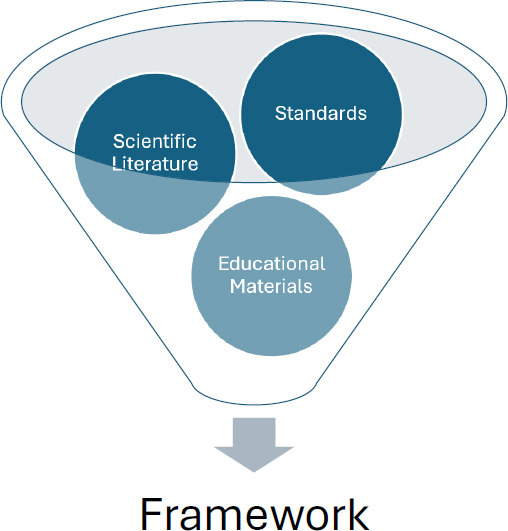
The framework was designed using an additive process (see Figure 4). The foundation of the framework was the data extraction charts used to review scientific literature and educational materials. After the research team identified the ADAS educational materials, conducted the data extraction, performed the literature review, and documented the standards development activities, the team discussed what had been learned from each activity as well as the types of information that had not been captured during data extraction. This process led to the addition of two components. The first was identifying whether the materials stated or implied objectives for the learners (i.e., what the audience should learn from engaging with the materials). The second was documenting whether the learning materials provided any opportunity (e.g., a quiz or challenge questions) for the learner to receive feedback pertaining to their understanding of ADAS. In a series of discussions, the research team refined the core components included in the framework, the categories within each component, and other relevant factors to be considered when evaluating or developing ADAS educational materials.
The framework (Figure 5) is organized into five factors that characterize ADAS educational and training materials in terms of their scope and depth. Organized as a structured hierarchy, the framework is designed for left-to-right reading, where each factor’s categories progress in complexity and depth. These factors include the desired objective(s) of providing training/education, the audience for the materials, the types of ADAS covered, the types of content included, and the mode used to deliver materials to the audience.
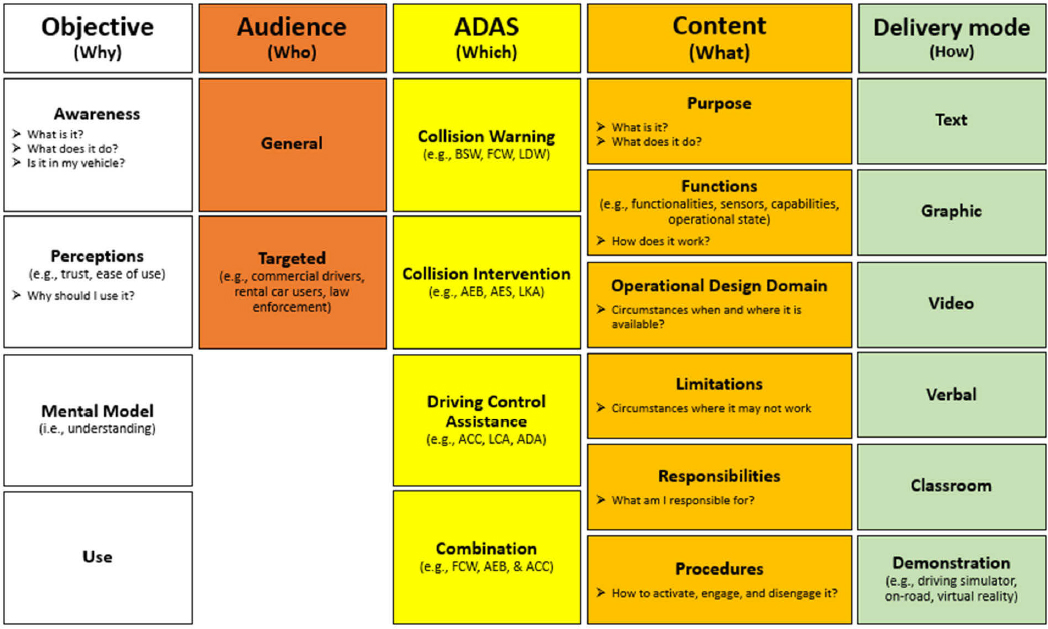
The objectives of education or training should be detailed in the beginning of the material. The objectives inform the learner of what they are to expect and detail the intended purpose of completing the training or education (Gagné et al. 1992). The objectives may entail (a) building awareness; (b) influencing perceptions (e.g., perceived usefulness); (c) promoting the development of a strong mental model (e.g., understanding and confidence in their understanding); and (d) informing the appropriate use of ADAS. Fostering driver awareness, perceptions, and mental model of ADAS may motivate them to properly use ADAS. The usage of ADAS is influenced by the drivers’ perceptions and perceived usefulness of the technology (Novakazi et al. 2020). If a driver is to use ADAS, they must first be aware that their vehicle has this technology. A gap in literature pertains to how to make a driver aware of the ADAS in their vehicle.
When characterizing the material, the evaluator should specify the intended audience. The audience may be a target population and further classified as a driver (e.g., novice, driver with a disability such as Parkinson’s disease), consumer (considering purchasing or recently purchased a vehicle), renter who infrequently uses ADAS in a multitude of vehicles, practitioners (e.g., service providers, educators, driving rehabilitation specialists), or decision-makers (e.g., fleet managers, policymakers). On the other hand, the ADAS material may be intended for a general audience without a specific use case in mind (e.g., purchasing a fleet of ADAS-equipped vehicles) or a driver without physical, motor, or cognitive detriments that need to be considered. While less is known about renters and drivers who purchased their vehicle used, recent findings suggest these users know less about ADAS compared to drivers who purchased a new vehicle (Boelhouwer et al. 2020; Reagan et al. 2023). Another reason to consider the audience is that they may have different motivations to learn to use ADAS or have different characteristics (e.g., technology proficiency) that may impact their willingness to use ADAS. While not yet captured in the framework, detailing the advantages and disadvantages of ADAS may alter individuals’ perceptions or motivate them to become more aware of ADAS or even use ADAS.
The three categories of the ADAS considered in the review and documentation activities were integrated into the framework: (a) collision warning; (b) collision intervention; and (c) driving control assistance.
Training and educational material can focus on a single system (e.g., LKA) or a combination of systems (e.g., LKA, LDW, and LCA). An individual may be educated or trained to identify and distinguish differences between systems that may be easily conflated. For instance, LDW, LKA, and LCA inform or assist the driver regarding lateral control and thus may be easily conflated. Finally, if ADAS that the research team did not include in their review (e.g., parking assistance features) are of interest, they can easily be added to the framework.
At a high level, education should detail the purpose of ADAS (i.e., what it is and what it does). Providing the learner with the purpose of ADAS may motivate them to determine whether they have this technology in their vehicle. Drivers’ understanding of ADAS improves with exposure, with particular improvements to their understanding of the technology’s limitations as opposed to improvements in system function (Carney et al. 2022). The functions and capabilities (e.g., how it works) of ADAS are constrained by the ODD (Pradhan et al. 2023). The ODD is the context or set of conditions that may include environmental, traffic (e.g., speed limit), or roadway characteristics (e.g., lane markings) in which the system was designed to function (ISO/TS 14812:2022, Intelligent transport systems — Vocabulary 3.7.3.2). Informing the driver of their responsibilities and roles while using ADAS and reminding them to always be engaged in the driving task promotes the usage of ADAS (Zheng et al. 2023). Lastly, the driver should be informed about the procedures to modify settings, activate, engage, recognize system state, and deactivate ADAS to facilitate the use of technology. The content of the education should be mapped to the objectives and intended audience. If the objective of education is to foster awareness of ADAS, providing details about the ODD and procedures may be superfluous.
While there are several combinations of delivery modes to educate drivers about ADAS or expose them to this technology, most materials include text, graphics, and/or videos. Demonstrations have been used in research settings, possibly in an attempt to replicate the buying experience at dealerships and provide a hands-on learning experience. ADAS demonstrations can be presented to learners in a driving simulator, on a closed track or planned route, or through naturalistic driving. Generally, the delivery mode of education is selected after determining the ADAS, objectives, audience, and content, but it may be practical for the practitioner to begin by considering the delivery mode. The mode of education is also influenced by the desired level of engagement, interaction, frequency, and duration. Lastly, when designing or evaluating educational material, it is important to consider the organization and inaccuracies of the material.
3.2 Gaps in Education Materials
Next, the research team used the framework to characterize the gaps in the educational materials. This section describes the gaps identified in educational materials relative to objectives, audience, which ADAS and what types of content were included, and how the materials were presented to the audiences, including delivery modes.
3.2.1 Objective of Providing Education Materials to Learners
The research team was unable to identify an explicit or implied objective for 19 (43%) of the 44 educational materials. Several objectives mentioned learning about ADAS to assist with purchasing a vehicle, while others indicated learning how to properly use ADAS to “enhance your driving,” “drive safer,” or “maximize safety.” Objectives in materials that targeted specific populations tended to include more detailed information about what the audience could expect to learn. Interestingly, many of the resources referred to ADAS as “safety features” or “safety technologies” in the objective. In contrast, the terms “ADAS” and “driver assistance” tended to be used more in resources provided by transport agencies or driving safety advocacy and research associations.
Although the team did not attempt to classify materials without an explicit or implied objective, many would likely fall under the category of awareness. These results illustrate an apparent gap between theory and practice.
3.2.2 Audience
The research team identified at least one stated or implied audience for each source, and a large portion of sources seemed to target more than one group. Most materials (57%) were aimed toward drivers in general. Materials targeting new car buyers comprised 39%, with used car buyers and driving education following at 25% and 14%, respectively.
The research team’s review of materials and communication with the SME panel revealed significant gaps in the audience, which are crucial for understanding the entire range of educational needs related to ADAS. A glaring omission is the lack of materials for driving rehabilitation specialists and the drivers resuming driving post-medical events. Sources of ADAS information for commercial vehicle drivers, fleet/safety managers, and operators of fleet vehicles were minimal, with only one source identified for each group. One source was geared towards educating students of driver improvement programs, and another source was designed to inform parents of novice drivers. Two sources were found for first responders and another two for driving assessors. Both older drivers and novice drivers were minimally covered, with only three sources addressing each of those groups.
3.2.3 Coverage of ADAS
The extraction process captured the sources that included information for any of the nine ADAS included in the review (see Table 1). Some materials presented each ADAS individually, and some described combinations of ADAS. Table 7 lists how many sources include information for each ADAS, both alone and in combination with other systems. There were only 11 sources that included AES, 14 that included LCA, and 12 that included ADA content, while more than 30 sources included information about the other six ADAS. Since fewer vehicles are equipped with AES, LCA, and ADA, the level of coverage across the reviewed materials appears to reflect the level of adoption of various systems into the vehicle fleet.
Considering the various ways the sources presented combinations of ADAS, more than half the sources grouped the lane support ADAS (i.e., LDW, LKA, and LCA). A lane support ADAS was presented in combination with a different type of system in only two instances. LDW was once presented with the other warnings (i.e., BSW and FCW), and LCA was once presented with ADA. FCW was most frequently paired with AEB or with AEB plus another ADAS. ACC was combined with AEB once. On a few occasions, one of the ADAS was grouped with features outside the scope of the review, such as blind spot intervention.
The pairings that appear most frequently are systems that may appear to have similar functions. For instance, LDW, LKA, and LCA all contribute to the vehicle’s lateral position and thus can be easily conflated. Similarly, FCW and AEB address the same crash type and are often experienced together. The efficacy of providing information about one or multiple systems has not been evaluated in the literature. When providing information about a combination of systems, it is important to distinguish the systems in a clear and concise manner.
The types of content included in the ADAS educational materials varied widely, but for the most part the coverage was rather consistent across ADAS (see Table 8). Educational materials predominantly described the purpose and function of ADAS, with both categories appearing 97% of the time. About half the sources included information about responsibilities (55%), limitations (50%), and ODD (41%). Procedures received the least attention, appearing in only 21% of the sources.
| ADAS | (n) | Alone | Combined |
|---|---|---|---|
| BSW | 31 | 28 | 3 (10%) |
| FCW | 32 | 18 | 14 (44%) |
| LDW | 33 | 15 | 18 (54%) |
| AEB | 32 | 18 | 14 (44%) |
| AES | 11 | 8 | 3 (28%) |
| LKA | 31 | 14 | 17 (55%) |
| ACC | 32 | 31 | 1 (3%) |
| LCA | 14 | 6 | 8 (57%) |
| ADA | 12 | 11 | 1 (8%) |
Lane support ADAS (i.e., LDW, LKA, LCA) included ODD content more frequently than the other ADAS. When ODD was presented for other ADAS, it was usually detailed on a manufacturer website or within the manuals. ODD requirements for a given ADAS can vary widely across the vehicle fleet, and if this information is included in materials, it could quickly become antiquated. For instance, the description of the ODD for ACC would have to be updated when manufacturers began to implement stop and go functionality. Sources that aim to provide general information about ADAS may have decided that it was too difficult to provide accurate information about possible ODD constraints when technologies are continuously changing.
Educational materials that covered LCA and LKA were most likely to include limitations, at 71% and 65%, respectively. Half the materials that covered ACC and ADA, two ADAS features that provide driving control assistance and perform a portion of the driving task, did not mention limitations. Less than a third of the materials describe BSW mentioned system limitations.
Responsibilities were not included in 45% of the material reviewed. Messaging about the actions or duties the user is expected to perform when using ADAS was often closely tied to system limitations and potential misuse of the system. Responsibility messaging was very similar across the manufacturers and frequently stated that ADAS are supplemental and do not replace the driver’s attention, judgment, and need to control the vehicle.
Procedural content was found primarily in manuals, which aim to inform owners how to use their specific systems, in contrast to sources providing general information that applies across different system implementations. One exception to this was ACC, where seven information sources besides the owner’s manuals provided procedural information.
Table 8. Number of sources presenting information about each ADAS, by type of content.
| ADAS | n | Purpose n (%) |
Function n (%) |
ODD n (%) |
Limitations n (%) |
Procedures n (%) |
Responsibilities n (%) |
|---|---|---|---|---|---|---|---|
| BSW | 31 | 31 (100) | 29 (94) | 7 (23) | 10 (32) | 5 (16) | 15 (48) |
| FCW | 32 | 32 (100) | 32 (100) | 8 (25) | 15 (47) | 5 (16) | 19 (59) |
| LDW | 33 | 32 (97) | 32 (97) | 19 (58) | 17 (52) | 8 (24) | 18 (55) |
| AEB | 32 | 31 (97) | 31 (97) | 10 (31) | 14 (44) | 4 (13) | 14 (44) |
| AES | 11 | 11 (100) | 11 (100) | 3 (27) | 5 (45) | 2 (18) | 7 (64) |
| LKA | 31 | 30 (97) | 30 (97) | 17 (55) | 20 (65) | 6 (19) | 16 (52) |
| ACC | 32 | 31 (97) | 31 (97) | 14 (44) | 16 (50) | 12 (38) | 19 (59) |
| LCA | 14 | 13 (93) | 14 (100) | 9 (64) | 10 (71) | 2 (14) | 8 (50) |
| ADA | 12 | 11 (92) | 10 (83) | 6 (50) | 6 (50) | 4 (33) | 10 (83) |
| Total | 228 | 222 (97) | 220 (96) | 93 (41) | 113 (50) | 48 (21) | 126 (55) |
3.2.4 Presentation of Education
This section describes the gaps broadly related to the delivery of the ADAS education materials. These include the delivery mode already included in the framework, as well as other observations and gaps made by the research team during the review of educational materials that are related to how education is delivered. These include whether materials referred the learner to consult owner’s manuals or gave learners the opportunity to test their knowledge.
3.2.4.1 Delivery Mode
As noted above, the vast majority of the ADAS educational materials reviewed were websites. During data extraction, as each type of content was identified, the researcher also noted how the content was communicated to the audience (i.e., medium). Table 9 provides a breakdown of different medium categories (text, image, animation, and video) across the six content categories for all nine types of ADAS included in the review. Not surprisingly, text was the most common media for all types of content, with nearly 90% of the sources that covered ADAS purpose, function, limitations, procedures, and responsibilities doing so with text. Interestingly, function was presented in an image almost as often as text. Nearly a third of the sources that covered purpose, function, and ODD did so using video. Animations, though rarely used, tended to address purpose and function.
| Medium | Purpose n (%) |
Function n (%) |
ODD n (%) |
Limitations n (%) |
Procedures n (%) |
Responsibilities n (%) |
|---|---|---|---|---|---|---|
| Text | 196 (88) | 188 (85) | 71 (76) | 102 (90) | 41 (85) | 110 (87) |
| Image | 72 (32) | 177 (80) | 9 (10) | 35 (31) | 15 (31) | 13 (10) |
| Animation | 20 (9) | 27 (12) | 3 (3) | 2 (2) | 0 (0) | 0 (0) |
| Video | 67 (30) | 66 (30) | 30 (32) | 20 (18) | 7 (15) | 30 (24) |
| Total | 222 | 220 | 93 | 113 | 48 | 126 |
3.2.4.2 Owner’s Manual Reference
Early in the review of educational materials, the research team noted that some sources directed the learner to refer to their owner’s manual. Manufacturer websites were observed to actively employ disclaimers to direct users to the owner’s manuals for comprehensive details, limitations, and responsibilities. However, these disclaimers often appeared in small font sizes, and accessing the full text of these disclaimers typically required an extra click, which increases the likelihood users will overlook them or think they are less important. This is unfortunate since the disclaimers carry crucial information and may also address the driver’s responsibilities when using the ADAS.
Outside of the manufacturers’ websites, some of the other educational materials highlighted that vehicle systems vary and encouraged learners to refer to the vehicle’s manual, consult with dealerships, or seek other reliable sources for accurate ADAS information. The owner’s manual would likely be the best reference for those who want to know the ODD or how to modify settings for specific ADAS features.
3.2.4.3 Owner’s Manual Challenges
Despite the manual being the primary source of vehicle-specific information about ADAS, owners who do consult their vehicle’s manual may face several challenges. The manuals reviewed included information for all trim levels across a model and did not specify which features, including ADAS, were relevant to a given trim. The phrase “if equipped” was commonly used, but none of the manuals provided information about which specific features were present on the vehicle or suggested a way for the reader to find out.
Each manufacturer’s manual presented material uniquely relative to the others. The organization of ADAS information varied, sometimes appearing together in one section and in others appearing under multiple headings. For example, at least one manual put information about how to adjust ADAS settings or parameters in a separate part of the manual from where the rest of the system information was presented. One manual frequently switched between similar ADAS features, such as LDW and LKA, a practice which may confuse readers.
Some manuals emphasize material with bold text, distinct colors, or boxed callouts, and the same manual might use multiple labels, like “Warning,” “Note,” and “Information,” for the emphasized information. In other manuals, the formatting of the text resembled a list of warnings. Both cases may make it difficult for the reader to identify what information is most important.
Some of the language used in the manuals include legal or technical terms and may require a high reading level for comprehension. For example, the term “telltale” was used in at least one manual, a word not commonly understood by most consumers. Researchers also observed instances where the text of the manual mentioned colors in the vehicle displays, but the images provided in the manual were not in color and some manuals did not include images to indicate where in the vehicle the driver should look for visual information about the ADAS state.
3.2.4.4 Method for Testing Knowledge
Only 9% of the educational materials provided any method for the learner to test their knowledge by applying what they had learned. The reviewed materials that provided test methods included student review questions in driver education and driver improvement materials, challenge questions on a website, and multiple-choice or true/false questions in online videos. A few members of the SME panel indicated they believed it was important for materials to include scenarios or options for testing knowledge. Including a challenge or quiz may help identify the current level of understanding for the learning.
3.2.5 Gaps in Evaluation of Educational Materials
The effectiveness of owner’s manuals, webpages, and other publicly available ADAS educational materials have not been evaluated. There remains an opportunity for researchers to fill this gap by evaluating the effects of this material on individuals’ understanding, perceptions, and use of ADAS. The literature review found that researchers often developed their own training materials from scratch or mimicked information provided in an owner’s manual. Training materials used in research were often more specific to the implementation of the ADAS for that study than educational materials that were publicly available.
One program evaluated the impact of an outreach campaign on the awareness, perception, and adoption of ADAS in the commercial motor vehicle industry (Staples et al. 2024). The evaluation found that about two-thirds of the respondents who were executives at large trucking companies reported being aware of the campaign, compared to 29% of the respondents who were drivers. The drivers aware of the campaign reported greater awareness of ADAS compared to those unaware of the campaign. Drivers’ perceptions of safety for all ADAS included in the survey were slightly lower one year after the campaign compared to baseline. One year after the campaign, drivers reported an adoption level (averaged across all ADAS technologies) of 19%, a 6% increase from the adoption level at baseline.
Given the differences in training and education, the framework does not currently include all details that can help in the evaluation of material. Specifically, factors such as timing, content structure, detail level, interaction, and engagement can also be considered when evaluating or characterizing ADAS education and training.
3.2.5.1 Timing of Education/Training
Based on findings from the literature review, there is no ideal duration, frequency, timing, or delivery method of training that has been shown to improve users’ understanding or use of ADAS. In an ideal world, interested users would learn about ADAS prior to using ADAS. However, this rarely happens in practice. While these are important factors to understand, we do not yet understand their effect. Something practical and feasible to consider is the date the educational material was created and for which systems. Providing this information and the date of the last update may help the reader determine whether the information provided may be antiquated due to advancements in technology.
3.3 Inaccuracies and Opportunities for Confusion in Education Materials
During the review of educational materials, the research team flagged any content that contained potentially inaccurate information. This determination was somewhat subjective, and the team agreed to be liberal when identifying these potential issues. Operationally, researchers documented materials that raised any question about the meaning or accuracy of the information, including when information seemed to contradict information given elsewhere by that source. Most of the flagged concerns were related to the use of ambiguous or inconsistent language rather than information that was strictly inaccurate. Therefore, the team decided to label to the concerns as “opportunities for confusion.” This term was used because content may be accurate in a certain situation, context, or specific implementation of ADAS but inaccurate in other settings. Though not all can be neatly classified, the observed issues generally fell into these categories: incorrect content, ambiguous content, lack of context, inconsistent content, and other issues.
3.3.1 Incorrect Content
The research team observed numerous sources communicating inaccurate information about ADAS. Some examples include:
- Describing ACC as a feature that one can “set and forget” or that helps a vehicle “stay within the speed limit.”
- Several images or videos that misrepresented the range of BSW sensors, including one that showed it covering multiple lanes to the right and left and another that showed BSW on only one side of the vehicle.
- While describing FCW/AEB combination, a video showed the ADAS vehicle braking for a motorcycle crossing its path. Though some advanced AEB systems may be able to respond in this situation, the video failed to explain that not all AEB systems do.
- Stating that AEB allows drivers to focus on the task of driving and maintaining vehicle control and relieves driver stress and fatigue.
- Images or videos showing drivers taking their hands off the wheel while using ADA.
- Referring to a system as LKA while describing the lane centering function of LCA, i.e., stating that LKA helps keep the vehicle centered in its lane or that LKA and ACC function together as ADA.
- Using the common cruise control icon (i.e., stylistic speedometer dial with arrow) rather than the ACC icon, which incorporates the outline of a vehicle into the former.
3.3.2 Ambiguous Content
Many of the reviewed educational materials used non-specific language that could lead to the audience being confused or misunderstanding the meaning. For example, several sources described various ADAS as maintaining a safe following distance, safe speed, safe lane position, or proper vehicle control. These vague word choices could cause the learner to infer that the ADAS has a level of control that does not accurately reflect the systems’ capabilities and limitations and could minimize the driver’s responsibilities with using the ADAS. The ambiguous language used to describe the things a given ADAS detects, i.e., cars, objects, or obstacles, raises questions such as, can the ADAS also detect other types of vehicles besides cars, are there types of objects that it cannot detect, and what exactly constitutes an obstacle? Some materials stated that ADAS are intended for highway use or function at highway speeds without clearly defining what speeds and roadway configurations are included or excluded as “highway.” Similarly, other materials referred to low speed without quantifying what that means. Some sources used metaphors (e.g., guardian angel) or idioms (too close for comfort), which are open to interpretation by the learner based on their personal experiences, judgment, and cultural background.
Other ambiguous content was associated with symbology in images. Several sources included “clip art” images with concentric arcs surrounding the vehicle(s), which do not represent typical sensor locations or ranges. These also did not provide captions explaining that the image did not represent actual ADAS functionality. Another source included a pair of images associated with FCW and AEB, and each included an inset showing a foot pressing a pedal. The meaning of the foot on the brake, that is, whether the driver must apply the brakes or the AEB is braking, was unclear.
3.3.3 Lack of Context
The review also identified ADAS educational materials in which a lack of context could lead to confusion on the part of the learner. One source used dozens of images without captions to explain why they were being included with the text. One of these images was a photograph of clearly visible lane markings in the LKA section that immediately followed text describing limitations when the lane markers are not visible. The LDW section of another source included an illustration of an empty roadway with faint lane markings, scattered leaves, and large snowflakes, presumably to call attention to situations when the system will not operate, but the accompanying text does not mention any of these limitations. A website included animations demonstrating various ADAS functionalities without any text or narration to provide context of the driving situations where the ADAS can be used. There were also instances where text information failed
to provide the necessary context to the learner. For example, one source of information about ACC suggested drivers use the “longest gap setting” without providing any explanation as to why. Finally, the research team noticed that some educational materials used original content from other sources they had already reviewed. When content was borrowed and inserted in new sources, it was sometimes used in a new context that did not align with the source from which it was taken.
3.3.4 Inconsistent Content
The research team observed numerous instances of inconsistent content, commonly when the text or narration accompanying an image or video conveyed conflicting meaning. For example, a video showed ACC/ADA detecting and responding to a vehicle ahead in a sharp curve while the narration explained that sharp curves could limit system performance. Later the same video showed ACC/ADA braking to a stop from highway speeds while approaching stopped traffic further ahead on the highway (i.e., an emergency situation), even though the system is designed to maintain a gap with a vehicle ahead and then can slow to a stop as the traffic ahead slows and stops. One PowerPoint presentation describing the function of lane support ADAS included several inconsistencies between the presenter notes and the narration in the embedded video. Another source that provided information for both ACC and ADA used the same icon for both systems. One source informed the learner that the ability to use AES might be affected if the user has a hearing impairment when the provided description of the system did not include any auditory component.
3.3.5 Opportunities for Confusion by ADAS and Content Type
Every source that was reviewed was flagged for at least one opportunity for confusion. Opportunities for confusion were summarized as a proportion of educational materials addressing each combination of ADAS and type of content (Table 10). Overall, content related to function had the highest percentage (81%) of opportunities for confusion whereas responsibility content was the lowest (8%). The other content types ranged from 27 to 47%. The ADAS that had the highest proportion of materials with opportunities for confusion was ACC with 56%, while other ADAS ranged from 38% to 48%. In particular, 94% and 71% of materials that described the function and ODD of ACC, respectively, contained at least one piece of information that was potentially confusing.
Table 10. Opportunities for confusion in the educational materials, by ADAS and content type.
| ADAS | Purpose n (%) |
Function n (%) |
ODD n (%) |
Limitations n (%) |
Procedures n (%) |
Responsibilities n (%) |
Overall n (%) |
|---|---|---|---|---|---|---|---|
| BSW | 8 (26) | 25 (86) | 2 (29) | 2 (20) | 1 (20) | 1 (7) | 39 (40) |
| FCW | 16 (50) | 25(78) | 3 (38) | 3 (20) | 3 (60) | 0 (0) | 50 (45) |
| LDW | 13 (41) | 28 (88) | 9 (47) | 2 (12) | 2 (25) | 1 (6) | 55 (44) |
| AEB | 10 (32) | 22 (71) | 3 (30) | 4 (29) | 2 (50) | 0 (0) | 41 (39) |
| AES | 5 (45) | 7 (64) | 0 (0) | 2 (40) | 1 (50) | 0 (0) | 15 (38) |
| LKA | 13 (43) | 23 (77) | 8 (47) | 6 (30) | 1 (17) | 2 (13) | 53 (45) |
| ACC | 11 (35) | 29 (94) | 10 (71) | 8 (50) | 7 (58) | 4 (21) | 69 (56) |
| LCA | 4 (31) | 12 (86) | 6 (67) | 5 (50) | 0 (0) | 0 (0) | 27 (48) |
| ADA | 4 (36) | 8 (80) | 2 (33) | 4 (67) | 2 (50) | 1 (10) | 21 (45) |
| Total | 84 (38) | 179 (81) | 43 (47) | 36 (27) | 19 (40) | 9 (8) | 370 (45) |
3.3.6 Educational Materials That Have Not Been Reviewed or Evaluated
The research team’s targeted search achieved their goal of identifying and reviewing ADAS educational materials provided by a wide variety of organizations. Nonetheless, due to time and financial constraints, there are ADAS educational materials that were identified but not reviewed, as well as areas where materials may exist but were not identified.
- Fleet-related materials: Organizations such as state institutions, universities, and private companies that own fleets of vehicles equipped with ADAS may provide education to the employees who operate those vehicles. These companies may also contract with third-party providers to provide instruction, e.g. defensive driving, which may or may not include information about ADAS.
- Commercial motor vehicle (CMV) training: Despite consulting at least ten organizations related to CMVs, including three specifically related to training, researchers were not able to identify any CMV driver training curricula to assess to what extent ADAS are covered. In May 2024, the AV Study Group (S.18) of the TMC initiated a proposed RP on “Optimization of Driver Training for ADAS,” suggesting that attention to this area may be increasing. ADAS education for transit drivers is another domain where materials may exist.
- Automobile insurance companies: Although a few resources from insurance companies were identified, the team did not investigate whether ADAS education materials are available for insurance agency employees like agents, adjusters, and underwriters. Understanding ADAS content could be useful to their customer service and risk management strategies.
- Rental car companies: As with the insurance industry, the researchers were unable to investigate whether the employees (agents, vehicle technicians, customer support) who work for the companies receive ADAS training. When the researchers inquired about whether the rental car companies provided information about ADAS to their customers, they were directed to contact the staff at the rental location.
- Law enforcement training: The researchers were able to review the slides for two presentations created for this audience. However, the review could not include any additional information shared by the presenters that was not contained in the slides.
- Dealerships: The research team interviewed 10 salespeople to learn about their ADAS education and training but did not receive or review any training materials. Doing so would be quite useful, as salespeople are one of the primary ways consumers learn about ADAS; however, manufacturers are unlikely to share these proprietary materials outside their organizations. One SME shared that the dealership where they recently purchased a vehicle offered a class to new owners. Obtaining these educational materials to characterize the training provided to the customer would also be beneficial.
- Technician training: In 2022, the National Institute for Automotive Service Excellence launched their ADAS Specialist Certification Test (L4). The ADAS Specialist Composite Vehicle Reference Booklet is available online. However, this resource was not reviewed due to its size and the highly technical nature of its content. There is also potential for ADAS training aimed at service advisors, who more often interact with customers during maintenance and repair visits, to help them communicate about ADAS-related issues to their customers.
- Driver training classes: During the review and documentation of educational materials, the research team learned of different training classes but were unable to attend any to review them. Attending various classes may reveal ADAS educational strategies employed for specific audiences (e.g., driver improvement, driver education, older driver).
- Social media: Except for YouTube, the most popular platform according to the Pew Research Center, the research team did not look for information about ADAS on social media platforms. There may be information about ADAS on Facebook, X, TikTok, Instagram, Reddit, and other sites. However, as noted above with the team’s searches on YouTube, finding high-quality content is likely to be a substantial challenge. Given that use of nearly all these platforms is on the rise,
- social media also presents an opportunity for connecting learners with ADAS information in an engaging way.
- Regulatory guidelines: After the team completed the review and documentation activities, AAMVA released an updated document with guidance for training drivers and individuals involved in driver education and training programs: Guidelines for Regulating Vehicles with Automated Driving Systems Edition 4.
- Future updates: A few of the organizations contacted by the team shared that they were in the process of making updates to ADAS educational materials or planned to do so in the future. Tracking how often these updates occur could provide insights into the evolving nature of ADAS training.
- DMV/DOT resources: Although the web search for materials provided by DMVs and DOTs was systematic, these agencies may have materials that are not posted online or are not posted in a format that would be subject to an online search (e.g., a PDF document that has to be downloaded), such as materials for staff who administer licenses or vehicles and driver handbooks.
- Though mentioned previously, it bears repeating only 20% of studies included the scientific literature review shared the training materials used.


