Mental Health, Suicide Prevention, and Addiction Mitigation in Construction and Maintenance (2026)
Chapter: 4 Case Examples

CHAPTER 4
Case Examples
Introduction
Follow-up case example interviews and data collection were conducted after the survey to gather further details regarding state DOT programs for mental health and wellbeing, suicide prevention, and addiction mitigation. The case example selection was based on the following qualification questions:
- Did your agency complete the survey?
- Does your agency have programs for mental health and wellbeing, suicide prevention, and addiction mitigation for employees?
- Does your agency have practices on measuring or tracking the implementation of policies, practices, programs, and guidelines?
- Is your agency willing to participate?
Five state DOTs met the qualifications and agreed to participate—those of Alabama (AASHTO Region 2), Kansas (AASHTO Region 3), Michigan and Mississippi (AASHTO Region 2), and Texas (AASHTO Region 4). Details of the individual case example interviews are outlined in the following sections. The interviews were conducted using a semi-structured approach, and the questions used for the interviews can be found in Appendix C. Each state DOT was invited to discuss in detail its programs and experiences with mental health, suicide prevention, and addiction mitigation for construction and maintenance personnel. Each case example is summarized using the following categories: policies, awareness of programs, programs, performance measures, and organizational dynamics.
Alabama Department of Transportation
Alabama DOT is a state agency with primary responsibility for statewide transportation in all modes of travel. Alabama DOT has about 4,400 employees spread across five geographic regions and has a central office. Alabama DOT values employees and has initiated mental health programs to support all employees of the agency. A statewide EAP, managed by a statewide agency called the Division of Risk Management, is provided to all agency employees. In addition, Alabama DOT has various initiatives in place to support mental health and wellbeing, prevent suicide, and mitigate addiction. These initiatives are described in the following subsections.
Policies
At Alabama DOT, mental health and wellbeing, suicide prevention, and addiction mitigation are all grouped together and are not separate programs. In terms of policies, the Division of Risk Management and a third-party consultant hired by the state of Alabama develop the policies
surrounding mental health, suicide prevention, and addiction mitigation. The central office personnel for Alabama DOT then promotes these initiatives and sends out information to the five regions and 10 areas across the state.
In terms of addiction mitigation, Alabama DOT has a drug and alcohol policy for CDL employees and for employees who get into an accident while on the job. Random drug testing is performed, and a positive test requires that the employee go through the program in order to keep their CDL. The policy can also be implemented if someone witnesses signs of alcohol or drug abuse in an employee. In these cases, the employee would need to be tested and then recommended to the EAP to receive help.
Awareness of Programs
Alabama DOT has an internal web page available to employees that lists all the policies and procedures it has in place, including those for mental health. Monthly newsletters include a variety of information from across departments, which may include information on mental health and wellbeing. In addition, office managers and supervisors are informed of programs and initiatives, which they then provide to employees. Each office also has a policy board that posts hard copies of the information in addition to the electronic copies received.
When an individual is recognized as struggling or changes in behaviors are noticeable, supervisors have the ability to recommend to the central office that the employee receive mental health assistance. Training and specific initiatives can then be tailored to the employeeʼs needs.
Alabama DOT personnel mentioned that they highlight consistency in raising awareness of mental health initiatives among employees. Part of these efforts is to normalize conversations about mental health—like conversations about physical safety—so that it is more comfortable for all to talk about. Some individuals are more comfortable and can broach the subject in an elegant way that makes for a more normalized conversation. But some individuals are not as comfortable and may be nervous when discussing mental health, which is not surprising considering its perceived taboo nature.
Alabama DOT has realized that employees who are more comfortable talking about mental health are assets who can be encouraged to engage with others to support them and provide resources. Although employees who are comfortable talking about mental health may not have all the answers, they can provide information about those resources. Although Alabama DOT personnel have worked to normalize mental health issues, additional innovative ways to reduce the perceived taboo of talking about mental health are needed in order to help employees recognize mental health issues and find the resources needed, provided by the state.
Although seeking to increase awareness, Alabama DOT central office personnel have noted that there is a limit to the information that can be shared regarding mental health as a result of the Health Insurance Portability and Accountability Act (HIPAA), which protects individualsʼ privacy. Instances have occurred in which more information was shared than would be allowed under HIPAA. Employees need to be educated to recognize mental health issues and to know what information they can collect for the situation.
Mental Health Programs
Mental health and wellbeing programs are developed centrally for the State of Alabama through the stateʼs Division of Risk Management. Awareness and implementation of programs is the responsibility of Alabama DOT for its employees. The Division of Risk Management guides the Alabama DOT central office personnel on how to implement the various policies and initiatives for mental health.
Monthly training is offered to all employees for mental health and wellbeing, suicide prevention, and addiction mitigation. The training bureau and training coordinators set up trainings when they are needed. The training coordinators dictate the employee classifications that need to attend. However, when training coordinators send out requests to supervisors to find the employees designated for mental health training, obtaining responses is a challenge. In most cases, only about half of the supervisors will follow up on this request.
Alabama DOT also has access to external programs related to mental health and wellbeing. Many organizations tied to highway construction offer training programs for mental health, suicide prevention, and addiction mitigation, which Alabama DOT promotes to its employees. In one example provided by Alabama DOT personnel, the American Traffic Safety Services Association provides training related to mental health and safety that is offered to agency employees.
Performance Measurement
Since health information for healthcare and mental health is protected, Alabama DOT finds it difficult to track the effectiveness of mental health and wellbeing programs. Feedback is strictly voluntary, and if an employee does not want to discuss the outcomes, they are not required to do so. However, when employees do volunteer information, they typically share what worked and what did not. Additionally, when a supervisor recommends an employee for mental health initiatives, the central office can follow up with supervisors to see how things are going with that particular employee.
The Alabama DOT tracks all training that employees receive, including those related to mental health, suicide prevention, and addiction mitigation. The information tracked tells Alabama DOT what training each employee has received in regard to mental health. Alabama DOT can analyze the data collected on mental health training to determine whether attendance is increasing. However, Alabama DOT personnel mentioned that analyzing the data can be a challenge if consistent data are not collected. If specific data are unavailable and cannot be collected, it makes it difficult for Alabama DOT to know the status of the various trainingsʼ reach and effectiveness. The system used for tracking information also is a barrier for Alabama DOT in that if any type of analyses are to be done on the tracking information, the data need to be exported to a spreadsheet; the system does not include a means for analyzing data. Alabama DOT is in the process of exploring new systems for tracking all training that will simplify data collection and analysis.
Organizational Dynamics
Alabama DOT employees have experienced fatalities, suicides, and severe injuries over the years, which are difficult situations to deal with. In these extremely challenging mental health situations, Alabama DOT employees can request a counselor from the Division of Risk Management to come out to help. If the Division of Risk Management cannot respond, Alabama DOT has a relationship with a social worker from the Division of Enforcement (a statewide agency). This social worker travels the entire state and has relationships with many state employees, including those working for Alabama DOT. With the training the social worker has received, they can engage with employees to help them through difficult situations and provide resources. A challenge with this approach is that the more the social worker is utilized, the less time they have available to reach all employees. Therefore, the social worker relies on helping supervisors to become more comfortable talking about mental health so that they can engage with their employees.
A challenge to engaging employees for mental health initiatives is disseminating information about mental health programs and training and reaching those employees who need the training. Alabama DOTʼs initiatives are housed in the central office, but the state is broken up into regions, areas, and districts. Emails and other information are posted in district offices (e.g., policy boards). Employees who are regularly in the office receive the information, but field employees who are not in the office or who do not regularly check emails may not be aware of the mental health and wellbeing initiatives that are in place. Compounding the challenge is that those reading the emails may think of the information as just another management initiative, and it may not be taken seriously. As Alabama DOT personnel mentioned, there are so many layers to mental health and wellbeing that they need to rely on others, and the information shared is only as good as those sharing it.
Communicating information on mental health and wellbeing to all employment levels at Alabama DOT tends to be a slow process. Although Alabama DOT central office personnel work to articulate mental health initiatives, one area of improvement would be to provide information to supervisors on how to communicate about them and follow up after the fact to find out the results. An aspect to consider is how well the supervisor emphasizes the mental health information passed along to them. This reflects how comfortable supervisors are in talking about mental health. Those that are more comfortable are more likely to emphasize mental health information and initiatives. As Alabama DOT personnel noted, more training is needed to continue to normalize discussions addressing mental health.
The Alabama DOT errs on the side of caution to effectively promote mental health, suicide prevention, and addiction mitigation more than in the past, as a result of past experiences with mental health situations. Alabama DOT personnel can tell supervisors about colleagues that seem to be experiencing challenges. However, distinguishing between someone simply having a bad day and someone experiencing more serious distress is a challenge. Alabama DOT personnel mentioned that in several instances, employees noticed that something was not right about another employee but did not inquire further. The results of these situations vary, and inconsistencies in how employees understand mental health is something that Alabama DOT is currently addressing so that employees can recognize mental health issues and know how to guide colleagues toward available resources. The premise is to educate employees so that they can recognize mental health issues. This way, if they see a potential sign of mental struggles in a colleague, they know to notify someone immediately. Alabama DOT wants to ensure that all employees have the tools available to promote the importance of mental health and know where they can find assistance and resources when an employee is struggling and needs help.
To assist the Alabama DOT to implement mental health and wellbeing initiatives, having additional resources available that can be offered at little to no cost would be beneficial, as some lower-level employees do not make a salary that matches todayʼs economy. For example, when an employee has mental health issues or a supervisor recommends an employee for mental health initiatives, the individual has up to three individual mental health therapy sessions available at no cost. However, after three visits, the employee must pay out-of-pocket. Additional resources that could offset costs beyond a third appointment would be helpful. If an employee requires extensive help (e.g., through an inpatient situation), Alabama DOT would like to have resources available to help the employee to take time off as needed and to pay for the inpatient services.
As a success story to mental health initiatives at state DOTs, Alabama DOT personnel mentioned that a newly hired civil engineer experienced a mental breakdown at work. In the moment, other personnel were not sure what to do. Rather than call the police or emergency services, the supervisor worked to get the distressed employee out of the environment and into the care needed. The employee improved, was moved to a different department and is now thriving as an exemplary employee.
Kansas Department of Transportation
Kansas DOT is a state transportation agency responsible for road and bridge maintenance (9,400 centerline miles), transportation planning, contract compliance, and transportation-related administrative support. To handle these responsibilities, Kansas DOT has over 2,300 employees across six districts, with a central office in Topeka. The decentralized approach of Kansas DOT means that each district is responsible for maintaining and improving transportation infrastructure within each region of the state, overseeing construction, maintenance, and safety projects. In terms of mental health and wellbeing, an EAP is available to all Kansas state employees (including the employees of Kansas DOT) through the stateʼs Department of Administration. The information on mental health and wellbeing, suicide prevention, and addiction mitigation collected from the Kansas DOT is presented in the following subsections.
Policies
In about 2020, Kansas DOT personnel started having conversations about pushing for more mental health and wellbeing initiatives beyond those provided by the EAP. At that time, the Kansas secretary of transportation was very safety conscious, and promoting safety, including physical and mental, was essential. A Division of Safety was created, which included mental health and suicide prevention programs. This division works with the DOTʼs HR department. This top-down support from the State of Kansas emphasizes that programs related to mental health and awareness work. The support from management has helped improve the awareness of and culture about mental health, suicide prevention, and addiction mitigation at Kansas DOT.
Awareness of Programs
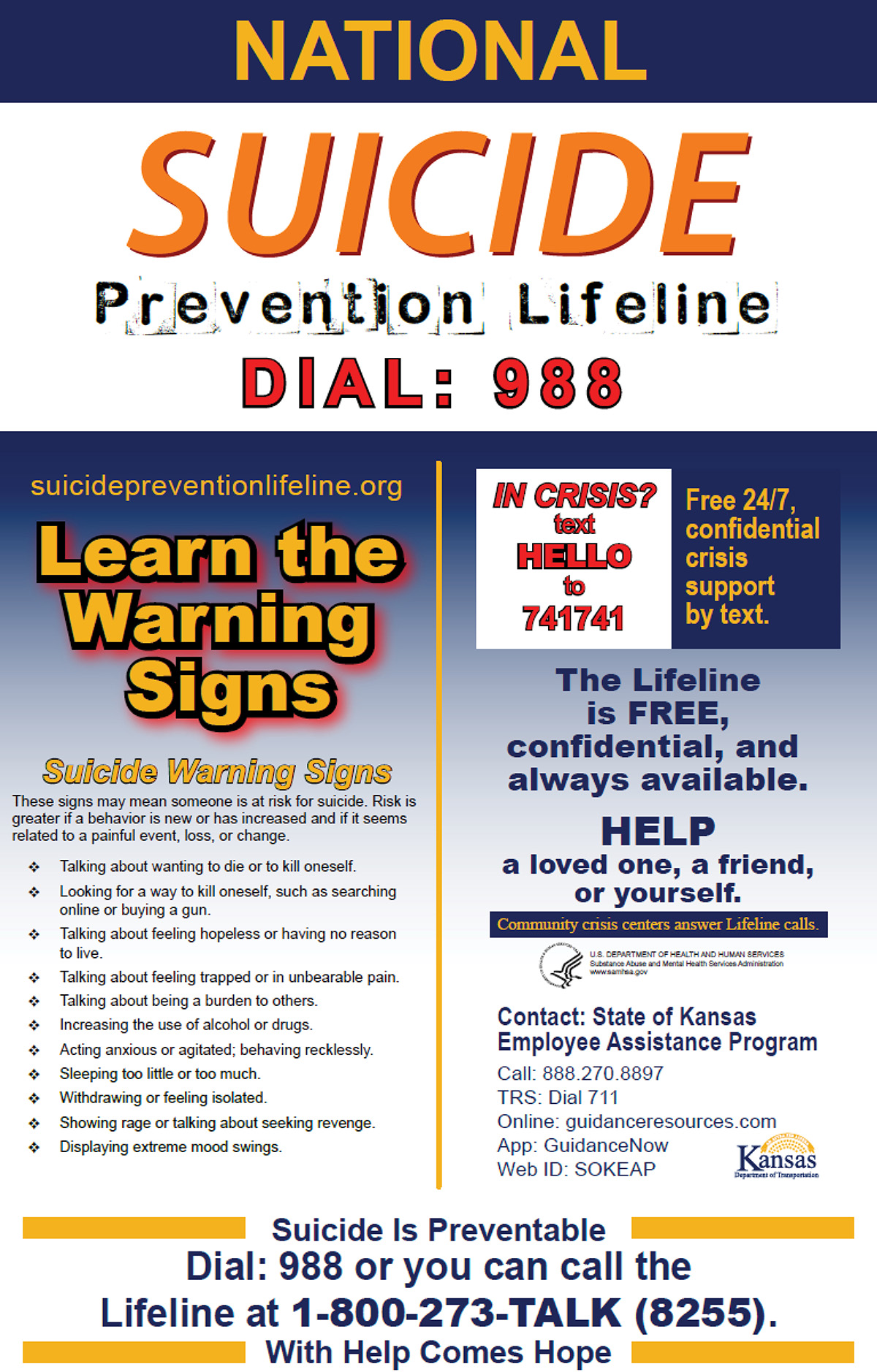
Kansas DOT promotes mental health and suicide prevention and engages employees through emails, flyers (Figure 18), key chains, and wallet cards. These resources provide information on suicide prevention and access to the EAP, with phone numbers to contact for assistance. Flyers and posters are placed in many locations in each office across the state—including bathroom stalls, where people can review the information in a more private setting.
District meetings may include agenda items to discuss mental health, suicide prevention, and addiction mitigation and to inform employees throughout the districts of the available programs. Kansas DOT also engages employees in other ways, such as having human resources staff greet employees as they arrive at the office, offer coffee and doughnuts, and hand out flyers and other information on mental health and wellbeing.
A challenge for Kansas DOT in making people aware of the mental health and suicide prevention programs available to them is getting people to recognize when they have a problem and to seek out these programs. As noted by Kansas DOT employees, many of the frontline field workers tend to follow the “tough guy” motto and will not seek help even when they are struggling. This is one of the areas Kansas DOT is working to address, by trying to communicate to employees that it is normal to struggle sometimes and that there are programs that will help.
Some of the Kansas DOT staff, including equipment operators and engineering technicians, belong to a union. Although the union is not very active, Kansas DOT sees an opportunity to partner with the union to help with awareness and education of employees toward mental health and wellbeing.
Long Description.
The poster for the National Suicide Prevention Lifeline emphasizes the importance of calling 988 for immediate assistance. It includes a section titled ‘Learn the Warning Signsʼ with a list of signs such as talking about wanting to die, feeling hopeless, and withdrawing from activities. The poster also provides information on how to get free, confidential support by texting ‘HELLOʼ to 741741. It encourages helping loved ones and offers contact details for the State of Kansas Employee Assistance Program. The message ‘Suicide Is Preventableʼ is prominently displayed, along with additional contact information for further support.
Mental Health Programs
Working for Kansas DOT, employees sometimes witness traumatic events related to severe injuries, fatalities, and suicides. Maintenance crews for Kansas DOT may also experience these when providing traffic control and while assisting with police and medical response. Kansas DOT learned that the Kansas Highway Patrol has a peer support program and partnered with them to offer peer support training. The Kansas Highway Patrol volunteered to help provide peer support to DOT employees across the state. As a convenience to DOT employees, many of the Kansas Highway Patrol offices are near DOT offices, allowing for easy access to training.
Kansas DOT has employees that have received peer support training within the central office and through human resources staff. If needed, Kansas DOT employees who have the certificate for the 40-hour basic peer support training are able to conduct interventions to support employees with emotional and mental health-related issues.
For addiction mitigation, Kansas DOT has a mandated drug and alcohol policy that applies to those drivers and operators that hold CDL licenses. Resources for addiction mitigation are found in the EAP; those experiencing addiction issues are referred there to find help. Kansas DOT is working toward improving the resources available to DOT employees for addiction mitigation.
Performance Measurement
Voluntary feedback is the primary way Kansas DOT knows whether mental health and suicide prevention initiatives are helpful. Word of mouth will include those that feel the programs or training attended was helpful and those who state that things like that “really are not for me.” Most of the feedback received comes in the form of emails, but feedback is also provided through phone calls and verbal conversations with employees. Kansas DOT personnel said that the feedback is helpful, but if they had more time and resources available, additional performance measures could be developed.
Central office personnel have discussed issuing a survey to employees after they accessed mental health initiatives to collect feedback. However, Kansas DOT is in the early stages of developing additional feedback measures. As the agencyʼs mental health and wellbeing, suicide prevention, and addiction mitigation programs evolve, essential performance measures will be established and maintained. The collection of feedback through a survey will help Kansas DOT to know which initiatives are effective and where more are needed.
One example of improvement is that some of the feedback received from employees were complaints about the current EAP. Although Kansas DOT does not control the EAP, employees have mentioned to DOT staff that they have tried using some of the mental health programs available, only to get caught up in a phone loop or never reaching someone that can help. Although Kansas DOT cannot change the EAP, it has made recommendations to the state agency on potential improvements.
Organizational Dynamics
The cultural climate at Kansas DOT around normalizing mental health and wellbeing is improving, and personnel are trying to nurture a culture of feeling comfortable sharing mental health issues. As Kansas DOT has found, normalizing conversations about mental health, highlighting that it is normal to struggle at times, and making it acceptable to ask for help come from education, getting people on board, and building trust. In recent years, providing more education and employee support for mental health programs has created the trust to grow this cultural climate.
Although trust has been built and has helped to improve tolerance levels for talking about mental health, a lack of trust creates a challenge in reaching all employees who may need mental health programs. Kansas DOT employees noted that it takes time to build trust but losing it can happen very quickly. Trust is needed for someone to reveal to another employee that they are struggling or to ask a fellow employee when they need help. Without trust, employees who need support may instead pretend that there is nothing wrong.
Information about mental health initiatives is distributed from the central office to all Kansas DOT employees across the state. However, there is a perception that if information comes from the central office, it is normal office chatter or must be bad news. In either case, employees can perceive this information as unimportant. This also feeds into the trust factor in that, for employees who perceive information coming from headquarters as making their job more difficult, information from the central office can only be bad. This makes it hard to get all employees to read the information from the central office that is related to mental health and wellbeing. In addition, when information is communicated from the central office to the districts, the central office personnel rely on district personnel to get the word out. If district personnel do not make mental health a priority, the information may not be disseminated to district employees. For this reason, Kansas DOT has started including mental health as agenda items for district meetings. However, this approach still does not reach frontline field workers.
Office staff at Kansas DOT seem to have a different perception of mental health and wellbeing than field staff. Typically, office staff have easy access to email and see the flyers posted around the office. Field staff who rarely check emails or spend time in the office are less likely to receive information about mental health programs other than that shared with them by supervisors. Yet field staff are the employees exposed to more accidents and safety issues than office staff. Office personnel are typically more accepting of talking about mental health and engaging with the programs available at Kansas DOT because of the education they have received. Therefore, gaining buy-in and building trust has been easier with office staff than with field staff.
Kansas DOT is continuously looking at ways to get mental health information to all employees in an easy and effective way. They want to create an atmosphere where employees can hear about someone struggling with mental health and can get them the support needed, to prevent staff from later hearing about a suicide. More resources and tools would help Kansas DOT to make sure all employees are reached with the information needed to become a part of a growing culture that normalizes mental health and providing employees the help they need. Additionally, Kansas DOT is looking for ways to keep the messaging about mental health fresh and new so that employees are continuously aware of what is available to them. Kansas DOT wants to see real change and improvement in mental health and wellbeing for all employees.
Michigan Department of Transportation
Michigan DOT is a state transportation agency responsible for 9,669 lane miles of state and federal-aid highways. To handle this responsibility and support other modes of transportation throughout the state, Michigan DOT has over 2,500 employees across seven regions, 22 transportation service centers, and 47 additional facilities, with its headquarters located in Lansing. To support these valuable employees, the Civil Services Commission, a state agency, offers an employee service program (ESP) to all state employees, including those at the DOT. Part of the ESP includes support for mental health and wellbeing as well as suicide prevention for all state employees. Michigan DOT also has a substance abuse program that it controls. Details on mental health and wellbeing efforts at Michigan DOT are summarized in the following subsections.
Policies
The ESP serves as the primary source for health-related tools and policies for State of Michigan employees, including resources for mental health and wellbeing and suicide prevention. The Civil Services Commission facilitates the ESP and related policies, which Michigan DOT does not control. In addition, the Civil Services Commission handles all human resources functions for all state agencies in Michigan. Advocacy groups and healthcare providers are available to help answer questions about the services offered. The policies and programs established by the Civil Services Commission go through union negotiations, and the commission also reviews leave requests and related information to ensure that proper resources are available to Michigan DOT employees.
Awareness of Programs
A newsletter called the “Monday Minute” is distributed to Michigan DOT employees on Mondays. It includes information from across the agency, including information and articles on mental health and wellbeing programs and resources available to employees. Presentations on mental health and suicide prevention are also given to inform employees about ways to address these issues and what resources are available. Some area engineers have also taken the initiative to discuss mental health and wellbeing with each of their employees individually. Michigan DOT will also bring in personnel from the Civil Services Commission to discuss the ESP, which helps employees learn to navigate the system for receiving the services offered.
Michigan DOT also collaborates with construction organizations. The agency has had discussions with the Michigan Infrastructure and Transportation Association (MITA), representing heavy civil contractors in Michigan, about partnering for toolbox talks or safety briefings geared toward mental health as well as how MITA and the DOT can better work together on this topic. The American Council of Engineering Companies (ACEC) has also been engaged by Michigan DOT on how to increase awareness of mental health and wellbeing issues. These discussions have focused on how to improve mental health and make it a more normalized topic so that employees get the help they need when they need it.
Mental Health Programs
Some of the programs included in the Civil Service Commissionʼs ESP include free counseling, 24-hour services, suicide prevention resources and phone numbers, and mental health and wellbeing resources. The ESP includes a series of wellness sessions available to all Michigan DOT employees. These wellness sessions are presentations designed to increase employee knowledge and skills for addressing common work environment issues. Most sessions are 30 to 90 minutes long. The topics of these wellness sessions are shown in Figure 19. Additionally, wellness sessions for managers are available; these are designed to increase the knowledge and skills of managers and supervisors to help them with addressing workplace issues and challenges.
At Michigan DOT, an employee resource group (ERG) was established. All members are volunteers, and two current Michigan DOT employees run the initiative. An executive leadership sponsor oversees the group. When training or other initiatives related to mental health are considered ideal for Michigan DOT, the ERG works with executive leadership to implement them.
The initial kick-off meeting for the ERG occurred at the end of 2024, and over 50 people attended, which was more than expected. Several additional meetings also occurred across the department, and these meetings included hourlong coffee talks for 30–40 employees at which speakers would come to talk about different aspects of mental health and wellbeing.

Long Description.
The State of Michigan ESP list of wellness sessions is displayed as a grid of sixteen icons, each paired with a title. Topics include ‘Get to Know ESP for Employees,ʼ ‘Navigating Communication in the Workplace,ʼ ‘Coping with Grief and Loss,ʼ and ‘Coping with the Stress of Change and Uncertainty.ʼ Other themes cover ‘Prioritizing Self-Care and Stress Management,ʼ ‘Practicing Mindfulness to Support Wellness,ʼ ‘Managing Anxiety and Building Resilience,ʼ and ‘Work Life Balance.ʼ Additional subjects are ‘Understanding Burnout and What to do About it,ʼ ‘Beating the Winter Blues,ʼ ‘Promoting Positive Interactions in the Workplace,ʼ ‘Secondary Traumatic Stress,ʼ ‘Time Management,ʼ ‘Understanding Trauma and Building Resiliency,ʼ ‘Creating Healthy Habits,ʼ and ‘Coping with Caregiving.ʼ Each icon visually represents its respective theme, focusing on wellness and personal development.
Performance Measurement
Measuring the performance of mental health programs is typically done through verbal feedback from employees. Feedback is provided to safety managers or to the ERG on what is working and how these programs have helped them. In one example, a DOT employee was having discussions with new employees, and one of the new employees thanked the DOT employee for talking about mental health. The ESP performance is assessed through confidential information, and review is run by a different state agency. A challenge in collecting information about the performance of mental health programs is the need to protect patient confidentiality. Therefore, feedback is collected on a voluntary basis.
Annual performance reviews for Michigan DOT employees also include factors that encourage employees to take steps to improve their mental and physical wellbeing, as well as their overall work–life balance. As part of this process, employees are asked to report to their supervisors on any actions they have taken, are taking, or are planning to take to improve their mental health. For example, in one review, an employee who chewed tobacco for 20 years decided, through this program, to begin working on quitting that habit.
Organizational Dynamics
The cultural climate toward mental health within Michigan DOT has taken huge strides in the last six months, as noted by safety personnel. To go along with this, Michigan DOT has seen to it that monthly meetings include time for mental health moments. A safety moment has been a part of monthly meetings for a long time, and adding a mental health moment felt like a good addition. This has helped reduce the taboo in talking about mental health and suicide prevention. The normalization of mental health across the department has been a grassroots effort. It was initiated by safety personnel but is now led by the employees through the ERG. Construction professionals are comfortable talking about safety and physical issues. However, for the mental health programs to work at Michigan DOT, employees need to be equally comfortable talking about having a bad day, being overly stressed, or experiencing anxiety. As more conversations happen, safety personnel at the DOT have noticed that once an employee is comfortable with these topics, they tend to be very open and engaged.
The size of the department, with employees spread across the state, makes it challenging to communicate about mental health and wellbeing. Safety personnel at Michigan DOT understand that the initiatives and messaging will not reach everyone and that not everyone will be equally engaged. Part of the issue is that messaging coming from headquarters personnel may be perceived as just another initiative made by leadership that is not all that important to employees. To overcome this, more communication is done through meetings and conferences. Region engineers help to bring this information to the maintenance workers in the field, who may not attend meetings or conferences and rarely check emails. The ERG also helps with messaging, which allows peer-to-peer exchange rather than having the information come only from management at headquarters.
Informing employees about the high level of suicide and addiction in the construction industry has helped to make a difference in engaging with some employees. These concerning statistics tend to gain the interest of engineers, who realize something needs to be done to improve the industry and how it takes care of its workforce in terms of mental health.
Safety personnel are in the development phase of offering more standardized training for all employees covering mental health, suicide prevention, and addiction mitigation. The state ESP offers services such as this, and the DOT may partner with these services to provide the training, although internal staff would probably be better able to get the message across. Along with more training, Michigan DOT is also discussing the possibility of hiring counselors for their staff in each region. The counselors would be available to all employees to help them through difficult personal issues or when they experience something traumatic on the job. Counselors can also more effectively monitor employeesʼ mental health and ensure that those showing signs of distress receive the support they need.
Mississippi Department of Transportation
Mississippi DOT is a state agency responsible for developing and maintaining federal-aid and state roadways (over 29,000 highway lane miles). It also supports other transportation modalities, including the public transportation system, ports and waterways, aeronautics, and railroads. Mississippi DOT has over 3,400 employees in 35 divisions and seven districts across the state, with the headquarters in Jackson. To support these employees, the State of Mississippi offers a statewide EAP that includes support and assistance for mental health, suicide prevention, and addiction mitigation. In addition, Mississippi DOT has its own mental health and wellbeing initiatives as well as a substance abuse program. The information collected from discussions with Mississippi DOT staff regarding mental health and wellbeing is presented in the following subsections.
Policies
Beyond the statewide EAP, the HR department at the Mississippi DOT headquarters supports employee mental health and wellbeing and oversees the DOTʼs substance abuse program. Each district of Mississippi DOT has a Human Resources Manager who oversees the day-to-day aspects of the program. External stakeholders and healthcare providers lead the efforts on the mental health side. Vendors are contracted for the EAP, and a line of communication is established so that Mississippi DOT staff can keep everyone informed about what is available and offered to support mental health and wellbeing.
For addiction mitigation, Mississippi DOT has a mandated substance abuse program. The Mississippi DOT has access to additional information about an employee if that personʼs situation could put them or others in danger when they perform their work duties. When a positive drug or alcohol test occurs for an employee, that employee is automatically enrolled in the program and is engaged by a counselor. From there, a rehabilitation plan is set up. This process is also used for pre-employment drug screening. A positive test does not mean no employment but that the prospective employee must be enrolled in the substance abuse program as a condition of employment.
Awareness of Programs
Most of the Mississippi DOT workforce is based in the field and not in the office. This poses a challenge when distributing mental health and wellbeing information to employees. Word of mouth is used for the supervisors and employees who have engaged in mental health programs and training. Information is also sent out by program specialists through emails. Information from human resources on mental health and substance abuse are posted at different locations in all offices across the state.
EAP representatives are available when needed to visit sites across the state to speak to large groups. The EAP representative provides information about the EAP and what support programs employees have access to for mental health and wellbeing.
One of the barriers to making employees aware of mental health programs is the location of those providing information and support for these programs. The HR department is located in the administration headquarters building in Jackson, which is separate from the districts. Mississippi DOT has human resource professionals in the districts, but a site may be a few hoursʼ drive. This results in two issues, one being whether supervisors in the districts are willing to provide the information to their employees as a priority and the other being the lack of engagement with program specialists and human resource professionals, making it difficult to build trust. Someone who may be struggling with mental health is rarely going to interact with someone they do not know or trust on this topic.
Mental Health Programs
Programs related to mental health, suicide prevention, and addiction mitigation available to Mississippi DOT employees through the statewide EAP include the following:
- Short-term counseling;
- Emergency and crisis services;
- Trauma debriefings;
- Marriage counseling, grief counseling, addiction counseling; and
- Training for employees and supervisors.
The training offered is related to mental health and helping attendees understand how to communicate and talk comfortably about mental health, how to listen intently when someone
who is struggling asks for help, and what signs to look for that indicate someone might be struggling with mental health.
Many of the programs related to mental health and wellbeing at Mississippi DOT are a part of larger programs, with mental health being one portion of them. Mississippi DOT does not currently have programs geared exclusively toward mental health, suicide prevention, or addiction mitigation. Mississippi DOT uses lunch-and-learn sessions to talk about a variety of topics with employees. Mississippi DOT staff have used these sessions to bring in speakers to talk about mental health and wellbeing, workplace stress, and how to cope, among other things. In addition, many of the districts hold several events throughout the year (e.g., meetings, awards banquets, rodeos) and Mississippi DOT staff use these events to engage with employees about programs available to them to support their mental health.
Although these programs work, Mississippi DOT human resources staff envision establishing and implementing mental health-centered events that are strictly for mental health, suicide prevention, and addiction mitigation. They would also like to involve employees in shaping what these events would be, creating a partnership that helps employees understand the importance of mental health and that they have a voice in the process.
Partnerships with vendors help DOT employees know what they are getting in terms of programs available. Shopping around to different vendors allows the DOT to find the programs that fully support all employeesʼ needs. Vendors are reevaluated periodically to ensure that they meet the needs of employees and provide the mental health benefits promised. This allows Mississippi DOT to find and implement programs that fit. Part of the evaluation process is knowing whether a vendor can scale their services, whether employees can get the full advantage of the program offered, and how comprehensive the services are. Mississippi DOT has a large workforce, and the services rendered should fit with the diversity and size of the DOT as well as other state agencies that have a smaller workforce. Mississippi DOT staff noted that vendors need to offer programs that are easy to use and are not causing employees to jump through hoops to gain access to the service. If it is too difficult, employees tend to give up on getting the support they might need from the EAP.
Performance Measurement
Measuring the performance and effectiveness of mental health, suicide prevention, and addiction mitigation programs is a challenge for Mississippi DOT. Part of the issue is the need to maintain the confidentiality of health information. Feedback is collected from DOT employees only when employees are willing to volunteer the information. Typically, employees or supervisors reach out to human resource professionals across the districts or the program specialists in the central office to provide information. The feedback collected has been from individuals mentioning what services were beneficial to them, what programs they have taken advantage of, how effective they were, and if the programs have helped improve their quality of life.
Additional resources would help Mississippi DOT to establish programs for tracking effectiveness of mental health programs as well as to create new initiatives in-house that allow for more control over the programs by DOT staff. Formal feedback loops can be established, and tracking programs can be initiated to continuously monitor how well the mental health and wellbeing programs are supporting employees.
Organizational Dynamics
The workplace culture at Mississippi DOT focuses more on how to be safe in performing work and making sure the workforce has what it needs. There is less focus on a culture of mental
health and wellbeing. Physical safety is the primary focus so that everyone works safely in the field. Mental health, on the other hand, is not currently perceived to be as important. Although human resources staff noted that they are not trying to replace physical safety with mental health, there are fewer initiatives in place that are geared toward mental health than there are for physical safety.
The varied workforce at Mississippi DOT challenges human resources staff in getting the word out on mental health programs. Mississippi DOT has employees in administration, procurement, engineering, and maintenance, and some travel on a regular basis or spend the bulk of their time in the field. This is why Mississippi DOT takes advantage of district events and larger gatherings to promote mental health and inform employees about the programs available.
The communication gap between administration and those who travel and work in the field is challenging, because those in the field tend to be more hesitant to engage with mental health and wellbeing programs. Field workers tend to look toward the employees they know and are more familiar with when looking for information. The lack of familiarity and knowing those providing mental health information means that field personnel may be less likely to look for mental health and wellbeing support. Therefore, it is important to know who should be providing the information so that it reaches employees at all levels.
With mental health, each person experiences different struggles at different times. Therefore, Mississippi DOT has recognized the importance of prioritizing all mental health, suicide prevention, and addiction mitigation efforts equally so that support is provided to the fullest to all employees. However, with the current setup of a statewide mental health program and a DOT substance abuse program, the substance abuse program tends to have a higher priority because Mississippi DOT controls it. If Mississippi DOT can develop its own internal mental health programs in the future, its staff will be able to better balance the support and services offered.
As mental health education is provided and programs are promoted to employees, human resources staff noted that more resources would help them to continue to do more of this. Mississippi DOT would like to have regional therapists interact with employees more often, sending out information in the form of more emails and more literature handed out at large gatherings and taking a different approach with supervisors and middle management to get more buy-in. More training for supervisors lets them know what resources are available and how to talk to their crews about mental health so that employees are receptive to the information.
Texas Department of Transportation
Texas DOT is one of the largest state transportation agencies in the nation, with more than 13,600 employees across 25 districts and 35 divisions. Texas DOT builds, maintains, and operates over 200,000 lane miles and helps ensure the safety of more than 56,600 bridges. The agency also invests in multimodal mobility and helps support rural and urban transit systems, general aviation airports, highway–rail crossings, and public ports.
Texas DOT has a team of three personnel who oversee employee health and wellbeing. In 2018, Texas DOTʼs Wellness Program shifted to a holistic, six-dimensional program model and added an emotional wellness dimension to its program. An EAP exists at Texas DOT to help the agency take care of its employees. Among the benefits offered, Texas DOT has three separate programs, one each for mental health and wellbeing, suicide prevention, and addiction mitigation. Any information related to mental health and wellbeing, suicide prevention, and the substance abuse programs is developed at the agencyʼs headquarters in Austin.
Policies
Although Texas DOT does not have an official policy for mental health, the agencyʼs Human Resources Manual includes an overview of the Wellness Program, Employee Assistance Program, and the Substance Abuse program, which follows the Texas government code and the U.S. DOT federal code but is more oriented toward adhering to a drug- and alcohol-free workplace rather than addiction mitigation. The policy manual is updated twice a year and sent to employees.
Awareness of Programs
Because of the size of Texas DOT and the differing needs among the districts and divisions, a variety of communication avenues are used to bring awareness to the programs available for employees, including the following:
- Local human resources generalists within each district are asked to serve as the districtʼs wellness lead. These individuals assist in communicating health and wellness information to all employees in a district. Headquarters personnel meet with district wellness leads on a monthly basis.
- Each maintenance office has a Maintenance Office Manager that the wellness team partners with to assist in passing along wellness program information to maintenance crews, who may be field personnel that do not check email daily.
- The wellness team develops a Monthly Wellness Highlight flyer and a Road to Wellness article and asks for district wellness leads to disseminate the information as appropriate and to post it in common areas. These publications highlight current wellness programs, benefits, and wellness tips for employees.
- The wellness team works closely with the Communications Division to post mental health information and resources on the employee intranet.
- Texas DOT also has television screens at its headquarters campuses and in most maintenance offices that show employee-focused information and agency news. The wellness team creates promotional slides for upcoming programs and resources to be published on these screens. In addition, Texas DOT created an internal news video program called Texas DOT Newsbreak, which highlights employee stories and agency initiatives; this program provides an opportunity to promote mental health programs.
- Wellness fairs are conducted annually in every district, at which the wellness team can set up tables to inform district employees about the programs, benefits, and resources in place for mental health and wellbeing.
- The wellness team works with the agencyʼs healthcare provider, Blue Cross and Blue Shield of Texas, to highlight employee benefits that support mental health and wellbeing. Some of the benefits include virtual mental health visits, a care management program, and a newly released tool called “Learn to Live” that is available as a digital app.
- Texas DOT has also partnered with the local NAMI chapter to help support employees through educational webinars.
- The Substance Abuse program is a federally mandated program; therefore, awareness of the program is provided through the HR policy manual and HR generalists.
Mental Health Programs
Mental Health and Wellbeing Initiatives
Mental health awareness campaigns occur annually, and each year the campaign has a different theme. The 2025 theme was “Take a Moment,” which focused on exploring small, meaningful actions employees can take to shift their perspective, reduce stress, and sharpen their focus.
Employees were encouraged to “pause with purpose” and take intentional steps to support their mental health.
Another mental health initiative came as a result of two suicides occurring in the same Texas DOT district. The wellness team partnered with NAMIʼs Central Texas chapter to provide an in-person general suicide prevention awareness presentation to district leadership. They also decided to take it further by developing a more comprehensive initiative. The program “Tune Up Your State of Mind” was created to be more proactive by educating employees about mental health, warning signs that someone may be struggling, common conditions, and coping strategies. A flyer promoting the “Tune Up Your State of Mind” initiative is shown in Figure 20.
As part of this initiative, the following four foundational components can be included at district leadership discretion:
- District Assessment. The wellness team developed and performed an assessment to determine whether employees are aware of the mental health programs and associated resources available. The assessment also looked at whether employees felt supported enough to bring up any mental health issues with supervisors.

Long Description.
The poster titled ‘Mental Health in the Workplace: Tune Up Your State of Mind Initiativeʼ details goals such as education on mental health, promoting resources, and normalizing conversations. It highlights four foundational components: assessments to identify awareness, section visits for discussion, training with licensed professionals, and educational support materials. The initiative aims to enhance mental health awareness, provide resources, and create a supportive environment. Contact information for the wellness team is provided for further engagement.
- District Section Visits. District leadership, the wellness team, or both performed section visits to speak with employees in a small team setting about the initiative, gather feedback on what they are interested in learning more about, and what can be done to improve mental health within the workplace.
- Training Provided by a Licensed Professional Counselor (LPC). Based on the interests collected from the section visits, a partnered LPC conducts training at each individual maintenance office and focuses on the aspects of mental health and wellbeing that a particular section showed interest in. This is helping to normalize the conversation around mental health and wellbeing.
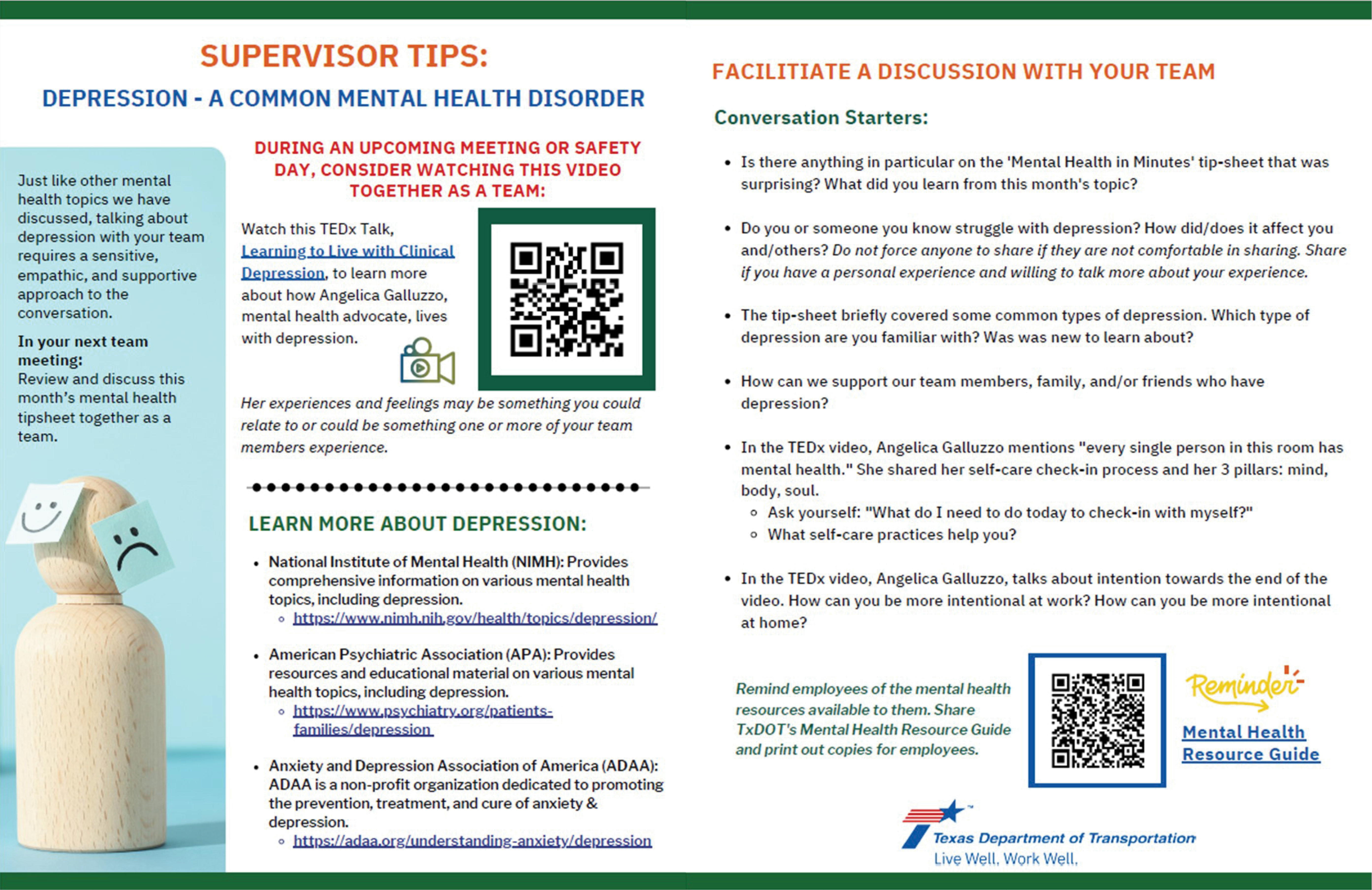
- Educational Support Material. Monthly tip sheets were developed to provide passive education to employees (e.g., factors that influence mental health, warning signs, how to start a mental health conversation, stress, anxiety, depression, burnout, substance use disorders, ADA rights). Accompanying supervisor tip sheets were also provided to help guide supervisors to have conversations about mental health during tailgate meetings (Figure 21). In addition, presentation slides were added to monthly safety calls to accommodate the monthly mental health focus topic. These tools are helping to normalize conversations about mental health.
Four districts within Texas DOT have adopted the Tune Up Your State of Mind program for use.
Suicide Prevention Initiatives
Texas DOT offers Question, Persuade, and Refer (QPR) training for suicide prevention. This training comes from the QPR Institute and teaches individuals how to ask if they are concerned about whether someone is considering suicide, how to persuade that person to get help, and how to refer them to professional help. Wallet cards have also been developed that provide warning signs of suicide and questions to ask to assess risk and intent. An example card is provided in Figure 22.
Future Mental Health Initiatives
An innovative program in development by the wellness team at headquarters is a peer support program to activate when critical incidents occur. Many times, DOT personnel might be the first ones on the scene of an event and may see things that impact their mental health. If these individuals were trained in a similar way to emergency response personnel, they would know more about what to do and would have better ways to cope with the memories of what happened. Although this program is in its infancy, the wellness team believes this will be beneficial, especially when employees witness something tragic while on the job.
Performance Measurement
The wellness team often utilizes qualitative metrics to measure the performance of mental health initiatives. Emails are received from district personnel thanking the wellness team for the campaign or for coming out to their office. In addition, the wellness team noted that more employees are becoming comfortable in talking about mental health and wellbeing and suicide prevention.
The wellness team performs survey evaluations for knowledge checks and to see if any behaviors changed toward mental health and suicide prevention. The wellness team also distributes pre- and post-training surveys on the QPR training to determine whether employees who have had the training feel more confident and comfortable having difficult conversations about mental health when someone they know is in a crisis. In addition, Texas DOT has seen an increase in employeesʼ use of the EAP counseling resources.
Long Description.
The Texas DOT flyer is aimed at supervisors and provides information on depression as a common mental health disorder. It includes tips for discussing mental health during meetings, a QR code linking to a video, and resources for learning more about depression. The left side highlights the importance of recognizing symptoms and offers a list of organizations for further support. The right side suggests conversation starters to engage team members in discussions about mental health, emphasizing the role of supervisors in creating a supportive environment. The flyer is designed to promote awareness and provide practical tools for addressing mental health in the workplace.

Long Description.
The Texas DOT infographic provides a guide for assessing suicide risk using the Columbia-Suicide Severity Rating Scale. It includes six questions to evaluate an individualʼs risk, such as inquiries about recent thoughts of self-harm or plans to act on these thoughts. The chart advises immediate help if certain responses are given. It also lists crisis resources, including calling 9 1 1 or calling or texting 9 8 8, for urgent support. The chart is designed to be a quick reference for identifying and responding to potential suicide risks.
The Substance Abuse program follows the U.S. DOT rules and regulations to ensure compliance. Program performance is monitored to maintain safety standards.
One of the barriers to effectively tracking the impact of mental health initiatives is confidentiality. When mental health affects an employee it is difficult to see—unlike a physical injury—which makes it difficult to know when someone is having issues. Also, many times those with mental health problems are unwilling to discuss them.
Organizational Dynamics
The cultural climate regarding mental health and wellbeing varies depending on the location in the state. Many of the urban areas are more accepting of and willing to discuss mental health. However, this is more of a challenge in rural areas, where the topic of mental health remains somewhat taboo. Normalizing the discussion of mental health typically falls on the leaders within each district and division. Some leaders are more willing than others to talk about mental health, suicide prevention, and addiction mitigation. Some leaders are even comfortable talking about their own mental health experiences, which helps other employees see that even management employees struggle sometimes. This helps with buy-in, but most leaders are not yet willing to do that. Leadership is important for gaining buy-in from employees, and lack of it impedes progress on mental health awareness. As the wellness team continues to educate employees and roll out new initiatives, the culture of mental health at Texas DOT will continue to evolve, and openness about mental health is expected to become more normalized over time.
In addition, Texas DOT hopes to integrate mental health and wellbeing with safety operations. Although there has been some collaboration with the agencyʼs Occupational Safety Division, safety efforts have primarily focused on the physical side, which remains essential. However, recognizing the connection between mental and physical safety is also critical. A personʼs mental state can significantly influence their risk of injury, decision-making, and overall safety.
Communication is a key component to raising mental health awareness and ensuring that employees are aware of the programs available to support their mental wellbeing. To make it easier for local HR district wellness leads and district leadership to share mental wellbeing information, the wellness team provides turnkey materials such as emails and flyers for the programs and campaigns. Local staff distributes the information; however, the wellness team currently has no way to track whether each district is actively communicating and promoting the mental health initiatives and benefits available at Texas DOT.
Another challenge in communication is that not all Texas DOT employees have an agency-issued cell phone. Maintenance personnel without a cell phone are not checking a computer for emails on a regular basis. The wellness team will continue to advocate to issue more agency cell phones to those in the field so that they receive important information on mental health education and associated programs. The wellness team also works with local HR district wellness leads and maintenance office managers to get the word out in ways other than through emails.
As the wellness team continues to promote mental health and wellbeing and develop initiatives, trust is important for providing mental health awareness and initiatives to employees. For Texas DOT employees to accept and gain interest in mental health and wellbeing, they need to be able to trust the people communicating the information. This highlights the importance of having the wellness team, district leadership, and local district HR representatives visit the maintenance offices across the state. By doing this, trust is established between the wellness team and district employees. Once maintenance crews see that leadership and HR employees are just like them, they are more willing to listen and engage with the mental health initiatives offered by the agency.
A lack of resources and funds makes it difficult to develop and implement mental health initiatives. One idea that Texas DOT would like to implement if more resources were made available would be to hire a mental health professional for the field personnel. That person would be available for education and implementation of programs. The mental health professional would also know what district employees are looking for and could roll out specific initiatives to match what the district employees want and need.
Overall, Texas DOT has emphasized mental health, suicide prevention, and addiction mitigation as important to supporting employeesʼ wellbeing. Several programs and initiatives have been implemented, some with better success than others. Discussions about mental health are now more commonplace, but still not at the desired level. Further education and programs will continue to help improve employee mental health.
Case Examples Summary
The five case examples have provided in-depth information about the state of the practice regarding state DOT programs for mental health and wellbeing, suicide prevention, and addiction mitigation. Each of the state DOTs serving as a case example was asked to discuss the policies in place for mental health and wellbeing, the approaches the DOT takes to promote awareness of the programs and associated resources; details of the actual programs for mental health, suicide prevention, and substance abuse; performance measures used to monitor and track the programsʼ effectiveness; and the organizational dynamics that influence how information is communicated, including challenges in communicating to all employees and working toward normalizing discussions on mental health and wellbeing.
Table 6 outlines the similarities and differences found across the five DOTs in terms of the type of programs they have and how policies are developed for mental health, suicide prevention, and addiction mitigation.
In order for employees to obtain assistance with mental health and wellbeing, employees need to be made aware of the programs available. Table 7 outlines the awareness campaigns that each of the five case example DOTs have in place currently. As shown, each state has a variety of campaigns for awareness and programs for mental health and wellbeing, suicide prevention, and addiction mitigation. Each state DOT uses emails and supervisors to communicate information. In addition, each state has an EAP available to all employees that includes resources for mental health and wellbeing.
Means of measuring and tracking mental health, suicide prevention, and addiction mitigation programs at each of the case example state DOTs is presented in Table 8. In each case example,

Long Description.
The column headers of the table are DOT, Type of Program, and Policy Development. The row headers of the table are Alabama, Kansas, Michigan, Mississippi, and Texas. The data given in the table row-wise are as follows: Row 1: Alabama: One program facilitated by central office staff; Mental health and suicide prevention: External state agency (Division of Risk Management); Substance abuse: DOT. Row 2: Kansas: Separate programs for mental health and suicide prevention, and substance abuse facilitated by HR staff at the central office; Mental health and suicide prevention: External state agency (Division of Safety); Substance abuse: DOT. Row 3: Michigan: Separate programs for mental health and suicide prevention, and substance abuse program facilitated by safety personnel at headquarters; Mental health and suicide prevention: External state agency (Civil Services Commission); Substance abuse: DOT. Row 4: Mississippi: Separate programs for mental health and suicide prevention, and substance abuse program facilitated by HR department at headquarters; Mental health and suicide prevention: External state agency; Substance abuse: DOT. Row 5: Texas: Wellness Program initiatives, EAP contract management, and Substance Abuse Program are facilitated by HR department; HR manual includes information on the wellness program, EAP, and substance abuse program: DOT.

Long Description.
The column headers of the table are DOT, Awareness Campaigns, and Programs. The data given in the table row-wise are as follows: Row 1: Alabama: Internal webpage; Monthly newsletters; Office policy boards; Supervisors communicate information; Employee assistance program; Monthly DOT training; Third-party construction organization training. Row 2: Kansas: Emails; Flyers or Posters; Key chains; Wallet cards; District meetings; HR staff greeting and having coffee with employees; Employee assistance program; Peer support training. Row 3: Michigan: Monday Minute newsletter; Presentations; Supervisors (area engineers) communicate information; Collaboration with construction organizations (MITA and ACEC); Employee services program including free counseling, 24-hour services, suicide prevention resources and phone numbers, and wellness sessions; Employee resource group; Standardized training (in development). Row 4: Mississippi: Emails from program specialists; Supervisors communicate information; Information posted in all offices; Human resource professionals in all districts; Employee assistance program including short-term counseling, emergency and crisis services, trauma briefings, marriage or grief or addiction counseling; Training for supervisors and employees. Row 5: Texas: HR generalists in each district communicate information; Maintenance Office Managers pass along information to field personnel; Monthly Wellness Highlightʼ flyers; Road to Wellnessʼ articles; Internal webpage; TV screens present information in offices; Texas DOT Newsbreak; Wellness fairs; Employee assistance program; Annual campaigns with a theme; Suicide awareness presentations; “Tune Up Your State of Mind” program; Question. Persuade. Respond. (QPR) suicide prevention training; Wallet cards (Mental Health Resources and Suicide Prevention); Peer support program (in development).

Long Description.
The column headers of the table are DOT and Performance Measures. The data given in the table row-wise are as follows: Row 1: Alabama: Voluntary feedback from employees; Tracking training received by employees. Row 2: Kansas; Voluntary feedback from employees; Survey of employees (in development). Row 3: Michigan: Voluntary verbal feedback from employees; Annual performance reviews include factors for employees to take steps in improving their mental and physical well-being. Row 4: Mississippi: Voluntary feedback from employees; Formal feedback loop and tracking program (in development). Row 5: Texas: Voluntary feedback from employees (emails, conversations); Survey evaluations for knowledge checks and to see if any behaviors changed toward mental health and suicide prevention; Pre- and post-training surveys for QPR training.
the performance of programs is based on voluntary feedback provided by DOT employees via email or conversations.
Lastly, challenges were collected from each of the case example state DOTs, as listed in Table 9. From the five DOT case examples, communication to frontline field workers, lack of engagement with and trust in the information provided from central offices or headquarters, and providing low-cost programs are the primary challenges noted.

Long Description.
The column headers of the table are DOT and Challenges. The data given in the table row-wise are as follows: Row 1: Alabama: Inadequate information to track effectiveness of programs due to confidentiality; Disseminating information to frontline workers and those that really need the programs; Providing low-cost programs. Row 2: Kansas: Complaints about the mental health resources available in the EAP; Perceived lack of trust regarding information provided by central office staff; Gaining buy-in from field staff. Row 3: Michigan: Communication of information to all employees for a large agency; Lack of engagement due to information coming from headquarters. Row 4: Mississippi: Inadequate information to track effectiveness of programs due to confidentiality requirements; Communicating information to field personnel; Providing low-cost programs. Row 5: Texas: Field employees lack DOT-issued cell phones and devices; Lack of process to track whether information passed along to supervisors was shared with employees; Unable to connect physical safety with mental health initiatives.


