Mexico City's Water Supply: Improving the Outlook for Sustainability (1995)
Chapter: 4 Water Supply, Distribution, and Disposal
4
Water Supply, Distribution, and Disposal
The management of water resources for the Mexico City Metropolitan Area (MCMA) is a large and complex problem, and the integration of water resource and institutional information is no easy task for any large city. In this chapter, information is presented on the quantities of water derived from the various sources, the treatment and distribution of this water, wastewater treatment, the drainage system, and water reuse. In many respects, this effort represents the first time that water resource information of this nature has been integrated for the MCMA. The water management agencies for the Federal District and State of Mexico have typically maintained data necessary for operation, maintenance, and planning of their respective service areas. Much of this information is not in a published form or readily available. In attempting to portray the water supply system for the entire metropolitan area, the committee requested and received a high level of cooperation from authorities of the principal water management agencies. The quantitative data for water supply, distribution, and disposal may be incomplete or imprecise in some respects; however, it presents the current picture of water management in the MCMA, and the presentation can be improved upon with further cooperation and open exchange of information. Recent institutional changes in Mexico are now encouraging a more holistic approach to water basin management, and these changes are discussed in Chapter 7.
WATER SUPPLY AND DISTRIBUTION
Characteristics of the Service Areas
Management of water and wastewater service within the MCMA is shared by the Federal District and the State of Mexico, who are each responsible for providing potable water and wastewater collection and disposal within their jurisdictional boundaries. The National Water Commission is responsible for delivery of water in bulk to the service areas, for operation of many of the deeper water supply wells, and the operation of various aspects of the hydraulic works dealing with importation of water from neighboring basins. Table 4.1 shows some of the water use characteristics of the MCMA.
The size of the Federal District is approximately 1,504 square kilometers. Whereas the entire district is considered a part of the MCMA, the southern portion of the district is sparsely populated and a smaller area of approximately 667 square kilometers is actually serviced by the common water distribution system and the wastewater collection system. Residents who do not have piped access rely on tank trucks for delivery of water, or on local wells and springs. Authorities have been attempting to restrict urbanization in this southern portion of the district because of the difficulties in providing basic services, and because it represents an important natural ground water recharge zone.
According to the Water and Sanitation Commission of the State of Mexico, the metropolitan area extends to the east, north, and west of the Federal District into 17 counties of the State of Mexico, having a total area of 2,269 square kilometers. Like the Federal District, a smaller area of approximately 620 square kilometers is served by the common water distribution and wastewater collection systems. Together, the two metropolitan service areas equal 1,287 square kilometers.
According to the 1990 census, 94 percent of the 15.1 million residents of the MCMA are serviced with a water connection either directly to the house or from a common distribution faucet in the neighborhood (INEGI, 1991a). A higher service level (97 percent) occurs in the Federal District than in the State of Mexico (90.5 percent). The balance of residents must obtain their water from tank trucks, supplied either by the government or at relatively great expense by private vendors. Values for average per capita water use, as reported by the Federal District and the State of Mexico are 364 and 230 liters per day respectively. Authorities attribute the larger per capita use in the Federal District to the fact that the Federal District is more developed and includes more commercial and industrial activity than the State of Mexico. Also, there are many private industrial wells within the State of Mexico not reflected in the estimates. Average per capita water use is not excessive when compared to that of the United States, which ranges from 250 to 1120 liters per day with an average of 660 liters per day (Tchobanoglous and Schroeder, 1985).
TABLE 4.1 Characteristics of the Mexico City Metropolitan Area and Usage of Water Supplied to the Federal District and the State of Mexico.
| Federal District | State of Mexico |
Total area of the MCMA (square kilometers) | 1504 | 2269 |
Area served by the common water distribution and wastewater disposal systems (square kilometers) | 667 | 620 |
Population of the MCMA (millions) | 8.3 | 6.8 |
Daily per-capita water usage (liters) | 364 | 230 |
Water usage by category (percent) | ||
Domestic | 67 | 80 |
Industrial | 17 | 17 |
Commercial and Urban Services | 16 | 3 |
Sources of information: Departamento del Distrito Federal, 1992b; Comisión Estatal de Aguas y Saneamiento, 1993; INEGI, 1991a. | ||
An important aspect of water service is the amount of unaccounted water lost due to leaks within the distribution system. In the United States, 15 percent is often used as a rule-of-thumb estimate in the absence of better data. An analysis by Boland (1983), based on 1981 data collected by the American Water Works Association, indicated that for 120 U.S. water utilities, the unaccounted fraction ranged from 0.00 to 0.55, with a simple (unweighted) average of 0.12. The estimate of 15 percent has been used by the National Water Commission in Mexico for planning purposes, however, the National Water Commission acknowledges that estimates of water losses through leakage in the MCMA vary widely and could be as high as 40 percent in some parts of the service area. Transmission losses, corrective actions, and water services are discussed further in Chapter 6.
Sources of Water
The current water use of the MCMA is approximately 60 cubic meters per second (cms) (Departamento del Distrito Federal, 1992b; Comisión Estatal de Agua y Saneamiento, 1993). Approximately 43 cms, or almost 72 percent of the water used, is drawn from various well fields that tap the aquifer throughout the Basin of Mexico (Table 4.2). The Federal District and State of Mexico
TABLE 4.2 Source and Quantity of Raw Water Supplied to the Federal District and State of Mexico Service Areas. All values are in cubic meters per second (cms).
Raw Water Sources | Federal District | State of Mexico | Total |
Basin of Mexico |
| ||
Well fields | 22.7 | 20.3 | 43.0 |
Magdalena River | 0.2 | - | 0.2 |
Madin Dam | - | 0.5 | 0.5 |
Springs, streams | 0.5 | 0.2 | 0.7 |
Imported Sources |
| ||
Cutzamala River | 7.6 | 3.0 | 10.6 |
Lerma well fields | 4.3 | 1.0 | 5.3 |
Total Water Supply | 35.3 | 25.0 | 60.3 |
Sources of information: Departamento del Distrito Federal, 1992b; Comisión Estatal de Agua y Saneamiento, 1993. | |||
combined have 1,089 registered wells at depths of 70 to 200 meters. This does not include wells operated by the National Water Commission, which are deeper. There are also a large number of non-registered wells, many of which are located in the State of Mexico. Wells are generally located in four different well fields within and surrounding the MCMA. These are labeled as South (or Xolchimilco), Metropolitan, East (or Texcoco region) and North well fields. Slightly greater rates of extraction (45 cms) have been reported by Mazari and Mackay (1993). Imported water from the Cutzamala and Lerma basins (see Figure 4–1) contribute about 26 percent of the total supply. The quantities provided by each of the water sources are shown in Table 4.2. Except in the case of the Magdalena River and Madin Dam, the same raw water sources supply the metropolitan service areas of both the Federal District and the State of Mexico (Departamento del Distrito Federal, 1992b; Comisión Estatal de Agua y Saneamiento, 1993).
Surface water within the Basin of Mexico contributes only about 2 percent (1.4 cms) of the water supply for the MCMA. The Magdalena River supplies water to the Federal District, whereas the Madin Dam on the Tlalnepantla River supplies the State of Mexico. Small, naturally occurring springs and streams are used where available, and these sources also enter the distribution system directly.
By the 1930s, continued subsidence and the realization that ground water supplies within the Basin of Mexico were being depleted had already prompted authorities to explore sources of water outside the basin. In 1941, construction began on a 15 kilometers long aqueduct to transfer water from wells in the
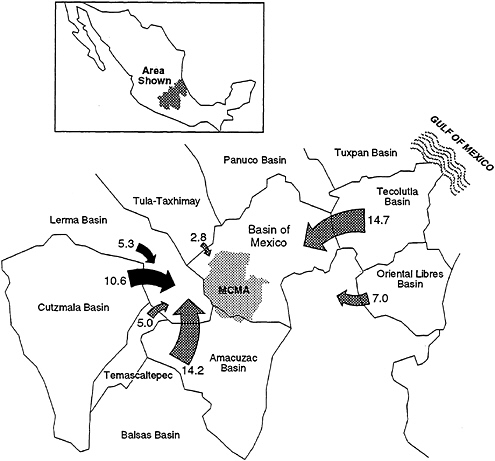
FIGURE 4–1 Shown in shaded arrows, the MCMA currently receives 10.6 cms of imported water from the Cutzamala Basin and 5.3 cms from the Lerma Basin, which are added together in the Cutzamala-Lerma System. Other arrows and quantities (in cms) indicate potential new sources for the MCMA based on studies by the National Water Commission.
Lerma Basin over the Sierra de las Cruces divide to Mexico City and the Basin of Mexico. In 1982, a more ambitious project was initiated that delivered surface water from the Cutzamala River Basin, a distance of 127 kilometers and a net rise in elevation of 1,200 meters. Currently, the Cutzamala-Lerma project is a combined system that delivers water from both the Cutzamala River and the Lerma Basin and contributes approximately 26 percent of the water supplied to
the MCMA. The relation of these neighboring basins to the Basin of Mexico is depicted in Figure 4–1.
The Cutzamala-Lerma System draws 10.6 cms of water from the Cutzamala River. After treatment near the withdrawal points, the Cutzamala River water is transported by aqueduct. Ground water imported from the Lerma Basin (4.3 cms) is disinfected with chlorine and added to the same aqueduct before the water reaches the MCMA distribution system. A separate aqueduct supplies the State of Mexico service area with 1.0 cms of ground water from the Lerma Basin.
As shown in Figure 4–1, the federal government has identified other sources of water from neighboring basins for their potential contribution to the water supply of the MCMA. According to the National Water Commission, the quantities of water potentially available from other neighboring basins add up to 43.7 cms, equal to the total extraction rate of the Mexico City Aquifer. The costs to import water from these areas are not known to the committee. At present, the government plans to import 5 cms of water from the Temascaltepec Basin, and is considering the importation of 14.2 cms from the Amacuzac Basin.
Water Treatment
Two water supply treatment plants treat surface water sources within the Basin of Mexico for delivery to the MCMA. The Federal District operates the Magdalena River treatment plant, which provides alum coagulation/flocculation, gravity sedimentation, rapid sand filtration, and chlorine disinfection. The National Water Commission operates a surface water treatment plant at Madin Dam, which supplies the State of Mexico service area and uses a similar treatment process as the Magdalena plant.
The National Water Commission treats imported Cutzamala River water at its source at the Los Berros treatment plant. Water treatment consists of prechlorination, alum coagulation/flocculation, gravity sedimentation, and rapid sand filtration. This plant is currently treating 10.6 cms of water (as was shown in Table 4.2) and is operating somewhat over its design capacity of 10 cms. Treatment takes place near the source of extraction, after which it enters the Cutzamala-Lerma System and is transported to the MCMA.
Treatment of ground water sources consists of chlorination to give a total residual of 0.2 milligrams/liter prior to entering the distribution system. Additionally, there are 326 re-chlorination stations throughout the distribution system to maintain the chlorine residual. The Federal District has three treatment plants that were originally designed for varying levels of advanced ground water treatment including removal of dissolved gases, color, iron, hardness reduction, filtration, and chlorination. These plants are old and in poor condition, and according to the water works department of the Federal District, they now sim-
ply provide disinfection with chlorine. There are other pilot plants performing a small amount of advance treatment of ground water on an experimental basis.
The Water Distribution System
The Federal District service area includes nearly 11,000 kilometers of distribution lines and 243 storage tanks with a capacity of 1.5 million cubic meters. Water from all the separate sources is added to the common distribution system. The Federal District is currently constructing a water transmission line (the Acueducto Periférico) that will transport water from the Cutzamala System—entering the distribution system from the west—to the southern and eastern part of the district (Departamento del Distrito Federal, 1992b).
The State of Mexico system has nearly 800 kilometers of distribution lines and 32 storage tanks with a capacity of 440,000 cubic meters. The State of Mexico operates the 49 kilometer water transmission line (the Macrocircuito) to transport water entering from the west side of the service area (including the imported water from the Cutzamala-Lerma System) to the east side (Comisión Estatal de Agua y Saneamiento, 1993). This transmission line is being upgraded to increase the volume of water taken from the Cutzamala-Lerma system to 7.3 cms, and to provide service to the eastern service area.
As mentioned, and shown in Table 4.2, the Federal District and the State of Mexico service areas share water from all sources, except for the Magdalena River serving the Federal District, and Madin Dam serving the State of Mexico. The Federal District and the State of Mexico service areas within the MCMA are each divided into five water service districts, and water enters the distribution system at designated “entrance points” at one or more locations in each service district. Figure 4–2 shows a map of the water service districts and the associated entrance points within the Federal District. Comparable information for State of Mexico service area was not made available for this report. Figure 4–3 is an attempt to show the quantities of water from each of the various ground and surface water sources as it is divided between the Federal District and the State of Mexico. Ground water is extracted within each of the water districts and directly enters the distribution system. Quantities of water are also collected from well fields outside of the service areas, from surface water sources within the basin, and are imported from the Cutzamala-Lerma System. Water collected within a particular service district does not necessarily enter the distribution system within the same service district. For example, water extracted from wells in the South Service District apparently enter the distribution system in the East and Central Service Districts. For the purposes of this report, it is sufficient to say that the distribution system is complex and interconnected throughout the MCMA. The information presented here is not published elsewhere, and as far as the committee is aware, this is the first attempt to
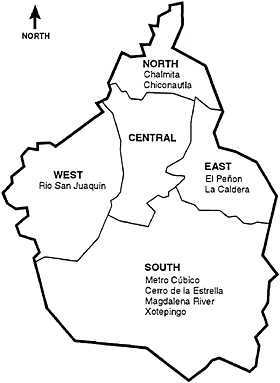
FIGURE 4–2 Water service districts within the Federal District and names of associated entrance points where water enters the distribution system.
describe water distribution for both the Federal District and State of Mexico service areas in a combined approach.
WASTEWATER COLLECTION AND DISPOSAL
A single, combined wastewater and stormwater collection system serves both the Federal District and the State of Mexico service areas in the MCMA. Each service area has its own sewer network; however, all the sewers eventually discharge into main interceptors of the general drainage system, conducting
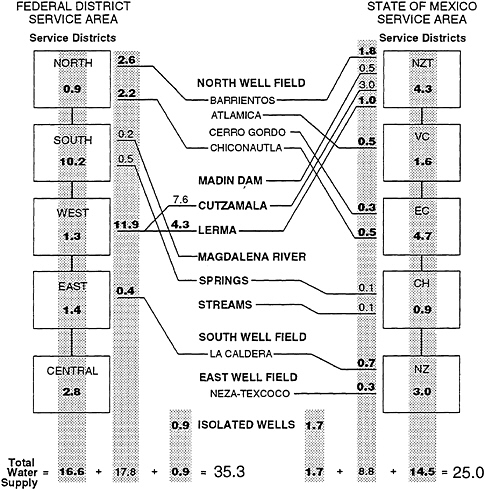
FIGURE 4–3 Schematic diagram of how quantities of water are allocated within the Federal District and the State of Mexico service areas in the MCMA. Bold numbers are quantities from ground water sources; plain numbers identify surface water sources. Ground water is extracted within each service district. Lines show quantities of water that enter the service districts from other sources, which, except for Cutzamala and Lerma, are within the southern portion of the Basin of Mexico. The Federal District and State of Mexico maintain separate distribution systems, but the service districts within each service area are interconnected.
the wastewater through four artificial exits located at the northern end of the basin. The main components of the drainage system, labeled in Spanish, are shown in Figure 4–4. The system network is over 10,000 kilometers long with 68 pumping stations, numerous dams (presa), lagoons, and regulatory tanks for flow control, 111 kilometers of open canals, 42 kilometers of rivers (rio) used primarily for drainage, and 118 kilometers of underground collectors (interceptor and emisor) and tunnels.
Based on the 1990 census (INEGI, 1991a), 82 percent of the 15 million residents in the MCMA are connected to the sewer system. About 6 percent use septic tanks, and over 9 percent are not serviced by any kind of drainage system. However, differences within the service areas are notable, with some counties supporting less than half the residents on a sewer system. Additional information on sewer service is provided in Chapter 6.
Domestic and industrial wastewater discharges and stormwater are collected in the secondary network (consisting of small pipe service at the neighborhood level), and then carried by the primary network into the General Drainage System flowing out of the basin to the north. The State of Mexico reports that the total dry weather flow for the MCMA, which consists mainly of untreated municipal wastewater, is estimated at 44.4 cms (Comisión Estatal de Agua y Saneamiento, 1993). During the rainy season, the region experiences many storms of high intensity and short duration. A single storm can produce up to 70 millimeters (about 3 inches) of rainfall, representing 10 percent of the total annual precipitation. Because of this rainfall pattern, and the irregular geography, the general drainage system was designed to carry 200 cms over a 45 hour period (Departamento del Distrito Federal, 1969; See AIC-ANIAC, 1994 for a detailed description of the drainage system).
Wastewater Treatment
Currently, 90 percent of the municipal wastewater from the MCMA remains untreated and is diverted out of the Basin of Mexico through the general drainage system. The untreated wastewater is then used to irrigate 80,000 hectares of farmland in the Valley of Mezquital in the State of Hidalgo to the north. Irrigation return flow drains into tributaries of the Panuco River, which empties into the Gulf of Mexico.
The approximately 10 percent of wastewater treated in the MCMA is for local reuse projects such as ground water recharge and agricultural and urban-landscape irrigation. There are 13 wastewater treatment plants in the Federal District and 14 in the State of Mexico service area treating a total flow of 2.62 and 1.69 cms respectively (Departamento del Distrito Federal, 1992b; Comisión Estatal de Agua y Saneamiento, 1993).
Table 4.3 gives the combined flow during both the dry and rainy seasons and the characteristics of the wastewater as it exits the basin through the Grand
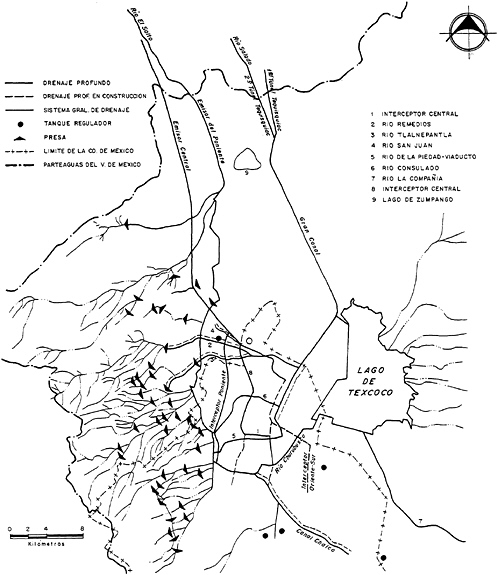
FIGURE 4–4 Main components of the general drainage system of the Mexico City Metropolitan Area. Portions of the hydrologic boundary (parteagues de V. de México) of the basin and Federal District boundary (Limite de la Cd. de México) are shown. See text for explanation. Source: Departamento del Distrito Federal, 1982.
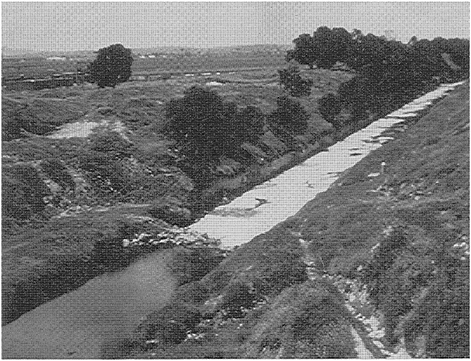
Photo 4–1 A view of the Grand Drainage Canal (Gran Canal Desaugüe), which carries wastewater and stormwater runoff from the Mexico City Metropolitan Area. The canal exits the Basin of Mexico through the Tequisquiac tunnel and empties into the Moctezuma River, a tributary to the Panuco River, which flows into the Gulf of Mexico. Courtesy of Robert Farvolden.
Drainage Canal (dry weather flow) or the deep drainage line (wet flow). The values given for the several contaminants are the average concentration for 1992. The U.S. average and the concentrations of these same contaminants in a typical raw municipal wastewater in the United States, with respect to being either weak, medium, or strong, are also given for the purpose of comparison (U.S. Environmental Protection Agency and U.S. Agency for International Development, 1992).
The level of many of the contaminants in the wastewater and the combined flow during both the dry and rainy seasons is similar and sometimes greater than that of typical wastewater in the United States. The very high concentration of total solids, total dissolved solids, and phosphorous, and to a lesser extent nitrites and nitrates, could be the result of untreated industrial wastewater discharge.
Tables 4.4 and 4.5 list the treatment plants serving the Federal District and the State of Mexico service areas, together with their design and current opera-
TABLE 4.3 Characteristics of Wastewater Flow in the Grand Canal as it Exits the Basin of Mexico.
Contaminantsa | Dry Weather Flow | Rainy Season Flow | Concentration Rangeb | United States Averageb | ||
| Weak | Medium | Strong |
| ||
Total solids | 1800 | 1800 | 350 | 720 | 1200 | — |
Total dissolved solids | 1611 | 1445 | 250 | 500 | 850 | — |
Total suspended solids | 179 | 357 | 100 | 220 | 350 | 192 |
Settleable solids, mL/L | 2.0 | 2.33 | 5 | 10 | 20 | — |
Nitrate, as N | 0.30 | .030 | 0 | 0 | 0 | 0.60 |
Nitrite, as N | 0.06 | 0.06 | 0 | 0 | 0 | — |
Total phosphorous, as P | 30 | 30 | 4 | 8 | 15 | 6.80 |
BOD | 240 | 187 | 110 | 220 | 400 | 181 |
aAll values as mg/L, except as noted. bU.S. Environmental Protection Agency and U.S. Agency for International Development, 1992. | ||||||
tional capacity, type of treatment provided, and reuse practice (Departamento del Distrito Federal, 1992b; Comisión Estatal de Agua y Saneamiento, 1993). The current flow of the 13 treatment plants within the Federal District service area (Table 4.6) is only 55 percent of design capacity, i.e., 2.621 versus 4.623 cms (Departamento del Distrito Federal, 1992b). Secondary treatment at all of these plants is provided by utilizing the activated sludge process.
Where tertiary treatment is practiced, it consists of coagulation/flocculation, sedimentation, sand filtration, and disinfection. In the case of disinfection, chlorine is added to achieve a 1 milligram per liter total residual at either the treatment plant or point of reuse.
The wastewater treatment plants in the Federal District are located to serve specific zones within the service area. Therefore, the raw wastewater characteristics at each plant are likely to be different, depending upon the source of the wastewater, e.g., domestic versus industrial. The treatment plants at El Rosario, Acueducto de Guadalupe, and Colegio Militar have performed poorly. The major problems associated with the wastewater at these three plants are reported to be high content of grease, oils, phosphorous, nitrites, and nitrates; low removal of alkalinity and hardness; and a high electric conductivity. A high concentration of oil and grease is known to cause operational problems with a
TABLE 4.4 Wastewater Treatment Plants Within the Federal District Service Area.
Plant | Design Capacity (cms) | Current Flow (cms) | Type of Treatment Provided | Reuse Practice |
Chapultepec | 0.160 | 0.106 | Secondary | RIC, ULI |
Coyoacán | 0.400 | 0.336 | Secondary | RIC, ULI |
Ciudad Deportiva | 0.230 | 0.080 | Secondary | ULI |
Sn. Juán de Aragón | 0.500 | 0.364 | Secondary | RIC, ULI |
Tlatelolco | 0.022 | 0.014 | Secondary | ULI |
Cerro de la Estrella | 3.0 | 1.509 | Secondary | GRI, AI |
Bosque de las Lomas | 0.055 | 0.027 | Secondary | ULI |
Acueducto de Guadalupe | 0.08 | 0.057 | Secondary | ULI |
El Rosario | 0.025 | 0.022 | Tertiary | RIC, ULI |
S.L. Tlaxialtemalco | 0.075 | 0.055 | Tertiary | RIC, GRI |
Reclusorio Sur | 0.030 | 0.013 | Secondary | RIC, ULI |
Iztacalco | 0.013 | 0.010 | Tertiary | RIC, ULI |
Colegio Militar | 0.020 | 0.018 | Secondary | RIC, ULI |
Total Capacity | 4.623 | 2.621 |
| |
RIC: Recreational Impoundments with Incidental Contact; GRI: Ground Water Recharge by Injection; ULI: Urban Landscape Irrigation; AI: Agricultural Irrigation. Source: Departamento del Distrito Federal, 1992b. | ||||
variety of secondary and tertiary treatment processes. Of these three plants, only El Rosario provides tertiary treatment. But the tertiary treatment it provides can only reduce the concentration of phosphorous; the unit operation and processes employed at this plant are not designed to remove nitrites and nitrates. The quality of the treated effluent at the other 10 treatment plants is reported to meet the requirements for their specific reuse purpose.
In the case of the 14 treatment plants within the State of Mexico service area (Table 4.5), it is noted that 7 (50 percent) of the plants are currently being operated at less than their designed flow capacity (Comisión Estatal de Agua y Sanimiento, 1993). Because some of the treatment plants are operated by either an industry or the county in which the plant is located, information on the operation and performance of all the plants was not available from the State of Mexico water and sanitation department.
The handling, treatment, and disposal of the residual or sewage sludge solids normally generated at wastewater treatment plants is a major consideration. These residuals can pose a hazard if not treated or disposed of properly. How-
TABLE 4.5 Wastewater Treatment Plants Within the State of Mexico Service Area.
Plant | Design Capacity (cms) | Current Flow (cms) | Type of Treatment Provided | Reuse Practice |
Pintores | 0.005 | 0.005 | Secondary | ULI |
Naucalli | 0.040 | 0.030 | Secondary | ULI |
S.J. Ixhuatepec | 0.150 | 0.030 | Secondary | IR |
Nezahualcoyotl | 0.200 | NA | Secondary | ULI |
U. de Chapingo | 0.040 | 0.040 | NA | ULI |
Lago de Texcoco (two treatment plants) | 1.50 | 1.000 | Secondary Tertiary | AI, L |
Termoeléctrica V. de México | 0.450 | 0.250 | Secondary | IR |
P. Sn. Cristobal | 0.400 | 0.250 | Secondary | IR |
Lechería | 0.030 | 0.010 | Secondary | IR |
Ford | 0.030 | 0.030 | Secondary | IR |
Club de Golf Chiluca | 20 | 20 | NA | ULI |
Revillagigedo Chiluca | 20 | 20 | NA | IR |
La Estadía Chiluca | 20 | 20 | NA | IR |
Total Capacity | 2.905 | 1.685 |
| |
ULI: Urban Landscape Irrigation; AI: Agricultural Irrigation; IR: Industrial Reuse; L: Lake Augmentation; NA: Not Available. Source: Comisión Estatal de Agua y Saneamiento, 1993. | ||||
ever, because wastewater treatment in the MCMA is performed for water reuse, rather than for disposal purposes, the sludge produced is apparently returned directly to the sewer system without any treatment.
WATER REUSE AND RECYCLING
Water reuse refers to the practice of reclaiming waters of impaired quality and using them, after suitable levels of treatment, for beneficial purposes. Water recycling refers to the capture and return of water of impaired quality for use in the same process that generated it; this can often be accomplished without excessive treatment of the water, such as with an industrial closed-loop cooling system. Municipal wastewater, which includes the used water generated by residences, commercial establishments, and often industrial facilities, is the most generally available source of reuseable water, following a suitable degree of treatment. Other sources of water of impaired quality have been considered for reuse, such as stormwater runoff and agricultural irrigation return flow.
However, the quality of these other sources is less predictable than treated municipal wastewater, and their suitability for reuse is not as well known (National Research Council, 1994). Table 4.6 (Metcalf and Eddy, 1991) identifies possible reuse applications for reclaimed municipal wastewater, together with the major concerns associated with each (for additional information, see U.S. Environmental Protection Agency and U.S. Agency for International Development, 1992).
Water reuse activities in the MCMA officially began in 1984 under the National Program for Efficient Use of Water (Departamento del Distrito Federal, 1990b). Water reuse was one component of a larger program to reduce water loss and improve system revenues. During the period 1990–1992, the program concentrated on several reuse activities in the MCMA, including protection of the natural aquifer recharge zones; aquifer recharge with storm water and reclaimed municipal wastewater; and use of reclaimed wastewater in industrial and service sectors.
This national program included the establishment of new wastewater discharge regulations by the Federal District, and in 1990, provisions were established for an industrial pretreatment program—an important prerequisite for any reclamation and reuse activity. However, little information is available on the extent and success of industrial pretreatment programs in the MCMA. Within the Federal District service area, the 2.62 cms of treated reused wastewater (Table 4.3) is distributed as follows: 83 percent-urban landscape irrigation and recreational impoundments, 10 percent-industrial, 5 percent-agricultural irrigation, and 2 percent-commercial, e.g., car washing (Departamento del Distrito Federal, 1992b).
The State of Mexico has also implemented a program specifically designed to increase the reuse of reclaimed municipal wastewater. The program goals include the development of feasibility studies for the construction of additional treatment systems and a distribution network for delivering reclaimed wastewater for reuse; the promotion of water reuse projects within both the public and private sectors; the rehabilitation of existing wastewater treatment plants; the preparation of operation and maintenance manuals and other documents for improved management of wastewater treatment and reuse systems; and a quantification of the potable water now being used for various purposes which could potentially be replaced with reclaimed wastewater. Under this program, potential water reuse activities—including agricultural irrigation, industrial use, urban landscaping, and aquifer recharge—have been identified within specific service districts of the State of Mexico service area. By the year 2000, the State of Mexico intends to have four new wastewater treatment plants with a total capacity of 8.6 cms (Comisión Estatal de Agua y Saneamiento, 1993).
Industries in the Federal District are recycling or reusing 2.4 cms of wastewater, largely for cooling water. This quantity is reportedly a 25 percent increase from the level of reuse in 1990 and double that of 1988. Many industries
TABLE 4.6 Wastewater Reuse Applications for Reclaimed Municipal Wastewater and Major Concerns Associated With Each Use.
Wastewater Reuse Applications | Concerns |
Agricultural Irrigation Crop irrigation; Commercial nurseries. Landscape Irrigation Park; School yard; Freeway median; Golf course; Cemetery; Greenbelt; Residential | Surface- and groundwater pollution if not properly managed; Marketability of crops and public acceptance; Effect of water quality, particularly salts, on soils and crops; Public health concerns related to pathogens (bacteria, viruses, and parasites); Use area control including buffer zone. May result in high user costs. |
Industrial Recycling and Reuse Cooling; Boiler feed; Process water; Heavy construction | Constituents in reclaimed wastewater related to scaling; corrosion, biological growth, and fouling; Public health concerns, particularly aerosol transmission of pathogens in cooling water |
Nonpotable Urban Uses Fire protection; Air conditioning; Toilet flushing | Public health concerns on pathogens transmitted by aerosols; Effects of water quality on scaling, corrosion, biological growth, and fouling; Cross-connection. |
Groundwater Recharge Groundwater replenishment; Salt water intrusion control; Subsidence control | Organic chemicals in reclaimed wastewater and their toxicological effects. Total dissolved solids, nitrates, and pathogens in reclaimed wastewater |
Recreational & Environmental Uses Impoundments, lakes, and ponds; Marsh enhancement; Streamflow augmentation; Fisheries; Snowmaking | Health concerns of bacteria and viruses; Eutrophication due to N and P in receiving water; Toxicity to aquatic life. |
Potable Reuse Blending in water supply reservoir; Pipe to pipe water supply. | Constituents in reclaimed wastewater, especially trace organic; chemicals and their toxicological effects; Aesthetics and public acceptance; Health concerns about pathogen transmission, particularly viruses. |
Source: Metcalf and Eddy, Inc., 1991. | |
have the potential of recycling or reusing wastewater. Private industry has already shown interest in the benefits of water reuse. For example, 26 private companies in the Vallejo area of the MCMA initiated a reuse program in 1989 by establishing a for-profit firm, Aguas Industriales de Vallejo (World Bank, 1992). The firm rehabilitated an old municipal wastewater treatment plant and distributes reclaimed water to its shareholder companies at three-quarters of the cost of government supplied potable water. Likewise, it has been estimated that most of the treated wastewater associated with the State of Mexico service area is reused by industry. The potential market for reclaimed wastewater varies with the type of treatment processes employed, but can be influenced by governmental policy on water pricing and wastewater permits. These policy considerations are explored more fully in Chapters 6 and 7.
A major wastewater reclamation and reuse scheme is being developed at Lake Texcoco in conjunction with programs for flood control and dust abatement. Historically, Lake Texcoco covered much of the lower elevations within the southern portion of the Basin of Mexico. Between flooding, the shallow, saline lake bed would dry and produce severe dust storms (Marsal, 1974). In response to this problem, the Texcoco Plan was established in 1971. The solution was to create smaller, more permanent ponds within the large, intermittent lake bed, and to rehabilitate the problem areas for further urban and agricultural expansion (e.g., using windbreaks, revegetation, agricultural irrigation, and drainage improvements). Interestingly, the artificial and more permanent lakes were created using lessons learned from the subsidence problem. High rates of pumping consolidated the clays and lowered the old lake bed by about 4 meters in places. The reuse component of the Texcoco plans include the construction of a facultative lagoon wastewater treatment system, and reclamation of the collected stormwater for agricultural irrigation. Thus, the potable water currently used for this purpose will be replaced.
Reclaimed wastewater has been added to recreational impoundments within the Federal District through several reuse projects. A portion of the treated wastewater from eight of the Federal District’s wastewater treatment plants is used for this purpose. One of the more significant projects is using reclaimed municipal wastewater to improve the lacustrine ecosystem of the historic canals of Xochimilco.
Artificial ground water recharge has been practiced in the region since 1943 as a method to alleviate flooding, and this is still an important consideration. Early projects involved runoff retention and surface spreading, channel modification, and infiltration wells. Many of these projects were done in the highly permeable basalt of the upland areas and achieved very high rates of infiltration during periods of heavy rains. Artificial recharge using injection wells was first developed in the Federal District around 1953. Water injection rates were reported to be 0.1 to 0.3 cms; however, the source or quality of the recharge water in these early projects was not measured, and half of the wells
were subsequently closed due to operational problems. In 1970, a series of approximately 56 wells was developed for the purposes of disposing of stormwater. These wells were capable of handling up to 35 cms of water collectively. Although the wells were not designed for recharge purposes, the stormwater possibly reached the aquifer. The Federal District is also developing a system of ditches along a slope of the Magdalena Contreras hills with the intention of collecting stormwater and promoting natural infiltration.
The Federal District constructed two pilot treatment plants in 1983 to study the potential for the advanced wastewater treatment of secondary effluent for potable reuse, and to examine the potential for treating contaminated ground water. Based upon results of the experimental treatment plants, a new treatment facility was constructed, with a capacity of 0.3 cms, and designed for both ground water treatment and direct potable reuse. The established goal of the reuse project was to blend the reclaimed wastewater with treated ground water and add it directly into the distribution system (Espino et al., 1987). Currently, the reclaimed wastewater is being used for non-potable purposes.
The Texcoco Project is currently carrying out studies on indirect potable reuse of reclaimed wastewater through artificial recharge of the aquifer using secondary and advanced treatment of municipal wastewater. The final effluent may be used in either infiltration ponds or injection wells. In a separate program carried out by the Federal District, a pilot-plant scale study is injecting advanced treated water directly into the aquifer at a rate of up to 0.05 cms. Monitoring wells are used to gauge changes in water quality and pressure levels.
A recent report of the National Research Council (1994) concludes that artificial recharge with reclaimed municipal wastewater “…offers particularly significant potential for non-potable uses,” and can “…reduce demands on limited fresh water supplies at minimal health risk.” If artificial recharge is considered for indirect potable uses, the health risks may be greater and public acceptance is less certain. In either approach, but especially where potable reuse is considered, careful pre-project study and planning are required.
The reclamation of municipal wastewater for possible direct potable reuse, i.e., “pipe-to-pipe,” has been researched in the United States and elsewhere in the world using experimental facilities. Although these experimental facilities have demonstrated the potential for direct potable reuse, there has been only one full-scale facility, in Windhoek, Namibia, where reclaimed wastewater was used directly to supplement the existing water supply source (Odendaal and Hattingh, 1987).
Although the Windhoek reclamation plant demonstrated that direct potable reuse is feasible, the long term effect of direct potable reuse on human health remains a question and thus, a concern. The potential health effect of a lifetime exposure to various chemicals that might be found in reclaimed wastewater has yet to be determined. Another major concern is the possible presence of un-
known trace quantities of organic compounds in untreated wastewater which have defied analytical determination and which may not be removed by today’s technologies. For these reasons and perhaps others, e.g., lack of public acceptance, direct potable reuse of municipal wastewater should be approached with caution and as a result, should probably be considered the least desirable option to solving a water shortage problem. See AIC-ANIAC (1995) for further water reuse guidelines and examples.


