Information for Women About the Safety of Silicone Breast Implants (2000)
Chapter: A History of Implants
A History of Implants
Attempts to improve the look of the breast by augmenting its sizeand shape date back to the late 1880s. Among the materials insertedin breasts early on were ivory, glass balls, ground rubber, ox cartilage,and sponges, sacs, and tapes made from various synthetic substances.Later came rubber, Teflon, and silicone.
Some breasts were augmented by injection. In the 1940s, an arrayof liquid substances were injected into the breast, such as paraffinand petroleum jellies. Later, industrial silicone fluid and medical-gradesilicones were injected into the breast by unlicensed practitioners,sometimes in staggering amounts. These methods of breast injectioncaused pain, skin discoloration, ulceration, infection, disfigurement,breast loss, liver problems, respiratory distress and pulmonary embolism,and even coma and death. The frequency of capsular contracture withpresilicone implants may have reached 100%. Between 12,000 and 40,000women received breast injections in Las Vegas before the procedurewas declared a felony under Nevada state law in 1976.
MODERN GENERATIONS OF IMPLANTS
In 1963, Dow Corning Corporation introduced the first silicone-gel-filledimplant. The earliest Dow shells had a high-molecular-weight “gum” filled with amorphous silica, and the gel in the implant was platinumcured. By the early 1970s, the Dow Corning Dacron-patched implanthad achieved stunning popularity, accounting by one estimate for88% of all implants sold.
These early implants had thick shells and gels. The silicone rubberelastomer shell usually had seams and a smooth surface. The insidecontained a firm silicone gel and fluids. Rupture rates were lowbecause of the tough shell, but complications from capsular contracturewere common and gel-fluid seepage was probably considerable.
Some implants had internal dividers to keep the gel from sagginginto the central part of the implant. Seal patches were used to closeup any holes or slits left by manufacturers or the valve entranceto an expander, and are still used for manufacturing today's seamlessimplants.
By the late 1960s, Dow's shells had become less thick and were seamless. And in 1968, HeyerSchulte Corporation became the first domestic manufacturer of saline-filledimplants. Early saline implants were fragile and heavy, with audible“sloshing,” and there was a very high deflation rate of up to 76%, probablybecause of the high-temperature vulcanizing process used to “cure” or strengthen the contents.
The original thick-shell models were replaced in the 1970s and early1980s by implants with thin shells. But these had a greater tendencyto rupture and deflate. These “second-generation” implants were generally smooth surfacedand had high contracture and gel-fluid seepage rates. More flexiblegels were introduced by various companies from 1972 to 1975, andthinner elastomer shells were introduced starting in 1972.
Another development in the 1970s was a polyurethane foam coatingon the implant shell. This coating appeared to reduce contractureand was popular; an estimated 110,000 women or more received thistype of implant before it was discontinued in 1991. The polyurethanecoating appeared to diminish capsular contracture by causing an inflammatoryreaction. This reaction discouraged formation of fibrous tissue aroundthe capsule. But the polyurethane coating started disintegratingalmost immediately, so that what eventually remained was a mostlysmooth implant surrounded by a capsule containing foam fragments.Pain, fluid accumulation, and infection were reported. The foam fragmentswere one reason a polyurethane-coated implant was difficult to
remove. There is no hard evidence to support the idea that the polyurethanefoam could lead to cancer. Beginning in the mid-1980s, most implantmodels were sold with a textured shell surface. The theory of texturingwas similar to that of a polyurethane coating; that is, the growthof tissue into the irregular spaces of the shell would prevent collagenand other fibrous tissue from forming excess growth around the implantcapsule.
Textured implants might also encourage the development of synovium,a thin membrane that secretes synovial fluid, a clear, sticky substance.Synovium may be a natural result of friction from the movement commonin all breast implants.
Another innovation in the second-generation implants was the “double lumen.” These implants had two cavities and two shells, which were either“patched” together or had one shell floating freely inside the other. Thedouble lumen was an attempt to provide the cosmetic benefits of gelin the inside cavity, while the outside lumen contained saline andcould be used for an expander or even for injections of antibioticsor steroids. The saline lumen was also thought to control contractureand gel and fluid seepage or rupture, but studies over the yearshave largely disproved such theories.
Various types of expanders evolved over the years, some of them withpermanent valves. A barrier coating on the inside of the shell wasdeveloped in the 1980s to help prevent silicone-gel “bleeding” or seepage.Rupture frequencies for silicone-gel implants were as follows:
first generation (from 1963 to 1972)—very low,
second generation (from 1972 to mid-1980s)—50 to 95% after 12 or more years, and
third generation (from mid-1980s to present)—still uncertain, but possibly about 10% in 5 years.
This modern third generation of implants, which dates from the mid-1980s,also saw improved silicone-gel implants, saline implants with muchbetter deflation rates, and stronger shells with barrier layers andtexturing. Although these data are incomplete, this generation ofimplants may offer lower rates of deflation and rupture, fewer contractures,and less gel diffusion or “bleeding.”
There was no standard breast implant in America. Since 1962, therehave been some 240 different types, made by at least 10 manufacturers.Given variations in sizes, shapes, types of valves and patches, gels,and shells, one estimate puts at 8,300 the number of different typesof implants available with slight variations over the years.
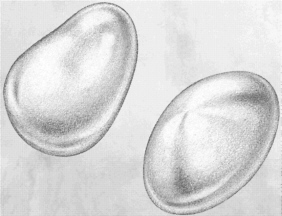
A majority of implants in place today are “single-lumen” (one-cavity) models filled with silicone gel. The shell (“elastomer”) is made of silicone rubber and has an inside barrier coating offluorosilicone or a modified layer of elastomer to help prevent siliconefluid from escaping. The outside of the shell often has a texturedsurface; tissue grows into this surface, stimulating an inflammatoryreaction. This inflammation can delay the development of the fibroustissue that causes capsular contracture.
In the 1990s, saline-filled, single-lumen implants almost completelyreplaced the formerly popular gel-filled models because of the 1992PDA moratorium on the use of silicone gel. In addition, the popularityof immediate implant reconstruction after mastectomy has grown, from3% of implants in 1983 to more than 25% in 1992. Reconstruction withimplants reached its zenith of 40% of all implants in 1990; sincethen, more women have chosen to have a breast constructed out oftissue from other parts of the body (the “flap” form of reconstruction).But this is a more difficult operation and not suitable for all women.
It remains to be seen whether implants of this third generation willcontinue to be used or if forthcoming study results (and FDA decisions)will bring about still another generation of implants. Furthermore,there is less information available about saline implants than silicone-gelimplants—silicone gel was the “fill of choice” until the 1990s. Saline implants contain a harmless saltwatersolution, cannot have silicone leakage (because they don't containsilicone), and appear to have lower rates of capsular contracture.Still, the jury will be out until more studies are forthcoming.


