Bridge Construction Inspection Training Resources and Practices (2025)
Chapter: 3 Survey Results
CHAPTER 3
Survey Results
Introduction
This chapter presents current practices used by state DOTs to train and establish qualifications for the bridge construction inspection workforce. To gather the latest information on how state DOTs train their staff for inspecting bridge construction, the synthesis team conducted a web-based survey. This survey was sent to the voting members of the AASHTO COBS, which represents all 50 state DOTs as well as those of the District of Columbia and Puerto Rico. The information provided in this chapter is derived from responses from 43 state DOT participants, representing an 83% response rate (see Figure 10). Furthermore, an examination of pertinent survey-acquired documents is incorporated to substantiate the results. The chapter commences with an overview of the findings from bridge construction inspections. This includes detailed information on the annual number and specific types of bridges constructed as well as an in-depth analysis of the workforce involved in bridge construction inspections. The chapter then presents organizational structures and responsibilities for bridge construction inspectors. Next, it discusses minimum requirements, qualifications, and certifications for bridge construction inspectors. Finally, the chapter presents bridge construction inspection training and a career path for bridge construction inspectors.
The 43 DOT respondents were not obligated to answer all survey questions. Consequently, the sample size (n) for each question differs. It should also be noted that some questions allowed the respondents to select more than one answer. The complete survey questionnaire is available in Appendix A, while Appendix B contains individual agency responses to each survey question. Detailed discussions of the survey’s key findings are presented in the following sections.
Organizational Structures and Overview of Bridge Construction Inspection
Question #7: Are there any requirements that separate a bridge construction inspector from general construction inspectors at the state DOT?
Bridge construction inspection provides quality assurance for constructing bridges and plays an important role in ensuring the safety and sound performance of state and federal transportation systems. The survey asked respondents if their state DOTs separate bridge construction inspectors from general construction inspectors. The survey results showed that out of 43 DOT responses, 34 state DOTs (79%) do not differentiate between bridge construction inspectors and general construction inspectors, while nine state DOTs (21%) do.
Question #8: Which organizational structures include bridge construction inspectors at the state DOT?

Figure 11 shows the organizational structure used by state DOTs for bridge construction inspection. Out of the total of 42 responses received, 32 DOTs (76%) have made use of district construction divisions. Additionally, 13 DOTs (31%) have opted for central construction divisions, while 10 (24%) have used their bridges and structures divisions for bridge construction inspection.
Additionally, one DOT mentioned that it uses local offices for its construction inspection activities. Another DOT indicated that “the DOT Bridge Program develops, designs, and delivers

projects for advertisement and also administers the construction of these projects.” Another DOT noted that each district has one structure control engineer that is the liaison between the district bridge and construction units.
Question #3: Approximately how many bridges are under construction at the state DOT in a typical year?
The number of bridges under construction per year varies among state DOTs. For bridges related to rehabilitation or widening projects, in a typical year, out of 43 responses, 33 DOTs (77%) have one to 50 bridges, six DOTs (14%) have 50 to 100 bridges, one DOT (2%) has 150 to 200 bridges, and one DOT (2%) has more than 250 bridges (see Figure 12).
For bridges related to maintenance or preservation projects, in a typical year, 20 DOTs (47%) have one to 50 bridges, 12 DOTs (28%) have 50 to 100 bridges, two DOTs (5%) have 100 to 150 bridges, four DOTs (9%) have 150 to 200 bridges, and four DOTs (9%) have more than 250 bridges.
For bridges related to new construction or replacement projects, in a typical year, 27 DOTs (63%) have one to 50 bridges, 12 DOTs (28%) have 50 to 100 bridges, two DOTs (5%) have 100 to 150 bridges, one DOT (2%) has 200 to 250 bridges, and one DOT (2%) has more than 250 bridges.
Question #6: How does the state DOT conduct bridge construction inspection?
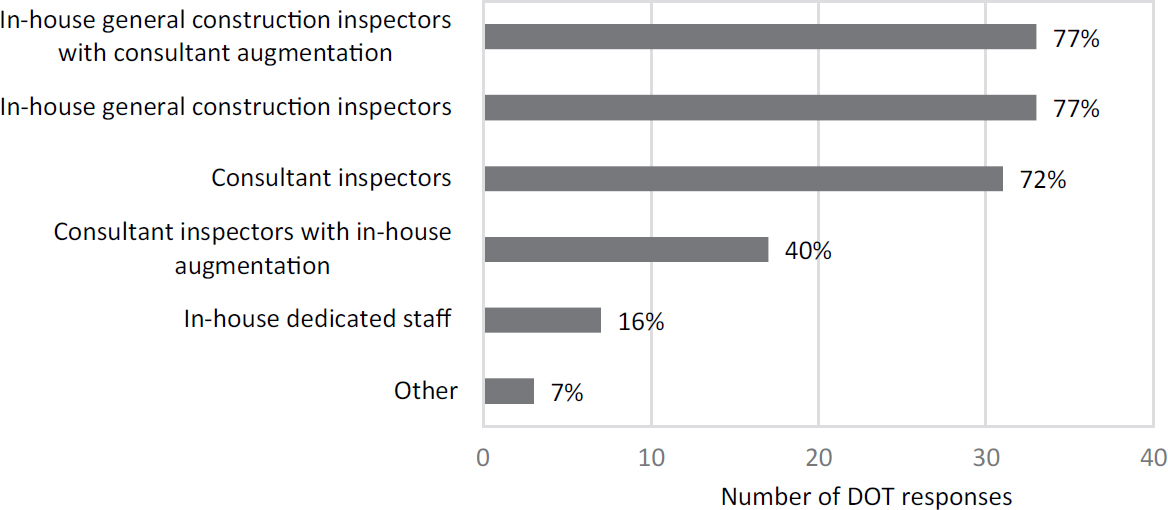
Figure 13 shows that 33 DOTs out of 43 that responded (77%) have used either in-house general construction inspectors or in-house general construction inspectors with consultant inspector staff augmentation to conduct their bridge construction inspections. According to the survey results, 31 DOTs (72%) reported that they have used consultant inspectors to oversee the construction inspection of their bridges. Seventeen DOTs (40%) have used consultant inspectors with in-house inspector staff augmentation. Seven DOTs (16%) indicated that they have used in-house dedicated staff (the staff do not perform non-bridge construction inspection) to conduct their bridge construction inspections.

Additionally, one DOT mentioned that its maintenance activities for bridges are reviewed by bridge maintenance staff that are separate from construction inspectors. Another DOT noted that “the DOT has a Structure Control Engineer (SCE) position in each District. SCEs are involved in monitoring and inspecting certain aspects of Bridge Construction like pile driving, beam acceptance and placement, and deck pouring procedures. We do not have specific bridge construction inspectors, but we will answer questions about bridge construction inspector qualifications with requirements for SCEs.”
Question #4a: For the new construction/replacement category, approximately what percentage of bridges under construction in a typical year are inspected by in-house staff and consultants in the state DOT?
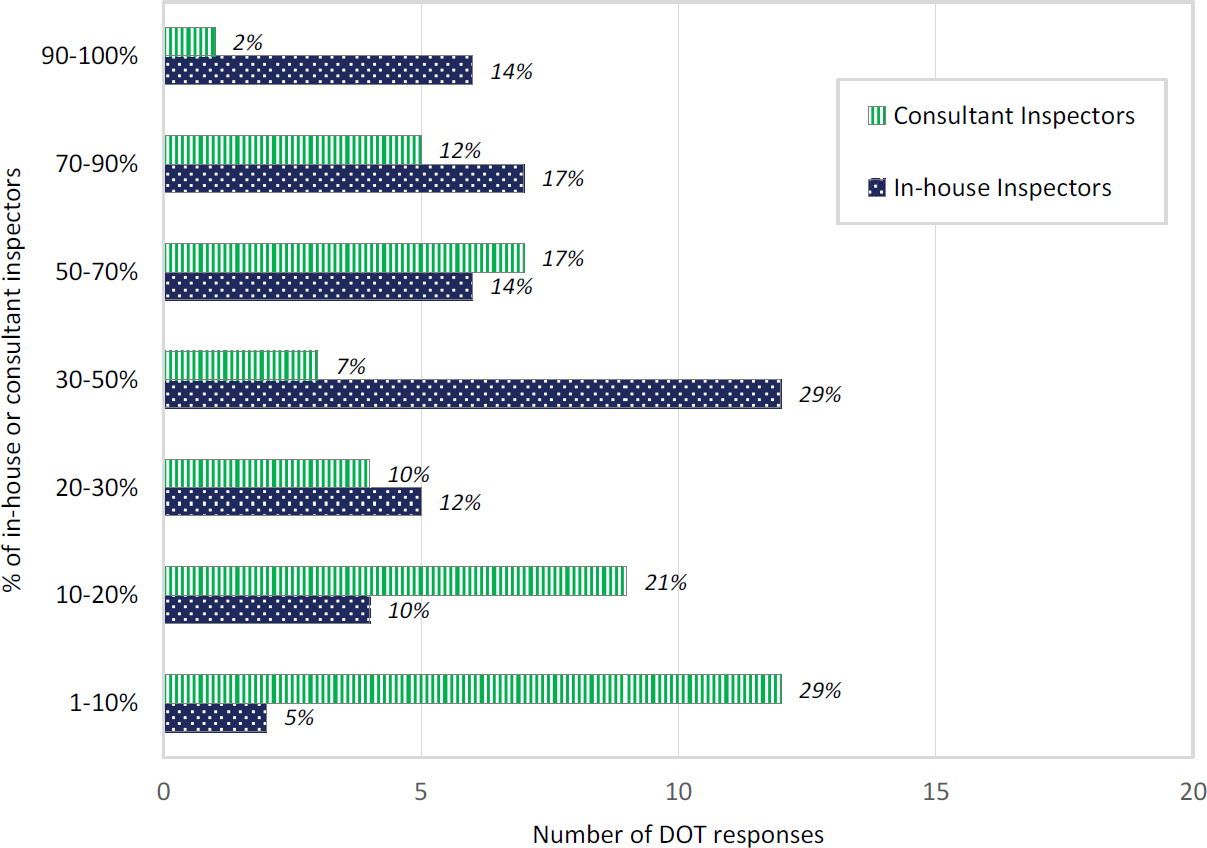
Figure 14 shows that for bridges under the new construction or replacement category, 12 DOTs out of 42 that responded (29%) have used in-house inspectors for 30% to 50% of their bridge construction inspections, seven DOTs (17%) have used in-house inspectors for 70% to 90% of their inspections, and six (14%) have used in-house inspectors for either 50% to 70% or 90% to 100% of their inspections. Figure 14 also shows that 12 out of 42 DOTs that responded (29%) have used consultant inspectors for 1% to 10% of their inspections, nine (21%) have used consultant inspectors for 10% to 20% of their inspections, nine (21%) have used consultant inspectors for 10% to 20% of their inspections, and seven (17%) have used consultant inspectors for 50% to 70% of their inspections.
Question #4b: For the maintenance/preservation category, approximately what percentage of bridges under construction in a typical year are inspected by in-house staff and consultants in the state DOT?
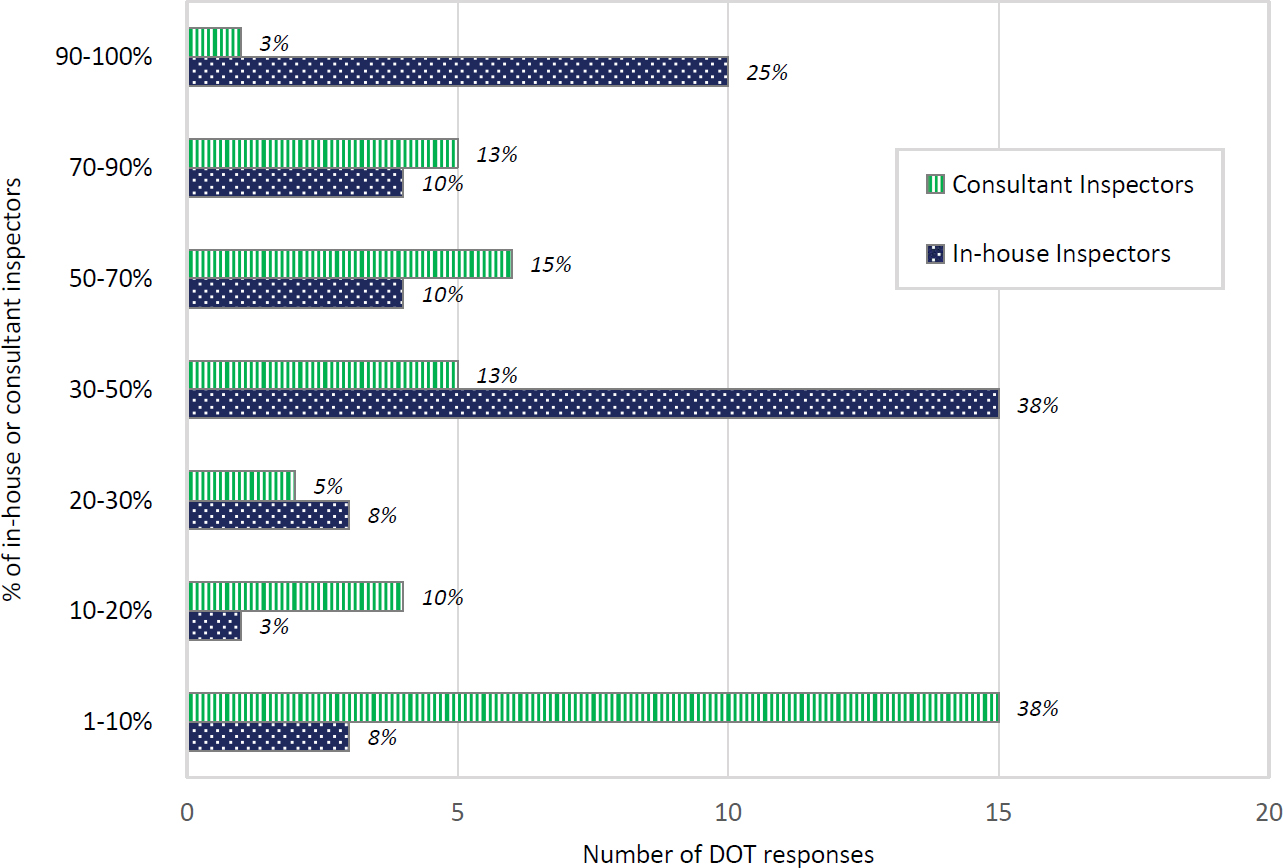
Figure 15 shows that for bridges under the maintenance or preservation category, 15 state DOTs out of 40 that responded (38%) have used in-house inspectors for 30% to 50% of their bridge construction inspections, 10 (25%) have used in-house inspectors for 90% to 100% of their inspections, and four (10%) have used in-house inspectors for either 50% to 70% or 70% to 90% of their inspections. Figure 15 also shows that 15 DOTs out of 40 that responded (38%) have used consultant inspectors for 1% to 10% of their inspections, six (15%) have used consultant inspectors for 50% to 70% of their inspections, five (13%) have used consultant inspectors for either 30% to 50% or 70% to 90% of their inspections, and four (10%) have used consultant inspectors for 10% to 20% of their inspections.

Question #4c: For the rehabilitation/widening category, approximately what percentage of bridges under construction in a typical year are inspected by in-house staff and consultants in the state DOT?
Figure 16 shows that for bridges under the rehabilitation or widening category, 11 state DOTs out of 40 that responded (28%) have used in-house inspectors for 30% to 50% of their for bridge construction inspections, nine (23%) have used in-house inspectors for 90% to 100% of their inspections, six (15%) have used in-house inspectors for 50% to 70% of their inspections, and five (13%) have used in-house inspectors for 70% to 90% of their inspections. Figure 16 also shows that 14 DOTs out of 40 that responded (35%) have used consultant inspectors for 1% to 10% of their inspections, six (15%) have used consultant inspectors for 50% to 70% of their inspections, and five (13%) have used consultant inspectors for either 20% to 30%, 30% to 50%, or 70% to 90% of their inspections.
Responsibilities and Competencies of Bridge Construction Inspectors
Question #11: What are the main responsibilities of bridge construction inspectors at the state DOT?
Figure 17 summarizes the main responsibilities of bridge construction inspectors based on 43 DOT responses. The top responsibilities of bridge construction inspectors identified by more than 90% of 43 DOT responses are as follows:
- Verifying contractor workmanship for contract compliance (42 DOTs, 98%)
- Understanding the contract documents (42 DOTs, 98%)
- Verifying field activities for compliance with plans and specifications (42 DOTs, 98%)
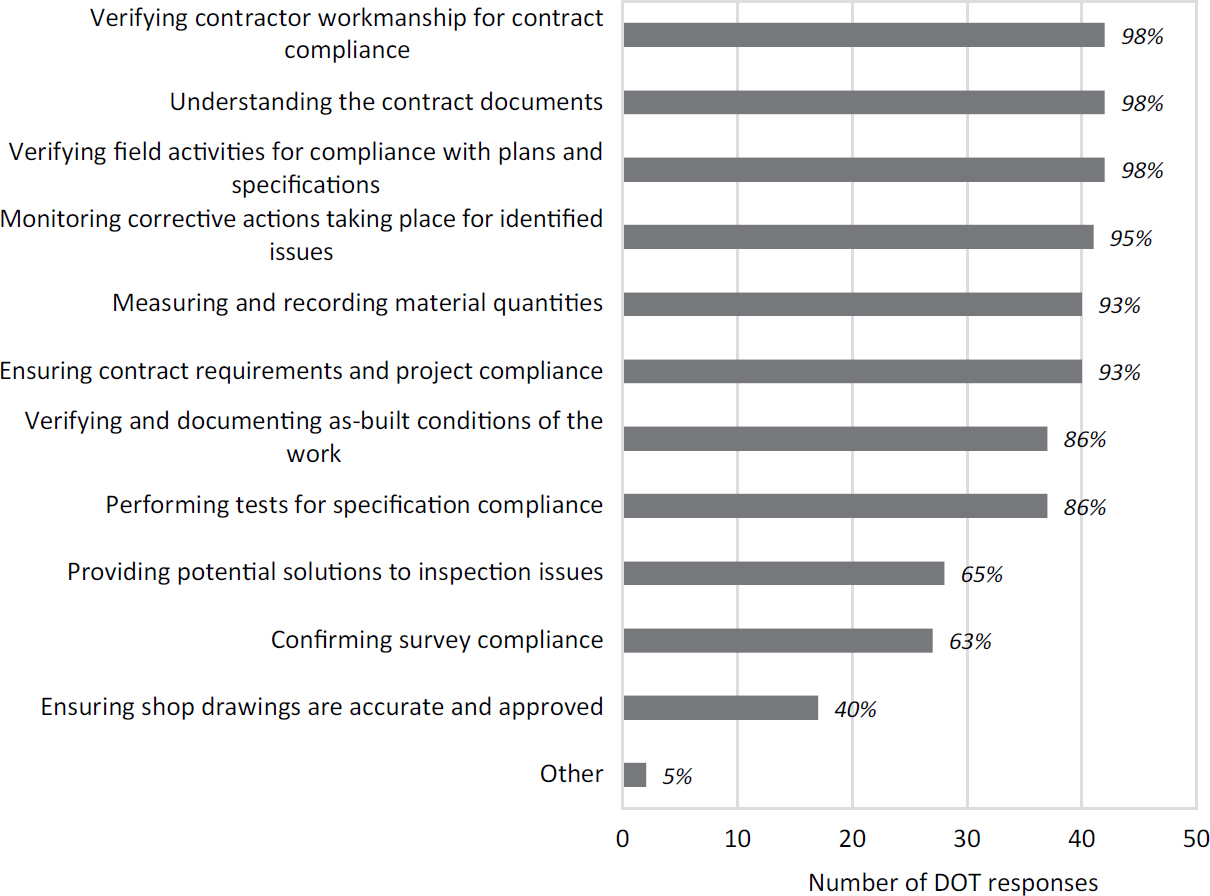
- Monitoring corrective actions (41 DOTs, 95%)
- Measuring and recording material quantities (40 DOTs, 93%)
- Ensuring contract requirements and project compliance (40 DOTs, 93%).
Further, one DOT noted that “the DOT has a Structure Control Engineer (SCE) position in each District. SCEs are involved in monitoring and inspecting certain aspects of Bridge Construction like pile driving, beam acceptance and placement, and deck pouring procedures.”
Question #24: Please rate the importance of the following core competencies for bridge construction inspectors.
The survey participants were then asked to evaluate the importance of core competencies and technical competencies for bridge construction inspectors using a five-point rating scale. This scale ranged from 0 for not applicable (or NA) to 5 for very high, with intermediate ratings of 1 for very low, 2 for low, 3 for moderate, and 4 for high. Table 9 summarizes the main core competencies and their weighted important score for bridge construction inspectors. The weighted score method is a decision-making technique used to prioritize options. The aggregated important or weighted score (WS) is calculated using Equation 1:
| (1) |
Where
| WSj = | The important score of the competency j, |
| nij = | The total number of responses to the competency j associated with the important rating ri, and |
| ri = | The important rating of the competency j. |
Table 9. Core competencies for bridge construction inspectors (n = 43).
| Core Competency | NA (0) | Very Low (1) | Low (2) | Moderate (3) | High (4) | Very High (5) | Weighted Score (WS) |
|---|---|---|---|---|---|---|---|
| Attention to detail | 0 | 0 | 0 | 3 | 10 | 29 | 4.62 |
| Dependability and reliability | 0 | 0 | 0 | 3 | 23 | 17 | 4.33 |
| Critical and analytic thinking | 0 | 0 | 0 | 10 | 18 | 15 | 4.12 |
| Written and oral communication skills | 0 | 0 | 1 | 10 | 21 | 11 | 3.98 |
| Mathematics | 0 | 0 | 2 | 13 | 17 | 11 | 3.86 |
| Professional registrations or certifications | 0 | 0 | 3 | 18 | 14 | 5 | 3.53 |
| Computer skills | 0 | 0 | 2 | 22 | 15 | 4 | 3.49 |
| Science | 0 | 0 | 7 | 22 | 9 | 4 | 3.24 |
The top five core competencies for bridge construction inspectors are:
- Attention to detail,
- Dependability and reliability,
- Critical and analytic thinking,
- Written and oral communication skills, and
- Mathematics.
Question #25: Please rate the importance of the following technical competencies for bridge construction inspectors.
Table 10 summarizes the main technical competencies and their weighted important score for bridge construction inspectors. Based on the weighted importance, the top technical competencies for bridge construction inspectors are:
- Familiarity with DOT regulations, policies, and procedures;
- Capacity to understand construction plans, specifications, and contract provisions;
- Knowledge of materials and construction means and methods;
- Background in inspection, material testing, and documentation;
- Understanding QA (quality assurance) principles; and
- Proficiency in using construction and inspection tools and technologies (tied with the previous technical competency).
Minimum Requirements, Qualifications, and Certifications for Bridge Construction Inspectors
Question #9: What are the minimum educational requirements for a bridge construction inspector at the state DOT?
The participants were asked to provide detailed information regarding the minimum educational qualifications and professional experience needed for individuals to serve as bridge construction inspectors within their state DOTs. Figure 18 shows that, as the minimum educational requirements for bridge construction inspectors, out of 43 responses, 29 DOTs (67%)
Table 10. Technical competencies for bridge construction inspectors (n = 43).
| Technical Competences | NA (0) | Very Low (1) | Low (2) | Moderate (3) | High (4) | Very High (5) | Weighted Score (WS) |
|---|---|---|---|---|---|---|---|
| Familiarity with DOT regulations, policies, and procedures | 0 | 0 | 0 | 0 | 15 | 28 | 4.65 |
| Capacity to understand construction plans, specifications, and contract provisions | 0 | 0 | 0 | 1 | 13 | 29 | 4.65 |
| Knowledge of materials and construction means and methods | 0 | 0 | 0 | 7 | 19 | 17 | 4.23 |
| Background in inspection, material testing, and documentation | 0 | 0 | 0 | 10 | 15 | 18 | 4.19 |
| Understanding QA principles | 0 | 0 | 0 | 11 | 18 | 14 | 4.07 |
| Proficiency in using construction and inspection tools and technologies | 0 | 0 | 0 | 9 | 22 | 12 | 4.07 |
| Risk identification and analysis skills | 0 | 0 | 5 | 14 | 15 | 8 | 3.62 |
| Understanding the project progress schedule | 0 | 0 | 5 | 15 | 16 | 7 | 3.58 |
| Knowledge of development, tracking, and reporting of performance measures | 0 | 0 | 10 | 11 | 16 | 6 | 3.42 |
require high school graduation; 10 (23%) require a General Educational Development (GED) or High School Equivalency Test (HiSET) certificate; and eight (19%) require a bachelor’s degree or associate degree.
Additionally, two DOTs mentioned that they do not have specific educational requirements for bridge construction inspectors. One DOT noted that it requires bridge construction inspectors to pass prerequisite DOT learning and materials testing courses. Another DOT indicated that it requires bridge construction inspectors to have a bachelor’s degree with Engineer in Training (EIT) certification or a professional engineer (PE) degree. Another DOT noted that some additional testing is done to ensure that each bridge construction inspector has knowledge of structures.

Question #10: What are the minimum experience requirements for a bridge construction inspector at the state DOT?
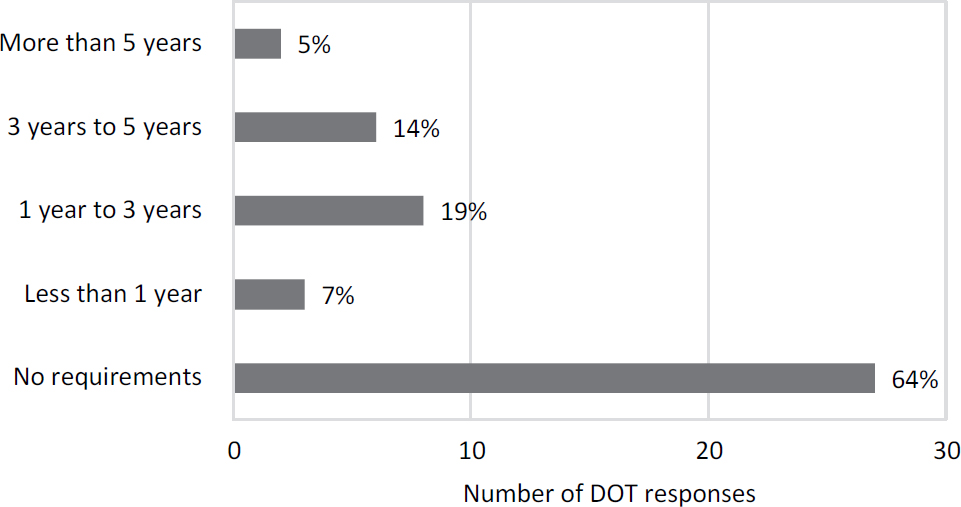
Figure 19 shows the minimum experience requirements for bridge construction inspectors. Out of 42 responses, eight DOTs (19%) require 1 to 3 years of experience for bridge construction inspectors, and six (14%) require 3 to 5 years of experience. Twenty-seven DOTs (64%) indicated that they do not have minimum experience requirements for bridge construction inspectors.
Question #23: What certifications and/or qualifications does the state DOT require or use for bridge construction inspection?
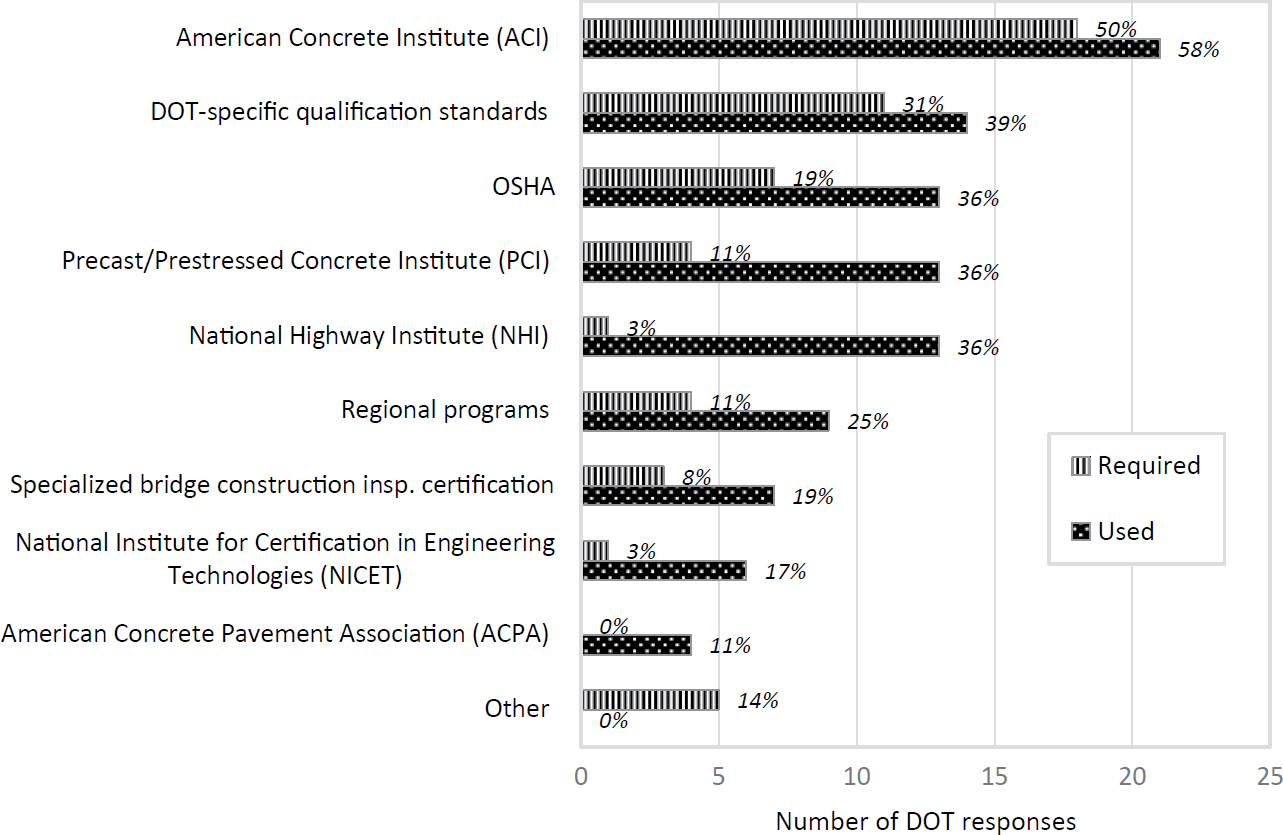
Out of 36 DOT responses to this question, 26 state DOTs (72%) indicated that they require some certifications for bridge construction inspectors. Figure 20 summarizes the different types of certifications used or required by state DOTs for bridge construction inspection based on the DOT responses. The top five certifications used by state DOTs for bridge construction inspection are:
- American Concrete Institute (ACI) (21 DOTs, 58%),
- DOT-specific qualification standards (14 DOTs, 39%),
- Occupational Safety and Health Administration (OSHA) (13 DOTs, 36%),
- Precast/Prestressed Concrete Institute (PCI) (13 DOTs, 36%), and
- National Highway Institute (NHI) (13 DOTs, 36%).
The top five certifications required by state DOTs for bridge construction inspection are:
- ACI (18 DOTs, 50%),
- DOT-specific qualification standards (11 DOTs, 31%),
- OSHA (seven DOTs, 19%),
- PCI (four DOTs, 11%), and
- Regional programs (four DOTs, 11%) [e.g., Northeast Transportation Technician Certification Program (NETTCP), Western Alliance for Quality Transportation Construction (WAQTC), Southeast Task Force for Technician Training and Qualification (SETFTTQ), Multi-Regional Training and Certification (M-TRAC), Northeast Center of Excellence for Pavement Technology (NECEPT), and Mid-Atlantic Region Technician Certification Program (MARTCP)].
The survey results indicated that five out of 36 state DOTs (14%) require certifications other than those indicated in Figure 20. One DOT mentioned that it requires a bridge construction
inspector to be a PE. Another DOT noted that the requirement for a bridge construction inspector is based on the construction engineering and inspection (CEI) scope of services. Another DOT indicated that a bridge construction inspector is required to have previous experience with bridge inspection.
Bridge Construction Inspection Training
Question #12: Does the state DOT administer in-person training for bridge construction inspectors?
The survey results showed that 35 state DOTs out of 43 that responded (81%) conduct in-person training for bridge construction inspectors. It should be noted that this survey question did not distinguish between formal and informal training.
Question #13: Does the state DOT administer online/virtual training for bridge construction inspectors?
Figure 21 shows that 22 state DOTs out of 43 that responded (51%) conduct online/virtual training for bridge construction inspectors.
Question #14: What training methods are used by the state DOT to provide the necessary knowledge, skills, and abilities for bridge construction inspectors?
The survey respondents were then asked about training methods that they have used to provide the necessary knowledge, skills, and abilities for bridge construction inspectors. Figure 22 summarizes the results of this question.


The following training methods have been used by more than two-thirds of the 43 DOTs that responded:
- Informal OJT (38 DOTs, 88%)
- Mentoring (formal or informal) (35 DOTs, 81%)
- Training led by an instructor in a traditional classroom setting (32 DOTs, 74%).
The following training methods have been used by more than one-third of the 43 DOTs that responded:
- Attending conferences/workshops (26 DOTs, 60%)
- Self-directed online learning (21 DOTs, 49%)
- In-person training with a third party (16 DOTs, 37%)
- Virtual training with a third party (15 DOTs, 35%)
- Communities of practice (14 DOTs, 33%).
Additionally, one DOT noted that it uses new methods involving manufacturer representative training. Another DOT stated that “the DOT has a Structure Control Engineer (SCE) position in each District. SCEs have a specific position description and PE license requirements to hold the position.”
Question #15: How are bridge construction inspection training materials developed in the state DOT?
Figure 23 shows the approaches state DOTs used to develop the training materials for bridge construction inspection. Out of 40 DOTs that responded, 34 (85%) have partnered with experienced current or retired DOT employees to develop the training materials for their bridge construction inspectors, 23 (58%) have partnered with industry members or consulting firms, and 10 (25%) have partnered with universities.
Additionally, two state DOTs have used in-house SMEs to develop the training materials for bridge construction inspection. Two other state DOTs have used NHI and AASHTO training materials for their bridge construction inspection training.


Question #21: Over the past 5 years, how often has the state DOT revised and updated the existing bridge construction inspection training materials?
Figure 24 shows that out of 24 state DOTs that have written materials for bridge construction inspection training, seven (29%) have revised and updated their training materials once over the past 5 years, and six (25%) have revised and updated their training materials annually.
Question #17: What NHI courses are required for or provided to bridge construction inspectors at the state DOT?
The participants in the survey were requested to specify the NHI courses that are necessary for or offered to bridge construction inspectors. The findings, based on responses received from 31 DOTs, are outlined in Figure 25, which shows that state DOTs do not require bridge construction

inspectors to take NHI courses. However, more than one-third of 31 DOTs that responded indicated that they have provided the following NHI courses to their bridge construction inspectors:
- FHWA-NHI-132069: Driven Pile Foundation Inspection (12 DOTs, 39%)
- FHWA-NHI-130129: Bridge Construction Inspection (12 DOTs, 39%)
- FHWA-NHI-132070: Drilled Shaft Foundation Inspection (11 DOTs, 35%)
- FHWA-NHI-132043: Construction of Mechanically Stabilized Earth Walls and Reinforced Soil Slope (11 DOTs, 35%)
- FHWA-NHI-130128: Bridge Construction Inspection—Prerequisite (11 DOTs, 35%).
Additionally, one DOT mentioned that it has offered an e-learning course related to pile driving and plan reading. Another DOT noted that “if an inspector wanted to take these trainings, the department would work to provide the opportunity. However, they are not regularly provided or promoted.”
Question #18: What formal/structured training topics are required for or provided to bridge construction inspectors at the state DOT?
Figure 26 shows the formal or structured training topics that are required for or provided to bridge construction inspectors based on 32 DOT responses. The top formal training topics required by state DOTs are:
- Concrete placement and testing (15 DOTs, 47%),
- Plan reading (10 DOTs, 31%),
- Steel reinforcement inspection (5 DOTs, 16%),
- Geotechnical/foundations (pile, pier, etc.) (5 DOTs, 16%),
- Structural inspection (5 DOTs, 16%), and
- Prestressed concrete inspection (5 DOTs, 16%).
The top five formal training topics provided by state DOTs to bridge construction inspectors are:
- Plan reading (25 DOTs, 78%),
- Concrete placement and testing (22 DOTs, 69%),
- Steel connection (bolt testing/weld testing) (21 DOTs, 66%),
- Steel reinforcement inspection (20 DOTs, 63%), and
- Geotechnical/foundations (pile, pier, etc.) (20 DOTs, 63%).
Question #19: Does the state DOT require additional or special training for bridge construction inspectors for complex bridges?
The survey results indicate that, out of 43 DOTs that responded, 32 (74%) do not require additional or special training for bridge construction inspectors for complex bridges; eight (19%) do require additional training (see Figure 27).
Written Inspection Training Resources
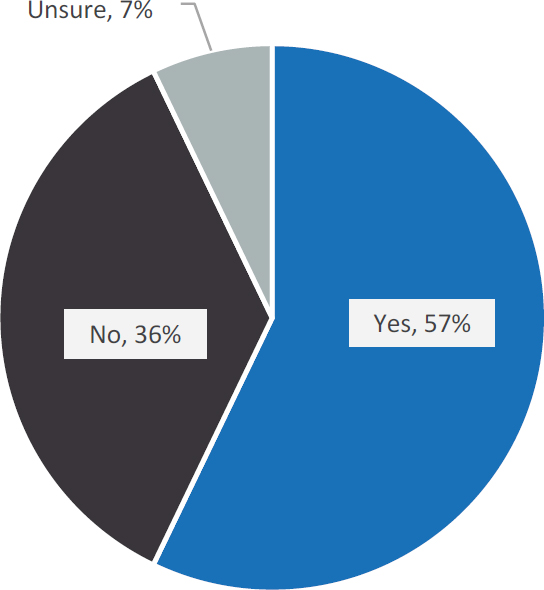
Question #20: Does the state DOT have written materials, documents, reports, or curricula for bridge construction inspection training?
Figure 28 shows that out of 42 DOT responses, 24 DOTs (57%) have written materials, documents, reports, or curricula for bridge construction inspection training.
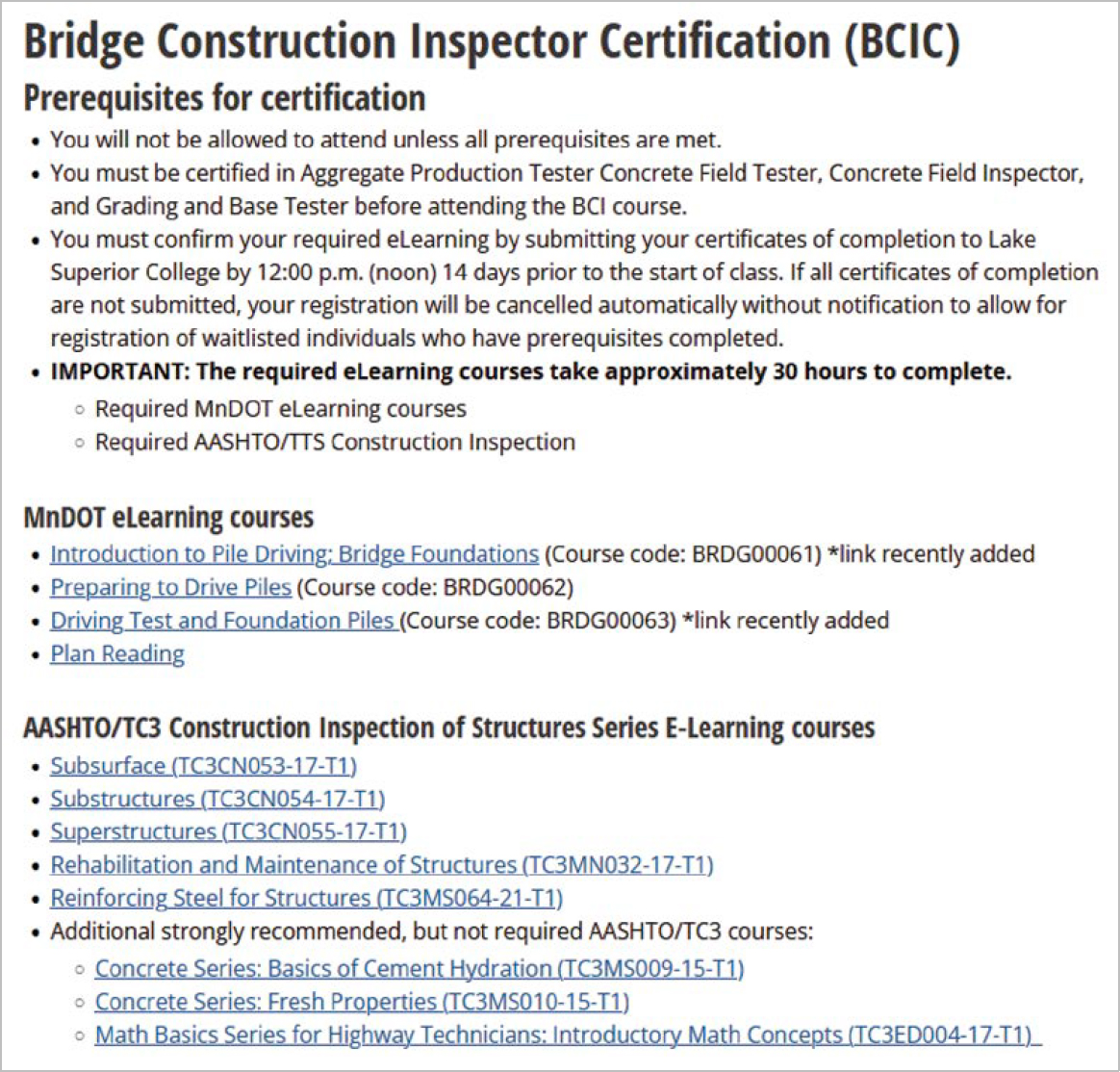
For example, MnDOT has provided several training materials for bridge construction inspectors, including its Bridge Construction Inspector Certification Training Manual, inspection forms and worksheets, standard specifications, and bridge construction manuals. Figure 29 shows a snapshot of the training materials available at MnDOT for bridge construction inspectors.



Note: WZTC = work zone traffic control; HMA = hot mix asphalt.
NYSDOT provides a series of training videos and handouts for construction inspectors. Figure 30 shows a screenshot of sample training materials available at NYSDOT for bridge construction inspectors.
Question #16: What resources and tools are used in the state DOT for training bridge construction inspectors?
Figure 31 summarizes tools and resources used by state DOTs for training bridge construction inspectors. Out of 41 DOTs that responded, 32 (78%) have relied on SMEs or experienced trainers for training their bridge construction inspectors; 25 (61%) have used inspection technologies such as iPads, mobile devices, drones, and software applications; 23 (56%) have used bridge construction inspection manuals; and 20 (49%) have used bridge construction inspection checklists. Other training tools and resources include PowerPoint presentations, a DOT engineering policy guide, and annual DOT construction schools.

NYSDOT has multiple construction inspection checklists, including for bridge deck concrete placement, bridge deck jacking and temporary structures, pile installation, and embankments. Figure 32 shows a sample construction inspection checklist for bridge deck concrete placement (NYSDOT 2024a). Similarly, Kansas DOT (KDOT) has 59 items placed into four sections in its bridge construction inspection checklist. There are 12 items in the daily diary section, 19 items in the field book inspection section, 23 items in the miscellaneous data section, and five items in the stormwater pollution prevention plan section. KDOT notes that the inspector should use the checklist in conjunction with the KDOT Construction Manual. Figure 33 shows a sample of the KDOT bridge construction inspection checklist (KDOT 2024).
Question #5: Does the state DOT have any written or informal inspection guidance for bridge construction inspection?
Figure 34 shows that out of 43 DOTs that responded, 32 (74%) have written guidance for their bridge construction inspections, and 16 (37%) have informal guidance.
The written guidance typically includes construction manuals, standard specifications, or inspection manuals. For example, Washington State DOT’s Construction Manual (WSDOT 2024) states that:
In an attempt to continually improve the quality of bridge contract plans, specifications, and estimates and to obtain feedback on engineering and construction practices, the Bridge and Structures Office is available to assist in conducting post-construction De-Briefing Sessions for “Capturing Lessons Learned.” . . . Suggested projects include Bridge Rehabilitation Projects, Bridges with complex staging, substructure conditions, or new material applications. Suggested attendees at these sessions should include Region Project Office Staff, State Construction Office, Bridge and Structures Office, Design Consultants, and the Contractor involved in the structural work.
Question #22: Does the state DOT measure the effectiveness of bridge construction inspection training?
The survey participants were subsequently asked whether they had established a specific process or criteria for evaluating the efficacy of the training programs for bridge construction inspection. Figure 35 shows that three DOTs out of 42 DOT responses (7%) measure the effectiveness of bridge construction inspection training. For example, the Minnesota and New York State DOTs have used testing scores and pass/fail rates of training courses to evaluate the effectiveness of bridge construction inspection training.
Career Development of Bridge Construction Inspectors
Question #26: Does the state DOT have a defined career path (e.g., a road map for inspector career advancement) associated with training opportunities for general construction inspectors and/or bridge construction inspectors?
The survey asked participants whether their state DOTs have established career paths that include training opportunities for general construction inspectors or bridge construction inspectors. Figure 36 shows that out of the 43 DOTs that responded, three (7%) have outlined a clear career advancement plan specifically for bridge construction inspectors. In contrast, 26 DOTs (60%) have established a well-defined career path for general construction inspectors.
Question #27: On average, what is the annual turnover rate (i.e., leaving the DOT) of general construction inspectors and/or bridge construction inspectors at the state DOT?
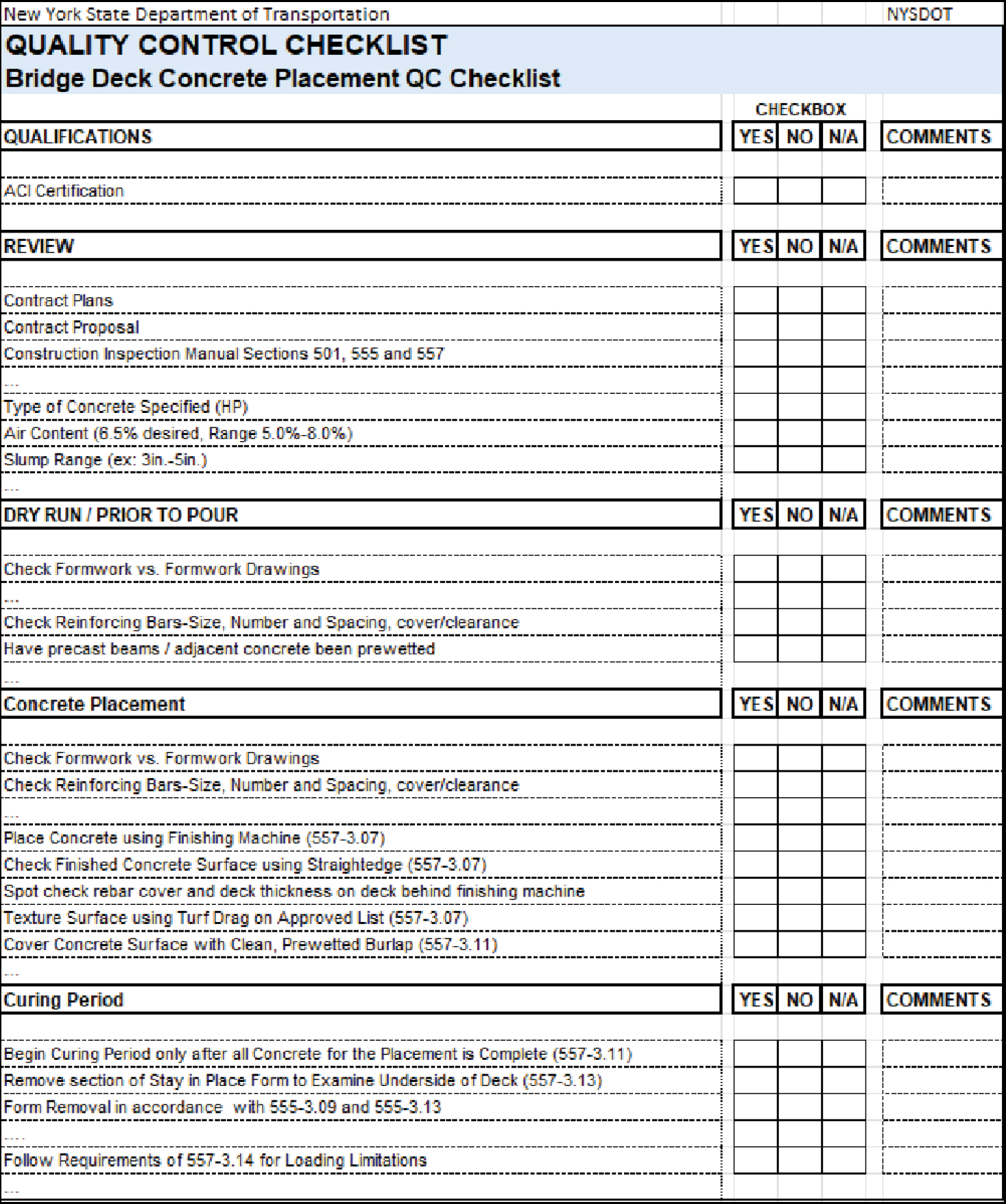
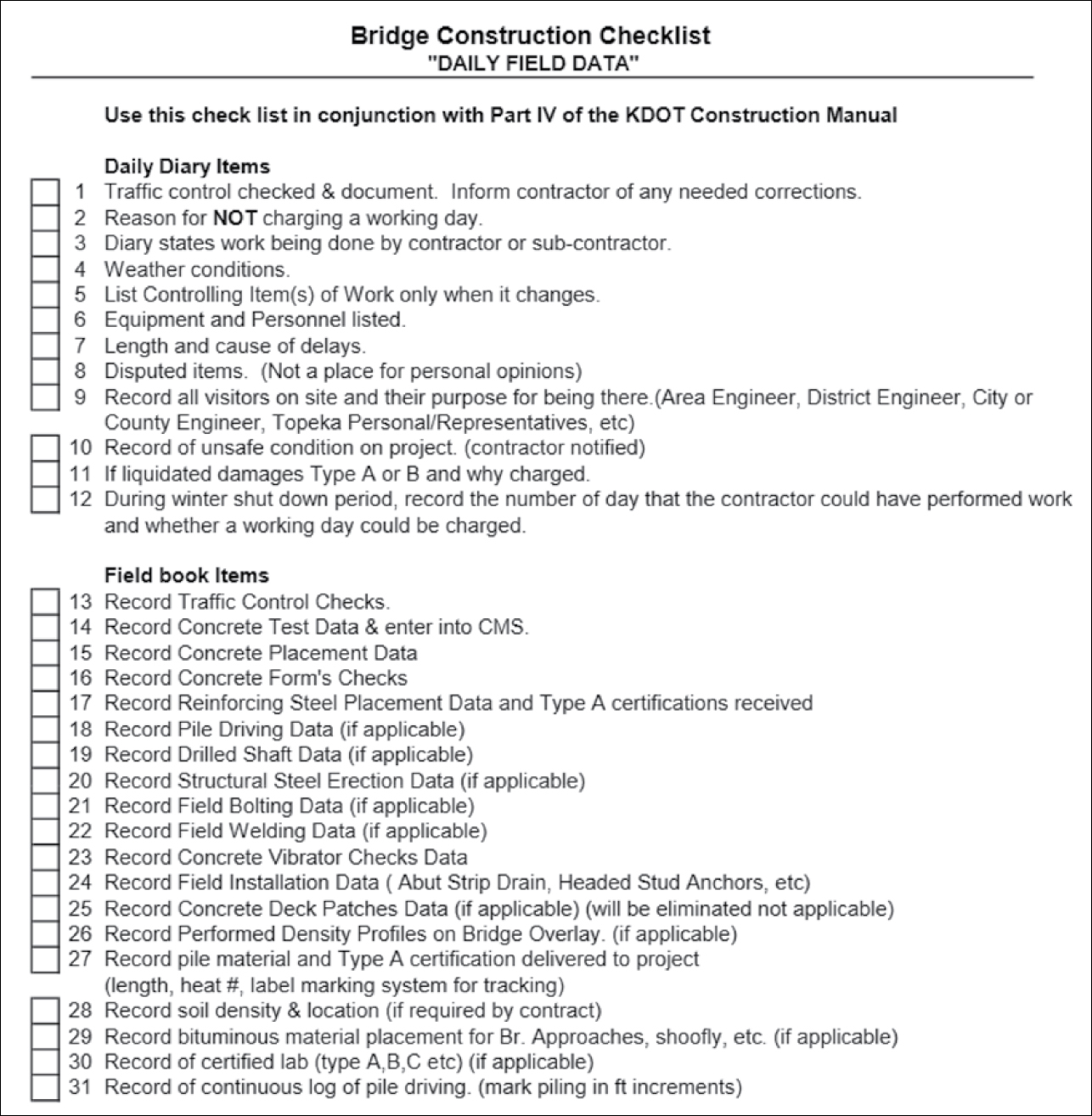
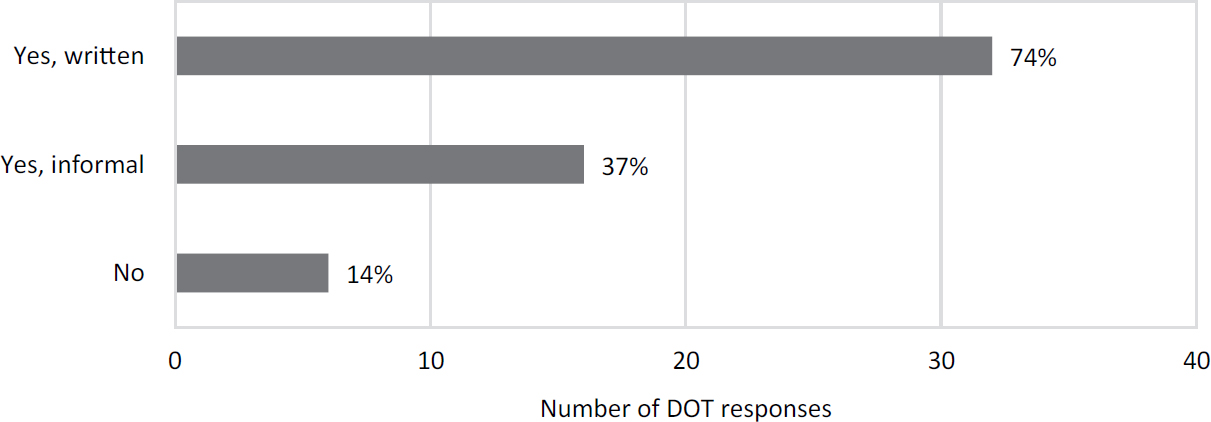

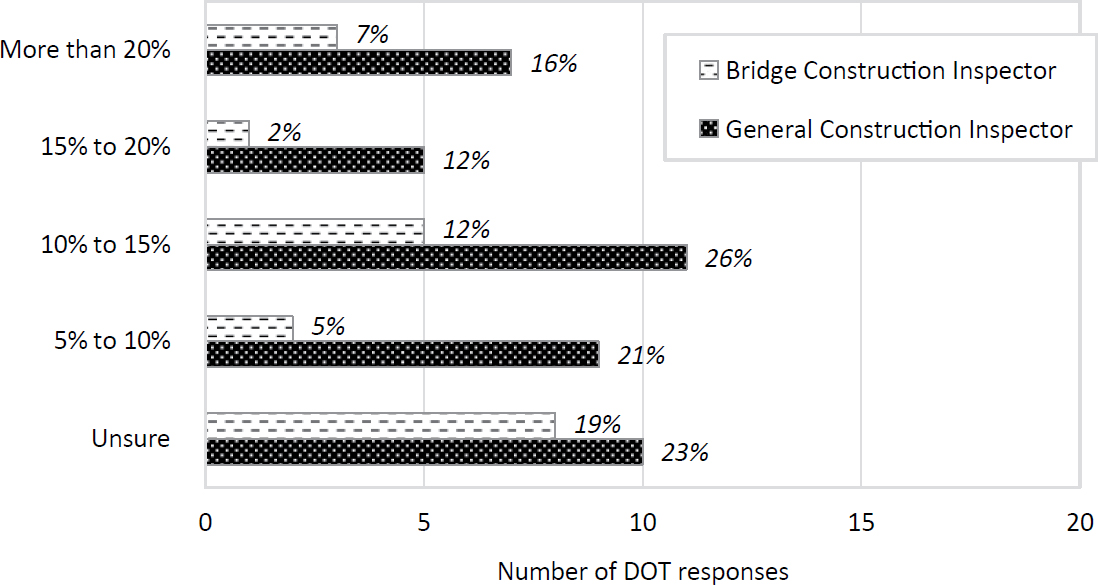
Figure 37 shows the annual turnover rate of bridge construction inspectors and general construction inspectors. Out of 43 DOTs that responded, nine (21%) indicated that the annual turnover rate of bridge construction inspectors is more than 10%, while 23 (53%) have an annual general construction inspector turnover rate of more than 10%. Overall, the annual turnover rate of bridge construction inspectors and general construction inspectors is between 10% and 15%.
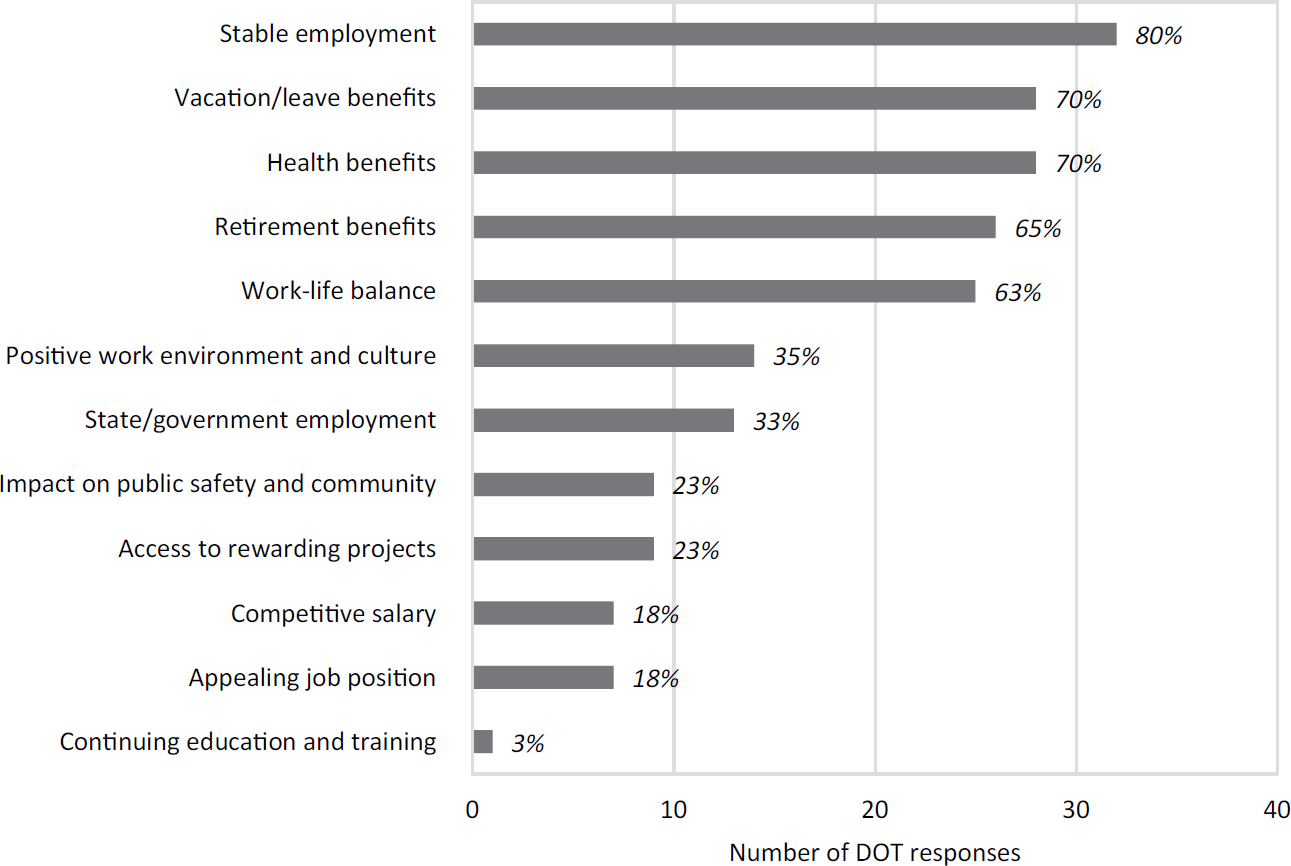
Question #28: Please select the top five factors of the following choices that attract construction inspectors (bridge or non-bridge construction inspection) to the state DOT when they are hired.
The participants were asked to list the top five factors that draw construction inspectors (for both bridge and non-bridge construction inspection) to state DOTs when they are recruited.

The findings are outlined in Figure 38 based on the 40 responses received. The top five factors that influence the hiring process of state DOT construction inspectors are:
- Stable employment (32 DOTs, 80%),
- Vacation/leave benefits (28 DOTs, 70%),
- Health benefits (28 DOTs, 70%),
- Retirement benefits (26 DOTs, 65%), and
- Work–life balance (25 DOTs, 63%).
Summary
This chapter has provided an overview of existing methods for training and the resources used by state DOTs in bridge construction inspection. The discussion is based on the analysis of responses from a national survey distributed to 50 state DOTs and the DOTs of the District of Columbia and Puerto Rico. The chapter commenced with an overview of bridge construction inspection findings, then discussed yearly bridge construction volume, categorized by bridge construction types. It then explored the composition of the bridge construction inspection workforce. Subsequently, the chapter outlined the organizational structures that govern bridge inspectors and delineated their specific responsibilities. It then detailed the minimum prerequisites, qualifications, and certifications necessary to become a bridge construction inspector. Finally, the chapter presented bridge construction inspection training programs and outlined a potential career trajectory for inspectors in this field. State DOTs use different processes for training inspectors, such as through OJT as well as in-person and virtual training.


