Previous Chapter: Appendix C: Interview Questionnaires
Suggested Citation: "Appendix D: Raw Survey Results." National Academies of Sciences, Engineering, and Medicine. 2025. Defining Contractual Risk Profiles to Increase Competition on Alternative Project Delivery Methods. Washington, DC: The National Academies Press. doi: 10.17226/29285.

Appendix D: Raw Survey Results

D1: Owner Survey Results

APDM: Owner - Dashboard
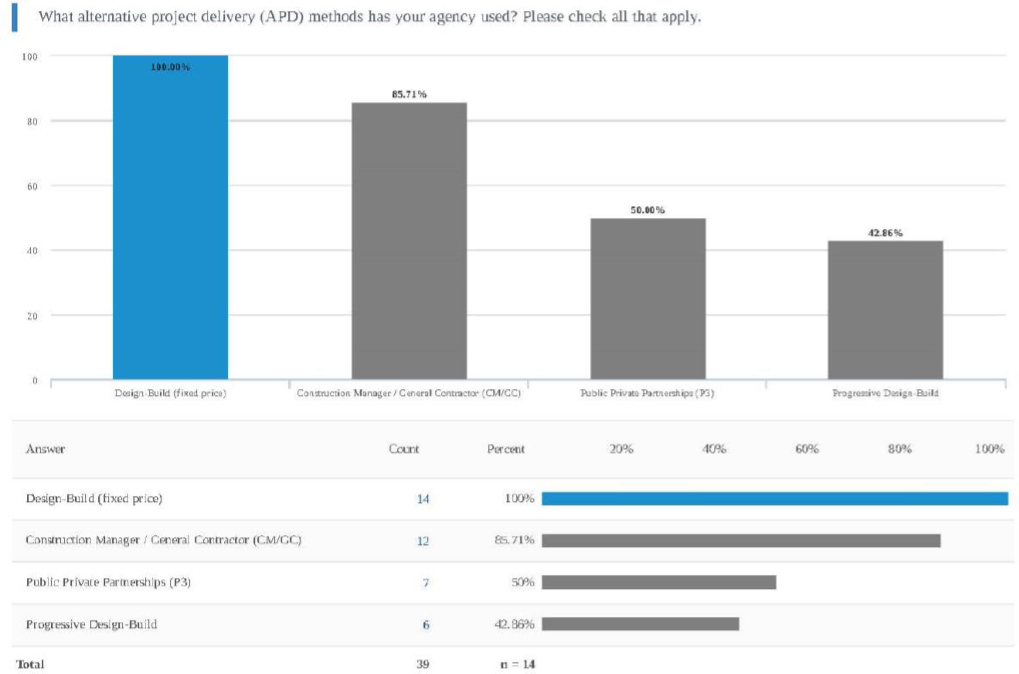
The vertical axis shows the percentage of project delivery. Four alternative project delivery methods are used by agencies. Design-Build (fixed price) shows 100 percent usage. Construction Manager or General Contractor is at 85.71 percent, Public Private Partnerships at 50 percent, and Progressive Design-Build at 42.86 percent, all in gray. The horizontal axis shows percentages from 0 to 100 in intervals of 20. The horizontal axis lists four project delivery methods: Design-Build, Construction Manager or General Contractor, Public-Private Partnerships, and Progressive Design-Build. The vertical axis shows percentage values from 0 to 100 in intervals of 20. Design-Build: 14 at 100 percent, Construction Manager or General Contractor: 12 at 85.71 percent, Public Private Partnerships: 7 at 50 percent, and Progressive Design-Build: 6 at 42.86 percent. The total number of responses is 39, with n equals 14.
Suggested Citation: "Appendix D: Raw Survey Results." National Academies of Sciences, Engineering, and Medicine. 2025. Defining Contractual Risk Profiles to Increase Competition on Alternative Project Delivery Methods. Washington, DC: The National Academies Press. doi: 10.17226/29285.

Please identify the top five risks that you feel can impact the successful delivery of a Design-Build (fixed price) project.
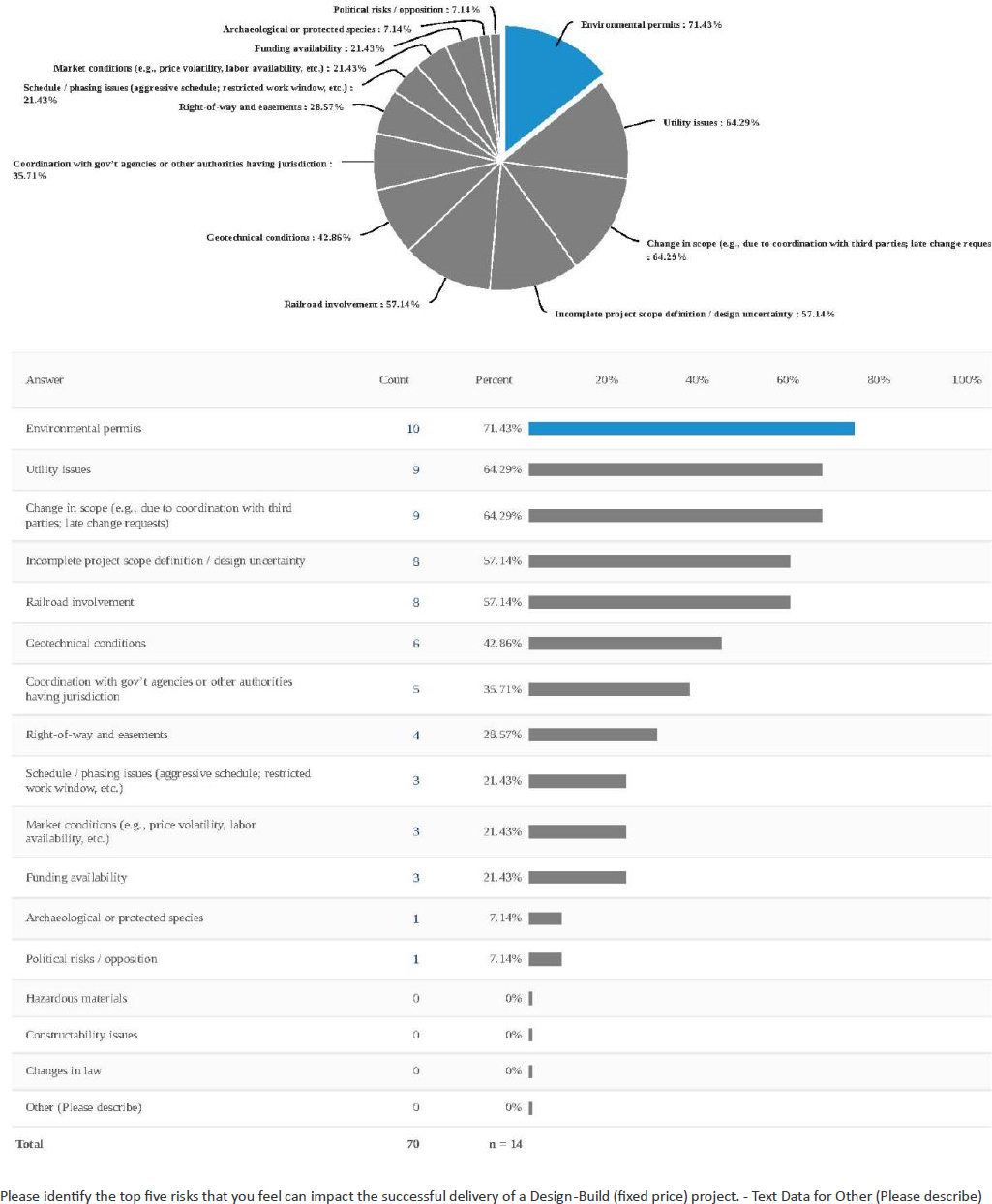
The factors affecting project delivery, are each labeled with a percentage. Political risks: 7.14 percent, environmental permits: 71.43 percent. Utility issues follow at 64.29 percent. Change in scope: 64.29 percent and incomplete scope definition: 57.14 percent. Geotechnical conditions: 42.86 percent, agency coordination: 35.71 percent, right of way: 28.57 percent, scheduling: 21.43 percent, market conditions: 21.43 percent, funding: 21.43 percent, archaeological: 7.14 percent, and railroad involvement: 57.14 percent. The survey results on factors affecting project development, listing each factor with its count and percentage. Environmental permits lead with 10 responses at 71.43 percent, followed by utility issues and scope changes, each with 9 responses at 64.29 percent. Incomplete project scope and railroad involvement both have 8 responses at 57.14 percent. Geotechnical conditions follow with 6 responses at 42.86 percent. Coordination with agencies has 5 responses at 35.71 percent, rights-of-way and easements have 4 at 28.57 percent, and schedule or design issues, market conditions, and funding availability each have 3 responses at 21.43 percent. Archaeological or protected species concerns and political risks each have 1 response at 7.14 percent. Hazardous materials, constructability issues, changes in law, and other factors received no responses.
Suggested Citation: "Appendix D: Raw Survey Results." National Academies of Sciences, Engineering, and Medicine. 2025. Defining Contractual Risk Profiles to Increase Competition on Alternative Project Delivery Methods. Washington, DC: The National Academies Press. doi: 10.17226/29285.

Please identify the top five risks that you feel can impact the successful delivery of a CM/GC or Progressive Design–Build project.
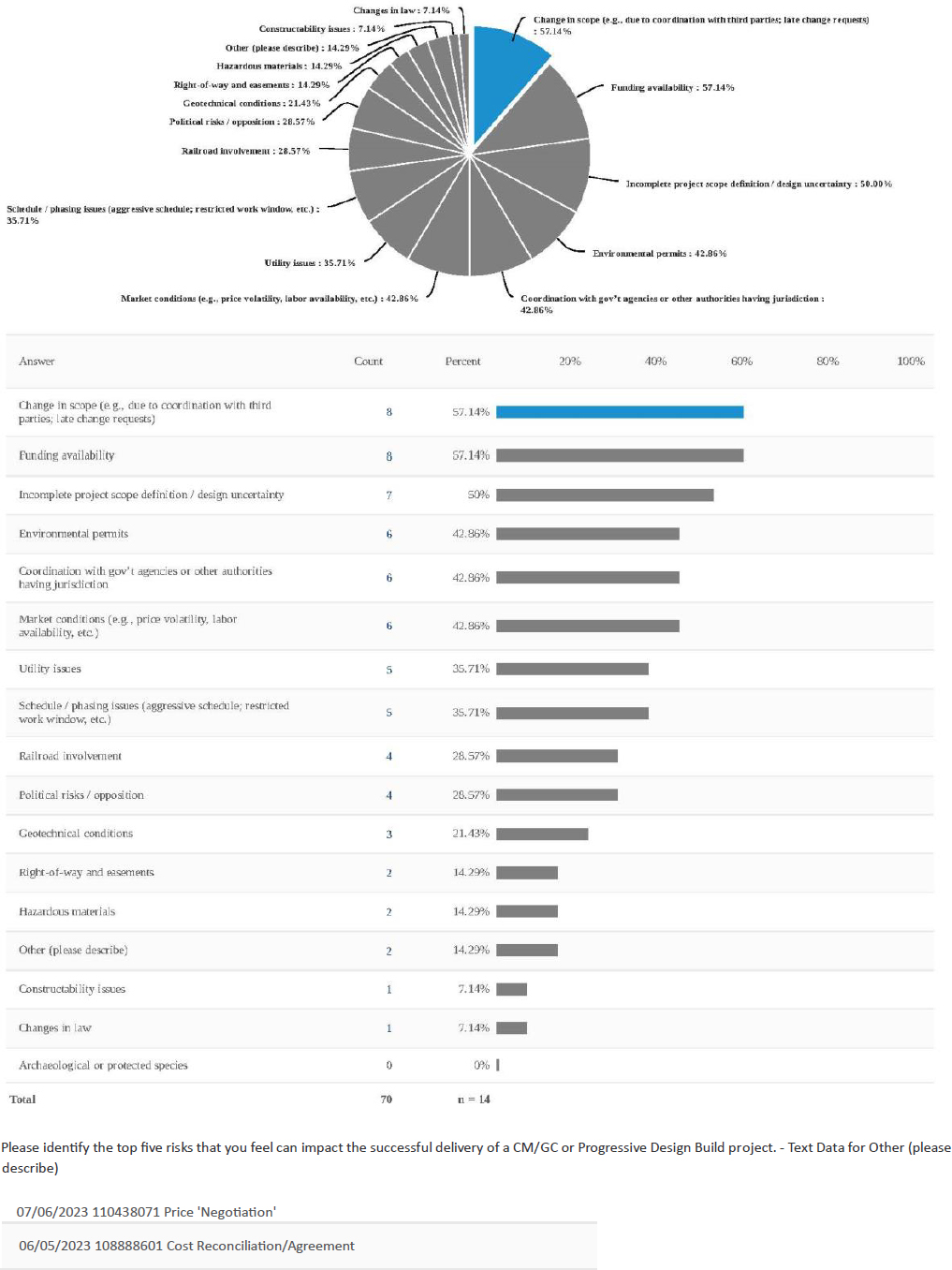
The largest segments represent funding availability and change in scope due to coordination or late requests at 57.14 percent. Incomplete project scope or design uncertainty follows at 50 percent. Environmental permits, coordination with government agencies, and market conditions (price volatility, labor availability) each account for 42.86 percent. Schedule or phasing issues (aggressive schedule; restricted work window is at 35.71 percent. Smaller segments include railroad involvement and political risks or opposition at 28.57 percent, geotechnical conditions at 21.43 percent, and right-of-way and easements, hazardous materials, and other (please describe) issues each at 14.29 percent. Constructability issues and changes in law are the smallest, each at 7.14 percent. The horizontal bars represent each issue’s frequency and percentage. Hanging scope and funding availability each have 8 responses at 57.1 percent. Incomplete project scope or design uncertainty follows with 7 responses at 50 percent. Environmental permits, coordination with agencies, and market conditions each have 6 responses at 42.9 percent. Utility issues and schedule or phasing issues each have 5 responses at approximately 35 percent. Railroad involvement and political risks each have 4 responses at 28.6 percent, while geotechnical conditions have 3 responses at 21.4 percent. Additional issues listed under APDM: Owner include right-of-way or easements, hazardous materials, and other specified concerns, each with 2 responses at 14.3 percent. Constructability issues and changes in law each have 1 response at 7.1 percent. Archaeological or protected species concerns received no responses. The total number of responses is seventy, collected from fourteen participants.
Suggested Citation: "Appendix D: Raw Survey Results." National Academies of Sciences, Engineering, and Medicine. 2025. Defining Contractual Risk Profiles to Increase Competition on Alternative Project Delivery Methods. Washington, DC: The National Academies Press. doi: 10.17226/29285.

Please identify the top five risks that you feel can impact the successful delivery of a P3 (fixed-price project).
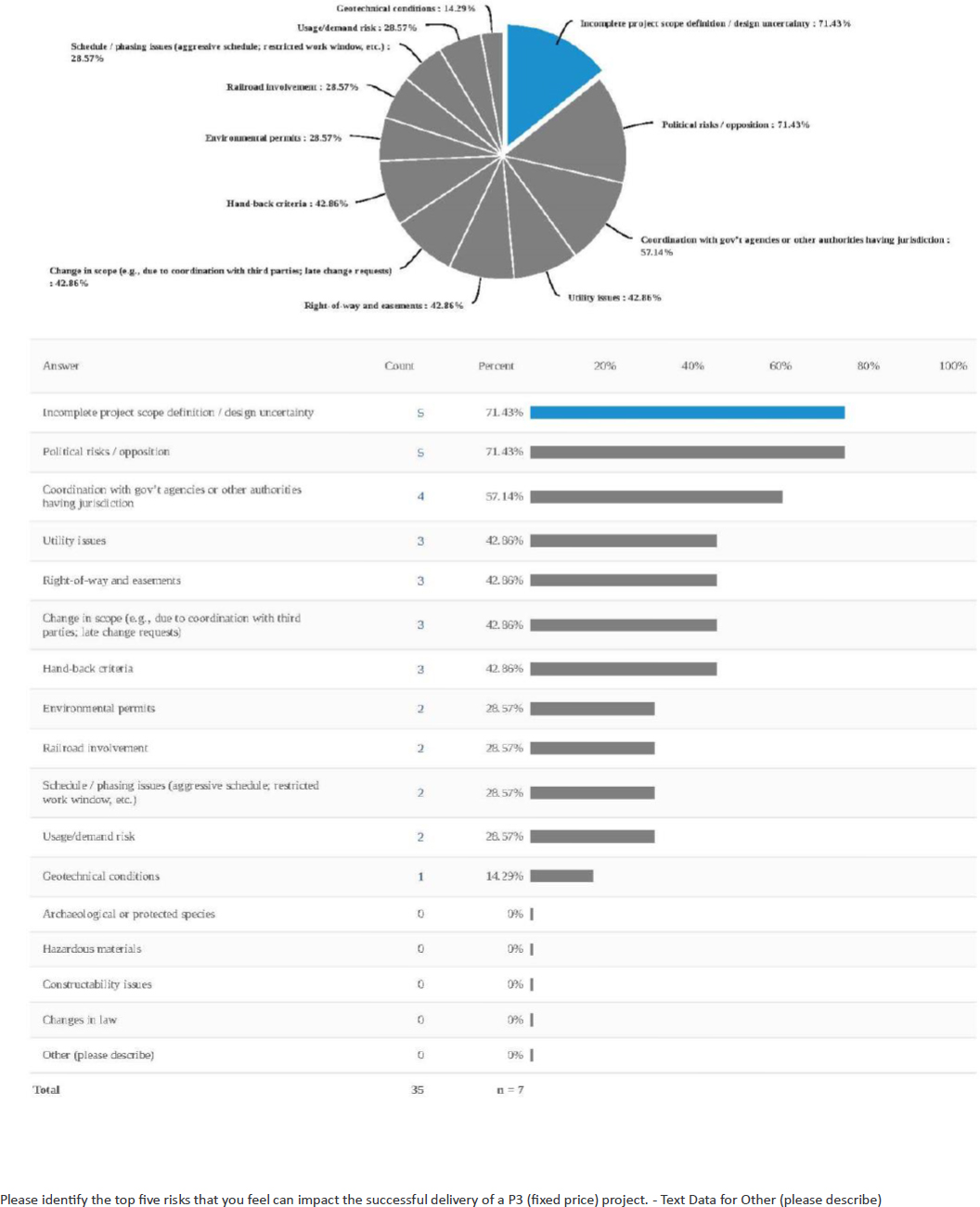
The factors contributing to project delays, with each segment labeled by issue and percentage. The largest segments, each at 71.43 percent, are incomplete project scope definition or design uncertainty and political risks or opposition. Coordination with government agencies or other authorities is at 57.14 percent. Utility issues, right-of-way and easements, hand-back criteria, and changes in scope due to third-party coordination or late requests are each at 42.86 percent. Usage or demand risk, environmental permits, railroad involvement, and schedule or phasing issues such as aggressive timelines or restricted work windows are each at 28.57 percent. Geotechnical conditions are the smallest factor at 14.29 percent. The horizontal bars represent each issue’s frequency and percentage, arranged in descending order. The top two reasons, each with five responses at 71.43 percent, are incomplete project scope definition or design uncertainty and political risks or opposition. Coordination with government agencies or other authorities follows with four responses at 57.14 percent. Four categories—utility issues, right-of-way, easements, change in scope due to third-party coordination or late requests, and hand-back criteria—each have three responses at 42.86 percent. Environmental permits, railroad involvement, schedule or phasing issues such as aggressive timelines or restricted work windows, and usage or demand risk each have two responses at 28.57 percent. Geotechnical conditions have one response at 14.29 percent. Archaeological or protected species, hazardous materials, constructability issues, changes in law, and other specified concerns each have zero responses.
Suggested Citation: "Appendix D: Raw Survey Results." National Academies of Sciences, Engineering, and Medicine. 2025. Defining Contractual Risk Profiles to Increase Competition on Alternative Project Delivery Methods. Washington, DC: The National Academies Press. doi: 10.17226/29285.
Assessing and Allocating Project Risk

Does your agency have a standard procedure or guidance for identifying, evaluating, and allocating project risk?
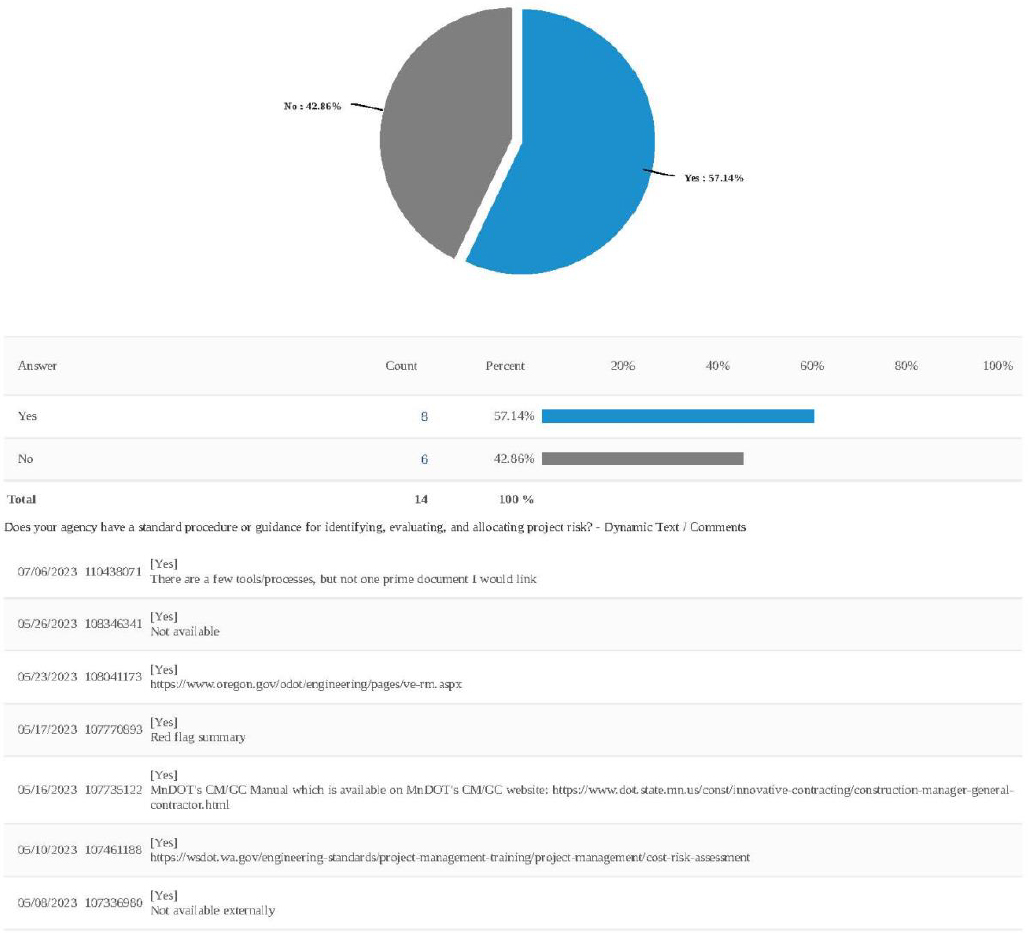
A pie chart shows the project responses with Yes at 57.14 percent and No at 42.86 percent. A bar chart shows 57.14 percent answered Yes and 42.86 percent answered No in a survey of 14 responses.
Suggested Citation: "Appendix D: Raw Survey Results." National Academies of Sciences, Engineering, and Medicine. 2025. Defining Contractual Risk Profiles to Increase Competition on Alternative Project Delivery Methods. Washington, DC: The National Academies Press. doi: 10.17226/29285.

Do your cost estimates involve a quantitative analysis of risk?
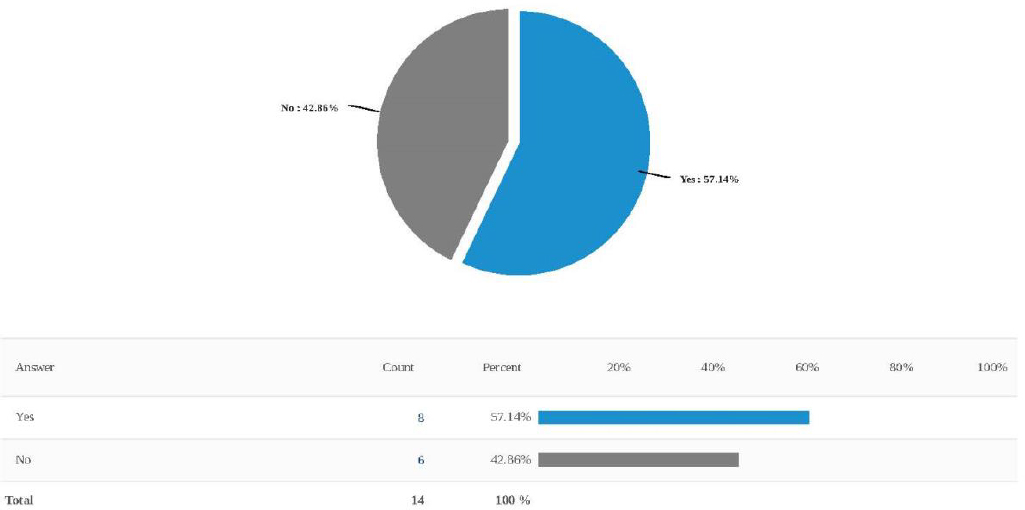
A pie chart shows the project responses with Yes at 57.14 percent and No at 42.86 percent. A bar chart shows 57.14 percent answered Yes and 42.86 percent answered No in a survey of 14 responses.

Is project risk considered when selecting a project delivery method?
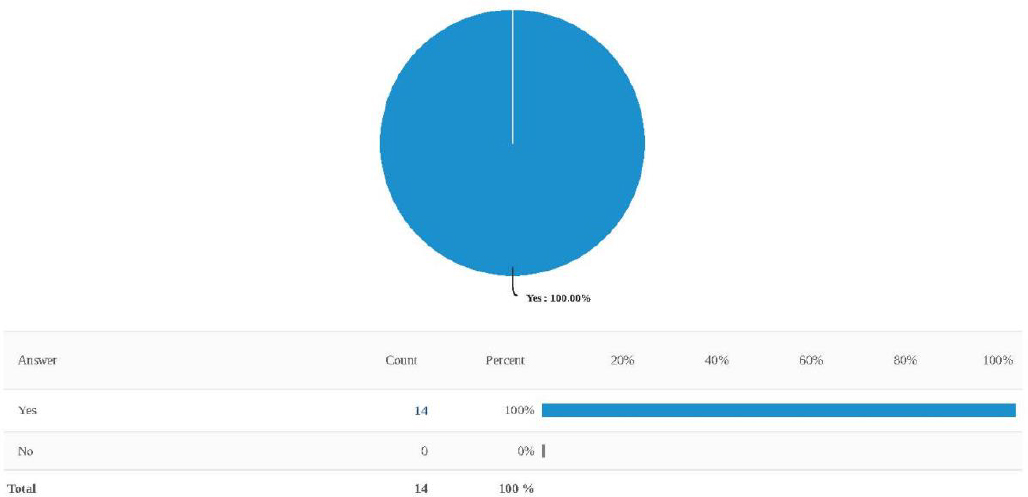
A pie chart shows the project response with 100 percent labeled as Yes. A bar chart shows 14 survey responses marked Yes, representing 100 percent of the total.
Suggested Citation: "Appendix D: Raw Survey Results." National Academies of Sciences, Engineering, and Medicine. 2025. Defining Contractual Risk Profiles to Increase Competition on Alternative Project Delivery Methods. Washington, DC: The National Academies Press. doi: 10.17226/29285.

What practices has your agency used to promote alignment between owner and industry perceptions of project risks during the procurement and contracting phase of a project? Please check all that apply.
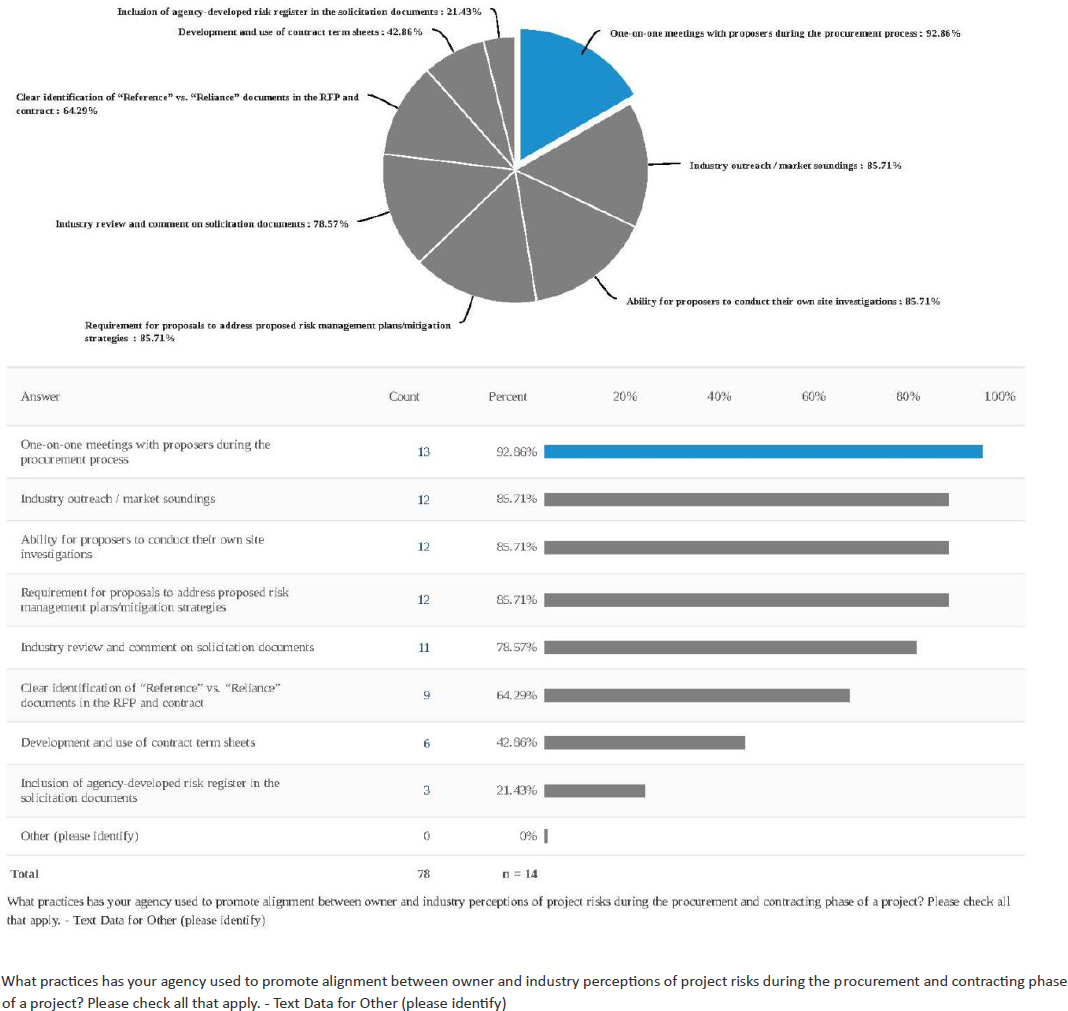
The largest segment represents one-on-one meetings with proposers during the procurement process at 92.86 percent. Three segments, each at 85.71 percent, include industry outreach or market soundings, proposer-led site investigations, and requirements to address risk management plans. Industry review of solicitation documents is at 78.57 percent. Clear identification of reference versus reliance documents in the RFP and the contract is at 64.29 percent. Development and use of contract term sheets is at 42.86 percent, and the inclusion of agency-developed risk registers in solicitation documents is the smallest at 21.43 percent. One-on-one meetings with proposers during procurement are highest at 92.86 percent, with 13 responses. Industry outreach, proposer-led site investigations, and addressing risk management plans each have 12 responses at 85.71 percent. Industry review of solicitation documents follows with 11 responses at 78.57 percent. Identification of reference versus reliance documents in the RFP and the contract has 9 responses at 64.29 percent. Development and use of contract term sheets have 6 responses at 42.86 percent, and inclusion of agency-developed risk registers is lowest with 3 responses at 21.43 percent.
Suggested Citation: "Appendix D: Raw Survey Results." National Academies of Sciences, Engineering, and Medicine. 2025. Defining Contractual Risk Profiles to Increase Competition on Alternative Project Delivery Methods. Washington, DC: The National Academies Press. doi: 10.17226/29285.

What practices has your agency used to help manage risk during the post-award phase of a project?
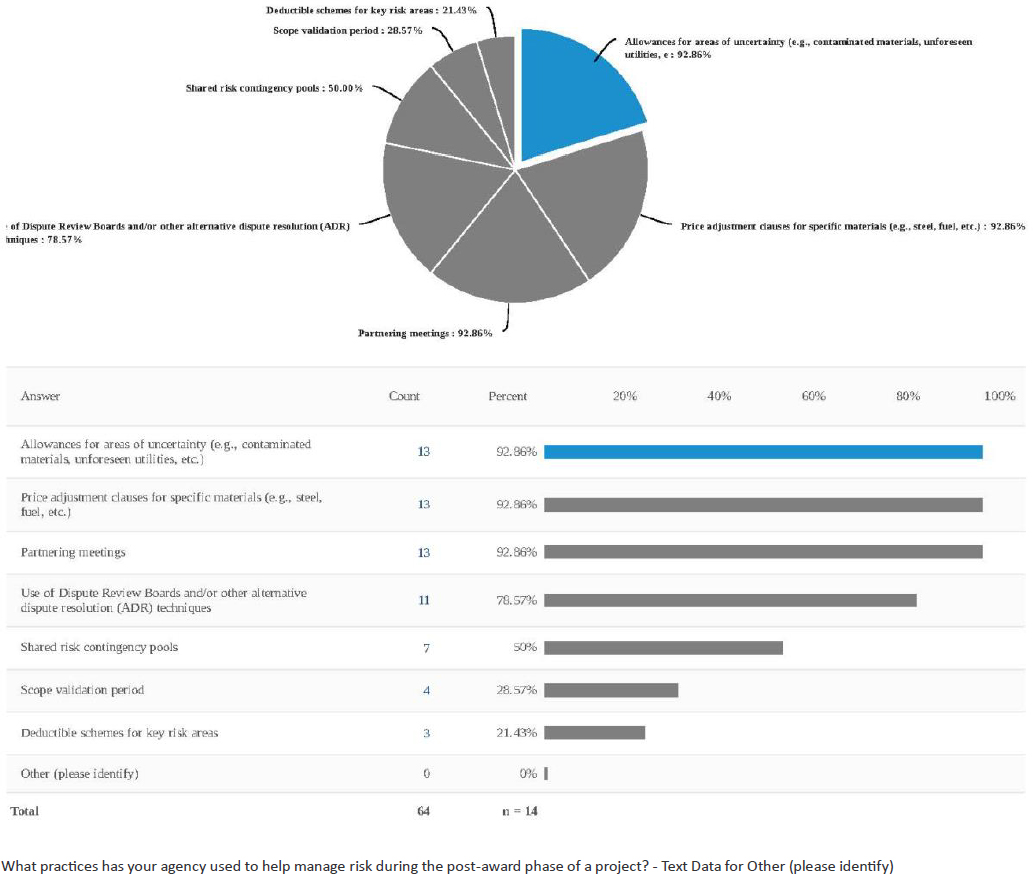
A pie chart shows contingency pools at 50 percent, scope validation at 28.57 percent, and utilities at 7.14 percent. Allowances for uncertainty, price adjustment clauses, and partnering meetings each have 13 responses at 92.86 percent. Use of Dispute Review Boards or other alternative dispute resolution methods has 11 responses at 78.57 percent. Shared risk contingency pools have 7 responses at 50 percent. The scope validation period has 4 responses at 28.57 percent, and the deductible schemes for key risk areas have 3 responses at 21.43 percent. The “Other” category has zero responses. Total responses are 64 from 14 participants.
Suggested Citation: "Appendix D: Raw Survey Results." National Academies of Sciences, Engineering, and Medicine. 2025. Defining Contractual Risk Profiles to Increase Competition on Alternative Project Delivery Methods. Washington, DC: The National Academies Press. doi: 10.17226/29285.

D2: Industry Survey Results

What alternative project delivery (APD) methods do you have experience with? Please check all that apply.
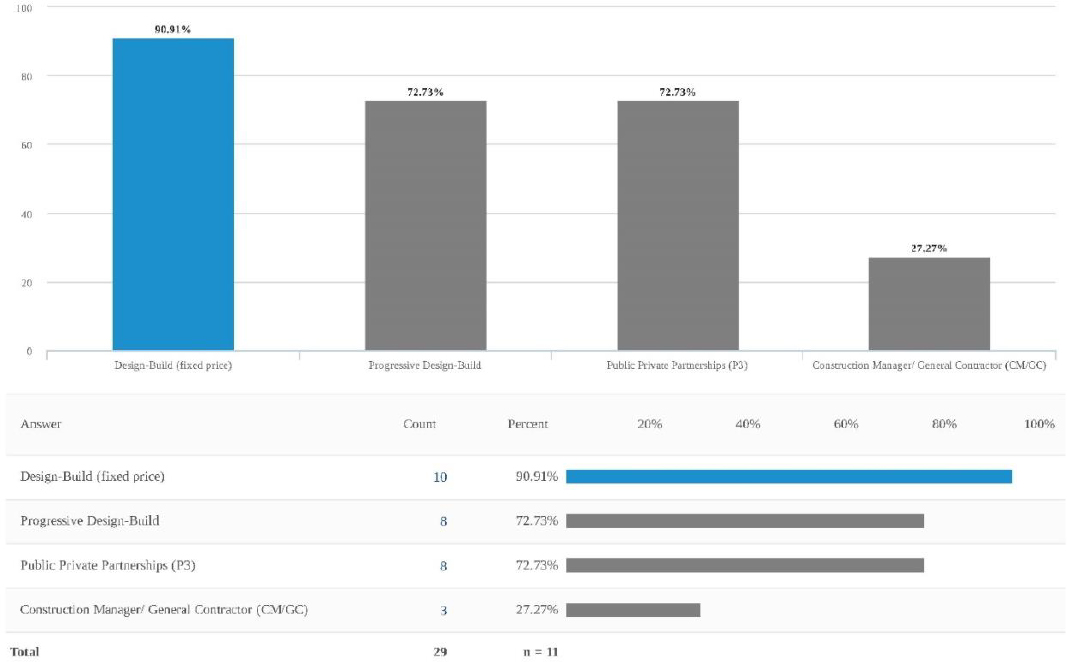
The data given in the bar graph are as follows: Design-Build shows the highest value at 90.91 percent and CM or GC the lowest at 27.27 percent. The data given in the bar graph are as follows: Design-Build shows the highest value at 90.91 percent and CM or GC the lowest at 27.27 percent.
Suggested Citation: "Appendix D: Raw Survey Results." National Academies of Sciences, Engineering, and Medicine. 2025. Defining Contractual Risk Profiles to Increase Competition on Alternative Project Delivery Methods. Washington, DC: The National Academies Press. doi: 10.17226/29285.

Assessing and Allocating Risk: Industry Survey – Dashboard

What is your firm’s typical role on APD projects? Please check all that apply.
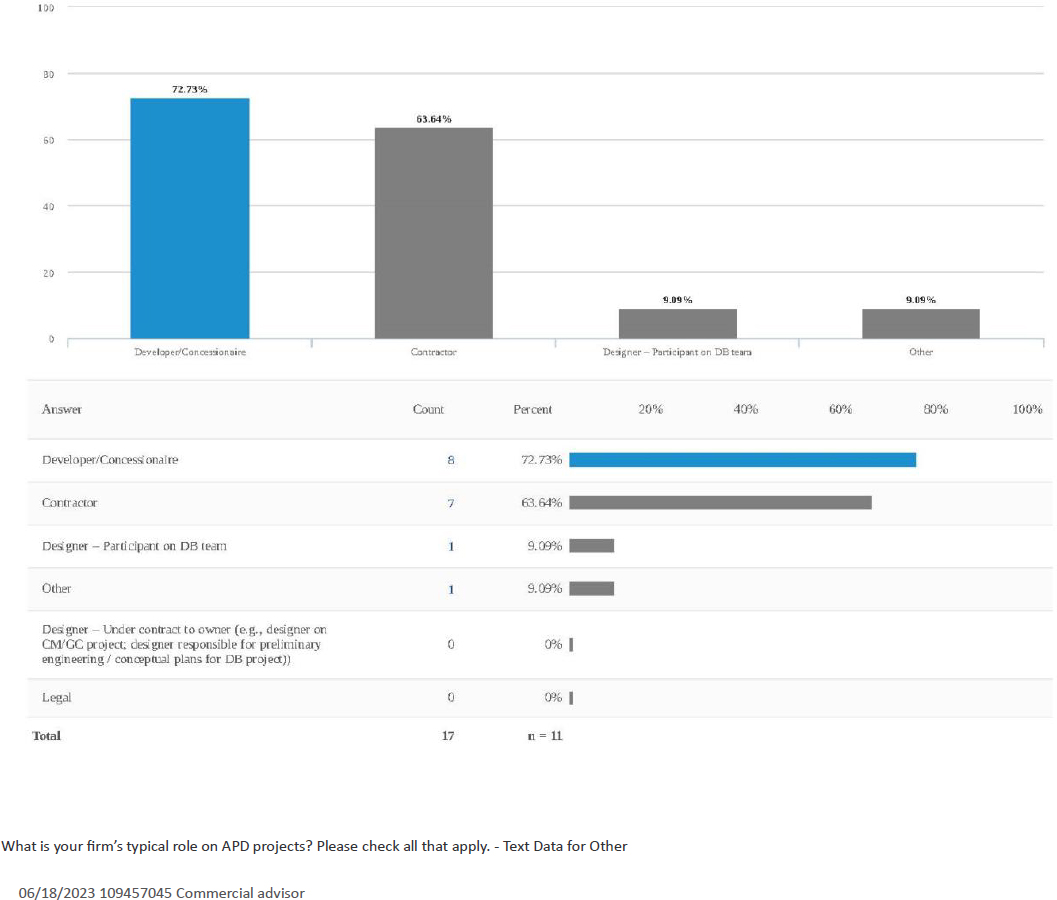
Four roles with their respective percentages. Developer or Concessionaire leads at 72.73 percent, shown by a bar reaching nearly 80 on the vertical axis. Contractor follows at 63.64 percent with a bar slightly above 60. Designer – Participant on the Design-Build team and Other roles each have 9.09 percent, represented by short bars just above the baseline. The vertical axis ranges from zero to one hundred. A bar chart presents project roles with counts and percentages. The developer or Concessionaire has 8 responses at 72.73 percent, shown by a blue bar. Contractor follows with 7 responses at 63.64 percent, represented by a gray bar. Designer – Participant on the Design-Build team and others each have 1 response at 9.09 percent, shown by short gray bars. Designer – Under contract with the owner and Legal has zero responses and no bars. The total count is 17 from 11 participants.
Suggested Citation: "Appendix D: Raw Survey Results." National Academies of Sciences, Engineering, and Medicine. 2025. Defining Contractual Risk Profiles to Increase Competition on Alternative Project Delivery Methods. Washington, DC: The National Academies Press. doi: 10.17226/29285.

Please rate the extent to which the following could impact your decision to pursue an APD project opportunity.
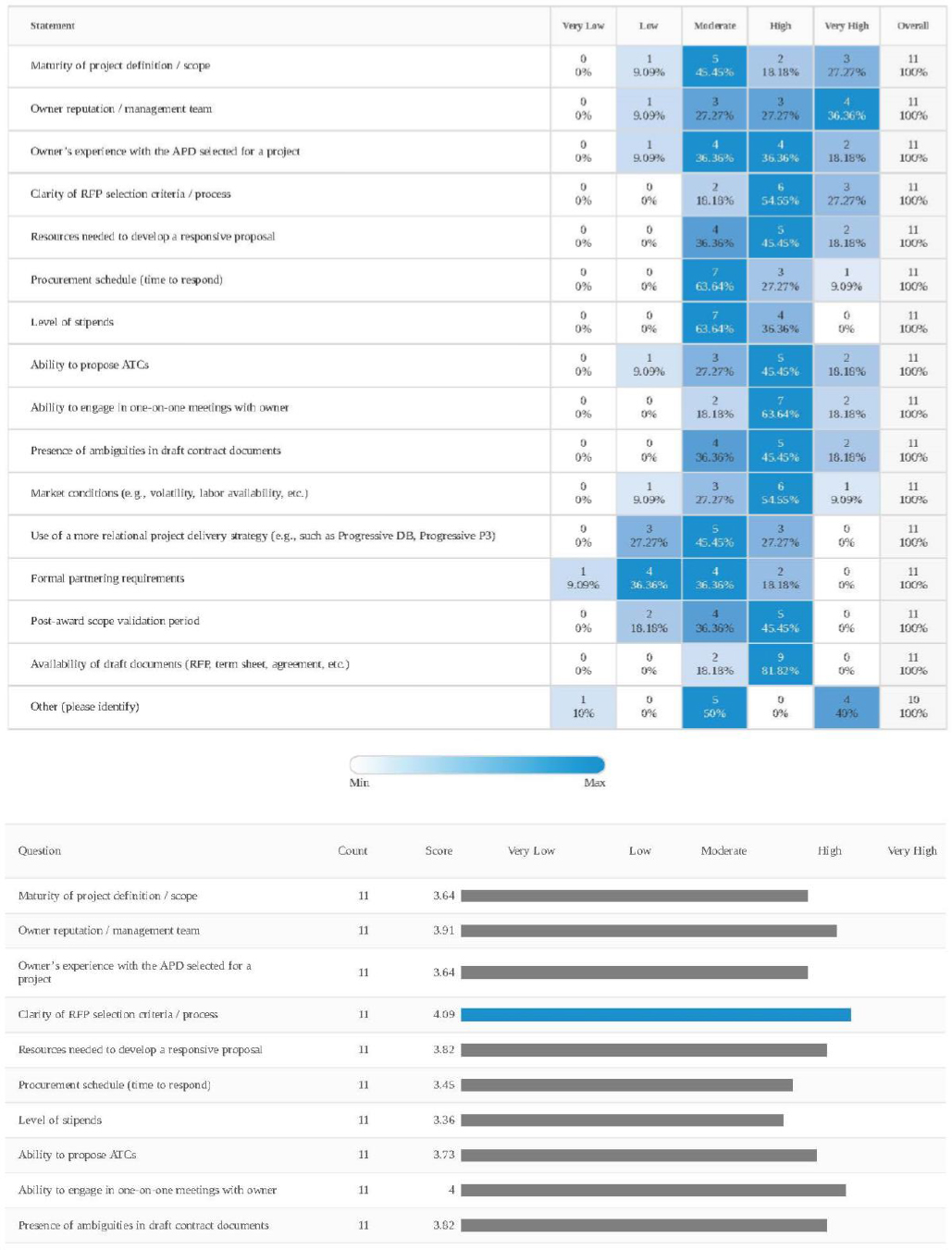
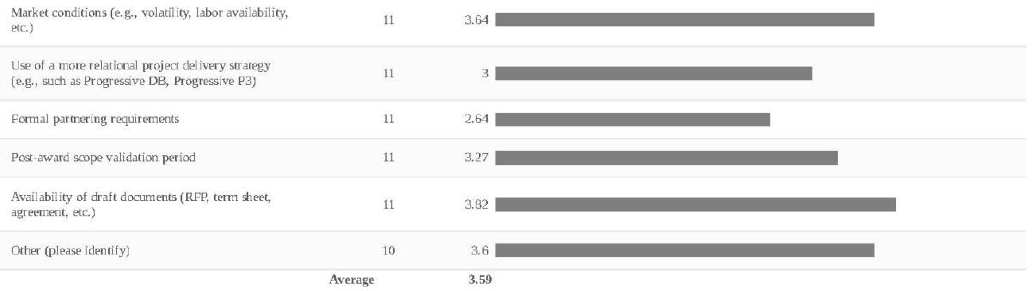
From left to right, the entries under the first column are maturity of project definition or scope, owner’s reputation or management team, owner’s experience with the selected alternative project delivery method, and clarity of RFP selection criteria or process. For example, maturity of project definition or scope is rated 0 percent Very Low, 9.09 percent Low, with one response, and 45.45 percent Moderate, with five responses. The owner’s experience with the selected method is rated 0 percent Very Low, 9.09 percent Low, and 36.36 percent Moderate. Blue horizontal bars visually represent the percentage values. Some rows, such as resources needed to develop a responsive proposal, procurement schedule, level of stipends, and ability to propose ATCs, are listed but not filled in with data. The columns are labeled Question, Count, Score, Very Low, Low, Moderate, High, and Very High. Each row lists a criterion such as maturity of project definition or scope, owner reputation, owner’s experience with the selected alternative project delivery method, and clarity of RFP selection criteria or process. Scores range from 1.27 to 4.09. Clarity of RFP selection criteria or process has the highest score at 4.09, followed by the ability to engage in one-on-one meetings with the owner at 4.00. Other high-scoring items include the presence of ambiguities in draft contract documents, the availability of draft documents, and the resources needed to develop a responsive proposal. Lower scores are seen for the post-award scope validation period at 1.27 and formal partnering requirements at 2.64. Each score is visually represented by a horizontal bar. The table includes a total of 15 criteria, with average scores indicating moderate to high concern or importance. The layout is structured for comparison across criteria, with descending order based on score.
Suggested Citation: "Appendix D: Raw Survey Results." National Academies of Sciences, Engineering, and Medicine. 2025. Defining Contractual Risk Profiles to Increase Competition on Alternative Project Delivery Methods. Washington, DC: The National Academies Press. doi: 10.17226/29285.
The columns are labeled Question, Count, Score, Very Low, Low, Moderate, High, and Very High. Each row lists a criterion such as maturity of project definition or scope, owner reputation, owner’s experience with the selected alternative project delivery method, and clarity of RFP selection criteria or process. Scores range from 1.27 to 4.09. Clarity of RFP selection criteria or process has the highest score at 4.09, followed by the ability to engage in one-on-one meetings with the owner at 4.00. Other high-scoring items include the presence of ambiguities in draft contract documents, the availability of draft documents, and the resources needed to develop a responsive proposal. Lower scores are seen for the post-award scope validation period at 1.27 and formal partnering requirements at 2.64. Each score is visually represented by a horizontal bar. The table includes a total of 15 criteria, with average scores indicating moderate to high concern or importance. The layout is structured for comparison across criteria, with descending order based on score.
Suggested Citation: "Appendix D: Raw Survey Results." National Academies of Sciences, Engineering, and Medicine. 2025. Defining Contractual Risk Profiles to Increase Competition on Alternative Project Delivery Methods. Washington, DC: The National Academies Press. doi: 10.17226/29285.

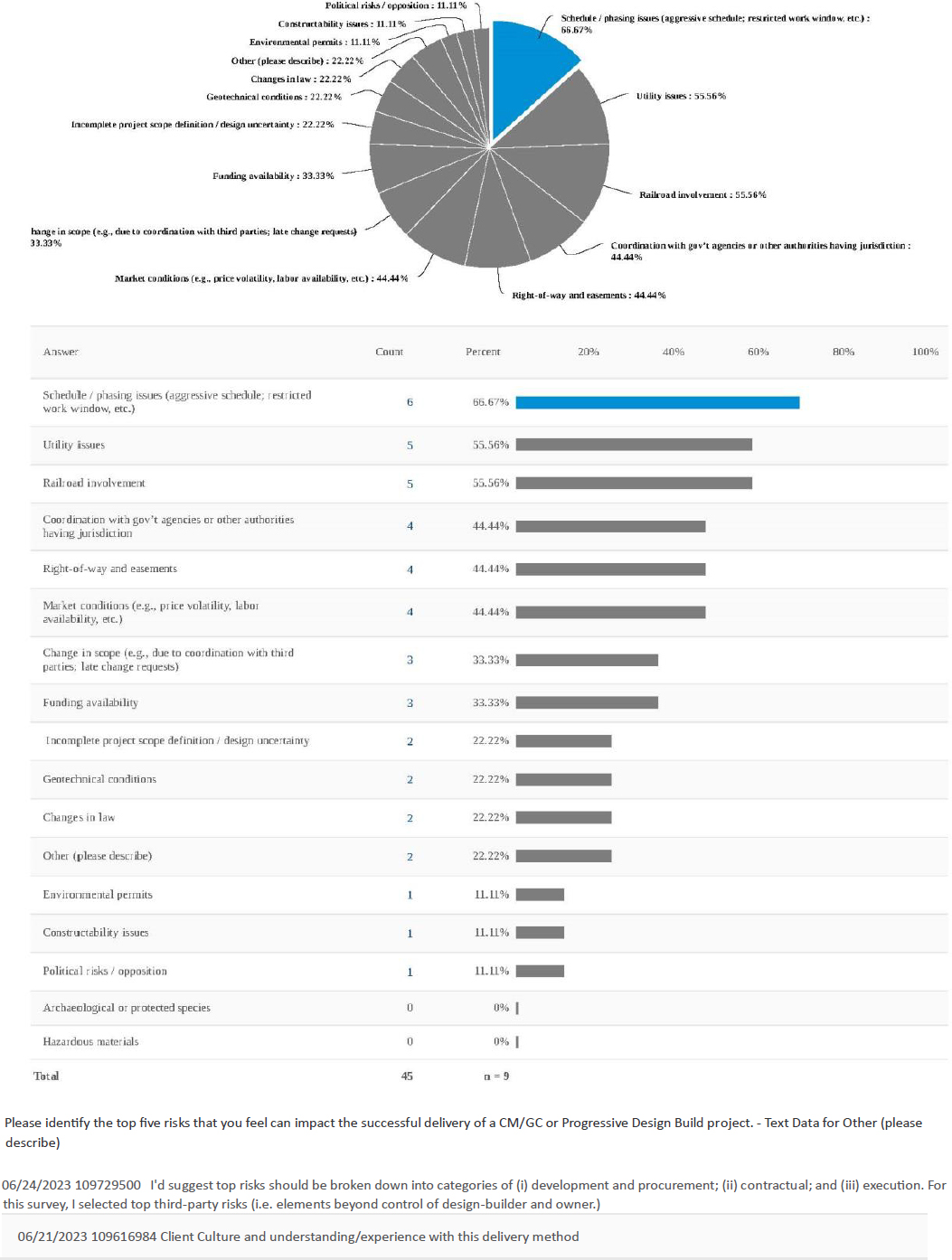
Please identify the top five risks that you fee
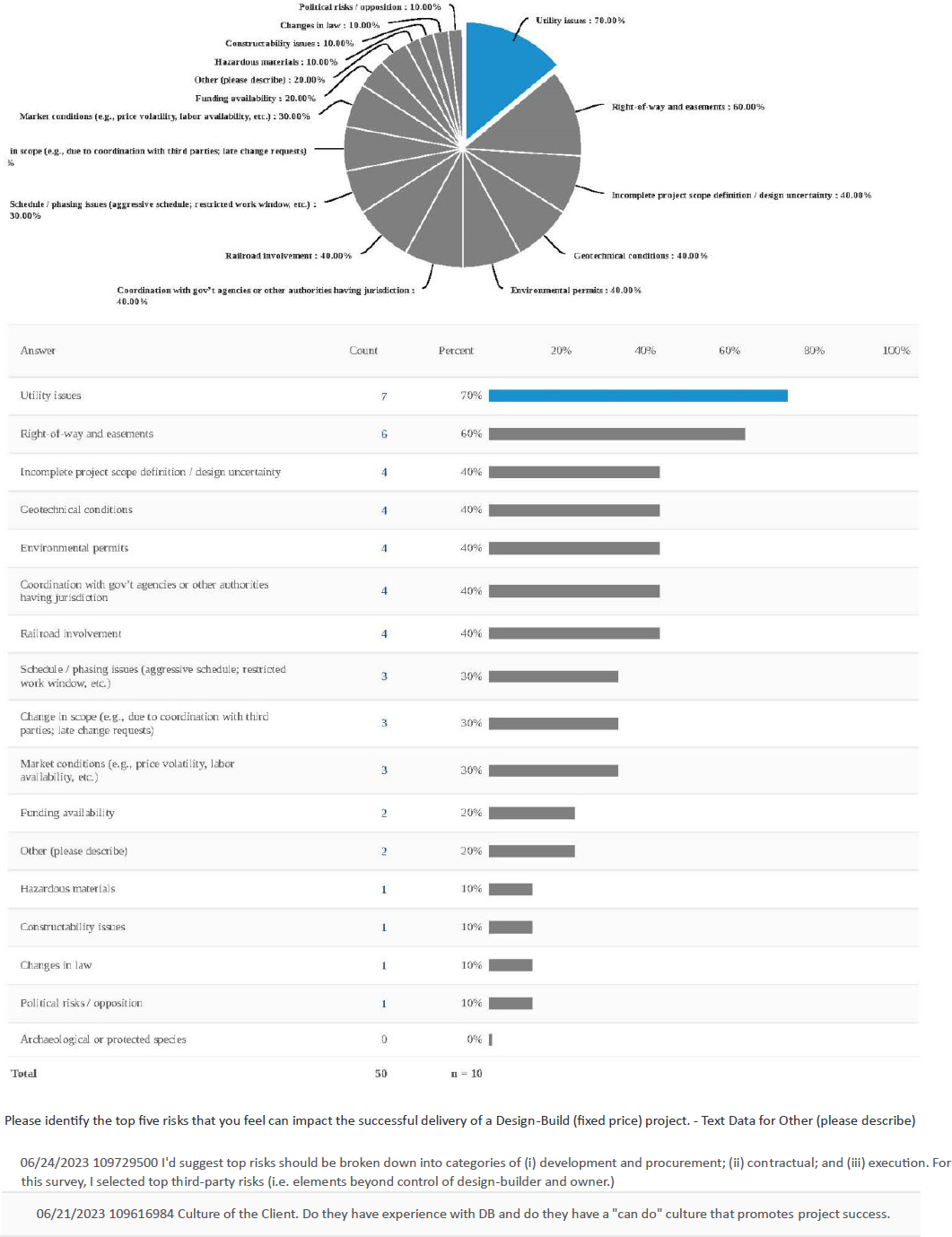
The largest segment represents utility issues at seventy percent. Right-of-way and easements follow at sixty percent. Several issues are marked at forty percent each, including incomplete project scope definition or design uncertainty, geotechnical conditions, environmental permits, railroad involvement, and coordination with government agencies or other authorities having jurisdiction. Schedules or phasing issues, such as aggressive schedules or restricted work windows, and market conditions like price volatility or labor availability, are each marked at thirty percent. An unlabeled segment titled “in scope,” referring to coordination with third parties or late change requests, is indicated by a line without a percentage. Smaller segments include political risks or opposition, changes in law, constructability issues, and hazardous materials, each contributing ten percent. Two segments—other (requiring further description) and funding availability—are each marked at twenty percent. The 18 project-related issues, along with their respective counts and percentages, are based on a total of 50 responses from 10 participants. The issues and their values are: Utility issues with 7 counts, 70 percent; Right-of-way and easements with 6 counts, 60 percent; Incomplete project scope definition or design uncertainty, Geotechnical conditions, Environmental permits, Coordination with government agencies, and Railroad involvement each with 4 counts, 40 percent; Schedule or phasing issues, Change in scope, Late change requests, and Market conditions each with 3 counts, 30 percent; Funding availability and Other with 2 counts, 20 percent; Hazardous materials, Constructability issues, Change in law, and Political risks or opposition each with 1 count, 10 percent; and Archaeological or protected species with 0 count.
Suggested Citation: "Appendix D: Raw Survey Results." National Academies of Sciences, Engineering, and Medicine. 2025. Defining Contractual Risk Profiles to Increase Competition on Alternative Project Delivery Methods. Washington, DC: The National Academies Press. doi: 10.17226/29285.

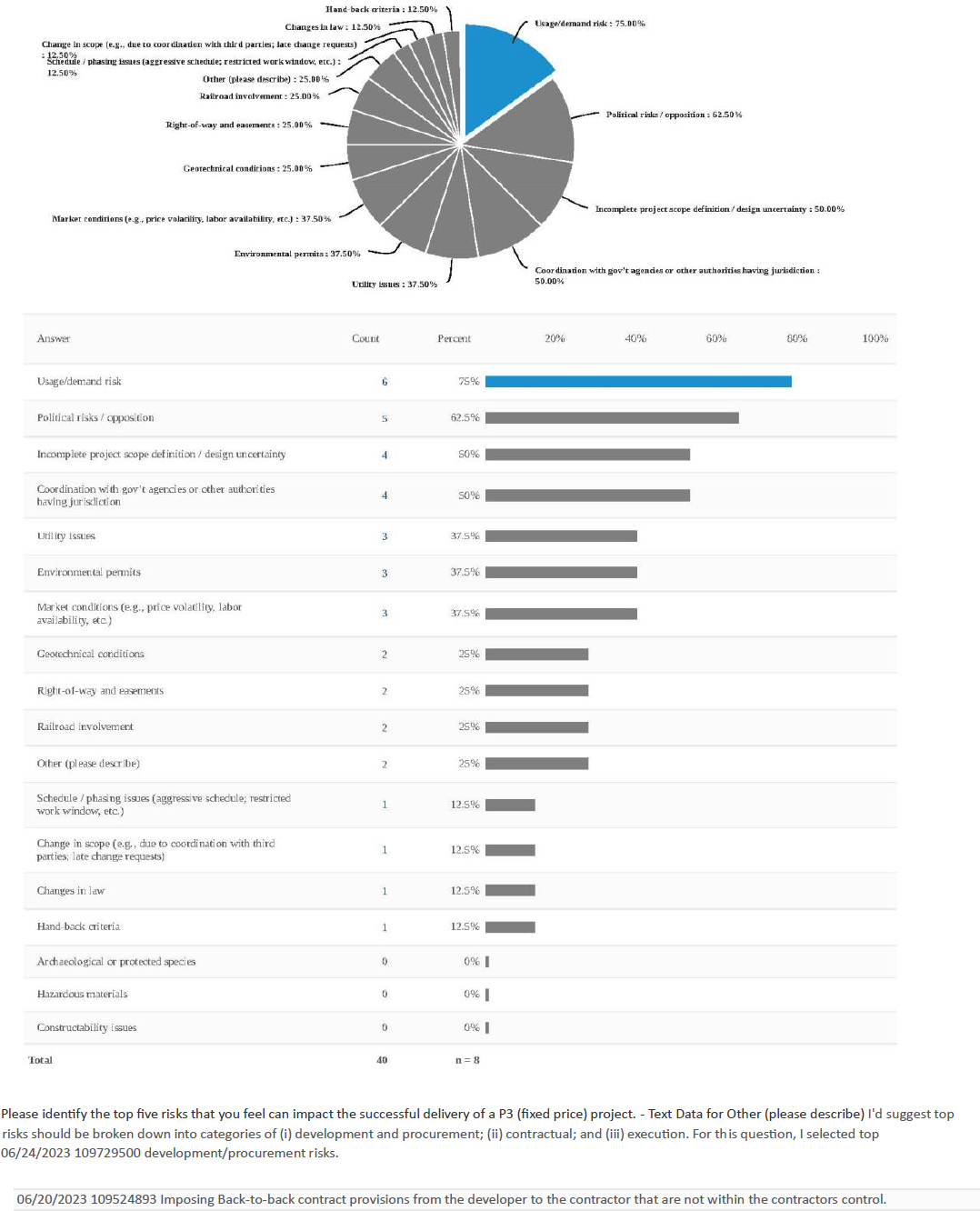
Please identify the top five risks that you feel can impact the successful delivery of a CM/GC or Progressive Design Build project.
The data is as follows: 1. Usage or demand risk, 75.00 percent. 2. Political risks or opposition, 62.50 percent. 3. Incomplete project scope definition or design uncertainty, 50.00 percent. 4. Coordination with gov’t agencies or other authorities having jurisdiction, 50.00 percent. 5. Utility issues, 37.50 percent. 6. Environmental permits, 37.50 percent. 7. Market conditions (for example, price volatility, labor availability, et cetera), 37.50 percent. 8. Geotechnical conditions, 25.00 percent. 9. Right-of-way and easements, 25.00 percent. 10. Railroad involvement, 25.00 percent. 11. Other (please describe), 25.00 percent. 12. Schedule or phasing issues (aggressive schedule; restricted work window, etc.), 12.50 percent. 13. Change in scope (for example, due to coordination with third parties; late change requests), 12.50 percent. 14. Changes in law, 12.50 percent. 15. Hand-back criteria, 12.50 percent. The percentage column of the table shows a bar graph depicting the respective percentage. The row entries are as follows: Row 1. Usage or demand risk, 6, 75.0 percent. Row 2. Political risks or opposition, 5, 62.5 percent. Row 3. Incomplete project scope definition or design uncertainty, 4, 50.0 percent. Row 4. Coordination with government agencies or other authorities having jurisdiction, 4, 50.0 percent. Row 5. Utility issues, 3, 37.5 percent. Row 6. Environmental permits, 3, 37.5 percent. Row 7. Market conditions (for example, price volatility, labor availability, et cetera), 3, 37.5 percent. Row 8. Geotechnical conditions, 2, 25.0 percent. Row 9. Right-of-way and easements, 2, 25.0 percent. Row 10. Railroad involvement, 2, 25.0 percent. Row 11. Other (please describe), 2, 25.0 percent. Row 12. Schedule or phasing issues (aggressive schedule; restricted work window, et cetera), 1, 12.5 percent. Row 13. Change in scope (for example, due to coordination with third parties; late change requests), 1, 12.5 percent. Row 14. Changes in law, 1, 12.5 percent. Row 15. Hand-back criteria, 1, 12.5 percent. Row 16. Archaeological or protected species, 0, 0 percent. Row 17. Hazardous materials, 0, 0 percent. Row 18. Constructability issues, 0, 0 percent. Row 19. Total, 40, n = 8.
Suggested Citation: "Appendix D: Raw Survey Results." National Academies of Sciences, Engineering, and Medicine. 2025. Defining Contractual Risk Profiles to Increase Competition on Alternative Project Delivery Methods. Washington, DC: The National Academies Press. doi: 10.17226/29285.

Please identify the top five risks that you feel can impact the successful delivery of a P3 (fixed price) project.
The data is as follows: 1. Usage or demand risk, 75.00 percent. 2. Political risks or opposition, 62.50 percent. 3. Incomplete project scope definition or design uncertainty, 50.00 percent. 4. Coordination with gov’t agencies or other authorities having jurisdiction, 50.00 percent. 5. Utility issues, 37.50 percent. 6. Environmental permits, 37.50 percent. 7. Market conditions (for example, price volatility, labor availability, et cetera), 37.50 percent. 8. Geotechnical conditions, 25.00 percent. 9. Right-of-way and easements, 25.00 percent. 10. Railroad involvement, 25.00 percent. 11. Other (please describe), 25.00 percent. 12. Schedule or phasing issues (aggressive schedule; restricted work window, etc.), 12.50 percent. 13. Change in scope (for example, due to coordination with third parties; late change requests), 12.50 percent. 14. Changes in law, 12.50 percent. 15. Hand-back criteria, 12.50 percent. The percentage column of the table shows a bar graph depicting the respective percentage. The row entries are as follows: Row 1. Usage or demand risk, 6, 75.0 percent. Row 2. Political risks or opposition, 5, 62.5 percent. Row 3. Incomplete project scope definition or design uncertainty, 4, 50.0 percent. Row 4. Coordination with government agencies or other authorities having jurisdiction, 4, 50.0 percent. Row 5. Utility issues, 3, 37.5 percent. Row 6. Environmental permits, 3, 37.5 percent. Row 7. Market conditions (for example, price volatility, labor availability, et cetera), 3, 37.5 percent. Row 8. Geotechnical conditions, 2, 25.0 percent. Row 9. Right-of-way and easements, 2, 25.0 percent. Row 10. Railroad involvement, 2, 25.0 percent. Row 11. Other (please describe), 2, 25.0 percent. Row 12. Schedule or phasing issues (aggressive schedule; restricted work window, et cetera), 1, 12.5 percent. Row 13. Change in scope (for example, due to coordination with third parties; late change requests), 1, 12.5 percent. Row 14. Changes in law, 1, 12.5 percent. Row 15. Hand-back criteria, 1, 12.5 percent. Row 16. Archaeological or protected species, 0, 0 percent. Row 17. Hazardous materials, 0, 0 percent. Row 18. Constructability issues, 0, 0 percent. Row 19. Total, 40, n = 8.
Suggested Citation: "Appendix D: Raw Survey Results." National Academies of Sciences, Engineering, and Medicine. 2025. Defining Contractual Risk Profiles to Increase Competition on Alternative Project Delivery Methods. Washington, DC: The National Academies Press. doi: 10.17226/29285.

Please identify how risks should be allocated on your Design–Build (DB) projects.
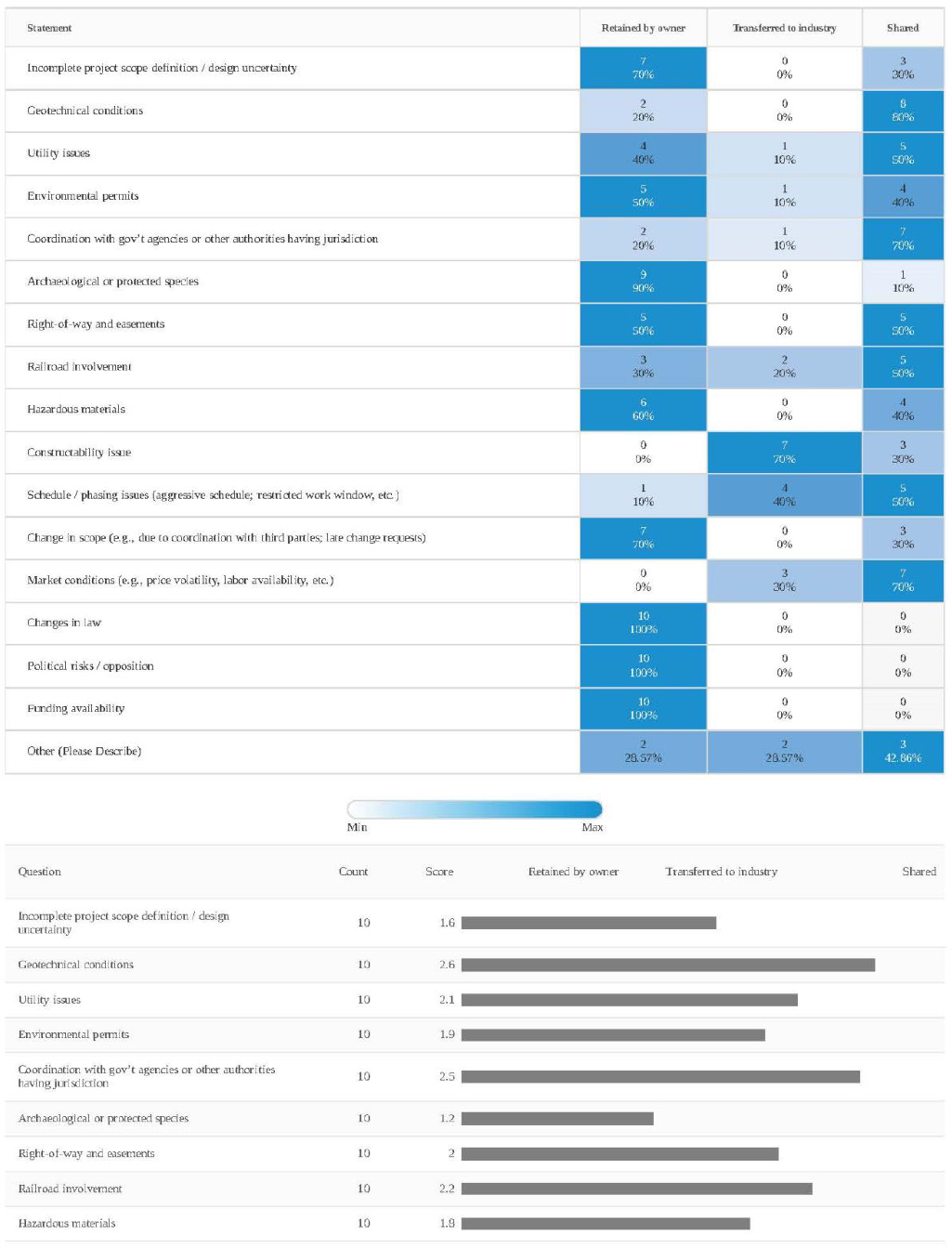
The row entries are as follows: Row 1. Incomplete project scope definition or design uncertainty, 7 (70 percent), 0 (0 percent), 3 (30 percent). Row 2. Geotechnical conditions, 2 (20 percent), 0 (0 percent), 8 (80 percent). Row 3. Utility issues, 4 (40 percent), 1 (10 percent), 5 (50 percent). Row 4. Environmental permits, 5 (50 percent), 1 (10 percent), 4 (40 percent). Row 5. Coordination with government agencies or other authorities having jurisdiction, 2 (20 percent), 1 (10 percent), 7 (70 percent). Row 6. Archaeological or protected species, 9 (90 percent), 0 (0 percent), 1 (10 percent). Row 7. Right-of-way and easements, 5 (50 percent), 0 (0 percent), 5 (50 percent). Row 8. Railroad involvement, 3 (30 percent), 2 (20 percent), 5 (50 percent). Row 9. Hazardous materials, 6 (60 percent), 0 (0 percent), 4 (40 percent). Row 10. Constructability issue, 0 (0 percent), 7 (70 percent), 3 (30 percent). Row 11. Schedule or phasing issues (aggressive schedule; restricted work window, et cetera), 1 (10 percent), 4 (40 percent), 5 (50 percent). Row 12. Change in scope (for example, due to coordination with third parties; late change requests), 7 (70 percent), 0 (0 percent), 3 (30 percent). Row 13. Market conditions (for example, price volatility, labor availability, et cetera), 0 (0 percent), 3 (30 percent), 7 (70 percent). Row 14. Changes in law, 10 (100 percent), 0 (0 percent), 0 (0 percent). Row 15. Political risks or opposition, 10 (100 percent), 0 (0 percent), 0 (0 percent). Row 16. Funding availability, 10 (100 percent), 0 (0 percent), 0 (0 percent). Row 17. Other (Please Describe), 2 (28.57 percent), 2 (28.57 percent), 3 (42.46 percent). The last column of the table shows a bar graph depicting the respective data. The row entries are as follows: Row 1. Incomplete project scope definition or design uncertainty, 10, 1.6. Row 2. Geotechnical conditions, 10, 2.6. Row 3. Utility issues, 10, 2.1. Row 4. Environmental permits, 10, 1.9. Row 5. Coordination with government agencies or other authorities having jurisdiction, 10, 2.5. Row 6. Archaeological or protected species, 10, 1.2. Row 7. Right-of-way and easements, 10, 2.0. Row 8. Railroad involvement, 10, 2.2. Row 9. Hazardous materials, 10, 1.8.
Suggested Citation: "Appendix D: Raw Survey Results." National Academies of Sciences, Engineering, and Medicine. 2025. Defining Contractual Risk Profiles to Increase Competition on Alternative Project Delivery Methods. Washington, DC: The National Academies Press. doi: 10.17226/29285.
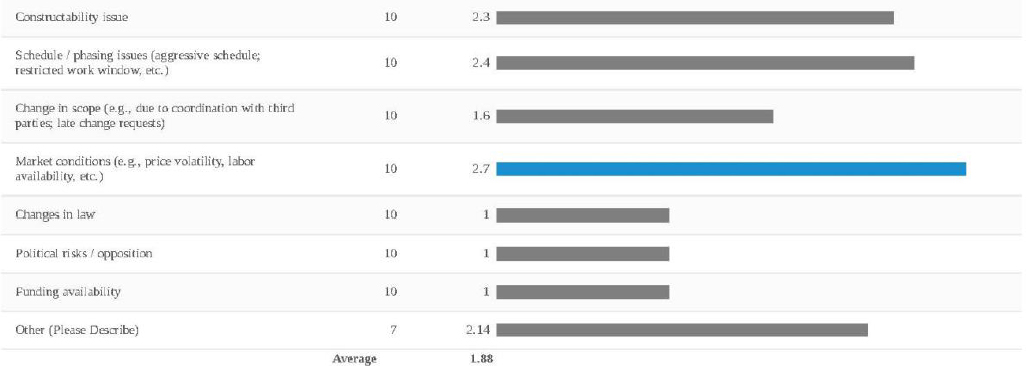
The last three columns of the table show a bar graph representing the respective data. The row entries are as follows: Row 1. Constructability issue, 10, 2.3. Row 2. Schedule or phasing issues (aggressive schedule; restricted work window, et cetera.), 10, 2.4. Row 3. Change in scope (for example, due to coordination with third parties; late change requests), 10, 1.6. Row 4. Market conditions (for example, price volatility, labor availability, et cetera.), 10, 2.7. Row 5. Changes in law, 10, 1.7. Row 6. Political risks or opposition, 10, 1.7. Row 7. Funding availability, 10, 1.7. Row 8. Other (Please Describe), 7, 2.14. The average score given at the bottom is 1.88.
Suggested Citation: "Appendix D: Raw Survey Results." National Academies of Sciences, Engineering, and Medicine. 2025. Defining Contractual Risk Profiles to Increase Competition on Alternative Project Delivery Methods. Washington, DC: The National Academies Press. doi: 10.17226/29285.

Please identify how risks should be allocated on your Progressive Design–Build or CM/GC method projects.

The row entries are as follows: Row 1. Incomplete project scope definition or design uncertainty, 3 (33.33 percent), 0 (0 percent), 6 (66.67 percent), 9 (100 percent). Row 2. Geotechnical conditions, 5 (55.56 percent), 0 (0 percent), 4 (44.44 percent), 9 (100 percent). Row 3. Utility issues, 4 (44.44 percent), 0 (0 percent), 5 (55.56 percent), 9 (100 percent). Row 4. Environmental permits, 6 (66.67 percent), 0 (0 percent), 3 (33.33 percent), 9 (100 percent). Row 5. Coordination with government agencies or other authorities having jurisdiction, 3 (33.33 percent), 0 (0 percent), 6 (66.67 percent), 9 (100 percent). Row 6. Archaeological or protected species, 8 (88.89 percent), 0 (0 percent), 1 (11.11 percent), 9 (100 percent). Row 7. Right-of-way and easements, 7 (77.78 percent), 0 (0 percent), 2 (22.22 percent), 9 (100 percent). Row 8. Railroad involvement, 5 (55.56 percent), 0 (0 percent), 4 (44.44 percent), 9 (100 percent). Row 9. Hazardous materials, 5 (55.56 percent), 0 (0 percent), 4 (44.44 percent), 9 (100 percent). Row 10. Constructability issue, 1 (11.11 percent), 5 (55.56 percent), 3 (33.33 percent), 9 (100 percent). Row 11. Schedule or phasing issues (aggressive schedule; restricted work window, et cetera), 2 (22.22 percent), 2 (22.22 percent), 5 (55.56 percent), 9 (100 percent). Row 12. Change in scope (for example, due to coordination with third parties; late change requests), 6 (66.67 percent), 0 (0 percent), 3 (33.33 percent), 9 (100 percent). Row 13. Market conditions (for example, price volatility, labor availability, et cetera), 2 (22.22 percent), 1 (11.11 percent), 6 (66.67 percent), 9 (100 percent). Row 14. Changes in law, 9 (100 percent), 0 (0 percent), 0 (0 percent), 9 (100 percent). The last three columns of the table show a bar graph representing the respective data. The row entries are as follows: Row 1. Incomplete project scope definition or design uncertainty, 9, 2.33. Row 2. Geotechnical conditions, 9, 1.89. Row 3. Utility issues, 9, 2.11. Row 4. Environmental permits, 9, 1.67. Row 5. Coordination with government agencies or other authorities having jurisdiction, 9, 2.33. Row 6. Archaeological or protected species, 9, 1.22. Row 7. Right-of-way and easements, 9, 1.44. Row 8. Railroad involvement, 9, 1.89.
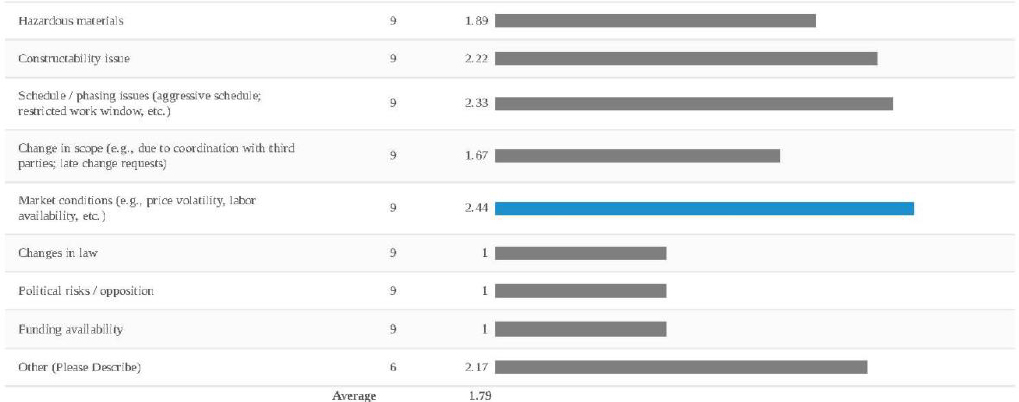
Suggested Citation: "Appendix D: Raw Survey Results." National Academies of Sciences, Engineering, and Medicine. 2025. Defining Contractual Risk Profiles to Increase Competition on Alternative Project Delivery Methods. Washington, DC: The National Academies Press. doi: 10.17226/29285.
The last column of the table shows a bar graph depicting the respective data. The row entries are as follows: Row 1. Hazardous materials, 9, 1.89. Row 2. Constructability issue, 9, 2.22. Row 3. Schedule or phasing issues (aggressive schedule; restricted work window, et cetera), 9, 2.33. Row 4. Change in scope (for example, due to coordination with third parties; late change requests), 9, 1.67. Row 5. Market conditions (for example, price volatility, labor availability, et cetera), 9, 2.44. Row 6. Changes in law, 9, 1. Row 7. Political risks or opposition, 9, 1. Row 8. Funding availability, 9, 1. Row 9. Other (Please Describe), 6, 2.17. The average at the bottom is 1.79.
Suggested Citation: "Appendix D: Raw Survey Results." National Academies of Sciences, Engineering, and Medicine. 2025. Defining Contractual Risk Profiles to Increase Competition on Alternative Project Delivery Methods. Washington, DC: The National Academies Press. doi: 10.17226/29285.

Please identify how risks should be allocated on your P3 projects.
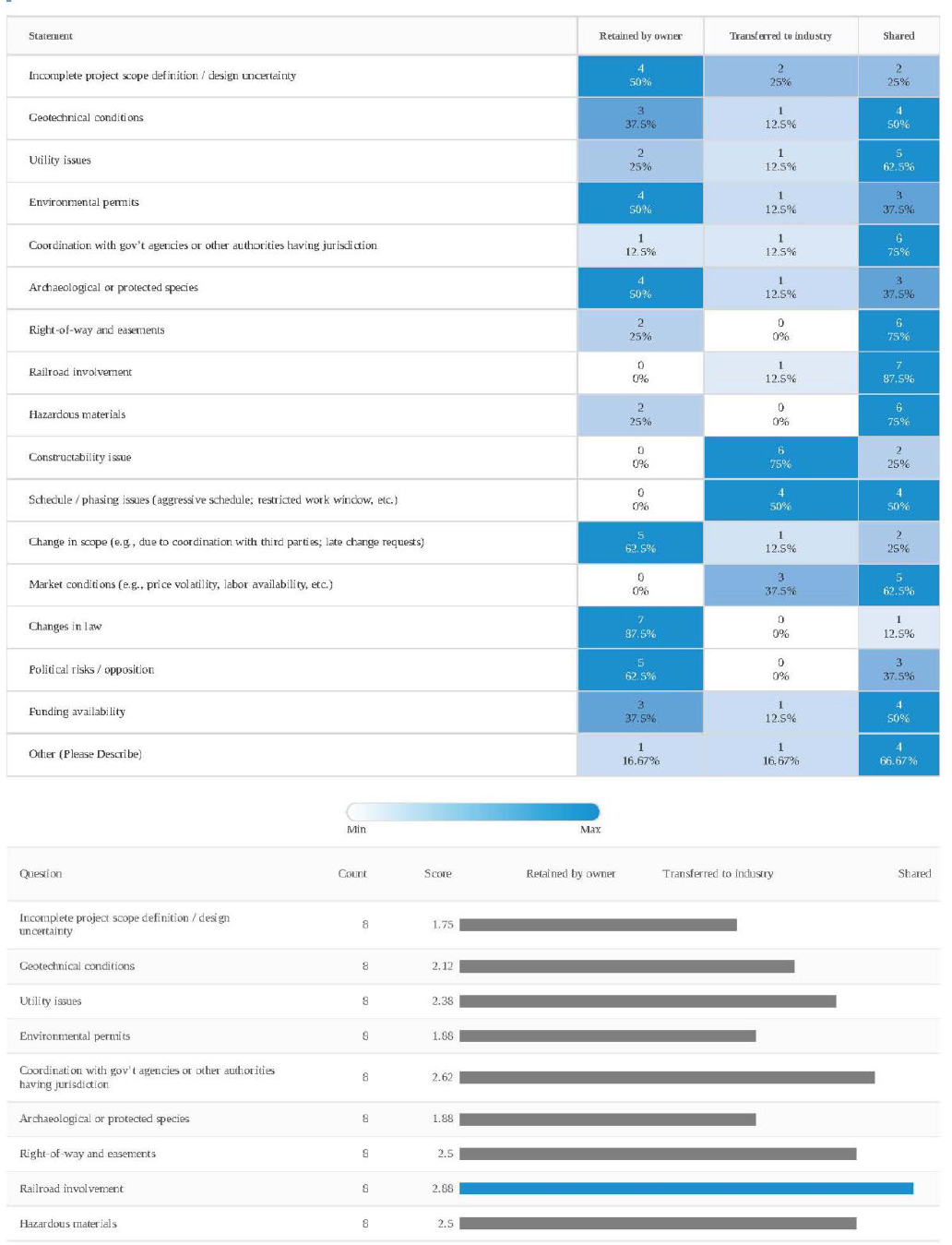
The row entries are as follows: Row 1. Incomplete project scope definition or design uncertainty, 4 (50 percent), 2 (25 percent), 2 (25 percent). Row 2. Geotechnical conditions, 3 (37.5 percent), 1 (12.5 percent), 4 (50 percent). Row 3. Utility issues, 2 (25 percent), 1 (12.5 percent), 5 (62.5 percent). Row 4. Environmental permits, 4 (50 percent), 1 (12.5 percent), 3 (37.5 percent). Row 5. Coordination with government agencies or other authorities having jurisdiction, 1 (12.5 percent), 1 (12.5 percent), 6 (75 percent). Row 6. Archaeological or protected species, 4 (50 percent), 1 (12.5 percent), 3 (37.5 percent). Row 7. Right-of-way and easements, 2 (25 percent), 0 (0 percent), 6 (75 percent). Row 8. Railroad involvement, 0 (0 percent), 1 (12.5 percent), 7 (87.5 percent). Row 9. Hazardous materials, 2 (25 percent), 0 (0 percent), 6 (75 percent). Row 10. Constructability issue, 0 (0 percent), 6 (75 percent), 2 (25 percent). Row 11. Schedule or phasing issues (aggressive schedule; restricted work window, et cetera), 0 (0 percent), 4 (50 percent), 4 (50 percent). Row 12. Change in scope (for example, due to coordination with third parties; late change requests), 5 (62.5 percent), 1 (12.5 percent), 2 (25 percent). Row 13. Market conditions (for example, price volatility, labor availability, et cetera), 0 (0 percent), 3 (37.5 percent), 5 (62.5 percent). Row 14. Changes in law, 7 (87.5 percent), 0 (0 percent), 1 (12.5 percent). Row 15. Political risks or opposition, 5 (62.5 percent), 0 (0 percent), 3 (37.5 percent). Row 16. Funding availability, 3 (37.5 percent), 1 (12.5 percent), 4 (50 percent). Row 17. Other (Please Describe), 1 (16.67 percent), 1 (16.67 percent), 4 (66.67 percent). The last column of the table shows a bar graph depicting the respective data. The row entries are as follows: Row 1. Incomplete project scope definition or design uncertainty, 8, 1.75. Row 2. Geotechnical conditions, 8, 2.12. Row 3. Utility issues, 8, 2.38. Row 4. Environmental permits, 8, 1.88. Row 5. Coordination with government agencies or other authorities having jurisdiction, 8, 2.62. Row 6. Archaeological or protected species, 8, 1.88. Row 7. Right-of-way and easements, 8, 2.5. Row 8. Railroad involvement, 8, 2.88. Row 9. Hazardous materials, 8, 2.5.
Suggested Citation: "Appendix D: Raw Survey Results." National Academies of Sciences, Engineering, and Medicine. 2025. Defining Contractual Risk Profiles to Increase Competition on Alternative Project Delivery Methods. Washington, DC: The National Academies Press. doi: 10.17226/29285.
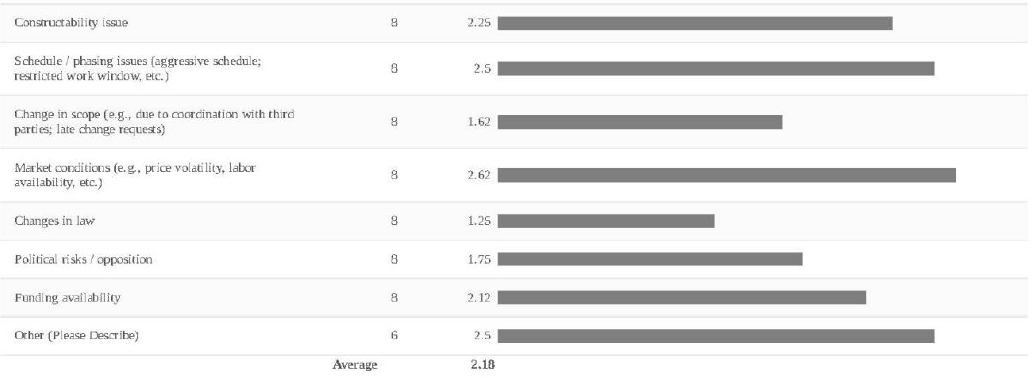
The last three columns of the table show a bar graph representing the respective data. The row entries are as follows: Row 1. Constructability issue, 8, 2.25. Row 2. Schedule or phasing issues (aggressive schedule; restricted work window, et cetera.), 8, 2.5. Row 3. Change in scope (for example, due to coordination with third parties; late change requests), 8, 1.62. Row 4. Market conditions (for example, price volatility, labor availability, et cetera.), 8, 2.62. Row 5. Changes in law, 8, 1.25. Row 6. Political risks or opposition, 8, 1.75. Row 7. Funding availability, 8, 2.12. Row 8. Other (Please Describe), 8, 2.5. The average score given at the bottom is 1.18.

Please identify if you would like to remain involved with any of the following aspects of this research study.
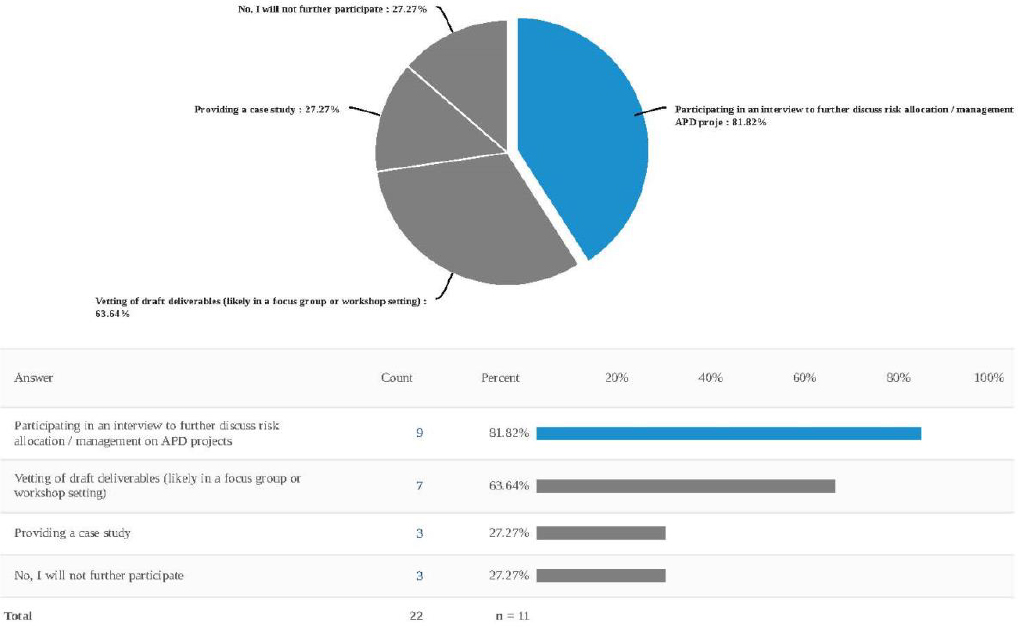
The data is as follows: 1. Participating in an interview to further discuss risk allocation or management A P D project, 81.82 percent. 2. Vetting of draft deliverables (likely in a focus group or workshop setting), 63.64 percent. 3. Providing a case study, 27.27 percent. 4. No, I will not further participate, 27.27 percent. The percentage column of the table shows a bar graph depicting the respective percentage. The row entries are as follows: Row 1. Participating in an interview to further discuss risk, 9, 81.82 percent. Row 2. Vetting of draft deliverables (likely in a focus group or workshop setting), 7, 63.64 percent. Row 3. Providing a case study, 3, 22.27 percent. Row 4. No, I will not further participate, 3, 22.27 percent. Row 5. Total, 22, n = 11.
Suggested Citation: "Appendix D: Raw Survey Results." National Academies of Sciences, Engineering, and Medicine. 2025. Defining Contractual Risk Profiles to Increase Competition on Alternative Project Delivery Methods. Washington, DC: The National Academies Press. doi: 10.17226/29285.
Page 126
Suggested Citation: "Appendix D: Raw Survey Results." National Academies of Sciences, Engineering, and Medicine. 2025. Defining Contractual Risk Profiles to Increase Competition on Alternative Project Delivery Methods. Washington, DC: The National Academies Press. doi: 10.17226/29285.
Page 127
Suggested Citation: "Appendix D: Raw Survey Results." National Academies of Sciences, Engineering, and Medicine. 2025. Defining Contractual Risk Profiles to Increase Competition on Alternative Project Delivery Methods. Washington, DC: The National Academies Press. doi: 10.17226/29285.
Page 128
Suggested Citation: "Appendix D: Raw Survey Results." National Academies of Sciences, Engineering, and Medicine. 2025. Defining Contractual Risk Profiles to Increase Competition on Alternative Project Delivery Methods. Washington, DC: The National Academies Press. doi: 10.17226/29285.
Page 129
Suggested Citation: "Appendix D: Raw Survey Results." National Academies of Sciences, Engineering, and Medicine. 2025. Defining Contractual Risk Profiles to Increase Competition on Alternative Project Delivery Methods. Washington, DC: The National Academies Press. doi: 10.17226/29285.
Page 130
Suggested Citation: "Appendix D: Raw Survey Results." National Academies of Sciences, Engineering, and Medicine. 2025. Defining Contractual Risk Profiles to Increase Competition on Alternative Project Delivery Methods. Washington, DC: The National Academies Press. doi: 10.17226/29285.
Page 131
Suggested Citation: "Appendix D: Raw Survey Results." National Academies of Sciences, Engineering, and Medicine. 2025. Defining Contractual Risk Profiles to Increase Competition on Alternative Project Delivery Methods. Washington, DC: The National Academies Press. doi: 10.17226/29285.
Page 132
Suggested Citation: "Appendix D: Raw Survey Results." National Academies of Sciences, Engineering, and Medicine. 2025. Defining Contractual Risk Profiles to Increase Competition on Alternative Project Delivery Methods. Washington, DC: The National Academies Press. doi: 10.17226/29285.
Page 133
Suggested Citation: "Appendix D: Raw Survey Results." National Academies of Sciences, Engineering, and Medicine. 2025. Defining Contractual Risk Profiles to Increase Competition on Alternative Project Delivery Methods. Washington, DC: The National Academies Press. doi: 10.17226/29285.
Page 134
Suggested Citation: "Appendix D: Raw Survey Results." National Academies of Sciences, Engineering, and Medicine. 2025. Defining Contractual Risk Profiles to Increase Competition on Alternative Project Delivery Methods. Washington, DC: The National Academies Press. doi: 10.17226/29285.
Page 135
Suggested Citation: "Appendix D: Raw Survey Results." National Academies of Sciences, Engineering, and Medicine. 2025. Defining Contractual Risk Profiles to Increase Competition on Alternative Project Delivery Methods. Washington, DC: The National Academies Press. doi: 10.17226/29285.
Page 136
Suggested Citation: "Appendix D: Raw Survey Results." National Academies of Sciences, Engineering, and Medicine. 2025. Defining Contractual Risk Profiles to Increase Competition on Alternative Project Delivery Methods. Washington, DC: The National Academies Press. doi: 10.17226/29285.
Page 137
Suggested Citation: "Appendix D: Raw Survey Results." National Academies of Sciences, Engineering, and Medicine. 2025. Defining Contractual Risk Profiles to Increase Competition on Alternative Project Delivery Methods. Washington, DC: The National Academies Press. doi: 10.17226/29285.
Page 138
Suggested Citation: "Appendix D: Raw Survey Results." National Academies of Sciences, Engineering, and Medicine. 2025. Defining Contractual Risk Profiles to Increase Competition on Alternative Project Delivery Methods. Washington, DC: The National Academies Press. doi: 10.17226/29285.
Page 139
Suggested Citation: "Appendix D: Raw Survey Results." National Academies of Sciences, Engineering, and Medicine. 2025. Defining Contractual Risk Profiles to Increase Competition on Alternative Project Delivery Methods. Washington, DC: The National Academies Press. doi: 10.17226/29285.
Page 140
Suggested Citation: "Appendix D: Raw Survey Results." National Academies of Sciences, Engineering, and Medicine. 2025. Defining Contractual Risk Profiles to Increase Competition on Alternative Project Delivery Methods. Washington, DC: The National Academies Press. doi: 10.17226/29285.
Page 141
Suggested Citation: "Appendix D: Raw Survey Results." National Academies of Sciences, Engineering, and Medicine. 2025. Defining Contractual Risk Profiles to Increase Competition on Alternative Project Delivery Methods. Washington, DC: The National Academies Press. doi: 10.17226/29285.
Page 142
Suggested Citation: "Appendix D: Raw Survey Results." National Academies of Sciences, Engineering, and Medicine. 2025. Defining Contractual Risk Profiles to Increase Competition on Alternative Project Delivery Methods. Washington, DC: The National Academies Press. doi: 10.17226/29285.
Page 143
Suggested Citation: "Appendix D: Raw Survey Results." National Academies of Sciences, Engineering, and Medicine. 2025. Defining Contractual Risk Profiles to Increase Competition on Alternative Project Delivery Methods. Washington, DC: The National Academies Press. doi: 10.17226/29285.
Page 144
Suggested Citation: "Appendix D: Raw Survey Results." National Academies of Sciences, Engineering, and Medicine. 2025. Defining Contractual Risk Profiles to Increase Competition on Alternative Project Delivery Methods. Washington, DC: The National Academies Press. doi: 10.17226/29285.
Page 145
Suggested Citation: "Appendix D: Raw Survey Results." National Academies of Sciences, Engineering, and Medicine. 2025. Defining Contractual Risk Profiles to Increase Competition on Alternative Project Delivery Methods. Washington, DC: The National Academies Press. doi: 10.17226/29285.
Page 146
Next Chapter: Appendix E: Interview Summaries
Subscribe to Emails from the National Academies
Stay up to date on activities, publications, and events by subscribing to email updates.