Defining Contractual Risk Profiles to Increase Competition on Alternative Project Delivery Methods (2025)
Chapter: Appendix B: Survey Questionnaires
Appendix B: Survey Questionnaires
Appendix B.1: Survey Questionnaire
(DOT / Owner Version)
(Please note: The actual survey will be developed and delivered using an online survey platform, such as Qualtrics or SurveyMonkey.)
Survey Introduction
You are invited to participate in a study assessing how the risk profiles of projects delivered using alternative project delivery (APD) methods (including design-build, construction manager/general contractor, and public private partnerships) can influence the pool of prospective proposers and the structure and pricing of the proposals received.
This study, conducted as National Highway Cooperative Research Program (NCHRP) Project 23-22, will result in the preparation of guidelines for state DOTs/owners addressing how to improve contractual risk allocation, stimulate competition, and improve the management and administration of major highway infrastructure projects delivered using APD methods.
The intent of this survey is to obtain feedback from owner representatives as to (a) their perceptions of the risks related to or impacting their use of APD methods and (b) the tools and techniques used to assess, allocate and manage risk. The collected survey responses, in conjunction with subsequent data collection efforts, including structured interviews and focus groups conducted with owner and industry practitioners, will be used to inform the development of a methodology for assessing and optimally apportioning project risk to increase the likelihood of a successful solicitation that attracts a suitable number of responsive and competitive proposals.
Please submit this survey no later than DATE. You may exit this questionnaire and return at any time; completed pages will be saved. We thank you in advance for your participation in this 10 to 15-minute multiple choice survey. We assure you that all responses will be treated as confidential.
If you have any questions, please contact the study’s Principal Investigators, Sid Scott or Michael Garvin:
A. General Information
- Please provide the following contact information:
Name:
Agency:
Title/Position:
Email:
- What alternative project delivery (APD) methods has your agency used? Please check all that apply.
-
- Design- Build (fixed price)
- Progressive Design-Build
- Construction Manager/General Contractor (CMGC)
- Public Private Partnerships (P3)
B. Perceptions of Risks Impacting the Use of APD Methods
- Through the following two-part question, please characterize your perceptions of risk on DesignBuild (DB) projects.
(Only respondents that indicated that they have DB experience in response to Question 2 will receive this question).
- Please identify the top five risks that you feel can impact the successful delivery of a DesignBuild (fixed price) project.
- Incomplete project scope definition / design uncertainty
- Geotechnical conditions
- Utility issues
- Environmental permits
- Coordination with gov’t agencies or other authorities having jurisdiction
- Archaeological or protected species
- Right-of-way and easements
- Railroad involvement
- Hazardous materials
- Constructability issues
- Schedule / phasing issues (aggressive schedule; restricted work window, etc.)
- Change in scope (e.g., due to coordination with third parties; late change requests)
- Market conditions (e.g., price volatility, labor availability, etc.)
- Changes in law
- Political risks / opposition
- Funding availability
- Other (please describe)
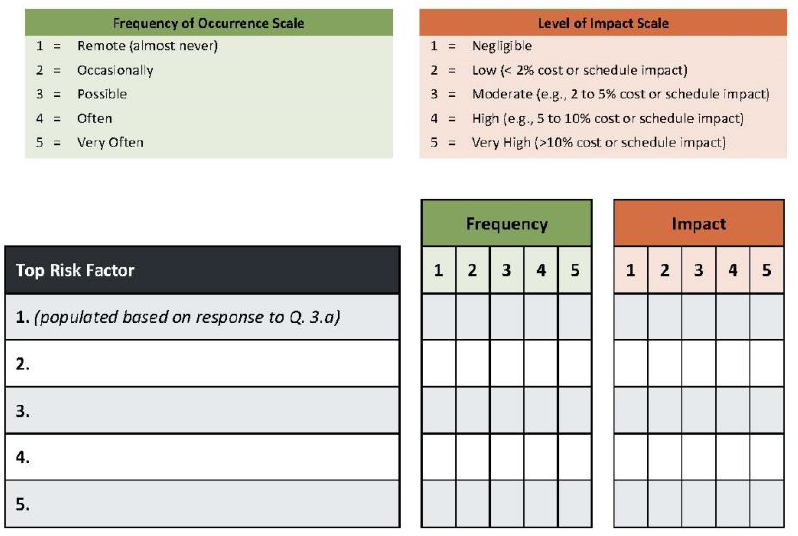
- Using the following scale, for each of your top five risks, please also indicate (1) how often they tend to occur, and (2) their potential impact on cost, schedule, or other project performance goals:
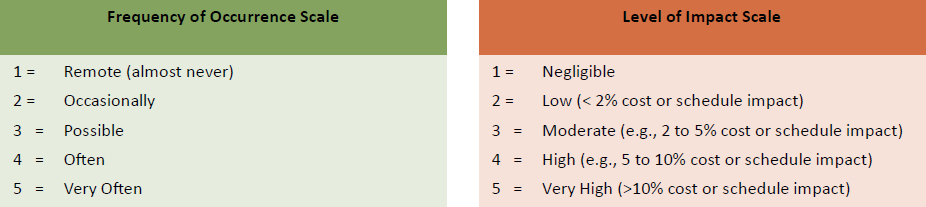
- Please identify the top five risks that you feel can impact the successful delivery of a DesignBuild (fixed price) project.
- Through the following two-part question, please characterize your perceptions of risk on APDM projects (such as CM/GC or Progressive DB) for which a fixed price is not established at the time of contract award.
(Only respondents that indicated that they have CM/GC or DB experience in response to Question 2 will receive this question).
- Please identify the top five risks that you feel can impact on the successful delivery of a CM/GC (or Progressive Design Build) project.
- Geotechnical conditions
- Utility issues
- Environmental permits
- Coordination with gov’t agencies or other authorities having jurisdiction
- Archaeological or protected species
- Right-of-way and easements
- Hazardous materials
- Constructability issues
- Schedule / phasing issues (aggressive schedule; restricted work window, etc.)
- Change in scope (e.g., due to coordination with third parties, late change requests)
- Market conditions (e.g., price volatility, labor availability, etc.)
- Changes in law
- Political risks / opposition
- Funding availability
- Other (please describe)
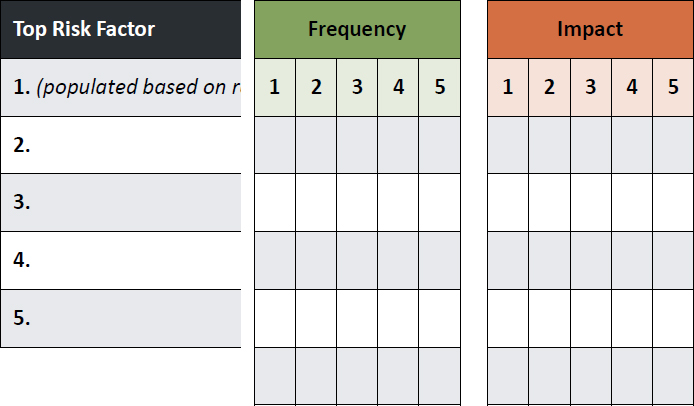
- Using the following scale, for each of your top five risks, please also indicate (1) how often they tend to occur, and (2) their potential impact on cost, schedule, or other project performance goals:
- Please identify the top five risks that you feel can impact on the successful delivery of a CM/GC (or Progressive Design Build) project.
- Through the following two-part question, please characterize your perceptions of risk on P3 projects.
(Only respondents that indicated that they have P3 experience in response to Question 2 will receive this question).
- Please identify the top five risks that you feel can impact the successful delivery of a P3 (fixed price) project.
- Incomplete project scope definition / design uncertainty
- Geotechnical conditions
- Utility issues
- Environmental permits
- Coordination with gov’t agencies or other authorities having jurisdiction
- Archaeological or protected species
- Right-of-way and easements
- Railroad involvement
- Hazardous materials
- Constructability issues
- Schedule / phasing issues (aggressive schedule; restricted work window, etc.)
- Change in scope (e.g., due to coordination with third parties; late change requests)
- Market conditions (e.g., price volatility, labor availability, etc.)
- Changes in law
- Political risks / opposition
- Usage/demand risk
- Hand-back criteria
- Other (please describe)
- Please identify the top five risks that you feel can impact the successful delivery of a P3 (fixed price) project.
-
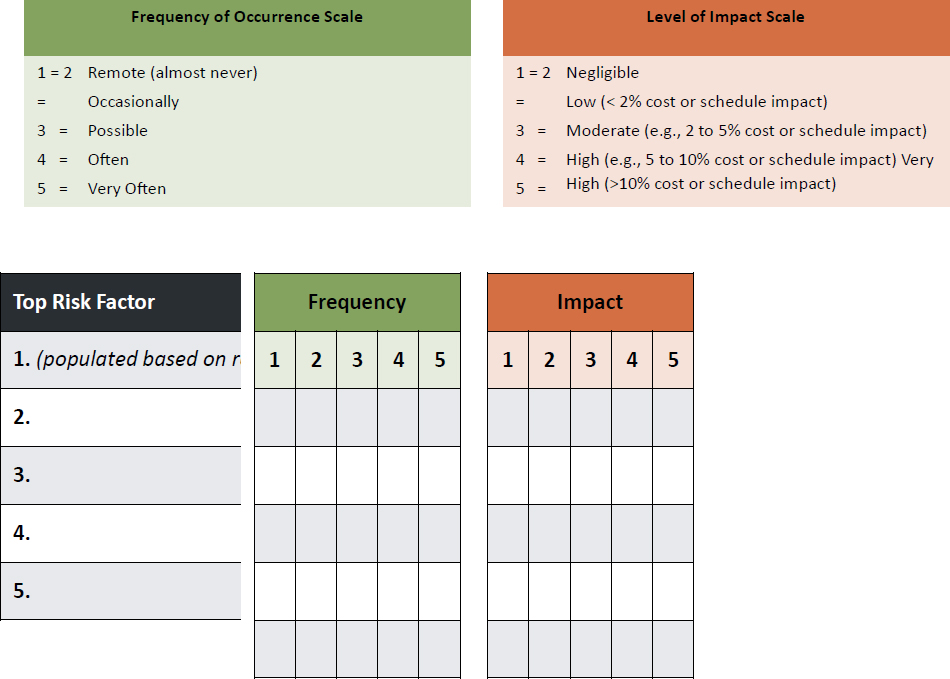
- Using the following scale, for each of your top five risks, please also indicate (1) how often they tend to occur, and (2) their potential impact on cost, schedule, or other project performance goals:

- Using the following scale, for each of your top five risks, please also indicate (1) how often they tend to occur, and (2) their potential impact on cost, schedule, or other project performance goals:
C. Assessing and Allocating Project Risk
- Does your agency have a standard procedure or guidance for identifying, evaluating, and allocating project risk?
- Yes
- No
If yes, please provide a website link to the guidance or submit via email.
- Do your cost estimates involve a quantitative analysis of risk?
- Yes
- No
- Is project risk considered when selecting a project delivery method?
- Yes
- No
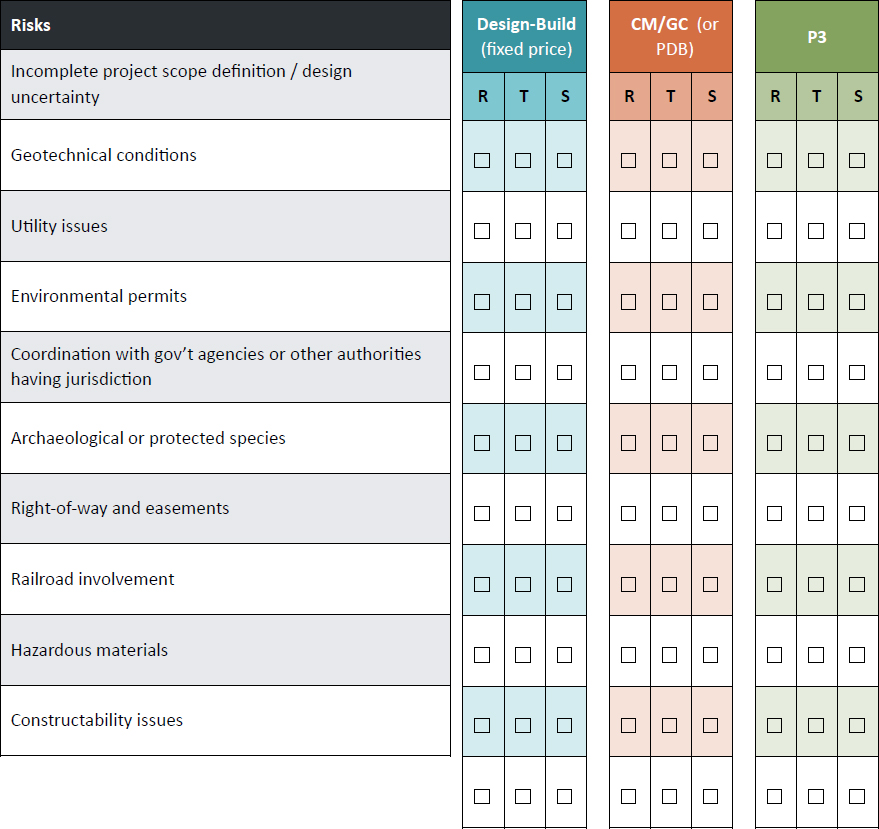
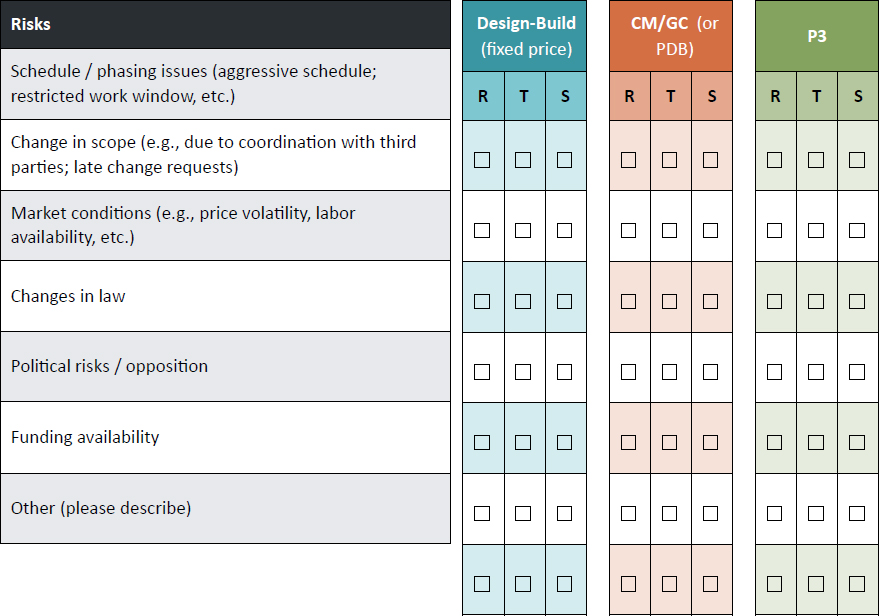
- Please identify how risks are typically allocated on your APD method projects. (Delivery methods will be based on the experience identified in response to Question 2)
(R = retained by owner; T = transferred to industry; S = shared)
- What practices has your agency used to promote alignment between owner and industry perceptions of project risks during the procurement and contracting phase of a project? Please check all that apply.
- Industry outreach / market soundings
- Industry review and comment on solicitation documents
- One-on-one meetings with proposers during the procurement process
- Ability for proposers to conduct their own site investigations
- Inclusion of agency-developed risk register in the solicitation documents
- Requirement for proposals to address proposed risk management plans / mitigation strategies
- Development and use of contract Term Sheets
- Clear identification of “Reference” vs. “Reliance” documents in the RFP and contract
- Other (please identify)
- What practices has your agency used to help manage risk during the post-award phase of a project?
Scope validation period
- Deductible schemes for key risk areas
- Shared risk contingency pools
- Allowances for areas of uncertainty (e.g., contaminated materials, unforeseen utilities, etc.)
- Price adjustment clauses for specific materials (e.g., steel, fuel, etc.)
- Use of Dispute Review Boards and/or other alternative dispute resolution (ADR) techniques
-
- Other (please identify)
- Please identify if you would like to remain involved with any of the following aspects of this research study:
- Participating in an interview to further discuss risk allocation / management on APD projects
- Providing a case study
- Vetting of draft deliverables (likely in a focus group or workshop setting)
- Other (please identify)
Appendix B.2: Survey Questionnaire
(Industry Version)
(Please note: The actual survey will be developed and delivered using an online survey platform, such as Qualtrics or SurveyMonkey.)
Survey Introduction
You are invited to participate in a study assessing how the risk profiles of projects delivered using alternative project delivery (APD) methods (including design-build, construction manager/general contractor, and public private partnerships) can influence the pool of prospective proposers and the structure and pricing of the proposals received.
This study, conducted as National Highway Cooperative Research Program (NCHRP) Project 23-22, will result in the preparation of a practical Guidebook to assist state DOTs/owners with:
- Identifying and evaluating the risk inherent in a project (including how owners and contractors may assess and prioritize these risks differently), and
- Developing and implementing practices to mitigate and/or manage these potential risks.
The intent of this survey is to obtain feedback from a broad and diverse spectrum of industry practitioners as to their perceptions of the tools and practices that can be used to improve contractual risk allocation, stimulate increased competition, and improve the management and administration of major highway infrastructure projects delivered using APD methods. The collected survey responses, in conjunction with subsequent data collection efforts, including structured interviews and focus groups conducted with owner and industry practitioners, will be used to inform the development of the Guidebook.
Please submit this survey no later than DATE. You may exit this questionnaire and return at any time; completed pages will be saved. We thank you in advance for your participation in this 10 to 15-minute multiple choice survey. We assure you that all responses will be treated as confidential.
If you have any questions, please contact the study’s Principal Investigators, Sid Scott or Michael Garvin:
| Sid Scott, P.E. Michael Garvin, Ph.D., P.E. One Commerce Square Charles E. Via Jr. 2005 Market Street Environmental Engineering Suite 820 116 Patton Philadelphia, PA 19103 Blacksburg, VA, USA 24061 Tel: 267-831-2912 540-231-7255 |
Department of Civil and sidscott@hka.com garvin@vt.edu |
A. General Information
- Please provide the following contact information:
Name:
Organization: Title/Position:
Email:
- What alternative project delivery (APD) methods do you have experience with? Please check all that apply.
- Design- Build (fixed price)
- Progressive Design-Build
- Construction Manager/General Contractor (CMGC)
- Public Private Partnerships (P3)
- What is your firm’s typical role on APD projects?
- Developer/Concessionaire
- Contractor
- Designer – Participant on DB team
- Designer – Under contract to owner (e.g., designer on CM/GC project; designer responsible for preliminary engineering / conceptual plans for DB project))
- Legal
- Other
B. Perceptions of Risks Impacting APD Projects
- Please rate the extent to which the following could impact your decision to pursue an APD project opportunity.

- Through the following two-part question, please characterize your perceptions of risk on DB projects.
(Only respondents that indicated that they have DB experience in response to Question 2 will receive this question).
- Please identify the top five risks that you feel can impact on the successful delivery of a Design–Build (fixed-price) project.
- Incomplete project scope definition / design uncertainty
- Geotechnical conditions
- Utility issues
- Environmental permits
- Coordination with gov’t agencies or other authorities having jurisdiction
- Archaeological or protected species
- Right-of-way and easements
- Railroad involvement
- Hazardous materials
- Constructability issues
- Schedule / phasing issues (aggressive schedule; restricted work window, etc.)
- Change in scope (e.g., due to coordination with third parties, late change requests)
- Market conditions (e.g., price volatility, labor availability, etc.)
- Changes in law
- Political risks / opposition
- Funding availability
- Other (please describe)
- Using the following scale, for each of your top five risks, please also indicate (1) how often they tend to occur, and (2) their potential impact on cost, schedule, or other project performance goals:
- Please identify the top five risks that you feel can impact on the successful delivery of a Design–Build (fixed-price) project.
- Through the following two-part question, please characterize your perceptions of risk on APDM projects (such as CM/GC or Progressive DB) for which a fixed price is not established at the time of contract award.
-
(Only respondents that indicated that they have CM/GC or DB experience in response to Question 2 will receive this question).
- Please identify the top five risks that you feel can impact the successful delivery of a CM/GC (or Progressive Design Build) project.
- Incomplete project scope definition / design uncertainty
- Geotechnical conditions
- Utility issues
- Environmental permits
- Coordination with gov’t agencies or other authorities having jurisdiction
- Archaeological or protected species
- Right-of-way and easements
- Railroad involvement
- Hazardous materials
- Constructability issues
- Schedule / phasing issues (aggressive schedule; restricted work window, etc.)
- Change in scope (e.g., due to coordination with third parties, late change requests)
- Market conditions (e.g., price volatility, labor availability, etc.)
- Changes in law
- Political risks/opposition
- Funding availability
- Other (please describe)
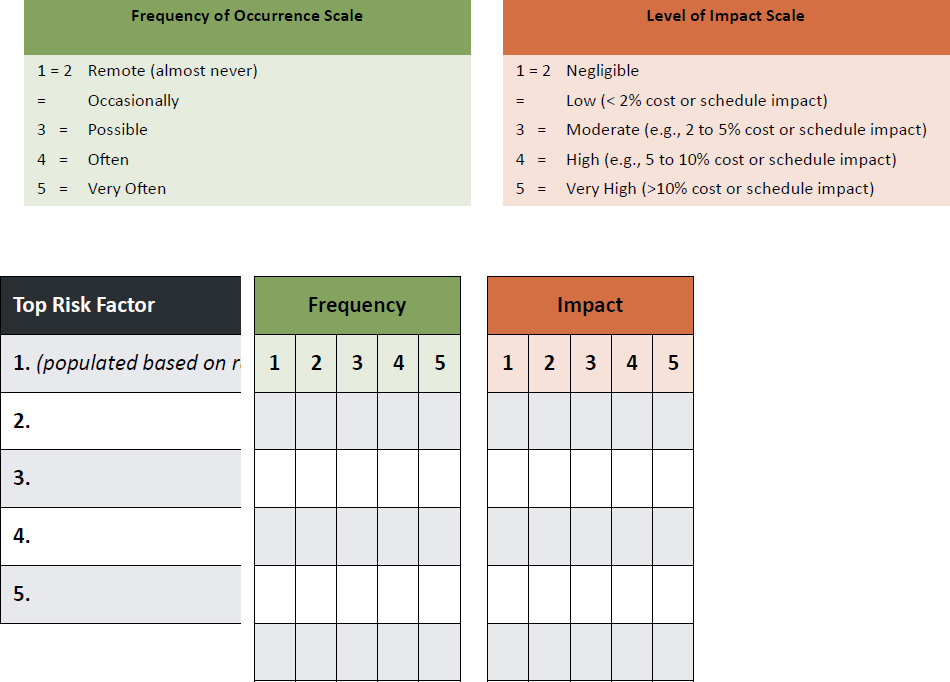
- Using the following scale, for each of your top five risks, please also indicate (1) how often they tend to occur, and (2) their potential impact on cost, schedule, or other project performance goals:
- Please identify the top five risks that you feel can impact the successful delivery of a CM/GC (or Progressive Design Build) project.
- Through the following two-part question, please characterize your perceptions of risk on P3 projects.
(Only respondents that indicated that they have P3 experience in response to Question 2 will receive this question).
- Please identify the top five risks that you feel can impact on the successful delivery of a P3 (fixed price) project.
- Incomplete project scope definition / design uncertainty
- Geotechnical conditions
- Utility issues
- Environmental permits
- Coordination with gov’t agencies or other authorities having jurisdiction
- Archaeological or protected species
- Right-of-way and easements
- Railroad involvement
- Hazardous materials
- Constructability issues
- Schedule / phasing issues (aggressive schedule; restricted work window, etc.)
- Change in scope (e.g., due to coordination with third parties; late change requests)
- Market conditions (e.g., price volatility, labor availability, etc.)
- Changes in law
- Political risks / opposition
- Usage/demand risk
- Hand-back criteria
- Other (please describe)
- Please identify the top five risks that you feel can impact on the successful delivery of a P3 (fixed price) project.
-
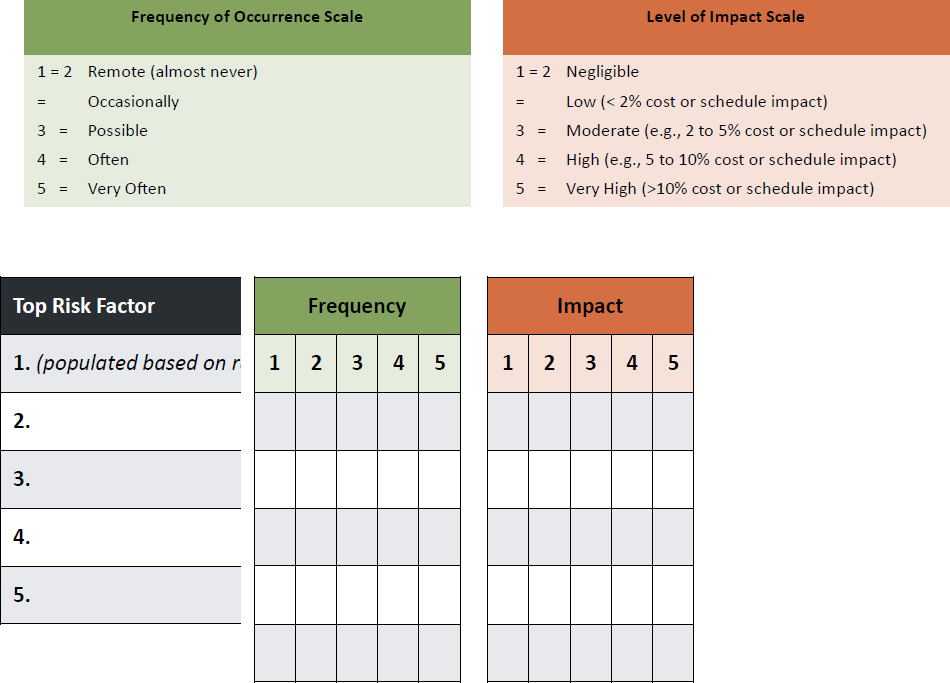
- Using the following scale, for each of your top five risks, please also indicate (1) how often they tend to occur, and (2) their potential impact on cost, schedule, or other project performance goals:
- Using the following scale, for each of your top five risks, please also indicate (1) how often they tend to occur, and (2) their potential impact on cost, schedule, or other project performance goals:
- Please identify if you would like to remain involved with any of the following aspects of this research study:
- Participating in an interview to further discuss risk allocation / management on APD projects
- Providing a case study
- Vetting of draft deliverables (likely in a focus group or workshop setting)
- Other (please identify)


