Strange Matters: Undiscovered Ideas at the Frontiers of Space and Time (2002)
Chapter: 8. Stretching Your Brane
8
STRETCHING YOUR BRANE
From Schwarzschild and Black Holes to New Dimensions of Space
We are all liable to the same errors, all alike the Slaves of our respective Dimensional prejudices.
—Edwin Abbott
Flatland
It now seems possible that we, the Earth and, indeed, the entire visible universe are stuck on a membrane in a higher-dimensional space, like dust particles that are trapped on a soap bubble.
—Steven Abel and John March-Russell,
“The Search for Extra Dimensions”
Ordinarily it’s unwise to admit religious evidence into scientific discussions. But let’s live dangerously and consult the Bible.
In the King James Version, in John 14:2, we read:
In my Father’s house are many mansions.
Biblical literalists might have a tough time with this passage. How could a “house” contain many mansions? Apparently, between King James’s time and the twentieth century, the meaning of mansion changed. Originally it meant “dwelling place,” so a house could contain more than one. So in the Revised Standard Version of the Bible, the verse reads “In my Father’s house are many rooms.”
That sounds better in light of the modern meaning of mansion. It makes no sense for something bigger than a house to be “in” a house. But in a way, the latest cosmological theorizing suggests that it is possible for something larger to be contained in something smaller. A whole universe, in fact, might fit into a space less than a millimeter wide. God’s house may contain many universes.
It’s a story like a mystery set in a mansion with a secret room, a room that contains many more mansions. As pop music’s OMC would say, how bizarre, how bizarre. But it’s very much like the story that many scientists have begun to tell about the universe. In what amounts to a real-life episode of The Twilight Zone, physicists have realized that nature may be concealing extra dimensions—not of sight or sound, but of space itself.
If so, the known universe may be just one of many “mansions” residing in the secret room of space’s hidden dimensions. “It’s just really frighteningly weird,” says Rocky Kolb. “It strikingly flies in the face of everything we thought was true.”1
On the other hand, it’s a weirdness with a vast appeal to people who ordinarily find physics boring. Fermilab physicist Joe Lykken says, “This is the first thing I’ve worked on that my wife thinks is interesting.”2
Normally, of course, dimensions themselves are boring. A dimension is basically just a number for describing position or motion. Any object’s position in space can be identified with three numbers: latitude, longitude, and altitude. You can describe any movement using a mix of just three directions: forward-backward, left-right, up-down.
Space as we know it possesses three dimensions. (If you add time, the “fourth” dimension, you get spacetime.)
At first glance the world would make no sense with more (or fewer) dimensions of space. Yet contemplating extra dimensions, beyond the three of familiar experience, is not a new thing. Even some nineteenth-century scientists speculated on dimensions inaccessible to ordinary human senses. By the 1920s, some physicists realized that nature might actually have hidden away, at subatomic size, some extra dimensions too small to be noticed. By the 1980s, those tiny dimensions seemed necessary for the theory tying nature’s particles and forces together with superstrings.
Physicists now wonder, though, whether the extra dimensions must really be so small, vastly smaller than an atom. Maybe those dimensions are as big as a millimeter across—10 million times the size of an atom. A dimension like that could be just like the mansion’s secret room—in one sense smaller than the mansion, but in another sense big enough to contain many additional mansions.
Apart from evoking the science-fiction fantasy of parallel universes, this view of space offers possible solutions to several cosmic problems. The hidden dimensions may contain clues about the nature of gravity, the origin of the universe, and the identity of the dark matter. If these hidden dimensions exist, they would represent another astonishing prediscovery, validating the prescient imagination of Flatland author Edwin Abbott and the mathematical insight of such scientists as Savas Dimopoulos and Lisa Randall.
Hidden dimensions would show once again that space is stranger than fiction, much the same way as another famous prediscovery revealed a place to go beyond sight and sound—the black hole. And in fact, the story of black holes ends up to be tied directly to the extra dimensions required by superstrings.
VISIONS OF BLACK HOLES
Black holes have a long history. After they were first imagined, it was almost two centuries before they were named and more than two decades after that before they were found. In its original form, the black hole idea emerged from Newtonian physics, perhaps another example where a good prediction was based on errant premises. Nevertheless, I think it’s fair to credit some insight to the man who first proposed the existence of stars so dense that light could not escape from them. His name was John Michell, born in England in 1724. He started his career as a geologist at Cambridge, where he was an expert on earthquakes. At age 40 he became rector at Thornhill in York-shire, but he kept his hand in science, turning his interest to the stars, and to gravity.
In 1784, Michell published a study on what you could find out about stars by examining the light they emitted—their distances, sizes and masses, for example.3 In those days, light was not understood very well, so drawing grand conclusions from studying it was a risky proposition. For one thing, Michell believed, like all good Newtonians, that light consisted of particles. So it was natural for him to imagine that a star’s gravity should have some effect on the particles of light that the star emitted.
Suppose a star, or some other body, was 500 times wider than the sun, yet just as dense. Its mass would be enormous, and its gravity, therefore, very strong. Michell calculated that light particles do not fly fast enough to escape the gravity of such massive objects. “Their light could not arrive at us . . . we could have no information from sight,” he wrote.4
A few years later, the French mathematician Pierre Simon de Laplace performed a similar calculation. Other speculations about black-hole-like objects appeared in the nineteenth century—Edgar Allan Poe, for example, described something like one in his prose poem Eureka. But the first modern math hinting at a black hole’s
possible existence came from a German astronomer whose name in English means black sign—Karl Schwarzschild.
Born in 1873 at Frankfurt am Main, he showed exceptional mathematical ability as a teenager and went to school at Strasbourg and Munich, where he applied his math skills to astronomy. He became a professor at the University of Göttingen in 1901. By 1909 he had become director of the astrophysical observatory at Potsdam.
Like Michell, Schwarzschild was very interested in light from stars, and he developed new techniques for observing and analyzing it. He also developed an interest in grander themes, such as the geometry of space itself—an important point to be discussed in Chapter 9.
But his fame today derives from work he did shortly before he died, from illness he contracted as a soldier on the Russian front during World War I. Even during wartime Schwarzschild tried to keep up with science, and late in 1915 he was intrigued by a new report in the Proceedings of the Prussian Academy of Sciences. It was a paper by Einstein—the first publication presenting the brand-new general theory of relativity. Einstein’s paper set out the basic equations of the theory. It was not, however, a trivial matter to solve the equations when they were applied to a specific real-world situation of any complexity. Schwarzschild, though, immediately saw a way to solve the equations in a relatively simple situation, the case of a perfectly round star.
Schwarzschild used Einstein’s equations to calculate the gravitational field around a mass point, which would describe the gravitational field inside a star (assuming that the star was not spinning). In a second paper he calculated the geometry of the spacetime around such a star—in other words, how a star of a given mass would warp the spacetime around it.
Schwarzschild zipped off the two papers to Einstein, a few weeks apart—the first one on the mass point, the second describing the
space outside the star (in Schwarzschild’s terms, the gravity of a “sphere of incompressible fluid”). Einstein reported the findings to the Prussian Academy in early 1916. By May of that year Schwarzs-child was gravely ill with pemphigus, an incurable skin disease. He returned home to Potsdam but died on May 16, and his exploration of Einstein’s new universe was over.
Eventually, though, Schwarzschild’s solutions would become immensely important for later explorers. “The Schwarzschild geometry,” the physicist Kip Thorne has written, “was destined to have enormous impact on our understanding of gravity and the universe.”5
In Schwarzschild’s solutions, a curious quantity appeared: a distance from the center of a star at which the equations suddenly broke down. (As Jeremy Bernstein has put it, “the mathematics goes berserk . . . time vanishes, and space becomes infinite.”6) Such a strange mathematical quirk would seem to demand some explanation of what its physical meaning was. For Schwarzschild, apparently, the answer was that a sphere could not get smaller than this radius, at least as measured by “an observer measuring from outside.” This distance from the center (or “Schwarzschild radius”) depends on the mass of the object.
For a sphere the mass of the sun, Schwarzschild noted, the distance would be 3 kilometers, about 2 miles. It seemed to Schwarzs-child that for any known star, the critical radius would always be inside the star. It would be impossible, he calculated, to reduce a spherical incompressible fluid to smaller than that size; as you squeezed it down the pressure would become infinitely great a little before you reached the Schwarzschild radius.7
Once again, though, history teaches the foolishness of ignoring mathematics’ power to reveal new phenomena in nature. Schwarzs-child, without knowing it, had provided the fundamental insight leading to the discovery of black holes.
NEW BLACK HOLE HORIZONS
Still, black holes are so bizarre that it took decades before the physics community was ready to ponder their actual existence. Einstein himself considered the possibility of black holes and rejected them. In a 1939 paper, he calculated that any group of objects (say, stars in a cluster) packing close enough together to approach the Schwarzs-child radius would become unstable. The objects would have to begin moving faster than the speed of light at such short distances—an impossibility, of course, according to Einstein’s special theory of relativity. Therefore, no black hole could form. “The essential result of this investigation is a clear understanding as to why ‘Schwarzschild singularities’ [that is, black holes] do not exist in physical reality,” Einstein wrote.8
But in the same year, another paper appeared, this one arguing in the opposite direction. J. Robert Oppenheimer, soon to lead the Man-hattan Project, and his student Hartland Snyder, were exploring the physics of collapsed stars. Already, Subrahmanyan Chandrasekhar had calculated his famous limit on how massive a white dwarf could be—about 1.4 times as massive as the sun. A white dwarf is a burned out sun, no longer producing enough energy to counter the inward pull of its gravity. With no pressure pushing outward, a white dwarf would shrink down to dwarfdom, until the pressure of compressing the subatomic particles themselves came to the rescue and prevented further shrinkage. But for a star with a mass of more than 1.4 suns, the gravity would overwhelm even the subatomic particle pressure.
A stellar remnant with too much mass might solve the problem by exploding, leaving behind a neutron star, in which the subatomic particles have, in essence, merged to create neutron matter. But even then, neutron stars have a mass limit that isn’t all that much greater than for white dwarfs. So it seemed to Oppenheimer that a sufficiently massive star might very well shrink down to a size of less than the Schwarzschild radius. He wondered what would happen then.
Apparently unaware of Einstein’s paper, Oppenheimer and Snyder produced a surprising conclusion—the answer depends on your point of view. To an observer far away from the collapsing star, its light gets redder and redder. The increasing strength of gravity— or warping of spacetime around the star—slows time down, stretching the star’s light to longer and longer wavelengths (redder and redder colors). At the Schwarzschild radius—remember, time is frozen—it stops altogether, so the light doesn’t even leave. It is frozen in time, and a distant observer sees no more action from the collapsing star.
Snyder and Oppenheimer reasoned that pressure would resist the continuing collapse of a star as it approached the Schwarzschild radius. But to simplify their calculations, they supposed there was no pressure. Then Einstein’s equations provided no solutions that could describe a situation in which the star stopped shrinking. “When the pressure vanishes . . . we have the free gravitational collapse of the matter,” Snyder and Oppenheimer wrote. “We believe that the general features of the solution obtained in this way give a valid indication even for the case that the pressure is not zero, provided that the mass is great enough to cause collapse.”9 In other words, with a star massive enough, the collapse caused by gravity would overwhelm whatever pressure there was.
And that gravitational collapse would create, in the eyes of someone watching from far away, just what we now call a black hole. As Snyder and Oppenheimer put it, “the star thus tends to close itself off from any communication with a distant observer; only its gravitational field persists.”
For a nearby observer, however, nothing is frozen, and the situation would appear quite different. “Near the surface of the star . . . we should expect to have a local observer see matter falling inward with a velocity very close to that of light,” the physicists wrote.10 Any such observer might fall in as well, winning the chance of a lifetime
to explore the arena within the Schwarzschild radius. But it would be a short lifetime. Once inside, any object, observer or otherwise, would be drawn to the intense gravitational attraction at the center, getting ripped to shreds on the way in—although Oppenheimer and Snyder didn’t mention that problem. They did calculate that an observer riding along with the infalling mass of the star would soon be unable to send a light signal to the outside world, and that “this behavior will be realized by all collapsing stars which cannot end in a stable stationary state.”11
Although this paper basically described the black hole picture pretty clearly, it seems that nobody paid much attention to it. Even when Oppenheimer died, in 1967, it wasn’t discussed in the obituary written by Hans Bethe for the Royal Society. Of course, the obvious reason for this lack of attention was that the paper appeared in The Physical Review on September 1, 1939, the day World War II began.12
No doubt the intervention of the war diverted everybody’s attention elsewhere—especially Oppenheimer’s. And maybe in those days science-fiction films hadn’t been imaginative enough to prepare science for such strange possibilities. In any event, it was almost two decades before anyone seriously took the issue up again.
In the late 1950s, John Archibald Wheeler at Princeton had been reviving interest in general relativity, beginning to produce a stream of outstanding students who would dominate the field for the rest of the century. Soon issues involving the Schwarzschild radius arose, but at first Wheeler was skeptical about the possibility of gravitational collapse below that limit. At a 1958 meeting in Brussels, Wheeler challenged the Oppenheimer-Snyder result. The weirdness of gravitational collapse into nothingness must somehow be eluded in real life, Wheeler believed. But he had no solution to the mystery of what happens to very large masses undergoing collapse. Oppenheimer was there, and he defended his original conclusion. “Would not the simplest assumption be that such masses undergo
continued gravitational contraction and ultimately cut themselves off more and more from the rest of the universe?” Oppenheimer asked.13 Wheeler didn’t think so then, but he would later.
In December 1963, the situation began to change. At a famous meeting in Dallas—the first Texas Symposium on Relativistic Astrophysics—the Oppenheimer-Snyder paper was a hot topic of discussion. In the next few years, Wheeler’s view changed, and the discovery of pulsars in 1967 dramatically demanded a better understanding of gravitational collapse. Wheeler came not only to believe in black holes, he even christened them. I told the story of how they got their name in a brief account in the Dallas Morning News in 1998:
In 1967, the discovery of dense, pulsating stars known as pulsars sparked further interest in the fate of heavy stars. Wheeler discussed the issues at a conference held that fall in the wake of the pulsar discovery.
After he’d used the phrase “gravitationally completely collapsed object” several times, someone in the crowd—Wheeler still doesn’t know who—offered a suggestion.
“Somebody in the audience piped up, ‘Why not call it a black hole?’” Wheeler said in an interview. . . .
Wheeler liked the suggestion and decided to slip the term into a talk at the end of 1967 that was published the following year, the first official use in print of the astrophysical “black hole. . . .”14
Still, naming them wasn’t the same thing as finding them. Though their theoretical possibility had been established, scientists debated for another quarter century whether black holes really existed. Several strong candidates had been discovered in the 1970s and 1980s, but loopholes always existed, in the form of possible alternate explanations or uncertainties in the observations.
Finally, in 1994, came the smoking gun—Hubble Space Telescope observations of the core of the galaxy M87 that left no way out for anyone except the most intransigent black hole doubters. Hubble’s evidence came from its view of a rotating disk of gas around the
center of M87, a spiral galaxy about 50 million light-years from Earth, in the constellation Virgo. The high speed of the swirling disk indicated that the M87 core contained a mass of nearly 3 billion suns— so much that it must almost certainly be a black hole. Other examples followed, providing even stronger evidence. By the end of the century, it was clear that Einstein’s universe was inhabited by many black holes.
Meanwhile, black holes also inhabited the minds of many theoretical physicists struggling to understand the nature of space, time, and gravity. During the 1990s, for example, superstring theorists began to take black holes very seriously. For it turned out, much to everybody’s surprise, that black holes concealed clues to the mystery of the extra dimensions of space that superstring theory required. Black holes, it seemed, might merely be superstrings in disguise.
NEW DIMENSIONS
Superstring theory contained two distinct possible prediscoveries: the strings themselves, and the existence of extra dimensions of space. At first, all the excitement was about the strings; the extra dimensions were an embarrassment. But by the mid-1990s more physicists began to focus on the extra dimensions and what to do about them.
Of course, curiosity about extra dimensions was nothing new. The idea had been clearly prediscovered in literature, in the 1880s, by Abbott in Flatland. Other writers had discussed extra dimensions, and occasionally a scientist would speculate on the possibility. In 1893, the astronomer Simon Newcomb gave a talk in which he described the implications of a “fourth dimension” of space. “Add a fourth dimension to space, and there is room for an indefinite number of Universes, all alongside each other,” he observed—which is just the sort of things that many physicists are saying today.15
Confusingly, Einstein’s special relativity of 1905 also introduced
a “new” dimension: time. Hermann Minkowski made this idea explicit in 1908, referring to the merger of time with space into spacetime, a continuum with four dimensions—three of space plus the one of time. Time therefore became known as the fourth dimension.
Time merely played the role of a fourth coordinate for describing a location. It was not at all the new dimension that Abbott had envisioned in Flatland. He was talking about a new dimension of space, just like the other three dimensions of space. But because of relativity’s popularity, the idea of a fourth spatial dimension has to go by the name of fifth dimension.
In 1912, such a fifth dimension was proposed by the Finnish physicist Gunnar Nordström, as part of trying to incorporate electromagnetism into a theory of gravity. But it seems that Nordström viewed his extra dimension as just a mathematical trick, and in any event, he later abandoned his theory of gravity in favor of Einstein’s general theory of relativity.16 Physicists today generally trace the genealogy of extra dimensions in the modern sense back to Theodor Kaluza, a mathematician-physicist who was born in Ratibor, Germany (now Racibórz, Poland) in 1885. While he was struggling to survive as a young teacher at the University of Königsberg, Kaluza noted the similarities between Einstein’s math for gravity and Maxwell’s for electromagnetism. Perhaps the two theories might just represent a special case of an underlying unified mathematics, Kaluza speculated.
“If one consider this as a possibility,” he wrote, “one is led almost inevitably to an initially unattractive conclusion”—namely, that such a view could be maintained “only by introducing the rather strange idea of a fifth space-time dimension.”17 Of course, “our previous physical experience contains hardly any hint of the existence of an extra dimension,” he pointed out. On the other hand, nothing in our experience prohibits the existence of such an extra dimension, either—provided that any changes measurable in known physical
quantities are restricted to the four ordinary dimensions. Any changes with respect to the fifth dimension could be either very small or zero, and so would not be noticed, Kaluza argued
In 1919 Kaluza sent a paper describing these ideas to Einstein, who apparently mulled it over for a while and then sent it off, in 1921, to be published. Kaluza’s paper appeared in print shortly thereafter, before the development of quantum mechanics, and so it was strictly a classical approach. But by the mid-1920s, quantum fever had infected most of Europe’s leading physicists, including Oskar Klein, a Swede who had studied under Niels Bohr in Copenhagen.
In 1923, Klein moved to the University of Michigan, where he worked out an approach to unifying gravity and electromagnetism with a fifth dimension. Klein was very excited about it until he returned to Europe and found out, from Pauli, about Kaluza’s paper. Nevertheless Klein had gone a little farther than Kaluza, in particular realizing that the fifth dimension could escape detection by being very, very small. In fact, he calculated that a fifth dimension could be curled into a circle with a circumference of about 10-30 centimeters.
And Klein, unlike Kaluza, understood quantum physics and developed the idea in a quantum context. “Although the introduction of a fifth dimension in our physical considerations may seem rather strange at first sight,” Klein wrote, quantum physics argued that an ordinary spacetime description of events on the atomic level was not possible, anyway. “The possibility of representing these phenomena by a system of five-dimensional field equations cannot be rejected a priori,” Klein pointed out.18
He even suggested that a fifth dimension could shed light on one of the deepest quantum mysteries, the duality between waves and particles. By 1927 it was clear that particles sometimes acted like waves, and waves sometimes acted like particles. It could be, Klein said, that waves waving in five dimensions could produce what appeared to be particles in four dimensions. Klein’s speculation sounds
very close to the way string theorists today have begun to explain a new, richer concept of duality—a point we will get to soon.
Although the Kaluza-Klein five-dimensional approaches attracted some attention—from Pauli, for instance, and even from Einstein—they were largely forgotten. But decades later, the extra dimensions returned in a new package, tied up with superstrings.
THE MAGICAL MYSTERY THEORY
The first superstring revolution, in 1984, revived interest in the Kaluza-Klein approach, but the situation was much more complicated than it had been in the 1920s. Now one extra dimension was not enough. Superstring theory demanded at least nine dimensions of space—six extra ones beyond the usual three. Following Klein, superstring experts all surmised that the extra dimensions had to be extremely small. Obviously, any extra dimensions must be small, or so the reasoning went, because otherwise we’d have seen them by now, or people would fall into them and disappear. (Nobody discussed that possibility, though, for fear of encouraging wild ideas about the Bermuda Triangle.) And even if for some reason you couldn’t fall into them, extra dimensions of space would alter physics in measurable ways. Space with more than three dimensions would affect the law of gravity, for example.19 So the extra dimensions had to be “compactified”—rolled up into tiny little balls far too small to be seen.
To most of the string physicists, a few extra dimensions were no big deal, as long as the right math was available to describe them. All you needed to do was to find the math describing how six extra dimensions could curl up—in other words, how to describe the shape of space, or topology, that would contain six curled-up dimensions. Unfortunately, it seemed that thousands of different possible shapes existed in the equations.
With that realization, superstring theorists faced another serious problem. Remember, there seemed to be five different versions of string theory, all suitable for describing nature. Now, it seemed, even if you could decide which of the five versions of string theory actually did describe nature, you were left with thousands of variations of that theory, each with a different shape for space. “It was not very nice to have 10,000 unified theories,” said Andy Strominger, a theoretical physicist now at Harvard, then at the University of California, Santa Barbara. “It would be nicer to have just one unified theory.”20
But then, in mid-1995, Strominger and colleagues produced a phenomenal insight into the problem. Space, it turns out, could be constructed so that all the possibilities can exist. Space of one shape can transform itself smoothly into any of the other shapes, so you don’t have to choose. Any one of them is just as good as another. A paper by Strominger, Brian Greene (then at Cornell), and David Morrison (at Duke) showed how the different possible shapes of the six extra superstring dimensions are just multiple ways of folding up the same underlying space, kind of like different knots in the same necktie. So perhaps there is only one way to represent space in superstring theory after all, and if there’s only one way to represent space, it’s a good bet that that space must be the one the universe is made of.
This realization came from insight into the superstring-black hole connection I mentioned earlier. At a fundamental level, described by quantum theory, a black hole is just like a basic particle of matter, the way water is inherently the same thing as ice. As Stephen Hawking pointed out in the 1970s, black holes “leak”; quantum processes allow radiation to get away, and in the process the black hole itself slowly evaporates. Ultimately a black hole could shrink into a tiny hole with about the mass of a bacterium. Under certain conditions, these tiny black holes can become entirely massless, in the process transforming themselves into superstrings.
Turning a black hole into a string might seem like the astrophysical equivalent of changing an elephant into an ant. Actually, though, it’s more like turning a coffee cup into a saucer. Mathematicians describe such space-shape transformations as changes in topology. For a mathematician, changing a doughnut into a coffee cup is no problem (it just takes a little stretching and twisting), but there is no way to change a saucer into a coffee cup (without cutting and pasting—a violation of topological rules). But in the superstring view of space, such clever magic tricks become possible. At the same time that space can change from one shape to another, black holes can change into superstrings.
“Usually we think that no matter how much you stretch a coffee cup, you can’t smoothly turn it into a saucer,” said Strominger. “String theory does know how to smoothly turn a coffee cup into a saucer.”
Still, transforming black holes into strings did not solve all of string theory’s problems. There remained the five different versions of the theory. But that problem yielded in a similar way. The five versions of string theory were just different variations of one underlying theory—an actor appearing in different disguises, like Tony Randall in Seven Faces of Dr. Lao. The mysterious underlying theory was named M theory by Edward Witten, who proposed the idea. In a brief account published in Nature in 1996, Witten said the M could stand for magic, mystery, or membrane, according to taste.
Why membrane? Because M theory introduced a new dimension to superstring theory, literally and figuratively. Instead of 9 dimensions of space, in the old superstring theories, M theory required 10. And instead of all the objects being one-dimensional strings, higher-dimensional objects, called membranes, were permitted as well. Instead of rubber bands, the world perhaps was made of soap bubbles.
SUPERBRANES
In the late 1980s, as string theory progress had stalled, I ran across a new idea that struck me as no less strange than superstrings. I wrote a column about it, carrying the headline “Supermembranes offer a new dimension.” It described an idea championed by Michael Duff, a physicist then in England, which took the original idea of superstrings a step further, into an additional dimension.
Superstring theory described tiny one-dimensional entities that curl into loops and vibrate, like plucked rubber bands, in 9 dimensions of space. Why not build the universe from two-dimensional objects—or membranes—in 10 dimensions of space? In fact, Duff contended, the extra dimension could solve many problems, and “supermembranes” might work better than superstrings at explaining how the universe is made. For some things, Handi-Wrap works better than rubber bands.
After all, if you believe in superstrings, accepting supermembranes is not that much of a leap. You can’t argue that one makes less sense than the other. For that matter, a particle with no dimensions doesn’t make much sense either, and it gives wrong answers to a number of important calculations, which is one reason superstrings became popular in the first place.
Alas, while I thought supermembranes sounded like a great idea, nobody else seemed to. Except for Duff, of course, who moved to Texas A&M University21 and continued to pursue supermembrane studies. I asked him there, at a meeting in 1990, how the supermembrane idea had been received. “Hard-nosed string theorists would scoff at membranes, because they’re dedicated to the string and that’s the end of the story,” Duff said. But it might be, he suggested, that both strings and membranes will turn out to have some validity.
“My own feeling is that neither . . . is actually the final theory of everything,” he said. “My suspicion is that they’re both just new
layers of the onion skin—that the ultimate theory may embrace both of them but be more than either of them. But that’s just a guess.”22
Call Duff a good guesser. That’s exactly what the situation seems to be today. When Witten introduced M theory, supermembranes (now just called “branes” for short) became a key part of the picture. But the picture itself became a little more confusing. Not only could you have both branes and strings, but branes could turn into strings. And any of the five versions of string theory could transform themselves into another version—just as one way of folding up the extra dimensions of space could switch into another. In other words, different versions of string theory were really all just the same theory looked at in different ways. Understanding how it all works demanded the expansion of the old notion of duality.
DUALITY
Duality is one of the deepest, and most difficult, concepts in modern physics. But it seems to hold the key to making sense out of the bewildering ideas of strings and membranes and extra dimensions.
At first glance, it isn’t hard to grasp, though. Duality refers to a special kind of symmetry, in which two different descriptions of something turn out to be equivalent. Think of electrons, which have dual personalities—behaving like a wave in some experiments, like a particle in others, the way some people behave differently at work from the way they act at parties.
In a similar way, lots of things in nature appear to be different when viewed from different viewpoints. The back of a house may look nothing like the front of a house, yet it’s the same house. (Even my cat can figure this out.)
But now for something a little more mysterious. Here’s a reader participation quiz. Look at the two drawings, of a triangle and a circle (Figures 1 and 2). Explain how they are actually two drawings of exactly the same object.
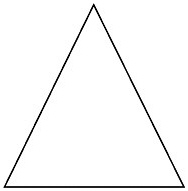
FIGURE 1 Triangle
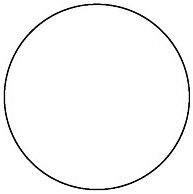
FIGURE 2 Circle
How could that be? I haven’t tested this one yet on my cat, but I’ll bet many people could figure it out. It just requires a little creative thinking, the sort that superstring theorists employ. OK, I’ll tell you the secret. You have to imagine an extra dimension. As long as you restrict your thinking to the two dimensions of the page, you’ll never get the triangle to look like a circle. But if you add a dimension with your mind’s eye, you can see how the circle and triangle are two views of a cone (Figure 3). In that way the two views are dual. In a very similar way, two theories that seem very different can turn out to be different views of the same theory. You just need extra dimensions to see how that can be.23
In M theory, of course, dualities get a lot more complicated. They involve adding dimensions in some cases, subtracting in others. They depend on what energy realms you are exploring—one theory describing phenomena at high energies turns out to be the same as another theory describing nature at low energies. A theory with membranes in 10 space dimensions can turn out to be the same as a theory describing strings in 9 space dimensions. In one way or another, each superstring theory is connected to another by a duality.
For example, in one version of superstring theory (Heterotic-E),
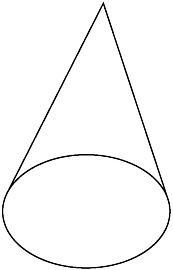
FIGURE 3 Cone
the math describes a one-dimensional string vibrating in nine dimensions of space. But that math works only if the string’s “coupling” strength is low. (Coupling strength refers to how easy or hard it is to split a string into two new strings—a measure of how strongly or weakly strings interact. A strongly interacting string—with a high coupling constant—splits more easily. The lower the coupling strength, the harder it is to split the string.) Nobody knows whether the coupling strength in reality is high or low. If the coupling strength is high, the Heterotic-E superstring looks more like a supermembrane, requiring another dimension of space to vibrate in. The low-coupling version of Heterotic-E theory, in 9 spatial dimensions, is dual to another theory, in 10 spatial dimensions.
This example captures an essential aspect of duality. The two theories look very much different—so different that they are formulated in a different number of dimensions. Yet at some deeper level, the theories are the same—they describe the same physics. In principle, you could use either theory to describe the Heterotic-E string. But usually with dualities, one theory is a lot easier to use than the
other. It’s like a house with the front door locked; maybe you can get in through the back door.
In any case, the dualities connecting the various superstring theories suggest that they are all the offspring of some grander, bigger, all-encompassing umbrella theory—M theory. And for that reason, John Schwarz of Caltech likes to say that M should stand for Mother, as in Mother of all Theories.
EXTRA DIMENSIONS GET BIG
Working out the details of dualities, and other features of M theory, produced even more surprises. For one thing, it turned out that there should be a special kind of supermembrane, called a D-brane (named for Peter Gustav Lejeune Dirichlet, a nineteenth-century mathematician). Key insights into the importance of D-branes came from work in the 1990s by Joseph Polchinski of the University of California, Santa Barbara. D-branes turn out to be needed to accommodate non-loop superstrings. A string that did not form a loop had to have a place to attach its two loose ends. D-branes provided just such a surface.
An even bigger surprise emerged from work by Witten and Petr Hořava, who found an interesting approach to life in 11 dimensions (as M theory seemed to require). Perhaps the 11th dimension is a space separating two 10-dimensional “walls”—or branes. Standard Model forces and particles (including all of us) might live on one of those 10-dimensional boundaries. The other boundary would be a “hidden” world, not accessible to us.
But why would we be stuck on one brane? Maybe because it’s a D-brane, and all the particles we are made of are strings that must remain connected to the D-brane surface. (In this respect, the D-brane becomes something like a black hole, from which nothing can escape. And in fact, work by Strominger and Cumrun Vafa at Harvard
has shown a deep relationship between D-branes and black holes— in a sense, D-branes are like the spacetime bricks from which black holes are built.)
All this was very interesting mathematically, if somewhat lacking in relevance to daily life. But other strange ideas were floating around that eventually came together to make quite a splash. In 1990, for example, Ignatios Antoniadis at CERN suggested that superstring theory could accommodate a relatively large extra dimension. And in 1996, Joe Lykken at Fermilab pointed out that superstrings didn’t necessarily have to be as supertiny as everybody thought. In fact, the influence of their existence might be noticeable at energies not too far out of the reach of current state-of-the-art atom smashers.
So it was in the air that something interesting might be going on in superstring theory’s extra dimensions. And then, in 1998, a new line of inquiry popped into the extra dimension picture: the extra dimensions might be BIG!
A SILLY MILLIMETER BIGGER
Previous efforts to envision big extra dimensions had run into a big problem: gravity. Gravity is, after all, just the geometry of spacetime itself. So the strength of gravity would be affected by the presence of extra dimensions—it was a simple calculation. Gravity varies as the inverse square of the distance between two masses precisely because there are three dimensions of space. Three dimensions would dilute the strength of the force by exactly the amount predicted by the inverse square law. More dimensions would dilute gravity more than that. So any extra dimensions must be too small to make a big enough difference to measure.
Savas Dimopoulos, however, knew something that most other people working in the field didn’t. A few years earlier, he had studied phenomena at distances shorter than a millimeter and found that
gravity’s strength had never been directly measured on those scales. It was thinkable, therefore, that gravity did not obey the inverse square law at short distances.
“It would be a disaster to change electromagnetism, but it would not be a disaster to change gravity,” he told me.24 “I knew there was much more freedom than people realized. I didn’t know what it would lead to.”
After our discussion in Houston about supersymmetry, Dimopoulos invited me to give a talk at Stanford, in February 2001, about my book The Bit and the Pendulum. At dinner after my talk, I asked him about the origin of the large extra dimension idea. The work leading to that idea, he said, was motivated by the hierarchy problem: why the fundamental mass in subatomic physics was so high compared to other basic quantities. Another way of phrasing it is to ask at what energy-scale gravity must become involved in explaining other phenomena—or, most simply, why gravity is (at ordinary energies) so much weaker than other forces. After all, a small magnet can pull a paper clip upward by magnetic force, even though the gravity of the whole Earth is pulling the other way.
“The key liberating thought was . . . what if only gravity propa-gates in the extra dimensions?” Dimopoulos said. He discussed the idea with Nima Arkani-Hamed, and then the two of them flew to Paris for discussions with Gia Dvali in early 1998. Out of those discussions came a breakthrough paper, appearing on the Internet in March and outlining a world with an extra dimension possibly as big as a millimeter—the size of a small ant, about 1/25th of an inch across.
That’s nowhere near big enough to hold a mansion, let alone the whole universe. But the visible universe is huge only in the familiar three dimensions of space. In additional dimensions, the universe would be extremely slim—the way a sheet of paper is big in two dimensions but thin in a third. In other words, the whole universe is just one big supermembrane, or brane, with three big dimensions
(and so is called a three-brane). Its other extra dimensions are too thin to notice. So our whole three-brane universe can fit into an extra dimension, even one a mere millimeter wide.
Think of the ant on a page of a book. The page has, to all appearances, two dimensions—width and height. Both width and height extend for several inches. Yet rip the page out of the book, and it could fit nicely in a file space a millimeter across, because the paper has an extra dimension, thickness, too thin to be noticed by the ant. In a similar way, the whole universe can have an extra dimension, too thin to be noticed by its human inhabitants.
Combined with the notion of the universe as a big brane, big extra dimensions suddenly became a realistic possibility. Maybe, physicists began to realize, extra dimensions are not invisible because they’re so small, but because they’re literally invisible. In other words, light can’t go there. We wouldn’t be able to see them even if they were big. And we couldn’t explore the extra dimensions because ordinary matter, like light, was not allowed to go there, either. In this new view, all ordinary forms of matter and energy must stick to the surface of the three-brane universe. You could think of light and matter as made of strings that need to be anchored to a surface—the space of our brane. So light, radio waves, magnetism, quarks, electrons, all operate only on the three-brane—that is, in the universe’s three familiar dimensions of space.
Gravity, though, can propagate as loops of string that don’t need a surface to stick to. So gravity, and only gravity, is allowed to explore the extra-dimensional space, known as the “bulk.”
With this realization, the imagination can run wild. In the Witten-Hořava picture, our universe could be viewed as one of the branes on the boundary of that slightly bigger 11th dimension.25 But if our three-brane universe is thin enough to fit into a millimeter-wide dimension, so could another one. In fact, countless other ultrathin three-brane universes could be tucked into an extra dimen-
sion like pages of paper stacked in a file folder. In the hidden dimensions, the visible universe’s thickness would measure on the order of a 10-millionth of a billionth of a millimeter. So countless such universes could fit in the extra dimensions.26
Such parallel 3-D universes, or brane worlds, might contain unusual forms of matter, possibly forming stars, planets, and people. “The specific laws of physics would be different in each of these branes,” Joe Lykken explained. “Their law of gravity would be the same as ours, but everything else would be different. . . . But maybe they could form galaxies and stars and planets.” And all would be less than a millimeter away from our “home” brane.27
LISA AND SUSY
Coping with an extra dimension as big as a millimeter is mind-bending (not to mention space-bending) enough. But that’s not all. Maybe the hidden dimensions are not merely a millimeter wide, but perhaps are infinitely large. Our brane world universe could turn out to be just a bubble of foam in an endless ocean, a tiny island in a vast cosmic sea. The true totality of creation would extend beyond human sensation and imagination. Or at least beyond the imagination of most humans.
But not Lisa Randall’s. In 1999, she and her collaborator Raman Sundrum published papers describing the math for a possibly infinite fifth dimension. I heard her mention this idea at a talk she gave at Fermilab in the summer of 1999, but I didn’t pay close enough attention to figure it all out. So a year later I asked her to explain. To me, it seemed that the idea of an infinitely large extra dimension had appeared out of nowhere.
“Well in a sense it did,” she told me. “We actually discovered this accidentally. We really started off motivated in an entirely different direction.”
Randall and Sundrum had been contemplating an old problem with supersymmetry—or SUSY. Almost everybody thinks SUSY is beautiful, but anybody in love with SUSY has to face the ugly truth— her symmetry is badly broken, destroyed by some changing conditions in the universe’s past (remember Chapter 3). If SUSY were faithful to nature, the superpartner particles would be all around us, with exactly the same masses as their partners. Evidently, that’s not the way it is—the superpartners must be much, much more massive. Somehow, sometime back in the distant past, nature’s supersymmetry was broken. It would be nice to know exactly how that happened.
The trouble is, many of the ideas for breaking SUSY also imply other phenomena that are known not to happen. Randall and Sundrum found, though, that adding extra dimensions to the calculations help avoid some of those unwanted consequences of SUSY breaking.
“That was our initial project, and it actually works quite well,” Randall said. But they encountered one situation where it didn’t work so well, where the gravitons—particles carrying the force of gravity through the extra dimension—were behaving badly (that is, the math wasn’t working out so well). Randall and Sundrum realized that this bad behavior could be related to the old question of why gravity was so weak compared to the other forces. And then it hit them—that problem could be resolved if gravity didn’t have to be the same strength everywhere. If the strength of gravity could vary, you could have an extra dimension as big as you wanted.
“So I’d like to say that we had this great idea,” Randall said, “but in fact what really happened was we discovered it by accident. But then we realized its implications.”28
So now we have another way of explaining why gravity is so weak. It simply doesn’t have the same strength everywhere in the infinite dimension. Gravitons should condense most densely around some brane. And not our brane. If our brane resides some distance
from the prime gravity brane, gravity would naturally not be very strong here.
“Gravity is weak because the graviton likes to be somewhere else in the extra dimension,” says Joe Lykken, who collaborated with Randall in elaborating that idea. “If we could move a little bit over in the extra dimension, gravity would look much stronger.”29
The Randall-Sundrum scenario and the approach of Dimopoulos and his collaborators differ in many respects. But both have provided an intellectual impetus for exploring realms beyond the known universe in a way that science has never been able to do before. The possible prediscoveries latent in these explorations would be on a scale of significance equal to, or even greater than, the grandest insights of human history—the Earth is round, the Earth is not the center of the universe, the universe is expanding. Of course, confirming the reality of extra dimensions, or universes beyond our own, will not be easy. But there’s hope.
SEARCHING FOR SPACE
Detecting the presence of extra dimensions and possible parallel brane worlds is not unthinkable. Since gravitons can fly freely through the extra-dimension space (the bulk), a nearby parallel brane might be detected through gravitational effects. Astronomers should notice objects in the visible cosmos behaving weirdly, as though under the influence of gravity from an unseen source. In fact, that’s exactly what astronomers do see—that’s why they say the universe is full of dark matter. Maybe the dark matter in the universe is really “transparent” matter, residing in nearby brane worlds and therefore invisible.
Another way to detect the extra dimensions would be by precisely measuring the strength of gravity at submillimeter distances. Since gravity weakens more rapidly with distance if there are more
dimensions, it should appear to grow more strongly than Newton would have expected as you move objects closer and closer. Attempts at such experiments so far show no signs of a deviation down to about a quarter of a millimeter, suggesting that if large extra dimensions are real, there must be more than one of them. (The more the number of large extra dimensions, the smaller the distance where their effects could be noticed.)
More evidence for extra dimensions could come from particle accelerators, perhaps the Large Hadron Collider (LHC) now under construction at CERN. The LHC could create particles with enough energy to escape from the brane and enter the bulk.
“You could actually deform your brane and produce particles that move off into the extra dimensions,” Lykken explained. Such escaped particles would reveal their departure through “missing energy” after all the other fragments in a particle collision had been accounted for.
Hidden dimensions also imply the exotic possibility that the CERN atom smasher could create tiny black holes. Such mini-black holes would probably go poof in an instant, producing a burst of radiation that scientists could immediately recognize as a black hole’s signature.
“You’d say, ‘Aha! I’ve made a black hole,’” Lykken commented.
INTO THE UNKNOWN
Of course, all these ideas may turn out to be completely wrong. Rocky Kolb, while interested in the extra-dimension developments, remains skeptical. “Land speculation in the extra dimensions is not warranted at this time,” he jokes.30
Lisa Randall is more confident. “At this point, I do think that the extra dimensions really are there,” she says.31
Lykken also believes that extra dimensions are a real possibility. And he emphasizes that the question of higher dimensions and
parallel universes is no longer just fun fiction, but has truly become a part of the scientific enterprise.
“You can go out and do an experiment in our lifetimes that will test whether these things are really there,” Lykken said. “So it’s not just fantasy, it’s experimental science.”
In any case, Lykken stressed to me that the point isn’t that these ideas are right, but that they illustrate how profoundly little scientists really know about the ultimate shape of reality. “We know almost nothing about what the universe might be like in extra dimensions,” he said. “We don’t know how many extra dimensions there are, how big they are, what kinds of stuff live there. . . . We’re going to find in the next century that there are all kinds of just amazingly weird things, and that we have not yet begun to make all of the discoveries that we’re going to make, in physics and in all other fields. Physicists have been lulled into a sense of self-satisfied security that we know almost everything. And undoubtedly that’s wrong. We don’t know almost everything. In fact, we may know almost nothing.”32