Strange Matters: Undiscovered Ideas at the Frontiers of Space and Time (2002)
Chapter: 9. Ghosts
9
GHOSTS
From Riemann and the Geometry of Space to the Shape of the Universe
In a finite universe . . . light which is received from opposite directions may in fact have originated from the same location and simply took different paths around the finite cosmos.
—Janna Levin and Imogen Heard
“Topological Pattern Formation”
The skies might even contain facsimiles of the Earth at some earlier era.
—Jean-Pierre Luminet, Glenn Starkman, and Jeffrey Weeks
“Is Space Infinite?”
Most scientists don’t believe in ghosts. But some astronomers do.
Such ghosts have nothing to do with Christmases past or yet to come, but rather with the past and future of the universe. These ghosts are galaxies, or rather, images of galaxies, the huge groups of stars that show up in telescopes as spiral pinwheels or elliptical blobs
of light. It may be that some of the galaxies in the sky are illusory, mere copies of galaxies already identified, showing up in another direction like the multiple images created by fun-house mirrors. Such ghostly images could appear if space throughout the universe is shaped rather strangely, allowing light from a distant galaxy to arrive at Earth by more than one route.
Strange as it sounds, this idea makes perfect sense to mathematicians who specialize in the branch of mathematics known as topology. Topology is concerned with the shape of space. Its formulas describe how the points that make up a surface, or any space, are connected.
Cosmologists have generally persuaded themselves that the topology of the real space of the universe must be simple. It’s a lot easier to study and describe a universe with a plane-Jane space and no fun-house-mirror distortions. But there’s no real evidence that space is so simple. On large scales, space’s topology could be what the experts call “nontrivial,” twisted around in such a way that you could see one and the same galaxy at different places in the sky.
All the triumphs of the big bang theory of cosmology have revealed nothing about the global shape of space. Data from early twenty-first century satellites will be needed to determine whether all galactic images are real or some are ghosts, and to tell astronomers how big the universe is—whether it is finite or infinite. If, in fact, the results show that the topology of space is nontrivial, it would be the most astounding restructuring of human conceptions of space since the prediscovery of non-Euclidean geometry.
NON-EUCLIDEAN GEOMETRY
In the nineteenth century, several mathematicians noticed that the standard geometry, handed down from the ancient Greeks in the form of books compiled by someone known as Euclid, might not be the
only way that geometry could be done. Until then, for more than two millennia, Euclid’s conception of space was the only one that anybody thought made any sense. His geometry was built with pure logic, founded on some simple definitions and assumptions that seemed unassailable.
Nobody knows much about Euclid, so it’s hard to say whether he regarded his geometry merely as a logically consistent system or a true description of reality. But followers of Euclid clearly believed that his geometry described the physical world—it told how real space is shaped. Euclid’s space is shaped, for example, such that the sum of the three angles in any triangle should amount to exactly 180 degrees.
In fact, many believed that Euclid’s was the only geometry that the human mind was capable of knowing. Immanuel Kant, the influential eighteenth-century philosopher, taught that Euclidean geometry was ordained to be true by the very structure of the human intellect; space could not even be conceived to be otherwise. Therefore, Kant concluded, Euclidean geometry was an example of synthetic a priori knowledge—it was a truth about the world that could be known to be true without doing any experiments.
Kant, of course, was all wet, but many people believed him anyway.1 Carl Friedrich Gauss, however, saw through Kant’s overconfidence.
Gauss, the greatest mathematician since Newton, realized that geometry could, logically, be construed in a way different from Euclid’s. Unfortunately Gauss was a perfectionist, who was therefore reticent about publishing his new ideas, especially those that were speculative. But his correspondence reveals that he had given serious thought to the subject of non-Euclidean geometry.
Born in 1777, Gauss first expressed Euclidean doubts as a teenager. In 1799 he confided some of those doubts to the mathematician Farkas Bolyai. “The path I have chosen,” Gauss wrote of his studies, “seems rather to compel me to doubt the truth of geometry itself.”2
And by that, of course, he meant Euclidean geometry, the only geometry anybody knew about back then. But that was soon to change.
Like many other mathematicians, Gauss was troubled by one central aspect of Euclid’s geometry, the famous parallel postulate. Much of what Euclid proved depended on his assumption about parallel lines—namely, that if you specified a point not on a line, only one line passing through that point could be parallel to the first line. (There are various other ways of saying the same thing, but that’s the idea.)
Before Gauss, few if any mathematicians doubted that assumption. But many believed it to be less than self-evident. Or they believed it to be so necessarily true that it ought to be possible to deduce it from Euclid’s other assumptions. All such efforts to provide such a proof failed, however, though occasionally some geometer would erroneously claim success.
Even Gauss worked on such a proof, producing one that he thought would look good “to most people,” but not to him. “In my eyes it proves as good as nothing,” Gauss wrote to his friend Bolyai.3
Over the years, Gauss gave up trying to prove Euclid right about parallels and instead found ways to do geometry differently. Without the parallel postulate, other familiar features of Euclid’s geometry were no longer necessarily true. The angles of a triangle, for example, did not have to add up to 180 degrees. “The assumption that the angle sum [of a triangle] is less than 180 degrees leads to a curious geometry, quite different from ours [Euclidean],” Gauss wrote in 1824 to another friend, Franz Adolph Taurinus. “The theorems of this geometry . . . contain nothing at all impossible.”4
But since Gauss didn’t like to publish anything that hadn’t been worked out thoroughly enough to guarantee immunity from criticism, he left his non-Euclidean musing to letters. The first to propose a serious non-Euclidean geometry publicly was the Russian mathematician Nikolai Lobachevsky.
Lobachevsky, born in 1792, was a pretty bright kid. He started
school young and at age 14 he entered the new university of Kazan. He excelled at math, earning academic honors, but before graduating he almost got kicked out of school for playing too many practical jokes. But by 1811, at age 18, he received his master’s degree and then stayed at Kazan for 40 years, ultimately becoming the rector (the head guy) at the school that almost expelled him.
Besides teaching math, and physics, and astronomy, Lobachevsky filled other odd jobs at Kazan, such as organizing the library and the museum. Nevertheless he found time to pursue some original mathematical thinking, and by 1826 he’d produced, in the words of E. T. Bell, “one of the great masterpieces of all mathematics and a landmark in human thought.”5
Lobachevsky had worked out the basics of a new geometry, based on the proposition that you could draw at least two parallel lines through a point not on the first line. He first delivered his ideas in an 1826 lecture; they were published (obscurely) a few years later. He called his creation “imaginary geometry” and claimed that it was superior to Euclid’s.
“In [Euclidean] geometry I find certain imperfections which I hold to be the reason why this science . . . can as yet make no advance from that state in which it came to us from Euclid,” Lobachevsky wrote later in a book explaining his system.6
He was not the only mathematician to explore the non-Euclidean realm at that time. Equal credit for discovering the new geometry sometimes goes to the Hungarian Janos Bolyai, son of Gauss’s friend Farkas. Bolyai’s approach was similar to Lobachevsky’s, showing that Euclid’s geometry was not the only possible description of the world. Or if it was, maybe there was another world. “Out of nothing,” the younger Bolyai wrote, “I have created a strange new universe.”7
He published his version in 1832, as an appendix to his father’s math textbook. It was not a good place to attract a lot of attention, so Bolyai’s work went unnoticed for years—as did, for the most part,
Lobachevsky’s. Even those who knew about the new geometries were generally not impressed. For most of the nineteenth century almost everybody still believed Euclid. The “non-Euclidean” geometries were considered to be either utter nonsense or at best interesting exercises of the mind that had nothing to do with the real world. (Lobachevsky didn’t help by calling his invention “imaginary” geometry.)
Bernhard Riemann, however, clearly understood that the real world might be different from the way Euclid envisioned it.
RIEMANN
Georg Friedrich Bernhard Riemann was another one of those tragic figures, a brilliant mind who died before his time. But he did manage in his 40 years to provide an abundance of intellectual fruit for later mathematicians—and physicists—to harvest. Riemann’s math made Einstein’s success of general relativity possible. And Riemann provided foundations for all sorts of further mathematical and cosmological inquiry.
In a way, it may have been beneficial for future scientists that Riemann died when he did, for had he lived he might have left future generations little to do. “It is quite possible,” wrote E. T. Bell, “that had he been granted 20 or 30 more years of life he would have become the Newton or Einstein of the nineteenth century.”8
Riemann was born in Breselenz, Bavaria, in 1826, son of a Lutheran minister, second of six children in a happy but very poor family. Shy and sickly, the young Bernhard was for years taught at home by his father, later moving in with his grandmother to attend a school in Hannover.
As a child he took a special interest in history, but by young adulthood his mathematical skills emerged. He astounded one teacher by mastering a 900-page book on number theory, by Legendre, in six days.
In 1846 Riemann entered the university at Göttingen—to study theology (his father’s idea). Soon, however, he switched to math, and he attended lectures by Gauss himself. But on the whole, times were bad in Göttingen in those days, so Riemann went to Berlin, where there was no Gauss, but there were several other outstanding mathematicians, including Dirichlet and Jacobi. After two years at Berlin, Riemann returned to Göttingen to finish preparations for his Ph.D. He defended his dissertation in 1851. Gauss praised it effusively.
Then came the decisive step for the future of science and mathematics. Getting a Ph.D. in those days was nice, but good for nothing. Earning the right to lecture at the university required a candidate to prepare advanced work on a special area of knowledge and then to deliver a major “habilitation” lecture on a topic chosen by the university’s review committee.
By the end of 1853, Riemann had completed his advanced report; he then offered the review panel three topics for his lecture— two on electricity (Riemann’s preference) and one on geometry. Gauss swayed the committee to select geometry, a fortunate twist in history for the future of science. On June 10, 1854, Riemann presented one of the greatest lectures in the history of mathematics: “On the Hypotheses that Lie at the Foundations of Geometry.”
It is hard to convey the richness of Riemann’s lecture, its depth of insight, and its freedom from age-old prejudices. Somehow Riemann saw through the blindfold of tradition that had retarded human intellect for millennia. Geometry, Riemann noted, presupposes the concept of space and requires certain basic notions about points and lines to be taken as given, in advance of any application of logic. “The relations of these presuppositions,” he declared, “is left in the dark. . . . From Euclid to Legendre, to name the most renowned of modern writers on geometry, this darkness has been lifted neither by the mathematicians nor by the philosophers who have labored upon it.”9 Riemann proceeded to lift the darkness.
Euclidean geometry seemed consistent with experience, of course, but perhaps that was only because measurements of it had never been precise enough to detect any deviations, he said. After all, Euclid’s system had never been tested in the realm of the “immeasurably large” or “immeasurably small.”
The realm of the small seemed particularly important, Riemann noted. “Knowledge of the causal connection of phenomena is based essentially upon the precision with which we follow them down into the infinitely small,” he said. “One pursues phenomena into the spatially small in order to perceive causal connections, just as far as the microscope permits.”10
But at the shortest distances, common human experience no longer is a sound guide. Euclidean geometry’s natural fit with reality may be limited to realms of ordinary sizes. “It is entirely conceivable that in the indefinitely small spatial relations of size are not in accord with the postulates of [Euclidean] geometry,” Riemann declared. The geometry of space itself may not be simple and the same everywhere, he noted, but could depend on “colligating forces that operate upon it.” From the modern point of view, it’s easy to see that Riemann’s remarks foreshadowed Einstein’s general relativity, in which matter and energy do in fact affect the local geometry of space.
In any event, deciding what space is “really” like cannot be properly done by logic alone—or by relying only on experience to date. Further observations of nature must be made, in realms beyond those previously accessible. But logical deductions from general notions, Riemann said, are valuable in making sure that physical investigations are not “hindered by too restricted conceptions, and that progress in perceiving the connection of things shall not be obstructed by the prejudices of tradition.”11 Whereupon, Riemann noted, the path of his inquiry would lead to physics, beyond the scope of his lecture on geometry.
It seems that among those who heard the lecture, only Gauss was
smart enough to appreciate it. But later generations have profited enormously from Riemann’s revelations in that lecture and their subsequent development.
His version of non-Euclidean geometry is the most famous of Riemann’s contributions. It differed dramatically from that of Lobachevsky and Bolyai. Their “space” was curved inward, like a saddle, so that a triangle’s angles would add up to less than 180 degrees. Riemann’s was curved oppositely, like the surface of a sphere, so that triangles possessed angles adding up to greater than 180 degrees.
That is really not so mysterious—the same is true for triangles on the surface of a sphere. It’s a property of curvature, and it’s easy to see that a two-dimensional surface can be curved. But Riemann saw further, realizing that space itself could possess geometrical relations analogous to those of a curved surface. In fact, you do not need to restrict the math to three-dimensional space—you can describe curvature of space of any number of dimensions. Riemann developed the math for describing such multidimensional spaces, or manifolds. He opened up a whole new way for reasoning about space beyond the realm of ordinary appearances.
Riemann’s approach naturally renewed the big question—does non-Euclidean geometry have anything to do with the “real” geometry of real space?—in a more sophisticated way. And that question, I think, illuminates the deeper issue concerning the relationship of mathematics to reality. Though Euclid’s theorems are often portrayed as strictly logical structures, divorced from the physical world, his axioms and postulates had after all been based on what was “selfevident” from experience. But then along came Lobachevsky and Bolyai and Riemann, adopting a parallel postulate that is not selfevident at all, to produce a different description of space, with observable consequences. Rather than taking what was presented by the senses as the obvious truth, the mathematical minds of the non-Euclidean geometers inferred a different truth. And it turned out to
be a truth not only “logically” true within its own system, but a truth about the physical world. And all this strikes me as a compelling case for the concept of prediscovery. The “logic” based on actual physical observation of the world produced the wrong geometry. The purely mathematical reasoning, exploring axioms not derived from experience, turned out to produce the prediscovery that space itself is curved.
Of course, Riemann did not live to see that vindication. It was half a century after Riemann’s death before Einstein, in attempting to understand gravity’s relationship to space, found that Riemann’s math was just what he needed to make his theory work.12 In fact, for a long time while working on general relativity Einstein was hopelessly stuck. It was only after his friend Marcel Grossmann alerted Einstein to the existence of Riemann’s math that general relativity’s pieces began to fall into place. Einstein’s success in formulating general relativity vindicated Riemann’s intuition that actual space might not be quite what Euclid had taught. “I have shown how Riemann’s theory . . . can be utilized as a basis for a theory of the gravitational field,” Einstein declared in 1915.13
In 1919, an eclipse offered the opportunity to test how the geometry of space depended on the presence of a massive object, in this case the sun. Light from a distant star chose the path that corresponded to Einstein’s version of Riemann’s geometry. Riemann, I therefore conclude, had prediscovered the true nature of the geometry of space. (If you like, you can give Einstein some of the credit, too.)
COFFEE AND DOUGHNUTS
Nowadays another grand question about space occupies the minds of freer thinkers who appreciate other aspects of Riemann’s legacy, having to do with space’s topology.
Different writers construe the terminology of topology in various ways. Some would say geometry includes both local features of space (designated by the term metric) and global features of all of space (described as space’s topology.) But more often, I think, experts refer to local features of space as geometry, and global features as topology.
There is another distinction. Geometry is about measurement and quantity; topology is about position and place. Geometry describes the precise relationships of angles and distances. Topology describes more general relationships of the points in a space. If you draw a circle freehand, it will probably not be perfectly round. Precise measurements will show that it does not have the exact geometry of a true circle. But it does have the topology of a circle, a line of points closed in a loop.
We’ve already discussed how the geometry of space is warped by the presence of matter, making it curved.14 And we’ve seen that the universe has an “average” geometry, determined by the amount of matter (and energy) that the universe contains. But whatever geometry the universe exhibits on average, local geometry can be changed by adding mass or taking it away.
Topology, on the other hand, is forever. It describes the intrinsic shape of space as a whole—such as whether space has holes in it.
The textbook example is space corresponding to the surface of a doughnut. A doughnut has a hole. So would the space corresponding to a coffee cup, with its hole in the handle. A doughnut made of tough and gooey dough could be deformed to resemble a coffee cup. But you could not reshape a ball into a coffee cup without cutting a hole in the ball somewhere. Doughnuts and balls thus have different topologies.
A shape with no holes is what mathematicians call “simply connected.” Technically, the key issue is whether any closed curve on a surface can be shrunk down to a point. Draw a circle on the surface of
a ball, for example, and you can see that you could make it smaller and smaller; ultimately it would look like a dot. But draw a loop on a doughnut through the hole and back around the outside. You can’t keep shrinking that loop; the doughnut gets in the way.
It’s a little trickier to visualize the topology of empty space, but the mathematical principles are the same. Space itself might be “shaped” in such a way to have very much the same properties as a surface with a hole.
Imagine, for example, a space constructed by stacking a bunch of cubes together to make a bigger cube. (Remember Rubik’s cube? Think of something like that, without worrying about the colors.) Now imagine that everything inside one cube is identical to everything in the next cube over (and above and below). Suppose further that the middle of one cube contained the Milky Way galaxy (and therefore Earth, you, and this book). In the next cube over (and above and below) would sit another Milky Way, another Earth, another you—a few billion light-years away.
In a “repeating” set of cubes like this, space is connected in a nontrivial way. The right side of one cube corresponds precisely to the left side of the next cube. In principle, you could look out into the next cube over and see the back of your own head.
Only recently have cosmologists begun to consider the possibility of such nontrivial topology seriously. But the idea actually goes back to the prescient writings of Karl Schwarzschild, the German mathematician who first showed that Einstein’s theory of general relativity implied the existence of black holes. A century ago, Schwarzschild commented that space could be put together in tricky ways. Imagine, he said, that astronomical observations deep into space revealed a curious repetitious pattern; as we looked farther and farther out, we would see more and more galaxies identical to the Milky Way. (Remember, at that time the Milky Way was the only galaxy known.) It would merely appear, Schwarzschild proposed,
“that the infinite space can be partitioned into cubes each containing an exactly identical copy of the Milky Way. Would we really cling on to the assumption of infinitely many identical repetitions of the same world? . . . We would be much happier with the view that these repetitions are illusory, that in reality space has peculiar connection properties so that if we leave any one cube through a side, then we immediately reenter it through the opposite side.”15
Mathematically, Schwarzschild made perfect sense. But nobody paid much attention. Why would anyone want to contemplate space shaped in such a strange way? A little over two decades later, though, the issue acquired some pertinence in connecting Einstein’s general relativity theory to the description of the universe. Alexander Friedmann, in his papers establishing the possible expansion of the universe, warned that predicting its future required a knowledge of the topology of space. It would be a mistake, he said, to assume without evidence that space was shaped in the simplest imaginable way. But then Friedmann died young, physicists forgot his warning, and only today have they begun to realize that the shape of space remains undiscovered—and therefore that space could be full of ghosts.
FEAR OF INFINITY
Pursuing these illusory images today are a host of cosmological ghost-busters—clever thinkers like David Spergel of Princeton, Jean-Pierre Luminet of the Paris Observatory, Glenn Starkman of Case Western Reserve in Ohio, and Janna Levin of Cambridge University, in England. They and others have analyzed the possibility of ghost images in the universe and various methods for detecting them. Their motivation is not to perform a cosmic exorcism, but to avoid what many people regard as the unsavory philosophical consequences of an infinite universe.
Einstein himself shared this concern. His equations did not specify the shape of space for the universe as a whole but only indicated how space would be curved in the presence of matter and energy. You should be thoroughly familiar by now with the three possibilities: Einstein’s equations allow the universe to be “closed” (curved like a ball), “open” (curved like a saddle), or “flat” (like a sheet of paper). A closed universe would be finite. A flat or open one would be infinite—if space’s global topology is simple.
Einstein clearly preferred a closed, finite universe. That prejudice reflected the influence of Ernst Mach, the physicist-philosopher whose disdain for atoms inspired my tirade in Chapter 7 about the possibilities for detecting superstrings. To the general public, Mach’s name is best known today for describing velocities greater than the speed of sound. Among physicists, though, he is better known for (besides his disbelief in atoms) a view of the universe known as Mach’s principle. Boiled down to its essence, Mach’s principle decrees that the mass of an object depends on all the other objects in the universe. More technically, Mach was talking about inertia, the tendency of an object to resist change in its state of motion, which is in fact a measure of its mass.
Einstein’s general relativity was built on the principle that the mass as measured by inertia is precisely the same as the mass involved in gravity. So Einstein’s theory incorporated a natural affinity with Mach’s principle. But both suffered from a serious problem in an infinite universe—the mass of such a universe would also be infinite. And therefore so would the inertia of any object. For that reason Einstein preferred the form of his equations in which the universe was closed, and therefore finite. When mathematicians objected that nontrivial topologies would allow even an open universe to be finite, he argued that trivial topology should be preferred because of its simplicity.16
For several decades afterwards, nobody seemed to worry too
much about the topology problem. Textbooks and popular articles alike generally ignored the topological loopholes that complicated the cosmological story. But as the twentieth century came to an end, astronomical observations forced physicists to reexamine their assumptions. As the evidence began to suggest an open universe, the drawbacks of an infinite space drew more attention to themselves.
In particular, studies in the 1990s of light from distant stellar explosions indicated that the universe is now expanding faster than it used to be. That would seem to suggest that the universe will expand forever, and not collapse someday, as it would if the universe is closed and finite. That development inspired a new round of fear of infinity.
INFINITY’S CURSE
In addition to the Mach-Einstein objection, infinity posed other serious philosophical problems. I remember well a physics meeting in 1998, where several physicists discussed the implications of the accelerating expansion of the universe.
At the time, the evidence wasn’t yet wholly convincing—at least not to me—and even now a few cosmologists raise some doubts about the conclusion that the universe will expand forever. Nevertheless, there was more reason than ever to believe that the universe might be infinite in extent. And that raised some disturbing issues.
“There’s some very speculative and bothersome and almost philosophical problems with actually infinite universes, even though that infinity is somewhere over the horizon beyond what we can observe,” said Edwin Turner, a Princeton astrophysicist.17
For instance, in a truly infinite universe, all possibilities become realities. An infinite universe would encompass an endless number of additional regions of space, equal in size to what astronomers can already see. But each region would contain a limited number of atoms, which could be arranged in a limited number of ways. With no
limit on space, all the possible atom arrangements would recur over and over again. So all possible combinations of matter, and all sequences of activity, would happen somewhere out there. Every person, every event, would exist in multiple places. Every baseball game and presidential election would replay itself. “If the universe is really infinite,” said David Spergel, “we’re having this conversation an infinite number of times, right now.” Or as Janna Levin puts it, “Somewhere else in the cosmos, you are there. In fact there are an infinite number of you littering space.”18
I talked to Spergel again three years later, shortly before the launch of the MAP (for Microwave Anisotropy Probe) satellite— Spergel’s best bet for finding out whether the topology of the universe is trivial or not.
“Geometry and topology are related but are not the same,” he reminded me. “Geometry is local curvature, topology is the large-scale structure. . . . If the geometry is flat or negatively curved, then the topology can either be infinite or finite. You can either have a flat sheet of paper that goes on forever, or you can fold it on itself and connect it up.”19
In fact, he said, if the universe is negatively curved—as the supernova evidence seemed to indicate—there are an infinite number of distinct ways to fold up space. So cosmologists who prefer a finite universe must figure out a way to show that the topology of space is nontrivial and how one of the many possible foldings would make the universe look the way it does.
Actually, Spergel insisted, nontrivial topology is not so unfamiliar. “People have a lot of experience with nontrivial topology from video games,” he pointed out. A video character moving off the right side of the screen can instantly reemerge on the left, as though the right side of the screen’s “space” were somehow connected to the left. Perhaps the space of the universe is connected in a similar way. Instead of a series of identical TV screens, the universe might consist of
identical cubes, as Schwarzschild envisioned. More accurately, the universe would be one big cube with all its sides connected. So if you looked out into space, you would see what seemed to be identical cubes surrounding a “central” cube on all sides.
If so, powerful telescopes looking deep into space might reveal galaxies in apparently adjacent cubes, but they would really be galaxies in the same cube, just seen from a different direction. One of the “distant” galaxies could turn out to be a ghost image of the Milky Way itself. A telescope pointing away from the Milky Way’s center could see it from the other side. (You could argue, of course, about
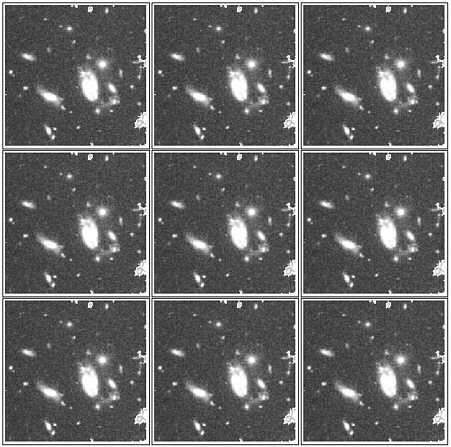
FIGURE 4 Strangely shaped space could create the illusion of multiple images of the same galaxies.
which image is the real galaxy and which is the ghost. Some experts say the closest image is the real thing and the others are ghosts, but on the other hand the closer image might be in an adjacent “cube.” In that case it might make more sense to call the image within your own cube the real one. It’s all just a matter of definition.)
But looking for ghosts in this straightforward way might not work too well. For one thing, if you see an object via light coming from different paths, the light will arrive at different times. A ghost of a galaxy will not look like what that galaxy looks like now but what it looked like a long time ago. So searching for identical galaxies at different points in the sky is probably a poor strategy. Some experts have suggested looking instead for similar clusters of galaxies, which would not have changed much over time. It might even work to look for groups of quasars, which would have changed in individual appearance but would have retained the same spatial relationships to one another.
MAP’S MAP
An ingenious scheme that might pay off sooner was proposed in the late 1990s by Spergel and colleagues Neil Cornish and Glenn Starkman. They plan to exploit data collected by the MAP satellite, launched in the summer of 2001. MAP was designed to record the temperature of the cosmic microwave background radiation, which has been streaming through space for 13 billion years, ever since the big-bang explosion cooled enough for atoms to form. For the most part, you’ll recall from Chapter 5, the temperature of that radiation is the same everywhere; subtle deviations betray the spots where small clumps of matter appeared, forming “seeds” that grew into galaxies.
Finding nontrivial topology isn’t its main purpose, but MAP’s map of the microwave sky could be scanned for evidence of identical temperature deviations appearing in different locations. In fact, Spergel
and colleagues calculated, a non-simple topology could reveal itself by imprinting precisely identical circles of temperature blips on the sky. (In other words, the blips in a circle around one point in the sky will be just the same as the blips around another circle at some other position in the sky. It will take some high-speed computing power to find such circular patterns.)
MAP could detect such circles only if the actual size of “one copy” of the universe (known as the “fundamental domain”) is small enough. So far, Spergel told me, other kinds of searches have established that the fundamental domain—the actual cube—must be at least 2 billion light-years across. Otherwise ghosts would have already been identified. MAP will extend the search for nontrivial topology to the entire visible universe.
“If it’s smaller than that, then we’ll see it,” Spergel said, and that would guarantee that the universe is finite. If MAP doesn’t see the circles, the universe might still be finite, but the “cube” size would be bigger than the whole apparent universe (the “covering space”), about 60 billion light-years across. (That number seems too big for a universe that is only 13 billion or 14 billion years old. But Spergel points out that the 13 or 14 billion years is the time light has had to travel to us from the most distant sources. During that time, the universe has continued to expand. So if you estimate how big it “really” is “now,” it would be more like 60 billion light-years across.)
So MAP may not be able to answer the topology question. “But it’s worthwhile to spend three weeks of computer time to look,” Spergel said, “given that you built that satellite.”
Of course, even further complications are possible. Space could be connected in many different possible ways. The “cube” version is only one of the simplest. The mathematician Jeffrey Weeks has described a much more complicated shape—with 18 sides—that could serve as the fundamental domain of space. Other shapes with even more sizes are also possible.
To many scientists, such complicated multiconnected topologies seem to defy the Occam’s razor approach of seeking simplicity in science. But Janna Levin and Imogen Heard argue that nontrivial topology is no more exotic than curved spacetime to begin with. And Jean-Pierre Luminet and Boudewijn Roukema point out that what counts as simple depends on your point of view. Modern attempts to describe the origin of the universe suggest that it might be simpler to make a universe with nontrivial topology than to make one with trivial topology. Nowadays the most popular way to “make” the universe involves quantum theory, which suggests there is some probability of a universe popping into being out of nothing. But the probability diminishes as the universe being created gets bigger. For an infinite universe, the odds are very slim.
“An infinite universe would have zero probability of coming into existence,” Luminet, Starkman, and Weeks pointed out in a 1999 Scientific American article.20 That suggests it would be a lot easier to make a finite universe. And current observations suggest that if our universe is finite, it must possess nontrivial topology.
Levin and John Barrow have proposed further benefits of nontrivial topology. It might explain, for instance, the highly structured arrangement of galaxies in the cosmos that seem to have grown from that smooth distribution of seeds in the cosmic microwave background radiation. Levin and Barrow invoke the murky math of quantum chaos to derive this conclusion, but their main point seems to be that structure might arise naturally along the shortest loops to get from one place to another in a nontrivial finite space.
“If . . . the universe is topologically finite,” they write, “then light and matter can take chaotic paths around the compact geometry. Chaos may lead to ordered features in the distribution of matter throughout space.” The distribution of galaxies, then, may be “providing a map of the shortest route around a finite cosmos.”21
Levin and Heard suggest that nontrivial topology might be
connected with string theory, inflation, and the vacuum energy or cosmological constant. A nontrivial topology might explain why some of the dimensions in superstring theory are large while others are small, a process that might have been worked out during the epoch of inflation.
“The . . . magnitude of the vacuum energy depends on the topology,” Levin and Heard write, “and it is conceivable that it selects three dimensions for expansion and three for contraction in a kind of inside/out inflation.” Understanding topology, it seems, may solve many problems.22
If it turns out to be the case that the universe is finite, with a nontrivial topology, science would once again be presented with an astounding anticipation. Just as Riemann and his predecessors foresaw that space’s geometry could be non-Euclidean, Schwarzschild and his successors forecast the possibility of nontrivial topology. Verification of their possible prediscovery may only be a matter of time.