In War and Peace: My Life in Science and Technology (2002)
Chapter: Photo Plates
Plate 1

My grandfather, Horton Stever, who with my grandmother, Mattie, raised my sister and me after our mother was hospitalized when I was one and Margarette three.

My sister Margarette, my life-long supporter with me. That determined look on my sister’s face was not without cause: She took a firm hand in seeing I behaved myself.
My parents. Both died when my sister and I were very young.

Quarterback for Northside High in Corning – “unbeaten, untied, almost unscored upon”: 266 – 8.
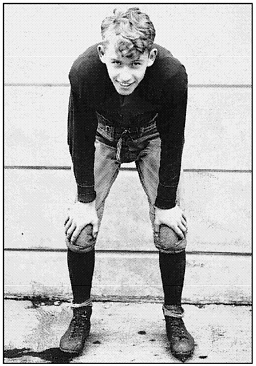
Plate 2
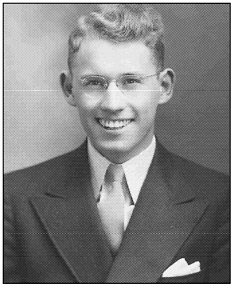
My Colgate graduation picture. I was voted “Most Brilliant,” sharing honors with classmates who were voted “Biggest Week-Ender” and “Biggest Tall Story Man.”

The casting of the Mount Palomar mirror at Corning Glass. The Cal Tech scientists who came to Corning to check on the work, especially Robert Millikan, were a huge boost for me to enter science. (Ayres A. Stevens)
Plate 3

Two of us in our faltboot on Lake Tulainyo working with our cosmic-ray apparatus. In the foreground is the snow glacier we had to get across carrying our equipment and our faltboot.
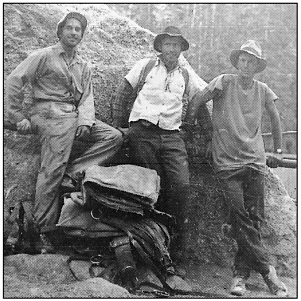
Taking a break after hauling mules and equipment up the High Sierras. Left to right, Bob Hoy, I, and Hugh Bradner.
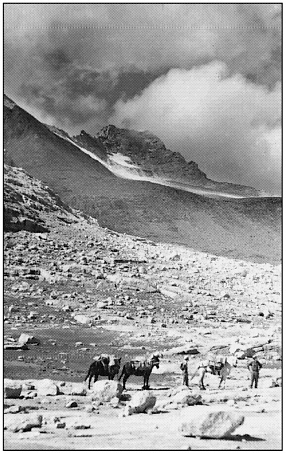
On the move toward Lake Tulainyo, at almost 13,000 feet in the High Sierras. Our rented animals were probably figuring out what to do to us next.
Plate 4
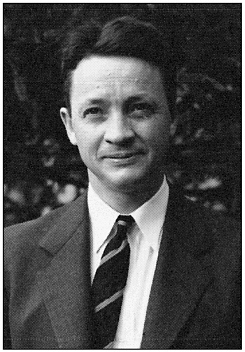
Victor Neher, who was my doctoral adviser until he left for the Rad Lab at MIT. I followed him immediately after I got my degree.

Cal Tech was booming when I got there, which had its downside, such as graduate students, me included, being “accommodated” in the loggia of the faculty club, the Athenaeum. (Bernard Hoffman/TimePix)

The triumvirate that transformed Cal Tech from the Throop College of Engineering into one of the premier technological and scientific institutions in the world. Left to right, Albert Noyes, chemist; George Ellery Hale, astronomer; and Robert Millikan, physicist. (Courtesy of the Archives, California Institute of Technology)
| This page in the original is blank. |
Plate 5
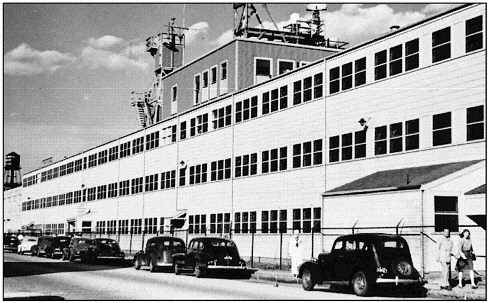
Temporary Building 20 at MIT, home of the Rad Lab. Paraphrasing Churchill, “Some Temporary!” It was home between 1943 and 1998 not only for the Rad Lab, but also after the war the Research Laboratory of Electronics and the Media Lab. (MIT Museum)
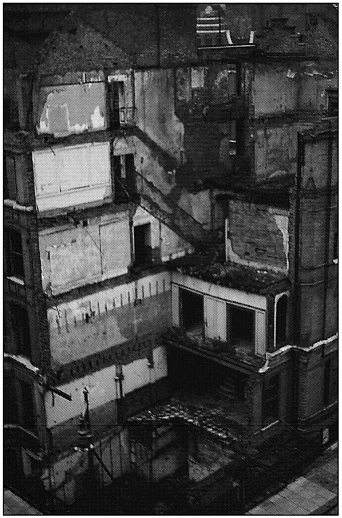
From my London office I had a pretty good view of the damage done by the Blitz and even without looking out I was shaken by the bombing blasts.
| This page in the original is blank. |
Plate 6

Shortly after the Normandy landings till the end of the war I was “Technical Observer #300,” authorized to go anywhere and even to take “custody of Prisoners of War.” I elected not to exercise that privilege.
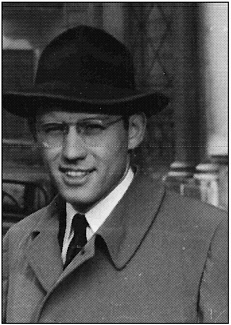
London, 1943, shortly after I arrived to become the second person in the two-man OSRD office to help coordinate the US-British work on radar.
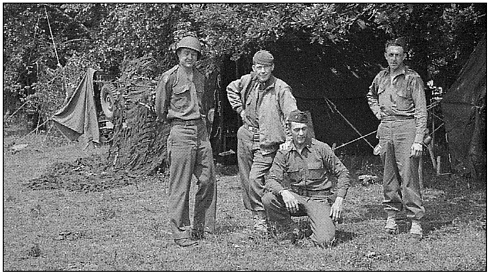
My first night in Normandy, about three weeks after D-Day.
| This page in the original is blank. |
Plate 7
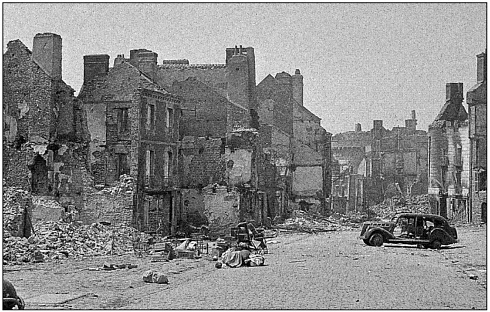
Hennebont, a town in Brittany. Only one example of the destruction we saw in the aftermath of the fierce battles from town to town after the Normandy invasion.

In Lannion, en route to our “capture” of a Wehrmacht unit. Though we hadn’t done the fighting and didn’t deserve it, we didn’t mind the enthusiastic welcomes all that much.
| This page in the original is blank. |
Plate 8

Sottevast, France, 1944. Bob Robertson, my colleague in my first technical intelligence mission after the Normandy landings at a captured – and destroyed – V-2 site.

In front of the pharmacist’s house in Trégastel where we were invited to stay, guarded through the night by Free French forces to protect us, with reason, against SS attacks.
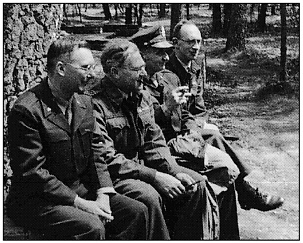
Volkenrode, 1945, the site of the immense and very well hidden research laboratory for the Luftwaffe. Hugh Dryden on the left, and Theodore von Kármán, third from the left.
| This page in the original is blank. |
Plate 9
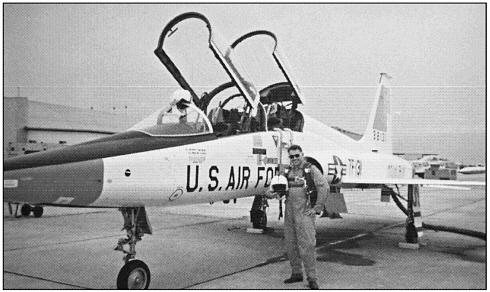
My first supersonic flight, in a TF 131 Tainer, 1964. (U.S. Air Force)

General Donald S. Putt, who recruited me to be Chief Scientist of the Air Force and later President of Carnegie Tech. (U.S. Air Force)

Jimmy Doolittle, who was my mentor, great friend, and splendid fishing companion. As a young lieutenant in the Army Air Force in the 1920s, he sat down to list his assets and debits, and by his own accounting wound up with one asset, “brave as hell” and one debit, “dumb as hell.” So, he decided to go to graduate school at MIT to earn a doctorate in aeronautical engineering.

| This page in the original is blank. |
Plate 11
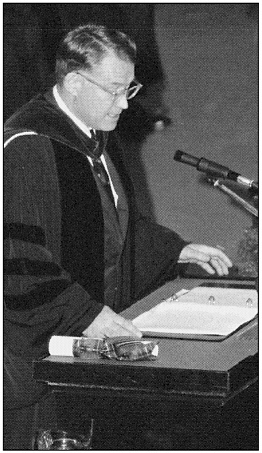
“A great university is a balanced one.” My inaugural talk as the new president of Carnegie Tech, 1965. (Carnegie Mellon)
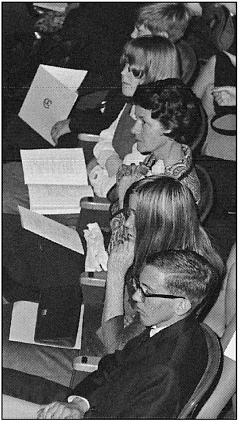
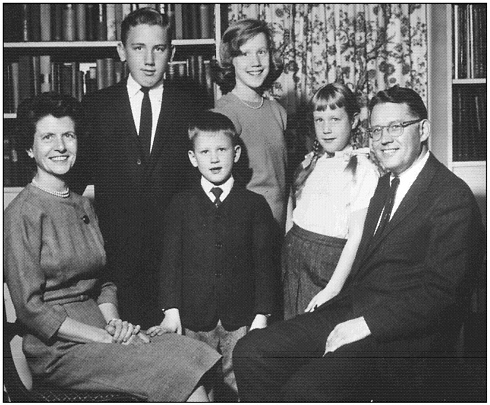
At least five were paying attention: Bunny and our four children listening to my inaugural speech. (Carnegie Mellon)

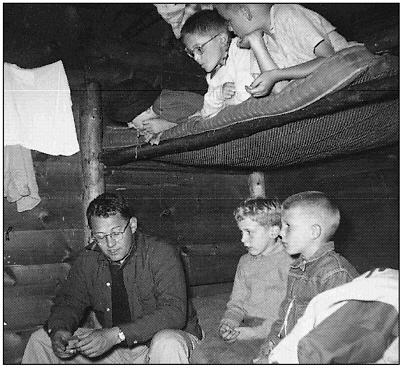
The deed is done. Aiken Fisher, Paul Mellon, and I at a press conference to announce the merger of Carnegie Tech and the Mellon Institute. (Carnegie Mellon)

| This page in the original is blank. |
Plate 13
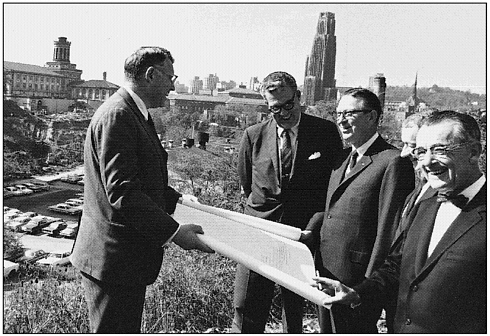
Five ambitious guys – including Aiken Fisher. chair of the CMU Board, and Fred Foy, head of Koppers, second and third from left, respectively, planning new campus construction. The U Pitt Tower of Learning is in the background. (Carnegie Mellon)

The B-52 Stratofortress went into service in 1952 and is still flying almost 50 years later. I saw it, albeit indirectly, at Edwards Air Force Base in California through the skid marks and gouging left when the first B-52 being delivered to the Air Force had landing gear problems. (Air Force Flight Test Center/History Office)
| This page in the original is blank. |
Plate 14

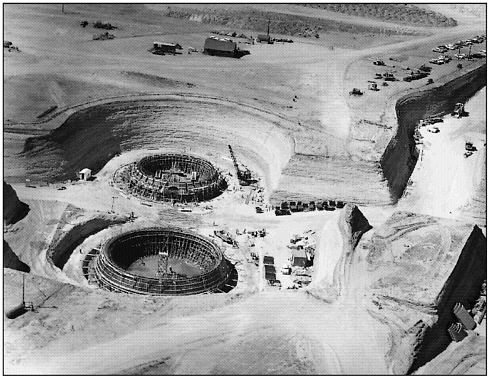
Confirmation in the mid-1950s that missiles tipped by nuclear weapons were technologically plausible and awareness that the Soviet Union was embarked on a vigorous effort to build guided missiles led the United States to commit itself to building intercontinental ballistic missiles, ICBMs. The first was Atlas, test launched August 1958 at Cape Canaveral (left). Then came Titan, also liquid-fueled like the Atlas, and the construction of Titan launch sites in the United States, such as this one near Denver, Colorado (below). Both were succeeded in the early 1960s by the solid-fueled Minuteman. (U.S. Air Force)
| This page in the original is blank. |
Plate 15

Jim Killian taking office in 1957 as the nation’s first science advisor – “science czar” was the hyperbolic phrase then, as Jim was lionized as the nation’s guide to responding to the shock of Sputnik. (NASA)

President Kennedy awarding the first National Medal of Science in 1961 to Theodore von Kármán, the great leader in aeronautics and astronautics. Von Kármán was quite rightly the only recipient that year. (Courtesy of the Archives, California Institute of Technology)
| This page in the original is blank. |
Plate 16
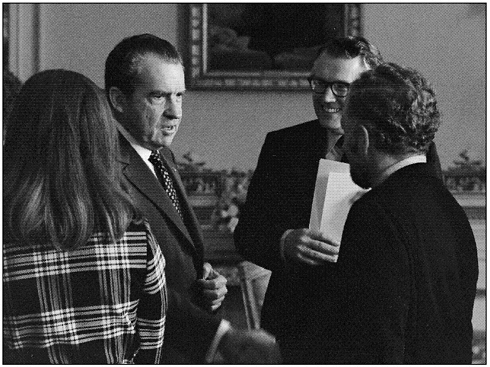
The National Medal of Science returns to the White House in 1973, as President Nixon receives that year’s recipients. (The White House)

The original presidential science advisers. From left to right: James Killian, George Kistiakowsky, Jerome Wiesner, I, Donald Hornig, Lee Dubridge, and Edward David. (Franklin Institute)
| This page in the original is blank. |
Plate 17
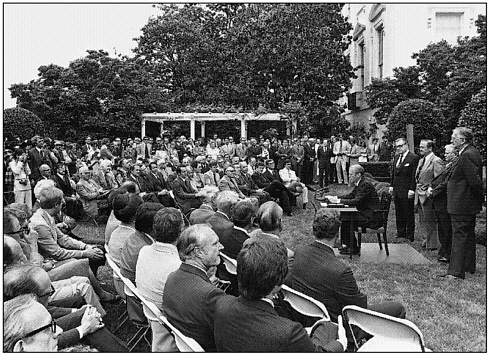
Science is officially back in the White House: Legislation establishing the Office of Science and Technology Policy is signed by President Ford in 1976. (The White House)
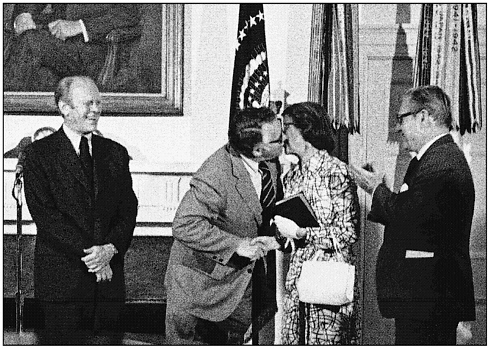
Kissing Bunny, the best part of being sworn in in 1976 as President Ford’s science advisor. To the right is Vice President Rockefeller. (The White House)
| This page in the original is blank. |
Plate 18
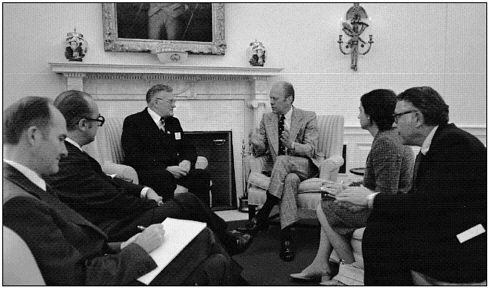
President Ford and I meeting with senior Soviet officials, including, third from left, V.A. Kirillin, of the Soviet Council of Ministers. (The White House)

Richard Atkinson (left) and Phil Smith (right), 1975, who helped the Foundation and me get through some rocky moments, MACOS not the least of them. Dick Atkinson succeeded me as NSF Director and Phil went with me to the Ford White House and then stayed on to serve my successor as science adviser, Frank Press. (National Science Foundation)

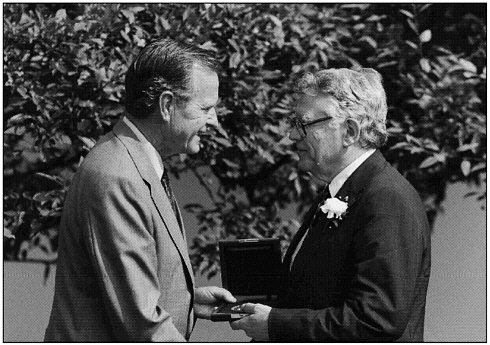


| This page in the original is blank. |
Plate 21
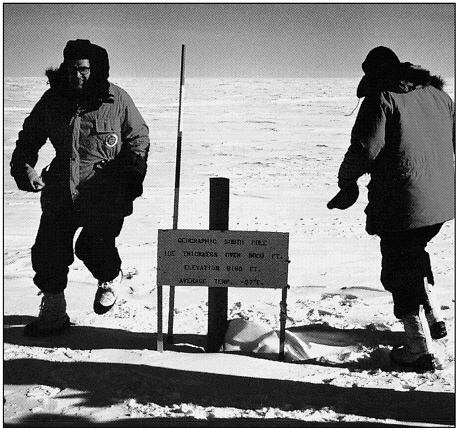
Bob Seamans, then Secretary of the Air Force, and I circumnavigating the world in style at the geographic South Pole, 1972.

At the Soviet South Pole station at Vostok. Not sure how many vodka toasts had gone down by then, but clearly there was no shortage of vodka, 1972.
| This page in the original is blank. |
Plate 22

Just prior to the “longest two minutes” of my life: The full-scale, full-duration firing of the Space Shuttle’s re-designed solid-rocket booster, which had intentional flaws, to ensure that the hot gases would in fact be contained, even if one or two barriers failed. (NASA)

A “few years later”: Victor Neher, my Cal Tech doctoral adviser who also helped lure me to the Rad Lab, and I in 1995.
| This page in the original is blank. |
Plate 23
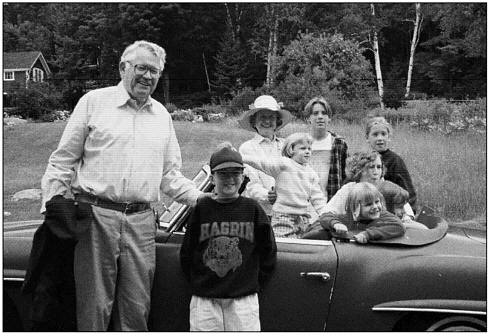
Randolph, New Hampshire, 1995: Seven grandchildren, two proud grandparents, and one very fine car.

Roy and Guy Jr. laid out a splendid trip for us in the Wind River Range right after I left government in 1976. The whiskers came off when I got home.
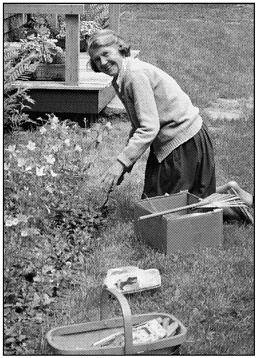
Bunny doing one of her favorite things, gardening at Randolph.