In War and Peace: My Life in Science and Technology (2002)
Chapter: 2 War
2
War
1941–1945. From the Rad Lab via a stormy Tagus to London, the Blitz, radar, and almost losing Britain’s most important secrets. On to the beach-head in Normandy, capture by the Germans, witness to the liberation of Paris, ghastly discoveries in Germany.
I boarded a Pan American Airways clipper for London at 6 a.m. on New Year’s Day 1943. I was to serve as scientific liaison officer for the London Mission of the Office of Scientific Research and Development. It was my first trip on a flying boat, my first Atlantic crossing, and the longest flight in my life. What was scheduled for 3 to 5 days, with stopovers in Bermuda, the Azores, Lisbon, and Poole in England, ending with a short train ride to London, actually took 19. We spent 13 days in Bermuda, first delayed by foul weather in the Azores and then by “maintenance needs.” The “needs” were in fact the use of our aircraft to help support the summit in Casablanca from January 14 to 24 between Franklin Delano Roosevelt and Winston Churchill, where they agreed on unconditional surrender as the terms for ending World War II.
It was an epochal time. The day after I left for London the Germans began their retreat from the Caucasus and later that month the Soviets began their drive to clear Stalingrad, Montgomery’s Eighth Army took Tripoli, and American bombers hit Wilhemshaven, the first U.S. raid on Germany. A month earlier Enrico Fermi and his colleagues on a former squash court at the University of Chicago achieved “the first sustaining chain reaction and thereby initiated the controlled release of nuclear energy.”1
A BRITISH GIFT
Things were different in the summer of 1940. In June, Norway surrendered and Hitler toured Paris, and then on September 7, 1940, at about 4:00 p.m., 348 German bombers escorted by 617 fighters blasted London until 6:00 p.m.2 The Blitz had started. In September 1940 a British group in great secrecy bore “gifts” to the United States, including a palmsized device inside a black japanned metal box.3 The device, a “cavity magnetron,” solved head-on the major obstacle to radar images sharp enough for precision location of aircraft, especially at night, for directing artillery fire, and for finding submarines. Until the magnetron, “seeing” objects at great distances was severely limited: the beam width of the signals sent out from a radar device and echoed back from the target was too wide to provide enough detail and the power or strength was too small for sufficient range. The cavity magnetron changed all that. Invented by physicists at the University of Birmingham only eight months before it was carried to the United States, it emitted highly focused microwaves4 at great power. The British team told a U.S. group5 gathered in a Washington hotel that the device “could generate ten kilowatts of power at ten centimeters, roughly a thousand times the output of the best U.S. tube on the same wavelength.”6
That was stunning. Radar then was long wave with meter-long signals. The British used the technology throughout the war for its Chain Home system to detect and track planes coming across the coast and to guide interceptors close enough for visual contact. While useable for daytime attacks, it lacked the resolution to guide interceptors to planes attacking at night, a tactic the Germans quickly turned to. The British desperately needed better resolution to guide artillery fire and fighter aircraft. Narrower beam widths—radar with wavelengths in centimeters not meters—meant greater accuracy, better resolution, less clutter from extraneous echoes, and less atmospheric interference. It would also yield better range information, better height readings, and more discrimination of closely spaced targets. As early as 1935, Robert Watson-Watt in Britain had pushed hard for the development of microwave radar, an urgency then shared neither by the United States or Germany7 nor the many other countries working on radar in the 1930s, including
Japan, Italy, France, and the Soviet Union. The Germans, for example, developed several radar systems in the 1930s, but they were of limited designs and intended mainly for gun laying8 (for example, the 53-cm Würzburg radar I encountered later).
The problem was getting centimeter radar with sufficient power. The cavity magnetron did that, a claim the Americans confirmed in tests a few weeks after the Washington meeting. More magnetrons were built and tested in short order, with components built by AT&T, RCA, Sperry, Westinghouse, and General Electric. But as remarkable as the cavity magnetron was, microwave radar also needed further development of its components—receiver, detector, and so forth—to be a workable device. On October 18, about a month after the magnetron arrived in the United States, the notion of a central laboratory to work on radar was approved by the Microwave Committee of the National Defense Research Committee (NDRC). The laboratory was charged with making the magnetron useable for insertion in aircraft, for gun laying or directing and timing artillery fire, and for guiding bombers. It was to be administered by civilian scientists and not report directly to the military, roughly the model used by the British. The Radiation Laboratory—the Rad Lab— was set up under the NDRC.9 Vannevar Bush, the NDRC director, started the lab with a budget of $455,000, approved the site (the Massachusetts Institute of Technology) and named as director Lee Dubridge, a physicist from the University of Rochester.10 By December 1, some 20 physicists had signed on, a full year before Pearl Harbor.11 A few weeks after the cavity magnetron came to the United States, a major laboratory to exploit it was up and running. And in March 1941 a device using the cavity magnetron enabled over Cape Cod the first air-to-air detection by Americans, coincident with a similar achievement by the British.12 At its peak, some 4,000 people worked at the Rad Lab from 69 academic institutions, and the products that flowed out of it by 1944 totaled $640 million.
I was given badge 149 when I arrived at MIT in June 1941, with a fresh doctorate in physics from the California Institute of Technology, having been recruited for the Rad Lab by I. I. Rabi and Victor Neher. Victor was among the 20 “charter members” of the lab. Rabi was to win the Nobel Prize in 1944 for his work on magnetic properties of atomic
nuclei. I was first put to work on modulators that formed the pulses and powered the magnetrons but was soon asked to help establish MIT’s Radar School. In the summer of 1942 I returned to the Rad Lab to work on K-Band, or 1-centimeter, radar components.
TO LONDON
On a Saturday evening in early fall 1942, Lee Dubridge called me at the Neher’s rented home where I lived to ask if I was interested in joining the London Mission of the Office of Scientific Research and Development for radar liaison with the British and our growing American forces in Europe. I listened hard and asked a lot of questions. But I had decided in microseconds that I was going hard after this opportunity. I was young, single, and feeling pressured by my counterparts who were going into the armed services. I wanted to get closer to the real war, so I accepted. My spirits leaped.
For the next three years I was part of what was then the world’s biggest effort in technology transfer, a term not used then but in vogue now. The exchange between Britain and America of science, technology, and engineering in radar and other technology for modern warfare had already begun, but it was about to become enormous. So too was the flow of ideas and equipment from laboratories and industry to our fighting forces. The part I was to play also foreshadowed much of my postwar life.
I spent two months getting ready for London. Thanks to Lee Dubridge, Rad Lab division heads briefed me. And thanks to Vannevar Bush, who arranged the introductions, leaders of industrial and military laboratories briefed me on radar work. Occasionally, it went beyond that. At Westinghouse, given the cachet of the Bush introduction, I was also told about recent work on the separation of uranium isotopes, even though I didn’t have the necessary clearance. I kept quiet. I visited Bell Laboratories to be briefed on magnetrons by James Fisk, later the head of the laboratories, and General Electric, to be briefed on vacuum tube developments by its head of research. And I talked with scientists who had visited British laboratories and with Britons assigned to the Rad Lab, notably Denis Robinson,13 the British Air Commission and Royal Air Force representative for aircraft-to-surface work.
Rough Passage
I also learned some lessons on the 19-day trip to Britain, one being the limits at the time of flying boats and navigation. On the leg from the Azores to Lisbon, I went forward to talk to the navigator of the Boeing 314 flying boat, who was unable to use celestial navigation because of a severe Atlantic storm and had to rely instead on compass and dead reckoning. Not too accurate. We missed Lisbon by several tens of miles but finally turned and landed on its Tagus River in a raging storm. A launch came out with enough space to take off some but not all of us. Huge waves pinned the launch against the plane. The boat and plane heaved up and down at different frequencies, with very heavy waves breaking over the boat. We finally maneuvered away from the plane, started toward shore, and were treated to foul language from the captain and crew when a big wave hit just as the captain opened a window to see his position. Cold and wet, we were forced to wait in a steel-corrugated customs shed and were told that no one would clear customs until everyone was off the plane. But the captain wouldn’t go out again until the storm let up. So the remaining passengers bobbed up and down in the plane all night. When they were finally taken off, the three women were limp with seasickness and had to be carried off. To top it, the plane steward had collected our passports and then dropped the bundle in the sea. Fortunately, it was retrieved, but for the rest of the war I traveled with a badly stained passport. During two more days of delay, I had a chance to telephone greetings from Sam Goudsmit of the Rad Lab to his sister, who had escaped the Nazi invasion of the Netherlands and was now in neutral Lisbon. We finally got from Lisbon to Ireland’s seaplane base at Foynes, circling far out in the Atlantic to avoid German interceptors based in France. Some weeks later another Clipper was intercepted and shot down with the actor Leslie Howard of Gone with the Wind aboard. The land plane that was to take us from Foynes to England had flown into ducks and damaged its wood-surfaced wings. More delays, although our stay in Limerick was considerably less tense than in Lisbon.
“Nonsense!”
I finally made it to London, checked into the Park Lane Hotel, and set out for the American Embassy in Grosvenor Square, to see Bennett Archambault, the science attaché, whom I had met in the States. I went past the Connaught Hotel into Grosvenor Square to the embassy and once past the Marine guard to Archambault himself, where I excitedly told him that “there’s an air raid on!” “Nonsense! There haven’t been any sirens.” “But,” I argued, “I heard both bombs and antiaircraft fire.” “Nonsense!” The air raid sirens sounded some 15 minutes later. The newspapers reported the next day that the German bombers went undetected by radar by flying in very low above the Thames estuary. Another hole in Britain’s radar defenses, adding to that of the Chain Home long-range radar against nighttime attacks.
The first blitz was from September 1940 to May 1941. London was hit the hardest:
Almost half of the 60,595 civilian dead were killed in the London region. The maximum tonnage of high explosives dropped on any provincial city was 2,000: London received more than 12,000 tons. It was bombed continuously for a far greater period than any other city, being raided for seventy-six continuous nights, with only one exception, in the autumn of 1940. . . . In central London only one house in ten escaped damage.14
The British security clearance for working with Americans was simple. Our top officers would introduce us to their top people, who would in turn introduce us to the people working for them down the line. Introductions done, we could work directly with our British counterparts or indeed with anyone at any level. Our London office for radar liaison, all of two people, David Langmuir, the senior member, and I, worked with all the British armed services—the Royal Navy, Army, and Air Force. Each had legitimate and complex interests in radar. Each had established laboratories to bridge civilian and military communities, many led by university people and populated by younger faculties and graduate students.
The morale and spirit of the military were up, with recent Allied
victories at Midway, Stalingrad, El Alamein, and Guadalcanal. Ahead were increasing air attacks on Germany and the return to Europe. Although air attacks on Britain had dropped substantially since the 1940 Battle of Britain, night attacks remained a problem. And attacks by German submarines on Atlantic convoys continued to be devastating, the allies having lost 70 ships totaling over 400,000 tons by February 1943.15
Better radar was desperately needed against nighttime attacks and the U-boats. That meant microwave radar, and I got to work on continuing the exchange of information on a critical component, the vacuum tubes essential to building successful microwave radar systems. Since the tubes, or valves as the British called them, were developed primarily by industry, I had many opportunities to visit British industrial laboratories and compare them with the American ones I had visited earlier. I took over from Dave Langmuir, attending meetings of the Committee on Valve Development, established early to coordinate British work on these critical components. I took notes all the while, although it was difficult for me in the beginning to understand the very rapid British speech. I always had the feeling that their brains and speech were running in a higher gear than mine.
Out of London
The principal feature of my second week in London was a four-day trip to Great Malvern, my first chance to get out of London to where the real work of research and development in radar was being done. Great Malvern—on the border between England and Wales and well inland— was chosen a couple of years earlier because of Britain’s deep concern with German air raids and the possibility of a German coastal raid to capture radar secrets. A raid on Bruneval, a French coastal town near Le Havre, had captured a German 53-centimeter, or Würzburg, radar. If the British could do it, why not the Germans?
Great Malvern housed two major radar centers—the Telecommunications Research Establishment, TRE, and the Army Defense Research and Development Establishment, ADRDE. The Telecommunications Research Establishment, established in 1940 under the Air Ministry, was where the first cavity magnetron was sent—to improve its power output,
to build microwave receivers, and the like. And it was at TRE that air-to-air microwave radar was developed and tested on the same day the Rad Lab tested its device over Cape Cod. The ADRDE, the principal research and development agency for the army, was more operationally attuned, focusing, for example, on building radar-controlled antiaircraft guns and gun-laying radar, for bearing, range information, and fire control for artillery.
I spent a good bit of time from early 1943 to mid-1945 on the London-Great Malvern route. The Paddington train went through Reading along the Thames to Oxford and then across the beautiful Cotswolds to Worcester, where we boarded a local for the last leg to Great Malvern. The TRE had taken over a “public” boys’ school; Americans would call it private.
The Royal Air Force was beginning to install sets using the cavity magnetron technology for ground radars and for airborne interception, bombing, and navigation systems. Priority was on air-to-surface radars critical to antisubmarine warfare. One tanker convoy lost seven of nine ships just south of the Azores. About 100 German submarines were hunting in the Atlantic at any given time.16
Early on the TRE and the Rad Lab had divided the work, with the United States working hard on the components for 3-centimeter radar, the X-band, while the British continued their strong development of 10-centimeter radar, the S-band. Indeed, that latter work was already paying off. By February 1943 there were initial successes against German submarines with 10-centimeter air-to-surface radar.17
Bombs and Coded Love Notes
Our work in London was occasionally interrupted by air raids, which we mostly ignored except when the explosions got too close. We weren’t alone in our insouciance. Even in the ferocious assaults of the 1940 blitz, about 60 percent of Londoners didn’t go to the shelters. As E. K. Chamberlin noted: “The majority of the population under attack seems to have gone to bed as though nothing untoward had happened, or was likely to happen—a statistical demonstration of the power of sheer habit and of an ingrained optimism that seems indistinguishable from fatal-
ism.”18 The air raid shelters were usually in hotel basements or subway stations. Traveling late at night on the “tube,” I saw families, old folks, and children, unrolling their blankets on the hard pavement just a few feet from the trains, unable to sleep. I decided that wasn’t for me. Still, we were kept awake by air raids, and I quickly found that British coffee— muddy and strong—magnified the effect. I had to choose between air raids and coffee. I quit coffee.
I greatly admired the air raid warning crews on the roofs. They would stay there with their hard hats and gas masks, ready to douse fires. And they would bellow at anyone pulling aside a blackout curtain and letting light out.
American organizations and their personnel were coming to London in increasing numbers, and they all wanted to work and live close to the American Embassy in Grosvenor Square. Our mission was also growing quickly, and we had to move from the embassy to a very good location one block from the Marble Arch off Hyde Park. Our new quarters were excellent. They were on the fifth floor, and we quickly discovered that the sixth and seventh floors were occupied by the government in exile of the Netherlands. We often met Dutch officials on the elevator, including the very tall Prince Bernhard in a fine uniform. A pleasant way to start the morning was to get on the elevator with him looking down at us from his great height. We would say “Good morning,” and he would respond with “Guten Morgen.” We were then living at a posh place, 40 Berkeley Square, in an apartment large enough to house five of us. We shared costs, pooled ration coupons, hired a cook, and on many Saturday nights had parties. The idyll was short lived. The Office of Strategic Services, which in time became the Cental Intelligence Agency, was also looking for space, and it had a lot more clout. So after a final and very noisy party, it was back to the Mount Royal Hotel, which fortunately was right across Oxford Street from our new offices.
In summing up my life in Britain those first few months in 1943, I realized I had grown in my capability to help in large scientific affairs. I had worked with impressive people, particularly great leaders in science, engineering, and government in both countries. I enjoyed my work but also found time to enjoy my stay, despite the frequent air raids. I dined and danced with very attractive women—British, American, Swedish,
Belgian, and Canadian. Our search for good food often ended up in a Chinese restaurant in Soho. I remember especially a cold Saturday night in early 1943. Dave Langmuir and I were far from home and not going to any parties. So we walked after dinner down to Piccadilly Circus to the cable office so Dave could cable his new wife, Nancy, in Washington. They had worked out codes from lines in poems that best expressed their feelings at the moment; for example, K1 for some lines by Keats or S34 for Shelley. The message sent, we had a drink to usher in the weekend, and hearing some singing outside went out to join in. The two of us wandered down the Strand in the blackout singing at the top of our voices when suddenly a tall figure emerged out of the dark. We looked up at a policeman, who said, “‘Ere, ‘ere, that will not do for the Strand in the middle of the night.” We apologized and went our way.
The next day was Sunday, and the security officer at the American Embassy called Bennett Archambault, the head of our office, at home asking if “you have a person by the name of Langmuir working in your group.” He went on that the British censors had discovered a message Langmuir sent that was clearly in code. “That is a security violation, and they want to know about it.” They called Dave in, and he described it as a love note to his wife. They did not smile. And they were quite emphatic that one did not use coded messages. Still, I bet those very serious censors relished telling the story to their wives and girlfriends, even “decoding” the message by reading the poems.
I continued to meet and work with a widening group of the three military services, with the major laboratories, and with companies working on microwave tubes—in London and the provinces. Before I left for London, I’d been told by Jerrold Zacharias at the Rad Lab that the British manufacturer of vital semiconductor crystal rectifiers had a much better yield than ours did, even though there had been information exchange on the process. I visited the manufacturer, the British General Electric Company,19 and was cordially received and given a tour of the tube manufacturing facilities, ending at the assembly line for the rectifiers. I compared every step of the process with Zach’s description of the U.S. one, and they were identical. Then I noticed that the women in packing each unit gently tapped it on the wooden table. I asked why and was told: “Oh, we find we get a better yield if we tap it just so.” That very
firmly set the tungsten “cat’s whisker” part of the mixer on the silicon crystal semiconductor. Problem solved and reported to Zach.
THE COMPTON MISSION
The intensifying war effort made even more urgent the effective coordination of British and American radar work. The American radar program had at the time nothing like the tight coupling by the British of research and development to military needs and operations. British laboratories were in close contact with their front-line airfields, naval ports, and army units. Their need to defend Britain from air attack was still great. And Bomber Command taking the war to the Germans was at airfields all around them. They had daily working relationships, some scientists were even involved in operations, and there was a “Sunday Soviet,” in which the research and development leaders would meet with military leaders for informal talk on immediate- and long-range problems.
All this activity led to the Joint Chiefs of Staff setting up an ad hoc Committee on Radar Research and Development headed by Karl T. Compton, president of the Massachusetts Institute of Technology (MIT). The British counterpart was a high-level radar committee, led by Sir Stafford Cripps, the minister of aircraft production. These committees were in some ways creatures of success, the realization that research and development programs in each country were exceptionally successful in developing radar components for a widening set of military uses. Needed now was integration of British and American priorities for different radar sets, production goals, and the calibration of new applications.
“Badly Shaken”
In April 1943, three months after I arrived in London, Karl Compton came to England as head of the Committee on Radar Research and Development20 to discuss, if not create, bilateral radar policy. Dave Langmuir, in preparation for this visit, came up with an ingenious idea— to create a pocket reference book for the mission members summarizing every radar system the British had in research, development, or production and including for each set performance data, development sched-
ule, and intended use. The British had not done this, fearing quite reasonably that their proximity to the enemy made the security risk too great. I demonstrated one day how great the risk was when I took a taxi from our office to the Air Ministry to confer about a couple of British radar sets for inclusion in the notebook. The taxi took a pleasant route along Park Lane, over to Hyde Park Corner, past Buckingham Palace, up the mall through the Admiralty Arch, then down Whitehall to the turn into the Air Ministry. I studied the notebook for a bit and then just enjoyed the scenery. Arriving at the ministry, I paid, bounded up the steps, and entered. I was just getting cleared when I realized I didn’t have the notebook, the guide to some of Britain’s most valuable radar secrets. I rushed out. No taxi. No traffic at all.
I ran the 100-yard dash in record time to Whitehall where it joins Parliament Street. There was only one taxi. It was my only hope and so I intercepted it. It was my taxi! It had gone down to Parliament and getting no fare had turned around. The notebook was on the back seat. I returned to the Air Ministry badly shaken. The finished notebooks made a great hit with the Compton mission.
The mission had a major impact. One of its first recommendations was to intensify the scientific and technical cooperation on radar with specifics on who should do what. Thus, the United States should focus on longer-range development work, given the likelihood that the Pacific War would last longer; on the further development of tunability, lower voltages, and higher power in the magnetrons; and on the technology for the 3-centimeter, H2X, radar, as well as 1-centimeter, K-band, radar.
Lee Dubridge and Louis Turner, also from the Rad Lab, stayed on in Britain after the Compton mission left to begin implementing its recommendations. That kept us plenty busy, helping them and the flood of other Rad Lab visitors who came after them and who needed help pairing with their British counterparts. Lee sought especially to understand the decision by the British to continue their emphasis on 10-centimeter radar, the H2S system, when the Americans were working hard on 3-centimeter, H2X, developed under the leadership of George Valley. The British of course knew that the H2X would give better target definition. But they had already invested much of their limited capacity on an H2S crash program under heavy pressure by the Royal Air Force Coastal Com-
mand for its battle against German submarines and by the RAF Bomber Command for its attacks against German arms industries, synthetic fuel plants, and other targets beyond the range of the bomber guidance systems then in use, GEE and OBOE.21
EUROPEAN WEATHER
The U.S. Eighth Air Force as it intensified its operations in 1942 discovered the limitations of daylight bombing. It didn’t have the long-range fighters to protect its bombers inland against German fighters and was working hard to correct that. And there wasn’t all that much daylight. The European continent is famous for its cloudy weather, and there were many days when daylight visual bombing was impossible. The Eighth Air Force in late 1942 tested British equipment for blind bombing, with one or two aircraft in each formation equipped with a British grid navigation system, either the GEE or the more precise OBOE, both using flight patterns set down by in-flight radio communications from ground stations. But both systems were limited to line-of-sight transmissions and could not go beyond the Ruhr.
The Eighth Air Force search for blind bombing technology then went to the 10-centimeter, or H2S, system. It was carried on the plane and showed cities, coastlines, rivers, and other large features of the terrain. But there were signs that the Germans had countermeasures to the 10-centimeter radar, having retrieved a set from a bomber that crashed near Rotterdam. And in any case the air force was anxious for even more precise guidance for its bombers and successfully tested, in a November 1943 raid on Wilhemshaven, crash production models of the 3-centimeter system, which offered finer details. That target was missed by eight previous bombing missions. By year’s end, H2X radar was guiding 90 percent of American bombing runs. And in time it became the Allies’ major bombing radar, and a stellar Rad Lab success story.22
Window
Luis Alvarez, a brilliant physicist, inventor, and experimentalist, was responsible for two Rad Lab projects of especial interest to the RAF, both
using 3-centimeter radar: the Eagle blind bombing system and a blind landing system. Pilots then would not admit that a completely blind system was safe, so to accommodate the doubters the name of Alvarez’s system was changed from ground control landing to ground control approach. It is now standard in commercial airports.
I arranged for Luis to meet at an airfield with Air Commodore, later Vice Marshall, Donald Bennett, commander of the RAF Pathfinder Force, responsible for marking targets for the main bombing force. Bennett was Australian and the youngest air commodore in the Bomber Command.23 Luis was very late. Suddenly, while the air commodore and I were talking, Luis burst in along with his pilot, both disheveled. They had crash landed their plane. After they recovered, the discussion went on, ranging from the night bombing techniques of the Pathfinder force, especially its technique for marking targets, to Luis’s blind landing system. It turned out Bennett himself had just tested in Scotland the first set sent to Britain.
When it was time to leave, the air commodore said, “If your plans would permit you to stay overnight, we have a very large raid on, in fact our largest ever, and you can hear the crew briefings before takeoff, and their debriefings after their return tomorrow morning.” Luis and I jumped at the chance. And then the air commodore added, “By the way, we’ll be using Window for the first time tonight.” Our eyes flew wide open; this was the first airborne use of a highly classified countermeasure to confuse enemy radar. It meant dropping bundles of thin strips of aluminum foil, cut to just the proper length to resonate with the wavelength of enemy radar. The idea was that a bundle of strips would spread out and look like an aircraft on radarscopes.
This raid was the first of three days of bombing the Port of Hamburg, with 739 planes used the first night and 3,000 over three days, including Eighth Air Force daylight bombers. It was a frightfully destructive raid with many civilian casualties, largely from the enormous firestorm touched off by incendiary bombs.
The predawn debriefing of the crews after the first raid differed dramatically from the preraid briefing the night before when the crews were told to use Window, by dropping the foil bundles serially and regularly. They argued strongly and loudly that each crew member already had
more than enough to do. They changed their tune when they learned at the debriefing that they had lost no planes from their airfield and very few from other fields. The Germans had a hard time with Window. Radio operators listening to the German broadcasts heard their ground-to-air controllers complaining: “The planes are having babies. What’s happening?”
The Germans came up with countermeasures to Window. And we did our part to make Window even more effective. The British Countermeasures Board, with which I liaisoned in Dave Langmuir’s absence, worked on keeping the initial successes up. For example, illustrating the coordination between British and U.S. efforts, there was a proposal that the British use American machines for stiffening the aluminum foil to keep them at full length since those that folded did not reflect as well, attenuating the false spoofing.
“LAND OF MILK AND HONEY”
The post-Compton mission stream of visitors and bilateral work intensified. There was intense collaboration on LORAN, a long-range navigational system similar to the British GEE but working in a different frequency and with longer-range capability. Both systems laid down overlapping hyperbolic grids, enabling, through two closely coordinated radio beacons, an airplane or ship to position itself very accurately. And we had joint coordination on K-band, or 1-centimeter radar, which I had worked on at MIT just before I left for England and which in principle could show bombers details as minute as railroad tracks.
In September 1943 I returned to the United States. It was a culture shock even though I’d been away only eight months. Despite the rationing of gasoline and shortages of sugar, coffee, and the like, home was a land of milk and honey compared to Britain. Yes, the United States had been at war for almost two years when I returned and there had been many killed and wounded, but the civilians hadn’t experienced the war firsthand.
Using my copy of the notebook on British radar sets I had shipped in a classified pouch, I gave a talk to the Rad Lab staff almost immediately upon my return. My theme was that it was time for radar to go on the
offensive rather than being used in the main to defend against attacks. The example I used was height-finding radar at Appledore in Devon, England, which the British were using for offensive air sweeps over the European continent. It was critical for RAF fighters engaging German fighters to know their altitude and to get above and behind them for maximum advantage. The tracking radar being worked on at the Rad Lab, using microwaves versus the longer-range Appledore radar, gave excellent positioning information but not height. Height finding was added after my talk.24
Concurrent with my visit, Lauriston (“Larry”) Marshall was getting ready to leave for London to be the first director of the newly established British Branch of the Radiation Laboratory, the BBRL, another product of the Compton mission and Lee Dubridge’s follow-up. It was solid recognition that a group was needed onsite to install, test, maintain, and modify as needed Rad Lab radar sets, especially the H2X systems. The British branch grew from about 30 people at the start to over 100 after D-Day.
After the Rad Lab meeting and the departure of Larry Marshall for London, I went to Washington for meetings at the OSRD Foreign Liaison Office, my home base. Bennett Archambault, my London boss, and Lee Dubridge had come in for meetings. I also met with people in the countermeasures business and visited major laboratories at Bell Laboratories and Columbia and other universities working on magnetrons and 10-centimeter and 1-centimeter radar. When I got back to the Rad Lab toward the end of October, new ideas were percolating for me to take back to London, including the Microwave Early Warning (MEW) system, a very high-powered system conceived by Luis Alvarez.
Turf
I returned to London on November 27, 1943, the day before Churchill, Roosevelt, and Stalin met for the first time, in Teheran, where they agreed to invade Western Europe in 1944. I came back to major changes. One was that the establishment of the BBRL meant realigning some of the work done until then by the London OSRD radar office, namely, Dave Langmuir and I. The second change was the reorganization of the
war effort to establish Britain as the base for landings in Europe. A new tactical air force, the U.S. Ninth, had been created to attack targets close to the invasion site and to transport paratroops. It complemented the U.S. Eighth Air Force, which would continue joint attacks with RAF Bomber Command on German air bases and cities and the plants making planes, tanks, and munitions for the German war effort. About this time I got a letter from Victor Neher that included a message from I. I. Rabi that I should return to the United States lest I get damaged in the fighting. No way, with London on the frontlines and about to be part of the greatest event of the war. Still, it was clear my portfolio would change.
Larry Marshall returned to the United States in January 1944, and Sam Goudsmit became acting head of the British branch of the Rad Lab. Goudsmit had a second and highly secret task as scientific head of the ALSOS mission to learn whether the Germans were successfully developing an atomic bomb.25 There was a second reason for Larry’s return to the United States: a fierce turf battle had broken out between OSRD and BBRL, more especially its two strong and talented leaders, Archambault and Marshall. I kept as aloof from that battle as I could. Soon John Trump replaced Marshall. John had a foot in both camps, being secretary of the radar division of the NDRC, now a part of OSRD, and having his office in the Rad Lab.
Before he left, Larry helped the Ninth Air Force acquire OBOE, the British blind landing system to cope with Europe’s foul weather. Sam and I finished the job by gathering the pertinent data, presenting it to the Ninth Air Force, and recommending that it use OBOE, while the Eighth Air Force, bombing deep in Germany, used the H2X system. First used in 1942, OBOE, while accurate, had a limited range and the Germans had begun jamming it. However, by late 1943 it had become much less vulnerable to jamming. OBOE depended on distance measurements from two ground stations, enabling the plane to locate its position very accurately and to time its release of bombs or markers for the follow-on bombers. Joe Platt26 came to England with a strong Rad Lab and BBRL team to handle the equipping of the Ninth Air Force with the latest microwave OBOE, which was credited by General Sam Anderson with about half of the Ninth Air Force raids over France before and after the invasion.
I also helped a Rad Lab team27 arrange the emplacement of the very
powerful MEW system near Dartmouth, for tracking large bomber and fighter sweeps over the Channel, Normandy, and Brittany. The MEW system was installed in February 1944, and while managed by the Ninth Air Force, it served all of the Allied air forces. It gave a superior overview of the land and air armadas during the Normandy invasion. A MEW set was also on Omaha Beach to direct fighter operations six days after the Normandy invasion began.
MISSILES
In late December 1943 Dwight D. Eisenhower became commander of the Supreme Headquarters of the Allied Expeditionary Force, SHAEF, based in London. The U.S. Air Force’s presence in Britain was already heavy, but now the number of U.S. Army people coming into the country was overwhelming. “The American invasion struck the British Isles like a huge Technicolor bomb, scattering nylons and cigarettes and goodwill over the whole country. . . .The sheer prodigality of American equipment and supplies dazzled a population which had been cozened into accepting carrot flan as a kind of luxury.”28
My customer base widened enormously with the complex hierarchical structure and many new levels to negotiate that necessarily came with SHAEF and its invasion planning. A third unit was added to the London mission of the OSRD and BBRL: a civilian radar unit,29 sent by Eddie Bowles, special assistant to the secretary of war, to advise, with British colleagues, including Robert Watson-Watt, who headed it, on optimal uses of radar and countermeasures during the first critical days of the invasion.
The Germans took note of the buildup in their own fashion with “The Little Blitz,” a series of raids in 1944, the most intense during the week of February 19. One of these was the worst air raid I experienced in London. I was in my fifth floor room at the Mount Royal Hotel, and on the top floor was Colonel Arthur Warner, an academic, who had been at the Rad Lab serving as reserve officer in the Coast Artillery and Antiaircraft Command. He came over to look at radar preparations. As many times before, I opted to stay in my room rather than go to the shelter during the raid. Art Warner joined me at its peak, badly shaken by what
was happening, with many nearby explosions and fire bomblets30 hitting our roof followed by commands to extinguish them from fire marshals. We kept up each other’s spirits. We walked outside the building after the raid to see the building across the street in flames and many fires lighting the sky. Art Warner’s report on antiaircraft activities would now have the ring of authenticity. And later that year in June the Germans first used Vergeltungswaffe-I, their Vengeance Weapon-1, or V-1, a flying bomb. Britishers called the V-1 “buzz bombs” because of the frightening noise they made before they struck.
The buildup by the U.S. Army included antiaircraft units, with a major part being the integration of SCR-584 radar into the preinvasion defense of Britain. The SCR-584, developed at the Rad Lab under Ivan Getting, was a gun-laying radar that came to be heavily used for antiaircraft batteries in Britain, for the European invasion, and for the war in the Pacific. It was then the largest investment in radar sets ever made but also very “profitable” since it was used to detect enemy aircraft and to control antiaircraft guns and, offensively, to guide aircraft to air and ground targets.
By spring 1944 I had two new assignments. First was planning technical intelligence missions to the continent to follow our troops as closely as we could to capture intelligence on the Germans’ technical capacities. This meant briefings on intelligence already in hand, planning specific missions, and working with other Allied units and our own three services. There were also safety briefings on the booby traps used by the Germans. As Technical Observer #300, I was given the simulated rank of major, to help get the equipment I needed and, not least, to be treated as an officer if captured.
The second assignment was guided missiles, the precursor to my professional life after the war. The stimulus of course was the intelligence coming in on the V-1 and V-2 German missiles. And the British had started the GAAP program, on a guided antiaircraft projectile. Vannevar Bush assigned me as liaison to the project. I soon became pretty knowledgeable about those new technologies, with frequent visits to the National Physical Laboratories, where they had a supersonic wind tunnel and a brilliant theoretical team; to the Royal Aircraft Establishment, where they were working on missile guidance and control; and to the
other governmental and industrial laboratories working on rocketry. I was now heavily involved in the guided-missile business and less in radar, which in any case was being well handled by the new BBRL leadership and by Bill Breazeale at the London Mission.
“A FLOATING DOCK”
It was May 1944, and the time for invasion was close. The mood in Britain was extraordinary. “Living on this little island just now uncomfortably resembles living on a vast combination of an aircraft carrier, a floating dock jammed with men, and a warehouse stacked to the ceiling with material labeled ‘Europe’. . . . The fight everybody is waiting for hasn’t started yet, but all over England, from the big cities to the tiniest hamlet, the people, at least in spirit, seem already to have begun it.”31
My first mission to the continent was beginning to take shape. It was to be joint with Howard P. (“Bob”) Robertson,32 a theoretical physicist from Princeton, who, although I didn’t know it at the time, had been sent to England by Vannevar Bush in part because of the intelligence leaking through on the Germans’ missile programs, especially the V-1. Odd construction sites, called ski sites, had appeared along the French coast in an arc stretching from Cherbourg to Belgium and Holland. They were “ski sites” because of a jog at the end of a long and narrow building. The odd design, easy to see in reconnaissance photos, was copied from a building at Peenemünde on the Baltic coast that had a little jog for truck loading. The Germans soon learned why we spotted their sites so easily and went to a straight design. But the secret was out.
On the morning of June 6, D-Day, shortly after we heard that the invasion of Normandy had begun, Bob Robertson, Bennett Archambault, and I met with R. V. Jones,33 the superb intelligence leader for the British Air Ministry, to begin planning in detail the Robertson-Stever mission to Normandy. Bob and I were to land on the invasion beaches on D-Day plus 16 and then follow the army up the Cotentin Peninsula toward Cherbourg. Jones and his colleagues shared with us their technical work and the vast amount of intelligence on the German missile program they had. Our office routinely received copies of the weekly intelligence s ummary of the British war cabinet. For some time the summary com-
ment was that “the Germans are not ready to use the V-1 operationally this week.” Then, six days after the invasion, the summary reported that “the Germans are ready to use the V-1s operationally this week.” And, sure enough, they did. Four V-1s were fired at London a week after D-Day.
The V-1 was a forerunner of cruise missiles, a pulsejet that got its thrust from burps of hot, high-pressure gas at the rear of a cylindrical tube.34 A simple, inexpensive, and tremendously effective weapon, it would not have been a great weapon if it had to be very accurate. But it had a target, London, 15 to 20 miles wide, and it had to fly only 100 to 200 miles.
Each V-1 snarled impending disaster from the buzzing of its pulsejet, followed by an eerie silence as the engine cut off and the weapon fell. Many were shot down over open country or sea, but those that got through killed or wounded over 24,000 people. There was no use shooting one down once over London because it was just as lethal. Antiaircraft guns were set up over the south coast, using the SCR-584 radar, a Bell Laboratories gun director aiming where the missile would be when a proximity fuze reached it. It surely startled the Germans looking out over the channel to see some of their V-1s shot down by a single shell rather than the usual barrage. The reason of course was that the shells didn’t explode unless they had run in close enough to touch off the fuze. These fuzes used small, continuous-wave radar to sense that they were close enough to the target to explode. Those that missed their target exploded on the sea surface.
Curiously, on the same day that the first V-1 was fired, a V-2 shot from Peenemünde went astray and landed in a farmer’s field in southern Sweden. British intelligence successfully arranged with Swedish officials to pick up the pieces. One of my colleagues in the Air Ministry, Squadron Leader Wilkinson, flew to Sweden with another squadron leader in the bomb bay of a Mosquito bomber. The pieces were brought back to the Royal Aircraft Establishment in Farnborough, where, just as curators do with dinosaur bones, they were suspended from a ceiling until they could be partially pieced together. It didn’t give all the answers, but it was an important step toward understanding the next weapon to hit Britain.
And it soon did—on September 8, 1944. The V-2 was the first rocket-propelled, medium-range ballistic missile.34 It came with no warning and hence was more terrifying. Just a flash, the bang of a supersonic shock wave, and an explosion. If you heard nothing, all was well; if you heard two bangs, a shock wave and an explosion, you were ok; if you heard only one big bang, you were gone! When one final explosion on March 29, 1945, ended five years of aerial bombardment of Britain by airplanes, buzz bombs, and rockets, “the enemy had dropped a grand total of 70,995 tons of high explosives and uncountable thousands of incendiaries, killing 60,595 civilians and seriously injuring another 86,182, destroying 222,000 homes and damaging nearly five million more.”36
NORMANDY
Bob Robertson and I flew to France about 20 days after D-Day, delayed by a strong storm at the Normandy beaches. Our C-47 had one other passenger, an army nurse, a two-man crew, and one very heavy replacement engine for a P-47 fighter. Since the invasion, the nurse had shuttled every day between France and Britain with a load of severely wounded men and then had returned to France with badly needed cargo. She was in a very bad state, her morale understandably low after having dealt with badly wounded men in tough flying conditions. We talked to her about other things and it may have done some good.
After an aborted first try, we landed on a small dirt field on the cliffs above Omaha Beach. We got an instructive tour of the beach, reminders of the terrible fighting a few days before, and then drove through Carentan toward the main road north up the Cotentin Peninsula toward Cherbourg. And we drove quickly, because the Germans were still shelling Carentan. The battle was on to break through to the west coast of the peninsula and to seize Cherbourg to the north. We passed through Ste.-Mère Église, where paratroops had landed on D-Day and saw the aftermath of the vicious fight, especially in the fields where gliders carrying troops landed—or tried to, some smashing into trees, walls, or earth berms.
We were hosted by an engineer’s unit encamped in a field surrounded
by the typical Norman bocage of small trees and bushes, solidified by centuries of accumulated rock and dirt. The engineers built a new dirt airfield every day, returning every night to tell us that another had been built. Remarkable. We slept in pup tents to the nightly sounds of German shells heading north and east and American shells south and west. Still, the field, circled by very high hedges, gave one at night an illusion of security as the bombardment went on overhead.
Tit for Tat
Our standard work routine was to leave right after breakfast, mostly in one jeep when Bob Robertson and I went together and our escorting officers had other missions and two jeeps when we went together. We had a bunch of different targets. For radar and guided-missile targets, we would take as many pictures as needed, make notes of both the effects of bombardment on the targets and of the demolition by the Germans as they retreated, and try to find something new in the equipment the Germans left behind. We seldom found any intact radar equipment, although the nature of the antennae, the electronic equipment, the communications, and the raid plots at the radar centers were revealing. I was quite impressed that our earlier intelligence briefings on what kinds of radars were located at given sites were so good. We had a good idea of what was there, from detecting the emanations from the radar sets and from photo reconnaissance observers picking out from the photos the antennae and layouts of the station. The very large long-wave antennae used to lay down beams for German bombers in their raids over Britain at night or during bad weather were located and identified by this sort of work by the British, who then used the information to jam the stations. The engineers who operated those beams constantly found countermeasures to the jamming, and then new kinds of jamming were introduced. An interesting tit-for-tat electronic battle. We arrived at one of those beam sites so soon after the fighting that we found German bodies still unburied. This made our site inspection unpleasant, even more so by our first discovery of booby traps.
Also, the V-1 launch sites had been bombed for some time before the invasion. Bob Robertson visited V-1 sites to study the effects of the bomb-
ing on them and to check if they were as advanced as intelligence said. They were. Also, aerial photography in France found several structures, dug deep into the ground with thick concrete walls and roofs, which were candidates for V-2 use, either assembly or storage. One of these V-2 sites was on the Cotentin Peninsula not far from Cherbourg in a town called Sottevast. It was on our target list and of most interest to Bob Robertson with his missile intelligence portfolio and also a second portfolio: operational research, with his particular interest being the effectiveness of bombing raids and bomb penetration against concrete structures such as submarine pens and the V-2 sites.
Bob and I drove our jeep to the Sottevast site, and while we found considerable damage, none of it was lethal to the operation, and it was mostly repairable. Even a direct hit on the concrete bunkers would have left a crater 5 feet deep and 12 to 15 feet wide but wouldn’t have penetrated. Bigger and more penetrating bombs were needed. At the V-2 site we were looking at, we came upon an office with a safe circled by a lot of dried blood. Someone had forgotten about booby traps.
About the same time we were visiting the V-2 storage site at Sottevast, American troops finally captured Cherbourg, secured almost the entire Cotentin peninsula, and captured the rest of it, Cap de La Hague, within a few days. Bob Robertson’s high credentials easily got us to the commanding general, who arranged for us to tour the vast fortifications and technical systems the Germans had built in the city, particularly in the port. The army hoped to capture the Cherbourg port intact, but the Germans had demolished the place, including sinking ships in the harbor to block navigation. However, a fuel pipeline was laid within several weeks from England to Cherbourg to supply airplanes, trucks, cars, and tanks.
We drove to the west coast of the Cotentin Peninsula to look at technical emplacements. Near Barneville on the coast we found huge antennae used by the Germans to communicate with their submarines and ships in the Atlantic. We didn’t stay long because just south of us troops were still fighting hard to capture La Haye-du-Puits, finally taken on July 5. On the coast north of Barneville, we found another concrete bunker.We probed it with flashlights and soon found inside bundled explosives with fuses attached. We left.
The Generals
Driving leisurely in sparse traffic down the main Cotentin road to an airport for our return to England, suddenly there were sirens and flashing lights. We were pulled off the road by military police. Then we saw a long armored column led by an open command car with tanks rumbling behind. In the command car stood General George Patton. He was in full “travel costume,” with a brass-plated helmet and his famous special pistols on his belt. He stood straight, looking like he was in a victory parade, although the only audience was us. He was leading his Third Army to St. Lo to exploit a breakthrough by the First Army. Later in Brittany I saw General Omar Bradley, commander of the U.S. land forces on D-Day, with a driver, a single guard, one jeep, no battle regalia, and no tank column.
I was happy to be back in London and spent much of my time there preparing for my next trip to France, this time to Brittany. Much of Brittany was open, although there was still intense fighting in Mont St. Michel to the east and in Brest to the west, and there were scattered pockets of Germans cut off from escape who might still put up a fight. It would stay that way for some time because Patton’s Third Army headed to Paris after the breakthrough at St. Lo.
This time our team consisted of Colonel Eric Bradley, commander of the U.S. Army Air Force Technical Section in London; Bennett Archambault, science attaché at the U.S. Embassy; Major Carl Lindstrand on the staff of the U.S. Army Technical Section; and me. We tried first to go to Lorient on the Brittany coast to get to the German submarine pens. Nothing doing. The Germans still held the town. Our route then took us inland to the northern Brittany coast, from Rennes through St. Brieuc and Guingamp to Lannion. We must have been the first Americans to get into Lannion because the crowd was so huge the police had to lead us through. There were flowers on the jeep, hands to shake, and hugs and kisses from women of all ages. Pleasant, but I felt guilty because I hadn’t done the fighting to get us there.
Capture and Surrender
We drove on without stopping to ask about the local situation at one of the Free French barriers. Not wise, it turned out. We drove a little farther north to Perros-Guirec, a small coastal town, to have a look at a major radar control center in a farmhouse on top of a hill, which was used to direct fighter aircraft. We drove up the hill along a small and narrow sunken road bordered by hedges. As we got closer, we suddenly realized there were many people on both sides wearing German helmets and carrying rifles. German soldiers in the road with rifles ready stopped us. Our senior officer, Colonel Bradley, a calm veteran of World War I, told us in a very low voice, “Don’t say anything.” That was wasted on me because I was speechless!
The Germans led us through a minefield to the farmhouse. There the German commander insisted that we use only German or French, which made us grateful for our school language studies. He wanted to know how close our tanks were, thinking that colonels commanded divi-
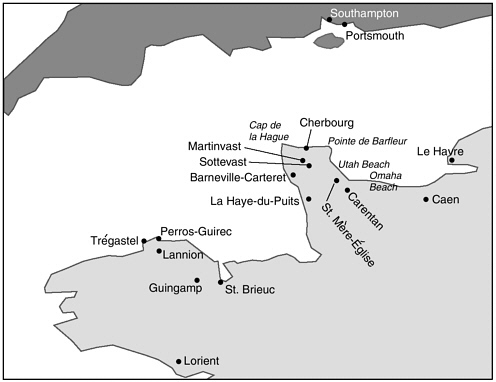
Normandy and Brittany sites.
sions and that we had come forward to parley, leaving our tanks hidden down the road. Colonel Bradley temporized for some time but then realized that this group wasn’t anxious to fight but to surrender. We got over that shock—we were after all technical not combat personnel—and suggested to the Germans that they surrender to us. They agreed, with two conditions: that we honor the Geneva Convention for the treatment of military prisoners, although we didn’t know much about it, and that they be made prisoners of either Americans or British. About this time three Free French officers were brought in under a flag of truce along with a Canadian officer who had been dropped by parachute well before the invasion to help the Free French work with our troops. We agreed to the Germans’ surrender terms, sealed at the German commander’s request with a glass of schnapps, and after some more palavering, some 500 German troops were carted off in rickety trucks, the engines fueled by natural gas kept in a bag on the top.
Whispered Conversations
Then we were back to Lannion for an impressive celebration dinner with the mayor and all the leading citizens of the area. Sad Brittany songs were sung with tears—”Ni zo bepred Bretoned, Bretoned, tud kaled,” “We are the Bretons forever, a robust people.”37 We responded first with the “Star-Spangled Banner” and then, after much wine, with “I’ve Been Working on the Railroad.” We stayed the night in a large and well-appointed chateau, finally going to sleep after a lively talk with the leader of the Free French group we had met after we “captured” the Germans. He was a thoroughly civilized fellow whose politics we disagreed with. It turned out he was a communist sent from Paris to direct local operations—a harbinger of French politics after the war.
Exploring the abandoned site the next day we found the entire raid-reporting center housed in several spacious rooms underneath the farmhouse. And we found an ingenious device for tracking aircraft on a visual map to control the air battle. Eric Bradley and Bennett Archambault returned to London with this haul.
Carl Lindstrand and I drove on to Trégastel on the Brittany coast, to look at a German Würzburg radar, but the Germans had blown it. We
were invited to stay for dinner and the night by the local pharmacist, Monsieur W. Jouille, and his wife. The dinner, contributed by many neighbors, was memorable, and our rooms were pleasant, but we were kept awake by nearby machine gun fire and whispered conversations just outside our rooms. The next morning we were told that the local Free French unit had guarded both our house and jeep. The danger was real. Another unit of our technical intelligence group working about 10 miles to the west came upon some Germans, including SS. They opened fire with no warning, killing an American officer and wounding another. And we met the wife of a Free French leader who had delivered supplies to a Free French unit. She and her child were held hostage by the Germans and their house was burned, but the leader did not give himself up. He was caught and executed. Carl and I stopped at a beautiful stone church to pay our respects to him. It was a moving moment with many of the local citizens taking part.
On the fiftieth anniversary of D-Day, I wrote letters to M. Jouille and the leader of the Free French unit that had guarded us and got back wonderful letters from Madame Jouille, the pharmacist’s widow, from the Free French fellow, and from the current mayor of Lannion, who had an account of the entire episode published. The pharmacist and his wife moved to Paris after the war and set up a very successful pharmaceutical laboratory there. The Free French fellow had gone with his colleagues, after we left, to help American troops in their attack on Brest. In 1946 he returned to his job working on a fishing boat off the Brittany coast.
Paris
Then it was back to London to prepare for our next technical intelligence mission, this time to Paris and this time as part of a joint British-American technical intelligence team, coordinated by a new SHAEF organization, the Combined Intelligence Operations Section. We landed on a grassy airfield just outside Chartres, where we were held up because of the heavy fighting in Paris. The spectacular view of the cathedral across the flat fields of the Beauce with its uneven steeples, one twelfth-century Romanesque and the other thirteenth-century early Gothic, rebuilt after
a disastrous fire, became for me the symbol of France. It was the first time I saw a part of France not torn by war.
We entered Paris when it was liberated by the French Second Armored Division and by the American Fourth Division. On August 29, 1944, General Eisenhower, in part worried about further German resistance or counterattacks and in part to reassure Parisians that the taking of Paris was an Allied victory, ordered a march through the city by the Twenty-Eighth U.S. Infantry Division, newly landed in Normandy and transported to Paris on its way to the front. I was so proud to see those Americans dressed for battle marching down the Champs-Elysées, the tanks and artillery caissons rolling along in great numbers three abreast. Paris celebrated as never before.
My colleagues and I billeted at the Ambassador and had immediate invitations, one from Sosthenes Behns, the head of International Telephone and Telegraph, who had flown in with us to reestablish the company’s Paris office, and the other at the Hotel George Cinq, where the host was Jacob P. den Hartog, then a professor of mechanical engineering at Harvard and after the war at MIT. Den Hartog, a Navy Reserve captain, was leading a delegation looking at the same things we were: captured technical information and equipment.
Our work was very different from our first two trips to France, for we were visiting operating industrial plants and laboratories and intact German facilities. But that doesn’t mean that we got any more information. Industrial officials mostly claimed they had done no technical work for the Germans. I’m sure this was in part true. Paris quickly replaced London for technical operations supporting our troops, both for the BBRL and for the London liaison office of OSRD. Many more scientists arrived from the United States, including Charlie Lauritsen, who had taught me nuclear physics at Cal Tech and had been on my graduate thesis committee. And Sam Goudsmit came, to join me on my radar visits in Paris intended to hide his real purpose, the ALSOS mission described earlier to determine German progress, if any, on building an atomic bomb.
Of all my technical intelligence trips, I got the least useful information out of Paris. But it was a fabulous two weeks walking in a beautiful city, relatively undamaged and in a festive mood. A. J. Liebling told his
American readers that “for the first time in my life and probably the last, I have lived for a week in a great city where everybody is happy.”37
The Allies made rapid progress. Patton’s Third Army reached the German border and freed Luxembourg. To the north and along the coast, the British and Canadians had a difficult time of it as the Germans fiercely defended the port towns of Le Havre and Antwerp. And to the east the Russians and Poles reported evidence that the Germans had murdered 1.5 million people at the Majdanek concentration camp. It was the first of many such horrifying discoveries by liberation troops.
Disaster
Our next trip was more promising—to Eindhoven in Holland, home of Philips Electronics. But getting to Eindhoven depended on the success of a major Allied operation, “Market Garden,” an airborne assault on September 17 on Holland. The goal was to seize canals and bridges to enable ground troops to enter Germany over the Rhine at Arnhem and into the Ruhr Valley. The rationale for the attack, flawed as it turned out, was that the German forces were so weakened that maintaining the pressure through a focused rather than broad attack would lead to quick collapse. The German resistance in fact turned out to be fierce, especially at Arnhem.
We returned to London to prepare for the Eindhoven trip and found a mood change in the city that was dramatic if short-lived. The Germans’ loss of their V-1 sites and airfields in northern France and more effective defenses—new high-speed RAF fighters together with SCR-584 directed guns and proximity fuzes—virtually stopped air attacks on England. The happiness in removing the blackout curtains quickly faded when in September the first V-2 landed in London. The arrival of that silent frightening weapon, against which there was no defense, made even more urgent the thrust into Germany and the capture of the V-2 sites.
We stopped in Brussels and then continued north while the Market Garden battles were intensifying. We were often delayed by German attacks on our long line of tanks, artillery, and troops concentrated on a single highway. We continued to the outskirts of Eindhoven, one of three sites for paratroop drops. More German aerial and tank attacks, but we
finally made it to Eindhoven and a welcome by Dutch scientists at the Philips plant. Our team was led by Robert Watson-Watt, A. P. Rowe, and W. B. Lewis from the British side and Bennett Archambault from the American. In a few days, we got a superb overview of electronic componentry—oscillators, cathode-ray tubes, and the like. I did notice, however, that there were areas of their own research about which they were reticent. Quite understandable, since with the end of the war they would face intense international competition for markets. And it was a time not only of technical exchanges but also long talks with our hosts at whose home Dave Langmuir and I were staying, a Philips engineer and his wife, and with their neighbors, of how hard their life had been under the Germans.
And then there was the daily evidence out the window that Market Garden was a disaster. Every day an almost unbelievable number of C-47s would fly north in great formations to drop supplies to American troops at Nijmegen and to the British at Arnhem. American paratroopers and British tanks got across the bridge at Nijmegen but meeting strong German resistance could only get a few miles farther, and they couldn’t get close enough to help British and Polish paratroops at Arnhem. Many of these had to surrender, but some escaped to be sheltered by the Dutch. The Germans were pretty rough on the Dutch people, who had counted on being freed. Civilians again suffered in the awful ways of war.
DEEPER INTO MISSILES
Back to London and two weeks later in mid-October to the United States. I met with Vannevar Bush, who surprised me with his intense interest in guided missiles. I told him of the British work on their guided antiaircraft projectile, GAAP, and our intelligence on German guided missiles, including, of course, the V-2. He was interested in the potential of guided missiles as a major war weapon although he didn’t think they would have a great effect on the war.
Bush asked me before I returned to London to work with various groups engaged with guided missiles. Arrangements were also made for me to visit the Air Force’s research facility at Wright Field and guided-missile facilities in Southern California. I visited Cal Tech and the Dou-
glas Aircraft Company, the latter working on a rocket-powered glide bomb.
At Cal Tech I talked with William Pickering, my substitute thesis advisor when Victor Neher left for the Rad Lab before I finished my thesis. Bill was advising on electronics, telemetering, communications, and tracking for ground-to-ground bombardment rockets being developed for the Army. That project became the foundation for the work of the Jet Propulsion Laboratory with the National Aeronautics and Space Administration, NASA, when it emerged a decade later.
As pleasant as all this was, I returned to New York rather quickly to a meeting of the Vacuum Tube Development Committee, our counterpart to the British Committee on Valve Development, where I reported on what we had seen at Eindhoven and on new British magnetron work. But the most important reason for hurrying east was to join a committee put together by Vannevar Bush to advise him on the future for the guided missiles then being worked on. The chairman was MIT Professor Joseph Boyce and included Richard Courant, the exceptionally brilliant mathematician from New York University; Jesse Beams, a very able physicist from the University of Virginia; and Ivan Getting, who was developing radar guidance for missiles. We discussed a report by Fritz Zwicky of Cal Tech, who had taught the hardest mechanics course I ever took. He proposed inserting very powerful rockets into the upper atmosphere high enough to orbit the Earth. It was the first time I had contact with someone serious about injecting satellites into the Earth’s orbit. That was 13 years before the Russians did it.
Before my scheduled return to London I also met with the group at the Johns Hopkins Applied Physics Laboratory developing an antiaircraft missile to defend naval ships in the Pacific against kamikaze attacks. Merle Tuve, a brilliant physicist from the Carnegie Institution of Washington, led the group. Tuve, with Gregory Breit, had used radar pulses to measure the height of the ionosphere, which starts at about 30 miles above Earth and has a big role in propagating radio waves. Merle invited me “to sit with us while we put the finishing touches on the proposal that we’re going to make to the Navy for a guided antiaircraft projectile program.” First, he asked everyone to propose the work they were going to do—on air-breathing ramjets, rockets, supersonic aerodynamics and
control surfaces, electronic controls, guidance, warheads, and so on. Then he asked each “to give me the amount of money you will need for your share of development.” Merle toted up the estimates, which came to “two and a half million dollars. But you guys are always underestimating the amount of money you’re going to spend, so I’m going to multiply that by four and ask the Navy for ten million dollars.” He did, and some years later with about a billion dollars spent, they produced the Bumblebee39program for the Navy.
Double Bang
I was supposed to return to London by mid-December, but my intestinal pains were sharpening. I was soon having my appendix removed at St. Luke’s Hospital in New York. I was there on December 16, 1944, when the Germans attacked in the Ardennes Forest in Luxembourg, trying to retake Antwerp and split the British and American armies. The German attacks in this Battle of the Bulge were initially successful, partly because bad weather made air support tough, and it took the British and Americans some seven weeks to regain the initiative. There were great acts of heroism, particularly at the Battle of Bastogne, on the Belgium-Luxembourg Border. And there were great military maneuvers, as when Patton’s Third Army, coming through from the south, was routed right through the communications and supply lines of other army units, usually a disastrous maneuver, to reach the front and break through to Bastogne. Bastogne was relieved by the Fourth Armored Division on December 26, and the battle in the Ardennes was effectively over on January 26.
I finally got back to London in January. Confidence in victory was very high, although V-2s were still being fired. On my first day back the Germans put on a great show for me by landing one close enough that I got the double bang of the shock wave and explosion. My main interest now was guided missiles, and I dealt with many visitors on that front, from the National Advisory Committee for Aeronautics, in time to become NASA, and from different army and navy groups. And I made contact again with the team for the British Guided AntiAircraft Projectile and their work at the Applied Physics Laboratory. And I was just
about to leave for the GAAP test range at Aberporth by Cardigan Bay off the Welsh coast when we got news that our troops were close to the next intelligence objective, Cologne. I led a technical intelligence team to Cologne, then to nearby Bonn, before returning to London. We didn’t get all that much information, especially compared to our next trip. The destruction in and around Cologne was immense. Cities such as Jülich and Düren were flattened. We climbed inside the steeple of the Cologne cathedral, its roof gone, and could see streets made virtually impassable by the bombing; the terrible state of the railroad yards, tracks broken and twisted; and, east across the Rhine, the main bridge in the water, destroyed by the retreating Germans. The danger was still real: German snipers a few hundred yards across the Rhine fired at steeple visitors who stuck their heads out too far. And the Germans would occasionally lob mortar shells on the plaza in front of the cathedral hoping to hit GIs visiting the site.
FINAL SWEEPS
In mid-April 1945 I finally got to Aberporth to see a major test firing of an antiaircraft missile. I returned afterwards to my hotel where several British colleagues and I were to meet for beer and dinner. When I entered the pub, my British friends had long, drawn faces. They told me that President Franklin Delano Roosevelt was dead of a massive stroke in Warm Springs, Georgia. Harry Truman was now president. I was shocked and saddened, the British even more so. Roosevelt had been a great friend to them and critical to their war efforts.
The final sweeps into Germany were under way. And I was directly reminded that the end was near when an OSRD historian interviewed me for the first time on the work of our London Mission.40 Even more interesting to me was a telegram from Theodore von Kármán in Washington, asking me to join a mission he was leading to Germany, as background for Toward New Horizons, intended as a postwar technical blueprint for the Air Force. Von Kármán did the report at the request of General Henry H. “Hap” Arnold, commanding general of the Army Air Corps during the war. Arnold was alarmed by the Germans’ rapid development of advanced jet aircraft toward the end of the war. The Germans
were already flying operational aircraft in the transonic range, powered by turbojets, and they soon expected to have turbojets powerful enough for supersonic flight. Von Kármán was then arguably a major figure in the United States in aeronautics. He came in 1930 to direct the Guggenheim Aeronautical Laboratory at the California Institute of Technology, which spawned NASA’s Jet Propulsion Laboratory. He trained many of the world’s leaders in aeronautics, including the director of research for the German Air Force. In fact, the head of the German Air Force, Hermann Göring, had offered the job first to von Kármán after he was already at Cal Tech. As von Kármán loved to tell it, “All I did was to send him a photograph of my face in profile.” Von Kármán’s nose was very prominent.41
I had little time to get ready but was there when von Kármán’s group went to the Hermann Göring Air Force Research Establishment, near the small village of Volkenrode, near Braunschweig in Lower Saxony. The place, planned by a former colleague of von Kármán, was immense:
Some fifty-six buildings, housing facilities for research in ballistics, aerodynamics, and engines, were built below the tree level, so they could not be identified or seen from the air. Some buildings were designed as farmhouses; others were underground, and still trees embedded in their concrete roofs camouflaged others. There was an airfield that was concealed by means of a cover of ash so it would not present a smooth surface from the air. The whole thing was incredible. Over a thousand people worked there, yet not a whisper of this institute had reached the ears of the Allies.42
The engineers and scientists at this remarkable place worked on transonic and supersonic aerodynamics, both theoretical and experimental, using wind tunnels for aircraft and firing ranges for artillery projectiles and rocket-propelled missiles. The wind tunnel data got the immediate attention of George Schairer, Boeing’s chief aerodynamicist designing the B-47 bomber. He was so excited when he saw the Volkenrode data on a swept-back wing design near the speed of sound that he fired off a telegram to Boeing, which in essence said: “Sweep back the wings of the B-47. Data follow.” That telegram gave Boeing the jump on designing high-speed subsonic aircraft. One famous German aerodynamicist refused to discuss his work until at a pleasant outdoor lunch the GI cook served up loaves of bread, real butter, and fresh milk. Turned out he hadn’t eaten for a long time, and his hunger won out over his silence.
Ghastly Story
To expose them to less bombing, the Germans had moved their V-2 and some V-1 production sites to an abandoned salt mine in the Harz Mountains, near Nordhausen. We flew to that site to see the manufacturing processes and view missiles in various states of assembly. But much more startling and shocking were their labor practices. They used as slave labor great numbers of captured or displaced foreign workers, cruelly overworking and starving them.43 The death rates were high. Nordhausen, its nearby Dora Concentration Camp, and its missile production site were liberated by American troops on April 11, 1945. The history of one of the liberating divisions, the 104th Infantry, tells the ghastly story:
Two miles northwest of Nordhausen a huge underground V-bomb factory was discovered. It was two miles in length, with two large tunnels approximately fifty feet in width and height, connected laterally by forty-eight smaller tunnels. From 1943 to 1945, 60,000 prisoners had toiled here in the production of V-1 and V-2 bombs. Of these, 20,000 had died from various causes including starvation, fatigue, and execution. The SS was in charge of the factory and the camp, with German criminals as straw bosses. Workers were executed at the slightest suggestion of sabotage. No workers had ever been allowed to leave the camp and when they became too weak to work, they were abandoned to die and their bodies burned at the crematorium within the grounds. Reports indicated that approximately one hundred bodies were cremated per day, and there were about thirty corpses piled on the ground awaiting such treatment when the 104th arrived. These bodies showed many signs of beating, starvation, and torture.44
After that ghastly experience, we flew to the university city, Göttingen, where von Kármán had studied under Ludwig Prandtl, the foremost aeronautical engineer, though now that mantle had passed to von Kármán. A few of us visited Prandtl, ill and at home. The two giants could hardly speak and the rest of us could hardly guess what they felt, knowing our own torn emotions.45
We had climbed a tower shortly after we arrived at Volkenrode and saw rockets over a nearby airfield. It wasn’t rockets but signal pistols fired in celebration: the war in Europe was over. And after more technical reconnaissance in Jena and other places, I returned to London for reports, for interrogation of German prisoners of war expert in guided missiles and rockets, and for another visit to Aberporth.
I thought about my four years in the war effort and of the immense
debt we owed the soldiers, sailors, and airmen who faced death. My second thought was of gratitude to the British people for their courage through years of air raids and missiles. And my third thought was of sympathy for the wounded, the homeless, and the displaced who had to struggle on. I thought of what my colleagues from Britain and the United States had accomplished in our:
secret war, whose battles were lost or won unknown to the public, and only with difficulty comprehended, even now, to those outside the small high scientific circles concerned. No such warfare had ever been waged by mortal men. The terms in which it could be recorded or talked about were unintelligible to ordinary folk. Yet if we had not mastered its profound meaning and used its mysteries even while we saw them only in the glimpse, all the efforts, all the prowess of the fighting airmen, all the bravery and sacrifices of the people would have been in vain.46
I returned to the United States in July 1945. I was 28.