Government-Industry Partnerships for the Development of New Technologies (2003)
Chapter: The Role of Partnerships in Current Technology Policy
The Role of Partnerships in Current Technology Policy
THE RELEVANCE OF PARTNERSHIPS
Partnerships in general are cooperative relationships involving government, industry, laboratories, and (increasingly) universities organized to encourage innovation and commercialization. The long-term goal of these public-private partnerships is to develop industrial processes, products, and services, and thereby, apply new knowledge to government missions such as improved health, environmental protection, and national security.
The Roles of Partnerships
Partnerships can take many forms, though they most often involve direct support for or participation in research and development (R&D) carried out among these entities. They can represent a pragmatic response to particular market situations in which firms and other organizations for a variety of interrelated reasons are unlikely to undertake needed investments in R&D independently.
• Funding New Ideas
Partnerships can help overcome funding gaps for needed R&D and for new products. In the real world, new innovative firms face substantial obstacles in their search for equity finance.1 Even though venture capital-
ists have strong motivations to gather information about the small businesses in which they may be investing, the idea entrepreneur is often the only person with in-depth knowledge of the market potential of the new technology.2 As Roger Noll notes, “Informational problems give rise to a second rationale for public support for commercial R&D, which is to improve efficiency in the market for investment in R&D-intensive firms, especially startups. The basic problem here is that people with innovative ideas may lack financial capital to undertake the R&D necessary to commercialize their innovation, and those with funds available for investment may be uninformed about the ideas.”3
The challenge facing new businesses in attracting adequate funding to nurture ideas through the innovation process can be complicated further by the cyclicality and herding tendencies of the financial markets.
• Training Researchers
Partnerships can play a supportive role in developing the researchers with the skills needed for modern collaborative research and development. R&D today increasingly calls for researchers who can integrate knowledge across traditional disciplinary boundaries, with complex research problems requiring the integration of new knowledge across a range of disciplines. This calls for researchers with interdisciplinary training, as in bioinformatics with its requirements for mathematics, computer science, and biology. Existing institutional boundaries, such as academic departments in universities, however, often have the effect of rewarding study and research that is focused on more traditional disciplines.4
Partnerships between universities and firms that cut across disciplines, though often challenging to implement and manage, are increasingly important to progress in such areas as biotechnology and information technologies as they become more interdependent. While projects led by individual investigators remain vital to general scientific and engineering advancement, solving complex problems in new areas such as bioinformatics and next-generation computing requires larger, multidisciplinary collaborations among scientists and engineering researchers.5 Partnerships involving universities, government agencies
and industry groups can help foster such collaboration by funding multidisciplinary research projects focused on complex problems.6
• Linking Innovation at the Federal, State, and Local Levels
Partnering between the public and private sectors takes places in multiple arenas. State and local governments often actively promote domestic industries, particularly as they compete in the global marketplace (see Box E). Some states have gone further to develop programs to foster the growth of innovative high-technology firms and the clusters of expertise and research that nurture them.7 In addition, angel and venture capital investing does not follow political boundaries, but is regionally based, constrained by the mobility of investors (often one day’s travel for angels) and the availability of investment opportunities.
In the U.S. federal system of government, political decision making occurs in multiple and often overlapping jurisdictions.8 This polycentric decision making presents special challenges in integrating R&D activity, especially when it is conducted at different physical locations, often in separate legal jurisdictions. Partnerships can help link activities, for example, in a national laboratory with complementary efforts underway at a state university, and small companies in a local technology cluster. Appropriately structured partnerships among industry, universities, and gov-
|
6 |
Federal laboratories offer important capabilities and lessons from experience in dealing with complex research problems. Historically, NIH has not directly supported industry R&D, but this is changing. In 1998, NIH laboratories entered into 166 CRADAs, and in 1999 NIH’s Small Business Innovation Research Program awarded more than $300 million to small companies. See Leon Rosenberg, “Partnerships in the Biotechnology Enterprise” in National Research Council, Capitalizing on New Needs and New Opportunities: Government-Industry Partnerships in Biotechnology and Information Technologies, op cit., pp. 111-115, discusses the extent and importance of university-industry partnerships in the biomedical field. For an account of the increasing relationships between non-profit research institutions and for-profit firms, see Chris Adams, “Laboratory Hybrids: How Adroit Scientists Aid Biotech Companies with Taxpayer Money—NIH Grants Go to Non-profits Tied to For-profit Firms Set up by Researchers,” Wall Street Journal, New York: Dow Jones and Company, January 30, 2001. |
|
7 |
One example is the California Council on Science and Technology (CCST), which is the leading partnership of industry, academia, and government in that state. Its mission is to identify ways that science and technology can be used to improve California’s economy and quality of life. As a nonpartisan, impartial, and not-for-profit corporation, it is designed to offer expert advice to the state and to provide solutions to science and technology policy issues. For more information, see <http://www.ccst.ucr.edu/>. |
|
8 |
Michael Polanyi coined the term “polycentricity.” See Polanyi, Logic of Liberty, Chicago: University of Chicago Press, 1951, pp. 170-84. For a classic description of polycentric governance in the United States, see Alexis de Tocqueville, Democracy in America, Chicago: University of Chicago Press, 2000. For a modern analysis, see Vincent Ostrom, The Meaning of American Federalism: Constituting a Self-Governing Society, San Francisco: Institute for Contemporary Studies Press, 1991. The notion of polycentric governance stands in contrast to decentralized governance, which often implies a devolution or delegation of authority from a center of power. |
ernmental organizations at the federal, state, and local levels can join together disparate elements within a de facto system of innovation. Such an approach can combine under appropriate conditions the advantages of localized innovation with the benefits of national integration.
Toward More Effective Partnerships
The need to advance new technologies, often in support of national missions, and often involving national laboratories, universities, and large and small firms
|
Box E. Developing Links Among Federal Agencies— The Case of TRP In addition to fostering links among centers of innovation at the federal, state, and local levels, some partnerships help foster greater coordination among government agencies. Whatever its other merits, the Technology Reinvestment Project (TRP) is reported as having a positive impact on interagency cooperation. As one TRP participant recollects, “following several weeks of intense joint program review with counterparts from five other agencies during the TRP, technology program managers grew to respect the competence and quality of the people and programs in these other agencies (whom, surprisingly, they had often never before met). Interaction among these individuals increased dramatically after that. Indeed, a hidden but direct result of the TRP was that these functions of the government became more effective overall. For example, rather than creating a new program with sub-critical funding in each new “hot” technical area as they had always done in the past, program managers would consult their counterparts in other agencies, and at least informally coordinate the design, management and execution of these new programs. It became conceivable that a new technology area might achieve a critical mass of funding through a well-coordinated set of complementary efforts in the S&T agencies, rather than have funding in the area be dissipated (as usual) among a large number of competing programs where overlaps and gaps dominate the research landscape.” Interagency partnerships for initiatives in the style of the TRP are an excellent way to improve the effectiveness of federal innovation programs. While, formal agency program coordination may still be necessary, such as through the White House Office of Science and Technology Policy, promoting productive informal relationships is also a “best practice.” |
has generated a remarkably wide range of public-private partnerships. An illustrative list here would include partnerships in such sectors as electronic storage, flat-panel displays, turbine technologies, new textile manufacturing techniques, new materials, magnetic storage, next-generation vehicles, batteries, biotechnology, optoelectronics, and ship construction.9 The list would also include federal programs such as the National Manufacturing Initiative, National Science Foundation’s (NSF) engineering research centers, NSF’s science and technology centers, the National Institute of Standards and Technology’s Manufacturing Extension and Advanced Technology Program, and the multi-agency Small Business Innovation Research program, among others.
University-industry cooperation is also on the upswing, with a significant percentage of university R&D now provided by industry10 and through innovative cooperation efforts, such as the MARCO program. In addition, there are a large number of cooperative research and development agreements between private firms and national laboratories. Some of these, such as the EUVL CRADA, involving companies, laboratories, and universities, are making significant technological contributions.
Despite the political disputes that sometimes surround partnerships, a de facto consensus emerged in the late 1980s concerning the utility of public-private partnerships. As Coburn and Berglund noted in the mid-1990s, “The federal government has undergone a sea change the past few years in its approach to the private sector. The broad awareness of and support for these activities in Congress and their spread throughout the $80 billion federal R&D system ensure that they will continue into the next Administration and beyond. The debate should address not whether these programs will endure, but whether they are shaped properly— at the program and aggregate levels—to achieve the desired benefits.” 11
Indeed, the proliferation of partnership programs, and the diversity of their structures and goals, underscores the need for a better understanding of cooperation among public and private sectors to conduct research and bring new technologies to commercial application. Contributing to this new focus on public-private partnership, the Committee has focused its study on three major elements of partnership activity: These are science and technology parks and regional growth clusters, industry consortia, and government awards to fund innovation. The Committee’s analysis of each is summarized below.
SCIENCE AND TECHNOLOGY PARKS AND REGIONAL GROWTH CLUSTERS
Promoting innovation-led growth by encouraging knowledge clusters through the development of science and technology (S&T) parks around the nucleus of national laboratories and research facilities is a key element of public-private partnerships in the United States and a critical factor in the realignment of the missions of U.S. research facilities in the post-Cold War environment.
The fact that firms group together to profit from shared expertise and services has encouraged interest in fostering industry clusters to enhance regional development.12 In this regard Paul Krugman has reintroduced Alfred Marshall’s three-fold classification of externalities “as arising from the ability of producers to share specialized providers of inputs; the advantages to both employers and workers of a thick labor market; and localized spillovers of knowledge, especially through personal interaction.”13 AnnaLee Saxenian has pointed out, in addition, that geographic proximity can foster, through repeated interaction, the mutual trust needed to sustain cooperation and to speed continual recombination of knowledge and skill. The importance of this activity leads Saxenian to observe that “paradoxically, regions offer an important source of competitive advantage even as production and markets become increasingly global.” 14
Historically such clusters often develop around a federally funded nucleus; one example is the high-technology industries that emerged and grew around the government laboratories and major universities in the Boston area. In other cases (e.g., Silicon Valley) multiple private industries interacting with a major university, and irrigated with substantial and sustained federal funding, created powerful developmental synergies.15
The success of S&T parks is derived from a variety of factors.16 These include the presence and involvement of a large research university, existence of a
|
12 |
Michael I. Luger and Harvey A. Goldstein (Technology in the Garden; Research Parks & Regional Economic Development, Chapel Hill: University of North Carolina Press, 1991, p. 34) write, “One of the conceptual difficulties is that there is no consensus about the definition of success. . . . The most commonly cited goals relate to economic development. But both the literature and our data from interviews with park developers, elected officials, university administrators, business leaders, and others confirm the existence of other goals, including technology transfer, land development, and enhancement of the research opportunities and capacities of affiliated universities.” |
|
13 |
See Paul Krugman, “Some Chaotic Thoughts on Regional Dynamics,” at <http://www.wws.princeton.edu/~pkrugman/temin.html>. |
|
14 |
See AnnaLee Saxenian, Regional Advantage, op. cit., p. 161. |
|
15 |
See Martin Kenney, ed., Understanding Silicon Valley, The Anatomy of an Entrepreneurial Region, Stanford: Stanford University Press, 2000. |
|
16 |
See David B. Audretsch, “The Prospects for a Technology Park at Ames: A New Economy Model for Industry-Government Partnership?” in National Research Council, A Review of the New Initiatives at the NASA Ames Research Center, C. Wessner, ed., Washington, D.C.: National Academy Press, 2001, p. 119. |
critical mass of knowledge workers, availability of funding over sustained periods, commitment of leadership to facilitate and guide the park’s development, the availability of physical infrastructure and quality-of-life amenities, and importantly the presence and willingness of individuals and teams in the private sector to commercialize some of the knowledge generated.17 If the benefits of parks are to be realized, a critical combination of these factors has to be present.
The goals of S&T parks and the definition of success vary a great deal. Traditional S&T parks are expected to diffuse knowledge and technology and thus provide an engine for regional growth. In practice, S&T parks often combine multiple goals. The S&T Park adjacent to Sandia National Laboratories in Albuquerque, New Mexico, for example, is designed to encourage close cooperation between Sandia and the private sector on common technological challenges, while sharing costs and expertise. This cooperation is also expected to contribute to a regional environment conducive to science-based economic growth. However, the goals of S&T parks can vary substantially. NASA’s Ames Research Center is a case in point. Located in the heart of Silicon Valley, Ames seeks to enable NASA to achieve its mission by providing economical access to technological capabilities external to NASA. The park’s goal is to draw in tacit knowledge from the exceptional technological and entrepreneurial community around Ames, while serving both as a source of trained personnel and as a conduit for laboratory innovations.18 The Committee’s analysis of the Sandia and Ames S&T parks is summarized below.
The Sandia S&T Park
National laboratories, as repositories of knowledge and scientific aptitude, represent important sources of development as nuclei for growth clusters. The federal government has made and continues to make substantial investments in the laboratories, which have developed a significant store of technology and talent. In their role as a steward of the nation’s nuclear weapons programs, the Sandia National Laboratories currently expend approximately $1.3 billion annually and employ over 7,000 people—many of whom are highly trained. Labora-
tories such as Sandia possess unique capabilities, facilities, and equipment (such as the teraflop computer), thus constituting a valuable national resource.
Just as the laboratories potentially offer much to the private sector, the laboratories themselves recognize that they cannot fulfill their mission in isolation, especially given today’s rapid pace of innovation. To remain effective, laboratories such as Sandia and others understand that they must stay abreast of the rapid technological change taking place in the commercial arena. This means building and maintaining ties to the private sector. One means of encouraging this mutually beneficial exchange is the Sandia Science and Technology (S&T) Park, which is contiguous to the laboratory in Albuquerque.19
The Sandia S&T Park is an entity legally separate from the laboratory itself. It is perhaps best viewed as a mechanism, in conjunction with companies engaged in cooperative research and development agreements (CRADAs) with Sandia, to help the laboratory fulfill its mission while also drawing on the unique assets of the Albuquerque region. An undertaking of this scope is inherently complex and in the case of this national laboratory there were a number of significant policy issues to be addressed.20 The interest of the Sandia managers in addressing these issues early in the process is reflected in the substantial progress the initiative has achieved thus far.21
The Ames S&T Park
NASA is also seeking to capitalize on its existing assets and promising new technological trends in biotechnology, nanotechnology, and information technology. NASA’s Ames Research Center, at Moffett Field, California, has developed a strategic approach to the use of its extensive human and physical resources consistent with NASA’s overall mission in order to leverage its own particular research capabilities and exceptional location in the heart of Silicon Valley.22
The Ames Research Center has embarked on a program to develop a science and technology park to bring together leading high-technology companies and exceptional universities, such as Carnegie Mellon University and the University of California at Santa Cruz, to contribute to its unique mission and to the educational and research requirements of the region. The park includes shared research facilities and public-private cooperation in teaching and training, and its goal is to contribute to NASA’s core missions of research, exploration, and discovery.23 The park is also intended to facilitate NASA’s commercialization of technologies developed by agency scientists and engineers and to contribute to related national benefits such as higher computer dependability.24
Both the Sandia and Ames initiatives highlight the potential to be gained from effective, regionally based partnerships. The analysis set out in the next major section emphasizes that gains from cooperative research activity can best be achieved when these undertakings have clear goals, develop metrics for measuring achievement, and conduct frequent assessments.
CONSORTIA
The Nature of Consortia
An industry consortium as a framework for precompetitive cooperative research can help individual firms or research groups develop new technologies. It can help a firm overcome market situations where the nature of the good inhibits it from taking up, at its own expense, the risk of developing new technologies.25 Consortia are heterogeneous in scope, organization, and purpose. The fact that there is no set model of how a consortium is supposed to be structured can be considered an advantage in that a consortium can be tailored to account for the particular nature of good in question and the specific perceived market opportunities that present themselves. Recognizing this, the Committee’s study of public-private partnerships has focused on the case of SEMATECH not as a model to be
blindly copied but as an example from which to draw positive framework principles of broad relevance.26
Consortia can help reduce research costs and help accelerate high-spillover technologies by coordinating precompetitive work among firms. Activities, such as those related to developing platform technologies and common standards, can be organized cooperatively, even as firms compete privately in their separate R&D efforts.27 In an R&D consortium a certain portion and type of the R&D— often involving research upstream from the market —is funneled into the organization where it is carried out collectively and is deployed by a variety of other firms.28 Firms also continue to compete privately through carrying on their own application-related R&D programs. Thus, firms cooperate when it is in their individual and collective interest to cooperate and compete when it is in their individual interest and the interests of consumers to compete. In his analysis of the SEMATECH consortium, Kenneth Flamm posits three related motives for firms to engage in such consortia-based cooperation.29
-
Sharing Information: The first is to share information among firms so that each firm can achieve a certain level of technological progress at a lower cost and more rapidly than any single firm could achieve on its own.
-
Internalizing High-Spillover Projects: The second is to conduct research where the high-spillover nature of the product inhibits individual firms from proceeding independently.
-
Increasing Spillovers: The third is to create incentives that encourage knowledge transfers (or spillovers) and thus, in a “virtuous circle,” increase the overall level of innovation activity in the industry.
Partnership roles for government in the case of consortia include legally enabling such cooperation, contributing to the funding of research activities, supporting research cooperation with national laboratories, and through grants or facilities to encourage advanced research on shared platform technologies.30 The reasons for government participation vary; they can invoke broad goals such as national security or the international competitiveness of a domestic industry or in developing technologies that offer substantial environmental benefits.
Well structured, well managed consortia offer a variety of advantages. Consortia can help:
-
Establish research goals and directions that expedite commercialization of technology and support for government missions.
-
Coordinate basic and underlying research with development of infrastructure, process, and design technology.
-
Preserve commercial incentives, including exclusive rights to certain intellectual property for product design.
-
Facilitate development of comprehensive technology roadmaps that illuminate critical challenges, gaps, and timetables.
-
Aid in the wide dissemination of general research information, including roadmaps.
-
Enable broad licensing of certain intellectual property related to product manufacturing, contributing to de facto industry standards.
-
Create a means of sharing certain non-competitive research costs and risks.
The Case of SEMATECH
As noted in Chapter IV, SEMATECH was founded in 1987 amidst what was seen as a crisis in the U.S. semiconductor industry. The market share of the U.S. industry was steadily declining, with the Japanese industry showing corresponding increases as Figure 4 shows.31 In addition to the impact of the trade practices noted above, there were also problems with manufacturing quality for U.S. producers. For example, in some cases productivity of Japanese semiconductor firms had surpassed, even with the same technology, those of their American counterparts.32 To meet this challenge 14 U.S. semiconductor manufacturers, with the support of the U.S. government, joined to form the SEMATECH consortium.33 This required a change in the mindset of industry leaders, who as fierce competitors were hesitant to cooperate with each other and, as independent entrepreneurs, uncertain about cooperating with the government. The government, or at least parts of it, was hesitant as well. After having played a major role in the industry’s origin, largely through procurement contracts, the U.S. government’s involvement with the industry was primarily that of a customer, and even that role was much diminished from that of the 1960s and 1970s.
The consortium represents a leading example of public-private experimentation in cooperative R&D. As Kenneth Flamm notes, “in terms of size, visibility, and public policy impact, SEMATECH has perhaps been the most significant private R&D consortium formed in almost two decades that have passed since the passage by the U.S. Congress of the National Cooperative Research Act of 1984, which granted partial antitrust exemption to registered U.S. R&D consortia.”34
At the time of SEMATECH’s founding, industry leaders became concerned that they needed to improve manufacturing quality and resolved to find a way to improve the situation collectively.35 Despite the independence and fierce competitiveness among firms in the industry, the Semiconductor Industry Association took the unusual step of approaching the government and making the argument that collective action was necessary for the sake of long-term U.S. economic
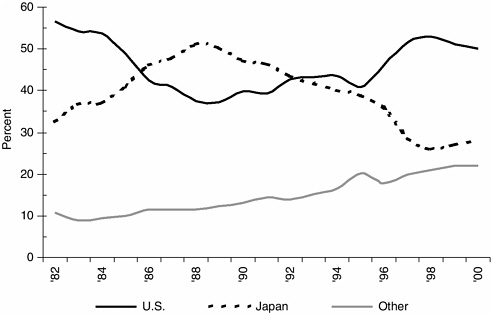
FIGURE 4 Worldwide semiconductor market share.
SOURCE: SIA.
competitiveness and the national defense.36 After much debate the industry and the Reagan Administration agreed on a unique arrangement in which the government and participating companies jointly funded the consortium, with the companies investing $100 million and the federal government matching that amount on an annual basis.37From 1987 to 1996, the government investment in SEMATECH totaled about $850 million.38 Participating companies included most of the largest semiconductor companies in the U.S., and all 14 companies appointed rep-
resentatives to work closely with the consortium.39 This close and effective cooperation with its membership was one of the distinguishing features of its operation.40
Initially planned to last five years, SEMATECH’s accomplishments and the continued challenges facing the industry led to its extension for an additional five years. Before the second term expired, the commercial success of participating firms led the SEMATECH Board to decide that it was not necessary to continue government support. As one participant noted, this decision came “much to the surprise of the people back here in Washington, where programs seem to have a life of their own.”41 Importantly, the end of the government’s contribution to the consortium’s operations did not signal the end of the program. On the contrary, after a period of adjustment, industry support again expanded.42
Today there is a widespread perception in industry and among informed academics that SEMATECH played a significant role in the resurgence of the U.S. semiconductor industry, albeit one that is probably not possible to quantify.43 As noted in Part IV, this view of SEMATECH’s contribution is widely shared outside the United States, not least in Japan and Europe, where major cooperative efforts influenced by the SEMATECH experience are underway.44
Perhaps the most appropriate measure of SEMATECH’s contribution is the reaction of the market itself—that is, the willingness of industry participants to continue to provide matching funds over a sustained period; and then independently for these same firms to continue and expand the consortium with private resources and new members. In short, the apparent emulation by other nations, the continued participation and funding by private firms, and the sustained technical inputs of SEMATECH, all give credence to claims of positive contributions for the consortium.45
SEMATECH’s Contributions to Best Practice
• A Cooperative Approach to Quality
SEMATECH’s purpose was to revive a seriously weakened U.S. industry through collaborative research and pooling of manufacturing knowledge.46 A central element of the challenges facing the U.S. semiconductor industry was manufacturing quality. U.S. manufacturing standards had fallen behind the standards of the Japanese semiconductor producers. The problem was manifested in lower manufacturing yields, higher costs, and inferior product quality.47 For example, users of U.S. and Japanese devices discovered that Japanese memory products had defect rates that were one-half to one-third those of comparable U.S. memory products. Similarly, skills in managing the development and introduction of new process technologies enabled Japanese semiconductor manufacturers to ramp up new products more rapidly than their U.S. counterparts.48
By the mid-1980s, the leading U.S. semiconductor firms had recognized the strategic importance of quality and began to initiate quality improvement pro-
grams. A key element in this effort was the formation of the SEMATECH consortium (See Box F), which in part reflected the belief that the Japanese cooperative programs had been instrumental in the success of Japanese producers.49
• Industry Leadership
After an early focus on developing a manufacturing facility to help solve manufacturing problems (rather than rely on a lab), the consortium eventually focused on three goals that involved improving:
-
Manufacturing processes;
-
Factory management;
-
Industry infrastructure, especially the supply base of equipment and materials.50
Keeping the consortium’s activities relevant to the interests of member companies and effective in meeting their needs was a central focus of the consortium’s management. To do so, the consortium relied on the direct involvement of its member companies’ leadership and on quality research staff (called assignees) rotated from its member companies.51 Senior executives of member companies participated actively on the consortium’s Board of Directors. An executive technical advisory board set priorities for research, development, and testing activities within the consortium. A series of subgroups, called technical advisory groups, approved and advised on specific projects.52 This close involvement substantially facilitated the exchange of information among members and ensured the continued relevance and application of the consortium’s research.
• Cooperation Between Equipment Suppliers and Device Makers
The consortium also encouraged cooperation between U.S. semiconductor equipment suppliers and the device producers. Cooperation between suppliers and device makers was facilitated by collaboration with the Semiconductor Equip-
|
49 |
See Larry D. Browning and Judy C. Shetler, SEMATECH, Saving the U.S. Semiconductor Industry, op. cit., Chapter 1. |
|
50 |
See Larry D. Browning and Judy C. Shetler, SEMATECH, Saving the U.S. Semiconductor Industry, op. cit., p. 205. |
ment and Materials Institute (SEMI), which provided institutional support and a voice for the equipment and materials suppliers to the industry.53
Cooperation between the device makers and the equipment suppliers, while sometimes difficult, became an important focus for the consortium.54 At the time, many of the equipment companies were one-product firms formed to build a particular kind of machine with the company’s fortunes tied to the life cycle of that equipment. SEMATECH worked with these companies to develop reliable tools, to focus on total quality control, and to understand the needs of the industry and the increasing sophistication of the manufacturing process. SEMATECH’s members began to recognize that much of the important work required to improve manufacturing equipment did not have to be done by each company individually, but could be done by the consortium centrally.55
• The Roadmap
|
“I guess part of why a roadmap makes sense to us is that with complex technology there’s no one right way to go.” Bill Spencer, Chairman Emeritus, SEMATECH |
The need for coordination among SEMATECH’s members was realized when it came time to identify those science and technology applications that had high potential promise and how then to accelerate the technology transfer to useful applications. This led to the development of the first technology roadmap. A roadmap is in essence a graphical portrayal of the relationships among science, technology, and applications over a period. Its scope includes technology management and planning; strategies for enhancing communications among researchers, technologists, product managers, suppliers, users, and other stakeholders, in-
cluding technology and product marketing; identifying gaps in R&D programs; and identifying obstacles to rapid and low-cost product development.56
Created in 1992, the first roadmap was developed in response to a request for information by the government about the most pressing research and development needs of the industry. Subsequent roadmaps were developed in 1994 and 1997. With the internationalization of SEMATECH, the International Technology Roadmap for Semiconductors (IRTS) was formed in 1998, with a schedule of regular reports and updates.
The development of technology roadmaps was a cooperative effort with SEMATECH, the SIA, and the SRC pioneering the creation of an innovative management decision aid that improves the coordination of consortium-based research activities and resources in an increasingly complex and uncertain technological environment. The widespread adoption of the roadmap concept by other industries (e.g., optoelectronics and nanotechnologies) underscores the value of this collaborative multi-institutional approach.57
Addressing New Challenges
Noting that SEMATECH provides evidence of “a government-industry partnership that can contribute,” some participants emphasize that the challenge for prospective consortia is to identify a charge clearly at the outset. Without a very specific charter, a multi-corporation organization may not have any more impact than a single laboratory. The impact can be greatest when the problems exceed what a single company can do—a case in point would be the challenges of a new lithography environment. As the industry moves away from optical lithography it faces billion-dollar R&D programs in order to reach the point where it can start operating alternative lithography systems. Addressing a challenge of this magnitude in an effective and timely manner requires some form of industry or industry-government cooperation.58
|
Box F. Lessons from the SEMATECH Consortium Because of its contributions, SEMATECH is often seen as a model for public-private partnerships.59 The SEMATECH experience has several lessons for organizing a successful consortium60: Understanding the Need for Cooperation—The range of R&D needs (from basic science to manufacturing infrastructure to whole new industries) is best understood by the industry when working in close cooperation with universities and government research laboratories. To achieve the full benefits of cooperation it is important to
|
A Potential Consortium in Solid-State Lighting
The challenges facing the solid-state lighting industry illustrate the role consortia can play in bringing new technology to the marketplace while achieving major national objectives. Solid-state lighting technology has the potential to revolutionize the lighting industry, and—if widely used—reduce energy dependence on overseas oil, enhance environmental quality, and improve productivity.61
Because light-emitting diode (LED) and Organic LED (OLED) technologies convert electricity more efficiently into light than today’s light bulbs, their widespread use can reduce the nation’s consumption of electricity by half, according to estimates highlighted by experts in the Committee’s report on Partnerships for Solid-State Lighting.62 Given that 20 percent of all electricity in the United States is used for lighting, the widespread use of solid-state lighting could reduce gross power usage by about 10 percent. Estimates of gross annual savings from this reduction vary from $10 billion in the near future to $70 billion by 2020. This reduced demand for electricity also translates into lower gross emissions from pollutants from power generation.63 Reduced dependence on scarce energy resources also can contribute to greater U.S. national security.
Additional benefits of solid-state lighting derive from their versatility and wafer-thin size and the fact they do not give off heat. Current fluorescent lighting technologies that illuminate most offices, by comparison, require substantial room—so much so that an average eight-story building, lighted using today’s technology, could have an additional floor added through the use of solid-state lighting.
|
The versatility of OLEDs is generating great enthusiasm among some members of the architectural community. As one expert has remarked, “Imagine a light source so integrated with building materials that with the activation of electric current, simple wood, brick, and concrete surfaces are transformed into a colorful, kinetic, luminous environment—where the infrastructure of the light source is diminished to virtually nothing while the presence of light is magnified.”64 |
As analysis of partnerships in solid-state lighting suggests, substantial cooperative, pre-competitive work is required among firms in the lighting industry to overcome remaining technological challenges, and to set standards and common interfaces for solid-state illumination devices. These improvements are needed to enhance mass-market acceptance and promote widespread use of this technology. In turn, such widespread use can help realize the energy savings and environmental benefits that this new technology offers. Knowledge spillovers generated through public-private partnerships in a consortium framework can accelerate this progress by making solid-state lighting more versatile, economical, and therefore acceptable to consumers. A consortium would appear to hold considerable potential to contribute to a range of valuable national goals.
GOVERNMENT AWARDS TO FUND INNOVATION
Firm Size and Sources of Innovation
Small business is widely believed to be a significant source of innovation and employment growth—a perception that has considerable basis in fact.65 Certainly in the nineteenth century the individual inventor played a central role in U.S. economic development. More recently the role of the small startup firms in regions such as Silicon Valley have reinforced the notion that small business is an important driver of economic growth.
|
64 |
Christina Trauthwein, “You Say You Want a Revolution. . .”Architectural Lighting, May 2001, p. 43. |
Yet the question of firm size and economic growth has been the subject of debate for much of the twentieth century and beyond. The early part of the twentieth century was marked by the rise of the large-scale enterprise in the United States, and the conventional wisdom held that large firms had compelling advantages in most performance measures—from profitability to productivity. It was widely accepted that large firms could operate at sufficient levels of scale to produce efficiently and generate the resources to develop innovations that would perpetuate market dominance. In 1950 Schumpeter, while pointing to the small entrepreneur as the vanguard of the wave of “creative destruction” that spurred innovation, nonetheless posited that large firms with substantial resources available for R&D would come to dominate capitalist economies.66 Galbraith later argued that the source of innovation was more plausibly the large firm, which he believed, had the resources available to invest at sufficient scale, not the individual innovator.67
Concentration and centralization in research and development, which characterized the early years of the twentieth century, did seem consistent with the ideas about firm size and innovation hypothesized by Schumpeter and Galbraith. The great corporate research laboratories were established at companies such as DuPont, General Electric, and AT&T. In the postwar years RCA’s Sarnoff Laboratory was established, and IBM’s Yorktown lab and Bell Laboratories enjoyed their heyday, generating innovations in computing and communications that have had profound effects on the U.S. economy and lifestyle.
The Role of Small Firms in Innovation
By the 1970s most data indicate that the story began to change, with small-firm growth accelerating. From 1975 to 1984 employment in firms with between 20 and 99 workers grew by 3.64 percent annually, while employment at firms with more than 1,000 workers grew at only one-third that rate, or 1.25 percent. From 1980 to 1987 the average real GNP per firm decreased by 14 percent, from $245,000 to $200,000.68 As The Economist noted in 1989, large firms are shrink-
ing in size and small ones are proliferating; in terms of the source of employment growth, “the trend of a century is being reversed.”69 With respect to large research laboratories, as Rosenbloom and Spencer have noted, a similar reduction in size has occurred, as IBM’s Yorktown facility was severely downsized in the 1990s and as the breakup of the Bell System in the 1980s changed the character of Bell Laboratories. Investment in long-term R&D is seen by many as the primary casualty of these changes.70
Even before the breakup of the large R&D laboratories there was a growing recognition of the role of small business in furthering technological innovation. The 1980s saw the emergence of such rapidly growing companies as Microsoft and Apple Computing. The 1990s witnessed the rapid growth of the U.S. venture capital industry, which helped high-growth firms to exploit the commercial potential of promising new technologies.71 To some extent, science and technology policy in the 1980s and 1990s reflected this emphasis on the innovative role of small and rapid-growth business.
Cooperation as a Policy Goal
In the 1970s and 1980s the United States recorded slow economic growth relative to postwar norms, sluggish productivity performance, and a loss of global market share and technological leadership in key U.S. industries, from steel and automobiles to television and semiconductors. There was also considerable concern about a rapidly rising trade deficit.72 The causes of the sub-par U.S. eco-
|
69 |
See “The Rise and Fall of America’s Small Firms,” The Economist, January 21, 1989, pp. 73-74. |
|
70 |
See Richard Rosenbloom and William Spencer. Engines of Innovation: U.S. Industrial Research at the End of an Era. Boston: Harvard Business Press, 1996. Irwin Lebow supports this view, observing that in the opinion of many, the most significant change brought about by the AT&T divestiture was that Bell Laboratories no longer operates under conditions as favorable to the pursuit of fundamental research, the results of which will not be evident for some time in the future. Information Highways and Byways: From the Telegraph to the 21st Century, Piscataway NJ: IEEE Press, 1995, p.157. |
|
71 |
For discussion of the relationship between innovative activity and firm size, see Zoltan J. Acs and David Audretsch, Innovation and Small Firms, Cambridge, MA: MIT Press, 1990, chap. 3. They maintain that it is important to recognize that small firms are not necessarily more innovative than large firms are. The relative contribution depends on the sector, market structure, capital intensity, and rate of innovation. Acs and Audretsch emphasize that both large and small firms bring advantages to the innovation process. Large firms have the resources for long-term R&D investments and benefit from substantial advantages, such as economies of scale, investment, and the market power necessary to recoup R&D investments. Small firms tend to have a higher tolerance for risk, are characterized by rapid decision making, and often focus on innovative activity as a core strategy. |
|
72 |
For an analysis of the sustainability of the deficit, see Catherine Mann, Is the U.S. Trade Deficit Sustainable? Washington, D.C.: Institute for International Economics, 1993. The U.S. Trade Deficit Review Commission was established in October 1998 to review the trade deficit and its implications for the economy as a whole. See <http://www.ustrdc.gov>. |
nomic performance defied definitive analysis, but dire warnings of U.S. economic decline and the “deindustrialization” of key manufacturing sectors proliferated.73
At the same time, U.S. trade competitors, such as Japan, seemed to have developed an effective economic model different in important respects from what many Americans believed to be the traditional laissez-faire U.S. approach.74 A key feature of that model was its emphasis on cooperation between government and industry rather than competition. The ability of different arms of Japanese industry to work with one another, and the close relationship between government and industry in supporting key economic sectors, appeared to have created substantial benefits for the Japanese economy.75
The mixed record of the large-scale demonstration projects of the 1970s and the perceived success of the government-industry cooperation in Japan led to a shift in U.S. policy in the 1980s.76 One of the strategies adopted by the United
States in response to its perceived loss in competitiveness was to encourage greater cooperation within industry and between industry and government. Most federal support for industry before the mid-1980s took the form of research grants or contracts for product development or procurement that often included substantial support for research.77 In the latter half of the decade a growing number of programs were established based on partnerships among government, industry, and universities. Indeed, the 1980s and early 1990s saw a conscious effort to expand cooperation, in part by using federal R&D funding more effectively to meet what were seen as unprecedented competitive challenges.
In addition to SEMATECH, which matched substantial federal and industry funding in a consortium of semiconductor manufacturers,78 these partnerships included the Semiconductor Research Corporation, which pools industry and limited federal funding to support university research in semiconductors, NSF engineering research centers, which involve industry-university cooperation on engineering problems, expanded CRADAs, and extramural programs at the National Institute of Standards and Technology.79
These public and private initiatives undertaken in the 1980s demonstrated a renewed emphasis on cooperation in U.S. public policy. In the latter part of that decade there was an increasing emphasis on public-private partnerships. Some, such as the Advanced Technology Program, were characterized by competitive awards of fixed duration. Facilitating these policy experiments were a number of major legislative initiatives passed by Congress. These are highlighted in Box G.
|
Box G. Principal Federal Legislation Related to Cooperative Technology Programs81
|
|
Problems That Small Businesses Face in Financing Growth
In addition to the growing recognition of the importance of small business for innovation and employment, there is also today a better understanding of the problems that small businesses face in financing growth. One type of problem has to do with information asymmetries in the market for startup financing. As Joshua Lerner has pointed out, asymmetries in information between entrepreneurs and financiers are likely to work to the disadvantage of small firms.81 Even though providers of funds have strong incentives to gather information about the small business in which they may be investing, the entrepreneur—especially in technology startups—is likely to be the only person with in-depth knowledge of the technology and the market opportunity. Moreover, that knowledge is likely to be insufficient to perfectly predict potential payoffs. The result is “statistical discrimination” whereby financiers are motivated to withhold funds, even for promising opportunities, because it is too costly—and often impossible—to gather the information needed to assess potential investment payoffs.82
A second problem involves the appropriability of R&D results. The economics literature has long recognized that knowledge is “leaky,” that is, new knowledge often transcends the boundaries of firms and intellectual property protection, so that the creator of that knowledge cannot fully capture the economic value of the knowledge through the price system.83 Moreover, several case studies of small businesses suggest that appropriability problems may be particularly acute for small businesses.84 In other words, R&D-generated innovations may escape the organizational walls of small firms with relatively greater ease than large businesses.85 At the same time ideas not valued and pursued in one firm are often the reason an entrepreneur starts a new firm.86
A third problem stems from asymmetries in the availability of capital. Private equity markets are characterized by two substantial funding gaps. The first gap occurs primarily in the seed and start-up financing stage. This gap ranges from $100,000 at the low end, the point at which the money raised from friends and families and bootstrapping runs out, to the $2 million range on the high end, the time when the venture would historically become attractive enough to catch the eye of venture fund investors. The second market gap occurs in the early stage of equity financing. While the venture capital industry has progressed to larger and later-stage financing, the informal market has remained active below the $2 million threshold. As a result, a capital gap in the $2 million to $5 million range has developed.87
These larger capital requirements, still considered early-stage deals, have spawned a new hybrid of angel financing—the angel alliance. These alliances represent relatively large groups of business angels willing to fund some second round, early-stage deals. In addition, some of the capital requirements in this secondary gap have been met through co-investment between private investors and early-stage financing entities.88
The Committee’s study of the SBIR program and ATP highlight specific issues related to the performance of public-private partnerships for which the federal government provides innovation funding to help small firms overcome early-stage financing hurdles. The role of assessment, taken up in the next section, follows a summary below of the features of the SBIR and ATP programs.
The Small Business Innovation Research Program
SBIR was established in 1982 as a way to channel federal research and development funds to small businesses, while meeting mission needs of various government agencies through the use of research and development (R&D) expertise that is often unique to small businesses.89 The SBIR grant-making process is structured in three phases. Phase I constitutes a feasibility study in which award winners undertake a limited amount of research aimed at establishing an idea’s scientific and commercial promise. Today Phase I grants can be as high as $100,000. Phase II grants are larger—normally $750,000—and fund more extensive R&D. It is intended to develop the scientific and technical merit and the feasibility of research ideas. In Phase III, which normally does not involve SBIR funds, grant recipients should be obtaining additional funds either from an interested agency, private investors, or the capital markets to move the technology to the prototype stage and into the marketplace.
Initially the SBIR program required agencies with R&D budgets in excess of $100 million to set aside 0.2 percent of their funds for SBIR. This totaled $45 million in 1983, the program’s first year of operation. Over the next six years the set-aside percentage grew to 1.25 percent. In 1992 Congress renewed the program and doubled the set-aside rate from 1.25 percent to 2.5 percent.90 For fiscal year 2000 this resulted in a program budget of approximately $1.2 billion across all federal agencies, with the DOD having the largest SBIR program at $554 million, followed by the National Institutes of Health (NIH) at $362 million.91 Since 1982, over $10 billion has been awarded to various small businesses through the SBIR program.92
Congress’s reauthorization of the SBIR program in 1992 resulted in the set-aside being raised from 1.25 percent to 2.5 percent. This increase was consistent with a recommendation from the National Academy of Sciences to increase SBIR funding as a means of improving the U.S. economy’s ability to adopt and commercialize new technologies.93 By 1992 the SBIR program had also become po-
|
89 |
See George Brown and James Turner, “The Federal Role in Small Business Research,” Issues in Science and Technology, Summer, 1999, p. 52. |
|
90 |
The Small Business Research and Development Enhancement Act, P.L. 102-564, October 28, 1992. |
|
91 |
See <http://www.acq.osd.mil/sadbu/sbir/overview.htm> for information on the DOD’s SBIR program. For information on NIH’s SBIR program, see <http://grants.nih.gov/grants/funding/sbir.htm#sbir>. |
|
92 |
Ibid. |
|
93 |
The Committee on Science, Engineering, and Public Policy of the National Academy of Sciences noted that “Congress should consider legislation to increase the agency SBIR set-aside. The program should be expanded so that more companies can participate in it.” See National Research Council, The Government Role in Civilian Technology: Building A New Alliance, Washington, D.C.: National Academy Press, 1992, p. 65. |
litically popular with increasingly influential small business advocates. In conjunction with the emergence of innovative small startups in computing, biotechnology, and advanced materials, there was ample support for program expansion in 1992.94 Most recently the Small Business Reauthorization Act of 2000 (P.L. 106-554) extended the program for a further eight years, while mandating in Section 108 of the legislation that the National Research Council conduct a comprehensive review of how the program has stimulated technological innovation and used small businesses to meet federal research and development needs.95
The Advanced Technology Program
The Advanced Technology Program describes its mission as “bridging the gap between the research lab and the marketplace.”96 Specifically the ATP provides cost-shared funding to industry intended to accelerate the development and dissemination of high-risk technologies with the potential for broad-based economic benefits for the U.S. economy.97 The ATP funding is directed to technical research (but not product development). Companies, whether singly or jointly, conceive, propose, and execute all projects, often in collaboration with universities and federal laboratories. The ATP shares the project costs for a limited time. Single-company awardees can receive up to $2 million for R&D activities for up to three years. Larger companies must contribute at least 60 percent of the total project cost. Joint ventures can receive funds for R&D activities for up to five years.98
|
94 |
See Brown and Turner, op. cit., p. 53. In addition to an account of SBIR’s evolution Brown and Turner offer constructive criticisms of the SBIR program and recommendations for improvement. |
|
95 |
This study is mandated under Section 108 of HR5667, The Small Business Reauthorization Act of 2000 (Public Law 106-554). It calls for a review of the SBIR programs of the DOD, Department of Energy, NIH, NSF, and NASA with regard to such parameters as the quality of the research projects being conducted under the SBIR program, the commercialization of the research, and the program’s contribution to accomplishing agency missions. The evaluation is also expected to include estimates of the benefits, both economic and non-economic, achieved by the SBIR program, as well as broader policy issues associated with public-private collaborations for technology development and government support for high-technology innovation, including benchmarking of foreign programs to encourage small business development. The assessment is to gauge the contributions of the SBIR program with regard to economic growth, technology development, and commercialization, and contributions by small business awardees to the accomplishment of agency missions. The review will also seek to identify best practices and operational improvements for the SBIR program. |
|
96 |
See the ATP Web site <http://www.atp.nist.gov/atp/overview.htm>. |
|
97 |
See National Research Council, The Advanced Technology Program, Challenges and Opportunities, C. Wessner, ed, Washington, D.C.: National Academy Press, 1999. |
|
98 |
See National Research Council, The Advanced Technology Program, Assessing Outcomes, op. cit. |
ATP was initiated as a means of funding high-risk R&D with broad commercial and societal benefits that would not be undertaken by a single company, either because the risk was too high or because a large enough share of the benefits of success would not accrue to the company for it to make the investment. ATP lacked the straightforward national security rationale that had underpinned many postwar U.S. technology programs. It did reflect, however, a general trend away from purely mission-oriented research and development toward more broadly based technological advances.
For the 41 competitions held 1990-2000 ATP made 522 awards for approximately $1.64 billion. These awards went to 1,162 participating organizations and an approximately equal number of subcontractors. Universities and non-profit independent research organizations play a significant role as participants in ATP projects. Universities have participated in over half of the projects, involving more than 176 individual universities.99 Indeed, recent Administration proposals to improve the program call for a greater role for universities.100
With peer-reviewed competitions, the ATP supports the development of a wide variety of new technologies. These have included adaptive learning systems, component-based software, digital data storage, information infrastructure for health care, microelectronics manufacturing infrastructure, manufacturing technology for photonics, motor vehicles and printed wiring boards, new tissue-engineering technologies, bio-polymer repairs, and tools for DNA diagnostics.101 These technologies are technically promising but commercially risky. This means that significant portions of the ATP-funded projects are likely to fail.102 This is to be expected; no failures would suggest insufficient risk. At the same time, recent research suggests that a significant portion are succeeding.103 The results of some projects, such as ATP’s early support for extreme ultraviolet (EUV) lithography research, have made significant contributions to the development of next generation lithography.104
|
Box H. Critical Characteristics of the Advanced Technology Program Independent researchers have summarized ATP’s “critical characteristics” that differentiate it from other government R&D programs.
Research led by Professor Maryann Feldman of Johns Hopkins University and Maryellen Kelly, formerly of Carnegie Mellon University, is particularly important in that it focuses on the ATP contribution to private-sector innovation.105 Feldman and Kelly identify the following characteristics of ATP: ATP funding does not displace private capital. Using data from a survey of 1998 ATP applicants, the study finds that most of the non-winners did not proceed with any aspect of their proposed R&D project, and of those that did, most did so on a smaller scale than initially proposed. This suggests that ATP funding is not simply displacing private capital. The program received high marks from its users. A substantial majority of the applicants surveyed by Feldman and Kelley considered ATP’s application process fair and rational. High spillover potential. The survey finds that the projects and firms selected by ATP are more willing than those not selected to share their research findings with other firms and tend to be collaborative in new technical areas and form new R&D partnerships—findings consistent with ATP’s goal of selecting projects with high spillover potential. “Halo Effect.” The study also finds that the ATP award can create a “halo effect” for recipients, increasing the success of award recipients in attracting additional funding from other sources, an effect documented by several earlier researchers.106 Feldman and Kelley conclude that the ATP is leveraging activities that have the potential to contribute to broad-based economic growth. |


