Wormwood Forest: A Natural History of Chernobyl (2005)
Chapter: 1 Wormwood
1
Wormwood
And the third angel sounded, and there fell a great star from heaven, burning as it were a torch, and it fell upon the third part of the rivers, and upon the fountains of waters.
And the name of the star is called Wormwood; and the third part of the waters became wormwood; and many men died of the waters because they were made bitter.
Revelation 8:10-11
In the years since the 1986 Chernobyl nuclear disaster spewed radiation around the globe and smudged the map of the then-Soviet Union with heavy contamination, the very word “Chernobyl” has become a synonym for “horrific disaster,” conjuring the frightful radioactive deserts that landscape Atomic Age science fiction and resonate deeply in modern imaginations haunted by the specter of nuclear war.
Surely, whenever I thought about the irradiated lands 50 miles north of Kiev, it was like contemplating a black hole. All I could picture was a dead zone, like a giant parking lot paved with asphalt or a barren desert of dust and ash where nothing could grow and nothing living could survive without protective gear. Only gloomy shades of black and gray colored my mental images.
But when I first visited the Chernobyl region, 10 years after the disaster, I was surprised to find that the dominant color was green. My notes from that trip are filled with emphatically underlined and circled comments like “feral fields,” “forests,” and “wildlife?!” Contrary to the
myths and imagery, Chernobyl’s land had become a unique, new ecosystem. Defying the gloomiest predictions, it had come back to life as Europe’s largest nature sanctuary, teeming with wildlife. Like the forests, fields, and swamps of their unexpectedly inviting habitat, the animals are all radioactive. To the astonishment of just about everyone, they are also thriving.
But to appreciate the land’s extraordinary resurrection, you first have to understand its demise.
Pripyat’s old wedding registry was not easy to find, even though we had the address. Despite the barbed wire perimeter around this radioactive ghost town less than two miles from the Chernobyl power plant, the hull of an empty high-rise on Friendship of Nations Street had been emptied of anything with the slightest value, including most of the metal signs that announced shops and services. Former residents and looters had stripped apartments and offices down to their faded wallpaper. Only one empty room hinted at its former function, probably because the cardboard sign on the door, reading “School of Communist Labor,” was too worthless to steal. But there was no sign of a wedding registry.
A perplexed Rimma Kyselytsia led our little group of explorers outside into a small square surrounded by empty apartment buildings. She studied the number painted on the side of the building and shook her blond curls in confusion. “It’s the right address. So, where is it?”
Since Rimma was the guide, my other companion—a botanist named Svitlana Bidna—and I shrugged helplessly.
My dosimeter beeped slowly. The radiation monitor’s liquid crystal screen displayed 80 microroentgens an hour. That was several times normal background levels, which range from 15 to 25 in most places. Decontamination, rain, and time have long since washed off much of the radioactive grime that coated the town after Chernobyl’s fourth reactor exploded in the wee hours of April 26, 1986. Pripyat was the plant’s bedroom community. Heralded as the world’s youngest city when it opened its doors in the mid-1970s, Pripyat also turned out to be its shortest lived.
A short flight of concrete stairs sprouting saplings and moss led to the back of the building where Rimma explored a row of what seemed to have once been stores and offices. The glass storefronts were all shattered, exposing the bare rooms to the elements, and she quickly spied a
faded red carpet runner, lying dirty and twisted with shards of glass, plaster, and deep piles of yellowed paper.
“This is it!” she exclaimed, vindicated in her guiding skill. Rimma was a Tatar with aquarium eyes and a matter-of-fact but realistic attitude towards her radioactive workplace.
The red carpet runner once led couples to secular Soviet marriage in the Pripyat Registry of Citizens’ Civil Status. Known by its Ukrainian acronym as a ZAHS (ZAGS in Russian), the office was not merely a marriage registry. ZAHSs documented the legal passages in Soviet citizens’ personal lives from cradle to grave, issuing birth certificates and death certificates and everything in between.
The deep piles of brittle paper on the floor were ZAHS forms and applications. Ivory cards informing brides and grooms of their wedding dates were mixed up with spilled stacks of divorce applications and forms to apply for “compensation in the form of gold wedding rings.” Hanging lopsided on the back wall, a red-lettered cardboard sign exhorted newlyweds: “Stand on the threshold of your introduction to the deep familial and social traditions of the Soviet people.”
In the neighboring room, two tall bookshelves had toppled over, spilling dozens of pulp folders containing the ZAHS archives into a moldy pile. Although the 1986 archives were missing, the records went back to the early 1970s, when the town first opened its doors. Judging by one fat folder, many couples applied to cut to the front of the wedding queue because they had already had a child together.
Sixteen marriage ceremonies took place on the last full day of human life in Pripyat. The only public record of those nuptials, tinged in hindsight with so much sadness, can be viewed in a five-minute film at Kiev’s Chernobyl museum. The split-second scene of the bride and groom leaving the storefront wedding registry is too fleeting to see their expressions, but the point of the wedding in the silent and grainy film was to show that April 26, 1986, was an ordinary, if unusually warm, Saturday afternoon in Pripyat. Oblivious to the radioactive cloud invisibly blanketing them, couples wheeled infants in strollers. Toddlers in shorts kicked a ball around a dirt playground. Women in sleeveless summer dresses gathered outdoors under a vendor’s umbrella, in the large groups that always signified something (anything) being sold in the shortage-ridden Soviet Union.
But the anonymous KGB cameraman knew that something was wrong. Gamma rays left flashes of light on the scene he filmed of two
men in camouflage and gas masks nodding to an unprotected and obviously surprised civilian. Armored personnel carriers drove down Pripyat’s boulevards, while uniformed officers checked radiation on a truck’s tires. Water trucks washed the streets with foamy detergent, leaving puddles in which sparrows splashed. From the roof of a Pripyat high-rise, the cameraman filmed the Chernobyl plant, shrouded in such a thick cloud of smoke and haze that only its dim outline was visible.
What did not get recorded on film was the nighttime explosion that ripped through the Number 4 reactor complex, spewing flames, sparks, and chunks of burning radioactive material into the air and, subsequently, around the northern hemisphere. Red-hot pieces of nuclear fuel and graphite fell on the roof, starting 30 fires and causing the roof to collapse into the reactor hall. By dawn the roof fires had been put out by 37 fire crews working without protection or dosimeters. Many became ill with acute radiation sickness. Thirty-one died, but at that point no one knew that the explosion had completely exposed the reactor core. The government commission from Moscow didn’t arrive until Saturday night, and it wasn’t until Sunday morning that its members could helicopter over the cavernous hulk to see that the explosion had ignited an extremely intense graphite fire. The graphite fire was releasing millions of curies of radioactivity that lit the air above the ruined reactor with an eerie glow. The crisis was actually an unprecedented disaster and it was far from over.
That morning, in his apartment not far from the ZAHS office, Volodymyr Pasichnyk had been watching his teenaged son playing with the dial on the TV set when the receiver suddenly tuned in on an odd frequency. “There was no picture, just talk, probably by walkie-talkie,” he recalled when I talked with him 15 years later. “They were talking about ‘people in hospitals’ and ‘hundreds of buses to Pripyat’.” Like most people in Pripyat—all of whose lives were somehow connected with the plant—he had heard rumors about something bad at the fourth reactor block. At that moment he understood the enormity of what had happened. The town was being evacuated.
The official announcement came on Pripyat radios at 10 o’clock Sunday morning. In only four hours, beginning at 2:00 p.m., 1,100 empty buses drove into Pripyat and drove out with nearly all of the town’s 45,000 residents in a convoy that was more than 10 miles long. It was, the authorities said, only meant to be for three days. Perhaps
they really meant it. But that was before anyone knew that the graphite fire would melt the fuel and belch the daily equivalent of several Hiroshima bombs for 10 full days, altogether releasing five times as much radioactivity as the initial explosion.
Pripyat could never be inhabited again. The ritual human cycles of birth and marriage, divorce and death, recorded by ZAHS scribes in the thick pulpy ledgers of Soviet bureaucracy, ended on April 26, 1986. And the stacks of cards for secular baptisms, with spaces for the names of new Soviet citizens, will never be filled in.
BIBLICAL BOTANY
Svitlana Bidna, my botanist companion, walked with Rimma and me on the thick moss carpets strewn over Pripyat’s crumbling asphalt roads, giving the tangled overgrowth of vegetation names and clarity. The straight rows of poplars lining the streets were planted when the town was built. The asters, still blooming in late October, were once garden flowers that enlivened the cinder-block sterility of the new Soviet town. But poplars are now growing out of storefronts and stairwells. Asters have taken to the wild in large lavender fields. And a diverse profusion of wild species are filling the cracks in the concrete and the voids left by people. Svitlana, who has been studying the town’s transmutation to forest after Chernobyl, predicts that the buildings will stand half a century, perhaps. Though, if left to itself, the greenery will consume most of the asphalt roads and concrete plazas in another decade or so.
Lichens such as the bright orange Xanthoria secrete chemicals that destroy the crystalline structure of minerals in concrete. Acids in the mosses that grow on dead leaves soften asphalt, crumbling it into pebbles. Birch, maple, and pine trees sprout from the cracks, buckling pavements with their roots and exposing more crevices for greenery to grow. Reeds grow in patches where the shallow water table is recreating once-drained swamps. A forest of silver birch, willow, wild pear, and pine fills the former soccer field, and islands of grass covering broad concrete plazas sprout tall bushes of false indigo, its long flower clusters dried into black tassels.
Pripyat was coming to resemble one of those fabled lost cities, devoured by jungle. Abandonment echoed in every corner of the crumbling monument to the disaster. A Ferris wheel and bumper cars rust
away in a tiny amusement park, scheduled to open on May 1, 1986, and never used. The town pool’s three-story glass facade had completely shattered into deep piles mixed with tiles from the wall mosaics that resembled incomplete jigsaw puzzles, with chalky green lichen replacing the missing pieces and making it impossible to tell what they once depicted. Shrubs and saplings grew in kindergartens scattered with tiny shoes, broken toys, and heartbreakingly small gas masks. We climbed up a high-rise where Svitlana showed us a good-sized birch tree growing from the center of a kitchen emptied of everything but an overturned table.
“Pripyat began returning to nature as soon as the people left, and there was no one to trim and prune and weed,” said Svitlana as we started heading back to our car. “It takes a lot of human effort to maintain urban landscapes.”
Back near the wedding registry, Rimma crouched down to a short bush that had grown out of a crack between the road and the curb. It was about a foot tall, with small cottony flowers growing directly from purplish stems.
She pulled off one of the leaves and crushed it between her fingers for me to sniff the unpleasant, varnishy aroma, reminiscent of shoe polish.
“What is it?” I asked, wrinkling my nose.
“Chernobyl,” she said, using the common—but incorrect—pronunciation. In fact, chernobyl with an “e” is the Russianized version of the Ukrainian word chornobyl. You won’t find chernobyl or chornobyl in most Russian dictionaries, except in reference to the disaster, although the word chernobyl’nyk is used in some Russian regions in reference to the herb. But because the first version has become the commonly accepted spelling for the disaster and the nuclear station, I will use Chernobyl, with an “e,” to refer to them. I will use Chornobyl, with an “o,” to refer to the herb and the town.
“That’s wormwood, right?” I asked, hoping to finally clarify the botanical question at the heart of the Chernobyl disaster’s putative biblical symbolism. It is often said that the meaning of the Ukrainian word chornobyl is “wormwood,” and the suggestion that the disaster fulfilled the biblical prophecy of the Wormwood star that augured Armageddon resonated deeply with the fear of nuclear apocalypse. But the botany was actually more complex.
Svitlana took a closer look at the plant and shook her head. “No,
‘chornobyl’ is Artemisia vulgaris. ‘Wormwood’ is Artemisia absinthium. The Ukrainian common name is polyn,” she said, handing me a leaf from a different plant that looked much like A. vulgaris, except it was covered with fine silky hairs that gave it a whitish tinge. As I looked around, I noticed that the plants were everywhere.
I crushed it to release the volatile oil, much more pungent than the first plant.
Botanically and chemically, Absinthium vulgaris is so similar to A. absinthium that A. vulgaris is also sometimes called “wormwood,” though “mugwort” is a more common English name. In Ukrainian, as well, polyn and chornobyl are sometimes used synonymously. Both plants are hardy perennials, tolerant of poor soil and thus plentiful in the sandy lands of the Polissia region—where the twelfth-century town of Chornobyl took its name from the plant and, in turn, gave it to the twentieth-century nuclear station seven miles away. Both are bitter medicinal herbs and natural pest repellants, ridding fleas from the home, slugs from the garden, and worms from the body. And both get their pungent fragrance from thujone, an organic toxin thought to be the psychoactive agent in absinthe, the infamous wormwood liqueur banned by most Western countries a century ago. Absinthe was said to produce an unusual intoxication and was highly addictive, although modern skeptics contend that the “high” and the habit most probably came from drinking the 75 percent alcohol absinthe required to dissolve the thujone and prevent it from clouding the emerald solution.
But if the thujone in Artemisia vulgaris is dilute, it is concentrated in A. absinthium. A crushed leaf of polyn-wormwood is much more pungent than a crushed leaf of chornobyl-mugwort. It is also more bitter and much more toxic, which is why animals happily nibble mugwort but leave wormwood alone. Even other plants avoid it. A. absinthium’s extremely bitter chemicals wash off the leaves and into the soil, poisoning it for other plants.
Given its natural repellant properties, many folk believed wormwood to have supernatural banishing powers. Mugwort, too, has magical properties, though none so potent. In Ukrainian folklore, both plants ward off the seductive and dangerous water nymphs called rusalkas, who lured victims with beautiful songs and then tickled them to death in crystal underwater lairs.
In Christian legend, when the biblical serpent was expelled from Eden, wormwood sprang in its trail to prevent its return. Indeed, the
herb is a frequent biblical symbol for bitterness, calamity, and sorrow; its use to name the third sign of the apocalypse that opened this chapter conjured the desolation that would follow the apocalypse.
In the wake of the Chernobyl explosion, few people in the officially atheist Soviet Union had Ukrainian-language Bibles. But some of those who did noted that the word “wormwood” in the Wormwood star of the book of Revelation was translated as polyn—and was a very close botanical cousin to chornobyl. Suddenly, the biblical prophecy seemed to acquire new meaning: wormwood was radiation, and it presaged the nuclear apocalypse that would end the world. The story spread like wildfire through the notorious Soviet rumor mill and as far as Washington, D.C., where President Ronald Reagan was said to have believed it, too.
I first learned of the apocalyptic connection about a month after the disaster, when a Ukrainian friend in Poland wrote me about it in a letter. I had just moved to Los Angeles from New York City in what was supposed to have been my “American experiment.” I didn’t want to sever my Ukrainian-American roots entirely. But I did want to try living without the sometimes suffocating support of the ethnic ghetto that was an integral part of my life in Manhattan. Chernobyl put an end to that experiment before it even started. I recall crying on the phone with my best friend in New York and realizing that only someone with Ukrainian roots could share the pain I felt contemplating the swirl of televised speculation about the disaster’s calamitous effects on a land that I had been raised to believe was very important to me but one that I had never seen because it was shrouded by an impenetrable Iron Curtain.
Chernobyl’s putative apocalyptic connection became so widespread, combining fears of radiation with apocalyptic dread, that the state-controlled Soviet media took the highly unusual step of running interviews with leaders of the Russian Orthodox Church (the most tolerated religion in the USSR) to debunk it, largely by arguing that no man could know when the end of time was near.
Perhaps their arguments would have been better served by botany. Aside from the fact that polyn and chornobyl are different species of Artemisia, it is unlikely that the wormwood in Revelation referred to either of them. Artemisia judaica is widely cited as the most likely candidate for biblical wormwood.
But judging by a cursory perusal of the 975 results that an Internet
search of “chernobyl wormwood” turned up, Armageddon-watchers seem untroubled by such technicalities (though they are troubled by others, such as how anyone can prove that “a third of the waters were made bitter” as predicated by Revelation 8-10). For them, Chernobyl equals wormwood, and the end of the earth as we know it is near. Far be it for me to dismiss biblical prophesy, but as we left the crumbling and Artemisia-choked landscape of Pripyat, it seemed that the only end Chernobyl heralded for certain was that of the Soviet Union.
NUCLEAR POWER
Back in the hired Soviet sedan driving on the sole road from Pripyat, the dosimeter perched on my knee began beeping faster as we drove due west of the power plant. The liquid crystal numbers suddenly started growing rapidly: 135, 165, 170, 228, 485, maxing out at the oddly apocalyptic 666 microroentgens when the car stopped under a tall white pillar topped with a red triangle.
The Soviet-era sign read: “V. I. Lenin Chernobyl Atomic Energy Station,” but I was stumped as to the monument’s possible meaning.
“It’s a torch,” Rimma explained. “It symbolizes the light that the Chernobyl plant produced.”
The Wormwood star also blazed like a torch, I recalled, although biblical symbolism doesn’t get you far in understanding how the disaster happened. What you need is a short detour into nuclear fundamentals.
Nuclear reactors like Chernobyl make light much like all thermal power plants. A reaction releases energy in the form of heat, which boils water to create steam, which then turns turbogenerators to produce electricity. In conventional plants, the reaction is the chemical combustion, or burning, of complex hydrocarbon molecules in fossil fuels. Combustion reactions involve chemical bonds, which join atoms together in molecules through the sharing of electrons, the quantum clouds of negative charge in the atoms’ outer reaches. Heat breaks the bonds holding carbon and hydrogen atoms together in the hydrocarbons.
But the thing about most atoms is that their outer electrons are promiscuous when unattached and eager to bond with any chemically suitable atom that dallies nearby. That’s why the world is not an invisible mist of loose atoms like the noble gases. When the hydrocarbons’
bonds are broken, the freed carbon and hydrogen can’t just be left dangling on their own, so they react with whatever is nearby, namely, the oxygen in the air. This creates simpler molecules, such as carbon dioxide, that need much less bond energy than the original hydrocarbon to stick together and are the main sources of the greenhouse gases that contribute to global warming. The excess chemical energy is released as heat (and light).
Instead of releasing energy by changing the electron bonds between atoms to create new and different molecules, the nuclear reaction releases energy by rearranging the nuclei inside atoms of one element to create atoms of a different element (Figure 1).
The strong nuclear force—the most powerful force in the universe—tightly binds the neutrally charged neutrons and positively charged protons inside the nucleus, overwhelming the mutual electrical repulsion between the protons. Operating on only the sub-subatomic level of quarks, the whimsically named points of energy that exist only in triplets (never alone) to make protons and neutrons, the
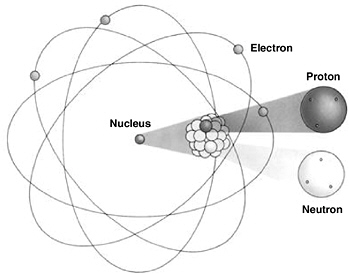
FIGURE 1 Diagram of an atom.
strong force glues the quarks together with an asymptotic strength that becomes stronger, like elastic, the farther apart they are pulled.
In nearly all of the matter we perceive with our senses, the strong force wins the tug of war with the repellant force between the protons, keeping the nuclei stable. And while it is a marvel of universal construction in and of itself, a stable atomic nucleus doesn’t actually do much of anything except hold on to the electrons that do the chemical work of building matter.
The positively charged protons inside the nucleus do that job, attracting the negatively charged electrons. The protons also determine what element the nucleus will be. Elements are distinguished by the number of protons in the nucleus, which are reflected in the “atomic numbers” in the periodic table. As the number of protons increases, from hydrogen with one proton all the way to the man-made elements whose atomic numbers have passed 110, the repulsion between them increases. And the number of quarks, provided by neutrons, that the strong force needs to keep the nucleus glued together increases as well. For helium, with two protons, two neutrons suffice for balance. But the brittle white metal bismuth needs 126 neutrons to hold its 83 protons together. Bismuth, in fact, has the largest stable nucleus in the periodic table. All larger nuclei are unstable, although some smaller nuclei are too because their proton-neutron ratios are askew. Unstable nuclei have too many conflicting forces inside, and to achieve a semblance of internal peace, they must eventually decay, casting out their excess energy in the form of subatomic particles and gamma rays. It is this casting out of energy that is called “radiation.”
Like all elements, uranium—the heaviest atom in nature—has several forms called isotopes, which share the same atomic number of 92 protons but vary in their numbers of neutrons and, hence, differ in their atomic weights and their stability. Natural uranium is a mixture of two isotopes. Uranium with an atomic weight of 238, designated U-238, makes up 99.3 percent. It is slightly radioactive and decays very slowly.
The remaining natural uranium, U-235, displays a unique property. Because of the particular instability of its 92 protons and 143 neutrons, uranium-235 can spontaneously fission—splitting apart into two or more nuclei of smaller elements plus two or three free neutrons. Fission produces dozens of different elements, but with the exception of plutonium, the daughter nuclei—called fission products—do not
fission. They are, however, far more radioactive than the original uranium, which is why nuclear waste is much more dangerous than fresh fuel.
Fission is incomprehensibly fast. The nucleus splits less than 0.00000000000001 seconds after absorbing a neutron. Fission is also extremely energetic. In one of the more dramatic manifestations of Einstein’s formula E = mc2, it releases the inconceivably powerful strong force that had been holding the unstable nucleus together to begin with. It is so energetic that the nuclear energy released by fission in one gram of uranium fuel is the equivalent of burning three tons of coal.
The U-235 atoms in nature are too few for the occasional spontaneous fissions to do more than add marginally to uranium’s heat—with one known geological exception. About 1.7 million years ago, in a place now called Oklo in the tiny West African country of Gabon, Earth itself ignited a natural fission chain reaction that consumed six tons of uranium over hundreds of thousands of years before burning itself out.
If uranium-235 occurs in higher concentrations, such as Oklo’s three percent, fission neutrons are more likely to hit other U-235 nuclei, causing new fissions that produce more neutrons and more fissions in a self-sustaining chain reaction. But aside from more concentrated U-235, fission also needs something called a moderator, which slows down the neutrons. Fast neutrons make fission fizzle out.
It seems counterintuitive that slow neutrons are more effective at fission because we imagine them hitting the nucleus hard and fast, like a marble breaking an egg. A slowly rolled marble would tap the egg but not necessarily break it. Yet in the quirky quantum world of the neutron, the marble can magically slip inside the egg without breaking the shell. The shell breaks only after the marble is inside. Fast neutrons zip by too quickly to perform that trick.
Fission powers all nuclear reactors, although their designs differ in the materials used to slow the neutrons. Most of the world’s nuclear reactors are water moderated. So was the Oklo natural reactor, which was saturated with groundwater.
Chernobyl and other reactors of its type in the former Soviet Union (called RBMKs, which stands for “reactor high-power boiling channel type” in Russian) were moderated with graphite—the crystalline carbon used in pencils. Schematically, the reactor core resembled a
collection of giant pencils interspersed with toothpicks and thin straws. The pencils were the 2,488 graphite columns. The toothpicks were 1,660 thin zirconium and steel fuel channels containing about 200 tons of slightly enriched uranium. The straws were pipes inside the fuel rods for the cooling water that flowed through and boiled, taking away heat. Viewed from above, the core looked like a giant round Scrabble board of multicolored squares and tiles.
In water-moderated reactors, losing or decreasing the amount of cooling water stops fission because the neutrons speed up too much and the chain reaction stops. In graphite-moderated reactors, the graphite keeps moderating even if the flow of water slows or is lost. Fission continues and without sufficient water to cool it, the reactor runs faster and hotter.
This, by all accounts, is what happened in the early hours of April 26, 1986.
In a mangled and ill-advised experiment that violated every rule in the plant’s own safety book, the pumps that powered Chernobyl’s emergency water cooling systems were deliberately shut down. Without the power of the pumps, the water that normally flowed at a rate of 28 tons an hour slowed down, letting it absorb more heat from the fuel. Instead of simply boiling, it turned to steam. Within minutes, the enormous pressure from the steam exploded the core (Plate 1).
RADIOACTIVE RAIN
The initial explosion broke apart the graphite and fuel with the force of about 30 to 40 tons of TNT, casting the heaviest and most deadly debris directly outside the reactor. On radiation maps, which depict increasing levels of radioactivity with a palette progressing from green to yellow to orange and increasingly darker shades of red, the patches from the explosion are a deep brown and look like lopsided horns. One horn is a long, thin arrow about a mile wide that reaches 6 miles to the west before gradually fading to lighter colors as it extends for a full 60 miles. The other horn is a short, wider lobe that fell northwest, over the Pripyat River. Between them is the town of Pripyat, colored a lighter shade of red. Luckily, the lethal fallout fell around the town and not on it. Even more luckily, it wasn’t raining in the reactor’s immediate vicinity or the death toll might have been much higher. In the air the fallout dispersed and diluted, much like a cloud of smoke. Rain
would have brought it down at deadlier concentrations, as it did in patches of Belarus that are as brown as the horns by the reactor. But those were—again luckily—in sparsely populated forests.
Located half a mile away from the concrete shelter built over the ruined fourth reactor, the Chernobyl torch monument stood directly in the narrow path of the long western arrow, known as the Western Trace in the scientific literature. The dosimeter’s beeping increased as our little group got out of the metal-shielded car and followed Rimma onto a sandy field of moss, short grasses, and pine trees that stretched west of the tall stone pillar.
With one eye on my feet as we trudged through rugged terrain, I watched the liquid crystal numbers change: 800, 1,230, 547 microroentgens an hour. Then suddenly the screen went blank.
I showed the dosimeter to Rimma, who had one just like it. With a brief look at the empty screen, she explained: “It maxes out at two milli, and shuts down.”
“Milli,” or a thousandth, was the prefix on the special radiation unit—the roentgen—that measured the gamma rays in the air we were walking through. In translation, Rimma told me that the dosimeter shut down when exposure levels exceed two thousandths of a roentgen an hour.
Background radiation up to dozens of times the usual levels elsewhere is the norm in Chernobyl lands after 15 years, with an average of 43 microroentgens an hour in 2004. But these levels are usually counted in micros—or millionths of a roentgen. Walking around micro background, even many times normal, was comparable to the gamma radiation exposure of living in Denver. Milli-land was a different league, more like the black, naturally radioactive sands of the Brazilian coast.
“Should we really be here?” I asked uneasily, watching the dosimeter’s numbers disappear and reappear depending on where we walked, once flashing 1,546 microroentgens—or one and a half milliroentgens—before blanking out again. Despite the uniform blocks of color on the radiation maps, the contamination was uneven and patchy.
My companions laughed. “A few minutes won’t make a big difference,” said Svitlana, the botanist, her face betraying nary a trace of concern.
Whether it would or wouldn’t make a difference, I would never know. Radiation is of the random and bizarre world of quantum me-
chanics, and the health impact of low doses is hugely controversial in radiology circles. I shrugged and followed my companions, reminding myself that the black sands of Brazil are a tourist attraction and that three milliroentgens an hour really wasn’t that much.
It is useful at this point to get some perspective on what these numbers mean. All of us are constantly exposed to natural background radiation from cosmic rays and radioactive elements, such as radon and potassium, in the earth. But some things we do can increase our dose from these natural sources. Air travel is one of them because the Earth’s atmosphere is what protects us from cosmic rays and planes fly where the atmosphere is thinner and less protective. In fact, of all professions, astronauts and airline crews have among the highest levels of occupational radiation exposure, even higher than nuclear industry workers. The higher the altitude, the thinner the atmosphere is and the greater the exposure to cosmic rays, so the exact figures vary. But a New York to Paris round-trip will give you a radiation exposure of about three milliroentgens. A round-trip from New York to Los Angeles will give you a little less: a total exposure of two milliroentgens.
On April 30, 1986, radiation levels in the field we walked through were as high as 30 to 40 roentgens an hour, capable of inducing acute radiation syndrome within a few hours of exposure and death, for most people, in a day. In the immediate vicinity of the reactor, radiation levels were at least 200 roentgens an hour. I say “at least” 200 because the only radiation meters available at the time maxed out at 200 roentgens, in the same way that my dosimeter maxed out at two milliroentgens. To this day, no one knows what the highest radiation levels were in the first postdisaster days.
What is known is that of the 600 or so emergency workers that battled the reactor, 500 were hospitalized. Of these, 237 were suspected of having acute radiation syndrome, with its symptoms of nausea, diarrhea, hair loss, and skin damage, but only 134 cases of radiation sickness were confirmed. Among them were some of the bus drivers who drove from Kiev to Pripyat on Saturday night and Sunday morning knowing nothing about the radioactive danger. While they waited for the evacuation order, they hung around on the streets, played soccer, stood on the roofs of their buses to get a better view of the fire burning at the power plant, and even baked potatoes.
According to secret documents declassified by the Ukrainian government, in Pripyat, which sat between the two lethal lobes, gamma
radiation measured 300 milliroentgens an hour on April 30. In the town of Chornobyl, the hourly exposure was 3 to 10 milliroentgens. But because roentgens measure only gamma rays (and X rays), while alpha and beta radiation also invisibly snap-crackle-popped the air and ground, actual radiation levels were higher.
Gamma radiation is simply easier to measure. A gamma ray is a photon—a packet of electromagnetic energy—like visible light but 10,000 times as powerful. The photon particle has no mass, no size, and no charge and wouldn’t even exist without its energy. In fact, it stops existing when its energy is spent. Like all things subatomic, a photon functions as both a particle and a wave, and in a gamma ray that wave is vanishingly tiny, measuring less than a billionth of a meter. Because it is so powerful and travels so far, gamma radiation can be mapped from the air.
In contrast, even very energetic alpha particles don’t travel more than a few inches in the air because they are composed of two protons and two neutrons and are thus quite heavy. Beta particles are much lighter, but even they travel no more than a few feet. This is why most maps of Chernobyl contamination in 1986 show only the cesium levels. Cesium emits a beta particle to produce barium-137, an extremely short-lived isotope that emits easily mapped gamma rays. But a brew of other radionuclides—atoms with radioactive nuclei—was also released.
Because the fourth reactor had been operating for two years, it was packed with an extremely radioactive inventory of fission products: cesium-134 and 137; iodine-131; strontium-89 and 90; plutonium-238, 239, 240, and 241; as well as a host of other radionuclides whose release from the core depended on their chemical qualities and the way the disaster developed over time.
Volatile elements (that is, those that easily turn to gas) such as iodine vaporized and bonded with mist, as did cesium, the only metal other than mercury to exist as a liquid at room temperature. The heat rising from the graphite fire’s enormous temperatures created a smokestack effect that lifted the radioactive gases and dust a kilometer high into the atmosphere. The smokestack effect did much to spare the local population from the most lethal effects, but it also allowed the contamination to drift around the northern hemisphere, falling with rain to leave highly radioactive patches in Sweden, Bulgaria, and Austria
and prompting the German Green Party to take up what became a global slogan: Chernobyl ist Überall, Chernobyl is everywhere.
Closer to the ground, the core sprayed radionuclides like a sprinkler, changing direction with the wind and contaminating patches of land around the reactor with shifting gradients that stain the radiation maps with deepening shades of mauve, rose, and brick.
When the wind shifted south again on April 30, the fire seemed smothered after helicopters dropped 5,000 tons of sand, clay, lead, and dolomite onto the core. The releases of radioactivity—while still about a Hiroshima a day—seemed to have stabilized.
Inexplicably on May 1, in a development that had never been predicted in any worst-case scenarios, the core began heating up and belching radiation that penetrated the thick cap of extinguishing materials. Again, volatile iodine and cesium vaporized first. But as the core got hotter—reaching temperatures of 3000°C (5400°F)—the fuel melted. Less volatile elements such as strontium, ruthenium, and zirconium vaporized and floated south towards Kiev just in time for the May Day parade—which took place as planned, children included—while officials said nothing about the danger and secretly evacuated their own families from the city.
At the time, of course, almost nobody knew this. But luckily, Soviet officials were far from the only sources of information. The clothes, hair, and skin of Western tourists who visited the affected areas on different days during the disaster gave Western scientists important clues about what was actually going in the reactor. The results of such atomic forensics later made it difficult for the Soviets to lie about the disaster. Although they kept things secret for as long as possible, eventually they did share data with their colleagues in Western nuclear industries, but opinions differ on whether any of them were fully honest with their respective publics.
People who visited Kiev before May 1 did not show evidence of radiation exposure, but those who visited on that date or afterwards did. Items dubbed the “Kiev trousers” and the “Minsk shoe” in the scientific literature carried radionuclides that could have been released only at extremely high temperatures and provided some of the first indications in the West that the core had melted and was spewing radioactive contamination over an extremely wide area inside the Soviet Union.
On the maps, the contamination pattern looks like a hand. The palm is painted in dark shades only within six miles of the plant, while the fingers, formed as the wind shifted slightly each day, fade gradually to pink, orange, and yellow 20 miles away. There were also the “anomalies”: the pink, mauve, and rose patches hundreds of miles away from the plant where radioactivity came down with rain. A similar phenomenon was observed after atmospheric nuclear tests in the United States. Fallout from bombs detonated in Nevada in the 1950s came down with rain on Rochester and Albany in New York.
On May 5, the day after Orthodox Easter Sunday, the core melt was so drastic that the radiation release was almost as large as the first day. Exposure levels approached 1,000 roentgens an hour close to the reactor core, 60 roentgens at the neighboring reactor No. 3, 800 milliroentgens in Pripyat, and 20 milliroentgens in the town of Chornobyl. Though few people in Kiev knew the details, the magnitude of the disaster was starting to trickle down, and on May 5 the city’s railroad and bus stations were packed with families trying to get their children out of the city.
Then, suddenly, the core melt stopped. No one is certain why, because no one knows why the core heated up in the first place. If it happened because fission had resumed, it may have stopped when the fuel melted into a magma of tendrils and blobs that flowed about the reactor’s depths, physically separating the fissile materials enough to stop the chain reaction.
To this day, no one knows exactly how much of the core the disaster released and it may never be known. In 1986 the Soviets estimated that 3.5 percent of the core was released, including 100 percent of the radioactive noble gases, 20 percent of the radioactive iodine-131, and 13 percent of the cesium-137.
Although the force of the reactor explosion equaled less than one percent of the 13-kiloton atom bomb dropped on Hiroshima, Chernobyl released a much greater amount of radioactivity. If Hiroshima released 3 million curies, Chernobyl spewed anywhere from 50 million to 200 million, although the most accepted estimate is the lower one. About 75 percent settled in the European part of the Soviet Union. The remainder sprinkled across the globe. In northern Scandinavia, thousands of contaminated reindeer had to be slaughtered because reindeer eat lichen and lichen, which have no roots, very efficiently absorb chemicals and nutrients from the air—including the
radioactive elements in the Chernobyl cloud. Small portions of radiation were even carried by birds, flying from their wintering grounds in Africa and arriving in Finland coated with fallout.
When clouds gathered over the Chernobyl region in May, bringing scattered thunderstorms, the Soviet military seeded them to induce rainfall farther from the area. The cloud seeding sparked rumors that the real reason for bringing contamination down over Belarus and remote parts of Russia was to keep the radioactive cloud from reaching Moscow.
Estimates vary about the exact amount of territory contaminated by Chernobyl in the most affected parts of the former Soviet Union. But whether by natural rain, cloud seeding, or the gentle deposition of dry fallout, it is safe to say that Chernobyl contaminated about 50,000 square miles with at least 40,000 becquerels of cesium per square yard (square meter). Close to the reactor, levels reached 1 million becquerels and in places like the torch monument many, many times more.
A becquerel represents one radioactive atom decaying per second. It is the wee cousin to the curie, a unit that represents the decay of 37 trillion radioactive atoms per second. If one curie is a large amount of radioactivity, one becquerel is very small. Although the becquerel is the preferred unit internationally, it is such a small amount of radioactivity that using it requires either writing a lot of zeros or, worse still, using scientific notation. To avoid either, I will generally use becquerel when referring to small amounts of radioactivity and curie to refer to large amounts.
The average human body contains 7,000 becquerels from the radioactive carbon, potassium, and other elements in a normal diet. Radioisotopes used in medical diagnosis contain 70 million (even that doesn’t achieve the status of a “large amount of radioactivity” and amounts to about two thousandths of a curie). The average smoke detector contains 30,000 becquerels of radioactive americium, although its alpha radiation does not penetrate the device’s plastic.
Imagine sprinkling the radioactive contents from slightly more than one smoke detector on each square yard of New York State. This approximates Chernobyl’s environmental impact in the affected parts of Belarus, Russia, and Ukraine. If you then dumped the contents of 50 smoke detectors on every square yard of Rhode Island, you can imagine the impact on lands within about 20 miles of the reactor. Nevertheless, it is still hard to picture since most of us don’t deliberately break
open smoke detectors to see what 30,000 becquerels of americium looks like.
It is easier to imagine what happened on the grounds of the Chernobyl nuclear plant, which was blanketed with anywhere from 1,100 to 2,200 pounds of radioactively contaminated debris expelled from the reactor in the explosion.
EXODUS
The nuclear station and the towns of Pripyat and Chornobyl were islands of modernity in a sea of scattered villages, where the mechanized life of the Soviet collective farm still hadn’t fully penetrated the thatched wooden cottages and folk traditions of the historically isolated Polissia region. Straddling the ethnic border between Belarus, Russia, and Ukraine, Polissia is Europe’s largest wetland, a water-logged landscape of peat bogs, marshes, swamps, and forests largely contained within the Pripyat River basin. In the nineteenth and twentieth centuries, most of the wetlands were drained to expose organic peat soils that were fertile for a while, but their nutrients were soon exhausted and, without fertilizers, the land deteriorated. Good only for growing undemanding crops like potatoes and flax, Polissia had the worst land in famously fertile Ukraine and not particularly good land in less fertile Belarus. It was the least populated region of both countries, had the lowest levels of urbanization, and also had the lowest density of roads and rails. The primary industry was dairy farming, but even the cattle were not very healthy because the grasses in their pastures were not nutritious.
Electricity lit most of the unpainted wooden dwellings, but there were few telephones and almost no private cars. People grew their own food, made their own tools, wove their own clothes, and still honored their own pre-Christian gods and traditions. Stores sold the little that people needed to buy—bread, a little salt—neither of them iodized.
Even when radiation drifted invisibly into their lives in the days following the Chernobyl explosion, the Polissian peasants continued the ancient cycles of agriculture and husbandry, planting the fields, pasturing cows, tending the family orchards and vegetable gardens. As on farms everywhere, children too had their chores, which kept them outdoors. When news of the disaster began to spread, many families kept their children confined to their houses, but no one kept them
from eating locally grown food. Weaning babies were especially vulnerable since most of their diet was fresh milk.
The main risk in the first postdisaster months was outside, where radioactive dust coated everything—trees, buildings, roads, animals, birds, clothing, trash, and meadows where domestic livestock grazed, as well as the gardens and cultivated fields that provided for local diets. Radioactive iodine coated the pastures and meadows grazed by cows and, within 48 hours of the initial explosion, it had already laced their milk. Within a few weeks, radioactive iodine was detected in milk that the American embassy in Moscow sent back to the United States for testing.
The air, too, buzzed with bombarding particles and gamma rays. Rural residents were especially vulnerable because their wooden houses offered less protection than the concrete high-rises of Pripyat. Had they not been evacuated, Pripyat residents who stayed in their homes would have received lower doses than their country cousins.
Radioactivity is, by its very nature, temporary. The unstable nuclei that Chernobyl dumped on the environment were destined eventually to decay, gradually reducing the amount of radioactivity outdoors, although each type of radionuclide has its individual way of decaying and does so in its own good time. Plutonium-239 has 94 protons, too many for its 145 neutrons to hold together. So it emits alpha particles to reduce the positive charges. Iodine-131 has too many neutrons, so it emits beta particles, which are twins of electrons, but born inside the nucleus rather than outside. Beta decay turns a neutron into a proton and is often accompanied by gamma rays. Because alpha and beta decays change the number of protons, both transmute nuclei into different elements. Plutonium-239 decays to uranium-235. Iodine-131 decays to the inert noble gas xenon.
Decay is triggered by a quantum event that is utterly random, so it is impossible to predict when a particular radioactive atom will decay. But the quantum world does observe the laws of statistics, making it entirely possible to predict the length of time needed for half of a large number of radionuclides to decay. This is known as the half-life. After 10 half-lives, any radioactive material will decay away to 0.1 percent of its original amount. After 30, the amount is too small to measure.
Like most radioactive isotopes, the fission products spewed out by Chernobyl were largely short-lived. Molybdenum-99, with a half-life of 66 hours, decayed away within about a month, as did neptunium-
239 and tellurium-132. But the corollary of a short half-life is high radioactivity because so many nuclei are decaying at the same time. So, for that month, the air was charged indeed, lobbing anyone on a contaminated patch with a subatomic barrage of ionizing artillery.
Alpha and beta particles and gamma rays are called ionizing radiation because they are energetic enough to knock electrons off atoms. This creates ions, which are charged up and more chemically reactive than they should be to avoid biochemical trouble. Yet while nothing but lead can stop a gamma ray, alpha and beta particles have to be pretty close to those atoms to do any ionizing. Ordinary clothes are a sufficient barrier against heavy alpha particles, which are stopped by a sheet of paper. Being much smaller than alpha particles, beta particles travel farther but are stopped by solid materials such as tin foil or the metal in cars. When the alpha and beta particles come from all surfaces, they are much more harmful. Skin exposure causes beta burn, with symptoms ranging from a kind of nuclear tan at their mildest to blisters, ulcers, and sores at the extremes. Many people who suffered acute radiation illness after the Chernobyl disaster also suffered enormous beta damage to their skin, a condition known as “cutaneous radiation syndrome.” This can lead to radiation keratoses, overgrowths of horny layers of skin, or to disfiguring redness caused by dilated capillaries and arteries.
Of the ephemeral fission products, iodine-131 was the most dangerous. With a half-life of eight days, it was virtually gone in three months. But in addition to externally zapping living things with beta particles, iodine-131 was absorbed into the body, collecting in the thyroid gland as an ingredient of hormones. Taking iodine tablets before or immediately after a nuclear accident packs the thyroid so it doesn’t absorb as much of the radioactive isotope, but the Soviet authorities distributed iodine tablets immediately only in Pripyat. In the surrounding villages, iodine prophylaxis was a week late, and in some irradiated locales, it didn’t arrive at all. Compounding matters, the nutrient-poor soils that make Polissia a choice location for wormwood and mugwort have so little natural iodine that the region has a historically high incidence of endemic goiter. With no other supply of the critical nutrient, the thirsty local thyroids eagerly drank in the radioactive iodine-131, which then wreaked biological havoc by ionizing the atoms in the glands’ cells.
The rural evacuations began one week after the explosion, right
after the core began heating up again. Based on gamma radiation readings taken at various distances, three circles were drawn around the disaster area. The innermost circle extended about a mile around the No. 4 reactor. The second circle had a radius of 6 miles; the third circle, a radius of 18 miles. The last two distances correspond to 10 and 30 kilometers, respectively, and because “10-kilometer zone” and “30-kilometer zone” are official designations, I will use them throughout when referring to the evacuated zone.
The entire 30-kilometer zone was evacuated the first week of May, although there are many conflicting reports about the details. Soviet newspaper reports asserted that the people together with some 35,000 head of cattle and 9,000 pigs were evacuated, although the ultimate fate of the livestock is unclear. Some say they were slaughtered and their radioactive meat was diluted to safe limits by mixing it with clean meat in processed foods. There were similar unconfirmed stories about the 10,000 domestic dogs that were supposedly shot to prevent rabies.
By the end of the month, a 100-mile perimeter of barbed wire, guard posts, and watchtowers bordered the 30-kilometer zone, which was coming to be known simply as the “zone,” in contrast with the 10-kilometer zone, nicknamed the desiatka, or the “ten.” As more detailed radiation readings were drawn in subsequent months, larger areas were evacuated beyond the borders of the 30-kilometer zone in Belarus, Russia, and Ukraine. By the end of September, 116,000 people were uprooted from 188 towns and villages, including Pripyat and Chornobyl.
THE BARROWS OF BURAKIVKA
Their epitaphs take the form of signs—where each village’s name is crossed out with a diagonal red line—that can be seen on roadways and thoroughfares throughout Eastern Europe, marking the spot where a place ends. Copies of the zone signs can be seen in Kiev’s Chernobyl museum, while the originals still stand where they always did, at the ends of what are now ghost towns and villages. Faded and scratched after 18 years, the most moving signs mark “no-places,” fields of rugged hillocks that jut crazily like large toppled blocks blanketed with grass. These are the buried villages in the 10-kilometer zone like Yaniv, which sat directly in the western arrow of lethal radioactivity, less than two miles from the plant.
Enlarged and grainy photographs in Kiev’s Chernobyl museum document how bulldozers interred Yaniv’s traditional thatched-roof cottages: tipping them into pits, covering them with soil, and then flattening them into a desert while water trucks sprayed a steady rain to keep the radioactive dust down.
Many radioactive graveyards were created on the run, as portrayed in this affecting description in a Soviet newspaper: “… machines kill machines. A metal ‘rhinoceros’ occasionally visits a bus and, in a flash, instead of a bus there is a flat cake. A herd of vehicles dies before our eyes. And the ‘rhinoceros’ having dug a shallow hole, shoves all the flat cakes, unhurriedly tramples on them, getting the radioactive garbage out of sight as quickly as possible.”
In the course of the cleanup, 600,000 “liquidators”—military and civilian—were sent to the zone on 15-day tours of duty to strip the surfaces of contamination. Not all surfaces. The zone was more than a thousand square miles and would grow with time. The Soviet budget was not large enough to clean it all, so decontamination in Ukraine was limited mainly to roadways and shoulders, the nuclear station, Pripyat, and the town of Chornobyl, which was just outside the 10-kilometer zone and became headquarters for the recovery efforts. The town’s cleanup included razing a dozen “hot” buildings, removing 150,000 cubic meters of radioactive soil, and laying 10 miles of fresh asphalt and concrete on roads and pavement.
With the exception of a few villages and the town of Bragin, the contaminated parts of Belarus were largely left alone. The same was true in the Russian republic.
The Chernobyl cleanup in the Ukrainian republic almost matched the disaster in its magnitude. Buildings were blasted with sand, then washed and sprayed with liquid glass to fix whatever radioactivity was left. Nearly 11 miles of dikes and dams were built to keep radionuclides from spilling into the Pripyat River, a major tributary of the Dnieper and source of much of then-Soviet Ukraine’s water supply. Roadsides were completely stripped and buried, and the roads themselves were repaved. Five thousand hectares of surfaces were sprayed with chemicals to keep radioactive dust from rising in the hot and dry summer of 1986. The roads in cities such as Kiev were washed so frequently that the vegetation was lush despite the lack of rain.
To keep radioactive dust from spreading outside the zone, the thousands of vehicles and machinery brought in for the cleanup were
destined never to leave. Liquidators working their two-week tours of duty changed into “dirty” buses at the 30-kilometer zone checkpoint and, if they were working in the “ten,” changed into still more contaminated buses at the inner checkpoint. They changed buses again upon leaving each zone.
Cleaning up the nuclear station’s grounds proved the greatest challenge. Moscow had no intention of abandoning the Chernobyl plant, which accounted for 15 percent of the Soviet nuclear energy capacity and more than 80 percent of its energy exports, mainly to Hungary. Indeed, the Soviet government’s insistence on continuing to operate the plant was one of the issues that fueled Ukraine’s drive for independence in 1991. Once independent Russia presented independent Ukraine with its energy bills for fossil fuels, however, operating Chernobyl didn’t seem so bad to Kiev, which kept the plant running until pressured by the West to close it in 2000.
But back in 1986, there were different priorities. Highly radioactive debris on the neighboring No. 3 reactor’s roof had to be shoveled off by hand. The fuel fragments and graphite littering the station grounds were bulldozed together with concrete, asphalt, and 20-foot-deep layers of topsoil. They were then stuffed into a wall of the 20-story concrete and steel structure built around the ruined reactor to contain the invisible clouds measuring hundreds of roentgens that hovered over the crater. It took 90,000 liquidators nine months to build the protective shell, officially called the Shelter Object, though better known by its nickname, the Sarcophagus.
The completion of the Sarcophagus in November 1986 ended the first stage of the Chernobyl recovery, and reactors No. 1 and No. 2 were restarted. By then winter had set in and the 10-kilometer zone was a barren wasteland, as desolate and bleak a place as any imagined in the most apocalyptic science fiction. It seemed as though a part of the planet had been killed (Plate 2).
Valery Antropov worked for “Complex,” a specialized government agency for radioactive waste management and decontamination. I met up with him at Burakivka, the site of a World War II mass grave of Soviet soldiers on the very tip of the western arrow, six miles away from the reactor. After Chernobyl it became a grave for short-lived radioactive waste, enclosed in barbed wire. While Rimma, the guide, and Svetlana, the botanist, drank tea inside the facility’s cinder-block
headquarters, Antropov and I strolled amid the rusting metal carcasses of bulldozers and excavators, cranes and compactors, dumpsters, loaders, and the armored personnel carriers whose layers of lead shielded their occupants from gamma rays in the early postdisaster months. The equipment had been brought from all over the Soviet Union to work on the cleanup and to be left in the zone for good, too contaminated to ever leave.
“What are we supposed to do with all this?” Antropov asked rhetorically, waving his arm at the jumbled equipment and machinery. There were three such equipment graveyards in the zone. “We can decontaminate metals by putting them in large pools of acid that remove the outer radioactive layers. That works well for smooth objects like pipes. But machinery is more difficult because its surfaces aren’t smooth.”
With too many nooks and crannies for radionuclides to hide in, the machinery should be dismantled and safely buried. But of the 30 long-term storage trenches at Burakivka, 26 have already been filled with 10 million tons of waste. The remaining four are far from enough for the additional 10 million tons that already require long-term storage, with much more still to come.
Antropov’s agency was also in charge of the protective gear that I rented from Chernobylinterinform for $15. Army surplus left over from the days when the Soviet military spearheaded much of the Chernobyl cleanup, it is convenient outerwear and the ubiquitous zone fashion. Although it offers no more radiation protection than regular clothes, if I did get some funky dust on me, I could just give it back to Antropov for decontamination and get another pair. But it was made of blue vinyl, swished annoyingly, and made me look three times my actual size.
It was but a few minutes’ walk from the radioactive parking lot to the burial mounds. The skies had grown steely gray, but there was no wind and the only sound was from the gravel crunching beneath our feet as Antropov showed me around the 250-acre site. Burakivka is one of the most radioactive places in the 30-kilometer zone—though places inside the “ten,” and especially near the Sarcophagus, are still higher.
The mounds resemble the huge prehistoric burial mounds called kurgans that dot the Ukrainian steppe. The kurgans’ most ancient burials are more than 5,000 years old, but the barrows of Burakivka need last only 300 years. By then the radioactivity will have decayed away.
“This is the largest storage facility for nuclear waste in the world,” Antropov said with pride. To a first-time visitor, such enthusiasm might have seemed odd, even bizarre. But it is quite common in the zone. The dedication and friendliness of the people who work there make it a surprisingly pleasant place to visit.
We came to a sandy bank overlooking an unfilled trench that was marked on the Burakivka map Antropov had given me as a gray rectangle—No. 28. About the size of an Olympic-sized pool and 12 feet deep, the bottom was a shallow marsh of reeds and sedges, their dried seed heads ready to scatter come spring. Blanketed on its floor and sides with a four-foot layer of clay, the trench was impermeable to water and the radionuclides that can flush out with it. The marsh formed from rain with no place to drain, though it evaporated in dry seasons.
“The Soviets used clay because it was cheaper than concrete, but it turns out that water can eventually penetrate concrete but not clay. There’s been no leakage at all in 15 years,” explained Antropov, leading me past trench No. 27, which was stuffed with a high pile of exposed debris.
Tractors would eventually compact the junk and cover it with a thick external blanket of clay. Once the debris settled even more inside the protective cocoon, the mounds would be packed with soil and planted with grass to keep them from blowing away. The lawns must be carefully tended and weeded of any stray saplings, because tree roots would crack the clay coffins, much as they are cracking through towns like Pripyat.
The complete sites are colored green on the map, an oddly ecological color considering their contents. But the point of managing radioactive waste is not to eliminate but to isolate. There is no currently practical way of getting rid of radioactive waste, a sobering fact that fuels much antinuclear sentiment. It can only be stored in such a way that radionuclides do not get into the environment. The barrows of Burakivka are green because they are among the few places in the zone where the millions of tons of radioactive Chernobyl debris are stored safely.
“Points for the temporary localization of radioactive wastes” is the cumbersome official term for Antropov’s biggest professional headache. It is a fancy way of saying “leaky radioactive dumps.”
“Digging, dumping, and covering were the right thing to do in
1986 so that all of the radioactivity wasn’t on the surface. It reduced background radiation by many orders of magnitude,” Antropov told me when we were back in the car with Rimma and Svetlana, driving towards the town of Chornobyl. “Those were emergency methods. They were only supposed to be temporary. But the dumps are still in the same places after 15 years.”
One problem is that all of the dumps are leaking into the environment. Without clay seals like those in Burakivka, water trickles through the debris and washes radionuclides into the soil.
Antropov pronounced “points for the temporary localization of radioactive wastes” as a single word based on its Russian acronym PVLRV: peverelev. Though he understood my Ukrainian perfectly well, Antropov, like most people in the zone, usually conversed in Russian. The specialists brought in during the early postdisaster years, when the zone was controlled directly by Moscow, came from throughout the Soviet Union and the lingua franca was Russian. It remained so even after the Ukrainian and Byelorussian (or Belarusian) Soviet Socialist Republics took legal control over the parts of the zone on their respective territories in early 1991. Ukraine got the larger part of the 30-kilometer zone, together with the nuclear station and waste dumps, and called it Zona Vidchuzhennya, a name it retained when the USSR collapsed in the summer of that year. Most Ukrainian signs translate the name into English as “Exclusion Zone,” though a better translation for Vidchuzhennya is “alienation.” I use both, but find Zone of Alienation a more affecting and accurate name.
Another problem with the waste dumps is that no one knows where they all are.
“We used to say that there are 800 peverelev,” he said. “But now we’ve come to realize that we really don’t know how many there are,” he continued as we drove past Kopachi, another buried village about midway between the two Chernobyls—the station and the town. On the radiation maps, it is the dark red color of brick.
He pointed out the window at the rough-hewn hillocks that bordered the empty road. We hadn’t seen any other cars in more than three hours of driving around the 10-kilometer zone.
“See, there you can tell that something is buried,” Antropov said. “But many of the burial trenches have flattened with time and not all of them were marked or mapped, so we don’t know how to find them.”
Svitlana, who was in the back seat with Antropov and me, also
looked out the window and jerked her chin at what looked like a shrub on one of the hillocks.
“You can find them by the radiomorphism of the trees,” she said, explaining that plants change their shape under the influence of high radioactivity. Instead of growing like a tree, which has a large, single trunk, and instead of growing like a Scots pine, on which the branches grow perpendicular to the trunk and well above ground level, radiomorphic pines grow from a single trunk close to the ground but branch into a filigree of multidirectional stems. They look like pine bushes.
“In 1986 and 1987, many trees exhibited radiomorphism. But today, the only places where radioactivity levels are high enough are the dumps,” said Svitlana. “That’s how you can tell where they are.”
Clearly intrigued, Antropov asked: “So, if we did a helicopter survey, we could identify the peverelev by the trees?”
Svitlana nodded: “The trees grow like bushes so they will be shorter than the surrounding forests.”
The zone was an interdisciplinary problem. The two specialists were still talking about identifying radioactive waste dumps with stunted pine bushes when we drove up to the 10-kilometer zone checkpoint. The first time I visited Chernobyl in 1996, I had to change out of a “dirty” 10-kilometer-zone car at that very same spot, although it had no longer been necessary to change cars at the border of the 30-kilometer zone to go back to Kiev.
Five years later, there were still checkpoints on the borders of the 10- and 30-kilometer zones. But I could drive my own car from Kiev into the “ten” and back again, and I usually did drive my own car in researching this book. It was cheaper than hiring drivers or taxis—the only other alternatives since public transportation doesn’t go to any of the evacuated and resettled regions.
That I was even permitted to do so was because a great deal of radioactive isotopes have already decayed away. After the extremely short-lived radionuclides disappeared in the first postdisaster year, the main external radiation doses came from cerium-144 and ruthenium-106, with half-lives of approximately one year, and after 15 years, only tiny fractions of them were left. At the dawn of the third millennium, the main radiation danger came from cesium-137 and strontium-90. Plutonium, too, will be a problem for all of imaginable time. But 95 percent of the radionuclides that remain are no longer on the zone, in
the form of dust and fallout that could get on me or in me. They are now in the zone, sunken to a depth of about two inches in the soil whence they have insinuated into the food chain.
“Chernobyl” and all that word entails is no longer a state of shock but has become a state of being—a radioactive state never encountered in nature on such a scale before.
NIGHTLIFE IN CHORNOBYL
By law the home base of any visitor to the Ukrainian Zone of Alienation (Belarus has different rules) is in a daffodil yellow prefab building in the town of Chornobyl. Brought from Finland in 1986 to house the Soviet emergency committee overseeing the cleanup, it is now the headquarters of Chernobylinterinform, the government agency that ushers nearly all visitors to the zone for the duration of their stay, except for evacuees and their families returning for visits. Much like the old Soviet Union, the zone is not a place in which to let people wander around freely. It is a land of internal checkpoints and watchtowers. Chernobylinterinform is like a neo-Intourist, the official Soviet travel agency that exercised total control over all visitors. It even has a hotel, in another yellow prefab building across the road, where I stayed during my visits.
But like the watchtowers, which are for fire prevention, Chernobylinterinform’s control is largely benign, to ensure a visitor’s safety rather than a paranoid regime’s secrecy—which was certainly the case in the early postdisaster years. You need permission to enter the zone, but after 15 years, getting it is routine. Just send a fax to Chernobylinterinform, tell them what you want to do, and give approximate dates. After that, you will get a return fax with a proposed program. According to zone regulations, the program is the equivalent of a permit to be in the zone.
After many zone visits, I’ve found the agency’s staff remarkably accommodating. Maryna Poliakova oversees the process. A matronly blond with a sad smile and stylish shoes, she works Mondays through Thursdays in a cozy office that is always the first stop for the hundreds of delegations—Swiss scientists, Japanese tourists, Ukrainian journalists—that visit the zone annually.
After a contraption that looked like a futuristic Nautilus machine flashed a green light to assure me that there was no radioactive dust on
my hands or feet, even after traipsing in the wormwood fields and forests all day long, I went to Maryna’s office to go through my notes while waiting for an early dinner in the canteen down the hall. Radiation maps and colorful calendars decorated the walls.
Rimma came in with a cloudy glass bottle and three shot glasses. “Let’s get warmed up,” she said, pouring viscous liquid into the glasses and passing them around. The distinct odor of homemade vodka filled the room.
Maryna sniffed her glass. “Is this from that samosel?”
Samosels means “squatters” or, more literally, “self-settlers.” The term refers to the several hundred people, overwhelmingly older women, who returned after the evacuation to live semilegally in the zone.
“Is it radioactive?” I asked, feeling slightly foolish. Rimma has a wealth of stories about foreign journalists who come to the zone in surgical masks and fear every puddle of water as a potential fountain of radioactive waste.
“No, it’s made from sugar, and radionuclides doesn’t get inside sugar beets,” said Rimma. “Besides, the sugar is from outside the zone.”
In fact, as I was told by scientists later, radionuclides do get inside the sugar beets, but they don’t remain in the processed sugar. For the purposes of deciding to drink or not to drink, though, it was a distinction without a difference.
Rimma nodded at me to try it. “It’s great stuff! I got it from an old babushka,” she explained, using the affectionate nickname for a grandmother.
Actually, it was foul beyond words. I grimaced after taking a sip and gave Rimma a puzzled look.
“Sixty percent alcohol,” she said. “You’ll see. It grows on you.”
She was right. It was almost as potent as absinthe, and probably as bitter. But whether it deadened my taste buds or had some other mysterious effect, after a second shot I did grow to like the stuff and acquired a pleasant glow just in time for dinner.
After a hearty four-course meal, I took a stroll outside. Chornobyl is not a ghost town like Pripyat. It is where the administration of the Zone of Alienation performs its dystopian task of running the no-man’s-land. It is also where zone workers like Rimma and Maryna live during their tours of duty. Unlike Maryna who works four days a week, Rimma works two weeks and then has two weeks off when her replace-
ment takes over. Zone rules prohibit anyone from living or working there full-time, which is why the samosels are in violation of the rules.
A labyrinth of silvery pipes snaked around the streets. Like most provincial Soviet towns in 1986, Chornobyl had old pipes that couldn’t deliver enough hot water for the two daily showers liquidators had to take during the cleanup. But new pipes couldn’t be laid in the ground because it would stir up radioactive dust. So they were laid on the surface, where they remain to this day, forming square arches where they cross the roads, like bridges.
Aside from the eponymous plant seven miles away, where about 4,000 people work, the town of Chornobyl is the most populous place in the no-man’s-land. But “populous” in this case means about 2,500 people daily in a town that once housed 10 times that number. Only a few curtained windows in the low-slung apartment buildings bespoke of any human habitation.
After about 10 minutes the asphalt road turned into a rough path, passing empty cottages, their gardens and orchards overgrown with weeds, bushes, and birch trees. The encroaching forests have consumed much of the wood-and-plaster cottages, even more so than the concrete and cinder blocks of Pripyat. Massive tangles of wild grapes crush thatched roofs with their weight. Trees shatter walls with the force of their growing branches and smash through buildings completely when they fall. Microbes and fungi feast on the organic materials in the wood, resins, paint, and paper used in building interiors.
It seems odd, but it is impossible to smell fresher air in an inhabited urban setting than in Chornobyl, where the number of cars can usually be counted on one hand and songbirds frequently provide the only sound. It is one of the disaster’s paradoxes, but the zone’s evacuation put an end to industrialization, deforestation, cultivation, and other human intrusions, making it one of Ukraine’s environmentally cleanest regions—except for the radioactivity.
But animals don’t have dosimeters. With nearly all humans in the zone confined to the two Chernobyls, the rest of the Rhode Island-sized territory has become a fascinating and at times beautiful wilderness teeming with beavers and wolves, deer and lynx, as well as rare birds such as black storks and azure tits.
At waist level, my dosimeter displayed a reading of 40 microroentgens per hour on the path, but when I stepped off it into the brush
growing near a collapsing cottage draped in scarlet leaves, the reading shot up to 70 and still higher when I crouched to hold the instrument closer to the fallen foliage. Then I noticed that the cottage’s yard had been stripped and the ground chaotically plowed by boars. The zone’s most populous large animals, boars roam its vast expanses in large herds. Nearly everyone in the zone has a story about encountering the woolly, tusked pigs in Pripyat courtyards, village gardens, and the town of Chornobyl, which the boars like to visit in the autumn for the windfall fruits in abandoned orchards.
Turning back to return to the hotel, I approached a camouflage-clad woman with short blond hair and a gold molar that flashed when she chortled at me.
“So, you’re human!” she said, pleasantly enough. “I saw something dark in the bushes and thought it was a boar!”
I laughed, too, at being mistaken for a boar, and after joining me in a few chuckles, the woman went on her way.
A blackbird trilled a song in the distance and then suddenly stopped when a golden eagle soared above some nearby tree tops, hunting for an evening snack. Golden eagles are rare in the forests of northern Ukraine, Belarus, and Russia; it was very rare to see one flying over a town, even if it was a mostly abandoned town like Chornobyl. It was also very rare to see one so close. Even a highly inexpert birder like me was able to identify it when I checked my bird handbook later. But the feral fields surrounding the largely empty town are now rich with the hares, rabbits, and rodents that are the golden eagle’s favorite diet. The multitude of small creatures has attracted many raptors, and it is almost impossible to visit the zone without spotting one, at least at a distance, hovering on a thermal.
The street around the hotel was devoid of people, and twilight started falling as I approached the yellow buildings. A small patch of lawn behind Chernobylinterinform had also been rooted by boars, although the light covering of fallen leaves suggested this had occurred some time earlier. No wonder boars are the bane of farmers, ripping up cultivated fields and causing much economic damage.
But there are no farmers for a boar to bother in the zone, I thought, climbing the short flight of stairs to the sparsely furnished but comfortable suite that served as my zone accommodations. There was even cable TV. During busy seasons, usually around the disaster’s anniver-
sary, Chernobylinterinform’s hotel can be a happening place. But October is slow, and the corridor was so dark I needed my penlight to check the room number on my door.
Taking off my camouflage outerwear, I dropped it in a separate pile on the floor, far from the couch where I settled to finish my notes. Reason and the flashing green light on the radiation detector told me they were uncontaminated. My dosimeter beeped a perfectly normal reading of 12 microroentgens an hour.
Yet the dread of radiation lingered. I recalled my exasperated fifth-grade teacher warning our misbehaving class that we would die in a nuclear war because we didn’t follow instructions. I spent months afterwards avoiding the radio for fear of hearing the Emergency Broadcast System announce: “This is NOT a test.” Inexplicably, that fear did not extend to television.
But the twin terrors of nuclear apocalypse and radioactive desolation have been constant companions of the nuclear age. Life, if it managed to survive the holocaust, would be horribly mutated, like the monsters inhabiting the contaminated badlands of science fiction. But Chernobyl was showing me a different view of the future. It was a radioactive future, indeed, in which ghost towns and villages stand in tragic testimony to the devastating effects of technology gone awry. But life in the Wormwood Forest was not only persevering, it was flourishing.


