Wormwood Forest: A Natural History of Chernobyl (2005)
Chapter: 8 The Nature of the Beast
8
The Nature of the Beast
Windows are boarded, and a padlock hangs like a rusted earring on the fang of a doorlatch.
Lina Kostenko
The elephant whose foot is at the very center of the Zone of Alienation is a unique and exotic beast, but it isn’t an animal. “Elephant’s foot” is the nickname given to one of the globular masses formed by the melted reactor core once it cooled in the disaster’s aftermath. The elephant’s foot, together with nearly 200 tons of nuclear fuel and fission products that exploded, burned, melted, and poured into the nooks and crannies of the demolished reactor building, have been the proverbial elephant in the room of this story, the subject I have deliberately avoided mentioning, though it is both metaphorically and literally at the very heart of the Chernobyl disaster and its aftermath.
Encased in the cracked and unstable Sarcophagus and so lethally radioactive that no one can get close enough, long enough to effectively study them, the elephant’s foot and other fuel-containing masses are among the zone’s greatest scientific mysteries and its greatest long-term dangers. Because in the absence of huge scientific breakthroughs and even larger amounts of money, that nuclear debris will mar the Earth so deeply into time that, in human terms, it may as well be forever.
It is a difficult notion to accept. One of human culture’s most primitive fears is of contamination, conjuring violations of purity and
sanctity, the defilement of nature. Pollutants are out of place, violating the established order and provoking fear, disgust, and avoidance. Radiation is especially wont to provoke these primal anxieties since it is invisible to our senses, yet the very knowledge of its presence fills us with helplessness and uncertainty.
Splitting atoms, the fundamental building blocks of matter, certainly does seem to violate the established order—especially when it produces a cauldron of highly radioactive isotopes and dangerous, man-made elements such as plutonium and americium whose pollution of the Earth is practically eternal. The link between radiation and pollution has fueled arguments that nuclear energy is “unnatural,” and in a very real way, it has become a totem for the artificial and manmade, an energy source that must be “contained” in sterile conditions and kept separate from the organic world.
Few objects on the planet look as unnatural as the Sarcophagus and its radioactive contents. It is a huge and ugly pollutant in the midst of the wilderness. But is that contaminated wilderness “natural”? As the British sociologist John Wills writes: “‘Nature’ is a difficult term to appreciate fully, its multifarious dimensions giving rise to its status as perhaps the most complex word in the English language.” He coined the phrase “unnaturally natural” to describe the paradox of man-made contamination—such as that surrounding some American nuclear weapons facilities—leading to the exclusion of people from swaths of territory that then become undisturbed wild lands. It is corollary to Bruce Sterling’s involuntary parks.
For if nature refers to the essential, innate quality of things, the elephant’s foot and other fuel masses, the Sarcophagus, and the radionuclides that have crept into all the links of the zone’s food chains have become unnaturally natural elements of the zone. The artificial has become an integral part of the natural in the radioactive wormwood forests of Chernobyl.
TECHNOGENESIS
On a sunny day in May, not long after the disaster’s eighteenth anniversary in a quickly blooming spring, I drove into the 10-kilometer zone with Rimma Kyselytsia. We didn’t encounter a single other car on our way to the nuclear station. The pine trees planted after the disaster had grown so tall that it was difficult at times to see the Sarcophagus
on the horizon. Only its ventilation stack was visible as we passed a forest of steel towers draped with transmission lines that carried 308 billion kilowatt-hours of electricity before the last of Chernobyl’s original four reactors was shut down in December 2000. But ending power generation was not the same as closing the plant. Although there was little evidence of them outdoors, thousands of people still worked there: decommissioning the reactors, building nuclear waste facilities, maintaining and monitoring the cracked and decrepit Sarcophagus.
The plant’s parking lot was wet when we drove in and got out of the car.
“They washed it down,” I noted. Although the contaminated asphalt was bulldozed and buried after the disaster, as were most of the roadsides, it was—and remains—impossible to clean the area completely. Wind blows contaminated dust and sand onto the asphalt, which must be sprayed regularly.
“A French journalist once thought she caught me in a lie because she had spent several days here but never saw the roads being washed,” Rimma recalled. “But then I pointed out to her that it was winter and if the roads are sprayed, they will ice over.”
Rimma shook her head at the memory as we walked past a silvery, larger-than-life bust of Lenin in the plaza that fronted the plant’s lobby. The Soviet plant’s full name was the “V. I. Lenin Chernobyl Atomic Energy Station,” named after the man who once declared famously (if inscrutably): “Communism is Soviet power and the electrification of the entire country.” Ukraine dropped the “V. I. Lenin” from the official name, though the plant’s original signs still displayed it, like a mausoleum to Soviet times. In fact, nearly all of the old Soviet symbolism remains where it was at the moment of the explosion because it is radioactive.
Lenin’s statue would surely have graced the grounds even if the plant had been named after Leonid Brezhnev, who was the USSR’s increasingly incoherent general secretary when Chernobyl’s No. 1 reactor went on-line in 1977. By the time the No. 4 reactor was completed in December 1983, Soviet spymaster Yuri Andropov was in charge, and when it exploded in 1986, Mikhail Gorbachev—the Soviet Union’s last leader—had been in office for a year.
I didn’t bother to ask why the Lenin statue was still there, long after his ideology had been knocked off its pedestal. Although a wave of Lenin deconstruction followed in the wake of the Soviet Union’s
1991 collapse—including a very large monument in the center of Kiev—there were still plenty of Lenins around. A modestly sized and esthetically unremarkable Lenin still stood in downtown Kiev. Only some elderly Communists care if it is there or not.
The town of Pripyat never had a Lenin monument, although its poplar-lined main boulevard carried his name.
On the colored radiation maps, the entire four-square-kilometer grounds of the power plant (not including the cooling pond)—together with Pripyat and the Red Forest—are marked with cross-hatching that the legend describes as “territory that experienced intensive technogenic influences as a result of decontamination works.” The word “technogenic” raises red underlining on my word processor’s spell check and doesn’t appear in my 10-pound Random House dictionary. For that matter, I couldn’t find it in any Ukrainian or Russian dictionaries. It seems to be a neologism created by combining “technology” and “genesis” and, thus, can be defined as something of technological origin—unnatural, artificial, man-made.
My dosimeter beeped around 30 to 40 microroentgens an hour as we walked towards the nuclear plant’s administrative building, south of the reactor complex. As soon as we entered the lobby, it dropped to 20. Farther inside the building, background was perfectly normal.
Stanislav Shekstelo, the deputy head of Chernobyl’s information department, was there to meet us but had only ordered a visitor’s badge for one. So, Rimma went to drink coffee in the cafeteria while I followed him through the security checkpoint and then up two flights of stairs to a large room with a model of the site and informative posters about its past, present, and future. There I learned that the nuclear plant’s work force had declined from a peak of around 12,000 in 1996 to 9,050 when it closed in 2000. Projected to number 3,300 in 2008, it will continue to decrease as time goes on.
Shekstelo explained that, officially, the Chernobyl Atomic Energy Station was no longer an atomic energy station since it no longer generates energy. It was the Specialized State Enterprise “Chernobyl Atomic Energy Station,” whose main task was decommissioning the reactors and transforming the Sarcophagus into an environmentally safe system.
“Environmentally safe system” was actually the official lingo, to be found in all of the plant’s informational materials. Volumes, however,
can and have been written about whether this is even possible and, if so, how to accomplish it.
As the Special State Enterprise’s assistant director, Oleg Goloskokov was in charge of the process and he soon joined us in the model room. A tall, blue-eyed Russian who has worked at Chernobyl since 1989, Goloskokov’s life has been tied to the atom since 1957. He was five years old and staying with his grandparents when the infamous Kyshtym nuclear spill forced their evacuation. Thirty villages were wiped off the map.
When I asked him his opinion about nuclear energy, he didn’t say whether it was good or bad, but slashed the air with his hands, making imaginary lines and boxes as if to regiment and enclose the rules and regulations that he said must be followed with any inherently dangerous technology. But he was cheerful enough during our chat, filled as it was with depressing numbers and insoluble problems.
Perhaps the greatest problem was figuring out what exactly was going on inside the Sarcophagus or, as it is officially called, “the Shelter Object.”
“We don’t know how much of the fuel is still inside the reactor building,” Goloskokov said. “There were about 200 tons at the time of the accident, but research has produced inconsistent results. According to various estimates, there are 160 to 180 tons remaining inside.”
Since the conventional wisdom holds that about 3.5 percent—or seven tons—of the reactor fuel was expelled in the explosion and fire, even the upper estimate of 180 tons signifies quite a lot of “missing” fuel.
Part of the missing fuel might be pieces of the core that the explosion threw into the reactor’s central hall. But a lot of the lead, boron, and sand that was dropped by helicopters to put out the graphite fire in 1986 actually missed the fire and fell instead on the core fragments, blanketing them with extinguishing materials that were 30 feet deep in places.
“We don’t know how much fuel is underneath it and we don’t know what form it’s in. All we know is that it’s there!” Goloskokov laughed in punctuation. At first I thought his sense of humor odd. But the more he talked, the more I realized that black humor was not a bad way to deal with the mysteries, puzzles, and ironies of Chernobyl.
The estimated 160- to 180-ton figure was not limited to the fuel
that was never ejected outside the reactor building in the explosion and fire. It also included ejected radioactive debris that was excavated from the nuclear power plant’s grounds together with vegetation, asphalt, and deep layers of soil. Packed into containers, the stuff was stacked into the Shelter Object’s northern wall, known as the Cascade Wall because of the “steps” that cascade down the structure’s side. In the photograph of the Sarcophagus in Plate 7, the Cascade Wall is on the left.
No one knew how much fuel was mixed up with the Cascade Wall’s contents, but at least they knew where it was. Far less was known about how much of the fuel was underneath the sand, gravel, concrete, and other building materials used to reconstruct the plant’s grounds after the decontamination efforts. Moreover, unlike the fuel debris in the Cascade Wall, the radioactive fragments beneath the ground were not isolated from the environment and had been gradually contaminating the groundwater.
Actually, Goloskokov rarely used the word “fuel” during our conversation. Instead, he used the term “fuel-containing material,” or FCM. Nuclear reactor fuel is in the form of pellets of slightly enriched uranium that are contained in zirconium tubes. The stuff inside the Sarcophagus was no longer in that form. From 10 to 36 tons of core fragments were thrown into the central hall and upper levels of the reactor building in the explosion. Some fuel and fission products melted in the graphite fire and mixed with the building’s structural elements together with the extinguishing materials dumped on the reactor. In the bubbler pool—a safety system beneath the reactor hall—the FCM took the form of brown ceramics and in one of the rooms on the third floor, black ceramics. One corridor contained FCM melted together with metal while the elephant’s foot in room 217 was known as an LFCM—a lavalike fuel-containing mass (Plate 8).
Most of the FCMs were far too radioactive for scientists to study in any detail. So all of the numbers and estimates of how much fuel they contain were very approximate. For example, the only hint of the elephant’s foot’s properties was obtained when someone standing at a relatively safe distance shot at the thing with a machine gun and broke off a piece that was retrieved remotely for laboratory study.
Goloskokov laughed again. “But this was just a tiny chip off a huge block. There’s no way to know how representative a sample it was.”
Only 25 percent of the premises were accessible to people. The rest
were either physically blocked by debris or too radioactive to approach—with readings of up to 3,300 roentgens an hour! Just 2 minutes in such areas can bring on acute radiation illness, while 10 minutes can yield a fatal dose. Robots and remote sensors must be used to measure and monitor the premises.
One robot, named Pioneer, was built by the same Pittsburgh-based firm that built the spunky Sojourner that explored Mars in 1997. A tractor-driven, remotely operated contraption similar to a small bulldozer, Pioneer was delivered in 1999 but was never put to work because the Shelter’s innards don’t resemble Martian landscapes and the robot proved unable to cross even the smallest obstacle.
The robots that were used were developed by Ukrainian engineers. In 2004, four of them were trundling around the reactor’s ruins, taking pictures and drilling samples. My favorite resembled a spider with radiation sensors and magnetic feet that let it climb vertically up metal walls.
Based on information from the robots, sensors, and samples, scientists think (but can’t know for sure) that none of the FCMs have formed a critical mass capable of a self-sustaining fission reaction. On occasion, some sensors have picked up evidence of neutron activity—which would indicate fission—but other sensors didn’t confirm the readings.
“So, we think that those were malfunctions,” said Goloskokov.
There are also about 10 tons of radioactive dust covering all parts of the reactor building. Worse still, the amount of dust is growing.
“The Shelter is not hermetic and was never intended to be,” Goloskokov explained. “There are about 100 square meters of cracks and openings.”
These cracks serve as a way for dust to get out into the environment. Birds fly in, get sprinkled with dust, and then fly out, carrying the contamination great distances. Such vectors are minor, however. But if one of the large, unstable objects inside—such as the 200-ton core cover that was blown on its side and hangs over the empty reactor vault—falls, it would raise a significant cloud of radioactive dust that could drift out into the environment.
The cracks also allow precipitation to get inside. In the early postdisaster period, the FCMs were hot and glass-like, so the water merely evaporated on contact. But now that the FCMs have cooled, the water no longer evaporates. Shelter experts—and an entire interdisci-
plinary institute of the Ukrainian Academy of Sciences is devoted to Shelter science—estimate that there are now from 2,000 to 3,000 cubic meters of water inside the structure. In comparison, an Olympic-sized pool holds 4,000 cubic meters.
This “unit water,” as it is known, affects electrical and diagnostic systems, corrodes metals, and deteriorates concrete. In the winter it freezes, cracking FCMs and creating dust. Most dangerously, it also leaches out water-soluble forms of enriched uranium and transuranic elements such as plutonium and then trickles and flows into the reactor’s basements, where it is ankle-deep in places. And the amount of transuranic elements in it is increasing with time. This means that the water poses a nuclear risk.
In contrast to fission products such as cesium-137 and strontium-90 that are merely radioactive, transuranic elements such as uranium and plutonium are also capable of fission. Since water is a moderator, slowing neutrons so that they are more likely to hit other atomic nuclei in a chain reaction, the transuranic soup accumulating in the bowels of the reactor poses the risk of starting an uncontrolled nuclear reaction.
This is why pumping that radioactive water out for processing is a top priority. It is also a huge undertaking. Although the plant has facilities for processing liquid waste created in the course of normal reactor operations, it is not suited for the dangerous job of removing the transuranic elements in the unit water. The problem is that when radioactive materials are separated from water, they are usually concentrated to take up less space for storage. But concentrating transuranic elements could create a critical mass that will sustain fission. So the decontamination facility must somehow ensure that such accumulations do not occur.
I swept my arm towards the Shelter, “So, will it ever be clean?”
“A green field?” Goloskokov smiled and shook his head. “I doubt it. You see, the Shelter Object itself is radioactive waste that should be processed and safely stored.”
Goloskokov laughed at the notion of such a mind-boggling task. “We’re talking about hundreds of thousands of tons. That is more radioactive waste than exists in the entire world! Disposing of it is simply unrealistic.”
CONFINEMENT
For security reasons, the only place that visitors can legally take close-up pictures of the Shelter is in a parking lot located about 250 meters away on its northwest corner, where there is a good view of the Cascade and Buttress Walls.
The structure is a gray and grimy eyesore surrounded by concrete partitions and concertina wire. Photographs barely convey how decrepit it looks in real life.
Rimma accompanied me to the Shelter. But I remembered Goloskokov’s words in describing it. “The Shelter is a very….” His voice had trailed off and he shrugged as if to underscore the inadequacy of his description: “It’s a very specific object, built under extremely high radiation levels, often remotely. It’s a covering to protect personnel and the environment from the high levels of radioactivity inside.” In that light, it seemed unfair to criticize the structure, which has done a pretty good job given its extraordinarily difficult task and the unique circumstances of its construction.
My dosimeter beeped rapidly in the parking lot, reading around 650 microroentgens an hour depending on where I walked. Closer to the Shelter itself, hourly doses are around 200 to 300 millirem. They were as high as 15 rem on the roof! The only comparable radiation doses on the plant’s ground were in the radioactive waste storage facilities where the average dose levels run to about 25 millirem an hour.
The parking lot was for the Shelter’s Visitors Center, which has an excellent view of the Sarcophagus from its second-story windows. The view is so excellent, in fact, that for security reasons you are not allowed to take pictures of it. My dosimeter beeped alarmingly near the glass and the numbers kept climbing. They kept climbing for so long that I decided not to stand there waiting for the final tally and left the device on the windowsill for a few minutes. A digital sign on the wall informed us that radiation levels on the building’s roof—where they reach their maximum at the Visitors Center—were 1.58 milliroentgens an hour and when I picked up the dosimeter a few minutes later, it displayed 600 microroentgens. But the reading dropped rapidly to 70 microroentgens just 25 feet away, near a TV set and VCR into which the center’s guide Julia Marusich popped a cassette about how the Shelter was built.
It was an engrossing short documentary that finally helped me reconcile images of the ruined reactor building (Plate 1) and the Sarcophagus (Plate 7). The direction of the explosion was north, the narrator explained, punching a crater into the Cascade Wall. So that part of the Sarcophagus was built first, under such hasty and dangerous conditions—with radiation levels up to 2,000 roentgens an hour—that it is one of the least stable parts of the building today and requires reinforcement. But most parts are unstable because the explosion caused structural damage to the reactor building inside, although lethal radiation levels made it impossible to assess in the disaster’s immediate aftermath.
Much of the Shelter was built in prefabricated pieces, placed on or above the reactor’s remains, and many of them were just laid in place and held by friction alone. A lot of the pieces never fit together properly, and as the underlying rubble has shifted with time, so have pieces of the Shelter.
To those who complain about the structure’s inadequacy, Goloskokov responded: “We did more than was possible and less than we wanted.”
On a detailed scale model of the Shelter, Marusich swung open the buttress wall like a door to reveal the structure’s astonishingly messy innards of what looked like metallic stalactites and tangled spaghetti. Tiny human figurines helped gauge the size of things and pink flags scattered about the premises indicated where sensors have been placed. She pointed out the reactor’s tilting western wall.
“It is propped up by the Shelter’s buttress wall, but it is unstable and could fall in an earthquake, knocking down the buttress wall and spilling radioactive debris and fuel-containing materials,” she said.
Although reverberations of Crimean and Carpathian earthquakes can be felt there, Polissia has not traditionally been considered a seismically active region. Nevertheless, the Chernobyl station stands at the intersection of several faults. In fact, there is some evidence that a small earthquake shook an area less than 10 miles from the nuclear station at 1:23 a.m. on the night of April 26, 1986, and may have contributed to the disaster. Unfortunately, no one can say for sure because there were no seismic stations anywhere near Polissia. And there aren’t to this day.
The western wall will be stabilized with two towers outside the
buttress walls. A supporting column on the southern wall must also be reinforced, along with southern parts of the roof.
While critically important, such stabilization works will merely help keep the Shelter from collapsing. Large posters in the Visitors Center explain what needs to be done to make it environmentally safe, while flags on the walls symbolize the consortium of 26 donor countries that are supposed to help foot the estimated $768 million bill for what is officially known as the Shelter Implementation Plan, or SIP. In the bureaucratic jargon of its public relations materials, the SIP is supposed to “provide a decision based route to choosing technical options without, at this stage, defining the ultimate technical solution.”
In plain English, this means building a new covering over the old leaky Shelter Object and then, maybe, hopefully, eventually—but not necessarily and definitely not within the SIP budget—figuring out what to do with what’s inside. Not surprisingly, the approach has led to some angry divisions between critics, who complain that the SIP merely means to sweep Chernobyl under an expensive rug without actually disposing of its contaminated insides, and proponents, who respond that the problem simply can’t be solved with current technology and budgets, so the best thing to do is to better isolate the radioactive mess from the environment. Critics also charge that the structure won’t be hermetically sealed against moisture and does nothing to prevent the moisture that is already inside the Sarcophagus from condensing. Proponents respond that it is better than having 100 square meters of cracks and openings like the current covering.
After considering a number of different ideas for a new shelter, the SIP experts settled on a giant arch that will be 328 feet high, span 853 feet, and weigh 20,000 metric tons. Officially known as the New Safe Confinement, it is supposed to last at least 100 years, although it may last as long as 300 if it is properly maintained.
To be assembled at a relatively safe distance from the Shelter and slid into place when it is complete, the Confinement is being billed as perhaps the largest movable structure ever to be built (Figure 4).
After removing the contaminated topsoil around the Shelter to reduce workers’ radiation exposure, a concrete and Teflon foundation about 10 feet thick and 50 feet wide will be built parallel to the Shelter’s northern and southern walls. The arch’s components will be preassembled in a shop in sections that are as large as possible—some may be as much as 200 feet long and weigh up to 200 tons—to reduce
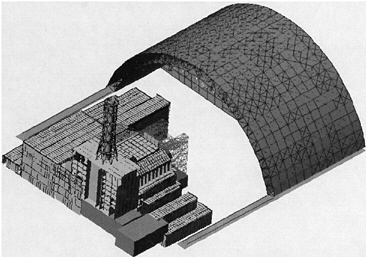
FIGURE 4 The New Safe Confinement.
the amount of time spent at the assembly site that will be set up in the shadow of the buttress wall.
As each section of the arch is completed in the assembly area, it will be slid along the foundation’s Teflon surface towards the Shelter, freeing the assembly area to build the following section. As new sections are slid towards their predecessors, those will in turn slide closer to the Shelter. After all the sections are built, hydraulic pulleys will slide the arch into place over the Shelter—a process that is expected to occur in 2008 and take less than a day.
This, at least, is the plan. But the Confinement is a complex object that poses a radioactive danger, and much must be done to prevent overexposure of the workers who will build it. In fact, as of 2004, there was still some debate as to whether an arch was the best form for a new Chernobyl cover. Some Ukrainian scientists expressed concern that it is simply too heavy for Polissian terrain, which is pocked with saucer-like depressions that suggest complex geological processes going on under the surface. Confinement planners haven’t studied them at all.
While waiting for the new Confinement, Shelter experts have tried to protect the FCM from water and simultaneously fix the dust with an
experimental polymer called EKOR. Billed as radiation- and corrosion-resistant material designed to maintain its integrity for centuries, EKOR is a white foam that hardens and seals the FCM. But because it hasn’t actually been tried outside the laboratory for any length of time, it is being tested on a pile of FCM slag in one of the bubbler pools to see how radiation resistant it really is.
Once completed, the arch will be like a nuclear Matrioshka doll, with the Confinement on the outside, the Shelter inside the Confinement, the ruined reactor inside the Shelter, and the radioactive FCMs inside all of it. Designed to withstand a Richter 6 earthquake and a Class 3 tornado—but not a plane crash because the Chernobyl area is a no-fly zone—the arch is supposed to keep the radioactive materials in and keep most moisture out, eventually eliminating the need for EKOR, although the experiment on the slag pile may still prove useful for the planet’s other radioactive messes.
The Confinement’s interior will be rigged with remotely operated cranes and other equipment for dismantling the upper parts of the Shelter and ruined reactor building. At that point, future nuclear archaeologists might find it possible to dig up the pile of extinguishing materials in the central hall and figure out how much missing fuel lies beneath.
Ideally, all of the highly radioactive insides should then be scooped, scraped, and swept up into containers and safely stored. But this is a gargantuan task, given the risks of occupational radiation exposure and the diffused location of the stuff—including all of the dust—throughout the reactor building. Moreover, since the melted fuel melded together with various reactor construction materials, it is no longer a matter of cleaning up what remains of the 200 tons of fuel, but of disposing of 3,000 tons of fuel-containing materials totaling about 20 million curies of radioactivity. The Confinement project budgets some money to research possible ways to safely dispose of the FCMs. But there is no money—and, currently, no realistic way—to actually do it. No one even expects to start for another 40 or 50 years.
By then, perhaps, scientists will figure out how and where to store the stuff. The FCMs are highly radioactive, long-lived waste that can’t be stored in the same way as the low- and medium-active, short- and medium-term waste stored on the plant’s grounds and in the barrows of Burakivka that I visited at the start of this journey. One storage option is to bury the stuff deep in the earth somewhere within the bor-
ders of the zone, but scientists have only begun preliminary reconnaissance work to identify geologically appropriate sites. Besides, geological storage is too expensive for Ukraine right now.
Even if (or when) the FCMs are cleaned out, the radioactive Sarcophagus itself will probably remain inside the Confinement for as long as both can stand.
What happens after the Confinement’s maximum three-century integrity expires is anyone’s guess. The scientists and engineers at the Chernobyl station didn’t seem eager to speculate about questions with no practical answers.
I decided to go talk to Volodymyr Kholosha, the head of zone administration, about it. A youthful 49-year-old who trained as a power engineer and worked at the nuclear station at the time of the disaster, Holosha occupied a sparely furnished office decorated with radiation maps on the second floor of Chornobyl’s former Soviet town hall, a few blocks away from Chernobylinterinform.
When I arrived, he invited me to sit and looked pointedly at his watch to indicate that I had little time, so with few preliminaries I asked him about the zone’s future.
With the assurance of someone who has done a good deal of thinking on the subject, Kholosha explained that some areas—namely the grounds of the nuclear station and the adjacent areas—will be used for decommissioning the three undestroyed reactors, processing and storing radioactive waste, and maintaining the Shelter Object and eventually the Confinement. Territory is needed to do all that. For example, 60 hectares in the Red Forest have been decontaminated to build a nuclear waste facility called Vector.
About six square miles containing the region’s original flora and fauna, or rare species, will be set aside. Already mapped and surveyed, they will be like radioecology sanctuaries, where nature will be allowed to renew itself and rehabilitate without human interference.
Then there were what Kholosha termed “priority rehabilitation” lands—territories, primarily in the southeastern parts of the zone where people can work with minimal radiological restrictions. He told me that saplings for future forestry farms had already been planted there and the zone was also considering fish farming, to breed young fish that can be grown to adulthood in other places.
“And what will the zone look like in 100 years?” I asked.
Kholosha sighed. “The zone will be a green oasis.”
He stopped as if to check off parts of its current landscape in his mind. “There will be no Chernobyl nuclear power plant. It will be decommissioned and deconstructed. And there will either be a new Confinement, to replace the one we are about to build. Or there will be no Confinement at all because its contents will be cleaned up.”
When I raised a skeptical eyebrow at that optimistic prediction, Kholosha smiled: “We can’t know what new technologies will be developed by then.”
“There will be some nuclear waste storage facilities around the territory,” he continued. “There may be more people living here than there are today, especially on the periphery—but not many. There will be fewer people working in the zone administration and at the nuclear waste facilities than there are today. And there will be many, many more animals.”
“I know that this is more in the sphere of science fiction. But what do you imagine 300 years from now?” I asked.
Kholosha shrugged. “That’s hard to predict. Maybe the number of people will grow, though I don’t think there will ever be as many people as there were before the accident. And they’ll probably be peculiar characters, like those people you have in America who go off to live alone into the wilderness.” I couldn’t help but think of Ted Kaczynski, the Unabomber, who holed up in his Montana cabin to write antitechnology manifestos during breaks from his bomb attacks. It was a chilling thought for the zone’s future.
The idea of repopulating the zone as the radionuclides decay with time is a subject of hot dispute. As of 2004, contamination levels were safe enough to lift restrictions on about 150 square miles. The clean areas will grow with time as more and more cesium and strontium decay. With the passage of 30 years, which is equivalent to the half-life of cesium-137 (30.7 years) and strontium-90 (28.79 years), restrictions can be lifted on more than half of those parts of the zone contaminated with only those radionuclides. Not all of it will be clean enough for permanent residence, but even the parts that can’t be inhabited can be used for some kind of economic activity.
Proponents of lifting restrictions on parts of the zone have come up with various ideas for what kind of economic activity can actually be conducted there even today. In Belarus they’ve taken up horse breeding on the cleaner periphery of the radiological reserve, an idea that is
also being considered in Ukraine. Other suggestions include fur farms and beekeeping, not for the radioactive honey produced but for breeding new colonies for sale.
A “Made in Chernobyl” label would probably be a tough sell, although aggressive marketing might achieve wonders. More seriously, the zone’s contamination is a constantly shifting kaleidoscope. High winds, hurricanes, and forest fires can spread radionuclides to clean zones. While such conditions can spread contamination outside the zone’s borders as well, the risks are greater close to the most highly contaminated areas.
When I asked about repopulating the zone, Kholosha responded: “That is less a question of radiology than of sociology, psychology, and economics. We’re not talking about professionals who work here, but of civilians returning for permanent residence.
“Imagine what’s needed for this to happen. First of all, the infrastructure would have to be renewed. After 18 years, everything has crumbled—stores, schools, post offices, sewage systems. But let’s say that money is found to do that. Imagine a child growing up here. He can’t go fishing because the fish in ponds and lakes are too radioactive. No matter what direction he walks in, he’ll eventually encounter barbed wire. And all this time he’ll grow up in the shadow of the Sarcophagus. What will be the psychological impact on this child’s life?
“It just doesn’t make sense to resettle the zone when there are uncontaminated parts of Ukraine that could use more people,” said Kholosha. “Sure, you could do it as an experiment. Let people with children come to live here, ship in clean produce. But I don’t think it’s a good idea.”
The zone is a sink for radioactivity, and this poses a radiological danger in and of itself. But it also acts as a barrier between the radiation and human exposure because its checkpoints keep a distance between the two. Letting people return for permanent residence would remove that barrier.
So, given those arguments, who was actually in favor of repopulating the zone? In Belarus the government was encouraging resettlement in villages on the border of the reserve, but not directly inside it. In Ukraine it was a grassroots movement.
“The samosels want it because they want a more normal situation. And evacuees who grew up with the climate here and can’t get used to
living in, say, the black earth steppe region want to return,” Kholosha told me. “These ideas are not coming from the top at all.”
Kholosha continued: “But it really is not a good idea. We analyze the things the samosels eat. Milk from cows pastured outdoors exceeds strontium limits, as do vegetables and fish.”
This poses a problem outside the zone as well. Samosels’ family and friends can apply for permission to enter the zone, increasing the number of potential poachers. Just a few weeks earlier, a businessman I knew boasted about visiting someone in the zone, going fishing, and then taking the fish home to his family in Kiev.
“Someone checked it with a dosimeter and it was fine,” he had explained when I asked if he wasn’t concerned about radioactivity. He was quite perturbed when I told him that the dosimeter only measured gamma radiation in the air and couldn’t tell him anything about the amount of radioactivity inside the fish. But at least he knew where the fish came from. Some poachers sell zone fish or game at markets, and no one is the wiser about their origins.
The town of Chornobyl’s samosels pose a special problem. First of all, there are many of them. About one-third of the zone’s permanent residents live there. And because the town is the headquarters of the administration and its 3,200 employees, its infrastructure is maintained quite well, creating an illusion of normality that fuels the grassroots demand for legal resettlement.
Nevertheless, if new settlement is not allowed, the samosels’ demands will gradually die with them.
Kholosha glanced at his watch and I rushed to pose my last question.
“And Pripyat?” I asked. “What will happen to Pripyat?”
Kholosha smiled sadly. “Pripyat will be ruins, like one of those Aztec or Inca cities.”
WORMWOOD FOREVER
The previous year’s old brown leaves skipped across Pripyat’s crumbling central plaza in the mild spring breeze. Pripyat was so young when it died that the plaza never did get an official name. But it was the only part of the town that hadn’t succumbed completely to forest, largely because it had been cleaned up when U.S. Vice President Al
Gore came to visit in 1998. It was also where buses carrying scientists and visitors inevitably parked, so what did grow usually got squashed.
While I pulled my dosimeter out of my vest pocket, Rimma crouched down to inspect a young sprout of wormwood that had poked up through the asphalt cracks. After our first botanical tour of Pripyat in Chapter 1, Rimma had become an experienced wormwood spotter. She plucked off a tiny leaf and crushed it for me to smell the familiar varnishy aroma.
Waist-high radiation levels were 36 micros an hour, but they were higher closer to the ground because that’s where nearly all the radionuclides are concentrated. Although it couldn’t actually measure radionuclides inside the wormwood, which was accumulating cesium as its spring juices activated, the dosimeter registered 120 micros in the air around it.
The plaza was a patchwork of readings. Near a plug of dried moss, they were 160; on some crumbling asphalt, 200. On another spot of moss the dosimeter beeped rapidly and kept climbing to finally hit 700 microroentgens an hour.
“That’s even higher than near the Sarcophagus,” Rimma noted. “The graveyard here is especially radioactive. Radiation levels are in milliroentgens in some places there.”
Placed between the town’s barbed wire enclosure and the Chernobyl station, the graveyard had been directly in the path of the debris from the initial explosion. But since I had been in so many “especially radioactive places” in the course of my journey, I decided that my story could do without more of them, especially with a dosimeter that was worthless in any place where radiation levels were higher than two milliroentgens an hour.
In fact, I didn’t even know the total dose I had received in researching this book. I could have easily purchased one of the clip-on dosimeters that all zone workers wear to measure their annual doses. But I started going to Chernobyl and collecting material for newspaper articles long before I knew I’d be writing a book. I rationalized this lapse on my part with the fact that Rimma goes to all the places I had visited and far more frequently. So, if she hadn’t exceeded dose limits then I probably hadn’t either.
I did, however, calculate my approximate exposure by adding up the number of hours I spent in the zone, multiplying that by the average zone radiation level of 43 microroentgens an hour plus adding
bonus exposure based on my time spent in so-called especially radioactive places such as the left bank polder, the Red Forest, and the shadow of the Sarcophagus. The number I came up with was a total exposure of about 25 milliroentgens. According to nearly every national and international radiation protection standard, this was well below the maximum recommended annual exposure. But as my journey drew to a close, I decided that whatever my total dose actually was, it was fast reaching “enough.”
Near some wormwood growing on a knoll of dried grasses, the hourly level was 600 microroentgens, but quickly dropped back to double digits when I straightened up to stroll amid the ghostly high-rises. Even after 18 years, when babies born in 1986 had reached adulthood, Pripyat was too radioactive to be inhabited. Its buildings had so crumbled that it seemed unlikely anyone but a desperate fugitive would try to live in one of them even if it wasn’t contaminated.
Indeed, the town looked even more decrepit than it did when I visited it at the start of this story. The grammar school was flooded with water from several days of rain. Water was still trickling through the old coatroom where an abandoned bird’s nest was perched on one of the clothes hooks. Chunks of peeling paint curled on the walls, and spongy linoleum squished beneath our feet as we carefully made our way down a corridor. The wood had rotted away in places, and a few times I stumbled into holes and sagging depressions in the floor. It did not feel structurally sound at all, and we quickly emerged into the tangled overgrowth outdoors where large clusters of red firebugs scurried about the ground in their spring orgies of feeding and mating.
The town’s erstwhile rose gardens, lawns, and tidy tree-lined promenades were succumbing to the infertile soil’s natural, hardy Artemisia vegetation. The Chernobyl region was once again living up to its medieval name and Kholosha’s predicted green oasis was well on its way to becoming a reality. Indeed, although they don’t often say so outright, it seemed to me that opponents of resettling the zone like the idea of its remaining a wildlife sanctuary.
James Lovelock, the inventor of the Gaia theory of Earth as a kind of living superorganism and a proponent of nuclear energy as a “green” alternative to climate-warming fossil fuels, recently cited Chernobyl’s transformation into a wildlife park in a British newspaper article he wrote in support of nuclear energy. He even proposed the deliberate creation of Zones of Alienation: “I have wondered if the small amounts
of nuclear waste from power production should be stored in tropical forests and other habitats in need of a reliable guardian against their destruction by greedy developers.”
It’s a wacky idea with a certain logic: The only way to save the planet from ourselves is to deliberately create involuntary parks, unnaturally natural places that are just fine for wildlife but too dangerous for humans.
The success of Lovelock’s scheme would depend partly on what the developers were developing. If it is a condominium complex for rich folks, such a radioactive sword probably would keep potential buyers out of that particular patch of tropical Eden. But I somehow doubt if nuclear waste would stop the logging of tropical forests, especially if the lumber is clean and if poor Third World workers are doing the work and absorbing the radioactive background doses.
Still, the benefits of nature conservation alone are not a very convincing argument in poor countries. With the help of impoverished peasants who call the butterflies “worms,” mobs and mafias have been illegally logging the ancient Mexican evergreen forest that is the winter haven for the monarch butterfly, and Mexican law has been helpless to prevent them.
Of course, aside from being risky, unethical, and way too weird for serious consideration, the problem with using radioactivity as a keepout sign is its invisibility. And this very invisibility is what makes more graphic keep-out signs crucial in radioactively contaminated areas. But some radionuclides are so long-lived that the signs will either disintegrate or become unintelligible long before they become unnecessary.
This very problem fueled a bizarre American debate in the 1990s, after the federal government authorized the country’s first long-term radioactive waste storage facility—the Waste Isolation Pilot Plant, or WIPP—in southwest New Mexico. To eventually store drums of contaminated, low-level waste such as clothes, tools, rags, and solid residues, the Department of Energy mined more than 10 miles of chambers 2,100 feet beneath the surface in the salt layers left when an ancient sea evaporated. Since geological activity at the site is deemed unlikely to disturb the waste once it has been stored (the timing of which, as of this writing, is unclear), the danger lies in its penetration by people unaware of the dangerous radioactive stuff inside or by
people such as terrorists, who know full well what’s inside and want to get some for a dirty bomb or other nefarious device.
For the foreseeable future, intruders are supposed to be warded off by the warning signs, barbed wire, and checkpoints that surround any highly secured place. But what to do about the unforeseeable future? Since some fission products are about as permanent as the landscape itself, environmental regulations require that public warnings about WIPP must remain effective for 10,000 years! And because even the U.S. government institutionally recognizes that it is not eternal, the warnings must work passively, without further human intervention, after the first century.
Of course, 10,000 years is an arbitrary time period. Much of the waste will still be radioactive after that. Nevertheless, it is far beyond the boundary of humanity’s poor collective predictive powers. For a glimpse of what this means, 10,000 years ago the seeds of civilization were just being planted with the invention of agriculture in the Middle East. The first cities arose in Mesopotamia about 5,000 years later. Given the pace of technological development today—as well as the destructive uses to which this technology has too often and too sadly been put—it is impossible imagine what 10,000 years into the future will hold. More accurately, it is possible to imagine but impossible to predict.
So, how to design warning signs that not only will last 10 millennia but also will be intelligible 400 generations from now? After 20 to 40 generations, any language becomes gibberish to its speakers’ descendants. Read Beowulf to see how the English language has changed since the eighth century. Even sixteenth-century Shakespeare can be tough going in parts. And for anyone who believes that the current Information Age will preserve dictionaries and grammars forever, try retrieving a document stored on an original “floppy” disk without going to an antique computer collector to find a drive that can read it.
But even if the carrier of the message remains intact and legible, what kind of marker will preserve the meaning of “keep out” to people for whom these two words will be like the still-undeciphered Linear A script of ancient Crete? Even the meaning of the traditional trefoil sign for radiation, designed in 1946, could change with time—like the swastika, which symbolized the sun and good fortune in many cultures before the Nazis contaminated it.
Still, if the far-into-the-future New Mexicans understand the message, there is no reason to think they would believe it. Vast halls of the finest museums would echo with emptiness if the world’s Indiana Joneses believed in mummies’ curses. To the contrary, a mummy’s curse is like an X marking the spot where treasure might be found.
Arizona State University geographer Martin Pasqualetti wrote about the problem of how to “alert the prudent without attracting the foolish.” He suggested that a “landscape of illusion”—one that would leave the WIPP site anonymous and unmarked on the surface but with subterranean warnings to anyone getting too close to the radioactive stuff inside—would provide better protection than what he called “landscapes of repulsion” that would be just as likely to attract the curious.
Design contests for so-called universal warning signs illuminate the dilemma. The signs, whose message is not based on words, have been proposed for WIPP as well as for another waste repository planned for Yucca Mountain in Nevada. The winning entry in one competition proposed planting the site with genetically engineered cobalt blue cactuses, despite the fact that such an unusual and alluring landscape would probably attract people rather than ward them off. The same could be true of more foreboding earthworks such as the “Landscape of Thorns,” composed of 50-foot-high concrete spires with sharp points jutting out at all angles, or “Forbidding Blocks”—giant, irregular blocks of black stone too closely spaced and hot to provide shelter.
If you were in the neighborhood in the year 10,000 and heard about such a mysterious, ancient monument, wouldn’t you go take a look? I would. Even anti-art or anti-architecture can’t shout a danger warning without attracting the very people it intends to repel.
The U.S. Department of Energy has—perhaps wisely—settled on a more mundane design for WIPP, consisting of a 33-foot-high earthen hill covering 120 acres and bordered by giant granite warning monuments. A roofless granite information center engraved with written and pictorial messages will sit in the center of the hill, and archives about the site’s contents will be stored in various locations around the world. But building will not begin until the end of the twenty-first century, so future generations still have time to come up with better ideas for warning their own descendants about the radioactive legacy our generation bequeathed them.
Thus far, however, no one is planning to inscribe semiotic warnings on the Confinement arch that will cover the Chernobyl reactor, perhaps because its lifetime will be short enough for current languages to remain intelligible and for current security to remain intact. Yet even if the arch were to be gouged with trefoil hieroglyphics and warnings, nothing similar is even remotely possible for the radioactive wilderness around it and the contaminated kurgan burial mounds containing the remains of buried villages such as Kopachi, Yaniv, and Chistohalivka.
Aside from barbed wire, checkpoints, and presumably eternal governments, no one I ever spoke to in Ukraine or Belarus conceived of, or even thought about, a permanent way to keep people out of the zone for the 300 years that amount to about 10 cesium and strontium half-lives. This is to say nothing about the 10,000 years mandated for WIPP, much less the 24,110-year half-life of plutonium-239.
Was this irresponsible? Or was it hubris to believe it was even possible?
The first floor lobby of the Pripyat high-rise was a dark, treacherous passage smelling of mildew and littered with a deep pile of ripped mattresses, chunks of paint and plaster, old shoes, and dismembered dolls. The elevator lay dead in its shaft.
I followed Rimma up the stairwell, listening to the rubble from collapsing walls and ceilings crunch beneath our feet.
Built by largely inexperienced members of the Komsomol—or the Young Communist League—during summer vacations, the buildings were structural horrors. There were no real right angles and the concrete slabs that were the building’s carcass didn’t meet. The stairwell was built in a chamber up the side of the building, but the exterior wall inexplicably ended six inches from the floor, letting in the outside air. The stupidities committed under the Soviet system—and its ability to creak along for so long despite them—are still astonishing. The poor construction will never last as long as the Egyptian pyramids or Aztec cities.
Looters had taken anything of value. Chernobyl coffee table books with photos taken soon after the disaster show intact furnishings and neatly made beds. But Rimma showed me a piano in a flat on the fourteenth floor. It was missing most of its wood, so its innards were exposed, and the scale I played on it was horribly out of tune. It and an
overturned table scattered with some books and paper were the only things left in the one-room apartment.
“This is the only place in the world where you can see what the Soviet Union was like before perestroika,” said Rimma.
And it was a very strange place, indeed.
One of the books on the floor was the Short Course on the History of the CPSU. The CPSU was the Communist Party of the Soviet Union, and the Short Course was its sacred text. Evidently, no looters found the book worth taking.
The floor was littered with many pieces of paper curled up like loose cigarettes, and I unrolled a few to find faded black-and-white photographs of babies, families, and a man squinting into the sun and holding up a large fish against a backdrop of tall reeds.
A yellowed copy of Izvestia, dated January 29, 1985, proclaimed in large block letters: “We won’t let the world detonate!” According to the article, “Soviet youth” said this in “hot support” of some utterance about world peace from the geriatric and generally useless General Secretary Konstantin Chernenko, who replaced Andropov and was the last of the old-guard Soviet Politburo assembled by Leonid Brezhnev. It was one month into his tenure when Chernobyl’s No. 4 reactor started generating electricity. Mikhail Gorbachev took his place in April of 1985.
The kitchen was empty but for the cabinets. A 1986 calendar displaying Kiev’s World War II museum was pasted on one of the cabinet doors. All of the red-letter days had long since faded away in the sun, leaving ghostly nondays—the nondays of Pripyat after its people left.
We left the apartment and climbed up the last two floors to the blacktop roof, where there was a panoramic view of Pripyat’s empty high-rises and the Shelter Object looming in plain view. It was probably the same high-rise that the anonymous KGB cameraman climbed to film the smoldering reactor in the silent movie I watched in Kiev’s Chernobyl museum at the start of my journey.
I recalled the shock waves when news about a Soviet nuclear disaster first leaked out of radiation detectors in Sweden. For months afterwards, Western media were filled with wild speculation and worst-case scenarios that tried to fill the vacuum of Soviet silence, while satellites tracked the radioactive cloud that drifted about the globe. With its invisible menace of radiation, the disaster touched the entire northern hemisphere and all the fears of the nuclear age.
I tried to picture how the shiny new arch (or whatever form the new Confinement eventually takes) would look on the horizon. Like the radioactive waste barrows of Burakivka, the Confinement arch should someday be painted green on the zone maps because the stuff inside it will, at least for the near future, be relatively safely enclosed. But the soil, plants, and animals of the entire Zone of Alienation are also, in a way, fuel-containing materials. And no confinement arch is big enough to isolate them from the environment. In the zone, FCMs are the environment.
Like the future WIPP monument built intentionally to communicate a cultural message to posterity, the Confinement arch would be like Stonehenge, the Egyptian pyramids, or their Eurasian counterparts, the earthen kurgans that dot the steppes—transcending the values of a particular culture and speaking to all humanity. While the arch itself is not intended to last as long as Stonehenge, in the absence of scientific breakthroughs in radioactive cleanup, some kind of protective shelter will have to stand on that spot of Earth for far longer than the megaliths, pyramids, and kurgans combined.
Will these successive shelters through the ages speak to all of humanity? And more importantly, what will they say? The tomb over the ruined fourth reactor was like a monumental Rorschach test, perhaps more revealing about the person looking for meaning in it than about the thing itself. Was Chernobyl’s message one of hazard, about the dangers of technology and the fact that all of us, 5 billion strong, live downwind from 300 nuclear reactors that are operated by mere people and have a statistical probability of one meltdown every 30 years?
Or was its message one of hope, that no matter how humanity messes up, nature will persevere—even if it is forever changed and unnaturally natural, like the radioactive landscapes of Chernobyl? Perhaps the arch would one day become a kind of environmental shrine, eerily sanctifying the radioactive wilderness around it. Or would it desecrate that wilderness? I imagined future philosophers making pilgrimages to contemplate the shelter shrine and come up with answers.
I didn’t have any.
Instead, I remember a dream I had soon after the disaster. In it I was out on the town with a group of faceless strangers on a dark, gray night. Suddenly a staircase appeared in a kind of scaffolding and I climbed it into my parent’s brightly lit kitchen. In the middle of the
linoleum sat the Chernobyl reactor core. It wasn’t big and looked like nothing special, but I knew it was emanating deadly, invisible rays. We walked over and around it in the kitchen, going about our business and pretending it wasn’t there. But I knew it was dangerous and told my mother: “We have to get rid of this thing!” And her eminently sensible response was: “But where are we supposed to put it?”
In my hyphenated Ukrainian-American existence, “America” was the streets and schools, bookshelves and television. But “Ukraine” was family, and the family gathered mostly in the kitchen. In dream logic, Chernobyl was in Ukraine, Ukraine was in my parents’ kitchen, and therefore Chernobyl was in my parents’ kitchen.
The worst-case scenarios depicted a dead land, a black hole that had moved me in an immediate way, as though I had lost a part of myself. In the years that followed, the disaster became a kind of hobby for me. I studied all Chernobyl matters closely and was convinced that the Soviets were lying about it even after Gorbachev ushered in glasnost. In fact, they did lie about a great deal. But by the time such details emerged in the early 1990s, I was living in Kiev where, oddly enough, my Chernobyl fascination suddenly dissolved.
I never understood why until I stood atop that Pripyat high-rise, surrounded by the wormwood forests, swamps, and fields blooming in the pastel palette of early spring. If a nuclear disaster really is in your kitchen—or in your metaphoric backyard—and there is nowhere else you can put it, it seems best not to think about it too much. Not, at least, until many years have passed, and the bountiful evidence of nature’s nearly miraculous resilience and recovery makes the thinking more bearable.


