Global Navigation Satellite Systems: Report of a Joint Workshop of the National Academy of Engineering and the Chinese Academy of Engineering (2012)
Chapter: Impact of Intentional, Low Power, In-Band, Personal Privacy Devices (PPDs) on Aviation--A.J. Van Dierendonck
Impact of Intentional, Low Power, In-Band, Personal Privacy Devices (PPDs) on Aviation
A.J. VAN DIERENDONCK
AJ Systems
Los Altos, California
What are PPDs? PPDs are small “jammers” that plug into cigarette lighter sockets that are meant to “jam” or “mask” Global Positioning System (GPS)-Global Navigation Satellite Systems (GNSS) receiver/navigators that report, through other means, the position of the host vehicle, when the user does not want his position known. Use is illegal in the United States. They are probably purchased via the Internet. Unknown (or known) to the owner, PPDs can jam other users of GPS (GNSS), including Safety-of-Life (SOL) operations. At Newark, New Jersey, airport (EWR), such a device’s radio frequency interference (RFI) affected the Ground-Based Augmentation System (GBAS) operation. GBAS performance interruptions have been observed since November 2009, impacting GBAS service availability, although there was no evidence of direct effects on airborne avionics. It was determined that RFI emanated from sources on the New Jersey Turnpike (NJT) (in motion). A test program determined direction of travel, average velocity, how frequently emitter(s) traveled past the EWR GBAS, and what time of day and days of the week events were observed.
RFI was also detected at Wide Area Augmentation System (WAAS) Reference Stations (WRSs) near Washington, D.C., and Houston, Texas. However, because of diverse location and redundancy of WAAS reference receivers, no interruptions of WAAS operations were noticed.
RFI was characterized by analyzing data collected from GPS receivers, spectrum analyzers, and time samples captured by real time data collection (snapshots). Through measurements of spectral shape, time series demodulation, magnitude of degradation in GPS receivers, and estimates of emitter(s) transmitted
power, RFI was characterized. The fact that the interference source was moving complicated the characterization.
THE SCENARIO AT EWR
NJT runs by the GBAS facilities (Figure 1). There was intermittent severe degradation or loss-of-lock in GBAS reference receivers. There were also additional GPS receivers/antennas installed at the GBAS shelter to record more detailed information when severe GBAS degradation was noted—one antenna with moderate directivity that was pointing horizontal northward along NJT, and one omni-directional pointing up. Of course, received interference power was greatest during the closest approach of the interference source. This resulted in negative elevation angles, so gain was low, but approximate azimuth direction could be observed.
The spectral peak of Antenna 1 is observed at GPS TOW1 (GPS Time of Week of event 1); the spectral peak of Antenna 2 is observed at GPS TOW2
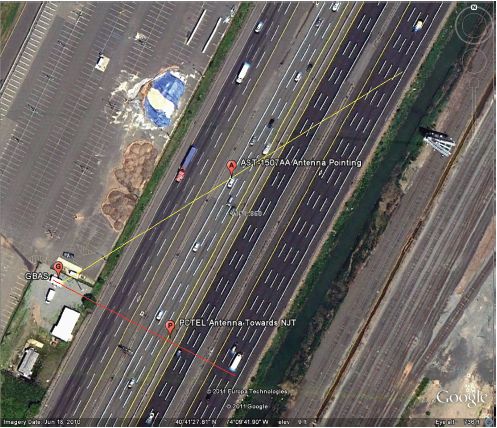
FIGURE 1 The scenario at EWR.
(event 2). The average speed is based upon the time difference. Google Earth images of 654 meters at 33° places RFI in the NJT southbound lane 5.
Multiple emitter types were observed (Figure 2). A linear sweep indicates that the underlying signal for this particular event is swept CW, starting at 1570 MHz and increasing to 1590 MHz in about 116 microseconds (8.6 kHz sweep rate). The small increase in the center of the band is GPS coarse/acquisition code.
OBSERVED L1 C/N0 DEGRADATION—RFI POWER ESTIMATES
Figure 3 presents a histogram of Normalized Measurements of C/N0 (L1 Carrier Power-to-Noise Density ratio) from a WAAS G-II Receiver that
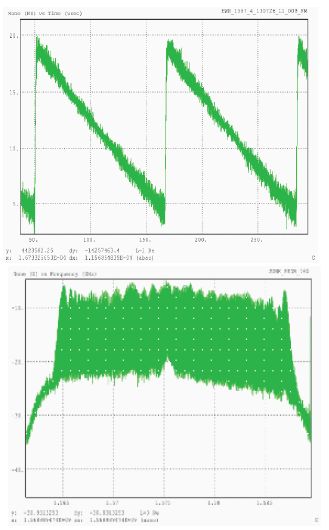
FIGURE 2 Typical wideband RFI.

FIGURE 3 WAAS G-II normalized C/N0 degradation (dB).
was developed covering 146 days. The events were recorded whenever loss-of-lock or severe degradation occurred in the GBAS Reference Receiver. The magnitude of degradation varied more than 20 dB, greater than the uncertainty with respect to Free-Space-Loss (FSL).
The estimated RFI power variation due to measurement accuracy is minimal—approximately ±1 dB RSS. The estimated RFI power variation due to other uncertainties is significant—transmit antenna gain and the loss exiting the vehicle, and the exact location of RFI transmitter (10 to 11 dB). The polarization mismatch loss uncertainty is 1 to 6 dB. Note that most of the degradations were less than about 8 dB, but a significant number had a degradation of 21 dB.
THE SCENARIO NEAR WAAS REFERENCE STATIONS AT LEESBURG, VIRGINIA, AND HOUSTON, TEXAS
Figure 4 shows a scenario near the WAAS Reference Station (WRS) at Leesburg, Virginia, showing highways relative to the ZDC-WRS. Figure 5 shows the degradation of Houston WAAS Reference Receiver normalized C/N0 versus time-of-day, occurring twice each day. It is postulated that the vehicle passed by on the airport access road to the airport, and then returned later. Similar degradations were observed at the ZDC-WRS.
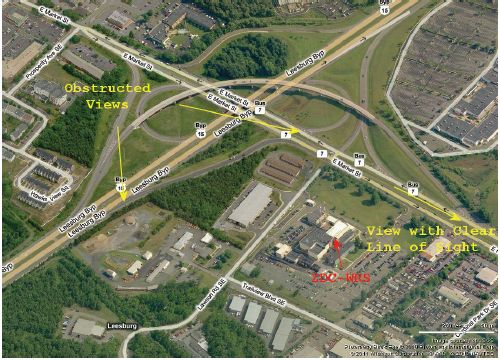
FIGURE 4 ZDC-WRS location relative to roads passing by.
SUMMARY
Aviation must consider PPD proliferation as inevitable. The key uncertainty in the presented results is the radiation pattern for emitter(s) installed in a vehicle. It is highly dependent on the structure of the vehicle and location of the RFI transmitter within the vehicle, which is not easily modeled. GNSS ground RF operating environment requirements may have to be improved by “hardening” from sighting and operational considerations. However, is 15–25 dB improvement even possible?
We must evaluate implications for avionics. No interruptions of GPS reception by avionics have been reported to date. Should the Avionics Minimum Operational Performance Standards (MOPS) RFI mask address unintentional intentional emitters, while retaining the aggregate of –110.5 dBm/Hz within +/– 10 MHz? Should we add an A/J requirement to MOPS?
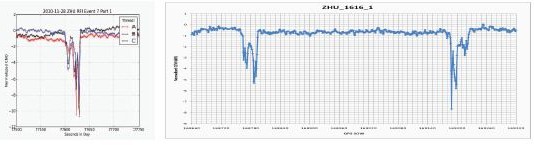
FIGURE 5 Degradation of normalized C/N0 versus GPS time-of-day (in seconds) at Houston WRS.


