Infusing Real World Experiences into Engineering Education (2012)
Chapter: Illinois Institute of Technology
The Distinctive Education Program at IIT
Lead Institution: Illinois Institute of Technology, Chicago, IL
Collaborating Institutions: corporations, entrepreneurial ventures, non-profit organizations, government agencies
Category: Curricular
Date Implemented: January 2010
Website: http://www.iit.edu/undergrad_ed/

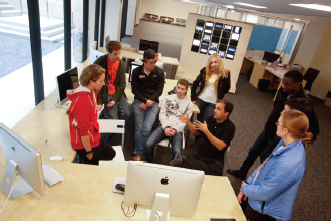
Program Description: The Distinctive Education Program at Illinois Institute of Technology (IIT) was created to: create a shift in the engineering educational model from one-to-many (lecture/lab format) to many-to-many (multiple faculty interacting collaboratively with students) to enhance learning; create a catalyst for innovation and creation of solutions to problems, by providing students with collaborative space, supplies, equipment, and materials; and cultivate teamwork and improve communication and faculty/student interaction. The program is composed of three interconnected components serving all undergraduates: (1) an interdisciplinary curriculum that integrates industry experts and problem solving (IPRO 2.0) with a network of faculty and professionals spanning all of our colleges; (2) a 13,000 sq. ft. dedicated space equipped with a rapid prototyping lab available to all students (The Idea Shop) that brings people from different backgrounds and areas of expertise together and provides materials, human resources, technology, and equipment; and (3) a strategic commitment to providing and integrating technology (iPad initiative), in which the university provides Apple iPads to all first-year students. To support this technology, IIT enhanced its campus-wide wireless infrastructure, provided training, and changed the way it does business, communicates and learns. The IPRO curriculum was integrated into the normal faculty-teaching load and is fully supported by university leadership. All undergraduates must complete two 3-credit-hour semester-long IPRO projects.
Anticipated and Actual Outcomes: We anticipated the program would: (1) foster a collaborative learning environment serving interdisciplinary project teams with state-of-the-art workspace and prototyping tools, (2) provide students more time and resources to work on projects, (3) create more community engagement and outreach projects, (4) increase corporate sponsorship, (5) increase enrollment, (6) provide access and equal opportunity to a diverse student body, (7) allow faculty to develop iPad-based curricula, (8) encourage sustainability and paperless initiatives, (9) increase student-faculty interaction, (10) encourage student ownership of research, ideation, fabrication, and professional development, (11) bridge social interactions of faculty, staff, facilitators, practitioners and industry experts, and (12) provide understanding of the project/ product development cycle and give students the means to bring their ideas to market. Our actual outcomes also included: (1) resources for faculty members to offer supplemental programs, lectures, and workshops, (2) increased use of educational apps, (3) analysis of real-time, continuous feedback, (4) projects driven by students’ passion and interest, (5) user-centered design methodology, (6) interprofessional foundation based on principles of teamwork, communication, project management, and ethical decision-making, (7) integration of concepts and faculty from psychology, design, business, architecture, and law into engineering education, and (8) increased public awareness of IIT.
Assessment Information: Assessment involves students, faculty, sponsors, alumni, employers and administrators. Data is collected throughout the course about learning objectives and performance of individuals, teams and program resources. Students must function on multidisciplinary and cross-functional teams, organize and manage complex projects, communicate effectively in a variety of ways, and engage in problem solving including complex nontechnical considerations. Assessment includes evaluation of deliverables (project plan, midterm review, presentations, exhibit/poster, final report), evaluation of IPRO Day performance by Chicago-area professionals, student satisfaction and team climate surveys, academic committee reviews, team member peer evaluation, and instructor and sponsor feedback. Since 2010, we have been reinventing IPRO via IPRO 2.0: The Next Generation of IPRO Experience, to further align our interprofessional, project-centered learning goals with IIT’s vision and strategic plan. This is accomplished by: (a) integrating our Institute of Design’s user-centered design principles, core problem solving, and collaborative innovation methodology, (b) fostering high-performance teamwork that encompasses team building, leadership, project management, communication, and ethical decision making, and (c) delivering a discovery and ideation process that inspires students to conceive new ideas.
Funding/Sustainability: First-time implementation: staff salaries (5.5 FTE), $380,000/yr; faculty salaries, $250,000/yr; expendable materials and supplies, $80,000/yr; major equipment purchased, $212,000; iPad initiative, $250,000/yr; wireless improvements, $100,000; and rent, $300,000/yr. The costs for prototyping the original IPRO program were borne by the university through its operating budget from 1995 to 1998 and then augmented through fulfillment of its business plan. From 1995 to 2010, IPRO has a record of receiving sustaining funding over several years in one-semester increments from corporations. As part of the strategic plan, the university has guaranteed the long-term sustainability of the Program by implementing the Responsibility Centered Management model. Sustainability is a result of strong commitment from the university’s upper administration and a clear funding model. The annual funding for the program comes from net tuition revenue ($1,000,000), IPRO corporate sponsorships and foundation grants ($500,000), the Provost’s Office (iPad initiative; $250,000.00), workshops, rapid-prototyping services, Idea Shop Store ($5,000), and partnerships with programs sharing space like Exelon Summer Institute and Boeing Scholars Academy.
