Epilogue
The Einstein quote that opens this report suggests that a tree and its branches serve as a metaphor for thinking about the integration of arts, engineering, humanities, mathematics, medicine, science, and technology because the vitality of the whole depends on the combined force of the parts. The trunk of the tree represents the core strength of the disciplines in higher education—the centralizing force that directs students through
the course of academic study. Yet the branches—where Einstein located religion, arts, and sciences—could also be seen as the locations for integration, as they move away from the trunk yet remain integrally connected to the core strengths of the whole. Most importantly, the branches create opportunities for trees to connect to each other. In a forest, the canopy of intersecting branches connects distinct units. In this metaphor, it is the connections between branches and trunk (and roots), rather than the singular strength of any one part, that make the tree healthy and viable.
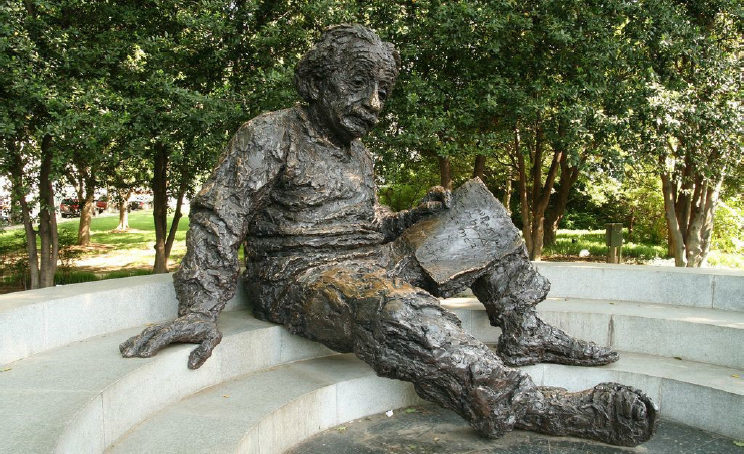
The statue of Einstein on the grounds of the National Academies of Sciences, Engineering, and Medicine faces the National Mall, not far from the Vietnam Veterans Memorial, the Lincoln Memorial, and the Reflecting Pool. Immediately behind the statue is a small grove of trees, which provide some shade in the summer (and backdrops to countless photographs of visitors sitting on Einstein’s lap). These trees provide a fitting image for this study of integration, for it is the connections between the flourishing branches, rather than the spindly trunks, that creates the canopy that provides both shade in the summer and viability in poor weather. Thinking about integration as the connections between branches transforms Einstein’s metaphor—as well as the setting of his monument—into a meaningful guide for future action.

