Strengthening U.S. Air Force Human Capital Management: A Flight Plan for 2020-2030 (2021)
Chapter: 6 Strengthening USAF Human Capital Management: A Flight Plan for 20202030
6
Strengthening USAF Human Capital Management:
A Flight Plan for 2020–2030
PREPARING NOW FOR THE FUTURE
“The evolving and dynamic security environment, which includes disruptive changes in the character and conduct of warfare, demands immediate changes to the identification, education, preparation, and development of our joint warfighters”
(Joint Chiefs of Staff, 2020, p. 2).
The U.S. Air Force (USAF) human capital management (HCM) system that has performed successfully in the past finds itself facing a different set of challenges than it confronted over the past three decades. The new great power competition likely to characterize the next decade is changing the very nature of warfare, involving complex technologies that are rapidly evolving. Moreover, those whom the Air Force will be recruiting to confront these developments bring a different set of qualifications and expectations. The Airmen needed in the future must be carefully selected, trained, and developed in the present to be prepared for future challenges when the time comes.
To succeed in this, it is critical that the Air Force undergo detailed and regular discussion about managing this set of developments: What does this future mean for Airmen? What skill sets will be needed in the Profession of Arms to succeed in the forecasted future environment? The Air Force has need for a highly technical and experienced workforce, and it is in fierce competition with private industry as well as the other Services for that talent. As future jobs are identified, HCM will require data-centric research
into critical competencies and other attributes. Forecasting human capital needs is complicated by rapidly advancing machine capabilities (e.g., automation, autonomous systems), which affect both human-machine interaction (including effective contributions to teams) and the development of machine components to augment or replace human operators. Likewise, the recent establishment of U.S. Space Force, within the Department of the Air Force, may impact aspects of Air Force HCM, including identification of new competencies and capabilities needed and assignments or transfers of personnel.
At the heart of preparing now for the future is the process of aligning the many elements that comprise the USAF HCM system and understanding feedback loops across the ecosystem model. This alignment should be guided by one critical strategic question:
How can the Air Force translate the strategic needs of future competition and conflict into connected HCM system requirements and decision-making policies and processes now?
To keep pace with future needs, the Air Force should expand thinking about steps that can be initiated today to strategically prepare for the future: What can be accomplished starting in the next 6 months that will make Air Force’s management of human capital better than it is today?
To guide Air Force initiatives, starting today and extending over the next 10 years, the National Academies of Sciences, Engineering, and Medicine’s Committee on Strengthening U.S. Air Force Human Capital Management offers this Flight Plan for immediate and future implementation to achieve objectives across three priorities—Data, Airmen, and Research:
The Data Priority
Human capital data is the most important strategic asset to optimize Airmen to fly, fight, and win in uncertain futures.
Recommendation: The USAF should deliberately manage Airmen through a connected HCM system, using data-driven decisions based on data systematically collected and analyzed.
The Airmen Priority
Ensuring the right Airman is in the right job at the right time is the best way to maximize performance and retention of the most effective Airmen.
Recommendation: The USAF should ensure Force effectiveness through evidence-based practices across a connected HCM system to optimally match Airmen to career fields, training, and job assignments.
The Research Priority
A connected and effective research system that informs USAF human capital decisions is critical to develop the future force and will provide substantial return on investment.
Recommendation: The USAF should invest in research that ensures that decisions about Airmen from accession to separation reflect professional best practices, evolve with changing technology and mission demands, and are integrated across the HCM system.
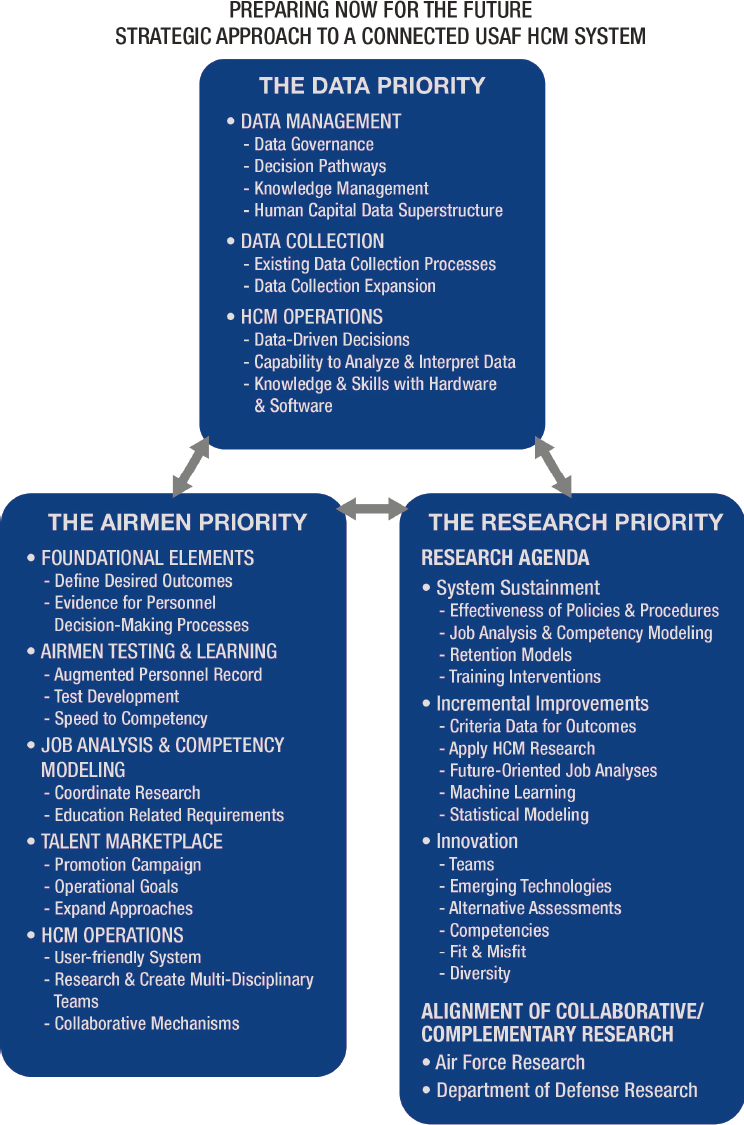
Much of what this Flight Plan recommends is not unique and has been recommended to Air Force leadership previously over the past 20 years in strategy documents and reports. As such, the committee sought to take a fresh look at these ideas in the current environment and in light of predicted future environments, and in relation to emerging technological opportunities to emphasize how the Air Force might approach its objectives to strengthen the USAF HCM system. Specifically, this Flight Plan recommends implementable actions to initiate immediate and future steps to forge a path for successful HCM into the mid-21st century (Figure 6-1 provides an overview of the action items for the Flight Plan’s three inter-connected priorities).
STRATEGIC APPROACH TO A CONNECTED USAF HCM SYSTEM
This Flight Plan is intended to advise the work of senior leadership and subordinate elements of the USAF Office of the Deputy Chief of Staff for Manpower, Personnel, and Services (AF/A1). However, the committee addresses this Flight Plan to the Assistant Secretary of the Air Force for Manpower and Reserve Affairs (SAF/MR), the resource authority for implementation and the office that should take responsibility for coordinating HCM research across the enterprise. Following the Flight Plan, SAF/MR should direct development of research and implementation plans across relevant USAF organizations, specifically, through elements of AF/A1; in addition, it should leverage external research organizations, as appropriate, to supplement internal capabilities (to include close coordination with other Services as well as the Office of the Secretary of Defense’s Office of People Analytics).
The ensuing discussion does not address resourcing, costs, or return on investment. The reason for this omission is because there exists a very wide
range of possible implementations, each carrying differing risks, costs, and potential returns on investments, including both immediate and systemic. Possible implementations could be “gold-plated” with very little risk but potentially relatively small return on investment unless calculated over a very long period of time. Alternatively, possible implementations could be “bleeding edge” and high risk but potentially very high return on investments. Even more complex would be a systemic implementation that combines low and high cost, low and high risk, and low and high return on investment elements. The decisions on how to address implementation of solutions are further complicated by the fact that some of the solution space may be characterized by very slow changing technology while other elements of the solution space may be evolving at a very rapid pace. These issues will need to be considered, of course, but without specifying a precise systemic solution, they cannot be considered by this committee.
Further, many elements of the Flight Plan are so closely intertwined that it becomes impossible to establish a rational priority among them. For example, suppose element X is an essential outcome of great importance, but element Y is on the critical path (as identified in the ecosystem model) to fully completing element X; is element X or element Y the “higher priority?” That said, addressing many elements of the Airmen Priority and the Research Priority will depend on accessible and accurate data that do not now exist. Thus, the committee believes that many elements within the Data Priority must be addressed very early in any comprehensive attempt to implement this Flight Plan. The Data Priority is a critical enabler of HCM decision-making, and the action items contained in this Flight Plan are intended to help the Air Force understand how to improve its approach to data without specifically prescribing what should be done. As such, the Data Priority action items purposefully emphasize strategic goals to improve decision-making, because the committee was not charged to (nor did it) conduct a thorough inspection or analysis of current USAF databases, cloud-based systems, fiber connections, etc. necessary to develop specific implementation solutions.
Efforts to address the Flight Plan’s three Priorities should be designed and implemented with the following strategic approach to a connected HCM1 system:
___________________
1 In this report, the word “connect” is used in various contexts. The intention associated with its use is to identify points at which people, data, and processes are brought together to achieve goals, such as better decision-making, more efficient information processing, or knowledge development. The report is agnostic on how these connections are made, since there are many different alternatives, each with costs and benefits, and each appropriate to some circumstances but not to others.
- Look for new opportunities to understand who Airmen are now, how they will develop as they continue in service, and who the Air Force needs them to be in the future, paying particular attention to potential mismatches between future needs and capability expectations.
- Inspire bold experimentation in approaches to USAF HCM, while also recognizing limitations of the state-of-science to ensure that changes to policies and procedures are scientifically valid.
- Drive scientific innovation in HCM through a coordinated effort across the service to blend the best of HCM research and development (“push”) with Air Force operational needs (“pull”) to advance scientifically valid capabilities faster than either could accomplish independently.
- Identify critical data needed to improve human capital decisions; plan and implement where, when, and how to collect that data and how to store and protect it while making it available to inform personnel decisions and research.
- Leverage expertise of the internal and external human capital research community to provide strategic input and perform data collection and analysis, commensurate with research and development processes applied to technology, weapons, and platform development.
Furthermore, SAF/MR should ensure that when human capital decisions are made, they are done with appropriate consideration of their impact on strategic needs and across other elements of the Air Force. To this end, as part of any implementation plan, SAF/MR should establish an ability to scientifically represent the entire HCM ecosystem in enough detail that changes and potential effects to any element of the system can be modeled and understood to a level of fidelity appropriate to the analysis and conclusions needed for the human capital decision under consideration (see Chapter 2 of this report). Creating such a model, validated against reality, provides a way to direct and coordinate research efforts, test the effects of proposed policy or technological changes, and understand subtle feedback mechanisms. To do so will require dedicated computational modeling research of the ecosystem so as to permit suitably comprehensive simulations necessary for exploring consequences of potential HCM decisions. The remainder of this Flight Plan offers a detailed discussion of the committee’s recommendations and action items for each of the three priorities.
THE DATA PRIORITY
Human capital data is the most important strategic asset to optimize Airmen to fly, fight, and win in uncertain futures.
Recommendation: The USAF should deliberately manage Airmen through a connected HCM system, using data-driven decisions based on data systematically collected and analyzed.
KEY ENABLERS/DRIVERS
- Emerging advances in technology enable volume and duration of data collection and analysis not previously feasible (e.g., artificial intelligence applications).
- Modern operational constraints and employment competition are expected to persist and increase, requiring innovative, efficient, and effective solutions to excel within those constraints to deliver the Air Force the nation needs.
- Digital qualitative methods, including technical capabilities in natural language processing, text mining, and other emerging advances allow qualitative data about Airmen (e.g., preferences) to be captured, processed, and used in human capital decisions as never before.
2030 DESIRED OUTCOMES
- The Air Force human capital data ontology and governance approach is in line with the Air Force data strategy and governance.
- Air Force personnel decisions across an Airman’s career are data-driven, and decision-makers leverage a collective human capital data superstructure2 for personnel data shared across the HCM system.
- The Air Force has a deep bench of talent and skills regarding data curation and maintenance, data analytics and forecasting, and data science.
___________________
2 The term “superstructure” is used here to preclude any implementation interpretation. The data superstructure may be physically centralized, federated, cloud-based, or connected by any other means that meets the needs determined by the Air Force. The point of having a superstructure is to have an overlying capability to securely access data from across the enterprise through a common interface that can reach into all component elements for requisite data, without engendering data update anomalies, copy cascade failures, or backup rollover issues.
WHY THIS IS IMPORTANT
- Valid and appropriate data are absolutely necessary to ensure the continued strength and vitality of a successful HCM system.
- The Air Force will not succeed in placing the right Airmen in the right jobs at the right time if it does not have access to the right data.
- Until critical systems can seamlessly share and use data across the human capital system, any efforts to reform or improve HCM are going to be slow, costly, and ineffective.
DATA FLIGHT PLAN
A vast amount of human capital data are already being collected to inform personnel decisions and develop policies, but such data are being collected in a variety of structures, formats, and methods. Further, in some cases, human capital data are either insufficient or not effective in informing personnel decisions. In other cases, new approaches to data analysis, such as text mining, make it possible to use data that were simply not usable before, creating new opportunities. As described below, the Air Force should take actions in data management, data collection, and HCM operations both to improve current data usage and to enable better data usage across the entire USAF HCM system. The major focus areas of the Data Priority are outlined in the Data Flight Plan overview (Figure 6-2), and details are provided in the action items that follow.
DATA MANAGEMENT
Data Governance
—Create a unified data governance approach, necessary for data to be used across the enterprise independent of data origin or administration, to ensure that the various data systems and repositories are using the same rules for data structure, data exchange, data definitions, and data curation.
- Develop and enforce a single comprehensive data governance structure (including formats, update policies, use policies, and structural security), keeping in mind that “data” includes a variety of things, such as algorithms, assessments, and rubrics, to facilitate alignment and collaboration across programs with similar or complementary data. Bring all data repositories into this structure, even if they physically reside on different systems, and normalize data curation and succession planning across the USAF HCM system, to ensure data collected are preserved and available for future research and

- Where Common Criteria Protection Profiles do not exist, sponsor the development of Protection Profiles to guide the development of appropriately secure implementations.
- Increase accessibility of data through robust de-identification processes to facilitate Air Force-sponsored research. De-identified data should be made available for analytical purposes to improve understanding of decision implications and effects. Pathways for accessing de-identified data should be developed to facilitate access. Policies regarding expanding the access and use of de-identified data for HCM should be developed.
analysis. Access control approaches should include, as appropriate and according to the applicable laws, regulations, and policies, least privilege, discretionary access control, mandatory access control, role-based access privileges, and lattice access management approaches. Access to fully identifiable data should be strictly restricted to need-to-know within controlled physical environs. Access to de-identified data should be carefully considered based on risk and outcome potential.
- Comply with existing policy guidance with regard to privacy and policy, as well as provide sufficient structural flexibility to adapt to new guidelines as well as new technology developments, particularly those that challenge the implementation of the policy requirements. This is particularly important with regard to de-identification solutions and challenges, which is a fast-moving area of research.
- Routinely review data storage media for susceptibility to obsolescence and degradation and, when necessary, move data to another storage medium. This should be integrated with data governance, so that any changes to data structure policies can be implemented as possible during the data transfer process.
—Plan for emergency operational capability in the absence of data, data sharing, and computational infrastructure (e.g., natural or deliberate disruption to information technology networks).
- Include exercises in which access to data is denied so as to plan for and develop robust emergency processes to support the critical HCM needs of the Air Force during such a crisis.
- Develop a minimal essential set of HCM information that is continually refreshed in a highly secure, wholly owned and operated system, which can serve as a hot replacement system for commercial data curation services (e.g., the “cloud”) for basic personnel matters in emergencies.
Decision Pathways
—Focus decision pathways on identifying the areas in which decisions could be improved through better use of data, and through auditing and documenting the decision algorithms and methods.
- Expand the capability for predictive and prescriptive analytics to support personnel decision processes. Expand the use of simulation and modeling for forecasting and understanding prioritization of workforce needs.
- Audit and document the existing decision algorithms and methods. For decision processes that rely on undocumented algorithms or on assumptions that may no longer be valid, consider re-engineering these to improve the validity and defensibility of the decisions.
Knowledge Management3
—Focus knowledge management linkages on creating the ability to leverage tacit and explicit knowledge to create a continuously learning knowledge-forward enterprise.
- Create a comprehensive knowledge management structure that permeates everything, including data, collaboration tools and processes, knowledge sharing opportunities, and governance.
- Facilitate knowledge management across the USAF HCM system through low-tech solutions such as implementing an annual or biannual conference to share presentations on relevant topics.
- Leverage technology to improve knowledge exchange across the USAF HCM system to improve tacit and explicit knowledge exchange, learn from others, and create opportunities for synergy. Potential technologies include collaboration tools and artificial intelligence-enabled software to facilitate data sharing and awareness of complementary efforts, leveraging data contained in a human capital data superstructure.
Human Capital Data Superstructure
—Create a human capital data superstructure: a unified system of systems for storage, access, and analytics of human capital data that is populated with all currently collected data and that is structured to be expandable to include new types and sources of data.
- Build a collaborative data management system that allows different units to efficiently collect, store, and share human capital data that will enable the Air Force to make better informed decisions.
- Establish standardized data collection procedures that prioritize efficiency and usable formats and ensure all data collected are sharable across the Air Force.
- Ensure that data can be accessed and efficiently transported across units whose mission and research interests could benefit from this information.
- Create “data marts” for those making human capital decisions, so that they have appropriate access to the history of individuals (including test scores, performance ratings, etc.) to establish a con-
___________________
3 In this discussion, the term knowledge management refers to the integrated management of all representations, uses, and storage of knowledge, including but not limited to the human brain, replications of aspects of human intelligence (e.g., artificial intelligence systems), books, videos, photographs, models, maps, charts, data sets, and collaborative processes. An effective knowledge management effort improves an enterprise’s use of all knowledge in order to better achieve goals and outcomes.
-
tinuously updating data profile of an individual Airman to inform decisions about that individual across his or her career.
- Conduct an audit of data being collected and made available to USAF HCM personnel to identify gaps in accessibility, usability, and utility of data in current form. Use the information gained through this audit to inform the development of the human capital data superstructure.
- Audit the human capital data superstructure against existing and planned USAF HCM processes to assess gaps in data and to identify decisions made without sufficient data. Use this information to evolve programs into systematic forecasting and modeling across the HCM system and to provide more robust analytics on how the overall USAF HCM system is performing.
- Continue the development of a comprehensive talent management system, leveraging the consolidated data management approach. Teach developing leaders how to use the Talent Marketplace to improve career pathway management and collect data from such usage (analytics) to inform the incremental improvement of both the system itself and the use of the system.
- Develop the analytic capability to monitor individuals and groups of individuals along career pathways, looking for unique profile elements that indicate a propensity for selection along different paths (e.g., adaptability). Use these data to illuminate juncture points where career decisions are made. Analyze and understand the data collected/available and how they might inform decisions, using methods such as longitudinal analyses.
DATA COLLECTION
Existing Data Collection Processes
—Increase the usability and utility of data already collected by ensuring it is in the appropriate format for use, is accessible when needed, and can be analyzed using the tools that are available. The utility of the data is a product of its validity, robustness, and comprehensiveness.
- Audit collected data to determine its validity and potential utility.
- Create usable and sharable data structures/formats that can be communicated and efficiently leveraged across multiple units.
- Identify software and other processes that can convert collected data to the established sharable data structures/formats.
—Expand collection of information on why Airmen leave active duty service.
- Evaluate the current utility of separation data and how effectively they are being used to inform effective retention programs, especially for critical skills and career fields with high training costs.
- Supplement regular non-anonymous exit surveys with periodic anonymous exit surveys to encourage honest responses about reasons for separation that may not emerge in the current processes; use current separation data more effectively by exploiting the ability to link separation information to Airmen records.
- Replace the single separation code with a comprehensive checklist for all reasons Airmen separate.
—Identify opportunities to incorporate artificial intelligence and other technologies to improve data flow, granularity of decisions, and speed of interactions.
- Consider a constellation of technologies, including machine learning and natural language processing, to better comprehend collected data and inform decision-making.
- Evaluate how artificial intelligence can enhance the utility of data and capitalize on the speed and accuracy of decisions.
- Investigate new qualitative analyses (e.g., natural language processing, text mining) of interview data to identify recurring patterns and themes that subsequently could be used to improve interventions, retention, and incentive plans.
Data Collection Expansion
—Audit the current personnel management decision processes to identify gaps in data collection areas where personnel management decisions could be better informed with either new or more data. This must include documenting the decision processes in detail to understand what data are used and in what ways, so that assumptions, rationales, and estimates can be identified. That information should be analyzed to identify new data sources to reduce dependencies on heuristics and estimates and improve precision and granularity of decisions.
- Collect more data relevant to analysis of person-job match (e.g., preferences, interests, motivation).
- Collect data to baseline existing readiness shortfalls at the individual level and validate whether anecdotes are representative of underlying data.
- Implement digitization of historical artifacts (e.g., paper records/interviews) so that they become usable for research and analyses.
- Analyze rollouts of new procedures, algorithms, etc. as quasi-experiments, by collecting data on their performance to compare
with the incumbent procedure and run controlled experiments when possible.
—Collect data to enable more robust analysis and insight into assignment performance, choices of training, motivations, short- and long-term goals, and attrition.
- Systematically document the types of information that decision-makers use when approving/denying waiver requests.
- Expand criterion data collection to include more distal outcomes (e.g., job attributes via surveys, pattern of job assignments across career).
- Increase metadata tagging ability to add contextual data to records, beyond time and location, to include robust descriptors such as environmental elements, team components, and unit morale.
—Collect data about teams, collaboration, and mission effectiveness; incorporate into data management (early warning capability) and analysis efforts.
- Identify information that would enable the Air Force to evaluate mission effectiveness focusing on team- and individual-level selection.
HUMAN CAPITAL MANAGEMENT OPERATIONS
—Institutionalize the practice of data-driven decisions in HCM.
- Embed data into all levels of USAF HCM decisions, inspired by leaders who transparently base decisions on data rather than intuition or anecdotal information.
- Increase data literacy Service-wide, not just at senior leadership levels, so that any individual making human capital decisions can appropriately analyze and interpret data.
- Communicate the criticality that all relevant collected data must be included in the human capital data superstructure to maximize its value to the HCM system. Consider the creation of a reward system for contribution to and use of the centralized HCM data superstructure.
—Improve capability to analyze and interpret human capital data.
- Develop a broader array of data science training opportunities (e.g., online opt-in courses) to significantly improve job function in critical jobs, contribution to data-driven culture, and mission readiness.
- Invest in the selection, development, and retention of more data science specialists, and specialists from other relevant areas such as decision science and economics, to leverage existing data and grow capacity.
- Promote a unified data community that collects and shares data and analyses across USAF HCM organizations and teams.
—Augment human capital knowledge and skills with cutting-edge hardware and software.
- Explore ways to break down administrative barriers, such as overly cautious risk management decisions, to effectively partner with industry and academia for rapid adoption of advancing computational capabilities (e.g., for data analysis) through expanded access to industry standard software suites.
- Ensure that analysts have access to hardware platforms that can run the industry standard software suites with adequate processing capacity.
THE AIRMEN PRIORITY
Ensuring the right Airman is in the right job at the right time is the best way to maximize performance and retention of the most effective Airmen.
Recommendation: The USAF should ensure Force effectiveness through evidence-based practices across a connected HCM system to optimally match Airmen to career fields, training, and job assignments.
KEY ENABLERS/DRIVERS
- Emergent technology (e.g., machine learning) requires reconsideration of the role of the Airman as more repetitive, routine, or dangerous activities are outsourced to machines or shared between Airmen and machines. As the Air Force brings a numerically smaller force augmented by technology to face future adversaries, it will become increasingly important to assign Airmen to capitalize on their unique contributions to tackle unexpected circumstances or situations where out-of-the-box thinking is required (humans-over-the-loop).
- Changing operational realities and forecasted futures require reconsideration of the historical approach to individual assessments for unit assignment as if “every unit is the same” (especially for differences between junior versus senior ranks and officer versus enlisted Airmen).
- Recent changes to the retirement structure are expected to alter Airmen perceptions of the costs of separating before retirement. As such, achieving good person-job fit over a career will be increasingly important to retaining a career force.
2030 DESIRED OUTCOMES
- The number of unfilled positions (at all levels and career fields) is reduced, especially for hard-to-fill positions for critical skills essential to force readiness and mission accomplishment.
- The Talent Marketplace is fully developed to successfully capture and leverage the unique talent in every Airman (officer and enlisted) in making job assignments.
- All individual and team personnel decisions are made based on consistently documented best practices with the greatest amount of quality data possible.
- Decision-making rationale (including validity considerations) about human capital assessment processes, policies, and procedures are documented and readily available for research across the USAF HCM system.
WHY THIS IS IMPORTANT
- The methods used to manage people for industrial era jobs are unlikely to be effective for managing people for information age innovations. As technology, speed of operations, and mission flexibility increase, HCM approaches need to change to keep up.
- Airmen are individuals with unique experiences, which should play a larger role in job assignment to maximize their contribution to the mission and to ensure the Air Force remains a competitive employer.
- Various selection and classification algorithms in use across many pockets (e.g., special operations, cyber, USAFA, AFSC assignments, AFROTC scholarships) create inefficiencies and missed opportunities for improved effectiveness when they do not capitalize on already existing data or validation processes to build upon each other or apply previously developed capabilities elsewhere.
AIRMEN FLIGHT PLAN
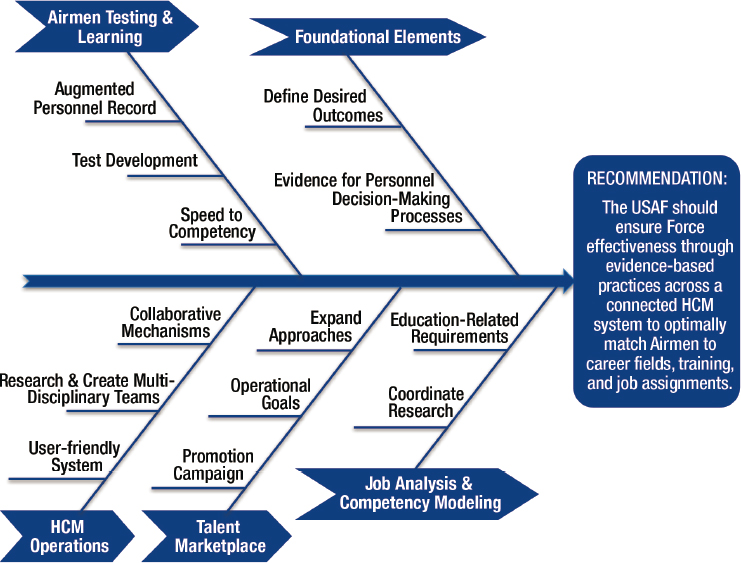
The USAF HCM system exists to ensure the readiness of Airmen to fulfill the mission of the Air Force. It impacts the quantity and quality of personnel, promotion and retention processes, training and professional development programs, job classification and job assignment policies and processes, and other human capital matters. To better serve its purpose and its needs, as well as those of its Airmen, the Air Force should expand and coordinate data-driven capabilities in foundational elements, Airmen testing and learning, job analysis and competency modeling, the Talent Marketplace, and HCM operations. The major focus areas of the Airmen
Priority are outlined in the Airmen Flight Plan overview below (Figure 6-3), and details are provided in the action items that follow.
FOUNDATIONAL ELEMENTS
—Define desired outcomes the Air Force wants to impact via its HCM system.
- Identify individual and collective outcomes Airmen and the Air Force require to provide ready forces for the nation’s defense (e.g., on-the-job performance, retention, engagement, training completion competency levels, weapons systems’ mission-capable rates).
- Determine whether/how the Air Force currently measures those outcomes, and whether their measurement is in line with professional best practices.
- Establish a regular schedule for the evaluation and adjustment of outcome measures for different AFSCs and ranks as job and mission requirements change over time (e.g., as reflected in new competency or job analysis data).
—Examine evidence for current personnel decision-making processes.
- Map every point in an Airman’s career where a personnel decision is made, and track how those decisions are being made.
- Examine whether personnel decisions such as selection, classification, job assignments, training, education, performance evaluation, promotion, career broadening, and sabbatical are made in a manner that positively impacts key individual and collective outcomes; use standards of evidence that reflect professional best practices; and use standards that reflect latest relevant research.
- Expand current and develop new models (e.g., expanding the causal loop model of the USAF HCM ecosystem) to consider tradeoffs (e.g., time, cost, desired outcomes) between different potential decisions (e.g., changes to selection processes versus training approaches).
- Examine personnel decision processes and procedures with regard to standards and bias and fairness; audit practices to ensure equitable treatment of all Airmen.
- Use results of the vetting above to inform priorities for filling gaps and improving personnel decision-making where needed.
AIRMEN TESTING & LEARNING
—Leverage the human capital data superstructure to enable the creation of an augmented personnel record (including, for example, centralized testing scores, training failures, and performance reviews) that could be accessed as appropriate to improve human capital decisions at the individual and team levels.
—Centralize and align operational test development efforts to reduce costs, continually monitor new developments and research on testing technology, and enhance testing capabilities.
- Catalogue existing test development efforts across the Air Force to facilitate coordination of efforts (e.g., identifying possible synergies, avoiding duplication of effort).
- Ensure that test development aimed at personnel decision-making aligns with relevant job requirements as revealed through job analysis or competency modeling.
- Improve integrity and capacity of online testing, and monitor potential effects on disadvantaged groups (e.g., those with limited access to internet or modern hardware).
- Explore innovative item types and administration formats (e.g., adaptive testing or remote proctoring).
—Increase speed to competency using skills assessments for self-development and adaptive training that tailors entry and progress through learning
modules based upon the experience level and performance of the individual Airman. Expand opportunities for adaptive training during the delayed entry program.
JOB ANALYSIS & COMPETENCY MODELING
—Coordinate Air Force-wide research efforts on job analysis and occupational competency modeling.
- Catalog all current and ongoing job analysis and competency modeling efforts occurring in the Air Force to build service-wide awareness of their existence, focus, and scope.
- Continue recent efforts to identify and reconcile discrepancies (and redundancies) between job analysis and competency models to bring them into alignment so that they are informing the design, development, and evaluation of human capital decision-making (e.g., selection, classification, placement, performance management, promotion, and retention) in a consistent way system-wide.
- Consolidate findings from the cataloging and reconciliation efforts described above to help derive an overarching enterprise competency framework/approach to synthesize current efforts, and guide future efforts.
- Review any proposed new job analysis or competency modeling effort against the consolidated results of the activities above (i.e., use the consolidated findings above as a starting point for new job analysis and competency modeling efforts).
—Conduct job analyses to clarify education-related requirements for all career fields in order to revise (as appropriate) current requirements or preferences for personnel with certain educational achievements.
- Identify and clarify the rationale for STEM-related requirements for each enlisted and officer career field that has such requirements.
TALENT MARKETPLACE
—Initiate a Talent Marketplace promotion campaign across the entire service to stimulate use and buy-in through formal training, consumer feedback, and success stories.
—Expand use of the Talent Marketplace, or a conceptually similar technology, to modernize the approach to enlisted Airmen assignments.
—Leverage data and create processes to further enable the operational goals of the Talent Marketplace for both officers and enlisted Airmen.
- Ensure that the Talent Marketplace is also an information marketplace that gives position holders and candidates enough information about one another to form informed preferences.
- For job openings already using the Talent Marketplace, encourage position owners to post detailed job descriptions and review many candidates (i.e., submit long preference lists), and encourage candidates to review many jobs.
- Incentivize true preference revelation for both “hiring” and “being hired” parties (i.e., make it safe to rank opportunities in their honest order of desirability).
- Use data to predict and recommend person-job match in a contextual manner, including preferences on both sides.
- Better leverage exit survey and other data for insights such as hidden reasons for attrition, the influence of preferences on separation decisions, and diversity concerns related to retention.
—Expand the Talent Marketplace to strategically fill hard-to-fill jobs and improve retention, especially in critical career fields.
- Analyze whether and why certain job assignments predictably cause top choices to resign rather than take the assignment.
- Consider alternative approaches and incentives to offer declined jobs to someone who would prefer the position.
- Develop flexible procedures that preserve the possibility of retaining candidates who have chosen to separate rather than accept an assignment, by exploring whether other assignments would cause them to reconsider.
HUMAN CAPITAL MANAGEMENT OPERATIONS
—Make the USAF HCM system more user-friendly for Airmen.
- Create an automated, searchable, personnel policy dashboard to assist all Airmen interacting with the personnel system, especially those with responsibility to make personnel decisions about other Airmen.
—Use readily available, sophisticated, and robust academic knowledge and research bases to support and advance all areas associated with HCM and create multi-disciplinary teams of specialists to spearhead the prioritized changes in HCM.
- Identify, recruit, and select diverse individuals with specialized education in multiple disciplines relevant for HCM (e.g., industrial/organizational psychology, workforce analytics, artificial intelligence architecture, human resources strategy, organizational behavior, psychometrics, labor economics).
- Provide educational opportunities to internally grow expertise, especially among diverse and under-represented groups, of those holding or in line to hold advanced specialist positions in HCM.
—Create collaborative mechanisms to enhance the joint work of HCM experts.
- Leverage diverse HCM expertise in designing databases (to ensure end-user needs are met) and in institutionalizing data-sharing practices and policies.
- Embed collaborative tools and practices into innovative research efforts (e.g., work on human dynamics of teams with automation should include roboticists, artificial intelligence experts, psychologists, human computer interaction designers, workforce planners) as well as into operational activities (i.e., accession, talent management, training).
THE RESEARCH PRIORITY
A connected and effective research system that informs USAF human capital decisions is critical to develop the future force and will provide substantial return on investment.
Recommendation: The USAF should invest in research that ensures that decisions about Airmen from accession to separation reflect professional best practices, evolve with changing technology and mission demands, and are integrated across the HCM system.
KEY ENABLERS/DRIVERS
- Emerging technologies that facilitate distance collaboration and information sharing offer new opportunities for cooperation and alignment between physically disparate research and operational entities.
- Complex new challenges from a future great power competition and a numerically much smaller force means the Air Force must prepare its human capital research enterprise to meet unexpected problems and rapidly experiment with evolving and bold ideas for their resolution.
- Personnel is the single largest expense for the USAF; human capital research is one of the more effective ways to facilitate the greatest return on investment in personnel.
- Digital collaboration tools and artificial intelligence applications offer new ways to overcome organizational stovepipes, especially across the research community, which are often due to physical separation.
2030 DESIRED OUTCOMES
- The Air Force has a more integrated, collaborative human capital research program that informs decisions about Airmen at all career stages.
- All assessment processes are subjected to routine and systematic validation and re-validation as the standard course of operations.
- Air Force-determined outcomes of importance (e.g., individual and team job performance, diversity, retention) are supported by an integrated research program focused on meeting Air Force needs.
WHY THIS IS IMPORTANT
- The Air Force aspirations of an effective talent management vision will not succeed without support from a robust research program that provides cutting-edge human capital research to inform data-driven 21st century force development decisions across a coordinated and connected HCM system.
- The world is changing and moving too fast to expect that the USAF HCM system will keep up without data-driven collaboration and research, including leveraging advantages of artificial intelligence.
- Without integrated research programs connected to strategic priorities, isolated research efforts die out, parallel or highly similar efforts are undertaken with duplication of resources, and assessments and other tools become operational because of high advocacy rather than validated science-based quality.
RESEARCH FLIGHT PLAN
To ensure the current and future effectiveness of the USAF HCM system, the Air Force should implement systematic research initiatives to leverage routine data collection and analysis processes for accurate and effective sustainment of the system. As that sustainment research identifies the need for changes in the existing system, and as professional best practices suggest alternatives to the existing system, the Air Force should also maintain an active research program to build upon its successes with incremental improvements. Simultaneously, the Air Force should invest in innovative, high-risk/high-reward research critical for future HCM approaches that keep pace with the competitive market. To maximize research synergy and reduce redundant efforts for cost savings, SAF/MR should oversee the research community with an enterprise-level perspective to identify similar ideas that emerge in different locations and with slightly different structures. The major focus areas of the Research Priority are outlined in
the Research Flight Plan overview (Figure 6-4), and details are provided in the action items that follow.
RESEARCH AGENDA
Research and Analysis for System Sustainment
—Evaluate the effectiveness of all USAF HCM system policies and procedures used in the initial assessment, entry-level classification, and assignment systems.
- Routinely examine the impact of the Armed Forces Qualification Test (AFQT), Air Force Officer Qualifying Test (AFOQT), qualification composite cut scores, and special tests for each enlisted AFSC or other officer-commissioning standards as measured against training success, early attrition, diversity, and other important Air Force criteria. As these analyses indicate unacceptable trends, initiate research to correct the identified problems.

- Routinely examine the effectiveness of waivers granted for enlistment, classification, or commissioning standards as measured against performance, retention, and diversity, and adjust policies as needed.
—Establish an Air Force-wide process for evaluating and updating job analysis and occupational competency data to ensure that they remain current over time.
—Use occupational competencies and other competency modeling efforts as a foundation in designing and evaluating selection and classification tools and decisions.
—Evaluate the impact of the entry-level selection and classification system on retention-related criteria beyond initial entry training (e.g., first-term attrition, re-enlistment, mid-career officer losses, 7-day option losses). If these analyses indicate limited potential for the existing system to impact these criteria, initiate research to identify high-potential constructs to augment or replace the existing system.
—Refine current retention models to account for contemporary trends that are inconsistent with the models. Leverage exit survey data to refine the Talent Marketplace. Expand upon types of data collected (more granular characteristics of Airmen retained versus leaving) as well as analytic techniques applied (e.g., sentiment analysis and text mining).
—Routinely evaluate training interventions (e.g., training technologies, implementation of pre-training, developing a multi-skilled Airman, retraining) regarding training cost and post-training performance.
Research for Incremental Improvements
—As the Air Force defines outcomes to achieve at each personnel decision point, measures for those outcomes may require both incremental and innovative research efforts to broaden the kinds of criterion data collected. Preliminary research initiatives could include:
- Expand validation processes and approaches for selection and classification elements to address long-term results (e.g., that the service member is successful in an Air Force career) in addition to near-term results (e.g., that the prediction of success in training is correct).
- Explore additional ways to collect performance information for use in program evaluation or validity studies (e.g., reviews for research purposes only, or capitalize on existing performance feedback information that could be de-identified for use in research).
—Ensure that the Air Force has an active research program dedicated to maintaining currency with HCM research literature. As predictors of important Air Force criteria (e.g., task performance, counter-productive
behaviors, citizenship behaviors) emerge in the private sector or other Services, the Air Force should evaluate those predictors for feasibility for use in its own context.
—Conduct future-oriented job analyses to forecast how different career fields will change (e.g., tasks and competency requirements), and use those forecasts in planning for new assessments to support future personnel decision-making.
—Explore advances in machine learning for improving prediction and understanding of valued Airmen outcomes (e.g., training performance, retention) using currently available archival data on Airmen as input (e.g., accession data, training data).
—Explore applications for machine learning that might lead to better understandings of relationships between person-job fit and outcomes such as poor performance, low job satisfaction, and early attrition.
—Assess USAF HCM decision points to determine whether some decisions that are now made by human judgment after a record review (e.g., a promotion board, school selection) could be made more efficiently, fairly, and reliably with statistical modeling.
Research for Innovation
—Better coordinate existing research and expand on current efforts on how to structure teams specifically to enhance mission effectiveness (including human and non-human team actors/robots or geographically dispersed operational and research teams).
—Examine the potential utility of emerging technologies (e.g., gaming, virtual reality, simulation, augmented reality, artificial intelligence) for improved human capital decision-making and training.
- Develop models for determining the effectiveness of these approaches to enhance, expand, and improve person-job matching and classification and online education, tests, and assessments.
- Determine methods to assess effectiveness of training when the training experience varies widely across individuals.
- Conduct more research to detect test compromise or to build assessment tools that are resistant to cheating, as training and assessments are increasingly conducted remotely.
—Make better use of qualitative data by investigating advances in natural language processing of available text data (e.g., performance review narratives, open-ended responses on surveys, Airmen resumes, job descriptions and task statements) to gain new insights on Airmen characteristics and career field requirements.
—Support research into methods that will allow de-identified data to be used for HCM research at individual and organizational levels.
—Explore alternative methods for assessing Airmen characteristics (e.g., competencies) that suggest promise based on findings emerging from the latest academic research literature (e.g., rapid response approaches to personality assessment, machine learning-based approaches to scoring traditional assessments).
—Expand and integrate research on important competencies (e.g., adaptability and resilience) in terms of assessment, job requirements, and training.
- Ensure that research efforts on these competencies are coordinated across the Air Force (i.e., within AF/A1, Air Force Research Laboratory, School of Aerospace Medicine, Air Education and Training Command, and Air Force Special Operations Command).
- Ensure that Air Force efforts in these competency areas are informed by and build upon efforts in other Services.
—Explore whether it is more beneficial for Air Force purposes to minimize misfit or maximize fit across AFSC and job assignment.
—Support research addressing diversity and the problem of adverse impact in assessments, decision processes, training success, and other personnel evaluation points.
—Support research to identify career fields where machine-human interactions will become more prevalent (e.g., humans operating in teams with robots and artificial intelligence) and the implications this has for HCM decision-making and training needs.
ALIGNMENT OF COLLABORATIVE/COMPLEMENTARY RESEARCH
Across the Department of Defense and USAF HCM research community, the Air Force should understand what is being pursued, enable and encourage collaboration, and monitor progress from the enterprise-level perspective for a more effective and efficient research system to serve Air Force strategic needs.
Air Force Research
- Conduct routine systematic reviews of research proposals across the Air Force to identify potential collaborations for HCM research. Look for interdisciplinary opportunities (e.g., economics, cognitive and social psychology) to increase cross-functional value potential.
- Periodically audit research programs to identify redundancies and create collaborative or synergistic opportunities, such as looking for larger sample sizes and/or increased scope of research questions.
- Adopt collaboration tools and processes, and apply existing research on collaboration, to enable cross-functional collaboration across distance and crossing organizational lines.
- Create an enterprise-level dashboard view of research progress, showing which elements have been evaluated: when, by whom, and what the results were. Monitor action implementation.
- Use artificial intelligence techniques to identify similar or synergistic lines of research, notifying the researchers of potential opportunities to collaborate.
Department of Defense Research
- Use regularly established meetings such as the Defense Advisory Committee on Military Personnel Testing (DACMPT) and Manpower Accessions Policy Working Group (MAPWG) to identify efforts from other Services that may provide the Air Force with new capabilities for low investment costs.
- Partner with other Services to increase sample sizes for human capital research on service-similar occupational specialties, especially those that are highly selective and have high attrition, such as special operations. These efforts should include research at the individual and team levels.
SUMMARY
The Flight Plans presented above represent an integrated approach to changing the existing USAF HCM system to better reflect the realities of changes in the world, including the people, processes, and technologies. Seismic changes have occurred in the past several decades that have impacted how people work, what people do, and how people work together. Using industrial era approaches to managing this quickly changing environment is a recipe for frustration and ineffectiveness. The Air Force recognizes the changes and challenges, which is why it asked for this study. Using this set of Flight Plans, the Air Force can craft an information-era solution to managing its most critical asset: its Airmen.
REFERENCE
Joint Chiefs of Staff. (2020). Developing Today’s Joint Officers for Tomorrow’s Ways of War: The Joint Chiefs of Staff Vision and Guidance for Professional Military Education and Talent Management. Available: https://www.jcs.mil/Portals/36/Documents/Doctrine/education/jcs_pme_tm_vision.pdf.
This page intentionally left blank.


