Origins, Worlds, and Life: Planetary Science and Astrobiology in the Next Decade (2023)
Chapter: Recent Achievements
Recent Achievements
The past decade has proved to be particularly rich in new discoveries. The members of the decadal survey committee identified some 40 significant advances during this decade. Ten representative examples from across the solar system can be found below.
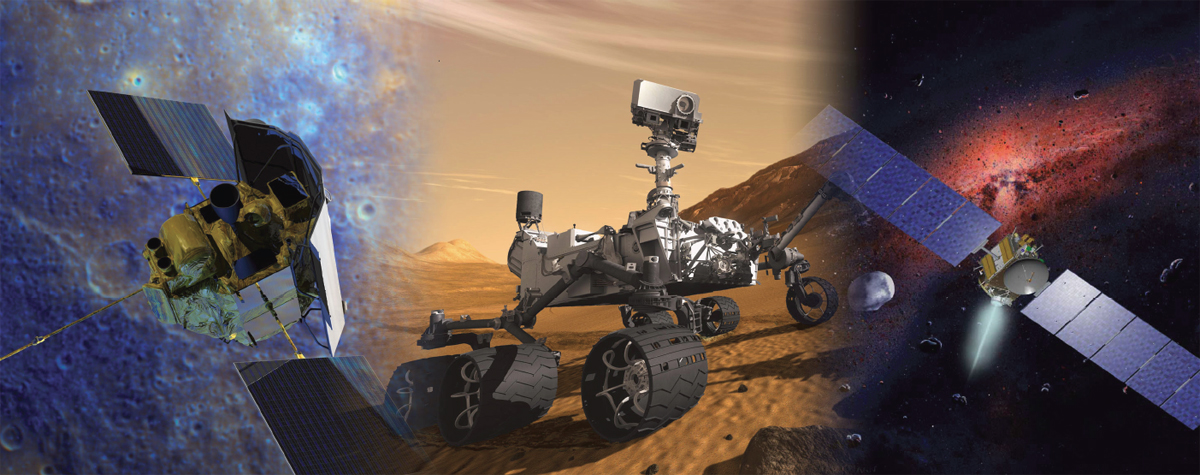
Mercury is a volatile-rich world: Contrary to predictions, data from MESSENGER (Figure 2) revealed that elements that evaporate at moderate temperatures are more abundant on Mercury than on Venus or Earth and are comparable with those on Mars. High abundances of sulfur and low abundances of iron in Mercury’s silicate mantle indicate that the planet formed with less oxygen than the other bodies of the inner solar system, providing insight into the building blocks and formation of terrestrial bodies.
Venus may have been habitable for billions of years: New climate models indicate that Venus could have had modern-Earth-like conditions until its current runaway greenhouse climate was triggered by several simultaneous, major volcanic eruptions about a billion years ago.
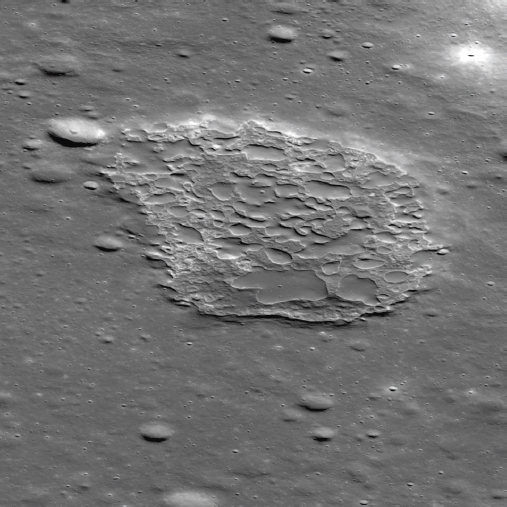
The Moon’s recent activity: The results returned by the Lunar Reconnaissance Orbiter indicate that the Moon’s surface has been
FIGURE 2 (Above) Artists’ impressions of some of the spacecraft responsible for the significant advances discussed in the decadal survey. From left to right: MESSENGER in orbit about Mercury, the Mars rover Curiosity exploring Gale Crater, and Dawn, which sequentially orbited the large asteroid Vesta and the dwarf planet Ceres.
altered in recent geologic times. Although volcanic activity was thought to have ceased more than a billion years ago, images of irregular basaltic deposits (Figure 3) indication that eruptions may have occurred within the past 100 million years.
The internal structure and habitable environments of Mars: The InSight lander detected marsquakes, with magnitudes as high as 4. Seismic waves probed the martian interior and revealed that Mars has a thick, fractured crust, a mantle, and a molten core that includes a sizable fraction of light elements. Elsewhere on Mars, Curiosity (Figure 2) and other rovers have explored numerous ancient habitable environments.
Brine deposits on Ceres: An unexpected result of the Dawn mission (Figure 2) was the detection of surface brine deposits, in some cases associated with recent cryovolcanism. This discovery suggests that water–rock interactions persisted throughout much of Ceres’s history, increasing its astrobiological potential.
The dilute cores of Jupiter and Saturn: Gravity data from Cassini and Juno—orbiting Saturn and Jupiter, respectively—have revealed that the deep interiors of both planets are not sharply defined, as previously assumed. Rather than having small rock–ice–metal cores, both planets likely have extended envelopes enriched with heavy elements. These results suggest that new models for the formation and evolution of the giant planets are required.
A habitable ocean at Enceladus: The presence of subsurface water on Enceladus has been known for some time. However, its distribution was unknown. Long-term observations by Cassini confirmed that the liquid layer is global in extent (i.e., an ocean) and in direct contact with the satellite’s rocky seafloor, making it a potentially habitable environment.
Titan is a world of two oceans: The presence of seas and lakes of liquid methane on Titan’s surface is not new. But long-term radar tracking of surface features by the Cassini spacecraft indicated the presence of a subsurface, liquid water ocean, sandwiched between two layers of ice. The combination of surface and subsurface liquid environments makes Titan unique.
Changeable Uranus and Neptune: Long-term monitoring of Uranus and Neptune by the Hubble Space Telescope (HST) revealed their atmospheres to be highly changeable. Contrary to Uranus’s bland appearance during Voyager 2’s flyby in 1986, HST’s observations showed a storm outburst in 2014 and significant brightening of seasonal polar clouds in 2022
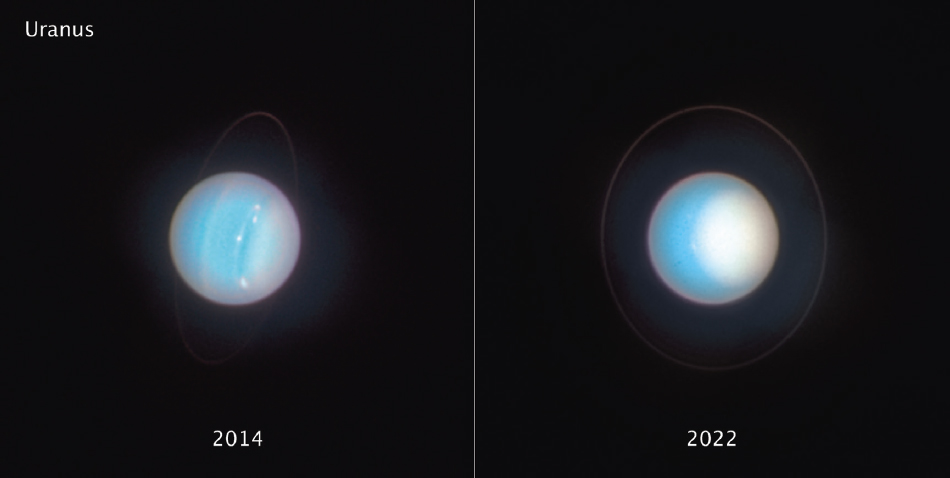
(Figure 4). A large dark spot was seen on Neptune during Voyager 2’s flyby in 1989, and HST’s observations revealed that other dark spots appeared in 2015 and 2018.
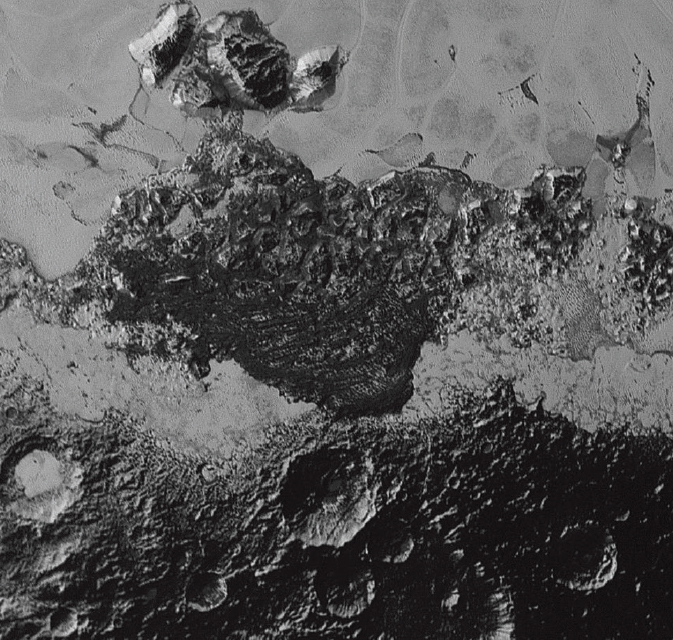
Pluto’s unexpected surface diversity: The New Horizons spacecraft revealed that Pluto (Figure 5) has glaciers of nitrogen ice, channels apparently carved by liquid, several possible cryovolcanoes, and a convecting—that is actively overturning—ice sheet unique in the solar system. Such observations demonstrate that very distant objects can be geologically active.


