Origins, Worlds, and Life: Planetary Science and Astrobiology in the Next Decade (2023)
Chapter: Recommended Investigations and Missions
Recommended Investigations and Missions
The 12 key questions outlined on the preceding pages are a useful starting point for defining a set of recommended activities to be addressed in the coming decade. But they are not sufficient, because each question is too broad. That is, none of the questions is readily addressable by a simple set of investigations or a finite set of spacecraft missions. Indeed, each of the questions encompasses issues that will keep multiple generations of researchers busy for decades. However, by breaking down each question into its component subquestions and asking how these might be answered, the committee identified some
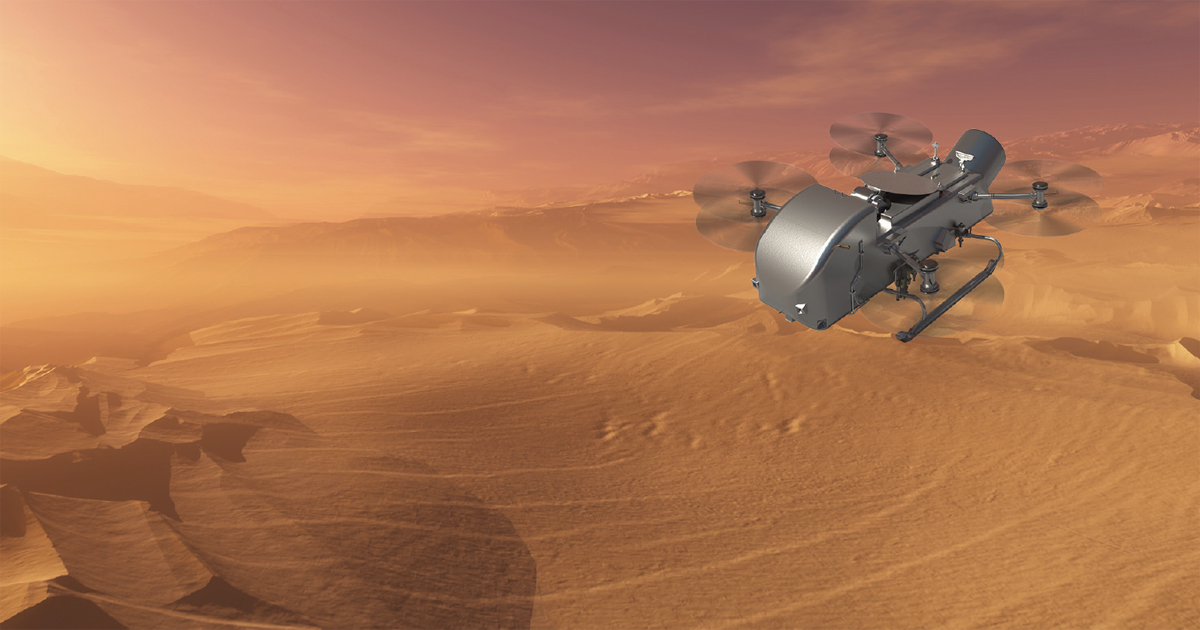
FIGURE 23 (Above) Artist’s impression of Dragonfly in flight above Titan’s hydrocarbon dunes in the mid-2030s. Selected for development in 2019 as NASA’s fourth New Frontiers mission, this eight-bladed rotorcraft is scheduled for launch in 2027. Each rotor is approximately 1 meter in diameter.
360 investigations that could potentially be addressed in the coming decade by a variety of research approaches using, for example, theory and modeling, laboratory studies, telescopic observations, and spacecraft measurements. Moreover, looking across these 360 strategic research activities it became obvious that specific issues, particular planetary bodies, and types of observations appeared multiple times. These common elements included the following:
- The central role of sample return and in situ analyses for providing breakthrough science and ground-truth for other types of studies;
- The lack of understanding of many aspects of ice giants and the importance of comparative studies of the ice- and gas-giant systems;
- The effects of processes occurring during the formation of the solar system on the mixing of primordial materials and the formation of planetary building blocks and the need to place additional constraints on the dynamical evolution of the solar system from the earliest phases of planet migration to ongoing bombardment;
- The complex interplay of internal and external processes that affect planets, moons, rings, and small bodies, and the factors responsible for the varied initial states and divergent evolutionary paths taken by the terrestrial planets;
- The environmental conditions that led to the emergence of life on Earth and the importance of understanding habitability beyond Earth, particularly on Mars and icy ocean worlds; and
- A strong desire to make substantive progress this decade in understanding whether life existed (or exists) elsewhere in the solar system.
A key aspect of a decadal survey is to recommend a program of activities—for example, new missions and associated basic research—for the coming decade. Organizing such a program around the six common elements listed above has the potential to make significant progress in addressing important aspects of the 12 science questions in the coming decade. But this is possible only if sufficient funding is available to pay for it. Matching community aspirations with fiscal reality is the most difficult aspect of a decadal survey. Fortunately, NASA’s planetary science and astrobiology programs and related activities at NSF have very strong bipartisan support in Congress—as evidenced, for example, by a doubling of PSD’s budget in the previous decade. Thus, devising a decadal plan that is expansive, aspirational, and inspirational is more likely to attract budgetary support than one that does not have these characteristics.
By making minimal, but realistic, assumptions about future funding for planetary science and astrobiology activities, the survey committee devised its recommended program for the period 2023–2032. The highlights are as follows:
- Begin work, if possible, on a major new mission to Enceladus in the late 2020s for launch in the late 2030s or early 2040s (Figures 28 and 29).
- Continue support for the Lunar Discovery and Exploration Program and initiate the Endurance-A rover mission in the latter half of the 2020s (Figures 32–34).
- Continue support of the Mars Exploration Program, and if possible, start work on Mars Life Explorer in the late 2020s/early 2030s (Figure 36).
- Continue the Discovery program (Figure 24) and select five new missions by 2032 (see Table 1).
- Continue the New Frontiers program (see Table 2) and select as many as three new missions from the survey’s recommended candidates by 2032 (Figures 38–46).
- Maintain support for planetary defense with the launch of NEO Surveyor (Figure 48) and begin work on a new rapid-response flyby reconnaissance mission.
- Increase funding for research and analysis programs so that total funding amounts to at least 10 percent of PSD annual budget by mid-decade.
Subsequent pages explore many of these recommended activities.