Origins, Worlds, and Life: Planetary Science and Astrobiology in the Next Decade (2023)
Chapter: Uranus Orbiter and Probe
Uranus Orbiter and Probe
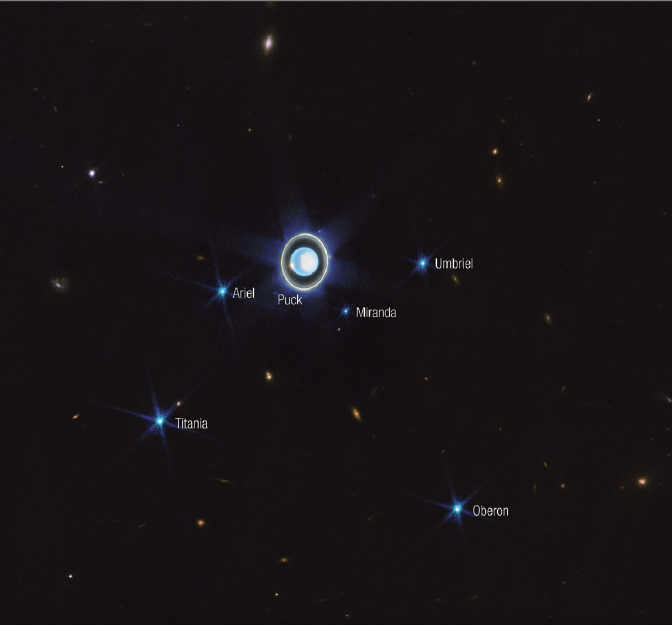
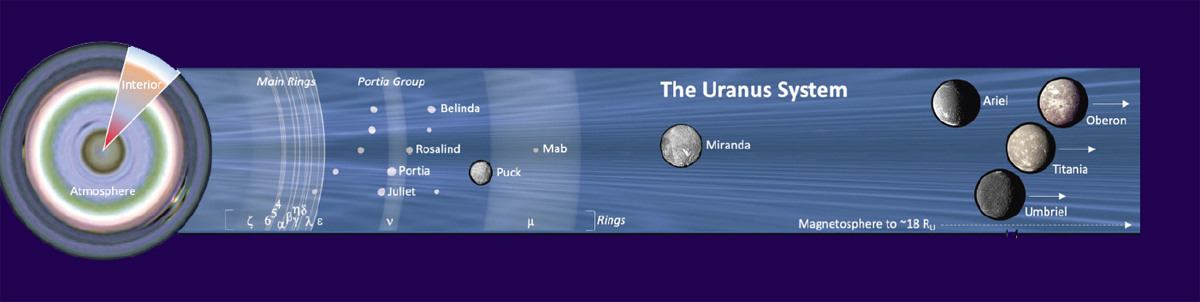
The decadal survey recommended that NASA begin work on a large-class mission to Uranus this decade. Uranus has an active atmosphere (see Figure 4), a complex magnetic field, numerous rings, and 27 known satellites (Figures 25 and 27) and is one of the most intriguing bodies in the solar system. A giant impact in the distant past may have knocked the planet on its side, producing its extreme axial tilt and, possibly, its rings and moons too. The satellites system is the least understood in the solar system. The larger satellites were imaged by Voyager 2 during its flyby in 1986 and appear to be made of ice and rock. Moons such as Ariel and Miranda—respectively 1,158 and 472 km in diameter—are surprisingly geologically active for such small bodies. Some of the moons may even possess internal oceans.
Uranus is an ice giant. Its internal structure and composition are distinctly different from the giant planets Jupiter and Saturn. While the giant planets are composed mostly of hydrogen and helium, ice giants have a larger proportion of heavier elements. However, the exact details of the internal structure and composition of Uranus remains unknown. Moreover, astronomical observations indicate that more than 30 percent of all known exoplanets are ice giants.
The Uranus Orbiter and Probe (UOP) mission (Figure 26) is designed to transform our knowledge of ice giants in general and of the uranian system in particular. Its comprehensive instrument payload includes a probe to descend through the uranian atmosphere by parachute,
FIGURE 25 (Above) The principal components of the uranian system are diverse small- and medium-size moons, numerous rings (designated by numbers and Greek letters), and a complex magnetic field (not shown). The planet’s internal structure is not well understood. Uranus, its rings, and the orbits of the moons are shown approximately to scale. The moons are approximately scaled correctly relative to each another, but their sizes are exaggerated relative to the planet and the orbits. The diameter of Uranus (i.e., 2RU) is four times that of Earth and Ariel is one-third the size of the Moon.
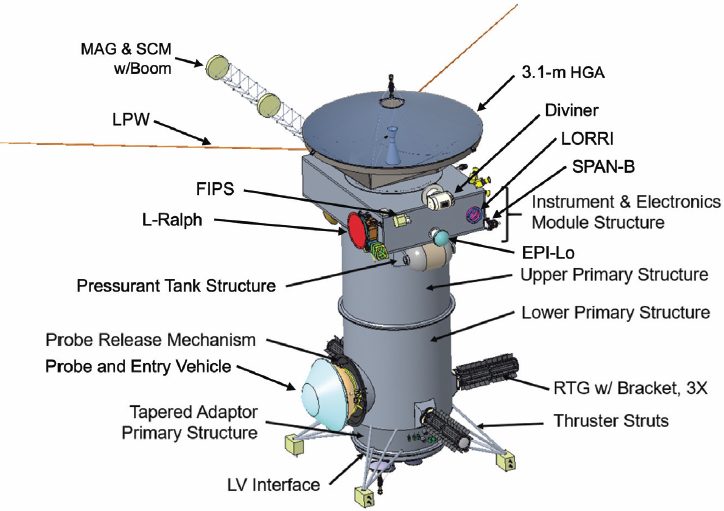
measuring chemical composition, elemental abundances, the temperature profile, and other key parameters. UOP will conduct a multi-year orbital tour addressing (1) the planet’s origin, interior, and atmosphere; (2) its magnetic field and magnetosphere; and (3) its satellites and rings. In doing so, UOP will provide ground-truth to the most abundant class of exoplanets. Utilizing particularly favorable planetary alignments in 2031 and 2032 would allow UOP to reach Uranus in about 13 years. Launch opportunities also exist in subsequent years, but the flight time would be 2 years longer. Opportunities for international cooperation on UOP are good because the European Space Agency has already expressed interest in providing a major component, such as the atmospheric probe.