Reforming the Coast Guard's Certificate of Compliance Program for Liquefied Gas Carriers: Promoting Efficient Implementation and Safety Effectiveness (2024)
Chapter: 3 The Certificate of Compliance Program and the Safety Framework for Liquefied Gas Carriers
3
The Certificate of Compliance Program and the Safety Framework for Liquefied Gas Carriers
The safety framework for gas carriers visiting U.S. ports was developed in the 1960s and 1970s in response to growing concerns about environmental protection and safety for the ships, ports, and surroundings. What began in the United States has now developed into a global and comprehensive approach to gas carrier safety with international standard-setting practices adopted by the International Maritime Organization (IMO) and the liquefied natural gas (LNG) and liquefied petroleum gas (LPG) industries.
The U.S. Coast Guard administers the federal and international safety framework for U.S. ports. The Coast Guard is a military service and branch of the U.S. armed forces, and Marine Safety is one of its 11 statutory missions. The Marine Safety mission and portions of the Marine Environmental Protection mission and Ports, Waterways, and Coastal Security mission are included in the Maritime Prevention mission program. The Coast Guard executes its Marine Safety mission by conducting flag state control (domestic) inspections, port state control (foreign) vessel exams, marine casualty (incident) investigations, ports and waterways management, merchant mariner credentialing, and regulations and standards development.1
This chapter begins with an introduction to the current international safety framework for gas carriers, as adopted by industry, government, and
___________________
1 Homeland Security Act of 2002, Sec. 888, “Preserving Coast Guard Mission Performance,” 107th Congress (2001–2002), https://www.dhs.gov/sites/default/files/publications/hr_5005_enr.pdf. Other missions include Search and Rescue, Drug Interdiction, Migrant Interdiction, Defense Readiness, Aids to Navigation, and Ice Operations. The 11 distinct missions are grouped into six major operational mission programs.
third-party organizations such as classification societies. It then explains the Coast Guard’s Port State Control (PSC) authority under international treaties and presents a history of the current Certificate of Compliance (COC) program for gas carriers, including the development of federal law and Coast Guard regulations and policy. Although the law behind the current COC program for foreign-flag gas carriers essentially has remained unchanged since 1978, this chapter examines how the international safety framework has greatly expanded since then. Coast Guard programs, such as the Liquefied Gas Carrier National Center of Expertise (LGC NCOE) and the Quality Shipping for the 21st Century (QUALSHIP 21) Initiative, were developed in support of safety as well.
The chapter then moves to the current COC program’s impact on the Coast Guard. It presents a detailed description of the COC examination process and the impacts of the dramatic increases in gas carrier COC exams since 2010. It concludes with an examination of Coast Guard gas carrier examination data and their implications for safety, as well as a projection of future increases in COC exams and attendant impacts on the Coast Guard’s workforce if current federal law continues.
INTRODUCTION TO THE SAFETY FRAMEWORK FOR GAS CARRIERS
Regulation of commercial vessel safety was limited until the mid-19th century, when some nations began establishing regulatory bodies responsible for the safety of commercial vessels flying their flags. These bodies included the U.S. Steamboat Inspection Service, which was created in 1871 and traces its history back to the Steamboat Inspection Act of 1838, and the United Kingdom’s Board of Trade.2 At approximately the same time, private organizations known as classification societies were established to protect the commercial interests of cargo shippers. These organizations, including the American Bureau of Shipping (ABS) and Lloyd’s Register of Shipping, issued rules on the design, construction, and inspection of merchant vessels.3
Today multiple entities have different roles and responsibilities for ensuring the safe design and operation of any merchant ship. This framework is often referred to as a safety net. This section introduces the entities—including industry, government, and third-party organizations—involved
___________________
2 Barbara Voulgaris, “From Steamboat Inspection Service to U.S. Coast Guard: Marine Safety in the United States from 1838–1946,” 2009, https://media.defense.gov/2020/Apr/24/2002288416/-1/-1/0/2009_MARINE_SAFETY_HISTORY_VOULGARIS.PDF.
3 Harold M. Heiser, “Classification Societies,” U.S. Naval Institute Proceedings 63, no. 408 (February 1937), https://www.usni.org/magazines/proceedings/1937/february/classification-societies.
in the safety net and responsible for ensuring the safety of gas carriers and their cargo.
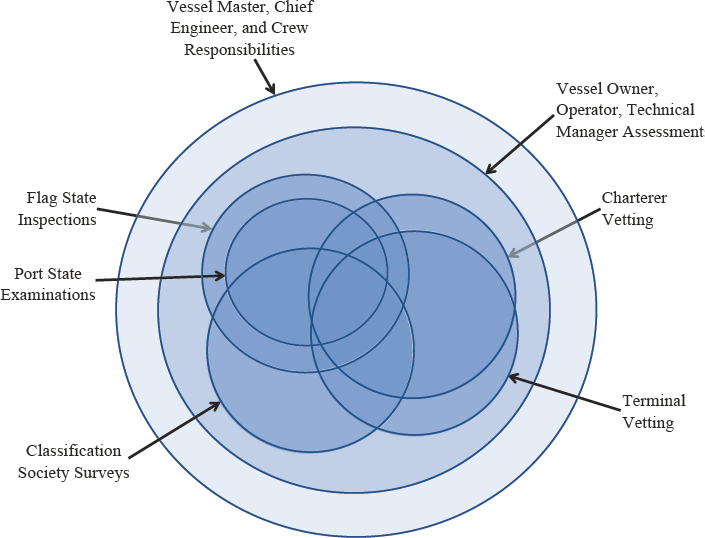
The safety net as it operates today for a gas carrier can be visualized as a series of overlapping circles: the actors in each circle have incentives and activities that support the overall safety of a vessel, its crew, and the surrounding port, terminals, and other vessels as well as the sea and shoreline environments. While governments and third-party organizations are responsible for enforcing the standards as represented in law, industry actors have financial incentives to pursue additional reliability and safety. While most of the actors view safety from the perspective of the vessel, terminals and the port state approach vessel safety from the perspective of the ports. The discussion below describes the responsibilities and incentives of each actor in Figure 3-1.
Industry
The safety of a gas carrier, as with any merchant vessel, begins with the vessel’s owner, master, and crew, who are ultimately responsible for ensuring
SOURCE: Committee analysis.
that the vessel is maintained in compliance with all applicable rules and regulations at all times. However, the structure of the U.S. export industries for LNG and LPG provides additional mechanisms and incentives for safety assurance. Reliability, of which safety is a significant part, is highly valued. Because the cargo is hazardous and there are potential liabilities and significant penalties if something goes wrong, the cargo owners and the insurers of the vessel and the cargo have financial incentives to ensure safety. Moreover, because the export industry is capital-intensive and debt-financed, downtime can be very expensive. The terminal facilities and the holders of the debt also have financial incentives to ensure that safety is maintained. In addition, the ocean shipping industry is segmented. Charterers, which may be the cargo owners or separate companies, contract for vessels for a defined length of time. Charterers have choices about which vessel owners and specific vessels they engage. A vessel, operator, or ship owner that is perceived as high risk is likely to find itself cut off from the U.S. LNG and LPG export markets. Further descriptions of the industry actors related to LGCs are described below.
Vessel Master, Chief Engineer, and Crew
As the most senior department heads on board the vessel, the vessel master and chief engineer are the most important and central actors in vessel safety. These two command personnel implement the safety system and programs aboard the ship. If they are not competent or motivated, the basic safety system fails. Ship owners/managers recognize this and put significant effort into the training, career progression, and promotion of individuals to these ranks. Industry and charterers also recognize the significance of a ship’s officers and have developed manning experience matrices to ensure that vessel owners/managers are putting people with proper training and experience aboard the ship. The master and chief engineer guide and direct the rest of the crew to ensure that the vessel is in compliance with all applicable rules and regulations. If a vessel is not in compliance with a charterer’s manning experience matrix, a ship may be put off-hire. In addition, many terminals have their own experience matrix, again to ensure that qualified and experienced personnel are operating ships. Charterers can also measure and audit the degree of compliance with their own experience matrices.
Vessel Owners, Operators, and Technical Managers
For the vessel master and chief engineer to do their jobs, they need to be given appropriate resources and support from the technical manager, who works for and receives and manages funding from the vessel owners and/or operators. The technical manager is the main person in charge of the safe,
efficient, and cost-effective performance of all ships assigned. The vessel owners and/or operators are responsible for providing enough resources to properly operate, maintain, and fully implement the safety management system (SMS), required by IMO’s International Safety Management Code (ISM Code), in the office and across the fleet. The SMS covers all aspects of vessel management including hiring, training, and promotion for vessel and shore personnel; technical support for the vessel (including development and implementation of a planned maintenance system covering all equipment on the vessel); operational support for the vessel (including compliance with all charter, terminal, and port requirements); development and implementation of health, safety, and environmental protection programs for the fleet; and overall compliance with statutory requirements (flag, class, IMO, etc.).
Charterers, Sub-charterers, and Commercial Managers
Charterers, sub-charterers, and commercial managers want to ensure that the ships that they hire are operated safely and reliably. A ship that is not operating safely will not be reliable. These stakeholders use vetting and assurance practices to determine if a specific gas carrier will be employed. Sub-charterers and commercial managers may have taken commercial positions on the loading and discharging of cargo, which can have an impact of tens of millions of dollars if not met for just one cargo. Therefore, sub-charterers and commercial managers will likely have their own vetting and assurance practices, on top of the charterer’s vetting practices, before taking on a ship. If a ship or manager becomes unacceptable to a charterer, it is a very serious financial issue for the vessel owner/operator/technical manager. Therefore, the owner/operator/technical manager generally assigns very high priority to resolving issues that arise during both internal inspections and charterer/terminal vetting, including ensuring that adequate resources are made available to fix any problem promptly and fully.
Terminals
Like charterers, terminals have a strong interest in ensuring that vessels calling at their facilities are safe and reliable. Terminals are also aware of their responsibilities to their other users and to the surrounding community. The most important issue is that the visiting vessel does not cause an incident that damages the terminal, restricting its future use. Therefore, terminals have their own vetting and assurance procedures that they typically engage every time a ship is scheduled to call. If a vessel has outstanding issues from previous vetting or terminal calls, a terminal may impose expensive countermeasures before loading/discharging and even refuse to allow the vessel access. An example is an unresolved issue with the propulsion machinery,
reducing the level of redundancy. The terminal may allow the vessel to load but only with a standby tug in attendance for the entire loading, potentially costing several tens of thousands of dollars.
Government
The United States is an active member of IMO, the United Nations’ specialized agency with responsibility for the safety and security of shipping and the prevention of marine and atmospheric pollution by ships. Founded in 1948 and coming into force in 1958, IMO develops standards that are adopted through international treaties for the safety, security, and environmental performance of international shipping. Currently, 175 IMO member nations meet regularly to develop and update international safety and environmental standards for commercial vessels. The oldest treaty under IMO’s administration is the International Convention for the Safety of Life at Sea (SOLAS), which has its origins in the RMS Titanic disaster in 1912 and first came into force in 1933. Currently 168 nations are signatories to SOLAS. Today, SOLAS applies to approximately 99% of the world’s fleet, and it is generally regarded as the most important of all international treaties concerning the safety of merchant ships to include liquefied gas carriers.
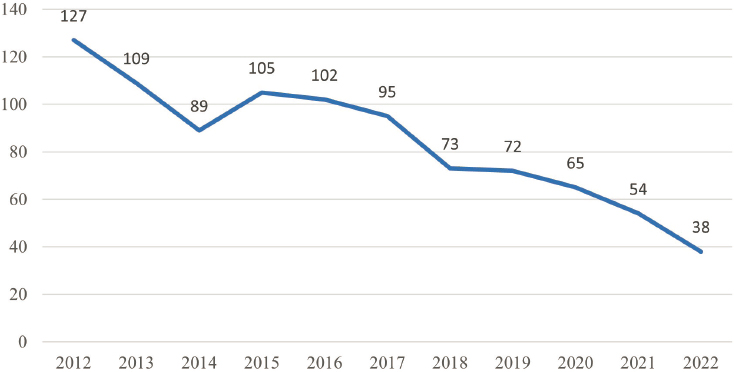
Additional key IMO standards relevant to gas carriers are in the International Convention for the Prevention of Pollution from Ships (MARPOL), first adopted in 1973 and coming into force in 1983, and in the International Convention on Standards of Training, Certification and Watchkeeping for Seafarers (STCW), first adopted in 1978 and coming into force in 1984.4 The international conventions and industry standards are regularly updated. As demonstrated in Figure 3-2, improvements to SOLAS and other international standards have contributed to the reduction in the number of total vessel losses by almost 70% over the last decade.
Flag States
Under SOLAS and other international conventions, the government of the nation whose flag the ship is entitled to fly, commonly referred to as the flag state, is required to ensure that ships flying its flag comply with the standards established under international law and conventions.5
___________________
4 IMO, “Brief History of IMO,” accessed March 22, 2024, https://www.imo.org/en/About/HistoryOfIMO/Pages/Default.aspx.
5 SOLAS Regulation I/6, MARPOL Annex I Regulation 6, Annex II Regulation 8, Annex IV Regulation 4, Annex VI regulation 5, and United Nations Convention on the Law of the Sea Article 94.
SOURCE: Data from Lloyd’s List Intelligence Casualty Statistics, https://lloydslist.com/sectors/casualty.
Flag registries, either directly or through the chosen recognized organization (RO), certify that the vessels are constructed, equipped, maintained, and manned to meet international standards. They also audit the management of the shipping company in which the technical manager resides to ensure that the vessel’s SMS is robust and that the technical manager is fulfilling the activities in the SMS. Flag requirements are also an important part of charterers’ or terminals’ vetting requirements.
Port State
SOLAS also authorizes the nation responsible for the ports to take actions to protect safety. When a foreign-flag gas carrier calls on a U.S. port, it is subject to PSC inspection, administered by the Coast Guard. SOLAS authorizes port states to verify that the certificates issued by the flag state are valid.6 Port states check a vessel and its equipment to confirm compliance with IMO standards and any additional port state requirements; this is to ensure that the vessel and equipment are manned and operated accordingly and maintain safety, security, and pollution prevention. While the port state is intended to provide assistance to flag state administrations in ensuring compliance with these standards and requirements, the port state role is completely independent of owners, class, and flag. The roles of the master,
___________________
6 SOLAS Regulation I/19.
crew, and owner are to keep the vessel operating safely, while the role of the port state is to keep the port operating safely. A port state inspection that finds many deficiencies—or worse, that leads to a detention that must be remedied before the vessel can leave the port—will require the owner to investigate and remedy safety issues to ensure that they do not recur. For the owner, vessel detention can mean revenue lost due to off-hire status and potential liabilities to the terminal and/or cargo owner for delays and other costs that impact their businesses.
Port states serve as the last entity in the “safety net” of the vessel. Gas carriers receive examinations from government agencies exercising PSC authority in ports all over the world. Many port states cooperate with each other to improve the efficiency of inspections and focus on the elimination of substandard ships. Nine regional agreements, or memoranda of understanding (MOUs), on PSC have been signed and cover many parts of the globe.7
Third-Party Organizations
Third-party organizations are of two types—the classification societies that provide independent confirmation that vessel standards have been met and the nongovernmental organizations that are collaborative mechanisms for industry to adopt and monitor best practices and standards that go beyond governmental requirements.
Classification Societies
Classification societies provide assurance to others in the maritime community—flag states, ports, vessel insurers, cargo insurers, etc.—that the vessel has been built and is being maintained according to international technical standards. Classification societies issue their own rules that are aligned with international standards and employ “surveyors” who review the vessel’s design drawings, attend during construction, and regularly conduct surveys and inspections over the life of the vessel in accordance with the society’s own rules and standards. Technically, a classification society’s rules are not mandatory; however, meeting these class requirements positively impacts insurance premiums, thereby encouraging voluntary compliance. Keeping a vessel in compliance with classification requirements (i.e., “in class”) is a fundamental part of charter contracts and other commercial agreements.
The International Association of Classification Societies sets out uniform standards for its 12-member classification societies to uphold in their
___________________
7 See https://www.imo.org/en/ourwork/msas/pages/portstatecontrol.aspx.
periodic vessel inspection work.8 Classification societies are also embedded in IMO and flag state requirements. SOLAS requires gas carriers and other vessels to be designed, constructed, and maintained in compliance with the structural, mechanical, and electrical requirements of a classification ociety recognized by the flag state.9 In addition, flag states typically entrust classification societies to act on their behalf. Classification societies serving as IMO ROs are empowered to conduct inspections and surveys of gas carriers, require repairs, and ensure compliance. As the RO on behalf of the flag state, the classification society will issue SOLAS and other certificates to gas carriers that comply with the relevant international standards. Because classification societies audit and advise technical managers on keeping a vessel “in class” and in compliance with international standards, their role in the safety net is to enforce threshold standards.
Nongovernmental Organizations
Industry also organized third-party organizations in response to growing public concern about marine pollution, in particular oil pollution, in the late 1960s. The Oil Companies International Marine Forum (OCIMF), founded in 1970, and the Society of International Gas Tanker and Terminal Operators (SIGTTO), founded in 1979, are voluntary organizations that promote safety and environmental protection within their respective industries. Today, OCIMF has 111 member companies, and SIGTTO has 170 member companies. Both produce guidelines and tools used by industry and are seen as leading authorities on the global marine industry’s safety and environmental performance. As they are nongovernmental organizations, IMO has granted OCIMF consultancy/advisory status and SIGTTO observer status.10
THE COAST GUARD AND PORT STATE CONTROL
PSC is the process by which the United States and other nations exercise authority over foreign vessels in waters subject to their jurisdiction. The goal of the Coast Guard’s PSC program is to eliminate substandard ships from U.S. waters. Ships that do not meet the standards mandated by applicable international treaties and U.S. laws and regulations could endanger the ship and persons on board or create undesirable consequences for the marine environment. The United States has a robust PSC program and conducted more than 8,700 foreign vessel examinations in 2022.
___________________
8 For a list of members, see https://iacs.org.uk.
9 SOLAS Regulation II-1/3-1.
10 OCIMF, “About OCIMF,” accessed March 22, 2024, https://www.ocimf.org/about-ocimf; SIGTTO, “About Us,” accessed March 22, 2024, https://www.sigtto.org/about-us.
The Coast Guard’s authority to conduct inspections on board vessels and to certify compliance with government standards originates in the federal government’s response to the new dangers posed by steamboat transport and a series of laws enacted in the mid-19th century, culminating in the centralization of the Steamboat Inspection Service in the U.S. Department of the Treasury in 1871. The inspection service was transferred to the Coast Guard in 1942 as part of consolidating all responsibilities for marine safety, including vessel inspections, in one federal agency.11
The Coast Guard’s authority to inspect vessels was based on declarations of a national emergency or for national security until the Ports and Waterways Safety Act of 1972. This law formally established the captain of the port (COTP) with the authority to regulate the operation of domestic and foreign ships on the navigable waters of the United States. Today, almost all U.S. and foreign-flag vessels operating in U.S. waters are subject to Coast Guard inspection under Title 46 U.S. Code (USC) Chapter 33.
In addition, nations that are party to SOLAS and certain other international conventions may verify that vessels of other nations operating within their waters comply with the conventions and may take action to bring ships into compliance if they are deficient. A nation may also enact its own laws and regulations to impose additional requirements on foreign vessels trading in its waters. Reciprocity is accorded to vessels flagged with countries that are parties to SOLAS.12 In other words, foreign nations that are signatories to SOLAS are assumed to have inspection laws and standards that are similar to those in the United States. When a flag state, or its designated RO, determines that a vessel meets specified standards, the government issues the vessel a certificate signifying compliance.
The Coast Guard verifies that foreign-flag vessels operating in U.S. waters comply with applicable international conventions, U.S. laws, and U.S. regulations through the use of PSC examinations. Under 33 Code of Federal Regulations (CFR) 1.01-12(a), the officer in charge, marine inspection (OCMI), who is generally the same individual as the COTP, is responsible for SOLAS intervention on foreign-flag ships. When the Coast Guard identifies a vessel that is not in substantial compliance with applicable laws or regulations, it imposes a detention or other controls to limit movement or operations of the vessel until the substandard conditions have been rectified and the vessel is brought into compliance.
___________________
11 This paragraph relies on information from Barbara Voulgaris, “From Steamboat Inspection Service to U.S. Coast Guard: Marine Safety in the United States from 1838–1946,” 2009, https://media.defense.gov/2020/Apr/24/2002288416/-1/-1/0/2009_MARINE_SAFETY_HISTORY_VOULGARIS.PDF. See also National Archives, “Acts of Congress Relating to Steamboats, Collated with the Rolls at Washington,” https://archive.org/details/aft7919.0001.001.umich.edu/page/n3/mode/2up.
12 46 USC § 3303 – Reciprocity for foreign vessels.
PSC examinations help to confirm that a vessel’s major systems comply with applicable international standards and U.S. requirements and that the crew possesses proficiency sufficient to safely operate the vessel. Through the PSC exam, the Coast Guard determines whether the required certificates are on board and valid, and whether the vessel conforms to the conditions required for issuance of the certificates. This is accomplished by a walk-through examination and visual assessment of a vessel’s relevant components and documents, as well as limited testing of the vessel’s systems and crew. PSC exams are not intended, nor desired, to be as rigorous as Coast Guard inspections for certification of U.S. flag vessels.13
With approximately 11,000 different foreign-flag ships typically making nearly 80,000 port calls to the United States each year, it is neither possible nor necessary for the Coast Guard to examine each vessel at every port call. The Coast Guard uses a risk-based decision tool to identify and manage the risk posed by arriving vessels. The risk-based approach, which uses targeting procedures,14 has proven to be effective, resulting in a decrease in the number of substandard vessels and an improvement in the performance of classification societies and flag states.
Today, substandard vessels are less likely to call on U.S. ports. Over the past decade, more than 70% of PSC exams conducted by the Coast Guard resulted in no deficiencies issued to the vessels.15 Detention ratios steadily decreased from a high of nearly 8% in the late 1990s to approximately 1% by 2006, where they have remained since.16
U.S. REQUIREMENTS FOR GAS CARRIERS
In addition to being subject to international standards, foreign gas carriers visiting U.S. ports are subject to U.S. standards, as contained in U.S. law and Coast Guard regulations and policy, including the requirement for a COC. This section delves into the history of the U.S. laws that led to the Coast Guard’s COC program and related regulations and policies. Although gas carrier technologies and standards have changed, U.S. law for foreign-flag gas carriers has remained the same since 1978. Box 3-1 contains a summary of current U.S. law and Coast Guard regulations and policies that pertain to this report’s discussion of the COC program for foreign gas carriers.
___________________
13 COMDTINST 16000.73, Marine Safety: Port State Control (D1-12), September 2021.
14 COMDTINST 16000.73, Marine Safety: Port State Control (D4), September 2021. See https://media.defense.gov/2022/Feb/09/2002935707/-1/-1/0/CI_16000_73.PDF.
15 Port State Control Division, PSC Annual Reports.
16 See PSC Annual Reports. See also Coast Guard CVC Work Instruction, “Targeting of Vessels for PSC Examination,” January 13, 2020, https://www.dco.uscg.mil/Portals/9/DCO%20Documents/5p/CG-5PC/CG-CVC/CVC_MMS/CVC-WI-021.pdf.
BOX 3-1
Summary of U.S. Law, Regulations, and Policies Pertaining to Certificates of Compliance for Foreign Gas Carriers
Title 46 U.S. Code (USC) Chapter 37 Carriage of Liquid Bulk Dangerous Cargoes
46 USC 3703 Regulations
- Authorizes the Coast Guard to regulate gas carrier design, construction, maintenance, and operation; see 46 CFR 154 below.
46 USC 3710 Evidence of Compliance by Vessels of the United States
- Requires U.S.-flagged vessels authorized to carry oil or hazardous material in bulk (including liquified or compressed gas) to hold a Certificate of Inspection (COI) with an endorsement indicating the vessel meets applicable requirements.
- Each COI is valid for not more than 5 years.
- A COI may be suspended or revoked.
46 USC 3711 Evidence of Compliance by Foreign Vessels
- Requires a Certificate of Compliance (COC) with U.S. law and regulations before a foreign-flag vessel may operate in the navigable waters of or conduct cargo operations in the United States.
- Each COC is valid for not more than 24 months.
- A COC may be suspended or revoked.
46 USC 3714 Inspection and Examination
- Each vessel must be inspected (U.S. flag) or examined (foreign flag) at least once each year.
- Each vessel more than 10 years of age must undergo an inspection of structural strength and hull integrity.
- An inspector may be contracted to conduct inspections or examinations and issue temporary certificates.
Coast Guard Regulations
46 CFR 154, Safety Standards for Self-Propelled Vessels Carrying Bulk Liquefied Gases, Also part of 46 CFR, Subchapter O
- Includes design requirements that exceed IMO’s International Code for the Construction and Equipment of Ships Carrying Liquefied Gases in Bulk.
- Implements the COC initial issuance, renewal, and annual examination requirements.
Coast Guard Policies
COMDTINST 16000.73, Marine Safety: Port State Control (D6-5), September 2021
- Allows cargo operations if the vessel is not more than 3 months beyond the expiration date of the previous COC renewal or the anniversary date of the previous COC exam; the required exam/renewal must be completed prior to departing.
- Requires vessels more than 3 months beyond the expiration date of their COC renewal or anniversary date of the previous COC exam to complete the examination process before commencing cargo operations.
U.S. Law
The COC program in operation today was developed under two federal laws: the Ports and Waterways Safety Act of 1972 and the Port and Tanker Safety Act of 1978. The 1972 act, as previously mentioned, gave the Coast Guard permanent jurisdiction over all vessels using ports of the United States. It also addressed the safety of ports and waterfront facilities, as well as environmental protection of U.S. waters.17 The 1978 act was a culmination of governmental actions to address tank vessels that date back to the Tank Vessel Act of 1936.
Tank vessels began moving oil in substantial quantities after World War I, but prior to 1936, tank vessels remained comparatively unregulated until a series of events in the 1930s drew attention to problems associated with these types of vessels. To start, oil began replacing coal for home heating purposes, which increased the number of shipments between the U.S. Gulf Coast and East Coast and imports from Venezuela. At the same time, concerns for maritime safety were growing worldwide, which were linked to the Convention for Promoting Safety of Life at Sea, 1929. The U.S. Tank Vessel Act of 1936 established the federal authority to regulate tank vessels carrying flammable or combustible liquid cargo in bulk. The law required tank vessels to undergo an inspection and hold a Certificate of Inspection (COI) with a cargo endorsement indicating what it was approved to carry, prior to taking on cargo. These requirements applied to domestic and foreign vessels; however, there was an automatic exemption for a foreign vessel holding a valid COI from another country recognized under law or treaty.18
The authority to regulate tank vessels remained essentially the same until the Ports and Waterways Safety Act of 1972.19 In the 1972 law’s statement of policy, Congress declared that vessels carrying certain cargo in bulk created substantial hazards, that existing standards needed to be improved, and that it was necessary to establish comprehensive standards. The law expanded to apply to all vessels carrying oil of any kind in bulk and to vessels carrying hazardous polluting substances in bulk.
In addition, the 1972 act established the COC to ensure that foreign-flag tank vessels complied with U.S. marine environmental protection rules and regulations. Certificates would be valid for a period specified by the secretary but were not to exceed the duration of the COI.20 The 1972 law stated that the secretary may accept foreign certificates, but it did not
___________________
17 H.R. Rep. No. 95-1384, 95th Congress, 2nd Sess. 27 (1978), https://www.congress.gov/bill/95th-congress/house-bill/13311/summary/19?s=1&r=2.
18 Ibid.
19 Ibid.
20 46 USC 391a (1976) – Shipping.
require acceptance. This meant that any foreign vessel could be examined to assure compliance with U.S. requirements.21
In December 1976, the foreign-flag tank vessel Argo Merchant grounded near Nantucket Island and released 204,000 barrels of heating oil into the water. That same month, the foreign-flag tank vessel Sansinena exploded and burned at a terminal in Los Angeles. Eight people lost their lives, 50 others were injured, and there was considerable shoreside damage and harbor pollution. In addition, there was a massive increase in U.S. oil imports, particularly crude oil. By 1978, the United States was importing more than 8 million barrels of crude oil per day, which was more than one-quarter of the crude oil moving in worldwide trade. Approximately 35 tank vessels were entering U.S. ports each day. The U.S. Department of Energy was also preparing to implement the Strategic Petroleum Reserve program, which was going to involve additional crude oil imports. Members of Congress became concerned that maritime traffic in U.S. ports continued to increase, marine incidents including fatalities continued to occur, and the marine environment was increasingly damaged by pollution. The result was the Port and Tanker Safety Act of 1978.22
The 1978 act emphasized safety as well as environmental protection. Its statement of policy declared that existing standards needed to be more stringent and comprehensive for the mitigation of hazards to life, property, and the marine environment. The statement also determined that existing international standards were incomplete, that those international standards were often left unenforced by some flag states, and that there was a need to prevent substandard vessels from operating in the navigable waters of the United States.23
The 1978 act separated the regulation and inspection of domestic and foreign vessels. While earlier law stated that a certificate shall not be issued until the vessel had been inspected,24 the 1978 act left this language for U.S. flag vessels but created a separate paragraph for foreign vessels that stated that a COC shall not be issued until the vessel had been examined.25 This distinction between inspection and examination would affect the Coast Guard’s implementation of the law. Certificates issued under the 1978 act were valid for a period not to exceed 24 months.26
The 1978 act also created a periodic inspection program, in addition to the certificate program, for both domestic and foreign tank vessels. The periodic inspection program required each domestic vessel to be inspected
___________________
21 H.R. Rep. No. 98-338. 111th Congress, 1st Session (1983).
22 H.R. Rep. No. 95-1384. 95th Congress, 2nd Sess. 27 (1978).
23 46 USC 391a (1982) – Shipping.
24 46 USC 391a (1976) – Shipping.
25 46 USC 391a (1982) – Shipping.
26 Ibid.
and each foreign vessel to be examined at least once each year.27 The law allowed the annual inspection or examination to be conducted by any officer authorized by the secretary. It also stated that if an officer was not reasonably available, the secretary may contract for the conduct of inspections or examinations.28 At the time, the primary reason for allowing contracting was to provide hiring flexibility in foreign areas where qualified Coast Guard marine inspectors were not normally available. However, it was recognized that on occasion, Coast Guard marine inspectors might not be readily available in the United States and that it might be necessary to contract services to facilitate and expedite inspections and examinations.29
In 1996, the law was amended to increase the length of time that certificates issued to U.S. tank vessels were valid from 24 months to 5 years. The purpose of the change was to align the U.S. certificate renewal intervals with those found in SOLAS and with ABS’s practices for its special periodic surveys. Congress did not envision any decrease in the level of safety due to these changes, because vessels on 5-year certificate renewal cycles would continue to receive annual inspections to ensure they complied with their COI. The certificate renewal interval for the COC for a foreign vessel was not changed and remained at 24 months.30
In summary, 46 USC 3714 requires all gas carriers to be examined at least once per year. 46 USC 3710 requires a domestic gas carrier to hold a COI prior to having cargo on board. These COIs are valid for 5 years. 46 USC 3711 requires any foreign-flag tankship, including a gas carrier, to hold a COC before the vessel may operate on the navigable waters of the United States or transfer cargo in a port or place under the jurisdiction of the United States. In addition, it restricts the term of the COC to not more than 2 years.
Finally, the COC program is unique to the United States. The committee did not identify any other countries that exercise PSC authority in the same manner as the United States or restrict foreign-flag gas carriers from operating unless they have been issued a COC or similar port state documentation.
U.S. Regulations
U.S. regulations further implement the COC requirements for gas carriers found in federal law.31 The regulations for gas carrier examinations and
___________________
27 Ibid.
28 Ibid.
29 H.R. Rep. No. 95-1384. 95th Congress, 2nd Sess. 27 (1978).
30 H.R. Rep. No. 104-106. The House Report does not discuss why the certificate renewal interval for foreign vessels was not changed.
31 In addition, federal regulations require foreign-flag cruise ships and mobile offshore drilling units to have a COC to operate in the United States; see 46 CFR 2.01-6.
COCs are found in Title 46 CFR Subchapter O, Part 154. 46 CFR 154.150 states that a vessel must call at a U.S. port for an examination before the vessel can receive a COC.
During the late 1960s, as LPG exports increased from U.S. Gulf ports and large imports of LNG appeared necessary in the near future, the federal government grew concerned that there was no international safety standard for the design of gas carriers under SOLAS. However, the Coast Guard had domestic regulations for the transportation of liquid flammable gases, contained in 46 CFR Subchapter D, Part 38, which were based on standards developed by the American Petroleum Institute and applied to the design of inland barges transporting liquefied flammable gas. To address this regulatory gap in SOLAS for the design of LNG and LPG ships, the Coast Guard prepared “Interim Guidelines for the Plan Review of Liquefied Flammable Gas Carriers” based upon existing domestic regulations. Foreign gas carriers were required to submit plans for their gas cargo systems to Coast Guard headquarters for review. Upon completion of the plan review and at the first call in a U.S. port, the OCMI (assisted by headquarters personnel, if requested) conducted an inspection to confirm that the gas cargo systems corresponded to the approved plans. At that point, the Coast Guard issued a letter of compliance (LOC) to the ship. Ongoing inspections were not required because the LOC’s purpose was to confirm that the ship had been constructed in accordance with approved plans.
In 1975, under U.S. leadership, IMO adopted the Code for the Construction and Equipment of Ships Carrying Liquefied Gases in Bulk” (GC Code), which provided a SOLAS standard for gas carrier design.32 In 1983, IMO adopted an updated set of requirements for gas carriers called the International Code for the Construction and Equipment of Ships Carrying Liquefied Gases in Bulk (IGC Code).33 The IGC Code became mandatory under SOLAS on July 1, 1986. Although the LOC program is no longer necessary, Coast Guard regulations still require the submission of ship plans, under 46 CFR 154.22, to receive what is called a Subchapter O endorsement (SOE) that verifies that the vessel meets design requirements. Unlike for most types of foreign vessels entering U.S. ports, U.S. standards for gas carriers do not simply mirror international design and construction requirements. Using the regulatory process, the Coast Guard has established four regulations that are more stringent than the IGC Code.34
___________________
32 RESOLUTION A.328(IX) adopted on 12 November 1975, Code for The Construction and Equipment of Ships Carrying Liquefied Gases in Bulk. https://wwwcdn.imo.org/local-resources/en/KnowledgeCentre/IndexofIMOResolutions/AssemblyDocuments/A.328(9).pdf.
33 Resolution MSC.5(48), adopted 1983, The International Code for the Construction and Equipment of Ships Carrying Liquefied Gases in Bulk, https://www.imo.org/en/OurWork/Safety/Pages/IGC-Code.aspx.
34 Coast Guard Proceedings 72, no. 3 (Fall 2015).
First, the United States requires enhanced grades of steel along the cargo area of a gas carrier’s hull to arrest cracks in the event of a cargo spill.
Second, the United States prohibits venting cargo vapor into the atmosphere at all ports, a practice that was allowed for temperature/pressure control under previous versions (prior to 2016) of the IGC Code, but is no longer allowed for vessels built since 2016. Because of this prohibition, the United States requires that foreign vessels maintain cargo tank pressure below the design vapor pressure either indefinitely or for a period of not less than 21 days for LNG.
Third, the United States sets different maximum allowable relief valve (MARV) settings for gas carriers using independent Type B and C tanks. The United States uses more conservative (higher) stress factors, which results in lower permissible pressure settings. Therefore, foreign-flag gas carriers are typically approved for two MARV settings: one for operating in international waters and one for U.S. waters. Prior to entering U.S. waters, the foreign vessel crew must set tank relief valves to the lower approved U.S. MARV settings. Because of advancements in construction materials, manufacturing, and inspection since the regulations were developed, the United States now accepts the international MARV settings for independent Type B and C tanks on vessels that were built to the standards found in the 1993 edition of the IGC Code or later. For gas carriers using membrane, semi-membrane, and independent Type A tanks, the allowable stresses in the tank are the same in the IGC Code and U.S. regulations.
Fourth, the United States uses more extreme ambient design temperatures for vessels required to have secondary barriers. To evaluate the insulation and hull steel for cargo tanks and secondary barriers for the purpose of design calculations, the IGC Code provides general standards and allows each flag state to dictate a higher or lower ambient minimum design temperature. The IGC Code’s general ambient design temperatures are 41°F for still air and 32°F for sea water. The United States specifies additional ambient design temperatures for vessels required to have a secondary barrier. The temperatures are 0°F for 5 knots air and 32°F for still sea water for any waters in the world, except Alaskan waters. For Alaskan waters, the temperatures are –20°F for 5 knots air and 28°F for still sea water.35
Coast Guard Policy
The Coast Guard conducts safety and environmental protection compliance exams and security exams on board foreign-flag vessels under the PSC
___________________
35 Ibid.
program. Though these exams are different, they are typically completed at the same time.36
Per the targeting procedure in Coast Guard policy, the COC is considered a PSC exam; however, the two are technically separate from a regulatory and programmatic perspective.37 COC exams are conducted by qualified Port State Control officers (PSCOs) and Port State Control examiners (PSCEs) with specific qualifications for certain cargos such as oil, chemical, and gas.
For the COC program, Coast Guard policy permits OCMIs and COTPs to allow gas carriers to commence cargo operations if there are no indications that the vessel is out of compliance and if the vessel is not more than 3 months beyond the expiration date of its COC renewal or, if due for an annual exam, is not more than 3 months beyond the anniversary date of the COC. In these cases, the required exam must be completed prior to the vessel departing. Vessels that are more than 3 months beyond the expiration date of their COC renewal or annual exam must have the required exam prior to commencing cargo operations.38
Coast Guard policy contains procedures for conducting COC exams overseas, but the policy is limited to tank vessels that conduct lightering operations39 inside the U.S. Exclusive Economic Zone and therefore do not come into port or come close enough to a U.S. port to allow the Coast Guard easy access from shore. Prohibiting offshore examinations minimizes risk to Coast Guard personnel that would otherwise have to fly offshore and reduces already short marine inspector workforce efficiency due to the time and limitations of traveling offshore.40
EXPANSION OF SAFETY ASSURANCE PROGRAMS
Congress enacted the Ports and Waterways Safety Act of 1972 and the Port and Tanker Safety Act of 1978 because it had concluded not only that existing standards for all types of cargo ships and tankers were incomplete but also that some flag states were leaving standards unenforced. At that time, the COC program was a mechanism to prevent vessels that did not meet the needed comprehensive standards from operating in the navigable waters of the United States. Since 1978, the international conventions that
___________________
36 COMDTINST 16000.73, Marine Safety: Port State Control (D1-8), September 2021.
37 COMDTINST 16000.73, Marine Safety: Port State Control (D6-1), September 2021.
38 COMDTINST 16000.73, Marine Safety: Port State Control (D6-5), September 2021.
39 “Lightering operations” means “the transferring of cargoes at sea from large deep-draft vessels to shallow-draft vessels for subsequent transfer to shoreside terminals due to the inability of the larger tank vessels to enter shallow ports.” See 46 USC 3715.
40 COMDTINST 16000.73, Marine Safety: Port State Control (D6-34), September 2021.
set standards for gas carriers have become more comprehensive. In addition, the gas carrier industries have expanded their own safety assurance programs.
This section highlights the significant changes to the gas carrier industry since 1978 and demonstrates that today’s safety net for gas carriers is much larger and more comprehensive, with multiple overlapping layers to ensure that these vessels comply with marine safety and environmental protection rules and regulations.
International Standards
Gas carriers calling at U.S. ports must meet international standards for safety, pollution prevention and response, and workers. SOLAS requires gas carriers with a keel laid date of July 1, 1986, or later to meet the IGC Code, which prescribes the international design and construction standards for the safe carriage of liquefied gases.41 SOLAS also requires gas carriers to be designed, constructed, and maintained in compliance with the requirements of a classification society.42 IMO recognizes that gas carrier design technology is a complex and rapidly evolving technology, and that the IGC Code should not remain static. Therefore, the IGC Code is kept under review, facilitating the integration of experience and technological developments. The IGC Code has been amended 13 times, most recently in 2022, in order to make improvements and to account for new technologies. The IGC Code applies to ships engaged in the carriage of liquefied gases, regardless of their size, including those of less than 500 gross register tons (GRT).43
The ISM Code was adopted by IMO in 1993 and entered into force on July 1, 1998. The ISM Code is mandatory under SOLAS, Chapter IX. The ISM Code takes a different approach to ship safety, by focusing on the operator’s management system rather than the physical condition of the vessel. The concept is that the managers are responsible for ensuring the quality of the vessels within their fleets. The three main principles of the ISM Code are to (1) promote safe practices in ship operations and working environments, (2) identify and mitigate risks, and (3) continuously enhance safety management skills of onboard and ashore personnel. The ISM Code is mandatory for passenger and cargo ships (including gas carriers) of 500 GRT and upward that are engaged in international voyages.
___________________
41 SOLAS Chapter VII, Regulation 13.
42 SOLAS Chapter II-1, Regulation 3-1.
43 The Code for the Construction Equipment of Ships Carrying Liquefied Gases in Bulk (IGC Code) and the Code for Existing Ships Carrying Liquefied Gases in Bulk (EGC Code), which were adopted by IMO on November 12, 1975, and entered into force on October 31, 1976, cover older ships.
In addition, MARPOL provides standards to prevent pollution of the marine environment and atmosphere by gas carriers. Additional MARPOL protocols were adopted in 1978 and 1997, and the convention has been updated by several amendments over the years. STCW establishes standards for seafarers that operate gas carriers that trade internationally and call on U.S. ports. Other international treaties cover various aspects of international shipping.
Enforcement of International Standards
Under SOLAS, Chapter I, Regulation 6, enforcement of the regulations in the convention is left to the SOLAS flag state whose flag the ship is entitled to fly. These inspections for SOLAS compliance consist of plan review and surveys during construction of the ship, which are followed by a series of periodic surveys throughout the ship’s life. Compliance is documented by the issuance of or endorsement on the applicable IMO certificate that indicates the satisfactory completion of the relevant survey. If a ship is found to be out of compliance or unsafe to proceed to sea due to an accident or defect discovered, the flag state must be notified to determine if an additional survey is required. If the ship is in a port of another contracting state to the SOLAS convention (port state), the appropriate authorities of the port state must also be notified.
For cargo ships, surveys take place on a 5-year cycle under SOLAS, Chapter I, Regulations 8, 9, and 10. The renewal survey takes place 5 years after initial full-term certificates are issued. Upon successful completion of the renewal survey, a new certificate is issued by the flag state. The renewal survey consists of a complete inspection to verify compliance with SOLAS and is similar to but not as extensive as a survey required for new construction. A periodic or intermediate survey is required approximately 30 months after the original certificate is issued. This intermediate survey is less extensive and intended to verify that the ship remains in compliance. Finally, three annual surveys are required: these are less detailed general inspections of the ship’s condition. With planning, the intermediate survey can also serve as the second or third annual survey. Deficiencies noted during the surveys must be corrected.
In the case of a U.S. flag cargo ship, the Coast Guard issues a COI. The COI is valid for 5 years under 46 CFR 31.01. This is in addition to SOLAS certificates issued to U.S. flag ships engaged in international voyages. Prior to February 2000, the COI issued to U.S. cargo ships was valid for 2 years; however, the Coast Guard Authorization Act of 1996 amended 46 USC 3307 to permit 5-year validity for the purpose of harmonizing inspections with IMO requirements.
Under SOLAS, Chapter I, Regulation 19, port states have the authority to verify that ships from other administrations are in compliance with SOLAS as evidenced by their valid certificates. If the certificate has expired or the vessel is not in substantial compliance, the port state may detain the ship, preventing it from sailing until the deficiencies are corrected. In the case of a port state detention, the ship’s administration and IMO must be notified.
Coordination Among PSC Programs
To exercise their authority to examine foreign vessels operating in their waters and ensure that they comply with international requirements, many nations have developed PSC programs similar to the Coast Guard’s program. This means that some ships may receive multiple redundant PSC examinations per year. On the other hand, some countries do not have the resources to examine every foreign ship. For these reasons, many countries work together to share PSC information and results through formalized MOUs.
PSC MOUs reduce the number of unnecessary examinations for individual ships, while helping focus PSC efforts on substandard ships. The first such agreement, the Paris MOU, covers Europe and Canada and was implemented in 1982. In 1991, IMO adopted a resolution encouraging regional PSC cooperation in other parts of the world. Today, there are nine MOUs around the world. According to the 2022 Paris MOU Annual Report, the 27 nations of the Paris MOU conducted 17,908 PSC examinations, found 47,167 deficiencies during these exams, and detained 723 vessels. The vessels examined in 2022 included 587 gas carriers, 6 of which were detained.44
The Tokyo PSC MOU, which took effect in 1994, covers the Asia–Pacific region and is made up of 21 nations. According to the 2022 Tokyo MOU Annual Report, these countries conducted 24,894 examinations on 15,853 individual ships, resulting in 46,769 deficiencies and 725 vessel detentions. The vessels examined in 2022 included 524 gas carriers, 8 of which were detained.45
Industry Collaboration and Vessel Vetting
Although maritime transport is a relatively safe mode of transportation, there are still accidents; whenever these occur, there are usually significant personal, economic, and environmental costs. As a result, companies that
___________________
44 See https://parismou.org/system/files/2023-06/Paris%20MOU%20Annual%20Report%202022.pdf.
charter a vessel to carry their cargo will generally conduct a vetting process to evaluate whether the vessel complies with international regulations and industry standards and to determine that the vessel is suitable to carry their cargo safely. A vetting inspection provides a thorough evaluation of the ship, along with its procedures and equipment. When the oil industry began vetting ships in the 1970s, each company had its own staff to conduct vetting. Today, vetting can be conducted by the charterer, the loading or receiving shore-terminal staff, or third-party companies that specialize in conducting such vetting inspections. They tend to follow an industry-developed ship inspection format. Although ship vetting inspection is not mandatory under international law, it is often required in the contract between charter parties and has therefore become a commercial necessity. A charterer will usually have options when it comes to selecting a ship, so the ship owners must accept the vetting process if they want to carry the cargo. Most gas carriers are subject to a vetting process.46
As part of promoting best practices in the design, construction, and operation of vessels transporting liquefied gas, crude oil, oil products, and petrochemicals, OCIMF provides an independent forum for bringing together its members and external stakeholders. OCIMF has produced a portfolio of guidance publications, tools, and inspection programs used by thousands of vessel owners, operators, managers, and charterers worldwide to enhance the safety and environmental performance of their operations. These include the Ship Inspection Report (SIRE) program, the Tanker Management and Self-Assessment (TMSA) program, and the Condition Assessment Program (CAP).
SIRE Program
In addition to the flag state inspections and classification society surveys, gas carriers are also subject to inspection under the SIRE program, which was introduced by OCIMF in 1993.47 Unlike classification society surveyors, who ensure compliance with the required standards, SIRE inspectors examine gas carriers and apply additional standards that are typically more stringent or focus on other areas. A SIRE inspection does not result in issuance of any mandatory regulatory certificates or documents. Instead, a SIRE inspection collects objective technical and operational data that are retained in a large database containing information shared by OCIMF members on all gas carriers. SIRE information informs vessel vetting processes in advance of chartering decisions and helps drive improvements in vessel quality and
___________________
46 See also Juan P. Presedo, Ship Vetting and Its Application to LNG, 3rd Edition (Witherbys, 2023).
47 See https://www.ocimf.org/document-libary/71-programmes-sire/file.
safety. By establishing a standardized, objective inspection process that systematically examines tanker operations, SIRE has been instrumental in driving up charterer expectations for operational behavior and safety standards in the industry. OCIMF is currently phasing in a revised SIRE 2.0, which, among other updates, will complete the digitization of inspection data. This will allow the more efficient analysis of aggregate data to spot trends across fleets and of granular data to identify root causes and evaluate mitigation.48
SIRE inspections are completed by accredited inspectors who follow a set of defined inspection criteria. Generally, these inspections take at least 8–12 hours. At the end of the inspection, any deficiencies are noted in a SIRE inspection report, along with the reason for the deficiency, a plan to rectify the problem, and steps to prevent reoccurrence. The inspection reports are then entered into a dedicated database hosted by OCIMF. This process produces a very large database of up-to-date information about tankers and barges, including gas carriers. Prospective charterers and other industry members can access the database and use the technical and operational information to ascertain whether a vessel is well maintained and managed. Since SIRE’s introduction, more than 180,000 inspection reports have been submitted. On average, industry representatives view more than 8,000 SIRE reports each month. Although a SIRE report is valid for 12 months, charter parties often state that a vessel must have a satisfactory report in the SIRE system that is not more than 6 months old. In practice, this often means charterers require the vessel to undergo a SIRE inspection at least every 5 months. Some charterers or terminals also require SIRE reports from a specific inspection company, which can mean that a vessel may undergo several SIRE inspections each year.49
TMSA Program
OCIMF introduced the TMSA program, designed to be used by the vessel or terminal managers, in 2004. This program provides companies with a method to improve and measure their own SMS. It encourages companies to assess their SMS against key performance indicators and provides a set of evaluation standards to grade their performance in the 13 categories listed in Box 3-2. The self-assessment results can be used to develop phased improvement plans that support continuous improvement of the SMS. TMSA results are divided into four levels, where Level 1 indicates the
___________________
48 K. Coelho and A. Gour, OCIMF, presentation to the committee, January 2023. See also OCIMF, “SIRE 2.0,” accessed March 26, 2024, https://www.ocimf.org/programmes/sire-2-0; Craig Jallal, “SIRE 2.0 Is Here. Are You Ready?” Riviera, December 1, 2023, https://www.rivieramm.com/news-content-hub/news-content-hub/sire-20-is-here-are-you-ready-78672.
49 K. Coelho and A. Gour, OCIMF, presentation to the committee, January 2023.
BOX 3-2
TMSA Elements of Gas Carrier Safety
OCIMF’s TMSA programa requires examination of 13 elements that make up gas carrier safety:
- Leadership and the Safety Management System
- Recruitment and Management of Shore-Based Personnel
- Recruitment, Management and Wellbeing of Vessel Personnel
- Vessel Reliability and Maintenance including Critical Equipment
- Navigational Safety
- Cargo, Ballast, Tank Cleaning, Bunkering, Mooring and Anchoring Operations
- Management of Change
- Incident Reporting, Investigation and Analysis
- Safety Management
- Environmental and Energy Management
- Emergency Preparedness and Contingency Planning
- Measurement, Analysis and Improvement
- Maritime Security
__________________
a OCIMF, Tanker Management and Self-Assessment 3: A Best Practice Guide, 2017. https://www.ocimf.org/publications/books/tanker-management-and-self-assessment-3.
vessel complies with IMO/flag state and classification society requirements. Levels 2–4 indicate an SMS in excess of baseline legal requirements. TMSA results are incorporated into SIRE inspections.50
Charterers use audited TMSA results when contracting with gas carriers. In today’s market, most charterers and terminals would require a vessel to meet a minimum of an audited TMSA Level 2 for a charter of even a single voyage. Therefore, a vessel in compliance with only Level 1, the threshold legal requirement, is not likely to find employment or commercial success as a gas carrier, especially in the U.S. export trade. For a long-term project with a multiple-year charter, which is very attractive to vessel owners because of the steady multi-year cash flow, an audited Level 2 or 3 is normally required before the charter is awarded. This TMSA level then must be maintained during the charter term, or the charter could be terminated or the vessel denied entry to the terminal. It
___________________
50 See also OCIMF, Tanker Management and Self-Assessment 3: A Best Practice Guide, 2017.
is difficult, and expensive, to obtain and consistently maintain an audited TMSA Level 3 or higher.51
Condition Assessment Program
Classification societies offer Condition Assessment Programs (CAPs), which are voluntary services used to assess the fitness of older ships through an independent evaluation of the condition of a vessel. Initially developed by the oil industry in the late 1980s, CAPs have expanded to other types of vessels, including gas carriers. CAP evaluations provide a detailed survey of the ship’s structure, including thickness measurements, as well as extensive testing of the vessel’s machinery, equipment, and cargo systems. They also conduct a strength and fatigue engineering analysis. The evaluation can take 10 days and results in a numeric rating for the vessel. A CAP 1 rating indicates that the condition of the vessel is similar to that of a vessel not more than 5 years of age. A CAP 2 rating signifies that the vessel’s condition is similar to a vessel not more than 10 years of age. Third parties can use the CAP rating to assess whether a vessel is suitable for charter based on its current condition rather than the vessel’s age.52
EXPANSION OF COAST GUARD SAFETY ASSURANCE PROGRAMS
Since 2000, the Coast Guard has developed two additional safety-related initiatives that apply to gas carriers: the QUALSHIP 21 Initiative, which targets all foreign-flag vessels, and the LGC NCOE, which provides advice, training, and surge support for Coast Guard operational commands.
QUALSHIP 21 Initiative
Coast Guard efforts to eliminate substandard shipping traditionally focused on improving methods to identify and target poor-quality vessels. Foreign-flag vessels would typically be examined at least once per year, regardless of safety record. To provide incentives for the “well-run, quality ship” and to reward vessels for their commitment to safety, the Coast Guard initiated QUALSHIP 21 in 2001 to recognize and reward vessels, vessels operators, and flag administrations for their commitment to safety and quality. Enrollment in QUALSHIP 21 is by vessel. To be eligible for QUALSHIP 21, a
___________________
51 K. Coelho and A. Gour, OCIMF, presentation to the committee, January 2023, and follow-on discussion.
52 See, for example, ABS, “Condition Assessment Program (CAP) for Aging Vessels,” accessed March 25, 2024, https://ww2.eagle.org/en/Products-and-Services/marine/condition-assessment-program-cap.html.
vessel must have had no detentions in the past 36 months, any of the other vessels owned or operated by the company must have had no detentions in the past 24 months, and the vessel flag state and classification society must meet certain performance standards.53
Depending on the vessel type, ships enrolled in QUALSHIP 21 receive a reduction in COC examination scope, are issued a certificate, and the vessel name is recognized on the QUALSHIP 21 and Electronic Quality Shipping Information System (EQUASIS) websites.54 For example, vessels enrolled in QUALSHIP 21 are only examined once every 2 years, while other vessels that are not in the program are examined annually. However, the Coast Guard is currently unable to reduce the COC examination frequency of vessels enrolled in QUALSHIP 21 because federal law specifies that an annual exam must be conducted.55 Yet if the enrolled vessel is in both QUALSHIP 21 and another program known as E-Zero, Coast Guard has extended the 3-month window beyond the annual exam to 6 months.56
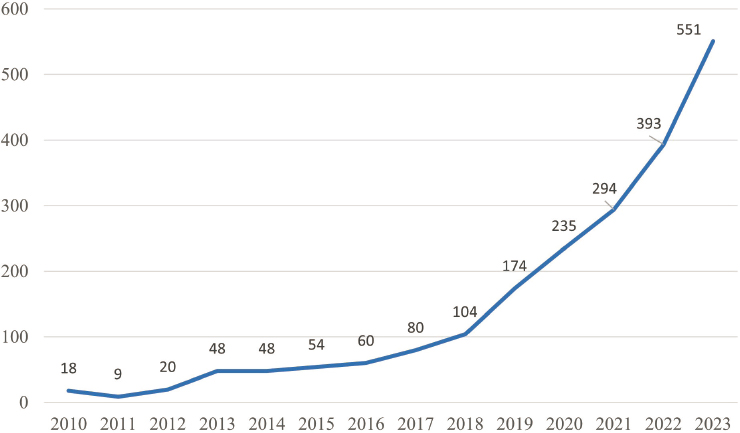
Even without a reduction in COC examination frequency, gas carrier participation in the QUALSHIP 21 program has expanded, steadily increasing from 9 gas carriers in 2011 to more than 550 gas carriers in 2023 (see Figure 3-3).
Liquefied Gas Carrier National Center of Expertise
The Coast Guard embarked on founding National Centers of Expertise (NCOEs) in 2007 as part of its “Marine Safety Enhancement Plan” and in response to a need for a targeted revitalization of technical competency and expertise to keep pace with increasing growth and complexity in the maritime industry.57 In addition to NCOEs for cruise ships, towing vessels, vintage vessels, outer continental shelf activities, casualty investigations, and suspension and revocation of merchant mariner credentials, the LGC NCOE was founded in Port Arthur, Texas, as a detached unit of the Coast Guard Headquarters Traveling Inspector staff.
___________________
53 Coast Guard, “QUALSHIP 21 Initiative,” accessed March 24, 2024, https://www.dco.uscg.mil/Our-Organization/Assistant-Commandant-for-Prevention-Policy-CG-5P/Inspections-Compliance-CG-5PC-/Commercial-Vessel-Compliance/Foreign-Offshore-Compliance-Division/Port-State-Control/QS21.
54 See https://www.dco.uscg.mil/Portals/9/DCO%20Documents/5p/CG-5PC/CG-CVC/CVC_MMS/CVC-WI-002(1).pdf.
55 46 USC 3714 inspection and examination.
56 See https://www.dco.uscg.mil/Portals/9/DCO%20Documents/5p/CG-5PC/CG-CVC/CVC2/psc/safety/qualship/QS21_EZero.pdf.
57 Coast Guard Message, ALCOAST 131/09, Subj: National Centers of Expertise (NCOE).
SOURCE: U.S. Coast Guard data (provided to the committee), 2023.
Although NCOEs have some military personnel, many civilian employees are employed to provide the needed stability, consistency, and industry knowledge for their long-term success.58 The NCOEs are expected to
- revitalize the Coast Guard’s technical competency and expertise to keep pace with the growth and complexity of the maritime industry;
- provide key venues for professional development and exchange between industry and Coast Guard personnel;
- enhance Coast Guard inspector and investigator capabilities while promoting nationwide consistency;
- become a repository of Coast Guard expertise and best practices within their respective maritime industry sector;
- assist in the standardization of techniques and processes across the Coast Guard;
- establish and cultivate enhanced working relationships and partnerships with public and private industry stakeholders to include professional training exchanges and joint training initiatives;
___________________
58 Coast Guard Annual Update Supplement to the Marine Safety Performance Plan, March 2010.
- provide consultation concerning unique design, examination, and operational situations and development of regulations, policy, and doctrine, as requested;
- monitor field activities and procedures to ensure uniform application of regulations, policy, and doctrine; and
- develop curriculum for both exportable and resident training courses.59
Although the LGC NCOE currently has only eight people on staff, many industry and other Coast Guard stakeholders informed the committee that the LGC NCOE has had significant positive impacts.60 The LGC NCOE has successfully increased the Coast Guard’s gas carrier competency, capabilities, and inspection consistency. LGC NCOE personnel keep pace with industry change and improve inspector knowledge and proficiency by supporting and providing gas carrier workshops, on-the-job training, industry training opportunities, gas carrier ship rides, training videos, and specialized input to the development of Coast Guard gas carrier inspection techniques, practices, and qualification requirements.61
The LGC NCOE serves industry as well as Coast Guard field units. Waterfront facility operators that handle liquefied gases and companies that operate gas carriers can and do direct specific technical issues and questions to the LGC NCOE, trusting that the knowledgeable staff will provide timely and informed responses.62 Similarly, Coast Guard field units regularly turn to the LGC NCOE for support. The LGC NCOE augments the marine inspector workforce from the field units with additional highly experienced gas carrier marine inspectors who provide specialized gas carrier expertise and technical advice to the field unit and sometimes assist with COC examinations. In 2021 and 2022, personnel from the LGC NCOE participated in approximately 10% of the COC exams completed by the Coast Guard. However, the LGC NCOE does not have sufficient personnel or resources to attend COC examinations of all liquefied gas carriers (LGCs) in all U.S. ports.
CERTIFICATE OF COMPLIANCE EXAMINATION PROCESS
The COC examination process is a multiple-step process that starts well before a gas carrier enters a U.S. port. In advance of a foreign-flag gas
___________________
59 Ibid.
60 Workshop presentations to the committee in Houston, Texas, March 2023. See https://www.dropbox.com/scl/fo/tokkjlryemozxp1ssnk60/h?rlkey=sybtyfnf2zok9sszaucqcx9mu&dl=0.
61 LGC NCOE, presentation to the committee, March 2023.
62 Workshop presentations to the committee in Houston, Texas, March 2023. See https://www.dropbox.com/scl/fo/tokkjlryemozxp1ssnk60/h?rlkey=sybtyfnf2zok9sszaucqcx9mu&dl=0.
carrier’s first visit to a U.S. port, the vessel owner or operator must submit design drawings, certificates, and information to the Coast Guard Marine Safety Center (MSC), which is located in Washington, DC, and provides engineering and technical support to Coast Guard field units.63 The Coast Guard MSC reviews the submitted information to verify that the foreign gas carrier is in compliance with the U.S. design requirements. The standard turnaround time for review by the Coast Guard MSC is 30 days; when complete, the Coast Guard MSC will develop an SOE, which describes the specific cargo that the vessel is allowed to carry. The Coast Guard MSC must complete and approve the SOE before the vessel’s first COC examination can be scheduled.
To receive the COC and SOE, the gas carrier must call at a U.S. port for examination by the Coast Guard to determine compliance with the applicable regulations.64 When the vessel is due for a COC exam (initial, annual, or renewal), the gas carrier owner, operator, or agent is required to provide the Coast Guard at least 7 days advance notice to arrange the exact time and location of the exam.65 In addition, before the examination will be conducted, the owner or operator must pay an examination fee to the U.S. Department of the Treasury.66
Risk Assessment and Vessel Targeting
All foreign-flag gas vessels are required to provide notice of arrival (NOA) information at least 96 hours prior to arriving in the United States. The local Coast Guard office in each U.S. port screens each of these vessels before they arrive using three risk-based matrices to determine their risk level or threat. The PSC Safety and Environmental Protection Compliance Targeting Matrix evaluates risk factors related to the vessel’s compliance with international safety and environmental standards and is intended to enable the Coast Guard to identify those vessels that pose the greatest risk of being substandard. The other two matrices assess a vessel’s security risk.67
Marine Information for Safety and Law Enforcement (MISLE) is the Coast Guard’s primary information management tool for planning, scheduling, executing, monitoring, and tracking all activities associated with foreign vessels. MISLE automatically applies the PSC Safety and
___________________
63 46 CFR 154.22. Safety Standards for Self-Propelled Vessels Carrying Bulk Liquefied Gases.
64 46 CFR 154.150. Safety Standards for Self-Propelled Vessels Carrying Bulk Liquefied Gases.
65 46 CFR 154.151. Safety Standards for Self-Propelled Vessels Carrying Bulk Liquefied Gases.
66 46 CFR 2.10. Fees.
67 COMDTINST 16000.73, Marine Safety: Port State Control (D4-1), September 2021.
Environmental Protection Compliance Targeting Matrix to foreign vessels that submit an NOA. This risk-based approach evaluates vessels based on six criteria: (1) time elapsed since the vessel was last examined by the Coast Guard; (2) performance of the flag state; (3) performance of the ship management company and detention history of vessels under its control; (4) performance of the RO; (5) history of compliance, which includes Coast Guard deficiency history, and involvement in marine casualties or violations and detentions by the Coast Guard or other governments that are party to the Paris or Tokyo MOUs; and (6) the vessel type and age.68
MISLE also allows the Coast Guard direct access to EQUASIS, which is a database of inspection data/results from Port State regimes around the world. Though EQUASIS is not used to score a vessel in the Coast Guard matrix, PSCOs are highly encouraged to use the system to obtain additional information regarding the safety history and overall condition of the vessel.
In general, all vessels that have not received a Coast Guard PSC exam in the previous 12 months will be a priority and undergo a Coast Guard PSC exam. The Coast Guard routinely de-prioritizes annual exams for container vessels, bulk carriers, or other types of cargo vessels that are enrolled in QUALSHIP 21 and that have received a Coast Guard PSC exam within the past 2 years. However, tank ships including gas carriers, even if they are enrolled in QUALSHIP 21, must receive a calendar-based annual exam because it is required by U.S. law to maintain the COC.69
Scheduling Exams
To avoid delays in cargo operations during a future visit to a U.S. port, gas carrier vessel owners and operators sometimes request an examination even though the COC is valid and an exam is not yet required. Coast Guard policy encourages OCMIs/COTPs to complete the COC exam when requested if the COC is within 3 months of expiration.70 However, input received by the committee from industry and Coast Guard stakeholders indicates that the Coast Guard is often unable to conduct these exams due to a lack of personnel resources.71
___________________
68 COMDTINST 16000.73, Coast Guard Marine Safety Manual, Vol. II: Materiel Inspection Section D: Port State Control, Chapter 4: Targeting of Foreign Vessels, D4-17, September 2021. See also Coast Guard Office of Commercial Vessel Compliance (CG-CVC) Mission Management System (MMS) Work Instruction (CVC-WI-021(1)), Targeting of Foreign Vessels for PSC Examination, January 13, 2020.
69 46 USC 3714 Inspection and examination.
70 COMDTINST 16000.73, Marine Safety: Port State Control (D6-5), September 2021.
71 Workshop presentations to the committee in Houston, Texas, March 2023. See https://www.dropbox.com/scl/fo/tokkjlryemozxp1ssnk60/h?rlkey=sybtyfnf2zok9sszaucqcx9mu&dl=0.
The Coast Guard tries to accommodate vessel schedules and will generally conduct exams any day of the week, including weekends. Sector Houston-Galveston can perform up to three COC exams on a Saturday or Sunday, while the much smaller Marine Safety Unit Lake Charles typically is only able to do one exam per day on weekends. The Coast Guard prioritizes vessels that are restricted from conducting cargo or from departing due to an overdue annual or expired COC exam. However, to ensure the marine inspectors can see the full condition of the vessel, conducting exams during daylight hours is essential.
Typically, the Coast Guard will not travel offshore for COC exams, except for lightering vessels that do not come into port. In addition to the increased safety risk associated with the transfer of the PSC team via helicopter or boat, offshore exams take considerably more time due to the additional transportation and logistics, significantly reducing the inspection team’s efficiency and ability to conduct multiple exams in one day. If transportation offshore is via helicopter, Coast Guard members must receive emergency egress training and require costly safety equipment that also limits access for training new inspectors.
Conducting Exams
After the COC exam is scheduled, a PSC team is assigned by the Coast Guard office. Each PSC examination team should contain a minimum of two members and a maximum of five, including trainees. One member must be an officer, chief warrant officer, or civilian marine inspector, with a foreign gas carrier examiner (FGCE) qualification. The second member should, at a minimum, be qualified as a PSCE.72 In an effort to expedite the exam, Coast Guard members interviewed by the committee stated that they typically assign up to four people to conduct a COC exam, and the team is divided to cover different areas of the vessel.
The inspection team conducts the COC exam according to the guidance found in the Coast Guard’s Foreign Gas Carrier Job Aid.73 The job aid contains an extensive list of possible examination items but states, “[I]t is not, however, the Coast Guard’s intention to ‘examine’ all items listed.” The depth and scope of the exam is to be determined by the PSCOs based on the condition of the ship, operations of the ship’s systems, and the competency of the crew.74
___________________
72 COMDTINST 16000.73, Marine Safety: Port State Control (D1-6), September 2021.
73 COMDTINST 16000.73, Marine Safety: Port State Control (D1-52), September 2021.
74 Coast Guard, Foreign Gas Carrier Job Aid, Job Aid FGCE, revised January 2022, https://www.dco.uscg.mil/Portals/9/DCO%20Documents/5p/CG-5PC/CG-CVC/CVC2/psc/jobaid/JobAid_Gas.pdf.
Areas covered by the job aid and subject to examination by the inspection team include the vessel’s certificates and documents, logs and manuals, lifesaving equipment, firefighting systems, electrical systems, instrumentation, topside equipment, cargo systems, cargo environmental controls, cargo area ventilation, gas fuel supply system, and general health and safety. In addition to assessing the material condition of the vessel and its equipment, PSCOs evaluate the competency of the crew by questioning them during the exam and witnessing the crew perform fire and abandon ship drills. The results of this examination are reported as deficiencies that can range from minor and immediately correctable to severe, which would result in detention of the ship.
Additional guidance for conducting COC exams is provided to PSCOs in the Coast Guard FGCE Tactics, Techniques, and Procedures (TTP). Box 3-3 lists the topics covered in the TTP. This comprehensive guidance details the
BOX 3-3
Scope of Foreign Gas Carrier Certificate of Compliance Examination
The Coast Guard’s Foreign Gas Carrier Examiner (FGCE) Tactics, Techniques, and Procedures (TTP) publication,a intended for use by PSCOs, provides an overview of the 14 topics covered in a Certificate of Compliance (COC) exam:
- Pre-Exam Preparation
- Certificates and Documents Examination
- Logs and Manuals Examination
- General Health and Safety Examination
- Lifesaving Equipment Examination
- Firefighting Systems Examination
- Electrical Systems Examination
- Instrumentation Examination
- Topside Equipment Examination
- Cargo Systems Examination
- Cargo Environmental Control Examination
- Cargo Area Ventilation Systems Examination
- Gas Fuel Supply System Examination
- Follow Up Actions
The Coast Guard does not inspect every item listed in every COC examination. The leading PSCO determines the scope of a specific COC examination.
__________________
a Coast Guard, Foreign Gas Carrier Examiner (FGCE) Tactics, Techniques, and Procedures (TTP), CGTTP 3-72.6A, February 2020, https://www.dco.uscg.mil/lgcncoe/carrier/ttp.
tasks and steps required to conduct a COC exam effectively, efficiently, and safely.75 The FGCE TTP is aligned with the FGCE job aid and performance qualification standard (PQS). It also states that the scope and depth of an examination is determined by the PSCOs and that it is not the Coast Guard’s intention to inspect every item listed in the TTP.
Though the time on board will vary based on the size of the PSC team and other factors, COC exams generally take 2 to 4 hours to complete. Industry representatives interviewed by the committee generally hold the Coast Guard PSC program in high regard, reporting that it is focused on safety; the standards are consistently applied; all parties are treated fairly; and, unlike some other ports around the world, the Coast Guard COC program is free of corruption.
Upon completion of a satisfactory initial COC examination, the Coast Guard PSCO will issue both the COC and the SOE, as necessary. Once an SOE is issued to a vessel, that document remains valid unless the vessel updates the list of cargo it carries, the vessel makes changes to the cargo containment system, or the vessel’s Certificate of Fitness becomes invalid.
In accordance with the current law, the COC is valid for 24 months, provided an annual exam is completed within 90 days of the 1-year anniversary of the COC’s issue date.76
Current Challenges with COC Exams
The committee heard from multiple sources that the process for scheduling and completing COC exams is causing vessel delays and increasing the amount of vessel traffic in already congested ports. The reasons can be attributed to the insufficient quantities of qualified Coast Guard PSCOs, the statutory requirement mandating annual COC exams, and restrictions imposed by the terminals and port facilities.
Vessels that are more than 3 months beyond the expiration date of their COC renewal or annual exam must have the required exam prior to commencing cargo operations.77 As documented by the Government Accountability Office and others, the Coast Guard continues to face a shortage of qualified personnel at units that conduct gas carrier COC exams, which can lead to delays in initiating cargo operations or in departing for vessels that were granted a 3-month extension.78
___________________
75 Coast Guard, Foreign Gas Carrier Examiner (FGCE) Tactics, Techniques, and Procedures (TTP), CGTTP 3-72.6A, February 19, 2020, https://www.dco.uscg.mil/lgcncoe/carrier/ttp.
76 COMDTINST 16000.73, Marine Safety: Port State Control (D6-1), September 2021.
77 COMDTINST 16000.73, Marine Safety: Port State Control (D6-5), September 2021.
78 Government Accountability Office, Assessment of a Risk-Based Approach for Conducting Gas Carrier Exams is Needed, January 2022, https://www.gao.gov/products/gao-22-105432.
As mentioned in Chapter 2, the gas carrier industry works to minimize the amount of time natural gas is in its liquid state because under ambient conditions, LNG reverts to natural gas without intervention. This process is described as “boil-off.” As a result, any delay for a LNG carrier without regasification equipment can lead to additional boil-off, which releases extra methane into the atmosphere and produces negative impacts to the environment.
Furthermore, some of the largest export facilities have imposed restrictions on gas carriers and will not allow them to berth at the terminal if they are due for a COC exam.79 The law requires the LGC to have a valid COC to conduct cargo operations, and the Coast Guard will restrict such operations if more than 3 months have passed since the anniversary or expiration of the COC. In addition, even if the vessel is not cargo-restricted, the COC exam process can slow or impede cargo operations, especially if one or more deficiencies are discovered. These terminals often have multiple vessels waiting to dock and load cargo, and any delay to cargo operations on the waterfront has a costly impact. To avoid the possibility of such delays, some terminals refuse the gas carrier until the COC exam has been completed. In these cases, the operator of the gas carrier must identify a suitable and available lay berth in the port. The LGC will typically transit from the anchorage to the lay berth in the port, undergo the COC examination, transit out of the port and back to the anchorage, transit back into the port a second time to conduct loading operations at the terminal, and finally transit out of the port when cargo operations are complete.
In addition to creating delays and imposing additional costs associated with pilotage and berthing, conducting a COC exam at a lay berth, instead of at the terminal, has detrimental impacts on marine safety. First, it increases the amount of vessel transits and traffic, particularly in the Houston Ship Channel, which is the busiest waterway in the United States with more than 9,000 deep draft vessel and 200,000 barge transits per year.80 The additional transits increase traffic congestion in the narrow channel and the possibility of collisions, groundings, and other navigation accidents.
Second, the additional transits create an additional burden on the crew of the gas carrier and impact their work and rest hours. Typically, the senior officers must be on watch in the pilot house or engine room when an LGC is navigating in and out of the port. These transits can take several hours
___________________
79 Workshop presentations to the committee in Houston, Texas, March 2023. See https://www.dropbox.com/scl/fo/tokkjlryemozxp1ssnk60/h?rlkey=sybtyfnf2zok9sszaucqcx9mu&dl=0.
80 “Accelerating Houston Ship Channel Expansion for Regional Economic and Environmental Benefits,” Port Bureau News, October 31, 2023, https://www.txgulf.org/news/accelerating-houston-ship-channel-expansion-for-regional-economic-and-environmental-benefits.
and are subject to delays due to weather and other vessel traffic, further increasing the risk of crew fatigue.
Third, lay berths may be in close proximity to other infrastructure, operations, and places gas carriers would not otherwise go. Coast Guard personnel from Sector Houston-Galveston told the committee that lay berths may not be outfitted with the customary infrastructure needed to rig the vessel’s accommodation ladder safely, preventing normal vessel access to the Coast Guard PSC team and requiring them to gain access using nonstandard means.81
Finally, although difficult to quantify, the practice of having gas carriers transit to lay berths for COC exams has a cumulative negative impact on commerce and creates inefficiencies in the global supply chain.
COAST GUARD VESSEL INSPECTION WORKFORCE
The Coast Guard’s marine inspection workforce is responsible for implementing the COC program for gas carriers. This section reviews the structure of the Coast Guard’s workforce, challenges with recruiting into marine inspection, the geographic distribution of the inspection workforce, and the FGCE qualification that must be completed before examining gas carriers.
Structure
To conduct marine inspections and PSC examinations, the Coast Guard uses a workforce comprised of a mixture of active-duty military personnel and civilian personnel.
Active-duty military members enter the Coast Guard from different sources and may be commissioned officers, including specialized chief warrant officers, or petty officers. All active-duty members are subject to reassignment and are typically relocated to a new position in a different geographic location every 2 to 4 years. These rotations enable the members to gain new experience and qualifications, which are typically needed to remain competitive for promotion.
After commissioned officers have qualified as marine inspectors and PSCOs and served as a marine inspector for 2 to 4 years, they are typically encouraged to acquire experience and competencies in other specialty areas, such as marine casualty investigations and waterways management, and in other geographic locations rather than continue working as a marine inspector or PSCO. These varied experiences and diverse skills are necessary for them to gain a broader perspective of the Marine Safety mission
___________________
81 Workshop presentations to the committee in Houston, Texas, March 2023. See https://www.dropbox.com/scl/fo/tokkjlryemozxp1ssnk60/h?rlkey=sybtyfnf2zok9sszaucqcx9mu&dl=0.
in preparation for senior leadership positions.82 By law, those officers who wish to be promoted and compete for assignment as a Prevention Department head at a sector office must qualify as a marine inspector and also acquire experience in casualty investigations, or waterways management, or attend postgraduate school to earn an advanced engineering degree.83
Chief warrant officers are unlike other commissioned officers. They are prior-enlisted members who were selected to become specialized members of the officer corps. As such, after qualifying, chief warrant officers may be assigned repeatedly to marine inspector positions in one or more locations for the remainder of their career and often provide comprehensive marine inspection knowledge and expertise.
Petty officers regularly participate in PSC exams but typically do not earn the qualifications necessary to lead an examination on a gas carrier.
The Coast Guard has several civilian personnel that serve as marine inspectors and PSCOs. Unlike active-duty members, these civilian personnel are not regularly subject to reassignment and generally remain at a single location for their entire career. This often allows them to gain more experience, acquire a deeper understanding of the local maritime stakeholders, and provide workforce continuity.
Unlike their active-duty military peers, the civilian marine inspectors are limited to 40 hours of work per week and cannot be expected to work after hours or on weekends. Civilian marine inspectors cannot be required to complete duties that are outside their normal job description. In contrast, active-duty military members easily can be used to fill other urgently required duties beside marine inspections, particularly in the event of hurricanes and other emergency responses that require the Coast Guard to surge forces in other mission areas.
Geographical Distribution of the Workforce
Coast Guard operations are divided between two areas, which contain a combined total of nine districts. Command and control is delegated from the districts to sector commanders and other operational leaders located in ports across the United States and its territories, the Far East, and Europe.
A sector commander is the sole person in charge of planning and executing operations in an area of responsibility, and that person has specific legal authorities, including
___________________
82 Coast Guard Commandant for Operations, “Operations Ashore Junior Officer Career Guide,” 2015, https://www.dco.uscg.mil/Portals/9/DCO%20Documents/5p/5ps/Design%20and%20Engineering%20Standards/docs/Ops_Ashore_Junior_Officer_Career_Guide_2015.pdf?ver=2017-06-16-142233-273.
83 14 USC 57(f). Prevention and response workforces.
- COTP, with authority to enforce port safety, security, and marine environmental protection regulations;
- OCMI, with authority over vessel standards and mariner competency;
- federal on-scene coordinator, with authority over oil and hazardous material spill response and preparedness;
- federal maritime security coordinator, with authority to establish and appoint members to the Area Maritime Security (AMS) Committee and implement the AMS Plan; and
- search and rescue (SAR) mission coordinator, with authority to direct SAR operations, including rendering decisions to suspend active searches.84
While gas carrier COC exams are a critical Coast Guard function, they represent a relatively small portion of the Coast Guard’s total workload and responsibility. In 2022, gas carrier COC exams accounted for less than 8% of all PSC exams completed by the Coast Guard, and the PSC program is only one element of the Prevention Department workload.
In addition to being responsible for the Sector Prevention Department and all marine inspectors and PSCOs, sector commanders typically have responsibility for patrol boats, boat stations, aids to navigation teams, marine safety units and detachments, vessel traffic services, response, and other sector personnel. As such, leadership at the sector is charged with managing many different responsibilities and missions, ranging from oil spill response and SAR cases to facility security incidents and hurricane preparation and response. The gas carrier COC exams represent a very small portion of the sector commander’s operational responsibility.
Challenges to Recruiting and Maintaining the Inspection Workforce
During its information gathering, the committee heard that the Coast Guard has difficulty acquiring and maintaining the workforce needed to conduct all required marine inspections properly. There are multiple contributing factors that cause this chronic shortage.
First, there is an insufficient number of marine inspector positions. In 2023, the Coast Guard had approximately 808 marine inspector positions distributed across the different field units. The Coast Guard’s Sector Staffing Model (SSM) is a validated tool that provides the optimal staffing level for each unit by position. The SSM uses a 3-year historic weighted data average (updated annually) in which the most recent year in the data set takes
___________________
84 Coast Guard, Coast Guard Publication 3-0: Operations, February 2012, https://media.defense.gov/2018/Oct/05/2002049082/-1/-1/0/CGPUB_3-0.PDF.
precedence over the preceding years. Based on the SSM, there was a shortage of 273 marine inspectors across all field units in 2023. In other words, on average, the Coast Guard was staffed with about 75% of the marine inspectors needed to complete its vessel inspection workload. As an example, Sector Houston-Galveston was staffed at 65 marine inspector billets, but according to the SSM, the sector needed 78 billets.85 Table 3-1 shows the number of marine and gas-qualified inspectors, the number of LGC arrivals, and the number of LGC COC exams conducted at the busiest gas ports in District 8 during 2022. District 8 received more than 75% of the LGC arrivals and conducted about 80% of the LGC COC exams in 2022.
In addition, the Coast Guard has difficulty training enough marine inspectors each year to fill all vacant positions. On average, approximately 25% to 33% of the marine inspector workforce at each unit departs each year. Many of these experienced and qualified marine inspectors are transferred to fill marine inspector positions at different field units, staff assignments that require marine inspection experience, or jobs that are unrelated to marine inspections. Currently, more than 15% of gas-qualified inspectors are assigned to units that have no LGC arrivals and only 40% of the gas-qualified inspectors are assigned to District 8 ports that received more than 75% of LGC arrivals in 2022. Other qualified marine inspectors leaving field units may retire or depart the Coast Guard. New marine inspectors are assigned to take their place but often do not arrive at the field unit with the proper qualifications needed to conduct LNG carrier and LPG carrier COC examinations and must be trained before they can be permitted to conduct COC examinations. The time needed to qualify varies significantly based on the level of experience and COC workload at the field unit. At Sector Houston-Galveston, one of the busiest gas carrier ports, a new marine inspector (MI) without a gas carrier qualification could take 16–24 months to obtain all of the prerequisite qualifications and earn a gas carrier qualification. At most ports, though, a new MI will not obtain a gas carrier qualification until their second tour, which may be 4–6 years after they begin inspecting vessels. A marine inspector who already has all of the prerequisite qualifications completed may be able to obtain a gas carrier qualification in 3 months at a busy port, but at most ports it will take 9–12 months.
Much of the workload associated with gas carrier COC examinations is concentrated in Houston and Port Arthur. Some Coast Guard marine inspectors may purposely avoid earning a gas carrier qualification for fear that they may be more likely to be confined to these ports and less likely to be assigned to marine inspector positions in other locations they perceive to be more desirable.
___________________
85 Coast Guard data (provided to the committee), 2023.
TABLE 3-1 Number of Marine and Gas-Qualified Inspectors, LGC Arrivals, and LGC COC Exams, District 8’s Busiest Sectors and Subunits
| District 8 Sector and Subunits | Number of Marine Inspectors | Number of Gas-Qualified Inspectors | 2022 LGC Arrivals | 2022 LGC COC Exams Conducted |
|---|---|---|---|---|
| Sector Houston-Galveston; MSU Texas City | 65 | 27 | 1,685 | 250 |
| MSU Port Arthur; MSU Lake Charles | 35 | 18 | 1,162 | 229 |
| Sector Corpus Christi; MSD Victoria; MSD Brownsville | 22 | 10 | 516 | 52 |
| Sector New Orleans; MSU Baton Rouge | 72 | 10 | 159 | 12 |
| Total | 194 | 65 | 3,522 | 543 |
NOTES: COC = Certificate of Compliance; LGC = liquefied gas carrier; MSD = Marine Safety Detachment; MSU = Marine Safety Unit. Gas-qualified inspectors include commissioned officers, chief warrant officers, and civilians.
SOURCE: Coast Guard data (provided to the committee), 2023.
FGCE Qualification
The Coast Guard’s FGCE qualification, required to conduct examinations and issue COCs, is an advanced qualification that requires significant training for both active-duty personnel and civilian members of the workforce. In accordance with 14 USC 312, an officer, member, or civilian employee of the Coast Guard assigned as a marine inspector shall have the training, experience, and qualifications equivalent to that required for a similar position at a classification society recognized under section 46 USC 3316 for the type of vessel, system, or equipment that is inspected. These requirements are the reason that most Coast Guard marine inspectors are commissioned officers.
Once an individual is assigned to a marine inspector billet, the typical progression of foreign vessel qualifications is as follows:
- PSCE
- Foreign freight vessel examiner
- Foreign tank vessel examiner–Oil
- Foreign chemical tanker examiner–Chemical
- FGCE–Gas
There are often variations in this progression, depending on the availability of vessels at a specific port. In addition, most officers obtain one or more domestic vessel inspection qualifications prior to obtaining an advanced qualification like the gas carrier qualification. All marine inspectors are required to obtain at least four qualifications during their first tour (3 years), with at least one foreign vessel and at least one domestic vessel inspection qualification. Although most marine inspectors are likely to follow the typical progress of foreign vessel qualifications outlined above, a marine inspector is only required to complete the PSCE qualification and at least one other foreign or domestic qualification before starting the gas carrier qualification process.
The requirements for obtaining the gas carrier qualification are laid out in the Coast Guard FGCE PQS. The training is composed of online training, in-person training, and on-the-job training that covers the performance of examination tasks and culminates in an oral exam before a qualification board. The 14 areas of training mirror the components of the COC examination and are listed in Box 3-3. The ability of an individual to perform all required COC examination steps and tasks must be validated by a designated verifying officer, who must observe and document the successful performance of each task. After all training and tasks are completed, the marine inspector sits before a qualification board, which makes the determination to issue the FGCE qualification. The qualification board is composed of three personnel holding the FGCE qualifications and focuses on scenario-based questions that deal with the risks associated with gas carriers.
The time to completion can vary depending on factors such as the availability of the required courses and the number of gas carriers available to perform the required tasks. Once qualified, an FGCE marine inspector must perform at least one gas carrier examination each year in order to maintain qualification status.
LIQUEFIED GAS CARRIER SAFETY PERFORMANCE
During its information gathering, the committee heard that gas carriers are typically well maintained compared to other types of foreign vessels subjected to PSC exams and generally receive fewer deficiencies and detentions. This is supported by the data in PSC Annual Reports.
In 2022, the Coast Guard examined 679 gas carriers, and Coast Guard PSCOs discovered 196 total deficiencies on 113 different foreign gas carriers, representing 17% of gas carriers examined (see Table 3-2).86 Just two
___________________
86 Coast Guard, Port State Control in the United States: 2022 Annual Report, 2022, https://www.dco.uscg.mil/Portals/9/DCO%20Documents/5p/CG-5PC/CG-CVC/CVC2/psc/Annual-Reports/annualrpt2022.pdf.
TABLE 3-2 Deficiency and Detention Percentage by Ship Type, 2022
| Ship Type | Number of Exams | Exams with Deficiencies | Number of Deficiencies | Percent of Exams with Deficiencies | Number of Detentions | Detention Percentage |
|---|---|---|---|---|---|---|
| Bulk Carrier | 2,500 | 616 | 1,380 | 24.64 | 27 | 1.08 |
| Container Ship | 1,433 | 361 | 796 | 25.19 | 14 | 0.98 |
| General Dry Cargo Ship | 984 | 262 | 610 | 26.62 | 21 | 2.13 |
| Passenger Ship | 339 | 180 | 651 | 53.09 | 5 | 1.47 |
| Refrigerated Cargo Ship | 137 | 48 | 122 | 35.03 | 2 | 1.46 |
| Gas Carrier | 679 | 113 | 196 | 16.64 | 2 | 0.29 |
| Chemical Tanker | 1,278 | 202 | 422 | 16.80 | 5 | 0.39 |
| Oil Tanker | 1,022 | 202 | 358 | 19.76 | 0 | 0.00 |
| Other | 334 | 75 | 159 | 22.45 | 2 | 0.59 |
SOURCE: Coast Guard, Port State Control in the United States: 2022 Annual Report, 2023, https://www.dco.uscg.mil/Portals/9/DCO%20Documents/5p/CG-5PC/CG-CVC/CVC2/psc/AnnualReports/annualrpt2022.pdf.
gas carriers were determined to be substandard and were detained by the Coast Guard. The gas carrier detention rate of 0.29% is far below the Coast Guard’s overall PSC detention rate of 0.89% for all foreign vessels.
Figure 3-4 presents the detention rate for different types of foreign-flag vessels examined by the Coast Guard under the PSC program over the past 3-year period. Since 2020, less than one-half of 1% of gas carriers examined by the Coast Guard were determined to be substandard and were detained due to deficiencies discovered during routine COC exams. Oil and chemical tankships performed slightly better, but passenger, container, bulk, dry cargo, and other vessels all performed considerably worse.
Consistent with the characteristics of the global fleet of gas carriers discussed in Chapter 2, most gas carriers that receive Coast Guard COC exams and operate in the United States are less than 10 years old. Vessel deficiencies are more likely to be discovered during COC exams conducted on gas carriers as they increase in age. Between 2013 and 2023, the percentage of gas carrier exams that had deficiencies increased as the vessel increased in age (see Figure 3-5).
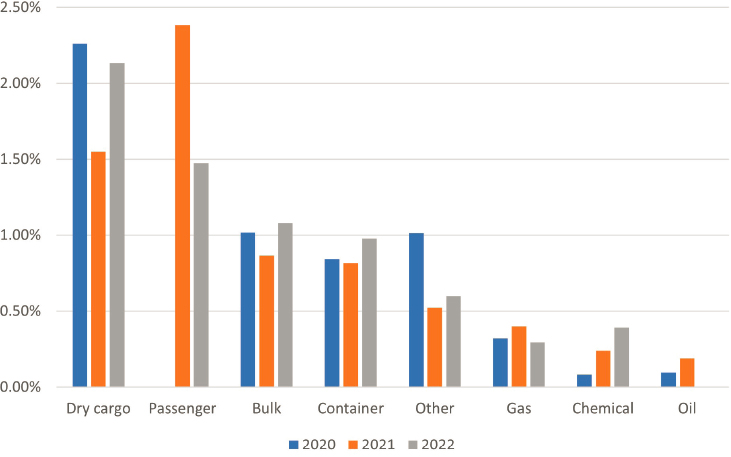
SOURCE: Coast Guard Port State Control Annual Reports.
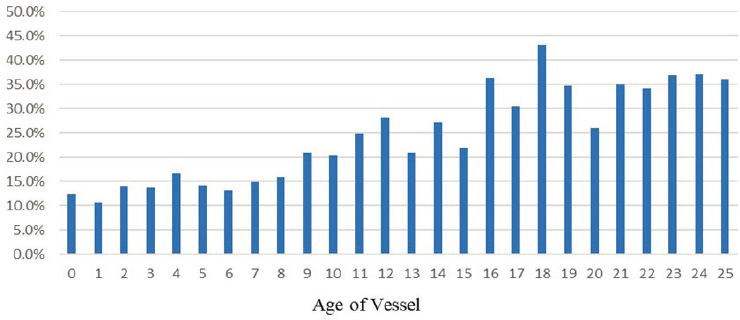
NOTE: Exams of gas carriers >25 years of age are excluded.
SOURCE: Coast Guard data (provided to the committee), 2023.
CURRENT COAST GUARD ACTIVITY LEVELS
In 2022, 11,235 individual vessels from 78 different flag states made 80,280 port calls in the United States. In addition to the 8,706 PSC exams conducted by the Coast Guard, marine inspectors also completed 20,341 inspections on 19,189 U.S. flag vessels in 2022.87 The 679 gas carrier COC exams represent just 2.3% of the total number of PSC and U.S. vessel inspections completed by the Coast Guard that year.
Consistent with the significant increase in LNG and LPG exports described in Chapter 2, LGC arrivals to the United States increased dramatically in recent years (see Figure 3-6). Between 2018 and 2022, gas carrier arrivals have gone up by 70%. Although arrivals of LNG carriers have increased by nearly 250% between 2018 and 2022, they represented only 34% of all LGC visits to the United States in 2022 (see Table 3-3).
Not all U.S. ports receive gas carriers. As discussed in Chapter 2, facilities that handle and export LNG and LPG are predominately concentrated in ports along the U.S. Gulf Coast.
Port Arthur has multiple LNG export facilities in operation or under development. As shown in Table 3-4, between 2018 and 2022 Port Arthur experienced increases of 153% and 171% in LPG carrier and LNG carrier arrivals, respectively.
___________________
87 Coast Guard, Flag State Control in the United States: 2022 Domestic Annual Report, https://www.dco.uscg.mil/Portals/9/DCO%20Documents/5p/CG-5PC/CG-CVC/CVC1/AnnualRpt/2022%20Flagstate%20Annual%20Report.pdf.
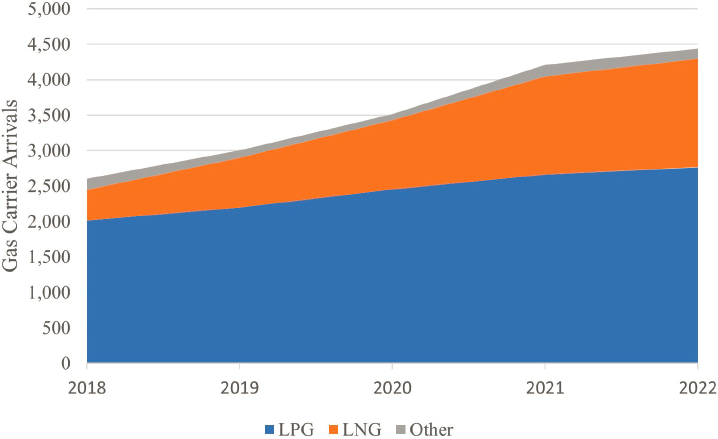
NOTES: LNG = liquefied natural gas; LPG = liquefied petroleum gas. “Other” includes anhydrous ammonia and general.
SOURCE: Coast Guard data (provided to the committee), 2023.
TABLE 3-3 Number of LGC Arrivals, 2018–2022
| Gas Carrier Arrivals | ||||||
| 2018 | 2019 | 2020 | 2021 | 2022 | % Change | |
| LPG | 2,013 | 2,197 | 2,455 | 2,661 | 2,765 | 37 |
| LNG | 437 | 702 | 975 | 1,382 | 1,529 | 250 |
| General | 126 | 95 | 74 | 151 | 135 | 7 |
| Anhydrous Ammonia | 30 | 11 | 8 | 13 | 9 | –70 |
| Total | 2,606 | 3,005 | 3,512 | 4,207 | 4,438 | 70 |
SOURCE: Coast Guard data (provided to the committee), 2023.
Corpus Christi has seen even more remarkable growth, receiving nearly 50 times more LNG carriers in 2022 than in 2018 and now accounting for 20% of all LNG carrier arrivals in the entire United States.
Despite the remarkable growth in Corpus Christi and Port Arthur, most of the activity remains in Houston, which still has more gas carrier arrivals than the other two ports combined.
TABLE 3-4 Number of Gas Carrier Arrivals by Port, 2018–2022
| Gas Carrier Arrivals by Port | ||||||
| 2018 | 2019 | 2020 | 2021 | 2022 | % Change | |
| MSU PORT ARTHUR | ||||||
| LPG | 156 | 166 | 153 | 345 | 395 | 153 |
| LNG | 277 | 397 | 442 | 564 | 752 | 171 |
| General | 0 | 3 | 0 | 13 | 14 | NA |
| Anhydrous Ammonia | 8 | 2 | 0 | 0 | 1 | –88 |
| Total | 441 | 568 | 595 | 922 | 1,162 | 163 |
| SECTOR CORPUS CHRISTI | ||||||
| LPG | 172 | 204 | 183 | 198 | 207 | 20 |
| LNG | 6 | 125 | 125 | 257 | 304 | 4,967 |
| General | 0 | 0 | 0 | 0 | 0 | NA |
| Anhydrous Ammonia | 0 | 0 | 0 | 0 | 0 | NA |
| Total | 178 | 329 | 308 | 455 | 511 | 187 |
| SECTOR HOUSTON-GALVESTON | ||||||
| LPG | 1,148 | 1,164 | 1,328 | 1,305 | 1,387 | 21 |
| LNG | 24 | 49 | 154 | 293 | 230 | 858 |
| General | 41 | 30 | 34 | 67 | 67 | 63 |
| Anhydrous Ammonia | 3 | 5 | 0 | 2 | 1 | –67 |
| Total | 1,216 | 1,248 | 1,516 | 1,667 | 1,685 | 39 |
| ALL OTHER PORTS | ||||||
| LPG | 537 | 663 | 791 | 813 | 776 | 45 |
| LNG | 130 | 131 | 254 | 268 | 243 | 87 |
| General | 85 | 62 | 40 | 71 | 54 | –36 |
| Anhydrous Ammonia | 19 | 4 | 8 | 11 | 7 | –63 |
| Total | 771 | 860 | 1,093 | 1,163 | 1,080 | 40 |
SOURCE: Coast Guard data (provided to the committee), 2023.
The number of PSC COC exams conducted by the Coast Guard has gone from 441 in 2018 to 679 in 2022, an increase of more than 50% (see Figure 3-7).
Although the number of gas carrier arrivals increased over the past 5 years, these increases did not result in an equal increase in the number of COC exams. As shown in Figure 3-8, over the past 5 years the Coast Guard
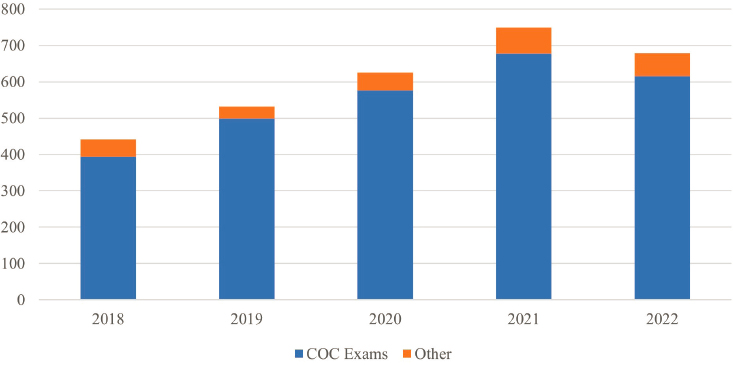
NOTE: “Other” includes additional PSC-related activities outside of a COC examination.
SOURCE: Coast Guard data (provided to the committee), 2023.
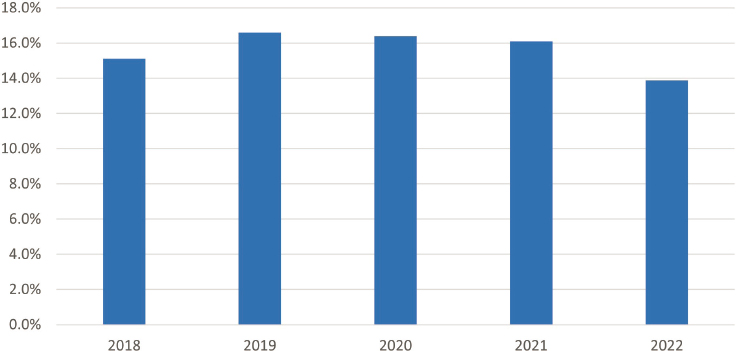
SOURCE: Coast Guard data (provided to the committee), 2023.
performed COC examinations on approximately 15% of the gas carriers that arrived in the United States.
PROJECTED COAST GUARD ACTIVITY LEVELS THROUGH 2040
As presented in Chapter 2, U.S. LNG exports are expected to continue to increase through the early 2030s and then stabilize at a high level through 2040, while U.S. LPG exports are expected to continue to increase through 2040. To analyze the impact of these forecasted increases in LNG and LPG exports on Coast Guard activities, the committee developed projections for LNG and LPG carrier visits to U.S. ports and for the COC program’s calendar-based annual exams.
The number of COC exams for LNG and LPG carriers is projected to increase 42% between 2023 and 2030 and 57% by 2040. The number of COC exams for LPG carriers is larger than for LNG carriers (414 versus 235, respectively, in 2023) and will rise more rapidly, increasing 46% between 2023 and 2030 and 67% by 2040. The number of COC exams for LNG carriers is projected to increase 34% between 2023 and 2030 and 38% by 2040. The projection for LNG COC exams is a conservative estimate. It is based on the Poten & Partners April 2023 projection for LNG exports through 2045, which stabilizes during the 2030s a bit above 140 MMt/year (see Figure 2-16). The Poten & Partners high scenario for LNG exports exceeds 190 MMt/year by 2030.88
Appendix C provides the detailed projection of COC exams for LNG and LPG carriers for the period 2024–2040, which is summarized below in Figure 3-9 and Table 3-5.
CHAPTER SUMMARY
In response to environmental concerns in the 1960s and safety concerns in the 1970s, the United States developed a comprehensive approach to gas carrier safety. When the COC program was established in 1972, there was a very small safety net to identify and correct safety concerns on gas carriers. Now, more than 50 years later, there is a much larger and more comprehensive global safety net for gas carriers, with multiple overlapping layers to ensure that these vessels comply with marine environmental protection rules and regulations. There are more international safety requirements, the standards are more stringent, the standards are enforced around the world, there is a high level of industry collaboration focused on safety, there is an extensive system of industry vetting, and there are detailed self-assessment
___________________
88 Poten & Partners, presentation to the committee, January 25, 2023.
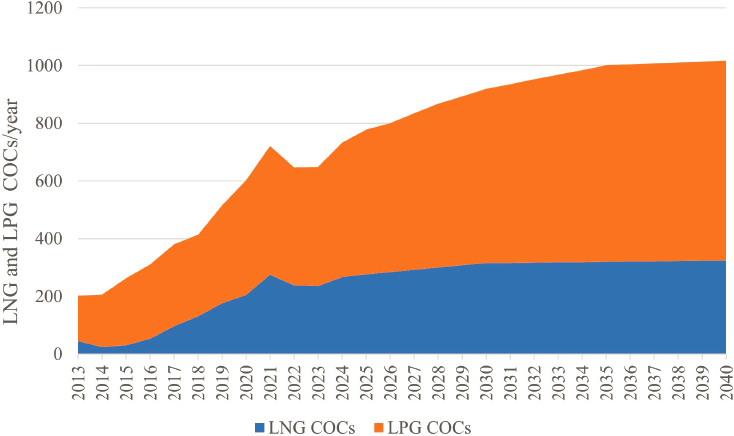
NOTES: Includes both imports and exports. COC exams include those that take place during COC renewals. 2013–2023 are actual exams.
SOURCE: Committee analysis of Coast Guard data (provided to the committee), 2023.
programs. In addition, industry tools such as SIRE 2.0 and audited TMSA provide a rich source of data related to gas carrier safety.
The Coast Guard’s COC program, in current form, was enacted in 1978 and has remained essentially unchanged for foreign gas carriers. For foreign-flag gas carriers, the COC program requires renewal of the certificate every 2 years and a calendar-based annual exam. This is more frequent than the 5-year certificate renewal cycle and risk-based approach to periodic surveys typically used by IMO and classification societies. U.S. cargo ships also typically have a 5-year COI. For other foreign cargo vessels, the Coast Guard currently uses a risk-based approach to periodic inspections and safety incentives such as the QUALSHIP 21 Initiative. Because of federal law, foreign-flag gas carriers cannot be fully integrated into these successful programs.
The boom in LNG and LPG exports since 2010 has increased pressures on the Coast Guard’s marine inspection workforce. COC exams for LNG and LPG carriers more than tripled between 2013 and 2023. By conservative estimate, these COC exams are projected to increase 42% by 2030 and 57% by 2040. COC exams for gas carriers represent a small percentage of
TABLE 3-5 Actual and Projected COC Exams for LNG and LPG Carriers, 2013–2040
| LNG COCs | LPG COCs | Total COCs | Index COCs (2023 = 100) |
|
| 2013 | 45 | 158 | 203 | 31 |
| 2014 | 24 | 183 | 207 | 32 |
| 2015 | 31 | 232 | 263 | 41 |
| 2016 | 53 | 258 | 311 | 48 |
| 2017 | 97 | 284 | 381 | 59 |
| 2018 | 131 | 283 | 414 | 64 |
| 2019 | 176 | 339 | 515 | 79 |
| 2020 | 205 | 398 | 603 | 93 |
| 2021 | 275 | 446 | 721 | 111 |
| 2022 | 238 | 409 | 647 | 100 |
| 2023 | 235 | 414 | 649 | 100 |
| 2024 | 267 | 466 | 733 | 113 |
| 2025 | 276 | 502 | 777 | 120 |
| 2026 | 284 | 516 | 800 | 123 |
| 2027 | 292 | 543 | 835 | 129 |
| 2028 | 300 | 568 | 868 | 134 |
| 2029 | 308 | 586 | 893 | 138 |
| 2030 | 315 | 604 | 919 | 142 |
| 2031 | 316 | 619 | 935 | 144 |
| 2032 | 317 | 635 | 952 | 147 |
| 2033 | 318 | 650 | 968 | 149 |
| 2034 | 319 | 665 | 984 | 152 |
| 2035 | 320 | 681 | 1,001 | 154 |
| 2036 | 321 | 683 | 1,004 | 155 |
| 2037 | 322 | 686 | 1,007 | 155 |
| 2038 | 323 | 688 | 1,010 | 156 |
| 2039 | 323 | 690 | 1,014 | 156 |
| 2040 | 324 | 693 | 1,017 | 157 |
NOTES: Includes both imports and exports. COC exams include those that take place during COC renewals. 2013–2023 are actual exams.
SOURCE: Coast Guard data (provided to the committee), 2023.
the Coast Guard’s port state responsibilities, and the PSC program is only one element of the Coast Guard’s overall marine inspection responsibilities; in addition, the COC exams require inspectors to have specialized qualifications that are time-consuming to achieve. The result is a small workforce that is stretched thin. The Coast Guard’s LGC NCOE has been a critical resource in helping the Coast Guard fulfill its safety and environmental protection responsibilities during the recent increases in gas carrier traffic.


