Developing a Guide for Transporting Freight in Emergencies: Conduct of Research (2024)
Chapter: 4 Final Deliverables
Chapter 4. Final Deliverables
Introduction
This chapter presents the approach and development of the final deliverables based on the following tasks:
- Task 4—Describe the Roadmap for Success. The purpose of this task was to develop and describe recommendations and tools necessary for successful emergency CMV weight limit regulatory relief.
- Task 5—Develop a Decision Framework and Guidance Materials. This task aimed to leverage previous tasks’ insights to develop final deliverables for consumption by practitioners dealing with truck permitting at state and local agencies.
Task 4—Describe Roadmap for Success
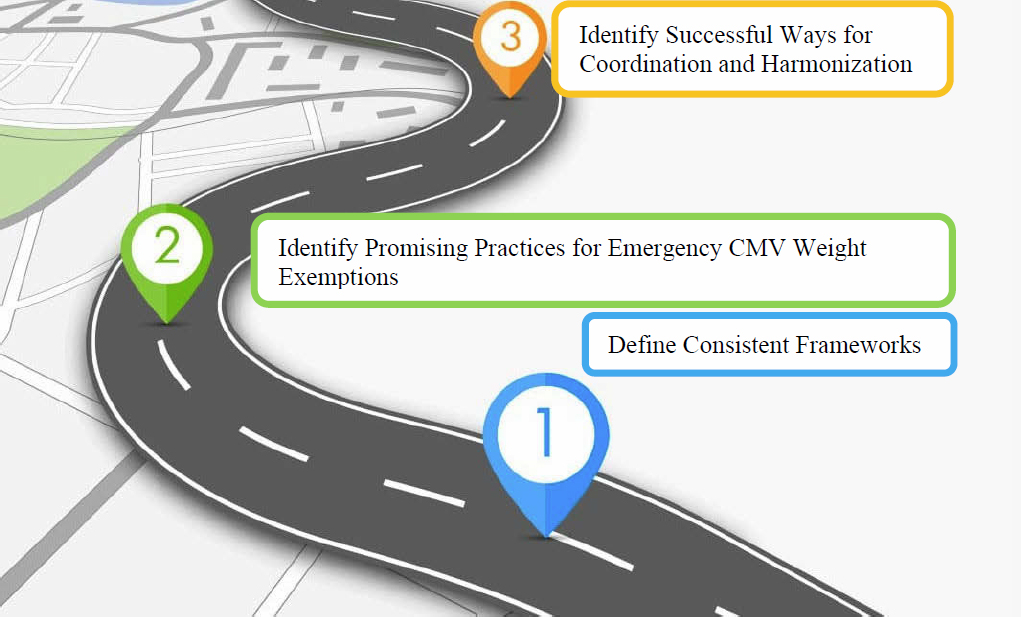
In Task 4, the researchers used the findings from previous tasks to describe recommendations and tools that states can use as promising practices for emergency CMV weight limit regulatory relief. The recommendations are consistent with emergency management and transportation operations frameworks, and implementable across jurisdiction boundaries and at multiple levels (local, state, and federal) by public and private sectors. The three milestones in this roadmap were the following (as shown in Figure 16):
- Define consistent frameworks.
- Identify promising practices for emergency CMV weight exemptions.
- Identify successful ways for coordination and harmonization with neighboring jurisdictions.
To achieve these milestones, the research team sought feedback during two specific meetings as part of this task. The first meeting was an interim presentation to the panel members based on the interim report in June 2023, where the research panel got an opportunity to see the progress of the project and provide input. The second meeting was conducted in the form of a virtual workshop in October 2023 with the audience of the research products of this project.
The comments received from the panel during the interim presentation were incorporated into the final reports. The summary of comments received from the audience of the guide during a virtual workshop and the expectations from the guide and other deliverables are as follows:
- Development of a Contact List: There is a strong consensus on the need for a clear and accessible contact list, preferably with 24/7 contact details.
- Commodity List: While many see the value in creating a list of essential commodities during emergencies, there was concern about the practicality of such an endeavor. The audience converged on steps to develop and provide an example rather than hard guidelines.
- Best Practices and Guidelines: The guide should provide high-level guidance, supplemented by best practices.
- Pre-Disaster Approach: One attendee mentioned the opportunity to develop pre-disaster processes, such as ensuring carriers reach safe parking spots before disasters strike.
- Communication: This was seen as another opportunity to streamline informal communication, and some guidance should be included in the guide.
Define Consistent Frameworks
In terms of consistent frameworks, researchers considered developing the following:
- A list of common commodities to include in special permits.
- Standards and formal communication protocols.
- Standard language on special permits (including road types and routing information).
- Consistent definitions of divisible and non-divisible loads.
Identify Promising Practices for Emergency CMV Weight Exemptions
Many promising practices were identified in earlier tasks. The following practices were expanded in the guide as part of this task, with a focus on best practices that maximize the harmonization between stakeholders during an emergency:
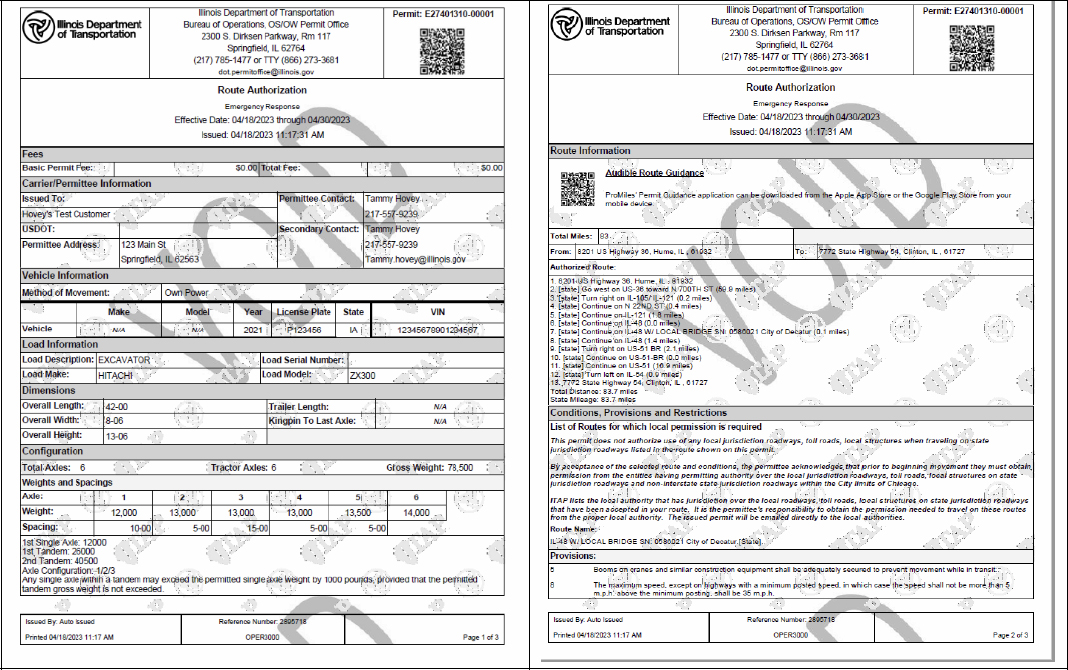
- Developing permitting systems and standards. For example, the Illinois Transportation Automated Permit system has a mechanism to customize permits for specific emergencies that utilizes new technologies (e.g., QR code) (see Figure 17).
- Providing routing information and needed guidance within the special permit, including city or county contacts, to obtain permissions to take the OS/OW loads on city or county roads.
- Refining mechanisms to leverage coordination, like a MAASTO MOU, which has found the least common denominator weight included in special permits and allowed through all states during the emergency.
- Conducting formal communication or regular meetings with neighboring state permitting agencies/authorities.
- Getting involved in emergency response management offices.
Identify Successful Ways for Coordination and Harmonization with Neighboring Jurisdictions
Coordination between authorities is essential to a speedy response and successful recovery from a disaster. Traditional response and recovery organizations utilize emergency management frameworks to create commonality and easy coordination. States can also create consistency in CMV emergency weight exemptions when coordinating actions and harmonizing procedures across jurisdictions. Such frameworks do not exist currently for OS/OW special permits, partly because the agencies responsible for OS/OW special permits vary from state to state. However, using a common operating picture and establishing a model for the practice can facilitate future coordination.
This subtask evaluated and identified ways state agencies might better coordinate their process with neighboring jurisdictions and how federal policy or regulation may support that effort. For example:
- Develop and use model or baseline forms, templates, policies, and procedures states can adapt to their requirements.
- Facilitate coordination and cooperation between multiagency coordination processes, fusion centers, liaisons, and joint operations centers.
- Identify in emergency operations plans and agency procedures the information requirements and the coordination and sharing mechanisms in a disaster/emergency that neighboring jurisdictions will utilize to coordinate OS/OW limit special permits and the delivery of emergency supplies in a disaster.
- Create training programs for those issuing special permits and for motor carriers that will help create a common operating picture and framework.
- Test CMV emergency weight exemption frameworks and processes in the national exercise program and use feedback to refine existing procedures and programs.
Task 5—Develop a Decision Framework and Guidance Materials
In Task 5, the research team developed the following deliverables:
- Developed guide.
- Developed webinar and PowerPoint slides.
- Identified training opportunities.
- Developed implementation plan, final report, and draft article.
The purpose of the above-mentioned subtasks was to develop the draft/final project deliverable that includes a guide, training material, and final report (including an implementation plan).
Development of Guide
The guide, published as NCHRP Research Report 1115: Transporting Freight in Emergencies: A Guide on Special Permits and Weight Requirements, is written for a state agency audience with language and content appropriate to and used by the practitioner community with truck permitting offices and decisionmakers. The guide is based on information collected from the practitioner community in a virtual workshop conducted in October 2023.
The guide has been divided into three sections and five chapters for ease in understanding and implementing. The first section deals with all the rules and regulations regarding emergency and disaster declaration that a decisionmaker or truck permitting agency staff needs to know.
The second section deals with various steps of the emergency management cycle, which includes prevention, preparedness, response, recovery, and mitigation. The two chapters in this section provide the guide users with the necessary information needed to develop MOUs, create a list of commodities during emergency, design formal communication protocols, and follow best practices for coordination and harmonization of special permits during emergency.
The last section or chapter of the guide provides the users with the existing tools and resources to implement the recommendations in the previous chapters. This chapter also consolidates the available resources for the user in one place. The guide has graphics and infographics to make it more attractive and easier to follow.
Identify Training Opportunities
The project team identified multiple types of training opportunities for potential implementation:
- Private-sector training—CMV operators. A brief training module that covers basics that CMV operators (heavy truck drivers) need to know about emergency overweight permits and multi-state operations.
- Private-sector training—CMV and third-party logistics (3PL) managers. A training module that covers basics and more specific considerations of emergency overweight permits for logistics managers of CMV fleets and/or 3PL companies.
- Public sector line staff—A brief training module for line and field staff (DMV staff, truck inspectors) that covers basics that agency personnel may need to know about emergency overweight permits and multi-state operations.
- Public sector program/management staff —An in-depth training module that covers all aspects of emergency overweight permitting including multi-state considerations. This training could also identify a checklist of considerations for multi-state collaborations as a prompt for discussions or working groups that multiple states or coordinating organization might organize.
- Public sector senior management/executive or legislative staff—A high-level training/briefing module that covers broad concepts of emergency overweight permits and why they are important in multi-state contexts.
The simplest and broadest application of training modules would be through a pre-recorded video webinar posted on a major publicly accessible and free streaming service that individual agencies could link to for dissemination. Another concept is for one or more coordinating organizations to host video content as well as other content (e.g., presentations, checklists, workbooks, etc.) on their Internet sites. Some training modules could also be developed to cover multiple audiences, for example, basic-level training modules that can be used for both private-sector CMV operators and public sector line staff, or more in-depth training modules that can be used for both private-sector logistics managers and public sector program/management staff; this help corresponding levels of personnel get on the same page with respect to emergency overweight permit considerations.
Development and Dissemination of Training Material
- The research team developed webinar (online seminar) slides to summarize the project and major findings. The team also anticipates a webinar related to the project’s results using TRB resources. The team plans to advertise the webinar in various channels (TRB committees, AASHTO, Institute of Transportation Engineers, etc.) and through contacts or organizations interviewed and surveyed during this project. The project team has noted potential training opportunities for personnel involved in OS/OW emergency special permits. To support this effort, the research team provided an overview of the guide in the TRB webinars.
Development of Final Report
The final report documents the research effort that includes following:
- An executive summary at the beginning of the report that can be used when sharing the research findings with policy makers and decision makers.
- A description of the research activities, key findings, and outcomes of the project.
- Implementation recommendations.
- Recommendations for future research on related topics that are identified during the research.
The final report documents the entire research effort, including literature review findings, lessons learned from the interviews, stakeholder interviews, best practices, challenges, and opportunities. The final report can be seen as the foundation of the guide developed as part of this project.


