Women's Empowerment, Population Dynamics, and Socioeconomic Development (2025)
Chapter: Summary
Summary
While the concepts of women’s empowerment, population dynamics, and socioeconomic development have been studied extensively from a variety of disciplinary perspectives, a holistic interdisciplinary review that reconciles the literature on these complex dynamics is absent. The lack of consensus limits the extent to which these concepts can be applied toward accomplishing global health and development goals. The Bill & Melinda Gates Foundation asked the National Academies of Sciences, Engineering, and Medicine to appoint a multidisciplinary consensus study committee focused on advancing the state of knowledge on the impact of women’s empowerment and associated population dynamics on socioeconomic development. The committee was tasked with developing a conceptual framework describing these dynamics and setting an agenda for future research and data collection.
To address the charge, the committee reviewed research from a wide variety of social science and health disciplines. While it became clear that existing empowerment frameworks do not fully address the interactions across women’s empowerment, population dynamics, and socioeconomic development, these frameworks enabled the committee to identify critical gaps and highlight women’s agency as a lynchpin in the empowerment process.
FRAMEWORK OF WOMEN’S EMPOWERMENT, POPULATION DYNAMICS, AND SOCIOECONOMIC DEVELOPMENT
The new conceptual framework proposed by the committee (see Figure S-1) builds on existing frameworks of women’s empowerment and highlights the central role of women’s agency at the societal, community, interpersonal, and intrapersonal levels. The framework shows how resources can support empowerment and illustrates the role of population dynamics as a potential mechanism through which empowerment can operate to influence socioeconomic development. The framework acknowledges that these relationships are often bidirectional or otherwise interrelated. The framework also recognizes the sociocultural environment, including norms, institutions, and other structural conditions, as a critical moderator of the women’s empowerment process and its relations with other constructs in the model. The rightmost box in Figure S-1 shows aspirational development goals, which are the higher-level goals anticipated when basic needs are met, human capabilities are realized, and human rights are guaranteed. We utilized this conceptual framework to guide an in-depth literature examination on the role of women’s empowerment in relation to population dynamics and socioeconomic development.
Our review of the research on the impacts of women’s empowerment on population dynamics found causal evidence related to the roles of family formation and fertility, cash transfers, skills training, employment, and education subsidies in shaping population dynamics. These studies often imply that impacts on family and fertility outcomes flow through women’s agency, but findings are largely inconsistent across studies and geographies. Reasons for inconsistencies include differences in the terminology and measurement of women’s empowerment, a paucity of research on the agency-related mechanisms through which interventions have their impact, and limited longitudinal data to clarify dynamic relationships between empowerment indicators and outcomes and trajectories of change. Research in this area is typically focused on women’s individual and interpersonal empowerment, with limited attention to the understudied higher levels of women’s empowerment (e.g., collective resources and agency). Research also lacks attention to the broader gender and policy context, such as the formal institutions and norms that condition the impacts of resources invested in women and women’s agency, and in turn, population dynamics. In addition, the interventions studied are often confined to single, small-scale geographies and to relatively homogenous cultural contexts, limiting their external validity and precluding an understanding of their effectiveness at scale.
A substantial body of work focuses on the relationships between women’s empowerment and healthcare access, utilization, and outcomes,
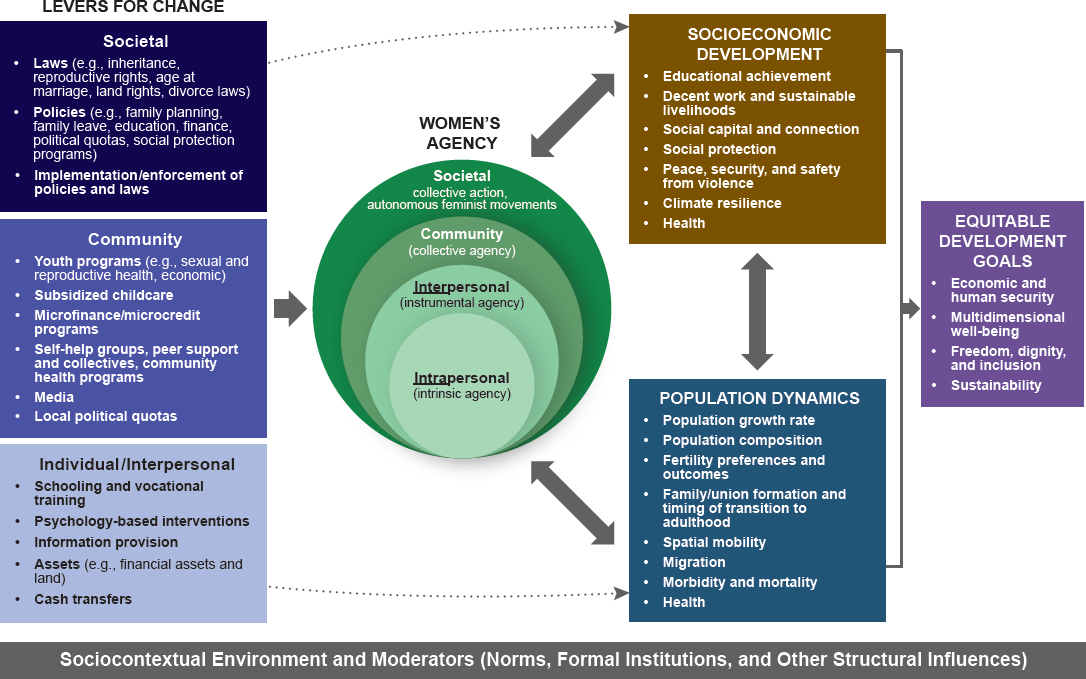
SOURCE: Developed by the committee.
specifically in the areas of reproductive, maternal, and child health. However, much of this work relies on cross-sectional data and uses unidimensional and/or narrowly defined indicators of empowerment, which limits understanding of the causal relationships between all dimensions of women’s empowerment and a broader range of high-priority public health outcomes for women and girls.
In terms of the impacts of women’s agency on socioeconomic development, many studies document how women’s access to resources, including assets and income, positively impacts socioeconomic development outcomes for themselves, their families, and their communities. Laws that reserve political leadership positions for women have been shown to increase girls’ career aspirations and educational attainment. They have also been shown to increase women’s empowerment by increasing their likelihood of benefiting from employment guarantees and increasing their access to financial services.
However, the evidence base isolating the specific role of women’s agency on socioeconomic development outcomes is thinner. Impacts are often presumed to result from changes in women’s preferences, yet these preferences are seldom measured directly. In terms of individual agency, self-efficacy is the most directly measured dimension with the greatest empirical evidence. Less empirical evidence exists for direct measures of women’s awareness of their rights, locus of control, goal setting, internal motivation, and the actions women may take without others’ knowledge, despite their conceptual importance as dimensions of individual agency. In terms of women’s interpersonal agency, their decision-making ability is, by far, the most measured construct. However, the specific domain of decision making is not always measured in alignment with theoretical pathways of influence. In terms of community-level agency, causal evidence is lacking on how changes in this parameter (e.g., the expansion of women’s networks, changes in collective efficacy, and changes in collective actions) impact socioeconomic development outcomes. Lastly, evidence is particularly limited on how societal-level changes in women’s agency affect socioeconomic development outcomes. For example, the influences of policy levers, such as autonomous feminist movements engaged in collective action for social change, have not been adequately explored.
The committee’s review of policies and programs that impact direct measures of women’s agency identified several areas in which interventions have influenced women’s aspirations, self-efficacy, and decision making. These areas include (a) financial programs, including cash transfers, microfinance, and job training and placement; (b) women’s collectives to support women’s economic and health status and build collective efficacy; (c) health interventions, including family planning and sexual and reproductive health programs, community health worker programs for maternal
and child health, and peer programs for mental health; (d) youth development interventions, including those focused on early marriage prevention and education promotion, as well as life skills training; and (e) social and legal protections and policies, particularly those related to gender-equal opportunity and safety from gender-based violence. These program and policy approaches align with the areas in which significant changes are seen in population dynamics (e.g., timing of sexual initiation, unions, or marriage; health; and family planning) and socioeconomic development outcomes (e.g., education, women’s labor market participation). While studies often show robust impacts of these programs, existing evidence cannot necessarily be generalized beyond often-homogeneous study populations and geographically narrow contexts.
Policies for which evidence appears to be inadequate include those in the areas of marriage, divorce and custody laws, wage equality laws, and family leave policies. Additionally, evidence from low- and middle-income countries regarding the role of agency at levels beyond the individual and interpersonal is generally insufficient. Evidence on collective agency and collective action as outcomes is limited, except in the case of women’s self-help groups, potentially because these groups operate with the intention of building solidarity among women. Evidence also is limited on the impact of women’s social movements on agency at the individual and interpersonal levels.
We identified three broad areas in which it would be especially productive to concentrate efforts in the near future to better understand the role of women’s empowerment in population dynamics and socioeconomic development. These areas, discussed below, include (a) improving the measurement of aspects of women’s empowerment, and in particular women’s agency; (b) strengthening study designs; and (c) investing in international collaborations and research harmonization.
IMPROVING MEASUREMENT
The committee’s review identified inconsistencies, limitations, and gaps in measurement as primary barriers to advancing knowledge of the role of women’s empowerment in population dynamics and socioeconomic development and subsequent targeted interventions that increase empowerment. These data limitations often mean that concepts and relationships considered important in theory are poorly defined, poorly operationalized, and not comparable across diverse social contexts, likely resulting in confounding effects. Studies often lack the full range of data elements necessary to measure women’s empowerment and to understand the pathways of influence on population dynamics and socioeconomic development. The lack of
longitudinal data in particular limits understanding of the trajectories of change. The identified gaps motivated several recommendations.
RECOMMENDATION 1: Data collection on women’s empowerment should be expanded to include the range of measures necessary to fully capture elements of women’s empowerment, as well as the dynamics and pathways in the committee’s new conceptual framework that remain poorly understood. Many of these aspects are multidimensional and should be understood as such. These include
- Sociocultural norms and structures as conditioning factors in the sociocontextual environment.
- Structural dynamics and sexism.
- The role of men, including structural gender inequalities, inequitable gender norms, and masculine dominance.
- Barriers to empowerment.
- Effective methods to reduce gender inequality in productivity, earnings, and profits.
- Effective methods to address norms surrounding women’s domestic work.
- Effective methods to eliminate occupational segregation.
- Effective methods to build resilience for women in the face of climate change and other shocks.
- Women’s access to health programs (e.g., social protection, insurance, contraception, prenatal and childbirth care, infant and child healthcare, women’s healthcare).
- Girls’ and women’s education and skill building.
- Girls’ and women’s social networks and supports.
- Couple dynamics.
- Perceptions of rights.
- Time allocation and control over time.
RECOMMENDATION 2: Researchers and government data-collection entities studying women’s empowerment should identify opportunities to collect longitudinal data from large-scale studies to better understand change over time, including the determinants of sustained gains in women’s empowerment and the long-term effects of women’s empowerment on socioeconomic development.
In addition to improving measurement of women’s empowerment broadly, this report also highlights work needed to develop better measures of women’s agency due to the centrality of agency in the empowerment process, and areas in which it is important to have a better understanding of the role of agency.
RECOMMENDATION 3: Research should prioritize the development of direct multidimensional, construct-specific, and multilevel measures of agency. To the extent that proxy measures are used, researchers should strive for consistency and clarity on how such measures are defined and used, and should be clear that the role of women’s agency is assumed and not directly measured. Particular attention should be paid to defining, operationalizing, and assessing the reliability and validity of the following dimensions of women’s agency in diverse contexts, leveraging the newest research:
- Individual awareness of rights, aspirations and preferences, goal setting and choice, and internal motivation.
- Control and decision making, including economic and reproductive decision making, at the individual and interpersonal levels.
- Collective agency in formal groups and informal networks at the community and societal levels (e.g., shared goals, collective efficacy, collective action toward shared goals).
Studies of agency would benefit from a life-course perspective—in other words, from recognizing that there are trajectories and turning points as people grow and change across life stages. Agency around life transition points and opportunities, such as reproduction or wage earning, can be particularly important to support women to achieve their life goals.
RECOMMENDATION 4: Research on agency should include studies of women’s agency across the entire life course and at key life stages and milestones, with consideration of the socioecological and cultural context and intergenerational influences on key life stages, milestones, and inflection points.
ENHANCING STUDY DESIGNS
While this report prioritizes the discussion of existing research pointing to causal influences on women’s empowerment (in particular, agency), and in turn the causal effects of women’s empowerment on population dynamics and socioeconomic development, the committee reviewed literature across a range of methods, including qualitative research, mixed-methods studies, and community-participatory and community-engaged research. Considerable gaps exist in some areas in which improved study designs could capture the highly dynamic nature of the interactions, disentangle exposure from outcomes, and establish causality. We also noted that study designs may not be explicit in their terminology related to women’s empowerment or about the factors being measured, intervened on, and evaluated, which
represents an additional challenge for the field. Further insight into underlying dynamics could be gained through in-depth qualitative exploration.
RECOMMENDATION 5: Research on women’s empowerment and agency should prioritize study designs that:
- Test causal relationships between dimensions of women’s empowerment and population dynamics and socioeconomic development, and that better elucidate the role of relevant concepts as causal factors or outcomes. These designs include randomized controlled trials, quasi-experiments, natural experiments, and longitudinal designs to establish causality; to examine reciprocal, temporal relationships; and to distinguish effects related to the mode of intervention delivery and quality of implementation from the content of the intervention.
- Include qualitative data collection to contextualize theories of change, to inform intervention and research design, and to aid in the interpretation of findings that offer causal evidence.
- Are informed by the perspectives of the women and communities being studied.
- Examine multiple intervention points along the theoretical pathways of interest.
- Provide understanding of life-course trajectories and inflection points.
RECOMMENDATION 6: Research funders should support studies designed to examine the effects of programs and policies intended to enhance women’s empowerment and, thereby, socioeconomic development. Study designs should include sufficient follow-up time to examine sustainability of impacts, as well as measures that permit assessment of unintended adverse effects of interventions, including outcomes (both intended and unintended) that may not be immediate.
RECOMMENDATION 7: To establish external validity, more attention should be devoted to understanding the role of interventions and the specific role of women’s agency as a mechanism for social change—at the institutional and societal levels, as well as across diverse cultural settings. Also, more attention should be paid to understanding the feasibility, acceptability, and sustainability of, as well as engagement with, these interventions.
RECOMMENDATION 8: Studies are needed to better understand the impacts of integrated approaches to women’s empowerment (e.g., cash transfers to women alongside efforts to address restrictive social and
gender norms) and integrated women’s healthcare (e.g., service-delivery models that can address women’s sexual and reproductive health as well as psychosocial care needs).
RECOMMENDATION 9: Research funders should support cost analyses and implementation science studies to provide guidance on scaling up efficacious interventions. Such efforts should include systematic tracking of program-implementation data. As evidence from experimental studies continues to grow, comparative effectiveness studies may provide best-practice guidance to government officials and civil society organizations regarding the most cost-effective empowerment approaches in specific country contexts.
COLLABORATION AND HARMONIZATION
Since women’s empowerment is deeply embedded into societies’ cultural and institutional structures, generalizing research findings beyond limited geographic and cultural contexts is challenging. Comparable data, collected across diverse contexts, are essential for drawing cross-cultural and cross-national comparisons and arriving at conclusions. The interdisciplinary nature of this field further highlights the importance of collaboration to set priorities, coordinate research efforts, and refine measurement approaches that can expedite insights into these questions.
RECOMMENDATION 10: Research funders should establish an international, multidisciplinary group to increase coordination and priority setting for the work in this area. The advisory group could include representatives of funding organizations and other experts and stakeholders, and it would be charged with
- Developing and publishing standards and best practices for development and validation of measures for empowerment, so researchers and implementers can better distinguish among the array of measures in use.
- Coordinating work on psychometric assessment of measures of empowerment and related concepts, and evaluating the possibility of (and recommended processes for) harmonizing measures and global indicators of women’s agency and empowerment that would be suitable for comparative use cross-culturally and with various populations.
- Identifying questions and measures that improve measurement of specific empowerment constructs in specific cultures and languages.
- Setting priorities for development of experimental studies to generate causal evidence on relationships that currently are not well understood.
RECOMMENDATION 11: Government, program, and researcher data collections should be better coordinated and aligned. The international group named in Recommendation 10 could facilitate efforts to enhance coordination and alignment across these groups.


