Women's Empowerment, Population Dynamics, and Socioeconomic Development (2025)
Chapter: 7 Levers for Change: Evidence on Programs and Policies to Increase Women's Agency in the Empowerment Process
7
Levers for Change: Evidence on Programs and Policies to Increase Women’s Agency in the Empowerment Process
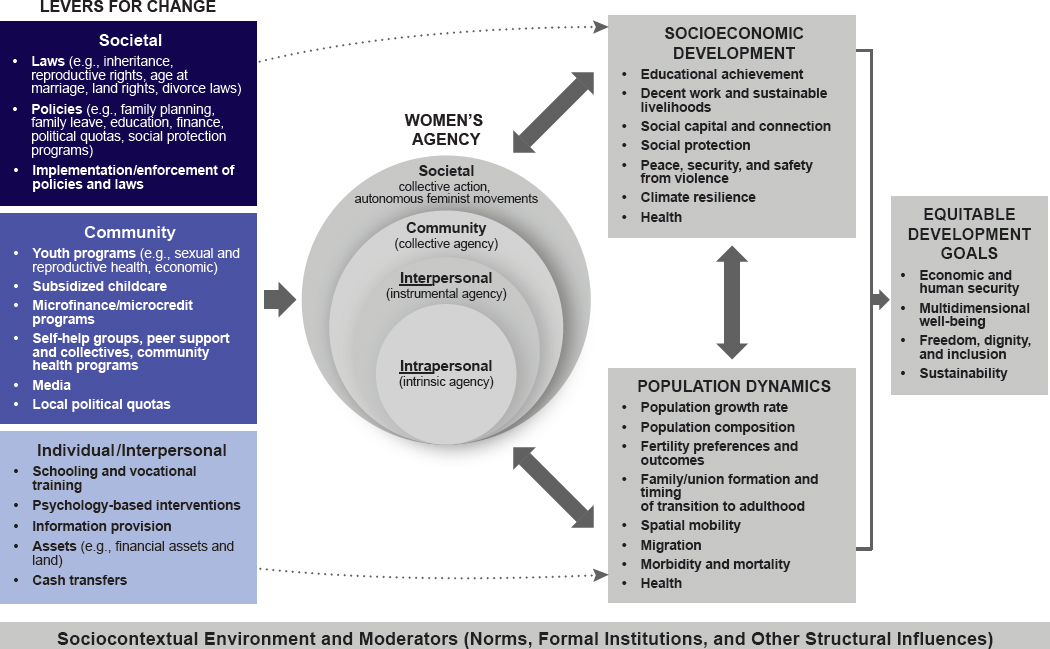
As presented in prior chapters, evidence suggests the utility of programs and policy approaches that provide women with resources or a more enabling environment to help them achieve their goals. While this work presumes significant impacts on women’s lives via agency, causal evidence from this research rarely includes measures of women’s agency as an outcome. This chapter focuses on studies that evaluate the impact of programs and policies on women’s agency. These programs and policies can be described as the “levers for change” in the committee’s new conceptual framework (Figure 7-1).
This review focuses on causal evidence generated from randomized controlled trials (RCTs) and regression discontinuity analyses, but we consider some studies with associational evidence to help contextualize and clarify findings. Broadly, this review includes evidence of impact on women’s agency outcomes from (a) economic empowerment programs for women, (b) women’s collectives and self-help groups, (c) maternal child health and family planning interventions, (d) youth and girls’ development programming, and (e) social and legal protections and policies. In this chapter, we consider the evidence base from these broad areas of program and policy.
FINANCIAL AND EMPLOYMENT PROGRAMS FOR WOMEN
Cash Transfers
Cash transfers involve the direct payment of money into a household or to an eligible person, typically with the goal of alleviating poverty or as part
of humanitarian response in times of crisis. Cash transfers can be unconditional or conditional, with the latter provided only if specified provisions are met, such as children in the household attending school or a pregnant person attending antenatal care. In addition to evidence regarding the effects of cash transfers on population and development outcomes discussed in prior chapters, some evidence exists regarding effects of cash transfers on direct measures of women’s agency.
Several studies evaluated effects of cash transfer programs to women in Latin America, conditional on child education or healthcare attendance, and showed positive impacts on women’s agency (Bergolo & Galván, 2018; Chang et al., 2020; de Brauw et al., 2014; Feldman et al., 2009; Handa et al., 2009; Molyneux & Thomson, 2011). A qualitative study involving narratives with mothers examined conditional cash transfer (CCT) programs conducted in Peru, Ecuador, and Bolivia, in which women received the transfers conditional on their children’s school attendance or their attendance at maternal and pediatric appointments (Molyneux & Thomson, 2011). This program demonstrated improvements in women’s household decision-making control, bargaining power, and freedom of movement. Using propensity score weighting, an evaluation of Bolsa Família, a nationwide cash transfer program in Brazil that provided an unconditional transfer to “extremely poor” households and a CCT (predicated on child’s school attendance and maternal and child healthcare attendance) to “poor” households with children below the age of 16, showed an increase in women’s decision-making power regarding contraception use, household durable goods purchases, as well as children’s school attendance and health expenses (de Brauw et al., 2014). However, these effects were largely driven by households in urban areas. In rural areas, the study found no increases, and possible reductions, in women’s decision-making power.
Other CCT studies from Latin America focused on children’s education alone, and these showed mixed effects. Another nationwide cash transfer program, the Oportunidades program in Mexico, increased women’s decision-making control over food expenditures and financial investments in children, likely because of the transfer going to the women, but there was no change in their decision-making control over children’s education, healthcare, and household repairs (Feldman et al., 2009; Handa et al., 2009). A similar program in Uruguay, evaluated via a regression discontinuity design, found an increase in women’s decision making on expenditures for the household (Bergolo & Galván, 2018). The findings from this study also suggested a possible increase in women’s responsibility for decisions related to some areas of household expenditures.
Research on cash transfers from other world regions shows some promise but appears to be more affected by social norms maintaining men’s economic control in households. Researchers conducted a cluster RCT
evaluation of the Government of Zambia’s Child Grant Program, which randomized the arms for mothers with children younger than six years to either receive an unconditional cash transfer or not receive the transfer. Families were then followed over four years. Women in households that received the cash transfer were more likely to be involved in a broader array of areas for household decision making, including household investments, though qualitative evidence indicated that men remained the primary decision makers (Bonilla et al., 2017). Studies from Uganda and Afghanistan also offered a cash and asset transfer intervention, combined with microenterprise training and psychosocial support, and these indicated significant effects on hope, aspirations, self-efficacy, and, in Afghanistan, aspirations for their daughters (Bedoya et al., 2019; Sedlmayr et al., 2018). A livestock transfer study from Bangladesh, focused on rural, “ultra poor” households, showed some complexity in findings related to women’s empowerment. While women retained ownership of the transferred livestock, they did not gain from new investments in mobilized resources and they actually showed a reduction in freedom of movement following gain in resources (Roy et al., 2015). Nonetheless, beneficiary women reported an increase in social capital, and results suggested that lower mobility aligned with not having to work outside the home, a preference of the beneficiary women. In sum, these studies again showcase the role of restrictive gender norms in affecting broader decision-making control and women’s preferences and choices regarding economic empowerment.
Microfinance and Entrepreneurship
Financial inclusion programs for women are designed to engage them with financial systems, such as banking and savings accounts, credit, money transfers, and insurance. Substantial research, some with causal evidence, exists in this area, including a systematic review of 32 reviews conducted on the topic. This research, while extensive, did not reveal clear and consistent findings regarding the value of financial inclusion on women’s agency (Duvendack & Mader, 2020; Saluja et al., 2023). The absence of clear and consistent findings may have been due to the focus on women’s entry into financial systems, so evidence regarding longer-term effects was lacking. Agency often was not measured, as the programs were designed to sway women toward the use of financial systems rather than to assess women’s desire for financial inclusion based on its value for their lives (Duvendack & Mader, 2020). Furthermore, key structural barriers persist in many contexts, compromising women’s uptake of and benefit from financial inclusion. These barriers include persistent male dominance in banking structures, unequal and low wages for women, gendered social norms that affect women’s financial literacy and feelings of competency, and structural barriers based
on class and ethnicity (Hoover et al., 2024). Nonetheless, some evidence suggests that the following types of financial inclusion programs are most useful for supporting women’s financial engagement and decision-making agency: microfinance, savings accounts, cash and asset transfer, and digital inclusion. This work also highlights the value of women’s self-help groups or collectives to support these types of financial-inclusion endeavors (Saluja et al., 2023; Yount et al., 2021).
Microfinance programs, particularly microcredit, have received much attention as a means to support women’s empowerment, but evaluations have yielded mixed results regarding impact on women’s agency outcomes (Alibhai et al., 2019; Chang et al., 2020; Gichuru et al., 2019; Kabeer, 2001; Orton et al., 2016). For example, Tarozzi et al. (2015) found no effect of access to microcredit on women’s agency, and Field et al. (2010) found that, in India, while women’s entrepreneurships benefitted from training for microcredit programs, these effects were observed for Hindu but not Muslim (i.e., religious minority) women.
An RCT evaluation of the Gender and Entrepreneurship Together (GET Ahead) program, developed by the International Labour Organization and now implemented worldwide, indicated important positive effects on women’s choice and agency (Huis et al., 2019). This evaluation, conducted in North Vietnam, demonstrated significant effects on female microfinance borrowers regarding their perceptions of choice and self-efficacy as well as household decision-making power for larger expenditures. Household conflicts or frictions also decreased over time. Interestingly, these effects were seen at the 12-month follow-up but not in earlier follow-ups, indicating that choice and agency may take time to develop in microfinance programs. A study from Nigeria similarly evaluated a rural microcredit scheme for women using a regression discontinuity design. The study compared women who were able and unable to obtain microcredit from the bank and found that obtaining microcredit increased women’s household decision making (Ikenwilo et al., 2016).
While these findings highlight the value of financial inclusion programs for women, another study, conducted in Burkina Faso, suggested that context matters with these types of programs. The research team evaluated the effects of economic interventions on a range of outcomes, including women’s agency in terms of decision-making control (Karimili et al., 2021). The study involved a three-armed RCT with the following treatment conditions. Intervention Arm 1 included four components: (a) a self-help savings group, (b) financial and entrepreneurial skills training, (c) cash transfer with training on effective investment of the cash for the business, and (d) monthly coaching and support. Intervention Arm 2 included the same components as Arm 1 but also included gender norm discussions with the family as well as discussion of child protection issues, such as early marriage and trafficking.
Intervention Arm 3 was a control group. Findings documented that Arms 1 and 2 both led to an increase in women’s decision making regarding their children’s health and well-being compared to the control group, but effects were stronger for Arm 2, which included gender norms and child protections coaching for families.
A study on microfinance participation in Bangladesh used propensity score matching to study the association between microfinance and key outcomes for married women. This study found that, in Matlab, women’s participation was associated with higher levels of agency, as measured by confidence in and use of voice and mobility with family and in the community, and in use of financial services and collective agency (Yount et al., 2021). Another study involved a cluster randomized trial to evaluate a five-day business training program in post-conflict Uganda, which also included a US $150 cash transfer along with management supervision and advising. At the 16-month follow-up, intervention participants reported improvements in women’s household decision making and perceived marital quality, as well as increases in women’s business ownership and incomes (Green et al., 2015). However, the inclusion of men mitigated the observed effects of the intervention on women’s household decision making.
Savings and savings accounts are another important element of financial inclusion, but these programs have received less study regarding their effects on women’s agency. We found one RCT evaluating women’s access to and use of a commitment savings product, conducted in the Philippines. Savings account withdrawal was allowed only when the account balance reached a pre-specified amount, making women less vulnerable to pressures from partners or others to withdraw the money. Women receiving these accounts reported an increase in decision-making control over a wide range of areas, including purchasing and investments, children’s education, fertility, and family planning. Effects were strongest for women with below-median decision-making power at baseline, suggesting the value of these types of products for vulnerable women (Ashraf et al., 2010).
Women’s Employment and Job Training
Women’s employment is associated with agency in many contexts, but not in all contexts and not across all types of agency indicators (Anderson & Eswaran, 2009; Grogan, 2023; Jensen, 2012; Kabeer et al., 2018; Salem et al., 2018). Using structural equations models for panel data and propensity score adjustment, Salem et al. (2018) found that women’s market and subsistence work was associated with women’s increased freedom of movement but not with gender role beliefs and household decision making. Different contexts and populations may yield different findings. For example, Dharmalingam and Philip Morgan (1996) suggested that women’s employment led to greater agency only in communities in which most women held jobs.
Nonetheless, women who have an independent income or some savings do appear to have greater freedom of movement and decision-making authority in their households (Acharya et al., 2010), whereas women without independent funds appear to have lower household bargaining power (Anderson & Eswaran, 2009). RCTs suggest that employment and job training programs strengthen women’s agency. An intervention in rural India increased awareness of and access to jobs with the help of recruiters, and found increases in women’s aspirations, with women reporting wanting to work more steadily throughout their lives (Jensen, 2012). McKelway (2018) also conducted an experimental trial in India to assess the causal impact of employment on women’s general self-efficacy by randomly assigning job offers to women enrolled in an employment placement program. The study found that those who received an employment offer reported significantly higher self-efficacy than those who did not receive an employment offer, with effects retained over time regardless of employment at follow-up assessment. Research from Kenya also showed increases in self-efficacy among young women as a result of a skills training program that provided internships and job placement support (de Azevedo et al., 2013).
Women’s Agricultural Development Interventions
Agricultural development programs are the cornerstone of maintaining a global food supply. These programs support farmers by providing them with better seeds, soil, and irrigation systems to strengthen production and improve their products; building farmers’ entrepreneurial and financial capacities to move their products to market effectively; and linking farmers to markets to maximize access to their products. While women make up a substantial portion of the agricultural labor force globally, due to gender discrimination, they are often left out of agricultural development programs and the production value chain. Women’s focused agricultural development interventions show some promise in improving women’s choice, agency, and benefit as agricultural workers.
Quisumbing et al. (2024) synthesized mixed-methods findings of the effects of 11 agricultural development programs across nine countries in South Asia and Africa using rigorous RCTs and measures of choice and agency in the Women’s Empowerment in Agriculture Index. The authors found largely null results, though somewhat stronger findings in South Asia compared with Africa. Collective efficacy effects were more likely to be observed than were household agency impacts. Women’s critical consciousness and choice were more likely to be raised in programs that also addressed gender norms as part of agricultural development.
When extending the program with a nutrition-sensitive approach for women agricultural workers and children in Bangladesh, findings were
strengthened. Waid et al. (2022) evaluated the impact of a three-year homestead food production program using a similar above-described agricultural development program for women and men but with additional nutritional training. Using a two-armed cluster RCT, the study found that, by the four-year follow-up, women in the intervention group demonstrated improvements in self-efficacy, asset ownership, and group membership, though again, household decision making was not affected. Inclusion of male partners may have reduced the intervention’s effectiveness with respect to women’s bargaining power and decision making. An experimental study conducted with agricultural workers in Uganda found that targeting women alone for training on agricultural development led to their having a greater role in agricultural decision making than did working with both men and women in the same household (Lecoutere et al., 2023). An RCT among sugarcane farmers in Uganda showed that an intervention that relied on intrahousehold transfers of productive assets to women as well as a behavior change intervention substantially increased women’s agency, measured as group membership, self-confidence, and decision making regarding household, financial, and agricultural decisions (Ambler et al., 2021).
Results from women’s empowerment programs in agriculture do not always yield positive findings. A study evaluating provision of motor pumps for irrigation to farmers in northern Ghana assessed outcomes on women’s empowerment and found no effect (Bryan & Mekonnen, 2023). The study, which compared matched treatment and control villages, with a subgroup of farmer groups from treatment villages receiving the pumps, used difference-in-difference analyses to assess both effects on farmers and, within the treatment villages, potential spillover effects on those who did not receive the pumps. While there was no effect of the intervention, there were in fact negative spillover effects on those who did not receive pumps. These findings show the sensitivity needed when engaging in empowerment and development intervention efforts to avoid adverse study effects.
WOMEN’S COLLECTIVES
Emerging evidence supports the value of women’s collectives for their role in increasing collective efficacy and collective action, but this literature primarily focuses on health or economic outcomes, not on agency outcomes (Brody et al., 2015; Farnsworth et al., 2014; Minckas et al., 2020). Still, literature review on women’s collectives shows their favorable effects on key aspects of women’s collective agency (Evans & Nambiar, 2013):
- Collective problem-solving to ensure access to and safety for shared environmental resources, such as rivers and forests;
- Collective decision making on how to access and use financial assets and resources within families and communities; and
- Collective challenging of gender norms that restrict women’s full and safe participation in society.
However, findings with respect to women’s collectives are mixed, and evaluations of transformative outcomes arising from these collectives are rare. Inadequate assessments of contextual considerations (e.g., the presence of functioning infrastructures, inadequate follow-up periods to see transformative impacts) may have contributed to these limited outcomes. Other studies suggested that the collective’s functionality and “cooperative infrastructure” may affect women’s perceptions of its value and consequently their participation, as well as its agency-related effects (Ostrom, 2000). Nonetheless, it has been argued that women’s collective action is central to create women’s empowerment (Evans & Nambiar, 2013; Ostrom, 2000).
The strongest work on the impact of women’s collectives on economic outcomes and health outcomes has focused on self-help groups in India. A natural experiment evaluating effects of expanding women’s social networks via women’s entry into women-only credit self-help groups favorably affected women’s political agency and participation, their household decision making, and their collective efficacy (Prillaman, 2023). Another study using a neighbor-matching system to evaluate the effect of self-help group membership on women’s empowerment in India included assessments on empowerment of women and men. The study found that women’s empowerment improved without concurrent reduction in men’s empowerment, suggesting that women’s empowerment need not be a zero-sum game (Kumar et al., 2021). Women participating in self-help groups showed greater control over income and decision making over credit, with more active participations associated with stronger outcomes. Importantly, effects on domestic violence and respect in the household were not seen, indicating that effects were limited to economic empowerment.
A pre-post evaluation of a women’s self-help group program, which combined gender-transformative education and financial skills training delivery for women in a group setting, showed improvements in women’s financial decision making regarding their health and the household (Jejeebhoy et al., 2017). Evaluation of self-help groups for women sex workers in India, when integrated with HIV-prevention training (Guha et al., 2012), showed positive effects on condom use and collective efficacy; however, effects varied by city, with stronger effects observed in areas where sex worker self-help groups were stronger. Women’s self-help groups in India were also used in a maternal-neonatal behavior change health intervention in a quasi-experimental study, in which the intervention arm received an eight-session health intervention and the control arm received a standard
microcredit intervention (Saggurti et al., 2018). Women reporting a birth in the past 12 months were followed. Intervention participants showed better behavioral health outcomes, greater support from group members for care and transport, and greater collective self-efficacy. Findings suggested that salient health needs supported by women’s groups may yield stronger collective efficacy findings than what are seen for microcredit self-help groups.
Studies on women’s collectives in Africa also focused on economic and health outcomes. A cluster RCT evaluated the effects of a community-based, savings-led microfinance program for women’s self-help groups in poor and rural communities in Ghana, Malawi, and Uganda. The program, which involved pooling savings and turn-taking access, increased women’s household decision making, especially in households in which women started with lower-than-median household decision-making levels; and improved decision making led to more durable goods purchased for the household (Karlan et al., 2017). A study in Burkina Faso used a cluster RCT to evaluate an integrated agriculture and health program for women, with two treatment arms that varied on who delivered information—a woman elder or a health committee member. Both arms were compared to a control condition. Women in the treatment groups had the opportunity to work with other women on model farms and participate in meetings focused on nutrition and health. In addition to showing positive health effects on children (Olney et al., 2016), structural equation modeling of empowerment indicators as a mediator of observed health effects also revealed significant effects of the intervention on spouse communication, financial decision making, healthcare decision making, and family planning decision making (Heckert et al., 2019).
WOMEN’S HEALTH INITIATIVES
Sexual and Reproductive Health and Family Planning Interventions
A vast literature on family planning interventions incorporates gender-transformative approaches that are designed to alter restrictive gender norms and gender roles for women and men to support women’s reproductive agency and contraceptive use, in both clinical and community-based settings (Hay et al., 2019; Heymann et al., 2019). Evaluation studies, most of which involved gender-transformative family planning interventions, showed favorable effects on women’s contraceptive self-efficacy (Babalola et al., 2019; Begay et al., 2023; Lee & Yen, 2007; Raj et al., 2022). Finlay and Lee (2018) reviewed and synthesized studies exploring the causal effect of family planning on women’s economic empowerment and showed the effects of family planning services on women’s reproductive decision making. The authors highlighted a study by Ashraf et al. (2014),
which demonstrated that access to concealable contraceptives can empower women to better achieve their desired fertility level but also can lead to their lower subjective well-being, suggesting a psychosocial cost of making contraceptives more concealable. Chang et al. (2020) reviewed interventions designed to affect women’s and girls’ agency and highlighted programs that supported girls’ self-efficacy in Kenya and India (Baiocchi et al., 2017; Leventhal et al., 2015), though other research using a similar model of gender-transformative programing for girls in Kenya did not show effects on agency (Decker et al., 2018).
Robinson et al. (2017) conducted a systematic review of longitudinal studies and evaluation trials that examined the effectiveness of sexual and reproductive health interventions for women with HIV. The review reported mixed findings regarding self-efficacy to use condoms and other contraceptives, likely due to high levels of condom use and condom self-efficacy at baseline in many contexts. Moore et al.’s (2014) review of community empowerment-focused sexual and reproductive health interventions with female sex workers in Sub-Saharan Africa found that the interventions produced largely nascent levels of collective engagement and action, with only a few interventions progressing to community ownership and sustainability of the collective. Women in interventions that did progress to a sustained and stable collective were more likely to report improved sexual negotiation power with clients and community solidarity. In a one-arm longitudinal study, Gourlay et al. (2022) used collectives to support sexual and reproductive health, inclusive of HIV prevention, for adolescent girls and young adult women in HIV hotspots in Kenya and South Africa. All girls received the DREAMS intervention, which included sexual and reproductive health education and access to health services, family strengthening, peer group support, mentors and safe spaces, and community mobilization to change gender norms. The evaluation found weak effects on self-efficacy but favorable effects on social support, though these effects diminished over time as networks dissipated. Taken together, these findings do not indicate strong effects on women’s agency.
Community Health Worker-Delivered Maternal and Child Interventions
Community health workers (CHWs) are a low-cost, community-based approach used by clinics to ensure proximal reach to patients (Masis et al., 2021). CHWs are often women who provide the first point of contact for community members to enter care in low-resource settings in low- and middle-income countries (LMICs). Maternal and child healthcare and nutrition (MCHN), as well as women’s reproductive healthcare, are often a priority of CHW services, but these services are also central to infectious
disease management in cases of outbreaks and epidemics (Bhutta et al., 2013; Masis et al., 2021; Questa et al., 2020). Studies of CHW interventions and women’s agency are limited, but a recent RCT in Tanzania that evaluated a CHW-delivered MCHN intervention found increased decision-making power and choice in domestic labor among women in the intervention arm (which included men in the sessions with the CHW) than women in the control condition (in which CHWs only spoke to women; Galvin et al., 2023). Like the aforementioned family planning interventions, this inclusive-of-men approach can also change norms, as it is not normative for men to participate in CHW sessions.
Peer Support Interventions for Women’s Mental Health
Burke et al. (2019) reviewed the evidence from evaluation trials on peer support interventions to assess their effects on empowerment (as measured by the Rogers’ Empowerment Scale [Rogers et al., 1997], Personal Empowerment Scale [Segal et al., 1995], and Dutch Empowerment Scale [Boevink et al., 2016]), self-efficacy, and internalized stigma. The study found that much of the research focused on mental health interventions, and those interventions were offered as peer-led groups, one-on-one peer support, and a peer-run service model. Peer-led group interventions were the most common, and these showed small but significant positive effects on self-efficacy and self-regulation.
YOUTH DEVELOPMENT INTERVENTIONS
Early Marriage Prevention and School Retention Interventions
Causal studies document the value of child marriage prevention interventions in supporting girls’ agency to pursue education and develop aspirations beyond marriage. A systematic review of child marriage prevention interventions highlighted evidence, largely from experimental studies, that life skills and school voucher programs for girls and cash transfer programs for girls and their households could significantly impact girls’ choice and agency to remain in school as well as their aspirations for employment (Kalamar et al., 2016). A review of reviews extracted 13 intervention studies to reduce child marriage and identified the most promising empowerment-related intervention components to be skill-building to enhance voice/agency, strengthening social networks, providing women role models outside the family, and community engagement to change restrictive social and gender norms (Yount et al., 2017).
Consistent with these reviews, several programs in Africa, specifically in Liberia, Zimbabwe, and Zambia, focused on the ability of skills training,
mentoring, safe spaces, and tutoring to keep girls in school and reduce child marriage and adolescent pregnancies. These programs demonstrated significant effects on aspirations, self-confidence, self-efficacy, and self-reliance, as well as social skills (Adhoho et al., 2014; Ashraf et al., 2020; Hallfors et al., 2011). Often, these programs were offered after school and included assets such as school supplies.
A more recent cluster RCT study evaluating child marriage in Nepal included a three-arm comparison of (a) a girls’ intervention, providing economic and social supports as well as skill building (the Tipping Point Intervention); (b) a group that received the same intervention plus a community-based social norms program involving community and girl leaders (Tipping Point Plus); and (c) a control group (Yount et al., 2023). This study included a comprehensive set of choice and agency indicators at the individual (e.g., personal awareness/knowledge of sexual and reproductive health, aspirations for schooling and marriage, self-efficacy), interpersonal (e.g., communication with parents), and community (e.g., collective participation and action) levels. Despite COVID-19-related disruptions to programming, favorable effects at an eight-month follow-up were observed for the Tipping Point Plus arm on girls’ personal awareness of sexual and reproductive health and collective participation outcomes.
While these programs may be promising for agency indicators related to averting child marriage or to remaining in school, they may not lead to career or even employment aspirations. A review of programs designed to keep girls in school found that most of the evaluated interventions demonstrated increases in self-efficacy and confidence but not in aspirations in areas such as marriage, childbearing, education, and jobs (Adoho et al., 2014; Baiocchi et al., 2017; Bandiera et al., 2020; Chang et al., 2020; Decker et al., 2018; Leventhal et al., 2015; Rodella et al., 2015; Scales et al., 2013). Therefore, while girls’ education is important, it is not necessarily a panacea for all dimensions of women’s empowerment identified in the committee’s new conceptual framework. In Bangladesh, for example, research indicated that women who received formal education may have had more decision-making control, but that control did not appear to correlate with greater freedom of movement (Hussain & Smith, 1999); moreover, women who received higher education reported greater recognition of their choice to attain a career but not their actual attainment of a professional position (Ahmed & Hyndman-Rizk, 2020). Finally, education does not always lead to aspirational wage earning and employment, as seen in India (Chatterjee et al., 2018). These findings suggest that programs designed to keep girls in school may be more impactful on girls’ aspirations and actions when paired with concurrent efforts to change community norms and opportunities.
Life Skills Interventions
More general life skills interventions (i.e., not specifically focused on preventing child marriage and/or school retention) are household, community, or school-based programs that support people to manage aspects of everyday life, including social interactions, time management, and basic functioning. These are the skills people need to function effectively within general society, as well as in school and work environments. As such, these skills can help women and girls navigate spaces in which they lack or have been denied exposure, and they can facilitate women’s and girls’ choice and agency across domains of influence. A systematic review of life skills interventions documented that many interventions focused on girls and produced small yet significant positive effects on a number of choice and agency indicators, including self-worth and self-efficacy; but collective agency effects were not seen (Singh et al., 2022b).
Recent work integrated life skills with entrepreneurial skills training for youth. A recent study involved a three-armed cluster RCT evaluation of the Skills for Effective Entrepreneurship Development program, a three-week mini master of business administration program for high school students in Uganda. Treatment arms were (a) a 75% hard skills and 25% soft skills program, and (b) a 75% soft skills and 25% hard skills program; both were compared with a control condition. Over the 3.5-year follow-up, researchers found that the group with greater soft-skills training was more likely to demonstrate improved self-efficacy, persuasion, and negotiation, though both treatment conditions were more likely to see positive entrepreneurship and income outcomes compared with the control condition (Chioda et al., 2023). Pre-post evaluation of The Economic Empowerment of Adolescent Girls and Young Women project in Liberia similarly provided livelihood and life skills training for young people and, over the two-year follow-up period, found that women reported increases in self-confidence corresponding to increases in employment (Adoho et al., 2014). Rodella et al. (2015) evaluated the Haiti Adolescent Girl Initiative, which also offered skills training and job placement support, and found that recipients reported an increase in decision making related to finances, work, education, and relationships.
SOCIAL AND LEGAL PROTECTIONS AND POLICIES
Structural interventions are those designed to operate at scale across communities and to address structural oppressions thought to be caused by poverty and discrimination. While evaluation of programs and interventions can offer important causal evidence, social and legal protections and policies are less amenable to controlled trial designs. Nonetheless, some
evidence suggests that these protections and policies may impact women’s agency.
Social Protections
A systematic review (Perera et al., 2022) of studies evaluating the effects of social protection programs on socioeconomic development outcomes and empowerment indicators in LMICs found that the programs were more effective for women than men and in some cases increased women’s agency. For example, livelihood programs increased self-confidence and empowerment but not confidence regarding future work opportunities.
A difference-in-difference study on women’s justice centers in Peru (reviewed in Chapter 6) found that women living near an all-women’s justice center were more likely to report shared decision making with husbands (Kavanaugh et al., 2019).
Land Registration and Inheritance Rights
Research on agency-related effects of making land registration and inheritance rights more gender equitable is limited but promising. A study from Holden et al. (2011) showed that after a process of community land registration in the Tigray region in Ethiopia, female heads of household were more likely to rent out land. This was a capability they could enact thanks to increased tenure security. Absent the land certificate, women faced a greater risk of losing their land than did men. While this was the only study we could identify providing causal evidence on the value of land registration on women’s agency in land management, the findings suggest that land registration may be a meaningful lever for change. Adequate causal evidence on land registration from other contexts (and on assets more broadly) is lacking, despite the above-noted review on assets as a correlate of women’s choice and agency.
Heath and Tan (2020) studied another policy lever—inheritance rights. Between 1976 and 2005, a series of amendments to the Hindu Succession Act equalized inheritance rights between men and women in several Indian states. Comparing outcomes for women who were exposed to these reforms versus those who were not, the authors showed positive correlations of women’s inheritance rights at the state level with women’s say in household decisions and their autonomy to travel away from the home by themselves.
Gender Quotas
Gender quotas can increase women’s representation in government and corporate boards and increase policies that support women and families
(Clayton, 2021; Hughes et al., 2017; Krook & Zetterberg, 2014). However, these effects are context-specific. Furthermore, evidence is limited on the effects of gender quotas on agency indicators. Research from India indicated that gender quotas for women increased parental aspirations for daughters and aspirations among adolescent girls themselves, possibly by viewing the leaders as role models and/or by improvement of policies to support women’s employment and opportunities (Beaman et al., 2012). Gender quotas also increased public perceptions regarding women candidates’ capacities to win and to lead, and this change in public perception was associated with women’s collective agency in terms of their participation in political or community decision making (Allen & Cutts, 2018; Beaman et al., 2009; Bhavnani, 2009).
Subsidized Childcare
Global evidence documents the importance of quality childcare and early childhood education for both women’s employment and child development, but subsidized or free childcare remains limited across many countries (Chaturvedi, 2019). In many contexts, women’s employment relies on grandparent and extended family engagement for childcare, and studies document the value of grandparent involvement for child education, health, and development (Anderson et al., 2018; Coall & Hertwig, 2010; Pulgaron et al., 2016; Sear & Coall, 2011; Sear & Mace, 2008). However, even when grandparent involvement is an option, it is not ensured childcare, as grandparents might have more say over women’s employment, compromising women’s economic agency. To determine whether subsidized childcare for children under five would be of interest to women and would support their employment, an RCT in Nairobi demonstrated a potential increase in household decision making related to children’s healthcare, though no effects were seen on other decision-making variables (Clark et al., 2019). However, other childcare interventions (e.g., Ajayi et al., 2022) found no impacts on women’s decision making.
SUMMARY AND CONCLUSIONS
This chapter reviewed programs and policies from a wide variety of LMIC settings that showed impacts on women’s and girls’ agency via (a) financial interventions, including cash transfers, microfinance, and job training and placement; (b) interventions to expand and strengthen women’s collectives, to support women’s economic and health status and build collective agency; (c) health interventions, including sexual and reproductive health programs, CHW programs for maternal and child health, and peer programs for mental health; (d) youth development interventions, to
prevent early marriage, to promote education, and to strengthen life skills for other more general purposes; and (e) social and legal protections and policies, particularly those related to gender-equal opportunity and safety from gender-based violence. This literature shows that these approaches can have favorable effects on women’s and girls’ aspirations, self-efficacy, and influence in decision making. These program and policy approaches align with those that show significant changes in delayed marriage, health and family planning, and positive socioeconomic development outcomes, as discussed in previous chapters. However, additional research is necessary to better understand the pathways and contexts for the changes observed, including reasons for inconsistent findings.
Notably, one cannot assume that the same impacts would be observed in contexts outside of the intervention sites. Tailoring interventions to the local context, population, needs, and culture is a critical step for program effectiveness. Participation of community members in intervention design and evaluation is also essential for success and sustainment. Furthermore, while evidence is available for these levers, other theoretically important levers, particularly in the policy sphere, lack adequate evidence, such as divorce and custody laws, wage equality laws, and family leave policies. Evidence is also lacking from LMIC contexts regarding the impacts of programs on community efficacy and action-related outcomes. Impacts of women’s self-help groups on these outcomes were notable and suggest the importance of women’s collectives as an intervention strategy. More robust evidence on agency-related impacts of autonomous feminist movements is also necessary to draw more definitive conclusions about these relationships.
This page intentionally left blank.


