Women's Empowerment, Population Dynamics, and Socioeconomic Development (2025)
Chapter: 3 A New Conceptual Framework to Understand Women's Empowerment, Population Dynamics, and Socioeconomic Development
3
A New Conceptual Framework to Understand Women’s Empowerment, Population Dynamics, and Socioeconomic Development
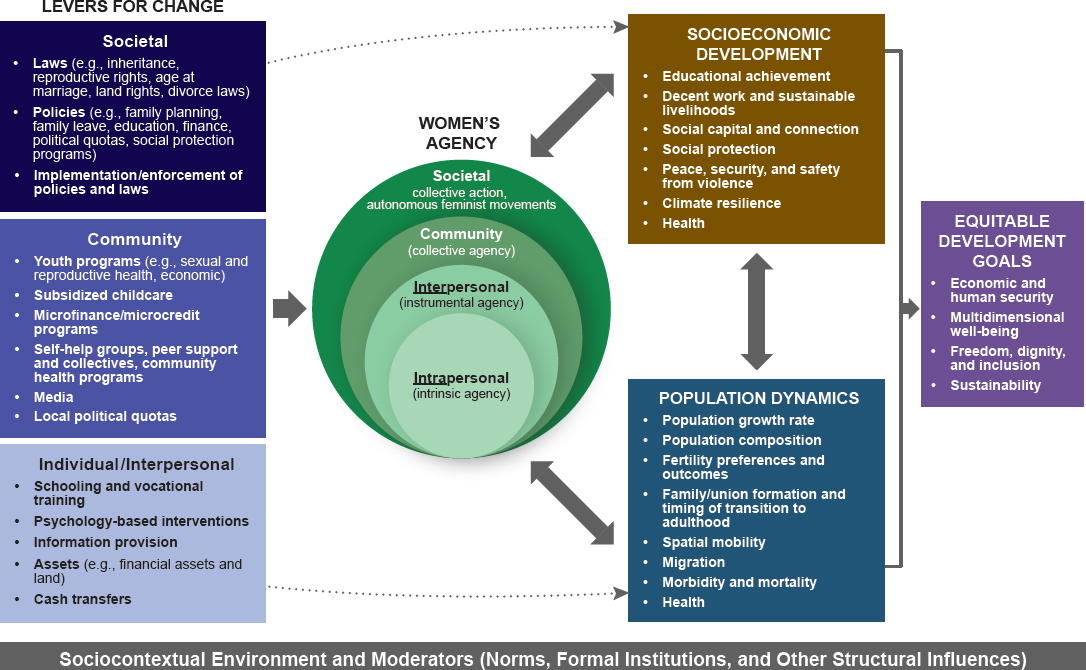
This chapter presents the new conceptual framework proposed by the committee, building on existing frameworks, a review and synthesis of the evidence base, and collective efforts to identify critical gaps and opportunities in the field. In this chapter, we describe the elements of the framework at a high level, while subsequent chapters discuss these elements and supporting literature in further detail. Our new conceptual framework (Figure 3-1) shows enabling resources (indicated here as levers for change) as potential contributors to changes in women’s agency at multiple levels of the social ecology. In turn, the process of women’s empowerment (i.e., changes in women’s enabling resources and multilevel agency toward achievement of self-determined goals) can affect, and can be affected by, changes in socioeconomic development and population dynamics (indicated with bidirectional arrows between these constructs). The dynamic, multilevel relationships between the constructs of women’s empowerment, population dynamics, and socioeconomic development are recognized to occur within a broader historical, cultural, and sociopolitical contextual environment. This environment may be enabling or restrictive and may ultimately moderate associations between empowerment and priority outcomes, thus “conditioning” the interrelationships between indicators of women’s empowerment, population dynamics, and socioeconomic development. In the case of some of the outcomes, the effects may unfold over generations.
The conceptual framework places women’s agency as the focal point. Represented by the circle in Figure 3-1, women’s agency contains multiple levels, from societal to intrapersonal. Agency is a key component of
SOURCE: Developed by the committee.
empowerment. We believe that narrowing the focus to agency allows a clearer view of women’s ability to act.
Levers for change, represented in the boxes on the left in Figure 3-1, are the areas we felt could influence agency, and therefore represent potential action items to effect change. These levers range from societal to community to individual/interpersonal. There is a direct arrow between those levers and agency.
The two boxes on the right in Figure 3-1 focus on key indicators of socioeconomic development and population dynamics. The bidirectional arrows between both boxes and women’s agency indicate that socioeconomic development and population dynamics are influenced by and influence agency.
The rightmost box in Figure 3-1 represents equitable development goals. These include a set of outcome variables influenced directly by socioeconomic development and population dynamics, and indirectly by agency and levers for change. All these areas fall within the context of the cultural environment and moderators of that environment. Rather than referring to these as social/cultural “determinants,” we prefer to use the word “influences,” which implies that sociocultural and environmental factors and their moderators are amenable to change.
This new conceptual framework differs from earlier frameworks due to its central focus on agency in the context of population dynamics, socioeconomic factors, and sociocultural factors, and the influence of levers that are possible to change. With the exception of the underlying sociocultural influences, each box or circle in the new conceptual framework is the subject of a chapter in this report. Using a life-course perspective, our discussion focused on the period of adolescence through adulthood, because many elements of population dynamics and socioeconomic development have key inflection points and opportunities at these life stages (Figure 3-2).
MULTILEVEL UNDERSTANDING OF WOMEN’S AGENCY IN EMPOWERMENT
Our new conceptual framework profiles the multiple levels of women’s agency in adherence with ecological systems theory (Bronfenbrenner, 1979; Reifsnider et al., 2005), considering levers for change and agency at individual, interpersonal, community, and societal levels. With this understanding, we clarify that empowerment processes operate within and across levels of the social ecology. For example, increases (or decreases) in one woman’s empowerment are related to increases (or decreases) in the empowerment of women’s collectives at the community and societal levels. Our new conceptual framework emphasizes agency as a core component of empowerment, central to empowerment as a transformative process. In

NOTES: This figure presents some key inflection points in the life course at which changes in women’s empowerment are most likely to affect population dynamics (red) and socioeconomic outcomes (green). The figure is illustrative and does not cover all potential outcomes or all the ways that these metrics may manifest across all life stages. We highlight some of these outcomes to illustrate why much of the work we present focuses on women’s years of menarche to childbearing and of secondary education to employment. These are also the years on which much of the literature is focused, for similar reasons.
SOURCE: Developed by the committee.
this new framework, agency is considered at the individual, interpersonal, community, and societal levels.
Individual-level agency involves expansion in one’s intrinsic ability to alter their circumstances in context but not directly in relation to others. Individual agency includes the efficacy or felt capacity to enact change and the motivation to enact change or the actions of change. Examples include voting, seeking an abortion, or escaping an abusive marriage. In these cases, a woman may act covertly, without the engagement or even knowledge of others in her household or family, or even in the absence of laws protecting or permitting these rights. Some have argued that this level of agency is decontextualized, as if occurring in a vacuum (Khader, 2016). Our new
conceptual framework of women’s empowerment explicitly shows how women’s individual agency relates with other levels of agency and is conditioned on the broader social and cultural context (Figure 3-1). As such, our framework recognizes that one woman’s actions may have differing consequences that depend upon the family, community, and societal contexts in which she is embedded, with important implications for investments in broader social, structural, and policy change.
Interpersonal agency entails the power to exercise one’s capabilities visà-vis someone else, particularly one with greater authority in the relationship, and to do so even in the face of resistance from others. Some use the term instrumental agency to describe women’s actions in relation to others (Jones et al., 2020a). We emphasize the term interpersonal agency to align with its socioecological framework and to differentiate agentic acts that women enact alone (individual agency) from those that women enact in relation to others (interpersonal agency). For women, interpersonal agency is often thought of as occurring within the context of households or families, relative to a spouse or in-laws (Malhotra, 2002). However, interpersonal agency can also occur in communities (e.g., with neighbors) or in work environments (e.g., with co-workers). Women’s interpersonal agency may be enacted through increasing voice or the ability to articulate practical needs, personal views, and strategic interests that may oppose the dominant norm in the context of power relations (Gammage et al., 2016; Klugman et al., 2014) and through increasing influence in decisions in which preferred outcomes differ across actors in these various contexts (Abbink et al., 2020; Ashraf, 2009; Doss, 2013; McElroy & Horney, 1981). These acts can be transformational in women’s social positioning and gender relations in households, families, communities, and work environments.
Community-level agency involves engagement in or leadership of community-based formal groups or informal networks characterized by shared awareness of gender inequalities (Eger et al., 2018), shared goals or aspirations for change, shared confidence in the ability to act on these goals or aspirations (Bandura, 2001), the coordinated articulation of these goals and aspirations (Gammage et al., 2016), or influential joint actions in the pursuit of shared goals or aspirations (Kabeer, 2011). Community-level agency may be enacted in women’s collectives, which engage in community mobilization and participatory action, and have been used effectively to improve the conditions of women’s lives with respect to their health, political participation, and economic position (Biskupski-Mujanovic & Najjar, 2020; Brody et al., 2015; Prost et al., 2013). Community-level agency may also be enacted through women’s mobilization to increase the presence of women in public spaces, often including freedom from harassment and abuse (Boyer, 2023; Gardner et al., 2017; Yount et al., 2017).
Societal agency involves changing and improving life circumstances, not just for oneself or those within a collective but for the wider benefit of others. To that end, such agency often takes the form of social movements affecting large geographic areas, from cities to nations to transnational environments, and includes efforts to change structures and policies that maintain sexism and heterosexism in society (Beckwith, 2000; Hurwitz & Taylor, 2012; Ray & Korteweg, 1999). Much work in this area comes from the field of political science, in which different terms (e.g., “women’s movements,” “feminist movements,” “women in social movements,” “autonomous feminist social movements”) yield somewhat different definitions (Beckwith, 2000; Htun & Weldon, 2012; Hurwitz & Taylor, 2012; Ray & Korteweg, 1999). Nonetheless, this work broadly recognizes that these movements often align with or are in response to sociopolitical conditions that the movement deems objectionable, and that movements may take on transformative or even revolutionary tones, with collectively determined goals that drive social and political change. Fukuda-Parr (2003) argued that these types of movements “have been the essential motor behind progress in achieving major policy shifts necessary for human development, such as the recognition of gender equality, the need to protect the environment, or the promotion and protection of a comprehensive set of human rights” (p. 309).
Empowerment Constructs and Terminology
While there is overlap in conceptualization of empowerment and its operation across levels, some inconsistency exists in definitions and terms across studies, and these disciplinary differences in terminology can contribute to confusion. For example, for some in the fields of education, psychology, and public health, choice in critical consciousness is distinct from agency or embeds agency, particularly as collective action, within it (Allen, 2008; Diemer et al., 2017; Freire, 1978; Orsini et al., 2022; Seider et al., 2020). However, other researchers in the fields of economics, sociology, and global development view critical consciousness as a form of agency, specifically defining it as one dimension of intrinsic agency (Bernheim & Whinston, 1985; Jones et al., 2020a; Martimort & Stole, 2009; Navarro-Mantas et al., 2022; Poudel et al., 2022; Yount et al., 2020). Similarly, as discussed in Chapter 2, we noted some disciplinary differences in the use of agency. With consideration of these disciplinary perspectives, Box 3-1 presents key concepts indicative of various dimensions of agency.
Women’s goals and aspirations are central to an understanding of women’s agency in the empowerment process. In research and practice, this perspective requires attention to women’s voices, to know their desires and preferences rather than assuming these based on a priori-determined global health or development goals (Rappaport, 1995; Zimmerman, 2000). Other
BOX 3-1
Key Constructs of Agency
- Critical awareness of rights and historical denial of rights
- Locus of control
- Sense of agency (subjective awareness of control)
- Aspirations and goal setting (expanded personal or shared choice)
- Self-efficacy (self-confidence, self-awareness of one’s capabilities)
- Motivational autonomy (internal versus external motivation)
- Decision making
- Bargaining/influence in decisions involving others
- Acting on goals
- Freedom of movement (including in previously male-dominated spaces)
- Voice (expressing views that may oppose dominant norms)
- Collective aspirations and goal setting (expanded shared choice)
- Collective efficacy (shared awareness of collective capabilities)
SOURCE: Committee generated.
factors important to attend to include the sense of control as well as the cognitive space that individuals and groups need to set well-defined goals (Donald et al., 2020), as well as their internal motivation to pursue self-determined goals (Ryan & Deci, 2000) or their shared motivation to pursue collectively determined goals. Crucially, understanding and measuring agency requires some knowledge of an individual’s or a collective’s goals.
Observed behaviors that are presumed to be agentic, such as the use of a contraceptive method or employment, may be due to external pressures (e.g., coercive programs or poverty) or social expectations rather than to personal preferences or internal motivations; hence, observed behaviors may not be indicators of agency (Donald et al., 2020; Malhotra & Mather, 1997; Raj et al., 2021; Yount et al., 2020). Conversely, preferences do not always result in observed behavioral agency, as inaction may be the choice taken due to resigned adaptation (Sen, 1987), fear of backlash (Kandiyoti, 1988; Komter, 1989), or the anticipated costs of action (Agarwal, 1997). Hence, it is important for preferences and agency to be understood in tandem with elucidating an individual or group’s transformative goal setting and actions toward goal achievement (Allen, 2008; Diemer et al., 2017; Freire, 1978; Orsini et al., 2022; Seider et al., 2020). Furthermore, these choices rely both on women’s critical awareness of options and on conditions or resources in the environment that expand the opportunities available to women to consider an extended set of choices. Throughout our new conceptual framework, these resources are contained in socioeconomic
development, population dynamics, and the sociocultural environment. The reciprocal nature of these relationships illustrates empowerment as a transformative process at multiple interrelated levels over time.
Population Dynamics
Population dynamics involve the growth, composition, and distribution of the population, with studies analyzing patterns of fertility, mortality, and migration globally or in given geographic areas, as well as the effects of a changing ecology on these dynamics (National Research Council, 1994). Given our charge to understand whether and how women’s empowerment affects socioeconomic development directly or indirectly via population dynamics, we focus foremost on the following:
- Fertility preferences and outcomes: family size, birth spacing, and child sex composition (i.e., desired versus achieved number and sex distribution of surviving children); population growth; desired versus achieved timing, number, and spacing of pregnancies; contraceptive preferences, access, and use.
- Sexual initiation and union formation: first sexual encounter, first sexual union, cohabitation, and first formal marriage (i.e., marriage celebrated and recorded according to local law and custom).
- Migration: internal (within country) rural-to-urban migration as well as international migration, voluntary and involuntary/forced migration, migration intentions and outcomes for women, women left behind.
- Morbidity and mortality: gender differences in life expectancy, mortality, and morbidity, with emphasis on maternal and child mortality, including age at death and sex differences in child death and in maternal morbidity and mortality.
- Health: the state of complete physical, mental, and social wellbeing and not merely the absence of disease or infirmity (World Health Organization [WHO] 1948) is included in our new conceptual framework as part of both population dynamics and socioeconomic development, because of its fundamental relevance in both areas. Given that our framework also includes outcomes such as social connectedness, resilience, and overall well-being, in subsequent chapters health primarily refers to physical and mental health.
Socioeconomic Development
Socioeconomic development is the sustained improvement in the social and economic well-being of the population, encompassing standard of
living (e.g., income per capita, poverty rates, and food security), human development (e.g., education and health), civil engagement, social cohesion, and state capacity (Ruck et al., 2020). Socioeconomic development definitionally requires equitable achievement of these goals across groups in society, including by gender (Chowa, 2019). Reducing the breadth and depth of inequality in the achievement of socioeconomic goals is thus a core component of development. As shown in our new conceptual framework (Figure 3-1), indicators of socioeconomic development are proximal outcomes that may contribute to broader aspirations for society, including human rights and dignity.
The indicators of socioeconomic development we have chosen are tied to global development goals and include the following:
- Educational achievements: These indicators relate to Sustainable Development Goal (SDG) 4 and refer not only to the number of years of education obtained by individuals in the population but also to the quality of that education and the skills (technical and socioemotional) imparted. While this indicator primarily concerns children and adolescents, it also includes achievement of “lifelong learning opportunities for all” (United Nations [UN], 2023).
- Decent work and sustainable livelihoods: These indicators relate to SDGs 1 and 8 and entail the ability to find a high-quality job and to earn an income. The International Labour Organization (ILO) defines decent work as productive work for women and men in conditions of freedom, equity, security, and human dignity (ILO, 1999). This definition implies that everyone who wants to work should be able to do so, whether in self-employment, unpaid family work, or wage employment in informal or formal sectors.
- Social capital and connection: Social capital has been defined as “an instantiated informal norm that promotes co-operation between two or more individuals” (Fukuyama, 2001, p. 7) or as the “features of social organization such as networks, norms, and social trust that facilitate coordination and cooperation for mutual benefit” (Putnam, 1995, p. 67). Social capital contributes to social connectedness, or the degree to which people have relationships that create a sense of belonging, care, value, and support (Centers for Disease Control and Prevention, 2024).
- Social protection: This relates to SDGs 1 and 2, and is achieved when the poor are protected from both transitory poverty (e.g., due to economic shocks) and chronic poverty (e.g., persistent food insecurity) through policies and programs designed to provide support to individuals and households facing social and economic risks (Devereux, 2001; Hulme & Shepherd, 2003).
- Political participation and good governance: Political participation involves people developing and expressing their opinions on the world and how it is governed, and their participation and efforts to shape the political environment and policy decisions that affect their lives. Political participation is a core principle of human rights and a condition for effective democracies (United Nations for Human Rights Office of the High Commissioner [UNHCR], 2021). More broadly, good governance requires transparent and accountable processes and institutions, an efficient and effective public sector that is responsive to citizens’ preferences, and respect for the rule of law (UNHCR, n.d.).
- Peace, security, and safety from violence: This construct relates to SDG 16 and includes safety from all forms of violence, including those related to war or violent conflict, criminal violence, gender-based violence, violence against children, and workplace violence. As such, it is also related to SDG 5. “Safety” from violence entails not only that individuals are protected from violence occurring but also that, if violence is perpetrated, the victims are offered adequate resources to heal physically and mentally, and that steps are put in place to prevent reoccurrence.
- Climate resilience: This construct relates to SDG 13 and entails the individual and collective ability to mitigate, adapt to, and recover from climate-related shocks and stressors (e.g., extreme weather such as heat waves, heavy rain and floods, and droughts). Effective resilience planning also considers chronic challenges, such as the deterioration of air quality and shifts in population migration related to climate.
- Health: (see above).
Equitable Development Goals
Socioeconomic development has a role in supporting equitable human development goals, which are the higher-level goals anticipated when basic needs are met, human capabilities are realized, and human rights are guaranteed. Foundational documents from the UN, including the UN Declaration of Human Rights 1948 (UN, 1948), the 1987 Brundtland Report from the UN World Commission on Environment and Development (Brundtland, 1987), and the first UN Development Programme Human Development Report from 1990 (UNDP, 1990), describe equitable development goals as security, well-being, freedom, dignity, inclusion, and sustainability. These goals also align with the 2015 UN SDGs with expectations of 2030 achievements (UN, 2015), as well as the planning occurring for the post-2030 agenda (Lutz & Pachauri, 2023; see Box 3-2 for detailed definitions of these goals).
BOX 3-2
Equitable Development Goals
Security
Security includes both economic and human security. Economic security is the ability of individuals, households, and communities to meet their basic economic needs, including food, shelter, and clothing. The right to work and earn gainful livelihoods and fair wages can help ensure economic security, but state-supported health, education, welfare, and environmental programs also are important (International Committee of the Red Cross, 2015). Human security is the ability of individuals, households, and communities to ensure that their physical safety and health needs are met, and their lives are free of fear (e.g., conflict, crime, natural disasters, and disease) and free from want (e.g., poverty, lack of nutrition) (King & Murray, 2001).
Well-Being
Well-being is broadly defined as encompassing happiness, life satisfaction, and fulfillment (Becchetti & Pelloni, 2013; Dahl, 2012; DeNeve & Sachs, 2020; WHO, n.d.); positive social connection, integration, and coherence (Keyes & Shapiro, 2004; Larson, 1993; VanderWeele et al., 2019); and the ability to meaningfully and purposefully contribute to the world (VanderWeele et al., 2019; WHO, n.d.).
Freedom
Freedom is the right to lead one’s life as one wishes, as long as one does not infringe on the rights and freedom of others. Negative freedom involves noninterference by others, while positive freedom involves the removal of constraints that impede one’s ability to achieve their full potential as they wish (Sen, 1999). Importantly, however, if others, such as the state, impose positive freedom, this can undermine an individual’s negative freedom, as the individual may not agree with the state (other) on how to achieve one’s goals or potential. Families, communities, or the state can impose coercive constraints on individuals and groups, and social inequalities and discriminatory norms influence the individuals and groups who may be targeted (Vasquez et al., 2021).
Dignity
Dignity is the condition in which one is recognized and treated as having inherent value—that is, value beyond what they can offer in terms of their utility or abilities—and receives respect and ethical treatment from their family, peers, communities, and government. Dignity requires that no human or state treat another human with contempt, abuse, alienation, exploitation, or discrimination, and that all people are worthy of having their basic needs met and being treated equivalently under law (Gewirth, 1992).
Inclusion
Inclusion refers to the ability of individuals, regardless of their backgrounds or identities, to participate actively in economic, social, and political processes. An inclusive approach to development requires challenging both formal institutions and informal institutions (norms) that marginalize individuals or groups based on gender, race, ethnicity, religion, class, caste, sexual orientation, or other identities (Pouw & Gupta, 2017; Yang et al., 2016).
Sustainability
Sustainability is the achievement of well-being and security in a balanced manner that does not compromise the ability of future generations to meet their own needs. For economic development to be sustainable, it requires the careful management of natural resources and consideration of environmental goals—such as the conservation of biodiversity, promotion of healthy ecosystems, and tackling climate change—alongside social and economic goals (Purvis et al., 2019).
SOURCE: Committee generated, based on definitions used in the literature (see citations).
Sociocultural Context
The empowerment process and its connection with population dynamics, health, and socioeconomic development occur within a broader social and cultural context that can facilitate or impede women’s empowerment and its impacts. Numerous models of the sociocultural context exist for understanding influences on population dynamics, health, and development (Anderson et al., 2003; Scrimshaw et al., 2022; Solar & Irwin, 2010). This report focuses on the sociocultural context for women’s empowerment. This context includes informal rules or social norms; formal laws; and formal structures including religion, government, education, economic stability, healthcare systems, and political climates, including those that reinforce structural oppressions and discrimination (e.g., Bergenfeld et al., 2021).
In this report, we define culture as the socially learned and shared sets of values and meanings that can govern behavior (Institute of Medicine, 2002). Culture underlies the informal and formal rules in the sociocultural context and can be modified by lived experience (Garro, 2000), creating a dynamic sociocultural context that can change in ways that improve or restrict women’s empowerment. Furthermore, the context often includes social hierarchies and structural oppressions based on gender as well as religion, race, ethnicity, caste, geographic residence, and economic status. These intersectional hierarchies and oppressions condition trajectories of empowerment for different groups of women and girls. As Sen and Ostlin note in an analysis for WHO, “Gender norms and relations are a persistent basis [for] social hierarchies and stratification[…], intersecting with social class, ethnicity, education, occupation, and income; influencing socioeconomic position and the distribution of other SDH [social determinants of health]; and being influenced by the wider socioeconomic and political context,
culture, and societal norms and values” (2011, p. 74). More recent efforts to diagnose repressive social and gender norms within institutional contexts offer important examples of how formal and informal institutions (norms) operate to sustain these social hierarchies (e.g., Bergenfeld et al., 2021).
The sociocultural context affecting women may often be most influential at the level of the family or extended family and in the community, particularly in contexts in which women’s movement is restricted or options beyond family responsibilities are limited. Here, social norms in terms of what a person thinks others do (i.e., descriptive norms) and what a person perceives others expect them to do (i.e., injunctive norms) can influence women’s and girls’ opportunities (Raj et al., 2024; Weber et al., 2019). Studies from across low- and middle-income country contexts show that restrictive gender norms affect preferences and behaviors related to freedom of movement, social interactions, sexuality and fertility practices, family responsibilities and roles, and employment participation and opportunities (Marcus, 2021; Weber et al., 2019). These norms can be particularly restrictive in rural settings, where cultural change via lived experience is slower and there is less cultural diversity. However, even in the most restrictive contexts, women overtly and covertly challenge familial norms, societal norms, and formal laws (Scrimshaw, 1978, 1985). Also, cultural norms and women’s responses to them change throughout the lifecycle. Social and cultural contexts are considered in Chapter 6, which explores research on the relationships between women’s empowerment and socioeconomic development.
SUMMARY AND CONCLUSIONS
Women’s empowerment has long been hypothesized as an important means to achieve development goals while also being a goal in itself; however, little work has clarified the role of population dynamics in this relationship at scale. The committee’s multidisciplinary review of existing frameworks and theories of women’s empowerment led to a novel, comprehensive conceptual framework linking women’s empowerment, population dynamics, and socioeconomic development, which addresses key gaps and opportunities in the evidence base. This new conceptual framework can
- Guide a multilevel understanding of agency across the social ecology;
- Consider population dynamics as a potential mechanism through which empowerment can operate to support socioeconomic development; and
- Elucidate necessary resources and how they can support empowerment.
The new conceptual framework is used in this report to guide an examination of the literature on the role of women’s empowerment on socioeconomic development, both directly and indirectly via population dynamics. Subsequent chapters examine empirical evidence to assess hypothesized relationships in the framework, as well as programs and policies that may serve as levers for change at various multilevel intervention points along the model, potentially increasing women’s empowerment and ultimately socioeconomic development. Research needs are identified in cases when this evidence is weak or lacking.


