Women's Empowerment, Population Dynamics, and Socioeconomic Development (2025)
Chapter: 6 Women's Empowerment and Socioeconomic Development
6
Women’s Empowerment and Socioeconomic Development
This chapter reviews the state of knowledge on the relationship between women’s empowerment (e.g., an expansion in women’s resources, choice, agency, or achievements) and various socioeconomic development outcomes. Similar to the preceding chapters, while the committee acknowledges the bidirectional nature of the relationship, as indicated in our new conceptual framework shown in Figure 6-1, this chapter places greater emphasis on how women’s empowerment—at various levels of the social ecology—impacts socioeconomic development. As described in Chapter 2, by socioeconomic development we mean the sustained improvement in the social and economic well-being of the population. We operationalize socioeconomic development as consisting of multiple dimensions of well-being, such as human development (e.g., education, nutrition, skills development, health outcomes, and access to quality care); material standard of living (e.g., access to decent work and sustainable livelihoods); social capital and cohesion; social protection; governance and the quality of public services; peace, security, and safety from violence (especially intimate partner violence [IPV]); and climate resilience. The chapter is organized around these topics, with health outcomes primarily discussed in Chapter 5. We recognize that reducing the breadth and depth of inequality in achieving these outcomes, including along gender lines, is a core component of socioeconomic development. We also acknowledge that important dimensions of socioeconomic development with links to women’s agency, such as maternal and child health and sexual and reproductive health, overlap with population dynamics and have thus been covered in previous chapters. Furthermore, we are aware of the large body of literature that relates population dynamics
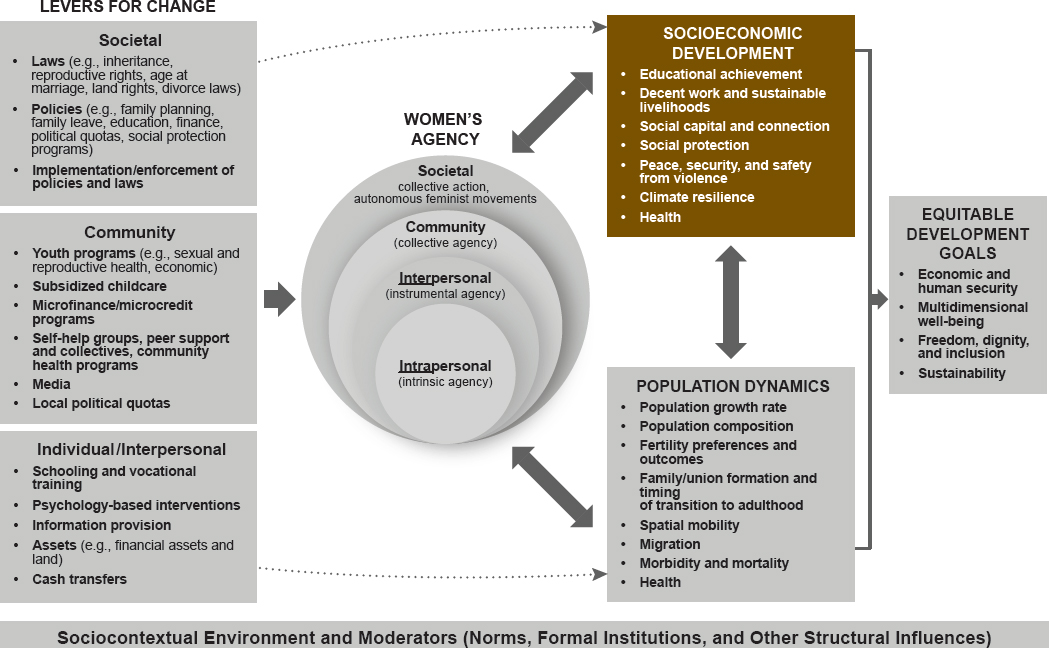
to the socioeconomic outcomes listed above, but in this report, we opt to emphasize the arrow that links women’s empowerment to socioeconomic development.
As discussed in prior chapters, literature on the role of women’s empowerment faces several methodological challenges, in part due to the variety of ways this concept is measured and its context-specific nature. These challenges are related to the difficulty of finding exogenous variation that drives women’s empowerment. In the area of socioeconomic development, studies that attempt a causal identification use legal or institutional changes that enhance women’s control over assets or their access to income as natural experiments; or they use programmatic interventions, such as conditional cash transfers, in the context of randomized controlled trials (RCTs). Some of the studies we reviewed directly measured women’s empowerment (e.g., through household bargaining or decision-making measures) and identified empowerment as a mediator for impacts of socioeconomic outcomes. However, because of the challenges of operationalizing and measuring empowerment, many of the studies did not explicitly measure the effects of the legal changes or interventions on women’s agency but instead examined their effects on the socioeconomic development outcomes of interest, such as female labor force participation or social protection. These studies then implicitly attributed the effects to the mediating role of women’s empowerment or resorted to theoretical models of household bargaining and decision making to make the case.
In addition to examining the links between women’s empowerment and various socioeconomic development outcomes, this chapter briefly reviews the state of knowledge about the relationship between women’s empowerment and macroeconomic outcomes, such as sectoral allocation of resources, productivity, and economic growth. Much of this literature used theory-based computable general equilibrium models to quantify the effects of women’s empowerment (or gender equality more broadly) on macroeconomic outcomes. These studies examined potential effects on macroeconomic outcomes through three main channels: an investment channel, in which women’s increased decision making affects the allocation of investments into human versus physical capital; a labor-allocation channel, in which lifting barriers to entry for women in various occupations and sectors can increase economic growth; and a fertility channel, in which women’s empowerment can affect economic growth through reduced fertility. These model-based approaches are methodologically distinct from the theory-agnostic statistical approaches discussed elsewhere in this report.
CHILD NUTRITIONAL STATUS AND SCHOOLING
Although educational achievement and health are listed as separate dimensions of socioeconomic development in our new conceptual framework, we opt to discuss child nutritional status and schooling together, since existing literature often treats them together as indicators of parental investment in child human capital. Several broad reviews of the association of women’s agency, autonomy, and empowerment with child nutritional status have been conducted (Carlson et al., 2015; Ruel & Alderman, 2013; Santoso et al., 2019). Carlson et al. (2015) focused on the notion of women’s autonomy, which they conceptualized as women’s household decision-making control along with women’s attitudes about the legitimacy of domestic violence. The authors acknowledged, however, that the literature they reviewed used many proxy measures of what they term “autonomy,” which we may view as “agency” in our new conceptual framework, impeding cross-national and cross-cultural comparability. Nonetheless, this review strongly suggests that improving maternal agency is conducive to improving children’s nutritional status. Ruel and Alderman’s review (2013) of the impact of agriculture, social safety nets, early child development, and schooling interventions on nutritional outcomes holds similar recommendations but highlights that much of what we see in the value of women’s empowerment in this realm is specific to what has been done with agricultural programs.
Santoso et al. (2019) conducted an even broader review of 62 associational studies linking women’s empowerment to child nutritional outcomes, using 200 indicators of empowerment and testing 1,316 associations with various child nutrition outcomes. This review did not find a conclusive relationship between women’s empowerment and child nutrition, with 82% of associations with stunting outcomes and 84% of associations with wasting outcomes being statistically insignificant. The authors attributed this result to limitations in study design related to poor selection of empowerment indicators, exclusive reliance on cross-sectional rather than longitudinal data, and improperly controlling for pathway variables that may mediate the relationship. Jones et al. (2020a) attempted to distinguish between the domains of empowerment and to account for pathways of influence using structural equation modeling in their study of the relationship between women’s empowerment and child nutrition in five African countries. They found that assets, intrinsic agency (which they measured via attitudes accepting of domestic violence), and instrumental agency (which they measured as women’s decision-making control) were positively associated with maternal body mass index (BMI). In turn, maternal BMI was positively associated with both the height-for-age and weight-for-height z-scores of their children. The authors also found that their attitudinal measure was
associated directly with several indicators of child nutritional status as well as indirectly, through improved maternal nutrition.
Using a novel operationalization of women’s empowerment based on a comparison of a woman’s perception of her own decision-making power relative to her husband’s perception, Annan et al. (2021) studied associations with various household well-being outcomes, including children’s health and education, in 23 Sub-Saharan countries. The study found that women assigning themselves higher decision-making power than their husbands assign them, which the authors refer to as “taking power,” is as effective as agreement between women and their husbands in terms of reducing girls’ stunting and wasting measures and increasing boys’ likelihood of receiving a full course of vaccinations. Generally, the authors found that women “taking power” was better for child outcomes than was being “given power,” but women who took power were subjected to significantly higher incidence of emotional violence.
Several studies attempted to identify a causal relationship between women’s agency at the societal or interpersonal levels and children’s nutrition and schooling outcomes. We begin with studies that exploited legal changes as natural experiments to identify causal effects. At the community level, laws that reserve leadership positions for women, such as a 1993 law in India, were shown to increase girls’ career aspirations and educational attainment (Beaman et al., 2012) and women’s economic empowerment through public work programs and access to financial services (Deininger et al., 2020). At the interpersonal level, researchers studied the impact of changes in divorce laws on household decisions, through their effect on women’s bargaining power (Corradini & Buccione, 2023; Roff, 2017; Stevenson, 2007). A law that enhanced women’s unilateral divorce rights in Egypt—a context in which divorce laws strongly favor men—was shown to increase investment in child human capital (Corradini & Buccione, 2023). The extension of alimony rights and obligations to cohabiting couples in Brazil was shown to increase hours worked by adult females and to increase investments in the education of children (Rangel, 2006). Kumar and Quisumbing (2012) examined how women’s perceptions of the division of household assets upon divorce affected women’s well-being and child schooling outcomes in rural Ethiopia. The authors found that in households that perceived divorce allocations to favor men, children’s schooling was negatively affected, more so for girls than boys.
There is considerably more research on the role of women’s agency as a mediating factor in the relationship between women’s economic empowerment and socioeconomic development outcomes. A longstanding result in the international development literature is that household spending decisions depend on the gender of the income recipient, and that when income accrues to women rather than men, it is more likely to be spent on children’s
nutrition and education rather than on privately consumed items, such as tobacco and alcohol (Doss, 1996; Duflo, 2003; Hoddinott & Haddad, 1995; Quisumbing, 2003). It has long been recognized that this result is at odds with a household decision model in which the household makes decision as a unit (also called the unitary household model). This discrepancy can only be explained by a model of the household in which decisions are a result of a bargaining process between two or more individuals with differing preferences, with the decision outcomes depending on their relative bargaining power (the so-called collective household model; Alderman et al., 1995; Chiappori, 1992, 1997). This approach was expanded in the 1990s and early 2000s into a broader research agenda on “gender and intrahousehold decisions and outcomes” (Quisumbing, 2003; Rogers & Schlossman, 1990). Evidence in favor of collective household models showing that assets or income accruing to women result in different household decisions is, therefore, indirect evidence on how shifts in women’s bargaining power—or agency—affect household decisions, even if women’s bargaining power or agency are not directly measured.
Exploiting a natural experiment related to agricultural reforms in post-Mao China that differentially increased demand for male and female labor depending on the product mixes in each region, Qian (2008) showed that increases in the relative share of income going to female household members in tea-producing regions resulted in higher survival rates for girls and improved educational attainment for all children. Conversely, a 2011 amendment to the Chinese Marriage Law that reduced women’s rights to housing property upon divorce led to significant reductions in household spending on children’s education, which one study attributed to women’s reduced bargaining power after the law was adopted (Li & Sun, 2023).
Using indicators of human and physical capital brought by men and women at marriage as a proxy for bargaining power, Quisumbing and Maluccio (2003) showed that in Bangladesh and South Africa, more assets brought to the marriage by women increased expenditures on children’s education, but the opposite was true in Ethiopia. Using the assets brought into the marriage and the distribution of assets upon divorce as proxies for bargaining power, Fafchamps et al. (2009) showed that increases in women’s bargaining power had a positive effect on child nutrition and school attendance, but their results did not extend to all dimensions of household welfare. Using a fully elaborated collective household model and data from Mexico, Reggio (2011) explicitly estimated a mother’s bargaining power using information on decision making about major household purchases and the age difference between husband and wife. The study found that an increase in a mother’s bargaining power was associated with fewer hours of child labor for her daughters, but not for her sons.
Analyses of the impact of the expansion of an old-age pension program to the Black population in South Africa in 1993 showed that benefits
accruing to women had a large impact on the nutritional status of their granddaughters, while no similar effect was found for benefits accruing to men. Men’s and women’s benefits had similar impacts on the nutritional status of grandsons (Duflo, 2003). Lancaster et al. (2006) showed that when power was more evenly distributed in the household, there was a higher tendency to spend on jointly consumed items, like children’s education. This and similar results have made it a standard practice to designate women rather than men as the recipients of cash transfers targeted to poor households, to maximize the transfers’ socioeconomic benefits (Gitter & Barham, 2008; Molyneux & Thomson, 2011). Evidence also suggests that women’s bargaining power mediates the effects of economic shocks on children’s human capital. Dovis et al. (2021) showed that the impact of a father’s employment shock on the participation of adolescent daughters in intensive domestic work in Egypt was modulated by the mother’s bargaining power.
DECENT WORK AND SUSTAINABLE LIVELIHOODS
Few studies examined the impact of women’s agency on women’s labor force participation or access to decent work. In fact, most existing literature examines the opposing direction of causality, namely the effect of access to work and economic opportunities on women’s agency and decision making (De Hoop et al., 2018; Grogan, 2023; Heath, 2014; Heath & Mobarak, 2015; Jensen, 2012; Kabeer, 1997; Kabeer et al., 2018; Pike & English, 2022; Salem et al., 2018).
A few studies examined the relationship between women’s intrahousehold bargaining power and their labor supply. Several studies used the Hindu Succession Act of 1956 in India as a natural experiment, which exogenously shifted women’s unearned income by improving their ability to inherit property, to show that the passage of the Act positively shifted women’s labor supply, contrary to the predictions of the standard labor supply model (Heath & Tan, 2020; Sapkal, 2017). The research attributed the positive effect to increased control over income and bargaining power, and women’s increased agency. In contrast, the introduction of unilateral no-fault divorce laws between 2008 and 2018 in all 32 Mexican states, which made it easier for women to obtain a divorce, did not increase women’s labor force participation and had a small positive effect on hours worked for employed married women (Hoehn-Velasco & Penglase, 2021). Hallward-Driemeier and Gajigo (2015) examined the effect of a legal reform in Ethiopia that expanded wives’ access to marital property and removed restrictions on working outside the home. They found that women exposed to these reforms were significantly more likely to work in occupations that required work outside the home and that employed more educated workers in paid and full-time jobs. Conversely, a 2011 change in the Marriage Law
in China that reduced women’s rights to housing property upon divorce led to a reduction in women’s work outside the home and women’s assumption of a higher burden of household chores (Dong, 2022).
A small but growing literature demonstrates that strengthening women’s agency over assets can improve livelihoods. For example, Ali et al. (2014) found that a land-regularization program in Rwanda led to large increases in agricultural investment. This effect was particularly pronounced for female-headed households, suggesting that this group suffered from high levels of tenure insecurity, which the program reduced. In Ghana, strengthening women’s tenure security led to shifts away from farm work, with large increases in women’s business profits (Agyei-Holmes et al., 2020).
In an RCT in India, Field et al. (2021) found that digital financial inclusion could encourage women’s labor force participation. They studied an intervention that helped women open their own bank accounts, trained women to use those accounts, and signed them up to receive direct deposit of wage payments for work under India’s public workfare program. The evaluation showed that this intervention, by giving women increased control over their wages, increased women’s agency and decision-making power in the household and increased their participation in the labor market. Similarly, providing female factory workers with private, blocked savings accounts in Côte d’Ivoire—thereby shielding their income from family and others in their social networks—increased their work attendance by 10% and earnings by 11% (Carranza et al., 2022). Furthermore, changing the way microfinance loans were disbursed from cash to digital accounts enabled women in Uganda to expand their businesses by allowing them to resist social pressures to share money with others in the household (Riley, 2024).
McKelway (2021) conducted an RCT in which women in India were offered a psychological intervention to increase generalized self-efficacy, and its effect on their labor supply was assessed. The study found short-term effects on women’s labor supply but no long-term effects on women’s employment. In Kenya, Orkin et al. (2023) found that a 60–90-minute workshop aimed at increasing aspirations and encouraging women to set goals and act on them increased their labor supply compared to a placebo workshop. Other research examined the impacts of psychology-based entrepreneurship training, finding positive impacts on women’s business income and profits mediated by changes in entrepreneurial self-efficacy, personal initiative, and/or entrepreneurial locus of control (e.g., Alibhai et al., 2019; Campos et al., 2017; Glaub et al., 2014).
Another strand of the literature examines the impact of engaging men to enhance women’s agency—through couples’ training or intrahousehold transfers of productive assets or information—on women’s livelihoods and well-being. A couples’ training in Uganda that shifted decision making and
increased women’s group participation resulted in increased food security and perceived well-being (Lecoutere & Wuyts, 2021). In a similar context, targeting women versus men with agricultural information increased women’s agricultural decision making, women’s subsequent adoption of recommended practices and inputs, and yields on fields that were managed by women (Lecoutere et al., 2023). Including wives in an agricultural extension training for men on cash crops in Côte d’Ivoire led to a large increase in joint farm management and, subsequently, to better economic outcomes on the farm (Donald et al., 2022). However, Ambler et al. (2021) found that although the transfer of a productive asset from husbands to wives increased the wives’ access to resources and agency, there were no shifts in food security, health, or educational outcomes, though life satisfaction improved for women and their husbands.
Improved access to childcare may free up women’s time and increase their time agency, allowing them to participate in earnings and livelihood activities. Although the positive effects of women’s access to childcare on their labor force participation are well documented in developed countries (Bick, 2016; Givord & Marbot, 2015), the evidence base in low-income settings is thinner. In Rio de Janeiro, Brazil, de Barros et al. (2013) showed that the odds of a mother having a job improved from 36% to 46% when she won a spot in a lottery for free childcare for low-income families. Household incomes increased by 16%. Clark et al. (2019) examined the effects of childcare in an informal settlement in Nairobi, Kenya. The authors found that women who were offered vouchers for subsidized early childcare were 8.5 percentage points more likely to be employed than those who were not given vouchers and had 24% higher monthly earnings. Martínez and Perticará (2017) randomized applicants to an afterschool program for children ages 6–13 in Chile and found that program participation increased employment by 5% and labor force participation by 7%. In urban Burkina Faso, Ajayi et al. (2022) found that mobile creches increased women’s hours worked and monthly income. Bjorvatn et al. (2022) offered childcare subsidies to households in urban and peri-urban Uganda, and found that single mothers offered the subsidy were 29% more likely to be employed and had 45% higher incomes. Across the sample, the childcare subsidy led to a 19% increase in household income. Lastly, Donald et al. (2023) found that opening community-based childcare centers in the rural Democratic Republic of the Congo not only increased women’s engagement in commercial agriculture and overall income but also benefited husbands, with large increases in overall agricultural productivity and income for households. Husbands increased their economic participation, for example by starting a business, and increased their income.
SOCIAL CAPITAL AND CONNECTION
Existing literature generally illustrates that groups and even nations with higher levels of social capital are more likely to be cohesive and reciprocally trusting, which in turn can facilitate positive civic engagement and action (Kawachi et al., 2008; Newton, 2001).
In the fields of public health and economics, focus on social capital is typically at the levels of individual and community. Research from these fields demonstrated that social capital was more likely among people with higher levels of education, income, and asset ownership, and tended to be higher for men relative to women and for middle-aged adults relative to younger adults (Kawachi et al., 2008; Villalonga-Olives et al., 2018). A large body of associational research looked at the reverse relationship—how social capital differentially affected men’s versus women’s advancement. Some of this work documented how the gender homophily of networks could disadvantage women because, relative to men’s networks, women’s networks tended to have lower social and economic standing and less proximity to power (Groysberg, 2010; Ibarra, 1992, 1993; Lutter, 2015; McPherson et al., 2001). Additionally, an intervention study in Benin, which provided health education with microfinance, found that effects on social capital (measured using questions on group membership, support networks, participation in village meetings and public positions, and influence in the village) were greater for women in single-sex groups compared to mixed-gender groups, suggesting that women-to-women support may be important in some contexts and possibly for specific issues (Karlan et al., 2017).
Overall, causal evidence on approaches designed to increase social capital for health is promising, but studies do not directly include empowerment indicators as an outcome or mediator despite alignment with empowerment theories. From the public health field, longitudinal studies evaluating interventions designed to affect social capital at the individual level (e.g., via building social networks and social support) as well as at the community and institutional levels (e.g., via use of existing social networks to strengthen community or group capacities and assets) showed significant improvements on network connections, strength of connections, and actions including civic participation (Villalonga-Olives et al., 2018). Furthermore, this study demonstrated some effectiveness in healthcare utilization and health outcomes, including those related to mental health, maternal and child health, water and sanitation, and climate concerns (Villalonga-Olives et al., 2018). However, 25 years of public health work in this area have yielded too few intervention trials and some inconsistent findings on health outcomes (Shiell et al., 2020), and no research recognized women’s empowerment as part of evaluating social capital interventions.
Research on social capital interventions has also been conducted in the field of political science, with mixed results. Historically, the field was called
to view social capital as endogenous and not as a means nor an outcome for intervention (Jackman & Miller, 1998). However, evidence regarding the importance of social networks as a means of trust building and cohesion at the national level (Newton, 2001) led to greater work on interventions to promote social capital, though these studies remain few. One such example is a randomized field experiment of a participatory development intervention conducted in rural Sudan with 24 communities (16 treatment communities and 8 control communities). This study measured norms and network density in the communities by surveying select residents, and it assessed perceptions of local governance and civic participation via household surveys (Avdeenko & Gilligan, 2015). No effects were seen on social networks or norms, but civic participation and perceptions of a more open local governing body increased. These findings suggested that the impact of this intervention may have come from its effect on governing institutions more than its effect on networks. In contrast, a qualitative analysis of an intervention designed to improve social capital to reduce violence among youth in Cali, Colombia, suggested that drawing on the strong internal bonds of pre-existing groups and linking these groups to the wider community and municipal institutions was useful in reducing public and domestic violence (Snoxell et al., 2006).
Intervention studies have also focused on life skills and cash transfers for women and girls, to assess the impact of these interventions on social capital in post-conflict and conflict settings. These studies also yielded mixed findings. A multicomponent intervention for “ultra-poor” women in Afghanistan offered training and linkage to sustainable livelihoods, asset transfers (often cows), unconditional cash transfers, and coaching (Bedoya et al., 2023). A two-armed RCT was used to evaluate the program, and significant effects included improved social capital for women. Furthermore, these effects were largely sustained even after U.S. troop withdrawal from Afghanistan, showing the improved resiliency for women receiving the intervention. A three-armed cluster RCT conducted in Liberia (post-Ebola and post-conflict) evaluated three groups: Group 1—Girls’ Empowerment (GE), a mentor-facilitated life skills intervention for 13–14-year-old girls; Group 2—Girls’ Empowerment Plus (GE+), which added cash transfers to GE; and Group 3—a control condition (Özler et al., 2020). The GE interventions had no impact on girls’ social capital. A two-armed cluster RCT evaluated a safe-spaces plus life skills intervention for South Sudanese adolescent girls recruited from refugee camps in Ethiopia (Lindsay et al., 2018). The intervention showed a significant effect on girls’ social supports and connections; however, observed effects only held true for girls in communities that were not severely affected by conflict (Buehren et al., 2017). Finally, a two-armed cluster RCT evaluated effects of a group intervention offering microfinance with IPV prevention and support counseling for
women in South Africa (Pronyk et al., 2008). This intervention showed significant effects on community participation; strength of networks; and collective reciprocity, solidarity, and action two years subsequent to the intervention initiation. A review of evaluations testing the effect of cash transfers on risk for IPV revealed some mixed findings, but many indicated reduced risk for IPV and none indicated increased risk for IPV (Buller et al., 2018). Buller et al. (2018) proposed that cash transfers reduce women’s risk for IPV by increasing their emotional security and well-being, as well as their empowerment in terms of decision-making control. Research also suggests that cash transfers can reduce mental health stress, though findings are mixed depending on country context (Maara et al., 2023).
In the above review of interventions to affect social capital, we could find no causal evidence specifically focused on women’s empowerment to increase social capital, nor could we find any studies that assessed whether observed effects on social capital were mediated by women’s agency. This is an important area for further inquiry.
SOCIAL PROTECTION
As defined in Chapter 3, as an outcome, social protection captures food security, resilience to shocks, smooth income (or consumption), and a safety net for the poorest residents. Studies have found that women absorb household shocks by reducing their own nutrient intake before that of their children (Bhutta et al., 2009; Christian, 2010) and by selling off female assets like jewelry (Rao et al., 2019). This pattern of women as “shock buffers” was also found during the recent COVID-19 pandemic, during which women took on a greater share of the increase in domestic and care work and suffered economically as a consequence (e.g., Goldstein et al., 2022). Another pathway identified in the literature explores how women’s lack of access to information and communications technology (ICT) could affect social protection. Such technology is crucial for information acquisition on upcoming shocks and in post-disaster situations, for maintaining familial and social ties, and for receiving cash remittances—which are important sources of resilience (Bernier & Meinzen-Dick, 2014; Frankenberger et al., 2013; Mukoya, 2020). Bridging the “digital divide” and increasing women’s ownership and control over ICT may thus be a pathway for increased social protection.
A wide-ranging literature documents associations between women’s agency and social protection, and describes how certain resources are implicitly linked to greater social protection through women’s agency. As mentioned earlier in this chapter in the discussion on child nutrition and schooling, women’s increased bargaining power was associated with increased household expenditures on child health and education, which can
increase resilience in the long run (e.g., Quisumbing & Maluccio, 2003). Households headed by women with higher economic agency, physical capital empowerment, psychological empowerment, and farm financial management skills empowerment were found to be more food secure (e.g., Sharaunga et al., 2016). Moreover, women’s access to land was correlated with household food security across contexts (e.g., Alemu, 2015). Some literature demonstrates that increasing women’s land rights and knowledge of their rights could lead to adoption of practices that increase resilience, such as soil and water conservation practices and agroforestry on agricultural lands (Meinzen-Dick et al., 2019; Quisumbing & Kumar, 2014).
A recent systematic review (Perera et al., 2022) looked at studies that evaluated the effects of social protection programs on socioeconomic development outcomes (e.g., education, health, safety) and empowerment indicators (e.g., economic empowerment, voice, agency) in low- and middle-income countries (LMICs). Evaluated programs included social assistance (77%), labor market programs (40%), social insurance interventions (11%), and social care interventions (9%). The authors found that, overall, these programs were more effective for women than men in affecting socioeconomic development and empowerment outcomes, but family support was important for women to benefit from the programs. Furthermore, the study found that the social assistance and social insurance programs supported women’s savings and investments (e.g., economic empowerment). Evidence on the value of social care interventions was limited.
Levels of women’s agency were found to predict whether women were insured and by how much—for example, through women’s willingness to pay for index insurance-based products (Akter et al., 2016; Bageant & Barrett, 2017; Clarke & Kumar, 2016). Some studies documented a relationship between women’s inclusion in decision making over water and better-functioning water systems with expanded access to water, which could lead to strengthened resilience to shocks (e.g., United Nations Development Programme, 2006). One study in Tanzania found that women share water more equitably than men do, especially in times of scarcity (Lecoutere et al., 2015). Lastly, women’s self-help groups have been recognized internationally as central to social protection efforts (e.g., Asaki & Hayes, 2011), due to their role as platforms for distributing, targeting, and advocating for resources by communities, and as sources of mutual aid for their members. Notably, however, a tension may exist between social protection for households and for women. While lending to women likely reduces household vulnerability, the benefits to women are not as certain, because loans procured by women can be diverted into enhancing the household’s assets and income (Garikipati, 2008). This tension highlights the importance of women controlling the resource in question—and the importance of considering the potential backlash she might face from doing so.
A growing literature also documents causal relationships between women’s empowerment and greater social protection. Graduation programs designed to increase the agency of extremely poor women led to higher levels of total consumption and food security and stronger social and financial support (e.g., Bossuroy et al., 2022). Similar livelihood programs for adolescent girls also affected household-level food security (Adoho et al., 2014). Women’s financial inclusion—through products as simple as savings lockboxes—helped households cope with adverse health shocks by allowing them to smooth their consumption through self-insurance rather than shedding livestock assets (Aker et al., 2020; Dupas & Robinson, 2013). Lastly, though insurance tends to be more effective than savings at managing food insecurity and shocks, field experiments showed that female farm managers were less likely to purchase agricultural insurance and more likely to invest in savings for emergencies (Delavallade et al., 2015).
POLITICAL PARTICIPATION AND GOOD GOVERNANCE
As discussed, a growing body of research focuses on the role of technology, and specifically mobile phones, in women’s empowerment and shifting attitudes. For example, Varriale et al. (2022) conducted an analysis using micro-level data from the AfroBarometer covering 36 African countries and estimated that regular mobile phone use was associated with more positive attitudes of women toward women’s participation in politics.
Women’s greater agency in politics—defined here as the increased capacity for women to influence political decision making—can influence socioeconomic outcomes in two main ways. First, to the extent that women have distinct priorities from men, an increase in the consideration given to women’s priorities could change the types of programs or policies put in place. Second, to the extent that women behave differently than men when in political positions (e.g., if they are less likely to be corrupt or more responsive to voters’ priorities), an increase in women’s representation in politics could alter the effectiveness of public spending. There is descriptive evidence for gender gaps in both priorities and behavior. Turning first to priorities, Clayton’s (2021) review listed a series of studies from across the globe showing how women tended to report more concern about healthcare and poverty while men reported more concern for national safety and infrastructure. A national study in India also suggested that the gender and caste of women state legislative representatives may matter for district-level investments in child schooling (Halim et al., 2016). Concerning behavior, both a cross-country analysis and a within-country, across-time analysis by Swamy et al. (2001) showed that corruption was less severe in locations where women held a larger share of parliamentary seats and senior positions in the government bureaucracy and comprised a larger share of
the labor force. Survey evidence also suggested that Indian female leaders elected under the reservation system were less corrupt than male leaders (Beaman et al., 2010).
Establishing the causal impact of increased women’s political agency on policy outcomes is difficult because countries with more women in leadership positions, or countries where women’s votes are more likely to be pivotal, may differ from countries where women have less political agency. To credibly establish causality, studies have exploited sudden changes in laws or rules governing women’s suffrage or representation. For example, Miller (2008) exploited the sharp timing of state-level women’s suffrage laws in the late 19th-/early 20th-century United States to document how the increase in female suffrage led directly to an increase in healthcare spending: politicians were immediately responsive to the fact that the composition of the electorate had changed. Similarly, Fujiwara (2015) showed that a technology-induced decrease in de facto de-enfranchisement of the poor in Brazil led to a shift in government spending toward healthcare that was particularly beneficial to the poor. Since women were disproportionately poor, they disproportionately benefited. The same study found positive downstream effects of political inclusion on both the utilization of health services (e.g., prenatal visits) and newborn health (e.g., low-weight births) for less-educated mothers. This finding is consistent with Kudamatsu’s (2012) cross-country evidence on democracy’s effect on health outcomes in Sub-Saharan Africa.
As discussed in Chapter 4, introduction of gender quotas in politics is a common tool to increase women’s representation in government. Evidence from India, where gender quotas at various levels of government are often not imposed consistently across geographies, showed that quotas influenced policy outcomes in ways that benefitted women and children in particular (Beaman et al., 2010; Chattopadhyay & Duflo, 2004; Clots-Figueras, 2011). A recent review of the evidence on quotas by Clayton (2021) concluded that by making gender issues salient to legislators as well as by increasing the share of legislators who are women, quotas typically increase “legislative attention to issues related to women’s rights, public health (particularly children’s health), poverty alleviation, and, in agrarian rural contexts, access to potable water” (p. 239). Whether this increase is a net “positive” for socioeconomic development depends, of course, on whether legislative attention is zero sum. In that case, an increased focus on issues that are of greater relevance for women’s well-being may decrease attention given to other issues that are of greater concern to men. This shift, in turn, may lead to backlash or retaliation for nonadherence to prevailing gender norms (Raj et al., 2024).
PEACE, SECURITY, AND SAFETY FROM VIOLENCE
This section reviews the evidence on how women’s empowerment impacts security and safety from violence at both a societal level (e.g., the avoidance of war) and at the individual or household levels (e.g., reducing IPV). Starting with the societal level, some studies suggested that greater societal gender equality had a pacifying effect on the willingness of political leaders to use violence to achieve political goals (Hudson et al., 2012), but causality was difficult to establish. Some scholars argued that greater representation of women in state/national legislatures increased the likelihood that a conflict would terminate in a negotiated settlement (Best et al., 2019), but here again, causality was difficult to establish.
At the individual and community levels, studies showed that women holding less decision-making control and having attitudes more accepting of IPV were more likely to report IPV (Dalal et al., 2022; García-Moreno et al., 2013; Garg et al., 2021; Mootz et al., 2022; Muluneh et al., 2021; Sardinha et al., 2022). Family contexts and community norms of violence against women also affected women’s risk for IPV. Cross-national research showed that women who have witnessed IPV in their parents’ relationships, experienced abuse in childhood, and who reside in contexts with attitudes accepting of IPV were more likely to report a history of IPV in their current relationships (Mootz et al., 2022; Muluneh et al., 2021; Shakya et al., 2022).
Research showed mixed associations between women’s agency and risk for IPV. For example, in Bangladesh, women’s participation in microfinance was not significantly associated with their experiences of physical, psychological, sexual, or economic IPV; however, their participation was significantly positively associated with other agency outcomes, including their intrinsic voice/mobility; instrumental agency (e.g., using financial services, voice with husband, voice/mobility outside the home); and collective agency (Yount et al., 2021). A 2016 systematic review of the effects of microfinance (e.g., savings and credit) programs, which included controlled trials, observational studies, and panel data analyses, showed mixed effects on IPV and mostly null effects on decision-making ability and mobility (Gichuru et al., 2019). Considering digital technology as a proxy for women’s agency, using cross-national Demographic and Health Surveys (DHS) data, Pesando (2022) found that women’s independent ownership of mobile phones was associated with a 9–12% decreased likelihood of emotional, physical, and sexual violence over the previous 12 months (except in Angola)—a result that was robust to the use of matching techniques and instrumental variable estimates.
Causal evidence generally finds that increases in women’s agency lead to decreases in women’s experiences of IPV. Through a cluster RCT in Uganda, Chioda et al. (2023) found that a school-based upper-secondary
life skills intervention expanded women’s agency and reduced the incidence of IPV. Shah et al. (2023) found that an intervention to improve girls’ goal setting regarding their sexual and reproductive health and a soccer intervention, which “educates and inspires young men to make better sexual and reproductive health choices” both reduced IPV through different mechanisms; notably, the intervention showed no impact on contraceptive use despite increasing supply access (Shah et al., 2022). An RCT of facilitated group discussions for men around gender relations in the Democratic Republic of the Congo found that the program led to a decrease in the probability and severity of physical IPV but only among women who experienced high physical and moderate sexual violence at baseline (Gurbuz Cuneo et al., 2023). In Rwanda, the Bandebereho intervention, which involved couples in a curriculum focused on topics such as gender and power, couple communication and decision making, IPV, and reproductive and maternal health, led to large reductions in physical and sexual IPV, along with more equitable decision making (Doyle et al., 2018), and impacts were sustained up to six years later (Doyle et al., 2023).
Eggers del Campo and Steinert (2022) conducted a meta-analysis of 19 RCTs assessing the impact of economic empowerment interventions on women’s exposure to IPV. The analysis showed that women’s economic empowerment led to a significant reduction in the pooled measure of emotional, sexual, and physical IPV. The authors found tentative evidence that these effects may be amplified when gender sensitization training is included in the interventions. Some studies included in the meta-analysis, however, showed increases in IPV, often in the form of controlling behavior and economic coercion.
Lastly, increasing the availability of justice centers and police stations, in which female officers provide policing and legal services to reduce gender-based violence, appeared to be associated with increased reporting and prosecutions (Natarajan & Babu, 2020; Sviatschi & Trako, 2024). Research from Peru exploited the gradual rollout of women’s justice centers across districts and villages and found a 10% reduction in self-reported domestic violence, female deaths due to aggression, and hospitalizations due to mental health after a women’s justice center opened (Sviatschi & Trako, 2024). Women living near an all-women’s justice center were more likely to report shared decision making with partners.
Fewer studies have examined policy and intervention effects on sexual violence, sex trafficking, female genital cutting (FGC), and other forms of violence against women. There is a dearth of literature, particularly from LMICs, demonstrating significant reductions in sexual violence and sex trafficking. Much of the existent work is either with adolescents and focused on dating violence, or with college students and focused on rape (DeGue et al., 2014; Rivera et al., 2021; Vladutiu et al., 2011). These programs, largely
conducted in school contexts, showed that education, normative shifts, bystander behavior (e.g., “see something, say something”), and role models such as coaches as educators and supports can reduce sexual violence and dating violence. There is a lack of rigorous evaluation of interventions to affect sex trafficking, sexual exploitation, and sexual harassment, highlighting the need for greater focus on these pervasive gendered risks.
Evidence on effective interventions to prevent FGC shows more promise. Regression discontinuity analysis with DHS data from Burkina Faso showed a significant reduction in FGC following policy changes, but the authors recognize that the policy change happened simultaneously with community-level intervention efforts, suggesting that both top-down and bottom-up approaches may be important (Crisman et al., 2016). It should also be noted that these types of policies show greater effect in the Global North than the Global South, likely because of laws in national contexts where FGC is not normative (Boyle & Corl, 2010; Njue et al., 2019). Largely, across Africa, policies on FGC have little effect, both because these laws often do not co-occur with social norm change efforts and because the laws may not be strictly implemented (Muthumbi et al., 2015). Community-level social norm change interventions show some success in Africa (Berg & Denison, 2012; Diop & Askew, 2009; McChesney, 2015; Parvez Butt, 2020).
CLIMATE RESILIENCE
Much of the literature on women’s empowerment and climate resilience examines gender differences in exposure to climate shocks and differences in preferences and capacity in terms of response. Women tend to have less access to resources necessary to respond to climate change, such as assets, land and water, human capital, and technologies. Gender-specific constraints related to time, wealth, norms, and skills can hamper women’s adaptation and resilience (Food and Agriculture Organization, 2023). Easing these constraints could improve climate resilience, though rigorous evidence is scarce.
In addition, associations between women’s agency and mechanisms that could lead to greater climate resilience have been documented across countries. In particular, increased women’s agency was linked to higher adoption of climate adaptation strategies that involved increased agricultural information and knowledge, such as climate-smart agriculture (e.g., Mittal, 2016) and higher investment and planting (e.g., Madajewicz et al., 2013). A systematic review of studies conducted in Sub-Saharan Africa found conservation agriculture to be associated with women’s increased participation in agricultural decisions, increased income, and increased food security—but also with increased workloads and health risks (Wekesah et al., 2019). Moreover, a documented relationship was found between
women’s bargaining power in the household and the extent of diversification and commercialization of agricultural and livestock systems (Tavenner et al., 2019). Some evidence of differential investment also exists, for example higher farm investment than off-farm investment among women, resulting in less diversification (Andrews et al., 2012). Other studies found that women were more likely to adopt crop and livelihood diversification strategies important for reducing climate risks (De Pinto et al., 2020; Mersha & Van Laerhoven, 2016).
The importance of women’s groups and collective action emerges strongly in the literature on climate resilience. Women’s groups can function as effective avenues for conveying climate change and weather information, thereby enhancing awareness of practices that promote resilience to climate-related challenges (Dey et al., 2018; Farnworth et al., 2017). Establishment of community development councils and civic education leadership training was shown to increase women’s decision-making authority and the adoption of drought-preparedness measures by households (Grillos, 2018). Activism by women’s organizations has played a role in international climate policy processes, such as the establishment of the Women and Gender Constituency at the United Nations Framework Convention on Climate Change’s Convention of the Parties (Picard, 2021; Resurrección, 2013). Another channel emerges at the macro level, when gender-specific preferences regarding the environment are empowered through women’s leadership: greater female representation in governing bodies was associated with a lower climate footprint across contexts (Altunbas et al., 2022; Mavisakalyan & Tarverdi, 2019; McKinney & Fulkerson, 2015).
Causal evidence directly relating increased women’s agency to increased climate security and resilience is very thin. Gender-responsive approaches are rarely incorporated into “shock-sensitive” social protection programs, and research is lacking on how gender-responsive strategies within social protection intersect with climate change, providing limited insight into the effectiveness of such approaches in mitigating gender inequality in the context of climate change impacts (Bryan et al., 2023; Holmes, 2019).
MACROECONOMIC CONSIDERATIONS
So far, this chapter has detailed research on the effects of women’s empowerment on socioeconomic development outcomes at the levels of the individual, household, community, and society. But for many, the topic invokes macroeconomic considerations that have so far been outside the scope of inquiry. How does empowering women affect investment, sectoral allocation, productivity, and economic growth?
One strand of literature on these questions compares the economic growth experiences of countries that exhibit differing extents of structural gender inequality, using cross-country growth regressions (Kabeer,
2016). Many studies focus on gender gaps in education and labor force participation. A meta-analysis of studies on education, which included cross-country studies and single-country studies, found that greater gender inequality in average educational attainment predicted lower economic growth (Minasyan et al., 2019). Similarly, studies on women’s work found that gender inequality in labor force participation predicted lower economic growth (Klasen, 2002; Klasen & Lamanna, 2009). Other aspects of societal-level measures of women’s agency, including those directly related to women’s agency, are harder to measure in a consistent way for many countries and thus have received less attention. However, a recent extension of the literature investigated measures of women’s political empowerment—indices of women’s civil liberties, civil society participation, and political participation—finding positive associations with economic growth (Dahlum et al., 2022). These exercises are useful for identifying correlates of economic growth, but specific causal mechanisms are difficult to disentangle.
Because of this difficulty, research on macroeconomic consequences of increasing women’s empowerment necessarily relies more on economic theory and less on theory-agnostic statistical tools. Macroeconomists have worked toward quantifying specific mechanisms by specifying general-equilibrium models that embed various aspects of women’s empowerment and calibrating those models to the data (Cuberes & Teignier, 2014; Santos Silva & Klasen, 2021). Some of these models directly study pathways involving conventional factors of production: investment in physical capital, investment in human capital, and the size and sectoral allocation of the labor force. Others study indirect demographic pathways, especially the decline of fertility and consequent changes in the age structure of the population (e.g., the demographic dividend; Bloom et al., 2003).
The sections that follow review model-based approaches to understanding macroeconomic consequences of women’s empowerment. These model-based approaches are methodologically distinct from research cited in other sections of this report, and they lay out interesting economic mechanisms in specific terms. The work does not always focus specifically on women’s agency but instead on diverse forms of gender inequality, from control over household economic resources, to wage discrimination, to arranged marriage. We cast a wide net and try to draw out the implications for women’s agency, even for models of other forms of women’s empowerment and disempowerment. However, we narrowed the scope by including only quantitative models that are fit to data in a way that is relevant to contemporary LMICs. We omitted purely theoretical exercises and quantitative exercises that used less-relevant data.
Investment Channel
Investment is a classic starting point for considering the determinants of economic growth. How do aggregate saving and investment depend on women’s empowerment? Two quantitative macroeconomic models explore this issue in a way that offers insights into the effects of women’s agency.
The first model studies the macroeconomic effects of empowering women to have more control over household economic resources (Doepke & Tertilt, 2019). The authors highlighted a tradeoff between investment in physical and human capital. Household savings went toward the former, while spending on children’s health and education went toward the latter. To study these mechanisms, they built a model in which women and men exert differing control over household decisions. Incorporating the empirical finding that money in the hands of women rather than men is more likely to be spent on children (Duflo, 2012), they used the model to compare the effects of cash transfers targeting either gender.
Doepke and Tertilt found that the economic development consequences of gender-targeted transfers depended on the economy’s production technology. When the most important factor of production is human capital, money in the hands of women is more likely to boost economic growth because women spend it on their children’s human capital development. However, when physical capital or land are more important, money in the hands of men is more likely to boost growth because men put it in savings. Consistent with their theoretical claims, Doepke and Tertilt found that in the experimental evaluation of Mexico’s cash transfer program Progresa, transfers to women raised spending on children but reduced the savings rate. Although the authors specifically studied the allocation of cash, other drivers of women’s agency are likely to have similar effects in their model.
An earlier model by Tertilt (2005) offered other insights into women’s empowerment and investment. Tertilt studied how two marriage institutions that are thought to restrict women’s agency—polygyny and bride price in Sub-Saharan Africa—may reduce savings and economic growth. She developed a macroeconomic model incorporating these institutions, illuminating how they incentivize a father to have many daughters and profit from their marriages. The resulting overinvestment in the number of children crowds out saving and, consequently, investment in physical capital. The model looks at the role of marriage laws, rules, and norms, and finds that enforcing monogamy reduces fertility and increases savings and output per capita. Notably, economic models like Tertilt’s ignore the cultural embeddedness of polygyny and related institutions. As such, these models are more useful in their ability to illuminate macroeconomic mechanisms rather than in guiding policy. Consistent with the proposed mechanism, Tertilt documented that investment rates and capital-output
ratios were much higher in predominantly monogamous economies than in predominantly polygynous economies. The original analysis focused on the impact of enforcing monogamy rather than specifically promoting women’s agency. However, in follow-up work, Tertilt (2006) found that transferring consent from fathers to daughters had similar effects. Such a transfer of consent could directly improve women’s agency.
Labor Allocation Channel
In many LMICs, women face barriers to working, especially in certain occupations and industries. How do these barriers affect economic growth? Three quantitative models of sectoral choice shed light on this question. In all three cases, the key insight is that barriers to women’s work, either in specific sectors or overall, lead to the misallocation of talent, thereby shrinking the economy.
One thread in the literature on this topic explores the consequences of barriers to women working as managers or entrepreneurs. Cuberes and Teignier (2016) specify a model of occupational choice in which women face restrictions of increasing strictness on working, on working in self-employment, and on working as managers. These restrictions lead to the misallocation of female talent. Many women who would be productive in self-employment or managing others are prevented from doing so. Calibrating their model to data from many countries, the authors found that restrictions on the type of work women do caused substantial losses in per capita income in developing countries.
Chiplunkar and Goldberg (2023) noted that barriers to female management and entrepreneurship have ripple effects for female labor force participation more broadly, due to the greater tendency of female entrepreneurs to hire female workers. To quantify this effect, they developed a model with gender differences in economic frictions faced at multiple levels, as in Cuberes and Teignier (2016), and included an informal sector—a key feature of many low- and middle-income economies. Estimating the model using data from India, they found that policies supporting female entrepreneurship raised female labor force participation, female earnings, and aggregate output. Consistent with the channel emphasized by Cuberes and Teignier, one key mechanism for the increase in aggregate output was the reallocation of workers from firms owned by unproductive men to higher-productivity firms owned by productive women.
Another thread in the literature on labor misallocation focuses on industry rather than occupation. Lee (2024) built and calibrated an economic model to study the effects of the misallocation of women’s labor across industries on aggregate economic development. He documented that women were underrepresented in nonagricultural relative to agricultural
jobs, especially in lower-income countries, and used this fact to motivate an economic model in which women faced greater barriers to working in services or manufacturing. The model extended a well-known framework developed by Hseih et al. (2019) to quantify the effects of employment barriers faced by women and racial minorities in the United States. In Lee’s application to lower-income countries, the barriers to nonagricultural work led to a pernicious form of misallocation: women better suited for services or manufacturing instead had to work in agriculture or not at all. This mismatch of skills reduced labor productivity, both within agriculture and across the economy at large.
Fertility Channel
A final set of quantitative macroeconomic models explored how fertility affects the macroeconomy and, to a more limited extent, how it may mediate the effect of women’s empowerment. A large body of literature explores the first link, with early contributions featuring prominently in the National Academies of Sciences, Engineering, and Medicine’s precursor to this report (National Research Council [NRC], 1986). Model-based efforts to understand how the link mediates the effect of women’s empowerment are more limited.
Cavalcanti and Tavares (2016) recently attempted to understand this mediating role by analyzing the consequences of gender wage discrimination in a model that includes saving, labor force participation, and fertility. The modeling of wage discrimination and labor force participation mirrors the labor misallocation literature, but the addition of saving and fertility distinguishes this work. Applying their model to data from the United States and around the world, the authors found that reductions in gender wage discrimination increased market participation by women, which directly increased output per capita. But an indirect fertility channel turned out to be nearly as important quantitatively, with the increase in women’s work leading to lower fertility, which raised the capital-labor ratio, which raised output per capita.
That study aside, many macroeconomic studies that aim to quantify the economic growth consequences of fertility decline take fertility decline as exogenous. In other words, they disregard its root causes, including women’s empowerment. Nevertheless, insofar as expansions in women’s agency contribute to fertility decline, these studies can help shed light on how women’s empowerment may affect macroeconomic outcomes through the fertility channel. In the mid-20th century, Coale and Hoover (1958) pioneered the classic approach to quantifying the macroeconomic consequences of exogenous fertility decline.
Ashraf et al. (2013) updated Coale and Hoover’s approach, specifying a macroeconomic accounting framework and simulating it under various
fertility trajectories. Their framework quantified seven channels through which reduced population growth can affect per capita economic growth: (a) by raising land per worker, (b) by raising physical capital per worker, (c) by reducing the number of dependents per working-age adult, (d) by raising the average experience of workers, (e) by raising labor force participation rates by working-age adults, (f) by raising investment in children’s human capital, and (g) by freeing parents from childcare responsibilities. Coale and Hoover emphasized channels (a) and (b), but the previous National Academies report on this topic (NRC, 1986) argued that these channels were quantitatively modest at best. Channel (c), involving favorable changes in the age structure, is known as the “demographic dividend” (Bloom et al., 2003). Notably, over the long run, sustained fertility decline causes population aging, which brings new economic challenges (Kotschy & Bloom, 2023). So, the framework’s implications depend heavily on its parameterization.
Ashraf et al. (2013) parameterized their framework using data and projections for Nigeria, finding that meaningfully large reductions in fertility—moving from the medium to low variant of the United Nation’s fertility projection for Nigeria—moderately boosted output per capita, by 6% at a 20-year horizon and 12% at a 50-year horizon. Early on, reduction in the number of dependents per working-age adult was the primary channel, and freedom from childcare responsibilities was the next-most important. At 50 years, increases in land, physical capital, and human capital per worker became important, while the childcare channel mattered less. Karra et al. (2017) extended Ashraf et al.’s framework to allow for multiple sectors of economic activity and for the effect of lower fertility on women’s schooling. These additional channels doubled the economic growth benefits calculated by Ashraf et al.
Taking Stock of Macroeconomic Considerations
Quantitative economic models suggest nuanced effects of women’s empowerment on macroeconomic dynamics. Alleviating constraints on women’s work, both overall and in specific occupations and industries, may reduce the misallocation of talent and raise output per capita. Giving young women greater control over marriage may raise saving and output per capita, at least in polygynous societies. Increasing women’s control over household economic resources may have ambiguous effects, depending on the importance of physical and human capital in production. Also, fertility decline may moderately increase output per capita in high-fertility populations, but external validity is unclear for populations that have already undergone substantial fertility decline.
SUMMARY AND CONCLUSIONS
Overall, a great deal of evidence suggests that exogenous shifts in the determinants of women’s bargaining power, such as women’s access to assets or income, significantly affect household decision making in favor of investments conducive to long-term socioeconomic development, such as children’s education and nutrition. Household spending decisions depend on the gender of the income recipient. When income accrues to women, it is more likely to be spent on children’s nutrition and education rather than on privately consumed items, such as tobacco and alcohol.
Strengthening women’s control over assets, including secure vehicles for savings, can improve livelihoods by increasing women’s labor force participation and business profits. Such changes can also occur by directly strengthening women’s sense of agency through psychosocial interventions, though impacts are not always sustained over time. The positive effects of women’s access to childcare on their labor force participation are well documented in developed countries, with a slowly growing evidence base in low-income countries documenting large income benefits for women and men alike (though, interestingly, further improvements in women’s agency are not observed to result from childcare utilization).
Laws that reserve political leadership positions for women have been shown to increase girls’ career aspirations and educational attainment and women’s economic empowerment through public work programs and access to financial services. Though effects vary across studies and contexts, women’s economic empowerment appears to be associated with reductions in IPV in some contexts. In contrast, little to no research looks at how investments that increase women’s agency impact women’s social capital and connections. In addition, causal evidence directly relating increased women’s agency to increased climate security and resilience is very thin. Lastly, fertility decline may moderately increase output per capita in high-fertility populations, but it is unclear whether the findings can be generalized to populations that have already undergone substantial fertility decline.
Comparing available empirical evidence to theoretical pathways at the individual, interpersonal, community, and societal levels, a few patterns emerge. First, many measured impacts of individual agency and choice on socioeconomic development outcomes result from women’s differential preferences, yet these preferences are seldom measured directly. The individual agency construct for which the most direct empirical evidence exists is self-efficacy, though studies are limited. Even less empirical evidence exists for awareness of rights, locus of control, goal setting, and internal motivation, despite their theoretical importance. In terms of interpersonal agency, women’s decision-making ability is by far the most measured construct. However, the evidence review shows that the specific type of decision
making measured is not always in line with potential theoretical pathways. In terms of community-level agency, causal evidence is lacking on how shifting agency at this level (e.g., through changes in broader norms or community-mobilization efforts to expand and to strengthen women’s social networks, shared awareness of historical gender inequities and women’s rights, shared goal setting, and collective action) impacts socioeconomic development outcomes, especially given their theoretical relevance. Lastly, the evidence on how societal-level changes to women’s agency affect socioeconomic development outcomes is strikingly thin. Beyond legal changes, levers to be explored include women’s collective action and the formation and impacts of autonomous feminist movements at the societal level.


