Managing Highway Stormwater Quality: Driving Progress (2026)
Chapter: 1 Introduction
1
Introduction
Highways are both a source of and a conveyance system for pollutants to receiving waters through stormwater runoff. Impervious and compacted road surfaces accumulate pollutants, where they can be mobilized by stormwater runoff. The same surfaces also modify the hydrologic cycle by preventing stormwater from infiltrating into the ground, accelerating flow volume and velocities to increase peak discharges of stormwater runoff. These discharges can contribute to flooding, stream channel erosion and sediment deposition, and combined sewer overflows (Davis et al., 2022; Walsh et al., 2005). The pollutants in highway stormwater runoff originate from the highway environment and from other sources such as airborne deposition and discharges of stormwater from adjacent land uses and municipal stormwater systems to highway rights-of-way. They can include a variety of chemicals and substances, including some long known to be in highway runoff and others that have only recently been identified.
Types and concentrations of pollutants, and the degree to which they raise concern, vary by watershed because of differences in land use and the sensitivity of receiving waters. A watershed is depicted in Figure 1-1. While many forms of pollution emanating from highways are well studied, highway runoff may also contain pollutants that have yet to be detected (i.e., future contaminants of emerging concern). Ongoing changes to the highway environment, surrounding land uses, chemicals used in industry, and climate conditions are modifying the mixes and concentrations of pollutants. As the sources, fate, transport, and toxicity of stormwater pollutants are better understood, strategies for managing highway stormwater runoff may need to be modified and adapted.
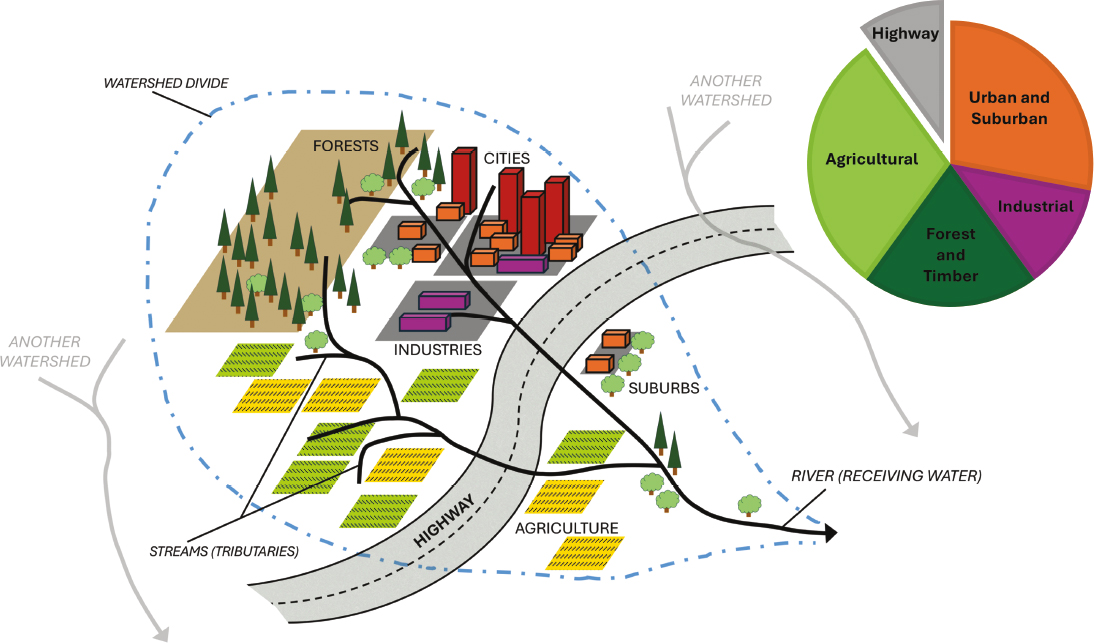
SOURCE: Study committee and staff.
___________________
1This sentence was changed after release of the report to clarify USEPA regulations per CWA 303(d).
The Clean Water Act of 1972 gives the U.S. Environmental Protection Agency (USEPA) authority to regulate stormwater discharges. The law established the National Pollutant Discharge Elimination System (NPDES) permits for point source discharges, including Municipal Separate Stormwater Systems (Section 402) and the Clean Water Certification requirement (Section 401) for water quality impacts of federally permitted projects. A total daily maximum load (TMDL), which is a calculation of the maximum amount of a given pollutant that can enter a body of water without violating water quality standards, is a tool used to help guide attainment of water quality standards. CWA Section 303(d) mandates that states identify water quality–impaired water bodies (i.e., those that do not meet water quality standards), determine the maximum acceptable load of the pollutants to attain the standards, and allocate the load to the various dischargers of the pollutants.2 A TMDL also establishes a pollutant target and creates allocations to the sources of the pollutant throughout a watershed (see Figure 1-1). TMDLs can also inform load reductions assigned to permits.3 Point sources of pollutants are assigned wasteload allocations that are enforceable through NPDES permit requirements, and nonpoint sources are assigned load allocations that are typically implemented through voluntary measures or state regulatory approaches. There can be inconsistency in the application of the terms “point source” and “nonpoint source” for different contexts and settings. From a technical standpoint, geographically diffuse highway systems are nonpoint sources of stormwater pollution when viewed at the scale of the drainage basin; however, highways are usually regulated as point sources at their outfall discharge locations. Highways are sources and conveyances of pollutants that are subject to NPDES permit-allocated wasteload reductions (see Figure 1-2). As a result, state and local departments of transportation (DOTs) have a keen interest in developing effective stormwater management strategies.
Because highway stormwater was traditionally viewed as primarily a safety hazard to motorists, highway drainage systems were designed to move stormwater off the roadway surface as quickly as possible. In response to clean water regulations, and as concerns about the impacts of highway runoff on the quality of receiving waters have grown, the stormwater management goals and strategies of state and local DOTs have become more holistic. Management approaches now include both structural and nonstructural means to reduce pollutant sources, stormwater runoff, and the pollutant concentrations and loads mobilized by stormwater. Increasingly, modern management techniques will often include green stormwater infrastructure designed to meet mitigation criteria by taking advantage of
___________________
3This paragraph was changed after release of the report to clarify USEPA regulations per CWA 303(d).
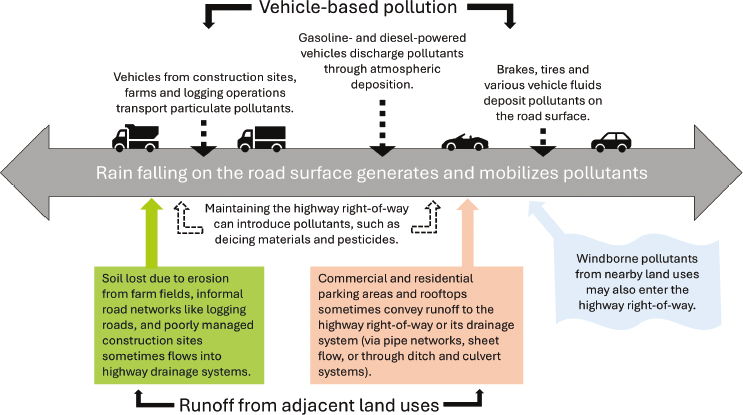
SOURCE: Study committee.
natural processes to slow, spread, retain, evaporate, infiltrate, and filter stormwater runoff before it is discharged to receiving waters.
Despite the many advances in highway stormwater management over the course of decades, some stormwater pollutants are inadequately or not removed by current management strategies, and there is a continuing need for improved means of addressing both traditional contaminants and contaminants of emerging concern and their changing sources. Doing so requires information and knowledge not only about these pollutants and their sources but also about the performance, cost, maintenance, resilience, and distribution of available control methods and practices. For state DOTs that have extensive highway systems traversing wide-ranging landscapes and watersheds, these challenges can be especially daunting and require significant resources, technical capacity, and expert guidance.
STUDY ORIGINS AND CHARGE
Congress called for this study in Section 11520 of the Infrastructure Investment and Jobs Act of 2021. The legislative text, which is contained in Box 1-1, asks for recommendations about methods that state DOTs can
BOX 1-1
Legislative Text Calling for this Study
SEC. 11520. STUDY ON STORMWATER BEST MANAGEMENT PRACTICES
- STUDY.—Not later than 180 days after the date of enactment of this Act, the Secretary and the Administrator of the Environment Protection Agency shall offer to enter into an agreement with the Transportation Research Board of the National Academy of Sciences to conduct a study—
- to estimate pollutant loads from stormwater runoff from highways and pedestrian facilities eligible for assistance under title 23, United States Code, to inform the development of appropriate total maximum daily load (as defined in section 130.2 of title 10 40, Code of Federal Regulations (or successor regulations) requirements;
- to provide recommendations regarding the evaluation and selection by State departments of transportation of potential stormwater management and total maximum daily load compliance strategies within a watershed, including environmental restoration and pollution abatement carried out under section 328 of title 23, United States Code (including any revisions to law (including regulations) that the Transportation Research Board determines to be appropriate); and
- to examine the potential for the Secretary to assist State departments of transportation in carrying out and communicating stormwater management practices for highways and pedestrian facilities that are eligible for assistance under title 23, United States Code, through information-sharing agreements, database assistance, or an administrative platform to provide the information described in paragraphs (1) and (2) to entities issued permits under the Federal Water Pollution Control Act (33 U.S.C. 1251 et seq.)
- REQUIREMENTS.— If the Transportation Research Board enters into an agreement under subsection (a), in conducting the study under that subsection, the Transportation Research Board shall—
- review and supplement, as appropriate, the methodologies examined and recommended in the report of the National Academies of Sciences, Engineering, and Medicine entitled “Approaches for Determining and Complying with TMDL Requirements Related to Roadway Stormwater Runoff” and dated 2019;
- consult with—
- the Secretary;
- the Administrator of the Environmental Protection Agency;
- the Secretary of the Army, acting through the Chief of Engineers; and
- State departments of transportation; and
- solicit input from—
- stakeholders with experience in implementing stormwater management practices for projects; and
- educational and technical stormwater management groups.
- consult with—
- REPORT.— If the Transportation Research Board enters into an agreement under subsection (a), not later than 18 months after the date of enactment of this Act, the Transportation Research Board shall submit to the Secretary, the Committee on Environment and Public Works of the Senate, and the Committee on Transportation and Infrastructure of the House of Representatives a report describing the results of the study.
use to evaluate and devise stormwater management and TMDL compliance strategies and on ways that the U.S. Department of Transportation (USDOT) can assist states in carrying out and communicating their strategies for highway and pedestrian facilities eligible for federal aid. In accordance with this legislative direction, the Federal Highway Administration (FHWA) and the National Academies developed the study’s statement of task (SOT) shown in Box 1-2.
The SOT calls for three major study activities. The first is a review of the data sources and methods used by a regionally diverse cross section of state DOTs to estimate and monitor pollutants in highway stormwater runoff and to determine the sources of the pollutants and their contribution to wasteload allocations in receiving waters. While the legislative text could be read to imply that the study itself would estimate pollutant loads across states, a review of how a varied selection of state DOTs estimate and monitor loads was deemed to be more achievable for this study. As a practical matter, it would not have been possible for the study to gather the needed data to estimate pollutant loads from the highway and pedestrian facilities of 50 state DOTs and other recipients of federal highway aid into thousands of water bodies and watersheds and involving scores of contaminants. A review conducted in this manner could reveal the variety
BOX 1-2
Statement of Task
A consensus study committee will
- Review the data sources and methods used by a regionally diverse cross section of state departments of transportation (state DOTs) to
- estimate and monitor pollutants in stormwater runoff from highways and pedestrian facilities that are eligible for federal aid, and
- determine the sources and loads of the pollutants in the runoff and their contribution to receiving water wasteload allocations established under the Clean Water Act;
- Assess the methods and approaches used by state DOTs to select total maximum daily load compliance strategies within a watershed, including strategies that involve environmental restoration and pollution abatement and taking into account laws, regulations, and other factors that can affect these strategy choices; and
- Consider how the federal government, including the Federal Highway Administration (FHWA), U.S. Department of Transportation (USDOT), and U.S. Environmental Protection Agency (USEPA), can assist in the communication and dissemination of best practices for highway stormwater management, as informed by the study committee’s review of state practices.
On the basis of its assessment, the committee may make recommendations to state DOTs, FHWA, USDOT, USEPA, and Congress regarding methods and practices for devising, selecting, and carrying out highway stormwater management compliance strategies and on FHWA’s and USDOT’s roles in promoting best practices. As appropriate, the committee may make recommendations pertaining to relevant laws and regulations.
and variability of pollutant loads and concentrations in highway runoff within and across different states, each employing their own estimation and monitoring methods.
The second part of the SOT calls for an assessment of the methods used by states to select TMDL compliance strategies, including the effects that existing laws and regulations can have on these choices. Note that the SOT allows for recommendations for changes in laws and regulations based on this assessment.
The third part of the SOT calls for a review of how federal agencies, including USDOT, FHWA, and USEPA, can assist in the communication and dissemination of best practices for highway stormwater management. The legislation points to information-sharing agreements, database assistance, and administrative platforms as options, but does not limit the study’s consideration of methods for assisting with best practice communication and dissemination.
STUDY SCOPE AND APPROACH
To conduct the study, the National Academies appointed an interdisciplinary committee of 11 members with expertise in stormwater management, civil and environmental engineering, green infrastructure, hydrology and hydraulics, water resources engineering and management, and environmental policy. Appendix B provides the biographies of the committee members.
In considering the SOT and its legislative origins, the committee made the following decisions about the study scope and how it would be fulfilled.
First, the legislative origin of the study, the Infrastructure Investment and Jobs Act of 2021, specifies that the study focus on highways and pedestrian facilities eligible for federal assistance under Title 23 of the U.S. Code, which can include many of the nation’s 3.9 million miles of highway apart from local roads and rural collectors. The committee also considered highway stormwater issues related to tribal lands, which fall under the Tribal Transportation Program (TTP). The TPP is part of the Federal-Aid Highway Program and is authorized under the Federal Lands Highway Program.
The SOT’s first and second tasks constitute the main study charge. They call for (a) a review of the data and methods used by a regionally diverse selection of states to determine the sources and loads of pollutants that highway stormwater contributes to receiving waters and (b) an assessment of state DOT TMDL compliance strategies. To ensure varied regional representation, the committee looked for states in different regions of the country where topographies, highway network densities, and precipitation and temperature patterns differ. This was achieved in part by consulting the National Oceanic and Atmospheric Administration’s (NOAA’s) reference maps of climatically consistent U.S. regions covering the 48 contiguous states, which is shown in Figure 1-3. As depicted in Figure 1-4, states in the same climate region generally share the same precipitation and temperature patterns. Information was gathered from state DOTs and other state and local agencies responsible for watershed management spanning eight of the nine NOAA climate regions, as well as Alaska (not shown in maps).
The committee also looked for states representing a range of water quality concerns. Highway stormwater management strategies and priorities will differ, for instance, depending on the contaminants of interest.
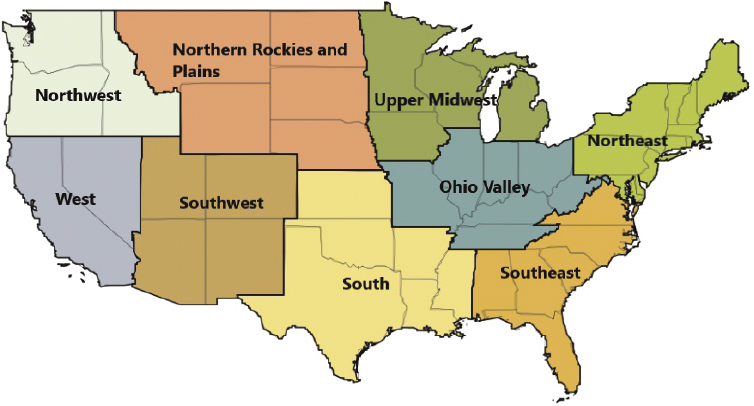
SOURCE: NOAA, https://www.ncei.noaa.gov/access/monitoring/reference-maps/us-climate-regions
For example, nutrient (e.g., nitrogen, phosphorus) and sediment loads are a particular concern for the large Chesapeake Bay watershed in the Mid-Atlantic region. Strategies for controlling these water pollutants will not be the same, for instance, as strategies used for water bodies in the Pacific Northwest, where controlling copper and 6PPD-quinone from tire wear are growing priorities to protect sensitive local fish species, including coho salmon.4
Finally, the committee wanted to be sure that the states consulted included some that have mature stormwater management programs and considerable historical data on program effectiveness. The states of Minnesota and Washington, for instance, were known to have long-standing stormwater management programs, so the committee invited them for briefings and information.
Table 1-1 lists the states consulted for briefings and information on their stormwater management priorities and challenges, TMDLs, and best practices for stormwater management. Officials from 15 states were consulted directly, including representatives from state DOTs, other state agencies, and local and tribal organizations. While the committee was not successful in directly consulting officials from states in the South region, the stormwater management experts on the study committee have experience working for and collaborating with public highway agencies in numerous states, including states in this region.
___________________
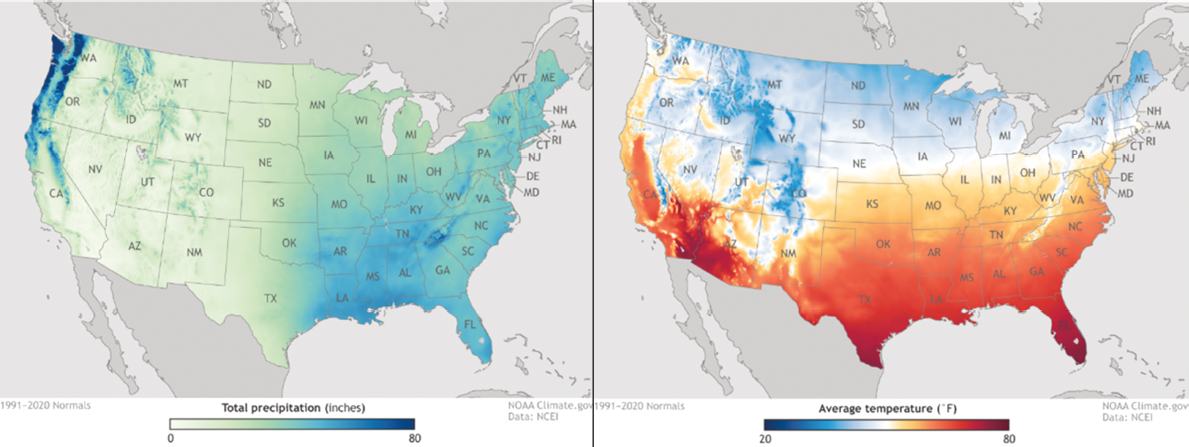
SOURCE: Precipitation, https://www.climate.gov/maps-data/data-snapshots/data-source/precipitation-1991-2020-monthly-average Temperature, https://www.climate.gov/maps-data/data-snapshots/data-source/temperature-mean-1991-2020-monthly-average
TABLE 1-1 Agencies and Organizations from 15 States Consulted
| State | Climate Region | State Agency | Local, Tribal, and Other Organizations |
|---|---|---|---|
| Alaska | Alaska | DOT | |
| California | West | DOT | San Francisco Estuary Institute |
| Colorado | Southwest | DOT | |
| Florida | Southeast | DOT | |
| Illinois | Ohio Valley | Dupage River Salt Creek Workgroup & Chicago Area Waterways Chloride Workgroup | |
| Maine | Northeast | DOT | |
| Massachusetts | Northeast | DOT | |
| Minnesota | Upper Midwest | DOT | |
| Montana | Northern Rockies/Plains | DOT | |
| New Mexico | Southwest | Jemez Pueblo | |
| North Carolina | Southeast | Department of Environmental Quality | |
| Rhode Island | Northeast | DOT | |
| Utah | Southwest | DOT | |
| Virginia | Southeast | DOT | |
| Washington | Northwest | Department of Ecology |
Although public highway agencies were the primary focus for gathering information, the committee also heard from academic experts, researchers, consultants, and advocacy groups, as acknowledged in the preface to this report. They provided information on many relevant topics, including potential emerging contaminants of concern, interactions of stormwater with groundwater, and TMDL modeling methods.
Informed by these consultations, the committee increased its understanding of the different data sources and methods used by state DOTs to design and select strategies for managing stormwater to achieve their TMDL pollutant reduction goals. Observing that highway stormwater management challenges are often specific to individual states and watersheds, the committee decided that its report should include examples of
the challenges faced by state DOTs, and the strategies and processes they employ to meet them, in different regional contexts. To structure the discussion, consideration was given first to the challenges that states face before and during TMDL development. The discussion then turned to challenges faced by state DOTs after TMDL development, including issues related to best management practices (BMPs).
In reviewing these challenges and the responses by states, the committee reached a number of conclusions concerning the methods and practices used for devising, selecting, and carrying out highway stormwater management compliance strategies. In cases where these conclusions suggest compelling needs and opportunities, such as for additional information and understanding or for revisions to existing processes and policies, the committee offers recommendations for addressing them.
REPORT ORGANIZATION
This report, which is organized into five more chapters, documents the committee’s work. Chapter 2 builds the foundational background for the report. It explains the interconnected nature of water, including the hydrologic cycle, the key requirements of the federal Clean Water Act for TMDLs, best practices for stormwater management, and hydrologic and stormwater models. This general background sets the stage for Chapter 3’s more focused discussion of the role of state DOTs in meeting their responsibilities for managing the contaminants in stormwater discharged across highway networks that traverse a wide array of topographies, watersheds, land uses, and jurisdictions. State DOTs and other state agencies, as well as public agencies at other jurisdictional levels, are faced with many challenges in fulfilling their highway stormwater management responsibilities. These challenges can differ from one jurisdiction to the next and across highway segments and watersheds. Chapter 4 identifies and analyzes challenges that arise prior to developing TMDLs, such as identifying contaminants of concern, establishing water quality standards, and implementing source controls aimed at limiting the release of contaminants into the environment. The chapter also examines the challenges that arise during the development of TMDLs, including allocating pollutant loads among parties having management responsibility and distinguishing between highway- and non-highway-sourced pollutants. Chapter 5 then focuses on TMDL implementation and BMPs for state DOT stormwater management, including the challenges arising in designing BMPs for the highway environment, monitoring their effectiveness, and improving their performance through better design, construction, and maintenance practices.
Based on the findings from these chapters that examine highway stormwater management challenges and analyze how states have tried to meet them, the committee’s key conclusions and recommendations are offered in Chapter 6. The chapter points to many needs and opportunities for improvement in areas such as in the TMDL regulatory process, BMP selection guidance, monitoring and modeling, workforce training, and data sharing and communications.
REFERENCES
Davis, A.P., Hunt, W.F., and Traver, R.G. 2022. Green stormwater infrastructure fundamentals and design. John Wiley & Sons.
Walsh, C.J., Roy, A.H., Feminella, J.W., Cottingham, P.D., Groffman, P.M., and Morgan, R.P. 2005. The urban stream syndrome: Current knowledge and the search for a cure. Journal of the North American Benthological Society 24(3), 706–723.


