Managing Highway Stormwater Quality: Driving Progress (2026)
Chapter: 4 Highway Stormwater Management Challenges and Opportunities: Before and During TMDL Development
4
Highway Stormwater Management Challenges and Opportunities: Before and During TMDL Development
This chapter discusses the highway stormwater management challenges that can arise both before a total maximum daily load (TMDL) is established and when it is being developed. Opportunities for addressing these challenges are also discussed. A TMDL is a science-based calculation of the maximum contaminant load that a water body can receive while still attaining water quality standards. A TMDL includes the recommended watershed-contributing load reductions necessary to get below the maximum contaminant load. The pre-TMDL phase is the period before a contaminant is identified and placed on a list of impaired waters [Section 303(d)]. Relevant activities include identifying, monitoring, and determining the sources and effects of contaminants of concern. Once a contaminant is listed, a TMDL is developed, requiring the creation of wasteload allocations (WLAs) assigned to National Pollutant Discharge Elimination System (NPDES) permit holders in the watershed and/or load allocations assigned to entities not permitted under NPDES, including allocations from highway runoff. TMDL implementation challenges associated with highway stormwater best management practices (BMPs) are discussed in Chapter 5.
Informed by the committee’s discussions with officials from state departments of transportation (state DOTs) and other consulted experts and interested parties, the chapter begins with a discussion of pre-TMDL challenges, including those associated with identifying and monitoring contaminants of concern, understanding contaminant interactions, and identifying and tracking the sources of contaminants. Consideration is then given to challenges that can arise during the development of the TMDL, including data and modeling limitations that can complicate the calculation of pollutant
load allocations for highway stormwater sources and the need to account for the natural background sources of contaminants. This discussion focuses on regulated pollutants (e.g., nutrients, metals, sediment, pathogens) that are generally subject to the TMDL process. However, as explained in Chapter 3, highway stormwater can also contain contaminants (i.e., microplastics and chemicals from tire wear particles) that are not currently regulated but nevertheless of concern. The challenges that these contaminants can present are also acknowledged here and elsewhere in the report.
The chapter discussion then turns to possible means for addressing the identified challenges. They include expanding state DOT and public participation in the TMDL process; employing alternatives to TMDLs; improving the monitoring of highway contaminant sources, transport, and impacts; and placing more emphasis on source control.
Finally, after having reviewed the opportunities for improving the TMDL process, the committee sought evidence of the effectiveness of the TMDL process for the management of highway stormwater contaminants. The chapter therefore concludes with a review of the limited evidence of effectiveness when highway stormwater management is a key contributor to the water quality impairment.
CHALLENGES BEFORE TMDL DEVELOPMENT
Complexity and Cost of Monitoring Contaminants
To recap background from previous chapters, watersheds and receiving water bodies are generally monitored by state environmental agencies for contaminants subject to U.S. Environmental Protection Agency (USEPA)–approved water quality standards. These water quality standards are often developed by states. Every two years, states are responsible for updating their Section 303(d) list of waters that are considered impaired and for which a TMDL has not yet been developed and approved by USEPA. The impairment designation is informed by monitoring data that reveal noncompliance (or a risk of noncompliance) with federal or state water quality standards for one or more regulated contaminants. TMDLs are thus developed for each contaminant exceeding water quality standards for given water bodies after they are added to the Section 303(d) list. These steps are usually the responsibility of state environmental agencies. While state DOTs are seldom involved directly in this monitoring and subsequent development of TMDLs, they may be involved in monitoring stormwater from the highway right-of-way (ROW) in the form of highway runoff characterization monitoring and outfall monitoring in accordance with municipal separate storm sewer system (MS4) permitting or other potential regulatory requirements.
Methods for monitoring highway stormwater contaminants can be challenging to implement technically, as well as expensive and labor intensive. State highways managed by DOTs can discharge to hundreds of impaired water bodies, often with multiple roads and potentially thousands of outfalls. For example, a stream may receive runoff from multiple highways with different characteristics (e.g., size, traffic) and therefore different pollutant loads and concentrations in their discharges. This spatial variability is very challenging to capture if only a handful of outfalls are sampled. A low-cost method of monitoring is through “grab” sampling, which may be as simple as gathering individual samples of stormwater obtained at a specific time during or after a storm event at a specific location along a flow path. This method, however, is inadequate as the sole data source for Clean Water Act Section 303(d) listing decisions or TMDL modeling. In particular, it is not well suited for characterizing pollutant transport during the highly variable conditions of storm events that will affect the concentration and discharge of contaminants from a highway ROW. Flow-weighted sampling, which involves collection of samples after a given incremental volume of discharge passes through a monitoring station (generally using an automated sampler), or high-temporal-resolution sampling, which uses in situ sensors for near-continuous monitoring coverage for some pollutant types, is better suited for monitoring contaminant loadings from highways (Davis et al., 2022; NRC, 2009). Time-weighted and/or passive sampling may also be useful to complement flow-weighted sampling to provide additional information on pollutant mass and concentration dynamics.
High-resolution in situ sensors can offer advantages over traditional stormwater sampling methods, as they enable greater monitoring coverage both within a single storm event and across multiple storm events. The rapidly growing field of the Internet of Things is leading to a variety of open-source sensors that are very low cost compared to commercial branded instruments. However, many in situ water quality sensors are still prohibitively expensive and capable of monitoring only a limited number of contaminants (e.g., suspended solids, nitrogen, dissolved organic carbon, and salinity). Some may also require frequent maintenance and measures to discourage theft and vandalism. Currently, most contaminant samples are analyzed in a laboratory using standard analytical methods; however, the methods and techniques for some emerging contaminants of concern, such as microplastics, are still under development.
As an example of sensor use for monitoring, Figure 4-1 shows a high-temporal-resolution sensor streamflow and nitrate (NO3-N) concentration plot, displaying high variability in both streamflow and nitrate concentrations throughout a storm event.
In addition to the potential for a high degree of variability in the concentrations and loads of highway stormwater contaminants that
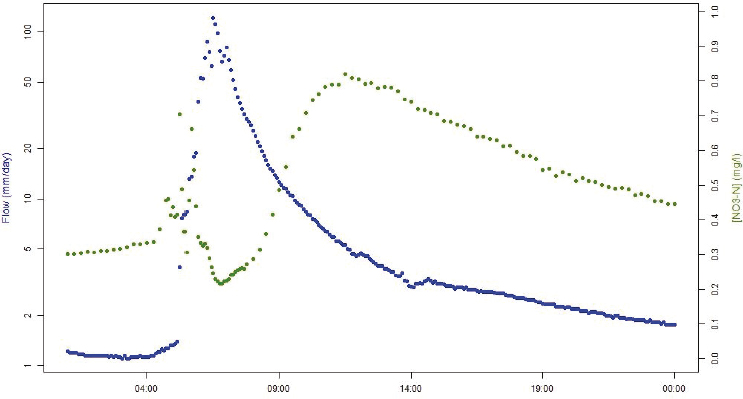
SOURCE: Delesantro, 2021.
are mobilized during a single storm event (i.e., intrastorm variability), there can also be high variability in contaminant concentrations and loads from one storm to another (interstorm variability) due to factors such as hydrologic and climate variability, seasonal changes, and anthropogenic causes. Such high interstorm variability means that many storm events need to be monitored at a single highway drainage location to adequately represent contaminant transport dynamics, which adds to the time and labor cost of monitoring. The minimum number of stormwater samples needed to adequately represent a wide range of expected pollutant concentrations and loads is dependent on pollutant and site characteristics (e.g., precipitation trends, seasonality of pollutant sources, drainage area land use, maintenance), and NPDES permit minimum sampling requirements also vary by permit type and location. For BMP monitoring, the Technology Assessment Protocol–Ecology by the Washington State Department of Ecology recommends a minimum of 15 paired influent and effluent flow-weighted composite stormwater samples.1 Because of these monitoring challenges, there can be limited data to calibrate relationships of contaminant concentrations with land use, precipitation levels, and terrain.
___________________
1https://apps.ecology.wa.gov/publications/summarypages/1810038.html
Source Identification and Tracking
Accurate stormwater pollutant source tracking can be valuable as it allows for more direct upstream pollutant management rather than downstream treatment after dispersal (Ports, 2009; Vezzaro et al., 2015). Source tracking can also increase the effectiveness of a TMDL by providing actionable data for the design and implementation of management practices. Source tracking is usually performed by the state environmental agency, sometimes in partnership with research organizations that possess the needed expertise and knowledge. However, because the pollution in highway stormwater runoff can originate from many sources and be discharged at multiple locations, this can complicate source tracking. Additionally, pollutants can be transformed (through biological, chemical, and physical processes) as they travel through watersheds, further complicating the identification of their sources.
Source tracking can also be expensive to perform, especially for a large watershed, but may have cost-saving benefits in the long run for state DOTs and others looking to use resources more efficiently to manage pollutant loads. While source identification methods will vary, common practices include estimating contaminant sources based on available water quality and hydrologic data, land use data, and permit information from dischargers within a watershed. This information can be used to estimate pollutant generation and transport throughout a watershed, using various modeling methods, as described in Chapter 2. However, the accuracy of model output is often limited, especially for determining the contribution of pollutant loads from distributed land use types with limited stormwater data, which is the case in many highway environments. Opportunities for using more advanced methods of source tracking are discussed later in this chapter.
If state environmental agencies do not believe that source tracking is needed to produce an approvable TMDL, they may have limited incentive to engage in such a resource-intensive activity that could otherwise benefit state DOTs. While state DOTs do not usually track contaminant sources, source identification could assist DOTs in understanding both where in the highway-owned land area different pollutants originate and the sources of pollutants that reach highways from adjacent land uses. Because DOTs are often held responsible for managing pollutants that originated outside of the highway environment, but are conveyed through DOT outfalls, source tracking can be a worthwhile step, increasing effectiveness of the TMDL in the long run. Box 4-1 later in this chapter gives examples of state-of-the-art source tracking methods that may be candidates for use by state DOTs.
Accounting for Contaminant Interactions (“Chemical Cocktails”)
Stormwater contaminants are currently regulated based on their individual deleterious effects on receiving water quality. However, given the many
stormwater contaminants, both regulated and unregulated, it can be important to understand and account for the ways in which multiple contaminants can interact to cause water quality impacts that are detrimental to ecosystem health, services, and functions, as well as to aquatic organisms and humans. Research suggests that contaminant mixtures and interactions among multiple stressors can be synergistic so as to have negative effects that exceed the sum of the effects of the individual pollutants (Kaushal et al., 2018, 2019, 2020). Moreover, some highway pollutants, such as deicing agents, can have secondary effects on water quality, while highway construction and development can indirectly influence the mobilization of naturally occurring contaminants or enhance other pollutant processes in ways that are not part of the TMDL process.
Because stormwater carries a wide variety of pollutants, water quality impairments can arise from these “chemical cocktails” of co-occurring pollutants coupled with hydromodification (that is, the alteration of the natural flow of water through a landscape). As an example, contaminants washed off the highway may interact with other entrained contaminants in BMPs to cause reactions that release contaminants into receiving waters (McQuiggan et al., 2022). Indeed, secondary mobilization of pollutants can be an issue in highway stormwater management due to changes in salinity, redox conditions, and pH.
CHALLENGES DURING TMDL DEVELOPMENT
Data and Model Limits for Developing Contaminant Allocations
In the committee’s information gathering about the data used for TMDL development, the consulted state DOTs raised concern that better data are needed on highway stormwater concentrations and pollutant loads to use during the development of TMDLs and assignment of load and wasteload allocations to state DOTs. The consulted states reported that TMDLs are sometimes developed using outdated or incomplete data that may be appropriate for trend analysis but short on the accuracy needed for establishing TMDLs, and the resultant TMDL-related requirements that end up in DOT MS4 permits. The models used for wasteload allocations typically assume that load generation mechanisms are related to land use and land cover; however, it was noted that few models distinguish roadways from other types of impervious cover and that few data sources are available that accurately represent the linear highway land use. Other TMDL calculation approaches (e.g., load duration curves) do not track individual source loadings or relative source contributions within a watershed. In such cases, a supplemental analysis is required to identify sources and assign wasteload and load allocations, which introduces further uncertainty in the TMDL
calculation. Some additional data and modeling issues that were reported by consulted state DOTs and modeling specialists include concerns that models are compartmentalized (e.g., for surface water only) and do not consider multiphase pathways (solid, liquid, and gas); static with regard to land use and climate, including observed intensification of the hydrologic cycle; focused on individual contaminants but not overall water quality; and unable to account for interactions of co-occurring contaminants. As many pollutants travel between different compartments of the water cycle (e.g., surface and groundwater) and undergo multiphase transport through land, water, and atmospheric pathways, the bias of data and models to only consider surface water can be a major source of uncertainty. The National Highway Runoff Database and the International Stormwater BMP Database were identified as sources of information that could be useful for better understanding highway pollutant concentrations, but continued use of these databases requires an investment in additional data collection and updating.
The models used for allocations were also criticized for their limited ability to incorporate uncertainty. Surface and subsurface flow path volumes and contaminant loads may be estimated by both process-based and data-based methods, and as deterministic or stochastic estimates. Stochastic estimates allow for greater consideration of predictive uncertainty. Because some models are designed to use storm event mean concentrations (EMCs) of contaminants and other parameters from prescribed distribution functions, they can be used to construct uncertainty bounds for peak flows, total stormwater volume, or pollutant loads (Herbst et al., 2023; Zhang et al., 2023). Because event concentrations can be dependent on flow rates (concentration-discharge functions from sampling), and high flows are known to mobilize certain pollutants or dilute others, it is important to account for event magnitude rather than relying on a temporally static EMC.
The Federal Highway Administration (FHWA) and U.S. Geological Survey (USGS) collaborated to develop the Stochastic Empirical Loading and Dilution Model (SELDM)2 for highway applications. SELDM consists of a robust monitoring and modeling framework in which the stochastic inputs are conditioned on highway and watershed characteristics derived from local and regional datasets. By integrating local precipitation distribution functions and runoff distributions from highways and adjacent watershed lands, the model is designed, using a Monte Carlo stochastic approach, to estimate loadings, dilution, and downstream loads and impacts with uncertainty boundaries (Granato, 2013). While state DOTs, including the Massachusetts DOT, Oregon DOT, and North Carolina DOT, have used SELDM (Granato et al., 2023a, 2023b), there can be a tradeoff to using
___________________
2https://www.usgs.gov/software/seldm-stochastic-empirical-loading-and-dilution-model-software-page
it and other stochastic models because of model complexity and the computing resources and workforce requirements for model use. Inasmuch as simpler models, such as load duration curves, will have limited capacity to represent water quantity and quality dynamics in multi–land use environments and under temporally variable conditions, their computational resources can typically be satisfied by desktop computers and they can be used by personnel without advanced modeling expertise.
As models become more complex, their use may be limited to more specialized agencies or consultants or by the development of community user groups. In the United States, federal agencies provide key support for the development, maintenance, and use of models at the state and local levels. The development of SELDM by FHWA and USGS is one example, while other examples include USEPA’s Stormwater Management Model,3 the U.S. Army Corps of Engineers’ Hydrologic Modeling System,4 and the U.S. Department of Agriculture’s support for Soil and Water Assessment Tool.5 Additional support may be provided through training materials and short courses or by turnkey contracts with private consultants. While research-grade models that are typically developed in academic environments can provide even more comprehensive and advanced methods, they can be difficult to translate into more general use unless accompanied by significant technical support. For instance, the Visualizing Ecosystem Land Management Assessments model6 is an example of software that moved from an academic setting to an agency (USEPA) and is now backed by agency resources for interfacing with state DOTs and local highway agencies.
Accounting for Natural Background Conditions
A challenge in developing TMDLs is pragmatic recognition that natural sources may be the limiting factor affecting attainment of a water quality standard. While rare, in some cases, poorly defined natural source contributions may be included in background conditions in the TMDL’s load allocation for nonpoint sources including highways. Examples of impairments due to natural background conditions or with a natural condition affecting the ability for a water body to attain the water quality standards, even with robust implementation of a TMDL and stringent permit requirements, include the following:
- Escherichia coli (E. coli): Elevated E. coli is a leading cause of water-body impairments nationally. Naturally occurring E. coli sources include birds, deer, beavers, raccoons, and other wildlife.
___________________
3https://www.epa.gov/water-research/storm-water-management-model-swmm
4https://www.hec.usace.army.mil/software/hec-hms/
6https://www.epa.gov/water-research/visualizing-ecosystem-land-management-assessments-velma-model
- These sources may be direct inputs to waterbodies or they may be intercepted and transported by drainage infrastructure.
- Metals: In some western states, marine shales are naturally occurring sources of selenium that can result in exceedance of water quality standards, particularly during groundwater-dominated low-flow conditions. These conditions can be exacerbated by irrigation practices. Arsenic is another example that exists in some areas at concentrations naturally orders of magnitude above USEPA’s currently recommended 0.02 µg/L water supply plus fish ingestion standard.
- Phosphorus: Elevated phosphorus concentrations are often associated with agricultural runoff, with municipal wastewater and urban runoff also contributing. In some cases, naturally elevated environmental baseline conditions may also be present. For example, in the Tualatin River basin in Oregon, which has a phosphorus TMDL, high phosphorus concentrations in soils contribute to naturally or legacy high phosphorus levels in the basin’s streams and rivers (Abrams and Jarrell, 1995). Similarly, in the Cherry Creek Basin in Colorado, groundwater has phosphorus exceeding potential future stream and reservoir standards.
Although USEPA provisions for Use Attainability Analysis7 can be used to recognize and account for naturally occurring pollutant concentrations that prevent the attainment of water quality standards, in practice “downgrading” beneficial uses or developing site-specific standards requires structured scientific supporting documentation. This process may carry a significant burden of proof for the proponent of such changes, including state DOTs.8
OPPORTUNITIES FOR MEETING CHALLENGES
During the committee’s consultations with state DOTs and others, the challenges described above were accompanied by observations and suggestions about opportunities for addressing them. As discussed next, they included earlier participation from the public in the development of TMDLs, exploring alternatives to TMDLs, and placing more emphasis on source control.
Expanding DOT and Public Participation in the TMDL Development Process
State DOT involvement in TMDL development varies by state and by TMDL, but there are opportunities to improve both state DOT success
___________________
7https://www.epa.gov/wqs-tech/use-attainability-analysis-uaa#anchor-1
8This paragraph was changed after release of the report to clarify USEPA regulations related to beneficial uses and water quality standards.
in TMDL implementation and overall water quality through expanding involvement in the early phases of TMDL development. State DOTs can have information that is helpful for TMDL developers to improve load allocations, including stormwater monitoring data from the highway rights-of-way, outfalls, and BMPs. Before TMDL development begins, state DOTs may already be tracking 303(d)-listed impaired waters that do not meet water quality standards, particularly within watersheds containing a significant highway footprint. However, this may be impractical due to the potentially hundreds of water-body/pollutant combinations and unknown timeline for new TMDL potential development. There is an opportunity for better communication between the TMDL authority and the public (including state DOTs) in the form of more advanced warning of intentions to develop a new TMDL. This would allow state DOTs to plan for supporting the TMDL authority, minimize surprises, or potentially pursue a TMDL alternative, where appropriate.
During the TMDL development process, state DOT involvement may include coordination with regulatory authorities to provide monitoring data, information on the highway stormwater system, or to help identify potential sources of highway stormwater contaminants. When afforded early consolations and participation in the process, state DOTs will have the opportunity to apply their unique knowledge of their transportation system to improve the accuracy and reliability of a TMDL. State DOTs will be empowered in this process if they have access to robust stormwater data to contribute to the process of estimating the transport of contaminants of interest from their highway system.
Public participation in developing TMDLs is important for multiple reasons. While members of the public may not have technical expertise, they can bring local knowledge into the development process that may help customize a TMDL to a particular watershed and its specific needs. Moreover, participation from the public early in the process is more likely to lead to public acceptance and understanding of the TMDL, leading to sustained support over time. Restoring waters impaired primarily from stormwater discharges in most cases will take many years or decades to accomplish and require a longer period of sustained public support and significant investment. Hence, restoration management approaches need to be understood and valued by the public. However, while public involvement in developing TMDLs is required by federal regulation, a common pattern noted among some states consulted is that opportunities for public participation in the TMDL development process tend to be limited until the state-required public comment period. This period usually occurs after a TMDL has already been drafted and past the point when it is likely to be altered substantively. Thus, expanding the opportunities for public participation before the public comment period may be desirable—for instance, by convening public meetings at the beginning of the TMDL development
phase to gather input from community members and groups, including the nonprofit sector, to hear concerns specific to different parts of a watershed.
Exploring Alternatives to TMDLs
Given the many challenges associated with TMDL development (and implementation, as discussed in the next chapter), it may behoove states to consider all pollutant reduction strategies to restore water quality that are allowed under the Clean Water Act in lieu of developing a TMDL. If water quality goals can be met through alternative strategies, a TMDL may not be needed.
Watershed-based planning can provide a more flexible and dynamic approach to restore water quality than TMDLs. They can also allow for a strategic and coordinated response to the problems of a watershed instead of a singular focus on reaching a numerical goal.
Indeed, USEPA has described watershed approaches as potentially providing the most effective framework for protecting water resources because they are hydrologically rather than jurisdictionally defined, involve many stakeholders, and are capable of addressing multiple water resource goals (e.g., water quality, water quantity, and habitat).9 Whereas USEPA considers TMDLs to be a watershed approach (as they are hydrologically defined and do involve many stakeholders), the assignment of load reduction responsibilities to individual permitted parties inherently discourages collaboration among stakeholders nor do TMDLs seek to address multiple water resource goals. TMDLs do not provide incentives for non-permittees to participate in the implementation of BMPs. And ideal watershed management plan could be crafted with much more flexibility to identify creative ways and incentives to bring regulated and nonregulated parties together.
Examples of some TMDL alternatives, also known by USEPA as Advance Restoration Approaches, that align better with the watershed-based framework include USEPA’s Subcategory 5r (r stands for “restoration”).10 This alternative acknowledges that many state watershed management programs face significant resource limitations that can impede the development of implementable TMDLs and cause delays in water quality restoration. Subcategory 5r therefore provides states with flexibility in how they apply their limited resources to achieve water quality standards. For example, the “Straight to Implementation” 5r alternative prioritizes immediate action to reduce loading of the target pollutant(s), foregoing the development of a TMDL. In such cases, the water body remains on the 303(d) list of impaired waters while actions are taken to reduce pollutant loading over a designated period. In its guidance, USEPA recommends an implementation
___________________
9https://www.epa.gov/nps/addressing-water-quality-challenges-using-watershed-approach
plan that documents the actions to be taken to address all contaminant sources, a schedule with clear milestones and target dates, the identification of all parties committed to the actions, plans for effectiveness monitoring of outcomes, and evaluations of the success of actions and outcomes. If the water quality standard is not met by the end of the period, then a TMDL may need to be developed. The 5r alternative therefore provides some flexibility for the use of a watershed-based approach.
Another alternative allowed by USEPA, commonly referred to as Category 4b demonstration,11 is for a state to forgo adding an impaired water segment to its 303(d) list if it is subject to other pollution control requirements and a suitable demonstration plan is developed and approved. Here again, USEPA’s regulations recognize that other pollution control requirements may obviate the need for the listing and development of a TMDL. A Category 4b demonstration can be used for segments impaired by point sources or nonpoint sources. The demonstration plan, when implemented, must ensure attainment with all applicable water quality standards through agreed-upon pollution control mechanisms within a specified time period. The pollution control mechanisms can include approved compliance schedules for capital improvements or plans enforceable under other environmental statutes (such as the Comprehensive Environmental Response, Compensation, and Liability Act). USEPA must approve the demonstration plan and has issued guidance similar to the guidance provided for Subcategory 5r approaches.
In recent years, a new water management paradigm has emerged, often referred to as the “One Water” approach. This approach takes a comprehensive view of the water cycle and seeks to manage all forms of water as interconnected parts of a single resource. One Water has inspired watershed-based planning that encourages collaboration and coordinated action by watershed partners to manage water resources to meet environmental, social, and economic goals more efficiently, including opportunities for water quality improvement by parties that have responsibility over both regulated and nonregulated contaminants.
An example of the One Water approach is the Jordan Lake (North Carolina) Watershed management program to address nutrient pollution. Partners in the Jordan Lake One Water Coalition,12 including North Carolina DOT, are working on a 4b demonstration to share the cost of water quantity and quality improvements but also realize co-benefits of responding to regulatory and nonregulatory concerns collaboratively and collectively. The aim is to attain similar or better levels of watershed protection at reduced costs by coordinating and leveraging each partner’s management practices. Figure 4-2 illustrates how tools such as land conservation priority mapping
___________________
11https://www.epa.gov/tmdl/category-4b-regulatory-alternative-tmdls
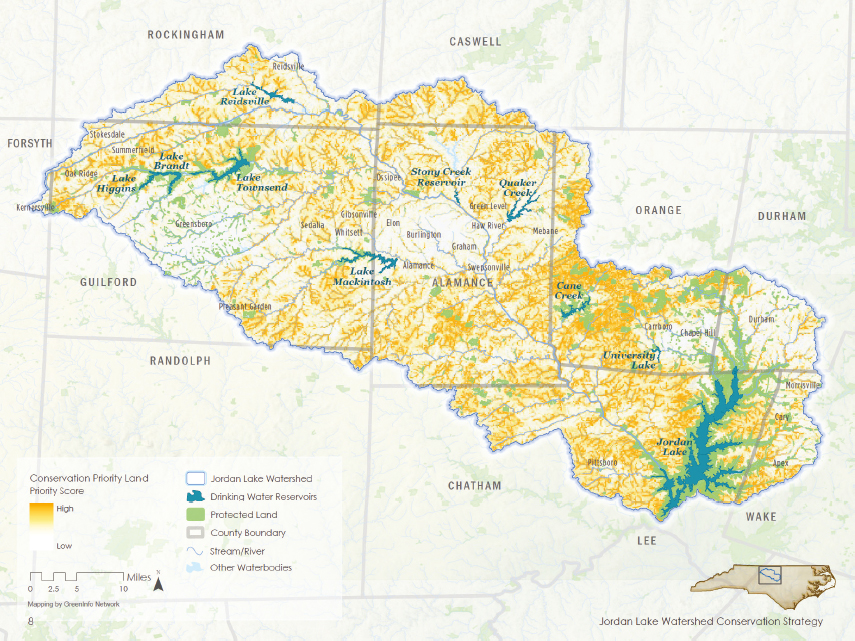
SOURCE: Jordan Lake Watershed Conservation Strategy, Triangle Land Conservancy, 2019.
are used by the Jordan Lake One Water Coalition to advise its members on high-impact land conservation investment opportunities within the watershed to further the objectives of the 4b demonstration efficiently among coalition partners.
While their development costs need to be considered, a benefit of the Subcategory 5r and Category 4b approaches is that they allow resources to be applied directly to reducing loading, rather than for development of the TMDL, which can be a time-consuming, lengthy, litigious, and expensive process. It was noted by state DOTs in presentations to the committee that TMDL alternatives, by their very nature, also tend to include more community engagement and acceptance, which can be a significant advantage for implementation. Candidates for the alternative approaches are watersheds where a government agency or watershed organizations have the ability to implement the array of actions needed to reduce pollutant loading and where there is a reasonable expectation that the standard can be achieved within the designated time frame. Additionally, watershed-based TMDL alternatives have the potential to avoid water quality standard delays for contaminants of emerging concern by allowing earlier action on regionally specific emerging contaminants that may not yet be of interest nationally. While these alternatives that could facilitate highway stormwater management are currently available, the committee’s observation from its consultations is that they are not widely utilized.
In some cases where natural sources or irreversible human-induced conditions are the dominant cause of impairment to a water body, a structured scientific assessment of whether the beneficial uses may be appropriate. In such cases, a formal “use attainability analysis,”13 which is allowed by USEPA’s regulations, may be warranted.14 Such an analysis can be an important consideration before a TMDL is developed if it will require the commitment of substantial resources for an unattainable goal. Such analyses, however, can be controversial because of the tensions that can arise when balancing economic, public heath, and ecological interests.
Improving Highway Contaminant Source, Transport, and Impact Monitoring
State environmental agencies and state DOTs can benefit from more accurate data on the sources, transport, and treatment of contaminants from highways. NPDES permits have monitoring requirements, but as described earlier in the chapter, there is a pressing need for state DOTs to have
___________________
13https://www.epa.gov/wqs-tech/use-attainability-analysis-uaa
14This paragraph was changed after release of the report to clarify USEPA regulations related to beneficial uses and water quality standards.
accurate methods for identifying sources of contaminants in order to better characterize the contaminants that originate in the highway environment, and thus to aid them in the implementation of their stormwater management programs. Investments in improved data collection on highway stormwater contaminant sources and magnitudes, transport, and impacts may empower state DOTs to become more involved throughout the TMDL process, guiding them in stormwater management decisions and adding accountability in effectiveness of contaminant load reduction strategies.
In this regard, states may be able to capitalize on the increasingly advanced capabilities of stormwater monitoring technology that employ high-resolution sensors, contaminant source tracking methods, and toxicity analysis. Box 4-1 gives examples of state-of-the-art source tracking methods commonly used in water research that, while not currently used in the TMDL process, may be candidates for future use that benefit state DOTs. Guidance on when these advanced techniques should be used would be helpful. In some cases, generic or regional information may be sufficient, while in others the more detailed and locally accurate information may be extremely useful. For instance, more detailed and accurate knowledge of sources may enable TMDL developers to identify categories of sources in a TMDL, each with different pollutant abatement responsibilities.
Additionally, states may employ toxicity analysis to characterize the impacts of contaminant chemical cocktails, evaluate BMP performance, and even identify new emerging contaminants, such as the tire wear–derived chemical 6PPD-quinone (Kayhanian et al., 2008; McIntyre et al., 2015; Taylor, 1999; Tian et al., 2021). Some states already employ biological monitoring (e.g., fish community monitoring or benthic macroinvertebrate monitoring) as a means of detecting chemical cocktail impacts on aquatic life. Because biological monitoring may not be attributable to a specific contaminant, states in the pre-TMDL phase may choose to pursue a TMDL approach using surrogate pollutants. To make these advanced monitoring techniques more accessible, state environmental agencies and state DOTs may need to partner with research organizations that have the requisite expertise.
Emphasizing Source Control
Source control, which prevents pollutants from being released into the environment at their points of origin before entering a water system, is generally considered to be more efficient than treatment to remove a pollutant that has already contaminated a water body. A successful example of source control, which applies to the highway environment, was the required phasing out of lead in automative gasoline during the 1980s. Reformulations of motor vehicle brake pads to reduce copper release is
Box 4-1
Contaminant Source Tracking Methods
Isotopic tracers
Isotopic tracers have been used by researchers to track pollutant sources in stormwater. For example, stable isotopes of water (δ18O and δD) can be used to determine the residence time or “age” of a water sample, which can be helpful in distinguishing “newer” stormwater from “older” groundwater in the environment. Additionally, dual nitrogen and oxygen stable isotope analysis of nitrate (δ15N-NO3− and δ18O-NO3−) has become a useful tool for both the identification of sources of nitrate in water and tracking nitrate transformation by nitrification/denitrification (Burgis et al., 2020; Divers et al., 2014; Kaushal et al., 2011; Kendall et al., 2007; Yang and Toor, 2016). The Stable Isotope Analysis in R model, developed by Parnell et al., is a Bayesian mixing model that uses stable isotope values among different pollution sources to estimate the proportional contribution of sources to a mixture (Parnell et al., 2010). In 2014, Yang and Toor used this method to estimate nitrate sources in six residential catchments in Tampa Bay, Florida. Results indicated that atmospheric deposition was the largest source of nitrate in street runoff samples (Yang and Toor, 2017).
Principal component analysis
Principal component analysis (PCA) is a dimension reduction statistical method that transforms sample variables into essential features, known as principal components. Principal components are linear combinations of the original variables that optimally explain the variance of all original variables (Greenacre et al., 2022; Lin et al., 2024). These principal components are used to represent different pollution sources. In 2009, McKenzie et al. used PCA to estimate the sources of metals in highway stormwater, revealing these connections: vehicle tires and zinc, lead, and copper; vehicle brakes and sodium, copper, and barium; and cadmium-plated vehicle brake rotors with cadmium in highway stormwater runoff (McKenzie et al., 2009).
Quantitative polymerase chain reaction
Quantitative polymerase chain reaction (qPCR) is a technique that couples amplification of a target DNA sequence with quantification of the concentration of that DNA species. qPCR can measure microbial source tracking markers of host organisms and viral and bacterial pathogens present in stormwater runoff (Steele et al., 2018). As an
example, Steele et al. used a combination of qPCR and PCA to estimate sources of pathogens and fecal contamination during storm events along beaches in San Diego, California, in 2014–2015. Results from these multiple source detection methods indicated the chronic presence of human fecal contamination in stormwater discharges, despite the presence of separate storm sewer and sanitary sewer systems in the monitored watersheds (Steele et al., 2018). Additionally, ongoing research has used quantitative microbial risk assessment to assess human health risk associated with various levels of human markers (e.g., HF183) (Boehm et al., 2018).
another example. These examples may be models for addressing the water contamination caused by 6PPD in vehicle tires (as discussed in Chapter 3). Other examples of source control practices beyond product prohibition include street sweeping or containment and cover. Defining a pollutant’s point of origin is sometimes challenging, uncertain, or subjective and may be a policy decision based in part on identifying an economically feasible management approach. Of course, because states may not have authority to regulate or control all contaminant sources, and because phase-out periods can be lengthy, source control may not always be a viable solution.
Gauging TMDL Success
Many TMDLs have been created since the 1972 Clean Water Act. Indeed, as of March 2026, USEPA reported that approximately 211,000 TMDLs with unique water-body and pollutant combinations have been established.15 These large numbers would suggest that there is likely to be varied experience in TMDLs succeeding in their purpose to restore impaired waters, including reassigning a water body from Category 4 to Category 1. To reassign a water body in this way, a state generally seeks to demonstrate to the satisfaction of USEPA that all water quality standards have been attained.16 A 2013 review of the TMDL program by the U.S. Government Accountability Office (GAO) evaluated a representative sample of 191 TMDLs and found that pollutants had been reduced in many waters, but few impaired
___________________
15R. Conde, personal communication, March 5, 2026.
16This sentence was changed after release of the report to clarify USEPA regulations per CWA 303(d).
water bodies had fully attained water quality standards (GAO, 2013). At that time, GAO also reported that about 83% of TMDLs achieved their permitted point source pollution reduction targets, but only 20% achieved nonpoint source pollution reduction targets.17 Different groups may have different perspectives on TMDL success. For instance, a state DOT might consider a TMDL successful if a WLA and required actions are removed from their MS4 permit, but no examples of this were found.
While USEPA has not undertaken an exhaustive review of TMDL effectiveness, it has documented success stories. By consulting USEPA’s Nonpoint Source Success Stories webpage18 and Nonpoint Source Projects Data Explorer,19 the committee sought to identify reported instances of TMDL’s achieving success in cases where highways were major contributors to water quality. According to USEPA, to qualify as a success story, a water body must have been listed on the 303(d) list or on the Integrated Report as a Category 4 or 5 water body during the 1998/2000 listing cycle or later and had waters that either (a) are partially or fully restored, (b) show progress toward achieving water quality goals, (c) show ecological restoration, or (d) were not impaired but have remained healthy and protected from water quality impairment. While all nonpoint source success stories feature water quality improvements that occur following nonpoint source management and are not primarily driven by permit-related work, there are some cases in which success stories occur in areas covered by NPDES permits. Since 2005, 863 success stories have been documented, including at least 18 that primarily involved roads or highways as pollutant sources or where state DOTs were partners in restoration efforts. These highway-related success stories most often involved contaminants that state DOTs have more control over and are sourced from highways and their use, such as sediment. Of note, from a regulatory perspective, progress toward reducing a pollutant associated with a TMDL does not provide relief to the permittee until the standard is fully attained.
Two examples of highway-related nonpoint source success stories are summarized in Box 4-2. They are provided to give some real-world examples and also to show how success can take time; both required about 20 years to attain Category 1 status after the initial impaired water listings. A general observation from USEPA’s documentation of more than 800 success stories is that relatively few of them involve highways as major contributors to the restored waters. This might have been expected
___________________
17These estimates did not differentiate among types of point sources that met TMDL requirements.
18https://www.epa.gov/nps/success-stories-about-restoring-and-protecting-water-bodies-impaired-nonpoint-source-pollution
19https://ordspub.epa.gov/ords/grts/f?p=109:9940::::9940::#map
BOX 4-2
Examples of USEPA Nonpoint Source Success Stories with Highway Involvement
Changing Road Management Improved Little Sand Creek
This success story documents Idaho’s Little Sand Creek, which was added to the state’s 1998 Clean Water Act Section 303(d) list of impaired waters for sediment. The Independent Highway District–Sandpoint (IHD) improved road drainage and implemented winter road management changes to reduce the amount of sediment reaching the creek. Recent data show that Little Sand Creek now supports its beneficial uses, which prompted Idaho Department of Environmental Quality to remove it from the state’s list of impaired waters for sediment in the 2018/2020 Integrated Report. This project had many partners, including the Idaho Department of Transportation, Idaho Department of Health and Welfare, IHD, Federal Emergency Management Agency, and U.S. Environmental Protection Agency.
Restoration of Straight Creek along I-70 at the Continental Divide
Hillslope erosion and traction sanding on Interstate 70 west of Denver, Colorado, contributed sediment-laden runoff to Straight Creek. In 1998, the Colorado Water Quality Control Commission placed Straight Creek on the Clean Water Act Section 303(d) list of impaired waters for sediment, leading to the state’s first sediment total maximum daily load (TMDL) in 2000. This TMDL prompted the implementation of innovative best management practices that successfully reduced sediment runoff in this high alpine watershed. Monitoring data confirmed attainment of the sediment water quality standard for aquatic life use, and Straight Creek was identified as Category 1-Attaining in the Colorado 2018 Integrated Report.
because, as explained earlier in the report, highways intersect with many different watersheds and are therefore usually one of many land use types assigned wasteload reductions in a TMDL and are seldom the predominant contributor of contaminants.
CHAPTER SUMMARY AND CONCLUSIONS
This chapter discusses the challenges and opportunities for highway stormwater management before and during the development of TMDLs, as
reported by states that were consulted. Challenges that arise prior to TMDL development include the complexity and cost of monitoring contaminants, understanding and accounting for contaminant interactions (or chemical cocktails), and identifying and tracking contaminant sources. Challenges identified during TMDL development include addressing data and modeling limitations and accounting for natural background contaminant sources. Among the opportunities to address these challenges include expanding state DOT and public participation; exploring alternatives to TMDLs; improving highway contaminant source, transport, and impact monitoring; and emphasizing source control.
Having considered these reported challenges and opportunities, the committee concludes the following:
Monitoring and Modeling Highway Stormwater
Conclusion 4-1: Stormwater discharges and associated loads from highway outfalls can be highly variable by location and over time. Furthermore, these discharges are often inconsistently monitored across a total maximum daily load watershed, creating uncertainty about a highway’s contribution of pollutants to an impaired water body. While advances in stormwater monitoring technologies and capabilities, including high-resolution sensors, source tracking technologies, and toxicity analysis, have the potential to expand and enrich the data available for understanding highway stormwater contaminant sources, loads, transport, and impacts, their cost and complexity can present practical challenges for application by state highway and environmental agencies.
Conclusion 4-2: While controlling pollutants at their source before they contaminate highway stormwater can be an effective and efficient means of preventing the pollution of water bodies, tracing pollutant sources can be resource intensive and involve the use of modeling techniques that have limited accuracy for the varied and distributed land use types that characterize the highway environment. Limitations in contaminant tracing and modeling accuracy can be especially problematic for state departments of transportation subject to total maximum daily loads covering pollutants that contribute to impairment but do not originate from highways or highway activities.
Eliciting Community and Highway Agency Views During TMDL Development
Conclusion 4-3: The early and sustained engagement by environmental agencies of state departments of transportation and local communities during the development of total maximum daily loads (TMDLs) can
improve the accuracy and reliability of the TMDL by incorporating highway agency expertise and citizenry knowledge of the transportation system and by increasing the potential for sustained public support for management practices and interventions that can take many years to restore impaired waters.
Incentivizing More Comprehensive and Holistic Strategies for Water Quality Management
Conclusion 4-4: While total maximum daily loads (TMDLs) are usually developed for individual pollutant and water-body combinations, the overall quality and ecological health of a watershed may be managed more effectively by using integrated, watershed-scale interventions, especially when impairments are driven primarily by discharges containing multiple (i.e., co-occurring) contaminants from multiple sources. To the extent allowed and facilitated by the U.S. Environmental Protection Agency, the use of watershed-scale alternatives to pollutant-specific TMDLs, such as Category 4b demonstrations and Category 5r designations (“Straight to Implementation”), can have the advantage of enabling earlier actions by parties to control pollutants, including those that are highway sourced but may not be subject to a TMDL or National Pollutant Discharge Elimination System permit (e.g., tire and brake wear particles and associated chemicals, and highway deicing salts).
REFERENCES
Abrams, M.M., and Jarrell, W.M. 1995. Soil phosphorus as a potential nonpoint source for elevated stream phosphorus levels. Journal of Environmental Quality 24(1), 132–138.
Boehm, A.B., Graham, K.E., and Jennings, W.C. 2018. Can we swim yet? Systematic review, meta-analysis, and risk assessment of aging sewage in surface waters. Environmental Science & Technology 52(17), 9634–9645.
Burgis, C.R., Hayes, G.M., Zhang, W., Henderson, D.A., Macko, S.A., and Smith, J.A. 2020. Tracking denitrification in green stormwater infrastructure with dual nitrate stable isotopes. Science of the Total Environment 747.
Davis, A.P., Hunt, W.F., and Traver, R.G. 2022. Green stormwater infrastructure fundamentals and design. John Wiley & Sons.
Delesantro, J.M. 2021. Urbanization controls on non-point source nutrient loading along the rural to urban gradient of the North Carolina Piedmont. The University of North Carolina at Chapel Hill.
Divers, M.T., Elliott, E.M., and Bain, D.J. 2014. Quantification of nitrate sources to an urban stream using dual nitrate isotopes. Environmental Science & Technology 48(18).
GAO (U.S. Government Accountability Office). 2013. Clean Water Act: Changes needed if key EPA program is to help fulfill the nation’s water quality goals. GAO-14-80, U.S. Government Accountability Office, Washington, DC.
Granato, G.E. 2013. Stochastic Empirical Loading and Dilution Model (SELDM) version 1.0. 0. U.S. Geological Survey.
Granato, G.E., Spaetzel, A.B., and Jeznach, L.C. 2023a. Approaches for assessing flows, concentrations, and loads of highway and urban runoff and receiving-stream stormwater in southern New England with the Stochastic Empirical Loading and Dilution Model (SELDM). U.S. Geological Survey.
Granato, G.E., Stillwell, C.C., Weaver, J.C., McDaniel, A.H., Lipscomb, B.S., Jones, S.C., and Mullins, R.M. 2023b. Development of the North Carolina stormwater-treatment decision-support system by using the Stochastic Empirical Loading and Dilution Model (SELDM). U.S. Geological Survey.
Greenacre, M., Groenen, P.J.F., Hastie, T., D’Enza, A.I., Markos, A., and Tuzhilina, E. 2022. Principal component analysis. Nature Reviews Methods Primers 2(1).
Herbst, R.S., Culver, T.B., Band, L.E., Wilson, B., and Quinn, J.D. 2023. Integrating social equity into multiobjective optimization of urban stormwater low-impact development. Journal of Water Resources Planning and Management 149(8), 04023038.
Kaushal, S.S., Groffman, P.M., Band, L.E., Elliott, E.M., Shields, C.A., and Kendall, C. 2011. Tracking nonpoint source nitrogen pollution in human-impacted watersheds. Environmental Science & Technology, 45(19), 8225–8232.
Kaushal, S.S., Gold, A.J., Bernal, S., Johnson, T.A.N., Addy, K., Burgin, A., Burns, D.A., Coble, A.A., Hood, E., Lu, Y., Mayer, P., Minor, E.C., Schroth, A.W., Vidon, P., Wilson, H., Xenopoulos, M.A., Doody, T., Galella, J.G., Goodling, P., Haviland, K., Haq, S., Wessel, B., Wood, K.L., Jaworski, N., and Belt, K.T. 2018. Watershed “chemical cocktails”: Forming novel elemental combinations in Anthropocene fresh waters. Biogeochemistry 141(3).
Kaushal, S.S., Likens, G.E., Pace, M.L., Haq, S., Wood, K.L., Galella, J.G., Morel, C., Doody, T.R., Wessel, B., Kortelainen, P., Räike, A., Skinner, V., Utz, R. and Jaworski, N. 2019. Novel “chemical cocktails” in inland waters are a consequence of the freshwater salinization syndrome. Philosophical Transactions of the Royal Society B 374(1764).
Kaushal, S.S., Wood, K.L., Galella, J.G., Gion, A.M., Haq, S., Goodling, P.J., Haviland, K.A., Reimer, J.E., Morel, C.J., Wessel, B., Nguyen, W., Hollingsworth, J.W., Mei, K., Leal, J., Widmer, J., Sharif, R., Mayer, P.M., Johnson, T.A.N., Newcomb, K.D., Smith, E., and Belt, K.T. 2020. Making “chemical cocktails”—evolution of urban geochemical processes across the periodic table of elements. Applied Geochemistry 119.
Kayhanian, M., Stransky, C., Bay, S., Lau, S.-L., and Stenstrom, M.K. 2008. Toxicity of urban highway runoff with respect to storm duration. Science of the Total Environment 389(2–3).
Kendall, C., Elliott, E.M., and Wankel, S.D. 2007. Tracing anthropogenic inputs of nitrogen to ecosystems. In R. Michener & K. Lajtha (Eds.), Stable isotopes in ecology and environmental science, 375–449.
Lin, B., Qi, F., An, X., Zhao, C., Gao, Y., Liu, Y., Zhong, Y., Qiu, B., Wang, Z., Hu, Q., Li, C., Sun, D., Lin, B., Qi, F., An, X., Zhao, C., Gao, Y., Liu, Y., Zhong, Y., Qiu, B., Wang, Z., Hu, Q., Li, C., and Sun, D. 2024. Review: The application of source analysis methods in tracing urban non-point source pollution: Categorization, hotspots, and future prospects. Environmental Science and Pollution Research 31(16).
McIntyre, J.K., Davis, J.W., Hinman, C., Macneale, K.H., Anulacion, B.F., Scholz, N.L., and Stark, J.D. 2015. Soil bioretention protects juvenile salmon and their prey from the toxic impacts of urban stormwater runoff. Chemosphere 132.
McKenzie, E.R., Money, J.E., Green, P.G., and Young, T.M. 2009. Metals associated with stormwater-relevant brake and tire samples. Science of the Total Environment 407(22).
McQuiggan, R., Andres, A.S., Roros, A. and Sturchio, N.C. 2022. Stormwater drives seasonal geochemical processes beneath an infiltration basin. Journal of Environmental Quality 51(6).
NRC (National Research Council). 2009. Urban stormwater management in the United States. The National Academies Press.
Parnell, A.C., Inger, R., Bearhop, S., & Jackson, A.L. 2010. Source partitioning using stable isotopes: Coping with too much variation. PLoS One, 5(3), e9672.
Ports, M.A. 2009. Source control: The solution to stormwater pollution. In World Environmental and Water Resources Congress 2009: Great Rivers (pp. 1–9).
Steele, J.A., Blackwood, A.D., Griffith, J.F., Noble, R.T., and Schiff, K.C. 2018. Quantification of pathogens and markers of fecal contamination during storm events along popular surfing beaches in San Diego, California. Water Research 136.
Taylor, S.M. 1999. Receiving water quality monitoring for assessment of storm water runoff impacts: A case study. In WRPMD’99: Preparing for the 21st century (pp. 1–9).
Tian, Z., Zhao, H., Peter, K.T., Gonzalez, M., Wetzel, J., Wu, C., Hu, X., Prat, J., Mudrock, E., Hettinger, R., Cortina, A.E., Biswas, R.G., Kock, F.V.C., Soong, R., Jenne, A., Du, B., Hou, F., He, H., Lundeen, R., Gilbreath, A., Sutton, R., Scholz, N.L., Davis, J.W., Dodd, M.C., Simpson, A., McIntyre, J.K., and Kolodziej, E.P. 2021. A ubiquitous tire rubber–derived chemical induces acute mortality in coho salmon. Science 371(6525).
Vezzaro, L., Sharma, A.K., Ledin, A., and Mikkelsen, P.S. 2015. Evaluation of stormwater micropollutant source control and end-of-pipe control strategies using an uncertainty-calibrated integrated dynamic simulation model. Journal of Environmental Management 151.
Yang, Y.-Y., and Toor, G.S. 2016. δ15N and δ18O reveal the sources of nitrate-nitrogen in urban residential stormwater runoff. Environmental Science & Technology 50(6), 2881–2889.
Yang, Y.-Y., and Toor, G.S. 2017. Sources and mechanisms of nitrate and orthophosphate transport in urban stormwater runoff from residential catchments. Water Research 112.
Zhang, X., Chen, L., Guo, C., Jia, H., and Shen, Z. 2023. Two-scale optimal management of urban runoff by linking LIDs and landscape configuration. Journal of Hydrology 620, 129332.
This page intentionally left blank.


