Operational and Service Factors When Integrating or Consolidating ADA Paratransit and On-Demand Services (2025)
Chapter: 2 Literature Review

CHAPTER 2
Literature Review
Introduction to Integration or Consolidation of ADA Paratransit with Microtransit
On-demand microtransit service is a demand-responsive transportation (DRT) service that allows customers to request trips on an immediate fulfilment basis, meaning the vehicle will arrive from within a few minutes up to a half hour (or 1 hour depending on the service parameters) as service capacity is available. Many microtransit services also allow advance reservations. Microtransit service designs can include dedicated vehicles operated in-house by the transit agency, dedicated service operations and vehicles from a contractor(s), and/or non-dedicated service providers such as taxis and transportation network companies (TNCs) (Rodman, 2022). Microtransit service is generally geared toward serving general public customers in the defined service zone, though some services are targeted toward specific customer groups.
The Federal Transit Administration (FTA) also adds that microtransit should be a shared-ride service (Fernandez, 2023); however, the inclusion of this characteristic in the definition of microtransit can become ambiguous, as some transit agencies provide a subsidized on-demand service using taxis or TNCs that primarily or solely provide exclusive-ride service but calls these services “microtransit.” Regardless of whether these exclusive-ride services are called microtransit, it is clear that only shared-ride microtransit services can be included in National Transit Database (NTD) DRT reporting. For the purposes of this study, the authors are including the shared-ride characteristic with the microtransit definition.
Commingling is defined as transporting general public, ADA or coordinated paratransit, and potentially other sponsored trip types together on the same vehicle at the same time. In this context, the action which enables the possibility of commingling involves integrating or consolidating these different services by utilizing the same fleet, drivers, and/or software platform resources. Prior to the proliferation of microtransit technology platforms throughout North America, commingling existed in traditional demand response service designs. Examples included grouping coordinated paratransit trips for local human service agencies together in the same vehicles, as well as general public dial-a-ride service with ADA paratransit trips added within those vehicles. One of the earliest coordinated systems appeared in Pittsburgh, where in 1979 the Port Authority of Allegheny County launched its ACCESS brokerage; this consolidated system was one of the first to commingle (1) paratransit trips stemming from Section 504 obligations, (2) senior shared-ride trips funded by Pennsylvania State Lottery revenues, (3) human service agency-sponsored trips (sponsored by over 100 agencies), and (4) general public trips (Gerty et al., 2011). TCRP Synthesis 168: Continuous Dynamic Optimization: Impacts on ADA Paratransit Services identified seven transit agencies responding to the project survey commingled all of their ADA paratransit and other trips together in shared vehicle rides (Rodman and Blume, 2023).
Disclaimer
Because microtransit service is relatively new, the research team found that the majority of readily available resources on how to integrate and consolidate ADA or coordinated paratransit with on-demand microtransit service are produced by the microtransit software companies themselves. These reports and web pages implicitly carry a promotional bias and often do not speak to the challenges of commingling ADA or coordinated paratransit trips with general public trips. This literature review section of the report references some of these company-authored resources for the purpose of discussing the integration or consolidation features and decision points for transit agencies in developing a service design that promulgates commingling. Any information on purported benefits of commingling from company materials included in this section are specifically pointed out or cited as such.
Defining Commingling
The term commingling as it appears in available literature and industry resources has several definitions. TCRP Report 143: Resource Guide for Commingling ADA and Non-ADA Paratransit Riders defines commingling as “routinely transporting ADA eligible paratransit riders with ‘other’ non-ADA paratransit riders on the same vehicles at the same time” (Gerty et al., 2011). The Routing Company (2023b) defines it as “vehicles being used for both paratransit and on-demand general public trips at the same time.” These non-ADA paratransit riders can be any type of general public customer using transit service, including on-demand microtransit (Via Transportation, 2021).
Levels of Integration or Consolidation
Companies in the on-demand microtransit space (including microtransit operations contractors and microtransit technology vendors) will sometimes frame commingling according to different kinds of integration and consolidation; these might include using the same fleet dispatched for different trip types, assigning a vehicle operator to provide either general public or paratransit service, or using the same vehicle to commingle different types of trips on that vehicle at the same time [Via Transportation, 2021; The Routing Company, 2023b; Virginia Department of Rail and Public Transportation (VDRPT), 2023].
Integrated or consolidated fleets and shifts allow agencies to move resources into and out of two or more parallel demand response services (Lewis, 2019); additionally, or alternatively, integrated services may use two separate but linked software platforms that enable dispatchers to send paratransit trips to a general public DRT vehicle with a certified driver. Transit agencies that do not commingle trips but have shared fleets or operator shifts may sometimes back up one of their demand response services with additional service capacity, typically in the event of a driver shortage for the day or an emergency event (Rodman, 2022). This synthesis report focuses on trips that are commingled on integrated or consolidated paratransit and microtransit services on an everyday basis.
Paratransit and microtransit technology platforms that allow commingling often use different user categories or types to identify the service eligibility and fare structure for each customer. Some platforms can also broker trips to non-dedicated service providers like taxicabs and TNCs based on customer parameters as well as current dedicated service availability (Mey, 2020). Parameters specific to customer and service types may include passenger on-board time in the vehicle, types of stops scheduled, boarding and alighting times, and more (Eisler, n.d.).
Goals and Motivations
Transit agencies looking to commingle trips together are often driven by the goal of reducing operational costs (Niles and Pogodzinski, 2021). Increased utilization of shared resources (fleet, drivers, customer support agents, reservationists, etc.) by integrating or consolidating services can help lower the overall cost per trip for the transit agency (Via Transportation, 2021). Depending on the levels of service demand among different customer groups, transit agencies may also be able to reduce the total number of dedicated vehicles needed to serve demand through efficiencies (VDRPT, 2023). Transit agencies may also see a benefit to consolidating from multiple software platforms to a single shared platform, reducing error rates in transferring trip information and staff time for reservationists and dispatchers (Niles and Pogodzinski, 2021); however, some integrated or consolidated designs employ two different software platforms based on the features needed in each system.
For local coordinated paratransit service trips sponsored by human service agencies, cost sharing has been a central tenet for commingling different types of paratransit and sponsored trips together since before microtransit technology existed; these coordinated trips are done through developed agreements for equitable cost-sharing between the parties (Gerty et al., 2011; Thomson, 2021). Commingling can also help reduce or eliminate duplication of transit services with overlapping service area footprints (Lyons and vanderWilden, 2022). Some transit agencies with microtransit services in place may already measure the number of ADA paratransit customers using microtransit for general public trips (Hansen et al., 2021). This is particularly meaningful for the transit agency perspective for two reasons: first, the mode shift of an ADA paratransit trip to a general public trip often comes with a cost savings because of the difference in operating costs between the two services. Second, the transit agency can enhance mobility options by offering a same-day alternative to a customer, who for a particular trip has the choice to take a same-day general public trip with a modicum of assistance from the driver versus a next-day ADA paratransit trip with a higher level of driver assistance. Depending on the service design and policies in place, a trip on microtransit might also involve a transfer, whereas an ADA paratransit trip might not.
Some transit agencies are motivated to use newer ADA paratransit–oriented technologies that have emerged from microtransit software vendors in integrated or consolidated service designs to take advantage of the softwareʼs CDO processes, which among other attributes automates proactive dispatching on the day of service to take advantage of available seating capacity in vehicles, especially during lower demand periods (Rodman and Blume, 2023). In addition, such software platforms in an integrated or consolidated design where dedicated vehicles experience periods of lower ADA paratransit demand can fill the dedicated runs with general public customers (Spare Labs, 2023).
Integrations between software platforms can also be used to commingle trips together; Regional Transportation District (Denver, Colorado) had an interface created between their different platforms so that dispatchers could assign ADA paratransit trips to microtransit vehicles with available capacity (Rodman, 2022). Private industry also touts their software platformʼs ability to improve on-time performance (OTP) and reduce call-in wait times (through customer use of smartphone apps in trip booking) as a result of these integrations or consolidations (Simaiakis, 2020). However, technology like smartphone apps may not be widely adopted by some ADA paratransit riders, which may minimize efforts to reduce call-in wait times.
Quality of service and capabilities of the microtransit technology to enhance mobility options for customers, particularly paratransit users, can be a main motivator for transit agencies thinking about customer perspectives. The FTA issued a Dear Colleague letter in 2023 affirming the use of technological innovation in demand-responsive services (including real-time service but
not specifically naming “microtransit”) as an eligible use of funds for existing formula grant programs (Fernandez, 2023). Some microtransit technology vendors offer smartphone apps for ride-booking, which can then be used by ADA paratransit customers to book and manage their trips rather than calling in, while still providing call-in services as backup or if preferred by customers. Additionally, transit agencies may choose to offer same-day booking to paratransit customers as capacity is available, allowing for more spontaneous travel (Friesen, 2021).
Another purported benefit of commingling (as messaged by private industry) is reducing any negative social stigmas put onto paratransit customers for riding a separate service, the idea being that paratransit service brought under a microtransit service brand would take away from paratransit an unfairly perceived sense of “otherness” (Via Transportation, 2021). Commingling passengers between different coordinated transportation programs may also help lower barriers between these groups through greater exposure between both riders and agencies (Lyons and vanderWilden, 2022).
Traditional Differences Between Paratransit and Microtransit
This section discusses information and findings in the literature specific to ADA paratransit and other types of paratransit types, particularly key aspects of the service requirements and considerations for how the service must work in a commingling context.
ADA Requirements
The ADA is civil rights legislation with regulatory requirements that must be met for ADA complementary paratransit service. This is key for commingling in ensuring ADA requirements are met even if the resulting effects are negative (e.g., longer travel times, trip request denials) for general public customers using the service. Longer travel times in particular can make it difficult for some transit agencies to provide ADA paratransit trips that are comparable to service on fixed routes. Transit agencies must prioritize ADA paratransit service even if conflicts develop between these trips and others that are requested (Gerty et al., 2011).
Service and operating parameters for ADA paratransit service are governed by these regulations and must be adhered to by the transit agency regardless of how the trips are delivered. These parameters include the minimum required service area, service days, and hours of service (the three of which are determined by fixed-route service coverage); reservation time period; and fare structure (also related to fixed-route service) (Gerty et al., 2011).
One of the key requirements for any DRT service is service equivalence. The ADA says that a DRT service when viewed in its entirety must provide equivalent service, and that such services are deemed equivalent when persons with disabilities (including but not limited to users of wheelchairs and other mobility devices) are provided the same level of service according to the following seven criteria [Federal Transit Administration (FTA), 2015].
- Response time
- Fares
- Geographic area of service
- Hours and days of service
- Restrictions or priorities based on trip purpose
- Availability of information and reservation capability
- Any constraints on capacity or service availability
These seven criteria apply to all modes of DRT service provided by a transit agency, including DRT services operated by the transit agency or a contractor but also other types of service
sponsored or subsidized by the transit agency, such as user-side subsidy programs (Ellis et al., 2023). Transit agencies are permitted to have some vehicles in service that are not wheelchair-accessible so long as people with disabilities canʼt feel the impact, meaning the DRT serviceʼs fleet mix can be composed of wheelchair-accessible vehicles (WAVs) and non-WAVs as long as the service is equivalent based on these seven criteria. Another important note is that the availability of WAVs and comparable response times in the DRT service does not alone ensure that the service is compliant, as all criteria must be met in the service provision and administration (FTA, 2015).
By definition, ADA paratransit services cannot have capacity constraints. Therefore, any limits on capacity or service availability apply only to other DRT services that operate on a first-come, first-served basis. In such cases, service must be equally available to all riders, and transit agencies must demonstrate that denial rates for riders with disabilities are comparable to those for riders without disabilities. The ADAʼs guidance for non-ADA paratransit DRT services says that the use of waiting lists or trip caps is acceptable as long as riders with disabilities are not waitlisted more often or have more trip cap limitations than other riders. The guidance also says that ADA paratransit service cannot have poorer OTP or longer ride times for riders with disabilities as compared to other riders (which would demonstrate the service to be capacity-constrained) (FTA, 2015).
Types of Paratransit
The word “paratransit” is often used as shorthand for ADA complementary paratransit, but there are also other types of demand-responsive services that can fall under the paratransit term as well. TCRP Report 124 specifies under the paratransit umbrella modes including taxis, subscription buses, and specialized/limited eligibility demand response transportation (KFH Group, Inc., 2008).
Another specialty trip type that transit agencies may consider is Medicaid-sponsored NEMT trips (Williams, 2022). If the rates negotiated by the transit agency are equal to fully allocated costs, the addition of NEMT trips would generally be an advantage. Moreover, integrating NEMT trips from different programs together in service can sometimes be advantageous, given that these trips often travel to common destinations for medical care (Einstein, 2024). If this proves to be true for a particular location, more shared rides would improve productivity, which in turn would reduce the operating cost per trip. On the other hand, if NEMT rates only cover a portion of the costs and/or if NEMT trips end up not being particularly ride-sharable or come with additional requirements which make the trips longer or require that they be served directly, commingling NEMT trips could backfire. Also, transit agencies looking to commingle NEMT and other medical trips may need to receive certification from their state program and disclose their operating plan to deliver the trips through on-demand microtransit with other customer types (VDRPT, 2023).
Another type of Medicaid-sponsored transportation that is often provided by ADA paratransit services are Medicaid waiver transportation trips taken by individuals with intellectual or developmental disabilities (IDD) who are beneficiaries of Home and Community Based Services (HCBS) and eligible for ADA paratransit to and from day programs. It is not uncommon for such trips to reflect around 20% of the total ADA paratransit ridership. Because these are group trips going to the same place, such day program trips can improve productivity. At the same time, a significant amount of peak hour capacity can be usurped by such subscription trips, which may affect the ability of some ADA paratransit services to meet the higher-level assistance needs of individuals with IDD. Some transit agencies have chosen to carve out separate services for these trips.
Pace, the bus transit and paratransit system serving the Chicago suburbs, offers a program called Advantage that leases vehicles to day program providers at reasonable monthly costs that
include fuel and maintenance. In the Twin Cities region of Minnesota, the Metropolitan Council in May 2024 introduced a new service called Metro Move; the service has its own contractor and separate set of vehicles and drivers and is designed to give people who have a disability and are served by a waiver another choice to connect to day program support services, jobs, and community resources. In both cases, capacity for their respective ADA paratransit services has been freed up by implementing these programs.
In TCRP Report 143, other rider types aside from ADA paratransit customers that may be relevant to commingling include Medicaid beneficiaries, older adults (funded by Title III or Older Americans Act or similar programs), FTA discretionary grant program beneficiaries, or those who participate in support services programs (Gerty et al., 2011). For example, in the ACCESS coordinated service in Pittsburgh, ADA paratransit trips (together with personal care assistants and companions) have historically reflected around 30% to 35% of total ridership while being commingled with trips for older adults (as much as half the total ridership). Many of the trips for older adults are sponsored through a Pennsylvania shared-ride services program (Gerty et al., 2011). In another Pennsylvania example, the coordinated paratransit service serving the Philadelphia area has historically had a ridership evenly split between ADA paratransit and trips for older adults. Since many trips for older adults tend to be group trips to senior centers for programs and congregate meals, coordinated paratransit services that cater to both ADA paratransit and transportation programs for older adults tend to have improved productivity and lower cost per trip than paratransit services designed solely to meet ADA paratransit service obligations.
ADA Compliance
Transit agencies are allowed to commingle ADA paratransit trips with other types of trips together in the same vehicles as long as there is not a capacity constraint created as a result (Gerty et al., 2011). In the United States, any demand response trips that are scheduled as ADA paratransit trips carry with them ADA complementary paratransit requirements that the transit agency must meet in the service provision; this is true whether or not the scheduled ADA paratransit trips are commingled with microtransit trips taken by general public riders. The compliance requirements mean that the transit agency, as well as any contracted service providers, must be able to track data used for performance metrics in ADA compliance reporting to ensure that no capacity constraints are present in the service delivery. Considerations important for compliance include collecting and analyzing whether there are patterns of denials, later trips, missed trips, excessively long trip times, and excessively long telephone hold times for ADA paratransit customers [National Aging and Disability Transportation Center (NADTC), 2023; Gerty et al., 2011; Eisler, n.d.].
Conversely, if an ADA paratransit–eligible customer chooses to book a trip as a general public customer on the microtransit service, the same ADA complementary paratransit requirements are not applicable for that given trip. In this case, the transit agency can make the decision on whether to employ the same guaranteed pick-up and drop-off windows, level of driver assistance to the customer, and other scheduling and operational policies with the customer for the general public–booked trip. Some microtransit software platforms use the same rider profile for ADA paratransit and general public trips; based on assistance characteristics for the rider and settings determined by the agencyʼs policies, the software platform can be set up to automatically provide a higher level of assistance to the paratransit-eligible rider even in cases when they book a non-paratransit trip (Spare Labs, 2024c).
Transit agencies can consider whether the process for determining ADA complementary paratransit eligibility should also assess applicantsʼ ability to use the general public microtransit service (NADTC, 2023). Transit agencies must remember that the seven criteria for ADA compliance
apply to all modes of DRT service they provide, including DRT services operated by the transit agency or by a contractor, as well as other types of service sponsored or subsidized by the agency (FTA, 2015).
Continuous Dynamic Optimization
TCRP Synthesis 168 defines continuous dynamic optimization (CDO) as “an automated process by which a scheduling/dispatching technology continuously or frequently considers additional trips just booked, changes to booked trips, cancellations, and day-of-service events in solving problems or in taking advantage of opportunities” (Rodman and Blume, 2023). CDO is a feature in microtransit software platforms that can be applied to specific or all types of trips to constantly determine efficiencies of service. Transit agencies can apply CDO toward both prescheduled and on-demand general public, ADA paratransit, and other sponsored trip types (Rodman and Blume, 2023).
Agencies may also distinguish at which points CDO is applied toward certain trip types; for example, CDO can be applied to prescheduled ADA paratransit trips up to the day of service, then be suspended so that the pick-up and drop-off times are set and certain for the customer (Rodman and Blume, 2023). When CDO is applied to ADA paratransit trips, it is critical that the originally scheduled pick-up and drop-off windows confirmed with the customer at the time of the reservation remain static, with the pick-up and drop-off times for the vehicle schedule only moving within the two confirmed windows.
Assistance from Drivers
Typically, drivers of general public microtransit services are not required to provide assistance to riders when boarding or alighting from the vehicle, and they do not leave the vehicle beyond the curb area. Conversely, customers of ADA paratransit service are at minimum provided curb-to-curb service and assistance getting in and out of the vehicle; some paratransit programs go beyond the curb to provide door-to-door or even hand-to-hand assistance from the driver (NADTC, 2023).
Possible Challenges for ADA Paratransit Customers
This section discusses information from available literature on the possible challenges and barriers created for ADA paratransit customers as a result of integrating or consolidating ADA paratransit with microtransit service.
Accessibility of Technology
While some ADA paratransit services have online web portals for trip scheduling and modifications, most do not have smartphone apps for customers to use in scheduling ADA paratransit trips. Most microtransit software platform companies provide a smartphone app as part of the service procurement, with the on-demand service being geared toward the majority of trips being booked by customers using the app. Compatibility with screen readers and Web Content Accessibility Guidelines (WCAG) is a consideration in ensuring that the smartphone app is accessible to persons with visual disabilities (NADTC, 2023; Dhanani, 2022).
Technology Comfort
Some ADA paratransit customers, particularly older adults, may not be comfortable with using smartphone apps or online portals to book their trips. For services where using an online
portal or a smartphone app is the only way to make a trip reservation, less technically proficient customers may be reluctant to use the service. Additionally, some customers may not have access to either technology (Choi and Maisel, 2022). For these reasons, ADA paratransit services that are integrated or consolidated with microtransit continue to have call-in numbers and reservationists available for ADA customers to book their trips (Simaiakis, 2020; Kang and Hamidi, 2019).
Dynamic Stop Locations
Many microtransit technologies have the capability to utilize virtual and/or fixed stop points, rather than providing pick-ups and drop-offs at any address in order to improve productivity. Virtual stops are technology-generated stops at nearby intersections that are identified based on configurable maximum walking distance parameters. Some microtransit technology platforms determine whether a vehicle should be routed to a fixed stop, a virtual stop, or an address in real time in order to maximize service efficiency. Additional walk distances to a fixed or virtual stop can be a barrier for riders to use the service, especially for persons with disabilities. Some technologies give transit agencies the ability to vary the type of stops used for the trip based on the rider, e.g., a microtransit service normally determining virtual stops for general public riders will instead use requested address pick-up and drop-off points for paratransit-eligible riders (AECOM and UrbanTrans North America, 2023). A survey of older adults and persons with disabilities in Arlington, Texas, found that 13% of respondents indicated walking access as a barrier to use of the local general public microtransit service (Miah et al., 2020). Additionally, virtual stops identified by the software platform may not account for curb space available at the pick-up point or construction in the area (unless manually accounted for by agency staff); in these cases, it is implied that the vehicle operator must then make decisions on alternative pick-up locations that are safe and accessible for the rider.
While virtual stops may be a barrier for some persons with disabilities to take general public trips on microtransit, ADA paratransit service is still required by law to offer curb-to-curb service at minimum. Microtransit software platforms typically allow for different types of stop assignments based on the type of passenger or service eligibility; for instance, dynamic virtual stops will be assigned to general public customers while direct curb-point pick-ups will be assigned to ADA paratransit–eligible customers (Eisler, n.d.). Figure 3 shows an illustration from a microtransit company showing how different stop types of work for a single vehicle run in an integrated or consolidated service design with commingled trips.
Fare Payment Options
Published literature does not have much discussion on fare payment option considerations for paratransit customers in integrated or consolidated service designs. The same Arlington, TX survey asked respondents about fare payment options for the microtransit service; 13% of respondents using pre-paid credit cards to ride microtransit have a negative perception of the service, possibly due to perceived inconvenience of the payment method (Miah et al., 2020). Utilizing TNCs for general public rides or with ADA paratransit–certified drivers for paratransit rides can present fare payment challenges in integrated or consolidated services, as TNCs generally do not accept cash fares.
Accommodations and Compliance in Commingling Designs
This section discusses information from available literature on how transit agencies and other transportation-providing organizations approach considerations for paratransit customers in their integrated or consolidated service designs, particularly with respect to service parameters,
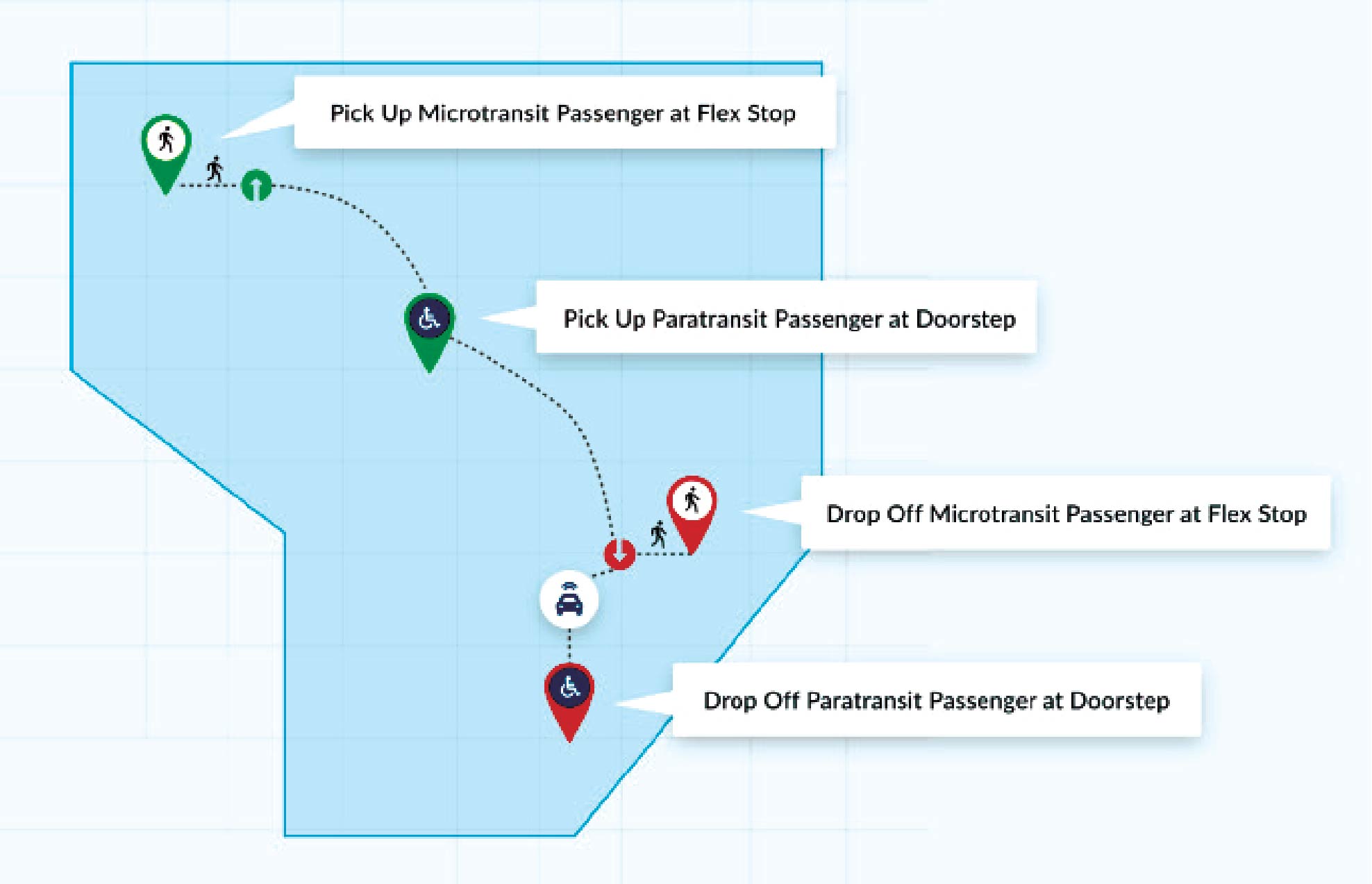
Long Description.
The map shows a route for a commingled trip with four location points marked, each representing a different stop type. The four stop types are as follows: Pick Up Microtransit Passenger at Flex Stop; Pick Up Paratransit Passenger at Doorstep; Drop Off Microtransit Passenger at Flex Stop; and Drop Off Paratransit Passenger at Doorstep.
communication, and other accommodations that go beyond those offered to general public customers.
Demand Estimation
The NADTC (2023) recommends that in areas where ADA paratransit customers can choose microtransit service for the same trip, transit agencies should be aware of existing ADA paratransit service in the area and engage local stakeholders and organizations to ensure that the microtransit service can meet community mobility needs. Data needed to measure potential service demand, including assessment of the general public market to be serviced and estimated level of trip demand, may be available from the U.S. Census Bureau data or other local sources (Gerty et al., 2011).
Fleet Assignments
Transit providers with mixed fleets (WAV and non-WAV) in an integrated or consolidated design will program the software platform to match passengers using a mobility device exclusively to WAVs. With eBus OnDemand in Stoke, New Zealand, passengers using a wheelchair or with a disability are commingled with general public trips and matched to a fully accessible vehicle, implying a fleet mixture of WAVs and non-WAVs (eBus, 2024). In concert with this policy, if there is a difference between fleets specific to different types or levels of driver training, a transit agency may want to configure these aspects into the matching algorithms in the software platform(s). Similarly, seating capacity of vehicles can be a decision point for assignment of paratransit trips with a mobility device.
Some microtransit software platforms will actively reassign commingled trips between vehicles in the fleet and supplemental non-dedicated service providers, if applicable (discussed later in this chapter) based on routing and fleet utilization efficiencies that are actively discovered (typically through software CDO). This can result in a trip originally assigned to one vehicle being moved to another before the customer pick-up occurs. For commingling trips with customers using a mobility device, the trip assignment to a WAV with an available wheelchair securement spot may be critical. In these instances, the software will often prioritize the paratransit trip in the initial vehicle assignment and move the general public trip to another vehicle (Eisler, n.d.).
Automation Versus Manual Interventions
Service delivery aspects that are important in ADA paratransit compliance for schedule development are often available as settings in the microtransit software platform. These variables include maximum onboard time for the passenger, meaning additional time that can be added to a trip on top of the most direct route. These time settings can vary based on time of day or relative to a maximum time cap allowable (Eisler, n.d.).
Transit agencies with integrated or consolidated services with microtransit can choose to take different approaches in whether or not staff will check and review commingling assignments done automatically by the software. Additionally, transit agencies may want to have dispatchers or reservationists manually group certain passengers together or modify driver assignments to serve specific customers or groups (Eisler, n.d.), especially with respect to subscription trips.
Dwell/Waiting Times
Transit agencies can adjust settings in the microtransit software platform to allow additional dwell/waiting time in the scheduled vehicle stop for customers that need additional time in boarding or alighting (NADTC, 2023). Additional time can be allocated by the software platform automatically or on a per-trip basis, depending on the customer profile or type of trip. Common examples of situations where additional time is programmed include trips where customers use a mobility device or live in residences with stairs or elevators.
Smartphone Apps and Online Portals
Many transit agencies have offered an online web portal option for ADA paratransit trip reservations since before the emergence of microtransit service technology. Online portals are advantageous for transit agencies as they free up staff time spent on the phone with customers (who may not only be requesting, confirming, or cancelling trips but also checking on arrival time on the day of service). Customers typically can use online portals to make new or manage existing trip reservations and edit personal profile information. Some web portals allow users to track the vehicle dispatched to serve their trip on the day of service or to set up push notifications, similar to a smartphone app (Maryland Transit Administration, 2024).
Technologies that accommodate integrated or consolidated services have features in their customer-facing platforms (both smartphone apps and online web portals) that allow the customer to input information on the accommodations they need, either in general or for a particular trip. Types of accommodations noted may include use of a mobility device (such as a wheelchair or walker), accompaniment by personal care attendants (PCAs) or companions, and level of driver assistance requested (Spare Labs, 2023). The software platform can then use these inputs to program additional waiting time upon vehicle arrival based on the customerʼs accommodation needs. This approach requires active engagement from the rider rather than passive acceptance of default settings.
Driver Training
Agencies with integrated or consolidated services must have ADA paratransit–certified drivers available to serve ADA paratransit trips. Drivers for these agencies must therefore become certified for ADA paratransit through cross-training and participate in approved drug and alcohol testing programs (Rodman, 2022). Drivers must be able to assist riders with disabilities, both where the disability is more apparent (e.g., a visual disability or an ambulatory disability where the customer uses a mobility device) and where the disability is hidden or “invisible” (e.g., an auditory or cognitive disability) (NADTC, 2023; VDRPT, 2023). Cross-training may be moot if the transit agency chooses to transition ADA paratransit drivers to become the microtransit drivers in the integrated or consolidated service.
Training for drivers, dispatchers, and reservationists on the tablet or smartphone application technologies can make for a difficult transition from previous paratransit scheduling software. Drivers tend to prefer transparency of information in the tablets or applications they use in order to gain trust in the software (Friesen, 2021).
Staff Acceptance
Driver and dispatcher acceptance of new CDO applications in microtransit technologies as applied to ADA paratransit service or integrated or consolidated services can prove to be a challenge. Dispatchers may be skeptical of the technology because they “know better,” while drivers may not be used to changes to their manifests (especially if they have been dependent on paper manifests). However, transit managers who have acquired CDO technology for their ADA paratransit services (if not consolidated services) report that the improvements in productivity and OTP outweigh the challenges. Moreover, in many cases managers have been able to reduce the number ADA paratransit schedulers and some dispatchers or provide them with new assignments because of CDO functionalities in the software platform (Rodman and Blume, 2023).
Communication and Customer Education
A benefit for paratransit riders using the smartphone app to arrange for their ride is the ability to track the location of their assigned vehicle and see the route they will travel to get to their destination (Simaiakis, 2020), a feature that can be enabled by the agency through software settings. The timing of the notifications for imminent vehicle arrivals can also be adjusted in the settings (e.g., the notification can be sent 3 minutes ahead of time instead of 1) (NADTC, 2023). Having training programs and instructional materials on how to use microtransit service can also make commingling an easier process for transit customers with disabilities (NADTC, 2023).
Current Prevalence and Practices
This section discusses information in available literature on trends in commingling paratransit and general public trips in microtransit for different service contexts. Prior to the arrival of microtransit technology, TCRP Report 143ʼs survey to agencies commingling demand response trips in 2011 (prior to the arrival of microtransit) found that respondents commingled trips in the same vehicles for non-sponsored riders with disabilities (57 percent), other agency-funded trips (57 percent), and/or general public riders (54 percent) (Gerty et al., 2011).
Geographic Settings
Commingling in microtransit has more prevalently occurred at medium- or smaller-sized transit agencies or municipal transit departments rather than at larger metropolitan transit authorities. In fact, the research team did not discover an example of a larger agency that was integrating or consolidating ADA paratransit with general public microtransit service at the time of this synthesis research.
There have been examples, however, of larger transit agencies with coordinated services. As a coordinated response to Section 504 of the Rehabilitation Act of 1973 (which required transit agencies to either retrofit these bus fleets with lifts or implement paratransit services), several transit agencies implemented paratransit services and many of these chose to implement coordinated services to improve service and cost efficiency. For example, the Port Authority of Allegheny Countyʼs ACCESS brokerage in Pittsburgh, Pennsylvania, was implemented as a coordinated and consolidated approach to serving paratransit trips, trips for older adults, human service agency trips, and even (a comparatively few) general public trips in a commingled fashion. This service was launched in March of 1979, well before the ADA became law. Examples of coordinated services commingling ADA paratransit riders with general public riders in dial-a-ride service include Pace (Chicago, IL), Ottumwa Transit Authority (Iowa), and Modoc County (California) (Gerty et al., 2011).
Prior to microtransitʼs arrival, smaller transit agencies had also been more likely to commingle demand-responsive trips due to larger service areas to cover, lower population densities, and/or scarcity of local resources to provide transit service (Gerty et al., 2011). County councils have also historically turned to commingling and coordinated approaches in transit service to reduce overall costs using the fixed financial investment of vehicles and administration already in place (Davison et al., 2014). Internationally, Denmark has an example of a coordinated demand response service to commingle rides together with hundreds of private providers and a transactional data standard (Lynott, 2020).
Scheduling Order
A strategy employed by many transit agencies commingling paratransit and general public trips in an integrated or consolidated service is to use the prescheduled paratransit trips as the “base trips” for available vehicles, then scheduling general public trips that are requested on the day of service to fill in any remaining capacity. The software platform creates an optimized schedule using the pre-booked paratransit trips, then adds on-demand trips to other available seats in the vehicles while creating dynamic routes with the service parameters for both (Via Transportation, 2023). In essence, the commingling of trips in DRT service is primarily used for ADA paratransit trips, while general public riders are added to empty seats within the same vehicles (Gerty et al., 2011). This helps ensure that paratransit trips are completed on time according to confirmed schedules without disruptions from other added trips (Via Transportation, 2021). Microtransit software companies state that their software platforms can handle these considerations while aiming for maximum capacity utilized by available vehicles (RideCo, 2024a). Scheduling staff and dispatchers may need to reserve seating capacity to handle requests from ADA paratransit customers for “go-back” or “will-call” trips for return travel from an appointment where the end time is uncertain (the customer calls when they are ready for pick-up) to provide these commingled customers the same scheduling priority.
System Capacity
For some integrated or consolidated service designs, the breadth of available travel designations in the microtransit service zones may result in growth in service demand that strains
system capacity beyond the available vehicles and drivers dedicated to the service. This generally occurs with larger microtransit service zones (such as citywide), places where transit service was not previously available, or places where the microtransit zone overlaps with a fixed-route system. In these situations, transit agencies struggling to meet overall service demand must deny trips to general public customers in order to ensure priority for paratransit trips (and ADA paratransit compliance, if applicable) (Gerty et al., 2011).
Same-Day Paratransit
Most transit agencies do not allow ADA paratransit customers to book paratransit trips on the same day, with the exception of go-back or will-call trips for return travel from an appointment; will-call trips are also used by transit agencies as a response to reemerging no-show trips (i.e., recurring instances of no-shows for the same planned return trip). Integrating or consolidating ADA paratransit service with microtransit provides a capability for increased flexibility in booking paratransit trips on the same day. Hampton Road Transit (Virginia), The Rapid (Grand Rapids, Michigan), and High Valley Transit (Utah) did introduce the capability for on-demand trips to be booked by customers in addition to prescheduled trips in their ADA paratransit service (Simaiakis, 2020; Rodman and Blume, 2023).
Even with these technology capabilities, many transit agencies choose to require advance bookings in response to concerns of increased demand and limited available capacity (Dwyer, 2024). Some agencies will allow paratransit trips to be booked on the same day only if available capacity is present, i.e., on a space-available basis only. ADA paratransit–eligible customers can still book a microtransit trip on the day of service in these instances, so long as the general public service parameters apply and the trip origin and destination are within the microtransit service area and hours.
Data Tracking
Technology platforms that support integrated or consolidated ADA paratransit and microtransit services typically have a single profile for each rider that includes information on the transit services they are eligible to use and any specialized accommodations as determined by the transit agency (Spare Labs, 2023). For example, a rider profile for an ADA paratransit customer would indicate their eligibility for ADA paratransit as well as for the microtransit service zone. If the trip may be taken as an ADA paratransit trip or a microtransit trip, the app can be programmed to automatically make the determination based on when the booking is made (along with the fare rate and other determinants), or the app or call-taker will prompt the customer to make that decision. In some cases, separate phone lines distinguish the type of service being requested.
If the transit agency and/or service provider are not able to accurately capture passenger miles and hours information for different types of commingled trips, this could lead to issues in allocating costs between different sponsored programs depending on the associated funding sources involved in the integrated or consolidated service design (Gerty et al., 2011). Thus, it is important that the software platform can be configured to allocate trips, estimate revenue vehicle hours and miles, and track other statistics on types of trips and vehicles (both dedicated and non-dedicated); this includes statistics by supporting funding source for the trip. Separately, the agency needs to collect accurate metrics on expenses, cost efficiency, and cost effectiveness for the sponsoring municipalities or human service agencies that fund the service.
Consistency in Policies
Transit agencies may also consider applying some ADA paratransit service standards to other riders (e.g., pick-up windows) in order to make operating policies and procedures consistent for staff (Gerty et al., 2011). Additionally, applying higher service standards and accommodations
across different trip types in microtransit service subsequently raises the level of service for customers. Planning in commingling passengers from different sponsored and coordinated programs can help clarify which service parameters and levels of assistance are pertinent to which types of similar customers that are similar to each other (Lyons and vanderWilden, 2022).
Dedicated Contractors and Non-Dedicated Service Providers
Transit agencies may choose to use a combination of dedicated service contractors and non-dedicated service providers as part of an integrated or consolidated service design; some contractors (in particular, taxicab companies) can provide both dedicated and non-dedicated service (Nelson\Nygaard Consulting Associates, 2007). Dedicated service contractors may perform all day-to-day operations functions in a turnkey approach or fulfill some other allocation of roles and responsibilities. The transit agency can also have in-house dedicated service provision supplemented by dedicated and/or non-dedicated service capacity from the contractor; another possibility is that a contractor operating dedicated service may subcontract with a non-dedicated service provider.
Transit agencies (or their dedicated fleet operations contractor) can broker certain trips to non-dedicated service providers or their drivers that will adversely impact the productivity of the dedicated fleet. Examples of these trips include peak overflow trips, trips in low-demand areas or times, long or out-of-the-way single trips that are not ride-sharable, will-call return trips, reemerging no-show trips, and trips not completed because of accidents or incidents. Non-dedicated service providers can also help transit agencies overcome driver shortage issues for staffing the dedicated fleet, provided that non-dedicated service providers have ample numbers of drivers on the road during service times (Dhanani, 2022). From the customer perspective, the use of non-dedicated service providers for microtransit service can potentially lower wait and travel times and help with driver shortages (Hansen, 2022; Rodman, 2022). Trip brokering and working with different sets of providers is made possible through application programming interface (API) linkages between the software platforms used by the different providers involved (Mey, 2022), or through concierge links (which allow a person to book a trip on behalf of a customer) with the non-dedicated service providerʼs technology.
Link Transit (Wenatachee, WA) contracts with two local social service agencies to provide non-dedicated overflow service to their dedicated microtransit program and for ADA paratransit service during evening hours. The transit agency found that utilizing non-dedicated service in these manners reduced the operational cost per trip overall for their demand response program (Rodman, 2022).
Multiple Transit Systems
Microtransit technology platforms can also be used to incorporate fleets, drivers, and trip requests from multiple transit agencies into a shared platform. Accurate data tracking of agency resources and rider types is for ensuring that each transit agency partner can meet regulatory and compliance requirements. Tahoe Truckee Area Regional Transit currently has agreements in place with two other local transit systems to share a software platform for microtransit service which provides an opportunity to commingle different types of trips between agencies, including (as the software company purports, should agencies pursue the option) ADA paratransit (Callaway, 2023).
Research and Reports on Practices and Effectiveness
This section of the literature review provides summaries of published or publicly available information on effectiveness of commingling paratransit and general public trips together in microtransit. The study team did not find many examples of published results on service performance,
but those that were available are included along with publicly available observations on qualitative results from transit agencies.
Service Strategies of Agencies
Mountain Line in Flagstaff, Arizona, first implemented their microtransit software platform to service only ADA paratransit trips, then began piloting a general public service two months later in a limited zone within the paratransit service area (Spare Labs, 2023). High Valley Transit (Utah) similarly phased in commingled trips in their service design after procuring a microtransit software platform; the agency did not commingle ADA paratransit and general public trips for the first six months of implementation, then commingled trips together once both sets of customer groups were used to the service (Rodman and Blume, 2023).
Some transit agencies, particularly larger metropolitan transit authorities, have chosen to acquire the microtransit software program first and use it exclusively for general public or ADA paratransit service; this allows them to see how the platform works for the first service and iron out any service issues while leaving the possibility for implementing commingling trips in the future (Mass Transit, 2023).
Golden Empire Transit District (Bakersfield, California) chose to have a single smartphone app for both general public and paratransit customers; the agencyʼs motivation was to focus staff training and simplify service messaging and branding for both customers and staff, enabling just one brand of service to be shown on the vehicles (Williams, 2022).
Fairfield Transit (California) eliminated 3 fixed routes and implemented 2 microtransit zones in their place, covering 40 square miles, while commingling trips in their service design. The agency structured fares at $2 for general public riders and $1 for older adults, persons with disabilities, and riders eligible for medical transportation (The Routing Company, 2023a).
The Town of Cobourg in Ontario, Canada, piloted commingled trips from their general public microtransit and paratransit services. The initial pilot design used 3 smaller 8-meter (approximately 26-foot) buses instead of larger conventional buses due to the inability of larger vehicles to access some streets within the service area; serving these neighborhood streets with curb-to-curb service was critical for their paratransit program. The smaller buses were equipped with low-floor ramps (Wills and Champagne, 2022).
Cost Reductions and Service Efficiencies
The City of St. Thomas in Ontario, Canada, found that commingling paratransit trips in their on-demand service, in concert with a comprehensive fixed-route network redesign, nearly doubled service ridership and increased overall service utilization by close to 70 percent (Via Transportation, 2021).
During a one-year microtransit pilot program, the Town of Cobourg in Ontario, Canada, found that service productivity reached 2.9 passengers per vehicle hour in their initial pilot month followed by 4.0 trips per vehicle hour in the second month; both marks were higher than previously measured productivity for paratransit service alone (prior to the microtransit pilot) at 1.53 trips per vehicle hour (Wills and Champagne, 2022). The town also saw their trip cost per passenger (compared to before the implementation) decrease by 7 percent, down from $22.30 to $20.70 (RideCo, 2022).
StarTran (Lincoln, Nebraska) launched a microtransit service with commingling following a reduction of their fixed-route service. The agency reported improved productivity from 1.5 to 2.0 passengers per revenue hour in their ADA paratransit program up to 4.0 passengers per hour
for their microtransit service with commingled trips. Concurrently the agency reported reductions in the number of dedicated vehicles on the road (by 3 total) and the number of staff hours (40 fewer hours) for vehicle operators per week (Spare Labs, 2024a).
High Valley Transit (Utah) found that commingling ADA paratransit and general public trips together in microtransit improved overall service productivity by 150 percent (Rodman and Blume, 2023).
Fairfield Transit (California) launched a microtransit service with commingling while eliminating unproductive fixed routes. The agency reported that ridership for demand-responsive services doubled after the commingling of ADA paratransit trips with microtransit trips was implemented (The Routing Company, 2024).
Customer Feedback and Service Rankings
The Town of Cobourg found the average customer rating of rides to be 4.74 (out of 5) during the first two months of their microtransit pilot with commingling. Additionally, the town measured the percentage of failed ride searches (defined as the number of instances when a customer could not get the trip reservation they wanted) at 6% during the same time period (Wills and Champagne, 2022). During the initial pilot, 82% of trips were booked in advance (including paratransit and general public trips) compared to on-demand (RideCo, 2022).


