Operational and Service Factors When Integrating or Consolidating ADA Paratransit and On-Demand Services (2025)
Chapter: 4 Case Examples

CHAPTER 4
Case Examples
This chapter provides in-depth information on case examples at transit agencies and cities implementing commingling of paratransit and general public trips in their own microtransit services. The study team analyzed the survey questionnaire results and determined priority candidates of interest for case examples based on a variety of criteria, including unique or distinct practices in the service design, types of demand response programs and commingled trips, geographic region and agency size differences, and representation of services using software platforms by different microtransit technology partners.
The study team completed five case examples, which are included in this chapter. The organizations that agreed to participate represent one metropolitan transit authority, one large urban transit district, and three municipal governments. The study team conducted guided semi-structured interviews with agency staff members to gather further information beyond the survey responses previously provided. Each case example includes the following sections: demand response services overview, service design and parameters, booking and communication, commingling processes, customer considerations and accommodations, fleet mixture and dispatching, benefits and impacts, and a summary of key takeaways.
The case example organizations and their locations are as follows:
- Airdrie Transit (City of Airdrie), Airdrie, AB
- Town of Great Barrington, Great Barrington, MA
- Butler County Regional Transit Authority, Hamilton, OH
- Tri-County Metropolitan Transportation District (TriMet), Portland, OR
- Citibus (City of Lubbock), Lubbock, TX
Airdrie Transit, City of Airdrie, Alberta

Long Description.
The logo shows an illustration of an oval structure with a body of water in the foreground and a hilly structure in the background. The text reads, 'City of Airdrie: Community and Opportunity.'
The City of Airdrie is located in Alberta, Canada, north of Calgary, and is part of the Calgary metropolitan area. Originally established as a village in 1909, Airdrie was formed as a town in 1974 before becoming a city in 1985 (Alberta Government, 2024; City of Airdrie, 2024e). Airdrie is governed by the 7 members of the Airdrie City Council, including the mayor as the chief elected official (City of Airdrie, 2024f). As of 2021, Airdrie had a population of 74,100 and land area of 33.22 square miles (Statistics Canada, 2022).
Airdrie Transit is a department within the city consisting of 4 staff members. Airdrie Transit has the following transit services available to customers (City of Airdrie, 2024h):
- Intercity Express (ICE) service with 3 routes connecting Airdrie to Calgary
- Local bus service consisting of 2 routes within Airdrie
- Hello-to-Go on-demand microtransit service
- Access Airdrie paratransit service
The City of Airdrie was selected as a case example agency due to their service design and policy-setting approaches for paratransit and general public trips in commingling, including decision making based on destination for trips dispatched to a non-dedicated service provider. The service also offers paratransit on a discretionary basis rather than by legal requirement, and thus provides an example of the cityʼs considerations and reasoning in providing customer accommodations and assistance for persons with disabilities.
Demand Response Services Overview
Airdrie Transitʼs demand response services are integrated using the same software platform, same service contractor, and same driver for most trips; the exception is for specialized medical appointment trips, which are served by a non-dedicated service provider. Airdrie Transit staff handle administration of the programs and call center/reservationist functions in demand response operations. PW Transit has been the contracted provider of local paratransit and general public demand response services as well as fixed-route service for the city since 2017, handling scheduling of drivers, dispatching, vehicle maintenance, and vehicle operations functions. The RideCo software platform has been used for all demand response trips since 2022, first as a soft launch in May and then fully implemented by July. The contractor brought their experience in using the software platform in other cities as a solution to Airdrieʼs previous paper-based scheduling process. In-house reservations staff received training on using the scheduling software.
The City of Airdrie is not subject to any legal requirements to provide paratransit service, as neither the Canadian federal government nor Alberta provincial government has legislation in place requiring such service. Instead, paratransit service in many Canadian cities, including Airdrie, is at the discretion of the municipal government on whether to fund the service and what level of service accessibility to provide. In practice, this can lead to confusion for new residents or visitors needing to use the local paratransit service, due to differing paratransit service policies between different cities.
Access Airdrie
The City of Airdrie has provided paratransit service since the 1990s. Most of the cityʼs demand response services were commingled at that point, operated through the dial-a-ride service model. Today, the paratransit service, known as Access Airdrie, consists of 2 different services: (1) local trips within the city limits and (2) trips to the City of Calgary for specialized medical appointments (City of Airdrie, 2024a). Local trip provision in the city has been consistent since service inception, while the policies for specialized medical appointments have changed over the years. Access Airdrie operates 7 days a week within the Airdrie city limits (Airdrie Transit, 2022).
Access Airdrie services are for paratransit-eligible customers only, providing shared-ride curb-to-curb service for both local city trips and medical appointment trips to Calgary. Residents interested in paratransit eligibility must complete an application and submit it to the city; the application indicates reasons for needing paratransit service and must be signed by both the applicant and a healthcare professional. Customers can apply for paratransit eligibility with input from doctors as well as nurses, therapists, or social workers who can certify their disability. Airdrie Transit staff reviews applications received and conducts interviews with the applicant to clarify any questions. Airdrie Transit bases eligibility for Access Airdrie service on the applicantʼs physical and/or cognitive ability to use the fixed-route service (Airdrie Transit, 2022). Roughly 95% of
applicants receive eligibility for paratransit service; the city asks applicants to allow up to 2 weeks for processing to be completed (Airdrie Transit, 2022).
As mentioned, specialized medical appointment trips to Calgary are available to customers eligible for Access Airdrie service. Before 2016, trips to Calgary were only available 2 days per week; the agency then opened up criteria to allow travel to Calgary Monday through Friday (Airdrie Transit, 2022). For specialized medical trips, the city takes the destination address of the trip from the customer and checks to see that it reconciles with the address of a medical facility; most of the time the addresses are correct, and the agency has not had issues with this verification system. Trips to Calgary are dispatched to a non-dedicated service provider (Checker Cab) which has wheelchair-accessible vans and operators trained to work with persons with disabilities; putting these trips into Checker Cab vehicles helps keep the service for trips local in Airdrie more efficient. Access Airdrie customers can book no more than 2 specialized medical appointment trips per month (Airdrie Transit, 2022). Trips can only be scheduled for travel between 8:00 a.m. and 6:00 p.m. on weekdays (City of Airdrie, 2024a).
Hello-to-Go
Source: Apple, 2024.
Long Description.
The logo includes a stylized version of the phrase ‘hellotogo’ with a smiley emoticon followed by the phrase ‘airdrie transit’.
Hello-to-Go is the name of Airdrieʼs on-demand microtransit service, available since 2022 to the general public for trips within city limits. The city previously launched an on-demand service in 2017 but abandoned it due to the technology not meeting service demand needs. With the implementation of Hello-to-Go, Airdrie Transit aimed to cut 2,300 service hours for fixed-route service in order to save $140,000 (Canadian dollars) annually that could be applied toward microtransit service (Pike, 2022).
During Hello-to-Goʼs soft launch period, trip reservations for local paratransit trips made over the phone were entered into the software platform as proof of concept. After 2 months the city made the decision to expand the platform use to include general public trips and to commingle the two trip types together; at this point, the serviceʼs smartphone app was also implemented and made operational for customers to use in trip planning and booking. The contractor, rather than the city, has a contractual agreement with the software platform. By placing the technology requirements for the service on the contractor, the city eliminates the need to go through the procurement process and expedites the implementation of the platform.
Service Design and Parameters
The cityʼs motivations for commingling trips together in demand response service are to decrease operating costs and improve cost efficiency and cost effectiveness, increase service capacity for paratransit trips, and provide enhanced technology tools to access service for paratransit customers. The city also looks at microtransit as an opportunity to better understand the transportation needs of customers through the study of service demand data generated. Goals for the on-demand model included offering transit service on Sundays, attracting new customers to transit service, giving Access Airdrie customers more service, and providing guaranteed arrival times for trips (Pike, 2022).
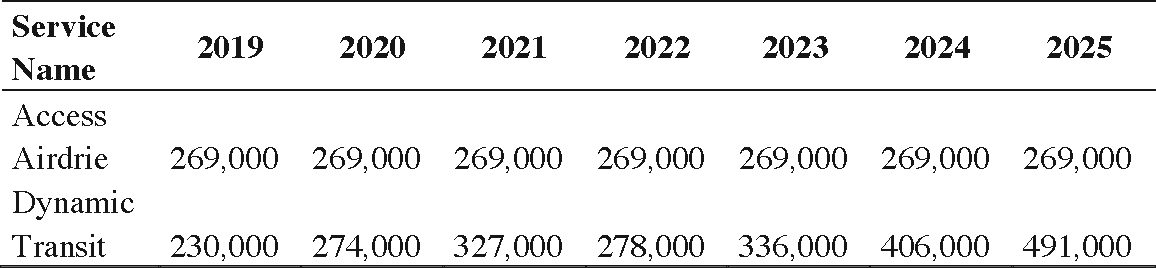
The cityʼs 2020 Transportation Master Plan update includes the following recommendations concerning demand response service in the city; paratransit service is noted as Access Airdrie, while on-demand microtransit service is noted as “dynamic transit” (City of Airdrie, 2020):
- Confirm specifications for Dynamic Transit
- Enter into discussions with service provider for Dynamic Transit service
- Acquire Dynamic Transit software and identify service provider
- Add an additional local fixed route on 24th Street to service new development, replacing existing Dynamic Transit service in this area
- Expected operational costs and capital costs noted in Table 2
The cityʼs intent in bringing in the software platform was always to have microtransit technology available for both local paratransit and general public demand response trips. The technology was tested with paratransit service first during the soft launch period because of paratransitʼs more challenging service parameters. The service area for Access Airdrie is citywide and includes some areas with rural, lower-density development where there is still a high service need from paratransit customers.
During the COVID-19 pandemic, the city suspended fixed-route service and completely shifted to dial-a-ride service; transit service was not used much during this time. The city began reintroducing fixed-route service in later 2021 and early 2022, but service levels on these routes are still not back to where they were in 2019. The city also started Hello-to-Go microtransit service as a way to reintroduce services impacted by the pandemic and help attract customers back to transit. The city has seen substantial population growth in the last several years, but most of the cityʼs new residents are outside of the fixed-route service footprint. Commingled trips in microtransit are seen as a way to sustainably introduce transit service in these lower density areas of the city.
Service Availability
The service zones for general public Hello-to-Go trips and Access Airdrie trips within the city partially overlap, with the general public zone being confined to fixed virtual stops in the software platform. The service hours for both types of trips are the same: Monday through Friday, service is operated 6:00 a.m.–11:00 p.m.; Saturdays, 7:00 a.m.–11:00 p.m.; and Sundays, 8:00 a.m.–6:00 p.m. (City of Airdrie, 2024a).
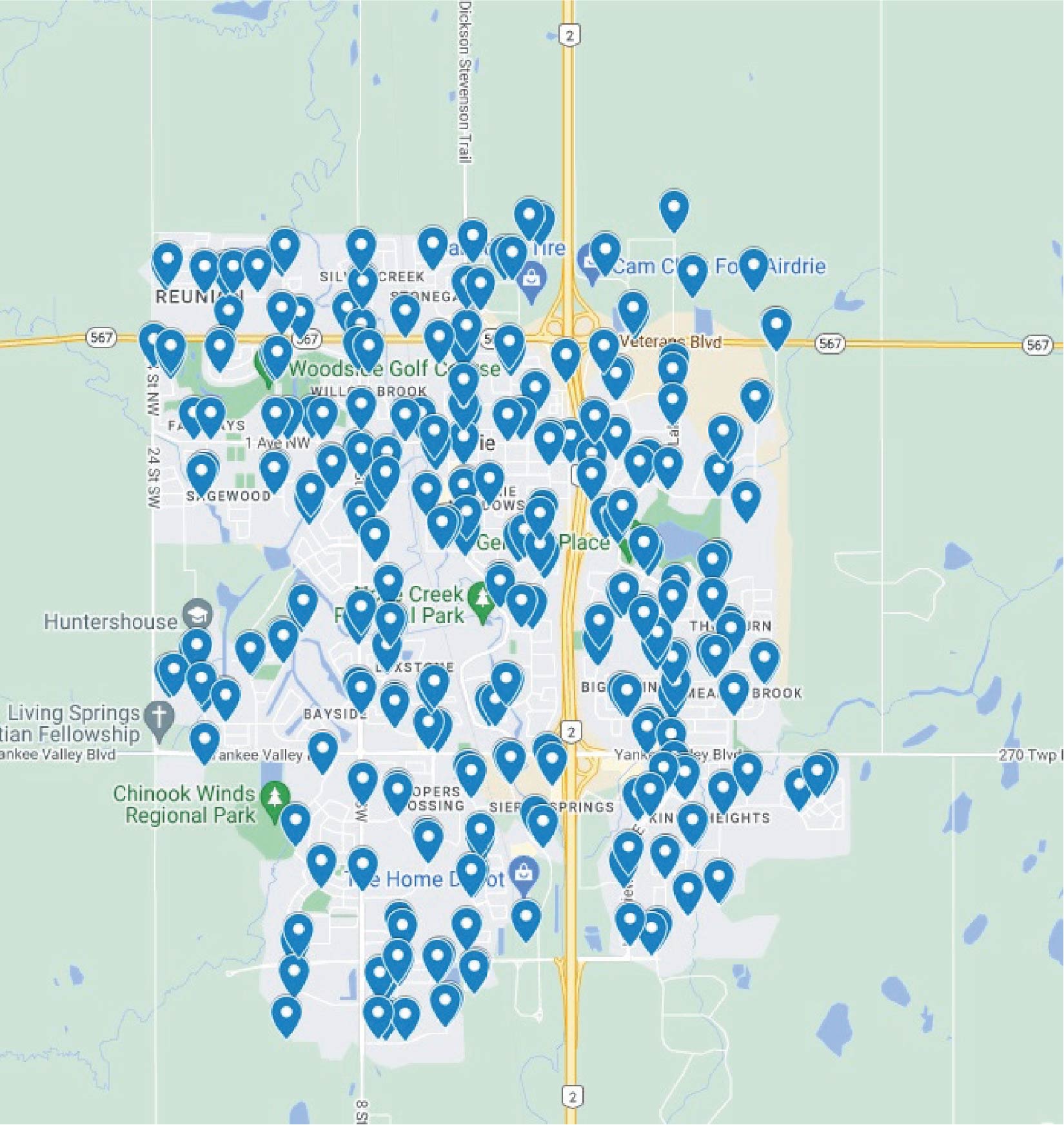
Hello-to-Go is designed to use a combination of traditional bus stops (with signposts) and virtual bus stops for general public pick-ups and drop-offs. The virtual bus stops are pre-defined by the city at designated locations rather than created in real time by the software platform; some of these virtual stops are defined by good locations in master-planned communities, while others may have a bus stop pad already in anticipation of being a future fixed-route stop. The map of available virtual stops for Hello-to-Go is publicly available on Airdrie Transitʼs website (see Figure 12). The city looks for location for virtual stops that have good lighting and safety elements for riders (City of Airdrie, 2024h). The city manages the implementation of new stops on an annual basis, proactively working in tandem with the acceptance of new developments and anticipating new roads to become owned by the city.
In the Hello-to-Go smartphone app, customers booking a general public trip enter their desired pick-up and drop-off locations along with the pick-up time. The app then provides the
Source: Adapted from City of Airdrie, 2020.
Long Description.
The column headers of the table are Service Name, 2019, 2020, 2021, 2022, 2023, 2024, 2025. The data given in the table row-wise are as follows: Row 1: Access Airdrie: 269,000; 269,000; 269,000; 269,000; 269,000; 69,000 dollars; 269,000. Row 2: Dynamic Transit: 230,000; 274,000; 327,000; 278,000; 336,000; 406,000; 491,000.
Long Description.
The map shows the locations of the virtual stops in the Hello-to-Go transit system; each location is shown by a pin on a map of the area. Some of the locations marked on the map include Hunter's House, Chinook Winds Regional Park, Bayside, Veterans Boulevard, and Woodside Gold Course.
customer with the estimated pick-up time and virtual stop location (City of Airdrie, 2024h). Information on the Hello-to-Go service explicitly states that pick-up and drop-off locations may be traditional bus stops with a sign posted or virtual stop with no markings present (City of Airdrie, 2024h). When booking either type of trip, customers are given a 15-minute pick-up window during which they are expected to be available for pick-up (Airdrie Transit, 2022). The same information is provided by the Airdrie Transit reservationist staff for trip requests that are taken over the phone.
Paratransit Parameters
Access Airdrie customers receive door-to-door service based on their eligibility for paratransit service. The hours of service on Hello-to-Go are consistent with the hours for local paratransit and general public trips. Previously, paratransit service availability ended before general public service hours; the city heard feedback from customers (both over the phone with city staff and from survey responses) and determined that additional service hours and service on Sundays were needed for paratransit customers.
Booking and Communication
Access Airdrie customers can book paratransit trips by either calling in to Airdrie Transit, using the available smartphone app, or the using the comparable online web portal. All three options can be used for trip modifications and cancellations as well as for scheduling standing-order (i.e., subscription) trips. General public customers also have the same three options for booking trips, though reservations over the phone are limited to the hours of 8:30 a.m. to 4:30 p.m., Monday through Friday. General public customers can book trips up to 7 days in advance (City of Airdrie, 2024h).
Smartphone App
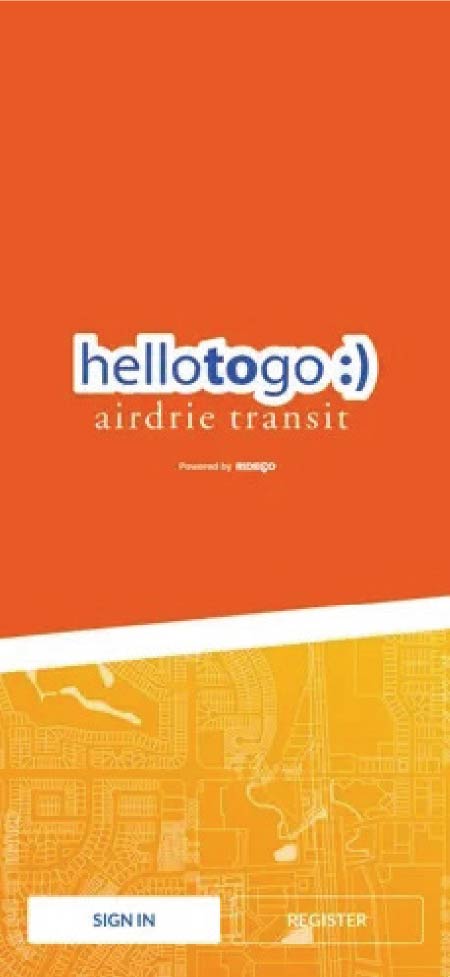
The Hello-to-Go smartphone app (see Figure 13) is provided as a generic “white label” app by the software platform company for customization and branding by the transit agency. The Airdrie Transit version of the app can be used for scheduling either a general public or local paratransit trip. The ability to schedule a paratransit trip is based on eligibility in the userʼs profile. Customers will receive notifications about their trips through the app, including imminent vehicle arrival notifications.
Long Description.
The home screen of the application shows the logo of the hellotogo service of airdrie transit on an orange background. The bottom of the page shows two options, Sign in and Register.
For paratransit customers, enabling booking of paratransit trips in this app is easier if the paratransit customer has the city set up the user profile for them before downloading the app. Any profiles created by users after the app has been downloaded are general public customer profiles, ineligible for curb-to-curb trips by default. The city must then work with the software platform provider on the backend to add eligibility for paratransit to the profile, which typically takes 24 hours or less. Customers will typically call the city when they are having an issue with using the app.
Paratransit Scheduling
Access Airdrie trips can be scheduled up to 30 days in advance; customers scheduling trips provide their address information, whether they are traveling with a personal care attendant (PCA) or companion, and what type of mobility device they will be using (if applicable). Call-in trip reservations can be made Mondays-Fridays 8:30 a.m.–4:30 p.m. (Airdrie Transit, 2022). Both the originally confirmed trip times and modifications to those times are sent to customers through smartphone app notifications and/or text messages.
The agency recommends that customers book trips at least 24 hours in advance to ensure available capacity (Airdrie Transit, 2022). Schedule requests can be made for same-day paratransit trips, but not for immediate, on-demand fulfillment. Generally, same-day requests for paratransit trips are more difficult to fulfill due to heavy usage of the Hello-to-Go service by general public customers. Sometimes the city will send out supplemental services to accommodate trips for paratransit users; these could include a supervisor in a vehicle or a contracted taxi provider.
Trip Modifications
The software platform will automatically send notifications for general public trips in cases when the platform is attempting to adjust the confirmed pick-up window significantly. If the customerʼs revised pick-up time is outside the allowable window, the customer will receive a notification through the smartphone app and/or a text message about the change. The service parameters allow for 45 minutes of potential change on either side of the originally confirmed 15-minute pick-up window. For Access Airdrie customers, staff will also sometimes call customers by phone to confirm schedule changes.
Customers are directed to make trip cancellations at least 1 hour before their scheduled pick-up time. Airdrie Transit will access a fee according to the fare rate for the trip if a late cancellation
occurs; the city may also decide to review booking privileges for the customer if staff observe an excessive number of late cancellations and no-shows. The following scenarios are considered late cancellations (Airdrie Transit, 2022):
- Clients who cancel with less than 1 hour notice
- Clients who are not ready or present when the vehicle arrives
- Clients who cancel their trip with the driver at the door
Fare Payment
Hello-to-Go service (including local Access Airdrie trips) accepts multiple forms of payment for trip fares including cash, tickets, monthly passes, online payments, and electronic fares (Airdrie Transit, 2022). Fare rates for both are set at $2.90 per trip, consistent with local fixed-route service; children under the age of 6 can ride the service for free when accompanied by a fare-paying guardian. Ticket books and monthly passes can be purchased in person at Airdrie City Hall and three local grocery/retail stores (some with multiple locations) (City of Airdrie, 2024g). Monthly pass rates are $67.50 for adults, $48.75 for children and students, and $43.15 for older adults. Cash fares are paid by the rider at the time of boarding into the on-board farebox; change is not provided by the driver. Tickets are inserted into the same farebox; a ticket book with 10 tickets costs $23.60. Monthly passes are shown to the driver at the time of boarding.
The mobile payment system is through the HotSpot smartphone app, where customers can purchase tickets or monthly passes (City of Airdrie, 2024g); this system is separate from the Hello-to-Go booking app as the two are not integrated. Mobile and online fare payments are shown from the smartphone app to the driver at the time of boarding; the driver then marks the customer as paid on their on-board tablet. If a customer uses mobile fare payment, they will show the driver confirmation of the fare payment on the app as they board the vehicle; then the driver will mark the customer as paid in their on-board tablet.
Specialized medical appointment trips to Calgary cost $30.00 for each one-way trip (City of Airdrie, 2024a). Customers traveling for these trips are not required to pay the driver at the time of boarding; they are sent an invoice by mail after the date of travel (Airdrie Transit, 2022).
Fair Access Program
The city has been a longtime adopter of making transit service affordable for residents. The city worked with a social planning group to develop and implement Airdrie Fair Access (AFA), an income-based subsidy program that provides a sliding scale of transit fare rates (City of Airdrie, 2024d). The application is unified for all city services that adopt this program.
Qualified applicants for the AFA program must be residents of Airdrie and have a household income that is within 25% of the low-income rate as defined by the Statistics Canada federal agency. Applicants provide proof of residency and income criteria as part of their application. The AFA program has 3 defined discount levels based on a combination of household income and the number of adult members in the household; Level A offers residents who qualify a 75% discount; Level B, a 50% discount; and Level C, a 25% discount (City of Airdrie, 2024d).
Applications for the AFA program are processed by the Community Links department of the City of Airdrie, who determines qualification and contacts the applicant about the decision. There are several available documentation options to prove household income level and/or eligibility approved by another government agency (City of Airdrie, 2024c). If qualified, the resident is issued an AFA card as proof of their benefit; the card is either mailed to the resident or can be picked up in person. Approval lasts for one year, after which residents must reapply to prove qualification (City of Airdrie, 2024c).
Customers that are eligible for the lower fare rates either prepay for their trip or pay the lower fare at the time of boarding. These customers are not required to show a card or identification proving their eligibility for the lower fair, which helps remove and prevent any social awkwardness for or stigma against these riders. The city worked with the contractor to educate drivers not to question lower fare payments made by some customers. Customers with an AFA card can purchase discounted ticket books and monthly passes at city hall or Genesis Place (City of Airdrie, 2024b). The only fare payment method that customers cannot use AFA rates with is the mobile payment system; the city is working with that program to allow for customer affordability programs.
Commingling Processes
Within the software platform for Hello-to-Go service, all general public and local Access Airdrie trips are commingled and managed automatically by the software. These commingled trips are then scheduled onto dedicated vehicles operated by the contracted provider. Specialized medical appointment trips to Calgary are not commingled with other trips and are instead dispatched to the non-dedicated service provider. CDO is applied in the software platform to all commingled trips both before the service day and on the day of service itself. The optimization algorithm is based on the number of seats booked in vehicles by the trips currently scheduled. Airdrie Transit staff will not make adjustments to the commingled trips in the software with the exception of calling Access Airdrie customers about trip times that the system moves outside of the confirmed pick-up window threshold.
General public customers on Hello-to-Go can request trips up to 7 days in advance, but trips are scheduled onto vehicles on the day of service. Airdrie Transit staff observes that general public trips often fill open spots in capacity where paratransit customers have not booked. General public trip demand is typically heavier in the morning, while Paratransit service demand is typically higher during the middle of the day.
Local paratransit customers can book up to 30 days in advance, though not for immediate fulfillment of service on the same day. The Access Airdrie program offers many trips in the subscription category, which is included as part of the riderʼs profile in the software platform. If the paratransit customer does not book their trip before the day of service, they generally will not be able to travel when they want as general public trips will have filled up the available capacity.
Paratransit customers are supposed to provide information at the time of booking on the number of PCAs and/or companions that will accompany them on their trip. Operational challenges due to limited seating capacity can occur if additional undisclosed companions are present at the pick-up point when the vehicle arrives.
Customer Considerations and Accommodations
Airdrie Transit incorporates a number of special considerations for commingled paratransit trips, either automatically by the software platform or as a matter of policy. In the Hello-to-Go service, the standard waiting time for the vehicle upon arrival at the pick-up point is 1 minute for general public passengers (City of Airdrie, 2024h). For Access Airdrie service, however, the software platform automatically increases this time to 2 minutes for qualified customers. Extra wait/dwell time is provided to paratransit customers on a case-by-case basis based on conditions in the customerʼs profile. Some paratransit customers have 2 minutes to board based on their use of a mobility device, need to use an elevator, or other similar needs or accommodations that require more time.
The dedicated fleet of Hello-to-Go vehicles are all equipped with ramps for mobility devices. Customers can also travel with a pet onboard the bus during their trip; the agency directs customers to transport smaller pets in a cage or carrier (City of Airdrie, 2024h). When paratransit customers request service, they can designate and confirm the presence of a PCA for the trip at no fare charge (the PCA can change from trip to trip) (Airdrie Transit, 2022). Customers are generally pretty good about confirming whether they will have an additional rider with them. In rare cases when customers have others tagging along for the ride, the scheduled vehicle may not be able to serve the request due to optimization and capacity issues.
Driver Assistance
Hello-to-Go drivers are trained in wheelchair securement and in providing service with dignity and sensitivity to customers with disability needs. Drivers are not required to help customers with carrying baggage or carrying mobility devices up/down stairways. Drivers have the right to refuse to allow pets on board the vehicle due to concerns of limited space or risk to other passengers (City of Airdrie, 2024h). Drivers are able to perform the following tasks in assisting customers (Airdrie Transit, 2022):
- Operating power lifts and ramps on vehicles
- Securing mobility devices to the floor of the vehicle with the restraint system
- Assisting clients with lap/shoulder straps and belts
- Assisting clients on and off vehicles
Customer Education
The city has had to do more customer education with general public customers than originally anticipated about the differences between general public and local paratransit trip services. General public users with virtual stops for their trips started to question why they were not receiving curb-to-curb service similar to paratransit customers. Sometimes customers will also question accommodations made for some customers when a disability may not be visually obvious (e.g., “invisible disabilities”).
City staff have found that having these conversations with customers early in the process (proactively and before the service launch), to explain how commingling works and differences in service policies, makes a substantial difference. Once the customer understands the differences in service policies, they are usually understanding of accommodations made for some riders.
Customer Feedback
The City of Airdrie has periodically conducted survey and public input efforts about transportation service needs, and Airdrie Transit staff will also note customer comments and/or formal complaints received over the phone. Paratransit customers previously requested that service hours be extended to match the hours of fixed-route service and into the weekends, both of which are now in place in the Hello-to-Go service model. Additionally, the number of wheelchair-accessible vehicles (WAVs) in the dedicated fleet has been increased over time so that all vehicles are now wheelchair accessible.
Fleet Mixture and Dispatching
The contracted provider has 11 WAVs (Dodge Promasters) for the Hello-to-Go service (City of Airdrie, 2024h); the city will reconfigure seating in the software platform (not in the vehicles themselves) based on service needs and days/periods of higher demand, opening up additional capacity as needed. The seating capacity in the software platform is adjusted in order to help keep service productivity at a good level and monitor space for mobility devices. The current vehicle
fleet does not have any vehicles with rear lifts for larger mobility devices. The city is looking at acquiring such vehicles in the future during upcoming life cycle replacements.
As noted previously, specialized medical appointment trips are served by the non-dedicated service provider while all Hello-to-Go commingled trips are served by the contracted provider. The Hello-to-Go vehicles are equipped with tablets that provide information to the driver on the scheduled pick-up and drop-off times. The actual arrival times for trip events are calculated automatically by the software platform. The driver will confirm that the total number of passengers boarding with the customers (i.e., additional PCAs or companions) matches the numbers of persons indicated in the trip reservation (City of Airdrie, 2024h).
For same-day Access Airdrie trip requests, the city will often dispatch a supervisory vehicle or a non-dedicated service provider to fulfill the trip. In the instance of a missed paratransit return trip that is not the fault of the customer, the city will dispatch another vehicle to provide service for that trip. The software platform will also flag an issue to drivers and dispatchers when trips are abandoned in the schedule and manual intervention is required.
Benefits and Impacts
Paratransit demand levels in Airdrie have always been fairly steady, and the city has not seen a dramatic increase in paratransit trip demand since the implementation of the Hello-to-Go service model. About 30% of Hello-to-Go commingled trips are Access Airdrie paratransit trips. Productivity for the overall service is 4.3 trips per revenue hour on weekdays and 4.2 on weekends. Costs for the service have slightly decreased and cost efficiency has slightly improved since the implementation.
Airdrie Transit believes that its service performance has met the cityʼs goal of sustainably introducing transit service in Airdrieʼs lower-density areas. The city does anticipate additional demand for the service as multiunit housing developments continue to be built within city limits, and understands the need to communicate this fact to elected officials in order to plan for adding capacity and vehicles for the Hello-to-Go service.
Performance Measurement
Airdrie Transit receives performance data from the software platform for use in Tableau, a data visualization application, and has not had any issues in data availability or transit service reporting requirements. The city looks at OTP as a key indicator of service performance; the goal is to have 90% of trips completed within 5 minutes of the originally scheduled drop-off time. The city also aims to reduce no-shows and late cancellations of trips, which are caused more by general public customers than by paratransit customers.
Any no-shows or late cancellations impact service performance for all other customers. If a customer repeatedly exhibits these behaviors, Airdrie Transit will first send a warning then throttle the customerʼs ability to schedule trips in the software platform. Airdrie Transit staff are usually able to resolve these issues with the customer before escalation and penalties are needed.
Customer Feedback
Hello-to-Go has enhanced the customerʼs perception of level of service and satisfaction to a higher level than was achieved with the dial-a-ride model. A slight issue has been teaching customers how to use the smartphone app; the city aims to empower customers to be comfortable in self-service for booking trips and making modifications. Agency staff will show customers how to use the app to book service; however, its small size and pool of resources limit its ability to do more travel training.
Service Demand
The city observes that the popularity of the Hello-to-Go service has made it in some ways too successful, meaning that capacity is oversubscribed and there are not enough vehicles or resources to meet that capacity. Staff estimates that vehicle capacity on the road could be doubled and latent demand for general public trips would still not be fully met. Fixed-route ridership has declined since the implementation of the Hello-to-Go service. For example, city staff have observed that high school students like the convenience of Hello-to-Go virtual stops and will use the microtransit service instead of their designated school bus route. These general public trips potentially take away opportunities for paratransit customers to use the service. The city wants to make sure that the service primarily provides trips for the areaʼs most vulnerable populations rather than serve as a convenient way to travel.
The city is considering how to target its microtransit service provision more carefully, potentially looking at limiting general public microtransit service to first-and-last-mile service connections to the fixed-route system, rather than duplicating service in places where fixed route is already provided. Currently the fixed-route network only covers about 50% of the service area, and many new residents are moving to lower-density areas beyond fixed-route walksheds.
The city is working with the software provider to move toward a “mobility-as-a-service” model so that Hello-to-Go would serve more as a connection to fixed-route service for the general public (which was the cityʼs original intention). Shifting some general public trips to the fixed-route system would help ensure that Hello-to-Go has service capacity available for paratransit customers, including more same-day capacity. The city may also consider reassigning a vehicle for on-demand trips only to serve these flexible trips and maintain remaining capacity for more efficient, pre-booked trips.
Summary
The City of Airdrieʼs Hello-to-Go service is an example of an integrated service model that considers service efficiency for commingling parameters and builds in addition accommodations on a case-by-case basis for paratransit customers. The service also demonstrates how paratransit is handled by an agency outside of the United States that is not subject to federal or state/provincial complementary paratransit requirements.
Key Challenges
- Same-Day Availability. Both general public and paratransit customers can book trips in advance; but even though paratransit trips can be booked further out, the result is often limited availability to accommodate same-day requests.
- Additional Companions. Paratransit customers will sometimes have additional PCAs and companions with them at boarding that were undisclosed when booking; this can create capacity and scheduling problems requiring manual intervention.
Notable Practices
- Published Virtual Stops. The microtransit service uses virtual stops that are preset in the software platform based on safety considerations; the stops can be viewed by riders in the app and online before booking a trip.
- Non-dedicated service providers for Long Trips. Requests for trips outside of city limits (i.e., medical trips to Calgary) are automatically not commingled and instead dispatched to a non-dedicated service provider.
Lessons Learned
- Profile Set-up. Because new profiles created within the software platform are automatically set to general public eligibility by default, paratransit-eligible customers may encounter scheduling problems and delays when using the smartphone app.
- Service Constraints. Because the general public service zone overlaps with the fixed-route network, fixed-route ridership has been noticeably cannibalized; consideration of constraints for general public trips may be implemented to fix these issues.
Town of Great Barrington, Massachusetts

Long Description.
The circular town emblem features two gold griffins flanking a red-and-white shield with three chevrons. Above the shield is a crown followed by a bearded man with a red and white cap, looking towards his right. Below the shield is a banner with the Latin motto 'Honesta Quam Splendida.' The outer ring reads 'Town of Great Barrington Massachusetts' and '1761.'
The Town of Great Barrington is located in Berkshire County, Massachusetts, which is located in the southwest corner of the state. The town was officially incorporated in 1761; presently the town has a selectboard consisting of five elected members, a town manager, and an open town meeting government (Town of Great Barrington, 2024a). Within the town organizational structure, the Microtransit Program Director for transportation service works under the Assistant Town Manager/Director of Planning and Community Development (Transit Talent, 2024). Portions of the town and county are located in the Pittsfield small urbanized area (UZA); in 2020 the townʼs population was 7,172, while Berkshire Countyʼs population was 129,026 (United States Census Bureau, 2020). The town is not a designated recipient of federal or state formula funding for public transportation.
In the northern part of the county, Berkshire Regional Transit Authority (BRTA) is located in Pittsfield, Massachusetts. BRTA is the designated rural transit district for Berkshire County but provides local fixed-route service in 13 of the countyʼs 32 communities. Services provided by BRTA include the following:
- Local fixed-route bus service (12 routes) (BRTA, 2024b)
- ADA complementary paratransit service within three-quarters of a mile of local routes in Pittsfield (BRTA, 2019)
- Limited express bus service between Pittsfield and Great Barrington on weekdays
From 2001 to 2021, BRTA participated in a transportation arrangement brokered by MassHealth, the stateʼs combined Medicaid and Childrenʼs Health Insurance Program service. These trips are now handled by the Montachusett Regional Transit Authority (BRTA, 2024a).
Other transportation services available in Berkshire County include (Town of Great Barrington, 2024b):
- Elder Services of Berkshire County, Inc.
- American Cancer Society (Road to Recovery Program medical trips)
- County Ambulance Inc. (general public and medical trips)
- County Rainbow Taxi Inc./Arrow Taxi (general public and ambulatory medical trips)
- CRT Cabulance (medical trips, plus trips for older adults and persons with disabilities)
- Ad Lib (trips for persons with disabilities)
- Retired Senior Volunteer Program (RSVP) (trips for ambulatory older adults)
- Solider On (medical trips for veterans who are older adults and/or persons with disabilities)
The Town of Great Barrington was selected as a case example agency to highlight a nonpublic transit agency in a small rural community commingling trips in on-demand microtransit. While the town does not have ADA complementary paratransit service requirements, their prioritization of older adults and persons with disabilities for available service capacity while commingling these trips with other general public trip requests using a software platform offers a unique combination of service design, regional coordination, and policy considerations in microtransit commingling.
Demand Response Services Overview
The Town of Great Barringtonʼs microtransit service is called the TriTown Connector, which started in May 2023 and presently provides service 7 days a week in Great Barrington as well as the neighboring towns of Egremont, Monterey, Stockbridge, West Stockbridge, and Sheffield. Additionally, TriTown Connector provides limited service for older adults and persons with disabilities in the City of Pittsfield and Town of New Marlborough. TriTown Connector is a completely consolidated service with a single dedicated vehicle fleet and group of full-time and part-time drivers. The Town of Great Barrington administers and operates the service while receiving some local funding and in-kind support from the other participating communities. Since late 2023, the town has used TripShot as the software platform for all TriTown Connector reservations, scheduling, and dispatching functions, moving away from a previous system that required many more manual decisions by the dispatcher (Passenger Transport, 2024).
Long Description.
The logo consists of the words ‘TriTown Connector’ with stylized letter O’s connected with lines.
The TriTown Connector service commingles requests for all trip types together, including from older adults, defined by the town as 55 and older (Town of Great Barrington, 2024c); from persons with disabilities; and from the general public. The service area initially included Great Barrington, Egremont, and New Marlborough; the selection of these towns for the initial service area was very intentional, based in part on demand and in part to experiment with providing service to communities that did not previously have any public transit. The service now includes additional communities and has outgrown the TriTown name as a result of expansion.
Service Hours
The total service area for TriTown Connector is now over 230 square miles serving 15,000 residents. The core area has service days of 15 hours on weekdays and 13 hours on weekends; service for the City of Sheffield was increased to these hours beginning July 1, 2024. For most communities in the service area, service hours run weekdays, 6:30 a.m.–9:00 p.m., and weekends, 7:30 a.m.–9:00 p.m. (TriTown Connector, 2024b). Initially, the program had different service hours for communities farther out, but the town found this too confusing in terms of operations and customer communication.
During the summer of 2024, TriTown Connector ran an expanded summer-only “Night Owl” service in Egremont, Great Barrington, Monterey, Stockbridge, Sheffield, and West Stockbridge, going until 10:00 p.m., Sunday through Tuesday, and until 11:30 p.m., Wednesday through Saturday (TriTown Connector, 2024b). These expanded hours are intended to address a longstanding issue related to transportation for older adults and persons with disabilities getting home from the hospital emergency room in the evenings, as well as provide transportation service to late-shift employees at area healthcare facilities (including Fairview Hospital and a number of nursing homes).
Conversely, service in New Marlborough is limited to older adults and persons with disabilities while only running on weekdays. Service is also available for medical appointments to Pittsfield on Mondays and Wednesdays from 8:00 a.m. to 4:00 p.m. (Town of Great Barrington, 2024c).
BRTA Paratransit
Separate from the Town of Great Barringtonʼs efforts, the neighboring BRTA, the rural transit district for Berkshire County, operates fixed-route bus service in Pittsfield as well as ADA complementary paratransit service in the required area around those fixed routes. Two of BRTAʼs flexible fixed routes provide service in the same area where TriTown Connector operates, meaning BRTAʼs ADA paratransit service area partially overlaps in some places with the TriTown Connector service zones. While BRTA does not have a formal agreement with the Town of Great Barrington, the agency has encouraged some of their ADA paratransit customers (through mailers to area
councils on aging and other means) to use the TriTown Connector service instead for their trips; this is likely motivated by the high cost of paratransit service operations. As a result, TriTown Connector provides some trips for these BRTA ADA paratransit customers, but they are not scheduled as paratransit trips with the associated formal compliance requirements for the town to meet.
Funding
The initial TriTown Connector pilot period was funded through a variety of federal, state, and local funding sources. Federal grant programs included FTA Section 5317 New Freedom funds and the Section 5310 Community Transit Grant Program (CTGP) through the Massachusetts Department of Transportation (MassDOT). State funding was received from the Massachusetts Economic Development Bond Bill. Local match funding for these grant programs was provided by the towns of Great Barrington, Egremont, and Stockbridge. Additionally, the Regional Transportation Advisory Committee of South Berkshire County supported local advertising costs (TriTown Connector, 2024a). The first-year budget for the program (including staffing and vehicles) was estimated to be $406,000 (Alvarez, 2023).
In late 2023, the Town of Great Barrington received two additional grant awards from MassDOTʼs CTGP competitive funding program to help continue supporting TriTown Connector service. One grant of $215,004 funded ongoing operations costs, while a second grant of $20,000 helped fund the purchase of the current software platform (Town of Great Barrington, 2023). In May 2024, the town received a $200,000 grant award from MassDOTʼs Regional Transit Innovation grant program to move to a new operations center and convert all part-time operators to full-time. The town was also recently awarded a $7,000 grant from the American Public Transportation Association (APTA) to provide unlimited free rides to area veterans and to fund a veteransʼ outreach coordinator to assess the transportation gaps for this population, as well as a $12,000 grant from the Southern Berkshire Rural Health Network which is going toward supporting the expanded Night Owl summer operating hours. In July 2024, the town received a grant from the Berkshire Taconic Community Foundation to support operations that would extend late-night service and certain fare-free rides (e.g., trips to local food pantries or free meal sites) on TriTown Connector through June 2025 (TriTown Connector, 2024c).
TriTown Connector receives local funding support from the different communities that receive service, which is variable based on the level of ridership; part of the funding is tied to providing workforce trips as a secondary priority. Great Barrington, Egremont, and Stockbridgeʼs contributions make up about 50% of local match money, while other communities contributed smaller amounts. For example, the Town of Stockbridge only has a few riders per day and paid a lower initial amount ($10,000) for operations support but also provided vehicles for the fleet. Two towns purchased non-wheelchair-accessible vehicles for the program, paying for the maintenance and insurance cost as well.
For local municipalities, the amount to contribute to TriTown Connector service is lower than the cost to pay in to the regional rural transit provider for service. TriTown Connectorʼs operations budget was around $400,000 for its first year of service; comparatively, the estimated cost of doubling the frequency of the local fixed-route service would have been $700,000. While BRTA does not provide any funding support for TriTown Connector operations, two of the fleetʼs WAVs came through BRTAʼs Section 5310 Mobility Assistance Program; the agency also provides a small stipend for costs of maintaining the vehicles.
Fare revenue makes up a little under 10% of the total operations cost. Staff expects the funding for the program to remain the same in the short term; recently the service was awarded funds for fiscal year 2025. The town is always looking for other funding streams and grant opportunities that might be available to support the program.
Service Design and Parameters
With TriTown Connector, the Town of Great Barrington aims to mainly provide transit service to older adults and persons with disabilities (Alvarez, 2023); these riders are prioritized for trips ahead of other trip requests. Because the town does not have any fixed-route service there is no ADA complementary paratransit requirement, so the priority for these passengers is driven by the agency.
Outside of the BRTA service area, the county had not had consistent options for DRT service. Some private taxicab services are available in the county, but the cost for cab fare in longer county trips is prohibitive for many residents (Coleman, 2022). This service priority is an outgrowth of an earlier transportation service for older adults offered by Great Barringtonʼs Council on Aging for older adults and serving a few local communities. In 2020, the Southern Berkshire Elderly Transportation Company, which had provided trips for older adults, ceased operations (Alvarez, 2023). In response, the Council on Aging restarted a transportation service for older adults and persons with mobility impairments; the service ran Monday–Friday, 8:00 a.m.–3:00 p.m., within the towns of Great Barrington, Alford, Monterey, and Stockbridge (Coleman, 2022).
Town staff found extraordinary political support for the development of the TriTown Connector service from city leaders in the local communities. The town had previously heard complaints about not having enough transportation service available in the region. Berkshire County also has a substantial aging population; currently around 50% of residents are over the age of 60.
Planning Study
The Berkshire County Microtransit Planning Study that led to the development of the TriTown Connector service was conducted from 2021 to 2022. This study was done by an undergraduate senior studying transportation systems analysis in collaboration with the Regional Transportation Advisory Committee (RTAC) and Berkshire Regional Planning Commission (BRPC). The study built off transportation needs for the area identified in several previous studies, including access to transportation for workforce development, DRT service to neighboring towns, and developing transportation options in step with new technological developments (Coleman, 2022).
The study included a survey sent to residents and community input meetings. The survey was conducted countywide and received over 2,200 responses. One of the main transit service needs identified by the study was trips for persons with disabilities who could not, or could no longer, drive a personal vehicle, thereby improving quality of life through better mobility. Another target market was workforce trips; this need was heard from both local businesses and individuals. The destination for many of these workforce trips was identified as Bard College at Simonʼs Rock in Great Barrington; other destinations of interest were Fairview Hospital, Walmart/Allendale Plaza (Pittsfield), Williams College, Northern Berkshire Healthcare, Berkshire Community College, Berkshire Medical Center, and Pittsfield Public Schools. Half of survey respondents also stated that they would prefer to use a smartphone app to book a shared-ride service (Coleman, 2022).
The primary findings from the study on service design considerations for a new microtransit service were as follows (Coleman, 2022):
- Service would use existing paratransit or Council on Aging vehicles to provide a complementary shared-ride service for the general public.
- Service would allow both prescheduled trips for priority customers and new on-demand trips for other customers.
- Priority customers would include persons with disabilities and older adults, who would be able to book rides up to a certain number of weeks in advance of the day of travel.
- Fare rates would be affordable for riders based on community input.
- Selected region for the initial pilot would be based on a comparison of different eligible zones in the county for service demand.
Zone Design
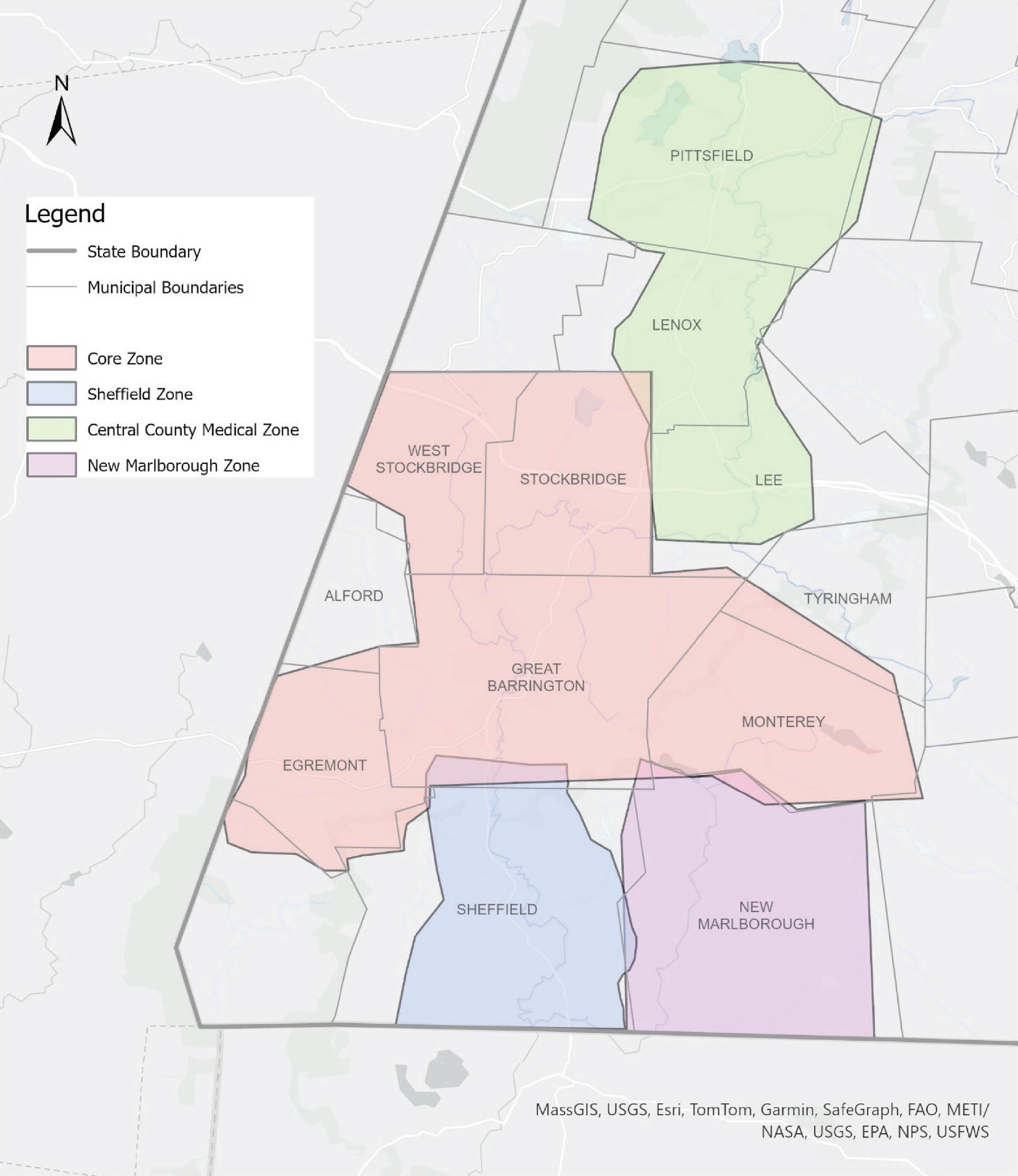
TriTown Connector has three service zones set up in the backend of the software system. A map of the service zones is shown in Figure 14. The combined service area of the three microtransit zones is 230.9 square miles. Separately, the core service zone centered around Great Barrington is 134.5 square miles in size, the New Marlborough zone is 47.9 square miles, and the Sheffield zone is 48.5 square miles. There is an additional Central County Medical Zone for trips going to and from Pittsfield, a service limited to Mondays and Wednesdays. The zone boundaries are approximate; the dispatcher has the discretion to override for addresses on the border of a community when needed. On weekdays, 5 dedicated vehicles are used to serve the three service zones with all vehicles able to travel between the 3 zones. The majority of the rides requested are going to Great Barrington from the outer towns; very rarely are trips from other towns aside from Great Barrington requested for in-town travel.
Stop Design
TriTown Connector service is curb to curb throughout most of the service zones, with a few exceptions based on destination and/or customer type. In Great Barrington there are two places where general public trips are dropped off or picked up at fixed points. First, TriTown Connector directs riders to be picked up and dropped off at BRTA bus stops in the downtown area of Great Barrington, due to the amount of congestion that occurs downtown. Second, general public trips going to and from Bard College at Simonʼs Rock campus can only use certain designated locations. The software platform matches trips requested in these two areas to the nearest fixed points automatically.
Conversely, older adults and persons with disabilities still receive curb-to-curb service in these areas; the city uses different ride classes in the platform to automatically determine which stop type the ride will receive. Since TriTown Connector does not provide ADA paratransit trips, there is not an eligibility application process for using the service. Persons with disabilities are self-identified. Initially there were only a couple of people with disabilities (under the age of 55) riding the service, but the town has found that portion of ridership to have increased. Great Barrington trips in the core service zone make up about 80% of the service ridership.
Booking and Communication
Currently, all TriTown Connector trip reservations are made either over the phone, through a web portal, or through a smartphone app. Customers can call the reservation phone number 7 days a week between 8:00 a.m. and 5:00 p.m. All customers call the same dispatcher number to request trips; in practice, there is only one dispatcher. Trips can be requested (for all customer types) up to 30 minutes in advance of travel, though the request may be filled more immediately if a vehicle is available. For the purposes of setting expectations, customers are encouraged to book their trip 24 hours in advance if their travel will be for an important appointment.
Booking Practices and Updates
About 50% of trips are booked within 24 hours of the ride time, but a lower percentage are booked on the same day of travel. Trips can be booked on the software platform up to 100 days in advance, though staff try to limit trip requests to a month in advance of the trip. With this policy for advanced booking in place, staff have not had many issues with customers making
Long Description.
The legend of the map shows two lines representing the state boundary and municipal boundary. Four color zones represent the Core Zone (red), Sheffield Zone (blue), Central County Medical Zone (green), and New Marlborough Zone (Violet). Areas shown within each zone are as follows: Core Zone: West Stockbridge, Stockbridge, Great Barrington, Egremont, and Monterey. Sheffield Zone: Sheffield. Central County Medical Zone: Pittsfield, Lenox, and Lee. New Marlborough Zone: New Marlborough.
last-minute changes to their reservations, and reservations for standing rides have not caused any capacity issues. Any new trip pick-up times from the software are either communicated through a phone call or an app notification.
In the smartphone app, standing rides can be seen by the rider as well as the dispatcher. About one quarter of the rides are self-booked by customers in the smartphone app; such self-bookings are encouraged because the dispatcher can only handle one call at a time and may be busy on the line if other customers are calling in. Customers using the smartphone app also receive a notification when the vehicle is about to arrive for the pick-up.
Trips can also be booked online using the TriTown Connector web portal. Staff have set up “Lobby Host Login” access to the web portal at hospital emergency rooms, senior centers, and other local organizations; this level of access allows the user to create a new rider, make a new ride request on their behalf, and watch the progress of the ride in the system. These users are not able to see the same level of information as the dispatcher, but they can keep track of rides that they helped book.
Staff has found that the self-service options available through the web portal helped alleviate call volumes (given that there is only one phone line and one dispatcher), and fulfilled the need for rides home from the hospital for older adults and persons with disabilities. In April 2024, 79% of total trips were booked over the phone while the remaining 21% were booked through the smartphone app or web portal.
Fare Rates and Payment
Fares for TriTown Connector are $2 for in-town trips and $4 for multi-town trips; during the summer of 2024, a special fare rate of $1 for in-town trips was available on Sundays. Children under 5 ride free with an adult (1 child per adult), while military veterans also ride free without limitations (TriTown Connector, 2024b). Medical appointment trips to Pittsfield are $20 round trip. Weekly Workforce Passes providing one daily round-trip for a 7-day period for multi-town trips are available for $15 per week. Weekly unlimited passes for older adults and persons with disabilities are similarly available for $15 per week (TriTown Connector, 2024d).
The correct fare rate for the particular trip is determined by the driver and paid for by the rider at the time of boarding according to established fare policy and based on the ridersʼ origin and destination (i.e., whether the trip will qualify as a multi-town trip). The driver collects the fare from the customer and inputs the information for the trip into a mounted tablet in the vehicle. Feedback from customers is that the fare rates are affordable overall. The service also sometimes receives donations from riders at the time of boarding.
Fare payment is made with pre-paid punch tickets, available at a discounted rate ($15 for travel within town and $25 for multi-town trips), or with cash. The town periodically offers flash sales on these tickets (e.g., 10 rides for $10). Pre-paid punch tickets can be purchased at the Claire Teague Senior Center transportation office in Great Barrington (weekdays, 8:00 a.m.–4:00 p.m.), from other county senior centers, or from drivers directly (TriTown Connector, 2024b).
Although some customers have asked for the ability to pay for trips by credit or debit card, that option is not directly available at this time. However, the town recently partnered with two local supermarkets to make pre-paid punch tickets available for purchase by credit card; this fare option is particularly popular with younger riders (TriTown Connector, 2024b).
Commingling Processes
All trips are commingled together regardless of passenger type. Priority for fulfilling trip requests is first given to older adults and persons with disabilities and second to the local
workforce (which is tied to funding support from the member communities). The commingling process is done automatically by the software before and during the day of service. Standing order subscription trips will often appear in the vehicle schedules 12 to 24 hours prior to the day of travel as the software platform auto-populates the schedules the night before. Town staff have found that prioritizing trip types accurately can be challenging, especially given the large number of subscription workforce riders that use TriTown Connector.
TriTown Connector staff check the commingling decisions made by the software on the day of service. Anything booked before the day of service is highly prioritized, while other day-of trips are booked to available capacity left on a first-come, first-served basis for all customer types. Staff will still prioritize same-day requests from older adults or persons with disabilities over other trips requests received on the day of service.
Continuous dynamic optimization (CDO) is applied to all types of trips scheduled in the platform, though exceptions can be applied (either automatically in the software or manually by staff) depending on the customer or trip type. Any changes to trip times are communicated to customers through a push notification in the smartphone app.
Customer Considerations and Accommodations
Door-to-door service is provided to older adults and persons with disabilities on request. The rider profile information in the software platform includes emergency contact information and other accommodation notes that are available for staff and drivers to view. The town encourages riders that need assistance to ride to have family or volunteers accompany them at no charge (similar to a PCA arrangement) (TriTown Connector, 2024b). The town has had slight challenges in teaching customers unfamiliar with on-demand mobility how to use the service compared to previous local transportation services.
The software platform settings have also been adjusted to increase boarding and alighting dwell times for these trips. Specific dwell time settings for various rider classes are 4 minutes for the general public, 6 minutes for older adults, 7 minutes for persons with disabilities, and 12 minutes for riders with a mobility device. These dwell time settings are not expressly communicated to customers. The system is not set up to have additional arrival time for any of these classes.
TriTown Connector uses a comprehensive operator training program that follows Massachusetts Rural Transit Assistance Program guidelines. The town has also added other training components including a disability awareness course, a wheelchair securement class, and a rural transit customer service course. Staff shadow new vehicle operators during the onboarding process, as well as conduct periodic safety training for drivers.
Because the level of call-in requests has been consistent, the town has not felt the need to formally advertise the TriTown Connector program to date. The other participating communities have information on the service or links to the main TriTown Connector webpage available on their own websites.
Fleet Mixture and Dispatching
Since the same software platform and fleet are used across different zones, operations between them are mostly similar, with the except of the New Marlborough zone. In New Marlborough only older adults and persons with disabilities are eligible to ride; no other general public trips are served. The one dedicated vehicle for trips with older adults or persons with disabilities is unlocked on weekdays, operated by a full-time driver.
The town employs around 20 total vehicle drivers (some full-time and others part-time) to operate the TriTown Connector service (Steele, 2024). Driver hiring and retention has been a
challenge from time to time, as the town has to meet a weekly schedule with its current staff of operators and has limited resources to increase pay rates. At times the town will prioritize staffing during peak priority trip demand periods rather than overall peak hours, which can lead to very tight scheduling at other times during the day.
Switching drivers from paper manifests to using tablets to follow for trip duties was initially a challenge but resulted in improvement over time as drivers and dispatchers grew to trust the software platform (Alvarez, 2023). The software platform has capped settings in the system for the ratio or rider time versus vehicle time (which can be overridden by the dispatcher as needed); the parameters are set so that the software cannot add more than 9 minutes to the total ride time from what was previously scheduled. This setting was put in place to help protect the townʼs goals for OTP of service.
Vehicles are supposed to arrive within 10 minutes of the scheduled pick-up time in order to be considered on time. Once the vehicle arrives, the customer has the maximum number of minutes to board the vehicle, depending on the dwell time setting for their rider class (as explained earlier). After that period, if the customer has not yet boarded the trip is considered a no-show. If a no-show occurs for a trip scheduled by an older adult or person with a disability, the dispatcher will try to reach the customer by calling them; if there is no response to the phone call, the dispatcher will send the local police department to the home for a wellness check.
Dispatching
Dispatchers handle same-day requests for older adults or persons with disabilities, but not with the same priority as prescheduled trips. The dispatcher inputs and manages these requests and sends the information to the driverʼs tablet, which provides the driver with notifications of trip duties and pick-up and drop-off times, or sends it to the driver over radio.
Occasionally the dispatcher has to fill in as a vehicle operator; this is done only as necessary for trips for older adults or persons with disabilities. Since the program has one dispatcher at any given time, staff try to limit the dispatcherʼs time away from their desk to no longer than 1 hour.
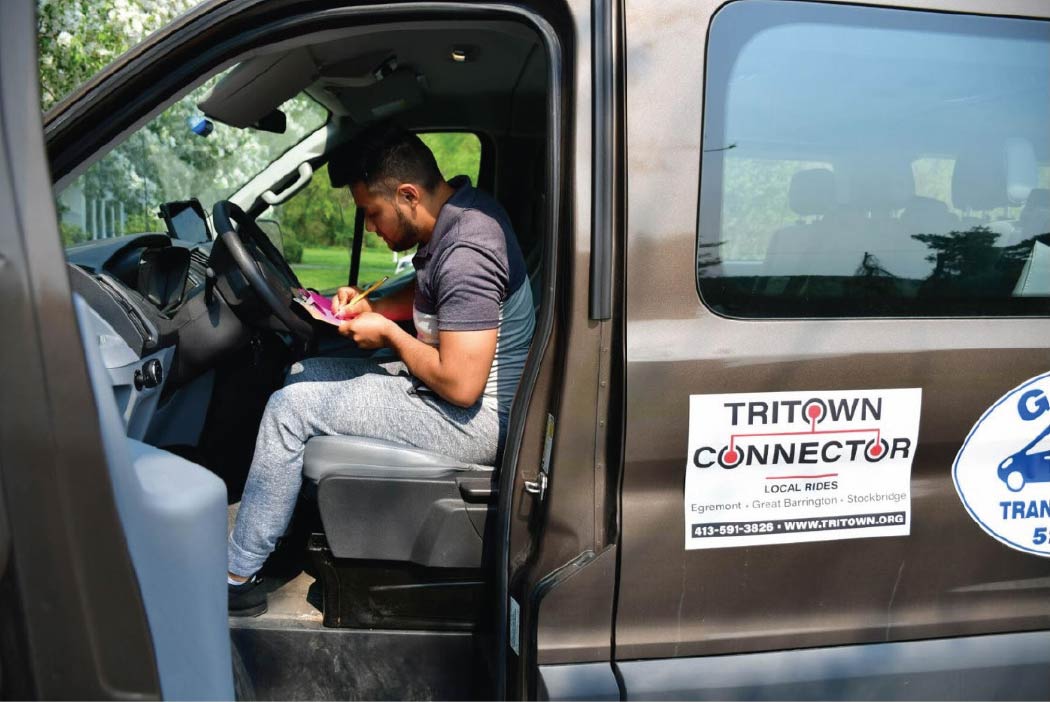
Vehicles are equipped with radios, allowing dispatchers to troubleshoot remotely by communicating with other drivers. If the dispatcher is temporarily filling in as an operator, they can often use the radio to troubleshoot issues from the road. The program director also will sometimes drive a vehicle for revenue service if there is a driver shortage on the given day (Alvarez, 2023). Figure 15 shows a TriTown Connector driver in their vehicle.
Long Description.
The vehicle door displays the TriTown Connector logo along with a service area list: Egremont, Great Barrington, and Stockbridge. Trees and greenery are visible through the window.
Vehicle Fleet
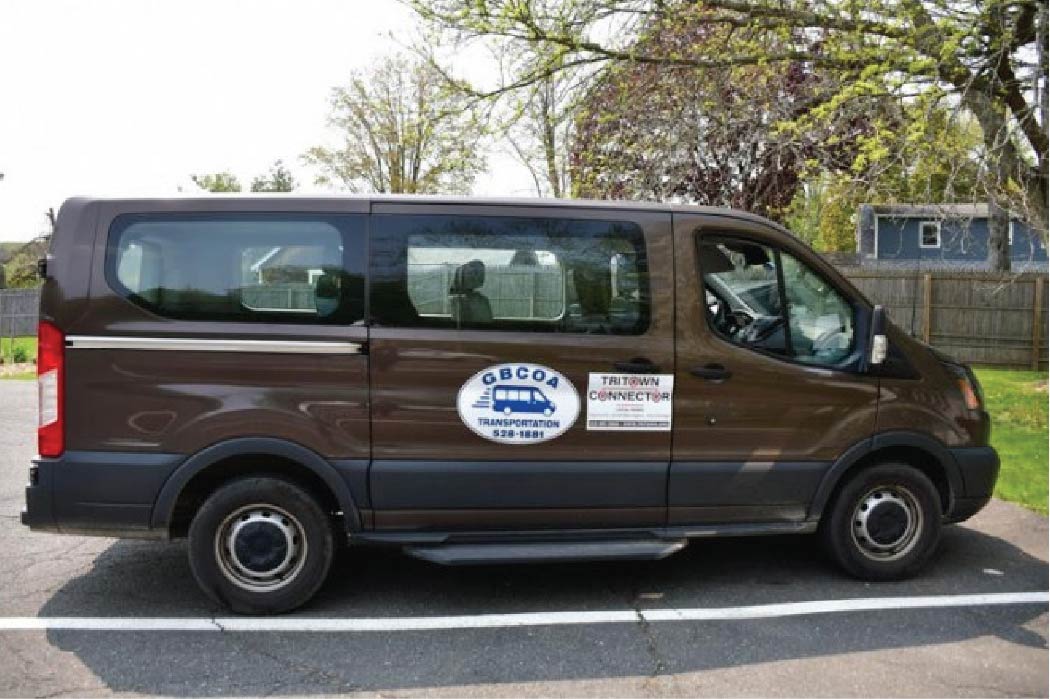
City of Great Barrington currently has 7 total vehicles for TriTown Connector service, made up of 3 WAVs and 4 non-WAVs (see Figure 16). For the subset of WAVs, 2 vehicles have 12 seats with 2 mobility device securement spots while the third vehicle has 8 seats and 1 securement spot. The 4 non-WAVs consist of 2 minivans and 2 SUVs; 1 of the SUVs is designated for use by the dispatcher or supervisor as needed. There are 5 vehicles operated at maximum service and 2 spares at any given time. In practice the city has not yet experienced any operations issues in providing WAVs to service trips requested.
Prior to the TriTown Connector program, having an adequate spare vehicle ratio was something that city staff did not have prior experience with (given that they are not a transit agency). After the program commenced, demand for service grew quickly, with peaks in service occurring on shopping days on Thursdays and Fridays. In the initial months, the program was using all 4 of its vehicles during these peak days before acquiring additional vehicles for greater capacity and spare ratio. The staff learned the importance of having adequate spare vehicles to cover circumstances when a vehicle went out of service due to an accident or mechanical issues.
Initial experiences on vehicle demand needs have made the town more proactive in planning for changes in demand peaks and maintaining vehicle availability. The service still sees peaks in demand on given days or weeks depending on local events, so staff have learned to plan in advance based on anticipated peak demand. The town has found the state department of transportation to be helpful in acquiring more vans.
Benefits and Impacts
The Town of Great Barrington has seen service productivity and cost efficiency for TriTown Connector improve since the start of the service as well as after implementation of the more advanced software platform. Currently, service productivity is around 2.50 trips per hour on weekdays and 2.21 on weekends. Monthly ridership across all service zones broke 2,000 rides in early 2024 (see Table 3).
Service Performance
For April 2024, TriTown Connector had the following performance statistics:
- Productivity: 2.73 trips per hour
- OTP: 93.7%
Long Description.
The vehicle displays two logos on the side: one for the TriTown Connector service and another for GBCOA, the Great Barrington transportation program. The van is situated in a parking lot with trees, grass, and a house visible in the background.

Source: Adapted from TriTown Connector, 2024e.
Long Description.
The column headers of the table are Town, Egremont, Great Barrington, Monterey, New Marlborough, Sheffield, Stockbridge, West Stockbridge, TOTAL. The data given in the table row-wise are as follows: Row 1: Sep 23: 109; 988; 47; 8; 22; 81; 4; 1,259. Row 2: Oct 23; 71; 1,007; 45; 15; 10; 84; 3; 1,235. Row 3: Nov 23; 32; 1,109; 6; 22; 0; 25; 3; 1,107. Row 4: Dec 23: 7; 1,154; 12; 19; 2; 51; 13; 1,258. Row 5: Jan 24: 6; 1,266; 57; 45; 5; 53; 7; 1,439. Row 6: Feb 24: 5; 1,583; 37; 43; 20; 57; 1; 1,746. Row 7: Mar 24: 15; 1,924; 54; 31; 6; 102; 3; 2,135. Row 8: Apr 24: 9; 1,714; 65; 48; 90; 102; 0; 2,208. Row 9: May 24: 0; 1,818; 82; 29; 88; 32; 4; 2,053. Row 10: Jun 24: 30; 1,651; 86; 20; 80; 104; 9; 1,997. Row 11: Jul 24: 41; 1,871; 120; 27; 94; 171; 14; 2,375. Row 12: Aug 24: 48; 2,137; 101; 37; 125; 149; 27; 2,624.
- Cost efficiency: $16.48 per passenger trip
- Cost effectiveness: ∼$45 per revenue hour
Staff track the proportion of rides per month by rider types between older adults and persons with disabilities versus all other general public riders; there is a soft goal of keeping the proportions between these groups around 50/50% each. Staff also track the number of trips by trip purpose, as an outgrowth of the previous transportation program for older adults. The driver asks the rider their trip purpose at the time of boarding and writes it down on a paper manifest. The TriTown Connector coordinator looks at the number of trips by trip purpose every month. About one quarter of trip purposes are for workforce trips, while medical or shopping trips are other top categories. One item on the staffʼs wish list is to have this data collected on the tablet by the driver, rather than having to compile the information later.
Cost effectiveness (per revenue hour) has increased a little bit since the service started, mostly due to the addition of an assistant operations manager with increased administrative overhead. Staff does have data for how often trip requests are met within 60 minutes of the requested time, and staff will monitor the levels of trips provided to older adults and persons with disabilities. As the service continues, town staff expects the rider mix of older adults and persons with disabilities to change. In April 2024, persons over 55 without a disability made up 22.5% of completed trips, persons with disabilities made up 24.5%, and other general public riders made up the remaining 53%.
On average, customers request a TriTown Connector trip about 18 hours in advance; this is for completed trips and does not include no-shows or cancellations. Trip requests within the hour of travel made up 26.3% of trips completed, while 32.3% of trips are requested between 1 and 12 hours before. Furthermore, 18.5% are requested between 12 and 24 hours while the remaining 23% are requested over 24 hours in advance.
Trips are considered on time if the pick-up occurs within 10 minutes after the scheduled time. On-time performance (OTP) is currently around 93–94% based on this standard; staff has a soft benchmark of 90% for pick-up OTP. The driver will wait for the customer if they arrive early before the pick-up time. The town recently updated its drop-off OTP policy to define on time as within 10 minutes of the scheduled drop-off. There is not currently a benchmark for drop-off OTP; staff are working with the software company to provide a standard report that provides this information. The current software platform has made a significant difference over time in improving OTP (which could not previously be measured) once staff became more acquainted with the system and the right parameters were put in place.
Customer Feedback
The software platform also collects data on ride ratings called the Net Promotor score. At the end of their ride, customers receive a notification to rate their ride on a scale from 1 to 5 stars; they can also provide feedback as a comment. As recently as April 2024, the average Net Promotor score for all trips was 99% favorable (either 4 or 5 stars). Staff track this score on a monthly basis along with pick-up OTP. Staff have observed very few customer complaints about TriTown Connector service, which can be either left in the smartphone app or logged by the drivers or dispatcher; the most common complaint is that the ride was late.
The town has also periodically conducted surveys with riders and residents for feedback on TriTown Connector service as well. One recent survey indicated that respondentsʼ most highly prioritized improvement would be greater reliability of service.
Data Availability
Town staff have access to a live online dashboard from the software platform with exportable reports and can have raw data files sent to them on request. One challenge is trying to estimate how many rides the service cannot meet on a regular basis. The software platform is not currently set up to track when a service request is denied (meaning that no vehicles are available at that time). Staff can manually go through the audit logs in the software platform to gather this information, but the platform does not generate an automatic report on these events.
Summary
The TriTown Connector microtransit service from the Town of Great Barrington is an example of rural communityʼs effort to develop a mobility solution to answer previously unmet needs for service and prioritize that service for specific rider groups. Although the service does not provide ADA paratransit trips, the town uses many similar principles in commingling policies and software platform parameters for scheduling and dispatching to meet service demand in the community.
Key Challenges
- Driver Availability. Staffing vehicle operators to meet service demand in the rural county has been a recurring challenge, frequently requiring the dispatcher or manager to drive a revenue vehicle into service.
- Continual Funding. Presently there are no regular federal or state formula funds apportioned to support the service because the town is not a designated recipient/subrecipient for such programs.
Notable Practices
- Hybrid Stop Types. The software platform is configured to only allow fixed stop points to be used in denser areas of Great Barrington, with an automatic override to provide curb-to-curb service for persons with disabilities and older adults.
- Partner Web Portal Access. The town worked with local hospital emergency rooms and other service organizations to provide login access to the software platformʼs web portal, allowing others to make rider requests on behalf of the customer.
Lessons Learned
- Vehicle Supply. The town had growing pains in figuring out the proper number of vehicles to have in the fleet that would meet both service demand and spare ratio requirements.
- Prioritized Rider Groups. The prioritization of older adults and persons with disabilities for service capacity along with subscription workforce trips can sometimes leave little remaining room to serve other general public trips.
Butler County Regional Transit Authority, Hamilton, Ohio
Long Description.
The stylized 'B' in the BCRTA logo is shaded in light blue and consists of two dark blue arrowheads facing the northeast direction.
Butler County Regional Transit Authority (BCRTA) operates public transit service throughout Butler County, Ohio, located in the southwestern area of the state. BCRTA was created as an independent public agency in 1994 by the Butler County Commissioners. The agency is the designated transit provider for the county, which is in a non-urbanized area of Ohio. However, because a portion of the Cincinnati urbanized area (i.e., the Cincinnati, OH–KY–IN UZA) extends into Butler County, BCRTA is considered a large urban transit provider a nd is the designated grantee of federal and state urban transportation funds (BCRTA, 2024k). The official service area of the agency is the entirety of Butler County, measuring 470 square miles in area and 390,357 in population as of the 2020 Census (NTD, 2022a).
Middletown, Ohio, is a small urban transit district within Butler County, and the City of Middletown contracts all service for their district (known as Middletown Transit Services, or MTS) to BCRTA; the agency has operated and administered Middletown fixed-route and paratransit service in this manner for over a decade. BCRTA also provides trips for military veterans contracted by the Butler County Veterans Service Commission (BCVSC) (BCRTA, 2023). BCRTA likewise provides late-night service for students in the Oxford, OH, area (i.e., SafeRide trips) that are sponsored by Miami University (BCRTA, 2024g). BCRTA is governed by a nine-member board of trustees that is appointed by the county commissioners (BCRTA, 2024k).
Passenger trips and vehicles operated for service in 2022 as reported in the NTD are provided in Table 4. Services operated by BCRTA include the following:
- Fixed-route bus service, 12 total, grouped and branded as Oxford (5), Regional (3), and Middletown (4)
- Commuter express service to Cincinnati, branded as CincyLink
- BCRTA paratransit service for BCRTA and MTS, branded as BCare
- General public demand response service, branded as BGo
- Contracted service trips for veterans in Butler County
- SafeRide trips sponsored by Miami University
BCRTA was chosen as a case example for this synthesis because of its mixture of general public, ADA paratransit, contracted, and sponsored trip types that are commingled together in a consolidated service. The agencyʼs prioritization of available microtransit capacity for pre-booked ADA paratransit trips and contracted veteransʼ trips, along with several differences in geofenced (i.e., mapped service boundaries) areas and associated parameters managed by the software platform, demonstrate the levels of complexity for commingling trips that microtransit
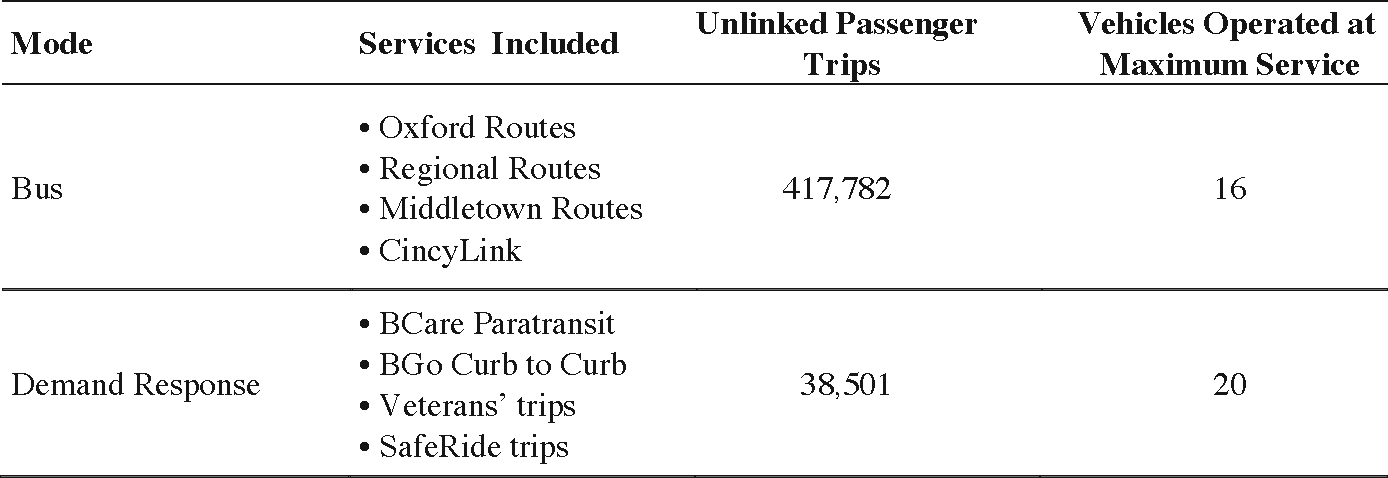
Mode and Data Source: NTD, 2022a.
Long Description.
The column headers of the table are Mode, Services Included, Unlinked Passenger Trips, and Vehicles Operated at Maximum Service. The data given in the table row-wise are as follows: Row 1: Mode is Bus; services included are Oxford routes, Regional routes, Middletown routes, and CincyLink; unlinked passenger trips are 417,782; vehicles operated at maximum service are 16. Row 2: Mode is Demand Response; services included are B Care Paratransit, B Go Curb to Curb, Veteran’s trips, and SafeRide trips; unlinked passenger trips are 38,501; vehicles operated at maximum service are 20.
service may handle. The BGo service also serves as an example of a microtransit service solution in a rural county and small urbanized area that developed as a natural evolution of demand response service over time.
Demand Response Services Overview
BCRTA is the operator for all dedicated services in Butler County, including general public paratransit and microtransit. BCRTA handles all operations functions in-house, including scheduling reservations and answering customer calls; the agency also handles all troubleshooting during operations and does not subcontract any of their services. Via is the software platform for all demand-responsive services, providing technical support for the software as needed. Prior to 2018, BCRTA was using mobile data terminals (MDTs) in vehicles along with paper manifests for all demand response trips. Scheduling software for demand response services has been used by BCRTA since then; the current software platform has been in place since 2023. All demand response service vehicles are branded as BGo Curb to Curb Road Service.

Source: Via Transportation, Inc., 2024.
BCare and BGo
BCRTAʼs ADA complementary paratransit service, BCare, is provided only within three-quarters of a mile from fixed routes in Butler County (BCRTA, 2018). The agency provides this paratransit service for required ADA service areas around the sets of fixed routes in Oxford, Middletown, and regional routes. Middletownʼs paratransit zone is separately geofenced and has different available service hours (including service availability on Saturdays).
BCare paratransit service is intended for customers who cannot use BCRTA fixed-route or BGo service at times when fixed-route service is not available (BCRTA, n.d.). Eligible customers file an application for paratransit service. Applicants can be approved for temporary or unconditional eligibility; unconditional approval comes with a five-year eligibility period, after which the customer needs to be recertified. Since paratransit customers file one eligibility application and have a single rider profile in the software platform, they can book paratransit trips in either paratransit service zone; this makes it simpler for the agency from an operations perspective (BCRTA, 2024a).
BCRTA has always had general public demand response service; a rebranding (and repricing) for this service occurred at the time microtransit service was introduced. Prior to 2018, general public service was provided in five or six different zones within Butler County; the agency received feedback from customers that trips between the different zones were not affordable. In 2018, the agency changed service to one combined zone in the county under the name BGo. The service is not positioned as a premium service, though it does provide convenience in transit service in a county where transportation network companies (TNCs) are not as readily available as in denser urban areas. BGo is functionally available on a first-come, first-served basis during its service hours (Monday–Friday, 6:00 a.m.–11:00 p.m.) (BCRTA, 2024j).
The service zone for BGo covers the entire county limits and also goes past the southern county boundary; the reasoning for this extension of the service area is to provide customers with the ability to transfer to Southwest Ohio Regional Transit Authority (SORTA) in neighboring Hamilton County. Figure 17 depicts the service zone for BGo in purple, while the Oxford ADA paratransit service area is depicted in blue; note that the county boundaries are not displayed in the map. BCRTA does not currently have a formal agreement with SORTA for service connections, though there is a potential regional effort to pilot a one-click, one-call center through NEORide (a council of governments representing over 20 transit agencies across multiple states) (NEORide, 2024).

Long Description.
The BGo service area is highlighted in purple, covering most of Butler County, Ohio. Towns within the service boundary include Oxford, Reily, Okeana, Alert, Somerville, Collinsville, McGonigle, Auburn, Millville, Shandon, Ross, Astoria, Jacksonburg, Seven Mile, Overpeck, New Miami, Hamilton, Fairfield, Pleasant Run Farm, Avalon, Middletown, Blue Ball, Monroe, Four Bridges, Mason, Wetherington, Pisgah, The Woods, Sharonville, and Evendale. Surrounding areas such as Morning Sun, West Elkton, Rockdale, New Haven, Harrison, Wyoming, Blue Ash, Carlisle, Franklin, Red Lion, Kings Mills, Maine, Landen, and Loveland Park lie outside the service boundary.
SafeRide
BCRTA also provides SafeRide trips for students to use in evening hours; this program is contracted with and supported financially by Miami University so that it is fare-free to riders. BCRTA has had a contract with the university since 2012, recently signing a new 10-year agreement in 2024. The smartphone app service support for SafeRide launched in March 2023. SafeRide service is available within a square mile and adjacent areas of certain fixed routes in the Oxford area when the routes are not in service at night (BCRTA, 2024j). During the Fall and Spring semesters, service hours are Monday–Saturday, 10:00 p.m.–3:00 a.m., and Sunday, 10:00–1:00 a.m.; during other times of the year (summer and winter terms) service hours are 7:00 p.m.–12:00 a.m., 7 days a week (BCRTA, 2024g).
Veterans’ Trips
BCRTA has also operated a service contract for the BCVSC for about 9 years. Prior to 2022, these trips were provided only within the county; then the agency also took over contract trips
going to Cincinnati as well as Dayton. All return trips from these cities outside of the county are considered will-call trips. Availability of veteransʼ trips is guaranteed all year long. The customer calls the commission, who then authorizes the user for the trip. The commission sends BCRTA a Next Day Report (usually around 3:00 p.m. the day before) which shows the trips that need to be scheduled into BGo service. Sometimes the commission will call the agency directly for same-day trip demands, but such requests are not a regular occurrence. The agency sends the commission a bill at the end of every month for trips performed. Billing is per trip, based on a zone-based structure: local in-county trips are $24, trips to/from Dayton are $50–60, and trips to/from Cincinnati are over $100.
Service Design and Parameters
BCRTAʼs goals for integrating microtransit technology into BGo service included reducing costs, thereby improving cost efficiency and cost effectiveness, as well as improving service productivity and on-time service performance. The agency did not define a new microtransit service zone but rather used the software platform to manage the parameters of the existing general public, paratransit, and contracted services. General public customers can travel anywhere within the BGo service zone and are provided with curb-to-curb service. BCare customers scheduling paratransit trips can travel anywhere within either of the two paratransit service zones (Oxford/Regional or Middletown) for their trips and are provided door-to-door service; however, a BCare paratransit trip cannot connect a requested drop-off that is in a different paratransit zone from the requested pick-up.
The software platform was procured through the NEORide group, a council of governments formed in Ohio that provides mobile ticketing coordination and group purchasing for agency members; BCRTA often pools procurement with another group in order to have more buying power than they could on their own. NEORide is the agency participating in the agreement with the software company; the contract was initially set up for a 12-month pilot period which could then be extended an additional 4 years following mutual agreement. The current service agreement was signed in January 2023.
BGo buses serving BGo, BCare, or SafeRide trips may arrive within 15 minutes before or after the scheduled pick-up time (for a total “on-time” window of 30 minutes); this means that customers need to be ready for travel up to 15 minutes before their scheduled pick-up. The standard wait time for these trips after vehicle arrival is 5 minutes; if the customer hasnʼt boarded by that time, the driver deems the trip a no-show (BCRTA, 2024c). BCRTAʼs management of Middletown ADA paratransit service is done under the same policies as Butler Countyʼs ADA paratransit service (BCRTA, 2018).
BCRTA has two different no-show policies: one for ADA paratransit trips and the other for general public trips. The agency follows ADA regulations for no-shows by measuring the percentage of BCare scheduled trips that the customer has a no-show on; at 10% of scheduled trips the customer receives a written warning, then at 15% the customerʼs service is suspended. For general public trips, service is suspended for the customer once they have at least three no-shows in a month (BCRTA, 2024c). The agency had many more no-shows and late cancellations about 6 years ago, but enforcement of these policies has reduced their occurrences. Customers that are assessed a no-show fee can pay either in person at the Middletown Transit Station or by mail; no-show fees can only be paid in cash (BCRTA, 2024e).
Booking and Communication
BGo and BCare customers (as well as SafeRide) can modify or cancel an existing trip or schedule a new trip with a smartphone app, online platform, or call-in number to manage their trips; this
includes scheduling a new trip or modifying/cancelling an existing trip; in addition, BCare customers can manage new or existing subscription trips through these means. BCRTA reservationists and call specialists have access to the software platformʼs operations console as part of the service agreement, which enables staff to book trips, check trip details, adjust rider account information, access reports and data exports, and provide customer service support.
Both mobile apps send trip notifications to customers. In addition, reminders can be sent out through the interactive voice response (IVR) system. (Veterans, in particular, prefer notification by IVR than by smartphone app.) On veterans and BCare paratransit trips, if the customer does not come out to the vehicle within the 5-minute waiting period, the BCRTA dispatcher will make a phone call to the customer or their guardian before declaring them a no-show. Dispatchers are trained to make use of all available communications systems.
Smartphone Apps
Customers using a smartphone app to book their trips will receive a notification when the vehicle arrives. Veterans and BCare customers also have the option to sign up for notifications from the IVR system. Customers must cancel their trip at least 1 hour before the scheduled pick-up time, otherwise they are accessed a no-show penalty and/or charge (BCRTA, 2024c).
There are two separate mobile apps that tie into the software platform for microtransit: BGo and BCare; the apps are provided by the software company under the service agreement and “white-labeled” to reflect the logo and branding of the transit agency or service. The BGo app (see Figure 18) is used by general public customers and customers scheduling SafeRide trips, while the BCare app is used by paratransit customers for scheduling ADA paratransit trips. The apps show customers the entire pick-up window; agency staff have found this to be good for transparency with the customer, enabling staff to communicate to the customer that the vehicle may arrive at any point during that window.
As mentioned, while there are separate apps for different services, there is one user profile on the backend that carries multiple eligibilities. For example, a paratransit-eligible customer would have one user profile with eligibilities for BCare and BGo assigned to the profile; this way, if the paratransit customer chooses to schedule a general public microtransit trip, they can use the BGo app with the same user profile and the agency can track trip types by customer on the backend. About 20% of general public trips in BGo are booked by paratransit-eligible customers, and BCRTA has heard very positive feedback from customers on the smartphone apps.
Booking by Trip Type
For every trip booked in either the BGo or BCare app, the customer is asked to provide their trip purpose according to predefined categories (as shown in Figure 19). Examples include SafeRide, court, day program, employment, food delivery, personal shopping, and more. No trips are restricted by trip purpose based on a travel reason. This information is gathered for each trip because it helps BCRTA for planning purposes.
General public trips for BGo can be booked for the service hours available in the BGo zone. BGo customers can book a trip where the vehicle will arrive in as soon as 5 minutes or no later than 30 minutes. Similarly, eligibility for SafeRide trips in the BGo app is based on whether the origin and destination of the requested trip fall within the SafeRide geofenced zone during available service hours. The student chooses a microtransit trip in the BGo app then selects their travel purpose as SafeRide, which allows the system to automatically determine their eligibility. Nearly all SafeRide trip requests are made using the BGo app, which is popular with students. BGo trips can be booked up to 7 days in advance (BCRTA, 2024j).
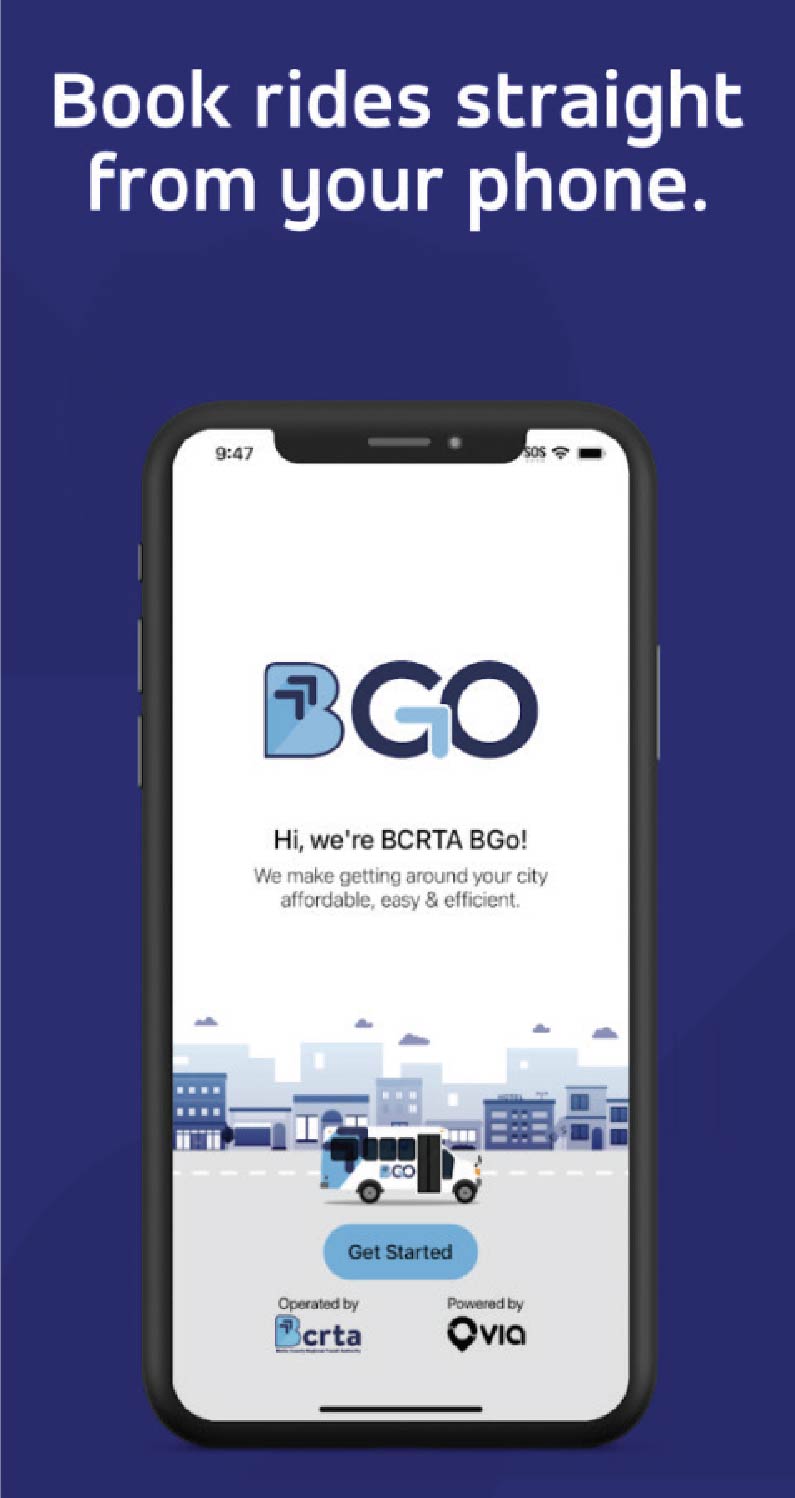
Long Description.
The home screen shows a vehicle traveling on a road. The text reads, 'Bgo: Hi, we're BCRTA Bgo. We make getting around your city affordable, easy, and efficient.' Above this text, another text reading 'Book rides straight from your phone' is written. The bottom of the homepage shows the option 'Get Started.'
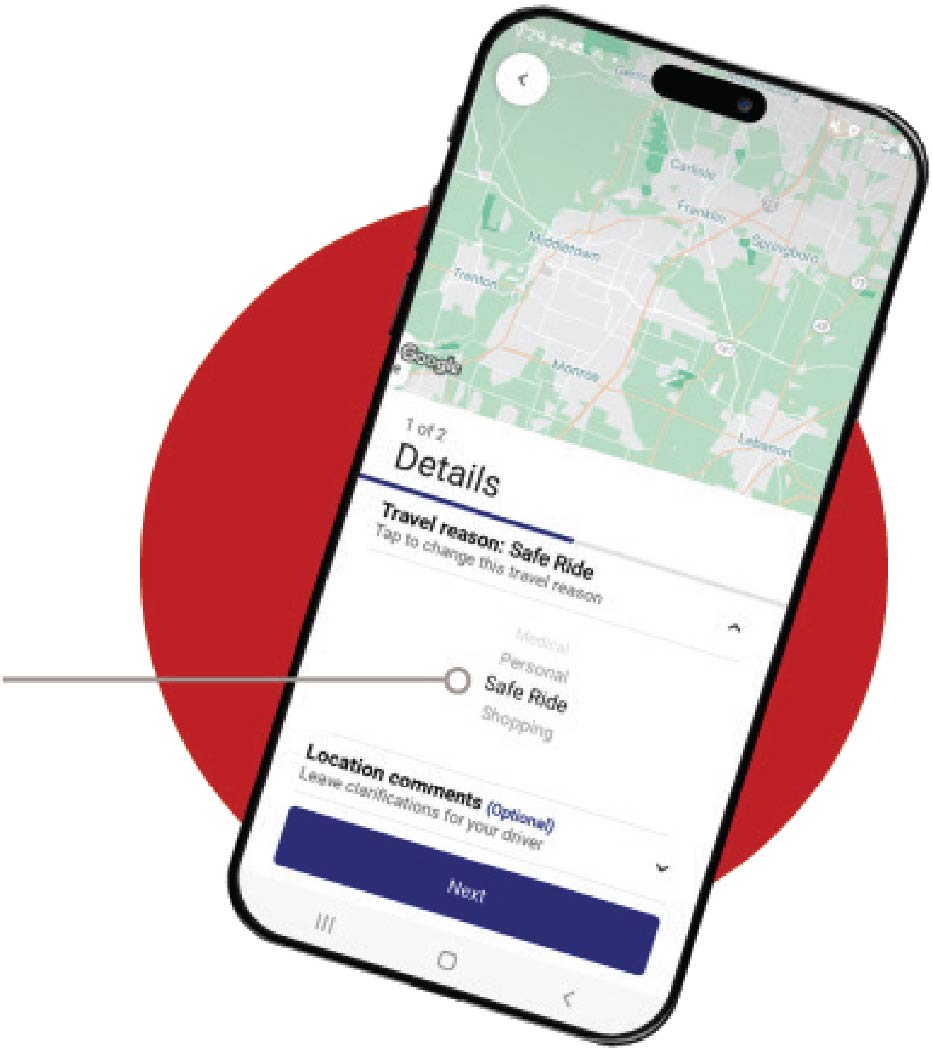
Long Description.
The display of the smartphone shows a map in its upper half. The lower half is titled Details. This section reads the following: Travel reason: Safe Ride. Tap to change the travel reason. Location comments (optional). Leave clarifications for your driver.
For BCare trips, customers are directed to schedule trips before the day of travel; customers are encouraged to schedule trips earlier if possible but no more than 2 weeks in advance (BCRTA, 2018). BCRTA will allow for some same-day paratransit trips if available capacity and schedule slack allows (BCRTA, 2024d). BCare customers can call in to the agency to schedule trip or use the BCare smartphone app. Subscription trips are available for BCare customers that have unconditional eligibility.
Fare Rates and Payment
BGo trips for general public customers were $5 per trip (or free for children under the age of 12) (BCRTA, 2024c); this fare rate was determined during the initial BGo zonal consolidation in 2018 that aimed to simply rates for travel within the county and make the service affordable for customers. If a BGo rider has a child that will ride with them, they are supposed to either tell the booking agent over the phone or indicate so in the mobile app (BCRTA, 2024b). During the initial stages of the COVID-19 pandemic BGo trips were temporarily fare-free; BCRTA does not have a dedicated tax levy system, and the agency determined that the costs to conduct fare collection and reconciliation were prohibitive compared to the revenue benefits at the time. As mentioned, BCare trips and SafeRide trips on the microtransit service are fare-free, the latter supported by sponsorship from the local university. Veteransʼ trips are fare-free to the customer while costs for service are supported by the service contract.
Mobile ticketing is available through the EZfare app, either by purchasing a single ride ticket or a stored value on their account (which must be purchased with a credit card) (Grant, 2024). EZfare (see Figure 20) encompasses 15 total transit systems in the region, including BCRTA (EZfare, 2024). Agency staff estimate that about 40% of customers use this app. BCRTA is currently working on a link between the mobile ticketing platform and the software platform for the BGo and BCare apps. Customers can still pay cash fares for their trips (drivers cannot make change), and all vehicles are equipped with on-board validators for mobile ticketing.
Commingling Processes
All types of general public (including SafeRide), paratransit, and veteransʼ trips are commingled together in the dedicated vehicle fleet automatically by the software platform. BCRTA messages in their rider materials that all BGo, ADA paratransit, and SafeRide passengers may ride with
Long Description.
The advertisement shows three smartphone screens with the EZfare app interface displaying account balance, buy tickets, ticket wallet, track your vehicle, other trip tools, and transaction confirmation. The text reads 'Buy Tap Go. Add funds to your EZfare Account and never run out of money to travel.' The background is light blue with white cloud illustrations, and the EZfare logo is prominently displayed in red, blue, and white.
other patrons (BCRTA, 2024c). There is no difference in service priority between Butler County and Middletown ADA paratransit riders; the software platform is able to automatically recognize the customerʼs eligibility for paratransit service and whether their trip falls within either of the two paratransit service areas. BCRTA also does not set aside any dedicated vehicles to perform service for a particular type of customer group. BCRTA has not had any major issues/instances of needing to make exceptions for commingling certain types of riders in microtransit service; previously there were a couple BCare riders that displayed aggression toward other customers, but these instances were resolved by having them travel with a PCA for future trips.
Commingling decisions are made automatically by the software in real time, including on the service day of the trip itself. Veteransʼ and ADA paratransit trips are given priority in scheduling available capacity in the dedicated vehicle fleet. The software platform is configured to never deny these trips when they are booked in advance of the day of travel. The remaining available capacity is for general public trips (as well as SafeRide requests) to fill in the gaps. General public customers are not able to book the requested trip unless there is available capacity; if there is none, the software platform will ask the customer to please try again later.
For paratransit trips, BCRTA anchors the pick-up time according to the time originally confirmed with the customer; this means the pick-up time will not be changed by the software platform and the pick-up window for the customer stays the same. For general public customers, the estimated time of arrival displayed in the smartphone app will change in real time from the software based on the actions of the driver, but that does not change the anchored window in the schedule. (BCRTA will on occasion call the customer to ask if they could be picked up earlier before making a change to the scheduled pick-up time.)
In order to keep trips on time, the software platform may change vehicle assignments for the customer by matching them to a different vehicle for pick-up; for example, the customer may see one license plate number in the app change to the license plate number of a different vehicle now matched to them instead. These real-time updates offer greater service efficiency.
Customer Considerations and Accommodations
The BGo software platform does allow for additional boarding time based on customer type and mobility device characteristics in the customerʼs profile. For example, the microtransit service allows up to 4 minutes of boarding time for customers with a mobility device; the standard boarding time for customers is 1 minute after the vehicle arrives.
BCare riders are allowed to have one PCA ride for free on their trip. BCRTA has not experienced any issues with riders bringing too many additional PCAs or companions; sometimes riders will have two companions, but people are generally reasonable about following the policy. Door-to-door assistance for paratransit trips is offered to all BCare customers and is not restricted by conditional eligibility. All BCRTA drivers are trained in wheelchair and mobility device securement. BGo drivers can also assist passengers with carrying up to four normal-size shopping bags on to and off of the vehicle (BCRTA, 2024c).
BCRTA offers a travel training program that can teach customers how to plan trips and ride the fixed-route, BCare paratransit, or BGo services. BCRTAʼs ADA Paratransit Application includes a section where applicants can indicate whether they have previously received travel training and whether they would be interested in learning more about the service (BCRTA, n.d.). Previously BCRTA did more travel training for ADA paratransit customers, but that has lessened more recently. The available training options in the program include (BCRTA, 2024i):
- Destination – teaching an individual how to get to/from a specific destination
- Group/Classroom – overview of the BCRTA system, how to plan trips, and fare options
- Train the Trainer – for social service agencies wanting to learn about BCRTA services
Fleet Mixture and Dispatching
For the BGo microtransit service, BCRTA operates a mixed fleet of 16 WAVs which includes cutaway buses and low-floor minivans (see Figure 21). The software platform is able to configure the seating capacities for each vehicle type, including those that can accommodate extra-large mobility devices.
Each BGo vehicle comes equipped with a Samsung tablet. The tablets are set up so that the driver can see the entire schedule for the current day as well as the next (subject to real-time changes by the software platform). The previous software platform used by BCRTA only allowed drivers to see trip information for the next 90 minutes; the drivers prefer the current configuration. BCRTA observed that after the initial implementation period, drivers became better at following the tabletʼs order of trip duties, particularly because the software does not allow a later trip duty (a later pick-up or drop-off in the dynamic schedule) to be performed; to make such a change, the driver would have to call into dispatch for approval.
The arrival times for each trip are determined automatically by the software platform. For the trip to be properly logged, the vehicle has to be within 900 feet of the pick-up or drop-off point, and the driver must press the “Arrive” button on the tablet; at a pick-up, the no-show timer starts once the “Arrive” button is pressed. Because the pick-up times for BCare and veteransʼ trips are anchored to their originally scheduled times in the software platform, there is never a circumstance in which the BCRTA staff or the software platform needs to communicate a new pick-up time.
The software platform has three different “buckets” of trip rider types: (1) paratransit, (2) microtransit (which includes general public and SafeRide trips), and (3) NEMT for veterans. Drivers will see the icon applicable for the trip next to the rider information on their tablet. Theoretically BCRTA could toggle trip buckets between drivers, but in practice the agency does not throttle driver availability. From an operational perspective, the agency feels it is more efficient if all dedicated vehicles and their operators are able to perform any of these trips. The trip notes for each passenger provide information to the driver on what level of passenger assistance is needed for the customer.
If a trip denial for paratransit service or a “road call” (e.g., vehicle breakdown) occurs, BCRTA will either dispatch another dedicated vehicle or send a road supervisor to serve the trip. “Whereʼs my ride?” calls are handled by the transit agency call specialists in-house. BCRTA does not
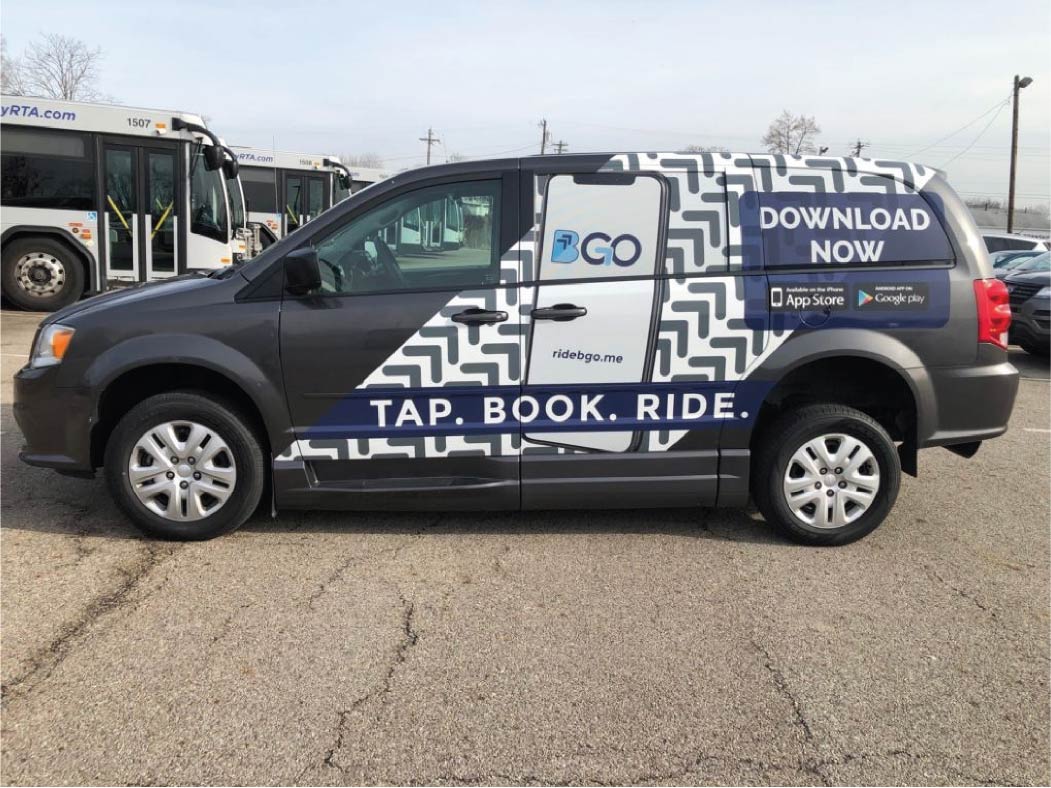
Long Description.
The vehicle is wrapped in a geometric blue and white pattern with the BGo logo and tagline "TAP. BOOK. RIDE." The text on the van reads, 'Download now' with the logo of the App Store and Google Play. The URL "ridebgo.me" is also shown. In the background, several full-sized transit buses are visible.
provide will-call service for return trips, exception for veteransʼ trips, as stipulated under their contractual agreement.
Benefits and Impacts
Approximately half of the commingled trips performed on a daily basis are BCare paratransit trips. Since moving to the current software platform, current service productivity for all BCRTA demand response service has been over 2 trips per revenue hour in some months (up from 1.2–1.3 trips/revenue hour in 2018). BCRTA has seen that paratransit ridership and trip requests have increased during this period, while cost efficiency for service has improved. During May 2024, BCRTA had an overall BGo service productivity score of 1.8 trips per hour (BCRTA, 2024h).
The software platform has a standard automated report that the agency can produce at any time; BCRTA has not run into any issues with reporting or data availability. BCRTA worked with the software company to develop a report consistent with the S-10 Average Days of Service report in the NTD (data fields shown in Table 5). Milestones for data and report availability, including service dashboards with key performance indicators and a data generator tool that provides raw data for download, are built into the contract with the software company.
OTP for BGo and BCare microtransit services is currently around 95 percent. BCRTAʼs measurement of OTP is based on the originally confirmed pick-up time, with early or late pick-ups outside the window counting negatively toward performance. BCRTA has also incentivized better OTP among drivers through a friendly competition and prize drawing each month; drivers are eligible for the drawing if they have an OTP above 90% along with at least 100 trips completed that month.
Performance metrics of interest to BCRTAʼs Board of Trustees are OTP, trips per hour, and trips per month. BCRTA does not have a formal performance benchmark for no-shows and late cancellations but monitors progress for both to try to reduce the number of occurrences to zero. While the software platform does collect ride rating information and comments from customers, BCRTA does not receive many customer comments through the smartphone apps. BCRTA does conduct annual surveys to customers independently from the software platform.
Aside from educating customers about the nature of on-demand service, BCRTAʼs biggest issues are related to hiring and retaining drivers to put service on the road. Agency staff observe that more general public trip demand could be served if the agency had additional drivers for demand response service, estimating that enough demand exists to utilize the capacity of 25 vehicles. BCRTA tracks refusals and denials to serve general public trips on BGo for planning purposes. Staff estimate that there are between 1,000 and 1,200 general public refusals and denials per month.
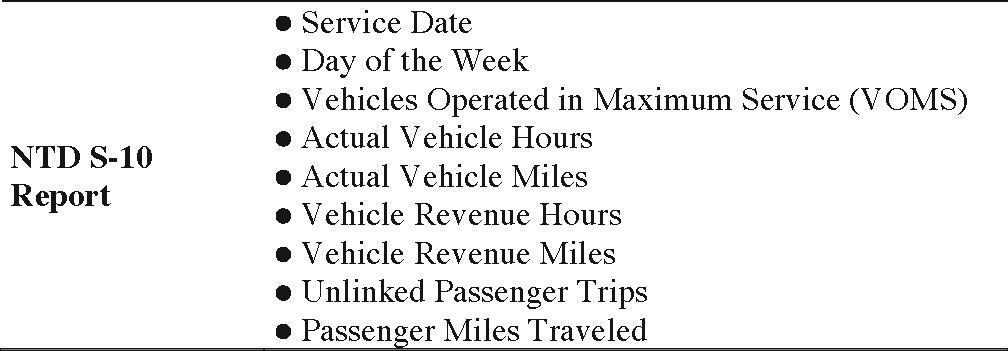
Source: Adapted from BGo service agreement.
Long Description.
The data given in the table row-wise are as follows: Row 1: NTDS-10 Report: Service Date; Day of the Week; Vehicles Operated in Maximum Service (VOMS); Actual Vehicle Hours; Actual Vehicle Miles; Vehicle Revenue Hours; Vehicle Revenue Miles; Unlinked Passenger Trips; Passenger Miles Traveled.
Summary
BCRTA has successfully implemented on-demand microtransit service technology to meet the structures, policies, and capacities of multiple demand response services, while prioritizing ADA paratransit and veteransʼ trips. The agency is able to commingle all trips together without issues in rider compatibility or overly burdensome travel delay. The consolidated design with in-house vehicles and staff gives BCRTA full control of operations and responding to customer service needs.
Key Challenges
- Meeting Demand. The microtransit service regularly has to deny trip requests from general public customers due to scarcity or lack of available capacity. Driver retention has been the primary limiter to putting more vehicles in service.
- Software Integrations. Mobile ticketing is available but not automatically integrated with the microtransit software platform (to date). Additionally, contracted veteransʼ trips must be input by agency staff manually rather than directly scheduled.
Notable Practices
- Unified Profile. The microtransit software platform uses a single user profile for customers which contains their eligibilities for different BCRTA services. The single profile is easier for customers in scheduling trips and helps the agency in data analysis.
- Uniform Windows. The agency uses the same before and after service windows for all types of trip pick-ups (15 minutes before and after) in order to streamline messaging of operations to both drivers and customers.
Lessons Learned
- Report Development. The agency worked together with the software company to develop an automated report for NTD reporting, which was particularly critical for ADA paratransit compliance requirements as well as monthly and yearly NTD reporting.
- Rider Compatibility. For some riders, suggesting the accompaniment of a PCA for their trips can help to ease attitudinal or behavioral challenges in commingling different rider types together.
Tri-County Metropolitan Transportation District of Oregon (TriMet), Portland, Oregon
The Tri-County Metropolitan Transportation District of Oregon (TriMet) is the metropolitan transit authority for the Portland, Oregon, metropolitan area. The agency was created in 1969 by a municipal resolution, then the State of Oregon passed legislation in the same year allowing the creation of transit districts and associated taxing powers (TriMet, 2024l). TriMetʼs legal status in the state is that of a municipal corporation to provide mass transportation in its district (TriMet, 2024j). The agency is governed by a board of directors consisting of seven members who are appointed by the governor; this board sets agency priorities and enacts legislation including taxing and policy ordinances (TriMet, 2024c).

Long Description.
The logo consists of the word TriMet with a graphic showing three interconnected circles in between ‘Tri’ and ‘Met’.
TriMet directly operates fixed-route bus, ADA complementary paratransit, and rail service in the Oregon portion of the Portland urbanized area (UZA). Also available in the Portland metropolitan area is the Portland Streetcar service, which consists of three total streetcar lines. The service is owned by the City of Portland, who contracts all service operations out to TriMet.
TriMetʼs service area is 383 square miles with a population of 1,558,315 as of the 2020 U.S. Census (NTD, 2022b).
Service statistics for TriMet for fiscal year 2022 can be found in Table 6. Services available from TriMet include the following:
- Fixed-route bus service consisting of 75 total lines, including local and Frequent Express (FX) bus service (TriMet, 2024d)
- Metropolitan Area Express (MAX) Light Rail service with five lines named by color (Blue, Green, Orange, Red, and Yellow) (TriMet, 2024i)
- Westside Express Service (WES) Commuter Rail service line connecting Wilsonville to Beaverton (TriMet, 2024m)
- LIFT paratransit service
- LIFT+ (i.e., LIFT Plus) overflow service for paratransit trips by customer choice through transportation network company providers
TriMet was selected as a case example agency for this synthesis to capture an example of an agency that is commingling trips within a microtransit service (still in its early development stages) and because it represents a service that will be in place at a larger metropolitan transit authority, compared to other implementations presently in place at mostly smaller agencies. The TriMet microtransit service offers the example of a smaller pilot in a controlled zone that may be expanded to other places in the service area if the service is proven successful. TriMetʼs use of non-dedicated service providers for overflow paratransit trips and designated types of trips also has unique implications for commingling in microtransit service.
Demand Response Services Overview
TriMet administers the ADA complementary paratransit program while contracting service operations to Transdev, who provides dedicated service for LIFT. The service contractor handles most day-to-day program functions including reservations, scheduling, dispatching, call and control center tasks, vehicle maintenance (provided under a separate contract with Penske), and staffing vehicle operators. TriMet also has multiple non-dedicated service providers for LIFT trips, including Big Star Transit, UZURV, and Broadway Cab; an additional provider, Uber, is available for LIFT+ trips as part of a riderʼs choice program. The entire LIFT program uses Trapeze as its scheduling software platform.
TriMet is working toward an integrated service with different software platforms between paratransit and microtransit. The agency released an request for proposal (RFP) for a microtransit technology platform in April 2024; the aim of the RFP is to find a software platform that can be integrated with the agencyʼs existing trip brokerage platform for paratransit service (TriMet, 2024k). The current operations plan is for the microtransit service zones to operate from 6:00 a.m. to 9:00 p.m. At the time of this writing, TriMet was aiming to soft launch the microtransit service in September 2024; the service will be branded as TriMet NEXT Neighborhood Express.

Source: NTD, 2022b.
Long Description.
The column headers of the table are Mode, Services Included, Unlinked Passenger Trips, and Vehicles Operated at Maximum Service. The data given in the table row-wise are as follows: Row 1: Light Rail: MAX Light Rail; 18,589,527; 94. Row 2: Hybrid Rail: WES Commuter Rail; 103,198; 4. Row 3: Bus: Bus lines; 30,484,694; 498. Row 4: Demand Response: LIFT; 437,924; 157.
LIFT
For current LIFT service, trips are provided to all locations within three-quarters of a mile of fixed-route bus and light rail service within the TriMet service area (this is defined as the “ADA Boundary”). Service hours are consistent with fixed routes as required by the ADA, with LIFT service generally available from 3:30 a.m. to 2:30 a.m. 7 days a week (TriMet, 2024a).
LIFT customers are given a 30-minute pick-up window at the time of their reservation; TriMet will set the pick-up window for any given 30-minute period that covers the confirmed pick-up time, meaning the window is not necessarily set for a consistent number of minutes before and after the time. Vehicles will wait for 5 minutes upon arriving at the location (within the negotiated pick-up window) before the trip is considered a no-show (TriMet, 2024a). TriMet uses four categories for determining an applicant or visitorʼs eligibility for LIFT service: unconditional, conditional, temporary, and visitor (TriMet, 2024b).
LIFT rides can be booked by customers from 3 days in advance up to 5:00 p.m. the afternoon before the day of desired travel. Subscription service trips can be scheduled by LIFT customers if they are traveling to the same destination at least once a week over a 30-day period. When TriMet lacks excess demand capacity, LIFT trips can use no more than 50 percent of available capacity (TriMet, 2022b).
TriMet also has a contract with the State of Oregon to provide trips for persons with intellectual and developmental disabilities; TriMet is paid $65.72 per trip. These trips are within the TriMet service district but can go beyond the ADA boundary. (TriMet is looking to revise the policy that currently has such customers grandfathered into the program even if they live outside the boundary.)
LIFT+
TriMetʼs overflow service program for ADA complementary paratransit service is called LIFT+ (i.e., LIFT Plus). Customers who agree to sign up for LIFT+ allow TriMet to dispatch a non-dedicated service provider (e.g., a TNC or taxicab) to serve their LIFT trip request rather than a standard LIFT vehicle and operator. Customers make trip reservations with TriMet (either online or over the phone) as usual, then TriMet schedulers decide which type of provider will serve the trip.
The customer receives a text message and/or phone call if their trip is moved to a LIFT+ provider. Trips served by a LIFT+ provider must be paid using a LIFT Hop card (TriMet, 2024g).
The LIFT+ program is newly implemented in 2024; currently one provider, a major TNC, is involved in serving trips; TriMet is working to get more providers involved including other TNCs and cab companies. Once there are multiple providers, customers will not have the option to select a preferred LIFT+ provider for their trips (TriMet will continue to make the decision based on scheduling considerations). LIFT+ drivers only provide curb-to-curb service (rather than door-to-door like TriMet drivers) and are not required to assist the customer in getting in or out of the vehicle or carrying any bags. WAVs are available from LIFT+ providers for customers requiring them for their trip.
The enrollment form for LIFT+ is available at an online webpage from TriMet, and TriMet LIFT Customer Service staff are also available to assist customers in completing and submitting the application. Customers are not bound to the program if they decide to unenroll after signup (TriMet, 2024g).
Pandemic Same-Day Pilot
During the COVID-19 pandemic, TriMet conducted a small same-day paratransit service pilot. The service had about 30 riders signed up to participate, but just 14 trips were performed
over a 6-month period due to travel requirements being too prescriptive and time-limited. Ultimately, the agency found that too many of the trips were solo, same-day rides traveling to far-flung areas, which led to operational challenges (e.g., trips being unable to travel across the Willamette River due to time limitations).
Service Design and Parameters
TriMetʼs broad goals for microtransit service and commingling trips together are to decrease costs, thereby improving cost efficiency and cost effectiveness; to improve service productivity; and to provide on-demand reservation options for paratransit customers. The microtransit and paratransit services will be integrated so that services using different software platforms will use the same set of vehicles and drivers that are presently available for LIFT service. As noted earlier, TriMet currently contracts with Transdev for all day-to-day functions with LIFT service. The microtransit RFP specifies that the selected technology vendor will work with TriMetʼs contractor for LIFT service (TriMet, 2024k). TriMetʼs fixed-route service is under a collective bargaining contract with the Amalgamated Transit Union (ATU); the agency notes that in recent years, fixed-route service has frequently struggled to have enough operators. One motivation for TriMet to have the microtransit service operated with paratransit vehicles and staffing is that the agency can then use LIFT-contracted vehicle operators for the microtransit service (which is fully staffed through Transdev).
The integrated microtransit service design will prioritize booking of paratransit trips, locking these in as trips based on prescheduling, then add in general public on-demand trips in the microtransit zone as capacity is available. Part of this service comes from a practical planning perspective; TriMet knows what to expect for demand from paratransit trips that are scheduled up to the prior day, but has not previously operated same-day or on-demand service. Typical weekday peak demand for LIFT service occurs from 10:00 a.m. to 3:00 p.m. Allowing additional on-demand general public trips may help grow demand during the same peak period or during early morning or late afternoon periods. Eventually, TriMet may consider having same-day on-demand paratransit trip bookings throughout the entire TriMet service district. Starting small with microtransit service availability is aimed at helping the agency develop the service slowly and determine whether microtransit is a good fit at TriMet.
TriMet chose zones for the soft launch of its microtransit service, NEXT Neighborhood Express, in the City of Gresham, located in the east side of their service area. The zones were chosen for their relatively high number of paratransit trip origins and destinations within the same zone as well as for their relatively low fixed-route ridership—an important consideration, since the agency wants to avoid cannibalizing ridership from fixed routes. Presently, TriMet uses five dedicated vehicles (3 at maximum service with 2 spares) to provide paratransit trips in the chosen microtransit zones (TriMet, 2024k).
The agency projects that it will be able to service microtransit trips on demand by creating three distinct microtransit zones. The on-demand microtransit service will be available weekdays from 6:30 a.m.–8:00 p.m. for the pilot period, with customers able to travel anywhere within the geofenced zone. The ADA complementary paratransit zone covers a larger geographic area than the projectʼs microtransit zones. As a result, the integrated software platforms must be able to determine which trips are eligible to occur entirely within the customerʼs eligible service zone for that trip, based on whether the trip is booked as a paratransit or general public trip (TriMet, 2024k).
Paratransit riders will still be provided door-to-door service, while a subset of riders will be provided hand-to-hand service; for these latter trips, TriMet will dispatch an additional vehicle from one of the supplemental non-dedicated service providers. General public trips on microtransit
will need to be requested in advance through the available smartphone app; walk-ons will most likely not be accommodated due to the nature of virtual stops. At this point, it is not anticipated that additional supplemental vehicles will be dispatched when there is excess demand for general public on-demand trips but no remaining capacity.
Figure 22 shows the proposed microtransit zone for the initial pilot and two potential additional zones for the future if service is proven viable. The district boundaries for TriMet are demarcated by the dashed grey line, while the ADA paratransit expanded service area (which will occur as part of the microtransit pilot) is noted by the hatched blue polygon. The microtransit service zones for general public trips are shaded in green. The pink/red areas show priority areas from TriMetʼs planning efforts. An additional goal or motivation for the microtransit pilot is to provide improved mobility service options at or near these identified priority areas where paratransit service demand has historically been higher. TriMet also looked for opportunities to serve denser areas without fixed-route service that could connect riders to destinations like big retail concentrations, medical centers, banking, and social service centers.
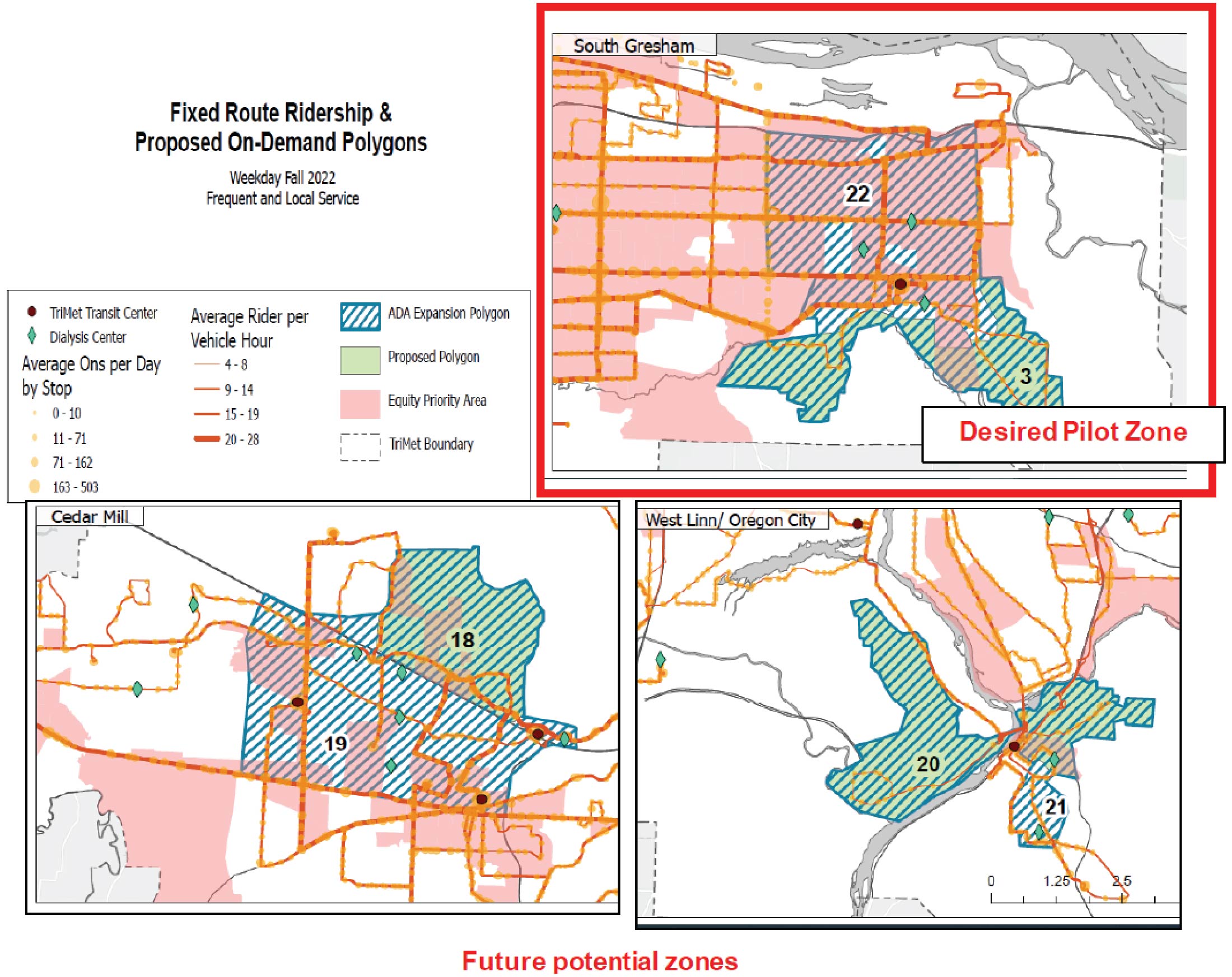
Long Description.
Three areas are highlighted: a "Desired Pilot Zone" in the South Gresham region and two "Future Potential Zones" in Cedar Mill and West Linn or Oregon City. The maps use color coding to indicate TriMet transit centers, routes by average riders per vehicle hour, and proposed on-demand service polygons. Orange lines represent transit routes, and green hatched areas represent proposed on-demand polygons. Map 1 shows the region of South Gresham with 22 and 3 marked in red and green, respectively. Map 2 shows the region of Cedar Mill with 18 and 19 marked in green and blue, respectively. Map 3 shows the region of West Linn or Oregon City with 20 and 21 marked in green and blue, respectively.
The RFP for microtransit software platform technology issued by TriMet includes the following aspects for technical specifications (TriMet, 2024k):
- Customization of the software platform, including white labeling and of agency branding
- Ability to modify software platform algorithm priorities in real time to adjust to existing conditions
- Driver management functions and rider information presented to drivers
- Data ownership and ability to access data from the software platform
- Data reporting features and calculations and how well they meet NTD reporting requirements
- Rider profile and functional features for booking trips and receiving status updates
- Compliance of the software platform features with the ADA
- Honoring negotiated trip times for ADA paratransit riders and ability to adjust dwell/wait times for given riders
- Measurement of OTP based on originally scheduled vs. optimized times
Booking and Communication
Currently, paratransit customers can utilize the smartphone app from the contracted LIFT service provider. LIFT customers receive notification by phone (either text, call, or in the smartphone app) when the vehicle is 15 minutes away from pick-up (TriMet, 2022b). TriMetʼs goal is to have a single app for paratransit or general public microtransit customers alike. The app will eventually allow paratransit customers to schedule paratransit trips on a same-day basis, with the same exceptions for various customers as present in the current LIFT service (i.e., customers receiving hand-to-hand service have additional booking complexities that cannot be achieved through the app); these trips will be a premium service and not given priority over trips scheduled in advance. The current paratransit contractor will continue to operate the call center; general public microtransit customers will have to use the smartphone app, a web portal, or a call center number from the new technology company.
LIFT customers can call in by phone or use the online booking tool to schedule a new trip or modify/cancel an existing trip. For the online option, customers create an account that can be managed from a computer, smartphone, or tablet; this option is suitable for customers who only require door-to-door service, meaning those needing hand-to-hand service from drivers must call in instead. Customers needing to make new or manage existing subscription LIFT trips must also call in. Reservations are taken by call center staff on weekdays 9:00 a.m.–5:00 p.m. or weekends 10:00 a.m.–5:00 p.m. (TriMet, 2024h).
TriMet also has a customer notification phone system, available since 2019. The system provides a phone call reminder about upcoming scheduled trips the day before (at which point the customer is provided the option to cancel their trip) and, on the day of the trip, a notification via phone call when the vehicle is 15 minutes away, in addition to other service notifications like inclement weather announcements. (Other advance notifications can also be set up.) (TriMet, 2024h).
Policies
TriMetʼs current no-show policy counts no-shows, cancellations at the door, and late cancellations together. LIFT customers must cancel their trip at least 61 minutes before the scheduled pick-up window in order to avoid a late cancellation fee. Trips that are cancelled late for emergencies or other circumstances beyond the customerʼs control are not counted as no-shows. Once a customer exhibits a pattern of no-shows, there are four levels of escalation, beginning with a letter of warning and moving on to periods of service suspension. In lieu of a suspension, the customer has the option to pay a fine that is equal to the single-ride fare times the number of trips missed in the calendar month (TriMet, 2018). Customers can also request a same-day service change for their scheduled trip if the request is made more than 120 minutes in advance of
their scheduled pick-up window; LIFT dispatchers do their best to accommodate such requests (TriMet, 2019).
If the new software platform recommends that a paratransit trip be moved more than 5 minutes outside the customerʼs negotiated window, TriMet anticipates that staff will call the customer to confirm that the change is acceptable. Trip denials will be recorded if the new pick-up time is more than an hour from the originally requested time.
Fare Structure and Payment
TriMet anticipates that the fare structure for microtransit service will follow the current rates for TriMet fixed-route service and other fare discount programs. Fares for LIFT are $2.80 per trip, which customers can pay either in cash (drivers do not issue change) or using their Hop Fastpass card (i.e., Hop card) (TriMet, 2024e). LIFT customers using the Hop card can earn a monthly pass as they spend the equivalent rate ($74) for fares in that given month, and customers can also set up auto-loading of funds from their debit or credit cards (TriMet, 2022b). For fixed-route service, TriMet has an Honored Citizen Fare rate that allows qualifying customers (including adults aged 65 and older, people on Medicare, people with disabilities, people who qualify based on income, and veterans or active-duty military) to ride up to 2 hours for $1.40; these customers ride free after spending $2.80 in a day or $28 in a calendar month for the rest of the given period (TriMet, 2024f). The Honored Citizen Fare rate is based on legislative requirements from the State of Oregon.
For microtransit service, the general public fare will be $2.80 per trip and $1.40 per trip at the Honored Citizen rate. The fare for LIFT customers will be based on fixed-route fare rules, regardless of whether they book their trip as an ADA paratransit trip or as a general public microtransit trip. Prescheduled trips by LIFT customers will be $1.40 per trip.
Microtransit service will accept fare payment by Hop card, by Apple Pay/Android Pay, or by tapping their debit/credit card at the time of boarding the vehicle. No cash will be accepted onboard the vehicle. TriMet will not be integrating fares as part of the new microtransit service. General public microtransit customers will pay their fare at the time when they board the vehicle, while paratransit customers will continue to pay for trips through currently available means. The agency may consider some kind of fare integration with the microtransit vendor platform if the microtransit service were expanded throughout the service area.
Commingling Processes
TriMet anticipates that commingling decisions in the microtransit service will vary depending on individual circumstances; factors to be considered could include a passengerʼs mobility needs, trip purpose, and available fleet resources. Trips requiring hand-to-hand service or other similar accommodations would not be commingled with general public riders; instead, TriMet would dispatch a non-dedicated service provider that can assist in paratransit service delivery to fulfill the trip.
The agency would rely primarily on predetermined criteria and characteristics already set up in the software system rather than make decisions on a case-by-case basis. The scheduled trip information would be automatically transferred via link between the two software systems using the available brokering module in the paratransit software platform. TriMet aims to minimize manual interventions by staff, though commingling decisions will be checked by dispatchers on the day of service.
TriMet also anticipates that CDO will be applied continuously to both general public microtransit trips and paratransit trips (currently it is applied only to paratransit). Meanwhile, coordination between dispatchers and drivers will be vital for managing any unexpected service gaps
or early arrivals in the vehicle schedules. Even with CDO applied in the new software solution, paratransit trip times will still be required to adhere to the originally scheduled pick-up window that is communicated to the customer. This means that while the estimated pick-up time may shift within the window based on software algorithm, the window will always remain the same to comply with ADA requirements. The microtransit software platform will also ensure that trips to accommodate mobility devices are matched to the appropriate vehicle types.
TriMetʼs RFP also stipulates that the microtransit software platform must be able to distinguish between different trip booking types and account for other available TriMet services. As mentioned, TriMet does not want to cannibalize fixed-route ridership with its new microtransit service. The RFP states that general public trip requests that can be achieved by a current fixed-route service should not result in an option to reserve a microtransit trip but instead display the available fixed-route options. The software will allow for same-day requests for service (on-demand) through the smartphone app, online web portal, or call center (TriMet, 2024k).
Customer Considerations and Accommodations
LIFT operators will provide door-to-door service for both pick-up and the drop-off, parking as close as possible to the door so that they can escort the customer without losing sight of the vehicle. LIFT operators also provide assistance for boardings and alightings from the vehicle, as well as mobility device securement (TriMet, 2022b). Operators will also provide hand-to-hand service for customers in need of additional assistance, provided that the customer and their caregiver sign an accountability agreement (TriMet, 2022a). TriMet currently uses 5 minutes for dwell/load time for riders using mobility devices in the software platform, noting that sometimes the software platform will double the amount of loading time for riders with multiple devices (e.g., a wheelchair and a walker).
TriMetʼs RFP for microtransit service includes stipulations that vehicle operators will assist with securing mobility devices, but that general public customers will be responsible for carrying bags and other items on and off the vehicle themselves. Operators will be able to assist with and troubleshoot payment issues as well. Customers will indicate (through the app or with the call center) when booking whether they are traveling with a mobility device or service animal; this will enable the software platform to account for vehicle capacity considerations. LIFT customers will also indicate whether they will have any PCAs or companions (up to 2 allowed) at the time they book their trip (TriMet, 2024k).
TriMet anticipates that paratransit riders will be able to request on-demand trips in the microtransit zone, which will be met if capacity is available as a general public scheduled trip. LIFT- eligible customers will still receive door-to-door service even for these same-day booked trips. One use case that may be preferred for the on-demand service option is dialysis trips made by LIFT customers, as on-demand scheduling may be a better fit for when timing of the end of their appointment is uncertain. The current paratransit software platform already includes information on emergency contacts and other accommodation notes for customers as part of their profile.
TriMet currently offers free travel training to riders to learn how to use its bus and rail services, though it is unclear whether this training will extend to the microtransit service. The marketing and community engagement teams in the agency frequently collaborate on marketing efforts and educating riders about new services.
Fleet Mixture and Dispatching
Current LIFT dedicated vehicles have three possible seating configurations: either 10 ambulatory seats and 3 mobility device spots or 12 seats and 2 spots in cutaway buses (left illustration in Figure 23), and 4 ambulatory seats and 2 mobility device spots in Ford Transit vans (center
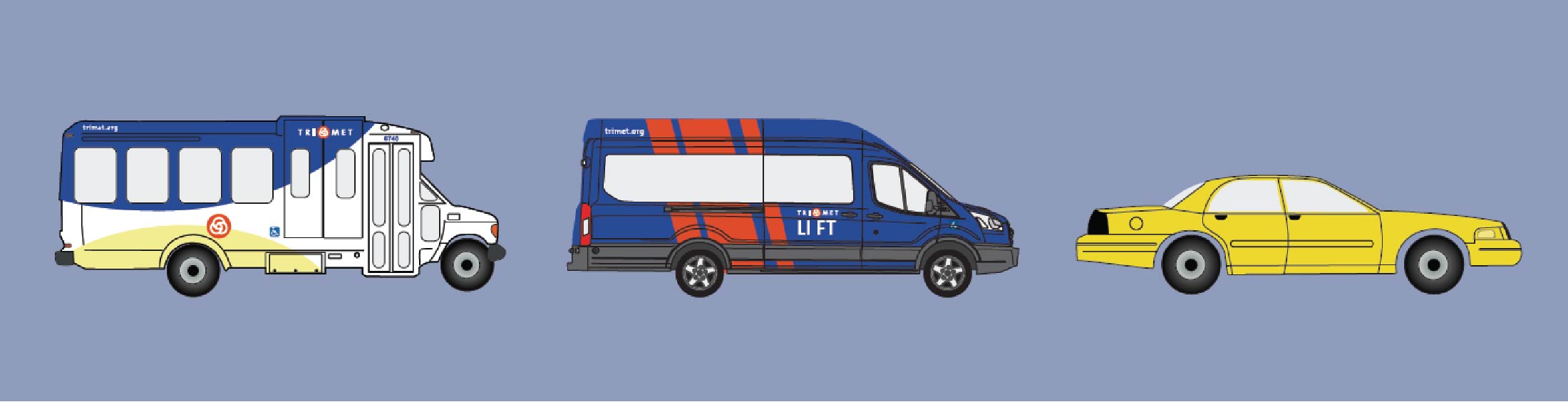
Long Description.
The first vehicle resembles an citibus in white with blue and yellow regions. The second vehicle shows a slightly elongated van in blue with three red stripes at its center. The third vehicle is a taxi in yellow.
illustration). Taxicab sedans are also used as vehicle type by non-dedicated service providers (right illustration); all vehicles display TriMet and LIFT logos (TriMet, 2022b). Vehicles are equipped with tablets that display manifest information to the driver. For the initial microtransit pilot zone, TriMet will use 3 dedicated cutaway buses along with 2 spares to provide service.
For the initial pilot program, trips will be dispatched through integration of the paratransit trip broker module and the microtransit software platform to the available dedicated vehicles in the microtransit zone. The microtransit RFP stipulates that the current dedicated service contractor will operate the microtransit service in agency-owned vehicles branded for the microtransit service (TriMet, 2024k).
For LIFT service, the priority for serving trips in case of a missed trip or road call is (1) a vehicle dispatched from the same provider, (2) a vehicle dispatched from a different provider, and (3) a service supervisor from the contractor fulfilling the trip. TriMet anticipates that these priority rankings will remain the same during the microtransit pilot, with the caveat of wanting to use TriMet-branded vehicles and vehicles branded for the microtransit service in order to show provider consistency to customers. TriMet also wants to ensure that a sufficient number of WAV vehicles for the microtransit zone are available at all times.
Benefits and Impacts
Because the microtransit pilot had not been launched at the time of this writing, TriMet did not yet have data available on impacts of commingling ADA paratransit and general public trips together. LIFT service currently has a productivity rate of about 1.6. Compared to pre-pandemic rates, LIFT usage has recovered around 90% on weekdays and nearly 70% on weekends (higher on Sundays than Saturdays due to church attendance).
TriMet estimates that adoption of the on-demand service technology for trips by LIFT customers will be around 70 to 75% of total microtransit ridership. Conversely, there is concern that general public riders using the service may get impatient due to longer trip durations compared trips taken directly with a TNC. Due to the smaller size of the microtransit pilot zone, TriMet does not envision having to deny requests for general public microtransit trips due to capacity constraints.
TriMetʼs RFP for microtransit technology includes requirements for data reporting, including a live online dashboard with exportable reports, a provision for raw data files available upon request, and main categories for reporting needed by the agency.
The NEXT Neighborhood Express microtransit service is only guaranteed to be a pilot, with any continuation or expansion of the service being contingent on the pilot outcomes. Microtransit
service may not be a good fit for the agency due to extensive service coverage demands in the agencyʼs district. Typical models for microtransit used in the United States have not been successfully advocated for in Portland. TriMetʼs chosen pilot zone fits a unique criteria of higher paratransit ridership and low fixed-route ridership in the area; the zone is also purposefully located at a priority area for those most in need of transit.
TriMet has purposefully been patient in looking for a microtransit opportunity that meets the criteria of agency and ridership needs, wanting to ensure that the main focus remains on performing core agency services well. A challenge in learning more about types of microtransit software and their capabilities in order to make better-informed decisions is that there are no resources available for making a side-by-side comparison of different software platforms. Additionally, because algorithms and features in most software platforms are frequently changing, it is difficult for agencies to keep up and figure out the best set of tools for their unique needs.
TriMet has heard comments from customers in the planned microtransit area that they are excited about the serviceʼs launch. TriMet also hears feedback from the agencyʼs Committee on Accessible Transportation, who has said that they want paratransit customers to have the ability to book same-day paratransit trips for greater spontaneity in travel planning.
Summary
TriMetʼs integrated microtransit pilot will use two different software platforms to prioritize the needs of ADA paratransit riders while fitting in general public trips to remaining vehicle capacity. TriMet will also work with their existing dedicated service contractor and non-dedicated service providers for paratransit as part of the service design for available capacity and operations strategy in the microtransit pilot.
Key Challenges
- Fare Integration. TriMet will not be integrating fares as part of the initial microtransit pilot, due to the complexities involved with fitting the new software into the agencyʼs existing electronic fare payment system.
- Information Overload. Resources and pitches from microtransit companies can be confusing and constantly changing in terms of what is available from the company and the capabilities of the software platforms.
Notable Practices
- Integrated Software. TriMet wants to maintain the prioritization of paratransit customer needs by using the existing software platform for all paratransit reservations and management of fleet resources to meet trip demand.
- Customer Accommodations. Microtransit drivers will provide door-to-door service to paratransit customers, as identified in their customer profiles, who book on-demand trips.
Lessons Learned
- Targeted Service Zone. TriMet is purposefully starting with a small microtransit zone in an area with unique service demand measured in order to prove viability of the service design concept.
- Commingling Criteria. TriMet will not commingle trips that have particular passenger mobility needs or accommodations requested; these factors will be flagged and determined automatically by the software.
Citibus, City of Lubbock, Texas

Long Description.
A stylized citibus logo in red and black appears next to the City of Lubbock Texas logo
The City of Lubbock is a municipality and the county seat of Lubbock County, located in the High Plains/Panhandle region of Texas. The county was founded in 1876 and elected as the county seat in 1891 (Graves, 2016). Lubbockʼs municipal government consists of a mayor and city council members from six designated districts (City of Lubbock, 2024).
Citibus is the name of the public transportation department within the City of Lubbock. Citibus operates local fixed routes that operate in the City, including a set of routes under local contract agreement with Texas Tech University. In total there are 10 local city routes and 7 university routes (Citibus, 2024a). For demand response service, the city operates Citibus On-Demand for their general public microtransit service and Citibus Access (or CitiAccess) for the ADA paratransit service. Prior to the COVID-19 pandemic, Citibus ran a “Night Ride” demand response service. Table 7 shows trip and vehicle data by travel mode for Citibus in 2022.
Citibus was chosen as a case example for their consolidation of ADA paratransit service with on-demand general public trips in microtransit, along with their integration of Medicaid trips which are commingled with microtransit service trips. Their consolidated approach additionally increased the service area for their ADA paratransit service beyond the required boundaries, resulting in increased service access for paratransit-eligible customers.
Demand Response Services Overview

Source: Citibus, 2024c.
Long Description.
A logo with the phrase “on demand GoPass” appears next to the citibus access logo, in which the C in the word “Access” is a stylized wheelchair.
Citibus On-Demand and Access services are available throughout the City of Lubbock; the service zone boundaries for both are set according to the city boundaries. Prior to the On-Demand service, Citibus Access service followed the three-quarter-mile required boundary for ADA complementary paratransit service area around the cityʼs fixed-route service. Access service is now available citywide without any distinctions made for premium service areas. Eligibility for Access service is based on residence within the city limits along with other factors.
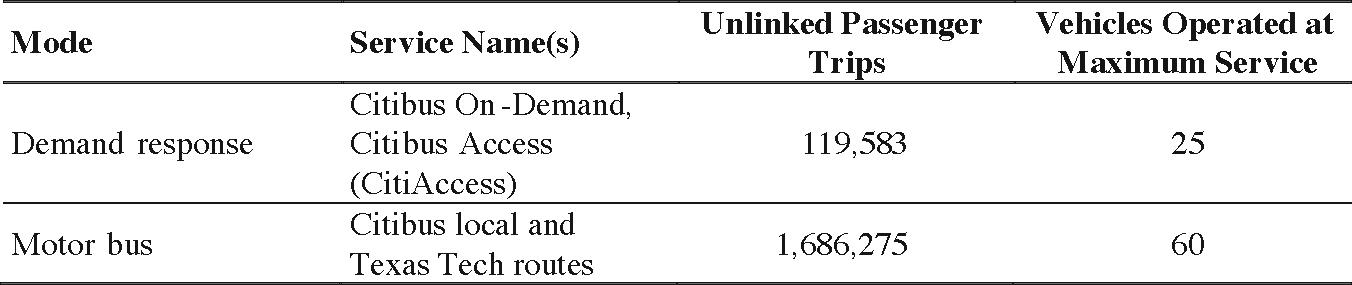
Source: NTD, 2022c.
Long Description.
The column headers of the table are Mode, Services Included, Unlinked Passenger Trips, and Vehicles Operated at Maximum Service. The data given in the table row-wise are as follows: Row 1: Demand response: Citibus On-Demand, Citibus Access (CitiAccess); 119,583; 25. Row 2: Motor bus: Citibus local and Texas Tech routes; 1,686,275; 60.
The Citibus On-Demand pilot program started in May 2020. The city had been considering implementation of microtransit service in the preceding months. When the COVID-19 pandemic hit the United States in mid-March, the implementation of microtransit pilot was sped up with its scope expanded. Citibus had reduced fixed-route service frequencies (from 30 minutes to 60 minutes) along with some small changes to route segments as a result of lower service demand and driver shortages. Citibus had been planning on updating their fixed-route network, but when the pandemic began the city wanted to avoid making too many service changes or disrupting available travel options to customers. Citibus worked with the software company to fold ADA paratransit service into the platform over the course of one week during May 2020 following the start of the microtransit pilot. (In hindsight, the city might have taken more time for this implementation in order to iron out the kinks and ensure that the both the platform and consolidated model could handle all service parameters.)
Citibus also serves Medicaid trips on the same set of vehicles used for microtransit service with On-Demand and Access trips. The city is typically sent reservations for Medicaid trips from the broker about 3 to 4 days in advance; sometimes these requests come in on short notice, but not typically.
Service Design and Parameters
Citibusʼ intention with implementing its On-Demand service was to help fill in the service gap areas not already covered by the cityʼs fixed-route bus service or its Access service (Citibus, 2023, 2024c). Goals for the consolidation of On-Demand and Access services included decreasing costs, thereby improving cost efficiency and cost effectiveness; improving OTP; and bolstering ridership to fixed routes.
On-Demand Service
The city made the decision to make the On-Demand service zone citywide rather than limited to a smaller area, in order to test demand in areas not previously serviced by fixed routes. The city saw a benefit in generating data in areas newly served to have a better understanding of where trip demand occurs throughout the city, which could then be applied to further service planning efforts. On-Demand service is available on weekdays, 7:00 a.m.–11:00 p.m., and on Saturdays, 7:00 p.m.–11:00 p.m.; the evening-only service on Saturdays partially overlaps with the end of the fixed-route service period.
Citibus did not have explicit target rider markets in mind when developing the microtransit service. The city was interested to see where trips might be generated in areas of the city that did not previously have transit service. There was some interest in seeing the service demand in some areas with higher concentrations of lower-income households. Citibus is now providing some trips for requests in all areas of the city (both general public and ADA paratransit). Some areas had particular service demand growth; for example, the city observed that trip demand in the far south area of Lubbock began to grow after the microtransit implementation.
Access Paratransit Service
Access service is available on weekdays 5:35 a.m.–7:45 p.m. and Saturdays 6:35 a.m.–7:55 p.m. (Citibus, 2024c). Citibus decided to fold paratransit service into the same software platform used in the On-Demand pilot in order to help simplify processes for schedulers and vehicle operators while using the same paratransit vehicles for service. Prior to On-Demand service, the Access service area was confined to the ADA-required three-quarter-mile minimum boundary within fixed routes. The city saw a need for further transit service in the community, including expanded paratransit service availability. Access service is currently available anywhere within the Lubbock city limits, or other locations (none currently) designated/approved by the Transit Advisory Board (Citibus, 2023).
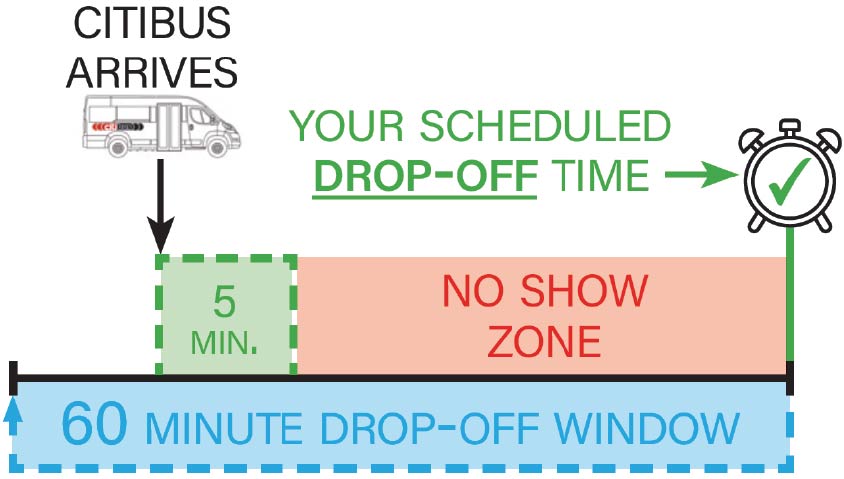
Long Description.
A flow chart depicts a 60-minute drop-off window in blue. A green section above the blue section represents the 5-minute period before the scheduled drop-off time. A red section labeled “No Show Zone” indicates the period after the scheduled drop-off time, emphasizing that the passenger must be dropped off by the scheduled time to avoid a no-show. An arrow points to a green check mark on a clock icon next to the text "Your Scheduled Drop-Off Time"; above the arrow is a transport vehicle with the words “Citibus Arrives.”
Pick-up and drop-off windows for Access trips are specified in Citibusʼ Guide to Ride. For trip pick-ups based on the scheduled pick-up time, Access uses a service window of −0/+30 minutes (that is, zero to 30 minutes after the scheduled pick-up time), after which “untimely service” is considered to have occurred. Trip pick-ups based on the scheduled drop-off time have a vehicle arrival window of 1 hour before the appointment/drop-off time (see Figure 24); customers are expected to board within 5 minutes of the vehicleʼs arrival. Access trips that are cancelled within 2 hours of the scheduled pick-up time are considered late cancellations (Citibus, 2023).
Medicaid Service
Medicaid service provided by Citibus has its own specific criteria and guidelines that the city must follow. Pick-ups for Medicaid passengers can occur up to 1 hour before the scheduled appointment/drop-off time (see Figure 25). The vehicle operator waits 10 minutes upon arrival at the pick-up before the trip is considered a no-show. All Medicaid trips are scheduled by Medicaid passengers directly with the Medicaid office rather than calling Citibus. Similar to paratransit, Medicaid passengers can schedule their return trips as will-call trips rather than prescheduling the trip in advance (also through the Medicaid office) (Citibus, 2023).
Fare Rates
Prior to the consolidated service in 2020, fares for Access were $3.50 per trip (consistent with the cost of an all-day pass on fixed-route service) along with some premium fare rates for destinations outside of the three-quarter-mile service zone. During the first 6 months of the COVID-19 pandemic, Citibus made all services fare-free; then, fares for all services were set to $2 a trip. The reasoning for restoring fares at lower levels than before was to account for customers now
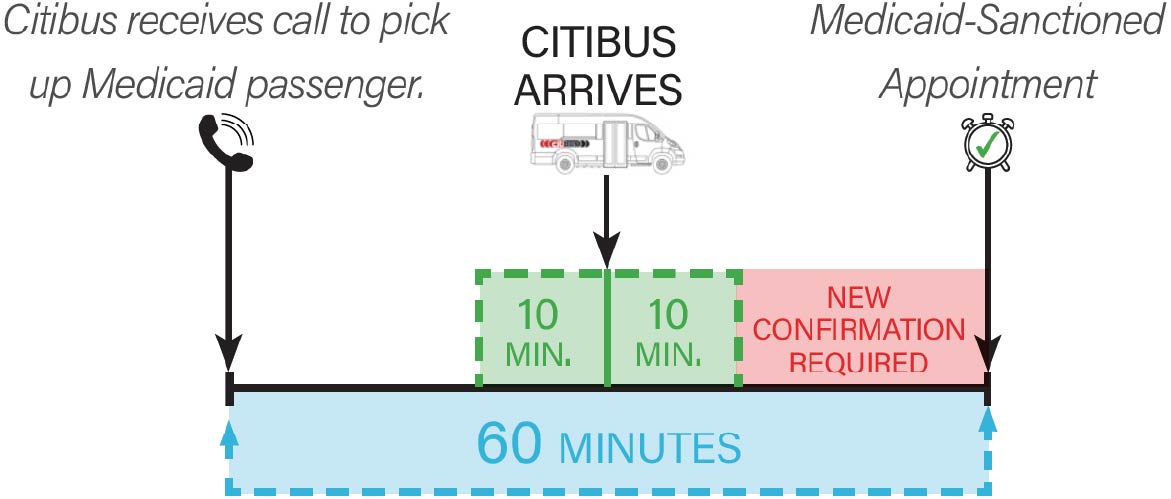
Long Description.
The process shown in the flow chart begins when Citibus receives a call to pick up a Medicaid passenger. A 60-minute window is shown in blue. The vehicle arrives within a green 20-minute window, split into two 10-minute segments. If the passenger is not picked up by the end of this green window, they enter a red zone labeled “New Confirmation Required,” indicating a need to reschedule. The timeline concludes with a Medicaid-sanctioned appointment marked by a clock icon and green check mark.
experiencing reduced service frequencies on fixed-route transit (Citibus, 2023). Additionally, all Access premium fare rates were eliminated as a result of the ADA paratransit service zone being expanded to the entire city limits.
Booking and Communication
The Citibus On-Demand service initially used a smartphone app from the software vendor for customers to request trips. In 2022, the app for the service was changed to GoPass instead; this app also is compatible with the software company but is available from Dallas Area Rapid Transit (DART) in Dallas, Texas, for licensing by other transit agencies. The City of Lubbock signed an interlocal agreement for subscription and license to GoPass in December 2021; the agreement includes consent from the GoPass vendor for DART to grant Citibus license to the software platform (City of Lubbock, 2021).
On-Demand Service App
Citibus was motivated to change to the new app because it allows multimodal trip planning between demand response and fixed-route services; the city wants customers to be able to use a single app for planning and booking trips. The app also restricts customers making advanced reservations, requiring them to request trips at least 2 hours in advance (Citibus, 2024b). The previous app allowed same-day bookings to be made immediately after midnight, resulting in customers logging on to the app at midnight and filling up that dayʼs remaining vehicle capacity. Citibus staff estimates that approximately 80% of general public trips are booked using the GoPass app; the remaining 20% of general public customers call in. Reservationist service hours for On-Demand trips are available Monday through Saturday from 6:00 a.m. to 11:00 p.m.
Currently, a separate smartphone app is needed to schedule Citibus Access ADA paratransit trips. Same-day trips can only be booked in the GoPass app as general public trips (Citibus, 2024b), and fill available vehicle capacity from Access trips booked up to the day before. Initially, the app allowed paratransit customers to book a same-day paratransit trip, but this was a setting in the software platform that was later identified and corrected. The city is working on how to allow advance bookings in the app, which will then allow for booking ADA paratransit trips by Access customers; a future integration is planned to allow for advanced bookings in the GoPass app for both paratransit and general public trips.
Access Paratransit Trips
ADA paratransit customers can schedule a trip in advance of the day of travel over the phone from 6:00 a.m. to 10:00 p.m. Monday through Saturday; these call-in hours are expanded from 8:00 a.m. to 5:00 p.m. prior to 2020. On Sundays, customers can record voicemail messages with their trip reservations, but in practice this feature is seldom utilized (Citibus, 2023). Alternatively, Access customers can use the Citibus Access app to schedule single paratransit trips (subscription trips must call in), and they can view any trips (including subscription and Medicaid trips) in the Access app. Approximately 20% of Access customers use the app to schedule trips; the remaining 80% call in. Before switching to the current set of apps, Access customers were gradually increasing their smartphone app usage for booking, but the change in apps has resulted in more call-in reservations.
Access paratransit trips can be booked from 1 to 7 days in advance either over the phone or through the Access app. The app does not allow for same-day requests to be made for paratransit trips. Citibus will try to accommodate requests for same-day paratransit trips over the phone if space is available in remaining service capacity. Access customers can make subscription bookings for ADA paratransit trips if they have planned travel to the same location at least once a week
for a minimum of 90 days. As a policy, Citibus limits subscription trip bookings to no more than 50% of their prescheduled service (Citibus, 2023).
Medicaid Trips
All Medicaid trips must be scheduled by customers through the Medicaid broker. Medicaid customers are directed to preschedule their trips through the Medicaid booking system from 3 to 4 days in advance. The Medicaid office has a specific phone number for trip reservations on weekdays from 8:00 a.m. to 5:00 p.m. to schedule these trips. Same-day requests for scheduling Medicaid trips to go to appointments are typically not available due to seating capacity (Citibus, 2023), but Citibus will provide some will-call return trips for Medicaid customers.
Same-Day Communication
Citibus has an IVR system. Customers can sign up for and receive text message alerts plus same-day reminders and notifications about their trips through the smartphone app. Riders communicate only with customer service agents for service-day calls. Citibus has a maximum of three customer service agents available at any given time (Rodman and Blume, 2023). Generally, these agents will only adjust and move trips in the software platform during a vehicle breakdown situation.
Fare Payment
As discussed earlier, single rides for On-Demand general public and Access paratransit trips are all $2 per trip (Citibus, 2024c). For comparison, fixed-route service is $1 for a one-way trip and $2 for an all-day pass. For Citibus microtransit, customers have the option to pay cash at the time of boarding the vehicle, pay with an integrated electronic fare (e-fare), or use the smartphone app for fare payment; the smartphone app can only be used for fare payment if the customer books the trip through the app originally. Passes for microtransit trips can also be purchased from the Citibus Administrative Offices on weekdays from 8:00 a.m. to 5:00 p.m. Medicaid trips are paid entirely through the Medicaid program, so no fare is collected from the customer for those trips (Citibus, 2023).
Both smartphone apps, GoPass and Access, can handle trip reservation and fare payment functions. Customers have the option to save a credit/debit card into the app for fare payment; when the customer books a requested trip in the app, the app gives them the choice of paying with the saved card in the app or with cash at the time of boarding. The vehicle operator can see on their tablet whether the customer has already paid their fare in the app prior to boarding the vehicle.
The GoPass app has a workaround option, Vanilla Direct Pay, that enables riders to use cash to add value to their in-app wallet through a barcode scan directly in the smartphone app. The app user can go to the register at certain local convenience stores and retailers and give the cashier cash for the amount they want added to the wallet. The cashier scans a barcode in the userʼs app, and the value of the cash paid is added to the userʼs wallet (Citibus, 2024d). Figure 26 is an illustration of how Vanilla Direct Pay works for customers.
Commingling Processes
In the Citibus On-Demand and Access microtransit service, all trip types are commingled together in the same vehicles, including general public, ADA paratransit, and Medicaid. Commingling is managed automatically by the software platform, with no manual interventions from Citibus staff. Access trips are booked as first priority in the software platform, ahead of general public trips (Spare Labs, 2024b). There is no priority within ADA paratransit trips for Access customers, meaning all Access trips get the same priority level regardless of location (as long as the origins and destinations are within city limits).
Long Description.
The first panel shows a user adding funds to their GoPass wallet using cash, highlighting the "Add Funds to Wallet" option. The second panel directs users to tap “Add Funds Using Cash” and shows participating retailers like CVS, Walgreens, Family Dollar, and 7-Eleven. The third panel displays a barcode used for payment at the store, with instructions to show the code to the cashier. The fourth panel features a map view in the app to help users find a nearby retail location to complete the transaction. The text emphasizes that this system is aimed at riders who have cash but no credit or debit card.
In the parameters of the software, ADA paratransit and Medicaid trips both have the same level of priority and are assigned as Access trips. Any remaining seating capacity on the vehicles is then available for general public trip requests. If an Access trip is cancelled before or on the day of service, additional capacity is opened up to meet general public trip requests. Same-day rides booked as On-Demand trips are given lower priority compared to Access trips (either ADA paratransit or Medicaid). The software platform then selects the time closest to the customerʼs request based on availability (Citibus, 2023).
Originally, Medicaid trips were only assigned to vehicles with drivers that were credentialed for Medicaid, which requires specific paperwork to be filled out by the driver at the time of the trip. Citibus had specific drivers that were credentialed for Medicaid trips; the software would match Medicaid trips to those drivers and vehicles only. Over time staff found this setup to be limiting; Medicaid trips could not be reassigned to vehicles in real time, restricting the service from achieving maximum efficiency. Citibus changed their approach; now, all drivers are credentialled for Medicaid trips, helping to ensure flexibility and efficient handling.
Pick-up Windows
For ADA paratransit trips, Citibusʼ microtransit service locks the confirmed pick-up and drop-off windows in place at the time of the trip booking. At the start of the consolidated service implementation, the city worked with the software vendor to adjust settings in the platform that were moving paratransit trip times and ultimately misrepresenting OTP. The initial OTP for Access trips following launch was 99%, but it was discovered that the platform would automatically move back the scheduled pick-up time in order to achieve better performance. An adjustment was made to timestamp and lock the trip pick-up and drop-off windows based on the confirmed times with the customer.
Before 2020, Citibus used a −15/+15 minute pick-up window for paratransit trips. This was changed to −5/+25, then, with the consolidated service, 0/+30; the same window is applied to general public trips to create uniform operations for all trips. Access customers have told the city that they like this change because it has made their pick-up times more fixed regardless of trip type. If the vehicle arrives before the pick-up time, the driver will wait for the customer to board when they choose; sometimes the customer will board before the scheduled time (which then actually reduces OTP for the service). Access customers also have the option to book by drop-off time instead (as discussed earlier).
Continuous Dynamic Optimization
Citibus began using CDO in the software platform in January 2022; the goals of this implementation were to further improve productivity, reduce costs, improve OTP, and have higher quality of dispatching. The software platform automatically reassigns trips to different vehicles in the dedicated fleet and updates the driversʼ tablets in real time (Rodman and Blume, 2023). The software platform is set to allow for a maximum of 20 additional minutes of flexibility in travel time (while still being on-time for a scheduled drop-off) as well as a maximum of total on-board trip time of 1 hour. These limits are in effect for all customers on the day of service.
The city has not seen any major issues with using CDO from a commingling standpoint. Sometimes a customer will not understand why they cannot be driven home directly, or why their trip time has some slight added inconvenience from serving other trips. Citibus has seen some complaints from customers whose pick-up time is changed (within their originally confirmed window) as CDO processes are applied. Customers may receive multiple notifications about pick-up times which can lead to minor confusion, and sometimes the vehicle will arrive earlier than expected (Rodman and Blume, 2023).
Customer Considerations and Accommodations
Citibus has three levels of service assistance in the consolidated microtransit service, organized as a tiered structure and making reasonable modifications based on passenger need. Citibus gathers information on Access customersʼ needs during the eligibility application process. Level 1 is curb-to-curb service, level 2 is door-to-door service, and level 3 is hand-to-hand service (Citibus, 2023). The vehicle operator can see in the passenger notes displayed on their tablet what level of assistance the customer needs.
Citibus at first thought about creating a formal policy based on this assistance structure, but ultimately did not do so to avoid labeling passengers. Instead, Citibus has fields in the software platform about the level of accommodations the customer needs. Currently there are no preset modifications to the dwell times for the trip based on the assistance level in the parameter settings of the software platform. According to policy, operators can assist passengers in carrying up to 4 bags, which cannot exceed 20 pounds combined (Citibus, 2023).
Access customers may be accompanied by an unlimited number of companions of PCAs during an ADA paratransit trip; these additional riders must be indicated at the time the trip reservation is made, whether over the phone or through the Access app. Companions are charged the same applicable fare rate as the customer. However, PCAs who can provide a form showing they are qualified to serve in that role can ride free (Citibus, 2023).
Medicaid Trips
Vehicle operators on Medicaid trips must be credentialed to provide Medicaid transportation. However, software optimization in the consolidated service means that Medicaid trips may be moved from vehicle to vehicle rather than staying with a credentialed driver; this resulted initially in Medicaid trips being assigned to drivers that were not credentialed. To correct this problem, Citibus worked with the software vendor to create a “duty” for each type of service, then assigning the duties to the drivers operating vehicles on that day. The platform is then able to match the right trips to the available duties, and Medicaid trips are only assigned to Medicaid-credentialled drivers. Citibus gives those drivers the paperwork for all possible Medicaid trips they may or may not serve that day (Rodman and Blume, 2023).
Feedback and Awareness
Citibus focuses upon ride ratings and comments from customers made through the feedback mechanism in the smartphone apps, rather than conducting formal surveys. The city has not made any efforts toward formal customer education other than announcing the service and making information on how to use it available online. The city is trying to be more definitive with customers on what the service will or will not do for travel or accommodations. When the city has had to place limits on service, that has necessitated communicating those limits back to the customer. Citibusʼ current strategy is to onboard new ADA paratransit customers through use of the smartphone app at the point of eligibility assessment or recertification.
Citibus does offer a free travel training program for customers to learn how to use Access, On-Demand, and fixed-route services. The program provides individualized training and is available to all customers regardless of whether their eligibility for Access service is approved (Citibus, 2023). The Guide to Ride available on Citibusʼ website has information about riding Access and On-Demand service together; the guideʼs approach treats the booking, communications, and boarding processes between the two consolidated services as the same while making any necessary distinctions for ADA paratransit and Medicaid requirements along the way.
Fleet Mixture and Dispatching
Vehicles for the microtransit service are branded as Citibus, using the cityʼs existing Access service fleet. No new vehicles were acquired before implementation of the On-Demand service; the same fleet capacity was the same as it had been for Access service. The city is now running a couple of additional vehicles in the fleet during evening hours, now four to five vehicles compared to two to three in 2019, depending on demand.
Fleet Mixture
The Citibus DRT fleet consists of 10 New England Wheels Frontrunner vans, 9 Chevrolet ARBOC Cutaway vans, 14 Dodge Promaster 3500 vans, and 2 Dodge Promaster 1500 vans. The makeup of the diversified fleet (see Figure 27), with 4 different vehicle types and smaller vehicles, was orchestrated to help with Citibusʼ operations costs, but has limited the number of vehicles that can accommodate multiple customers with mobility devices. The Frontrunner and Cutaway vans can accommodate up to 3 mobility devices, while the smaller vans can accommodate 1 or 2 each.
Long Description.
Two Citibus DRT vehicles are shown. The first vehicle, at top, features a high-roof design with double passenger doors in the middle, while the second vehicle, at bottom, has a lower profile and a single side door. Both vans display the Citibus logo on the side in bold lettering.
The smaller vehicles are also designed for light duty, but due to high service demand and the large service area they have accumulated more mileage than anticipated from longer trip lengths.
Dispatch and Communication
The software platform helps Citibus determine the number of vehicles that need to be in service based on demand, and the cityʼs operations team knows how to make adjustments to the in-service fleet numbers as needed. Sometimes staff must force an Access trip into the vehicle run in order to accommodate the reservation; this will cause late trips and further effects downstream, but CDO eventually corrects for these issues. The actual vehicle arrival times for each trip pick-up and drop-off are determined automatically by the software platform.
In the instance that a road call or missed trip occurs, Citibus will first dispatch another DRT vehicle in revenue service. If there is not a vehicle nearby that can take on the passengers due to available seating capacity or trip parameters, Citibus will dispatch a road supervisor to fulfill the trip. Citibus call specialists field any customer calls received on the day of service. Dispatchers can get in touch with vehicle operators through either the tablets or radio communication (Rodman and Blume, 2023).
Benefits and Impacts
Citibus looks at performance for all microtransit service trips together rather than separating out trips by type; this is made easier by the fact that general public trips use the same OTP windows and trip parameters as ADA paratransit trips. Citibus has not had any issues with gathering tracking data needed for ADA paratransit service and Medicaid program compliance. Overall, the microtransit service has an average productivity of 2.6 trips per revenue hour on weekdays and 1.0 trip per hour on weekends, while the serviceʼs average pick-up time for on-demand trips is 15 minutes or less (Citibus, 2023). Implementing CDO in the software platform improved productivity and reduced operating cost per trip while lowering the number of real-time interventions needed from dispatchers (Rodman and Blume, 2023).
The overall service areas for the On-Demand and Access services expanded when the microtransit service began and have remained the same since May 2020. As a result, trip lengths can commonly extend to 10 miles. Use of the paratransit service grew as a result of the expanded service area, creating additional demand beyond the capacity needs Citibus had anticipated. There have also been anecdotal reports of fixed-route busses and microtransit vehicles traveling down the same road. The long microtransit trips are not efficient from either a service or cost perspective, putting a strain on the vehicles and racking up miles in the Citibus fleet. Paratransit service utilization grew as a result of the expanded service area, creating additional demand that has grown beyond Citibusʼ anticipated capacity availability. The city is currently thinking about how they can scale back service availability to make better use of dollars and resources.
Service Demand
ADA paratransit and Medicaid trips were not distinguished in the data before 2020, so the city does not have hard data on paratransit service usage compared to service prior to the COVID-19 pandemic. Citibus estimates that ADA paratransit trips are up between 25 to 50 trips daily compared to 2019. Citibus previously received more Medicaid trips from the broker, but presently Medicaid trip numbers fluctuate from day to day. Prior to 2020, Citibus had a maximum of 350 demand-responsive trips daily; currently, the city is providing 600 microtransit trips daily (including general public).
The increase in demand for paratransit trips has strained the capacity of the available fleet and drivers to provide service. Staff have observed that trip distribution in the service area was
more balanced two years ago, but since then there have been more trips originating in the far south area of the city. The surge in demand has provided data to staff for further analysis and insight but has made it difficult to provide enough service on the road. Meanwhile, fixed-route service has not been restored to pre-2020 service schedules and frequencies due to a shortage of available drivers; once it is possible to do so, Citibus plans to implement previous fixed-route service schedules all at once in order to minimize service disruptions. Citibus is presently considering how to accommodate additional service demand growth and optimizing its microtransit operations.
Maintaining efficient costs of service operations has been difficult with general public microtransit and ADA paratransit service being available citywide. A possible unintended consequence of expanded service is that riders who previously used fixed-route transportation now seem to be using microtransit for some trips instead. For example, Citibus has seen college students using microtransit for on-demand trips even though the city is also providing fixed-route service on campus. Some customers take microtransit trips even though fixed-route service is available due to the convenience of on-demand; this is not an ideal outcome for the service implementation. Fixed-route ridership has grown in the last few years but is probably 150,000 trips short of pre-pandemic levels (albeit as the city is operating 45% less service).
On-Time Performance
On-time performance (OTP) is the primary performance metric that the city uses to monitor the service. ADA paratransit service previously had an OTP ranging from 72% to 74% prior to 2020. Since moving to the current software platform for microtransit, overall OTP for all trips is 93% (89% for Access trips, 94% for general public) thus far in 2024. This improvement has met the cityʼs goal for increasing OTP. The software platform produces a report that shows OTP broken down into various categories including overall, by pick-up, by drop-off, and by different types of trips. Citibus does not have a set goal for OTP but instead monitors OTP performance over time.
Other Available Data
Citibus staff also monitors vehicle loads, passenger hours (i.e., ride times), and locations of trips for a perspective on service performance. Citibus will look at trip ratings data and submitted comments as they come in through the smartphone apps. The software platform has a live dashboard with exportable reports that have met Citibusʼ needs for reporting and compliance without any issues.
Summary
Citibusʼ consolidation of ADA paratransit service into its on-demand microtransit service has enabled the city to more efficiently match trips to available DRT vehicles. Using identical service areas and pick-up windows for both general public and ADA paratransit trips has simplified operations for staff and drivers as well as communication with customers about the service.
Key Challenges
- App Integrations: Presently there are two different smartphone apps for the microtransit service, one for booking on-demand trips and the other for booking ADA paratransit trips. Replacing the two current apps with a single new smartphone app with additional features for general public trips could leave some gaps for ADA paratransit customers.
- Demand Growth: The large service area for all trip types has led to growth in the number of ADA paratransit trip requests and in the length of trips served, as well as some ridership moving from fixed routes to microtransit.
Notable Practices
- App Wallet: The smartphone app for the On-Demand service allows a variety of fare payment methods for general public trips, including paying cash to increase the value of the userʼs stored wallet in the app to pay toward future trips booked.
- Medicaid Integration: Citibus schedules Medicaid trips into the software platform from trips brokered up to before the day of service. The service provides the same prioritization to Medicaid trips as ADA paratransit while also handling different pick-up windows, trip parameters, and will-call returns.
Lessons Learned
- Advance Booking: Previous settings in the smartphone app allowed general public customers to fill up available capacity after midnight on the day of service. The city adjusted parameters to make sure settings were not overly accommodating for these trips.
- Required Credentials: The integration of Medicaid trips into microtransit had initial growing pains due to the requirement that trips be matched to credentialed drivers. A decision to have all drivers so credentialed helped improve service efficiency.


