Full-Depth Reclamation: Current Practices (2025)

Chapter: Appendix C: Other Agency Survey Responses

Previous Chapter: Appendix B: Agency Survey Responses (DOTs)
Suggested Citation: "Appendix C: Other Agency Survey Responses." National Academies of Sciences, Engineering, and Medicine. 2025. Full-Depth Reclamation: Current Practices. Washington, DC: The National Academies Press. doi: 10.17226/29222.

APPENDIX C
Other Agency Survey Responses

An additional survey was sent to other agencies as well. This survey was identical to that distributed to the state DOT agencies. The respondents of this survey include the following agencies: Bitume Quebec, New Brunswick Dept. of Transportation and Infrastructure, City of Calgary, City of Ottawa, Alberta Transportation and Economic Corridors, Ministry of Transportation Ontario, Saskatchewan Ministry of Highways, Nova Scotia Public Works, Manitoba Transportation and Infrastructure, Government of Newfoundland and Labrador Transportation and Infrastructure, City of Medicine Hat, University of California Pavement Research Center, Ministère des Transports du Québec, KGS Group, U.S. Forest Service, and Halifax Regional Municipality.

A pie chart shows the distribution of responding other agencies and their use of mechanical F D R and slash or F D R.
Figure 47. Distribution of responding other agencies and their use of mechanical FDR or FDR over the past 5 years (number of responses = 16).
Long Description.

The data is as follows. Both mechanical FDR and FDR, 8. Mechanical FDR only, 5. FDR only, 1. Mechanical FDR or FDR not used, 2.

Suggested Citation: "Appendix C: Other Agency Survey Responses." National Academies of Sciences, Engineering, and Medicine. 2025. Full-Depth Reclamation: Current Practices. Washington, DC: The National Academies Press. doi: 10.17226/29222.
A pie chart shows the distribution of responding other agencies and their years of experience with F D R.
Figure 48. Distribution of responding other agencies and their years of experience with FDR (number of responses = 13).
Long Description.

The data is as follows. Less than 5 years, 0. 5 to 10 years, 1. 10 to 20 years, 6. More than 20 years, 6.

A pie chart shows the distribution of responding other agencies and the approximate number of lane miles of F D R.
Figure 49. Distribution of responding other agencies and the approximate number of lane miles of FDR they perform per year (number of responses = 13).
Long Description.

The data is as follows. Less than 50 lane miles, 7. 50 to 100 lane miles, 1. More than 1000 lane miles, 3. Unsure, 2.

A bar graph on the distribution of responding other agencies and average daily traffic for roads on which F D R is performed.
Figure 50. Distribution of responding other agencies and the average daily traffic for roads on which FDR is performed (number of responses = 13).
Long Description.

The horizontal axis for the number of agencies ranges from 0 to 10 in increments of 2. The vertical axis for average daily traffic lists different categories. The data is as follows. Less than 2,500, 9. 2,500 to 5,000, 6. 5,000 to 10,000, 6. 10,000 to 20,000, 3. 20,000 to 30,000, 3. More than 30,000, 3. Unsure, 2.

Suggested Citation: "Appendix C: Other Agency Survey Responses." National Academies of Sciences, Engineering, and Medicine. 2025. Full-Depth Reclamation: Current Practices. Washington, DC: The National Academies Press. doi: 10.17226/29222.
A bar graph on the distribution of responding other agencies and the factors considered when determining when to use F D R.
Figure 51. Distribution of responding other agencies and the factors considered when determining when to use FDR (number of responses = 13).
Long Description.

The horizontal axis for the number of agencies ranges from 0 to 14 in increments of 2. The vertical axis lists different categories. The data is as follows. Existing primary stresses, 12. Existing pavement structure, 11. Existing ride quality, 7. Existing subgrade type, 5. Initial slash construction cost, 5. Life cycle cost or cost slash benefit, 4. Other, 6.

Table 28. Other agency reported “Other” factors considered when determining when to use FDR.

Possibility of grade raise

Environmental sustainability

FDR is considered on a case-to-case basis, not at a network level

Structural Integrity

Decision trees in PMS

Frost susceptibility (frost heave, winter riding quality)

A bar graph depicts the distribution of responding other agencies with respect to primary distresses addressed with F D R.
Figure 52. Distribution of responding other agencies with respect to primary distress(es) addressed with FDR (number of responses = 12).
Long Description.

The horizontal axis for the number of agencies ranges from 0 to 14 in increments of 2. The vertical axis lists different categories. The data is as follows. Fatigue cracking, 12. Potholes, 10. Longitudinal and transverse cracking, 9. Rutting, 9. Base failure, 4. Other, 2.

Suggested Citation: "Appendix C: Other Agency Survey Responses." National Academies of Sciences, Engineering, and Medicine. 2025. Full-Depth Reclamation: Current Practices. Washington, DC: The National Academies Press. doi: 10.17226/29222.
A pie chart on the distribution of responding other agencies that perform a pre-design investigation before conducting FDR.
Figure 53. Distribution of responding other agencies that perform a pre-design investigation before conduction FDR (number of responses = 13).
Long Description.

The data is as follows. Yes, always, 10. Yes, sometimes, 2. No, 1.

A bar graph shows the distribution of responding other agencies with respect to testing.
Figure 54. Distribution of responding other agencies with respect to the testing conducted during FDR pre-design investigations (number of responses = 12).
Long Description.

The horizontal axis for the number of agencies ranges from 0 to 12 in increments of 2. The vertical axis lists different categories. The data is as follows. Sampling of materials, 10. Evaluation of the thickness of layers, 9. Evaluation of strength or stiffness of layers, 7. Other, 7.

Table 29. Other agency reported “Other” activities conducted during FDR pre-design investigations.

Boreholes, cores

FWD is conducted on a network level, but not for the purpose of considering FDR treatment

Project level evaluation of distresses; updated traffic counts (including classification)

Agency site investigation guide is followed

Frost heave evaluation

Investigation done regardless of FDR. GPR is sometimes completed.

Suggested Citation: "Appendix C: Other Agency Survey Responses." National Academies of Sciences, Engineering, and Medicine. 2025. Full-Depth Reclamation: Current Practices. Washington, DC: The National Academies Press. doi: 10.17226/29222.
A bar graph shows the distribution of responding other agencies with respect to stabilizing agents used in F D R projects.
Figure 55. Distribution of responding other agencies with respect to the stabilizing agents or additives used in FDR projects (number of responses = 8).
Long Description.

The horizontal axis for the number of agencies ranges from 0 to 8 in increments of 2. The vertical axis lists different categories. The data is as follows. Cement, 7. Foamed asphalt, 6. Emulsified asphalt, 4. Lime or lime kiln dust, 1. Quarry by-products, 1. Calcium chloride, 0. Fly ash, 0. Other, 3.

Table 30. Other agency reported “Other” stabilizing agents or additives used in FDR projects.

Gel asphalt

Choice between FDR-C and FDR-FA is based on material properties (USCS) of the combined recycled material. Emulsified asphalt may be considered in the future.

Most FDRs in province are completed without additive however some projects have been completed with lime (no mix design).

A bar graph shows the distribution of responding other agencies with respect to the pavement design methodology used.
Figure 56. Distribution of responding other agencies with respect to their pavement design methodology used to design an FDR pavement (number of responses = 13).
Long Description.

The horizontal axis for the number of agencies ranges from 0 to 6 in increments of 1. The vertical axis lists different categories. The data is as follows. Empirical design, 5. Mechanistic-empirical design, 3. No design methodology, fixed pavement cross-section for FDR projects, 2. Other, 3.

Suggested Citation: "Appendix C: Other Agency Survey Responses." National Academies of Sciences, Engineering, and Medicine. 2025. Full-Depth Reclamation: Current Practices. Washington, DC: The National Academies Press. doi: 10.17226/29222.
Table 31. Other agency reported “Other” for pavement design methodology used to design FDR pavements.

Empirical Design with a parallel M-E design if FDR is chosen treatment

No current design standard in place for FDR

Shell curves used for pavement design. Recycled material treated as base material.

A bar graph depicts the distribution of responding other agencies regarding how F D R layers property values are determined.
Figure 57. Distribution of responding other agencies with respect to how FDR layer property values are determined during pavement design (number of responses = 5).
Long Description.

The horizontal axis for the number of agencies ranges from 0 to 5 in increments of 1. The vertical axis lists different categories. The data is as follows. Determined project by project, 4. Fixed based on the stabilizing agent used, 1. Fixed across the state, 0. Other, 0.

Table 32. Other agency reported layer coefficient or modulus values used for mechanical FDR.

0.10 to 0.12

Level 3 – mix design value

Depending on existing granular material and depth, consider as subbase (CBR 20) or granular base (CBR 40-80)

1,500 MPa

0.12 to 0.14

310 MPa

0.04 to 0.14 (84 to 209 MPa)

0.1

Table 33. Other agency reported layer coefficient or modulus values used for FDR.

0.25

Level 3 – Mix design value

300 MPa

0.20 to 0.25

3,000 MPa for FDR-FA and 10,000 MPa for FDR-C

0.09 to 0.31 (136 to 972 MPa)

0.14

Suggested Citation: "Appendix C: Other Agency Survey Responses." National Academies of Sciences, Engineering, and Medicine. 2025. Full-Depth Reclamation: Current Practices. Washington, DC: The National Academies Press. doi: 10.17226/29222.
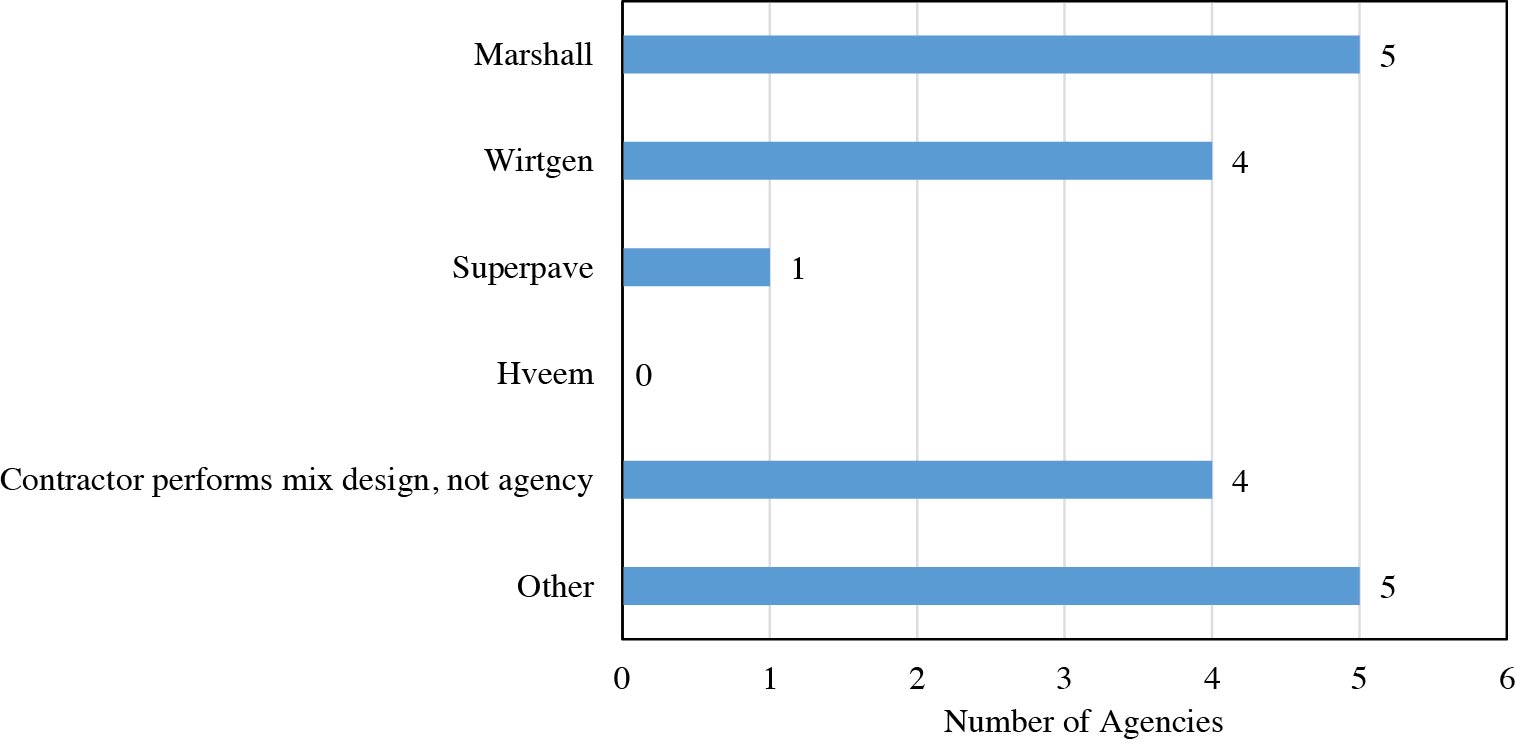
A bar graph shows the distribution of responding other agencies regarding the type of mix design used for F D R projects.
Figure 58. Distribution of responding other agencies with respect to the type of mix design used for FDR Projects (number of responses = 13).
Long Description.

The horizontal axis for the number of agencies ranges from 0 to 6 in increments of 1. The vertical axis lists different categories. The data is as follows. Marshall, 5. Wirtgen, 4. Superpave, 1. Hveem, 0. Contractor performs mix design, not agency, 4. Other, 5.
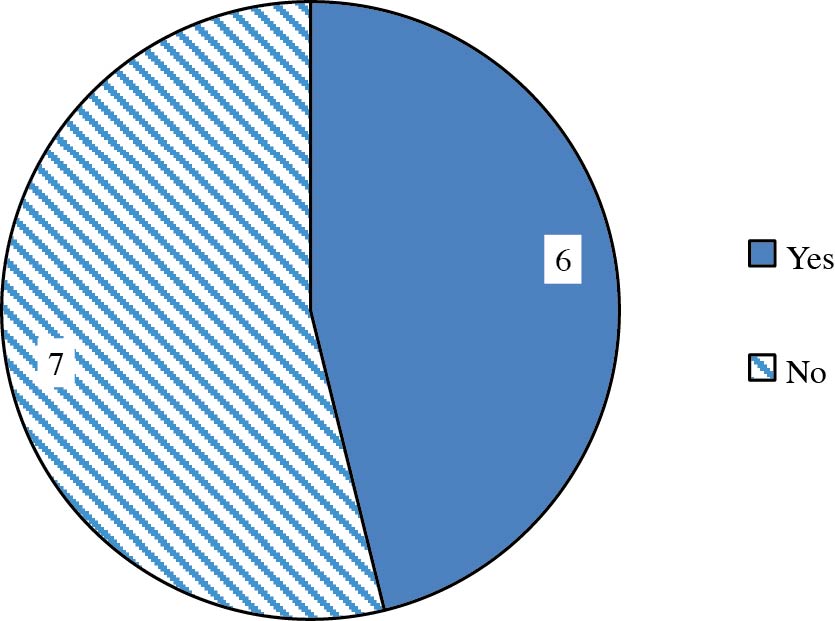
A pie chart depicts other agencies with respect to if their C P T A has a standard specification for mix design of F D R.
Figure 59. Distribution of responding other agencies with respect to if their CPTA has a standard specification for mix design of FDR (number of responses = 13).
Long Description.

A pie chart shows the data as follows. Yes, 6. No, 7.

Table 34. Other agency responses to if they have a standard specification for mix design of FDR.

Mix Design Formulation. Sample recovery and mix design formulation will be conducted by the Department or its representative. Mix designs will be conducted in accordance with procedures outlined in the latest version of the Wirtgen Cold Recycling Manual. (Division 4 Section 22 - Subsection 6.1 https://novascotia.ca/tran/publications/asphalt/Standard-Specification-Manual-2023.pdf)

The mix design methods for FDR-FA and FDR-C are both under revision. Please contact me and I can provide details

Suggested Citation: "Appendix C: Other Agency Survey Responses." National Academies of Sciences, Engineering, and Medicine. 2025. Full-Depth Reclamation: Current Practices. Washington, DC: The National Academies Press. doi: 10.17226/29222.
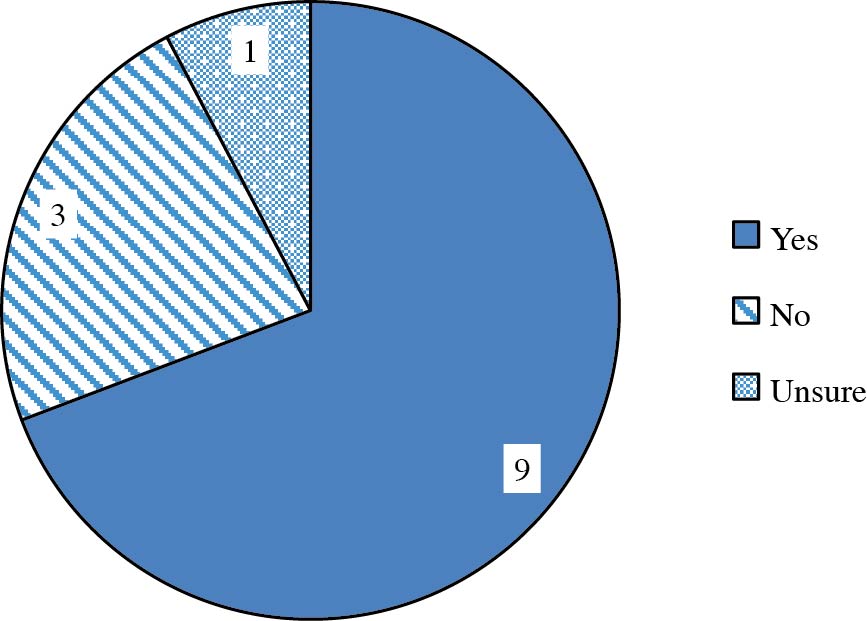
A pie chart shows the distribution of agencies on if they have a standard specification for materials and construction.
Figure 60. Distribution of responding other agencies with respect to whether their agency has a standard specification for materials and construction of FDR (number of responses = 13).
Long Description.

A pie chart shows the data as follows. Yes, 9. No, 3. Unsure, 1.
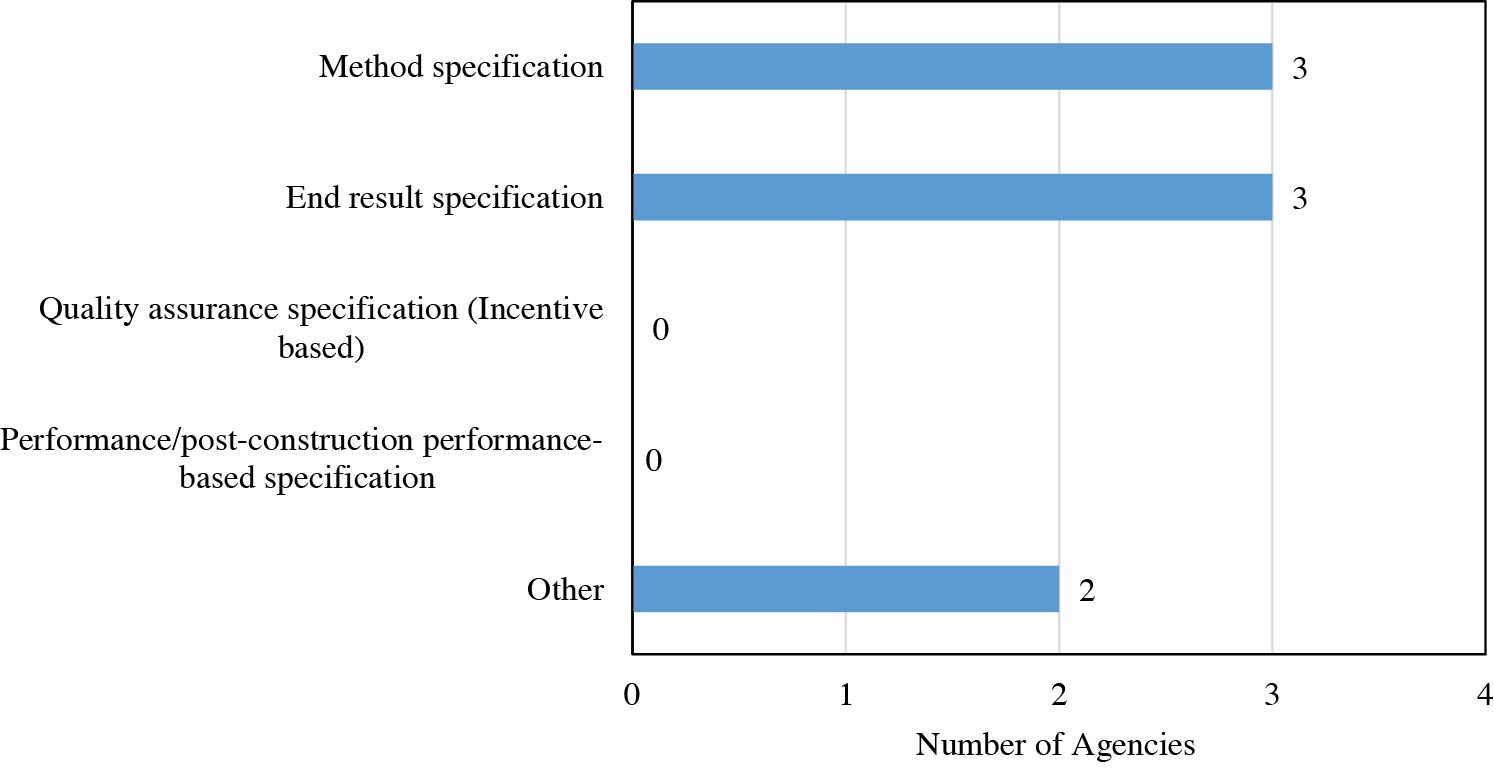
A bar graph shows the distribution of responding other agencies regarding the type of materials and construction standards.
Figure 61. Distribution of responding other agencies with respect to the type of materials and construction Standard Specification their CPTA has for FDR (number of responses = 8).
Long Description.

The data is as follows. Method specification, 3. End result specification, 3. Quality assurance specification (incentive-based), 0. Performance slash post-construction performance-based specification, 0. Other, 2.

Table 35. Other agency reported “Other” for the type of materials and construction standard specification their CPTA has for FDR.

Both method and end result specs.

Go to section 370 – Pulverize Existing Asphalt

Table 36. Other agency responses to if they have a standard specification for materials and construction of FDR.

The specifications for FDR-FA and FDR-C are both under revision. Please contact me and I can provide details

Suggested Citation: "Appendix C: Other Agency Survey Responses." National Academies of Sciences, Engineering, and Medicine. 2025. Full-Depth Reclamation: Current Practices. Washington, DC: The National Academies Press. doi: 10.17226/29222.
A bar graph shows the distribution of responding other agencies with respect to who determines the stabilizing agent type.
Figure 62. Distribution of responding other agencies with respect to who determines the stabilizing agent type in an FDR project (number of responses = 8).
Long Description.

The horizontal axis for the number of agencies ranges from 0 to 5 in increments of 1. The vertical axis lists different categories. The data is as follows. Contractor determined based on agency requirement, 4. Agency determined, 2. Contractor determined independently, 0. Unknown, 0. Other, 2.

Table 37. Other agency reported “Other” for who determines stabilizing agent types in an FDR project.

Agency determined. This is to ensure that recycling agent choice is based on material properties not cost, primarily to avoid shrinkage cracking when FDR-C is used on primarily RAP and AB materials

Donʼt typically use stabilizing agent but if used, agency determined.

A bar graph shows data from responding other agencies regarding the primary factor used to determine stabilizing agent type.
Figure 63. Distribution of responding other agencies with respect to their primary factor used to determine the stabilizing agent type used in FDR projects (number of responses = 6).
Long Description.

The horizontal axis for the number of agencies ranges from 0 to 4 in increments of 1. The vertical axis lists different categories. The data is as follows. Mix design results, 3. Historic use or past performance, 2. Traffic level, 0. Availability of material, 0. Life cycle cost analysis, 0. Other, 1.

Suggested Citation: "Appendix C: Other Agency Survey Responses." National Academies of Sciences, Engineering, and Medicine. 2025. Full-Depth Reclamation: Current Practices. Washington, DC: The National Academies Press. doi: 10.17226/29222.
Table 38. Other agency reported “Other” for how stabilizing agent types are determined in FDR projects.

Local experience and pavement design analysis (stabilizing agent used in no more than 17% of past FDR projects due to curing issues).

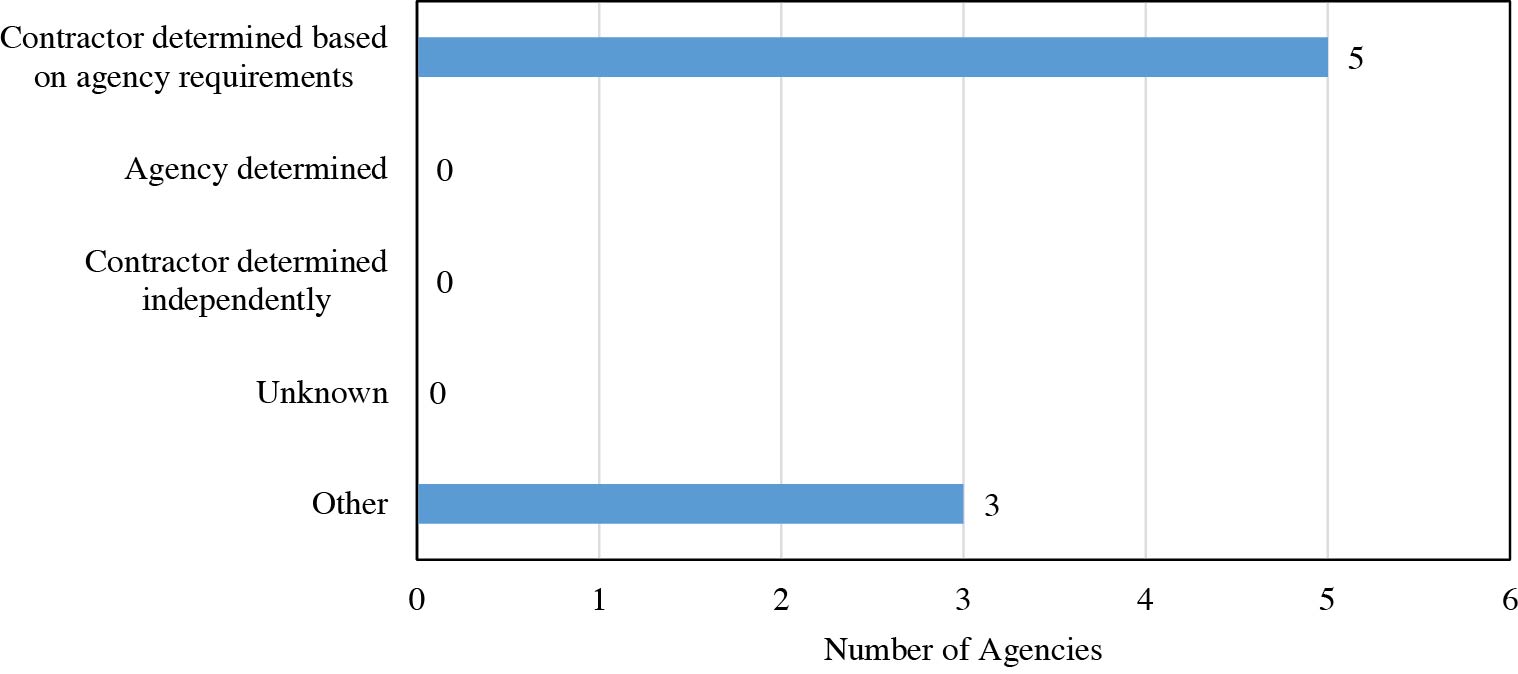
A bar graph shows data from responding other agencies regarding who determines stabilizing agent dosage in an F D R project.
Figure 64. Distribution of responding other agencies with respect to who determines the stabilizing agent dosage in an FDR project (number of responses = 8).
Long Description.

The horizontal axis for the number of agencies ranges from 0 to 6 in increments of 1. The vertical axis lists different categories. The data is as follows. Contractor determined based on agency requirement, 5. Agency determined, 0. Contractor determined independently, 0. Unknown, 0. Other, 3.

Table 39. Other agency reported “Other” for who determines stabilizing agent dosage in FDR projects.

FDR only includes pulverization and grading – no additives are applied.

Bitumen type and dosage depend on mix design testing and cement dosage is agency determined

Donʼt typically used stabilizer but agency selected if used.

A pie chart shows the data from responding other agencies regarding the determination method of stabilizing agent dosage.
Figure 65. Distribution of responding other agencies with respect to determination method of stabilizing agent dosage (number of responses = 8).
Long Description.

The data is as follows. Dosage determined by performing a mix design, 5. Fixed dosage based on stabilizing agent type, 1. Other, 2.

Suggested Citation: "Appendix C: Other Agency Survey Responses." National Academies of Sciences, Engineering, and Medicine. 2025. Full-Depth Reclamation: Current Practices. Washington, DC: The National Academies Press. doi: 10.17226/29222.
Table 40. Other agency reported description of how “Fixed Dosage is Based on Stabilizing Agent Type” in FDR projects.

3 stabilization types: emulsion (or foamed bitumen) with 0%, 0.8% or 1.5% cement

Table 41. Other agency reported “Other” for determination method of stabilizing agent dosage.

No additive for FDR – only Mech. FDR

Again, stabilizer not really used.

A bar graph shows the distribution of responding other agencies regarding the Q A processes used for F D R construction.
Figure 66. Distribution of responding other agencies with respect to the QA processes used for FDR construction (number of responses = 13).
Long Description.

The horizontal axis for the number of agencies ranges from 0 to 8 in increments of 2. The vertical axis lists different categories. The data is as follows. Contractor Q C and agency inspection or testing, 7. Agency inspection and testing only, 4. Contractor Q C only, 1. No Q A process, 0. Other, 1.

Table 42. Other agency reported “Other” for QA processes used for FDR construction.

Method Spec. for Mech. FDR – Agency QC/QA and Contractor responsible for own QC

Suggested Citation: "Appendix C: Other Agency Survey Responses." National Academies of Sciences, Engineering, and Medicine. 2025. Full-Depth Reclamation: Current Practices. Washington, DC: The National Academies Press. doi: 10.17226/29222.
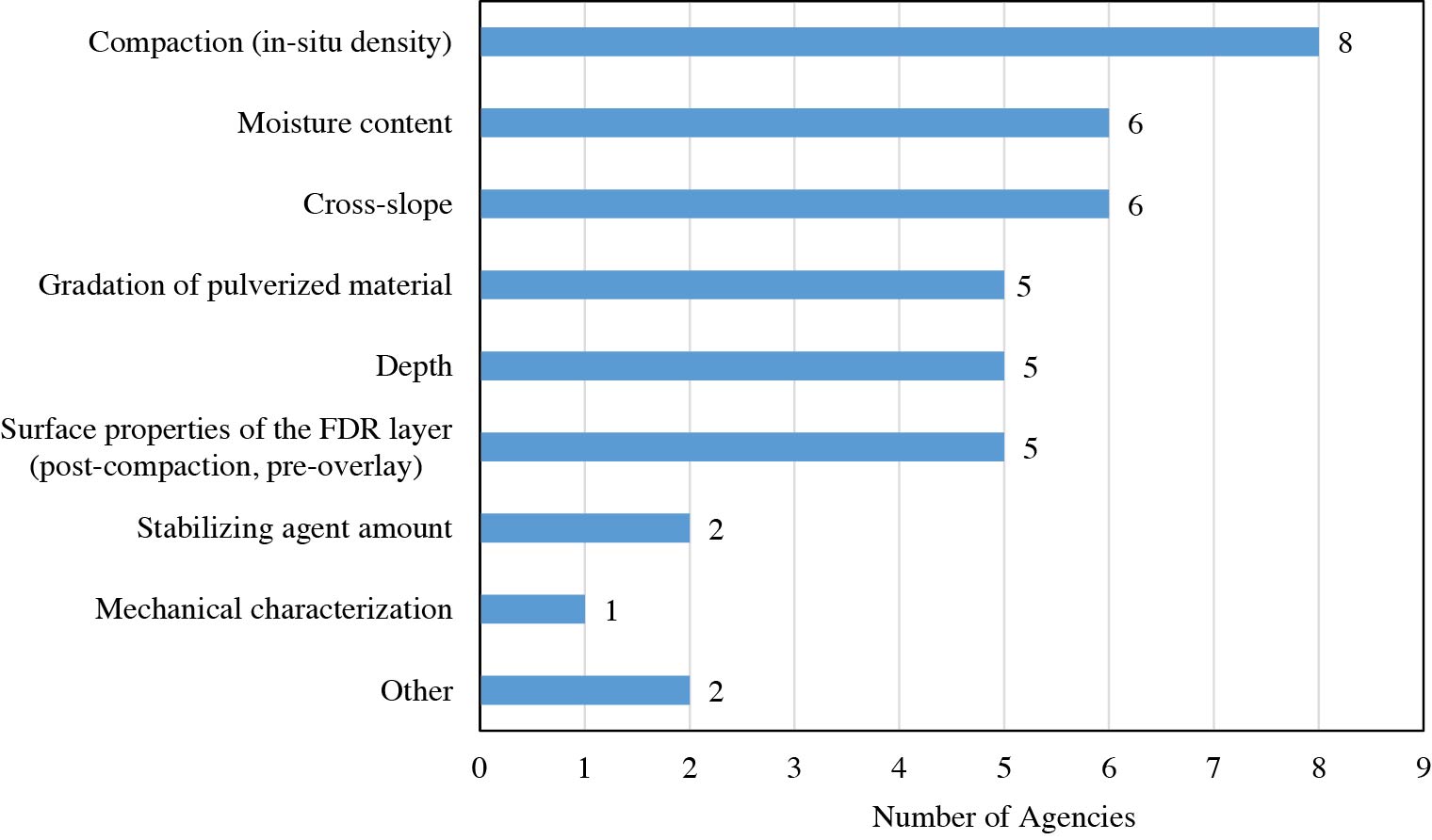
A bar graph shows the distribution of responding other agencies with respect to parameters.
Figure 67. Distribution of responding other agencies with respect to parameters required as part of agency inspection and testing (number of responses = 11).
Long Description.

The horizontal axis for the number of agencies ranges from 0 to 9 in increments of 1. The vertical axis lists different categories. The data is as follows. Compaction (in-situ density), 8. Moisture content, 6. Cross-slope, 6. Gradation of pulverized material, 5. Depth, 5. Surface properties of FDR layer (post-compaction, pre-overlay), 5. Stabilizing agent amount, 2. Mechanical characterization, 1. Other, 2.

Table 43. Other agency reported “Other” for parameters required as part of agency inspection and testing.

We preform MTO LS-621 and require the sample to have no more than 50% asphalt coated particles

Varies between projects

A bar graph shows the distribution of responding other agencies on parameters required as part of contractor Q C.
Figure 68. Distribution of responding other agencies with respect to parameters required as part of contractor QC (number of responses = 8).
Long Description.

The horizontal axis for the number of agencies ranges from 0 to 9 in increments of 1. The vertical axis lists different categories. The data is as follows. Compaction, 8. Stabilizing agent amount, 6. Depth, 6. Cross-slope, 6. Moisture content, 5. Surface properties of FDR layer (post-compaction, pre-overlay), 5. Gradation of pulverized material, 4. Mechanical characterization, 2. Other, 0.
Suggested Citation: "Appendix C: Other Agency Survey Responses." National Academies of Sciences, Engineering, and Medicine. 2025. Full-Depth Reclamation: Current Practices. Washington, DC: The National Academies Press. doi: 10.17226/29222.
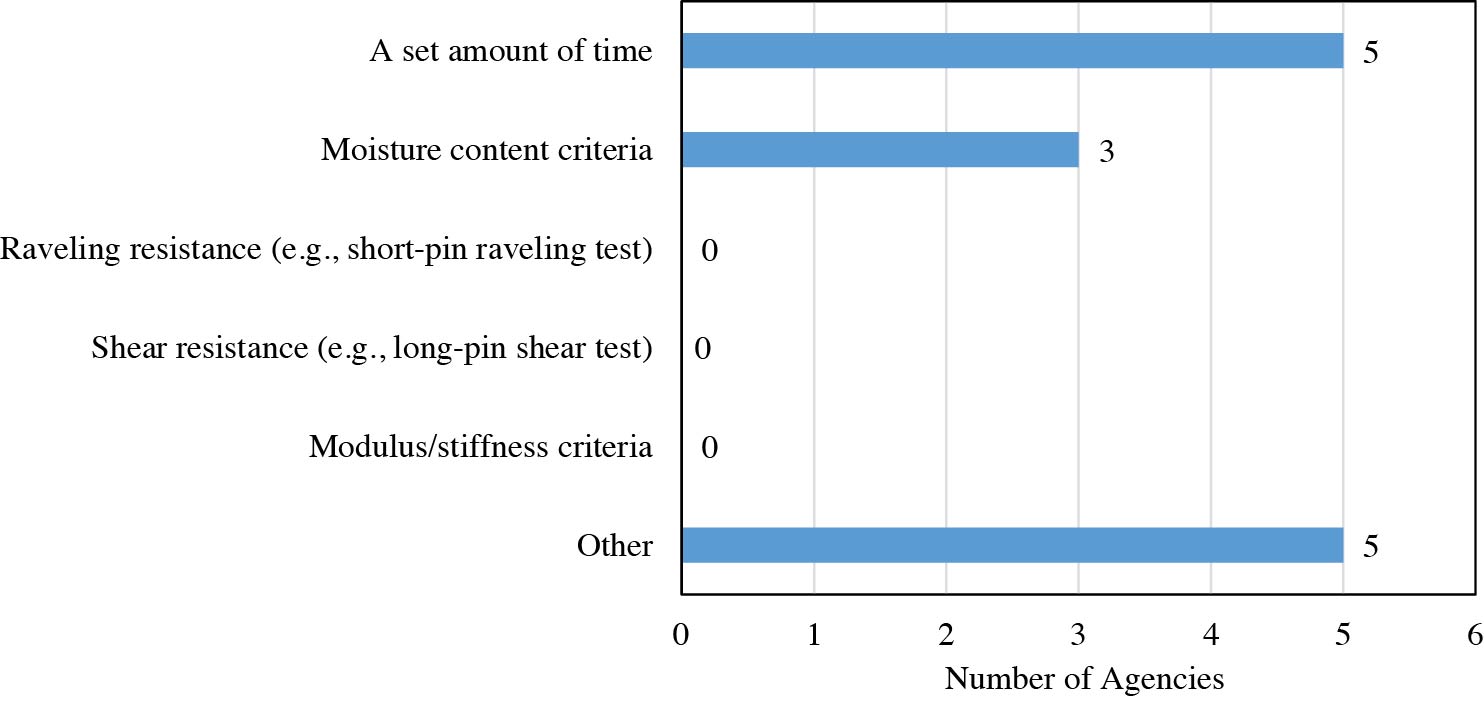
A bar graph shows the data of responding other agencies.
Figure 69. Distribution of responding other agencies with respect to how it is determined when traffic or surfacing placement is allowed on a newly constructed FDR layer (number of responses = 11).
Long Description.

The distribution is with respect to how it is determined when traffic or surfacing placement is allowed on a newly constructed FDR layer. The horizontal axis for the number of agencies ranges from 0 to 6 in increments of 1. The vertical axis lists different categories. The data is as follows. A set amount of time, 5. Moisture content criteria, 3. Raveling resistance (for example, short-pin raveling test), 0. Shear resistance (for example, long-pin shear test), 0. Modulus slash stiffness criteria, 0. Other, 5.

Table 44. Other agency reported “Other” for how it is determined when traffic or surfacing placement is allowed on a newly constructed FDR layer.

Traffic is allowed after compaction and surfacing is completed as soon as possible or scheduled

Mechanical FDR only, so traffic allowed immediately after construction of base layer

Proof roll with loaded tandem in conjunction with evaluation of surface defects and laboratory results

FDR layer typically must be opened to traffic at end of construction shift. SPRT and LPST currently being investigated for FDR-FA

Not yet determined

Figure 70. Distribution of responding other agencies with respect to testing conducted to evaluate FDR projects over time (number of responses = 13).
Long Description.

The horizontal axis for the number of agencies ranges from 0 to 8 in increments of 1. The vertical axis lists different categories. The data is as follows. Evaluation of ride quality, 7. Visual evaluation of distress over time, 6. Non-destructive field testing (such as FWD, et cetera), 4. Testing of field cores, 3. No performance evaluation conducted, 2. Other, 3.

Suggested Citation: "Appendix C: Other Agency Survey Responses." National Academies of Sciences, Engineering, and Medicine. 2025. Full-Depth Reclamation: Current Practices. Washington, DC: The National Academies Press. doi: 10.17226/29222.
Table 45. Other agency reported “Other” for testing conducted to evaluate FDR projects over time.

Pavement condition data, including surface distress and roughness data collected on network level.

FWD on selected projects

All roads subject to annual automated pavement condition survey. Select FDR projects are part of UCPRC LTPP project which includes FWD, coring, and visual assessment

A pie chart depicts the distritubion of other agencies regarding routine use of treatments to reduce cracking potential
Figure 71. Distribution of responding “Other” agencies with respect to routine utilization of treatments to reduce cracking potential in asphalt overlays on FDR (number of responses = 13).
Long Description.

A pie chart shows the data as follows. Yes, 4. No, 9.

Table 46. Other agency reported treatments routinely used to reduce cracking potential in asphalt overlays on FDR.

Chip seal, micro-surfacing, route and seal

Crack Sealing

FDR-C specifications require microcracking (method spec) on all projects

Limitation of portland cement amount (no more than half of the bitumen amount)

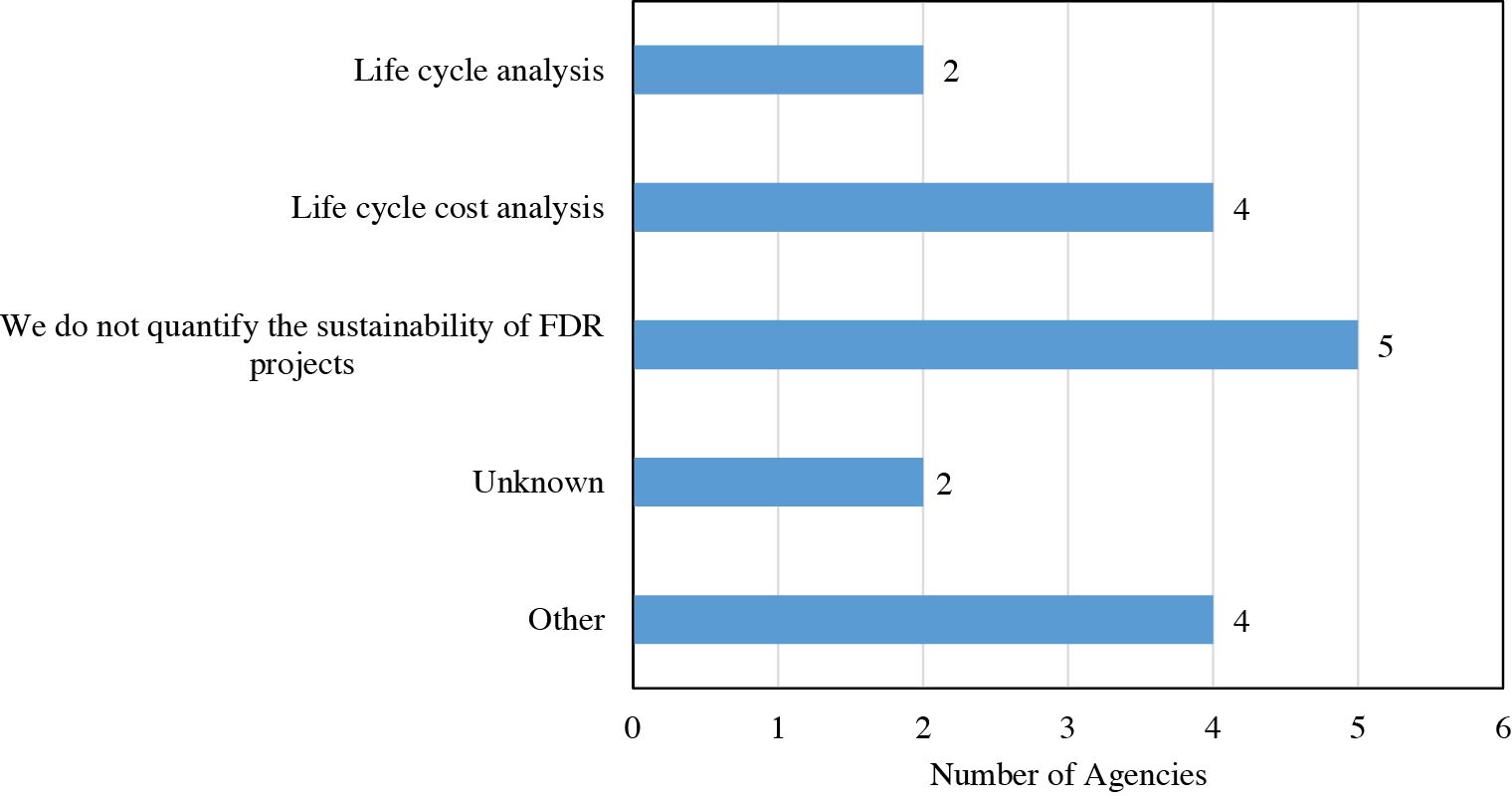
A bar graph shows the distribution of responding other agencies on efforts to quantify sustainability of using F D R.
Figure 72. Distribution of responding “Other” agencies with respect to efforts employed (or planned to be employed) to quantify the sustainability of using FDR (number of responses = 13).
Long Description.

The distribution is with respect to efforts employed (or planned to be employed) to quantify the sustainability of using FDR. The horizontal axis for the number of agencies ranges from 0 to 6 in increments of 1. The vertical axis lists different categories. The data is as follows. Life cycle analysis, 2. Life cycle cost analysis, 4. We do not quantify the sustainability of FDR projects, 5. Unknown, 2. Other, 4.

Suggested Citation: "Appendix C: Other Agency Survey Responses." National Academies of Sciences, Engineering, and Medicine. 2025. Full-Depth Reclamation: Current Practices. Washington, DC: The National Academies Press. doi: 10.17226/29222.
Table 47. Other agency reported “Other” for efforts employed to quantify the sustainability of using FDR.

No immediate plans, but will need to be done sooner than later.

GreenPave rating assessment

PaLATE has been used in the past to quantify environmental impacts of PDR and FDR as compared to conventional

LCCA is in plan

A bar graph depicts data from responding other agencies regarding the challenges experienced in implementing F D R projects.
Figure 73. Distribution of responding other agencies with respect to challenges experienced to implement FDR projects (number of responses = 15).
Long Description.

The horizontal axis for the number of agencies ranges from 0 to 7 in increments of 1. The vertical axis lists different categories. The data is as follows. Lack of agency experience, 6. Lack of contractor expertise, 6. Poor performance of previously constructed FDR, 2. Lack of mix design methods and design procedures, 1. Lack of criteria to determine stabilizing agent dose, 1. Lack of funding for planning or pre-construction, 1. No significant challenges, 3. Other, 6.

Table 48. Other agency reported “Other” for challenges experienced to implement FDR projects.

Grade raise restriction.

Introduction of cement as stabilizing agent with asphalt based agents make it more complex in assessing design, construction and long term performance determination

No challenge for mechanical FDR. Stabilized FDR could not be done because of inconsistency in thickness and base material quality issue.

Agency decision making process and funding mechanisms are built around mill and overlay and remove and reconstruct strategies. Cold recycling does not always fit these strategies, and/or the full benefits of are not quantified in the analysis.

Curing of stabilizing agent require favorable climatic conditions. Also, compaction method.

Limitations due to geometry and utilities

Suggested Citation: "Appendix C: Other Agency Survey Responses." National Academies of Sciences, Engineering, and Medicine. 2025. Full-Depth Reclamation: Current Practices. Washington, DC: The National Academies Press. doi: 10.17226/29222.
Page 108
Suggested Citation: "Appendix C: Other Agency Survey Responses." National Academies of Sciences, Engineering, and Medicine. 2025. Full-Depth Reclamation: Current Practices. Washington, DC: The National Academies Press. doi: 10.17226/29222.
Page 109
Suggested Citation: "Appendix C: Other Agency Survey Responses." National Academies of Sciences, Engineering, and Medicine. 2025. Full-Depth Reclamation: Current Practices. Washington, DC: The National Academies Press. doi: 10.17226/29222.
Page 110
Suggested Citation: "Appendix C: Other Agency Survey Responses." National Academies of Sciences, Engineering, and Medicine. 2025. Full-Depth Reclamation: Current Practices. Washington, DC: The National Academies Press. doi: 10.17226/29222.
Page 111
Suggested Citation: "Appendix C: Other Agency Survey Responses." National Academies of Sciences, Engineering, and Medicine. 2025. Full-Depth Reclamation: Current Practices. Washington, DC: The National Academies Press. doi: 10.17226/29222.
Page 112
Suggested Citation: "Appendix C: Other Agency Survey Responses." National Academies of Sciences, Engineering, and Medicine. 2025. Full-Depth Reclamation: Current Practices. Washington, DC: The National Academies Press. doi: 10.17226/29222.
Page 113
Suggested Citation: "Appendix C: Other Agency Survey Responses." National Academies of Sciences, Engineering, and Medicine. 2025. Full-Depth Reclamation: Current Practices. Washington, DC: The National Academies Press. doi: 10.17226/29222.
Page 114
Suggested Citation: "Appendix C: Other Agency Survey Responses." National Academies of Sciences, Engineering, and Medicine. 2025. Full-Depth Reclamation: Current Practices. Washington, DC: The National Academies Press. doi: 10.17226/29222.
Page 115
Suggested Citation: "Appendix C: Other Agency Survey Responses." National Academies of Sciences, Engineering, and Medicine. 2025. Full-Depth Reclamation: Current Practices. Washington, DC: The National Academies Press. doi: 10.17226/29222.
Page 116
Suggested Citation: "Appendix C: Other Agency Survey Responses." National Academies of Sciences, Engineering, and Medicine. 2025. Full-Depth Reclamation: Current Practices. Washington, DC: The National Academies Press. doi: 10.17226/29222.
Page 117
Suggested Citation: "Appendix C: Other Agency Survey Responses." National Academies of Sciences, Engineering, and Medicine. 2025. Full-Depth Reclamation: Current Practices. Washington, DC: The National Academies Press. doi: 10.17226/29222.
Page 118
Suggested Citation: "Appendix C: Other Agency Survey Responses." National Academies of Sciences, Engineering, and Medicine. 2025. Full-Depth Reclamation: Current Practices. Washington, DC: The National Academies Press. doi: 10.17226/29222.
Page 119
Suggested Citation: "Appendix C: Other Agency Survey Responses." National Academies of Sciences, Engineering, and Medicine. 2025. Full-Depth Reclamation: Current Practices. Washington, DC: The National Academies Press. doi: 10.17226/29222.
Page 120
Suggested Citation: "Appendix C: Other Agency Survey Responses." National Academies of Sciences, Engineering, and Medicine. 2025. Full-Depth Reclamation: Current Practices. Washington, DC: The National Academies Press. doi: 10.17226/29222.
Page 121
Suggested Citation: "Appendix C: Other Agency Survey Responses." National Academies of Sciences, Engineering, and Medicine. 2025. Full-Depth Reclamation: Current Practices. Washington, DC: The National Academies Press. doi: 10.17226/29222.
Page 122
Next Chapter: Appendix D: Results of Contractor Survey on Full-Depth Reclamation Construction Practices
Subscribe to Emails from the National Academies
Stay up to date on activities, publications, and events by subscribing to email updates.