Full-Depth Reclamation: Current Practices (2025)
Chapter: Appendix D: Results of Contractor Survey on Full-Depth Reclamation Construction Practices

APPENDIX D
Results of Contractor Survey on Full-Depth Reclamation Construction Practices
The contractor survey questionnaire and results are presented in this appendix. The following companies participated in this survey: California Nevada Cement Association, Pavement Recycling Systems, Mountain States Constructors, Inc., Ruston Paving Co., Inc., Slurry Pavers Inc., SurfaceCycle, Atlanta Paving and Concrete Construction, Mt. Carmel Stabilization Group, Inc., Recon Construction Services, Inc., and E. J. Breneman, L.L.C.
Part A: State-of-the-Practice Related to the Use of Full-Depth Reclamation
Question 1: Has your company conducted (within the past 5 years) Mechanical FDR or FDR pavement rehabilitation projects?
- Both Mechanical FDR and FDR
- Mechanical FDR only
- FDR only
- Our company has not conducted Mechanical FDR or FDR projects within the past 5 years

Long Description.
The data is as follows. Both mechanical FDR and FDR, 11. Mechanical FDR only, 0. FDR only, 0. Mechanical FDR or FDR not used, 0.
Question 2: How many years of experience does your company have conducting FDR? (select best option):
- <5
- 5–10
- 10–20
- >20
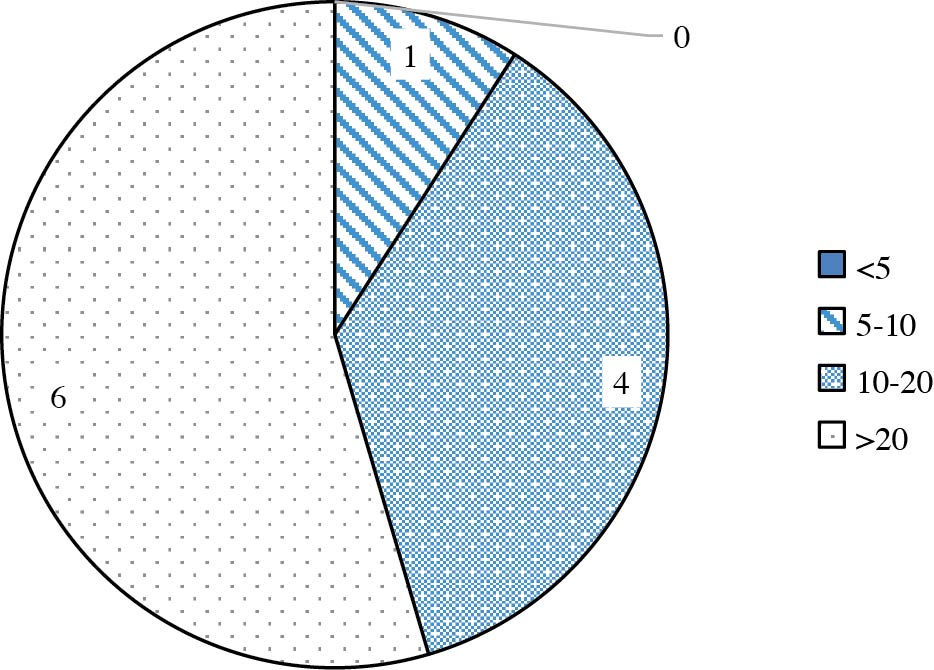
Long Description.
The data is as follows. Less than 5, 0. 5 to 10, 1. 10 to 20, 4. More than 20, 6.
Question 3: What is the approximate number of lane miles per year that are recycled by FDR by your agency? (select best option):
- <50
- 50–100
- >100
- Unsure

Long Description.
The data is as follows. Less than 50, 1. 50 to 100, 2. More than 100, 7.
Question 4: On which roadway types (average daily traffic levels) does your company typically carry-out FDR? – select all that apply:
- <2,500
- 2,500–5,000
- 5,000–10,000
- 10,000–20,000
- 20,000–30,000
- >30,000
- Unsure

Long Description.
The horizontal axis for the number of agencies ranges from 0 to 12 in increments of 2. The vertical axis for average daily traffic (ADT) lists different categories. The data is as follows. Less than 2,500, 10. 2,500 to 5,000, 8. 5,000 to 10,000, 8. 10,000 to 20,000, 5. More than 30,000, 5. 20,000 to 30,000, 4. Unsure, 1.
Question 5: When conducting FDR, what are the most common primary distress(es) in the existing pavement? – select all that apply:
- Base failure
- Fatigue cracking
- Longitudinal and transverse cracking
- Potholes
- Rutting
- Unsure
- Other (please specify)

Long Description.
The horizontal axis for the number of agencies ranges from 0 to 12 in increments of 2. The vertical axis lists different categories. The data is as follows. Base failure, 11. Rutting, 9. Fatigue cracking, 9. Potholes, 8. Longitudinal and transverse cracking, 7.
Question 6: Before conducting FDR, does your company perform a pre-design investigation? (select best option):
- Yes – always
- Yes – if the agency requires it
- No
- Unsure
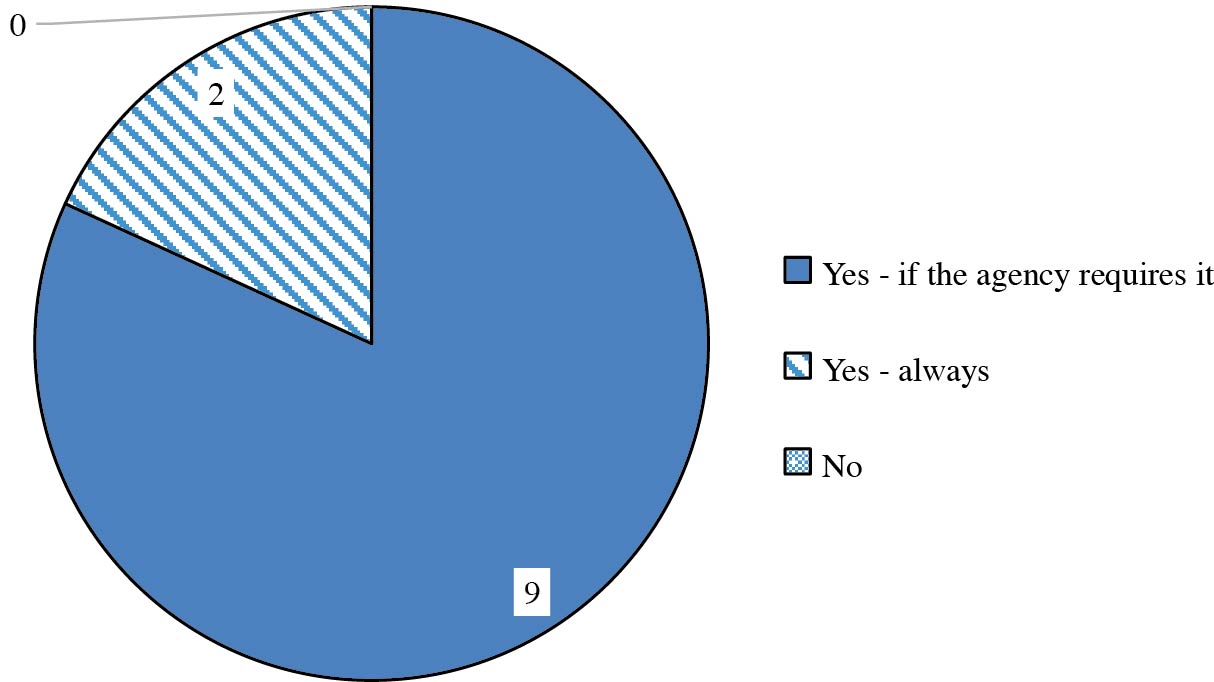
Long Description.
A pie chart shows the data as follows. Yes, if the agency requires it, 9. Yes, always, 2. No, 0.
Full Designs |
Question 7: When conducting a pre-design investigation for FDR, what testing is conducted? – select all that apply:
- Evaluation of strength/stiffness of layers of existing pavement structure (such as, Falling Weight Deflectometer or Dynamic Cone Penetrometer testing)
- Evaluation of the thickness of layers of existing pavement (such as Ground Penetrating Radar testing or core drilling)
- Sampling of material (for verification of layers for understanding lower layer condition from cored samples)
- Other (please specify)

Long Description.
The horizontal axis for the number of agencies ranges from 0 to 12 in increments of 2. The vertical axis lists different categories. The data is as follows. Sampling of materials, 11. Evaluation of the thickness of layers, 6. Evaluation of strength or stiffness of layers, 4. Other, 1.
Question 8: Which of the following stabilizing agents or additives are generally used for an FDR project by your company? – select all that apply:
- Calcium chloride
- Cement
- Emulsified asphalt
- Foamed asphalt
- Fly ash
- Lime (or lime kiln dust)
- Quarry by-products
- Other (please specify)

Long Description.
The horizontal axis for the number of agencies ranges from 0 to 12 in increments of 2. The vertical axis lists different categories. The data is as follows. Cement, 11. Lime or lime kiln dust, 5. Emulsified asphalt, 4. Foamed asphalt, 3. Fly ash, 3. Quarry by-products, 2. Calcium chloride, 1. Other, 1.
We use all of these, it would be helpful to define “generally”. |
Part B: State-of-the-Practice Related to the Use of Stabilizing Agents in Full-Depth Reclamation
Question 9: Who determines/specifies the stabilizing agent type in FDR applications? (select best option):
- Agency determined
- Contractor determined based on agency requirements
- Contractor determined independently
- Unknown
- Other (please describe briefly)

Long Description.
The horizontal axis for the number of agencies ranges from 0 to 8 in increments of 2. The vertical axis lists different categories. The data is as follows. Agency determined, 7. Contractor determined based on agency requirement, 3. Contractor determined independently, 0. Other, 1.
Agency determined if Agency is involved. Contractor determined if no Agency involved. |
Question 10: What is the primary factor your company uses to determine which stabilizing agent to use in an FDR project? (select best option):
- Traffic level
- Availability of material
- Historic use or past performance
- Life cycle cost analysis
- Mix design results
- Other (please specify)
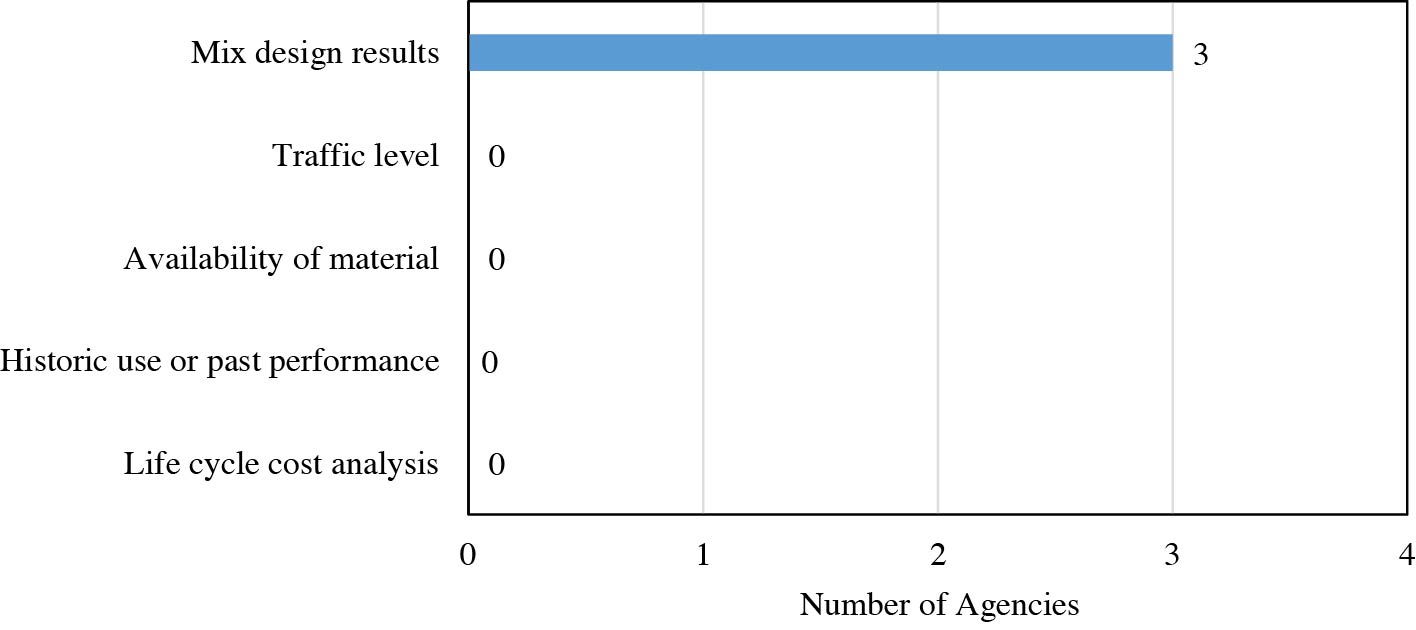
Long Description.
The horizontal axis for the number of agencies ranges from 0 to 4 in increments of 1. The vertical axis lists different categories. The data is as follows. Mix design results, 3. Traffic level, 0. Availability of material, 0. Historic use or past performance, 0. Life cycle cost analysis, 0.
Question 11: Who determines/specifies the stabilizing agent dosage in FDR applications? – (select best option):
- Agency determined
- Contractor determined based on agency requirements
- Contractor determined independently
- Unknown
- Other (please describe briefly)
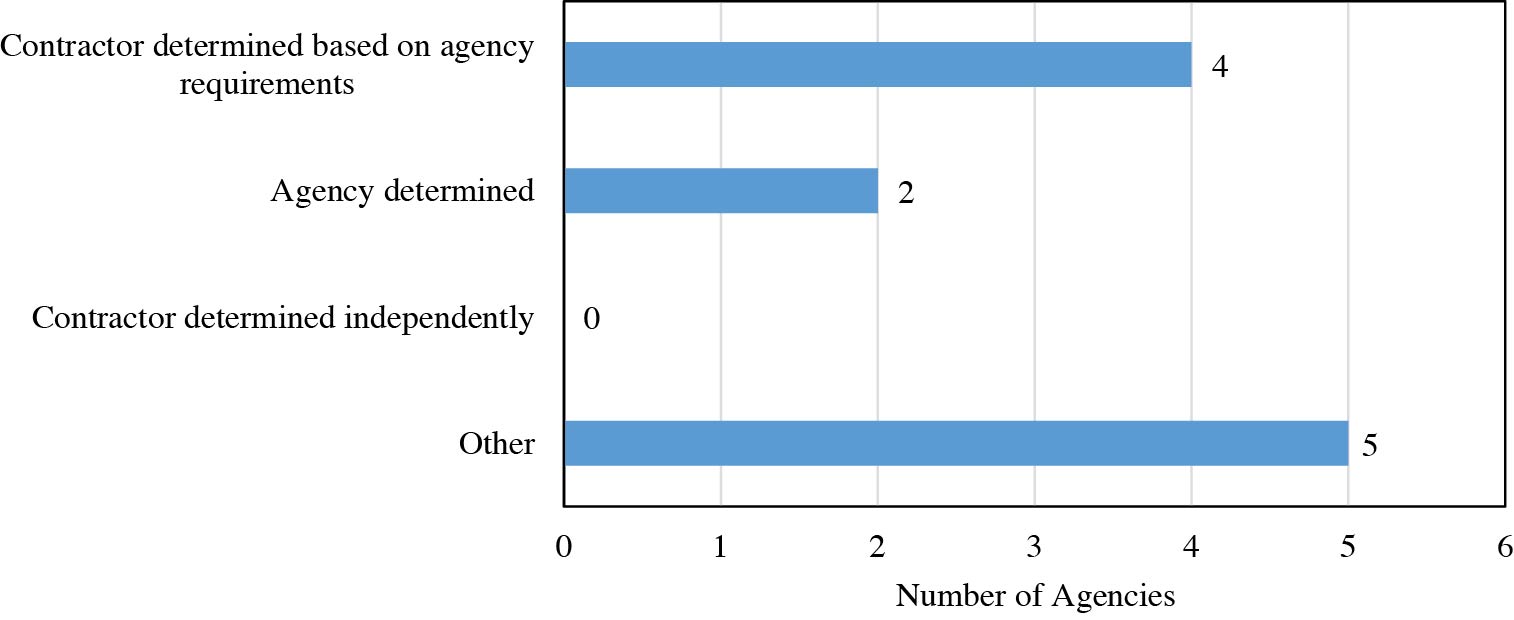
Long Description.
The horizontal axis for the number of agencies ranges from 0 to 6 in increments of 1. The vertical axis lists different categories. The data is as follows. Contractor determined based on agency requirements, 4. Agency determined, 2. Contractor determined independently, 0. Other, 5.
Agency determined if Agency is involved. Contractor determined if no Agency involved. |
Perform mix design in order to meet specified compressive strength requirements. |
Mix design results |
Mix Design / Via Geo-Tech |
Based on mix design as determined by geotechnical engineer |
Question 12: How does your company determine the stabilizing agent dosage in an FDR project? – (select best option):
- Fixed dosage based on stabilizing agent type (please briefly describe):
- Dosage is determined based on our methodology (please briefly describe):
- Based on agency guidelines
- Other (please specify)

Long Description.
The data is as follows. Fixed dosage based on stabilizing agent type, 0. Dosage is determined based on our methodology, 2. Based on agency guidelines, 1. Other, 1.
Through the mix design to achieve desired strength |
Determined based on Mix Design developed to agency guidelines given samples obtained from roadway |
Based on design min/max strength requirements established by agency |
Part C: State-of-the-Practice Related to Post-Construction for Full-Depth Reclamation
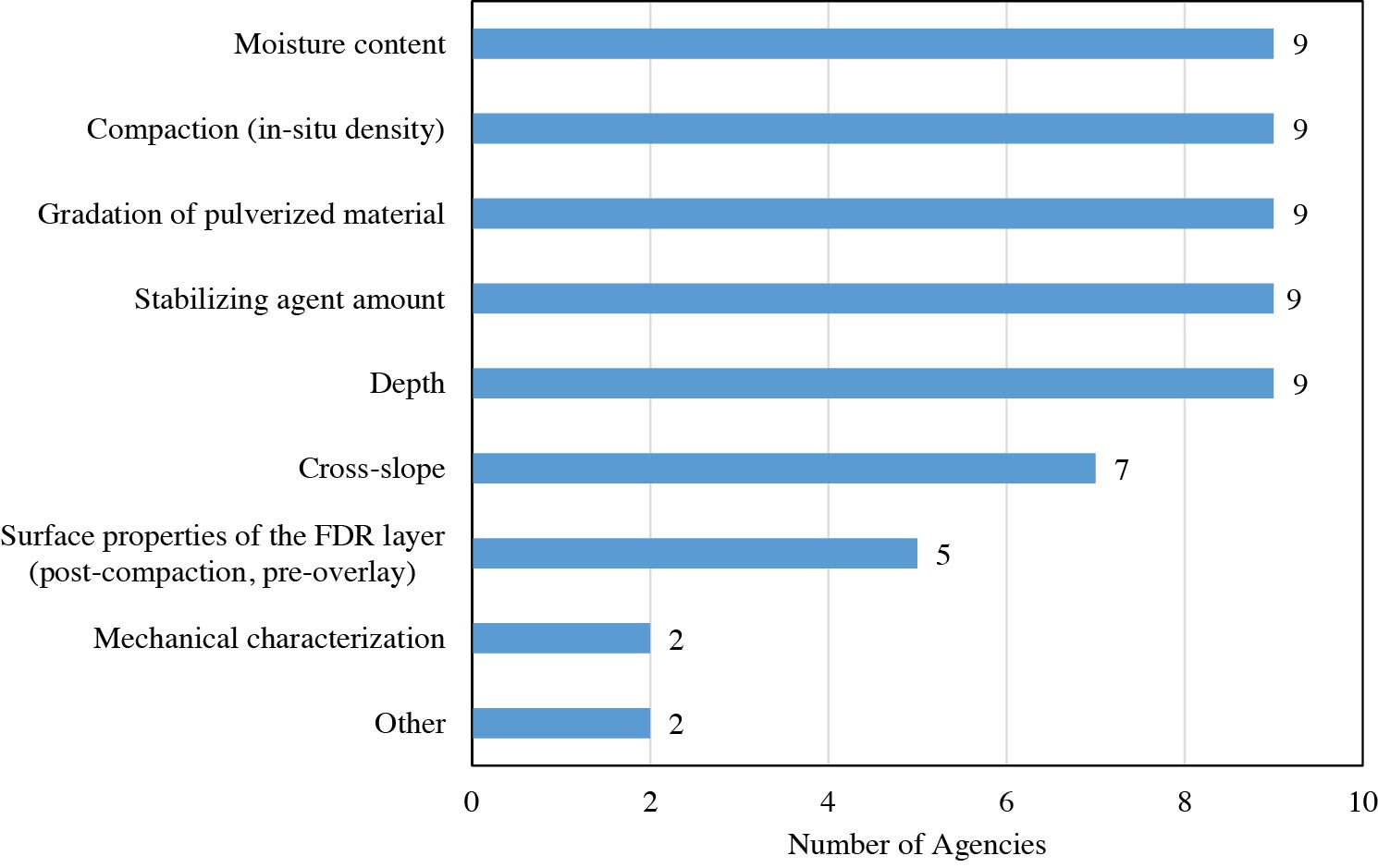
Question 13: What properties does your company evaluate during FDR construction for quality control (QC)? – select all that apply:
- Moisture content
- Compaction (in-situ density)
- Gradation of pulverized material
- Mechanical characterization
- Stabilizing agent amount
- Depth
- Cross-slope
- Surface properties (such as smoothness or deviation from a straight edge) of the FDR layer (post-compaction, pre-overlay)
- Unknown
- Other (please specify)
Long Description.
The horizontal axis for the number of agencies ranges from 0 to 10 in increments of 2. The vertical axis lists different categories. The data is as follows. Moisture content, 9. Compaction (in-situ density), 9. Gradation of pulverized material, 9. Stabilizing agent amount, 9. Depth, 9. Cross-slope, 7. Surface properties of FDR layer (post-compaction, pre-overlay), 5. Mechanical characterization, 2. Other, 2.
Strength |
Lab test results of field samples |
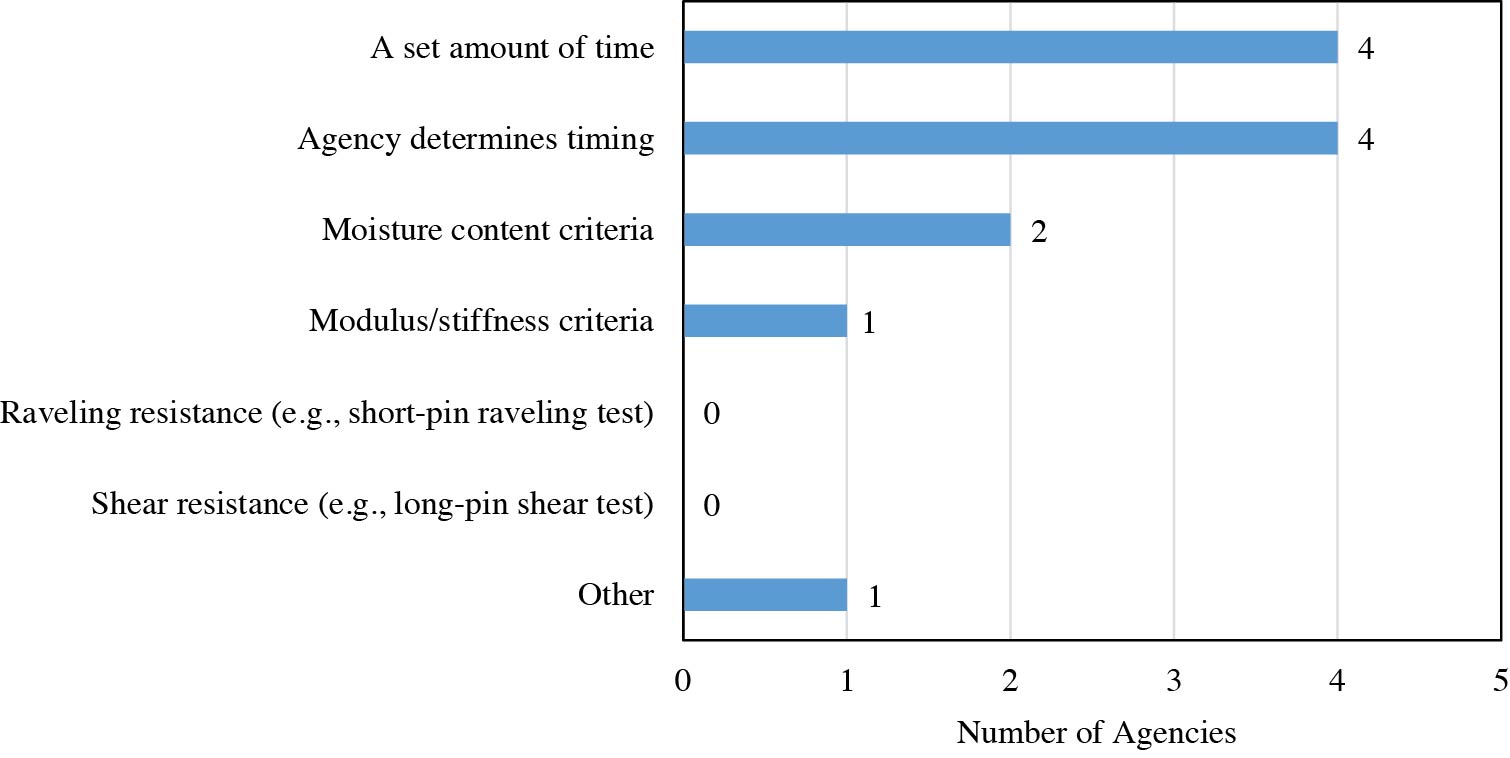
Question 14: How does your company determine when to allow traffic or place surfacing on the FDR layer? – select all that apply:
- A set amount of time
- Raveling resistance (e.g., short-pin raveling test)
- Shear resistance (e.g., long-pin shear test)
- Modulus/stiffness criteria
- Moisture content criteria
- Agency determines timing
- Other (please specify)
Long Description.
The distribution is with respect to how it is determined when traffic or surfacing placement is allowed on a newly constructed FDR layer. The horizontal axis for the number of agencies ranges from 0 to 5 in increments of 1. The vertical axis lists different categories. The data is as follows. A set amount of time, 4. Agency determines timing, 4. Moisture content criteria, 2. Modulus slash stiffness criteria, 1. Raveling resistance (for example, short-pin raveling test), 0. Shear resistance (for example, long-pin shear test), 0. Other, 1.
Set amount of time, agency determines, Monitor strength gain or stabilized layer with DCP |
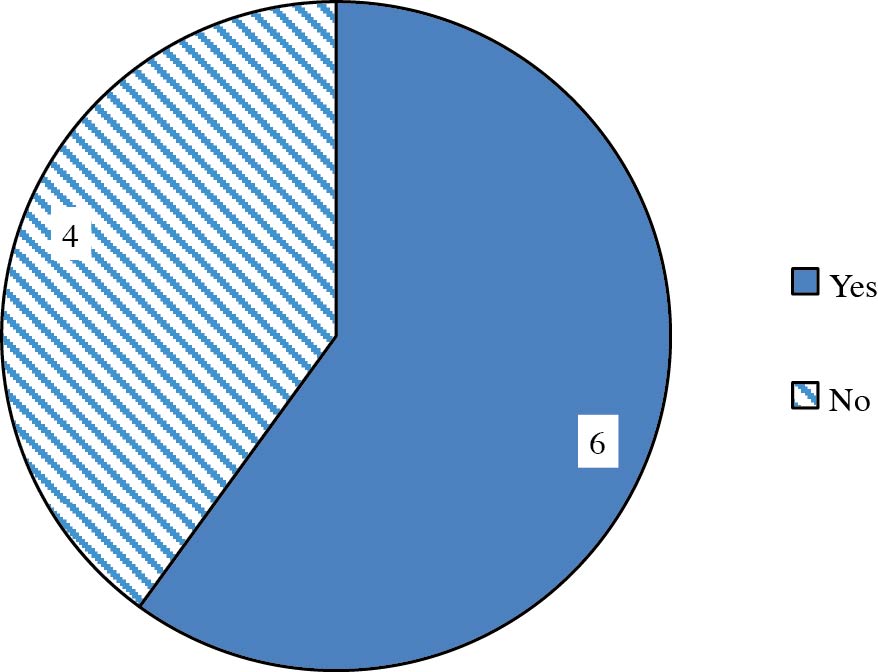
Question 15: When performing FDR, does your company routinely perform any treatments to reduce the potential for cracking in asphalt overlays on FDR?
- Yes (please briefly describe which treatments)
- No
- Unsure
Long Description.
A pie chart shows the data as follows. Yes, 6. No, 4.
Microcracking |
Microcracking |
Microcracking. Moist cure or seal FDR surface. Curing time. |
Microcracking when required per engineerʼs design |
Microcracking is used on 10% of cement stabilization projects |
Microcracking with roller |
Part D: Identification of Challenges and Future Plans
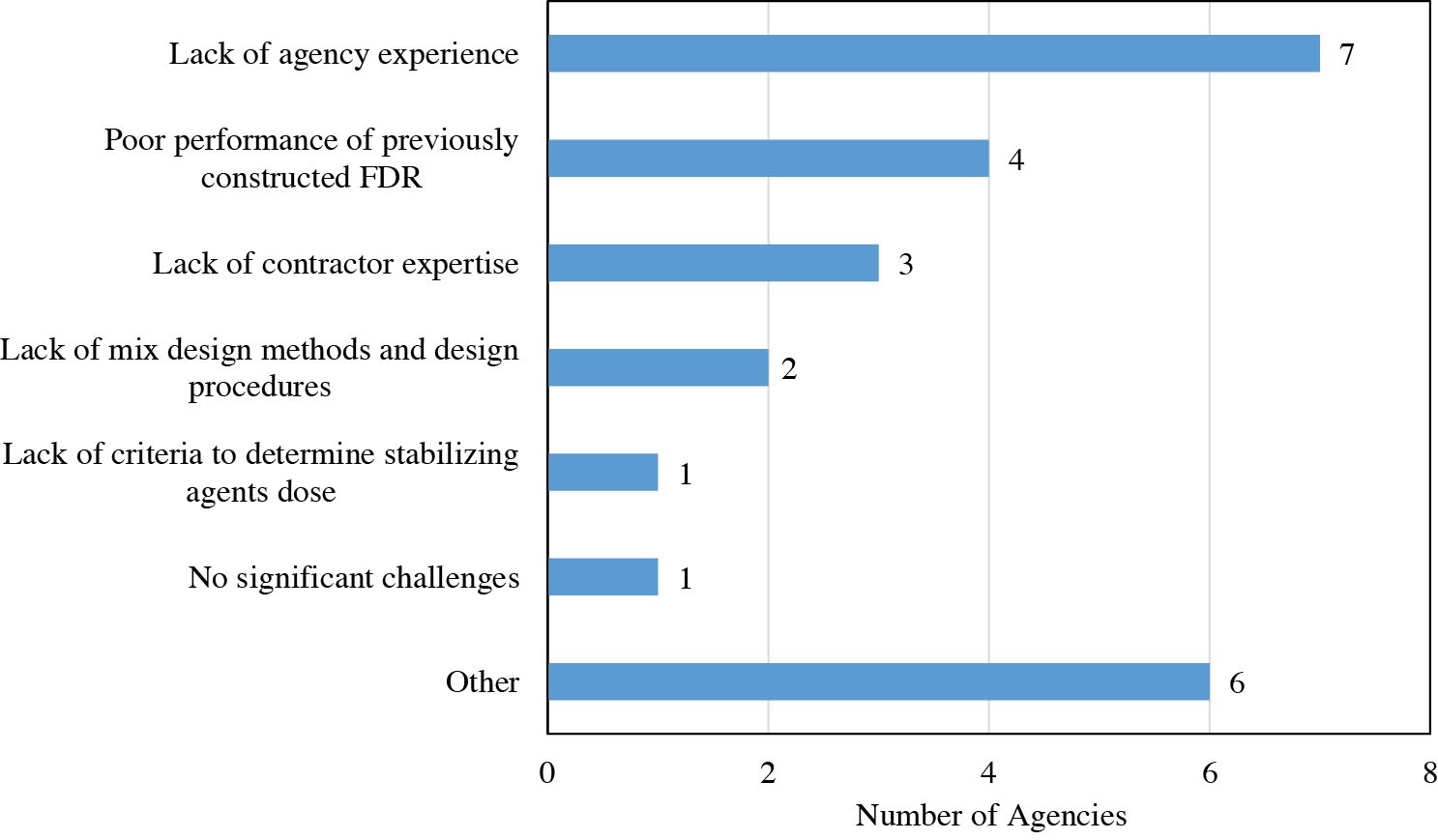
Question 16: What challenges to starting (or continuing) to successfully perform FDR has your company experienced?
- Lack of agency experience
- Lack of contractor expertise
- Lack of mix design methods and engineering-based design procedures
- Lack of tests and criteria to determine dosage of stabilizing agents and/or performance
- Poor performance of previously constructed FDR rehabilitated pavements
- No significant challenges
- Other (please describe briefly)
Long Description.
The horizontal axis for the number of agencies ranges from 0 to 8 in increments of 2. The vertical axis lists different categories. The data is as follows. Lack of agency experience, 7. Poor performance of previously constructed FDR, 4. Lack of contractor expertise, 3. Lack of mix design methods and design procedures, 2. Lack of criteria to determine stabilizing agent dose, 1. No significant challenges, 1. Other, 6.
Lack of consultant experience |
In rare cases we are challenged by early cracking of FDR pavements |
Poor project selection, poor additive selection |
Other fly by night contractors improperly installing and pricing work- destroying the reputation of the product by spreading cement on shoulders, destroying cars, improper install and equipment. |
We find that sometimes FDR is being used as a fix to more than what it is capable of. I.e., the road profile/drainage are needing addressed before FDR can be successful. We also see it being used in situations that are extremely complex due to concentration of homes/businesses etc. Without the proper closures in place to be able to perform the work correctly. |
Educating Engineers |
Question 17: If you have any additional information or thoughts you would like to share regarding this topic, please do so here:
- (please provide additional information or thoughts regarding FDR)
With quality control and following best FDR practices we have found great success in performing FDR |
Agencies need to understand there are specialized contractors who can perform the work in just about any circumstance. Our work at Hartsfield airport has enlightened them on the difference in contractors approach and skill. Having proper equipment, spreading and controls for dust, dust protection and layout make all the difference in the cleanliness of a project. We have completed some of the most complex roads in Atlanta and Georgia. One single contractor ruined a county for over a decade because of their poor technique. |
FDR is a great tool and can be a successful solution for many roadways, airports, etc. Many times the understanding of what FDR can and canʼt do is not totally recognized by the agency/owner setting it up. Our company can help with that and find a path that either points to a project being a FDR success story or not. |
The use of FDR should be expanded as a means to use less natural resources, reducing material that has to be landfilled or wasted and significant savings to ancillary costs by reducing truck traffic on adjacent infrastructure. Additionally FDR provides a quicker alternative to conventional construction while providing a stronger base. Gaining acceptance and understanding by specifying agencies is a significant barrier to increased use |
Abbreviations and acronyms used without definitions in TRB publications: |
|
A4A |
Airlines for America |
AAAE |
American Association of Airport Executives |
AASHO |
American Association of State Highway Officials |
AASHTO |
American Association of State Highway and Transportation Officials |
ACI–NA |
Airports Council International–North America |
ACRP |
Airport Cooperative Research Program |
ADA |
Americans with Disabilities Act |
APTA |
American Public Transportation Association |
ASCE |
American Society of Civil Engineers |
ASME |
American Society of Mechanical Engineers |
ASTM |
American Society for Testing and Materials |
ATA |
American Trucking Associations |
CTAA |
Community Transportation Association of America |
CTBSSP |
Commercial Truck and Bus Safety Synthesis Program |
DHS |
Department of Homeland Security |
DOE |
Department of Energy |
EPA |
Environmental Protection Agency |
FAA |
Federal Aviation Administration |
FAST |
Fixing Americaʼs Surface Transportation Act (2015) |
FHWA |
Federal Highway Administration |
FMCSA |
Federal Motor Carrier Safety Administration |
FRA |
Federal Railroad Administration |
FTA |
Federal Transit Administration |
GHSA |
Governors Highway Safety Association |
HMCRP |
Hazardous Materials Cooperative Research Program |
IEEE |
Institute of Electrical and Electronics Engineers |
ISTEA |
Intermodal Surface Transportation Efficiency Act of 1991 |
ITE |
Institute of Transportation Engineers |
MAP-21 |
Moving Ahead for Progress in the 21st Century Act (2012) |
NASA |
National Aeronautics and Space Administration |
NASAO |
National Association of State Aviation Officials |
NCFRP |
National Cooperative Freight Research Program |
NCHRP |
National Cooperative Highway Research Program |
NHTSA |
National Highway Traffic Safety Administration |
NTSB |
National Transportation Safety Board |
PHMSA |
Pipeline and Hazardous Materials Safety Administration |
RITA |
Research and Innovative Technology Administration |
SAE |
Society of Automotive Engineers |
SAFETEA-LU |
Safe, Accountable, Flexible, Efficient Transportation Equity Act: A Legacy for Users (2005) |
TCRP |
Transit Cooperative Research Program |
TEA-21 |
Transportation Equity Act for the 21st Century (1998) |
TRB |
Transportation Research Board |
TSA |
Transportation Security Administration |
U.S. DOT |
United States Department of Transportation |

Transportation Research Board
500 Fifth Street, NW
Washington, DC 20001