Exploring Risks of Repeated Head Impacts in Youth and Strategies to Minimize Exposure: Proceedings of a Workshop (2026)
Chapter: 2 Characterizing Repeated Head Impacts in Youth
2
Characterizing Repeated Head Impacts in Youth
Key Points Highlighted by Individual Speakers1
- Repeated head impacts (RHI) can be defined as repeated head acceleration events that occur in the absence of diagnosed injury. Measurement and characterization of RHI rely on key biomechanical parameters, including the linear and angular acceleration of impacts, as well as their direction—all of which influence strain on brain tissue (Arbogast).
- RHI exposure is highly individualized. Such proxy measures as age of first exposure or years played often fail to capture this variation and may yield inconsistent findings (Arbogast, Chandran).
- Sensor-based measurement technologies offer promise for measuring RHI but have technical limitations. Differences in sensor type, trigger thresholds, data filtering, and coupling all affect measurement accuracy (Arbogast, Yang).
- Video confirmation and other methods of head acceleration event confirmation, such as machine learning, substantially reduce the number of sensor-recorded impact events, emphasizing its importance in improving data quality and avoiding
___________________
1 This list is the rapporteurs’ summary of points made by the individual speakers identified, and the statements have not been endorsed or verified by the National Academies of Sciences, Engineering, and Medicine. They are not intended to reflect a consensus among workshop participants.
- overestimation of RHI exposure in youth sports (Arbogast, Yang).
- Inconsistent sensor types and data-processing methods make it difficult to compare findings across studies. Increased harmonization in measurement and reporting practices may improve the reliability and interpretability of research on youth RHI exposure (Arbogast).
- Exposure to RHI in youth may be shaped by a range of intersecting factors, including sex, age, race, socioeconomic status, and access to protective environments. Broader social and structural contexts, such as disparities in equipment, training, and oversight, may also influence who is most likely to experience RHI (Chandran, Register-Mihalik).
- The current RHI evidence base reflects a narrow slice of youth experiences, with a disproportionate focus on male athletes and helmeted sports—especially football. Female athletes, younger children, participants in nonhelmeted sports, and youth involved in nonsport activities remain underrepresented in research to date (Register-Mihalik, Yang).
- Expanding RHI research to include a broader range of sports, nonsport activities, and underrepresented populations—including female athletes, para-athletes, and children under age 11—may help improve understanding of exposure risk and inform more inclusive prevention strategies (Register-Mihalik, Yang).
- Youth sports participation is associated with a range of physical, mental, and social benefits—including improved fitness, reduced risk of depression and anxiety, increased academic engagement, and better long-term health outcomes—highlighting the importance of weighing benefits alongside RHI risks (Meehan).
- Decision making about sport participation involves weighing the potential risks of RHI against the physical, mental, and social benefits of sports. These choices may vary depending on family priorities, developmental goals, and individual health histories, and often involve collaboration between parents, clinicians, coaches, and youth (Meehan).
The first aim of the workshop was to explore the characterization of repeated head impacts (RHI) among youth, including approaches to defining and measuring exposure, identifying who is at risk, and understanding how potential risks might be weighed against developmental and health benefits. Presentations and discussions over two sessions explored the biomechanical underpinnings of RHI, limitations of current measurement methods, patterns of exposure across demographic groups and activity contexts, and the benefits of sports participation in relation to emerging risk evidence. Speakers underscored key research gaps and called for more comprehensive, inclusive approaches to studying and addressing RHI in youth.
DEFINING AND MEASURING RHI EXPOSURE IN YOUTH
Kristy Arbogast, scientific director at the Center for Injury Research and Prevention at Children’s Hospital of Philadelphia, outlined key challenges in defining and measuring RHI. She emphasized the need for clear parameters grounded in biomechanics and highlighted the limitations of such proxy measures as years played or position. Arbogast described the promise and pitfalls of wearable sensor technologies, emphasizing that data interpretation depends on careful alignment between research objectives and measurement strategy. She concluded by calling for greater standardization and transparency in RHI research to enable meaningful comparisons across studies.
Arbogast opened her presentation by highlighting the importance of establishing a standard definition for RHI. She proposed defining RHI as “repeated head acceleration events that occur in the absence of diagnosed injury” such as concussion, but she noted that this framing is subject to variability and imprecision depending on the method used to record such events. This variability, she noted, is a recurring theme across the RHI literature and underscores the need for more clearly defined parameters.
Methods for Measuring RHI
The Limits of Proxy Measures
Much of the current RHI literature relies on proxy measures—such as age of first exposure, years played, position played, highest level of sport played, or cumulative head impact index—to estimate exposure. Arbogast noted that these proxies often yield conflicting results and do not reflect individual-level variability (Alosco et al., 2017; Brett et al., 2019; Caccese et al., 2023; Deshpande et al., 2017; Grashow et al., 2024; Iverson et al., 2021; Kmush et al., 2020; Russell et al., 2021). For example, data from high school soccer and collegiate football teams show dramatic within-team
differences in impact exposure: some players record zero head impacts over a season, while others experience up to 10 (Huber et al., 2021). These findings emphasize that head impact exposure is an individual measure that proxies fail to capture.
Biomechanics of RHI
To frame the issue of measuring RHI, Arbogast revisited basic physics principles. Head impacts, she explained, are acceleration events defined by their magnitude, duration, frequency, and direction. Both linear and angular acceleration contribute to strain in brain tissue, and the direction of motion plays a critical role. Finite element models show that higher angular acceleration, even with constant linear acceleration, leads to greater strain, and direction-specific movements can result in different patterns of strain. Arbogast emphasized that these biomechanical factors are fundamental to understanding RHI and its potential health implications.
Distinguishing RHI from Daily Head Movements
Arbogast distinguished RHI from the head accelerations experienced during typical daily activities such as sneezing or sitting down abruptly. Foundational research has helped define an “envelope” of head motion during daily activities (Funk et al., 2011; Miller et al., 2020a). Arbogast emphasized that RHI, in contrast, fall outside this normal range and may present risks not yet fully understood.
Direct Measurement Using Head Impact Sensors
To move beyond proxies, researchers are using wearable sensors to capture real-time head kinematics (for a review, see Patton et al., 2020). Arbogast traced the rise of this approach back to the early 2000s with the introduction of the Head Impact Telemetry (HIT) system (Crisco et al., 2004). These tools have improved quantitative measures of head acceleration events, Arbogast said, but they also introduce measurement challenges.
A major concern is sensor precision and recall. Sensors may record false positives or fail to detect real impacts. Even when true impacts are captured, the magnitude reported may be inaccurately high. A variety of strategies can be used to confirm impacts including time-stamping sensor events to align with game or practice times, conducting video review, or employing advanced analytic methods, such as machine learning. To
highlight this issue, Arbogast described a study involving girls lacrosse and boys lacrosse in which only 32 percent of sensor-recorded events were confirmed as in-game impacts for girls, and only 65 percent of events were confirmed for boys (Cortes et al., 2017).
Sensor coupling—the way a sensor interacts with its environment—is another key factor. Skin-mounted and skull-cap sensors both move independently of the skull during soccer ball impact, introducing a lag in motion and reducing accuracy (Wu et al., 2016). Another study comparing helmet-based and mouthguard-based sensors showed dramatic differences in recorded values. Mouthguard sensors have better coupling and therefore more accurately represent the motion of the head (Shah et al., 2019).
Trigger thresholds—minimum acceleration values required to record an event—also affect sensor performance. Raising a sensor’s threshold lowers the number of recorded events (Patton et al., 2023; Tooby et al., 2024).
Filtering—the signal-processing step used to reduce noise in sensor data—presents another challenge. Arbogast explained that the cutoff frequency used in filtering affects the measured peak linear and angular accelerations. For example, adjusting the filter from 50 Hz to 200 Hz, which reflects the range used across published studies, can cause meaningful shifts in reported peak values (Lin et al., 2024; Patton et al., 2024; Tierney et al., 2024). These methodological differences complicate comparisons across studies and highlight the need for transparency and standardization in filtering protocols.
Throughout her discussion of these factors, Arbogast emphasized that sensor choice and configuration must be guided by the specific research question. Whether the goal is to count impacts, measure peak accelerations, or evaluate cumulative injury risk, the sensor system must be appropriately matched to the study objective. Outcome measures—such as impacts per player per athletic exposure, impacts above a given threshold, or biomechanical injury metrics—must also be selected accordingly. There is no universally correct approach, she noted, but alignment between measurement strategy and research intent is essential for producing meaningful, interpretable findings.
Improving Measurement Practices
Interpreting sensor data requires careful consideration, particularly in light of the wide variability in methods and reported concussion thresholds. Arbogast referenced a graph showing that reported concussion thresholds range from 15 g to 115 g (linear acceleration) and 1 to nearly 14 krad/s2
(angular acceleration) (Figure 2-1).2 Daily activities, she noted, occupy a lower range on this spectrum. This “tremendous range,” driven by differences in sensor settings and processing methods, complicates RHI measurement and interpretation, Arbogast said.
To address these challenges, Arbogast highlighted best practices from the Concussion Head Acceleration Measurement Practices (CHAMP) Best Practice Consensus Conference. Recommendations include confirming that sensors are functioning properly for each session, excluding data collected outside of play periods, transparent reporting of filtering and other data-processing methods, and validating impacts either through video verification or machine learning algorithms (Arbogast et al., 2022).
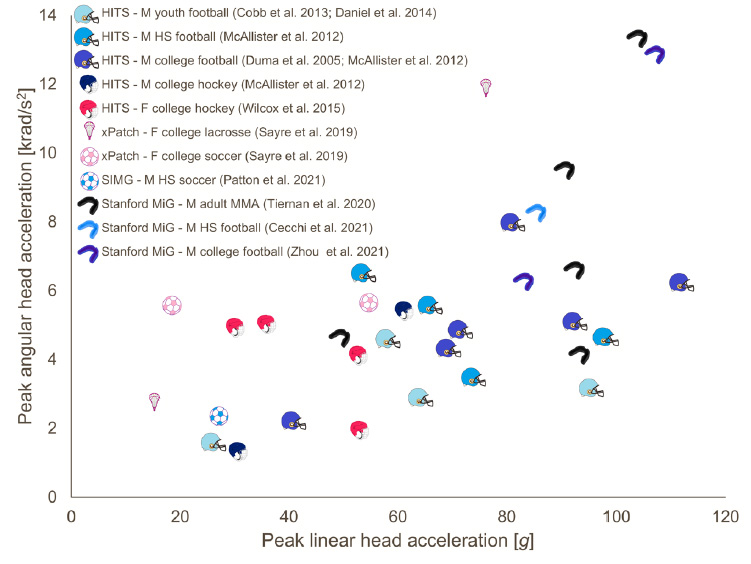
NOTE: g = gravity; krad/s2 = kiloradian per second squared.
SOURCE: Presented by Kristy Arbogast, April 15, 2025. Developed by Declan Patton.
___________________
2 The unit of measurement for linear acceleration is meters per second squared (m/s2). One gravity or “g” is defined as the acceleration due to Earth’s gravity, which is about 9.8 meters/s2. The unit of measurement for angular acceleration is radian per second squared (rad/s2). A krad/s2 is 1,000 times more.
Final Thoughts
In closing, Arbogast emphasized that RHI can be best understood as a mechanical phenomenon shaped by both linear and angular acceleration, as well as direction. Exposure is highly individualized, making proxy measures often inaccurate. While sensors offer promise for direct measurement, their usefulness depends on careful attention to technical specifications, data-processing methods, and adherence to best practices in study design and reporting. Accurate measurement, she noted, is essential for interpreting the health outcomes associated with RHI and for advancing research. Arbogast encouraged participants to carry these core concepts into the remainder of the workshop, reminding them that meaningful interpretation of outcome data depends on clarity in defining and measuring RHI.
DESCRIBING RHI EXPOSURE IN YOUTH
Avinash Chandran, chief science officer at the Datalys Center for Sports Injury Research and Prevention, introduced and moderated a session focused on identifying who experiences RHI in youth. The session aimed to describe the current evidence base for the epidemiology of RHI exposure in young people; examine the structural and contextual factors that shape RHI risk; appraise the activities and environments most commonly associated with exposure; and explore how youth, families, and institutions navigate the risk–benefit calculus of participation in activities that carry exposure risk.
RHI are not a single event but a cumulative experience, and different dimensions—such as who is exposed (e.g., age, sex, race, identity), where exposure occurs (e.g., school, sport, and community settings), and how it happens (e.g., through type and level of contact or safety practices)—may influence the complex pattern of RHI exposure, Chandran said. He noted that exposure patterns are not evenly distributed and are likely shaped by broader societal, social, structural and cultural contexts, such as uneven access to protective equipment and underrepresentation of certain populations in research (Figure 2-2).
Demographic Characteristics Shaping Youth RHI Exposure
In her presentation, Johna Register-Mihalik, associate professor in the Department of Exercise and Sport Science at the University of North Carolina at Chapel Hill, examined demographic characteristics that may influence the likelihood of exposure to RHI among individuals aged 17 and younger. She focused on available evidence related to age, sex, and other contextual factors, and highlighted key gaps in the literature.
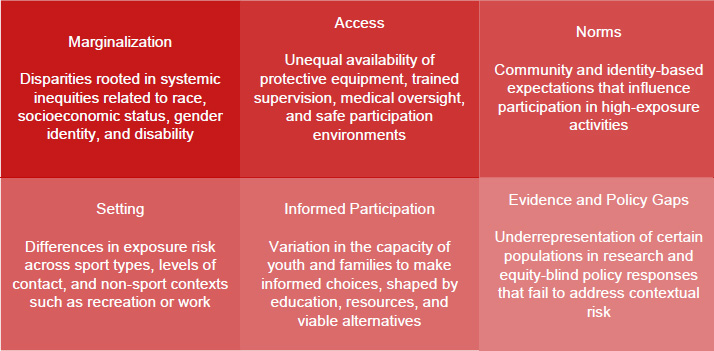
SOURCE: Presented by Avinash Chandran, April 15, 2025.
Sources of Demographic Data
Most research on youth RHI exposure originates in organized sport settings, especially helmeted contact sports, Register-Mihalik said. A 2021 systematic review of studies recording sensor acceleration events during sport participation found that 75 percent of studies came from helmeted sports, with American football alone accounting for over 65 percent of sensor-based research. Other sports such as rugby, ice hockey, soccer, and lacrosse are also represented, but to a much lesser extent (La Flao et al., 2022). Despite improvements in measurement, Register-Mihalik said the literature still reflects a narrow slice of youth sport experience (Figure 2-3).
Age Representation and Considerations
Register-Mihalik discussed the distribution of studies across age groups in RHI literature. Most studies on RHI in sports focus on collegiate athletes, with only 40 percent of studies focused on athletes under the age of 18. Data are more limited for younger children; studies involving participants under age 11 account for only 4 percent of research (La Flao et al., 2022). Given the high rates of sport participation and brain development occurring in early childhood, this gap is particularly significant, Register-Mihalik noted. Although interest in younger cohorts is growing, limitations in measurement and study design make it difficult to isolate age-specific effects.
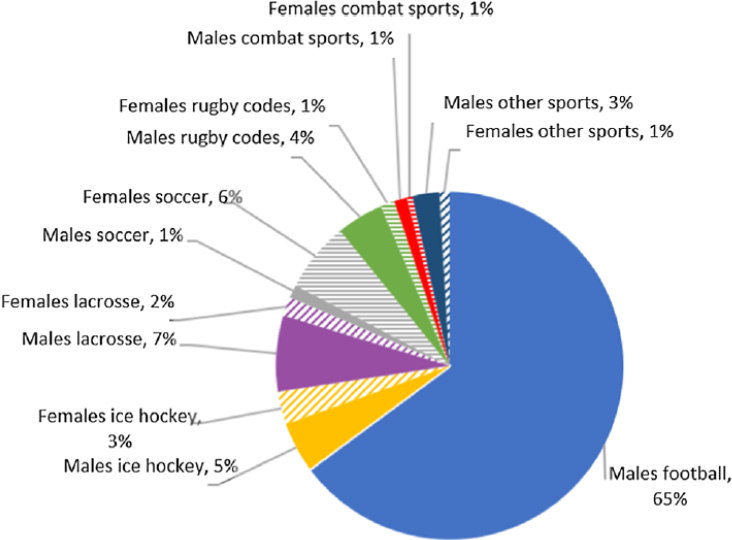
SOURCE: Presented by Johna Register-Mihalik, April 15, 2025. From La Flao et al., 2022. Permission provided by Springer Nature.
Sex Representation and Considerations
The RHI literature remains disproportionately focused on male athletes, largely because of the early emphasis on football, Register-Mihalik said. Only 22 percent of studies reviewed included at least one female participant, and females made up just 15 percent of all participants—despite their significant presence in youth sports (La Flao et al., 2022).
Comparative studies using head impact sensors suggest male athletes sustain more frequent or higher-magnitude acceleration events (La Flao et al., 2022), but Register-Mihalik cautioned that these findings may be shaped by sampling biases rather than true sex-based differences. She called for increased inclusion of female athletes in future studies to better reflect actual participation and assess potential risk differences across sports.
Other Demographic and Contextual Factors
Register-Mihalik discussed the limited data available on the influence of race, socioeconomic status (SES), and environmental conditions on youth
RHI exposure. While research across other areas of traumatic brain injury and brain health has demonstrated differences by race, SES, and factors for injury risk and recovery (Halabi et al., 2024), these factors remain under-explored in the youth RHI context, she said.
Research Gaps and Future Directions
Register-Mihalik concluded by noting that the current RHI evidence base reflects a narrow segment of youth sports. Better alignment between research and actual participation—across age, sex, and social context—will be necessary to understand who is most at risk and to inform meaningful strategies for protecting youth athletes.
Characterizing Activity-Based Sources of RHI Exposure in Youth
Jingzhen Yang, Nationwide Children’s Hospital, discussed sport and nonsport activities that may increase risk for RHI exposure in youth. Yang highlighted that youth head impacts occur across a range of settings, and understanding both sport- and nonsport-related sources is key to improving prevention and research.
Yang shared findings from a meta-analysis of biomechanical characteristics of concussive and subconcussive impacts in youth sports. The pooled estimate of mean peak linear acceleration (PLA) and mean peak rotational acceleration (PRA) of concussive impacts in male youth athletes playing American football was 85.6 g and 4,506 rad/s2, respectively. In contrast, subconcussive RHI had lower average PLAs (24 g for males, 20.5 g for females) and PRAs (1,254 rad/s2 for males, 1,886 rad/s2 for females) (Sundaram et al., 2023). As discussed by Arbogast, several sensor parameters (e.g., trigger thresholds and filtering) can affect sensor performance.
American Football
RHI exposure in youth tackle football varies by different characteristics, such as age, position, and style of play (Pankow et al., 2022). High school athletes tend to experience more frequent head impacts than younger players, with median RHI per game ranging from 15.5 to 21.4 compared to 7.9 to 12 impacts per game for youth players (Bellamkonda, 2018; Broglio et al., 2013; Daniel et al., 2014; Urban et al., 2013). Similarly, practices at the high school level involve more head impacts than youth practices (Bellamkonda, 2018; Daniel et al., 2014; Urban et al., 2013). The front of the helmet is the most common site of impact—accounting for 31–52 percent of total impacts—while the top of the helmet is the least common site but is associated with the highest PLA (Cobb 2013; Daniel, 2012). In contrast,
PRA varies based on impact location. Position-specific data show that linemen experience the highest number of impacts, while quarterbacks and other skill positions3 sustain impacts with higher PRA and PLA (Broglio et al., 2013; Martini, 2013). Offensive strategy also influences exposure: teams that favor running plays tend to accumulate more head impacts overall, but at lower magnitudes than pass-heavy teams (Broglio et al., 2013; Martini, 2013). Lastly, players with more years of play experience sustain more impacts than first-time players over the same time period (Young et al., 2014).
Other Sports
Although most studies on RHI in youth have focused on male football players (La Flao et al., 2022), more recent research is expanding into such sports as soccer, ice hockey, and lacrosse (Huber et al., 2023; Patton et al., 2021, 2023, 2024).
Yang presented findings on RHI exposure in youth soccer. A video-based study of 60 teams (ages 12–14) found that male players experienced more ball-to-head impacts than females, with the greatest differences observed in the older age groups. Across all participants, 92.4 percent sustained zero or one ball-to-head impact per game, likely reflecting age-based restrictions on using one’s head to hit the ball (heading). However, Yang noted key limitations of this study: Impact force and motion data were not collected, and exposures were calculated based on total roster size rather than players actively on the field (Wahlquist et al., 2023). A different study using sensors found that female soccer athletes tend to experience greater impacts than male soccer athletes, with PLA values ranging from 40.9 to 47.4 g compared to 27.6 to 33.3 g in males (Caccese, 2018; Chrisman et al., 2019).
Video verification is essential for interpreting sensor-based RHI data in youth sports, Yang said. She cited a multisport study that tracked head impacts in high school soccer, basketball, lacrosse, and field hockey using headband-mounted sensors. Researchers paired sensor data with video review to confirm true head impacts. In female youths playing soccer, for example, only 32 percent of sensor-recorded events were confirmed; for male youths playing soccer, 26 percent of events were validated (Huber et al., 2021). This sharp reduction highlights the risk of overestimating RHI when relying solely on sensors.
Yang emphasized the challenges of interpreting RHI data in youth soccer owing to high variability in measurement (Wahlquist and Kaminski, 2021). PLA values ranged widely depending on sensor type and placement—for
___________________
3 Players responsible for handling the ball and advancing it downfield to score points.
example, from 9 to 20 g for in-ear and mouthguard sensors, 15.2 to 24 g for skin-mounted sensors, and up to 38.5 g for headband-mounted sensors (Chrisman et al., 2016, 2019; Hecimovich et al., 2018; Miller et al., 2020b; Rich et al., 2019; Sandmo et al., 2019). PRA values also varied, from 700 to 14,500 rad/s2, likely attributable to sensor differences (Caccese, 2018; Hanlon and Bir, 2012; Hecimovich et al., 2018; Miller et al., 2020b; Rich et al., 2019; Sandmo et al., 2019).
Nonsport Activities
Yang also discussed nonsport sources of RHI in youth: recreational activities, playground injuries, accidental head trauma, and child abuse. While these exposures may contribute substantially to RHI burden, current research in these settings has focused largely on traumatic brain injuries (TBIs) and not RHI, she said. Yang discussed several challenges to research on nonsport-related RHI, including a lack of wearable sensors, unpredictability of exposure, privacy and ethical concerns, lack of standardized exposure measures, and reliance on retrospective self-reported data.
Future Research
Yang closed by outlining future priorities: broadening research beyond football, standardizing RHI measurement and analysis, prospectively assessing short-term and long-term effects of RHI on brain health, and developing prevention strategies. She emphasized the importance of designing evidence-based programs to reduce RHI exposure and protect youth from head injury.
Considering Risks and Benefits from Activities Exposing Youth to RHI
William Meehan, director of the Micheli Center for Sports Injury Prevention, and director of research for the Brain Injury Center at Boston Children’s Hospital, was invited by the planning committee to examine the benefits of youth sports participation and how families and clinicians might weigh those benefits against the potential risks of RHI. While much of the workshop focused on emerging risk evidence, Meehan emphasized the importance of incorporating physical, mental, and social benefits of youth activities into informed decision making. He acknowledged that this is a controversial area, with polarized views on whether youth should participate in contact sports.
Meehan noted that families routinely accept certain risks in childhood—such as those involved in bike riding or playground activities—because of
the developmental or health benefits they believe those experiences offer. Sports participation, he suggested, should be understood within a similar framework: carrying potential risks, but also potential benefits that should be considered.
Potential Benefits of Sports Participation
Meehan described a range of physical and mental health benefits associated with youth sports, including improved motor skills (Fisher et al., 2005; Lopes et al., 2011; Williams et al., 2008; Wrotniak et al., 2006), cardiovascular endurance (Hebert et al., 2017; Ortega et al., 2008; Ruiz et al., 2010), bone health (Faigenbaum and Myer, 2012), and lower rates of obesity and cardiovascular risk factors (Hebert et al., 2017; Ortega et al., 2008). Participation has also been associated with lower all-cause mortality over the lifespan via higher lifelong physical activity, Meehan noted (Dohle and Wansink, 2013; Kjønniksen et al., 2009; Wichstrøm et al., 2013).
He described mental health effects as particularly relevant, commenting that youth athletes tend to report fewer symptoms of depression and anxiety, higher self-esteem, and stronger social functioning (Boone and Leadbeater, 2006; Harrison and Narayan, 2003; Jewett et al., 2014; Steptoe and Butler, 1996; Vella et al., 2015). Drawing from national survey data, Meehan noted lower rates of hopelessness and suicidality among adolescents involved in sports (Taliaferro et al., 2008)—an important consideration amid ongoing concerns about youth mental health.
Sports participation has also been linked to reduced risk-taking behaviors, including lower rates of substance use (Harrison and Narayan, 2003; Steiner et al., 2000), and to greater academic engagement and time management (Domazet et al., 2016; Esteban-Cornejo et al., 2014; Jonker et al., 2009, 2010; Marsh and Kleitman, 2003; Umbach et al., 2006;). These effects may extend into adulthood; Meehan cited longitudinal studies showing that former youth athletes are more likely to remain physically active, report better general health, and have fewer physician visits later in life (Dohle and Wansink, 2013; Kjønniksen et al., 2009).
Balancing Risk and Benefit in Clinical Practice
In clinical settings, Meehan argued, decisions about sport participation are not purely medical, but also ethical and personal. Applying principles of medical ethics—autonomy, beneficence, nonmaleficence, and justice—he emphasized the importance of helping families make decisions that align with their goals and values (Beauchamp and Childress, 1994; Bunch and Dvonch, 2004; Ross et al., 2012; Sailors et al., 2013).
Some may reasonably opt for lower-risk sports (Merkel, 2013), he said. Others may choose contact sports based on social, developmental, or motivational factors. In such cases, Meehan emphasized that risks of inactivity must be considered alongside risks of RHI (Fiuza-Luces et al., 2013; Viña et al., 2012). He offered a clinical example of a family that allowed their child to play contact sports with the understanding that they would reevaluate participation if injuries became more frequent—a flexible approach grounded in informed, ongoing assessment (Devitt and McCarthy, 2010).
Meehan concluded by underscoring that efforts to reduce RHI risk should occur in tandem with efforts to preserve access to the broader benefits of youth sports. When supported by safe practices and informed choices, he argued, sports participation can contribute meaningfully to lifelong physical and emotional well-being.
Discussion
Understanding Intersectionality and Individual Risk
As moderator, Chandran asked Register-Mihalik to elaborate on how intersectionality of individual characteristics could influence the risk of exposure to RHI and how research might better capture these compounded risks. Drawing on the socioecological model, Register-Mihalik explained that factors at multiple levels including a person’s identity and demographics (e.g., race, sex, socioeconomic status, years of experience); the immediate social and organizational context; and the policy environment interact in shaping youth exposure and outcomes. She cautioned that a one-size-fits-all approach that ignores variation in needs, resources, or circumstances could worsen disparities. While some research has explored these intersections in TBIs and concussions more broadly, she noted, this work has yet to be fully translated into the study of RHI.
Clinical Communication and Risk Education
Responding to a question from an online participant about whether parents should steer children toward “brain safe” sports until the brain is fully developed, Meehan stated that current evidence does not support the idea that concussions are more harmful when sustained at younger ages. He referenced the Kennard Principle, which posits that younger brains are often more capable of recovery than adult brains (Elliott, 2020; Kennard, 1936).
Along the same vein, Rebekah Mannix, Boston Children’s Hospital, asked Meehan how he conveys to families both the relative risks and the certainty of available evidence. He explained that he tries to avoid giving vague or dismissive responses, instead pointing to specific studies when
relevant and explaining how risk varies with cumulative exposure. He often uses data from professional football players to contextualize risk, while cautioning that these data may not apply directly to youth athletes given differences in size, force of play, and medical protocols.
Measuring Exposure and Implications for Nonsport Settings
Returning to research considerations, Chandran asked Yang to elaborate on challenges in defining “meaningful exposures” to RHI, especially outside of organized sports. Yang noted that key biomechanical exposure measures captured by sensors, including impact frequency, intensity, duration, and magnitude, are difficult to quantify in nonsport settings. She suggested that creative documentation methods, such as video analysis, might offer pathways forward in contexts like recreational activities or playgrounds.
Sensor Technology and Data Interpretation
The discussion continued with a technical exchange sparked by a question from Luca Marinelli, GE Healthcare, who asked whether the wide variability in head acceleration data stems primarily from the lack of reproducibility in sensor data or reflects biological heterogeneity.
Yang responded by highlighting several sources of variability tied to the sensors themselves, noted in Arbogast’s talk. These factors include the type of sensor, issues with coupling, and threshold setting. Because of these differences, video verification is essential to reduce false positives, she said. Arbogast noted another key source of variability: filtering strategies. Once raw data are collected, they are processed to remove noise, but there is no standard approach across the field. Arbogast drew a comparison to automotive safety testing, where standard filtering practices have enabled reliable comparisons across studies for decades. She argued that similar standardization in RHI research would improve comparability and support meta-analyses. Without it, the field risks drawing inaccurate conclusions from technically inconsistent data.
Both panelists emphasized that while biological variability likely contributes to observed differences, a significant portion stems from methodological inconsistencies. Only by addressing these inconsistencies and harmonizing methods can the field generate reliable, actionable evidence on youth exposure to RHI, Arbogast said.
Comparing Across Generations
A final question from Jaclyn Caccese, Ohio State University, posed to Meehan asked how researchers account for differences in era of play when
studying RHI. Meehan noted that current athletes benefit from improved concussion management, while athletes from prior eras played under outdated return-to-play protocols, sometimes sustaining multiple concussions in rapid succession. On the other hand, he also discussed the increasing size and power of modern athletes, suggesting that both improvements in care and increased biomechanical forces must be weighed when comparing across generations.
REFERENCES
Alosco, M. L., A. B. Kasimis, J. M. Stamm, A. S. Chua, C. M. Baugh, D. H. Daneshvar, C. A. Robbins, M. Mariani, J. Hayden, S. Conneely, and R. Au. 2017. Age of first exposure to American football and long-term neuropsychiatric and cognitive outcomes. Translational Psychiatry 7(9):e1236.
Arbogast, K. B., J. B. Caccese, T. A. Buckley, A. S. McIntosh, K. Henderson, B. D. Stemper, G. Solomon, S. P. Broglio, J. R. Funk, and J. R. Crandall. 2022. Consensus Head Acceleration Measurement Practices (CHAMP): Origins, methods, transparency and disclosure. Annals of Biomedical Engineering 50:1317-1345.
Beauchamp, T. L., and J. F. Childress. 1994. Principles of biomedical ethics. 4th ed. Oxford, UK: Oxford University Press.
Bellamkonda, S., S. J. Woodward, E. Campolettano, R. Gellner, M. E. Kelley, D. A. Jones, A. Genemaras, J. G. Beckwith, R. M. Greenwald, A. C. Maerlender, and S. Rowson. 2018. Head impact exposure in practices correlates with exposure in games for youth football players. Journal of Applied Biomechanics 34(5):354-360.
Boone, E. M., and B. J. Leadbeater. 2006. Game on: Diminishing risks for depressive symptoms in early adolescence through positive involvement in team sports. Journal of Research on Adolescence 16(1):79-90.
Brett, B. L., D. L. Huber, A. Wild, L. D. Nelson, and M. A. McCrea. 2019. Age of first exposure to American football and behavioral, cognitive, psychological, and physical outcomes in high school and collegiate football players. Sports Health 11(4):332-342.
Broglio, S. P., D. Martini, L. Kasper, J. T. Eckner, and J. S. Kutcher. 2013. Estimation of head impact exposure in high school football: Implications for regulating contact practices. American Journal of Sports Medicine 41(12):2877-2884.
Bunch, W. H., and V. M. Dvonch. 2004. Informed consent in sports medicine. Clinics in Sports Medicine 23(2):183-193.
Caccese, J. B., T. A. Buckley, R. T. Tierney, W. C. Rose, J. J. Glutting, and T. W. Kaminski. 2018. Sex and age differences in head acceleration during purposeful soccer heading. Research in Sports Medicine 26(1):64-74.
Caccese, J., J. Schmidt, J. Moody, S. Broglio, T. McAllister, M. McCrea, P. Pasquina, T. Buckley, and Care Consortium Investigators. 2023. Association between sports participation history and age of first exposure to high-risk sports with concussion history. Research in Sports Medicine 31(3):260-272.
Cecchi N. J., A. G. Domel, Y. Liu, E. Rice, R. Lu, X. Zhan, Z. Zhou, S. J. Raymond, S. Sami, H. Singh, I. Rangel, L. P. Watson, S. Kleiven, M. Zeineh, D. B. Camarillo, and G. Grant. 2021. Identifying factors associated with head impact kinematics and brain strain in high school American football via instrumented mouthguards. Annals of Biomedical Engineering 49(10):2814-2826.
Erratum in: Cecchi N. J., A. G. Domel, Y. Liu, E. Rice, R. Lu, X. Zhan, Z. Zhou, S. J. Raymond, S. Sami, H. Singh, I. Rangel, L. P. Watson, S. Kleiven, M. Zeineh, D. B. Camarillo, and G. Grant. 2023. Correction: Identifying factors associated with head impact kinematics and brain strain in high school American football via instrumented mouthguards. Annals of Biomedical Engineering 51(2):456.
Chrisman, S. P., C. L. Mac Donald, S. Friedman, J. Andre, A. Rowhani-Rahbar, S. Drescher, E. Stein, M. Holm, N. Evans, A. V. Poliakov, R. P. Ching, C. C. Schwien, M. S. Vavilala, and F. P. Rivara. 2016. Head impact exposure during a weekend youth soccer tournament. Journal of Child Neurology 31(8):971-978.
Chrisman, S. P. D., B. E. Ebel, E. Stein, S. J. Lowry, and F. P. Rivara. 2019. Head impact exposure in youth soccer and variation by age and sex. Clinical Journal of Sport Medicine 29(1):3-10.
Cobb, B. R., J. E. Urban, E. M. Davenport, S. Rowson, S. M. Duma, J. A. Maldjian, C. T. Whitlow, A. K. Powers, and J. D. Stitzel. 2013. Head impact exposure in youth football: Elementary school ages 9–12 years and the effect of practice structure. Annals of Biomedical Engineering 41(12):2463-2473.
Cortes, N., A. E. Lincoln, G. D. Myer, L. Hepburn, M. Higgins, M. Putukian, and S. V. Caswell. 2017. Video analysis verification of head impact events measured by wearable sensors. American Journal of Sports Medicine 45(10):2379-2387.
Crisco, J. J., J. J. Chu, and R. M. Greenwald. 2004. An algorithm for estimating acceleration magnitude and impact location using multiple nonorthogonal single-axis accelerometers. Journal of Biomechanical Engineering 126(6):849-854.
Daniel, R. W., S. Rowson, and S. M. Duma. 2012. Head impact exposure in youth football. Annals of Biomedical Engineering 40:976-981.
Daniel, R. W., S. Rowson, and S. M. Duma. 2014. Head impact exposure in youth football: Middle school ages 12–14 years. Journal of Biomechanical Engineering 136(9):094501.
Deshpande, S. K., R. B. Hasegawa, A. R. Rabinowitz, J. Whyte, C. L. Roan, A. Tabatabaei, M. Baiocchi, J. H. Karlawish, C. L. Master, and D. S. Small. 2017. Association of playing high school football with cognition and mental health later in life. JAMA Neurology 74(8):909-918.
Devitt, B. M., and C. McCarthy. 2010. “I am in blood stepp’d in so far…”: Ethical dilemmas and the sports team doctor. British Journal of Sports Medicine 44(3):175-178.
Dohle, S., and B. Wansink. 2013. Fit in 50 years: Participation in high school sports best predicts one’s physical activity after age 70. BMC Public Health 13:1100.
Domazet, S. L., J. Tarp, T. Huang, K. Gejl, J. J. Andersen, and L. B. Bugge. 2016. Associations of physical activity, sports participation and active commuting on mathematic performance and inhibitory control in adolescents. PLOS ONE 11(1):e0146319.
Duma, S. M., S. J. Manoogian, W. R. Bussone, P. G. Brolinson, M. W. Goforth, J. J. Donnenwerth, R. M. Greenwald, J. J. Chu, and J. J. Crisco. 2005. Analysis of real-time head accelerations in collegiate football players. Clinical Journal of Sport Medicine 15(1):3-8.
Elliott, D. 2020. The legacy of the Kennard Principle. Journal of Undergraduate Neuroscience Education 19(1):R11.
Esteban-Cornejo, I., S. Gómez-Martinez, C. M. Tejero-González, R. Castillo, R. Lanza-Saiz, G. Vicente-Rodriguez, A. Marcos, and D. Martinez-Gomez. 2014. Characteristics of extracurricular physical activity and cognitive performance in adolescents: The AVENA study. Journal of Sports Sciences 32(17):1596-1603.
Faigenbaum, A. D., and G. D. Myer. 2012. Exercise deficit disorder in youth: Play now or pay later. Current Sports Medicine Reports 11(4):196-200.
Fisher, A., J. J. Reilly, L. A. Kelly, C. Montgomery, W. Paton, and J. Y. Reilly. 2005. Fundamental movement skills and habitual physical activity in young children. Medicine & Science in Sports & Exercise 37(4):684-688.
Fiuza-Luces, C., N. Garatachea, N. A. Berger, and A. Lucia. 2013. Exercise is the real polypill. Physiology 28(5):330-358.
Funk, J. R., J. M. Cormier, C. E. Bain, H. Guzman, E. Bonugli, and S. J. Manoogian. 2011. Head and neck loading in everyday and vigorous activities. Annals of Biomedical Engineering 39(3):766-776.
Grashow, R., C. O. Tan, J. D. Thomas, H. DiGregorio, H. Lee, R. S. Rotem, D. Marengi, D. P. Terry, S. R. Eagle, G. L. Iverson, A. J. Whittington, R. D. Zafonte, M. G. Weisskopf, and A. L. Baggish. 2024. Career duration and later-life health conditions among former professional American-style football players. Occupational and Environmental Medicine 81(10):498-506.
Halabi, C., S. Izzy, A. M. DiGiorgio, H. Mills, F. Radmanesh, J. K. Yue, H. A. Choshali, G. Schenk, S. Israni, R. Zafonte, and G. T. Manley. 2024. Traumatic brain injury and risk of incident comorbidities. JAMA Network Open 7(12):e2450499. doi:10.1001/jamanetworkopen.2024.50499.
Hanlon, E. M., and C. A. Bir. 2012. Real-time head acceleration measurement in girls’ youth soccer. Medicine & Science in Sports & Exercise 44(6):1102-1108.
Harrison, P. A., and G. Narayan. 2003. Differences in behavior, psychological factors, and environmental factors associated with participation in school sports and other activities in adolescence. Journal of School Health 73(3):113-120.
Hebert, J. J., H. Klakk, N. C. Møller, L. Grøntved, K. Wedderkopp, and L. B. Andersen. 2017. The prospective association of organized sports participation with cardiovascular disease risk in children (the CHAMPS study-DK). Mayo Clinic Proceedings 92(1):57-65.
Hecimovich, M., D. King, A. Dempsey, M. Gittins, and M. Murphy. 2018. Youth Australian footballers experience similar impact forces to the head as junior- and senior-league players: A prospective study of kinematic measurements. Journal of Sports Science and Medicine 17(4):547-556.
Huber, C. M., D. A. Patton, D. Jain, C. L. Master, S. S. Margulies, C. C. McDonald, and K. B. Arbogast. 2021. Variations in head impact rates in male and female high school soccer. Medicine & Science in Sports & Exercise 53(6):1245-1251.
Huber, C. M., D. A. Patton, K. R. Rownd, C. Patterson Gentile, C. L. Master, and K. B. Arbogast. 2023. Neurophysiological effects of repeated soccer heading in youth. Journal of Biomechanical Engineering 145(9):091005.
Iverson, G. L., J. B. Caccese, Z. C. Merz, F. Büttner, and D. P. Terry. 2021. Age of first exposure to football is not associated with later-in-life cognitive or mental health problems. Frontiers in Neurology 12:647314. doi:10.3389/fneur.2021.647314.
Jewett, R., C. M. Sabiston, J. Brunet, L. O’Loughlin, G. Scarapicchia, and J. L. O’Loughlin. 2014. School sport participation during adolescence and mental health in early adulthood. Journal of Adolescent Health 55(5):640-644.
Jonker, L., M. T. Elferink-Gemser, and C. Visscher. 2009. Talented athletes and academic achievements: A comparison over 14 years. High Ability Studies 20(1):55-64.
Jonker, L., M. T. Elferink-Gemser, T. Toering, R. Lyons, and C. Visscher. 2010. Academic performance and self-regulatory skills in elite youth soccer players. Journal of Sports Sciences 28(14):1605-1614.
Kennard, M. A. 1936. Age and other factors in motor recovery from precentral lesions in monkeys. American Journal of Physiology 115(1):138-146.
Kjønniksen, L., N. Anderssen, and B. Wold. 2009. Organized youth sport as a predictor of physical activity in adulthood. Scandinavian Journal of Medicine & Science in Sports 19(5):646-654.
Kmush, B. L., M. Mackowski, J. Ehrlich, B. Walia, A. Owora, and S. Sanders. 2020. Association of professional football cumulative head impact index scores with all-cause mortality among National Football League players. JAMA Network Open 3(5):e204442. doi:10.1001/jamanetworkopen.2020.4442. Erratum in: JAMA Network Open 3(6):e2010560.
La Flao, E., G. P. Siegmund, and R. Borotkanics. 2022. Head impact research using inertial sensors in sport: A systematic review of methods, demographics, and factors contributing to exposure. Sports Medicine 52(3):481-504.
Lin, N., G. Tierney, and S. Ji. 2024. Effect of impact kinematic filters on brain strain responses in contact sports. IEEE Transactions on Biomedical Engineering 71(9):2781-2788.
Lopes, V. P., L. P. Rodrigues, J. A. Maia, and R. M. Malina. 2011. Motor coordination as predictor of physical activity in childhood. Scandinavian Journal of Medicine & Science in Sports 21(5):663-669.
Marsh, H. W., and S. Kleitman. 2003. School athletic participation: Mostly gain with little pain. Journal of Sport and Exercise Psychology 25(2):205-228.
Martini, D., J. Eckner, J. Kutcher, and S. P. Broglio. 2013. Subconcussive head impact biomechanics: Comparing differing offensive schemes. Medicine & Science in Sports & Exercise 45(4):755-761.
McAllister T. W., L. A. Flashman, A. Maerlender, R. M. Greenwald, J. G. Beckwith, T. D. Tosteson, J. J. Crisco, P. G. Brolinson, S. M. Duma, A. C. Duhaime, M. R. Grove, and J. H. Turco. 2012. Cognitive effects of one season of head impacts in a cohort of collegiate contact sport athletes. Neurology 78(22):1777-1784.
Merkel, D. L. 2013. Youth sport: Positive and negative impact on young athletes. Open Access Journal of Sports Medicine 4:151-160.
Miller, L. E., J. E. Urban, V. M. Whelan, W. W. Baxter, S. B. Tatter, and J. D. Stitzel. 2020a. An envelope of linear and rotational head motion during everyday activities. Biomechanics and Modeling in Mechanobiology 19(3):1003-1014.
Miller, L. E., E. K. Pinkerton, K. C. Fabian, L. C. Wu, M. A. Espeland, L. C. Lamond, C. M. Miles, D. B. Camarillo, J. D. Stitzel, and J. E. Urban. 2020b. Characterizing head impact exposure in youth female soccer with a custom-instrumented mouthpiece. Research in Sports Medicine 28(1):55-71.
Ortega, F. B., J. R. Ruiz, M. J. Castillo, and M. Sjöström. 2008. Physical fitness in childhood and adolescence: A powerful marker of health. International Journal of Obesity 32(1):1-11.
Pankow, M. P., R. A. Syrydiuk, A. T. Kolstad, A. K. Hayden, C. R. Dennison, M. Mrazik, B. E. Hagel, and C. A. Emery. 2022. Head games: A systematic review and meta-analysis examining concussion and head impact incidence rates, modifiable risk factors, and prevention strategies in youth tackle football. Sports Medicine 52(6):1259-1272.
Patton, D. A., C. M. Huber, D. Jain, R. K. Myers, C. C. McDonald, S. S. Marguiles, C. L. Master, and K. B. Arbogast. 2020. Head impact sensor studies in sports: A systematic review of exposure confirmation methods. Annals of Biomedical Engineering 48:2497-2507.
Patton, D. A., C. M. Huber, S. S. Margulies, C. L. Master, and K. B. Arbogast. 2021. Non-header impact exposure and kinematics of male youth soccer players. Biomedical Sciences Instrumentation 57(2):106.
Patton, D. A., C. M. Huber, D. Fedonni, S. S. Margulies, C. L. Master, and K. B. Arbogast. 2023. Quantifying head impact exposure, mechanisms and kinematics using instrumented mouthguards in female high school lacrosse. Research in Sports Medicine 31(6):772-786.
Patton, D. A., C. M. Huber, D. Jain, S. Kleiven, Z. Zhou, C. L. Master, and K. B. Arbogast. 2024. Head impact kinematics and brain tissue strains in high school lacrosse. Annals of Biomedical Engineering 52(10):2844-2853.
Rich, A. M., T. M. Filben, L. E. Miller, B. T. Tomblin, A. R. Van Gorkom, M. A. Hurst, R. T. Barnard, D. S. Kohn, J. E. Urban, and J. D. Stitzel. 2019. Development, validation and pilot field deployment of a custom mouthpiece for head impact measurement. Annals of Biomedical Engineering 47(10):2109-2121.
Ross, J. R., J. D. Capozzi, and M. J. Matava. 2012. Discussing treatment options with a minor: The conflicts related to autonomy, beneficence, and paternalism. Journal of Bone and Joint Surgery 94(1):e3(1-4).
Ruiz, J. R., F. B. Ortega, R. Castillo, M. Sjöström, and the AVENA Study Group. 2010. Physical activity, fitness, weight status, and cognitive performance in adolescents. Journal of Pediatrics 157(6):917-922.e1.
Russell, E. R., D. F. Mackay, K. Stewart, J. A. MacLean, J. P. Pell, and W. Stewart. 2021. Association of field position and career length with risk of neurodegenerative disease in male former professional soccer players. JAMA Neurology 78(9):1057-1063. doi:10.1001/jamaneurol.2021.2403.
Sailors, P. R., S. Teetzel, and C. Weaving. 2013. Prescription for “sports medicine and ethics.” American Journal of Bioethics 13(10):22-24.
Sandmo, S. B., A. S. McIntosh, T. E. Andersen, I. K. Koerte, and R. Bahr. 2019. Evaluation of an in-ear sensor for quantifying head impacts in youth soccer. American Journal of Sports Medicine 47(4):974-981.
Sayre H. D., D. A. Bradney, K. M. Breedlove, and T. G. Bowman. 2019. Concussive head impact biomechanics in women’s lacrosse and soccer athletes: A case series. Athletic Training & Sports Health Care 11(3):143-146.
Shah, A. S., R. Chiariello, K. Dolick, A. Wild, L. D. Nelson, P. Gibson, D. S. Hedin, M. McCrea, and B. D. Stemper. 2019. Video assessment and evaluation of two wearable sensors in American football players. Proceedings of IRCOBI 2019. https://www.ircobi.org/wordpress/downloads/irc19/pdf-files/86.pdf (accessed September 5, 2025).
Steiner, H., R. W. McQuivey, R. Pavelski, E. Pitts, and K. Kraemer. 2000. Adolescents and sports: Risk or benefit? Clinical Pediatrics 39(3):161-166.
Steptoe, A., and N. Butler. 1996. Sports participation and emotional wellbeing in adolescents. Lancet 347(9018):1789-1792.
Sundaram, V., V. Sundar, and A. J. Pearce. 2023. Biomechanical characteristics of concussive and sub-concussive impacts in youth sports athletes: A systematic review and meta-analysis. Journal of Sports Sciences 41(7):631-645.
Taliaferro, L. A., B. A. Rienzo, M. D. Miller, R. M. Pigg Jr, and V. J. Dodd. 2008. High school youth and suicide risk: Exploring protection afforded through physical activity and sport participation. Journal of School Health 78(10):545-553.
Tiernan, S., A. Meagher, D. O’Sullivan, E. O’Keeffe, E. Kelly, E. Wallace, C. P. Doherty, M. Campbell, Y. Liu, and A. G. Domel. 2020. Concussion and the severity of head impacts in mixed martial arts. Proceedings of the Institution of Mechanical Engineers. Part H, Journal of Engineering in Medicine 234(12):1472-1483.
Tierney, G., S. Rowson, R. Gellner, D. Allan, S. Iqbal, P. Biglarbeigi, et al. 2024. Head Exposure to Acceleration Database in Sport (HEADSport): A kinematic signal processing method to enable instrumented mouthguard (iMG) field-based inter-study comparisons. BMJ Open Sport & Exercise Medicine 10:e001758.
Tooby, J., J. Woodward, R. Tucker, B. Jones, É. Falvey, D. Salmon, M. D. Bussey, L. Starling, and G. Tierney. 2024. Instrumented mouthguards in elite-level men’s and women’s rugby union: The incidence and propensity of head acceleration events in matches. Sports Medicine 54(5):1327-1338. doi:10.1007/s40279-023-01953-7. Epub 2023 Oct 31. Erratum in: Sports Medicine 54(5):1339-1341.
Umbach, P. D., M. M. Palmer, G. D. Kuh, and S. J. Hannah. 2006. Intercollegiate athletes and effective educational practices: Winning combination or losing effort? Research in Higher Education 47(6):709-733.
Urban, J. E., E. M. Davenport, A. J. Golman, J. A. Maldjian, C. T. Whitlow, A. K. Powers, and J. D. Stitzel. 2013. Head impact exposure in youth football: High school ages 14–18 years and cumulative impact analysis. Annals of Biomedical Engineering 41(12):2474-2487.
Viña, J., F. Sanchis-Gomar, V. Martinez-Bello, and M. C. Gomez-Cabrera. 2012. Exercise acts as a drug: The pharmacological benefits of exercise. British Journal of Pharmacology 167(1):1-12.
Vella, S. A., D. P. Cliff, C. A. Magee, and A. D. Okely. 2015. Associations between sports participation and psychological difficulties during childhood: A two-year follow-up. Journal of Science and Medicine in Sport 18(3):304-309.
Wahlquist, V. E., and T. W. Kaminski. 2021. Purposeful heading in youth soccer: A review. Sports Medicine 51:51-64.
Wahlquist, V. E., T. A. Buckley, J. B. Caccese, J. J. Glutting, T. D. Royer, and T. W. Kaminski. 2023. Quantitative analysis of ball-head impact exposure in youth soccer players. Journal of Sports Science and Medicine 22(3):591-596.
Wichstrøm, L., T. von Soest, and I. L. Kvalem. 2013. Predictors of growth and decline in leisure time physical activity from adolescence to adulthood. Health Psychology 32(7):775-784.
Wilcox, B. J., J. G. Beckwith, R. M. Greenwald, N. P. Raukar, J. J. Chu, T. W. McAllister, L. A. Flashman, A. C. Maerlender, A. C. Duhaime, and J. J. Crisco. 2015. Biomechanics of head impacts associated with diagnosed concussion in female collegiate ice hockey players. Journal of Biomechanics 48(10):2201-2204.
Williams, H. G., K. A. Pfeiffer, J. R. O’Neill, M. Dowda, R. M. McIver, M. L. Brown, and R. R. Pate. 2008. Motor skill performance and physical activity in preschool children. Obesity 16(6):1421-1426.
Wrotniak, B. H., L. H. Epstein, J. M. Dorn, K. J. Jones, and P. T. Kondilis. 2006. The relationship between motor proficiency and physical activity in children. Pediatrics 118(6):e1758-e1765.
Wu, L. C., V. Nangia, K. Bui, B. Hammoor, M. Kurt, F. Hernandez, C. Kuo, and D. B. Camarillo. 2016. In vivo evaluation of wearable head impact sensors. Annals of Biomedical Engineering 44(4):1234-1245.
Young, T. J., R. W. Daniel, S. Rowson, and S. M. Duma. 2014. Head impact exposure in youth football: elementary school ages 7-8 years and the effect of returning players. Clinical Journal of Sports Medicine 24(5):416-421.
Zhou, Z., X. Li, Y. Liu, M. Fahlstedt, M. Georgiadis, X. Zhan, S. J. Raymond, G. Grant, S. Kleiven, D. Camarillo, and M. Zeineh. 2021. Toward a comprehensive delineation of white matter tract-related deformation. Journal of Neurotrauma 38(23):3260-3278.
This page intentionally left blank.


