Exploring Risks of Repeated Head Impacts in Youth and Strategies to Minimize Exposure: Proceedings of a Workshop (2026)
Chapter: 5 Reflecting on Research Gaps and Opportunities for Youth Exposure to Repetitive Head Impacts
5
Reflecting on Research Gaps and Opportunities for Youth Exposure to Repetitive Head Impacts
Key Points Highlighted by Individual Speakers1
- Emerging imaging technologies, such as ultra-high-performance MRI systems, have the potential to transform detection of subtle brain changes related to repetitive head impacts (RHI), but their integration into youth research will require careful consideration of measurement priorities, feasibility, and interpretation (Marinelli).
- Lessons from the evolution of other exposure science fields, such as radiation safety, illustrate the importance of accurate exposure monitoring, dose–response research, and evidence-based threshold for risk—elements that are still underdeveloped in RHI research (Bazarian).
- Current gaps in outcome measurement—particularly the lack of sensitive, validated markers beyond concussion diagnosis—limit the ability to evaluate the effects of RHI exposure or the success of interventions (Brett, Mannix).
- Findings from advanced MRI studies of RHI show inconsistent direction and magnitude of changes across studies, underscoring the need for reproducible, harmonized imaging protocols before results can be reliably interpreted (Brett).
___________________
1 This list is the rapporteurs’ summary of points made by the individual speakers identified, and the statements have not been endorsed or verified by the National Academies of Sciences, Engineering, and Medicine. They are not intended to reflect a consensus among workshop participants.
- Exposure assessment methods need to consider individual variability, timing and clustering of prior impacts, and differences across sports, positions, and levels of play. Advances in sensors, video analysis, and modeling offer opportunities but require validation and standardization (Gabler).
- The absence of agreed-upon standards for consumer-facing head-impact devices raises concerns about accuracy, interpretation, and responsible use of data in community settings (Gabler).
- Determining which outcomes to prioritize—ranging from clinical symptoms to subclinical imaging or biomarker changes—remains a central challenge, particularly in pediatric populations where functional relevance and developmental appropriateness are essential (Mannix).
- Large, prospective longitudinal multicohort studies, potentially with sequential cohort designs, are needed to capture the full trajectory of youth RHI exposure and outcomes. Tracking diverse participants at regular intervals with biomarkers, imaging, physiological, academic, and functional measures—and applying advanced analytic approaches that account for brain development—would help clarify outcomes related to RHI exposure (Brett, Gioia, Mannix).
- Advances in technology, analytics, and study design will need to be paired with clear research priorities, cross-sector collaboration, and sustained investment to close existing evidence gaps and inform youth safety policies (Gabler, Mannix, Marinelli).
The final aim of the workshop was to reflect on key research gaps and opportunities for understanding exposure to repetitive head impacts (RHI) in youth. Presentations and discussion examined advances in imaging and sensing technologies; lessons from other exposure sciences; uncertainties in linking RHI to structural, functional, and biological brain changes; methods for quantifying individual and cumulative exposure; and strategies for selecting and tracking meaningful short- and long-term outcomes.
REFLECTIONS ON RESEARCH GAPS AND OPPORTUNITIES
Luca Marinelli, senior principal scientist at GE HealthCare Technology and Innovation Center, opened the workshop’s final session by framing it
as an exploration of major knowledge gaps and promising tools to address them.
Before turning to the panel, Marinelli gave a short overview of recent magnetic resonance imaging (MRI) hardware advances that could transform brain imaging in RHI research. He explained that while public attention often focuses on the large magnet in MRI systems, gradient coils—which encode spatial information and contrast—are equally critical. A new generation of ultra-high-performance, head-dedicated gradient systems (e.g., GE SIGNA MAGNUS, Siemens Connectome 2, United Imaging NeuroFrontier) can achieve much higher performance for both maximum gradient strength and slew rate than whole-body systems, overcoming limits imposed by amplifier power and peripheral nerve stimulation, Marinelli said. Developed through academic–industry–federal (including the National Institutes of Health and the Department of War) partnerships, these systems now allow submillimeter isotropic resolution, ultra high b-value diffusion imaging, and visualization of fine-scale gray–white matter microstructure or glymphatic flow changes in vivo in minutes—capabilities not possible with prior clinical MRI, he said. He illustrated the expanded “parameter space” these systems open for detecting subtle microstructural alterations potentially linked to RHI.
Marinelli closed by noting that such imaging performance could produce unprecedented detail for studies of head-impact biomechanics, structural and functional sequelae, and longitudinal monitoring, setting the stage for the session’s exploration of additional knowledge gaps and approaches to address them.
Lessons from Other Types of Exposures
Jeffrey Bazarian, professor of emergency medicine and neurology at the University of Rochester, drew on lessons learned from other types of exposures, focusing on ionizing radiation, to consider how they might inform the RHI field. He noted that radiation science faced the challenge of understanding how exposure relates to outcomes and of deciding how to put guardrails in place to limit adverse effects. Radiation safety standards evolved from a complete absence of regulation to internationally enforced occupational limits, and he suggested that this history could offer a road map for how the RHI field might advance toward evidence-based safety thresholds (Mannix et al., 2022).
Radiation exposure and RHI exposure share important parallels. In both cases, a single high-intensity event can cause an obvious acute effect, such as skin burns from radiation or a concussion from a direct blow to the head. More difficult to study, and potentially more consequential for long-term health, are the cumulative effects of repeated, lower-level exposures
that may not produce immediate symptoms but which can lead to serious problems years later, such as cancer in the case of radiation. In the case of RHI, research is ongoing to determine whether such cumulative exposure is linked to neurodegenerative disease or other clinical outcomes.
Bazarian traced how radiation standards emerged and evolved, beginning with Marie Curie’s discovery of radioactivity in the early 1900s. Curie burned herself multiple times handling radioactive materials. By the 1920s, it was recognized that there was a minimum dose of radiation that would cause skin redness. At that time, the daily limit was set at 100 millisieverts, but new evidence led to lowering the limit to 1 millisievert per day in the 1930s. Advances in the late 1930s and early 1940s, including the development of dosimeters and badge monitors, made it possible to measure exposure directly. After World War II, studies of atomic bomb survivors provided critical data on how levels of exposure related to health outcomes over time. This allowed the creation of dose–response curves and, by the mid-1950s, adoption of the concept of a minimum cumulative permissible dose. The current occupational limit is 50 millisieverts per year, enforced internationally by the International Atomic Energy Agency (IAEA) and guided by explicit principles of justification, optimization, and limitation (European Commission et al., 2014; IAEA and ILO, 2018).2
Bazarian observed that the RHI field is at a much earlier stage in this process (Figure 5-1). A key step will be developing a reliable way to monitor cumulative exposure; in radiation work, this is done with a badge dosimeter. He questioned whether current head-impact sensors can measure exposure with the accuracy needed for this purpose. Determining thresholds for acceptable risk, he added, remains a major challenge. Bazarian closed by asking the group whether the field is “there yet” in terms of having the information needed to follow the path taken in radiation safety—establishing clear connections between dose and response and setting reasonable safety standards for RHI.
Understanding Structural and Functional Changes in the Brain After Youth RHI Exposure
Benjamin Brett, assistant professor in the Department of Neurosurgery at the Medical College of Wisconsin, discussed knowledge gaps related to RHI exposure and approaches or tools to address these gaps.
Brett outlined three questions related to RHI that remain to be addressed. The first key question concerns the consistency of findings across studies examining exposure and structural and functional MRI results. Brett
___________________
2 See https://icrpaedia.org/Fundamental_Principles_of_Radiological_Protection (accessed September 8, 2025).
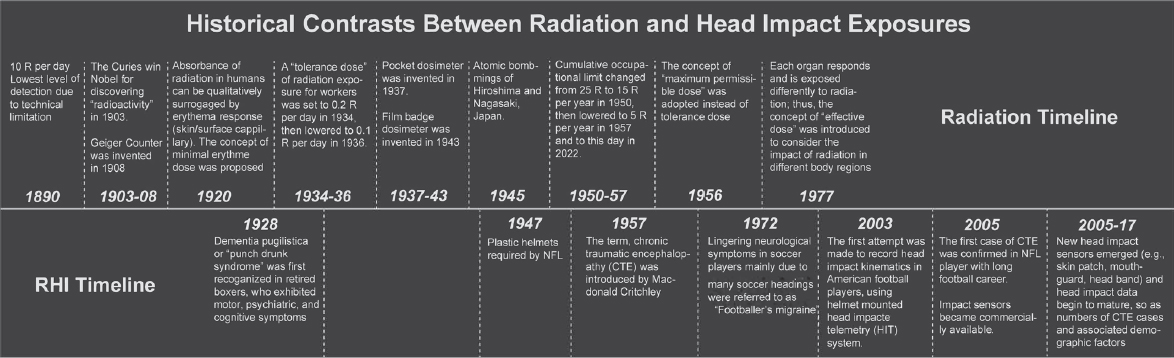
NOTES: CTE = chronic traumatic encephalopathy; HIT = head impact telemetry; NFL = National Football League; R= Roentgen (a unit of exposure that measures the amount of ionizing radiation).
SOURCE: Presented by Jeffrey Bazarian, April 16, 2025. From Mannix et al., 2022. Reprint permission provided by Mary Ann Liebert, Inc. publishers.
highlighted that even within the same imaging modality, such as diffusion MRI, study findings vary widely, sometimes showing increased fractional anisotropy after RHI exposure and other times showing decreases. He provided examples from youth and collegiate athletic studies that demonstrate conflicting results in the direction of changes in fractional anisotropy and cerebral blood flow from pre- to postseason (Brett et al., 2021; Goubran et al., 2023; Holcomb et al., 2021). This variability raises the challenge of whether the field can produce replicable results that reliably capture the neuroimaging changes associated with RHI, Brett said.
The second question involves the course of neuroimaging changes over time and the trajectory of these changes once an athlete stops playing contact sports. Brett drew parallels with traumatic brain injury research (Wang et al., 2018), noting that both the timing of measurement and the stage of biological development may influence imaging outcomes. He described studies showing partial recovery of functional connectivity and white matter microstructure in the weeks or months following sport discontinuation (Fitzgerald et al., 2024; Yuan et al., 2018), but emphasized that the timing, durability, and cumulative effects of these changes remain unclear (Brett et al., 2024).
The third question asks what biological processes underlie the neuroimaging changes linked to RHI exposure. Brett noted that while changes in fractional anisotropy or cerebral blood flow are measurable, it is not yet clear whether these reflect white matter degradation, vascular alterations, perivascular space changes, or other mechanisms such as microtubule disintegration or blood–brain barrier breakdown. Determining the underlying biology is essential for interpreting imaging results and understanding potential long-term implications, he said.
To address these questions, Brett first emphasized the importance of improving the ascertainment of RHI exposure, particularly in retrospective studies. He showed that the choice of exposure metric—such as years of participation versus advanced modeled estimates—can alter the observed associations with neurobehavioral outcomes, underscoring the need for accurate and standardized exposure measurement (Brett et al., 2022). Second, he called for continued advancement and validation of imaging protocols, noting innovations such as adding temporal components to cerebral blood flow measurements and developing more sensitive positron emission tomography (PET) tracers for neuroinflammation. These advances could help capture the dynamic and multifactorial nature of brain changes after RHI. Finally, Brett urged the adoption of analytical methods capable of integrating multiple imaging and biological measures over time, such as subtype-and-stage inference models (Young et al., 2018). Such approaches, he said, could better reflect the simultaneous and interacting processes
that occur following RHI exposure, ultimately leading to a more complete understanding of its effects.
Quantifying Youth RHI Exposure
Lee Gabler, senior engineer at Biocore LLC, opened his presentation by introducing his focus on methods for quantifying youth RHI exposure. He began with a brief return to the fundamentals of head impact biomechanics, echoing earlier remarks by Arbogast on the importance of magnitude, duration, and direction of both linear and angular acceleration in producing brain deformation (See Chapter 2).
Gabler underscored two elements he sees as central to addressing current knowledge gaps related to youth exposure to RHI: the timing of prior head impacts and the individuality of each athlete’s exposure. The brain continues to move inside the skull for hundreds of milliseconds after impact (Alshareef et al., 2018), and neurometabolic cascades can last minutes to days (Giza and Hovda, 2001). These overlapping recovery windows, Gabler said, create periods of heightened vulnerability in which the frequency of impacts can influence outcomes, meaning that impact counts or severities alone cannot capture true exposure—there must be a temporal component. Gabler also presented data from Division I college offensive linemen showing substantial variation in head impact severity between athletes in the same position group, with some players sustaining median accelerations more than 50 percent higher than others (Gabler et al., 2025). These findings, he concluded, highlight the need for a clearer understanding of how the timing and severity of prior impacts affect health outcomes and for measuring exposure at the individual level rather than relying on generalized estimates or proxies.
Measurement Devices
Gabler reviewed the primary device categories used to collect RHI data—skin patches, earpieces, helmet-mounted sensors, and instrumented mouthguards—describing how each varies in accuracy, practicality, and user compliance. Each device has trade-offs, Gabler said. Instrumented mouthguards have the best coupling to the skull and thus capture head kinematics most directly, but they are prone to loss, damage, or nonuse by athletes. Helmet-mounted sensors are worn by all players but measure motion indirectly, which can introduce error. The choice of tool, Gabler emphasized, should be guided by the goals of a given study or application, with careful consideration of the trade-offs between data quality, completeness, and feasibility.
Emerging Approaches for Measuring RHI Exposure
Gabler turned to emerging approaches for measuring RHI exposure, beginning with computer vision systems that integrate multiangle video with player tracking data (Naik et al., 2022). At present, these systems can be used as a proxy for counting head impacts, but they hold the potential to deliver coarse severity estimates without requiring athletes to wear sensors. Achieving this would require rigorous synchronization of the various data streams and careful validation of the algorithms used to detect and classify impacts.
He also described the potential of “digital twins” to enhance RHI quantification. “A digital twin is a set of virtual information constructs that mimics the structure, context, and behavior of a natural, engineered, or social system (or system-of-systems) [and] is dynamically updated with data from its physical” counterpart. The bidirectional interaction between the virtual and physical entities is central to the concept, enabling the virtual model to predict future states and inform decisions that realize value (NASEM, 2024). In a sports context, Gabler suggested a digital twin could be created for an athlete using their unique data streams and then placed in simulated scenarios to predict outcomes such as the likelihood of injury or the cumulative effects of head impacts. By running these simulations, digital twins could be used not only to estimate RHI exposure but also to help guide player management and optimize training or gameplay strategies. Gabler said that implementing such a system would require large, well-organized, and synchronized datasets, as well as robust scientific foundations for the predictive models that underlie the simulations.
Standards for Consumer-Facing Uses of Devices
Gabler noted that many head impact sensors are now affordable and available for use outside of research settings, making it increasingly important to ensure that consumers have access to accurate and meaningful information. He pointed to initiatives such as the CHAMP consensus process, which has developed best practices for collecting and analyzing acceleration data for RHI research (Arbogast et al., 2023). He suggested that minimum standards for accuracy, recall, and precision are needed for consumer-facing products so the data they generate are reliable, valid, and presented in ways that are useful to parents, coaches, and physicians.
Developing such standards would require addressing several unresolved questions, Gabler said, including what levels of accuracy should be required for devices intended for public use, how to handle false positives, which specific metrics should be reported, and how to provide the necessary context for nontechnical users to interpret results appropriately. Gabler
added that achieving consistency and safety in consumer applications might eventually call for either government oversight or manufacturer-led standardization, ensuring that these technologies are deployed in a responsible and informed manner.
Methods for Tracking Short- and Long-Term Cognitive and Clinical Outcomes
Rebekah Mannix, chief of the Division of Emergency Medicine at Boston Children’s Hospital, was unable to attend the workshop. Her presentation and remarks were presented on her behalf by Bazarian. In her prepared talk, Mannix examined the question of what outcomes should be prioritized in research on RHI in youth. She framed “clinical outcome” as a broad and variable concept that could encompass cognition, behavior, physiology, oculomotor and vestibular function, academic performance, social connectedness, and overall life satisfaction (Stephen et al., 2022). A central challenge, she noted, lies in deciding which outcomes are most relevant, particularly when subclinical changes such as neuroimaging abnormalities or fluid biomarker shifts occur without overt symptoms. These subclinical measures could serve as early indicators of later neurodegeneration, she said, but their status as meaningful endpoints remains uncertain.
Mannix urged careful consideration of whether subclinical changes—such as neuroimaging findings, molecular shifts in fluid biomarkers, or magnetic resonance spectroscopy—should be treated as outcomes in RHI research. Although these measures may not be linked to symptoms, in a long-term process where few individuals develop neurodegeneration, it may be reasonable to study them, with clinical effects emerging later. She noted that biomarkers could serve either as early predictors of future problems or as outcomes in their own right. Outcomes, she argued, should have construct and criterion validity, measure the intended process, correlate with or predict relevant endpoints, be sensitive to change, be developmentally appropriate, and meaningful to the child and family. “Not everything that can be counted counts, and not everything that counts can be counted,” she conveyed. Statistical significance, she cautioned, does not necessarily translate into real-world effect; a moderate effect size in a domain such as working memory may not be noticeable in everyday life. Functional consequences, such as having to repeat a grade or newly requiring an individualized education program, may offer a more meaningful reflection of change.
Mannix also highlighted the potential of emerging technologies for tracking proxy outcomes, including smartphone-based momentary ecological assessment (a research method that involves collecting real-time information) and wearable devices that track activity and sleep. She pointed to the National Institutes of Health’s common data element repositories as a resource for identifying and harmonizing relevant measures.
Looking ahead, Mannix proposed the creation of a “Birmingham Brain Study,” modeled on the Framingham Heart Study (Dawber et al., 1951), to prospectively follow cohorts of contact and noncontact sport participants longitudinally from childhood. Such a study would collect biomarkers, cognitive and physiological assessments, school performance data, and functional measures at regular intervals, she said. Analytic models would be needed to integrate predictors and outcomes, account for developmental changes in the brain, and apply methods such as latent growth curve modeling. She envisioned combining hypothesis-driven approaches with artificial intelligence techniques to uncover latent patterns that may not be apparent through conventional analyses.
Mannix acknowledged the logistical and ethical challenges inherent in such an effort: obtaining informed consent in pediatric populations, the practicalities of specimen collection—though she noted that new at-home dried blood spot techniques may alleviate some barriers, maintaining participant engagement over the long term, and ensuring diversity in recruitment to capture a broad range of experiences and exposures.
In closing, Mannix urged the field to work toward standardizing definitions of outcomes, establishing biomarker repositories, and multisite pediatric consortia to address RHI exposure. Such steps, she argued, will be essential to distinguishing signals from noise in an evidence base that is still developing.
Discussion
RHI Dose–Response Studies
Drawing from the radiation exposure field, Marinelli asked Bazarian about ethical considerations for structuring a long-term outcome study to establish a dose–response curve for RHI. Bazarian explained that radiation research relied on both human and animal studies, with animal work becoming especially important after data from Hiroshima survivors revealed uncertainty at lower exposure levels. He suggested a similar approach for RHI, using animal models to determine whether a safe lower threshold exists that does not produce cellular damage. Brett noted that, as with radiation, exposure models should balance potential harms with potential benefits. For example, computed tomography (CT) scans involve radiation exposure but are critical for disease management. Likewise, RHI models may need to consider the benefits of activities that involve head impacts alongside their potential risks, Brett said.
An Evolving Definition of Traumatic Brain Injury (TBI)
Rivara asked whether new high-resolution MRI could reveal brain changes in cases currently deemed normal by CT imaging—such as after RHI or mild concussion—and whether this should prompt a redefinition of TBI. Bazarian predicted that, as with other diseases, TBI will ultimately be recognized as a spectrum disorder, with outcomes ranging from asymptomatic injury to overt clinical deficits. The question, Bazarian argued, is when are these changes clinically meaningful.
Giza outlined two factors in translating basic science to clinical understanding. First, the same biomarker change—whether from imaging, blood, or autonomic measures—may reflect different biological processes depending on when it is measured after exposure. He suggested that animal models are critical for interpretation of these changes. Second, the biological response to more subtle injury such as head impacts that do not lead to diagnosed concussion may not always follow the expected course observed after a more substantial brain injury, involving nerve fiber stretch injury, metabolic disturbance, toxic protein aggregation, and neurodegeneration. Work from Mark Burns’ lab, using an RHI animal model, found no inflammation, astrogliosis, or cell death, but did reveal time-dependent synaptic changes and altered network activation during memory tasks (Sloley et al., 2021; Winston et al., 2016). These results suggest that some RHI-related cognitive effects may arise from reversible synaptic alterations and could even reflect short-term adaptations that later return to baseline, he said. Giza concluded that recognizing these possibilities—and that such changes may not always signal progressive neurodegeneration—requires ongoing, iterative exchange between basic science and clinical research.
Marinelli, building on the discussion of how to interpret high-resolution imaging findings, described two approaches. One treats imaging as a precise reflection of brain microstructure, raising the question of what resolution is appropriate to truly represent the underlying tissue. The other is pragmatic: If an imaging measure can reliably distinguish disease states and provide prognostic information, it is clinically useful even as a proxy, he said.
Technological Improvements for Quantifying RHI Exposure
An audience participant asked what type of cameras are needed for computer vision for the detection of head impacts, as many sport events are already recorded. Gabler responded that multiangle video and, when available, synchronized player-tracking data can improve impact detection accuracy. As a follow-up, Marinelli asked what additional elements may be needed for devices to achieve the sensitivity and bandwidth to be useful for
measuring RHI. Gabler said that accelerometer technology captures the six degrees-of-freedom involved in measuring three-dimensional head kinematics but that improvements are likely needed in angular sensors (involved in measuring rotational effects).
Longitudinal Cohort Designs
Expanding on the concept described by Mannix, Gioia highlighted the potential of a longitudinal approach to studying RHI modeled on the Framingham Heart Study. He noted that current technologies make it possible to shorten follow-up by using sequential cohort designs in which individuals are followed for 3 to 5 years, and cohorts are then linked to create longer-term trajectories. He suggested integrating existing datasets, such as those from the Concussion Assessment, Research, and Education (CARE) Consortium, which follows athletes from college onward,3 to extend analyses into middle age. This approach could help capture outcomes that may not appear immediately after exposure.
Bazarian raised a methodological concern that if the development of conditions such as chronic traumatic encephalopathy (CTE) is rare (Adams et al., 2018; Agrawal et al., 2024; Forrest et al., 2019; McCann et al., 2022; Postupna et al., 2021), but head impact exposure is common, sequential cohort designs may miss cases by not following the same individuals over time. Gioia acknowledged this possibility but said a sufficiently large sample could mitigate the risk of missing cases. Brett discussed ongoing work to harmonize multiple cohorts across the lifespan to create a unified exposure timeline. He noted that even harmonized multisite studies encounter challenges—such as scanner variability—that can introduce methodological noise, emphasizing the need for substantial upfront work to ensure data comparability before combining datasets.
“Everyday” RHI Exposure
Arbogast revisited Bazarian’s analogy between radiation exposure and RHI, noting that unlike radiation—which is usually limited to specific locations—RHI exposure can occur in many contexts, including everyday activities such as running or hard braking in a vehicle. She asked whether such movements should be measured in an RHI “dosimeter” and invited thoughts on the type of science needed. Bazarian said that, as with radiation, low-level exposure is constant, but monitoring is generally reserved for those in high-exposure settings. With that in mind, Arbogast proposed monitoring all sport-relevant exposures for athletes—across multiple teams
___________________
3 See https://careconsortium.net/ (accessed August 14, 2025).
if relevant for that athlete. Both Bazarian and Arbogast emphasized the importance of teasing apart the independent contributions of stress on the autonomic nervous system that results from exercise versus nervous system effects caused by head impacts, noting that this distinction applies to both physiological and imaging measures. Lastly, Marinelli observed that, unlike radiation effects, RHI outcomes vary by individual. Bazarian concluded that better understanding of how exposures translate to brain responses remains a central need.
Safety Standards for RHI Exposure
An audience member asked who is responsible for setting safety guidelines for RHI and what work is underway in this area. Bazarian noted that in the United States, the National Institute for Occupational Safety and Health (NIOSH) sets standards for many occupational exposures, such as radiation, and establishes recommendations for monitoring.4 He observed that while RHI in sports could be considered an occupational exposure for some participants, there are differences that may make NIOSH an imperfect fit. Yeates emphasized that the field currently lacks the data needed to identify exposure thresholds that increase short- or long-term risk. Without such data, he said, it is difficult to offer clear public guidance. Brett suggested beginning with scenarios involving the highest-severity impacts, while Gabler proposed focusing on each athlete’s “top-percentile” impacts as a starting point for mitigation strategies. Gioia noted that some sports have already adopted risk-reduction measures, such as limiting contact during practices, which could provide a foundation for developing broader RHI safety policies.
FINAL REMARKS
Rivara concluded the workshop by revisiting its primary objectives and expressing appreciation for the contributions of speakers, moderators, planning committee members, and the engaged audience. He underscored that its central aim—supported by the Centers for Disease Control and Prevention that had requested the workshop—was to examine the current evidence on the risks of repeated head impacts among youth and strategies to minimize exposure. Over the day-and-a-half program, the workshop addressed this aim through sessions that defined and characterized RHI, described activities and populations at increased risk, and examined what is known and unknown about short- and long-term outcomes. Discussions also considered biological and social factors that may influence these
___________________
4 See https://www.cdc.gov/niosh/index.html (accessed September 9, 2025).
outcomes, shared perspectives from families and youth sports organizations, and reviewed current and emerging interventions. The final sessions reflected on opportunities for informed decision making, policy change, and the identification of key research gaps. Rivara closed by underscoring the importance of continuing research and public health action to address outstanding questions about RHI exposure in youth.
REFERENCES
Adams, J. W., V. E. Alvarez, J. Mez, B. R. Huber, Y. Tripodis, W. Xia, G. Meng, C. A. Kubilus, K. Cormier, P. T. Kiernan, and D. H. Daneshvar. 2018. Lewy body pathology and chronic traumatic encephalopathy associated with contact sports. Journal of Neuropathology & Experimental Neurology 77(9):757-768.
Agrawal, S., S. E. Leurgans, L. L. Barnes, K. Dams-O’Connor, J. Mez, D. A. Bennett, and J. A. Schneider. 2024. Chronic traumatic encephalopathy and aging-related tau astrogliopathy in community-dwelling older persons with and without moderate-to-severe traumatic brain injury. Journal of Neuropathology & Experimental Neurology 83(3):181-193.
Alshareef, A., J. S. Giudice, J. Forman, R. S. Salzar, and M. B. Panzer. 2018. A novel method for quantifying human in situ whole brain deformation under rotational loading using sonomicrometry. Journal of Neurotrauma 35(5):780–789.
Arbogast, K. B., J. R. Funk, G. Solomon, and J. Crandall. 2023. Measuring head acceleration like a CHAMP. Journal of Athletic Training 58(4):283-284. doi:10.4085/1062-6050-0516.22.
Brett, B. L., K. M. Koch, L. T. Muftuler, M. Budde, M. A. McCrea, and T. B. Meier. 2021. Association of head impact exposure with white matter macrostructure and microstructure metrics. Journal of Neurotrauma 38(4):474-484.
Brett, B. L., A. M. Nader, Z. Y. Kerr, A. Chandran, S. R. Walton, J. D. DeFreese, K. M. Guskiewicz, and M. McCrea. 2022. Disparate associations of years of football participation and a metric of head impact exposure with neurobehavioral outcomes in former collegiate football players. Journal of the International Neuropsychological Society 28(1):22-34.
Brett, B. L., A. Klein, P. Vazirnia, S. Omidfar, K. Guskiewicz, M. A. McCrea, and T. B. Meier. 2024. White matter hyperintensities and microstructural alterations in contact sport athletes from adolescence to early midlife. Journal of Neurotrauma 41(19-20):2307-2322.
Dawber, T. R., G. F. Meadors, and F. E. Moore Jr. 1951. Epidemiological approaches to heart disease: The Framingham Study. American Journal of Public Health and the Nation’s Health 41(3):279-286.
European Commission, Food and Agriculture Organization of the United Nations, International Atomic Energy Agency, International Labour Organization, OECD Nuclear Energy Agency, Pan American Health Organization, United Nations Environment Pro-gramme, and World Health Organization. 2014. Radiation protection and safety of radiation sources: International basic safety standards (IAEA Safety Standards Series No. GSR Part 3, STI/PUB/1578). Vienna, Austria: International Atomic Energy Agency. https://www.iaea.org/publications/8930/radiation-protection-and-safety-of-radiation-sources-international-basic-safety-standards (accessed September 8, 2025).
Fitzgerald, B., S. Bari, N. Vike, T. A. Lee, R. J. Lycke, J. D. Auger, L. J. Leverenz, E. Nauman, J. G. Goña, and T. M. Talavage. 2024. Longitudinal changes in resting-state fMRI brain self-similarity of asymptomatic high school American football athletes. Scientific Reports 14(1):1747.
Forrest, S. L., J. J. Kril, S. Wagner, S. Hönigschnabl, A. Reiner, P. Fischer, and G. G. Kovacs. 2019. Chronic traumatic encephalopathy (CTE) is absent from a European community-based aging cohort while cortical aging-related tau astrogliopathy (ARTAG) is highly prevalent. Journal of Neuropathology & Experimental Neurology 78(5):398-405.
Gabler, L. F., D. A. Patton, K. A. Reynier, I. J. Barnett, A. M. Miles, N. Z. Dau, J. R. Clugston, D. G. Cobian, K. G. Harmon, A. P. Kontos, and R. C. Lynall. 2025. Distribution of position-specific head impact severities among professional and Division I collegiate American football athletes during games. BMJ Open Sport & Exercise Medicine 11(1).
Giza, C. C., and D. A. Hovda. 2001. The neurometabolic cascade of concussion. Journal of Athletic Training 36(3):228-235. PMID: 12937489; PMCID: PMC155411.
Goubran, M., B. D. Mills, M. Georgiadis, M. Karimpoor, N. Mouchawar, S. Sami, E. L. Dennis, C. Akers, L. Mitchell, B. Boldt, and D. Douglas. 2023. Microstructural alterations in tract development in college football and volleyball players: A longitudinal diffusion MRI study. Neurology 101(9):e953-e965.
Holcomb, J. M., R. A. Fisicaro, L. E. Miller, F. F. Yu, E. M. Davenport, Y. Xi, J. E. Urban, B. C. Wagner, A. K. Powers, C. T. Whitlow, and J. D. Stitzel. 2021. Regional white matter diffusion changes associated with the cumulative tensile strain and strain rate in nonconcussed youth football players. Journal of Neurotrauma 38(19):2763-2771.
IAEA (International Atomic Energy Agency) and ILO (International Labour Organization). 2018. Occupational radiation protection (IAEA Safety Standards Series No. GSG-7, STI/PUB/1785). Vienna, Austria: International Atomic Energy Agency. https://www.pub.iaea.org/MTCD/Publications/PDF/PUB1785_web.pdf (accessed September 8, 2025).
Mannix, R., K. Kawata, and J. J. Bazarian. 2022. Defining an approach to monitoring brain health in individuals exposed to repetitive head impacts: Lessons learned from radiation safety. Journal of Neurotrauma 39(13-14):897-901.
McCann, H., A. Y. Bahar, K. Burkhardt, A. J. Gardner, G. M. Halliday, G. L. Iverson, and C. E. Shepherd. 2022. Prevalence of chronic traumatic encephalopathy in the Sydney Brain Bank. Brain Communications 4(4):fcac189.
Naik, B. T., M. F. Hashmi, and N. D. Bokde. 2022. A comprehensive review of computer vision in sports: Open issues, future trends and research directions. Applied Sciences 12(9):4429.
NASEM (National Academies of Sciences, Engineering, and Medicine). 2024. Foundational research gaps and future directions for digital twins. Washington, DC: The National Academies Press.
Postupna, N., S. E. Rose, L. E. Gibbons, N. M. Coleman, L. L. Hellstern, K. Ritchie, A. M. Wilson, E. Cudaback, X. Li, E. J. Melief, and A. E. Beller. 2021. The delayed neuropathological consequences of traumatic brain injury in a community-based sample. Frontiers in Neurology 12:624696.
Sloley, S. S., B. S. Main, C. N. Winston, A. C. Harvey, A. Kaganovich, H. T. Korthas, A. P. Caccavano, D. N. Zapple, J. Y. Wu, J. G. Partridge, M. R. Cookson, S. Vicini, and M. P. Burns. 2021. High-frequency head impact causes chronic synaptic adaptation and long-term cognitive impairment in mice. Nature Communications 12:2613. doi:10.1038/s41467-021-22744-6.
Stephen, S. J., L. Hasman, M. Goldenberg, K. Merchant-Borna, K. Kawata, R. Mannix, and J. J. Bazarian. 2022. Short-term neurologic manifestations of repetitive head impacts among athletes: A scoping review. Journal of Head Trauma Rehabilitation 37(5):318-325.
Wang, K. K., Z. Yang, T. Zhu, Y. Shi, R. Rubenstein, J. A. Tyndall, and G. T. Manley. 2018. An update on diagnostic and prognostic biomarkers for traumatic brain injury. Expert Review of Molecular Diagnostics 18(2):165-180.
Winston, C. N., A. Noël, A. Neustadtl, M. Parsadanian, D. J. Barton, D. Chellappa, T. E. Wilkins, A. D. Alikhani, D. N. Zapple, S. Villapol, E. Planel, and M. P. Burns. 2016. Dendritic spine loss and chronic white matter inflammation in a mouse model of highly repetitive head trauma. American Journal of Pathology 186(3):552-567. doi:10.1016/j. ajpath.2015.11.006.
Young, A. L., R. V. Marinescu, N. P. Oxtoby, M. Bocchetta, K. Young, N. C. Firth, D. M. Cash, D. L. Thomas, K. M. Dick, J. Cardoso, J. van Swieten, B. Borroni, D. Galimberti, M. Masellis, M. C. Tartaglia, J. B. Rowe, C. Graff, F. Tagliavini, G. B. Frisoni, R. Laforce, E. Finger, A. de Mendonça, S. Sorbi, J. D. Warren, The Genetic FTD Initiative, and The Alzheimer’s Disease Neuroimaging Initiative. 2018. Uncovering the heterogeneity and temporal complexity of neurodegenerative diseases with Subtype and Stage Inference. Nature Communications 9:4273.
Yuan, W., K. D. Barber Foss, S. Thomas, C. A. DiCesare, J. A. Dudley, K. Kitchen, B. Gadd, J. L. Leach, D. Smith, M. Altaye, and P. Gubanich. 2018. White matter alterations over the course of two consecutive high-school football seasons and the effect of a jugular compression collar: A preliminary longitudinal diffusion tensor imaging study. Human Brain Mapping 39(1):491-508.


