Funding for Maintenance of Complete Streets (2026)
Chapter: 4 Case Examples

CHAPTER 4
Case Examples
Following the survey, case example interviews were conducted in May and June of 2024 to further understand the state of the practice for maintaining post-construction Complete Streets facilities. The case example interview selection was based on the following criteria:
- Did the agency complete the survey?
- Does the agency have a Complete Streets Policy?
- Is the agency willing to participate?
- Does the selection attempt to represent the diversity of approaches, different levels of maturity in the implementation of a Complete Streets Policy, and geographic diversity?
Candidates for follow-up interviews were selected based on several goals, including applying a diversity of approaches to maintenance, providing geographically representative DOTs, and identifying important gained experiences that could be beneficial to other DOTs. In total, five state DOTs were invited to participate in case example interviews. Details of the individual interviews are outlined in the following sections. The interviews were conducted online using a semi-structured approach. The questions each DOT was asked can be found in this chapter. Each DOT was asked to discuss its experience with maintaining Complete Streets infrastructure, their Complete Streets Policy successes and challenges, and partnerships with local agencies. Additional information was requested from each DOT regarding their specific responses to the survey. Initial questions included the following:
- What is (your DOTʼs) approach to ongoing maintenance of Complete Streets facilities?
- How does (your DOT) handle maintenance of public ROW within Complete Streets Corridors?
- What are some of your maintenance policy best practices?
- Do you see any challenges with prescribing maintenance measures in Complete Streets Policy updates (monetary, legislation, or jurisdiction)?
- What are the opportunities for improvement to Complete Street policies maintenance procedures?
Lastly, interviewees were also asked about specific responses to the questions about maintenance staffing, funding, equipment, and so forth.
The following summaries were reviewed by the providing DOTs for accuracy.
4.1 California
The goal of Complete Streets Policy and designs is to ensure that all users have access to safe, comfortable, and convenient modes of transportation, as well as networks for each mode. Although early Complete Streets policies focused on funding and design, new emerging issues
are being incorporated by cities, states, and other early adopters, including maintenance of the active transportation features.
A key for Caltrans is having a formalized policy for Complete Streets that requires the inclusion of bike/pedestrian/transit facilities in all projects (unless an exception is documented/approved). Even before adoption of the formalized Complete Streets Policy, Caltrans had other policies and procedures in place that achieve similar ends. In 2017, Caltrans adopted the state bike and pedestrian plan, Toward an Active California, concurrent with a substantial increase in new funding directed to active transportation from Senate Bill 1, the Road Repair and Accountability Act of 2017. The act provided an additional $1 billion for active transportation for 10 years. Caltrans developed design guidance for several active transportation elements, including buffered bike lanes, lead pedestrian intervals, and separated/protected bike lanes.
Caltrans has been implementing Complete Streets with several milestones, including the Directorʼs Policy DP-37—Complete Streets (Omishakin 2021a). The Directorʼs Policy states that the responsible programs include the usual project delivery and safety programs but also include maintenance and operations.
The Directorʼs Policy represents a more explicit application of Complete Streets requirements than is seen in other policies and programs. It clearly states the following:
. . . all transportation projects funded or overseen by Caltrans will provide comfortable, convenient, and connected complete streets facilities for people walking, biking, and taking transit or passenger rail unless an exception is documented and approved.
Beginning in 2021, Caltrans started developing the Complete Streets Action Plan (CSAP) (Figure 29) and related guidance. As the name would imply, the action plan is oriented toward implementation and tracking progress. The committed tasks or planned actions are broken out into the following six categories:
- Policy and procedures;
- Standards and guidance;
- Funding and projects;
- Data collection and evaluation;
- Training, communication, and promotion; and
- Planning and research.
Caltrans invested much staff time and other resources in the effort and made significant early progress. The status of each task can be found in quarterly updates and via the programʼs online dashboard (https://dot.ca.gov/programs/sustainability/complete-streets/csap). The CSAP current progress chart shows the status of all 54 actions.
To develop the CSAP, the Directorʼs Office of Sustainability collaborated with other divisions, including the Division of Traffic Operations, the Division of Safety Programs, and the Division of Maintenance.
According to the CSAP, and much like for other state DOTs, the new requirements and actions apply to both headquarters and districts.
In summary, headquarters is responsible for developing policy, acquiring equipment, tracking the inventory and needs, and training staff. The districts, by comparison, are responsible for collaborating on projects during the design phase, implementing maintenance agreements, and collaborating with headquarters on equipment needs.
Policy Achievements
As an emerging field of study, the maintenance of Complete Streets/active transportation facilities is not studied or discussed much, especially at the state level. From a review of the Caltrans CSAP and the University of Washington Seattleʼs best practices research being conducted for the Washington State Department of Transportation (WSDOT), the matter is being seriously addressed by seasoned professionals with supporting elected and other leadership.
For example, the following action (Caltrans 2022a) speaks to the developmental steps being taken in California to build the collaborative bodies, data sets, and other information necessary to make improvements:
Action 3.1: Develop recommendations to update existing complete streets maintenance equipment policies to align with DP-37. Review existing complete streets maintenance equipment policies and identify the areas that need to be edited/updated in order to improve the ease at which additional and/or specialized equipment can be procured for the maintenance of complete streets.
Caltrans is also directing agency staff to develop a process for tracking the various active transportation improvements in the highway network and from new projects (Figure 30).

Long Description.
The chart shows 78 percent of tasks completed, 20 percent on track, and 2 percent cancelled. Below the chart, it states a total of 51 high-priority tasks. A button labeled “Live Dashboard” is present, indicating real-time tracking capabilities.
The CSAP developed action items from interested parties, headquarters, and each of the 12 districts. Several relevant action items specific to maintenance of Complete Streets facilities follow. The actions listed are part of a comprehensive approach that is affecting protocols and organizational structure at Caltrans, representing a true change in practice as well as policy. For example, the following action (Caltrans 2022a) has implications for budgeting as well as equipment:
Action 1.3: Quantify and identify procurement pathways for specialized equipment needed to maintain complete streets.
More broadly, the following action (Caltrans 2022a) speaks to implementation and recommendations for additional change:
Action 3.1: Evaluate existing complete streets maintenance equipment policies and develop recommendations to update policies to align with DP-37.
In 2021, in addition to releasing the CSAP, Caltrans Secretary Toks Omishakin sent a directive to all staff. This memo (Omishakin 2021b) requires the following six actions for improved implementation of Complete Streets:
- Develop contextual design guidance,
- Champion design flexibility among project development teams,
- Update processes for the Complete Streets decision document,
- Develop a process for including Complete Streets in highway maintenance projects (pavement and bridge),
- Launch Complete Streets hub to facilitate cross-functional collaboration, and
- Develop biennial updates to the CSAP.
Under the action to develop a process for including Complete Streets in highway maintenance projects (pavement and bridge), the memo states the following:
HQ Division of Maintenance, with support from the Directorʼs Office Sustainability team, Office of Complete Streets in Project Delivery, and District Maintenance and Complete Streets Coordinators, will develop a process for tracking the inclusion of complete streets elements in Major Highway Maintenance (Pavement and Bridge) projects. District Directors will be final signatories for projects that do not incorporate complete streets elements.
The Maintenance Manual has an entire chapter dedicated to pedestrian and bicycle facilities (Chapter P: Pedestrian and Bicycle Facilities). The following excerpt from the manual (Caltrans 2022b) discusses recommendations regarding bicycle safety:
(A) Establish a sweeping schedule for roadways and pathways that anticipates both routine and special sweeping needs. This may involve more frequent seasonal sweeping, and should include periodic visual inspection, particularly in areas that experience frequent flooding, or have frequent vandalism. The sweeping program must follow policy identified in Volume 1, Chapter D1 of the Maintenance Manual.
(B) Remove debris in curbed sections with maintenance vehicles that pick up the debris. On roads with flush shoulders, debris must be picked up and removed. For certain bicycle facilities (i.e., Class I and Class IV), a standard-sized sweeper may not fit within the width of the bikeway. If these bikeways are present in a district, it may be necessary to rent or procure specialty equipment to accommodate the regular sweeping of these facility types.
Performance Measures
Of the responding DOTs, four DOTs (California, Georgia, Minnesota, and Ohio) stated that their performance measures are comprehensive and available to the public. California is one of the states working on a set of public-facing performance measures related to the maintenance of Complete Streets. During interviews, representatives from Caltrans and WSDOT asserted that they were developing public-facing performance measures related to maintenance of Complete Streets. The performance measures will track capital maintenance like roadway rehabilitation and repair but not field maintenance, such as sweeping.
Complaint-Response System
Caltrans accepts online and phone-in comments about the condition of state highways, including all facilities for all modes. Situation types are included in the online drop-down menu. These include a few active transportation features but not all possible features. The drop-down options included roadway and shoulders, as well as landscaping, curb, and sidewalk. Bike lanes and cycle tracks are not options. After selecting a roadway and travel direction for a new
comment, the commentor is asked which transportation mode is affected. The options include cars, bicycles, walking, and bus. This is a unique feature among the DOTs.
Staffing
The following action (Caltrans 2022a) is relevant to staffing at Caltrans:
Action 2.6: Identify key functional areas in need of a dedicated complete streets unit/office and resource accordingly. Designate dedicated offices of complete streets in key functional areas such as Maintenance, Traffic Operations, or others that would focus on policy, procedures, guidance, tools, and training to effectively implement complete streets and active transportation on the state highway system.
Furthermore, Action 5.2 directs staff to expand the training program for the Complete Streets Tracking Form (CSTF) to include staff in the district maintenance crews. The department will also be developing training for Caltrans district maintenance engineers.
Funding
Funding for the maintenance of active transportation facilities is emphasized in the Caltrans CSAP (Caltrans 2022a) as follows:
Action 2.9: Develop funding target for percentage of Minor B budget dedicated to complete streets. Develop a District Maintenance-based project target to devote 10–15% of the Minor B budget to complete streets projects beginning in the 21/22 FY and continuing on an ongoing basis.
The agency has been collecting maintenance data and completing deterioration reporting for highway assets. These data are being used to launch a roadway deterioration model, which will enable more accurate forecasting of funding needs.
Equipment
When surveyed about their current equipment specific to Complete Streets, Caltrans asserted ownership and use of pavement painting stencils, replacement bollards, and other safety features. The CSAP will likely result in changes to that, with additional equipment being funded, obtained, and for which training would presumably be provided. The following excerpt is from the CSAP (Caltrans 2022a):
Action 1.3: Quantify and identify procurement pathways for specialized equipment needed to maintain Complete Streets.
To address the potential need for additional and/or specialized equipment to maintain complete streets facilities, initiate a Caltrans District-based process to identify short- and long-term maintenance equipment needs for the maintenance of walking, biking, and transit facilities. This effort will result in the delivery of a needs assessment to the Division Chief of Maintenance to inform the development of a BCP to procure equipment as needed. The needs assessment will include:
- Current & future equipment needs (sweepers, grinders, etc.)
- Cost and preferred procurement option (purchase outright, lease, on-call service contract, District share, etc.)
Caltrans staff described how different the environment is from Northern to Southern California. Caltrans staff described how diverse the environment is across the state itself and within each of the 12 districts. The differences include different natural environments, weather, district capacity, urban form, and levels of support for Complete Streets. Maintenance is also varied among the districts. Some states are small enough, geographically, to provide centralized training, equipment, and more. California and other states cannot do so and would need to deploy training and equipment in several locations statewide. In Northern California, protocols, training, and equipment are necessary for snow removal, whereas this is of limited concern in Southern California.
Operations
A key to the well-thought-out plan adopted by Caltrans was the cross-departmental information sharing, as well as collaboration with local government. As the survey of state DOTs and this report find, the maintenance of active transportation facilities is often the responsibility of local government partners. With few systems in place to track maintenance, much less across units of local and state government, the work is deferred until there is a complaint-driven response.
Caltrans is collecting data on Complete Streets facilities and with that inventory will be scoping maintenance needs, such as repaving and sweeping. Caltrans is trying to streamline the process of developing maintenance agreements with locals.
Action 1.9 calls for Caltrans to develop a Geographic Information System (GIS) database with an inventory of Complete Streets projects and to share the database with districts and external partners. Caltrans also provides templates for maintenance agreements with local government partners. At the time of this writing, the new maintenance Quick Cases provide guidance on the maintenance of bike and pedestrian facilities as well.
The Office of Complete Streets Planning and Office of Statewide Maintenance developed and released Highway Maintenance 1 and Highway Maintenance 3 Complete Streets Guidance for Complete Streets Coordinators, which provide guidance on the stateʼs expectations for fully maintaining a facility, including active transportation facilities.
The guidance memo provides detailed matrices of appropriate treatments for various facility types (Figure 31).

Long Description.
The column headers are HM -1 Treatments, Enhancements to existing Class 1 Bikeway (Bike Path), Enhancements to existing Class 2 Bikeway (Bike Lane), Enhancements to existing Class 2 Bikeway (Buffered Bike Lane), Enhancements to existing Class 3 Bikeway (Bike Route - Sharrow), Enhancements to existing Class 4 Bikeway (Separated Bikeways), Bicycle Tolerable Drainage Grates, and Green Paint Conflict Zone. The row headers are Slurry Seal, Chip Seal, Crack Seal, Seal Coat Microsurfacing, Thin overlay or AC Overlay (thickness 0.10 inches to 0.20 inches), Digouts, Partial Depth Recycling or Partial Depth Recycling with Overlay, Slab Replacement or Repair PCC Slabs, and Slabs Grinding. The data given in the table rows are as follows: Row 1: Check, check, check, check, check, check, check. Row 2: Check, check, check, check, check, check, check. Row 3: Cross, cross, cross, cross, cross, cross, cross. Row 4: Check, check, check, check, check, check, check. Row 5: Check, check, check, check, check, check, check. Row 6: Cross, cross, cross, cross, cross, cross, cross. Row 7: Check, check, check, check, check, check, check. Row 8: Cross, cross, cross, cross, cross, cross, cross. Row 9: Cross, cross, cross, cross, cross, cross, cross.
Chapter P in the Caltrans Maintenance Manual has sections specific to maintenance observations and documentation, including P.04.02 Bicycle Facilities Maintenance Practices and P.04.03 Pedestrian Facilities Maintenance Practices (Caltrans 2022b).
Summary of Experience Gained: California
Californiaʼs Complete Streets Policy aims to ensure safe, comfortable, and convenient transportation for all individuals, regardless of socioeconomic status or ability. The policy, its implementing programs, and supportive legislature have incorporated maintenance of active transportation features. A key to success has been the formalized policy requiring bike, pedestrian, and transit facilities in all projects, unless exceptions are documented and approved. Even before this formal policy was implemented, Caltrans had supportive procedures in place. Significant funding, such as the $1 billion from Senate Bill 1, has been crucial for developing and maintaining infrastructure. Specific design guidelines have helped to systematize the active transportation assets, which will have efficiencies for maintenance programs. The CSAP is highly action oriented, with tasks categorized into areas like policy and procedures, standards and guidance, and funding and projects. Collaboration across divisions has been essential. Caltransʼ progress is reported through regular updates and an online dashboard, ensuring transparency and accountability.
4.2 Maryland
Complete Streets is mandated under the Maryland Annotated Code Transportation Article § 2-112, §5-408.1, §7-310, and §8-204.1. This is a statutory requirement for Maryland to adopt a Complete Streets Policy for highways, transit, and airport facilities. In 2012, a Complete Streets Policy that applied to the Maryland Aviation Administration (MAA), Maryland Transit Administration (MTA), and State Highway Administration (SHA) was adopted. In 2023, The Secretaryʼs Office (TSO) began to update the policy and added all Maryland DOT modal agencies. The 2024 Complete Streets Policy now applies to SHA, MTA, MAA, Maryland Port Administration (MPA), and Maryland Transportation Authority (MDTA). The extension to ports and all other Maryland DOT agencies is unique among DOTs and represents a notable practice for consideration elsewhere. Marylandʼs Complete Streets Policy is a component of the 2011 Plan MD—2035 Sustainable Growth Plan, which encourages Maryland DOT SHA to develop transportation alternatives using context-sensitive solutions to support safe and equitable freight, transit, bicycle, and pedestrian infrastructure for all. Plan MD is an update to Title 5—State Planning, Subtitle 6—State Development Plan of the State Finance and Procurement Article under Section 5-605.
Legislation Origin and Goals
Adopted in 2012, the SHA Complete Streets Policy seeks to achieve interconnected, multimodal transportation networks across Maryland that support safe and equitable access to all users. Goals of the policy are to
- Develop a safe and efficient multimodal transportation network across Maryland that provides for the access, mobility, and safety needs of pedestrians, cyclists, transit users, motorists, and freight carriers.
- Partner with local governments, transit agencies, interested parties, businesses, and residents to plan, design, construct, operate, and maintain the Complete Streets network throughout Maryland.
In 2023, Maryland DOT began updating its Complete Streets Policy to focus on all users, ages, and abilities with an emphasis on the needs of underserved and vulnerable users and align with the National Roadway Safety Strategy recommendation of employing a Safe System Approach. The new policy objectives are
- Safety—Prioritize safety for vulnerable users,
- Connectivity—Connected networks for all modes,
- Equity—Engagement with underserved populations, and
- Climate—Encourage mode shift by investing in infrastructure for low- and no-carbon travel.
In 2024, Maryland DOT updated the Complete Streets Policy and related programs to advance safety and multimodal access and mobility goals for the department. The Model Complete Streets Initiative supports the implementation of a pedestrian safety action plan, collection of sidewalk data, development of strategic Complete Streets approaches to project delivery, creation of shared use mobility programs, technical assistance for local jurisdictions, the update of other guidance documents and procedures that inform efforts across all Maryland DOT modes, and more. The year 2012 was rather early for a state DOT to adopt a Complete Streets Policy. The continual improvement manifested in a 2024 update, which represents the commitment of Maryland DOT to Complete Streets and active transportation facilities.
Policy Achievements
The Complete Streets Program was established by House Bill 535 during the 2018 legislative session as a competitive matching grant program within Maryland DOT, seeking to provide resources to local governments to encourage the following:
- Consistent and routine active transportation design elements and infrastructure during the planning, design, construction, and reconstruction of new and existing locally funded roads;
- Adoption of urban retrofit street ordinance designed to provide safe access to users of multiple modes of transportation; and
- Development of ranking systems for Complete Streets projects that consider the needs of all communities.
The funding for this program is mandated to come from the Maryland state budget provided by the governor and not to be construed for SHA to provide for staffing or operating expenses. While Maryland DOT SHA awaits the funding of the program, it continues to move forward with delivering transportation network improvements for pedestrians, bicyclists, transit riders, and motorists. This goal is essential to SHA meeting its Vision Zero goal of reaching zero fatalities.
In addition to federal programs, such as Transportation Alternatives and Safe Routes to Schools, the state supports the Kim Lamphier Bikeways Network Program. This program was initiated in 2011 in a statute that allocates state funds to the development of bicycle infrastructure, including protected bike lanes and shared use paths. Additional grants support feasibility studies and advanced designs for bicycle-friendly facilities in various Maryland locations, promoting safer, low-stress cycling environments.
The Office of Active Transportation and Micromobility
To support the Complete Streets approaches and the Vision Zero initiative, Maryland DOT SHA created the Office of Active Transportation and Micromobility (OATM). This office focuses
on enhancing safety and access for cyclists and pedestrians, marking a shift from previous practices where such programs were part of broader infrastructure planning. A new Director of Bicycle & Pedestrian Access has been appointed to lead efforts in advising on human-powered travel, including walking, cycling, and using mobility aids or micromobility devices like e-bikes and e-scooters. The officeʼs goals are to prioritize vulnerable road users, improve transportation access for all, and increase nonmotorized travel options.
The OATM within Maryland DOT has introduced the Model Complete Streets Initiative, which represents a collaborative effort across various Maryland DOT sectors to address transportation and infrastructure requirements. The goal is to position Maryland at the forefront of national efforts in enhancing traffic safety. Key activities helping to advance the initiative include
- Complete Streets Policy update,
- Pedestrian Safety Action Plan,
- Vulnerable road user safety assessment,
- Sidewalk inventory,
- Bicycle facility design guidelines,
- The 2050 Maryland Statewide Bicycle & Pedestrian Master Plan, and
- Expanded local technical assistance.
Maryland DOT also has prioritized enhancing safety and accessibility within Marylandʼs transport network, particularly by bridging gaps in regional trails to create a connected network.
Maryland DOT Complete Streets Policy Update
In 2023, the Maryland Secretary of Transportation directed Maryland DOT to revise the 2012 SHA Complete Streets Policy (https://www.mdot.maryland.gov/tso/pages/newsroomdetails.aspx?newsId=692&PageId=38). The update aims to reflect the latest Maryland DOT guidelines, state mandates, and national best practices. It supports the Moore–Miller Administrationʼs goals, including Vision Zero, connectivity, and reducing greenhouse gas emissions. The new policy expands its scope beyond SHA, MTA, and MAA projects to encompass all Maryland DOT SHA-related planning and design efforts, emphasizing safety and promoting a shift toward people-centric modes. This comprehensive approach involves all sectors in the implementation of this initiative. The policy was published in June 2024. All the references to maintenance are contained in one element, as follows (MDOT 2024):
V. The best approach to reducing the cost of maintaining bicycle and pedestrian facilities is to plan for future maintenance in the project design phase, selecting sustainable and resilient materials and effectively locating street trees. Maintenance activities can also provide opportunities to comply with ADA and should be used to make facilities as accessible as possible. Every effort must be made by the leading agency to address surface conditions, debris, encroaching vegetation, signage, and markings for the life of the project or the project agreement. Where a lead agency is unable to participate in maintenance or cost-share opportunities, the state shall perform its due diligence to investigate innovative alternatives or technical assistance to deliver and maintain the project.
Additional implementation guidance is being developed by each Maryland DOT mode.
Performance Measures
Marylandʼs new policy (MDOT 2024) states the following requirement:
On or before November 15 each year, each MDOT [Maryland DOT] mode and MDTA shall submit a report to the Assistant Secretary for Planning and Project Development at TSO, providing status updates on all projects subject to the policy, including reports on applicable safety and accessibility performance metrics and speed management case studies.
SHA does track Complete Streets performance metrics. The updated policy will allow Maryland DOT to track active transportation use, crash statistics, and carbon reduction progress. At the time of this writing, reporting on Complete Streets maintenance performance was nonexistent.
Complaint-Response System
In response to the survey, Maryland DOT staff stated that there was a system in place, and it did allow for the identification of issues on bike and pedestrian facilities. They also post telephone numbers for their maintenance shops (https://www.roads.maryland.gov/mdotsha/pages/Index.aspx?PageId=505). A phone number is provided for non-emergency repairs (i.e., those that do not require a police presence).
Staffing
The previous Complete Streets Policy (2012) received a good rating for how it addressed adequate personnel for maintenance of existing projects. However, it did not provide training programs that focus specifically on maintenance needs or considerations. It also did not specifically encourage recruiting skilled labor, requiring special certificates, or requiring maintenance staff workers to continue education. The new Complete Streets Policy (2024) includes recommendations for training and certifications for maintenance personnel. At the time of this writing, an implementation plan for the policy was in development.
Funding
The 2012 Complete Streets Policy received a fair rating for how it addressed funding the maintenance of existing projects. Maintenance funding comes from the Office of Procurement and Project Quality Assurance or the Office of Planning and Capital Programming. It comes from federal, state, and local partnerships. There are challenges and barriers to maintaining active transportation facilities.
The 2024 Complete Streets Policy applies to the design and construction of sidewalks, multi-use paths, bike lanes, and other bike facilities. This policy will fund maintenance of highway lanes and shoulders.
Maryland DOT has developed a Maryland-based Equity Index to address scoring projects for equity considerations. SHA customized its classification system to align with Marylandʼs unique community and land-use traits. The system utilizes short trip opportunity area (STOA) assessments from the 2040 Maryland Transportation Plan as the basis for defining context zones. STOAs identify areas where short, nonmotorized trips (e.g., walking) are feasible, considering factors such as population density, employment centers, public transit access, educational institutions, and households without cars. This method has enabled Maryland DOT SHA to advocate for sustainable trips and widespread access to transportation in partnership with sister agency projects.
For now, the OATM does not have an integrated system to track key performance indicators (KPIs) after projects have been implemented. It is their hope that these metrics will be compiled into one dashboard so that real-time countermeasures can be benchmarked for effectiveness in future projects. As a part of the Complete Streets Policy, Maryland DOT is required to adopt multimodal performance metrics and track programmatic performance Maryland DOT-wide. A progress report to the Maryland General Assembly is due each December.
The 2012 Complete Streets Policy received a fair rating for how it identified maintenance resources for existing projects. Current policy only allows for the maintenance of immediately
adjacent roadways and ROW of damaged facilities. Maryland DOT SHA requires that local partners share the cost of developing and maintaining Complete Streets features and facilities. The most likely partnerships have been with local public works/traffic departments or local parks and recreation departments.
Equipment
The 2012 Complete Streets Policy did not address equipment resources or procurement for maintenance of existing projects. Maryland DOT SHA only has replacement bollards and other safety features at its disposal for maintenance of Complete Streets facilities.
Operations
The 2012 Complete Streets Policy prioritized maintenance needs based on clear criteria, such as facility proximity, community context, and safety measures. Safety, connectivity, and need are considered in the methodology for prioritizing maintenance of active transportation facilities.
Maryland DOT SHA utilizes an online portal to track complaints and service requests from citizens. The current Complete Streets Policy outlines a more robust complaint and service request system.
It also addresses the maintenance of active transportation facilities and construction of Complete Streets facilities when no partner agencies will assist with maintenance; it also includes an approach to the allocation of maintenance resources.
The new Complete Streets Policy is inclusive of the Maryland DOT SHA Vision Zero goals through the Pedestrian Safety Action Plan and expansion of bike and pedestrian networks through the adoption of the 2050 Maryland Statewide Bicycle & Pedestrian Master Plan.
In January 2022, an MD-187 Needs Analysis was completed. The study highlighted that 338 crashes were reported from 2014–2018, of which 65 were severe, disabling, or fatal. Of those 65 crashes, 14 involved bicyclists and pedestrians. Remedies identified in the plan included a road diet from six lanes to four lanes, speed limit reduction from 45 mph to 35 mph, lane width reduction from 11 feet to 10.5 feet, and 5-foot buffered bike lanes with vertical separation from traffic. These improvements have reduced crashes by 47 percent, calmed traffic, reduced Washington Metropolitan Area Transit Authority (Route J2) travel times, and reduced excessive speeding. The OATM was able to help Montgomery County locate and purchase street sweeper equipment for the bike lanes.
While upgrades to Old Georgetown Road (MD-187) are successes, areas of need continue to be in rural counties like District 2 with a lack of personnel to help guide policy areas where assets have fallen into disrepair and require emergency solutions. The 2024 Complete Streets Policy update through the Context Driven Access & Mobility for All guidelines provides an overview of transportation strategies tailored for various Maryland environments, emphasizing their unique features and potential enhancements. It is not a strict rulebook but a resource to encourage exploration and application of effective transportation solutions. The guide will outline a framework for six distinct contexts in Maryland: urban core, urban center, traditional town center, suburban activity center, suburban, and rural areas. The Context Driven Toolkit will provide the countermeasures needed to address corridors identified in the Pedestrian Safety Action Plan.
Proven Solutions for the Maintenance of Complete Streets Facilities
The OATM has identified partnerships with local municipalities and Smart Growth America and doctoral internships with higher education institutions focused on refining funding measures
for operations and maintenance as integral to normalizing Complete Streets concepts. Design guidelines recommended in the 2050 Maryland Statewide Bicycle & Pedestrian Master Plan are embedded in all future project implementation plans.
In addition, the OATMʼs Bikeways Program is funded through the Maryland DOT trust fund. This enables activities such as facility maintenance to be serviced at the district and local levels, with grant writing and other training opportunities.
Summary of Experience Gained: Maryland
Maryland DOT has been at the forefront of normalizing active mobility as the cornerstone of its Complete Streets Policy. The initial 2012 Complete Streets plan set the tone for addressing safety and multimodal options. In 2018, a framework for a Complete Streets local match grant program was established. In 2019, the Context Driven Access & Mobility Guidelines were implemented. In 2023, the statewide Pedestrian Safety Action Plan addressed Maryland DOT SHAʼs most vulnerable corridors for pedestrian safety. All these initiatives are to be codified in the update to the Maryland DOT SHA Complete Streets Policy and the development of an implementation plan.
As the design and construction of comprehensive projects expand across SHAʼs seven districts, securing maintenance funding remains a complex issue. This is because maintenance operations are managed at the district level and often depend on local partnerships. These partnerships sometimes necessitate additional backing from Maryland DOT to ensure fair agreements.
4.3 Minnesota
In May 2010, the governor of Minnesota signed the Omnibus Transportation Policy Bill into law. This bill codified Complete Streets into Minnesota Statute 174.75, the statute that defined Complete Streets and required the implementation of a Complete Streets Policy. To comply with the statute, MnDOT adopted Policy Number OP004 (now Number OE004), Complete Streets Policy, in November 2013. This policy was revised in May 2016, October 2022, and February 2023. The MnDOT Office of Sustainability and Public Health was created in 2019. This office took responsibility for the policy and aligned it to maximize the health of people, the environment, and the economy.
Legislation Origin and Goals
Minnesota Statute 174.75 defines Complete Streets as follows:
. . . the planning, scoping, design, implementation, operation, and maintenance of roads in order to reasonably address the safety and accessibility needs of users of all ages and abilities. Complete Streets considers the needs of motorists, pedestrians, transit users and vehicles, bicyclists, and commercial and emergency vehicles moving along and across roads, intersections, and crossings in a manner that is sensitive to the local context and recognizes that the needs vary in urban, suburban, and rural settings.
The policy also supports the transportation system goals outlined in Minnesota Statute 174.01 by
- Minimizing fatalities and injuries for transportation users throughout the state,
- Providing multimodal and intermodal transportation facilities and services to increase access for all persons and businesses,
- Ensuring economic well-being and quality of life without undue burden placed on any community,
- Ensuring that the planning and implementation of all modes of transportation are consistent with the environmental and energy goals of the state,
- Increasing the use of transit as a percentage of all trips statewide, and
- Promoting and increasing bicycling and walking as a percentage of all trips.
All MnDOT employees and partners working on trunk highway projects are required to comply with the Complete Streets Policy. The policy outlines the responsibilities of key project interested parties, including project sponsors, planners, project managers, public engagement and communications professionals, the Office of Project Management and Technical Support, the Office of Transportation System Management, modal offices, engineers, landscape architects, designers, maintenance superintendents and supervisors, and the Director of the Office of Sustainability and Public Health.
MnDOT developed the Complete Streets Handbook as a companion to the Complete Streets Policy (MnDOT 2022). The handbook encourages local road authorities to adopt similar policies or implement projects with a Complete Streets mindset. Multijurisdictional collaboration is imperative to effective implementation and operation of an integrated roadway network that serves all transportation methods and people of all ages and abilities. Complete Streets is not a one-size-fits-all way of developing projects; it is a methodology that allows
- Thoughtful consideration of all modes in the planning and design of all transportation policies, systems, networks, facilities, programs, and activities;
- Conscious decision-making about how and where each mode is served;
- Consideration of user needs, financial feasibility, local interest, and adherence to state transportation policy; and
- Inclusion of network connections and individual linear facilities into all transportation plans and project designs.
Policy Achievements
MnDOT employs a family of strategic plans to set goals for all the ways people move and goods are moved throughout Minnesota. The plans work together to address the complex, multimodal infrastructure network spanning the diverse areas of Minnesota, from the dense urban cores to sparse rural areas. The family of plans include
- Minnesota GO Plan,
- Multimodal Plan,
- Highway Investment Plan,
- Bicycle Plan,
- Aviation Plan,
- Freight Plan,
- Rail Plan,
- Ports and Waterways Plan,
- Pedestrian Plan, and
- Greater Minnesota Transit Plan.
The Complete Streets Policy requires a Complete Streets approach in all phases of project planning and delivery. Therefore, each plan uses Complete Streets as the framework. The objective of the policy is not to require all modes of travel for all roads but to prioritize the needs of the most vulnerable users and address the needs of users on the interconnected transportation system.
To accomplish this goal, MnDOT developed a Complete Streets Project Hierarchy Tool to be used during the initial planning, scoping, and preliminary design phases of transportation projects. The tool helps build a baseline set of goals and expectations for planning and design elements of the project by categorizing key user groups by relative vulnerability, identifying their expected volumes and access needs by context, and providing opportunities to increase safety for each group. The hierarchy process is separated into the following four key steps:
- Project review—Identify user demand, crash history and level of risk, existing traffic control, topography, geometrics, demographics, jurisdiction, corridor segmentation, and existing activity centers.
- Context categories—Apply one of nine context categories to each project segment to define a baseline hierarchy (e.g., urban core, suburban residential, rural)
- User mix adjustments—Review project-specific plans, policies, and context cues to better understand user group needs and refine baseline hierarchy.
- Project specific documentation—Using the results from Steps 1 through 3, together with community and interested party engagement, document findings in the Complete Streets project report.
The family of strategic plans, along with the Project Hierarchy Tool, is supporting more consistent agency decision-making based on relative vulnerability and context. This has resulted in numerous successful Complete Streets projects for a range of land use contexts and budgets.
Complete Streets projects often create unique maintenance needs through the installation of active transportation facilities, such as bicycle lanes and mixed-use paths. These facilities may require specialized equipment and create additional long-term costs for implemented projects. Through the use of the Complete Streets Project Hierarchy Tool, maintenance needs are identified early in the planning phase of projects.
Performance Measures
The current MnDOT Complete Streets Policy does not list any KPIs to identify the effectiveness of maintenance operations.
Complaint-Response System
There is currently no complaint or service request system to track and respond to maintenance needs available to the public. MnDOT reported that it uses safety and need to prioritize maintenance of active transportation facilities by contractors.
Staffing
The Complete Streets Policy and implementation guidance direct maintenance engineers and staff to identify maintenance considerations and commitments early in the project planning phase. The current policy does not provide requirements for training programs focused specifically on maintenance. The policy also does not address recruiting skilled labor or require any certifications or continuing education for maintenance staff. Maintenance work is primarily completed by contractors.
Funding
MnDOT has adopted Policy FM011: Cost Participation for Cooperative Construction Projects and Maintenance Responsibilities Between MnDOT and Local Units of Government, which limits
their participation in cooperative construction projects and subsequent maintenance to trunk highway purposes only. The policy and guidance handbook list the specific criteria that project elements must meet to be funded by MnDOT. Maintenance of all sidewalks and mixed-use paths is the responsibility of the local government unit. Costs of non-routine maintenance, such as resurfacing, coating, and bridge rehabilitation, are shared between MnDOT and the local government unit in the same ratio as the initial cost of construction.
MnDOTʼs Maintenance Manual (MnDOT 2014) outlines the various contracts and agreements used to fund maintenance of the highway system. Primarily, maintenance is funded through cooperative construction agreements during project development. Local jurisdictions are responsible for maintaining their facilities, and this has, at times, left facilities unmaintained. However, through the development of the Statewide Pedestrian System Plan and the Statewide Bicycle System Plan, MnDOT has identified key areas where improvements can be made. Both plans suggest creating alternative maintenance funding opportunities or purchasing equipment for the local jurisdictions. The Bicycle System Plan lists establishing a funding source for maintaining local bicycle routes as the top suggestion during public engagement.
Equipment
The current policy does not address equipment resources or the procurement process for maintenance equipment. MnDOT does not have any specialized equipment for active transportation facilities because maintenance is completed by contractors. The Maintenance Manual provides guidelines and best practices for clear roads, which includes properly inspecting and calibrating equipment.
Operations
MnDOT has partnered with numerous cities and local partners to plan and construct Complete Streets projects. MnDOT also worked directly with local jurisdictions and citizens to develop the Statewide Pedestrian System Plan and the Statewide Bicycle System Plan. The top concern from the general public was improving winter maintenance. Other top maintenance concerns included repairing cracks and trimming vegetation. Interviews with local staff echoed these concerns. Through outreach and engagement with local agencies and the public, the Statewide Pedestrian System Plan identified 10 action items related to maintenance that future policies and plans should address.
MnDOT makes it a priority to identify maintenance needs in the initial phases of project development. Through the implementation of the Complete Streets Policy, all projects are planned and constructed to serve all users of the transportation network. MnDOT partners with local agencies and organizations, creating maintenance agreements to ensure that projects are well taken care of after construction. The Maintenance Manual provides guidance and best practices for maintaining roadways throughout the network, including shoulders and road approaches.
Summary of Experience Gained: Minnesota
In 2013, MnDOT was one of the first DOTs to develop a statewide policy. All projects that are undertaken by MnDOT must comply with the Complete Streets Policy at all levels of project development. To assist with this, the Complete Streets Project Hierarchy Tool was developed to assign baseline goals and expectations for planning and design elements of the project (https://www.dot.state.mn.us/complete-streets/transportation-hierarchy-tool.html). The new policy and implementation guidance encourages identification of its maintenance needs, and responsibilities
for Complete Streets projects are identified early in the planning phase. MnDOT follows a cost participation policy that requires local agencies to maintain and fund facilities that are outside of the trunk highway ROW. Facilities that are the responsibility of MnDOT are maintained primarily by contractors, and there are no requirements for training or certifications to perform the work. The Maintenance Manual includes guidelines and best practices for clear roads, but MnDOT does not have any specialized equipment for active transportation facilities.
MnDOT has numerous examples of projects that transformed previously dangerous, unwalkable roads into welcoming pedestrian and bicycle corridors. Through the development of the Statewide Pedestrian System Plan and the Statewide Bicycle System Plan, several concerns of the general public were recognized, and goals were set to find solutions. One major concern was the maintenance of sidewalks and bicycle paths during snowy winter conditions. MnDOT has dedicated newer plans and policies to address this matter together with local agency partners.
4.4 Nevada
The Nevada Department of Transportation (NDOT) commits to integrating user-centric features into the planning, design, construction, maintenance, and operation of both new and upgraded transportation facilities. The incorporation of active transportation elements will be determined based on their relevance, promoting safe and accessible mobility for pedestrians, cyclists, and transit users of all demographics. The 2017 Complete Streets Policy specifies requirements for resurfacing or restriping projects as well. NDOTʼs Complete Streets Committee, formed as part of implementing the 2017 policy, includes staff from the Maintenance and Asset Management Division.
Legislation Origin and Goals
A Complete Streets program is defined as follows in the Nevada Revised Statute 277A.285 as it relates to county governments:
Complete Streets program means a program for the retrofitting of streets or highways that are under the jurisdiction of the commission for the primary purpose of adding or significantly repairing facilities which provide street or highway access considering all users, including, without limitation, pedestrians, bicycle riders, persons with a disability, persons who use public transportation and motorists. The term includes the operation of a public transit system as part of a Complete Streets program . . .
NDOT ensures that the stateʼs highway system is accessible and safe for travelers of every age and ability. This commitment is reflected in all aspects of its work, from planning and design to construction and ongoing maintenance. NDOT treats each project as an opportunity to enhance safety and mobility for everyone in Nevada, acknowledging the importance of bicycles, pedestrians, and public transportation within the broader transportation network.
NDOT prioritizes the safety and ease of movement for cyclists and pedestrians in every project, independent of the funding source. The concept of Complete Streets is central to this strategy, integrating these considerations from the initial planning stages through the execution, maintenance, and operational phases. The creation of an active transportation network is a collaborative effort, involving various NDOT departments, local agencies, and local community members.
Policy Achievements
For every new or reconstructed roadway project, including those involving resurfacing or restriping, that affects areas with current or anticipated development or transit services, NDOT will evaluate the inclusion and financing of active transportation facilities. The design will be
context sensitive, factoring in local land use, available space, and existing infrastructure. In urban and suburban settings, separate bike lanes on arterial roads are favored over shared lanes.
NDOT has developed a process that assesses projects for their impact on safety for drivers, pedestrians, and cyclists, with a focus on minimizing any adverse effects on nonmotorized travel. Except for controlled-access highways where nonmotorized travel is legally restricted, limiting access for nonmotorized users is not an acceptable approach. Efforts will be made to prevent transportation projects from hindering the movement of pedestrians, cyclists, and transit users by ensuring safe crossings, maintaining route continuity, and adhering to current accessibility standards.
Exceptions
NDOT aims to integrate facilities for vulnerable road users into all suitable infrastructure projects. Exceptions to this policy may arise under special circumstances, such as
- Controlled-access highways where nonmotorized use is legally restricted (alternative accommodations will be provided within the same corridor);
- Areas where low population or employment density, or transit service levels, do not support the need for such accommodations; and
- Routine maintenance projects as defined by the FHWA and the Department of Justice, which may be exempt from these requirements.
Each exception request will be evaluated individually. Decisions to forego accommodations must be documented, detailing why active transportation elements are not feasible. In urbanized areas, agreement from the MPO or local jurisdiction is required if active transportation elements are deemed unfeasible. NDOT will engage with the MPO or local jurisdiction early in the design phase, and their concurrence is necessary to move forward with the final designs.
Complete Streets initiatives aim to enhance the connectivity of the transportation network by linking current and future pedestrian and bicycle paths, ensuring the safety and accessibility of all travel modes—including motor vehicles. NDOT is advised to consult the following plans:
- Nevada Statewide Bicycle Plan,
- County Bicycle Plans,
- Pedestrian Safety Action Plans,
- ADA Transition Plan,
- NDOT Access Management Policy, and
- NDOT Speed Management Action Plan.
These plans will help integrate the safety and mobility needs of all transportation modes into the existing and planned street network. NDOT completed a Vulnerable Road User Safety Assessment as part of the 2023 updated version of their Strategic Highway Safety Plan. The assessment focused on 10 counties. The results are presumed to now be one of the resources that informs decision-making on active transportation facilities (NDOT 2023).
Performance Measures
NDOT measures the success of the Complete Streets Policy using two performance measures: the percentage of the ADA Transition Plan completed and the percentage of projects in the Statewide Transportation Improvement Program that involve Complete Streets elements.
NDOT currently does not track any Complete Streets performance metrics for maintenance, equity, or other resources. There are currently no plans to update the existing Complete Streets Policy regarding construction, network, maintenance, or partnerships.
Complaint-Response System
NDOT does have a public complaint/service request system that tracks and responds to maintenance needs. NDOT uses Zendesk as its online portal for maintenance complaints; however, maintenance requests can be made via email and phone. NDOT only addresses maintenance complaints that are within NDOT ROW, when maintenance of immediately adjacent roadways is planned or implemented, or when the staff and/or funding required to complete maintenance becomes available.
Staffing
NDOT has made it a priority to engage all project-interested parties from the beginning, including the planning, design, construction, and maintenance phases. The dissolution of the Context Sensitive Design Approach Team reflects the integration of its principles into standard practice. Now, all projects, with the exception of controlled-access highways, are inherently designed and executed as Complete Streets. This shift ensures that every project is human centered, prioritizing the safety of cyclists and pedestrians, and aligns with NDOTʼs commitment to achieving Vision Zero objectives.
NDOT partners with MPOs and local governments on project delivery and maintenance expectations. NDOT is proactive in helping communities find resources through grants and other means.
The existing Complete Streets Policy (2017) does not provide training programs that focus specifically on maintenance needs or considerations. It also does not specifically encourage recruiting skilled labor, requiring special certificates, or requiring maintenance staff workers to continue education. There are no plans to implement or add training on maintenance for Complete Streets features.
Funding
According to the existing Complete Streets Policy, maintenance funding comes from district maintenance. However, there are challenges and barriers to maintaining active transportation facilities. The existing NDOT Complete Streets Policy only funds the design and construction of highway lanes and shoulders, sidewalks, multi-use paths, bike lanes, and other bike facilities. The policy will fund maintenance of highway lanes, shoulders, and sidewalks.
Due to the diminishing resources of the transportation trust fund, NDOT is seeking the collaboration of the FHWA and FTA to explore and develop innovative funding strategies for the maintenance of increasingly intricate transportation networks. Presently, the financial support for NDOTʼs Complete Streets initiatives is secured via cooperative agreements with MPOs and local governments.
Equipment
The existing Complete Streets Policy received a fair rating for addressing equipment resources or procurement for maintenance of existing projects. All specialty maintenance equipment is procured at the district level.
Forecasting
The NDOT survey respondents indicated that their Complete Streets Policy can better address maintenance resources for existing projects. NDOT policy only allows for the maintenance of immediately adjacent roadways and ROW of damaged facilities.
Operations
Similar to many other state DOTs, the existing Complete Streets Policy does not prioritize maintenance needs based on clear criteria. NDOT does experience challenges in maintaining its active transportation facilities and features, primarily in the mining sectors of the state (District 3). Each project has its own challenges, which are identified in the feasibility study that is considered in the methodology for prioritizing maintenance of active transportation facilities.
NDOT emphasized commitment to active mobility and safety. Given that NDOT operates only three service districts, maintaining them poses a unique set of challenges, particularly for certain districts.
NDOTʼs partnership with Carson City, Nevada, and Carson Area MPO on the US 50 East William Street Complete Streets project has provided a strong example of Complete Streets design, with maintenance having been considered. This extensive project, spanning 4.5 miles, incorporates a variety of features, such as reduced lane width, a 9-foot shared bike lane, 8-foot sidewalks compliant with ADA standards, landscaping designed with a low impact approach, and intelligent traffic signals. Since its public inauguration in 2023, the Carson City Public Works Department has managed the maintenance of this corridor.
District 3 faces unique hurdles in construction and maintenance because of its vast, mineral-laden landscape in Nevada. The lucrative mining sector competes for human and contractor resources, complicating partnerships. Additionally, retaining technicians for traffic signal repairs and applying high-grade pavement markings are challenging.
NDOT regarded Complete Streets as essential to its daily transportation decision-making practices and processes. To this end,
- The Context Sensitive Design Approach (CSDA) Group was formed to integrate Complete Streets practices. This group, when formed, included representatives from traffic safety engineering, traffic operations, ADA, bike/pedestrian, maintenance, engineering design, and the districts. The CSDA Group was designated as the leader in implementing the Complete Streets Policy and was responsible for managing exceptions to providing accommodations for all modes of travel.
- NDOT incorporated Complete Streets principles into the Comprehensive Plan, Statewide Transportation Plan, the Bicycle Master Plans, and other relevant plans, manuals, checklists, decision trees, rules, regulations, transportation policies, and programs as needed.
- NDOT reviewed its current standards and guidelines to ensure they reflected the best available standards and guidelines and effectively implemented Complete Streets.
- When opportunities arose, NDOT encouraged professional development and training for its staff on nonmotorized transportation issues through attendance at conferences, classes, seminars, and workshops.
- NDOT staff identified all current and potential future sources of funding for street improvements and recommended enhancements to the project selection criteria to support Complete Streets projects.
- NDOT promoted project coordination among departments interested in the activities within the public ROW to make better use of fiscal resources.
- Interdepartmental coordination will be emphasized to optimize the use of fiscal resources for activities within the public ROW.
Summary of Experience Gained: Nevada
The existing Complete Streets Policy is a comprehensive approach to designing and operating roadways that addresses all users, including pedestrians, bicyclists, motorists, and transit riders of all ages and abilities. The policy aims to create a network of roads that are safe, comfortable, and convenient for everyone, reflecting the communityʼs needs and context. It emphasizes the importance of integrating Complete Streets principles early in the planning process and throughout project delivery, maintenance, and operations. NDOT collaborates with various departments and interested parties to develop multimodal projects that align with community goals and values, ensuring that safety and mobility needs are addressed for all users.
The policy outlines specific guidelines and performance measures to implement Complete Streets effectively. It encourages the use of the latest design standards, solutions that fit the community context, and innovative practices for public input. With the integration of Complete Streets principles into all projects, the challenge of sustainable maintenance continues to be an emerging topic. NDOT has partnered with MPOs and local municipalities to deliver and maintain active transportation projects; however, NDOT seeks additional guidance from the federal government on pathways for post-delivery maintenance resources.
4.5 Washington State
Washington Stateʼs survey responses indicate the various ways in which they are addressing maintenance. Survey respondents were also frank about the shortcomings in previous efforts. For example, when asked about prioritization in maintenance, WSDOT staff responded that they currently do not use clear criteria to prioritize active transportation facilities; however, they asserted that maintenance teams have prioritization. When asked about WSDOTʼs plans to implement training on maintenance considerations for Complete Streets features, the agency responded affirmatively.
WSDOT has initiated a study as part of its comprehensive investment in Complete Streets Policy implementation. WSDOT has assembled a research team on best practices in active transportation maintenance in support of the stateʼs Complete Streets Policy. WSDOTʼs maintenance operations branch manager serves as a special advisor. The University of Washington Sustainable Transportation Lab studies transportation systems, economics, and environmental impact, with a focus on emerging transportation technologies, human behavior, and public policy interaction. It has been tasked with studying the following best practices for Complete Streets maintenance:
- Design strategies to ensure durability and low maintenance costs;
- Snow clearing;
- Removal of sand, leaves, and other debris;
- Resurfacing and striping;
- Vegetation and drainage;
- Vertical elements, including lighting;
- Equipment used;
- Use of dedicated teams;
- Planning and budgeting metrics; and
- Coordination among jurisdictions.
Legislation Origin and Goals
The Move Ahead Washington package gave way to the Complete Streets Implementation Memo, which clarified the policy and provided instruction for WSDOT teamsʼ planning and designing projects. This can serve as a model for integrated project delivery. One of the key
components of this approach is the integration of the multimodal level of traffic stress analysis, which is a process that helps to identify when a buffered bike lane or protected bike lane is needed. Overall, the adoption of Complete Streets as the default approach for project development in the state is an example of a key win in the effort to reverse the trend of rising pedestrian and cyclist crashes.
Move Ahead Washington (SB 5974) states that the department must incorporate the principles of Complete Streets for projects of $500,000 or more. Soon after the passage of SB 5974, the department produced Project Delivery Memo #22-03—Complete Streets Implementation to immediately clarify policy and provide instruction to WSDOT teamsʼ planning and designing projects (WSDOT 2022). That direction is now codified as Revised Code of Washington 47.04.35.
The delivery memo (WSDOT 2022) recognizes an obligation to provide maintenance as follows:
Complete Streets prioritizes more comfortable and equitable, context-sensitive network connectivity for all roadway users through close coordination with our local partners and interested parties. This is aligned with WSDOTʼs policy and commitment to develop and maintain an interconnected and integrated multimodal transportation system that provides all Washington travelers with safe, sustainable, and equitable access.
A Culture of Complete Streets
WSDOT initiated a study as part of its comprehensive investment in Complete Streets Policy implementation. WSDOT Principal Complete Streets Statewide Planner Ursula Sandstrom responded that their research and the results of this synthesis may provide information that will be used to begin to build training on this topic.
Policy Achievements
WSDOT staff and researchers at the University of Washington Seattle shared several ways in which they were doing the foundational work needed for a different approach to active transportation facilities and their maintenance. As with any organization, certain processes and practices will need to change.
Much of the funding for Complete Streets in Washington had been directed by City Streets as part of the State Highways Guidelines from 1997, amended in 2013 (WSDOT 2023). For years, as in most states, local governments were responsible for maintaining active transportation facilities and, in some cases, their capital costs as well. As shown in Figure 32, some flexibility is provided.
Strategies to Funding Operations and Maintaining Complete Streets Facilities
WSDOT is already building and maintaining active transportation facilities and will do so more systematically when they conclude the best practices research and make some operational

Long Description.
The table consists of no column or row headers and outlines two infrastructure elements: Bike lanes and permeable pavement. The data given in the table are as follows: Row 1: Bike lanes: Dedicated lanes for the use of bicyclists; City See Note [5]; State See Note [5]. Row 2: Permeable pavement: Allows stormwater through the pavement structure into the underlying soil, mimicking the natural process of infiltration; See Note [8]; See Note [8]. Attached to the table is a note stating the following: Note 5 states that pavement is the stateʼs responsibility. Striping and pavement markings are dependent on the population of the city. Populations fewer than 25,000 are the stateʼs responsibility, and populations over 25,000 are the citiesʼ responsibility; Note 8 states that cost sharing is negotiated on a case-by-case basis.
decisions. The following excerpt from Chapter 301 of the Design Manual makes clear how the agency is requiring early consideration (WSDOT 2024):
Maintenance staff has identified scoping through the 30% design phase as a critical period for their input. The scoping phase presents opportunities to identify maintenance concerns and adequately address them within the project scope and budget. The period between scoping and 30% design presents opportunities to evaluate and refine options, as well as gain more understanding of project constraints that may impact a previously identified or requested maintenance feature. As the constraints and design trade-offs become evident, it is necessary to review the impacts to maintenance needs and requests that were originally captured in the project scope and ensure they are not impacted by constraints or the options under evaluation.
The Design Manual further specifies that maintenance teams will need to provide and explain to design teams several data (WSDOT 2024), including the following:
- The frequency of maintaining the asset,
- Labor costs,
- Material costs,
- Traffic control costs,
- Utility costs,
- Additional equipment costs (cost to repair if equipment owned, rental costs, or purchase cost of new equipment needed), and
- Cost of procuring replacement parts for the asset.
Performance Measures
WSDOT is committed to enhancing the transparency and accountability of transportation infrastructure and services across Washington State. This initiative started in 2012 and is called the Transportation Performance Management Program. WSDOT has actively been partnering with MPOs to meet the performance targets established by FHWA. Recent reports based on these data have focused on pavement and highway safety (https://wsdot.wa.gov/about/accountability/transportation-performance-management-reports). As yet, there is no routine reporting on active transportation facility maintenance.
Complaint-Response System
Washington State has a Traffic Incident Management Coalition, which comprises 911 public safety/communications, fire/rescue, emergency medical services, and other organizations. The state maintains the WSDOT Incident Response Team, but the service is largely intended for vehicular crashes and highway breakdowns.
Staffing
WSDOT is clearly thinking across divisions and working with the districts on a new approach to maintenance. Maintenance considerations, such as the horizontal and vertical clearances for bridges, are often built into some design manuals. These areas cannot have frontage roads or other barriers to accessing the bridge with the proper maintenance vehicles. WSDOT is developing similar guidance for active transportation and will build a body of knowledge as it collaborates on this effort through the next few years.
Chapter 11 of the Maintenance Manual (WSDOT 2023) states the following:
Maintenance needs to attend or participate with program management and design meetings from the planning stage and scoping, all the way through to the pre-contract review or 90% of PS&E development. The expectation should be documented in the project management plan.
Funding
The Climate Commitment Act provided new funding for active transportation facilities. The agency discussed during the interview how some of these funds will be dedicated to maintenance of the facilities.
WSDOT is making the investments needed in the knowledge, staff, and equipment needed, which is explained in the following excerpt (WSDOT 2021):
Maintenance needs for active transportation include repair of physical facilities, pavement markings and signage, sweeping, snow/ice and debris removal, and environmental factors such as vegetation and weather-related changes . . . Where WSDOT provides maintenance of active transportation facilities it does so out of existing budgets, which the agency deems insufficient for maintenance of all assets for all modes.
WSDOT will be able to better forecast maintenance needs based on their commitment to inventory active transportation features and to be more prescriptive about the maintenance implications of design decisions. WSDOT has developed data on the maintainability of Complete Streets features (Figure 33).
Equipment
Chapter 301 of the Design Manual (WSDOT 2024) provides updates for equipment and material needs, including:
- Sweeping,
- Snow removal,
- Striping and pavement markings, and
- Signing.

Long Description.
“The column headers of the table are strategy category, strategy, speed range (mph), hard or soft, land use, cost, and maintainability. Land use is further divided into four sub-columns: R, SU, U, and UC. Cost is further divided into two sub-columns: Initial and Ongoing. The table lists four strategy categories. Each category is divided into a set of strategies. The data given in the table are as follows:
Row 1, Strategy Category: Circular Intersections. Strategy: Neighborhood Traffic Circle. Speed Range (mph): Less than or equal to 35. Hard or Soft: Hard. Land Use: R: Blank, S U: Blank, U: Blank, UC: Asterisk. Cost Initial: Low. Cost Ongoing: Low. Maintainability: Three-fourths of circle filled.
Row 2, Strategy Category: Circular Intersections. Strategy: Mini Roundabouts. Speed Range (mph): Less than or equal to 35. Hard or Soft: Hard. Land Use: R: Blank, SU: Check, U: Check, UC: Check. Cost Initial: Low. Cost Ongoing: Low. Maintainability: Half of circle filled.
Row 3, Strategy Category: Circular Intersections. Strategy: Compact Roundabouts. Speed Range (mph): All. Hard or Soft: Hard. Land Use: R: Check, SU: Check, U: Check, UC: Check. Cost Initial: Medium. Cost Ongoing: Low–Med. Maintainability: Half of circle filled.
Row 4, Strategy Category: Circular Intersections. Strategy: Modern Roundabouts. Speed Range (mph): All. Hard or Soft: Hard. Land Use: R: Check, SU: Check, U: Check, UC: Check. Cost Initial: High. Cost Ongoing: Medium. Maintainability: Half of circle filled.
Row 5, Strategy Category: Delineation. Strategy: Lane Narrowing. Speed Range (mph): All. Hard or Soft: Either. Land Use: R: Check, SU: Check, U: Check, UC: Check. Cost Initial: Low. Cost Ongoing: None. Maintainability: Full circle.
Row 6, Strategy Category: Delineation. Strategy: Optical Speed Markings. Speed Range (mph): Greater than or equal to 40. Hard or Soft: Soft. Land Use: R: Check, SU: Check, U: Blank, UC: Blank. Cost Initial: Low. Cost Ongoing: Low. Maintainability: One-fourth of circle filled.
Row 7, Strategy Category: Delineation. Strategy: Pavement Markings: Longitudinal. Speed Range (mph): Less than or equal to 45. Hard or Soft: Soft. Land Use: R: Check, SU: Check, U: Check, UC: Check. Cost Initial: Low–Med. Cost Ongoing: None. Maintainability: Full circle.
Row 8, Strategy Category: Delineation. Strategy: Pavement Markings: Transverse. Speed Range (mph): All. Hard or Soft: Soft. Land Use: R: Check, SU: Check, U: Check, UC: Check. Cost Initial: Low. Cost Ongoing: Low. Maintainability: One-fourth of circle filled.
Row 9, Strategy Category: Delineation. Strategy: Transverse Rumble Strips. Speed Range (mph): All. Hard or Soft: Either. Land Use: R: Check, SU: Check, U: Check, UC: Check. Cost Initial: Low. Cost Ongoing: None. Maintainability: Half of circle filled.
Row 10, Strategy Category: Horizontal Deflections. Strategy: Lane Shifts. Speed Range (mph): All. Hard or Soft: Either. Land Use: R: Check, SU: Check, U: Check, UC: Check. Cost Initial: Low–Med. Cost Ongoing: None. Maintainability: Three-fourths of circle filled.
Row 11, Strategy Category: Horizontal Deflections. Strategy: Chicanes. Speed Range (mph): All. Hard or Soft: Hard. Land Use: R: Check, SU: Check, U: Check, UC: Check. Cost Initial: Medium. Cost Ongoing: None. Maintainability: Three-fourths of circle filled.
Row 12, Strategy Category: Intersection Geometry. Strategy: Reduced Turn Radii. Speed Range (mph): All. Hard or Soft: Hard. Land Use: R: Check, SU: Check, U: Check, UC: Check. Cost Initial: Med–High. Cost Ongoing: None. Maintainability: Three-fourths of circle filled.
Row 13, Strategy Category: Intersection Geometry. Strategy: Removing Right Turn Lanes. Speed Range (mph): Less than or equal to 45. Hard or Soft: Hard. Land Use: R: Blank, SU: Check, U: Check, UC: Check. Cost Initial: Medium. Cost Ongoing: None. Maintainability: Full circle.
Row 14, Strategy Category: Intersection Geometry. Strategy: Protected Intersections. Speed Range (mph): Less than or equal to 35. Hard or Soft: Hard. Land Use: R: Blank, SU: Blank, U: Check, UC: Check. Cost Initial: High. Cost Ongoing: Low. Maintainability: One-fourth of circle filled.
Below the table is note with an asterisk, which reads the following: Not to be installed on state highways.
Below the note is a key with the following definitions (from left to right):
Row 1, L = Low, R = Rural, Open circle = Very Hard
Row 2, I = Intermediate, SU = Suburban, One-fourth of circle filled = Hard
Row 3, H = High, U = Urban, Half of circle filled = Neutral
Row 4, UC = Urban Core, Three-fourths of circle filled = Easy
Row 5, Full circle = Very Easy”
As mentioned previously, collaboration between maintenance and design teams is key to having efficient maintenance systems. The following excerpt from the WSDOT Design Manual emphasizes this collaboration (WSDOT 2024):
Consult with all maintenance jurisdictions for partnering opportunities and clearly understand which jurisdiction will be responsible for specific elements of the bike facility maintenance. Some maintenance jurisdictions may be better equipped to maintain the bike facility than others. Certain bike facilities, like the raised and curb separated, clearly fall within the jurisdictional authority of an incorporated city (see Chapter 1103 and Chapter 1600 for more information). For other facility types it may be more advantageous to discuss the capabilities of each maintenance jurisdiction and develop a maintenance agreement.
WSDOT is also intent on ensuring that routine maintenance work does not worsen bike and pedestrian service. A common example is when snowplows leave piles of snow in bike lanes or on highway shoulders used as bike lanes. The following policies from the Maintenance Manual (WSDOT 2023) provide good examples:
Plowing: Must be done at speeds appropriate to conditions to avoid damage to roadside hardware, highway signs, utility lines, mailboxes, parked cars, and other private property. Special care must be taken to avoid blocking sidewalks and bike lanes in areas where pedestrians may be present . . .
After the priority lanes are cleared, attention is needed to make sure the bike lanes and sidewalks are travelable.
Operations
The Children of the Sun Trail provides a pathway for pedestrian and bicycle trips parallel to the length of the North Spokane Corridor freeway (Figure 34). This project was highlighted by WSDOT staff because it represented an example of a design influenced by the participation of the maintenance staff during the design phase. During project development, an assessment was completed that identified the equipment, staffing, and funds needed to maintain the new section of the Children of the Sun Trail.
Summary of Experience Gained: Washington State
WSDOT has embraced a proactive approach to maintaining Complete Streets and active transportation facilities, addressing both past challenges and future improvements. Although survey
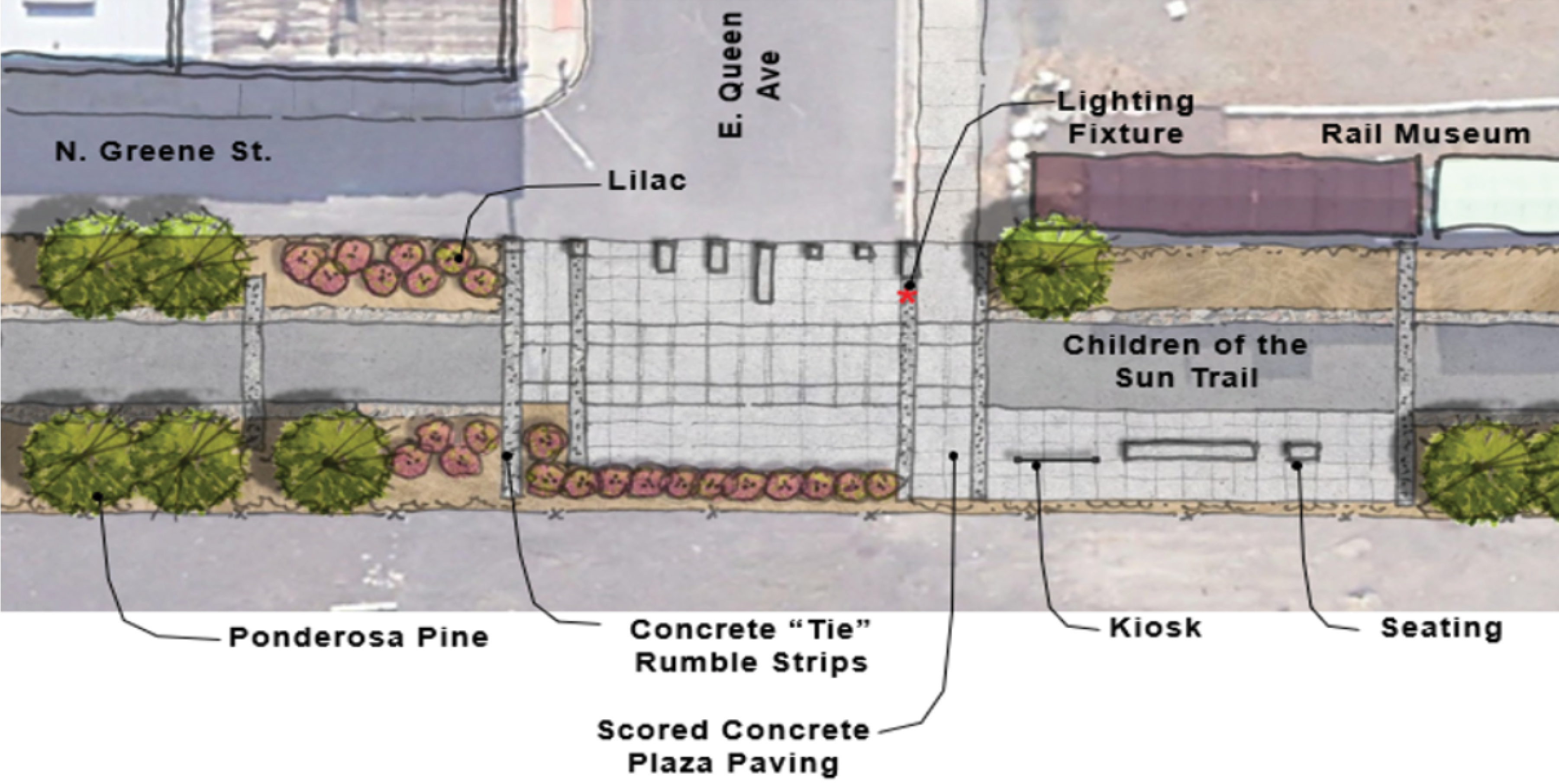
Long Description.
The drawing illustrates new trail facilities designed by WSDOT, featuring a layout with Ponderosa Pine trees, lilac plants, and scored concrete plaza paving. It includes concrete 'tie' rumble strips and a kiosk along the Children of the Sun Trail. The layout also shows seating areas, a lighting fixture, and proximity to the Rail Museum. Streets like N. Greene St. and E. Queen Ave. are labeled, indicating the integration of these features into the urban environment.
respondents acknowledged that previous efforts lacked clear prioritization criteria for active transportation maintenance, WSDOT has committed to integrating maintenance needs more systematically moving forward. To support this transition, the agency has initiated training on maintenance considerations for Complete Streets features.
WSDOT has assembled a research team to study best practices for active transportation maintenance in support of the stateʼs Complete Streets policies. In partnership with the University of Washington Sustainable Transportation Lab, which focuses on how transportation technologies, human behavior, and policy interact, this team is evaluating key maintenance strategies. Their research covers
- Design strategies to ensure durability and minimize maintenance costs;
- Snow clearing and debris removal (sand, leaves);
- Resurfacing, striping, and managing vegetation and drainage;
- Maintenance of vertical elements, such as lighting;
- Equipment requirements and use of dedicated maintenance teams; and
- Planning, budgeting metrics, and coordination among jurisdictions.
The Move Ahead Washington package, through SB 5974 and Project Delivery Memo #22-03 – Complete Streets Implementation, designates Complete Streets as the standard for infrastructure projects over $500,000. This policy integrates a multimodal level of traffic stress analysis to identify the need for buffered or protected bike lanes, fostering safer and more connected networks.
WSDOTʼs collaboration with academic researchers and internal teams reflects its focus on embedding maintenance into project design. The agency now ensures that maintenance staff participate in the early stages, particularly from scoping to the 30-percent design phase, to evaluate design trade-offs and address operational constraints. This approach also supports accurate forecasting of maintenance costs, including labor, equipment, and materials.
The Climate Commitment Act provides new funding for active transportation infrastructure, allowing WSDOT to scale its efforts and better support facility upkeep. WSDOTʼs shared maintenance agreements with municipalities define clear jurisdictional responsibilities, while updated policies ensure snow plowing and other operations do not block bike lanes or sidewalks.
WSDOTʼs Transportation Performance Management Program, which has tracked pavement and safety performance for a decade, could expand to include maintenance reporting for Complete Streets. Through cross-divisional collaboration and investments in knowledge, staff, and equipment, WSDOT is positioning itself as a leader in sustainable and accessible multimodal infrastructure, ensuring that its active transportation facilities remain functional for all users.
Washington State has introduced, tested, and refined several practices that have advanced the field of Complete Streets planning and design, such as the low-stress network and project requirements. The issue of maintenance is being studied closely, with the state and its partners soon producing materials that should have transferable benefits for other state DOTs.


