State DOT Training Programs Used to Comply with NPDES Stormwater Permit Requirements (2026)
Chapter: Appendix A: Survey Questionnaire

APPENDIX A
Survey Questionnaire
NCHRP PROJECT 20-05 SYNTHESIS TOPIC 56-14
State DOT Training Programs Used to Comply with NPDES Stormwater Permit Requirements
State Department of Transportation Survey
Email Cover Letter
Dear State DOT Stormwater Professional,
The National Cooperative Highway Research Program (NCHRP) of the Transportation Research Board (TRB) in partnership with the American Association of State Highway and Transportation Officials (AASHTO) and under a cooperative agreement with the Federal Highway Administration (FHWA) is preparing this synthesis on State DOT Training Programs Used to Comply with National Pollutant Discharge Elimination System (NPDES) Stormwater Permit Requirements.
The purpose of this questionnaire is to identify, document, and summarize practices used by state DOT training programs to comply with NPDES stormwater permit requirements. The results of this questionnaire will be incorporated into a synthesis of highway agency practices, with the intent of helping agencies evaluate and improve their stormwater training programs and NPDES compliance requirements.
Typically, staff within the construction, environmental, or training divisions would be appropriate to fill out this survey since it asks detailed questions about stormwater management training offerings. It is our understanding that you are one of your state DOTs primary contacts regarding stormwater management, however we realize these responsibilities may be shared across various offices in your state DOT, so you may consider seeking additional guidance from colleagues in completing this questionnaire. If you are not the appropriate person to complete this survey, please forward it to the correct person at your agency and CC Dr. Blake Whitman.
Please complete and submit this survey by February 25, 2025. This survey was designed to take approximately 20 minutes, and it is set up so you can exit and return to the survey if you need to allocate your time over several sessions. If you have any questions or problems related to this questionnaire, please contact Dr. Blake Whitman.
Questionnaire Tips
- If you are unable to complete the questionnaire, you can return to the questionnaire at any time by reentering through the provided survey link as long as you access the questionnaire from the same computer and browser. Reentering the survey will return you to the last completed question.
- Survey navigation is conducted by selecting the “Back” (previous) or “Next” button at the bottom of each page.
- Until you submit the survey, you may revise your answers at any time.
- There is no time limit once you begin the survey.
- The back button on the browser should not be used.
- All fields that have an asterisk are required.
- For reference, a PDF of the questionnaire is attached to the original email. If you did not receive the PDF questionnaire, one can be requested by contacting Dr. Blake Whitman.
Thank you for sharing your time and expertise with the state DOT community.
Guidance
This questionnaire seeks to synthesize stormwater training available to state DOTs. For the purpose of this questionnaire, please consider the following definitions:
Definitions
- Minimum Control Measures: measures designed to reduce pollutants entering water bodies, protect water quality, and meet the Clean Water Actʼs goals
- Public Education and Outreach: Permittees are required to provide educational material about stormwater to four audiences (residents, industry, commercial, and construction). The purpose of the educational material is to provide the targeted audience information about stormwater and how their actions may impact it.
- Public Participation: Permittees are required to at least annually provide an opportunity for the public to participate in the development/implementation of their Stormwater Management Program (SWMP). Notices must comply with state public notice requirements.
- Illicit Discharge Detection and Elimination (IDDE): Permittees are required to find and eliminate sources of non-stormwater from their storm sewer system. Permittees are expected to systematically look in their system for non-stormwater sources and remove them. Part of this requirement includes development of a systemwide storm sewer system map.
- Management of Construction Site Runoff: Permittees are required to have a program for management of stormwater discharges from construction sites that disturb 1 or more acres of land. Their program should include requirements for projects to implement sediment and erosion control practices as well as requirements for site plan review.
- Management of Post-Construction Site Runoff Control: Permittees are required to address stormwater runoff from new development and redevelopment that disturb 1 or more acres of land. The goal of this measure is to manage stormwater by encouraging infiltration, filtration, evapotranspiration, or water reuse.
- Pollution Prevention and Good Housekeeping: Permittees are required to implement good housekeeping practices in operations such as vehicle maintenance, open space, buildings and infrastructure.
- Municipal Separate Storm Sewer System (MS4): conveyance or system of conveyances that is (1) owned by a state, city, town, village, or other public entity that discharges to waters of the U.S., (2) designed or used to collect or convey stormwater (e.g., storm drains, pipes, ditches), (3) not a combined sewer, and (4) not part of a sewage treatment plant, or publicly owned treatment works.
- National Pollutant Discharge Elimination System (NPDES): permit program that addresses water quality by regulating point sources that discharge to waters of the United States.
- Stormwater Control Measure (SCM) or Best Management Practice (BMP): practice designed to enhance stormwater quality or manage stormwater quantity, or both. Some examples include wet detention ponds, infiltration basins, bioretention basins, enhanced swales, underground vaults and cisterns.
- Temporary Erosion and Sediment Control Measures: measures used to reduce the dislodgement and transport of soil during construction activities and will be removed upon final stabilization.
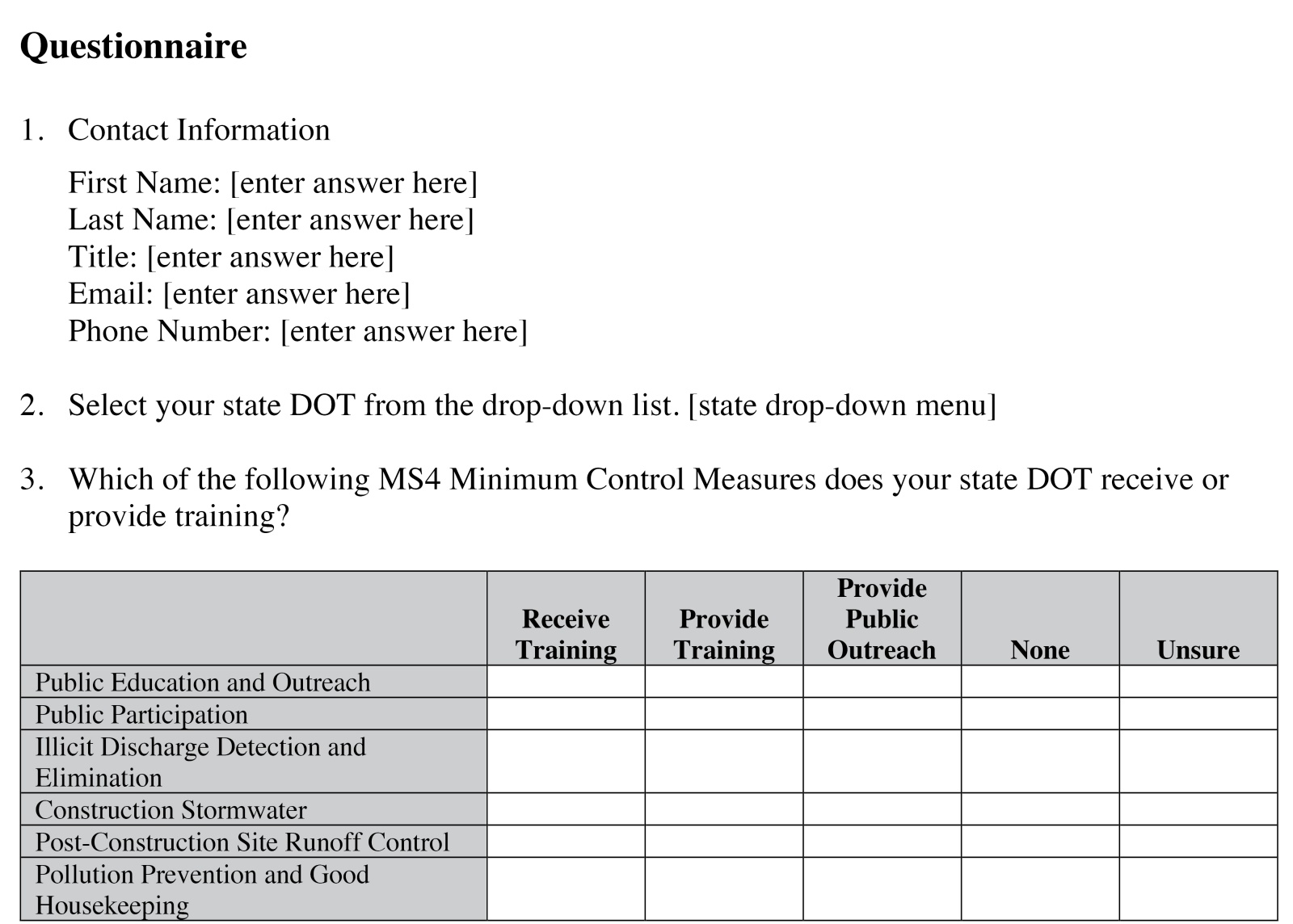
Long Description.
This page begins a questionnaire used to collect information from state DOTs. It asks for contact details, requires selection of a state DOT, and includes a table to show whether the DOT receives or provides training or public outreach related to MS 4 minimum control measures, including education, participation, discharge detection, construction, post construction runoff control, and pollution prevention.

Long Description.
This section is a questionnaire table that asks which stormwater topics are included in training provided to or received by state DOT personnel. For each listed topic, the user selects whether it is addressed within construction stormwater training, post construction stormwater training, other dedicated training, not addressed with training, or if they are unsure. Topics include public education and outreach, public participation, illicit discharge detection and elimination, construction and post construction stormwater management principles, design, construction, inspection, and maintenance of stormwater control measures, good housekeeping in municipal operations, SWPPP design, environmental aspects, permit compliance requirements, and other related subjects.
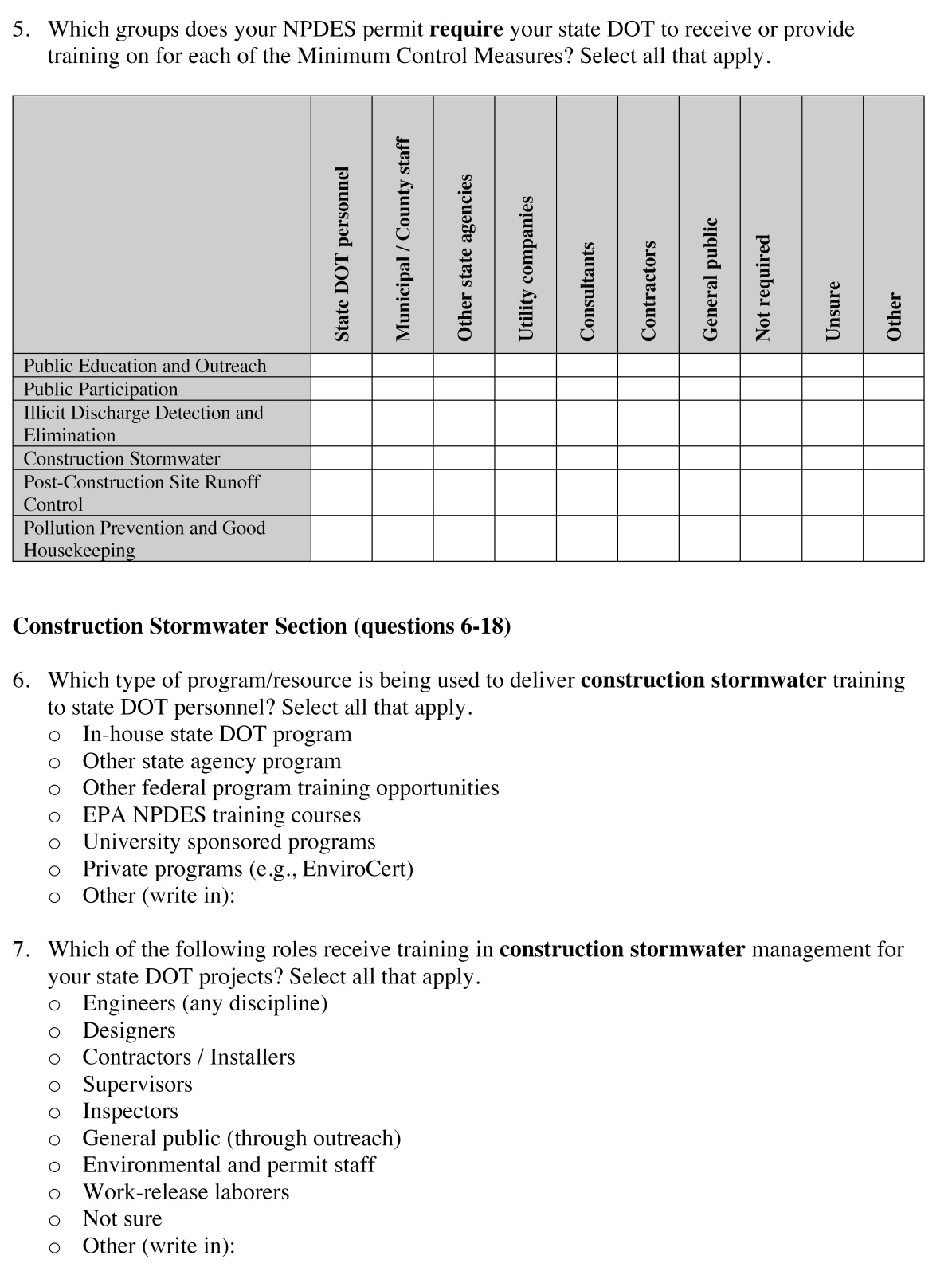
Long Description.
This page includes questions focused on training requirements under the DOT NPDES permit and construction stormwater programs. It asks which groups require the state DOT to receive or provide training for minimum control measures, such as municipal staff, consultants, contractors, and others. It also asks who provides construction stormwater training to DOT personnel and which DOT project roles receive training, including designers, inspectors, supervisors, managers, environmental staff, and other identified groups.
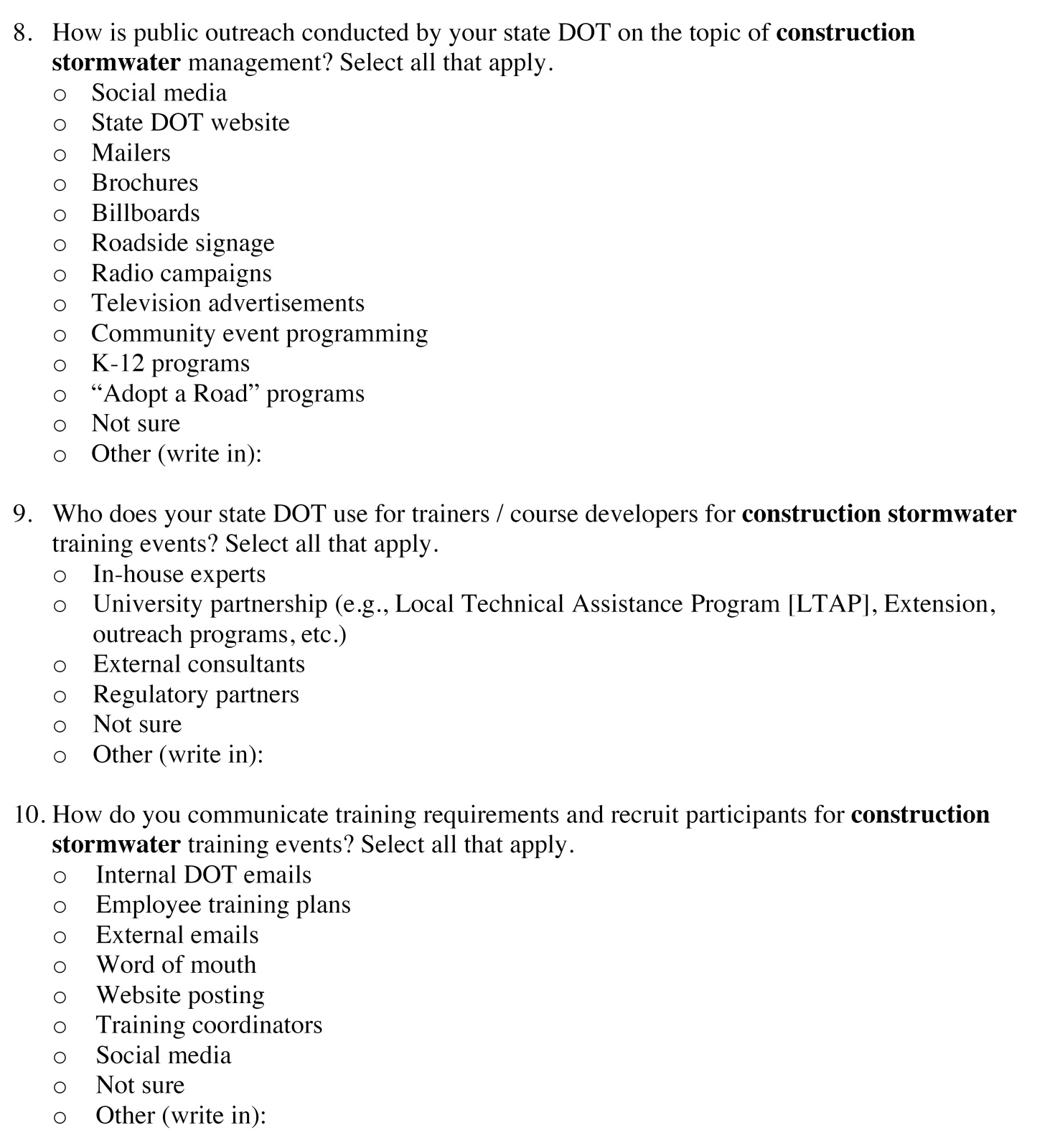
Long Description.
This section asks how a state DOT conducts public outreach related to construction stormwater management, including methods such as websites, mailers, brochures, media campaigns, community programs, and other outreach tools. It also asks who develops or delivers construction stormwater training, such as in house staff, university programs, external consultants, or regulatory partners. The final question asks how training requirements are communicated and how participants are recruited, including emails, websites, training coordinators, social media, and other methods.
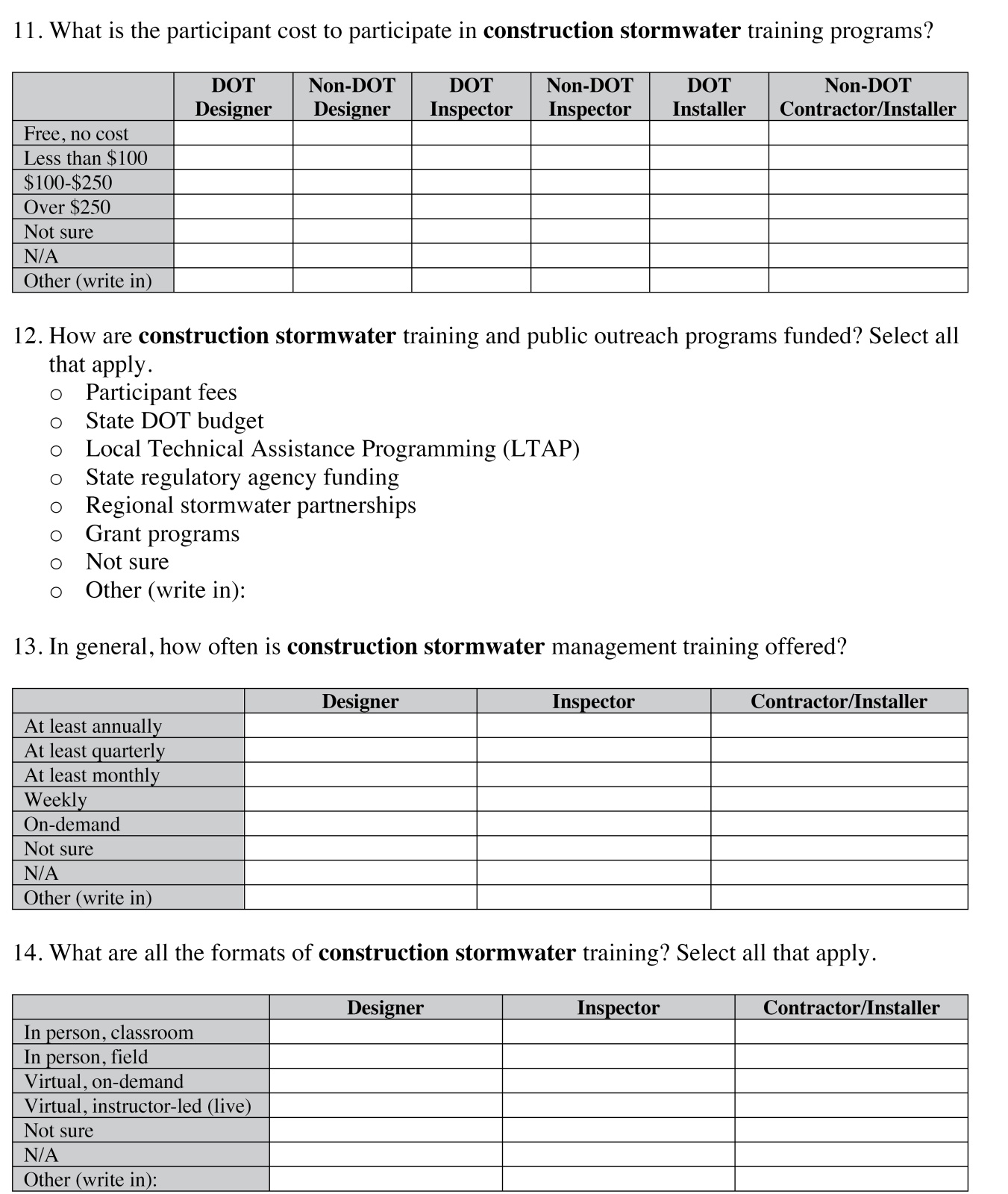
Long Description.
This section asks about construction stormwater training programs offered by a state DOT. It collects information on participant costs by role, such as designers, inspectors, and contractors or installers. It also asks how training and public outreach programs are funded, including permit fees, state funding, partnerships, and grants. Additional questions address how often training is offered and the formats used, such as in person classroom sessions, on demand options, virtual instructor led training, and other delivery methods.
Long Description.
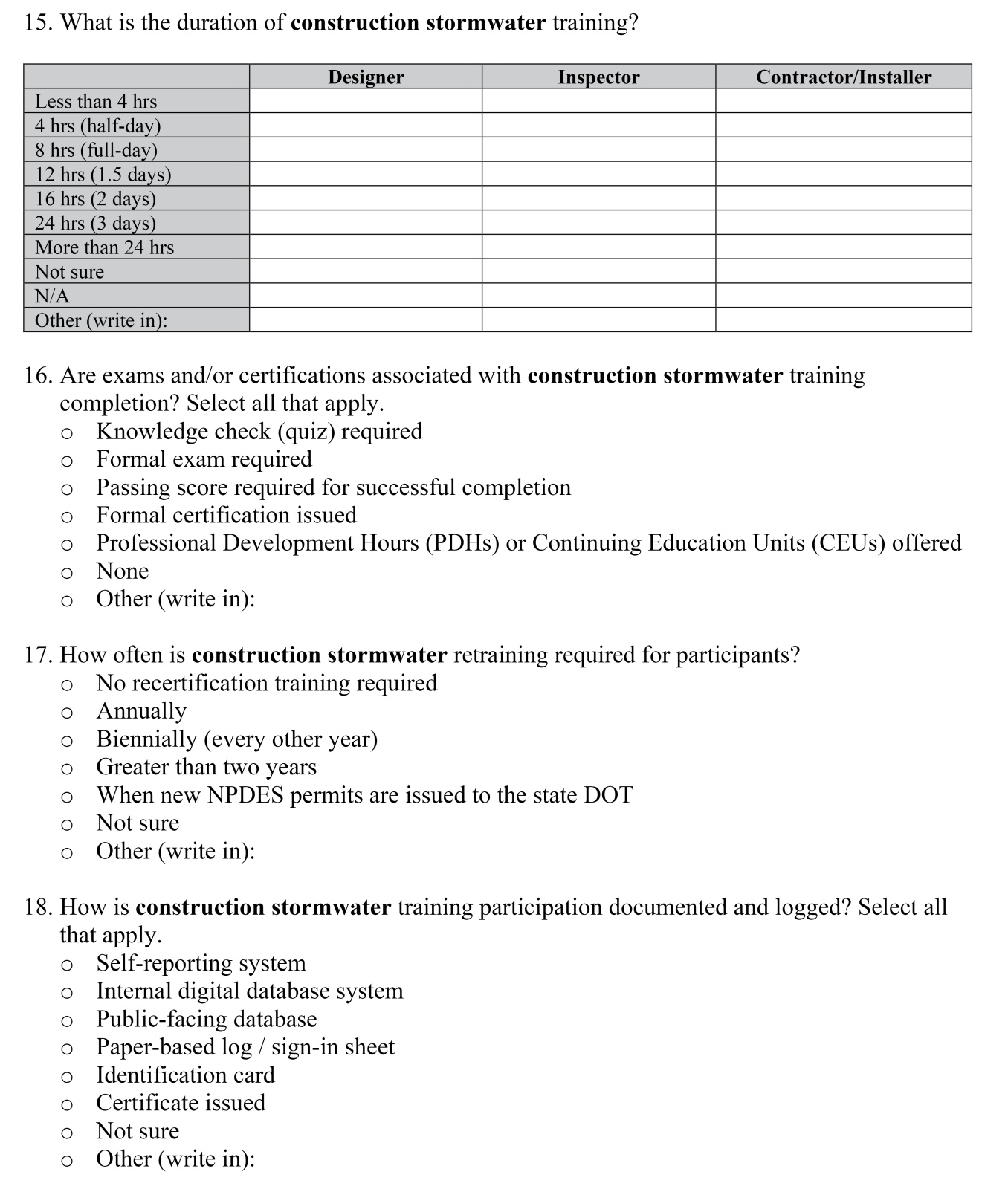
This section asks for details about construction stormwater training provided or required by a state DOT. It includes a table to indicate the duration of training by participant role, such as designers, inspectors, and contractors or installers. It also asks whether exams, quizzes, certifications, or continuing education credits are associated with the training. Additional questions address how often retraining is required and how training participation is documented and logged, including digital systems, certificates, sign in sheets, and other tracking methods.

Long Description.
This section asks about post construction stormwater training for state DOT personnel. It identifies which programs or resources are used to deliver training, such as in house DOT programs, federal or state programs, university sponsored courses, and private programs. It also asks which DOT project roles receive post construction stormwater management training, including engineers, designers, inspectors, supervisors, and environmental staff. The final question focuses on how public outreach on post construction stormwater management is conducted, including digital media, printed materials, community programs, and other outreach methods.

Long Description.
This section asks about post construction stormwater training and public outreach programs managed by a state DOT. It covers who develops or delivers training, how training requirements are communicated and participants are recruited, and the cost to participants by role. It also asks how post construction stormwater training and outreach programs are funded, including permit fees, state funding, partnerships, grants, and other sources.

Long Description.
This section asks about post construction stormwater management training offered by a state DOT. It collects information on how often training is offered, the formats used such as in person, virtual, or on demand options, and the duration of training by participant role. It also asks whether exams, quizzes, certifications, or professional development or continuing education credits are associated with post construction stormwater training completion.

Long Description.
This section asks how often post construction stormwater retraining is required and how participation is documented, such as through digital systems, certificates, or sign in sheets. It then introduces a case example section that asks whether the state DOT participates in innovative stormwater training or outreach efforts and whether the respondent is willing to take part in a follow up interview to discuss current practices and examples in more detail.

Long Description.
This final section collects contact information for a co-worker if the respondent selected that option earlier in the survey. It also provides instructions for sharing additional comments or documents related to the survey by upload or email. The section concludes by confirming that the respondent has reached the end of the survey and is ready to submit their responses.


