Frontiers of Materials That Learn: Proceedings of a Workshop (2026)
Chapter: 3 Biological Materials as Substrates for Intelligent Behavior
3
Biological Materials as Substrates for Intelligent Behavior
The workshop’s second session was moderated by James De Yoreo, a Battelle fellow at Pacific Northwest National Laboratory and a member of the National Academy of Engineering. As he explained, the session was designed to be something of a mirror image of the first session. “What we heard in the last one was about using materials as systems to do learning,” he said, “but from a materials science perspective we’d actually like to use learning as a way of changing the properties of the system.” In doing that, he explained, the goal is to optimize the functioning of a material, and, in the end, function comes down to structure. The question becomes how can a system learn from how it is performing in the environment to change its structure in the direction of improving its performance.
Such learning requires a few different properties that are naturally present in biomolecular systems, De Yoreo said, and to discuss them he focused specifically on proteins. One such required property is allostery, which refers to the way in which a molecule binding to one site on a protein causes a change in the shape of the protein that affects the protein’s activity at a different site. The property can be engineered to create switches, he said, and one can imagine having a whole library of different switches that act in different situations. “You can imagine, for example, catalytic systems that can adapt themselves to whatever substrate is available rather than being tied to a particular kind of substrate,” he said, or perhaps solar energy systems that can adapt their efficiency in producing power in response to changes in the spectrum to which they are exposed.
One of the important aspects of biological systems, De Yoreo added, is that researchers are now able to design proteins to have desired properties. Indeed, he said, there is now a whole library of different artificial proteins that have been made de novo. Another aspect of proteins that makes them attractive from the materials point of view is that they can interface with inorganic materials and perform such functions as modulating a material’s electronic properties. Proteins are also dynamic, he continued, “so you can have the individual components replace themselves, depending on what is going on.”
Given all these valuable properties, he concluded, the question is how one takes advantage of biological materials to create systems with desirable properties. That question would be addressed by the two panelists.
COMPUTATIONALLY DESIGNED NOVEL PROTEIN–PROTEIN INTERFACES
Possu Huang, an assistant professor of bioengineering at Stanford University, spoke about computationally designed novel protein–protein interfaces and, more generally, emergent behavior in designed novel proteins.
What Nature Can Do Versus What People Can Do with Proteins
Huang began by offering two brief examples of what proteins can do: the first one focused on what proteins in nature can do and the second on what proteins harnessed by human scientists can do. The first involved a natural protein, photolyase, that repairs DNA (Christou et al., 2023; Maestre-Reyna et al., 2023). When DNA is damaged by ultraviolet light, Huang explained, a crosslink forms between two of the bases, creating a cyclobutane pyrimidine dimer, and that crosslink acts as a tiny handle that the repair protein can latch onto. The photolyase holds onto the excited state of its active cofactor, flavin adenine dinucleotide, which pumps in an electron to repair the bases by breaking the covalent bonds of the crosslink and letting the two strands of the DNA reconnect.
What is particularly interesting about the repair, Huang said, is that once the repair has been made, the photolyase must release the DNA molecule (Figure 3-1). “The protein itself actually has a very strong positive charge on one side of it,” he said, “so how do you release the DNA, which is negatively charged, after you make the repair?” It turns out, he said, that there is a very elegant coordinated movement in the protein. “Basically, you would hold onto the handle, you would repair the bases, but then upon completion of the repair, the bases flow back, and just that little tiny change allows the system to release the substrate and then continue on to the next cycle.”
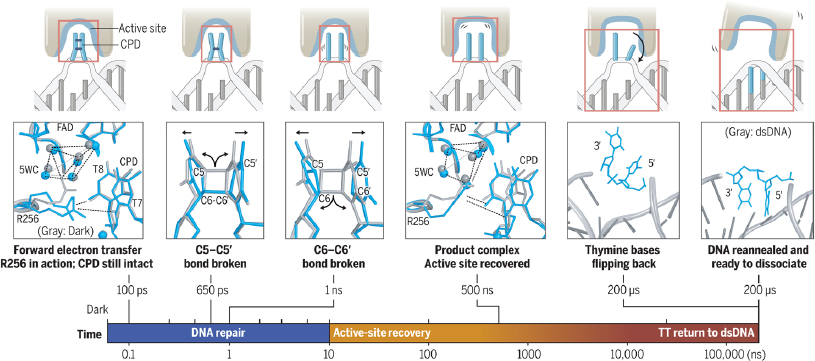
NOTE: CPD = cyclobutane pyrimidine dimer.
SOURCES: Presented by Possu Huang on October 2, 2025; image from Maestre-Reyna et al. (2023).
Then Huang offered a quick description of recent work in which a protein-based neural network could compare the amounts of multiple inputs and create a “winner takes all” output (Chen et al., 2024). The researchers, he said, were able to set up protein domains to carry out computer logic operations just through what he called “copy and pasting.” In particular, the researchers used small pieces of de novo designed protein that were simple helical bundles. These bits of protein, Huang said, “can actually have recognition specificity, and then they can pair up, split proteases, and then, because you have this ability to create self-cleaving and incomplete pairing of these ends, you can create different activation and inactivation signals.” Then, when the proteins are introduced into cells, he said, one can get a sort of learning behavior by processing the signals.
At present, he continued, the community has built many different types of protein shapes, and he showed an illustration from a recent publication from his lab that contained nearly 150 different de novo designed protein shapes that have been created (Chu et al., 2024). As was clear from the illustration, Huang said, researchers have been able to design and create proteins in a wide variety of shapes and topologies—indeed, pretty much all of the shapes found naturally, including some that are macromolecular assemblies. But in terms of how such proteins might be used in learning systems, he said, the need for the proteins to behave dynamically presents a stumbling block. “When we now build proteins from scratch, we don’t have that behavior,” he said, in part because it is just so difficult to build an entire protein-based system for representing and manipulating information.
A New Approach to Modeling Sequence and Structure
To build protein systems that can process information like nature does requires an approach to building proteins that is different from the usual one, he said. The original paradigm for designing proteins follows this workflow, he said:
Function → structure → sequence → protein.
That is, Huang explained, one begins with the desired function for a protein to serve, such as some sort of enzymatic activity. Achieving this function generally involves creating particular shapes dictated by the placement of amino acids in space to create, say, binding or active sites. But the first step in creating the shape is to build the backbone of the protein, he said, “then you introduce the sequences to fit, and whatever you come up with, you test in the experiments.” But this is where the problem arises, he continued, “because if you already built the backbone as a rigid body, there’s always a problem with this step, because now your sequence just explained this rigid body. You don’t have this dynamic behavior.”
People in his lab have been thinking hard about this problem, he said, because the original goal there was to build molecular motors with an information-processing capability, and they believe that the solution to the problem of getting dynamic behavior into designed proteins is to combine the two steps “structure” and “sequence” into one. “It’s pretty intuitive and obvious,” he said, “but in practice it’s very, very difficult to do.”
Historically these two steps have been treated separately because of the computational complexity involved in doing them at the same time, Huang said. “The combinatorial degrees of freedom in terms of molecular degrees of freedom is too high. So you have to lay down the backbone, and then you lay down the next layer of the complexity to home in on whatever explains that backbone behavior.” Combining the two and doing them at the same time is very challenging, he said, “especially when you come to a design approach where you actually can flip the sequence on the fly.” To accomplish this, his team turned to neural networks to generate the protein molecules, he explained, but during the generation process, side chains were represented by “superposition states,” which Huang describes as essentially a set of atoms that can turn into any amino acid residue.
As a result, as the overall structure of a protein is built and is coalescing, he said, the side chains can resolve themselves and fall into the specific amino acid type that is required. In doing this, his team uses a class of generative models, called diffusion models, borrowed from computer vision. He described these diffusion models as a powerful new class of generative models that work via an iterative generation process. They provide higher-quality results and also allow for information
to interact; specifically, interleaving sequence and structure generation allows each of the two processes to provide feedback to the other.
In essence, Huang said, these diffusion models add noise to produce a Gaussian distribution, “then you resolve this noise according to the neural network behaviors so that you can home in on specific signals in the process.” The process allows them, he said, “to have this multiobjective consideration from the backbone and side chain and blend them together.” The modeling process relies on training data, but, Huang said, since it is a generative model, when there are spaces for which there are no true data, it is possible to generate data that behave similarly to the true data. “So we are using this type of ability to create protein structures,” he said, “and the idea is to create new proteins that … extrapolate this dynamic behavior in between states.” Expanding on this, he said that his lab has been using generative models not necessarily just to build rigid rocklike structures, but also to interpolate between states. For example, he said, “proteins loops are dynamic, but then we’re using this generative model to fill in the gaps.”
He provided detail on the conceptual underpinning of this work by referring to a diagram (Figure 3-2). In working with a diffusion model, he explained, the goal is to determine both the structure and the sequence by reducing the amount of noise; in the diagram, moving right on the x-axis or moving down on the y-axis corresponds to a decrease in noise, and the ultimate goal is to end up near the origin, where noise on both dimensions has been minimized and both the structure and the sequence are fully known. “So, essentially, to solve a problem, you want to go from the upper right to the lower left,” Huang said. “This is just to reduce the
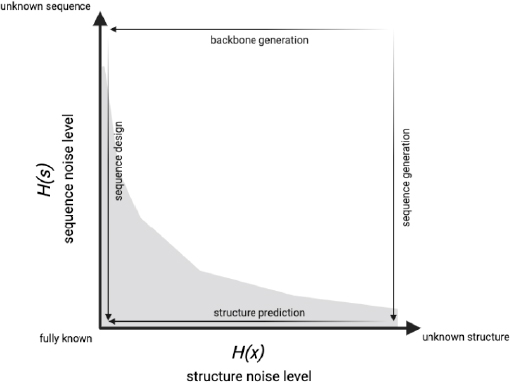
SOURCE: Presented by Possu Huang on October 2, 2025.
noise on the structure—essentially, the placement of atoms—and then also you want to actually resolve your amino acid sequence on the fly.” However, the typical approaches travel along only one dimension. If, for instance, AlphaFold, an AI system developed by Google DeepMind, is used to determine the structure of a protein from its sequence, then that would correspond to moving along the x-axis from right to left. “In the traditional way of designing proteins,” he continued, “you take a known structure and then you spread the sequence onto it, and that would just be traversing along the y-axis.”
By contrast, what his team needed to do to capture the dynamic behavior they were interested in was to move in the middle of the diagram, said Huang, which they did by using the diffusion model to blend the information on structure and sequence (Figure 3-3). “The idea is that you could define a functional feature that requires you to traverse along the sequence space a little bit, so it’s downwards, but then once you coalesce certain sequence behaviors, then you can actually build the rest of the backbone to support it,” he explained. “Of course, this is not necessarily just a sigmoidal or some sort of clear smooth steps, but we’re hoping that we can set up the framework to build this type of molecule.”
His lab uses a particular type of diffusion model that is atomistic, Huang said. Essentially it only keeps track of single atoms, and what they ended up with was the ability to diffuse the atoms, which coalesce to form a new protein structure. And the key is to do both the backbone and the side chains together, with the information on each feeding into the other.
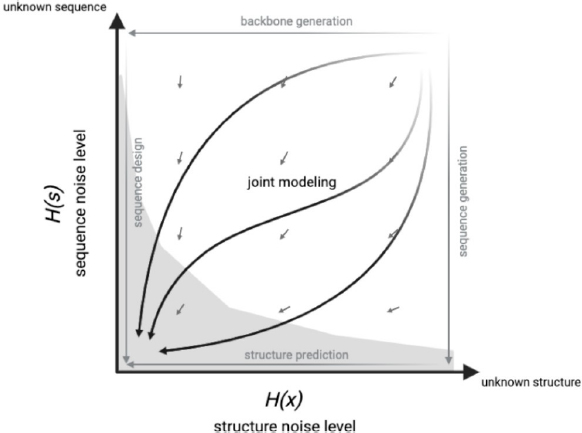
SOURCE: Presented by Possu Huang on October 2, 2025.
Current Work
Huang then switched from talking about the tools his team had developed to solve this particular problem of designing dynamic proteins to talking about the current status of work with these tools as well as the outlook for the future. “Currently,” he said, “what’s really interesting is that once you have these type of generative model networks, you can just impose constraints and allow it to conditionally generate almost anything that’s baked into the system.” In training these models, he said, the data used are typically from natural proteins, but the type of network architecture that they use is very good at recycling components. For instance, there might be certain patterns that arise in active sites that bind to a particular small molecule, and some of the arrangements could be found in native proteins, so the model would end up recycling a snippet of that native protein with the desired functionality. More generally, he continued, it is possible to build a brand new protein by recycling known parts from multiple proteins.
The goal of the work, he said, is to build a system that can conditionally generate active sites, such as small-molecule binding sites or enzyme access sites. If, for instance, the system were applied to protein–protein interfaces, it could directly generate such interfaces. As an example, he showed an illustration of a piece of a protein and said that with his method one could use details about the protein surface and the protein’s chemical properties to generate a new protein with the right shape and properties to interface with the given protein. “This has been applied to many, many different tasks, and these tasks have been actually quite robust,” he said, particularly in the case of proteins that have some kind of observable natural counterpart. “For example, it could be an immunotherapy target, and there are a lot of antibodies that have been bound to it,” or what is referred to as “hotspot interactions.” In such cases it is possible to recycle information from natural proteins to build brand-new proteins that bind to the same site. That has been very, very useful, he said.
However, he added, the method can run into problems in the case of a really novel target with no known natural proteins that bind to it. The difficulty comes from the need for dynamic behavior. “This type of method is really good at building rocks that complement the other rock that makes this interface,” he said, but anything that involves loops, such as antibodies, is much more challenging. It is actually very, very difficult to generate those type of interactions reliably, Huang said.
Over the past several years, he continued, his lab has been working on generating loops, and he showed an illustration of a particular protein that his lab has been working with (Figure 3-4). He noted that this particular protein also served to illustrate that it is possible to build proteins potentially with some conditioning and then later potentially induce learning behavior.
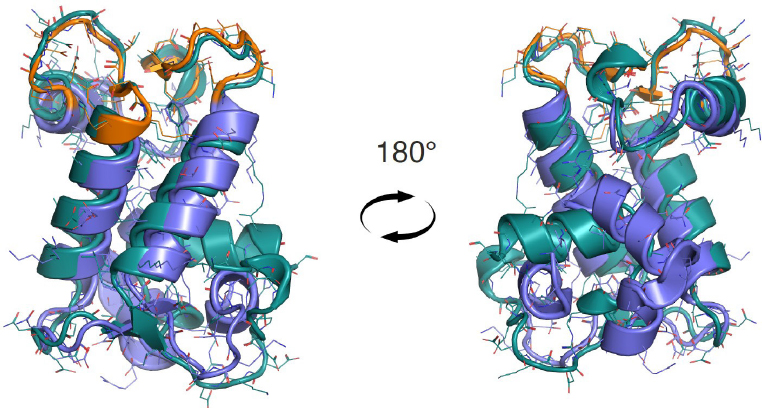
NOTE: Orange = motif; teal = generated structure; purple = crystal structure.
SOURCES: Presented by Possu Huang on October 2, 2025. “Conditional protein structure generation with protpardelle-1c” (Figure 5A) by Lu et al. (2025), detail used under CC BY 4.0 license.
This protein, Huang said, is a brand-new structure consisting of some novel parts and some parts that have been recycled from natural proteins. His team conditioned the orange loops, which can bind to lanthanide. The purple part has a natural protein that also binds to some lanthanide. And then the teal section is what his team generated. Parts of it look similar to natural proteins, he said, but the bottom half of it is completely different.
With this design, he said, they are able to tune the lanthanide binding specificity, which is something that the natural protein cannot do. Currently the team is working with the half of the protein that is different from the natural protein to tune the unfolding behavior of the protein so that it could be possible to release the lanthanide. “The idea is to go in and capture this metal and maybe release it,” he said.
In introducing his last example, Huang showed a video of myosin and actin, with the myosin acting as a molecular motor to pull on the actin. Recently, he noted, researchers had introduced a very powerful time-resolved technique, cryogenic electron microscopy (cryo-EM), that made it possible to observe the action of this motor in great detail (Klebl et al., 2025). With this technique, he said, it is possible to observe the action so closely that it becomes possible to explain the movements of the proteins. Because the cryo-EM data are at the level of individual atoms, he said, “you can actually see how the side chains reorganize themselves and respond to these changes.” Those data have also provided some of the impetus
for his team’s efforts to couple the backbone and side-chain movements into one simulation, he added.
Currently, Huang said, his team is using their design tools to build proteins that have this sort of molecular motor behavior, responding to environmental cues by folding up. Using the insights from the myosin–actin observations, they are designing and building different pieces that are not in nature and hooking them up to create a protein that folds up.
Huang closed by describing a dilemma that the field is currently facing. After researchers develop a design through some sort of generative model, they use the very powerful AlphaFold model to determine how the molecule will fold up. “Then whatever AlphaFold thinks that it can fold up to the right shape, you produce in the wet lab,” he said. However, he continued, it turns out that there are many proteins whose structure AlphaFold cannot predict accurately, so researchers end up producing only a small subset of designs—those whose structures AlphaFold can predict accurately. That is why, for instance, that so many of the designs researchers actually produce are helical bundles, he said—“because without multiple sequence alignment for these new type of proteins, AlphaFold can really only predict very simple proteins, and alpha helices that are dominating that space.”
To get around that problem, Huang said, people in the field are considering building a direct feedback system that could overcome their reliance on AlphaFold. The idea would be to use the generative model to make its own hypotheses about sequence and structure and then to test the designs by creating the molecules and observing their structures. “The experimental readout would allow us to feed back to the models so that they are no longer relying on evolutionary sequence and behaviors,” he said, “and that would actually allow us to have a more physical view of how these molecules behave.” The sort of rapid feedback and iterative cycles needed to improve molecules and design models in this way would require the development of a new high-throughput data-generation system, he said, but currently this appears to be the best option to learn how to incorporate dynamic behavior into proteins.
Question-and-Answer Period
In the discussion following Huang’s talk, Andrés García from Georgia Tech mentioned how when the body develops antibodies, the B cells generate a variety of different structures, and he asked whether Huang’s generative models also develop a diversity of solutions to a problem. Huang answered that generative models can generate essentially an infinite number of solutions but that in the particular case of the antibody problem, there are a number of challenges, including difficulties that AlphaFold has in making predictions related to antibodies. However, he added, “it turns out that AlphaFold does have some concept of a physical world. If you drill
it hard enough, you actually could potentially find an answer, and recently there’s a paper that talks about using a language model to drill AlphaFold space (Mille-Fragoso, 2025), and then they would actually be able to find some small antibody fragment that seems to be able to bind to targets specifically, but that remains to be tested and explored.”
Arvind Murugan from the University of Chicago asked Huang about his approach to the trade-offs that must be made in designing enzymes or catalysts. For instance, he noted, a molecule that binds to a substrate well will not release easily. “In this kind of approach,” he said, “I couldn’t tell if you’re going to put in that kind of tension or you are just directly trying to solve the problem and hoping that the tension goes away?” Huang answered that his group’s latest preprint was trying to address this exact issue—and, in particular “to build the machinery to try to address this problem.” Currently, he said, although there has been great progress in protein design, the field is still not very good at building things such as enzymes or even antibodies. One specific way his group is approaching the problem, he said, is to account for all the microstates. “When we generate a specific active site, we can also blow it up to increase all local ensembles nearby,” he said. Then our new approach would be to account for all the ensemble behaviors and then maybe we could model the release state as well, he said. “Then we come up with a sequence that explains across the microstates.”
ULTRASENSITIVE AND ROBUST MECHANOLUMINESCENT LIVING COMPOSITES
Shengqiang Cai, a professor of mechanical and aerospace engineering at the University of California, San Diego (UCSD), spoke about combining living organisms with material structures to create biohybrids that might be useful in building learning systems.
Bioluminescent Algae
Cai began by noting that in his lab, as a materials engineer, he does not work directly on materials that learn. Instead, he and his team are using a new approach to create a material that is responsive or tunable, and such a material, he said, could be important in creating learning systems.
The approach involves creating what Cai called “biohybrids.” The idea behind the approach was triggered by the observation of bioluminescent waves in the ocean, which are regularly seen near UCSD. The bioluminescence in these waves is caused by algae called dinoflagellates, he explained. “It’s a very interesting type of algae which can produce light, and the trigger is stress.” When one applies a force to these algae, which have a size of tens of microns, they produce light.
Recent work by a group in the Netherlands explored the processes that lead the algae to shine (Jalaal et al., 2020). They held individual dinoflagellate cells with a micro-pipette and pushed on them with either a hard indentation device or a fluid flow, and they observed the outcome through an optical microscope with a high-speed camera. They found that the light was produced by the cells via a viscoelastic response, with the intensity of the light depending on both the size and the rate of the cell’s deformation.
The process by which the cells emit light is actually pretty complex, Cai said. During daylight hours the algae absorb photons that trigger chemical reactions inside the cells, and the chemical reaction responsible for the bioluminescence is reversible, with the direction of the reaction being determined by the pH of the cell. During the night, stresses on the cell cause sodium ion channels to open, changing the pH of the cell and reversing the reaction from its daytime sunlight-driven phase. This reverse reaction generates light.
It does not take much force to reverse the reaction and cause the cells to emit light, Cai said. “It’s a very, very small pressure that is needed to open the ion channels.” The light emission is not a case of mechanical energy being converted to optical energy, he continued. Instead, it is just a matter of pushing on the cells enough to open up their walls, and that requires less than 1 pascal of pressure.
Biohybrids
As a mechanical engineer, Cai said, he is used to biomimicry and bioinspirations—creating system that either mimic or are inspired by living systems—but in this case the bioluminescence of the algae is such a complex process that it would be difficult to reproduce it with a nonliving system. “It’s very small scale, and many complex chemical reactions happen,” he noted. So instead of doing biomimicry or bioinspiration design, his group chose to use the biology directly and use the algae as part of an engineered system. Such biohybrids, sometimes called engineered living materials, are the focus of a newly emerging area in materials science, he said.
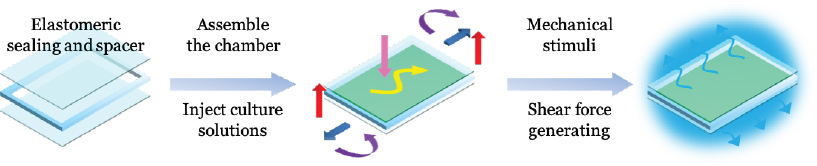
A simple way to create such a biohybrid mechanoluminescent device is to collect algae, mix them with a culture solution, and enclose that into a chamber (Figure 3-5). When the chamber is deformed, it produces light. However, the shear stress in the chamber is not very large, and the resulting light is weak.
To get stronger light, Cai put pillars into the chamber. He explained that the pillars move, more intense flow is generated, and larger stress is induced. “Therefore, we see more light,” he said. The chamber is highly sensitive to mechanical force, and Cai showed photos where different objects were pressed against the chamber and the individual algae cells acted like pixels, lighting up only when they felt pressure and thus reproducing the shape of the object with the light emitted from the chamber. But, he noted, this construction is a system, not a biomaterial, and it is not very convenient to use. The next step was to create a material from the algae.
SOURCES: Presented by Shengqiang Cai on October 2, 2025. From Li et al. (2022). Schematic drawn by Chenghai Li.
Bioluminescent materials already existed, Cai noted, and he pointed in particular to mechanoluminescent materials such as some ceramics and mints, including the wintergreen lifesaver candies that are well known to emit light when crushed. The problem with these materials, Cai said, is that a very large stress is needed to generate light from them, generally great enough that it will actually break the material. His team’s goal was to use dinoflagellates to make a highly sensitive and soft mechanoluminescent material.
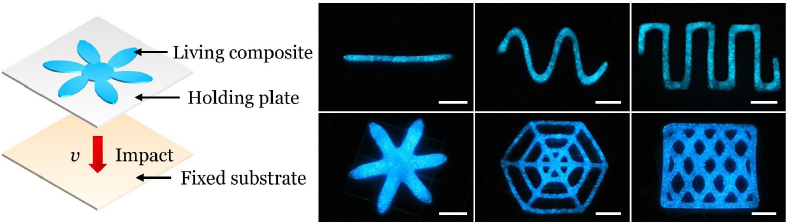
To do that, they mixed the dinoflagellate cells into a hydrogel network, which is essentially a polymer network holding a great deal of water. The polymers need to be biocompatible and, in particular, sufficiently crosslinked into a dense network that they cannot enter the algae cells. This living composite is in the form of a gel that is highly sensitive to mechanical forces, such as being compressed or stretched, and it will respond to even slight forces by emitting light. Once the material has been created, the next step is to put it into a useful form. One way that Cai’s team does this is to use a three-dimensional printer to create various objects from the gel, and he showed several shapes that they created in this way (Figure 3-6).
After printing the different shapes, Cai’s team compressed them to show that they emitted light under pressure, and they also checked the printing resolution of the material. They found that the resolution was more or less determined by the size of the algae. The thinnest filament they could print was hundreds of microns across, which is, he said, approximately the size of one or several of the dinoflagellate algae.
One challenge in working with most biohybrid materials, Cai said, is that the living components often have short lifetimes, and careful maintenance is usually needed. To address that problem for the currently developed biohybrid material, his group coated the hydrogel with a dry elastomer—in this case, silicon rubber, which is transparent, biocompatible, and also gas permeable. Once they did that, he said, they found that the material became extremely durable with a very long lifetime. Without a coating, once the gel is put in air it will dry out within a day, he added, “and once it dries out, it’s not functional anymore.” But the coated gel retains its mechanoluminescence after half a year without any additional maintenance. “So,
SOURCES: Presented by Shengqiang Cai on October 2, 2025. From Li et al. (2023).
you just leave the gel there and make sure it can see light during daytime,” Cai said, “and no additional maintenance is needed.”
Cai’s team also made the gel mechanically stronger and tougher by introducing a second interpenetrating polymer network into the gel system, which led to a material that could be stretched several times without breaking. It is a really tough material that is also highly sensitive and responds to pressure by emitting light. To illustrate one way the material can be used, he showed a video from a Paris fashion show where a runway model was wearing a flowing outfit with a complex printed design that glowed with the model’s movements.
Uses for Engineered Living Materials
Cai closed his talk by offering some thoughts on how engineered living materials could be put to use. “Because our starting point is engineering living materials, the traditional wisdom here is we try to use unique functionalities of the biology to create a material which has unique properties or functionalities,” he said, but a second potential use for engineered living materials is to help biologists better understand biology. For instance, in the original study he had mentioned earlier on how dinoflagellates produce light in response to pressure (Jalaal et al., 2020), the researchers had been working with individual cells. But in the work that Cai’s group did 3 years later (Li et al., 2023), they worked with one piece of gel containing many, many of the algae. He said, “this is naturally a high-throughput experiment if you can combine the mechanics and imaging processing.” He argued that by engineering living materials it should be possible to use them as a platform for high-throughput experiments, which, he noted, are very valuable today for a number of reasons, including providing data for artificial intelligence models. Since most biomechanic experiments are low throughput, he suggested that using engineered living materials to provide data much more quickly should help biologist in their study of biological processes.
Cai then briefly mentioned several other types of engineered living materials that researchers in various institutions have developed. One material included bacteria that emit light when exposed to various chemical stimuli. Another used neurons and muscle cells to create a system in which an optical signal triggered the deformation of the muscle. Yet another included chloroplasts in a polymer system so that the material could perform photosynthesis and produce glucose.
Engineered living materials have a number of strengths that would make them useful in creating materials that learn, Cai said. They can be responsive, adaptive, and tunable. They can carry out very sophisticated processes in spatially constrained conditions. They can be capable of harvesting various forms of energy and elements from the environment. And they can display unique and unconventional sensing capabilities. However, he continued, there are still a number of obstacles that must be overcome in order to create engineered living materials that learn. For example, it will be necessary to implement learning rules in these materials and to institute feedback loops.
Cai closed by showing an illustration of how a slime mold was able to solve a simple maze. The slime mold was able to find the shortest path in 4 hours.
“It’s very exciting,” he concluded. “Both engineered living materials and materials that learn are emerging fields. It will be very exciting if we can see an even younger field being generated through the collaboration of the two groups.”
Question-and-Answer Period
In the question-and-answer period that followed the presentation, an audience member noted that dinoflagellate algae in the wild activate collectively and asked Cai if he had to take precautions in the lab to avoid that, given that his biohybrids could light up very precisely in the desired shapes rather than lighting up across large patches. Cai answered that the algae in his biohybrids did not require collective interactions but could light up individually. “They do not need to talk to each other,” he said.
A question from De Yoreo dealt with the issue of keeping the algae alive in the systems and whether anyone had worked on introducing vasculature into the systems in order to keep the cells alive longer. Cai answered that, in general, it is important to have vasculature or something similar to increase the lifetimes of the biological components of biohybrids but that it is not so important for the particular dinoflagellate they use because it is very tough if it is provided with the right conditions. It needs the right culture solution and the right concentration of the cell, it needs to be coated with an elastomer so that the water does not evaporate, and it needs to be exposed regularly to light, and if those conditions are met, it will stay functional for at least 6 months without any additional maintenance.
Bartosz Grzybowski from the Institute for Basic Science in South Korea asked Cai to elaborate about potential applications for his light-emitting biohybrids. Cai said that he did not have a good answer for that as his team has not developed any useful applications yet, but he believes that there are some potential applications. One area his team has been looking at is robotics, he said, and they believe that the way the biohybrids emit light in response to pressure might be useful in communication between robots, but they have not yet done anything with this idea.
DISCUSSION
De Yoreo, the session’s moderator, began the discussion period with a question aimed at both presenters. Noting that the feedback loop will be the difficult part in using their dynamic materials to create learning materials, he asked, “Do you see a way to build in a feedback loop, or, alternatively, do you see a way to have a megalibrary in which the system chooses the particular structures that it needs based on performance rather than changes the structure of the individual component of the system?”
Cai agreed that the feedback loop is indeed one of the challenges but said that in various responsive materials, especially polymers, there is inherently a certain type of feedback loop. For example, the materials can strengthen themselves when subjected to a force, and in many synthetic polymers or biohybrid materials, with each deformation the material becomes stiffer and stiffer, so there is a self-strengthening response. “It can be challenging if the feedback is more complex,” he continued. “For example, if I want to deform the material here and I want some weird phenomena, weird changes, somewhere else, that can be hard. But some feedback does exist in the material system.”
De Yoreo replied that he would like to differentiate between “response,” which is a fixed behavior, and the sort of learning response that varies according to conditions so that a system can modify the response as conditions change. The sort of stiffening that Cai talked about is a response but not a learned response, he said, “and so the question is how to take performance and feed it back into structure. That’s the challenge.” He then turned to Huang and asked about the protein design problem. “Essentially you need to accelerate evolution by a factor of 109, right? So instead of it happening over 1,000 years, it happens over a minute.”
Huang answered that, in biological systems, feedback is constantly happening. “For example, with pseudopods that come out of the cell, it’s essentially polymerization that’s triggered by food over there that it has to crawl over to get to it,” he said. This sort of simple-minded biological system can serve as the basis for the sort of dynamic system that Huang is interested in building, but he would like to have multiple feedbacks that cause different changes in the system. “The material
themselves … should just do one thing,” he explained, “and when you actually want to have multiple feedbacks to the same system, at least in biological systems, it seems like it’s just connecting multiple domains. But they all couple, and currently we cannot build anything like that.” Clarifying that a bit, De Yoreo said, “So this is the library, but they’re all involved, and the way in which they each act in the collective outcome is going to be the thing that changes.” Huang replied, “That’s why I think it’s probably the easiest way to engineer that.”
Workshop planning committee member Andrea Liu asked Huang to talk about his work relative to the talks from the first session. Noting that he had been talking about putting structure and sequence together, she said that the real goal should be to put structure, sequence, and function all together in one thing. Would it be possible, she asked, to embody the constraint due to the desired function as part of a loss function along with the structure and sequence constraints?
“That is definitely what we are thinking about,” Huang answered, and it should be doable. “For example, one of the examples that I showed earlier was this partially reconstituted protease, but that could potentially be the feedback—like, you perform some behavior, maybe the protein cleaves itself into some parts, and then maybe you can reintroduce it as a cycle.” However, he added, he has not thought that through yet. Then, speaking directly to Liu’s question, he speculated on how all those conditioning factors could be built into the protein. Currently, he said, his team is building interfaces that are not quite at the level of enzymes. They are conditioning one interface to one downstream molecule, and then the other interface to another molecule, he said, and thus creating an assembly of multiple complexes that have different inputs and outputs depending on what they bind to. “Then also,” he suggested, “it could be a hierarchical system where you have three components coming together, it forms a new interface, and then the next one can come on to actually read off of that or redirect the output.” It would be similar to the DNA system that Winfree described in which the DNA molecules can talk to themselves, “but proteins are just much further behind in terms of having this origami full-control capability.”
Turning to Cai, Liu then asked him about the advantages and disadvantages of biohybrid materials versus other kinds of stimulus-responsive materials for making materials that can learn. Cai answered that he believes that biohybrid materials do have some advantages. For example, biohybrid materials may have various types of unique responses, such as the way that the dinoflagellate biohybrids emit light when exposed to various stimuli. Another unique feature of biological materials is that they can harvest energy from their surroundings and even grow, which are not easy features to build into synthetic materials.
Arvind Murugan from the University of Chicago asked Huang about the importance of having degrees of freedom that can be modified easily. In Huang’s talk, for instance, it seemed like the training degrees of freedom were the amino acid sequences of the proteins, so the learning process involved synthesizing new DNA
with a difference sequence in each iteration step, which is a slow process. Murugan asked if it were possible for some of the functionalities to come from an assembly of multiple parts, such as cofactors. “Then in principle you could keep the sequences the same, but the function could depend on how much of the cofactors you have,” he said, and that iterative loop would be much easier and faster.
Huang answered that the molecular motor example he showed is very similar to what Murugan was suggesting. When thinking of materials that can change in response to the environment, he said, people tend to think in terms of such things as proteases making changes in proteins, but the people in his lab think more in terms of conformational switches. One way to do this is to create energy barriers between states so that transitions between states can be driven by such things as a cofactor that is light responsive. For instance, shining one wavelength of light would drive the system into one state, while shining a different wavelength would put it into another. “So doing this conformational switch with a large barrier potentially can store that state and create the feature that you want,” he said.
Lisa Manning, workshop planning committee chair, asked Cai about the possibility of taking advantage of the fact that cells can store memories and internal states very easily. Thus, one could apply stress to a cell to cause it to change its internal state, she said, and that could be used as a sort of memory to drive a different type of behavior. “It strikes me that update rules in cells are more plausible than some other systems,” Manning said, “and that would be a real easy benefit of them if you could take advantage of that key feature, as opposed to materials where … changing the length of the spring is actually pretty hard to do dynamically on the fly.” In short, could changing the internal state of a cell be used in a learning material system? Cai agreed that this might work. “This is indeed a possible mechanism to embed the feedback loop into the materials that can learn, which may provide unique strengths, as compared to synthetic materials,” he said.
De Yoreo then asked each of the presenters what technologies they saw as low-hanging fruit for using biohybrids or proteins in materials that learn. Huang said that his lab is thinking about building a protein with two different features: one would be a state switch, while the other would be the ability to, upon switching, create a new interface for a substrate or a subsequent binder of a protein to read out. Once this has been accomplished, it should be possible to create a learning system that could be used for computations. Enzymes could be incorporated into this as well, Huang said, “because sometimes we bang our head against a wall trying to come up with this confirmational switch.” Enzymes are somewhat easier to work with, he said, and the de novo proteins they build can also incorporate various native parts, such as a readout, a trigger, or even a very simple localized feed such as energy into the system. “We haven’t actually built a full system yet,” he said, “because I was just too busy building the components. But those are the things that we’re thinking about moving toward.”
Cai said that in his opinion, the low-hanging fruit with biohybrid materials is that the materials may provide a good platform for studying biology. The typical approach in the materials field has been to make use of biology by using its unique functions as patterns or inspirations for designing better materials, he said, but “I’m thinking it is indeed possible to build a material to help to understand biology better, especially in conjunction with computational design.” Given that artificial intelligence models need very large amounts of data, biohybrids could be very useful as the basis for high-throughput biological experiments, “which can hopefully help to understand biology better.”
REFERENCES
Chen, Z., J. M. Linton, S. Xia, X. Fan, D. Yu, J. Wang, R. Zhu, and M. B. Elowitz. 2024. A synthetic protein-level neural network in mammalian cells. Science 386(6727):1243–1250.
Christou, N. E., V. Apostolopoulou, D. V. M. Melo, M. Ruppert, A. Fadini, A. Henkel, J. Sprenger, D. Oberthuer, S. Günther, A. Pateras, et al. 2023. Time-resolved crystallography captures light-driven DNA repair. Science 382(6674):1015–1020.
Chu, A. E., T. Lu, and P. S. Huang. 2024. Sparks of function by de novo protein design. Nature Biotechnology 42(2):203–215.
Jalaal, M., N. Schramma, A. Dode, H. de Maleprade, C. Raufaste, and R. E. Goldstein. 2020. Stress-induced dinoflagellate bioluminescence at the single cell level. Physical Review Letters 125(2):028102.
Klebl, D. P., S. N. McMillan, C. Risi, E. Forgacs, B. Virok, J. L. Atherton, S. A. Harris, M. Stofella, D. A. Winkelmann, F. Sobott, V. E. Galkin, P. J. Knight, S. P. Muench, C. A. Scarff, and H. D. White. 2025. Swinging lever mechanism of myosin directly shown by time-resolved cryo-EM. Nature 642(8067):519–526.
Li, C., Q. He, Y. Wang, Z. Wang, Z. Wang, R. Annapooranan, M. I. Latz, and S. Cai. 2022. Highly robust and soft biohybrid mechanoluminescence for optical signaling and illumination. Nature Communications 13(1):3914.
Li, C., N. Schramma, Z. Wang, N. F. Qari, M. Jalaal, M. I. Latz, and S. Cai. 2023. Ultrasensitive and robust mechanoluminescent living composites. Science Advances 9(42):eadi8643.
Lu, T., R. Shuai, P. Kouba, Z. Li, Y. Chen, A. Shirali, J. Kim, and P. S. Huang. 2025. Conditional protein structure generation with Protpardelle-1c. bioRxiv [Preprint]. Aug 18:2025.08.18.670959.
Maestre-Reyna, M., P. H. Wang, E. Nango, Y. Hosokawa, M. Saft, A. Furrer, C. H. Yang, E. P. Gusti Ngurah Putu, W.-J. Wu, et al. 2023. Visualizing the DNA repair process by a photolyase at atomic resolution. Science 382(6674):eadd7795.
Mille-Fragoso, L. S., J. N. Wang, C. L. Driscoll, H. Dai, T. Widatalla, X. Zhang, B. L. Hie, and X. J. Gao. 2025. Efficient generation of epitope-targeted de novo antibodies with Germinal. bioRxiv. https://doi.org/10.1101/2025.09.19.677421.


