Frontiers of Materials That Learn: Proceedings of a Workshop (2026)
Chapter: 4 Physical and Chemical Systems as Substrates for Intelligent Behavior
4
Physical and Chemical Systems as Substrates for Intelligent Behavior
The workshop’s third session, moderated by Varda Hagh from the University of Illinois Urbana-Champaign, was on the topic of physical and chemical systems that can be used as substrates for intelligent behavior. Noting that the previous two sessions had been focused mainly on biological systems that could be used as substrates for intelligent behavior, Hagh said that biology may actually be a more natural substrate for learning and intelligent behavior but that physical and chemical systems have their own properties that could prove useful.
Systems can serve as substrates for intelligent behavior in two basic ways, she said. First, they can facilitate intelligent behavior in materials, especially nonliving matter, because, for example, the components are programmable. Second, they can provide a space for the emergence of intelligent behavior. This is different from just facilitating intelligent behavior, she said, because in the first case that behavior is being programmed in, but in the second it is emerging without being directed from the outside.
Offering a brief overview of her own work, she said that her research is centered around four themes: collective assembly, interactions of active matter with soft matter, path planning for growth printing (for additive manufacturing), and memory in population dynamics. The first two are her main focus, she said. The work that is most relevant to the workshop, she said, looks at harnessing the power of collective intelligence. “This is inspired by social insects, which together build shelters,” he said. “A lot of social insects—bees, termites, ants, even caterpillars—can work together to build a structure. Of course, they don’t have a civil engineer that tells them where to put the material. They’re collectively learning how to do
it, and they’re figuring out how to do it in a way that it meets the functional needs of the colony.”
So Hagh is working on a theoretical framework that would provide direction for how to program a collection of individual agents so that they will work together to build a structure. The agents are not provided with a blueprint for that structure or with central control; instead, they are programmed with local rules about construction or depositing material, and the goal is to have collective behavior emerge that results in the construction of a structure. Her group has some results that they hope to write up by the end of the year, she said, “but we were able to even control basically the widths of the distribution of the behavior that they would demonstrate.”
One of the potential applications that her group is very excited about is collective construction in space, Hagh said. Before humans go to someplace such as Mars and before superintelligent robots go there, she said, “we need some collection of dumb robots that are just programmed to do simple tasks, so that they can basically just go in there and work together to just lay some infrastructure.” To that end, she has recently started collaborating on a project at the Jet Propulsion Laboratory, she said.
Another research direction relevant to the themes of the workshop is the study of the behavior of bots that are placed in soft boundaries. When a collection of them are placed in a soft boundary together, “there’s some sort of synchronization that emerges out of this,” Hagh said, “and we’re trying to see if we can understand it.”
The three types of substrates for intelligent behavior that would be covered in the session, she said, were dynamically configurable network materials, chemical reaction networks, and robot swarms. And with that, she introduced the first speaker.
DYNAMICALLY RECONFIGURABLE NETWORK MATERIALS
Mark Tibbitt, an associate professor of macromolecular engineering at ETH Zürich, spoke remotely to the workshop audience about dynamically reconfigurable network materials. In particular, he described work with networks of polymers whose structures and properties could be modified dynamically. Although his lab has not yet carried out specific learning in these materials, he said he thought that they could serve as effective substrates for reinforcing or stabilizing learning in other materials owing to their ability to adapt to specific multistable setpoints through environmental responsiveness.
Materials That Learn
Tibbitt began by offering a few details on how real systems learn, particularly the material components in real systems. Showing a video of a baby elephant learn-
ing to control its trunk, he noted that the baby starts out with a large number of degrees of freedom in how it moves its trunk. “It can explore all sorts of space,” he said, but as it learns the specific task of moving its trunk to, say, grab a tree branch and pull it toward its mouth, not only does the brain figure out how to control the muscles, but there is also a stabilization of the various materials involved in the movement, including the trunk’s muscles, the skin, and others. “That’s exactly what I think part of learning is—stabilizing down to reduced degrees of freedom and specific multistable points,” he said.
More generally, he continued, in learning materials there should be a large range of behaviors that has to, in some sense, “collapse” as the materials reconfigure themselves for specific learned behaviors. Materials that learn should also have what he called “multistability” so that a single material can have different setpoints and be able to move easily from one setpoint to another. Finally, he said, materials that learn should also be perceptive so that they can sense, learn, and respond to their external environment.
Polymeric Systems
Tibbitt’s lab is focused on polymeric systems, which he said have some similarities to the systems that Eric Winfree had spoken about in the previous session except that instead of using DNA as a linking system, Tibbitt’s group uses polymer chains that have some chemical functionality.
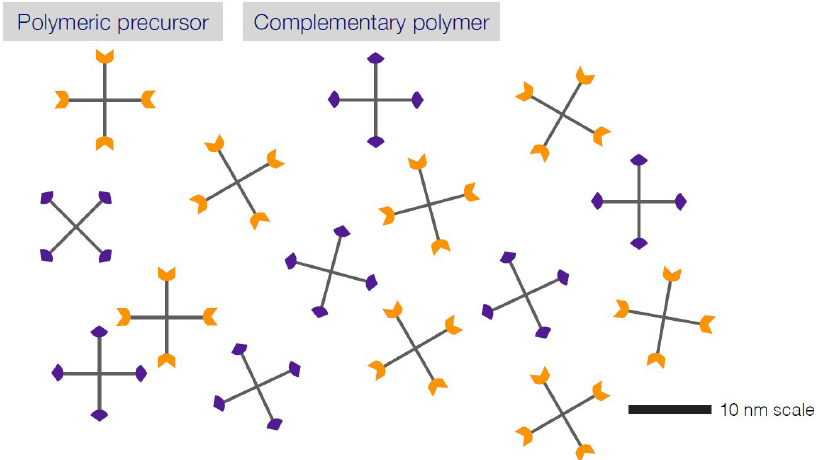
To create these systems, they begin with polymer chains, which are nanometer scale, and functionalize them with certain chemistries on the ends of the chain. Then they create other polymer chains with different chemistries that will react with the first type, and they make many copies of each, creating a solution of polymers (Figure 4-1).
Next they trigger reactions to get the two different types of polymers to interact, and their interaction leads to the formation of an elastic, three-dimensional network structure. These structures have typical elastic properties, Tibbitt said. They can be squeezed or pulled on like a rubber band. Furthermore, when they are put into an aqueous solution, they may swell or change their volume. “We as a community now have a pretty good understanding of how to design their properties, from controlling different features like the network architecture or how they’re linked together.” For instance, they can determine how much they swell and how durable they are.
Offering some background, Tibbitt said that the reason he got into this field originally was that he was interested in the extracellular matrix. “Any living system has a matrix around all of the biological components,” he said. “This is the extracellular matrix, and it’s a really key driver of biological function.” For instance, the individual cells in a human body are embedded in such a matrix, which is a
SOURCE: Presented by Mark Tibbitt on October 2, 2025.
different type of polymer network, and the properties of that extracellular matrix, such as its viscoelasticity and what features lie in it, drive different aspects of cell function. “This can happen at the single-cell level or at the multicellular level,” he said, “and there’s really interesting work from Viola Vogel’s lab looking at how collective cell behavior, in connection with the matrix, guides tissue healing through the organization of different properties.”
As an engineer, he continued, he thinks about how one could replicate features of the extracellular matrix and design systems that would make it possible to study that matrix in a more careful manner. And eventually it would be valuable to be able to engineer specific features such as elasticity or various chemical features that would interact with the living system. Initially, the goal in the field was just to engineer artificial matrices in which living systems could function normally, but that has been moving toward the goal of promoting various functions of living systems and cooperating with the biology of the living systems.
That in turn led Tibbitt to become interested in how the polymer networks might learn. Polymer networks are traditionally engineered via covalent linkages, he noted, “so you have two chains that get linked together and they’re permanently bound together until something comes and breaks them, and that gives really robust properties.” He compared the networks to a rubber band that can be stretched and relaxed thousands of times during its lifetime. However, he added,
these polymer networks are not so good at reconfiguring themselves in order to adapt to some change.
Use of the Materials in Learning Systems
This is what led Tibbitt and others in the field to thinking about switching from covalent linkages, which are permanent and will fracture and fail when stretched too far, to something else with a different type of energetic landscape where it is possible to easily move from a bound state to an unbound state and to a rebound state. There are various chemistries that can be used to do that, Tibbitt said, but he focused on boronate esters, which provide a type of dynamic covalent linkage that allows the polymer chains to hold each other but also to break and grab onto new pairs. That makes it possible to create a material that is stretchy and viscoelastic when it is deformed slowly but that will fail elastically if it is stretched very quickly. “So it has this kind of elastic behavior,” he said, “but it can be put back together, it can heal, it can adapt, and under different deformation conditions, it behaves in different manners.” The reversible bonds enable that reconfigurable behavior, and this is what his team is interested in as a substrate for exploring materials that learn.
To illustrate the sort of work his team is doing, he offered two examples. One was focused on material design, while the other involved integrating microbes into a polymer system and seeing how that could add various types of features into an otherwise nonliving structure.
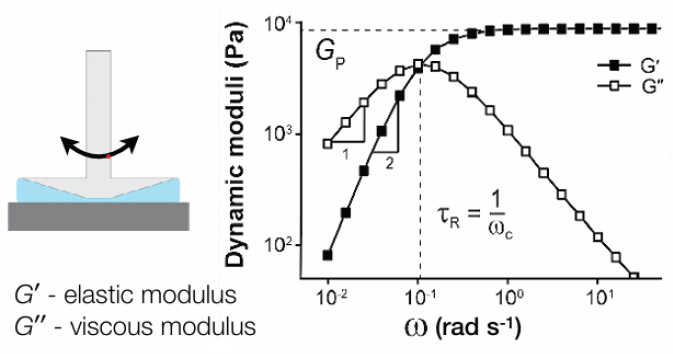
The first example involved work done in Tibbitt’s lab on polymer networks with boronic ester crosslinks. “We can synthesize these systems basically by functionalizing two chemistries on the ends of these polymer chains, and these happen to form this type of boronate ester bond that can break and reform under ambient conditions quite easily,” he explained. “And then we can measure the material properties.” In particular, the team does a lot of radiology to examine the properties of the materials. Showing a figure that graphed the elastic and viscous moduli of one of the polymer network materials (Figure 4-2), Tibbitt pointed to the plateau of the elastic modulus in the high-frequency range. “This is where we deform the material very quickly, and it has an elastic behavior,” he explained. By contrast, at low frequencies, or long timescales, these types of materials actually flow, he said. “So there is some reconfiguration happening that allows the material to undergo a flowlike behavior.”
Having learned to measure and describe the properties of these materials quite well, Tibbitt said, his team has developed an ability to design the materials with desired properties, which has led them to build in some types of interesting features that could be useful in a learning context. For example, they can vary the material properties by changing things such as the polymer concentration or, more easily,
SOURCES: Presented by Mark Tibbitt on October 2, 2025. Right image from Marco-Dufort et al. (2020).
the pH and temperature. “Since these bonds are under chemical equilibrium,” he explained, “if you change the temperature—or in this case, if you change the pH—it changes the equilibrium constant of the bond quite substantially, and that changes the material properties.” This in turn gives the team access to a range of different stiffnesses for the material as well as allowing them to vary how elastic the material is under different constraints and to change the relaxation time, which indicates the crossover point at which the material moves from an elastic behavior to a flowlike behavior.
The relaxation time is modified by changing the pH in the system, he said. “So for a very similar polymer formulation, if we just shift the pH slightly, we go from something that is relatively stable at high pH to something that flows very quickly,” he said. If the material is cut into pieces, at neutral pH the pieces will immediately flow back together and reform into a single piece, whereas at higher pH where the bonds are more stable and the lifetime of those bonds is longer, discrete chunks of the material will still be visible even after an hour-and-a-half. “It is still healing and it is flowing back, but it takes a longer time, and we can then tailor this,” he said. This raises the possibility of creating a material with a discrete number of different elasticities or flow behaviors and that are controllable by changing the pH or some other variable, such as temperature.
Another way to control the properties of such a material relies on the fact that when a material has reversible bonds, depending on how reversible they are, there can be a number of kinetic traps that resist the material’s relaxation. “But then if we can shift how reversible those bonds are,” Tibbit said, “we can then allow the system to more quickly relax back to a max entropy state.” This relaxation to a maximum entropy state happens via defects in the networks, Tibbit explained. The bonds do
not all form perfectly. The polymer strands might form some loops, or they might have dangling ends where they are not bound to anything, and then the polymer strands can rearrange themselves. The ability to bind and unbind leads to additional entropy maximization in these reversible polymer networks, he said.
“We can write down equations to calculate what the entropy of the network is,” he continued, “and we can calculate how this should look, and we can actually then predict the max entropy state.” They can then use triggerable reversible chemistries to form a network with a certain percentage of bound cross-links. In the example Tibbitt showed, that percentage was 60 percent. “There’s a lot of defects in the network,” he said, “but it forms an elastic material with some appreciable modulus, and we can use that material. But then if we trigger reconfiguration, so we allow the bonds to move around, due to the entropy relaxation this will actually liquefy. So you still have the same number of bonds form, but they move around into a way that the system will liquefy.”
Next, they could change, for example, the pH or temperature and slightly change the equilibrium, causing a change in the number of formed bonds, and this could lead to a material with an even higher stiffness than it had at the beginning. “So then we have this idea of multistability,” he said, “being able to move from one material at a given setpoint to another setpoint and another, just by allowing the system to either reconfigure or maybe change the equilibrium constant in the system.” This is a feature that might be very useful in learning systems, he suggested.
Tibbitt closed by talking about work at ETH on integrating living systems into these nonliving polymer networks. They hope that by integrating living functionality into these reconfigurable networks, they might produce more perceptive, responsive, and functional materials. His own work is focused on developing materials for carbon sequestration, he said, but he would focus on some of the materials’ design features that might have applicability to materials that learn.
His group starts with the viscoelastic polymer network materials, which can be extruded out of a printing element to create a particular shape. They incorporate a photosynthetic microbe into the material that can use light and nutrients to nucleate the mineral calcium carbonate as a way of storing carbon dioxide in a stable form. As the microbes reproduce, they spread through the material, depositing the calcium carbonate. “If we let these grow for a period of time, we actually see that they form a mineral skeleton in these systems,” Tibbitt said, “and we can then burn away all of the polymer component, all of the bugs, and we have this mineral skeleton remaining.” In short, this is a process that starts with an elastic material but then adds rigidity to it, which could be used in various ways.
This is what we’re thinking of for the future in the direction of how we can better engineer these reconfigurable materials as substrates, Tibbitt said. We are also thinking about how we can take these simple systems with microbes and get them to be able to adapt and evolve over their life cycles. And mentioning the
next presentation by Bartosz Grzybowski on chemical reaction networks, he said that there may be ways to do the same thing purely with chemical networks and reconfigurable networks, but also to get some crosstalk between what the chemical system can do and what the material system can do in order to have adaptive and evolving properties.
In closing, he said, “I think these reconfigurable networks can be a fun way to think about materials that can learn or can help support learning.”
Question-and-Answer Period
In the discussion period following the presentation, Itai Cohen of Cornell University asked if there would be a reason to try to do this work at larger scales, perhaps with materials that are stiffer. Tibbitt answered that there are certainly opportunities and ideas where that would be very attractive. In his work with microbes, he said, the objects they have made have generally been on the centimeter scale, although he added that his group has scaled them up to tens of centimeters and even meter scale just to show that they can do it. They have not tried to do anything more at those larger scales, he said, but certainly various possibilities exist for using them at various scales.
Cohen followed up by asking if the soft polymer is sufficient to hold the weight of such larger pieces. “I guess it depends on what the load of interest is,” Tibbitt answered, but he added that one thing people in the field are interested in is combining rigid systems with more elastic objects to build larger structures that could have some of the properties of reconfigurable materials. “I know in the robotics field there are some people working on tensegrity-like structures that have soft and hard objects together that then can reconfigure into different stable states,” he said. “And I think you could do that also with dynamically reconfigurable soft materials so that they’re adapting over time to the changes or the reinforcement that might happen.”
Cohen also asked if there are ways to apply some sort of field that would change the bonds themselves. “If you had multiple bond types, maybe you could melt some subset of them or change the nature of which ones would bind to which,” he suggested. Tibbitt said that this is definitely happening in the field. In his presentation he had talked about a relatively simple system with one type of polymer system and one type of dynamic bond, but that could be expanded in various ways. One might have multiple types of bonds in the same polymer system, for example, or different types of polymers, or even more rigid objects such as fibral components, things that might interact in different ways. And in the case of chemical networks, he added, one can imagine having chemical networks that are communicating with each other to give the material different setpoints for different stable points in the system.
Lisa Manning, workshop planning committee chair, then asked about the use of entropy to change the state of the system. What is the trigger for that, she asked,
and could it be made local? Tibbitt answered that he and his graduate student Lucien Cousin are examining this but have not yet examined the local aspects. “The way this works,” he said, “is we have a disulfide bond, which is another type of dynamic reconfigurable bond, and we can change the pH substantially by adding an organobase, and that can then turn it into a reconfigurable system.” But they have only done that globally. He went on to speculate that one might add photobases or something similar into the system so that one could use light or some other local trigger to change the ability of both bonds to rearrange. That would probably not happen at the single-bond scale, he said, but it could be on the micron scale. “I think you could have local clustering and other places liquefying, and that could be a reinforcement scheme,” he said, “but we haven’t played with this.”
Workshop planning committee member Andrea Liu asked if the polymer networks reconfigure under stress. Yes, Tibbitt answered. For instance, when they extrude the material to print it, they apply pneumatic pressure on the back that creates a shear stress in the material, which allows it to flow. “But that also causes reconfiguration,” he said, “and we’re trying to see how much we can understand and control that as well.” One thing they have observed is that when the materials are flowed with a very high shear rate, they extrude small wormlike fragments. “So they flow, but then they solidify in certain regions,” he said, “and we think there’s sort of shear banding in these types of systems, and you have densification in certain regions and liquefication in other regions.” It should be possible to take advantage of this behavior in a controlled setting, he said, but his team has not explored that yet.
CHEMICAL REACTION NETWORKS
Bartosz Grzybowski, a distinguished professor of chemistry at IBS Korea, opened his presentation with a question. What make biological materials “smart materials”? The answer, he said, is “networks,” and he referred to the workshop’s previous presentations that focused on creating networks of various sorts. In particular, these networks had such features as switches, cycles, and autocatalysis. But, he asked, “Can we engineer these things in molecules other than biomolecules?” In other words, biomolecules such as proteins and DNA have structures that can be adapted to create learning systems, but is that possible with much simpler molecules? His presentation answered that question in the affirmative and, in particular, described some chemical reaction networks that could be useful starting points for creating learning materials.
The typical view of organic reactions, Grzybowski said, is that they are linear: A goes to B goes to C, and so forth. People recognize that there are side products as well, but they assume that the side products account for only a few percent of the total reaction product. “But what I’m going to tell you is biblical—that the last side products can become the first,” he said. “They are going to become the major
products.” In other words, he said, he would like to change the usual linear view of chemical reactions to a network view and, in particular, to see collections of chemical reactions in terms of networks that are switchable.
He became interested in the topic of chemical networks around 2005, he said, when he and his team published a paper treating all known organic reactions as a connected network as a way of studying the mechanisms by which organic chemistry evolved (Fialkowski et al., 2005). From there he went into using an understanding of the network of organic reactions to allow the computational design of efficient synthesis pathways (Mikulak-Klucznik et al., 2020). He established two companies based on this work, he said, and people are still using their algorithms in academia and industry.
However, he said, “for learning, we don’t want to have a network that exists only in a computer.” In this case the computer chooses which options from a huge network should be used to create a synthetic pathway. But, Grzybowski said, “I would like to have a network like this in a flask, so all the steps need to be compatible with each other.” The steps will need to be kinetically correct, and, ideally, there would also be some sort of control element that would allow switchability.
Network Design by Algorithm
To describe how to do this, Grzybowski spoke about network design both by algorithms and by robots. He began with algorithmic design, and he described the general approach in this way: One starts with some substrates provided to the computer along with some rules of chemistry, and the computer uses those rules along with what he described as “nontrivial algorithms for searching networks of synthetic options” to see how the initial molecules react with each other and what their products are. In the next iteration, those product molecules are added to the pool of available molecules, and the algorithms and reaction rules are run again to get even more molecules. In that way, he said, it is possible to create a universe of all the possible reactions that can happen.
There are thousands of chemical rules, he said, and the approach results in a huge tree of synthetic possibilities where some interesting systemic behavior may or may not appear. “In doing that,” Grzybowski said, “remember everything needs to happen in one flask. So the kinetics of all the individual processes will have to be concerted, and side reactions cannot really highjack you, because then they become the major problems.” Thus, he said, the process has a layer of chemical rules, a layer of kinetics, and even a layer of quantum mechanics.
To illustrate, he offered an example where he started with six basic substrates that are thought to be the initial building blocks of life—water, methane, ammonia, hydrogen sulfide, and two nitrogen species—and around 600 prebiotic reaction rules. The reactions were run under either acidic or basic conditions, and what
emerged after seven generations was a collection of 53 biotic and 34,231 abiotic compounds (Wołos et al., 2020). In particular, Grzybowski said, it reproduced quite a number of molecules that became the molecules of life. “I call it a tree of life,” he said, “and in these generations of the tree … you see amino acids, you see building blocks of DNA, and all that.” Reaction cycles also appear, with A going to B, B going to C, and C going to A. “Even in a small network like this, we start generating many things with feedback cycles,” he said.
As an aside, Grzybowski noted that the effort involved the generation of 5 billion molecules, which was the largest molecular network ever calculated. His group accomplished it by working with people in cryptocurrency, who are used to carrying out immense calculations on distributed networks of computers (Roszak et al., 2024). “We made it a computer game that kids played all over the world, and they were calculating on their machines while we paid them a little bit of money, but they calculated 5 billion molecules,” he said.
Noting that the chemical reactions were done without any enzymes, but were just under chemical control, he said that the process led to a number of biologically important cycles. One, for instance, was the glyoxylate cycle, one of the basic cycles of biology, and without any enzymes it was about 90 percent complete (Roszak et al., 2024). The formaldehyde assimilation cycle was another. A third was an autocatalytic cycle replicating iminodiacetic acid (IDA). Because this cycle was predicted to double the amount of IDA with each iteration, Grzybowski’s team tried it out in the lab and found that the yield was 126 percent—not the theoretical yield of 200 percent, but since the steps are not 100 percent efficient, it was proof that the algorithm could help discover such cycles. “In organic chemistry there are maybe three or four examples of cycles,” he said, “and in terms of auto-replication, it’s even less,” so being able to discover new ones is particularly valuable.
It is also possible to use this technique to produce switchable cascades that will produce one of two different products, depending on the conditions. For example, Grzybowski said, their computer program predicted a network of possibilities that could lead to two different drug precursors. Specifically, depending upon whether they used a high or low concentration of hexamethylphosphoramide, a lithium-coordinating reagent, they would produce a spiral compound with two rings or a tricyclic compound (Klucznik et al., 2024). When the experiment was done, the program’s prediction was borne out, meaning that they had realized switchability—at least an early form of it—in practice.
Many biological networks are controlled by concentrations, Grzybowski said, such as the way the body controls sugar levels by creating sugars when the levels get too low and degrading them when the levels get too high. It turns out, he continued, that this sort of concentration-dependent switchability is also a pretty common phenomenon in chemical networks as well, but the mechanism is different. In biological networks, enzymes play a major role, and the chemistry is not dependent
on the concentrations. “In chemistry,” he said, “you have something called mass action, meaning you change the concentration, you shift the equilibria, and you modify the rates.” This implies that in the case of a chemical network, changing the concentrations of the input can potentially cause the network to move into a different part of the phase space.
This realization led his lab to decide to study such phase spaces in an exhaustive manner to see whether or not this is a common behavior.
Reactions Versus Reaction Networks
A major challenge in this task was the sheer number of experiments that would be required. “If you have one parameter to change, you probably have to carry out 50 experiments,” Grzybowski said. “Two parameters, A and B concentrations, 50 squared. Three parameters, 50 cubed. So good luck doing this by hand. In terms of graduate student years, it’s probably 1,000.”
To speed things up, Grzybowski’s team turned to robots to prepare the reactions, doing the nuclear magnetic resonance (NMR) imaging to get a chemical spectrum, even washing the test tubes. But the NMR was still too slow, he said, so they started building robots that could determine the composition of the mixture with a completely different technique: taking a photo in the ultraviolet–visible range, which takes just 3 seconds for each sample, and then analyzing the resulting UV-Vis spectrum. At each point in the space, that spectrum provides “some crazy signal,” he said, as it is the result of a superposition of the spectra of the various different molecules found at that point. But his team came up with a clever way of figuring out exactly which molecules make up the signal in a given spectrum. They carry out a single high-performance liquid chromatography (HPLC) separation of the mixture, separating out all of the various molecular components and creating UV-Vis spectra for each of those molecules, creating a “basis set.” Then the UV-Vis spectrum at each point in the space can be mathematically analyzed to determine which of the individual molecules in the basis set and in what percentage make up each of the individual spectra. This allows the researchers to characterize the molecular distribution at each point in the phase space far more quickly than if they had to perform HPLC at each of those points (Jia et al., 2025). “There might be regions where you don’t have complete knowledge,” Grzybowski said, “but if your basis set is enough, you’ll reconstruct at every point.”
In particular, he said, this technique allows them to analyze very complex mixtures and get their compositions in terms of products and byproducts at a throughput of about 1,000 reactions per day. “If you were to try to do it with HPLC and NMR, good luck,” he said.
With this capability, his team began exploring the reaction spaces—they call them “hyperspaces” because they can have high dimensions—of various reactions.
Some of the hyperspaces proved to be quite boring, he said. They had one maximum, and the slope of the reaction space could be no more than one because if they changed the initial concentration by X, then the change in the final concentration of each species is at most X. “So this is insignificant in the sense that the hyperspaces of the yields of each product are very shallow” he said. In particular, there was no switching.
However, other reactions were more interesting. For instance, they looked at the Hantzsch reaction, first discovered in 1881, which produces two dihydropyridine scaffolds which are very useful in medicinal chemistry. They used a technique called spectral unmixing, which involves basis components, HPLC, and deconvolution. After the first round of reactions, they saw three major products, but they found that they could not fit all the spectra perfectly, Grzybowski said, “so we knew the error was large and we were missing information in some parts of this space.” So they took it for repurification by HPLC, and they discovered more components but still had significant error. They ended up doing eight rounds of purification to identify the complete Hantzsch reaction space. In one corner of the reaction space they found the original reaction products that were discovered 150 years ago, but other parts of the space—representing other conditions—had different sets of products. Under certain conditions, for instance, they found products for the Petrenko-Kritchenko reaction (Jia et al., 2025).
What is particularly interesting about this reaction space, Grzybowski said, is that in different parts of the space it is possible to get up to 60 percent yield. That is, in different parts of the space, different molecules become the major product. Shifting the conditions under which the reaction takes place makes it possible to switch from one major product to another.
Nor is this a one-off thing, he said. His group has explored the hyperspaces of other reactions and found the same thing. Coumarin synthesis using Pechmann condensation was discovered in 1883, but the group has found many reaction products other than coumarin that the network can be switched to produce. In the case of the Biginelli reaction for synthesizing dihydropyrimidone, a famous reaction in organic chemistry, they constructed the network and “found something very interesting that we couldn’t even characterize,” Grzybowski said. For one set of conditions the reaction forms “this monster molecule that nobody has even imagined,” he said. “You can switch the network cleanly to it, and this molecule is actually becoming functional.” The molecule is functionally fascinating, he added, because it self-dimerizes in solution.
“We’ve been seeing that every chemical reaction that we touch is in reality a network, with concentration-dependent branches being activated,” Grzybowski said. So, as an ultimate test, his lab looked at olefin bromination, discovered in 1846 and one of the oldest reactions in organic chemistry. “You go to an organic chemist and they’ll tell you, ‘Oh, maybe it’s one product, maybe two products,’” he said. In
reality, he continued, it actually has four different products, and each of them can be harnessed in about 70 to 80 percent yield.
Summing up, Grzybowski said that organic reactions are not what the textbooks say they are. They are not like linear chains. Instead, they are switchable networks embedded in condition hyperspace. “This will become a new definition of chemical reactions,” he predicted.
Looking to the future, Grzybowski spoke about how such chemical reaction networks might be used. They can allow chemists to make different products simply by adjusting the reaction conditions. In particular, he said, they could make possible smart reactors, which are important for sustainability. Such smart reactors could make different products from the same components but different controls.
More interesting, there is an opportunity to couple this chemistry to material properties and, eventually, perhaps to create materials that learn. “We’ve been all constrained in material science by a very limited number of chemical reactions that can be switched,” he said. “So I think that this is opening a very interesting opportunity for the future. I’m not saying it’s learning, but it’s discovering the control elements for learning. And then we can at least try learning.”
Question-and-Answer Period
In the question-and-answer period following the presentation, Monica Olvera de la Cruz of Northwestern University asked Grzybowski to expand on the difference between biological and chemical reactions. Grzybowski answered that in biology the enzyme is usually first order in the reactant, while in chemistry it is possible to have zero-order reactions such as intramolecular reactions as well as first-order reactions and second-order reactions, so there are more opportunities to push reactions or shift equilibria by mass action. “You just adjust the concentrations,” he said. However, individual enzymatic reactions will almost always have the same outcome irrespective of the concentration of the starting material. “So that’s why when people model kinetic networks of enzymes, it’s just A goes to B goes to C goes to D, and there is some kind of enzyme one, enzyme two, enzyme three,” he said. “There’s a subset of all the networks that we can model in which you have the equilibrium, kinetic rate, and different orders of reaction. So what I meant is that there’s mathematically much richer space with all the different orders of reactions.”
Stefano Martiniani from New York University commented that exploring hyperspace, even robotically, takes a huge amount of time. “As soon as you go beyond three dimensions, you’re not going to be able to do it,” he said. “If you have a problem of exponential complexity, if your algorithm is not smart, you can’t solve it, it doesn’t matter how big your computer is. It doesn’t matter how many robots you have. Once you expand the scope of the chemistries, you’re going to have to sample more intelligently. So have you thought about that?”
Absolutely, Grzybowski answered. To this point, the largest space they have sampled is six-dimensional. In cases in which the slopes on the output surface are shallow, that makes it possible to simplify the sampling, but larger slopes can lead to a situation in which it is impossible to do enough sampling. “The largest slope we have predicted is for an autocatalytic reaction,” which doubles the amount of a given molecule with each reaction. With that slope of 2, he said, “we expected something that goes to a singularity.” And in reality, he added, the slope was around 2.3.
Martiniani followed up with a question about network redundancies. “One of the features of biochemical systems is built-in redundancies,” he said. “What that means is that if there is a perturbation, you might follow a different path but make the same product or a similar product that has the same function.” Might Grzybowski, he asked, build networks where even if the initial conditions are changed, they end up in the same place?
“Oh, yeah,” Grzybowski answered, “this is actually quite common.” There are often many bypasses in these networks where the reaction can take different paths and end up in the same place, but he did not include them on his illustrations because they can get so messy that they become illegible. “This is actually something that we’re trying to avoid,” he said.
Liu commented that the reaction networks Grzybowski had described could be thought of as essentially performing classification problems, that is, giving different outputs depending on the inputs. The interesting thing is that they just do that naturally, she said, and asked how common this is. “It’s interesting you didn’t have to tune reaction constants to get this or anything,” she said. “It just comes out.”
Grzybowski answered that except in the cases of the very simplest chemical reactions, it seems to be a generic feature of chemical reactions that they are actually networks of reactions that can lead to different places depending on the reaction conditions. “I think 99 percent of chemistry is this way.” The only reason no one had noticed this, he suggested, is that the basic mindset of a chemist is “I want this product, and I don’t care about anything else.”
Exploring these network will require making the conceptual constraints of chemistry less rigid, he said, with chemists learning to “explore sideways.” Technically, he continued, it will involve adjusting stoichiometries in a manner that chemists will not find intuitive. “So some of these things appear in ratios of concentrations that are like 1.3 to 1,” he said. “Why 1.3 to 1? Don’t ask me. But this is how the kinetic rates play out. So we’re only at the beginning of this in many ways.”
Finally, answering a follow-up question from Liu, Grzybowski said that his team is currently working to understand the theory of these systems. For example, he said, they have a program that enumerates all of a certain type of network, such as those with reasonable combinations of kinetic constraints, and they are trying to determine the percentage of networks in which switchability is observed. And by “switchability,” he added, he did not mean cases where the concentration of A or
B was changed by a few percent but rather such cases as going from A being more than 50 percent and B being below 5 percent to the opposite. “This is required for good classification,” he commented.
“The next step,” he concluded, “would be to start putting these networks together, and this is where human imagination as a chemist is just not adequate anymore, because with 20 different mechanistic steps in one network and the other, you want to make sure that none of them is cross-reactive. So it explodes combinatorially. Computers can do it, but I don’t think we can.”
ROBOT SWARMS
Itai Cohen, a professor of physics at Cornell University, spoke about what will be required to create swarms of tiny, independent robots that can learn and how they might be used. The inspiration, he said, is in the sorts of capabilities that swarms of tiny creatures display in nature. He spoke in particular of L. Mahadevan’s work on termites and the nests they create. The shape and structure of a nest depends on interactions among the termites in a colony. Essentially, he said, termites taste one another using their antennae and, based on what they taste in the context of the background pheromone levels, can decide to expand the nest laterally or create some sort of dislocation that makes it grow vertically. Air channels through the nest changes the pheromone levels depending on the structure of the nest, which in turn changes the termites’ behavior, Cohen explained, “so this is an example of a way in which a system is coupling with its environment and changing its rules of behavior based on what the environment is doing.”
This is a powerful paradigm, he said, and to illustrate its power he showed a map of Brazil with a highlighted area indicating a section of Brazil that has been terraformed by termites. That section is approximately the size of England, he said. “This whole area in Brazil is completely full of termite mounds, about twice the size of a human being,” he said. “So if we’re ever going to terraform Mars, … we’re going to need some sort of way of doing this in a systematic fashion with little robotic elements like these.”
Current Capabilities in Small Macroscale Robots
In talking about what it will take to create swarms of such microbots, Cohen began by discussing the current capabilities of small robots. He first showed a video of a swarm of “kilobots” that moved mostly in one direction with some random movements in other directions. They have three legs and a vibrating motor whose vibration changes when the bot is facing away from a light instead of toward it. He also showed macroscale robots that interacted with one another to form various shapes, such as the letter N, and to create oscillating networks in which the robots
form patterns based on their locations and the phases of their clock cycles relative to one another. He also mentioned work from Corentin Coulais at the University of Amsterdam that has exhibited emergent behaviors such as waves that don’t die out but instead increase in their amplitude, robots that can spontaneously generate motion, and others.
However, he continued, while there is interesting work going on at the macro scale, it is limited by the number of robots that can be created. A graduate student can make about 1,000 robots during his or her graduate career, he said, “so if you’re ever going to make something like 500,000 or a million robots, you’re going to need to have something that’s much more automated, and that’s where doing things at the microscale can be useful.”
Current Work in Microscale Robots
Science fiction has envisioned microscale robots for a long time, he said, such as Tony Stark’s backpack from which thousands of nanorobots will emerge at the click of a button and form his Iron Man suit. But, Cohen asked, are there are any real microscopic robots today? “I would say the answer is, ‘Sort of,’” he said. “We have a lot of systems where you have some control of tiny particles. These are sometimes called active particles, if you’re in physics, but in engineering, these are microbots, and there are various ways in which you can manipulate these, either through magnetic fields or acoustic, electric, and chemical methods.”
But these sorts of robots are very limited in the sense that they must have some sort of external brain, an infrastructure outside of the robots that is used to make decisions and direct them. There may be, for instance, a camera to keep track of what the system is doing and, in the case of magnetic microbots, a hexapole magnet to control them.
“One of the questions that we’ve been trying to address is whether we could put that infrastructure on board the microscopic robots,” Cohen said, and he transitioned into a description of some of the work his team has been doing to try to make that happen.
He began by defining a microscopic robot as a submillimeter device that has some way to harness power from light, has a brain, and has appendages. Brains at this scale are relatively doable, he said, given that the line widths of semiconductor devices today are as low as 3 nanometers. “We can make very small brains,” he said. By contrast, it has proven to be quite challenging to make moving parts such as arms or legs at that scale. “We just didn’t have any microscale actuators,” Cohen said. Microelectromechanical systems have radii of curvatures that are on the order of millimeters, which is far too large for a microscopic robot for which the basic building element needs to be microscopic in scale. “That means that you need to really bend things at a very small scale,” he said.
“The fundamental problem is that microscopic machines cannot be built in the way that macroscopic machines are,” he said. “We can’t take a jet engine and simply shrink it down to the microscopic scale because we don’t have nano screws or nano screwdrivers or nano engineers to screw the nano screws with the nano screwdriver.” This means that it is necessary to come up with a fundamentally different way of making machines at this scale, Cohen said, and the way that his group and others have been exploring is through an origami-like folding process, where the robot is fabricated lithographically in two dimensions in such a way that it will fold up into a desired shape when exposed to certain conditions.
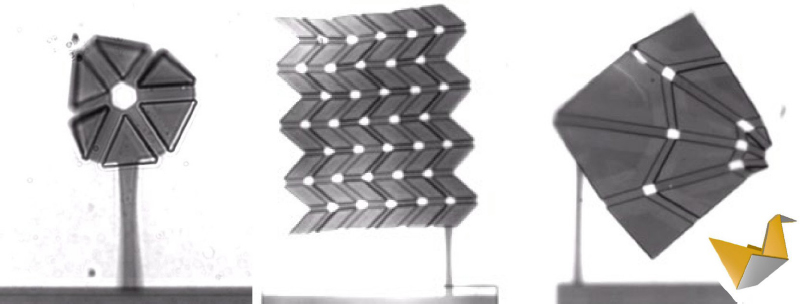
To create folding pieces, the group makes 10-nanometer thin free-standing films by adding an inert material to 7-nanometer pieces of platinum, Cohen explained. If such a strip is then put into solution and a voltage is applied to the platinum, ions from solution will adsorb onto the surface of the one side of the platinum that is not protected by the inert material. This creates a stress, which causes the platinum to bend. Applying the opposite voltage causes the ions to leave the platinum, and it will return to its original shape. If one then fabricates rigid elements on top of the platinum, only the sections of the platinum that are not covered by the rigid elements can bend, and this creates an origami-like structure that will bend in a desired pattern. To illustrate, Cohen showed an image of three origami structures his team has created this way—a hexagonal fold, a Miura ori (a flat sheet that folds into a complicated accordion-like structure), and what Cohen called “possibly the world’s smallest folding duck” (Figure 4-3). The devices are all on the scale of the diameter of a human hair, he said. “So these are very, very small devices.”
His group is not the only one that has been making such devices, Cohen said. “A lot of good, excellent research has been focused on this.” But what is nice about
SOURCES: Presented by Itai Cohen on October 2, 2025. Images created by Qingkun Liu and the Cohen Lab.
the devices that his team makes, he continued, is that they are electronically actuatable, which means that they can be interfaced with electronics.
Initially, the devices were activated through a wire attached to them, but then Cohen’s team put photovoltaics directly on the devices, attached to an actuator, so that when laser light was shined on the photovoltaic, the device would move. An important feature is that since these are created lithographically on a substrate, it is possible to make many of them at one time. “You can release them all from the substrate,” he said, “and this is your army of microscopic robots that is now ready to go and be actuated.”
To illustrate, he showed a video of a flat robot with four legs. “We shined light on the front photovoltaics to actuate the front legs,” he said, “shined light on the back photovoltaic to actuate the back legs, and if you go back, forth, back, forth, this is a robot that folded itself up and walked off the petri dish.” The robot was 40 microns by 70 microns by 2 microns, he said, and for a while it held the Guinness World Record for the smallest walking robot, although his team has now made walking robots that are almost an order of magnitude smaller.
Of course, even though there was no longer a wire attached to each robot, they still had to be directed from the outside, Cohen said, so the next step was to create robots that could direct themselves. To do that, they put a brain circuit on board so that when light shone on the robot it walked by itself. “Now you can release these things, and in light from the microscope they will just walk autonomously across the page,” he said.
This is the current state of affairs in his lab in terms of integrating electronics into microscopic robots, he said, and it has led to a number of different types of projects that they are doing at Cornell, including looking at ciliated surfaces, metamaterials, and surgical tools and even gearing up to make flying robots.
Looking to the Future
In the last portion of his presentation Cohen spoke about what is needed to reach the goal of robot swarms that learn.
First, he said, there is a need for new materials for actuation. “If you want to actuate in the body, for example, you need to solve the platinum problem,” he said. Originally, he said, his group worked with thin strips of platinum, but that element is limited by the fact that the platinum just adsorbs ions onto its surface. This means that if one wishes to make a stronger actuator by making the film thicker so that it can function in the body, the ions adsorbed onto its surface do not create a strong enough force to bend the thicker strip. This is what he referred to as the “platinum problem.”
They solve that issue by replacing the platinum with palladium, which is a bulk absorber of hydrogen, so that many more ions can come into play. “Now we can
make actuators that are 200 microns thick and can still bend,” Cohen said, “and that allows us to operate inside the body.” Using palladium, his group has made a microscopic gripper that works inside of an agarose gel that has the stiffness of brain matter, and they are trying to put such grippers at the ends of fibers in order to make microscopic surgical tools. “This is the kind of thing that you get from strong actuation,” he said. His group has also made microvalves that could in the future be used in drug-release devices as well as microscopic robotic arms that can swing, lift, twist, and grasp and may someday form the basis for microsurgical tools.
In other work they have created “amphibious” actuators that can work in any environment, not just in solution. To do that, they put platinum layers on either side of a layer of tantalum oxide, which serves as a source of oxygen ions. By applying a voltage across the two platinum electrodes, it is possible to make the oxygen ions flow to one platinum layer or the other, depending on the direction of the voltage. Thus, the strip can bend up or down, depending on the voltage. The device works even under vacuum, Cohen said.
In addition to new materials, there is also a need for new microscopic sensors, he said. Relatively good optical sensors already exist, and there are temperature-sensitive transistors that allow the creation of thermally sensitive circuits, but chemical sensing is quite difficult to do in CMOS (complementary metal–oxide semiconductors), and mechanical sensing is a major need at this scale. “Because magnetic fields can penetrate the body,” he continued, “it would be extremely useful if we could take some of those magnetically sensitive particles and be able to put circuits on them that could change their magnetic states, and so I think switches that couple electronic signals to magnetic states would be very useful to build.” This could probably be done with magnets, he said, and it might also work with bubbles that are sensitive to acoustic perturbations, creating electronic switching of bubbles.
A third need, Cohen said, is strategies for creating swarms that learn, which will require electronics that can sense the environment and then have interactions with other electronics in order to “do something interesting.” His lab is working on different approaches to creating swarms that learn, he said. One involves electronic chips that send voltage signals to one another, forming what is known as a Kuramoto oscillator. These chips are able to synchronize their behavior, as follows: Suppose the chip contains an oscillator with a voltage that increases and, when it reaches a threshold voltage, it fires a little voltage pulse and resets. If two of these are coupled together, the voltage pulse from one gets transferred to the other oscillator and advances its phase—and vice versa. That coupled behavior leads to both oscillators being advanced until they are perfectly synchronized. This is similar to how fireflies synchronize their flashing in nature, he noted.
In this way his team was able to create synchrony in a collection of multiple operators. They start off at different frequencies and then converge onto the fre-
quency of the fastest oscillator. In particular, the team did this synchronization in an array of cilia, where initially the cilia were waving at different frequencies, but they ended up all waving at the same frequency but at different phases so that the overall motion looked like a wave passing through the collection of cilia, with one dipping, then the next, and the next, and so on in perfect synchrony.
“We’re now at the point where we can get these chips to talk to one another,” Cohen said, “and these chips have thermal sensors on, and that allows us to have the ciliated system interact with the environment.” For example, if the chips are put into a temperature gradient, then the oscillators can either enhance the cold area or enhance the hot area, depending on how the circuits are wired. “That’s the first time that we’ve really been able to couple these microscopic robots to their environment and manipulate the environment based on what it is that they’re sensing,” Cohen said.
There will be much more that they can do once they introduce nonreciprocal interactions, he continued. If the phase advances are uneven—A advances the phase of B by a lot, but B advances the phase of A by a little—then instead of just waves that propagate across the system, interesting patterns begin to emerge, particularly when the nonreciprocity is large. It would make it possible, for instance, for the team to create central pattern generators for little chips that would form the backbones of micro-robotic “centipedes.” It would also allow them, he said, “to create elastronic materials, where instead of just having a metamaterial with its usual properties, you could put an electronic component on each of these panels and they would be able to talk to each other and create interesting patterns that allow the sheet as a whole to move and modify its shape.”
Furthermore, Cohen said, if one wishes to find strategies to create robot swarms that learn, there is a sense that “if you want to create interesting behaviors, you have to be working on an interesting landscape.” The landscape of possibilities has to be robust and rich enough to encourage learning—it should have “enough of a rippled shape to it that you can jump between states and form limit cycles around new locations,” he said—but the community is still grappling with what that might look like. One idea that his team had was that it might be useful to work near bifurcations because very small changes in the control parameters can lead to very large changes in the behaviors of the system. “So working near phase transitions, especially second-order phase transitions where things are very sensitive to how close you are to the critical point, might be useful as a strategy,” he suggested.
The final need he mentioned was determining how to do effective computation at the microscale. “At the macroscale,” he said, “I can send a robot in and it can use lidar to map out its space in three dimensions and do waypoint finding using a complicated CPU.” However, this approach requires far too much power for components at the microscopic scale. “So we’re going to need to completely change the way that we think about robotics at the microscopic sale,” he said. “Even just
the communication between the robots ends up being a challenging problem at this scale.”
Ultimately, he concluded, building learning microscopic robots with the ability to carry out valuable tasks will require pushing the limits of Bell’s law, which states that a new class of computer is created at a lower price approximately every decade. In this case, he said, computers will have to be shrunk down “by another order of magnitude or three in volume, but certainly an order of magnitude in price.” The microscopic robots will have to be simple systems with relatively poor-quality sensors, he continued, but they will also need to be robust enough and simple enough that they can be programmed and can interact in ways that produce some sort of emergent behaviors that ultimately lead to swarms that learn. “That’s the vision,” he said.
Question-and-Answer Period
Hagh opened the question-and-answer period by asking if the number of robots in a swarm matters in terms of emergent behaviors. For example, are the behaviors that emerge for a swarm of 1,000 robots different from those that would emerge from a collection of 5 or 10? Absolutely, Cohen said. For a small group of robots, the behaviors that appear might be team-like behaviors, such as assembling into an antenna or doing something to make it possible to coordinate among individuals. But with very large groups, the behaviors that emerge would follow much more general rules and be more robust in the sense that not every robot had to do exactly the right thing to produce the behavior.
Hagh followed up by asking if there would be some sort of transition point at which an individual robot’s interactions with all the other members of the group become unimportant and it is just the interactions with the nearest neighbors that matter. Cohen answered that this will likely depend on the particular task at hand, but certainly there will be some limit at which it is unruly and not very useful to keep track of every robot and the emergent behaviors become the main factor of interest.
Arvind Murugan of the University of Chicago then followed up on Cohen’s comment about wanting swarms to work near bifurcation points. Was the idea that the collective behavior of the robots is described by being near a second-order phase tradition or a bifurcation point, or was this meant to describe something about the individual agents? Either could be true, Cohen answered. For example, he said, his team has thought about designing machines around bifurcation points, “and the thing that’s nice about having a machine that operates near a bifurcation—not at the bifurcation where it’s infinitely sensitive, but near it—is that you can have your control surfaces give you very sensitive responses.” Similarly, if a swarm’s behavior is near some sort of phase transition boundary, it should be pos-
sible to take advantage of the behavior’s resulting sensitivity to conditions when designing swarms that learn.
Workshop planning committee member Andrea Liu of the University of Pennsylvania asked about controlling the dynamics of a swarm by controlling the local rules by which the robots interact with one another. Cohen answered that one way to do this is to give the individual robots sufficient computing power to change their behavior according to what they are sensing in their environment. In principle, then, the robots could be reprogrammed by shining light on them. “So there’s this way in which you could start to have the system do what it does on its own and then give it a nudge every now and then from the outside world,” he said.
In response to a question from Stefano Martiniani of New York University, Cohen said that it is possible to put memory on the robots and, indeed, it is useful for them to have memory in part because the power might be intermittent “so you need some ability to store a state so it doesn’t get reset each time the sun goes away.” As for computational capabilities, it is already possible with line widths as small as 160 nanometers to do basic computing, but the real power will arrive when the line widths shrink and an individual robot can hold, say, 1 million transistors. This, however, will require collaboration with specialists in computer architecture and programmers who can deal with uncertainty, he said. “There’s a whole bunch of electronics that need to happen so that we can make something like this a reality.”
DISCUSSION
Hagh opened the discussion period by asking the three presenters if there might be a way for the types of materials systems that they described to start learning on their own and, if so, how that might be done. Cohen answered that he thinks of learning as exploring a phase space, “but you need something to tell you whether you’re doing better or worse.” If there is such feedback, he said, “there’s no problem in trying to create a phase space that the system can explore and then guide itself through, … but there has to be something that the system is rewarded for or is trying to optimize.” That should be possible to do, he added.
Grzybowski said that he did not believe that chemicals can actually learn, per se, but he does believe they can self-optimize and maybe self-amplify. So, making a network maximize the production of a desired product under certain conditions or choosing the substrates that generate the most valuable products is realistic, but learning is probably asking too much. “Building a chemical brain or something, I don’t think we’re going to get there,” he said.
When Cohen suggested having a computer involved, Grzybowski said that learning should be possible in a chemical network if there was some sort of feedback provided by a computer. But having a purely chemical network learn is probably not going to happen, he said, at least not in his lifetime, and he is not even
sure why that would be desirable. “What would you like the chemicals to learn?” he asked. “I want them to produce valuable stuff—that’s fine. But what should my aldehydes and amines and ketones learn? Not sure.”
Tibbitt said that it is possible that in the case of the sort of learning materials networks they were talking about, if a cycle is repeated in the system, this would enrich the system for a certain behavior. For example, if the system is subjected to an external event multiple times, it might start to behave more ready for that event, perhaps through a structural alignment or the enrichment or depletion of a chemical. “I would consider learning without too much external input,” he said. However, he added, it is not clear if that would happen in the chemical networks.
Talking to Grzybowski, Cohen said, “In some sense, isn’t a cell just a bag of chemical networks?” And a cell can do all sorts of interesting things, he added. “It can take inputs from its outside, it can learn how to reproduce, it can compete with other cells, a bacteria can poison other bacteria.” Grzybowski answered that perhaps the development of antibiotic resistance could be considered learning by a cell. “So, yeah, if you consider this kind of adaptation a form of learning, then, yes, then that would be possible.” However, he added, he was interpreting “learning” to be more like what happens when one learns French.
Kanaya Malakar from Rutgers University asked if there is a way to think about the learning process in terms of hysteresis, or how the state of a system depends on its history so that the state at a certain point can be different if different paths were taken to get to that point. Tibbitt answered that while he did not use the term, it certainly is part of the process. If a material is subjected to the same deformation field many times, he said, it often undergoes hysteresis and remembers those past events. “I think we should try to exploit that and not view hysteresis as a defect but something that we can work with,” he said.
Viola Vogel from ETH Zürich asked Grzybowski whether his way of thinking about chemical reactions in term of networks might be usefully applied to thinking about biochemical reactions in the cell. She drew a parallel between Grzybowski’s comments about how chemists have traditionally focused on optimizing the yield for a single product and ignored the rest of the chemical reaction network with how biologists examine signaling networks in the cell. “People try to map out signaling networks, usually by looking at which protein interacts with which protein, and then putting together these diagrams,” she said. “They say nothing about rates, about kinetics, about relative concentrations, and they think they understand how cells work based on drawing networks.” Perhaps Grzybowski’s approach to understanding networks of “dumb little molecules” might be translated into “this much more complex world of small, medium-sized, and macromolecules that control cell behavior.”
Grzybowski answered that biological systems have a huge advantage over chemical networks because of the presence of enzymes, which are specific to cer-
tain operations and do not interact with one another. By contrast, he said, “if you take two catalysts in chemistry, one based on nickel and one based on palladium, and you put them together, there is a significant chance that they will exchange the ligands, and one is going to destroy the other, and then you have a mess. If you put two proteins together, they can stay in the same solution and they’re not going to kill each other.” The bottom line is that chemistry has a much harder time achieving what biology can accomplish inside of cells with enzymes. “So whether in chemistry we would be able to control networks of that size, like 40,000 reactions in parallel, I doubt it,” he said. “I would be happy with a few hundred.”
Cohen then offered his thoughts on the question. Seeing circuits as being focused on a single molecule output is the wrong way to think about them, he said. “We really need to think about cells as occupying a point in a 20,000-dimension phase space of gene-expression patterns,” he said. Each cell has 20,000 genes and a fingerprint that is associated with expressions of the collection of those genes. “The behavior of the cell is an emergent behavior that comes from that particular expression pattern,” he explained, “and when you think about the sort of combinatorial range of expressions that you could get in a cell, it’s much, much larger than the biological behaviors that we observe like cell differentiation or cancer.” But the cell does not do everything that is possible for it to do, given the 20,000 different genes. “What actually happens is that the cell chooses to live in some sort of lower-dimensional manifold associated with a behavior,” Cohen said, “and the behavior has to be continuous. It has to be evolvable. So there are some constraints that happen that take you from that 20,000 combinatorial different possibilities to something that’s much lower in dimension and is associated with the emergent behaviors.” And the field is starting to think about the behavior of the cell more globally in this way, he said, rather than focusing on such questions as whether it produced a particular chemical or not.
Vogel agreed and said that the important question is how to identify and understand the rules that govern behavior for this scaled-down collection of possibilities.
“It is a very, very deep question,” Grzybowski said, “and I think that there are two parts of the problem.” One part is the reactions that one wants to get on a molecular level, converting A into B. “We know how to do that,” he said. The big problem concerns not these desired transformations but rather the transformations that need to be avoided, he said, and there are far more of these undesirable transformations. Unfortunately, researchers know very little about them because the only reactions that are published are those that are free of incompatibility problems. “So, to me, this is the biggest thing,” he said.
James De Yoreo of Pacific Northwest National Laboratory asked about the possibility of systems learning from their failures—in essence, trying something new when a previous action had not worked. “Thinking about things like the swarm of robots,” he said, “it’s the equivalent of saying, I’m having my robots go through a
landscape that’s difficult, and they keep crashing, and they figure out we have to do something else and go somewhere else.” So, he asked the presenters “In any of your systems, do you see a way to program in, not reinforcement based on success, but learning based on failure to do something else that might be successful?”
Cohen answered that this particular ability of a brain which can be seen in mammals and birds has to do with simulation, “so you need to be able to have the part of your brain, which is like the agranular frontal cortex, that allows you to do simulations.” In robots it might work to have a “digital twin” made to test different scenarios. Grzybowski said that in chemical systems it is more difficult “because when you fail, it means that all of your soup just precipitated and there is no way of bringing it back to life. So, you have to repeat the experiment.”
For the final question, an audience member said that it seemed as though the presenters were mainly working with large groups of postdocs and asked if this kind of super-interdisciplinary research is compatible with training young graduate students in departments. Tibbitt answered that all of the work he showed had been done by Ph.D. students and that his group currently has 15 doctoral students and only two postdocs. “So I think it’s possible to find the right people,” he said. “Very possible.” Cohen said that his lab is split 50/50 between postdocs and Ph.D. students and that they do different things. “With students you can develop processes over longer periods of time,” he said. “But it’s true, there is something that is very useful about having people who are bringing in expertise that isn’t my own and sort of integrating it with things that are happening on campus.” Grzybowski said that in his South Korean lab the ratio is closer to 80/20 postdocs to graduate students, while in his algorithm lab in Poland his team members are all his former students who stayed with him after graduation. He added that the situations in the two countries are quite different. “In Poland I could nurture the students for much longer,” he said. “There were no expectations; any paper was a success and was fine.” In South Korea the attitudes toward scientific publications are much different, he said. “You know how it is—Nature next year, and Science a year after.”
REFERENCES
Fialkowski, M., K. J. Bishop, V. A. Chubukov, C. J. Campbell, and B. A. Grzybowski. 2005. Architecture and evolution of organic chemistry. Angewandte Chemie 11(44):7263–7269.
Jia, Y., R. Frydrych, Y. I. Sobolev, W. S. Wong, B. Prajapati, D. Matuszczyk, Y. Bilgi, L. Gadina, J. C. Ahumada, G. Moldagulov, N. Kim, E. S. Larsen, M. Deschamps, Y. Jiang, and B. A. Grzybowski. 2025. Robot-assisted mapping of chemical reaction hyperspaces and networks. Nature 645(8082):922–931.
Klucznik, T., L. D. Syntrivanis, S. Baś, B. Mikulak-Klucznik, M. Moskal, S. Szymkuć, J. Mlynarski, L. Gadina, W. Beker, M. D. Burke, K. Tiefenbacher, and B. A Grzybowski. 2024. Computational prediction of complex cationic rearrangement outcomes. Nature 625(7995):508–515.
Marco-Dufort, B., R. Iten, and M. W. Tibbitt. 2020. Linking molecular behavior to macroscopic properties in ideal dynamic covalent networks. Journal of the American Chemical Society 142(36):15371–15385. https://doi.org/10.1021/jacs.0c06192.
Mikulak-Klucznik, B., P. Gołębiowska, A. A. Bayly, O. Popik, T. Klucznik, S. Szymkuć, E. P. Gajewska, P. Dittwald, O. Staszewska-Krajewska, W. Beker, T. Badowski, K. A. Scheidt, K. Molga, J. Mlynarski, M. Mrksich, and B. A. Grzybowski. 2020. Computational planning of the synthesis of complex natural products. Nature 588(7836):83–88.
Roszak, R., A. Wołos, M. Benke, Ł. Gleń, J. Konka, P. Jensen, P. Burgchardt, A. Żądło-Dobrowolska, P. Janiuk, S. Szymkuć, and B. A. Grzybowski. 2024. Emergence of metabolic-like cycles in blockchain-orchestrated reaction networks. Chem 10(3):952–970.
Wołos, A., R. Roszak, A. Żądło-Dobrowolska, W. Beker, B. Mikulak-Klucznik, G. Spólnik, M. Dygas, S. Szymkuć, and B. A. Grzybowski. 2020. Synthetic connectivity, emergence, and self-regeneration in the network of prebiotic chemistry. Science 369(6511):eaaw1955.


