Data Ontologies for Data-Driven Decision-Making: Research Approach and Findings (2026)
Chapter: 4 Ontology Development Framework
4. Chapter 4 – Ontology Development Framework
4.1. Overview of Framework
This chapter presents the guiding framework and associated methodology for creating and using data ontologies to support informed decision-making. The framework draws from practices and varied fields of study, including the medical field, construction, and transit planning, among others. The framework enables users to plan and create ontologies that effectively transition legacy systems into advanced technologies, such as cloud-based solutions. The ultimate objective of the ontology development strategy is to maximize the use of internal resources to leverage enterprise data in legacy systems effectively. This can be achieved by facilitating strategic planning and preparation, supporting technical activities, and ensuring continuous improvement.
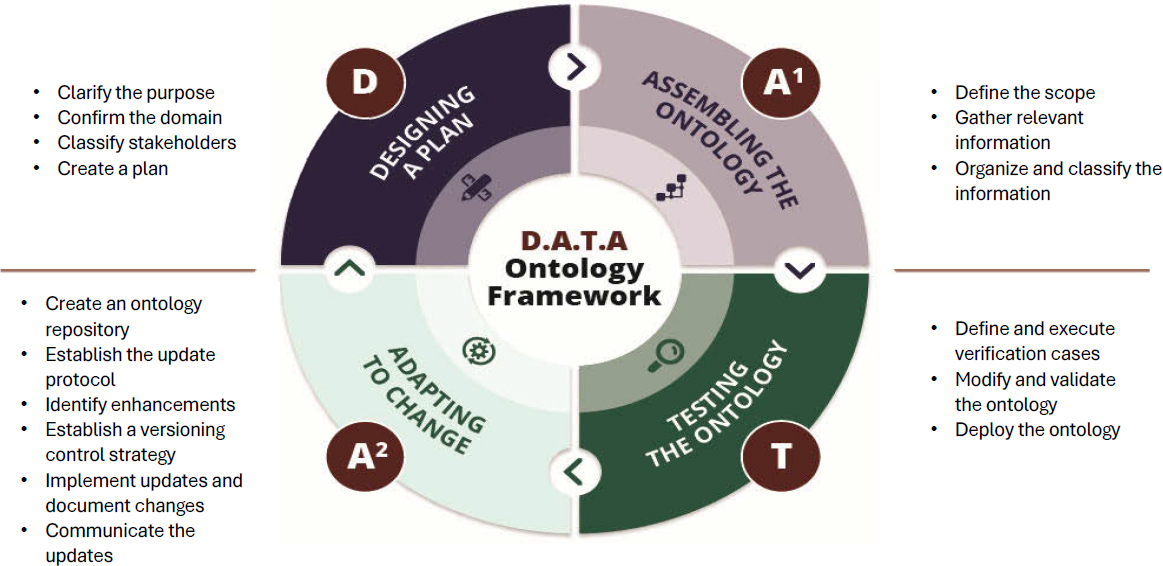
The continuous improvement principle underscores ontology development as a journey, not a destination. The guiding framework consists of four cyclical strategies: Designing a plan that enables success (D), Assembling the ontology (A1), Testing and validating the ontology (T), and Adapting and improving the ontology (A2) and process based on the lessons learned, changes in program objectives, or use case outcomes. This is referred to as the DATA Framework. Figure 2 illustrates the DATA Framework, along with the strategies and supporting activities for developing a data ontology.
If effectively implemented, the DATA Framework can enable users to capitalize on existing opportunities to align with foundational data principles, support broader agency goals, and provide a structured, meaningful, and consistent approach to organizing knowledge about transportation data.
4.2. Overview of Methodology
The following subsections describe the four essential strategies of the DATA Framework and outline the steps for executing each strategy. For each step in the methodology, the guide also provides competency questions that enable the user to align their actions with the objectives of each strategy.
4.2.1. Pillar D: Designing a Plan
This strategy is essential as it prepares users for success and provides a solid foundation to execute the other critical components of the framework. Designing a strategic plan for your data ontology program is a crucial step in ensuring the program’s long-term sustainability. A well-designed strategy will help define a clear direction and focus, identify the needed resources, and effectively engage stakeholders to achieve the long-term goals of your data program. The program can be sustained over the longer term by setting realistic and achievable goals during this planning stage. Many organizational or business programs fail due to a lack of an effective strategy or proper initial planning. However, if effectively executed, it will enable users to target resources efficiently and adapt to emerging needs while maintaining the program’s original focus. The DATA ontology framework helps guide users in achieving these objectives and mitigating risks by implementing the 4Cs Steps: clarifying the program purpose, confirming the domain, classifying stakeholders, and creating the plan.
4.2.2. Pillar A1: Assembling the Ontology
This strategy of the DATA Framework involves developing a data model that represents how the key concepts or data elements in a given or multiple domains are related, making systems semantically interoperable. This is when the technical activities involved in building the ontology take place. This pillar enables users to establish the scope of the ontology, gather relevant information, and organize and classify concepts or data elements to facilitate data integration and system interoperability, thereby enhancing data-driven decision-making.
4.2.3. Pillar T: Testing the Ontology
This strategy focuses on evaluating the efficacy of the built ontology to verify and validate how well the ontology meets its intended purpose. It involves defining and verifying use cases and scenarios to ensure consistent results, modifying and validating the reasoning and integration potential of the ontology to ensure its completeness, and
deploying the ontology to facilitate broader use by other systems and users. To accomplish this pillar of the framework, take the following operational steps:
- Define and execute verification cases by developing test scenarios, assigning responsibilities to team members, and documenting results for review,
- Modify and validate the ontology by updating classes and relationships, conducting peer reviews, and confirming alignment with domain requirements, and
- Deploy the ontology by integrating it into target systems, training end users, and monitoring its performance to ensure effective use.
4.2.4. Pillar A2: Adapting to Change
This strategy acknowledges that data and domains evolve over time. To ensure the longevity of the ontology, it is essential to keep it updated with the most recent data and information. Updates can also include enhanced or additional functionality for applications that use the ontology. The following steps outline practical methods for updating an ontology and ensuring that the updates are effectively communicated to users and relevant stakeholders. These steps include:
- Developing ontology repositories or libraries,
- Establishing update protocols,
- Identifying and implementing enhancements and updates,
- Establishing documentation and versioning control, and
- Communicating updates.
4.3. Guide Outline
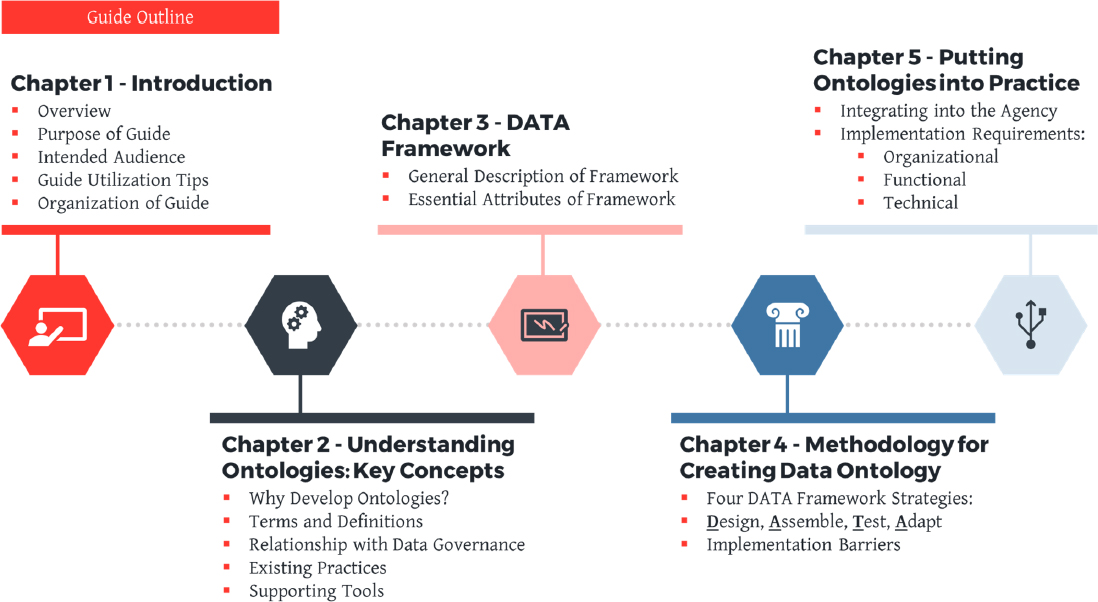
The outline shown in Figure 3 was driven by the conceptual framework and the methodology for developing data ontology.