Public Transit and Ride Sharing for Rural, Tribal, and Frontier Agencies: A Guide (2026)
Chapter: 7 Service Partnerships

CHAPTER 7
Service Partnerships
Service partnerships involve collaboration between public transit agencies and private SUM providers to enhance transportation services, particularly in rural, tribal, and frontier areas. There are multiple approaches to establishing partnerships; federal coordination can reduce grant application strain and leverage resources, partnering with neighboring regions or statewide opportunities can increase service and cost efficiencies, or partnering with businesses and employers can create champions for transit services. The challenges associated with partnerships include liability, software integration, contractual requirements, and staff qualifications. Effective communication about the value of the partnership is crucial to engaging private companies.
Typically, the overall goal of a partnership is to integrate on-demand SUM services with existing public transit services to improve accessibility, coverage, and service quality in less populated areas. Examples of such partnerships include collaborations with companies like TNCs, microtransit, and micromobility companies. These highlight the importance of coordination and collaboration to address transportation challenges in rural settings.
Why This Is Important
Service partnerships are important for several reasons, including the following:
- Resource optimization. This allows public transit agencies to leverage private-sector resources, such as technology, vehicles, and drivers, leading to more efficient and cost-effective transportation solutions.
- Expanded service coverage. Partnerships can extend transit services to underserved or unserved areas, particularly in rural, tribal, and frontier regions.
- Cost efficiency. Collaborating with private providers can reduce operational costs through shared resources and economies of scale.
- Improved service quality. Private partners often bring advanced technology and innovative solutions that enhance service reliability, scheduling, and user experience.
- Increased flexibility. Partnerships offer more flexible service options, such as on-demand microtransit and ridehailing, which can better meet diverse needs compared to fixed-route services.
- Access to funding. Joint efforts can facilitate securing funding from various sources, including federal, state, and local grants, as well as private investments.
- Enhanced mobility options. Integrating different modes of transportation, such as bikeshare, carshare, and ridehailing, provides a comprehensive mobility ecosystem.
- Community benefits. Effective partnerships improve access to essential services like healthcare and employment, enhancing the overall quality of life for all residents.
- Risk sharing. Collaborating with private entities allows for shared risk in service provision, which is particularly beneficial for pilot projects and new service implementations.
- Financial sustainability. By sharing costs and resources, partnerships help sustain transportation services financially, especially in areas with limited traditional funding.
- Addressing specific needs. Partnerships can focus on specific issues such as first- and last-mile connections, gap services in low-density areas, and mobility for all groups.
- Community and economic benefits. Effective transportation partnerships support local economies by improving access to jobs, education, healthcare, and other essential services.
Service Partnership Examples
Examples of service partnerships relevant to rural transportation-providing organizations are shown in Table 1.
Partnership Approaches
Coordination and engagement with federal partners can help reduce the strain of grant applications and leverage available local, state, federal, private, and non-profit resources to assist with SUM service fund sourcing. Coordinating efforts can simplify and consolidate the grant application process, making it less burdensome for agencies to apply for funding. By working together, federal partners can combine local, state, federal, private, and non-profit resources, creating a more substantial and accessible pool of funds. Regular meetings and communication between different stakeholders, such as quarterly meetings between councils of governments, local agencies, and state DOTs, can ensure that resources are allocated efficiently and effectively. Coordination can address funding disparities and improve connectivity between metropolitan and rural areas, ensuring that isolated communities receive adequate support. Engaging with various partners allows for the sharing of successful strategies and solutions, such as pooling resources to provide additional accessible vehicles and connecting with local tribal senior centers.
Partnering with neighboring regions or considering statewide opportunities with larger-scale partnerships may be able to increase service and cost efficiencies that can justify subsidies and fares that reach lower-density communities. Coordinating trips within and between adjacent rural transit service areas through partnerships can increase service and cost efficiencies. This coordination can be facilitated through MOD platform requirements that integrate open data and cross-platform scheduling, payment, and service requirements. By doing so, it can reduce inefficiencies in intra- and inter-trip service areas, making it more feasible to provide on-demand services in spread-out, low-density communities. Additionally, involving regional partners willing to contribute funding can help subsidize services, making them more affordable and accessible, which can justify the subsidies and fares needed to reach these communities.
Businesses and employers may be good partners and may provide champions for transit service (e.g., casinos on tribal lands). Non-profit partners for transportation services may also provide a supplement for service provision if they are available and willing to participate. There are several potential approaches to establishing these partnerships, as follows:
- Businesses and employers can provide financial support through direct funding, sponsorships, or grants, such as sponsoring transit routes or bikeshare stations.
- Employers can create or support transportation programs for their employees, such as vanpools or shuttle services.
- Partners can advocate for transit services within the community and promote the use of public transportation among their employees and clients.
- Non-profit agencies and businesses can share resources such as vehicles, drivers, or maintenance facilities.
- Non-profit agencies can offer in-kind support such as volunteer drivers, administrative assistance, or space for transit-related events and meetings.
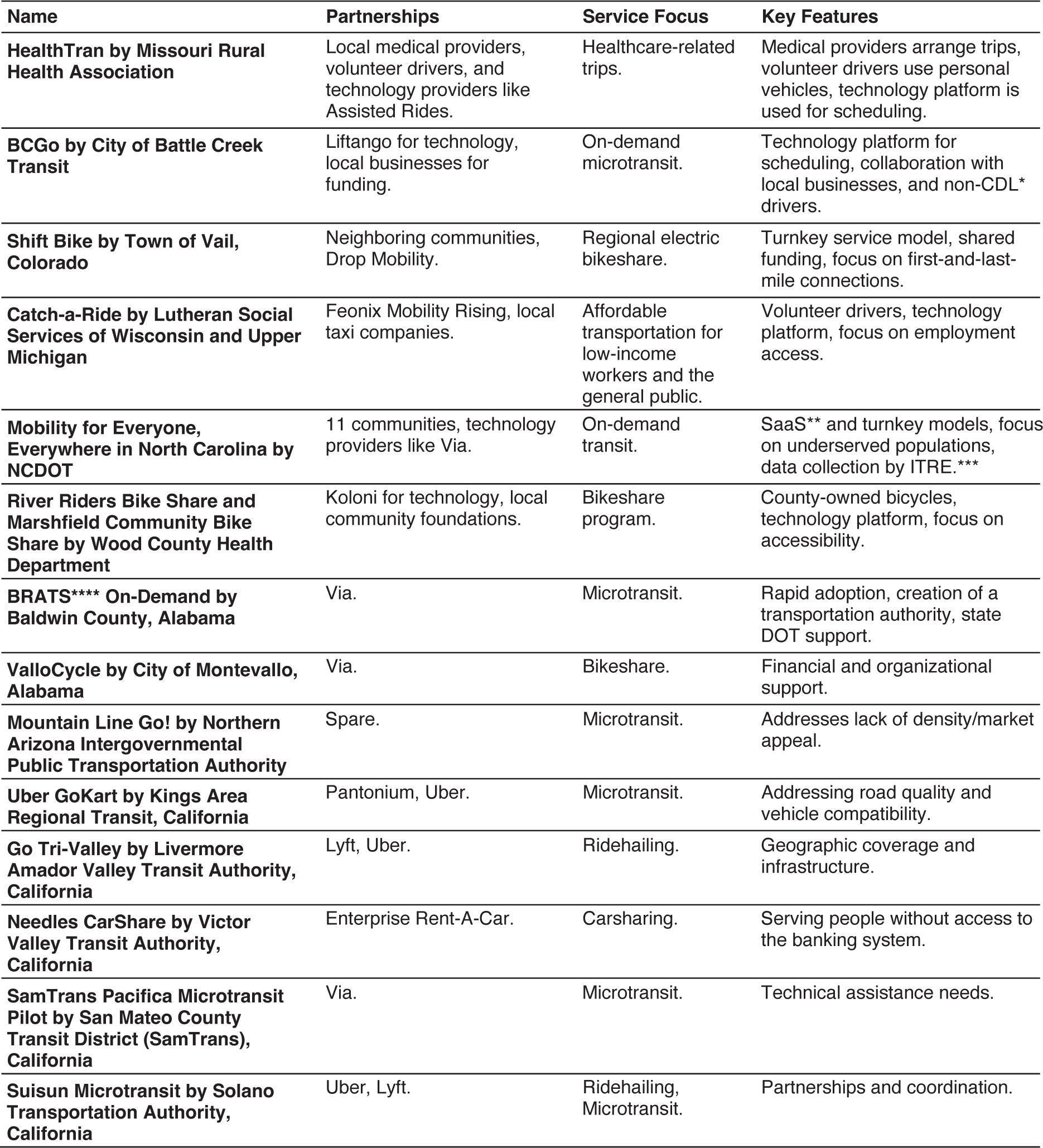
*Commercial driverʼs license. **Software as a service. ***Institute for Transportation Research and Education. ****Baldwin Regional Area Transportation System.
Long Description.
Row 1 provides the column headers: Column 1: Name. Column 2: Partnerships. Column 3: Service Focus. Column 4: Key Features.
Row 2 Name: HealthTran by Missouri Rural Health Association. Row 2 Partnerships: Local medical providers, volunteer drivers, and technology providers like Assisted Rides. Row 2 Service Focus: Healthcare-related trips. Row 2 Key Features: Medical providers arrange trips, volunteer drivers use personal vehicles, technology platform is used for scheduling.
Row 3 Name: BCGo by City of Battle Creek Transit. Row 3 Partnerships: Liftango for technology, local businesses for funding. Row 3 Service Focus: On-demand microtransit. Row 3 Key Features: Technology platform for scheduling, collaboration with local businesses, and non-commercial drivers license drivers.
Row 4 Name: Shift Bike by Town of Vail, Colorado. Row 4 Partnerships: Neighboring communities, Drop Mobility. Row 4 Service Focus: Regional electric bikeshare Column Row 4 Key Features: Turnkey service model, shared funding, focus on first-and-last-mile connections.
Row 5 Name: Catch-a-Ride by Lutheran Social Services of Wisconsin and Upper Michigan. Row 5 Partnerships: Feonix Mobility Rising, local taxi companies. Row 5 Service Focus: Affordable transportation for low-income workers and the general public Column Row 5 Key Features: Volunteer drivers, technology platform, focus on employment access.
Row 6 Name: Mobility for Everyone, Everywhere in North Carolina by NCDOT. Row 6 Partnerships: 11 communities, technology providers like Via Row 6 Service Focus: On-demand transit. Row 6 Key Features: Software as a Service and turnkey models, focus on underserved populations, data collection by Institute for Transportation Research and Education.
Row 7 Name: River Riders Bike Share and Marshfield Community Bike Share by Wood County Health Department. Row 7 Partnerships: Koloni for technology, local community foundations. Row 7 Service Focus: Bikeshare program. Row 7 Key Features: County-owned bicycles, technology platform, focus on accessibility.
Row 8 Name: Baldwin Regional Area Transportation System On-Demand by Baldwin County, Alabama. Row 8 Partnerships: Via Row 8 Service Focus: Microtransit. Row 8 Key Features: Rapid adoption, creation of a transportation authority, state DOT support.
Row 9 Name: ValloCycle by City of Montevallo, Alabama. Row 9 Partnerships: Via. Row 9 Service Focus: Bikeshare. Row 9 Key Features: Financial and organizational support.
Row 10 Name: Mountain Line Go! by Northern Arizona Intergovernmental Public Transportation Authority. Row 10 Partnerships: Spare. Row 10 Service Focus: Microtransit. Row 10 Key Features: Addresses lack of density/market appeal.
Row 11 Name: Uber GoKart by Kings Area Regional Transit, California. Row 11 Partnerships: Pantonium, Uber. Row 11 Service Focus: Microtransit Row 11 Key Features: Addressing road quality and vehicle compatibility.
Row 12 Name: Go Tri-Valley by Livermore Amador Valley Transit Authority, California. Row 12 Partnerships: Lyft, Uber Row 12 Service Focus: Ridehailing Row 12 Key Features: Geographic coverage and infrastructure.
Row 13 Name: Needles CarShare by Victor Valley Transit Authority, California. Row 13 Partnerships: Enterprise Rent-A-Car Column Row 13 Service Focus: Carsharing Row 13 Key Features: Serving people without access to the banking system.
Row 14 Name: SamTrans Pacifica Microtransit Pilot by San Mateo County Transit District (SamTrans), California. Row 14 Partnerships: Via Row 14 Service Focus: Microtransit Row 14 Key Features: Technical assistance needs.
Row 15 Name: Suisun Microtransit by Solano Transportation Authority, California. Row 15 Partnerships: Uber, Lyft Row 15 Service Focus: Ridehailing, Microtransit Row 15 Key Features: Partnerships and coordination.
- Partners can help engage the community by participating in planning processes, providing feedback, and helping identify transportation needs and solutions.
- Businesses and non-profits can integrate transit services into their operations, such as offering transit passes as part of employee benefits or coordinating with transit agencies to align service schedules with work shifts.
- Partners can share data on employee or customer travel patterns to help transit agencies optimize routes and schedules.
- Collaborating on joint initiatives such as ride-sharing programs, carpooling incentives, or bikeshare programs can enhance overall mobility options in the community.
NCDOTʼs Mobility for Everyone, Everywhere in North Carolina
The Mobility for Everyone, Everywhere in North Carolina (MEE NC) program was established as a partnership between NCDOT and 11 communities in North Carolina in 2022 with funding from the federal Rural Surface Transportation Grant Program. The MEE NC program includes agencies using different service models for their programs, including full turnkey agreements with the private provider, software-as-a-service agreements while using agency drivers and vehicles, contracting of vehicles-only for the service, and other arrangements. The MEE NC program employs two different service models: (1) software as a service (SaaS) in which the transit agency provides drivers, vehicles, and operations management, while MEE NC supplies the software; and (2) transportation as a service (TaaS) or turnkey in which MEE NC provides a complete solution, including drivers, vehicles, software, and operations management.
Looking at non-traditional sources of funding from local partners and developing braided service models between different rural agencies can help with funding challenges to a certain extent, helping to reduce reliance on funding from traditional federal and state programs by diversifying the financial support base. Local partners can provide additional financial resources, while braided service models allow for the sharing of resources and costs among different agencies. This collaborative approach can optimize the use of available funds, fill service gaps, and enhance overall service efficiency without solely depending on traditional funding streams.
Coordination between different rural transit agencies in a state mobility management model can help transition mobility resources to fill service gaps while preventing competition with one another through the use of a single scheduling and dispatching system. The following approaches can be used:
- Centralized scheduling and dispatching. A single system allows for efficient allocation of resources, optimizing routes, reducing deadhead miles, and ensuring vehicles are used more efficiently.
- Resource sharing. Agencies can share vehicles, drivers, and maintenance facilities, which reduces costs and improves service coverage.
- Unified service planning and standards. Coordinated service planning and adherence to unified standards ensure comprehensive coverage and a consistent user experience.
- Data integration and analysis. A centralized system collects and analyzes data from all agencies, providing insights to optimize resource allocation and improve services.
- Improved communication and coordination. Regular communication, facilitated by the centralized system ensures all parties are aware of service changes and resource availability.
- Cost savings and enhanced funding opportunities. Reduced duplication of services and optimized resource use lead to cost savings and better chances of securing funding.
- Flexibility and adaptability. The system allows for quick adaptation to changing demand patterns and service needs.
- Preventing competition. Coordinated services avoid competition for the same passengers, focusing instead on providing complementary services.
Service Procurement
When planning for an SUM service implementation, agencies need to decide whether to offer an RFI or RFP based on the level of known information and needs. Developing an accountability framework can ensure all contracted partners uphold the terms and conditions of the ultimate agreement. This framework should contain the following elements:
- Roles, responsibilities, and expectations in the contract should be clearly outlined. Specific, measurable performance indicators (KPIs) and SLAs should be defined. Compliance with federal, state, and local regulations, including ADA and Title VI requirements, should be included.
- Regular performance reports detailing key metrics such as service reliability, customer satisfaction, and compliance should be required. Protocols should be established for timely and accurate data exchange. Periodic site visits and audits should be conducted to verify compliance and performance.
- Regular coordination meetings to discuss performance, challenges, and improvements should be scheduled. A primary point of contact should be designated within each organization for streamlined communication. A feedback mechanism for continuous improvement and issue resolution should be implemented.
- Incentives for exceeding performance metrics, such as bonuses or contract extensions, should be offered. Penalties for non-compliance or failure to meet performance standards, such as financial penalties or contract termination, should be defined.
- Training programs on compliance, customer service, and technology use should be provided. Technical support should be offered to ensure partners can effectively use required systems and platforms.
- In terms of documentation and record-keeping, partners should be required to maintain detailed records of all service activities, including trip logs, maintenance records, and customer feedback. Further, regular reviews of documentation should be conducted to ensure accuracy and completeness.
- Dispute resolution is critical for an accountability framework. A clear process for resolving disputes, including mediation and arbitration options, should be established. Escalation procedures for unresolved issues, ensuring timely and effective resolution should be defined.
- Regular performance reviews should be conducted to identify areas for improvement. Best practices and lessons learned should be shared to enhance service quality. Partners should be encouraged to propose innovative solutions and improvements.
- Third-party auditors should be engaged to conduct compliance audits periodically. Internal audits should be performed to ensure adherence to contractual terms and regulatory requirements.
- Performance reports and audit results to maintain transparency should be published. Stakeholders, including customers and community members, should be engaged in evaluating partner performance.
In terms of implementing an accountability framework, agencies should create standardized contract templates incorporating all accountability measures and conduct thorough onboarding sessions for new partners, which cover all aspects of the accountability framework. Ongoing
training sessions should be scheduled to keep partners updated on compliance requirements and best practices. Implementing a robust performance monitoring system helps track and evaluate partner performance continuously. Agencies can also establish a feedback loop to gather input from partners and stakeholders, using it to refine and improve the accountability framework.
Agreement Funding
Determining who will pay for the service from a local support perspective (direct fares, contract for fares/service, etc.) is a key element. Stakeholders and beneficiaries (including local businesses and employers) should be identified as part of this process. You should determine if riders will pay direct fares and what fare structure will be used (e.g., flat rate, distance-based, time-based). In terms of local government, you should assess if local municipalities or counties will subsidize the service through general funds, grants, or specific taxes. Non-profits or community organizations may also be an option to provide funding or in-kind support.
Funding sources should be assessed. This includes evaluating the feasibility of charging riders directly and the potential fare levels that would be acceptable and affordable; exploring contracts with local governments, businesses, or non-profits to provide funding in exchange for guaranteed service levels; identifying available federal, state, and local grants or subsidies that can support the service; and considering partnerships with private companies that might benefit from the service and are willing to share costs.
Stakeholder engagement is critical, including holding public meetings to gather input from community members and stakeholders on funding preferences and willingness to pay; conducting surveys to understand the communityʼs willingness to pay fares and supporting the service through taxes or other means; and engaging in discussions with potential business partners, non-profits, and local governments to explore funding commitments.
Agencies can also consider developing a funding plan, ideally one that combines multiple sources such as direct fares, local government contributions, business partnerships, and grants; ensuring the funding plan is sustainable over the long term, with provisions for adjusting fares or seeking additional funding as needed; and including contingency plans for potential funding shortfalls or changes in funding availability. The funding plan and financial performance should be reviewed regularly following service implementation.
Formalizing an agreement should be the next step including drafting and signing contracts or memorandums of understanding with funding partners to formalize commitments; and establishing clear fare policies, including fare levels, payment methods, and any discounts or subsidies for specific rider groups.
Agreement Requirements
Specify requirements for cash payment, WAVs or adaptive vehicles, dial-in trip requests, risk sharing and goals for data sharing, and identify transit agency/vendor protocols for protecting PII. In terms of cash payment, the agency should ensure that service providers accept cash payments to accommodate unbanked or underbanked customers. Secure and transparent fare collection processes should be implemented for cash payments. Receipts should be provided for all cash transactions to maintain accurate records. Drivers and staff should be trained on handling cash payments securely and efficiently.
In terms of dial-in trip requests, the agency should establish a dedicated call center to handle trip requests via phone for customers without internet access or smartphones. The agency should
ensure that the call center operates during all service hours to accommodate trip requests and that multilingual support is provided in the call center to assist non-English speaking customers. The agency should ensure the call center is accessible to individuals with hearing or speech impairments, using teletypewriter or other assistive technologies. The agency should implement a streamlined and user-friendly process for booking trips by phone, including confirmation of trip details.
Risk sharing should be covered, consisting of requiring the service provider to maintain adequate liability insurance coverage, including coverage for accidents and injuries; including indemnification clauses in the contract to protect the transit agency from legal claims arising from the service providerʼs operations; considering requiring performance bonds to ensure the service provider meets contractual obligations; and defining financial penalties for non-compliance with service standards or contractual terms. Goals for data sharing should be defined, including specifying that the transit agency retains ownership of all data generated by the service; defining the types of data to be shared, including trip data, performance metrics, customer feedback, and incident reports.
Procurement Planning
Begin the procurement mechanism creation for the new service/technology by first clearly defining your needs and objectives; these should include specific functionalities, performance metrics, and compliance requirements. Internal and external stakeholders should be engaged, including end users, to gather input on service needs, potential challenges, and desired outcomes. Also, market research should be conducted to identify potential vendors, solutions, and industry trends that meet the defined requirements.
Detailed technical and functional specifications should be developed for the service and/or technology, including performance metrics, compliance requirements, and integration needs. Clear and measurable evaluation criteria should be established to assess vendor proposals, including technical capabilities, experience, cost, and compliance with requirements. The agency should determine the appropriate procurement type (e.g., RFI, RFP, request for proposal, invitation for bid) and develop a detailed procurement plan outlining the timeline, budget, evaluation criteria, and key milestones. The agency should ensure that the procurement process complies with all relevant federal, state, and local regulations, including procurement laws and funding requirements. Finally, potential risks should be identified and mitigation strategies developed.
In terms of drafting the procurement documents, the scope of work should be clearly defined, including detailed descriptions of the services or technology to be procured, performance expectations, and deliverables. Comprehensive terms and conditions should be included, covering payment terms, contract duration, performance guarantees, data sharing, and liability. The format, content, and submission requirements for vendor proposals should be specified, including deadlines and contact information for inquiries. Finally, the agency should ensure the procurement documents are reviewed by legal counsel to ensure compliance with procurement laws and regulations.
Check for vendor compliance with the data-sharing agreement early and be prepared to renegotiate if terms cannot be met. Data-sharing agreements often include provisions on data ownership, variables to be provided, levels and aggregations, data storage, and access. Further, monitoring these aspects can help ensure compliance. In terms of data sharing, standardized data protocols and agreements should be established to ensure seamless and secure data exchange. Real-time data should be provided on vehicle locations, ridership, and service performance to improve service planning and operations. Advanced data analytics capabilities should be utilized to optimize routes and schedules. Provisions for regular reporting and audits to ensure
transparency and accountability should be included. Centralized data portals should be created for easy access and uploading of data. Protocols for anonymizing and aggregating data to protect user privacy should be implemented. Finally, shared data should be used to develop and monitor performance metrics.
Financial Sustainability
During a pilot, SUM companies will sometimes lower their price beneath profitability to get their foot in the door, then increase the cost once the service is proven. Guard against this upfront with partner expectations by developing long-term contractual agreements that outline pricing structures not just for the pilot phase but also for subsequent phases; this can include clauses that limit price increases or tie future costs to specific performance metrics. Performance-based contracts, where payments are tied to the achievement of specific service quality and ridership goals, should be implemented; this can help align the interests of the service provider with those of the public agency.
Detailed cost breakdowns and transparency from the service provider should be required. This can help the agency understand the true cost of service provision and identify any unjustified price increases. Thorough evaluations of the pilot phase should be conducted to assess the serviceʼs effectiveness and cost-efficiency. This data can be used to negotiate better terms for long-term contracts. Relationships with multiple service providers can help avoid dependency on a single company. This can provide leverage in negotiations and ensure that there are alternative options if costs become prohibitive. Finally, agencies should work with regulatory bodies to establish guidelines and oversight mechanisms that prevent exploitative pricing practices.
Funding Sources and Project Costs
Look at both traditional and non-traditional funding sources, including non-emergency medical transportation revenues; partnerships with hospitals, community colleges, and other local entities; partnerships with local cancer centers and dialysis centers; donations; and non-U.S. DOT federal sources such as community development block grants through the Department of Housing and Urban Development, the Department of Agriculture, the Department of Veterans Affairs, and the Department of Health and Human Services.
In identifying project cost estimates, the agency first determines the service area, target population, service type, geographic coverage, service hours, and target user groups for the service (both during the pilot period and the anticipated timeline for ongoing service). Cost components of these estimates should include initial setup and capital costs, operating costs, technology costs, marketing and outreach, training and staffing, and contingency funds. Quotes can be obtained from vendors for vehicles, technology platforms, and other capital expenses. Historical cost data from similar projects or services should be used to estimate operating expenses. Industry benchmarks and best practices for cost estimates in similar service models should be referenced. Agencies should consult with IT and software providers to estimate costs for procurement, implementation, and ongoing support. Costs should be estimated based on previous campaigns or industry standards for similar initiatives. Review cost estimates with stakeholders, including financial experts, service providers, and community representatives.
Monitoring Progress
Agencies should evaluate progress toward financial-related KPIs on a monthly basis and summarize their outcomes annually (or before for shorter pilots); this starts with determining the specific
KPIs that will be used to measure the success of the service, which should align with the service goals and objectives. Ensure that data collection mechanisms are in place to gather the necessary information for each KPI. This may involve using technology platforms, manual data entry, or a combination of both. Evaluations should review the collected data to assess progress toward each KPI, potentially through the use of data visualization tools or dashboards to make the data easier to interpret. These evaluations can in turn identify any trends, issues, or areas needing improvement.
At the end of each year (or at the end of the pilot period for shorter pilots), compile the monthly data into an annual summary. This summary can highlight key achievements, challenges, and lessons learned; the agency should also compare the annual outcomes against the initial goals and objectives to assess overall performance. Monthly evaluations can also be compiled on a quarterly basis to provide a more detailed analysis of the service/project progress and include any mid-term adjustments or changes in strategy following the initial implementation.
Agencies should develop a formal evaluation plan that outlines the process for ongoing evaluation, including sections on data collection methods, frequency of evaluations, responsible parties, and how the data will be used to inform decision-making. Ensure that the evaluation plan is a living document that can be updated as needed based on the findings from the evaluations. Share the findings from the evaluations with all relevant stakeholders, including internal teams, external partners, and the community. Agencies can use the evaluation results along with stakeholder comments to make informed decisions about service adjustments, expansions, or other strategic changes.
Replicability and Scalability
Service partnerships are highly replicable and scalable due to the following factors:
- Leveraging private-sector resources such as technology, vehicles, and drivers can be applied across different regions, making it easier to replicate and scale.
- Partnerships can extend transit services to underserved areas, a need in many regions, making the model applicable in various rural contexts.
- Shared resources and economies of scale reduce operational costs, which is beneficial for scaling services.
- Advanced technology and innovative solutions from private partners enhance service reliability and user experience, which can be replicated in different areas.
- Offering flexible service options like on-demand microtransit and ridehailing can be adapted to meet diverse needs in various rural areas.
- Joint efforts can secure funding from multiple sources, making it easier to replicate and scale services.
- Integrating different transportation modes provides a comprehensive mobility ecosystem that can be scaled to other areas.
- Improved access to essential services enhances the quality of life, which is a universal need, making the model replicable.
- Shared risk in service provision is beneficial for pilot projects and new implementations, facilitating scalability.
- Sharing costs and resources helps sustain services financially, making it easier to scale.
- Focusing on issues like first- and last-mile connections and mobility for underserved populations can be adapted to different regions.
- Supporting local economies by improving access to jobs and services is a replicable benefit.
Overall, the replicability and scalability of service partnerships are supported by their ability to optimize resources, reduce costs, improve service quality, and enhance community benefits, making them adaptable to various rural regions and contexts.
Key Takeaways
- Service partnerships allow public transit agencies to leverage private-sector resources, leading to more efficient and cost-effective transportation solutions.
- Partnerships can extend transit services to underserved or unserved areas, particularly in rural, tribal, and frontier regions.
- Collaborating with private providers can reduce operational costs through shared resources and economies of scale.
- Private partners often bring advanced technology and innovative solutions that enhance service reliability, scheduling, and user experience.
- Partnerships offer more flexible service options, such as on-demand microtransit and ridehailing, which can better meet diverse needs compared to fixed-route services.
- Joint efforts can facilitate securing funding from various sources, including federal, state, and local grants, as well as private investments.
- Integrating different modes of transportation, such as bikeshare, carshare, and ridehailing, provides a comprehensive mobility ecosystem.
- Effective partnerships improve access to essential services like healthcare and employment, enhancing the overall quality of life for residents in underserved areas.
- Collaborating with private entities allows for shared risk in service provision, which is particularly beneficial for pilot projects and new service implementations.
- By sharing costs and resources, partnerships help sustain transportation services financially, especially in areas with limited traditional funding.
- Partnerships can focus on specific issues such as first- and last-mile connections, gap services in low-density areas, and mobility for all residents.
- Effective transportation partnerships support local economies by improving access to jobs, education, healthcare, and other essential services.
- This chapter discusses challenges like liability, software integration, contractual requirements, and staff qualifications, and emphasizes the importance of effective communication and coordination.
- Agencies need to develop clear procurement plans, accountability frameworks, and funding strategies to ensure the successful implementation and sustainability of service partnerships.
Additional Resources
The documents described in Appendix B, such as the RFI, RFP, Service Agreement, and Intergovernmental Agreement templates, contain elements that facilitate the use of partnerships to provide SUM services. The RFI and RFP templates invite agencies to partner with mobility service providers to provide SUM services. Detailed descriptions of the partnersʼ services, including technology, vehicles, and drivers, imply that the agency is looking for comprehensive service partnerships that cover all aspects of SUM services. Further, agencies seek partners who can provide transparent and accountable service delivery. The service agreement templates clarify that the relationship between an agency and service partner is that of an independent contractor; outline the mutual licensing of trademarks, service marks, trade names, copyrights, logos, slogans, and other identifying symbols between the service provider and the agency; describe how to handle confidential information, ensuring that both parties protect each otherʼs proprietary information and comply with applicable laws; and ensure that both parties are protected against potential risks and liabilities.
The Implementation Checklist in Appendix C covers steps such as evaluation criteria, including partnership scope and service procurement; regulatory compliance; technology parameters; service agreements as part of operational strategies; and service performance assessment.


