Implementation of A Guide to Computation and Use of System-Level Valuation of Transportation Assets (2026)
Chapter: 2 Task Summaries
2. Task Summaries
2.1 Task 1: Outreach Material Development
Task Objectives
The objectives of this task included developing a shared understanding of the project’s goals among the research team members and the project panel and preparing initial outreach materials to summarize and promote the resource, disseminating information to stakeholders, and soliciting agencies for the set of agency pilots planned for Task 3.
Activities Performed
The research team began the project by drafting an amplified work plan for the project. The team then conducted a kickoff meeting with the project panel on April 17, 2024
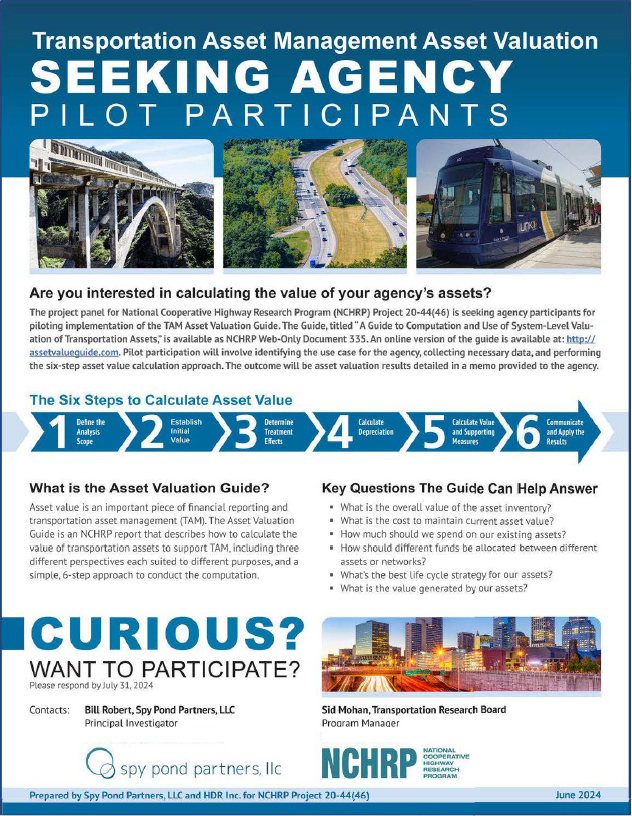
Following the kickoff meeting, the research team revised the amplified work plan and prepared outreach materials. These resources were intended to summarize the core steps for calculating asset value, promote the asset valuation guidance, and solicit interest in the agency pilots. These outreach materials included:
- Asset Valuation Quick Start Guide: A two-page summary of the asset valuation guide, the six steps to calculate asset value, key questions that asset valuation can answer, five asset value related measures, and the three asset valuation perspective included in the guidance.
- Asset Valuation Overview Video: A two-minute video version of the quick start guide.
- Asset Valuation Pilot Marketing Flyer: A flyer introducing the asset valuation pilots. It was distributed to project stakeholders via email and at different AASHTO and TRB events.
All of the outreach materials for the project were added to a new page of the digital version of the asset valuation guidance, highlighted to readers through a banner on the home page, and
accessible through the menu drop-down system. A copy of the Pilot Marketing Flyer and the Asset Valuation Quick Start Guide are included in Appendix A.
Outcomes
The deliveries produced during this task are listed in Table 2-1.
Table 2-1. Task 1 Deliverables
| Deliverable | Description |
|---|---|
| Amplified Work Plan | An outline and timeline for the project’s remaining tasks. The document was updated based on panel comments. |
| Kickoff Meeting Presentation Materials | An agenda for the kickoff meeting and PowerPoint slides designed to facilitate discussion between the project panel and research team members. |
| Kickoff Meeting | An opportunity to create a shared understanding of project goals, supplementary tools, and the approach to the pilots conducted in Tasks 2-3. |
| Outreach Materials | A poster, two-page flyer, and video that summarized and promoted the asset valuation guide, designed to disseminate information and attract pilot participants. |
2.2 Task 2: Pilot Participation Identification
Task Objectives
The objective of this task was to publicize the asset valuation guidance developed through NCHRP Project 23-06 and identify a set of potential pilot participants.
Activities Performed
In this task the research team disseminated the materials developed in Task 1 and communicated with agencies that volunteered and showed interest in conducting agency pilots. Research team members discussed the research at the AASHTO Asset Management Subcommittee meetings held on April 15 and May 20, 2024
As potential pilot participants were identified, the research team discussed what topics each pilot might explore, and reviewed the proposed pilot in the context of the criteria identified in the workplan for selecting pilot participants:
- Coverage of all value perspectives (cost, market, and economic).
- Diversity in sizes and locations of agencies.
- Diversity in agency asset valuation maturity.
- Diversity in asset types.
- Compliance with TAMP requirements.
The team conducted follow-up meetings with seven potential pilot agencies to assess their interest and define possible scopes of work.
Outcomes
The research team prepared Technical Memorandum 1 – Pilot Recommendations to summarize the dissemination of outreach materials and selection process for the volunteer agencies in the pilot program. A teleconference meeting between the research team and the project panel was scheduled to review and finalize the proposed participants. Table 2-2 includes the list of deliverables produced for Task 2.
Table 2-2. Task 2 Deliverables
| Deliverable | Description |
|---|---|
| Dissemination of Outreach Materials | The outreach materials prepared in Task 1 were released to the public and promoted to attract volunteer agencies for the pilot program. |
| Technical Memorandum 1 – Pilot Recommendations | A formal summary of Task 2 developed by the research team and shared with the project panel for review. |
| Participating Agencies for the Pilots | An approved list of participating agencies for the pilot program in Task 3. |
2.3 Task 3: Pilot Implementation
Task Objectives
The objective of this task was to conduct a set of agency pilots to help disseminate and test the asset valuation guidance.
Activities Performed
For this task, a standard procedure for the pilots was repeated for each of the participating agencies identified in Task 2. The five core steps are summarized below:
- Initial Meeting. The first step was to conduct an initial meeting to discuss:
- An overview of the asset valuation calculation framework and process.
- Confirmation of the use cases and scope for the pilot, given the agency needs.
- Data availability, including data on existing assets, asset condition or age, treatment costs, and other data required for demonstrating specific use cases.
- Potential approaches for resolving data issues if sufficient data were unavailable for supporting the use cases.
- Schedule and next steps for conducting the pilot.
- Data Collection. The next step was to collect the data necessary for the analysis. Specific data requirements were largely dependent on the selection of use cases (with the economic perspective requiring the most data). Data required for all pilots included:
- Data on the existing asset inventory.
- Inventory condition and/or age, depending on the approach used to calculate depreciation.
- Default useful lives by asset class (and component if assets were further componentized).
- Identification of asset treatments considered to add life to an asset, including asset construction, renewal, replacement, and possibly additional treatments.
- The unit cost of each treatment.
- Impact of each treatment on condition and/or useful life.
- Resolving Data Issues. For some pilots, revisions to the data collection approach were required to include additional data or approximate data that was not readily available. In this step, the research team worked with the participants to identify and resolve any data issues. This included revising the scope of the pilot or using proxy or example data as a substitute where needed.
- Analysis. Next, the research team performed the asset value analysis. This involved performing the use cases using the data. The analysis yielded calculations of asset value and related measures for one or more scenarios outlined in the initial meeting.
- Agency Review. Once the analysis was completed the research team presented draft results to the participants, detailed the results in a technical memorandum, and provided the memorandum for review to the relevant agency. The results for the pilots were compiled into Technical Memorandum 2 – Pilot Summaries for review by the project panel.
Outcomes
The research team conducted the six pilots with the agencies identified in Task 2. For each pilot, a technical memorandum was drafted and shared with the organization staff who provided the data and set the scope of the asset valuation calculations. The research group next compiled this set of technical memoranda into Technical Memorandum 2 – Pilot Summaries, before sending it to the project panel. Table 2-3 includes a list of agencies with which pilots were performed as part of Task 3.
| Agency | Contact | Assets | Use Cases |
|---|---|---|---|
| Illinois DOT | Laura Heckel | Pavement, Bridges |
|
| District DOT | Blake Holub | Pavement |
|
| Maryland Transportation Authority | Evan Howard | Bridges |
|
| Agency | Contact | Assets | Use Cases |
|---|---|---|---|
| New Mexico DOT | Virginia Stubella | Pavement, Bridges |
|
| Utah DOT | Chris Whipple | Signs, Lighting |
|
| Washington DOT | Matt Versdahl | Bridges |
|
The deliverable for Task 3 was Technical Memorandum 2 detailing the pilots performed for each of the six agencies listed above.
2.4 Task 4: Case Study Development
Task Objectives
The objective of Task 4 was to adapt the results of the agency pilots performed in Task 3 into case studies. The case studies described the asset valuation practices used in the pilots – including tools, programs, and processes – in sufficient detail to support technology transfer to other agencies.
Activities Performed
In this task the research team used detailed materials from Task 3 to develop a set of anonymized case studies. Each case study described the scope of the valuation (e.g., which assets), the purpose of the valuation, the methodology, and the lessons learned. Case studies were intended to provide helpful context to an external audience, describing the asset valuation practices used in the pilots with sufficient detail to support learning by other agencies.
Data from the participating agencies was adapted as needed for the purpose of providing examples. In several instances, data from multiple sources were combined and simplified to best illustrate the asset value calculation process. A summary of the case studies is included in Table 2-4. The finalized case studies are included in Appendix B.
Table 2-4. Case Studies Developed in Task 4
| Title | Assets |
|---|---|
| Calculating Asset Value for Pavement Base and Surface in a Midwestern Agency | Pavement |
| Comparing Pavement Valuation Based on Condition vs. Age in a Southwestern Agency | Pavement |
| Calculating Asset Value for Assets with Varying Levels of Data Availability in a Western Agency | Multiple asset types |
| Comparing Bridge Valuation Using Three Depreciation Approaches in a Northwestern Agency | Bridges |
| Using FHWA BIP Tool Data to Develop Bridge Deterioration Curves | Bridge |
| Valuing a Bridge Using the Economic Perspective in an Eastern Agency | Bridge |
| Valuing Pavement Based on Condition in a Metropolitan Agency | Pavement |
Six of the seven case studies were based on the pilots performed in Task 3. The remaining case study, “Using FHWA BIP Tool Data to Develop Bridge Deterioration Curves,” documented a general approach for developing depreciation curves for bridges that was used in multiple pilots. The research team used the FHWA Bridge Investment Program (BIP) to gather bridge data for each state and then performed do-nothing scenarios using FHWA’s National Bridge Investment Analysis System (NBIAS) to model the deterioration of the assets. Depreciation curves for the state bridges were then derived from this data.
Outcomes
Seven new case studies were drafted by the research team through Task 4. These case studies were included in Technical Memorandum 3 and reviewed by the project panel.
2.5 Task 5: Supplementary Material Development
Task Objectives
The objective of Task 5 was to develop supplemental materials to support the implementation of the asset valuation guidance. In addition to preparing case studies in Task 4, the research team used information and experience from prior tasks to develop additional case studies, other supporting materials, and update the digital version of the asset valuation guidance hosted at the following URL: https://www.assetvalueguide.com.
Activities Performed
The research team met with the project panel via teleconference on June 12, 2025, to discuss possible materials to be developed as part of the task. The supplemental materials selected in the panel meeting fall into three main categories: additional case studies, website improvements, and other material.
Additional Case Studies
The research team prepared two additional case studies as part of this task. These are listed in Table 2-5. The case study “Calculating Vehicle Asset Value Using the Market Perspective” was added to address asset valuation for an additional asset class, vehicles, and demonstrate use of the market perspective. The case study “Valuing Highway Assets Using the Economic Perspective in a Western Agency” was prepared based on experience with a state that was interested in piloting the asset valuation guidance but not included in Task 3. This case study provided an additional example of the use of an economic perspective to support asset valuation. These additional case studies are included in Appendix B.
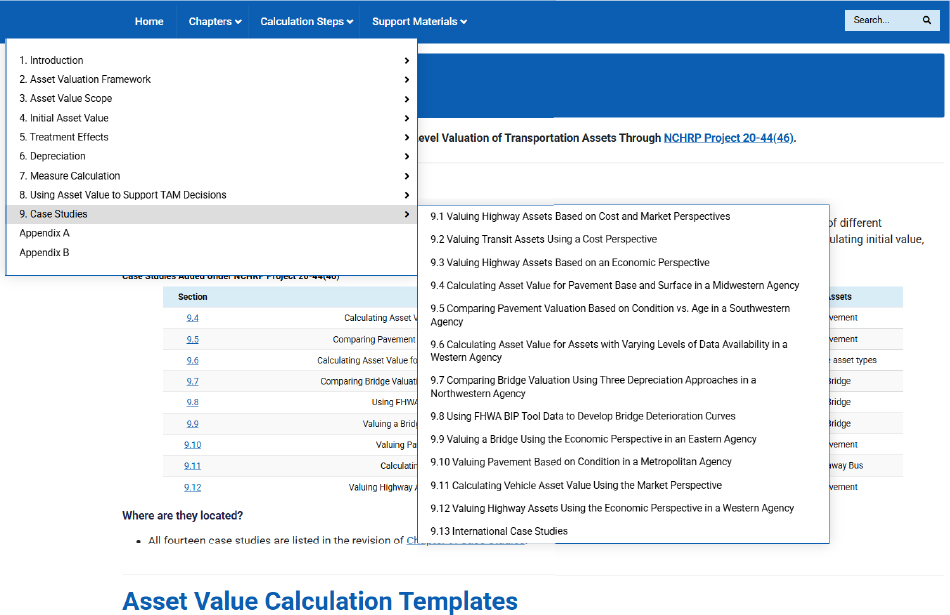
Chapter 9 of the digital version of the asset valuation guidance was reorganized to accommodate the nine additional case studies. Note that the site clearly distinguishes between the new case studies and the original set developed through NCHRP Project 23-06 and included in NCHRP Web-Only Document 335.
Table 2-5. Supplemental Case Studies
| Title | Assets |
|---|---|
| Calculating Vehicle Asset Value Using the Market Perspective | Buses |
| Valuing Highway Assets Using the Economic Perspective in a Western Agency | Pavement |
Other Supporting Materials
The research team developed other materials as part of Task 5, including calculation templates, an audio version of the guidance, updated disclaimers, a glossary of key terms, and recent updates page.
Calculation Templates
The research team developed two spreadsheet tools to support the asset value calculations. Each spreadsheet tool contains a tab with instructions and recommendations, a tab for setting user-defined parameters, and a results tab.
The Bridge Value Calculation Template is a spreadsheet for calculating bridge asset value using bridge inventory and condition data and parameters defined by the calculating agency or user. In addition to calculating replacement value, the template calculates remaining (or current) asset value using two approaches: composite rating and age-based. The template also yields costs to maintain value and asset consumption ratios for each of the three approaches.
The Ancillary Asset Value Calculation Template is a spreadsheet for calculating ancillary asset value using inventory and age data and parameters defined by the calculating agency or user. This tool is intended to be used for assets with limited available data. In addition to calculating replacement value, the template calculates remaining (or current) asset value, cost to maintain value and asset consumption ratio.
Audio Version of the Guidance
To improve the accessibility and usefulness of the asset valuation guidance, an audio version of the website was developed by the research team. This audio version of the guidance covers the nine chapters of the asset valuation guidance, as well as the two appendices.
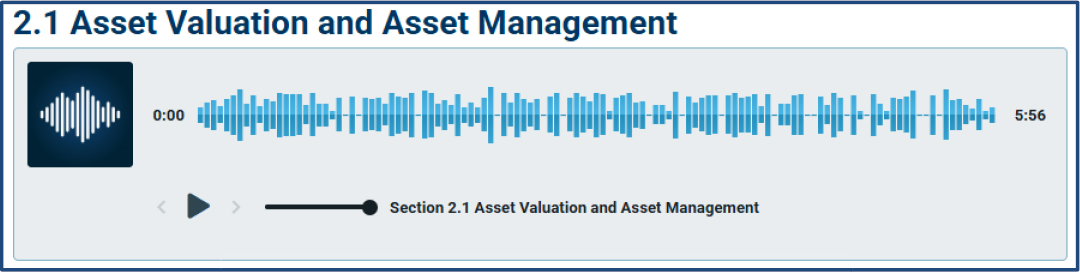
These audio files were recorded using a platform for converting text files to computer-generated narration. These audio files were then embedded at the beginning of each chapter and section using a media player that allows users to control the audio and scroll through the audio file. Figure 2-2 shows a screenshot of the media player that appears at the top of every section, chapter, and appendix page.
Updated Disclaimers
New disclaimers have been added to the “About the Guide” page to clarify that NCHRP Project 20-44(46) builds on the work conducted under NCHRP Project 23-06. The disclaimers also highlight how the deliverables produced in the pilot program were adapted to be the new content and improvements to the digital version of the asset valuation guidance.
A disclaimer was also added about the use of a tool to create the audio version of the guidance. While this text-to-speech platform is not considered generative AI, the research team deemed it important to credit the tool for its contribution and clarify that portions of the guide’s enhancements were created with this software, rather than human narration.
Finally, a “Spotlight on Asset Value Requirements: Why Calculate Asset Value?” disclaimer was added to the home page of the guide. This text provides a two-paragraph overview of the pertinent United States Code, Code of Federal Regulations, and Government Accounting Standards Board requirements for calculating transportation asset valuations. The disclaimer was added to the home page to help highlight to readers how valuations are important not only for internal use at agencies but also required in legislation.
Glossary of Key Terms
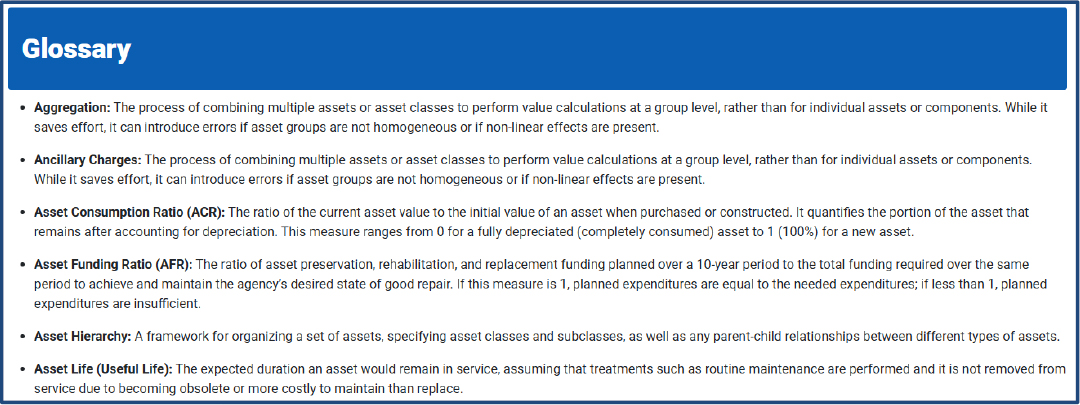
The asset valuation guidance is intended to be a resource for transportation industry workers of all backgrounds and experience levels. To improve the guide’s accessibility for readers with little experience with economic analysis or any form of asset valuation, the research team developed a glossary and added it as a subsection under the “Support Materials” drop-down menu in the banner at the top of each web page. This glossary includes an alphabetized list of dozens of terms pulled from each of the nine primary chapters of the guide with a brief definition. Figure 2-3 shows a screenshot of the Glossary page with several example definitions.
Recent Updates Page
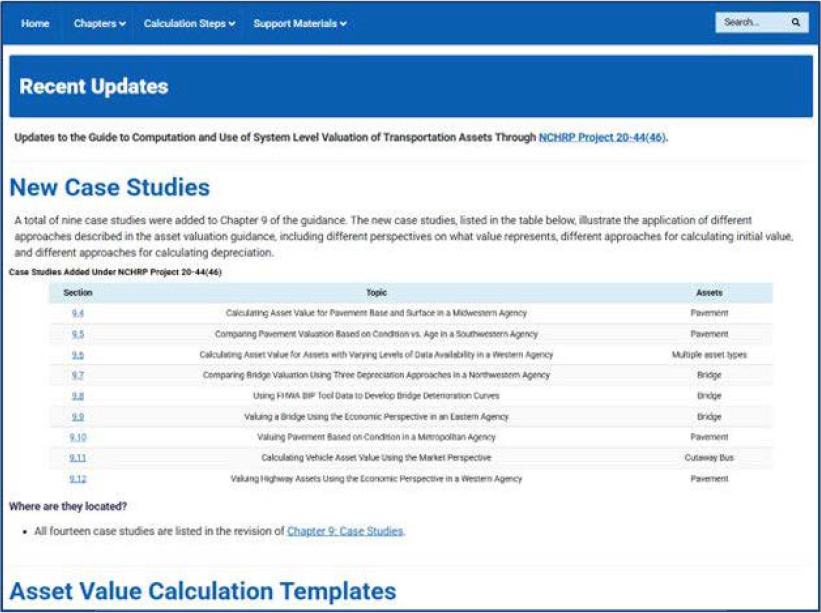
To direct readers to the new content developed through this research project, the research team added a “Recent Updates” page listed under the “Support Materials” drop-down menu in the banner at the top of the digital guide. This summarizes the content additions and site improvements made throughout NCHRP Project 20-44(46). The overview page includes links that direct readers to the new content and clarifies how these updates enhance the guide. Figure 2-4 shows a screenshot of the new page.
Asset Valuation Video
The video developed in Task 1 as part of pilot promotional material was reedited to serve as a general introduction to the asset valuation guidance. The research team added this video to the home page of the digital version of the guide.
Website Improvements
Improved Navigation Menu
The research team redesigned the navigation system for the site to improve its usability. This new design allows readers to jump directly to the sections and supplemental materials they are looking for, rather than needing to navigate through multiple pages. This redesign also improves accessibility for pages which were unintuitive to find and were often skipped by readers, such as the appendices. Drop-down menus were also added to the lefthand navigation panel that appears in the nine chapters of the site. As part of this update, a numbering system was also introduced to make navigation between sections more intuitive. Figure 2-5 shows an example of the redesigned drop-down menus.
New Color Theming
To improve the user experience of the guide, the research team added color themes to each of the nine main chapters of the website. These color themes add variation to the white, blue, and black format of the original version of the site.
Improved Search Functionality
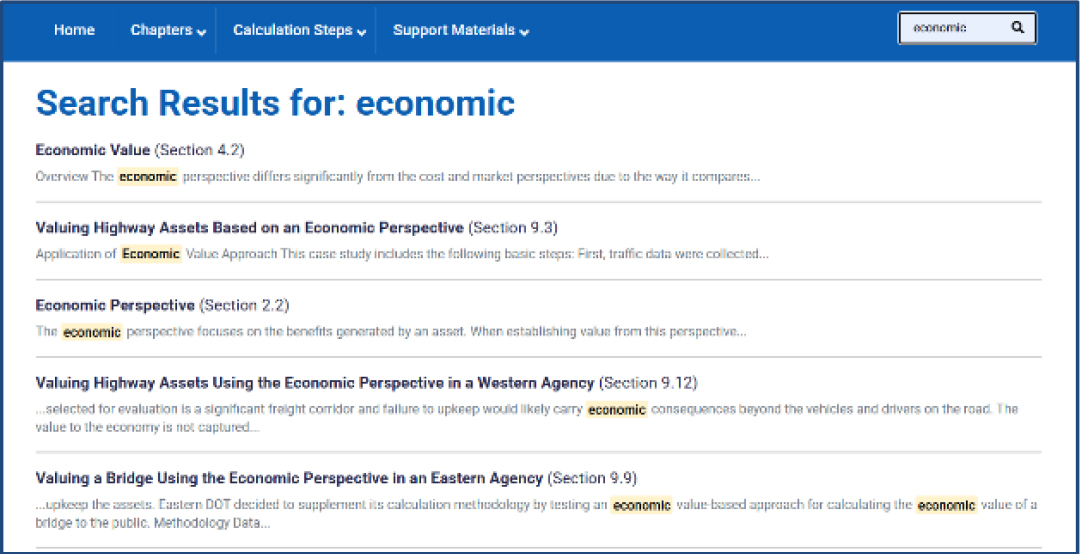
The search functionality on the original version of the website was limited. Readers were able to search for any term or phrase, but the results only listed the sections in which those terms
appear. The research team developed a new search format to address this shortcoming and improve the user experience for readers.
The search feature was improved to include results from different sections of the guide, not only the main nine chapters. This new system includes guidance in the “Calculation Steps,” and the digital appendices. The new search also provides a preview of the key terms appearing within those pages, allowing readers to better assess which sections of the guide are worth exploring in more depth and limit the time wasted searching through unrelated content. Figure 2-6 shows an example of the new search feature being used.
Outcomes
Results of this task, including the additional case studies, other materials, and a summary of the website changes, where detailed in Technical Memorandum 4 submitted to the project panel. Also, panel members were provided with access to a staging version of the website to facilitate review prior to updates to the public-facing version of the website.
2.6 Task 6: Report Preparation
Task Objectives
The objective of this task was to document the work performed on the project and develop an action plan that describes additional research and other activities to advance asset valuation in the future.
Activities Performed
Work on the task began with a panel meeting on September 19, 2025. The research team shared a presentation that summarized the updates made to the digital version of the asset
valuation guidance in Task 5, provided a live demonstration of the staging site’s new features, responded to the comments received on Technical Memorandum 4 from the project panel members, and gave an overview of the proposed action plan. Following this meeting, the research team drafted this contractor’s final report to document the work performed throughout the research project.
Outcomes
The outcome of Task 6 is this contractor’s final report, which includes an action plan and presentation on the project.


