Exploring Cellular-Based Private Wireless Networks for the U.S. Aviation Industry (2026)
Chapter: 1 Introduction and State of the Industry

CHAPTER 1
Introduction and State of the Industry
The Need for Better Connectivity—Today and Tomorrow
What happens when technology brings people, data, devices, and systems together? You have connectivity. Connectivity enables communication, and communication is foundational for safe and successful airport operations. However, airports still lack ubiquitous and reliable connectivity. This results in serious security and safety gaps that leave staff and passengers vulnerable, and it keeps airports stuck using outmoded and inefficient practices that strain already limited budgets. Figure 1 depicts these issues.
Consider the following three examples:
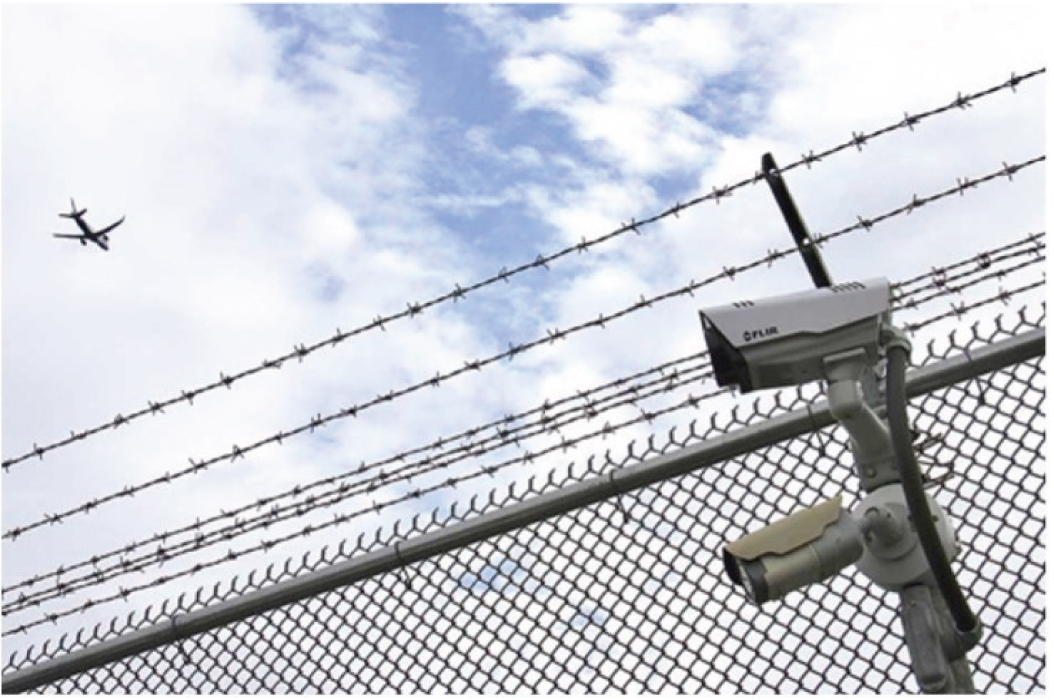
Because of financial or technological limitations of providing connectivity, many airports have not deployed security cameras in remote areas like the airportʼs perimeter (Figure 2) to obtain video feeds or perform analysis in real time. Because of this, potential security issues like vehicle or unauthorized personnel incursions can occur without surveillance. In the worst case, physical assaults have occurred in these areas, and the lack of surveillance has dramatically delayed urgent action needed by responders.
Unreliable service areas or “dead zones” in and around airport buildings (Figure 3) limit the use of established technologies to improve operational efficiency. For example, work orders are often duplicated because they are recorded on paper first and then manually logged in an airport office. This example and others can lead to erroneous or outdated data that can greatly affect airport operations that rely on accurate or real-time data for critical decision-making or timely fixes to critical infrastructure, or both.
Relying on old technology is preventing airports from capitalizing on newer connectivity advancements available that simplify operations. One example is Internet of Things (IoT) sensors. These can be placed on equipment such as escalators or baggage handling systems (Figure 4) and integrated with operational systems that can automate assignment of a staff member to address maintenance needs or outages. Another example is real-time bag data points and tracking that can help lower the number of lost bags and, in turn, improve passenger satisfaction and lower costs associated with baggage recovery. In fact, this is soon to be a capability that passengers expect to be provided at all airports and by all airlines.
Because connectivity issues have always existed, airports have generally become accustomed to them. Others continue to operate from wired and wireless solutions that have never been and never will be able to meet all their connectivity needs—a mode in which these operators continue because they have little time to research other options, or they think other options would be cost prohibitive.
And that is today. What about tomorrow?

Long Description.
The infographic presents the business value of connectivity in airport operations. The no coverage section includes a crossed wireless signal symbol near a perimeter with a control tower and terminal. The no connectivity section includes a simplified network line with disconnected nodes. The impacts section contains icons of a worker with a crossed-out wireless signal, a crossed-out robot, a crossed-out server stack, a crossed-out security camera near a fence barrier, and a crossed-out robotic arm. The final set of circular icons features a crossed-out shield, an open lock, a tortoise surrounded by circular arrows, a dollar sign and declining chart, and a thumbs down symbol.

Every industry, including aviation, is increasingly marching toward digital transformation, with promising solutions in areas like automation and smart facilities growing exponentially. But this journey will come to a halt without solid, ubiquitous connectivity put in place—something that, in large part, can be accomplished today through private wireless networks* (PWNs). Figure 5 illustrates this effect.
*Although private wireless network could generally describe any wireless network (for example: Wi-Fi), for the purpose of this guide, the term refers to the description in the next section and sidebar.


Long Description.
The coverage section includes a control tower and terminal with a wireless signal symbol and green checkmark. The connectivity section includes a network with multiple connected nodes. The impacts section includes icons, each marked with a green checkmark, with a worker wearing a helmet and a mobile device, a robot, a server stack, a security camera near a fence barrier, and a robotic arm. On the right, circular icons include a shield, a thumbs up, a rabbit surrounded by circular arrows, and a dollar sign and a chart with a rising line. Coverage and connectivity correspond to the private wireless network. Use cases and integrations correspond to impacts.
Practical Explanation of PWNs
A PWN is best described by its two primary aspects: it is mobile technology, and it is a private network. A practical explanation of a PWN is given here.
A PWN is . . .
Mobile Technology
For this guide, mobile technology is synonymous with what was called cellular technology for many years. As a mobile network, a PWN provides wireless connectivity to people and things, whether stationary or in motion within the networkʼs coverage area. It further means that PWNs follow the same trusted technical standards that are used by the large mobile network operators that consumers have been using for many years (such as AT&T, T-Mobile, or Verizon). A PWN is simply a scaled-down version of those networks.
(continued on next page)
A PWN is . . . (Continued)
A Private Network
A PWN is owned by or at least controlled by a private organization or enterprise such as an airport operator. In other words, an airport operator can have its own 4G LTE or 5G network (and in the future, 6G, 7G, and beyond). For details on mobile technology generations, see Chapter 3.
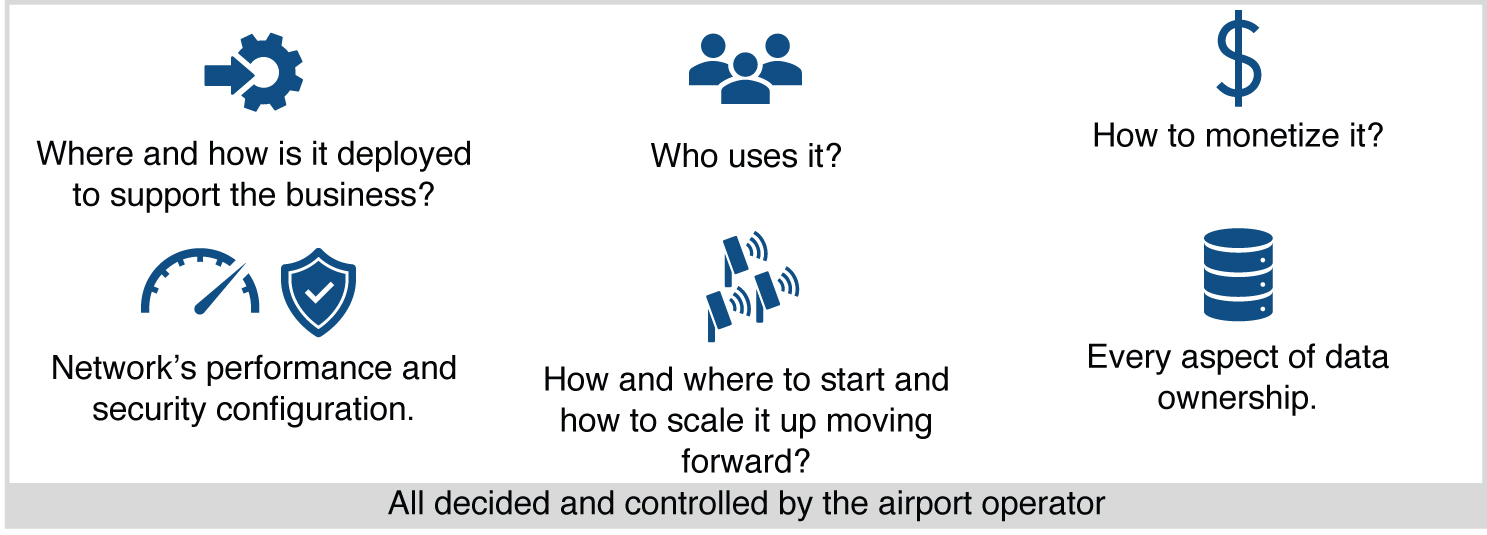
Because a PWN is based on proven mobile technology, it can provide at least the same level of performance and security as that of public networks that the world has trusted for years. And because it is a private network, it can enable an airport operator to improve performance and security (even above that of public networks) as desired and maintain control over all aspects such as those in Figure 6.
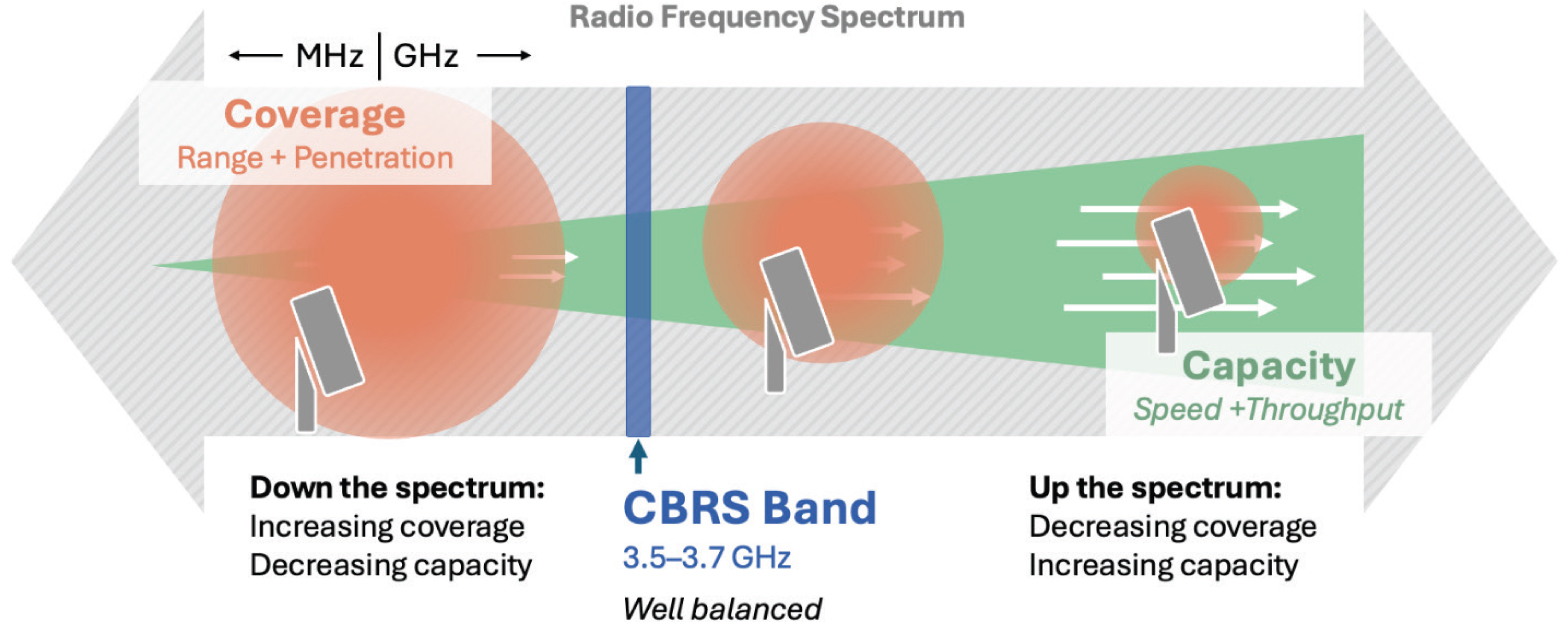
Another major reason PWNs in the United States are so valuable and growing in use is that they can freely use a band of wireless spectrum known as the Citizens Broadband Radio Service (CBRS). The Federal Communications Commission (FCC) created the CBRS band in 2015 and officially released it for use in 2020 within the mid-range of the radio frequency (RF) spectrum (Figure 7). This is an ideal range because it strikes an excellent balance between coverage and capacity, making it well-suited for a wide range of use cases. Because this is the primary band
Long Description.
The figure lists all the aspects of a PWN that are decided and controlled by the airport operator. The aspects are as follows: Where and how it is deployed to support the business; Who uses it; How to monetize it; Network’s performance and security configuration; How and where to start and how to scale it up moving forward; and Every aspect of data ownership. Each aspect has a corresponding icon.
Long Description.
The schematic presents the radio frequency spectrum with frequency ranges labeled in megahertz and gigahertz. It illustrates coverage on the left with range plus penetration, and capacity on the right with speed plus throughput. The CBRS band is narrow and highlighted in the middle between coverage and capacity. It is labeled 3.5 to 3.7 gigahertz with the description, well balanced. There is increasing coverage and decreasing capacity down the spectrum on the left. There is decreasing coverage and increasing capacity up the spectrum on the right.
in which PWNs operate in the United States, they are often informally called CBRS networks. PWNs are also known as private mobile networks and private cellular networks.
The existence of the CBRS band is a big deal! In recent years, public operators have spent close to $100 billion to license and deploy mid-band spectrum (S&P Global 2022). Because the CBRS band is freely available for use, many have called it a multibillion-dollar gift from the U.S. government. This is also why the use of PWNs has grown exponentially since mid-2020 when the CBRS band became available.
Put simply: A PWN provides the flexibility to feasibly push connectivity further—today and into the future—all while providing the performance and security demanded by an airport operatorʼs use cases.
State of the Industry
Aviation Use of PWNs
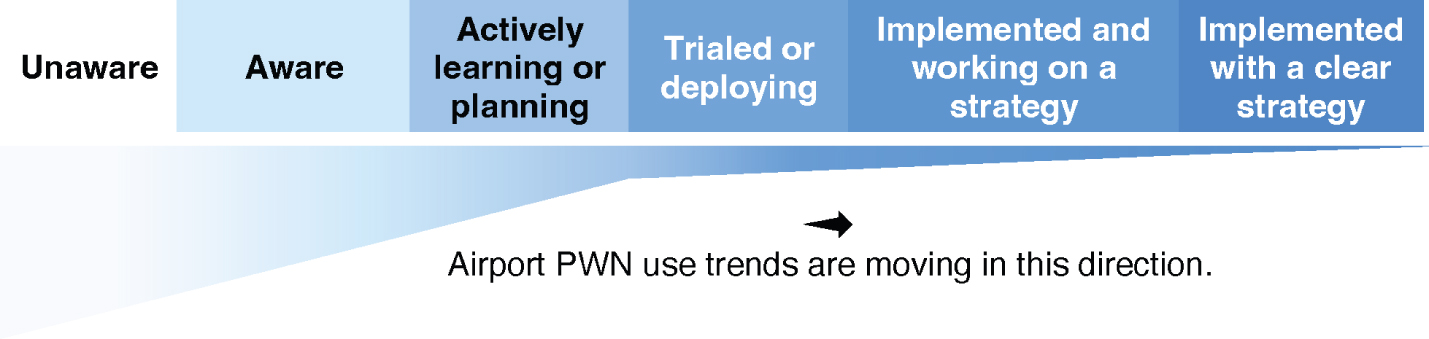
Driven by the introduction of the CBRS band, PWNs are being rapidly deployed by industries such as industrial manufacturing to enable automation, machine-to-machine communication, and real-time control of machinery and processes. Other industry examples include energy, mining, education, and healthcare. Yet because of the relatively early use of this technology, the number of airport operators who have deployed a PWN is still quite low as of mid-2024. Although a comprehensive survey was beyond the scope of this research project, Figure 8 summarizes the research teamʼs educated perspective on the state of the aviation industry.
Many U.S. airports are still unaware of PWNs, but a growing number are actively learning and initiating planning efforts; some are trialing and deploying networks of their own. Examples of trials or deployments the research team uncovered include larger airports (MIA, MSP, LAX, SEA, and DFW) and smaller airports (OAK, ONT, and RNO). Of these, the team found MIA to be the largest permanent airport PWN deployment with a clear and intentional strategy for its future. Examples of non-U.S. airports with an implementation and future strategy are Brussels Airport in Belgium and Frankfurt Airport in Germany. Airlines are also considering PWN use. For example, the research team uncovered one that had deployed a PWN to provide connectivity to toolsets used at its aircraft maintenance headquarters.
U.S. Regulatory Outlook
The U.S. government has developed a robust strategy for using RF spectrum to maintain global leadership in both business and wireless technology. Part of this is the FCCʼs loosening of strict sharing rules for CBRS (the FCC originally created rules for a dynamic yet strict three-tiered sharing system to ensure the incumbents already using CBRS spectrum always receive priority use). Because of the demonstrated success of the CBRS sharing system over the past few
Long Description.
The trend of awareness and use of PWNs in the aviation industry go, from left to right as: unaware, aware, actively learning or planning, trialed or deploying, implemented and working on a strategy, and implemented with a clear strategy. Below the spectrum of categories is a wedge that is thick on the left (unaware) and narrowing to a small point on the right (implemented with clear strategy). This has an arrow pointing to the right and labeled as airport PWN use trends are moving in this direction.
years, the U.S. government amended its conservative sharing rules in 2023 to be less restrictive, and it will continue to monitor, evaluate, and revise them as needed. The FCC is also researching potential ways to move CBRS incumbents to other bands of spectrum to make room for new application opportunities in the mid-band. In addition, the U.S. government is actively working to identify other bands of spectrum that can be made available for dedicated and shared use, focusing on three bands: the 3.1 to 3.45 GHz band for dedicated use, 600 MHz of the 37 GHz band for shared use, and the 42 to 42.55 GHz band for shared use. More information about the current U.S. strategic outlook for spectrum is in the “Memorandum on Modernizing United States Spectrum Policy and Establishing a National Spectrum Strategy” (U.S. White House 2023).
Industry Organizations
To help spread awareness and best practice to airport operators, aviation industry associations and conferences have included PWNs on their agendas. Key examples include Airports Council International (ACI) World, ACI North America (ACI-NA), the OnGo Alliance, the Global System for Mobile Communications Association, and 5G Americas. Airport operators who wish to engage with peers in this space should consider joining ACI-NAʼs Wireless Working Group. This group is ACI-NAʼs Business Information Technology subcommittee and provides regular updates through online meetings and at ACI-NA conferences.
PWN Industry Status
The market for PWN technology is mature, but PWN adoption is still in its early stages, especially at airports. This means that many service providers (e.g., vendors, manufacturers) offer a lot of hardware and software solutions from which airports can choose. As partnerships and relationships among these providers are still forming, airports need to be aware of the potential for inflated deployment costs from margin stacking and duplicated risk premiums that could be hidden in bid packages from ad hoc teams. Therefore, during the procurement process for hiring a managed service provider (MSP), it is advised that airports seek assistance from a trusted systems integrator or ownerʼs representative who is experienced at designing, deploying, and managing a PWN.
Purpose and Overview of the Guide
This guide is intended to help airport operators across the maturity spectrum shown in Figure 8. It should help educate those still learning and provide guidance in strategic areas such as ownership, monetization, procurement, financing, innovation, and expansion later. This guide presents information in a way that aligns with an airport operatorʼs PWN lifecycle:
- General Education: Chapters 1 and 2
- Planning: Chapter 3
- Design: Chapter 4
- Deployment, Ongoing Management, and Expansion: Chapter 5
Depth of Content
The team developed two versions of this guide:
- Research Report: This document, which contains all guidance.
- ACRP Research Results Digest 29: Exploring Cellular-Based Private Wireless Networks: Summary. This is a shorter, summarized version of this full guide. This is available on the page for this guide at nationalacademies.org/publications.
Summary of Research
This guide was written by a research team that included several researchers and subject matter experts in the wireless and aviation industries. This team reviewed a large amount of literature and conducted interviews with airports, airlines, ground handlers, governmental organizations, wireless vendors and experts, and more. The interview process involved the following stakeholders:
- Aircraft manufacturers
- Boeing
- Airbus
- Airline representatives
- Spirit Airlines
- Southwest Airlines
- Ground handlers
- Swissport
- Airport operators
- Dallas–Fort Worth International Airport
- Oakland International Airport
- Athens International Airport
- Miami International Airport (site visit)
- Frankfurt Airport (site visit)
- Minneapolis–Saint Paul International Airport
- Aviation and cellular/CBRS industry associations
- OnGo Alliance
- Mobile carriers
- T-Mobile (T-Systems)
- Solution providers
- NTT (site visit)
- Syniverse
- Nokia
- MXD Labs (site visit)
- Boingo
- Digital Global Systems
- Ingram Micro
- Cradlepoint
- Betacom
- Spectrum access system (SAS) providers
- Federated Wireless
- Aviation solution providers
- Pattern Labs
- AeroCloud
- ADB Safegate
- JBT
- Government
- FCC
- Other
- Columbia Capital
For details on the site visits and airport interviews the team conducted, see Appendix A.
In addition to the many interviews conducted, the team interacted with many other organizations through a detailed literature review. As part of the research, the team reviewed and considered many publications, articles, and other literature. The following lists some of the sources for the literature review:
- ACRP
- Aircraft IT
- Airports Council
- Apple
- Aviation Today
- FCC
- U.S. General Services Administration
- Huawei
- Nokia
- OnGo Alliance
- Program for Applied Research in Airport Security
- RCR Wireless
- Samsung
- Syniverse
- Thales Group
- Others


