Exploring Cellular-Based Private Wireless Networks for the U.S. Aviation Industry (2026)
Chapter: Wrap-Up

Wrap-Up
How will you incorporate a PWN to bring people, data, devices, and systems together? This will mean different things to different airports, such as the following:
- Enhancing safety and security, expanding opportunities to apply intelligent security (e.g., AI, ML capabilities) in both landside and airside locations
- Improving operational efficiency that can connect and optimize airport processes and interoperable capabilities with stakeholders, creating collaborative results, closing gaps in connectivity, expanding service to more devices, and offloading traffic from other networks
- Expanding data sharing, situational awareness, and asset coordination to empower decision-making, overcoming limitations and obstacles to communicate real-time, mission-critical data
- Creating cost-effective solutions by reducing implementation costs, streamlining processes, and maximizing existing investments
- Scaling new use case ideas over time
- Monetizing a portion of the network to fund new use cases
- Setting up the airport for the future by experimenting with innovations that lead the airport toward an overall digital transformation
As a one-page final takeaway, Figure 45 summarizes the why, what, and how of your PWN project. It is up to you and your team to decide what your airport will do to lay a foundation for connectivity across your airport ecosystem.
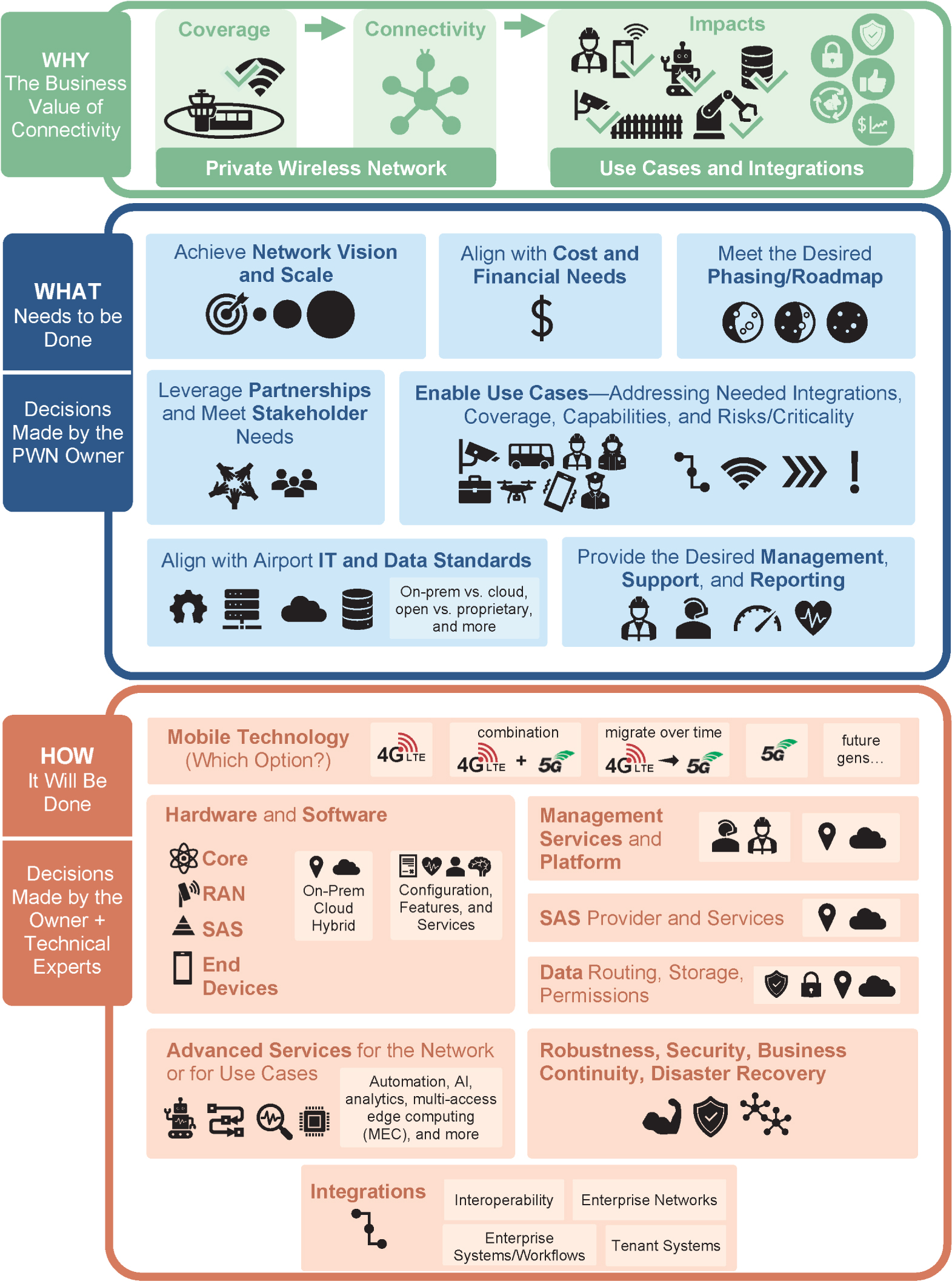
Long Description.
The infographic presents a framework that connects business value, planning decisions, and technical implementation for PWNs. The top section links coverage and connectivity within a private wireless network to impacts through use cases and integrations. The middle section outlines what needs to be done, decisions made by the PWN owner, including achieve network vision and scale, align with cost and financial needs, meet the desired phasing or roadmap, leverage partnerships and meet stakeholder needs, enable use cases while addressing needed integrations, coverage, capabilities, and risks or criticality, align with airport IT and data standards, on-premises versus cloud, open versus proprietary, and more, and provide the desired management support and reporting. The bottom section outlines how it will be done, decisions made by the owner plus technical experts, including mobile technology options 4 GLTE, combination 4 GLTE plus 5 G, migrate over time 4 GLTE to 5 G, 5 G, and future gens, hardware and software such as core, RAN, SAS, on-premises or cloud or hybrid deployment, configuration features and services, and end devices, management services and platform, SAS provider and services and data routing, storage, permissions, advanced services for the network or use cases including automation, AI, analytics, multi-access edge computing, MEC, and more, robustness, security, business continuity, and disaster recovery, and integrations including interoperability, enterprise networks, enterprise systems and workflows, and tenant systems.

