New Strategies for New Challenges: Corporate Innovation in the United States and Japan (1999)
Chapter: Vertical and Diagonal Relationships in Outsourcing
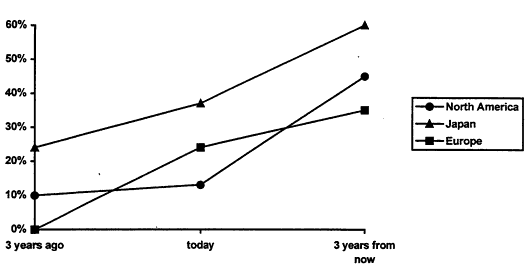
Figure 4-1 Percentage of companies with high reliance on external sources for technology.
Source: Edward B. Roberts, "Benchmarking the Strategic Management of Technology," Research-Technology Management, January-February 1995, p. 55.
original equipment manufacturer (OEM), and consequently the level of OEM control decreases. Another way of looking at it is that as the level of technology controlled by suppliers increases, OEMs must enter into more equal relationships with them. Therefore partnering between OEMs and suppliers is becoming more frequent.
External sourcing of technology and innovation generally occurs within two types of institutional relationships. One is the relationship between OEMs and suppliers.4 Outsourcing is the term usually applied to this type of relationship. The other is the formation of strategic technology partnerships between corporations, usually for a limited time and purpose. The terms alliance and consortium are commonly used to describe this form of relationship. External sourcing as used in this report includes both types of relationships. It also encompasses a broad range of activities from a growing reliance on suppliers for increasingly independent and sophisticated engineering and design work to encouraging suppliers and universities to conduct research and development which can be integrated into the corporate innovation process.
Vertical and Diagonal Relationships in Outsourcing
The relationships of trust between suppliers and OEMs and the benefits to technological innovation that such relationships can bring are characteristic of many of the Japanese vertical alliant business groups (vertical keiretsu). U.S. firms have been adopting aspects of the Japanese vertical keiretsu model by reducing the number of suppliers, giving those suppliers more scope to innovate (sometimes by providing functional specifications), and increasing the level of
TABLE 4-1 Company-financed R&D Contracted to Outside Organizations by R&D-performing Companies, 1993 and 1996, million dollars
|
|
|
1993 |
1996 |
|
Total |
|
|
|
|
|
Manufacturing |
3,462 |
5,833 |
|
|
Nonmanufacturing |
2,339 |
4,293 |
|
Total as a percentage of company-financed R&D |
3.6 |
4.9 |
|
|
SOURCE: National Science Foundation, Division of Science Resources Studies, Survey of Industrial Research and Development: 1996. |
|||
TABLE 4-2 Japanese Industry R&D Funding Paid to Outside Organizations, 1993 and 1996, million dollars
technological cooperation between original equipment manufacturer and supplier. This trend is facilitated by the use of computer-aided design and manufacturing systems linked through computer networks, allowing co-development in the OEM supply chains.
Japanese OEMs have enjoyed more or less exclusive vertical relationships with their suppliers, and conducted research and development jointly with commitment by the OEM to buy and by the supplier to produce. Although the evidence is mainly anecdotal at this point, members of the Japanese working group point to a trend in which more Japanese suppliers are expanding to diagonal relationships, diversifying their research, and expanding markets, leading to higher levels of outsourcing in the Japanese economy.
Japan's vertical keiretsu are an interesting model for U.S. firms. Some may wonder whether U.S. firms may make the mistake of mimicking old keiretsu, after Japan has moved to "diagonal" relationships across vertical alliance boundaries. However, it is unlikely that arrangements similar to Japan's traditional keiretsu would be allowed under U.S. law. Still, U.S. manufacturers such as Chrysler and Eaton have adapted aspects of Japanese supplier

