Nutrient Requirements of Nonhuman Primates: Second Revised Edition (2003)
Chapter: 1 Feeding Ecology, Digestive Strategies, and Implications for Feeding Programs in Captivity
1
Feeding Ecology, Digestive Strategies, and Implications for Feeding Programs in Captivity
The welfare of nonhuman primates in captivity depends heavily on meeting their nutrient needs in a manner that considers normal foraging and feeding behavior, structure and functions of the digestive system, and the options and constraints of captive dietary husbandry.
FEEDING ECOLOGY
In developing a system for the nourishment of captive nonhuman primates, it is helpful to examine the literature on the feeding ecology of primates in the wild. Several observational methods have been used to record foraging and feeding behavior in natural ecologic systems (Altmann, 1974; Lehner, 1996), and data derived with these methods are summarized in Tables 1-1 through 1-6. To interpret the findings properly, the reader should have a background in the methods used, and a brief discussion of them follows.
Feeding-Ecology Methods Involving Visual Observations of Behavior
Data collected during visual observations of behavior typically include length of feeding bout, plant species eaten, plant parts eaten (for example, fruit and leaf), percentage of part eaten, feeding rate (for example, number of fruits consumed per minute), diameter and height of food plant, and food-plant location.
OBSERVATION OPTIONS
Choosing a data-collection method requires, as a first step, selection of one of two animal-observation options.
Focal-Animal Observation One individual is observed during a given session of data collection (it can also be a pair or a small subgroup). Sessions can vary from 5 min to a whole day. This method is used to identify multiple behaviors in selected individuals. When sessions are only 5-10 min long, it is common to switch observations to another animal in the group for the next session.
All-Animal Observation Primates that are naturally grouped are observed simultaneously. This method is feasible only when observing a few easy-to-see behaviors. It is not recommended for detailed feeding behaviors.
SAMPLING METHODS
After selection of an animal-observation option, the second step is to select a method of sampling foraging and feeding behavior.
Ad Libitum (or Periodic) Sampling This is the classic, pre-1970s field method, used before modern statistical techniques and advanced technologies were commonly applied. Today, it is recommended only for preliminary reconnaissance or the study of rare behaviors. This method is biased toward spectacular behaviors, like hunting, thus overestimating faunivory compared with herbivory.
Continuous-Recording Sampling Method These sampling methods result in the most complete and accurate data. They are recommended for studying feeding ecology but are difficult to use with arboreal animals, such as primates.
-
All-Occurrences Sampling. All occurrences of one or a few behaviors are recorded over an extended period,
TABLE 1-1 Prosimian Feeding Ecology
|
Scientific Name |
Common Name |
Dieta |
Behavior |
Body Weightb |
References |
|
100% insectivorous |
|||||
|
Tarsius |
|||||
|
T. bancanus T. dianae T. pumilus T. spectrum T. syrichta |
Western tarsier Dian’s tarsier Pygmy tarsier Spectral tarsier Philippine tarsier |
Animal prey 100%; T. bancanus example: beetles 35%, ants 21%, locusts 16%, cicadas 10%, cockroaches 8%, vertebrates 11% of feeding time (not seen eaten by all Tarsius); also eaten: crickets, mantids, moths |
Nocturnal, arboreal, solitary or pairs or multimale/ multifemale, group size 2-6 individuals |
77.6-117 g females, 27.5-134 g males |
Crompton & Andah, 1986; Fogden, 1974; Gursky, 1996; Kappeler, 1991; MacKinnon & Mackinnon, 1980a; Niemitz, 1984; Nietsch & Niemitz, 1991; Tremble et al., 1993 |
|
Mostly insectivorous |
|||||
|
Allocebus |
|||||
|
A. trichotis |
Hairy-eared dwarf lemur |
In wild, unknown; in captivity, insects 70%, sweetened rice broth, fruit |
Nocturnal, arboreal, forage solitary or male/female pair, sleep 2-6 |
78-90 g females, 75-98 g males |
Albignac et al., 1991; Kappeler, 1991; Meier & Albignac, 1991; Mittermeier et al., 1994 |
|
Arctocebus |
|||||
|
A. aureus A. calabarensis |
Golden angwantibo Angwantibo |
Animal prey 79% (73-85%), fruit 13% (12-18%), other vegetation 8%; prey: caterpillars 77% (65-90%) crickets, beetles, ants |
Nocturnal, arboreal, forage solitary, sleep 1-2 |
A. aureus 150-270 g; A. calabarensis 200-465 g |
Bearder, 1987; Charles-Dominique, 1974; Charles-Dominique & Bearder, 1979; Gonzalez-Kirchner, 1995; Silva & Downing, 1995; Wolfheim, 1983 |
|
Galagoides |
|||||
|
G. demidoff G. thomasic G. zanzibaricus |
Demidoff’s bush baby Thomas’s bush baby Zanzibar bush baby |
Animal prey 75% (70-81%), fruit 17% (4-30%), gums/ resins 5% (0-18%), leaves, buds; prey:moths, beetles, grasshoppers, ants, some birds |
Nocturnal, arboreal (mostly), forage solitary, sleep (females) 1-10 |
G.demidoff 46-69 g females, 78-85 g males; G. thomasi 55-149 g; G. zanzibaricus 118-155 g females, 130-183 g males |
Charles-Dominique, 1974; Gonzalez-Kirchner, 1995; Harcourt & Bearder, 1989; Harcourt & Nash, 1986; Hladik, 1979; Kappeler, 1991; Nash et al., 1989; Nash & Harcourt, 1986; Silva & Downing, 1995 |
|
Loris |
|||||
|
L. tardigradus |
Slender loris |
Almost exclusively insects, small amount of young leaves, shoots, hard-rind fruits, flowers, eggs, small vertebrates; often insects strong smelling |
Nocturnal, arboreal, forage solitary, sleep 2-4 |
102-322 g |
Butynski, 1982; Petter & Hladik, 1970; Silva & Downing, 1995; Wolfheim, 1983 |
|
Omnivorous, gums dominate |
|||||
|
Euoticus |
|||||
|
E. elegantulus (Galago elegantulus) E. pallidusc |
Southern needle-clawed bush baby Northern needle-clawed bush baby |
Gums 55% (35-75%), animal prey 32% (20-44%), fruit 12% (5-20%), birds |
Nocturnal, arboreal, forage solitary, sleep 1-7 |
271 g female, 270-360 g males |
Butynski, 1982; Charles-Dominique, 1974, 1977; Charles-Dominique & Bearder, 1979; Gonzalez-Kirchner, 1995; Hladik, 1979; Kappeler 1991 |
|
Galago |
|||||
|
G. senegalensis G. moholi |
Northern lesser bush baby Southern lesser bush baby |
Gums (Acacia) 48%, animal prey 52% (butterflies, moths, beetles), gums from 2 tree species, no vertebrate prey |
Nocturnal, arboreal, forage solitary, sleep 1-3 |
G. senegalensis 126-193 g females, 125-212 g males; G. moholi 140-229 g females, 160-255 g males |
Bearder, 1987; Bearder & Doyle, 1974; Bearder & Martin, 1979; Doyle, 1979; Doyle & Bearder, 1977; Harcourt & Bearder, 1989; Nash & Whitten, 1989; Silva & Downing, 1995 |
|
Otolemur |
|||||
|
O. crassicaudatus (Galago crassicaudatus) |
Thick-tailed greater bush baby |
Gums 44% (18-62%), fruit 27% (21-33%), animal prey 14% (1-27%) (invertbrates and vertebrates), nectar 4% (0-8%), seeds 3% (0-7%), misc. vegetable matter 8% (0-16%) |
Nocturnal, arboreal, male solitary, female and offspring forage together, sleep 1-6 |
1122-1497 g females, 1126-1750 g males |
Bearder & Doyle, 1974; Butynski, 1982; Doyle & Bearder, 1977; Kappeler, 1991; Masters et al., 1988 |
|
Phaner |
|||||
|
P. furcifer |
Fork-marked lemur |
Tree gum (resins) bulk of diet, some fruit, sap, animal matter 10%, flowers, buds, nectar, secretions of Homoptera insects |
Nocturnal, arboreal, solitary or male/ female pairs, sleep 1-4 |
350-600 g |
Charles-Dominique & Petter, 1980; Hladik, 1979; Hladik et al., 1980; Kappeler, 1991; Pariente, 1979; Petter et al., 1971, 1975 |
|
Omnivorous, plants (especially fruits) dominate |
|||||
|
Cheirogaleus |
|||||
|
C. major C. medius |
Greater dwarf lemur Fat-tailed dwarf lemur |
Fruit, young leaves, flowers, nectar, leaf buds, gums, animal prey (mostly insects, some chameleons); C. major lethargic in cool, dry season; C. medius increase in body weight 120-250 g during rainy season (6 months), hibernate 7-9 months |
Nocturnal, arboreal, forage solitary, sleep 1-5 |
C. major 235-470 g; C. medius when feeding (rainy season) 142-217 g, especially tail, hibernate loses 100 g |
Hladik, 1979; Hladik et al., 1980; Mittermeier et al., 1994; Petter et al., 1977; Wright & Martin, 1995 |
|
Eulemur (Petterus) |
|||||
|
E. coronatus E. fulvus E. macaco E. mongoz E. rubriventer |
Crowned lemur Brown lemur Black lemur Mongoose lemur Red-bellied lemur |
Fruit 45% (7-79%), leaves 45% (20-89%), flowers 10% (1-52%), few insects; dry season diet of E. mongoz, E. rubriventer, E.fulvus in some habitats nectar 82% (81-84), fruit 17%, leaf 1%; E. fulvus tolerates high levels of toxic plant compounds |
Cathemeral, mostly arboreal, multimale/ multifemale groups, group size 5-18 or just family groups |
1.4-2.4 kg |
Andriatsarafara, 1988; Colquhoum, 1993; Dague & Petter, 1988; Hladik, 1979; Kappeler, 1991; Overdorff, 1993; Richard & Dewar, 1991; Silva & Downing, 1995; Sussman, 1974, 1977; Sussman & Tattersall, 1976; Tattersall, 1977, 1979; Wilson et al., 1989; Yamashita 1996 |
|
Galago |
|||||
|
G. alleni G. gallarum G. matschiei |
Allen’s bush baby Somali bush baby Matschie’s bush baby (was Euoticus inustus) |
Fruit 74% (73-76%), animal prey 24% (23-25%) (invertebrates and frogs), 2% other vegetation (fallen fruit, seeds, gums) |
Nocturnal, arboreal, forage solitary 86%, sleep (females) 1-4 |
G. alleni 200-445 g; G. gallarum 196-225 g |
Butynski, 1982; Charles-Dominique, 1977; Gonzalez-Kirchner, 1995; Nash et al., 1989 |
|
Lemur |
|||||
|
L. catta |
Ring-tailed lemur |
Fruit 54% (34-70%), leaves 33% (24-50%), flowers 3% (0-8%), herbs 8% (6-15%), bark, sap, cactus, misc 2% (0-7%); Tamarindus indicus is 25% of diet: 12% leaf, 12% pods |
Diurnal, arboreal, terrestrial, multimale/ multifemale, with 1 alpha female, group size 5-30 |
1.96-2.705 kg |
Jolly, 1966; Kappeler, 1991; Rasamimanana & Rafidinarivo, 1993; Sauther & Sussman, 1993; Silva & Downing, 1995; Sussman, 1974; Yamashita, 1996 |
|
Microcebus |
|||||
|
M. (Mirza) coquereli M. murinus M. myoxinusc M. rufus |
Coquerel’s dwarf lemur Gray mouse lemur Pygmy mouse lemur Brown mouse lemur |
Fruit, animal matter (insects, frogs, bird eggs, chameleons), young leaves, flowers, gums, sap/resins, nectar, buds, seeds; spends up to 50%of time in dry season licking larval secretions of Homoptera off branches |
Nocturnal, arboreal mostly, forage solitary, some pairs, sleep 1-4; M. murinus store fat in tail and less active in dry season, do not hibernate, sleep 1-15 |
M. coquereli, M. myoxinus 302 g female, 308 g male; M. rufus 41-63 g females, 35-70 g males; M. murinus 40-109 g varies 50-60 g when “hibernates” |
Corbin & Schmid, 1995; Hladik, 1979; Kappeler, 1991; Pages, 1980; Petter et al., 1971, 1977; Wright & Martin, 1995 |
|
Nycticebus |
|||||
|
N. coucang N. pygmaeusc |
Slow loris Pygmy loris |
Fruit 50%, animal prey 30%, gums 15% (10-19%), shoots, bird eggs, insects that have repugnant taste and smell |
Nocturnal, arboreal, forage solitary |
N. coucang 375-900 g female, 850-1207 g male: N. pygmaeus 372 g female, 462 g male |
Bearder, 1987; Duckworth, 1994; Kappeler, 1991; Silva & Downing, 1995; Tan, 1994; Van Horn & Eaton, 1979 |
|
Otolemur |
|||||
|
O.garnettii |
Garnett’s greater bush baby |
Fruit 27% (4-50%), animal prey 61% (44-78%) (beetles, ants, termites, snails, birds), seeds 3% (0-7%), other vegetation 9% (0-18%) (resins, bark, pollen) |
Nocturnal, arboreal, male solitary, related females overlap |
740-1460 g female, 822-1640 g male |
Bearder, 1987; Harcourt & Nash, 1986; Masters et al., 1988; Nash & Harcourt, 1986; Nash et al., 1989; Silva & Downing, 1995 |
|
Perodicticus |
|||||
|
P. potto |
Potto |
Fruit 74% (65-82%), gums 40% (21-60%), animal prey 20% (10-30%) (ants make up 65%of insect prey), some leaf and fungus; when fruit is scarce (dry season) |
Nocturnal, arboreal, forage solitary 96%, pairs 4%, sleep 1-2 |
850-1600 g |
Charles-Dominique, 1974; Gonzalez-Kirchner, 1995; Hladik, 1979; Oates, 1984 |
|
Varecia |
|||||
|
V. variegata |
Ruffed lemur |
Ripe fruit 74%, 21% leaves (2% shoots, 1% young leaves, 18% mature leaf), flowers 5% (1-40%), seeds, nectar; 74% nectarivorous in 1 month of year |
Diurnal, arboreal mostly, family or larger groups, 5-32 individuals |
3.512 kg female, 3.471 kg male |
Dew & Wright, 1994; Kappeler & Ganzhorn, 1993; Morland, 1993; Richard & Dewar, 1991; Rigamonti, 1993; White, 1989 |
|
Leavesdominate other plant parts |
|||||
|
Avahi |
|||||
|
A. laniger |
Woolly lemur |
Seasonally exclusively folivorous: 91% leaves (40% mature leaves, 51% mixed mature and young), 9% flowers, rarely fruit and bark |
Nocturnal, arboreal, monogamous pairs, groups 2-5 individuals |
1.3 kg female, 1.0 kg male |
Albignac, 1981; Ganzhorn, 1988; Ganzhorn et al., 1985; Harcourt, 1991; Kappeler, 1991; Richard & Dewar, 1991 |
|
Indri |
|||||
|
I. indri |
Indri (babakoto) |
Young leaves, buds, and petioles 45% (1-75%), fruit 38% (5-75%), unripe seeds 12% (10-15%), flowers and buds 3% (1-6%), mature leaves 2% (0-3%), occasionally soil |
Diurnal, arboreal, monogamous family groups 2-6 individuals |
7.1 kg female, 5.8 kg male |
Hladik, 1979; Mittermeier et al., 1994; Pollock, 1975, 1977 |
|
Lepilemur |
|||||
|
L. dorsalis L. edwardsi L. leucopus L. microdonc L. mustelinus L. ruficaudatus L. septentrionalis |
Gray-backed sportive lemur Milne-Edwards’ sportive lemur White-footed sportive lemur Small-toothed sportive lemur Weasel sportive lemur Red-tailed sportive lemur Northern sportive lemur |
Leaves primarily, some fruit, bark, seeds, flowers; L. mustelinus can tolerate high alkaloid levels; L. ruficaudatus may practice caecotrophy and have high tolerance for toxins; L. leucopus 100% leaves |
Nocturnal, arboreal, solitary or male/ female pairs, sleep 1-3; do not hibernate |
544-915 g, L. edwardsi 1000g |
Albignac, 1981; Charles-Dominique & Hladik, 1971; Ganzhorn, 1988; Hladik, 1979; Hladik & Charles-Dominique, 1974; Hladik et al., 1980; Kappeler, 1990, 1991; Kappeler & Ganzhorn, 1993; Nash, 1994; Silva & Downing, 1995 |
|
Propithecus |
|||||
|
P. diadema P. tattersalli P. verreauxi |
Diademed sifaka Golden-crowned sifaka Verreaux’s sifaka |
P. diadema and P. tattersalli: young leaves 25% (5-44%), mature leaves 25% (0-46%), fruit, ripe or unripe 43% (0-72%), flowers 7% (0-23%); P. verreauxi: mature leaves 38% (2-70%), young leaves 40% (0-70%), fruit 7% (5-8%), flowers 10% (0-40%), bark 5% (4-9%) |
Diurnal, mostly arboreal, pairs to multimale/ multifemale groups, 2-12 individuals |
P. diadema: 5.6-7.2 kg, P. tattersalli: 2.1-3.8 kg, P. verreauxi: 3.5-3.6 kg |
Hemingway, 1998; Hladik, 1979; Jolly, 1966; Kappeler, 1991; Meyers & Wright, 1993; Richard, 1974, 1977, 1978; Yamashita, 1996 |
|
Mostly bamboo |
|||||
|
Hapalemur |
|||||
|
H. aureus H. griseus H. simus |
Golden bamboo lemur Lesser bamboo lemur Greater bamboo lemur |
Bamboo 95% (85-98%) (shoots 89%, mature leaves 6%, young leaves 1%, petioles 1%), flowers 1%, fruit 2%, fungus 2%; H. griseus also eats phragmites leaves and shoots, Papyrus pith; H. aureus eats a bamboo containing 12 × lethal dose (for humans) of cyanide |
Diurnal or cathemeral, arboreal, family 2-6 individuals; H. simus 1 male + multifemale or multimale/ multifemale groups 4-30 individuals |
H. aureus 1.5 kg female, 1.7 kg male; H. griseus 800-939 g; H. simus 1.3-2.4 kg |
Glander et al., 1989; Kappeler, 1990; Meier & Rumpler, 1987; Overdorff et al., 1997; Petter & Peyrieras, 1970a; Petter et al., 1975, 1977; Silva & Downing, 1995; Wright, 1986; Wright & Randrimanantena, 1989; Wright et al., 1987 |
|
Wasthought of asinsectivorousbut isomnivorous-frugivorous |
|||||
|
Daubentonia |
|||||
|
D. madagascariensis |
Aye-aye |
Seeds/nuts 47% (12-84%), nectar 8% (1-20%), larvae 20% (2-45%), canker 20% (5-42%), other (soft fruit, fungus, galls, bamboo) 5% (0-12%); larvae extracted with long thin finger; eat coconuts (0-58% where available) same way. |
Nocturnal, arboreal, forage solitary, sleep 1-2 |
2.6 kg female, 2.8 kg male |
Ancrenaz et al., 1994; Andriamasimanana, 1994; Erickson, 1995; Iwano & Iwakawa, 1985; Kappeler, 1991; Petter & Peyrieras, 1970b; Pollock et al.,1985; Sterling, 1994; Sterling et al., 1993 |
|
aDiet format: mean (range). bBody weights in ranges whenever possible; single numbers are not averages but indicate that only one individual of the species has been weighed in the wild. cNo data available from the wild but assumed to be similar to congenerics. |
|||||
-
often 1 day. Usually combined with focal-animal sampling, this is an excellent but difficult method for recording foraging and feeding behavior. Start-and-stop rules, independent of the behavior being studied, are required.
-
Sequence Sampling. A sampling period starts with the beginning of a sequence of a chain of behaviors, such as foraging for insects and feeding. The sampling period ends when the observed sequence ends. This method is of lim-
TABLE 1-2 Callitrhix Feeding Ecology
|
Scientific Name |
|
Dieta |
Behavior |
Body Weightb |
References |
|
Fruit and insect foraging dominate diet, gums seasonally important |
|||||
|
Callithrix |
|||||
|
C. argentata C. aurita C. geoffroyi C. humeralifer C. kuhlii C. mauesic C. nigriceps |
Bare-ear marmoset Buffy tufted-eared marmoset Geoffroy’s tufted-eared marmoset Tassel-eared marmoset Wied’s tufted-eared marmoset Maues marmoset Black-headed marmoset |
27% (24-30%) of total daily activity foraging for insects; therefore, total feeding time spent on insect foraging 56% (50-63%), fruit 33% (28-37%), exudates (gums) 11% (5-16%); when fruit scarce, exudate intake increased |
Diurnal, arboreal mostly, multimale/ multifemale group size 3-20 individuals |
190-320 g females, 357-450 g males; C. nigriceps 370 g male, 390 g female |
Ferrari, 1993; Ferrari & Ferrari, 1989; Ferrari & Rylands,1994; Ford & Davis, 1992; Harrison & Tardif, 1994; Koenig, 1995; Muskin, 1984; Rylands, 1993; Rylands & de Faria, 1993; Stevenson & Rylands, 1988 |
|
Fruit dominates, insects important, gums or nectar seasonal |
|||||
|
Leontopithecus |
|||||
|
L. caissarac L. chrysomelas L. chrysopygus L. rosalia |
Black-faced lion tamarin Golden-headed lion tamarin Black lion tamarin Golden lion tamarin |
Ripe fruit 53% (32-78%), insect foraging 25% (14-50%) of feeding time, unripe fruit 6-7%, exudates (gums) 9% (1-20%), nectar 7% (0-43%) |
Diurnal, arboreal mostly, pairs or multimale/ multifemale 2-3 adults/group, 2-16 total |
361-794 g females, 437-710 g males |
Albernaz, 1997; Butynski, 1982; Dietz et al., 1997; Ferrari, 1993; Ferrari & Ferrari, 1989; Ford & Davis, 1992; Rylands, 1993; Tardif et al., 1993 |
|
Gumsdominate, insectsimportant, fruit can depend on location |
|||||
|
Callithrix |
|||||
|
C. jacchus C. flaviceps C. penicillata C. pygmaea (was genus Cebuella) |
Common marmoset Buffy-headed marmoset Black tufted-eared marmoset Pygmy marmoset |
Exudates (gums) 45% (24-70%), fruit 16% (14-30%), insect foraging 39% (30-70%), nectar in dry season; C.pygmaea exudates (gums) 60% (30-77%), fruit 8% (0-10%), insects 30% (20-33%) |
Diurnal, arboreal mostly, multimale/ multifemale, groups 1-15; C. pygmaea monogamous families, up to 4 litters living together |
182-354 g females, 225-406 g males; C. pygmaea 112-140 g females, 99-160 g males |
Coimbra-Filho & Mittermeir, 1978; Ferrari & Ferrari, 1989; Ferrari & Rylands, 1994; Ford & Davis, 1992; Ramirez, 1985a; Rylands & de Faria, 1993; Silva & Downing, 1995; Soini, 1982, 1988, 1993 |
|
Insects and fruit dominate, gums and nectar seasonally important |
|||||
|
Callimico |
|||||
|
C. goeldii |
Goeldi’s monkey |
Preferred food insects; also soft, sweet fruit in wet season, sticky coating of gum on pods in dry season; rarely buds or young leaves; diet similar to Saguinus spp, sometimes live with mixed Saguinus troops |
Diurnal, arboreal mostly, monogamous pairs, some within group, 2-8 individuals |
400-535 g |
Ford & Davis, 1992; Heltne et al., 1981; Mittermeier & Coimbra-Filho, 1977; Pook & Pook, 1981, 1982 |
|
Saguinus |
|||||
|
S. bicolor S. fuscicollis S. geoffroyi S. imperator S. inustusc S. labiatus S. leucopus S. midas S. mystax S. nigricollis S. cedipus S. tripartitusc |
Bare-faced tamarin Saddleback tamarin Red-crested tamarin Emperor tamarin Mottled-faced tamarin Red-bellied tamarin Silvery-brown bare-faced tamarin Golden-handed tamarin Mustached tamarin Spix’s black-mantled tamarin Golden-mantled Cotton-top tamarin saddleback tamarin |
Insects 45% (30-77%), fruit 35% (13-74%), exudate 10% (0-37%), nectar 7% (0-35%), young leaves 3%, seeds; 34.8% of total activities foraging for insects, 17% plant foods; insect capture rate might be only 5.4% of prey-foraging time |
Diurnal, arboreal, multimale/ multifemale groups, 2-16 individuals; S. imperator, S. labiatus, and S. midas multimale/ multifemale, but only 1 reproducing female |
272-600 g females, 242-633 g males |
Crandlemire-Sacco, 1988; Egler, 1992; Ferrari & Ferrari, 1989; Ford & Davis, 1992; Garber, 1984, 1988, 1993a,b; Harrison & Tardif, 1994; Lopes & Ferrari, 1994; Pack et al., 1999; Peres, 1993a; Ramirez, 1985a,b; Skinner, 1985; Silva & Downing, 1995; Soini, 1987; Terborgh, 1983 |
|
aDiet format: mean (range). bBody weights in ranges whenever possible; single numbers are not averages but indicate that only one individual of the species has been weighed in the wild. cNo data available from the wild but assumed to be similar to congenerics. |
|||||
TABLE 1-3 Cebid Feeding Ecology
|
Scientific Name |
Common Name |
Dieta |
Behavior |
Body Weightb |
References |
|
More insectivorous than frugivorous |
|||||
|
Saimiri |
|||||
|
S. boliviensis S. oerstedii S. sciureus S. ustusc S. vanzoliniic |
Bolivian squirrel monkey Red-backed squirrel monkey Common squirrel monkey Golden-backed squirrel monkey Black squirrel monkey |
Animal prey, particularly insects 60% (47-100%), vertebrates 1%, fruit 25% (15-39%), flowers 5% (2-13%), leaves 13% (11-18%), seeds/ nuts, successful in 61% of insect foraging; during dry season, rely on figs |
S. boliviensis, S. oerstedii: diurnal, arboreal, multimale/ multifemale, groups, up to 23 individuals; S. sciureus, S. vanzolinii: groups, 22-50 individuals |
0.54-1.25 kg females, 0.48-1.2 kg males |
Costello et al., 1993; Ford & Davis, 1992; Janson & Boinski, 1992; Mittermeier & vanRoosmalen, 1981; Rosenberger, 1992; Silva & Downing, 1995; Souza et al., 1997; Terborgh, 1983 |
|
Primarily frugivorous |
|||||
|
Ateles |
|||||
|
A. belzebuth A. chamek A. fuscicepsc A. geoffroyi A. marginatusc A paniscus |
White-bellied spider monkey Black-faced black spider monkey Brown-headed spider monkey Black-handed spider monkey White-whiskered spider monkey Black spider monkey |
Total fruit 78% (18-100%), including unripe fruit 6%; seed 5% (0-19%); total leaves 16% (0-38%), including mature leaves 3%; flowers 3% (1-10%); epiphytes 2%; dead wood, buds, insects 1% |
Diurnal, arboreal (salt licks on ground), fission-fusion, groups 3-35 individuals |
5.0-11.0 kg females, 5.8-9.8 kg males |
Chapman, 1987, 1988; Ford & Davis, 1992; Hladik, 1975; Klein & Klein, 1975, 1977; MendesPontes, 1997; Milton, 1981; Mittermeier & vanRoosmalen, 1981; Nunes, 1998; Robbins et al., 1991; Silva & Downing, 1995; Simmen & Sabatier, 1996; Symington, 1988; VanRoosmalen, 1985; VanRoosmalen & Klein, 1988; White, 1986 |
|
Primarily frugivorous, seasonally seeds or leaves important |
|||||
|
Aotus |
|||||
|
A. nigriceps |
Southern red-necked night monkey |
|
|||
|
A. trivirgatus |
Northern gray-necked owl monkey |
Fruit (soft) 44% (16-75%), leaves 32% (5-46%), insects 13% ( 5-15%), other (especially flowers) 11%; Aotus diet similar to Callicebus but ate less vegetation, more insects in abundant season |
Nocturnal, arboreal, monogamous family groups, 2-5 individuals; feed in groups 25-55 at low elevations |
0.78-1.1 kg females, 0.825-1.05 kg males |
Durham, 1975; Engqvist & Richard, 1991; Kinzey, 1992; Wright, 1981,1989, 1994 |
|
Callicebus |
|||||
|
C. brunneus C. caligatusc C. cinerascensc C. cupreusc C. donacophilusc C. dubiusc C. hoffmannsic C. modestusc C. moloch C. oenanthec C. olallaec C. personatus C. torguatus |
Brown titi monkey Chestnut-bellied titi monkey Ashy gray titi monkey Red titi monkey Bolivian gray titi monkey Hershkovitz’s titi monkey Hoffmann’s titi monkey Bolivian titi monkey Dusky titi monkey Andean titi monkey Beni titi monkey Masked titi monkey Collared titi or widow monkey |
Fruit 61% (30-87%) (of which seeds may be as much as 28%), leaves (mostly young) 21% (2-66%), insects 12% (0-28%), flowers 2% (0-18%); when food scarce, ate 25% bamboo and vine leaves |
Diurnal, arboreal, monogamous family 2-6 individuals |
0.7-1.5 kg |
Crandlemire-Sacco, 1988; Easley, 1984; Ford & Davis, 1992; Heiduck, 1997; Kinzey, 1977, 1981, 1992; Kinzey & Gentry, 1979; Muller, 1996; Palacios, 1997; Robinson et al., 1987; Silva & Downing, 1995; Terborgh, 1983, Wright, 1994 |
|
Cebus |
|||||
|
C. albifrons C. apella C. capucinus C. olivaceus |
White-fronted capuchin Tufted or brown capuchin White-throated capuchin Weeper or wedge-capped capuchin |
Fruit 55% (10-95%), of which seeds are 8% (0-39%); leaves (mostly young) 8% (0-39%); insects 33% (2-100%); flowers 2% (0-14%); C. apella in Argentina ate bromeliad leaves 72%, fruit 3%, insects 25% |
Diurnal, arboreal mostly, multimale/ multifemale groups of 2-40 individuals; C. apella, C. olivaceus: with alpha male |
1.4-3.8 kg females, 1.3-4.8 kg males |
Brown & Zunino, 1990; Chapman, 1987; Chapman & Fedigan, 1990; Ford & Davis, 1992; Hladik et al., 1971; Janson, 1985; Janson & Boinski, 1992; Mittermeier & vanRoosmalen, 1981; Peres, 1994a; Robinson, 1984; Simmen & Sabatier, 1996; Teaford & Robinson, 1989; Terborgh, 1983 |
|
Both fruit and seeds rank high, sometimes seeds dominate |
|||||
|
Lagothrix |
|||||
|
L. flavicauda L. lagothricha |
Yellow-tailed woolly monkey Woolly monkey |
Fruit 67% (6-95%), seeds 10% (0-35%); insects 7% (0-34%), leaves (mostly young) 12% (2-48%); flowers 2% (0-9%), pod exudates eaten at some sites |
Diurnal, arboreal, multimale/ multifemale groups of 5-70 individuals; highlands groups 6-7; lowlands groups 10-20 individuals |
3.5-6.5 kg females, 3.6-10.2 kg males |
Butynski, 1982; Defler & Defler, 1996; Durham, 1975; Ford & Davis, 1992; Kinzey, 1997; Luna, 1987; Peres, 1994b; Ramirez, 1988; Robinson & Janson, 1987; Soini, 1987; Stevenson et al., 1994 |
|
Cacajao |
|||||
|
C. calvus C. melanocephalus |
Bald uacari Black-headed uacari |
Seeds (mostly unripe) 59% (20-97%), fruit pulp 22% (1-60%), nectar 6% (0-58%), insects 5%, leaves and so on 3%; seeds of unripe fruit important as for all pithecines |
Diurnal, arboreal mostly, multimale/ multifemale groups 5-30 up to 100 individuals |
2.4-4.0 kg |
Ayres, 1989; Barnett & Brandon-Jones, 1997; Fontaine, 1981; Ford, 1994; Kinzey, 1992; Mittermeier & Coimbra-Filho, 1977 |
|
Chiropotes |
|||||
|
C. albinasus C. satanas |
White-nosed saki Bearded saki |
Seeds (mostly unripe) 53% (12-96%), fruit 37% (6-84.5%); leaves 2% (0-4%), flowers 5% (1-11%), insects 3% (0-24%); seed predators on 52 species and seed dispersers of 7 species; C. satanas ingest unripe fruit with hard pericarp |
Diurnal, arboreal, multimale/ multifemale groups 10-30 individuals |
1.9-3.3 kg females, 2.2-4.0 kg males |
Ayres, 1989; Ford & Davis, 1992; Kinzey, 1992; Kinzey & Norconk, 1993; Mittermeier & vanRoosmalen, 1981; Mittermeier et al., 1983; Norconk et al., 1998; Robinson et al., 1987; van Roosmalen et al., 1981, 1988 |
|
Pithecia |
|||||
|
P. aequatorialisc P. albicans P. irroratac P. monachus P. pithecia |
Equatorial saki Buffy saki Bald-faced saki Monk saki White-faced saki |
Seeds 38% (17-88%), other fruit 43% (3-51%), leaves (mostly young) 12% (0-32%), insects 1.0% (0-6%), flowers 6% (0-15%); P. monachus may eat more leaves or insects, P. pithecia more young seed ( 60%) |
Diurnal, arboreal, monogomous family groups, groups 2-8; P. aequatorialis, P. monachus: cryptic |
0.779-2.5 kg females, 0.964-3.1 kg males |
Buchanan et al., 1981; Ford & Davis, 1992; Happel, 1982; Kinzey, 1992; Kinzey & Norconk, 1993; Mittermeier & vanRoosmalen, 1981; Norconk, 1996; Norconk & Kinzey, 1990; Norconk et al., 1998; Peres, 1993b |
|
Primarily folivorous, some fruit, no animal prey |
|||||
|
Alouatta |
|||||
|
A. belzabulc A. caraya A. colibensisc A. fusca A. palliata A. pigra A. sarac A. seniculus |
Red-handed howler Black-and-gold howler Colba Island howler Brown howler Mantled howler Black howler Bolivian red howler Red howler |
A. palliata, A. seniculus, A. pigra: total leaves 54% (20-100%), including 38% young, 16% mature leaf; total fruit, especially figs, 39% (0-80%), including 34% ripe, 5% unripe; flowers 9% (0-90%); A. fusca, A. caraya: 72% leaves (45-89%); fruit 20% (2-55%); flowers 8% (0-24%) |
Diurnal, arboreal (drink on ground, A. palliata can swim), 1,2 or multimales/ multifemales, groups 4-21 individuals; One-male groups common |
2.4-7.6 kg females, 4.2-11.4 kg males |
Bicca & Calegaro, 1994; Chapman, 1987; Crockett & Eisenberg, 1987; de Thoisy & Richard-Hansen, 1997; Estrada, 1984; Estrada & Coates-Estrada, 1986; Ford & Davis, 1992; Galetti et al., 1987; Garcia, 1994; Gaulin & Gaulin, 1982; Glander, 1978; Hladik el al., 1971; Julliot & Sabatier, 1993; Milton, 1980; 1981; Mittermeier & van Roosmalen, 1981; Neville et al., 1988; Oftedal, 1991; Prates et al., 1987; Simmen & Sabatier, 1996; Smith, 1977; Stoner, 1996; Strier, 1992. |
|
Brachyteles |
|||||
|
B. arachnoides |
Woolly spider monkey or muriqui |
Leaves 58% (range 41-93%); fruit 28% (7-59%), within which unripe seeds were 8% (0-32%); flowers 14% (0-38%) |
Diurnal, arboreal, multimale/ multifemale and fission-fusion, groups 5-45 individuals |
9.4 kg female, 12.1 kg male |
Ford, 1994; Lemos, 1988; Milton, 1984; Neville et al., 1988; Nishimura et al., 1988; Strier, 1991, 1992 |
|
aDiet format: mean (range). bBody weights in ranges whenever possible; single numbers are not averages but indicate that only one individual of the species has been weighed in the wild. cNo data available from the wild but assumed to be similar to congenerics. |
|||||
TABLE 1-4 Colobine Feeding Ecology
|
Scientific Name |
Common Name |
Dieta |
Behavior |
Body Weightb |
References |
|
Strongly folivorous |
|||||
|
Colobus |
|||||
|
C. guereza C. vellerosusc |
Abyssinian, guereza, or eastern black-and-white colobus Geoffroy’s or white-thighed black-and-white colobus |
C. guereza: young leaves and buds 64% (52-90%), mature leaves 13% (2-22%), whole fruit 15% (0-34%), flower and bud 6% (0-17.1%); seeds 1%, stems 0.5%; other 0.5% |
Diurnal, arboreal mostly; C. guereza: 1 male or multimale/ multifemale group 2-50; others: multimale/ multifemale |
6.8-8.92 kg females, 9.7-13.5 kg males |
Clutton-Brock, 1975; McKey, 1978; Napier, 1985; Oates, 1977, 1978, 1994, Oates et al., 1994; Struhsaker, 1978a; Struhsaker & Oates, 1975 |
|
Folivorous but >30% seed-eating |
|||||
|
Colobus |
|||||
|
C. angolensis C. polykomos C. satanas |
Angolan black-and-white colobus King or western black-and-white colobus Black colobus |
Young leaves 31% (2-85%), mature leaves 18% (4-75%), fruit 8% (0-55%), seeds 35% (0-89%), flowers and buds 5% (0-31%), stems 1% (0-15%), other 1.5% |
Diurnal, arboreal mostly; C. angolensis 1 male or multimale/ multifemale groups 2-50; others multimale/ multifemale |
4.32-9.67 kg females, 9.7-13.5 kg males |
Dasilva, 1992, 1994; Groves, 1973; Harrison & Hladik, 1986; Maisels et al., 1994; McKey, 1978; McKey & Waterman, 1982; McKey et al., 1981; Silva & Downing, 1995; Tutin et al., 1997 |
|
Strongly folivorous, some seed |
|||||
|
Procolobus (Piliocolobus or Colobus) |
|||||
|
P. badius P. pennantii P. preussic P. rufomitratus P. verus |
Western red colobus Pennant’s red colobus Preuss’s red colobus Tana river red colobus Olive colobus |
Young leaves and buds 52% (7-85%) mature leaves and petiole 16% (1-60%), fruit (especially unripe) 9% (0-41%), seeds 12% (0-31%), flowers and buds 9% (0-36%), stems and miscellaneous 1% (0-17%) |
Diurnal, arboreal, multimale/ multifemale groups 5-80; P. rufomitratus, 1 male or multimale/ multifemale P. verus: 1 or 2 males + multifemale |
4.2-8.2 kg females, 4.7-11.0 kg males |
Brandon-Jones, 1985; Clutton-Brock, 1975; Decker, 1994; Gatinot, 1977; Maisels et al., 1994; Marsh, 1981, 1983; McKey, 1978; Mowry et al., 1996; Oates, 1988; Oates & Whitesides, 1990; Oates et al., 1994; Silva & Downing, 1995; Struhsaker, 1975, 1978a; Struhsaker & Oates, 1975; Wachter et al., 1997 |
|
Folivorous/frugivorous (>50% leaf, <50% fruit) |
|||||
|
Nasalis |
|||||
|
N. larvatus N. (Simias) concolor |
Proboscis monkey Pig-tailed langur |
Young leaf 45% (38-48%), mature leaves 4%, fruit 40% (17-50%), of which seeds are 15-20%, flowers and buds 3%; stems 3%; other 2.5%; insects <1%; fruit eaten usually unripe; frugivorous January-May, folivorous June-December |
Diurnal, arboreal, swimmers, 1 male + multifemale and bachelor troops, groups 2-20; N. (Simias) concolor also in pairs or multimale/ multifemale |
7.1-11.8 kg females, 8.8-23.6 kg males |
Bennett & Davies, 1994; Bennett & Sebastian, 1988; Ross, 1992; Watanabe, 1981; Yeager, 1989 |
|
Presbytis |
|||||
|
P. comata P. femoralis P. frontatac P. hosei P. melalophos P. potenziani P. rubicunda P. thomasi |
Grizzled leaf monkey Banded leaf monkey White-fronted leaf monkey Hose’s leaf monkey Mitered leaf monkey Mentawai Island leaf monkey Maroon leaf monkey Thomas’s leaf monkey |
Young leaves 41% (15-71%); mature leaves 4% (0-11%); fruit 42% (3-80%), of which about 7% is seeds (1-30%) and unripe fruit and seeds up to 30%; flowers and buds 10% (1-30%); other 3%; very little insect eaten <1%. P. rubicunda: seed predators |
Diurnal, arboreal, male + multifemale, monogamous pairs, groups 2-21; P. melalophos: 1 male or multimale/ multifemale |
3.0-6.7 kg females, 5.6-8.2 kg males |
Adiputra, 1994; Aldrich-Blake, 1980; Bennett & Davies, 1994; Brandon-Jones, 1985; Chivers, 1994; Curtin, 1980; Davies, 1991; Davies et al., 1988; Goodman, 1989; Gurmaya, 1986; Leutenegger & Cheverud, 1982; MacKinnon & MacKinnon, 1980b; Rodman, 1978; Ruhiyat, 1983; Silva & Downing, 1995; Ungar, 1995; Watanabe, 1981 |
|
Pygathrix |
|||||
|
P. nemaeus P. nigripesc P. (Rhinopithecus) avunculus P. (Rhinopithecus) bieti P. (Rhinopithecus) brelichi P. (Rhinopithecus) roxellana |
Red-shanked douc langur Black-shanked douc langur Tonkin snub-nosed monkey Black or Yunnan snub-nosed monkey Guizhou snub-nosed monkey Sichuan golden snub-nosed monkey |
Young leaves and buds 37% (7-93%), mature leaves 37% (31-88%), fruit 15% (5-47%), seeds 3% (0-15%), flowers 7% (0-28%), lichen 5% (0-50%); figs important, almost no insects |
Diurnal, arboreal (some also terrestrial), multimale/ multifemale or 1 male + multifemale, groups 3-200 individuals |
6.5-10 kg females, 10.9-20.3 kg males |
Bennett & Davies, 1994; Bleisch & Xie, 1994; Bleisch et al., 1998; Ji & Bleisch, 1994; Kirkpatrick, 1994; Lippold, 1995; Long, 1994; Nhat, 1993, 1994; Silva & Downing, 1995 |
|
Semnopithecus (Presbytis) |
|||||
|
S. entellus |
Hanuman langur |
In remote, wild areas: young leaves 26% (0-69%), mature leaves 26% (0-79%) fruit 34% (0-72%), of which about 3% is seeds (0-45%), flowers and buds 9% (0-43%), stem 1.6%; other 3%; more insects than other colobines; near farms: 90% of diet is cultivated crops; Himalayan subspp eat pinecones, bark, twigs during snowy winter months |
Troops near temples eat offerings, raid crops; diurnal, terrestrial, and arboreal, 1 male or multimale/ multifemale, groups 11-262 individuals |
6.7-15.6 kg females, 10.6-20.9 kg males |
Bennett & Davies, 1994; Hladik, 1975, 1988; KarGupta & Kumar, 1994; Newton, 1992; Oppenheimer, 1977; Silva & Downing, 1995; Srivastava, 1991; Starin, 1978 |
|
Trachypithecus (Presbytis) |
|||||
|
T. auratus T. cristatus T. delacouric T. francoisic T. geei T. (Kasi) johnii T. obscurus T. phayrei T. pileatus T. (Kasi) vetulus |
Ebony langur Silvered langur Delacour’s langur Francois’s langur Golden langur Nilgiri langur Dusky or spectacled leaf monkey Phayre’s leaf monkey Capped leaf monkey Purple-faced leaf monkey |
Young leaves and shoots 32% (9-52%), mature leaves and petioles 26% (1-61%), fruit 32% (1-55%), of which 7% is seeds (0-40%); flowers and buds 10% (0-43%), insects <1%, other 0.5%; more mature leaves than Presbytis and much of fruit eaten unripe; raids crop; T. pileatus - animal prey 1.6%, gum and termite soil |
Diurnal, arboreal (some also terrestrial), 1 (some 2) male and multifemale, groups 2-40 individuals |
3.0-10.9 kg females, 6.0-13.6 kg males |
Aldrich-Blake, 1980; Bennett & Davies, 1994; Brandon-Jones, 1985; Brotoisworo & Dirgayusa, 1991; Chivers, 1994; Curtin, 1980; Curtin & Chivers, 1978; Fleagle, 1978; Hladik, 1975, 1977, 1988; Hladik & Hladik 1972; Islam & Husain, 1982; Kool, 1992, 1993; Kumar-Gupta & Kumar, 1994; Li, 1993; MacKinnon & MacKinnon, 1980b; Mukhergee, 1978; Oates et al., 1980; Silva & Downing, 1995; Stanford, 1988; 1991a, 1991b; Whitten, 1987, Wrangham et al., 1993 |
|
aDiet format: mean (range). bBody weights in ranges whenever possible; single numbers are not averages but indicate that only one individual of the species has been weighed in the wild. cNo data available from the wild but assumed to be similar to congenerics. |
|||||
-
ited use for quantifying a diet, because the time required for food acquisition varies.
Time Sampling Methods Less complete but more manageable methods for recording feeding behavior, these are probably the most commonly used today. These methods also require independent start-and-stop rules, and dawn and dusk are often used.
-
One-Zero Sampling. A behavior is scored only once per observation period, regardless of the number of times it occurs. This method is adequate for preliminary reconnaissance. It is not recommended for detailed feeding-ecology studies, because it generally yields poor ‘‘time-spent’’ estimates.
-
Instantaneous Sampling. The observer records a focal-animal’s behavior at predetermined times. This method works well with ongoing behavior that can be timed with a stopwatch, such as feeding behavior. For example, during a feeding bout, what the animal is eating every 30 or 60 seconds is recorded. Another approach is to observe the focal animal every 15 min and record all behaviors for 5 min. A limitation of this approach is that rare events often are not recorded. However, when continuous observations prove impossible, this generally is considered the next-best method.
-
Scan Sampling. Instantaneous observations are made of several animals simultaneously. This is useful for studying less-detailed behavior.
Alternative Feeding-Ecology Methods
In some circumstances, particularly if terrestrial primates are being studied in dense rainforest, visual observations of feeding behavior are impractical. It can be impossible to see the animals well enough to determine what they are eating or how much time they spend eating it, and alternative methods might be needed. Some researchers studying nocturnal animals use both visual observations and alternative methods (Nash 1983). Alternative methods for studying feeding ecology are outlined below.
ANALYSIS OF STOMACH CONTENTS
Measurement of stomach contents, now rare, can be used to estimate the mass of different food categories consumed (for example, fruit, leaves, or insects); with care and skill, one can identify the species eaten (Booth, 1956; Fooden, 1964; Charles-Dominique, 1974; Gautier-Hion et al., 1980). However, because the animal must be killed, only a single measure per animal is obtained. An additional
TABLE 1-5 Non-colobine Cercopithecine Feeding Ecology
|
Scientific Name |
Common Name |
Dieta |
Behavior |
Body Weightb |
References |
|
Omnivorousbut predominantly frugivorous(depending on habitat) |
|||||
|
Macaca |
|||||
|
M. arctoides M. assamensisc M. cyclopis M. maurac M. ochreatac M. radiata M. silenus M. tonkeanac |
Stump-tailed macaque Assamese macaque Formosan rock macaque Celebes moor macaque Booted macaque Bonnet macaque Lion-tailed macaque Tonkean macaque |
Fruit and seeds, young leaves, flowers and buds, other plant parts, gums, grass, clover, sprouts, roots, bark, resin, animal prey (insects and vertebrates), fungus, raid crops/dumps; most species, little field work; M. radiata eat temple offerings |
Diurnal, arboreal and terrestrial, multimale/ multifemale, some 1 male + multifemale, group size 5-50; M. silenus: rarely on ground, but swim, as do many macaques |
3.69-8.5 kg females, 4.86-12 kg males |
Bynum, 1994; Krishnamani, 1994; Kurup & Kumar, 1993; Kuruville, 1980; Leutenegger & Cheverud, 1982; Richard et al., 1989; Silva & Downing, 1995; Wolfheim, 1983 |
|
M. fascicularis M. nemestrina M. nigra M. sinica |
Long-tailed or crab-eating macaque, or cynomolgus monkey Pig-tailed macaque Celebes or crested black macaque Toque macaque |
Fruit 67% (2-100%); flowers and buds 3% (0-68%); leaves 12% (1-62%); bark, roots, pith and other 6% (0-73%); grass 1%; fungi, resins and other 2%; prey items 11% (0-46%); M. fascicularis’ diet at one site was 51% temple offerings |
Diurnal, arboreal and terrestrial, multimale/ multifemale, group size 10-90 individuals |
M. fascicularis, M. sinica: 1.5-5.7 kg females, 3.9-8.39 kg males; M. nemestrina, M. nigra: 3.5-10.9 kg females, 6.2-14.5 kg males |
Aldrich-Blake, 1980; Butynski, 1982; Caldecott, 1986a,b; Davies et al., 1983; Dittus, 1977; Hladik, 1975; Lucas & Corlett, 1991; MacKinnon & MacKinnon, 1980b; O’Brien & Kinnaird, 1997; Richard et al., 1989; Rodman, 1978; Silva & Downing, 1995; Sussman & Tattersall, 1981; Temerin et al., 1984; Ungar, 1995; Wheatley, 1982; 1987; Whitten & Whitten, 1982; Wolfheim, 1983; Yeager, 1996 |
|
M. fuscata |
Japanese macaque |
Fruit 47% (0-100%); flowers 5% (0-40%); leaves 22% (0-94%); herb/grass 6% (0-65%); roots, bark, twigs, and other 13% (0-95%); fungi, resins, and other 1% (0-18%); prey 9% (0-50%); winter diets high in seeds in cedar forest, high in winter buds in other habitats |
Diurnal, arboreal and terrestrial, multimale/ multifemale group size 40-194 individuals |
8.3-18.0 kg females, 11.0-18.0 kg males |
Agetsuma, 1995a,b; Agetsuma & Nakagawa, 1998; Agetsuma & Noma, 1995; Hill, 1997; Iwamoto, 1982; Maruhashi, 1980; Nakagawa, 1997, 1989a; Suzuki, 1965 |
|
M. mulatta M. sylvanus |
Rhesus macaque Barbary macaque |
Fruit 24% (0-70%); flowers 5% (0-40%); leaves 47% (2-99%); bark, pith, roots, and other 11% (0-34%); herbs or grass 9%, (0-56%); fungi or sap 1%; prey 6% (0-66%); in some sites, M. sylvanus feed heavily on acorns and cedar leaves, cones, and cambium; M. mulatta eat temple offerings |
Diurnal, multimale/ multifemale; M. sylvanus: group size 12-59 individuals; M. mulatta: group size 10-200 individuals |
M. sylvanus: 10.2-11.2 kg females, 15.3-17.0 kg males; M. mulatta: 3.0-10.9 kg females, 5.08-10.9 kg males |
Deag, 1983; Goldstein & Richard, 1989; Lindburg, 1977; Malik, 1986; Mehlman, 1988, 1989; Menard & Vallet, 1986; Richard, et al., 1989; Seth & Seth, 1986 |
|
M. thibetana |
Tibetan macaque |
Reproductive plant parts 35% (10-59%), ground-layer foods 22% (11-33%), leaves and other vegetative parts 43% (30-56%), prey not quantified; fed by humans near temples |
Diurnal, mostly terrestrial, multimale/ multifemale |
7.81-14.2 kg females, 10.7-13.0 kg males |
Richard et al., 1989; Silva & Downing, 1995; Zhao & Deng, 1988; Zhao et al., 1991 |
|
Allenopithecus |
|||||
|
A. nigroviridis |
Allen’s swamp monkey |
Fruit 81%; pith 2%; roots, flowers, nectar, animal prey (vertebrates and invertebrates) 17%; little studied |
Diurnal, arboreal and terrestrial (swim), multimale/ multifemale, group size up to 40 individuals |
3.7 kg female, 5.95 kg male |
Gautier-Hion, 1988a,b; Zeeve, 1991 |
|
Cercocebus |
|||||
|
C. agilisc C. galeritus C. torquatus C. torquatus atys |
Agile mangabey Tana river mangabey White-collared mangabey Sooty mangabey |
Fruit 76% (14-100%); leaves 12% (0-83%); flowers and buds 1% (0-5%); other plant parts 4% (0-50%); prey 8% (0-22%) |
Diurnal, arboreal and terrestrial, multimale/ multifemale, group size 14-95 individuals |
4.7-5.47 kg females, 9.2 - 10.8 kg males |
Davies et al., 1983; Fleagle, 1988; Gautier-Hion, 1978, 1983; Gautier-Hion et al., 1980; Homewood, 1978; Mitani, 1989, 1991; Napier, 1981; Quris, 1975; Ross, 1991; Silva & Downing, 1995; Waser, 1984; Wolfheim, 1983 |
|
Cercopithecus |
|||||
|
C. campbelli C. dryasc C. erythrogaster C. erythrotis C. hamlyni C. mona C. petaurista C. preussic C. sclateri C. solatusc |
Campbell’s guenon Dryas guenon White-throated guenon Red-eared guenon Owl-faced monkey Mona monkey Lesser spot-nosed guenon Preuss’s monkey Sclater’s guenon Sun-tailed guenon |
Fruit (and seeds) 54.6-90%, animal prey 5.0-25%, leaves 6.0 -18.9%, flowers 3-6%, gums 1.9-2.8%, shoots, mushrooms, nectar; eat more leaves when fruit is scarce; raid crops; many species little studied |
Diurnal, arboreal (C. campbelli most terrestrial of all the guenons); 1 male, multifemale; group size: C. campbelli, C. hamlyni, C. preussi., C. solatus 2-15; C. erythrogaster, C. erythrotis, C. mona, C. petaurista, C. sclateri 4-35; C. sclateri multimale/ multifemale |
1.8-4.5 kg females, 2.4-7.0 kg males |
Bourliere et al., 1970; Caldecott, 1986a; Colyn, 1994; Napier, 1981; Oates, 1985; Silva & Downing, 1995; Wolfheim, 1983 |
|
C. ascanius C. cephus C. mitis C. neglectus C. nicitans C. pogonias C. wolfi |
Red-tailed guenon Mustached guenon Blue monkey DeBrazza’s monkey Putty-nosed or greater spot-nosed guenon Crowned guenon Wolf’s guenon |
Fruit 67% (5-100%) (seed only 8%); leaves 15% (0-96%); flowers 4% (0-51%); bark, pith, and other 2% (0-30%), fungi 2% (0-39%), invertebrates 14% (0-45%); C. mitis eat bamboo; C. pogonias eat more prey when food is scarce; C. mitis in southern Africa: fruit 21%; leaves 27%; cambium, pith, twigs 46%; fungi 6%; invertebrates less than 1% |
Diurnal; arboreal; 1 male-multifemale groups. (C. neglectus; some monogamous pairs); group size: C. ascanius, C. cephus, C. neglectus: 5-35; C. mitis, C. nictitans: 7-70; C. pogonias, C. wolfi: 1-19 individuals |
C. ascanius, C. cephus, C. pogonias, C. wolfi: 2.4-3.4 kg females, 3.2-4.8 kg males; C. mitis, C. neglectus, C. nictitans: 2.7-8 kg females, 4-9.99 kg males |
Beeson, 1989; Butynski, 1982, 1990; Colyn, 1994; Conklin et al., 1998; Cords, 1986, 1987; Gautier-Hion, 1978, 1980, 1983, 1988a; Gautier-Hion & Gautier, 1974, 1978, 1979; Gautier-Hion et al., 1980; Kaplin & Moermond, 1998; Kaplin et al., 1998; Lawes, 1991; Lawes et al., 1990, Moreno-Black & Maples, 1977; Napier, 1981; Rudran, 1978; Schlichte, 1978; Silva & Downing, 1995; Struhsaker, 1978b, 1980; Tutin et al. 1997; Wahome et al., 1993; Wolfheim, 1983; Wrangham et al., 1993 |
|
C. diana |
Diana monkey |
Fruit 39%; leaves 10%; flowers and buds 12%; bark, pith, and so on 1%; fungi 10%; invertebrates 31%; some reports claim more fruit or leaf |
Diurnal, arboreal, 1 male-multifemale, group size 5-50 individuals |
4.3-7.1 kg |
Oates & Whitesides, 1990; Ross, 1991; Silva & Downing, 1995; Wachter et al., 1997; Wolfheim, 1983 |
|
C. lhoesti |
L’Hoest’s monkey |
Fruit 42% (22-80%), leaves 19%, herbs 35% (because are terrestrial), flowers 4%, prey 9% |
Diurnal, terrestrial, somewhat arboreal, 1 male-multifemale, group size 5-17 individuals |
3-4 kg females, 6-7 kg males |
Colyn, 1994; Kaplin & Moermond, 1998; Silva & Downing, 1995; Wolfheim, 1983 |
|
Chlorocebus |
|||||
|
C. (Cercopithecus) aethiops |
Vervet, grivet, green, or tantalus monkey |
Fruit 46%; leaves 23% (more mature leaves than young); flowers and buds 10%; bark, twig, or pith 6%; fungi or gums 3%; grass 1%; prey 13%, raid crops; take handouts |
Diurnal, terrestrial and arboreal; multimale/ multifemale, group size 5-76 individuals |
1.5-5.23 kg females, 3.1-8 kg males |
Butynski, 1982; Davies et al., 1983; Dunbar & Dunbar, 1974; Galat & Galat-Luong, 1977, 1978; Harrison, 1983, 1984; Kavanagh, 1978; Moreno-Black & Maple, 1977; Napier, 1981; Silva & Downing, 1995; Whitten, 1983, 1988; Wolfheim, 1983; Wrangham & Waterman, 1981 |
|
Erythrocebus |
|||||
|
E. patas |
Patas monkey |
Fruit 20% (5-34%); leaves 17% (6-27%); flowers and buds 36% (7-65%); stems, shoots and pith 3%; sap and gum 10%; prey 16% (except Kenya: fruit and seeds 6%, leaves 3%, flowers 7%, gum 39%, prey 43%). |
Diurnal, mostly terrestrial, 1 male-multifemale, group size 5-34 individuals |
4.08-7.1 kg females, 7.48-12.6 kg males |
Isbell, 1998; Koster, 1985; Nakagawa, 1989b; Napier, 1981; Olson & Chism, 1984; Silva & Downing, 1995 |
|
Lophocebus |
|||||
|
L. (Cercocebus) albigena L. aterrimus |
Grey-cheeked mangabey Black mangabey |
Fruit 69% (21-91%), up to 32% of which was figs; leaves 7% (0-65%); flowers and buds 4% (0-35%); bark, pith, or stems 3% (0-22%); other plant parts 1% (0-33%); prey 17% (2-44%); raid crops |
Diurnal, arboreal, occasionally come to ground to drink, multimale/ multifemale, group size 6-28 individuals |
L. albigena: 5.4-6.4 kg females, 6.8-8.98 kg males; L. aterrimus: 13.0-18.0 kg females, 21.0 kg male |
Conklin-Brittain et al., 1998; Davies et al., 1983; Freeland, 1979; Gautier-Hion, 1977, 1978, 1983; Gautier-Hion et al., 1980; Horn, 1987; Mitani, 1991; Napier, 1981; Olupot et al., 1997; Olupot, 1998; Silva & Downing, 1995; Struhsaker, 1978b; Tutin et al., 1997; Waser, 1975, 1977, 1984 |
limitation is the bias introduced by persistence of fibrous items compared with more easily digested foods.
FECAL ANALYSIS
Recognizing cell structures of different plants in feces and identifying them, even to the genus level, requires considerable microscope training. Most researchers send fecal samples to specialized laboratories for plant identification (Moreno-Black 1978). Fecal analysis has been used effectively in studying the feeding ecology of the nocturnal galagos (Nash, 1983; Harcourt 1984) and some cercopithecines (Moreno-Black and Maples, 1977). Tutin et al. (1991), and Tutin and Fernandez (1993), studying lowland gorillas, used a macroscopic method to evaluate feces, looking for seeds and fibrous material. However, fecal analysis has the same limitation as does analysis of stomach contents: that is, the items that persist tend to be fibrous, whereas the more easily digested foods leave no trace.
FOOD REMNANTS
This method often is used in combination with fecal analysis or visual observation. It is useful when the animal
TABLE 1-6 Ape Feeding Ecology
|
Scientific Name |
Common Name |
Dieta |
Behavior |
Body Weightb |
References |
|
The Small Apes |
|||||
|
Hylobates |
|||||
|
H. (Bunopithecus) hoolock H. agilis H. klossii H. lar H. pileatus H. (Nomascus) gabriellaec H. (Nomascus) leucogenysc |
Hoolock or white-browed gibbon Dark-handed or agile gibbon Kloss’s gibbon White-handed gibbon Pileated or capped gibbon Golden-cheeked gibbon Chinese white-cheeked gibbon |
All fruit 72% (38-100%) (30% is fig), flowers 6% (0-24%); leaves (and shoots, petiole, and other 15% (0-62%) (mostly young leaves), prey 7% (0-25%); honey; leaf galls |
Diurnal, arboreal, monogamous with offspring, group size 2-12 |
4.4-8.6 kg females, 4.5-10 kg males |
Ahsan, 1994; Aldrich-Blake, 1980; Alfred, 1992; Choudhury, 1990; Ellefson, 1974; Gittins, 1982; Islam & Feeroz, 1992; Leutenegger & Cheverud, 1982; MacKinnon & MacKinnon, 1980a, 1980b; Mitani, 1990; Mukhergee, 1986; Palombit, 1997; Raemaekers, 1978, 1979, 1984; Roonwal & Mohnot, 1977; Silva & Downing, 1995; Ungar, 1995; Whitten, 1982, 1984; Wolfheim, 1983 |
|
H. moloch H. muelleri |
Silvery Javan gibbon Mueller’s Bornean gibbon |
Fruit 60% (range 56-62%), flowers 2% (0-4%), leaves 37% (32-44%), prey 1% (0-2%) |
Same |
5-8 kg |
Kappeler, 1984; Leighton, 1987; Robbins et al., 1991; Rodman, 1978; Silva & Downing, 1995 |
|
H. (Nomascus) concolor |
Black gibbon |
Fruits 21%, flowers 7%, leaves 11%, leaf buds and shoots 61%, bamboo |
Same |
4.5-9 kg |
Lan, 1993; Liu et al., 1989; Sheeran, 1993; Sheeran & Mootnick, 1995; Yang & Zuu, 1990 |
|
H.(Symphalangus) syndactylus |
Siamang |
Fruit 40% (6-59%) (figs are 28%), flowers 6% (0-32%), leaves 49% (24-70%) (42% young leaves), prey 5% |
Same |
9-11.14 kg females, 10.4-14.77 kg males |
Aldrich-Blake, 1980; Chivers, 1974, 1977; Chivers et al., 1975; Curtin & Chivers, 1978; MacKinnon & MacKinnon, 1978, 1980b; Palombit, 1997; Raemaekers, 1978, 1979, 1984; Silva & Downing, 1995 |
|
The Great Apes |
|||||
|
Pongo |
|||||
|
P. abelii |
Sumatran orangutan |
Fruit 74% (22-98%) (seeds were 26% in the fruit category), leaves and shoots 15% (7-42%), bark and wood 4% (0-16%), insects 5% (0-40%, includes search time), other (including flowers) 2%, eat succulent fruits and large fruits with hard husk |
Diurnal, arboreal mostly, males solitary, females travel with offspring, group size 1-3 individuals |
33-45 kg females, 75-91 kg males |
MacKinnon, 1974; Rijksen, 1978 ; Ungar, 1995; Wolfheim, 1983 |
|
P. pygmaeus |
Borneo orangutan |
Fruit 62% (0-100%), flowers 4% (0-60%), leaves and shoots 19% (0-77%), pith 1% (0-22%), bark and wood 11% (0-73%), insects 2% (0-27%), other 3% (0-41%) |
Same |
33-45 kg females, 75-91 kg males |
Hamilton & Galdikas, 1994, Galdikas & Teleki, 1981; Knott, 1999, 1998, 1996; Leighton, 1993; MacKinnon, 1974; Rodman, 1977, 1978, 1988; Silva & Downing, 1995; Suzuki, 1994; Wheatley, 1982 |
|
Gorilla gorilla |
|||||
|
G. g. beringei |
Mountain gorilla |
Pith, shoots, leaves and stems of herbs and shrubs 91% (range 85-96%); wood or bark 2% (0-7%) roots 1% (0-4%); flowers 2% (0-3%); fruit 1% (0-2%); dung 0.5% (0-2%); prey 1% (0-1%); fungus and miscellaneous 2% (0-5%) |
1 male (occasionally 2), multifemale group size about 9 individuals |
83-98 kg females, 159-278 kg males |
Fossey, 1974; Fossey & Harcourt, 1977; Goodall, 1977; Silva & Downing, 1995; Vedder, 1984; Watts, 1984, 1996; Wolfheim, 1983 |
|
G. g. gorilla |
Western lowland gorilla |
Pith, shoots, and stems of herbs and shrubs 17% (7-43%); leaves 21% (6-34%); bark 5% (0-32%); roots 1% (0-4%); flowers 1% (0-6%); seeds 4% (1-13%); fruit 48% (17-68%); prey 1% (0-4%); miscellaneous 2% (0-11%) |
Diurnal, terrestrial, some arboreal; 1 male, multifemale; group size 3-21 |
72 kg female, 139-170 kg males |
Kuroda, 1992; Kuroda et al., 1996, Nishihara, 1992, 1995; Remis, 1995, 1997; Rodgers et al., 1990; Sabater Pi, 1966, 1977; Tutin 1996; Tutin et al., 1984, 1991, 1997; Tutin & Fernandez, 1993; Williamson et al., 1990 |
is not directly visible but the researcher is close enough to identify the species on which it is feeding. When the animal has moved on, the feeding location can be investigated and food remnants characterized (Tutin et al., 1991, Tutin and Fernandez, 1993; Rogers et al., 1996).
Reporting Feeding Behavior
Once collected, feeding-behavior data may be reported in various ways. The following are some examples.
FEEDING TIME
Feeding time may be reported as a percentage of all daily activities or as a percentage of feeding time. For example, 35% of the day might be spent in foraging for insects, 19% feeding on plants, 25% in traveling, and the remainder in other activities. Within the time spent on plants, 60% of it may have been on fruit, 40% on leaves.
MASS OF FOOD AS PERCENTAGE OF TOTAL DIET MASS
The contribution that each food category makes to the total diet in mass terms may be expressed as a percentage of dry weight or of wet weight. The estimated grams consumed of each type of food may also be reported.
Feeding-Ecology Tables
The feeding ecology of all extant primates that have been studied is summarized in Tables 1-1 through 1-6. The data in these tables were derived from studies that used nearly all the above methods. Although the methods varied, grand averages (with ranges in parentheses) were calculated because no correction factors have been developed to make data gathered with different methods comparable. We assumed that the predominant food items (such as fruits, leaves, and insects) would remain predominant regardless of the method used and that the variability in diets due to habitat and seasonal differences would overwhelm most differences due to methods. Studies of some
primate species did not report percentages of different foods in the diet but provided only a food list and general food preferences. A few studies lasted 3-6 months, but most lasted a year or more.
The feeding-ecology data provide only general guidelines for captive-diet formulation, and the proportions of foods in wild diets, as measured, should not be taken literally. Some seasonal extremes in food choices represent selections based on necessity, not on preference. Most primates can survive for a few weeks or months on an extreme diet; otherwise, they could not survive seasonal changes in food supply. However, primates are more likely to flourish on diets that are matched to their gastrointestinal systems and thus are typical for their species.
PLANT-FEEDING STRATEGIES
Classification of primates on the basis of feeding strategies, such as folivory or frugivory, seems straightforward and rational. However, it is clear from the tabular data that young leaves, mature leaves, petioles, shoots, and other plant parts are eaten with various degrees of preference. Fruit-eaters sometimes consume only the pulp and spit out the seed, or they might consume the whole fruit and digest the pulp and seeds or pass the seeds intact in the feces. Some fruit is consumed only for the seeds, and the pulp and pod or husk are discarded. Gummivores (gumeaters and sap-eaters) tend to feed heavily on one or a few species of trees. Reproduction of gummivore diets is facilitated by information on the chemistry of the preferred exudates.
INSECT FORAGING AND FEEDING
Some primates specialize on immature insect forms (grubs, caterpillars, and larvae) rather than adult insects. Many primates, however, do not specialize. The nutritional value of insects and the issue of foraging time versus capture rate are elements of feeding ecology in need of much more study. There is little information on the chemical composition of insects, although larval forms are commonly assumed to be high in fat and adults high in protein. Many adult insects have a chitinous exoskeleton, and chitin contains nitrogen, but the effect on estimates of concentration of usable protein is often ignored (Oyarzun et al., 1996). In addition, most chemical-composition data have been generated in studies of temperate, rather than tropical, insects (Redford and Dorea, 1984; Studier and Sevick, 1992).
In the contribution of invertebrates to the total diet of a primate, foraging time versus capture rate is critical. Janson and Boinski (1992) reported that insect capture by Saimiri spp. was successful in 61% of total insect-foraging time; Cebus spp. had a capture rate of 38-42% of total insect-foraging time. Wright (1985, 1989) concluded that the insect-capture rate for Callicebus brunneus must be low inasmuch as the animals spent 15% of their foraging time searching for insects, but only 15% of their feces contained insect parts. Indigestible insect parts in the feces tend to overrepresent insects as a dietary item, so it appeared that the proportion of insect foraging time resulting in successful capture was limited.
Egler (1992) found that 59.1% of total food-foraging and feeding time of tamarins (Saguinus bicolor) was spent foraging for insects (14.3% of total daily activities), but only 5.4% of insect-foraging time resulted in successful capture and consumption of prey; thus, the fraction of total food-foraging and feeding time spent in eating insects was 3.2% (5.4% of 59.1%). Foraging for and feeding on plants are basically identical, considering how most plant-foraging and feeding data are collected. Assuming that the time spent in foraging for plants was identical with the time spent in feeding on plants (reported by Egler as 9.9% of total daily activities), then 24.2% (14.3% + 9.9%) would be the fraction of total daily activities devoted to foraging and feeding. However, if only 3.2% of total food-foraging and feeding time was spent in eating insects, then only 0.8% (3.2 % of 24.2%) of the total day was devoted to this activity. Adding the percentages of the day devoted to eating plants (9.9%) and to eating insects (0.8%) and dividing the latter by the total (10.7%) yields a fraction of 7.5% of total feeding time spent in eating insects (instead of 59.1%), leaving 92.5% of feeding time spent in eating plants (instead of 40.9%). However, the insects that the tamarins hunted were very large, perhaps a whole meal by themselves. This situation creates an interesting question: How does the size of the insect meal relate to the mass of plant material consumed? It is clear that the mass of each food item consumed would provide a more accurate measure of the composition of the natural diet than would timed records of foraging and feeding activity. The data in Tables 1-1 through 1-6 have not been adjusted for insect-capture rate, because for the vast majority of primates these rates are not known.
ADDITIONAL CONSIDERATIONS
As previously stated, the percentage of time spent in feeding is probably the most common factor used in describing a primate diet, but if foraging time is included as eating time, it can be inflated (Kurland and Gaulin, 1987). In addition, a measure based on grams consumed would be sometimes more accurate than time spent in feeding. To estimate grams consumed, one needs to determine, for example, how many fruits are eaten in an hour (or a feeding bout), what portion of the fruit is consumed, and how much the consumed portion weighs. The weight of seeds may or may not be included, depending on whether they are digested.
Because foods vary greatly in their water content, dry weights are more useful indicators of nutrient intake than wet weights and allow more accurate comparisons among studies. Daily dry-matter intakes can be calculated by multiplying the grams of dry matter consumed per hour or per feeding bout by the hours or feeding bouts per day. That yields a good estimate of total dry matter consumed. If the time spent in eating is clearly separated from foraging time, the total time spent in feeding on a given food and the total dry matter taken in from eating that food tend to lead to the same answer (Knott, 1999).
Total dry matter consumed, however, is still not the best method for evaluating usable energy and nutrient intake, because losses during digestion are not considered. Ideally, the diet should be analyzed for fiber components, partly or mostly indigestible fractions of dry matter, depending on the consuming species (see Chapter 3, “Carbohydrates and Fiber”). If laboratory support is available, data on gross energy and nutrient concentrations in natural foods are additional useful measures. However, gathering such data is extremely time-consuming, expensive, and in some field situations almost impossible. For many small, fast-moving, and unhabituated arboreal primates, it is extremely difficult to collect all the needed bits of information. The percentage of time spent in feeding on particluar items is often as good a measure as is realistically possible to determine.
The designation of the different feeding strategies (folivory, frugivory, insectivory, and gummivory) is based on the food category with the highest percentage of use (Chapman, 1987). Seasonal differences can make a normally frugivorous species appear folivorous and vice versa (Chapman and Chapman, 1990). Many primates exploit a small number of plant species heavily but sample small amounts of many species (Hladik et al., 1971; Glander, 1975; Smith, 1977; Chapman, 1988). Insectivory and gummivory are two feeding strategies predominantly of very small primates. Tarsius are small and can survive by eating only insects. Saimiri (the second commonest experimental primate but not well studied in the wild) is the smallest cebid and the most insectivorous. Some prosimians and most Callithrix, are small and can survive by eating mostly gums. The cercopithecines have been separated into two groups, colobine (Table 1-4) and noncolobine (Table 1-5). All colobines are foregut fermenters and are folivorous or granivorous (seed-eating). The noncolobine cercopithicines are hindgut fermenters and are generally more omnivorous.
HOW TO USE THIS INFORMATION
Considering the different methods and circumstances under which feeding-ecology data are collected, the information gathered will be variable in quality and subject to potential errors. The various data collection systems are described in this chapter, and the reader is urged to identify the system used in gathering the data of interest and to use personal judgement in interpretation of their applicability. Feeding-ecology data can be used to evaluate the appropriateness of a captive diet but do not provide a basis for setting quantitative nutrient requirements. They are used to classify primate species as primarily granivorous, folivorous, omnivorous, gummivorous, or insectivorous and provide guidance to food preferences and to probable qualitative and roughly quantitative nutrient needs. For example, leaves are generally higher in protein (dry basis) than are fruit, although wild fruits are much higher in protein than are fruits cultivated for human use (Conklin-Brittain et al., 1998, 1999, 2002). Consequently, folivores generally consume a diet higher in protein than do frugivores. An even more important consideration might be the presence of physical factors, such as fiber, in the natural foods of folivores and the effects these factors have on digestive function and health. Thus, evidence from feeding ecology studies and controlled research with captive primates has been used to develop the proposed dietary fiber concentrations shown in Chapter 3.
Many primate species consume diversified, omnivorous diets. Most of the primates that are routinely used in research fall into this category, in part because their diverse and omnivorous diet seems to make them more adaptable, and they are easier to keep in captivity than are more specialized species. For species that are rarely kept successfully in captivity, a close examination of their feeding ecology may be helpful in formulating a diet that is most appropriate for them. The folivorous monkeys pose a particular problem, and only recently have research trials begun to identify those combinations of formulated complete diets and cultivated foods that can substitute for their normal wild diet.
DIGESTIVE STRATEGIES
The primary function of the digestive system is to extract energy and essential nutrients from an animal’s environment in support of metabolic processes. Performing that function requires a series of physical and chemical steps that are related to the anatomy of the digestive system. The primary significance of gut structure is related to its effect on food selection and processing (Clemens and Phillips, 1980). Specialized structures are involved in food acquisition, ingestion, maceration, deglutition, and digestion. Secretions from the salivary glands, stomach, pancreas, liver, and intestinal tract provide lubrication and enzymes in a watery medium with a pH that is optimal for digestion. Symbiotic microorganisms in the foregut or hindgut of some animals provide energy and nutrients by degrading structural carbohydrates that are unaffected by endogenous enzymes and by synthesizing amino acids and
vitamins that are essential to their host. It is common for different orders of mammals to have different gastrointestinal tract specializations, but primates are unique among mammals in having diverse digestive tract arrangements within their own order (Chivers and Hladik, 1980).
Faunivores
The digestive systems of primates that consume animal material are typically simpler and shorter than those of plant-eating species. The basic gastrointestinal tract of faunivores includes a simple globular stomach, a tortuous small intestine, a short conical cecum, and a simple smooth-walled colon (Chivers and Hladik, 1980).
Primate faunivores, which tend to be small and nocturnal, feed primarily on invertebrates but can supplement their diet with plant materials. The diet of the angwantibo (Arctocebus calabarenis) consists of animal prey (85%) and fruits (15%). Similarly, Galago senegalensis, Microcebus spp., and Loris tardigradus are highly insectivorous, although Galago and Microcebus supplement their diet with gums and other plant exudates. The tarsiers (Tarsius spp.) are principally insectivorous, but they also eat such small vertebrates as geckos and other lizards (Napier and Napier, 1985).
Galago has a balloon-like stomach, a relatively short small intestine, a moderate-size cecum, and a smooth, non-complex colon (Clemens, 1980). The gastrointestinal tract of Tarsius includes a colon that is about one-fifth as long as the small intestine and a spiral cecum that is half as long as the colon (Figure 1-1).
Frugivores
Most primates are frugivorous, but none consume diets entirely of fruit. Fruit intake is augmented with variable proportions of invertebrates, vertebrates, and other plant parts, including leaves, flowers, and exudates. The gastrointestinal tracts of primates in this broad group exhibit little structural specialization, but variations among species have been described (Chivers and Hladik, 1980).
The basic frugivorous stomach is simple and globular (Hill, 1958). The marmoset stomach has a more elongated fundus than that of cebids, which is more specialized, with a globular fundus, conical body, and cylindrical pylorus (Chivers and Hladik, 1980).
Squirrel monkeys (Saimiri), douroucoulis (Aotus), woolly monkeys (Lagothrix), and spider monkeys (Ateles) have gastrointestinal tracts comparable with those of other frugivores (Figures 1-2 through 1-4), but in most of these species, the proximal portion of the colon is expanded and haustrated along its entire length (Hill, 1960; Hill and Rewell, 1948; Stevens and Hume, 1995). The cecum itself is not haustrated (Stevens and Hume, 1995).
Marmosets (Callithrix spp.) and tamarins (Saguinus spp., Leontopithecus spp.), as well as Saimiri and Aotus, have similar diets in the wild; fruits make up the majority of foods consumed, with invertebrate prey about 20%. The larger-bodied Lagothrix and Ateles consume diets composed mainly of fruit, with various proportions of leaves and seeds. Both Cebuella and Callithrix have a “short-tusked” tooth pattern in which the lower canines are incisiform and barely longer than the adjacent incisors; such dentition enables these species to create holes in bark to extract plant exudates (sap and gums) (Izawa, 1975).
Cercopithecine primates, except colobines, have cheek pouches that permit short-term storage of harvested ingesta. The stomach of these species (Cercopithecus, Macaca, and Papio) is relatively simple and smooth-walled, followed by a short small intestine (Figures 1-5 through 1-7). The cecum is typically haustrated by three taeniae, and can support some microbial breakdown of plant material. The galago (Galago crassicaudatus) (Figure 1-8) and the ruffed lemur (Varecia variegata) are prosimians that have a prominent cecum, but the cecum of the ruffed lemur is longer and more complex than that of the galago. The cecum of the vervet monkey (Cercopithecus pygerythrus) is sacculated (Clemens, 1980).
The enlargement of the colon or cecum in gibbons (Hylobates spp.), rhesus macaques (Macaca mulatta), Syke’s monkeys (Cercopithecus mitis), and vervet monkeys (Cercopithecus aethiops) is consistent with bacterial fermentation of leaf material in the diet (Sakaguchi et al., 1991; Bruorton et al., 1991). When they are fed identical diets, the production of volatile fatty acids (VFAs, end products of microbial fermentation) in the hindgut of the more omnivorous (Morris and Goodall, 1977) baboon (Papio cynocephalus) (Clemens and Phillips, 1980) is similar to that in the hindgut of the largely herbivorous Syke’s monkey (Cercopithecus mitis) (Hill, 1966).
The rates of digesta passage among frugivorous primates depend on proportions of fruit, leaf, and animal prey in the diet. Three groups of frugivorous lemurs—Varecia variegata variegata, Varecia v. rubra, and Lemur catta— fed a similar, mixed-ingredient diet exhibited median gut passage times of 1.71, 1.69, and 4.75 hours, respectively (Cabre-Vent and Feistner, 1995). Slightly longer mean transit times (2.7 hours) were reported for Varecia v. variegata and V. v. rubra fed experimental diets containing 15% and 30% acid detergent fiber (Edwards and Ullrey, 1999a).
Fiber type, not concentration, reduced passage time from 10 to 6 hours in Callithrix jachus and Saguinus fuscicollis (Krombach et al., 1984). Fiber concentration in diets consumed by macaques had no effect on the mean transit time of either particulate or liquid markers (Sakaguchi et al., 1991).
Baboons (Papio cynocephalus) had shorter mean transit times than Syke’s monkeys (Cercopithecus mitis), when
Primate Gastrointestinal Tracts
FIGURE 1-1 Tarsier

FIGURE 1-2 Squirrel Monkey
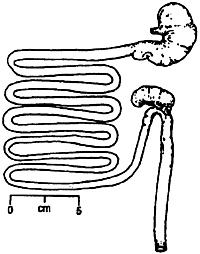
Stevens and Hume, 1995
Reprinted with the permission of Cambridge University Press
FIGURE 1-3 Night Monkey
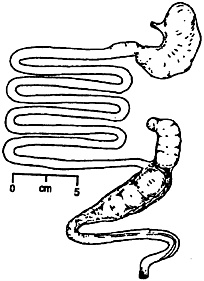
Stevens and Hume, 1995
Reprinted with the permission of Cambridge University Press
FIGURE 1-4 Wolly Monkey
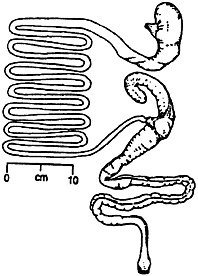
Stevens and Hume, 1995
Reprinted with the permission of Cambridge University Press
Primate Gastrointestinal Tracts
FIGURE 1-5 Vervet Monkey
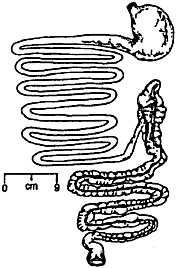
Stevens and Hume, 1995
Reprinted with the permission of Cambridge University Press
FIGURE 1-6 Macaque
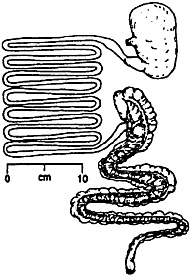
Stevens and Hume, 1995
Reprinted with the permission of Cambridge University Press
FIGURE 1-7 Baboon
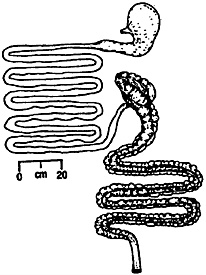
Stevens and Hume, 1995
Reprinted with the permission of Cambridge University Press
FIGURE 1-8 Bush Baby
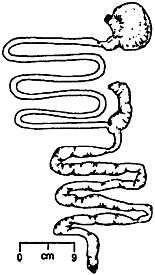
Stevens and Hume, 1995
Reprinted with the permission of Cambridge University Press
fed the same diet, for both fluid markers (35.0 vs. 39.9 hours) and 10-mm particulate markers (39.6 vs. 48.0 hours) (Clemens and Phillips, 1980). The mean transit times for the same diet fed to vervet monkeys (Cercopithecus aethiops) and the more insectivorous bushbaby (Otolemur crassicaudatus) were about 30 and 12 hours, respectively (Clemens, 1980).
Folivores
Primate folivores have a variety of physical adaptations that promote, through symbiotic microbial fermentation and mechanical action, the degradation of the structural and chemical defenses of plants. The two principal adaptations involve enlargements of the stomach or the hindgut to accommodate microbial fermentation (Parra, 1978; Langer, 1988). The extent of gastrointestinal tract modification is related to the proportions of plant parts (leaves, seeds, and fruits) consumed.
Members of the subfamily Colobinae have capacious and morphologically complex adaptations of the foregut, providing a primary site of microbial activity (Bauchop and Martucci, 1968; Caton, 1998; Kuhn, 1964). Colobines can be further divided into two large groups on the basis of the presence (quadripartite) or absence (tripartite) of a presaccus that can act as a preliminary storage compartment proximal to the principal region of fermentation (saccus) (Table 1-7). The tubus gastricus and pars pylorica are distal to the saccus. This arrangement allows the separation of ingesta between more neutral or alkaline (proximal) and acidic (distal) environments, supporting microbial fermentation in advance of gastric and enzymatic digestion. Anaerobic cellulolytic bacteria and other microbial symbionts in the saccus produce enzymes that degrade plant cell walls and promote access to the cellular contents. Thus, these
TABLE 1-7 Form of Foregut in Genera of Subfamily Colobinae
|
Form of Foregut |
Genus |
Source |
|
Presaccus absent (tripartite) |
Colobus |
Polack, 1908; Stevens and Hume, 1995 |
|
|
Semnopithecus |
Ayer, 1948 |
|
Trachypithecus |
Otto, 1835; Kuhn, 1964 |
|
|
Presbytis |
Caton, 1990 |
|
|
Presaccus present (quadripartite) |
Procolobus |
Hill, 1952; Kuhn, 1964 |
|
|
Rhinopithecus |
Ye et al., 1983 |
|
Pygathrix |
Edwards, 1995; Höllihn, 1971; Pilliet and Boulart, 1898 |
|
|
Nasalis |
Höllihn, 1971; Langer, 1988; Martin, 1837 |
species exhibit evolutionary convergence with ruminants in their adaptations of foregut structure for herbivory (Moir, 1968). As previously noted, in contrast with more-omnivorous cercopithecine primates, the colobines lack cheek pouches (Stevens and Hume, 1995).
The large sacculated forestomach of Asian colobines (such as Trachypithecus, Presbytis, and Pygathrix) includes a gastric canal in the presaccus, which might be analogous to the reticular groove in ruminants that shunts highly digestible milk, consumed during suckling, past the sites of fermentation to the distal portion of the stomach (Figure 1-9).
The small and large intestines of Asian colobines are about eight and two times body length, respectively. The cecum, serving as a secondary site of microbial fermentation, is one-fourth body length (Stevens and Hume, 1995).
Although the gastrointestinal tract of African colobines such as Colobus and Procolobus (Figure 1-10) is generally similar to that of Asian colobines, the small and large intestines are shorter, and the cecum is less well developed (Stevens and Hume, 1995). There is no evidence of rumination (regurgitation and chewing of a food bolus) in any colobine primate (Owen, 1835).
Several primate species exhibit hindgut fermentation, again reflecting the contribution of less-digestible plant materials in the natural diet. In these species, the symbiotic microorganisms occupy enlarged areas distal to the gastric and enzymatic sites of digestion. Quantitative recovery of nutrients produced by fermentation is not as high as in foregut fermenters (Edwards and Ullrey, 1999b).
The large intestine is enlarged in prosimians that feed on leaves or gums, both of which require microbial fermentation for digestion, and the cecum is elongated in Lepilemur, Phaner, Euoticus, and Indri (Chivers and Hladik, 1980).
The diet of the nocturnal sportive lemur (Lepilemur mustelinus) consists of flowers and leaves. This species practices coprophagy (ingestion of fecal material), which increases the recovery of nutrients from the relatively indigestible diet (Napier and Napier, 1985).
All great apes exhibit hindgut modification. The chimpanzee colon is haustrated by three taeniae over its length; the taeniae continue along the cecum and terminate in a vermiform appendix (Figure 1-11) (Stevens and Hume, 1995). The gastrointestinal tract of the gorilla is similar to that of the chimpanzee, although the small intestine is relatively long and the hindgut is more voluminous, indicative of its highly herbivorous diet. The small intestine and colon of the orangutan are longer than those of the chimpanzee, with an expanded proximal segment (Figure 1-12). The gastrointestinal tract of the gibbon is similar to that of other apes, although the colon is shorter. For purposes of comparison, the gastrointestinal tract of the adult human is shown in Figure 1-14.
Primate Gastrointestinal Tracts
FIGURE 1-9 Northern Douc Langur
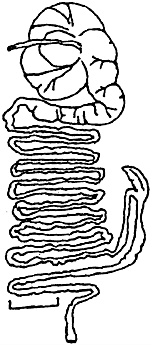
Edwards, 1995
FIGURE 1-10 Columbus Monkey
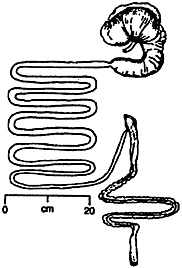
Stevens and Hume, 1995
Reprinted with the permission of Cambridge University Press
FIGURE 1-10 Chimpanzee
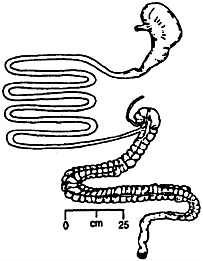
Stevens and Hume, 1995
Reprinted with the permission of Cambridge University Press
FIGURE 1-10 Orangutan
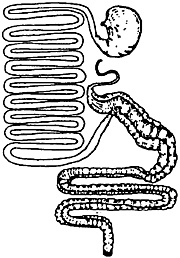
Stevens and Hume, 1995
Reprinted with the permission of Cambridge University Press
Primate Gastrointestinal Tracts
FIGURE 1-13 Howler Monkey
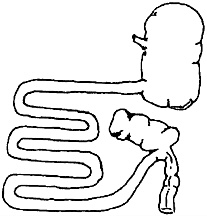
Edwards, 1995
FIGURE 1-10 Adult Human
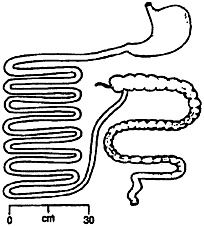
Stevens and Hume, 1995
Reprinted with the permission of Cambridge University Press
Adaptations for hindgut fermentation are most pronounced in the highly folivorous howler monkeys (Alouatta spp.) and Indrids (Avahi, Indri, and Propithecus). In these species, the complex nature of the hindgut is demonstrated by the presence of sacculations (haustra), longitudinal bands (taeniae), and flexures that presumably trap or slow the movement of digesta (Clemens and Phillips, 1980). Increased retention of food particles in this region facilitates microbial degradation by symbiotic organisms.
Some hindgut fermenters have adaptations in the foregut. For example, the stomach of Alouatta, which consumes a diet of at least 40% leaf material by weight (Hladik and Hladik, 1972; Edwards, 1995), is the most complex among the hindgut fermenters (Figure 1-13). It is a capacious globular sac, narrowing toward the bent tubular pylorus, guarded by strong pillars running longitudinally with the body (Chivers and Hladik, 1980).
Median gut passage time for a mixed-ingredient diet, including browse plants, fed to the highly folivorous Hapalemur griseus alaotrensis was 18.21 hours (Cabre-Vent and Feistner, 1995). Three species of howler monkeys fed two manufactured diets with different fiber concentrations (15% and 30% acid-detergent fiber [ADF]) exhibited no significant difference between diets in mean transit time of solids (28.0 vs. 21.5 hours) or liquids (14.6 vs 16.1 hours) (Edwards, 1995).
When fed a manufactured diet containing 15% ADF, silvered leaf monkeys (Semnopithecus cristatus) exhibited a mean transit time of 13.6 hours for both solid and liquid phases of digesta (Sakaguchi et al., 1991). Francois’ leaf monkeys (Trachypithecus f. francoisi) fed a comparable (15% ADF) diet had a comparable transit time for liquid digesta (13.5 hours), but the mean transit time for solid digesta was 27 hours (Edwards, 1995). When the same animals were fed a diet with twice the fiber concentration (30% ADF), there was no significant effect of the dietary change on the transit time of either liquids (15.5 hours) or solids (28.5 hours) (Edwards, 1995).
Digestibility studies with the Yunan snub-nosed monkey (Rhinopithecus bieti), a foregut fermenter that feeds primarily on lichens, revealed apparent dietary dry matter digestibilities of 71 to 80%. Mean (± SD) retention time of plastic digesta markers was 47 ± 17 hr (Kirkpatrick et al., 2001).
IMPLICATIONS FOR FEEDING PROGRAMS IN CAPTIVITY
Development of scientifically sound feeding programs for captive primates requires a balance of information on the species of concern. Gastrointestinal tract structure, natural feeding behavior, and nutrient composition of foods consumed by free-ranging individual animals are some of the items required to address dietary husbandry requirements. Identifying readily available foods to meet physio-
TABLE 1-8 Examples of Food Consumed by Primates in Zoos and in the Wild (Oftedal and Allen, 1997)
|
Food Type |
Dry Matter, % |
Crude Protein, % |
Fiber Fractionsa |
|
|||
|
NDF, % |
ADF, % |
AL, % |
Ca, % |
P, % |
|||
|
Market produce used in primate dietsb |
|||||||
|
Apples |
12.8 |
2.3 |
17.4 |
12.6 |
3.8 |
0.0 |
0.0 |
|
Green beans |
10.7 |
17.9 |
28.0 |
25.1 |
2.2 |
0.4 |
0.4 |
|
Cabbage |
8.9 |
14.7 |
20.6 |
21.9 |
1.7 |
0.6 |
0.3 |
|
Carrots |
12.2 |
7.7 |
15.2 |
16.5 |
1.5 |
0.2 |
0.4 |
|
Kale |
12.3 |
32.5 |
19.3 |
24.7 |
4.6 |
0.9 |
0.4 |
|
Foods eaten in the wild by red howler monkeys (Alouatta seniculus)c |
|||||||
|
Flowers |
25.1 |
14.4 |
50.6 |
35.8 |
17.1 |
0.5 |
0.3 |
|
Fruits |
23.7 |
7.0 |
53.8 |
35.2 |
16.6 |
0.6 |
0.2 |
|
Mature leaves |
36.5 |
16.6 |
57.2 |
40.5 |
20.4 |
1.4 |
0.1 |
|
Young leaves |
32.2 |
21.2 |
54.4 |
36.4 |
21.1 |
0.3 |
0.3 |
|
Note: all values, except dry matter, are expressed on a dry matter basis. aNDF = neutral detergent fiber; ADF = acid detergent fiber; AL = acid lignin. bAll data except calcium and phosphorus from Oftedal et al., 1982; calcium and phosphorus values from USDA Standard Release 14. cUnpublished data of M.S. Edwards, S.D. Crissey, O.T. Oftedal, and R. Rudran, as cited in Oftedal, 1991. |
|||||||
logic and behavioral needs of the species in captivity might be a greater challenge.
Diets for strict faunivores in a captive setting—including Arctocebus, Galago, Loris, Microcebus, and Tarsius—are limited by the availability of suitable vertebrate and invertebrate prey. Although crickets (Acheta domestica) and meal-worm larvae (Tenebrio molitor and Zophobas morio) are readily available, they are not adequate to support the estimated nutritional requirements of these nonhuman primates (Oftedal and Allen, 1997). Guidelines on the handling and care of invertebrate prey to improve their nutrient quality as foods, specifically their calcium content, are provided by Allen and Oftedal (1989).
Food consumption by Tarsius appears to be influenced by movement of the prey offered as food. Thus, dietary prey must not only be living when presented, but must also be maintained in an environment (for example, with proper temperature, humidity, and photoperiod) that supports their needs and encourages natural movement.
As one reviews the literature on natural feeding habits of primates, it should be noted that biologists identify wild plant foods with botanic terms (such as fruit, flower, and petiole). However, these plant parts and their compositions are substantially different from commercially available produce that has been selectively cultivated for human consumption (Table 1-8). Thus, if commercial produce is to be offered to captive primates, that selection should be based on suitable nutrient composition and not solely on the basis of botanic classification.
Free-ranging primates devote a large percentage of their daily activity to acquisition and processing of food, and foraging not only satisfies a physiologic need, but plays a behavioral and social role in the life of primates. Provisioning captive populations of primates removes the need to forage in order to survive. However, if the diet is presented as a meal or on a predictable schedule, the behavioral needs of the animal might not be satisfied. Caretakers are encouraged to offer the diet in small portions distributed irregularly throughout the species-typical feeding period. The manner of diet preparation and presentation can also influence feeding behavior and the opportunity for equitable acquisition of food by individual animals in groups (Smith et al., 1989).
Leaf-eating primates—including Propithecus, Indri, Alouatta, Nasalis, and Pygathrix—have long been recognized as specialist feeders that are difficult to adapt to a “captive” diet. The impression that plant fiber is a negative dietary component and that a diet low in fiber is “preferred” by these captive primates has produced many of the health problems commonly seen (Edwards and Ullrey, 1999b). That conclusion is supported by a number of reports of a high incidence of gastrointestinal disorders among leaf-eating primates, many of which might be a result of consuming rapidly fermentable foods such as commercial fruits and vegetables (Hill, 1964; Bauchop and Martucci, 1968; Hick, 1972; Höllihn, 1973; Benton, 1976; Benirschke and Bogart, 1978; Heldstab, 1988; Taff and Dolhinow, 1989; Janssen, 1994). The beneficial role of plant fiber in promoting satiety, normal fecal consistency, and gastrointestinal health is well documented (Cummings, 1978).
REFERENCES
Adiputra, I.M.W. 1994. Feeding behavior of Javan leaf monkey (Presbytis comata comata). 15th Congress International Primatology Society Handbook and Abstracts. #82. Kuta, Bali, Indonesia.
Agetsuma, N. 1995a. Foraging synchrony in a group of Yakushima macaques (Macaca fuscata yakui). Folia Primatol. 64:167-179.
Agetsuma, N. 1995b. Foraging strategies of Yakushima macaques (Macaca fuscata yakui). Int. J. Primatol. 16:595-609.
Agetsuma, N., and N. Nakagawa. 1998. Effects of habitat differences on feeding behaviors of Japanese monkeys: comparison between Yakushima and Kinkazan. Primates 39:275-289.
Agetsuma, N., and N. Noma. 1995. Rapid shifting of foraging pattern by Yakushima macaques (Macaca fuscata yakui) in response to heavy fruiting of Myrica rubra. Int. J. Primatol. 16:247-260.
Ahsan, M. 1994. Feeding ecology of the primates of Bangladesh. Pp. 79-86 in Current Primatology, Vol.1: Ecology and Evolution, B. Thierry, J.R. Anderson, J.J. Roeder, N. Herrenschmidt, Eds. Strasbourg: Universite Louis Pasteur.
Albernaz, A.L.K.M. 1997. Home range size and habitat use in the black lion tamarin (Leontopithecus chysopygus). Int. J. Primatol. 18:877-887.
Albignac, R. 1981. Lemurine social and territorial organization in a north-western Malagasy forest (restricted area of Ampijoroa). Pp. 25-29 in Primate Behavior and Sociobiology, A.B. Chiarelli and R.S. Corruccini, Eds. Berlin: Springer-Verlag.
Albignac, R., R. Justin, and B. Meier. 1991. Study of the first behavior of Allocebus trichotis Gunter 1875 (hairy-eared dwarf lemurs): prosimian lemur rediscovered in 1989 in the northeast of Madagascar (Biosphere Reserve of Mananara-Nord). Pp. 85-88 in Primatology Today: Proceedings of the 13th Congress International Primatology Society, A. Ehara, T. Kimura, O. Takenaka, M. Iwamonto, Eds. Amsterdam: Elsevier Science Publishing .
Aldrich-Blake, F.P.G. 1980. Long-tailed macaques. Pp. 147-165 in Malayan Forest Primates: Ten Years’ Study in Tropical Rain Forest, D.J. Chivers, Ed. New York: Plenum Press.
Alfred, J. 1992. The hoolock gibbon—Hylobates hoolock. Primate Report 32:65-69.
Allen, M.E., and O.T. Oftedal. 1989. Dietary manipulation of the calcium content of feed crickets. J. Zoo Wildl. Med. 20:26-33.
Altmann, J. 1974. Observational study of behavior: sampling methods. Behaviour 49:227-267.
Ancrenaz, M., I. Lackman-Ancrenaz, and N. Mundy. 1994. Field observations of aye-ayes (Daubentonia madagascariensis) in Madagascar. Folia Primatol. 62:22-36.
Andriamasimanana, M. 1994. Ecoethological study of free-ranging aye-ayes (Daubentonia madagascariensis) in Madagascar. Folia Primatol. 62:37-45
Andriatsarafara, R. 1988. Note sur les rythmes d’activité et sur le régime alimentaire de L. mongoz Linaeus1766 à Ampijoroa. Pp. 103-106 in L’équilibre des écosystèmes forestiers à Madagascar: Actes d’un séminaire international, L. Rakotovao, V. Barre, and J. Sayer, Eds. Gland, Switzerland and Cambridge, UK: IUCN.
Ayer, A.A. 1948. The Anatomy of Semnopithecus entellus. Madras: Indian Publishing House.
Ayres, J.M. 1989. Comparative feeding ecology of the Uakari and Bearded Saki, Cacajao and Chiropotes. J. Hum. Evol. 18:697-716.
Badrian, N., A. Badrian, and R.L. Susman. 1981. Preliminary observations on the feeding behavior of Pan paniscus in the Lomako Forest of Central Zaire. Primates 22:173-181.
Badrian, N., and R. Malenky. 1984. Feeding Ecology of Pan paniscus in the Lomako Forest, Zaire. Pp. 275-299 in The Pygmy Chimpanzee: Evolutionary Biology and Behavior, R. Susman, Ed. New York: Plenum Press.
Barnett, A.A., and D. Brandon-Jones. 1997. The ecology, biogeography and conservation of the uakaris, Cacajao (Pitheciinae). Folia Primatol. 68:223-235.
Bauchop, T., and R.W. Martucci. 1968. Ruminant-like digestion of the langur monkey. Science 167:698-700.
Bearder, S.K. 1987. Lorises, bushbabies, and tarsiers: diverse societies in solitary foragers. Pp. 11-24 in Primate Societies, B.B. Smuts, D.L. Cheney, R.M. Seyfarth, R.W. Wrangham, and T.T. Struhsaker, Eds. Chicago: University Chicago Press.
Bearder, S.K., and G.A. Doyle. 1974. Ecology of bushbabies Galago senegalensis and Galago crassicaudatus, with some notes on their behaviour in the field. Pp. 109-130 in Prosimian Biology, R.D. Martin, G.A. Doyle, and A.C. Walker, Eds. Pittsburgh: University Pittsburgh Press.
Bearder, S.K., and R.D. Martin. 1979. The social organization of a nocturnal primate revealed by radio tracking. Pp. 633-648 in A Handbook on Biotelemetry and Radio Tracking, C.J. Amlaner and D.W. Macdonald, Eds. Oxford: Pergamon Press.
Benirschke, K., and M. Bogart. 1978. Pathology of douc langurs (Pygathrix nemaeus) at San Diego Zoo. Erkr. Zootiere 257-261.
Beeson, M. 1989. Seasonal dietary stress in a forest monkey (Cercopithecus mitis). Oecol. 78:565-570.
Bennett, E.L., and A.G. Davies. 1994. The ecology of Asian colobines. Pp. 129-172 in Colobine Monkeys: Their Ecology, Behaviour, and Evolution, A.G. Davies and J.R. Oates, eds. Cambridge: Cambridge University Press.
Bennett, E.L., and A.C. Sebastian. 1988. Social organization and ecology of proboscis monkeys (Nasalis larvatus) in mixed coastal forest in Sarawak. Int. J. Primatol. 9:233-255.
Benton, L., Jr. 1976. The establishement and husbandry of a black howler, Alouatta caraya, colony at Columbia Zoo. Int. Zoo Yearb. 16:149-152.
Bicca-Marques, J.C., and C. Calegaro-Marques. 1994. Activity budget and diet of Alouatta caraya: an age-sex analysis. Folia Primatol. 63:216-220.
Bleisch, W., and J. Xie. 1994. Ecology and behavior of Guizhou golden monkeys (Rhinopithecus brelichi). 15th Congress International Primatology Society Handbook and Abstracts. #279. Kuta, Bali, Indonesia.
Bleisch, W.V., Z.M. Liu, E.S. Dierenfeld, and J.H. Xie. 1998. Selected nutrient analysis of plants in the diet of the Guizhou snub-nosed monkey (Rhinopithecus [Rhinopithecus] brelichi) . Pp. 241-254 in The Natural History of the Doucs and Snub-Nosed Monkey, N.G. Jablonski, Ed. Singapore: World Scientific Publishing.
Booth, A.H. 1956. The distribution of primates in the Gold Coast. J. West Afr. Scientific Assoc. 2:122-133.
Boug, A., S. Biquand, V. Biquand-Guyot, and K. Kamal. 1994. The response of commensal hamadryas baboons to seasonal reduction in food provisioning. Rev. Ecol. (Terre et Vie) 49:307-319.
Bourliere, F., C. Hunkeler, and M. Bertrand. 1970. Ecology and behavior of Lowe’s guenon (Cercopithecus campbelli Iowei) in the Ivory Coast. Pp. 297-350 in Old World Monkeys: Evolution, Systematics, and Behavior, J.R. Napier and P.H. Napier, Eds. New York: Academic Press.
Brandon-Jones, D. 1985. Colobus and leaf monkeys. Pp. 102-112 in Primates, D. Macdonald, Ed. New York: Torstar Books.
Brotoisworo, E., and I.W.A. Dirgayusa. 1991. Ranging and feeding behavior of Presbytis cristata in the Pangandaran Nature Reserve, West Java, Insonesia. Pp. 115-118 in Primatology Today: Proceedings of the 13th Congress International Primatology Society, A. Ehara, T. Kimura, O. Takenada, and M. Iwamonto, Eds. Amsterdam: Elsevier Science Publishing.
Brown, A.D., and G.E. Zunino. 1990. Dietary variability in Cebus apella in extreme habitats: evidence for adaptability. Folia Primatol. 54:187-195.
Bruorton, M.R., C.L. Davis, and M.R. Perrin. 1991. Gut microflora of vervet and samango monkeys in relation to diet. Appl. Environ. Microbiol. 57:573-578.
Buchanan, D.B., R.A. Mittermeier, and M.G.M. van Roosmalen. 1981. The Saki Monkeys, Genus Pithecia. Pp. 391-417 in Ecology and Behavior of Neotropical Primates, Vol.1, A.F. Coimbra-Filho and R.A. Mittermeier, Eds. Rio de Janeiro: Academia Brasileira de Ciencias.
Butynski, T.M. 1982. Vertebrate predation by primates: a review of hunting patterns and prey. J. Hum. Evol. 11:421-430.
Butynski, T.M. 1990. Comparative ecology of blue monkeys (Cercopithecus mitis) in high- and low-density subpopulations. Ecol. Monogr. 60:1-26.
Bynum, E.L. 1994. Population characteristics and habitat use in hybrid Macaca tonkeana and Macaca hecki in central Sulawesi, Indonesia. 15th Congress International Primatology Society Handbook and Abstracts. #302. Kuta, Bali, Indonesia.
Byrne, R.W., A. Whiten, S.P. Henzi, and F.M. McCulloch. 1993. Nutritional constraints on mountain baboons (Papio ursinus): implications for baboon socioecology. Behav. Ecol. Sociobiol. 33:233-246.
Cabre-Vent, N., and A.T.C. Feistner. 1995. Comparative gut passage time in captive lemurs. Dodo 31:76-81.
Caldecott, J.O. 1986a. A summary of the ranging and activity patterns of the pig-tailed macaque (Macaca n. nemestrina) in relation to those of sympatric primates in peninsular Malaysia. Pp. 152-158 in Current Perspectives in Primate Social Dynamics, D.M. Taub and F.A. King, Eds. New York: Van Nostrand Reinhold Co.
Caldecott, J.O. 1986b. An Ecological and Behavioral Study of the Pig-Tailed Macaque. Basel, Switzerland: Karger.
Casimir, M.J. 1975. Feeding ecology and nutrition of an eastern gorilla group in the Mt. Kahuzi region (Re épublique du Zaire). Folia Primatol. 24:81-136.
Caton, J.M. 1990. Structure and Function in the Catarrhine Stomach, with Particular Reference to the Family Colobidae. M.S. Dissertation. The Australian National University, Canberra.
Caton, J.M. 1998. The morphology of the gastrointestinal tract of Pygathrix nemaeus (Linneaus, 1771). Pp. 129-152 in The Natural History of the Doucs and Snub-Nosed Monkeys, N.G. Jablonski, ed. New Jersey: World Scientific.
Chapman, C. 1987. Flexibility in diets of three species of Costa Rican primates. Folia Primatol. 49:90-105.
Chapman, C. 1988. Patterns of foraging and range use by three species of neotropical primates. Primates 29:177-194.
Chapman, C.A., and L.J. Chapman. 1990. Dietary variability in primate populations. Primates 31:121-128.
Chapman, C.A., and L.M. Fedigan. 1990. Dietary differences between neighboring Cebus capucinus groups: local traditions, food availability or responses to food profitability? Folia Primatol. 54:177-186.
Charles-Dominique, P. 1974. Ecology and feeding behaviour of five sympatric lorisids in Gabon. Pp. 129-150 in Prosimian Biology: Proceedings of a Meeting of the Research Seminar in Archaeology and Related Subjects, R.D. Martin, G.A. Doyle, and A.C. Walker, Eds. Pittsburgh: University Pittsburgh Press.
Charles-Dominique, P. 1977. Ecology and Behavior of Nocturnal Primates: Prosimians of Equatorial West Africa. New York: Columbia University Press.
Charles-Dominique, P., and S.K. Bearder. 1979. Field studies of Lorisid Behavior: Methodological Aspects. Pp. 567-629 in The Study of Prosimian Behavior, G.A. Doyle and R.D. Martin, Eds. New York: Academic Press.
Charles-Dominique P., and C.M. Hladik. 1971. Le Lepilemur du sud de Madagascar: ecologie, alimentation et vie social. Terre Vie Rev. Ecol. Appl. 25:3-66.
Charles-Dominique, P., and J.J. Petter. 1980. Ecology and social life of Phaner furcifer. Pp. 75-95 in Nocturnal Malagasy Primates: Ecology, Physiology, and Behavior, P. Charles-Dominique, H.M. Cooper, A. Hladik, C.M. Hladik, E. Pages, G.F. Pariente, A. Petter-Rousseaux, and A. Schilling, Eds. New York: Academic Press.
Chivers, D.J. 1994. Functional anatomy of the gastrointestinal tract. Pp. 205-227 in Colobine Monkeys: Their Ecology, Behaviour and Evolution, A.G. Davies and J.F. Oates, Eds. Cambridge: Cambridge University Press.
Chivers, D.J., and C.M. Hladik. 1980. Morphology of the gastrointestinal tract of primates: comparisons with other mammals in relation to diet. J. Morphol. 166:337-386.
Chivers, D. 1974. The Siamang in Malaya: A Field Study of a Primate in Tropical Rain Forest—Contributions to Primatology Series, Vol. 4. (Pp 63-126). Basel, Switzerland: S. Karger.
Chivers, D. 1977. The feeding behaviour of Siamang (Symphaloangus syndactylus). Pp. 355-382 in Primate Ecology: Studies of Feeding and Ranging Behaviour in Lemurs, Monkeys, and Apes, T. Clutton-Brock, Ed. London: Academic Press.
Chivers, D., J.J. Raemaekers, and F.P.G. Aldrich-Blake. 1975. Long-term observations of siamang behaviour. Folia Primatol. 23:1-49.
Choudhury, A. 1990. Population dynamics of hoolock gibbons (Hylobates hoolock) in Assam, India. Am. J. Primatol. 20:37-41.
Clemens, E.T. 1980. The digestive tract: insectivore, prosimian, and advanced primate. Pp. 90-99 in Comparative Physiology: Primitive Mammals, K. Schmidt-Nielson, L. Bolis, and C.R. Taylor, Eds. New York: Cambridge University Press.
Clemens, E.T., and B. Phillips. 1980. Organic acid production and digesta movement in the gastrointestinal tract of the baboon and Sykes monkey. Comp. Biochem. Physiol. 66A:529-532.
Clutton-Brock, T.H. 1975. Feeding behaviour of red colobus and black and white colobus in East Africa. Folia Primatol. 23:165-207
Coimbra-Filho, A.F., and R.A. Mittermeier. 1978. Tree-gouging, exudate-eating and the ‘‘short-tusked’’ condition in Callithrix and Cebuella. Pp. 105-115 in The Biology and Conservation of the Callitrichidae, D.G. Kleiman, Ed. Washington, D.C.: Smithsonian Institution Press.
Colquhoum, I.C. 1993. The socioecology of Eulemur macaco: a preliminary report. Pp. 11-24 in Lemur Social Systems and Their Ecological Basis, P.M. Kappeler and J.U. Ganzhorn, Eds. New York: Plenum Press.
Colyn, M. 1994. Données pondérales sur les primates Cercopithecidae d’Afrique centrale (Bassin du Zaiöre/Congo). Mammalia 58:483-487.
Conklin-Brittain, N.L., R.W. Wrangham, and K.D. Hunt. 1998. Dietary response of Chimpanzees and Cercopithecines to seasonal variation in fruit abundance. II. Macronutrients. Int. J. Primatol. 19:971-998.
Conklin-Brittain, N.L., E.S. Dierenfeld, R.W. Wrangham, M. Norconk, and S.C. Silver. 1999. Chemical protein analysis: a comparison of Kjeldahl crude protein and total ninhydrin protein using wild, tropical plant parts. J. Chem. Ecol. 25:2601-2622.
Conklin-Brittain, N.L., R.W. Wrangham, and C.C. Smith. 2002. A two-stage model of increased dietary quality in early hominid evolution: the role of fiber. In Human Diet: Perspectives on Its Origins and Evolution, P. Ungar and M. Teaford, Eds. Westport, Conn.: Greenwood Publishing Group.
Corbin, G.D., and J. Schmid. 1995. Brief reports: Insect secretions determine habitat use patterns by a female lesser mouse lemur (Microcebus murinus). Am. J. Primatol. 37:317-324.
Cords, M. 1986. Interspecific and intraspecific variation in diet of two forest guenons, Cercopithecus ascanius and C. mitis. J. Anim. Ecol. 55:811-827.
Cords, M. 1987. Mixed-species association of Cercopithecus monkeys in the Kakamega Forest, Kenya. University California Publications 117:1-109.
Costello, R.K., C. Dickinson, A.L. Rosenberger, S. Boinski, and F.S Szalay. 1993. Squirrel monkey (genus Saimiri) taxonomy: a multidisciplinary study of the biology of species. Pp. 177-210 in Species, Species Concepts, and Primate Evolution, W.H Kimbel and L.B. Martin, Eds. New York: Plenum Press.
Crandlemire-Sacco, J. 1988. An ecological comparison of two sympatric primates: Saguinus fuscicollis and Callicebus moloch of Amazonian Peru. Primates 29:465-475.
Crockett, C.M., and J.F. Eisenberg. 1987. Howlers: variation in group size and demography in primate societies. Pp. 54-68 in Primate Societies, B.B. Smuts, D.K. Cheney, R.M. Seyfarth, R.W. Wrangham, and T.T. Struhsaker, Eds. Chicago: University Chicago Press.
Crompton, R.H., and P.M. Andah. 1986. Location and habitat utilization in free-ranging Tarsius bancanus: a preliminary report. Primates 27:337-355.
Cummings, J.H. 1978. Nutritional implications of dietary fiber. Am. J. Clin. Nutr. 31:S21-S29.
Curtin, S.H. 1980. Dusky and banded leaf monkeys. Pp. 107-145 in Malayan Forest Primates: Ten Years’ Study in Tropical Rain Forest, D.J. Chivers, Ed. New York: Plenum Press.
Curtin, S.H., and D.J. Chivers. 1978. Leaf-eating primates of peninsular Malaysia: the siamang and the dusky leaf-monkey. Pp. 441-464 in The Ecology of Arboreal Folivores, G.G. Montgomery, Ed. Washington, D.C.: Smithsonian Institution Press.
Dague, C., and J.J. Petter. 1988. Observations sur le Lemur rubriventer dans son milieu naturel. Pp. 78-89 in L’équilibre des écosystèmes forestiers à Madagascar: Actes d’un séminaire international, L. Rakotovao, V. Barre, and J. Sayer, Eds. Gland, Switzerland and Cambridge, UK: IUCN.
Dasilva, G.A. 1992. The western black-and-white colobus as a low-energy strategist: activity budgets, energy expenditure, and energy intake. J. Anim. Ecol. 61:79-91.
Dasilva, G.A. 1994. Diet of Colobus polykomos on Tiwai Island: selection of food in relation to its seasonal abundance and nutritional quality. Int. J. Primatol. 15:655-680.
Davies, A.G. 1991. Seed-eating by red leaf monkeys (Presbytis rubicunda) in dipterocarp forest of northern Borneo. Int. J. Primatol. 12:119-140.
Davies, A.G., E.L. Bennett, and P.G. Waterman. 1988. Food selection by two south-east Asian colobine monkeys (Presbytis rubicunda and Presbytis melalophos) in relation to plant chemistry. Biol. J. Linn. Soc. 34:33-56.
Davies, A.G., J.O. Caldecott, and D.J. Chivers. 1983. Natural foods as a guide to the nutrition of Old World primates. Pp. 225-244 in Standards in Laboratory Animal Management, J. Remfry, Ed. London, UFAW/ LASA Joint Symposium, Potters Bar, UK.
Deag, J.M. 1983. Feeding habits of Macaca sylvanus (Primates: Cercopithecinae) in a commercial Moroccan cedar forest. J. Zool. Lond. 201:570-574.
de Thoisy, B., and C. Richard-Hansen. 1997. Diet and social behaviour changes in a red howler monkey (Alouatta seniculus) troop in a highly degraded rain forest. Folia Primatol. 68:357-361.
Decker, B.S. 1994. Effects of habitat disturbance on the behavioral ecology and demographics of the Tana River red colobus (Colobus bacius rufomitratus). Int. J. Primatol. 15:703-737.
Defler, T.R., and S.B. Defler. 1996. Diet of a group of Lagothrix lagothricha lagothricha in southeastern Colombia. Int. J. Primatol. 17:161-190.
Dew, L., and P.C. Wright. 1994. Conservation implications of seed dispersal by primates in a Malagasy rainforest (Ranomafana National Park). Pp. 124 in 15th Congress International Primatology Society Handbook and Abstracts.
Dietz, J.M., C.A. Peres, and L. Pinder. 1997. Foraging ecology and use of space in wild golden lion tamarins (Leontopithecus rosalia). Am. J. Primatol. 41:289-305.
Dittus, W.P.J. 1977. The socioecological basis for the conservation of the Toque monkey (Macaca sinica) of Sri Lanka (Ceylon). Pp. 237-265 in Primate Conservation, His Serene Highness Prince Rainier III of Monaco and G.H. Bourne, Eds. New York: Academic Press.
Doyle, G.A. 1979. Development of behavior in prosimians with special reference to the lesser bushbaby, Galago senegalensis moholi. Pp. 158-206 in The Study of Prosimian Behavior, G.A. Doyle and R.D. Martin, Eds. New York: Academic Press.
Doyle, G.A., and S.K. Bearder. 1977. The Galagines of South Africa. Pp. 135 in Primate Conservation, His Serene Highness Prince Rainier III of Monaco and G.H. Bourne, Eds. New York: Academic Press.
Dunbar, R.I.M. 1976. Australopithecine diet based on a baboon analogy. J. Hum. Evol. 5:161-167.
Dunbar, R.I.M. 1977. Feeding ecology of gelada baboons: a preliminary report. Pp. 251-275 in Primate Ecology: Studies of Feeding and Ranging Behaviour in Lemurs, Monkeys, and Apes, T.H. Clutton-Brock, Ed. London: Academic Press.
Dunbar, R.I.M., and E.P. Dunbar. 1974. Ecological relations and niche separation between sympatric terrestrial primates in Ethiopia. Folia Primatol. 21:36-60.
Duckworth, J.W. 1994. Field sightings of the pygmy loris, Nycticebus pygmaeus, in Laos. Folia Primatol. 63:99-101.
Durham, N.M. 1975. Some ecological, distributional, and group behavioral features of Atelinae in Southern Peru: with comments on interspecific relations. Pp. 87-101 in Socioecology and Psychology of Primates, R.H. Tuttle, Ed. The Hague and Paris: Mouton Publishers.
Easley, S.P. 1984. Diet and territory in Callicebus torquatus. Am. J. Phys. Anthro. 63:154-155.
Edwards, M.S. 1995. Comparative Adaptations to Folivory in Primates. Ph.D. Dissertation. Michigan State University, East Lansing.
Edwards, M. S., and D. E. Ullrey. 1999a. Effect of dietary fiber concentration on apparent digestibility and digesta passage in nonhuman primates. I. Ruffed lemurs (Varecia variegata variegata and V. v. rubra). Zoo Biol. 18:529-536.
Edwards, M.S., and D.E. Ullrey. 1999b. Effect of dietary fiber concentration on apparent digestibility and digesta passage in nonhuman primates. II. Hindgut and foregut fermenting folivores. Zoo Biol. 18:537-549.
Egler, S.G. 1992. Feeding ecology of Saguinus bicolor bicolor (Callitrichidae: Primates) in a relict forest in Manaus, Brazilian Amazonia. Folia Primatol. 59:61-76.
Ellefson, J.O. 1974. A Natural History of White-handed Gibbons in Malayan Peninsula. In Gibbon and Siamang. Vol. 3. D.M. Rumbaugh, Ed. Basel: Karger.
Engqvist, A., and A. Richard. 1991. Diet as a possible determinant of cathemeral activity patterns in primates. Folia Primatol. 57:169-172.
Erickson, C.J. 1995. Feeding sites for extractive foraging by the aye-aye, Daubentonia madagascariensis. Am. J. Primatol. 35:235-240.
Estrada, A. 1984. Resource use by howler monkeys (Alouatta palliato) in the rainforest of Los Tuxtlas, Veracruz, Mexico. Int. J. Primatol. 5:105-131.
Estrada, A., and R. Coates-Estrada. 1986. Use of leaf resources by howling monkeys (Alouatta palliata) and leaf-cutting ants (Atta cephalotes)in the tropical rainforest of Los Tuxtlas, Mexico. Am. J. Primatol. 10:51-66.
Ferrari, S.F. 1993. Ecological differentiation in the Callitrichidae. Pp. 314-328 in Marmosets and Tamarins: Systematics, Behaviour, Ecology, A.B. Rylands, Ed. Oxford: Oxford University Press.
Ferrari, S.F., and M.A.L. Ferrari. 1989. A re-evaluation of the social organization of the Callitrichidae, with reference to the ecological differences between genera. Folia Primatol. 52:132-147.
Ferrari, S.F., and A.B. Rylands. 1994. Activity budgets and differential visibility in field studies of three marmosets (Callithrix spp). Folia Primatol. 63:78-83.
Fleagle, J.G. 1978. Locomotion, posture and habitat utilization in two symptric Malaysian leaf-monkeys (Presbytis obscura and Presbytis melalophos). Pp. 243-253 in The Ecology of Arboreal Folivores, G.G. Montgomery , ed. Washington, D.C.: Smithsonian Institution Press.
Fleagle, J.G. 1988. Primate Adaptation and Evolution. New York: Academic Press.
Fogden, M.P.L. 1974. A preliminary field study of the western tarsier, Tarsius bancanus Horsefield. Pp. 151-165 in Prosimian Biology, R.D. Martin, G.A. Doyle, and A.C. Walker, Eds. Pittsburgh: University Pittsburgh Press.
Fontaine, R. 1981. The uakaris, genus Cacajao. Pp. 443-494 in Ecology and Behavior of Neotropical Primates, Vol. 1, A.F. Coimbra-Filho and R.A. Mittermeier, Eds. Rio de Janeiro: Academia Brasileira de Ciîncias.
Fooden, J. 1964. Stomach contents and gastro-intestinal proportions in wild shot Guianan monkeys. Am. J. Phys. Anthro. 22:227-231.
Ford, S.M. 1994. Evolution of sexual dimorphism in body weight in platyrrhines. Am. J. Primatol. 34:221-244.
Ford, S.M., and L.C. Davis. 1992. Systematics and body size: implications for feeding adaptation in New World monkeys. Am. J. Phys. Anthro. 88:415-468.
Fossey, D. 1974. Observations on the home range of one group of mountain gorillas (Gorilla gorilla beringei). Anim. Behav. 22:568-581.
Fossey, D., and A.H. Harcourt. 1977. Feeding ecology of free-ranging Mountain Gorilla (Gorilla gorilla beringei). Pp. 415-447 in Primate Ecology: Studies of Feeding and Ranging Behaviour in Lemurs, Monkeys, and Apes, T. Clutton-Brock, Ed. London: Academic Press.
Freeland, W.J. 1979. Mangabey (Cercocebus albigena) social organization and population density in relation to food use and availaibility. Folia Primatol. 32:108-124.
Galat, G., and A. Galat-Luong. 1977. Démographie et régime alimentaire d’une troupe de Cercopithecus aethiops sabaeus en habitat marginal au Nord Séneégal. La Terre et la Vie 31:557-577.
Galat, G., and A. Galat-Luong. 1978. Diet of green monkeys in Senegal. Pp. 257-258 in Recent Advances in Primatology, Vol. 1, D.J. Chivers and J. Herbert, Eds. London: Academic Press.
Galdikas, B., and G. Teleki. 1981. Variations in subsistence activities of female and male pongids: new perspectives on the origins of hominid labor division . Current Anthro. 22:241-256.
Galetti, M., R. Laps, and F. Pedroni. 1987. Feeding behaviour of the brown howler monkey (Alouatta fusca clamitans) in a forest fragment in state of Sa ão Paulo, Brazil. Int. J. Primatol. 8:542-546.
Ganzhorn, J.U. 1988. Food partitioning among Malagasy primates. Oecol. 75:436-450.
Ganzhorn, J.U., J.P. Abraham, and M. Razanahoera-Rakotomalala. 1985. Some aspects of the natural history and food selection of Avahi laniger. Primates 26:452-463.
Garber, P.A. 1984. Proposed nutritional importance of plant exudates in the diet of the Panamanian tamarin Saguinus oedipus geoffroyi.Int. J. Primatol. 5:1-15.
Garber, P.A. 1988. Diet, foraging patterns and resource defence in a mixed species troop of Saguinus mystax and Saguinus fuscicollis in Amazonian Peru. Behaviour 105:18-34.
Garber, P.A. 1993a. Seasonal patterns of diet and ranging in two species of tamarin monkeys: stability versus variability. Int. J. Primatol. 14:145-166.
Garber, P.A. 1993b. Feeding ecology and behaviour of the genus Saguinus. Pp. 273-295 in Marmosets and Tamarins: Systematics, Behaviour, Ecology, A.B. Rylands, Ed. Oxford: Oxford University Press.
Garcia Chiarello, A. 1994. Diet of the brown howler monkey Alouatta fusca in a semi-deciduous forest fragment of southeastern Brazil. Primates 35:25-34.
Gatinot, B.L. 1977. Le regime alimentaire du colobe bai au Senegal. Mammalia 41:373-402.
Gaulin, S.J., and C.K. Gaulin. 1982. Behavioral ecology of Alouatta seniculus in Andean Cloud Forest. Int. J. Primatol. 3:1-32.
Gautier-Hion, A. 1971. L’e écologie du talapoin du Gabon. La Terre et la Vie 25:427-469.
Gautier-Hion, A. 1973. Social and ecological features of talapoin monkey—comparisons with sympatric cercopithecines. Pp. 147-170 in Comparative Ecology and Behaviour of Primates, R.P. Michael and J.H. Crook, Eds. London: Academic Press.
Gautier-Hion, A. 1977. Données sur le régime alimentaire de Cercocebus albigena albigena dans le nord-est du Gabon. La Terre et la Vie 31:579-585.
Gautier-Hion, A. 1978. Food niches and coexistence in sympatric primates in Gabon. Pp. 269-286 in Recent Advances in Primatology, Vol. 1., D.J. Chivers and J. Herbert, Eds. New York: Academic Press.
Gautier-Hion, A. 1980. Seasonal variations of diet related to species and sex in a community of Cercopithecus monkeys. J. Anim. Ecol. 49:237-269.
Gautier-Hion, A. 1983. Leaf consumption by monkeys in western and eastern Africa: a comparison. Afr. J. Ecol. 21:107-113.
Gautier-Hion, A. 1988a. The diet and dietary habits of forest guenons. Pp. 257-283 in A Primate Radiation: Evolutionary Biology of the African Guenons, A. Gautier-Hion, F. Bourliere, J.P. Gautier, J. Kingdon, Eds. Cambridge: Cambridge University Press.
Gautier-Hion, A. 1988b. Polyspecific associations among forest guenons: ecological, behavioural, and evolutionary aspects. Pp. 452-461 in A Primate Radiation: Evolutionary Biology of the African Guenons, A. Gautier-Hion, F. Bourliere, J.P. Gautier, and J. Kingdon, Eds. Cambridge: Cambridge University Press.
Gautier-Hion, A., and J.P. Gautier. 1974. Les associations polyspecifiques de Cercopitheques du plateau de M’passa (Gabon). Folia Primatol. 22:134-177.
Gautier-Hion, A., and J.P. Gautier. 1978. Le singe de Brazza: Une strategie originale. Z. Tierpsychol. 46:84-104.
Gautier-Hion, A., and J.P. Gautier. 1979. Niche écologique et diversité spécifique des espèces sympatriques dans le genre Cercopithecus. La Terre et la Vie 33:493-507.
Gautier-Hion, A., L.H. Emmons, and G. Dubost. 1980. A comparison of the diets of three major groups of primary consumers of Gabon (primates, squirrels, and ruminants). Oecol. 45:182-189.
Ghiglieri, M.P. 1984. Feeding ecology and sociality of chimpanzees in Kibale Forest, Uganda. Pp. 161-194 in Adaptations for Foraging in Nonhuman Primates: Contributions to An Organismal Biology of Prosimians, Monkeys, and Apes, R.S. Rodman and J.G.H. Cant, Eds. New York: Columbia University Press.
Gittins, S. 1982. Feeding and ranging in the agile gibbon. Folia Primatol. 38:39-71.
Glander, K .E. 1975. Habitat description and resource utilization: a preliminary report on mantled howling monkey ecology. Pp. 38-57 in Socioecology and Psychology of Primates, R.H. Tuttle, Ed. The Hague: Mouton Publishers.
Glander, K.E. 1978. Howling monkey feeding behavior and plant secondary compounds: a study of strategies. Pp. 561-574 in The Ecology of Arboreal Folivores, G.G. Montgomery, Ed. Washington, D.C.: Smithsonian Institution Press.
Glander, K.E., P.C. Wright, D.S. Seigler, V. Randrianasolo, and B. Randrianasolo. 1989. Consumption of cyanogenic bamboo by a newly discovered species of bamboo lemur. Am. J. Primatol. 19:119-124.
Goldstein, S.J., and A.F. Richard. 1989. Ecology of rhesus macaques (Macaca mulatta) in northwest Pakistan. Int. J. Primatol. 10:531-567.
Gonzalez-Kirchner, J.P. 1994. Behavioural ecology of Miopithecus talapoin on Corisco Island. Pp. 45-50 in Current Primatology Vol. 1. Ecology and Evolution, B. Thierry, J.R. Anderson, J.J. Roeder and N. Herrenschmidt, Eds. Strasbourg: Universite Louis Pasteur.
Gonzalez-Kirchner, J.P. 1995. The diet of sympatric prosimians in Equatorial Guinea. Folia Zool. 44:13-18.
Goodall, A. 1977. Feeding and ranging behaviour of a mountain gorilla group (Gorilla gorilla beringei) in the Tshibinda-Kahuzi region (Zaire). Pp. 449-479 in Primate Ecology: Studies of Feeding and Ranging Behaviour in Lemurs, Monkeys, and Apes, T. Clutton-Brock, Ed. London: Academic Press.
Goodall, J. 1996. The Chimpanzees of Gombe: Patterns of Behavior. Cambridge: Belknap Press of Harvard University Press.
Goodman, S.M. 1989. Predation by the grey leaf monkey Presbytis hosei of the contents of a bird’s nest at Mt. Kinabalu Park, Sabah. Primates 30:127-128.
Groves, C.P. 1973. Notes on the ecology and behaviour of the Angola colobus (Colobus angolensis PL Sclater 1860) in NE Tanzania. Folia Primatol. 20:12-26.
Gurmaya, K.J. 1986. Ecology and behavior of Presbytis thomasi in northern Sumatra. Primates 27:151-172.
Gursky, S.L. 1996. Group size and composition in the spectral tarsier, Tarsius spectrum: implications for social organization. Trop. Biodivers. 3:57-62
Hamilton, R., and B.M.F. Galdikas. 1994. A preliminary study of food selection by the orangutan in relation to plant quality. Primates 35:255-263.
Hamilton III, W.J., R.E. Buskirk, and W.H. Buskirk. 1978. Omnivory and utilization of food resources by chacma baboons, Papio ursinus. Amer. Natural. 112:911-924.
Happel, R.E. 1982. Ecology of Pithecia hirsuta in Peru. J. Hum. Evol. 11:581-590.
Harcourt, C.S. 1984. The behaviour and ecology of galagos in Kenyan coastal forest. Ph.D. Dissertation. Cambridge University.
Harcourt, C. 1991. Diet and behaviour of a nocturnal lemur, Avahi laniger, in the wild. J. Zool. Lond. 223:667-674.
Harcourt, C.S., and S.K. Bearder. 1989. Comparison of Galago moholi in southern Africa with Galago zanzibaricus in Kenya. Int. J. Primatol. 10:35-45.
Harcourt, C.S., and L.T. Nash. 1986. Species differences in substrate use and diet between sympatric Galagos in two Kenyan coastal forests. Primates 27:41-52.
Harding, R.S.O. 1976. Ranging patterns of a troop of baboons (Papio anubis) in Kenya. Folia Primatol. 25:143-185.
Harrison, M.J.S. 1983. Age and sex differences in the diet and feeding strategies of the green monkey, Cercopithecus sabaeus. Anim. Behav. 31:969-977.
Harrison, M.J.S. 1984. Optimal foraging strategies in the diet of the green monkey, Cercopithecus sabaeus, at Mt. Assirik, Senegal. Int. J. Primatol. 5:435-471.
Harrison, M.J.S., and C.M. Hladik. 1986. Un primate granivore: le colobe noir dans la forȓt du Gabon: potentialité d’évolution du comportement alimentaire. Terre Vie Rev. Ecol. Appl. 41:281-298
Harrison, M.L., and S.D. Tardif. 1994. Social implications of gummivory in marmosets. Am. J. Phys. Anthro. 95:399-408.
Harvey, P.H., R.D. Martin, and T.H. Clutton-Brock. 1987. Life histories in comparative perspective. Pp. 181-196 in Primate Societies, B.B. Smuts, D.L. Cheney, R.M. Seyfarth, R.W. Wrangham, and T.T. Struhsaker, Eds. Chicago: University Chicago Press.
Hashimoto, C., Y. Tashiro, D. Kimura, T. Enomoto, E.J. Ingmanson, G. Idani, and T. Furuichi. 1998. Habitat use and ranging of wild bonobos (Pan paniscau) at Wamba. Int. J. Primatol. 19:1045-1079.
Heiduck, S. 1997. Food choice in masked titi monkeys (Callicebus personatus melanochir): selectivity or opportunism? Int. J. Primatol. 18:487-502.
Heldstab, A. 1988. Management and disease problems in douc langurs at the Basle Zoo. Pp. 184-187 in AAZV Annual Conference Proceedings, Toronto, Canada.
Heltne, P.J., J.F. Wojcik, and A.G. Pook. 1981. Goeldi’s monkey, genus Callimico. Pp. 169-210 in Ecology and Behavior of Neotropical Primates, Vol. 1, A.F. Coimbra-Filho and R.A. Mittermeier, Eds. Rio de Janeiro: Academia Brasileira de Ciencias.
Hemingway, C.A. 1998. Selectivity and variability in the diet of MilneEdwards’ sifakas (Propithecus diadema edwardsi): implications for folivory and seed-eating. Int. J. Primatol. 19:355-377.
Hick, U. 1972. Breeding and maintenance of douc langurs at Cologne Zoo. Int. Zoo Yearb. 12:98-103.
Hill, W.C.O. 1952. On the external and visceral anatomy of the olive colobus monkey (Procolobus verus). Proc. Zool. Soc. Lond. 122:127-186.
Hill, W.C.O. 1958. Pharynx, oesophagus, stomach, small and large intestine: form and position. Primatologica 3:139-207.
Hill, W.C.O. 1960. Primates: Comparative Anatomy and Taxonomy, Vol. 4, Part A. Edinburgh: Edinburgh University Press.
Hill, W.C.O. 1964. The maintenance of langurs (Colobidae) in captivity: experiences and some suggestions. Folia Primatol. 2:222-231.
Hill, W.C.O. 1966. Primates: Comparative Anatomy and Taxonomy, Vol. 6. Edinburgh: Edinburgh University Press.
Hill, W.C.O., and R.E. Rewell. 1948. The caecum of primates. Trans. Zool. Soc. London. 26:199-256.
Hill, D.A. 1997. Seasonal variation in the feeding behavior and diet of Japanese macaques (Macaca fuscata yakui) in lowland forest of Yakushima. Am. J. Primatol. 43:305-322.
Hladik, C. 1973. Alimentation et activite d’un groupe de chimpanzés réintroduits en forȓt Gabonaise. La Terre el la Vie 27:343-413.
Hladik, C.M. 1975. Ecology, diet, and social patterning in Old and New World primates. Pp. 3-35 in Socioecology and Psychology of Primates, R.H. Tuttle, Ed. The Hague and Paris: Mouton Publishers.
Hladik, C. 1977a. Chimpanzees of Gabon and Chimpanzees of Gombe: some comparative data on the diet. Pp. 481-501 in Primate Ecology: Studies of Feeding and Ranging Behaviour in Lemurs, Monkeys, and Apes, T. Clutton-Brock, Ed. New York: Academic Press.
Hladik, C.M. 1977b. A comparative study of the feeding strategies of two sympatric species of leaf monkeys: Presbytis senex and Presbytis entellus. Pp. 323-353 in Primate Ecology: Studies of Feeding and Ranging Behaviour in Lemurs, Monkeys, and Apes, T.H. Clutton-Brock, Ed. London: Academic Press.
Hladik, C.M. 1979. Diet and ecology of prosimians. Pp. 307-358 in The Study of Prosimian Behavior, G.A. Doyle and R.D. Martin, Eds. New York: Academic Press.
Hladik, C.M. 1988. Seasonal variation in food supply for wild primates. Pp. 1-25 in Coping with Uncertainty in Food Supply, I. deGarine and G.A. Harrison, Eds. Oxford: Clarendon Press.
Hladik, C.M., and P. Charles-Dominique. 1974. The behavior and ecology of the sportive lemur (Lepilemur mustelinus) in relation to its dietary peculiarities. Pp. 23-37 in Prosimian Biology, R.D. Martin, G.A. Doyle, and A.C. Walker, Eds. Pittsburgh: University Pittsburgh Press.
Hladik, C.M., and A. Hladik. 1972. Disponibilité s alimentaires et domaines vitaux des primates à Ceylan. Terre Vie Rev. Ecol. Appl. 2:149-215.
Hladik, C.M., A. Hladik, J. Bousset, P. Valdebouze, G. Viroben, and J. Delort-Laval. 1971. Le régime alimentaire des primates de l’iîle de Barro-Colorado (Panama): résultats des analyses quantitatives. Terre Vie Rev. Ecol. Appl. 1:25-117.
Hladik, C.M., P. Charles-Dominique, and J.J. Petter. 1980. Feeding strategies of five nocturnal prosimians in the dry forest of the west coast of Madagascar. Pp. 41-73 in Nocturnal Malagasy Primates: Ecology, Physiology, and Behavior, P. Charles-Dominique, H.M. Cooper, A. Hladik, C.M. Hladik, E. Pages, G.F. Pariente, A. Petter-Rousseaux, and A. Schilling, Eds. New York: Academic Press.
Höllihn, K. 1971. Das Verhalten con Guerezas (Colobus guereza und Colobus polykomos), Nasen-affen (Nasalis larvatus) und Kleideraffen (Pygathrix nemaeus). Z. Saeugetierkd. 36:65-95.
Höllihn, U. 1973. Remarks on the breeding and maintenance of Colobus monkeys (Colobus guereza), Proboscis monkeys (Nasalis larvatus), and Douc langurs (Pygathrix nemaeus) in zoos. Int. Zoo Yearb. 13:185-188.
Homewood, K.M. 1978. Feeding strategy of the Tana mangabey (Cercocebus galeritus galeritua) (Mammalia: Primates). J. Zool. Lond. 186:375-391.
Horn, A.D. 1987. The socioecology of the Black Mangabey (Cercocebus aterrimus) near Lake Tumba, Zaire. Am. J. Primatol. 12:165-180.
Hoshino, J. 1985. Feeding ecology of mandrills (Mandrillus sphinz)in Campo Animal Reserve, Cameroon. Primates 26:248-271.
Isabirye-Basuta, G. 1989. Feeding ecology of chimpanzees in the Kibale Forest, Uganda. Pp. 116-127 in Understanding Chimpanzees, P. Heltne and L.A. Marquardt, Eds. Cambridge, MA: Harvard University Press.
Isbell, L.A. 1998. Diet for a small primate: insectivory and gummivory in the (large) patas monkey (Erythrocebus patas pyrrhontus). Am. J. Prim. 45:381-398.
Islam, M., and M.M. Feeroz. 1992. Ecology of Hoolock Gibbon of Bangladesh. Primates 33:451-464.
Islam, M.A., and K.Z. Husain. 1982. A preliminary study on the ecology of the capped langur. Folia Primatol. 39:145-159.
Iwamoto, T. 1982. Food and nutritional condition of free ranging Japanese monkeys on Koshima Islet during winter. Primates 23:153-170.
Iwamoto, T. 1979. Feeding ecology. Pp. 280-335 in Ecological and Sociological Studies of Gelada Baboons, M. Kawai, Ed. Basel, Switzerland: S. Karger.
Iwano, T., and C. Iwakawa. 1985. Feeding behaviour of the aye-aye (Daubentonia madagascariensis)onnutsoframy(Canarium madagascariensis). Folia Primatol. 50:136-142.
Izawa, K. 1975. Foods and feeding behavior of monkeys in the upper Amazon basin. Primates 16:295-316.
Janson, C. 1985. Aggressive competition and individual food consumption in wild brown capuchin monkeys (Cebus apella). Behav. Ecol. Sociobiol. 18:125-138.
Janson, C.H., and S. Boinski. 1992. Morphological and behavioral adaptations for foraging in generalist primates: the case of the cebines. Am. J. Phys. Anthro. 88:483-498.
Janssen, D.L. 1994. Morbidity and mortality of douc langurs (Pygathrix nemaeus) at the San Diego Zoo. AAZV Annual Conference Proceedings. St. Louis, Mo.
Ji, W., and W. Bleisch. 1994. Conservation of snub-nosed monkeys (Rhinopithecus spp) in China. 15th Congress International Primatology Society Handbook and Abstracts. #277. Kuta, Bali, Indonesia.
Jolly, A. 1966. Lemur Behavior: A Madagascar Field Study. Chicago: University Chicago Press.
Jouventin, P. 1975. Observations sur la socio-e écologie du mandrill. La Terre et la Vie 29:439-532.
Julliot, C., and D. Sabatier. 1993. Diet of the red howler monkey (Alouatta seniculus) in French Guiana. Int. J. Primatol. 14:527-550.
Kano, T. 1983. An ecological study of the pygmy chimpanzees (Pan paniscus) of Yalosidi, Republic of Zaire. Int. J. Primatol. 4:1-31.
Kano, T., and M. Mulavwa. 1984. Feeding ecology of the pygmy chimpanzees (Pan paniscus) of Wamba. Pp. 233-274 in The Pygmy Chimpanzee: Evolutionary Biology and Behavior, R.L. Susman, Ed. New York: Plenum Press.
Kaplin, B.A., and T.C. Moermond. 1998. Variation in seed handling by two species of forest monkeys in Rwanda. Am. J. Primatol. 45:83-101.
Kaplin, B.A., V. Munyaligoga, and T.C. Moermond. 1998. The influence of temporal changes in fruit availability on diet composition and seed handling in blue monkeys (Cercopithecus mitis doggetti). Biotropica 30:56-71.
Kappeler, H. 1984. Vocal bouts and territorial maintenance in the moloch gibbon. Pp. 376-389 in the lesser apes: Evolutionary and behavioural biology. H. Preuschoft, D.J. Chivers, W.Y. Brockelman, and N. Creel, Eds. Edinburgh: Edinburgh University Press.
Kappeler, P.M. 1990. The evolution of sexual size dimorphism in prosimian primates. Am. J. Primatol. 21:201-214.
Kappeler, P.M. 1991. Patterns of sexual dimorphism in body weight among prosimian primates. Folia Primatol. 57:132-146.
Kappeler, P.M., and J.U. Ganzhorn. 1993. The evolution of primate communities and societies in Madagascar. Evol. Anthro. 2:159-171.
Kar-Gupta, K., and A. Kumar. 1994. Leaf chemistry and food selection by common langurs (Presbytis entellus) in Rajaji National Park, Uttar Pradesh, India. Int. J. Primatol. 15:75-93.
Kavanagh, M. 1978. The diet and feeding behaviour of Cercopithecus aethiops tantalus. Folia Primatol. 30:30-63.
Kinzey, W.G. 1977. Diet and feeding behaviour of Callicebus torquatus. Pp. 127-151 in Primate Ecology: Studies of Feeding and Ranging Behaviour in Lemurs, Monkeys and Apes, T.H. Clutton-Brock, Ed. London: Academic Press.
Kinzey, W.G. 1981. The titi monkeys, genus Callicebus. Pp. 240-276 in Ecology and Behavior of Neotropical Primates, Vol. 1, A.F. Coimbra-Filho and R.A. Mittermeier, Eds. Rio de Janeiro: Academia Brazileira de Ciencias.
Kinzey, W.G. 1992. Dietary and dental adaptations in the Pitheciinae. Am. J. Phys. Anthro. 88:499-514.
Kinzey, W.G. 1997. New World Primates. New York: Aldine De Gruyter.
Kinzey, W.G., and A.H. Gentry. 1979. Habitat utilization in two species of Callicebus. Pp. 89-100 in Primate Ecology: Problem-Oriented Field Studies, R.W. Sussman, Ed. New York: John Wiley and Sons.
Kinzey, W.G., and M.A. Norconk. 1993. Physical and chemical properties of fruit and seeds eaten by Pithecia and Chiropotes in Surinam and Venezuela. Int. J. Primatol. 14:207-227.
Kirkpatrick, C. 1994. The natural history of the Yunnan snub-nosed monkey (Colobinae, Rhinopithecus bieti). 15th Congress International Primatology Society Handbook and Abstracts. #281. Kuta, Bali, Indonesia.
Kirkpatrick, R.C., R.J. Zou, E.S. Dierenfeld, and H.W. Zhou. 2001. Digestion of selected foods by Yunnan snub-nosed monkey Rhinopithecus bieti (Colobinae). Am. J. Phys. Anthropol. 114:156-162.
Klein, L.L., and D.J. Klein. 1975. Social and ecological contrasts between four taxa of neotropical primates. Pp. 59-85 in Socioecology and Psychology of Primates, R.H. Tuttle, Ed. The Hague and Paris: Mouton Publishers.
Klein, L.L., and D.B. Klein. 1977. Feeding behaviour of the Colombian spider monkey. Pp. 153-182 in Primate Ecology: Studies of Feeding and Ranging Behaviour in Lemurs, Monkeys, and Apes, T.H. Clutton-Brock, Ed. London: Academic Press.
Knott, C. 1996. Monitoring health status of wild orangutans through field analysis of urine. Am. J. Phys. Anthro. Supplement 22:139-140.
Knott, C. 1998. Changes in orangutan caloric intake, energy balance, and ketones in response to fluctuating fruit availability. Int. J. Primatol. 19:1061-1079.
Knott, C. 1999. Reproductive, Physiological and Behavioral Responses of Orangutans in Borneo to Fluctuations in Food Availability. Ph.D. Dissertation. Harvard University, Cambridge, Mass.
Koenig, A. 1995. Group size, composition, and reproductive success in wild common marmosets. Am. J. Primatol. 35:311-317.
Kool, K.M. 1992. Food selection by the silver leaf monkey, Trachypithecus auratus sondaicus, in relation to plant chemistry. Oecol. 90:527-533.
Kool, K.M. 1993. The diet and feeding behavior of the silver leaf monkey (Trachypithecus auratus sondaicus) in Indonesia. Int. J. Primatol. 14:667-700
Koster, S.H. 1985. Food habits of a free ranging patas monkey (Erythrocebus patas) in ‘‘W’’ National Park, Niger. Mammalia 49:589-591.
Krishnamani, R. 1994. Diet composition of the bonnet macaque (Macaca radiata) in a tropical dry evergreen forest in southern India. Trop. Biodivers. 2:285-301.
Krombach, F., C. Flurer, and H. Zucker. 1984. Effects of fibre on digestibility and passage time in Callithricidae. Lab. Anim. 18:275-279.
Kuhn, H.J. 1964. Zur Kenntnis van Bau und Funktion des Magens der Schlankaffen (Colobinae). Folia Primatol. 2:193-197.
Kumar Gupta, A., and A. Kumar. 1994. Feeding ecology and conservation of the Phayre’s leaf monkey Presbytis phayrei in northeast India. Biol. Conserv. 69:301-306.
Kurland, J.A., and S.J.C. Gaulin. 1987. Comparability among measures of primate diets. Primates 28:71-77.
Kuroda, S. 1992. Ecological interspecies relationships between gorillas and chimpanzees in the Ndoki-Nouabale Reserve, Northern Congo. Pp. 385-394 in Topics in Primatology, Vol. 2, Behavior, Ecology and Conservation , N. Itoigawa, Y. Sugiyama, G.P. Sackett, and R.K.R. Thompson, Eds. Tokyo: Universtiy Tokyo Press.
Kuroda, S., T. Nishihara, S. Suzuki, and R.A. Oko. 1996. Sympatric chimpanzees and gorillas in the Ndoki Forest, Congo. Pp. 71-81 in
Great Ape Societies, W. McGrew, L.F. Marchant, and T. Nishida, Eds. Cambridge: Cambridge University Press.
Kurup, G.U., and A. Kumar. 1993. Time budget and activity patterns of the lion-tailed macaque (Macaca silenus). Int. J. Primatol. 14:27-39.
Kuruville, G.P. 1980. Ecology of the bonnet macaque (Macaca radiata Geoffroy) with special reference to feeding habits. J.Bombay Nat. Hist. Soc. 75:976-988.
Lahm, S.A. 1986. Diet and habitat preference of Mandrillus sphinx in Gabon: implications of foraging strategy. Am. J. Primatol. 11:9-26.
Lan, D.-Y. 1993. Feeding and vocal behaviours of black gibbons (Hylobates concolor) in Yunnan: a preliminary study. Folia Primatol. 60:94-105.
Langer, P. 1988. The Mammalian Herbivore Stomach: Comparative Anatomy, Function and Evolution. New York: Gustav Fischer Verlag.
Lawes, M.J. 1991. Diet of samango monkeys (Cercopithecus mitis erythrarchus) in the Cape Vidal dune forest, South Africa. J. Zool. Lond. 224:149-173.
Lawes, M.J., S.P Henzi, and M.R. Perrin. 1990. Diet and feeding behavior of Samango monkeys (Cercopithecus mitis labiatus) in Ngoye Forest, South Africa. Folia Primatol. 54:57-69.
Lehner, P N. 1996. Handbook of Ethological Methods, 2nd ed. Cambridge: Cambridge University Press.
Leighton, D.R. 1987. Gibbons: territoriality and monogamy. Pp. 135-145 in Primate Societies, B.B. Smuts, D.L. Cheney, R.M. Seyfarth, R.W. Wrangham, and T.T. Struhsaker, Eds. Chicago: University Chicago Press.
Leighton, M. 1993. Modeling dietary selectivity by Bornean orangutans: evidence for integration of multiple criteria in fruit selection. Int. J. Primatol. 14:257-313.
Lemos de Sa, R.M. 1988. Situao de uma populao de Mono Carvoeiro, Brachyteles arachnoides, em um fragmento de Mata Atlantica (M.G.) e implicaes para sua conservao . M.S. Dissertation. Universidade de Brasilia, Brasilia, D.F.
Leutenegger, W., and J. Cheverud. 1982. Correlates of sexual dimorphism in primates, ecological and size variables. Int. J. Primatol. 3:387-403.
Li, Z. 1993. Time budgets of Presbytis leucocephalus. Acta Theriol. Sin. 12:7-13.
Lindburg, D.G. 1977. Feeding behaviour and diet of Rhesus monkeys (Macaca mulatta) in a Siwalik Forest in North India. Pp. 223-249 in Primate Ecology: Studies of Feeding and Ranging Behaviour in Lemurs, Monkeys, and Apes, T.H. Clutton-Brock, Ed. London: Academic Press.
Lippold, L. 1995. Distribution and conservation status of douc langurs in Vietnam. Asian Primates 4:4-6.
Liu, Z, Y. Zhang, H. Jung, and C. Southwick. 1989. Population structure of Hylobates concolor in Bawanglin Nature Reserve, Hainan, China. Am. J. Primatol. 19:247-254.
Long, Y. 1994. Time budget of Yunnan snub-nosed monkey (Rhinopithecus bieti). 15th Congress International Primatology Society Handbook and Abstracts. #282. Kuta, Bali, Indonesia.
Lopes, M.A., and S.F. Ferrari. 1994. Foraging behavior of a tamarin group (Saguinus fuscicollis weddelli) and interactions with marmosets (Callithrix emiliae). Int. J. Primatol. 15:373-387.
Lucas, P.W., and R.T. Corlett. 1991. Relationship between the diet of Macaca fascicularis and forest phenology. Folia Primatol. 57:201-215.
Luna, M.L. 1987. Primate conservation in Peru: a case study of the yellow-tailed woolly monkey. Primate Conserv. 8:122-124.
MacKinnon, J. 1974. The behaviour and ecology of wild orangutans (Pongo pygmaeus). Anim. Behav. 22:3-74.
MacKinnon, J.R., and K.S. MacKinnon. 1978. Comparative feeding ecology of six sympatric primates in West Malaysia. Pp. 305-321 in Recent Advances in Primatology, Vol. 1., D.J. Chivers and J. Herbert, Eds. London: Academic Press.
MacKinnon, J.R., and K.S. MacKinnon. 1980a. The behaviour of wild spectral tarsiers. Int. J. Primatol. 1:361-379.
MacKinnon, J.R., and K.S. MacKinnon. 1980b. Niche differentiation in a primate community. Pp. 167-190 in Malayan Forest Primates: Ten Years’ Study in Tropical Rain Forest, D.J. Chivers, Ed. New York: Plenum Press.
Maisels G., A. Gautier-Hion, and J.P. Gautier. 1994. Diets of two sympatric colobines in Zaire: more evidence on seed-eating in forests on poor soils. Int. J. Primatol. 15:681-703.
Malenky, R.K., and E.W. Stiles. 1991. Distribution of terrestrial herbaceous vegetation and its consumption by Pan paniscus in the Lomako Forest, Zaire. Am. J. Primatol. 23:153-169.
Malik, I. 1986. Time budgets and activity patterns in free ranging rhesus monkeys. Pp. 105-114 in Primate Ecology and Conservation, Vol. 2, J.G. Else and P.C. Lee, Eds. Cambridge: Cambridge Univ. Press.
Marsh, C.W. 1981. Diet choice among red colobus (Colobus badius rufomitratus) on the Tana River, Kenya. Folia Primatol. 35:147-178.
Marsh, C. 1983. Food availability, diet and ranging behavior in Tana River red colobus, Colobus badius rufomitratus. In Perspectives in Primate Biology, P.K. Seth, Ed. New Delhi: Today and Tomorrow’s Printers and Publishing .
Martin, W.C.L. 1837. Notes on the anatomy of the proboscis monkey (Simias nasalis). Proc. Zool. Soc. Lond. 1837:70-73.
Maruhashi, T. 1980. Feeding behavior and diet of the Japanese monkey (Macaca fuscata yakui) on Yakushima Island, Japan. Primates 21:141-160.
Matsumoto-Oda, A., and Y. Hayashi. 1999. Nutritional aspects of fruit choice by chimpanzees. Folia Primatol. 70:154-162.
Masters, J.C., W.H.R. Lumsden, and D.A. Young. 1988. Reproduction and dietary parameters in wild greater galago populations. Int. J. Primatol. 9:573-592.
McGrew, W.C., P.J. Baldwin, and C.E.G. Tutin. 1981. Chimpanzees in a hot, dry, and open habitat: Mt. Assirik, Senegal, West Africa. J. Human Evol. 10:227-244.
McKey, D. 1978. Soils, vegetation and seed eating by black colobus monkeys. Pp. 423-437 in The Ecology of Arboreal Folivores, G.G. Montgomery, Ed. Washington, D.C.: Smithsonian Institution Press.
McKey, D., and P.G. Waterman. 1982. Ranging behaviour of a group of black colobus (Colobus satanas) in the Douala-Edea Reserve, Cameroon. Folia Primatol. 39:264-304.
McKey, D.B., J.S. Gartlan, P.G. Waterman, and G.M. Choo. 1981. Food selection by black colobus monkeys (Colobus satanas)inrelationto plant chemistry. Biol. J. Linn. Soc. 16:115-116.
Mehlman, P.T. 1988. Food resources of the wild Barbary macaque (Macaca sylvanus) in high altitude fir forest, Ghomaran Rif, Morocco. J. Zool. Lond. 214:469-490.
Mehlman, P.T. 1989. Comparative density, demography, and ranging behavior of Barbary macaques (Macaca sylvanus) in marginal and prime conifer habitats. Int. J. Primatol. 10:269-293.
Meier, B., and R. Albignac. 1991. Rediscovery of Allocebus trichotis in northeast Madagascar. Folia Primatol. 56:57-63.
Meier, B., and Y. Rumpler. 1987. Preliminary survey of Hapalemur simus and of a new species of Hapalemur in eastern Betsileo, Madagascar. Primate Conserv. 8:40-43.
Menard, N., and D. Vallet. 1986. Le régime alimentaire de Macaca sylvanus dans différents habitats d’Algérie: II. Regime en forȓt sempervirente et sur les sommets rocheux. La Terre et la Vie 41:173-192.
Mendes Pontes, A.R. 1997. Habitat partitioning among primates in Maraca Island, Roraima, Northern Brazilian Amazonia. Int. J. Primatol. 18:131-157.
Meyers, D.M., and P.C. Wright. 1993. Resource tracking: food availability and Propithecus seasonal reproduction. Pp. 179-192 in Lemur Social Systems and Their Ecological Basis, P.M. Kappeler and J.U. Ganzhorn, Eds. New York: Plenum Press.
Milton, K. 1980. The Foraging Strategy of Howler Monkeys: A Study in Primate Economics. New York: Columbia University Press.
Milton, K. 1981. Food choice and digestive strategies of two sympatric primate species. Am. Natural. 117:496-505.
Milton, K. 1984. Habitat, diet, and activity patterns of free-ranging woolly spider monkeys (Brachyteles arachnoides E. Geoffroy 1806). Int. J. Primatol. 5:491-514.
Mitani, J.C. 1990. Demography of agile gibbons (Hylobates agilis). Int. J. Primatol. 11:411-425.
Mitani, M. 1989. Cercocebus torquatus—adaptive feeding and ranging behaviors related to seasonal fluctuations of food resources in the tropical rain forest of southwestern Cameroon . Primates 30:307-323.
Mitani, M. 1991. Niche overlap and polyspecific associations among sympatric cercopithecids in the Campo Animal Reserve, Southwestern Cameroon. Primates 32:137-151.
Mittermeier, R.A., and A.F. Coimbra-Filho. 1977. Primate conservation in Brazilian Amazonia. Pp. 117-166 in Primate Conservation, His Serene Highness Prince Rainier III of Monaco and G.H. Bourne, Eds. New York: Academic Press.
Mittermeier, R.A., and M.G.M. van Roosmalen. 1981. Preliminary observations on habitat utilization and diet in eight Surinam monkeys. Folia Primatol. 36:1-39.
Mittermeier, R.A., W.R. Konstant, H. Ginsberg, M.G.M. van Roosmalen, and E.C. da Silva, Jr. 1983. Further evidence of insect consumption in the bearded saki monkey. Primates 24:602-605.
Mittermeier, R.A., I. Tattersall, B. Konstant, D.M. Meyers, and R.B. Mast, Eds. 1994. Lemurs of Madagascar. Washington, D.C.: Conservation International.
Moir, R.J. 1968. Ruminant digestion and evolution. Pp. 2673-2694 in Handbook of Physiology, Section 6, Alimentary Canal, Vol. 5, Bile: Digestion Ruminal Physiology, C.F. Code and W. Heidel, Eds. Washington, D.C.: American Physiological Society.
Moreno-Black, G. 1978. The use of scat samples in primate diet analysis. Primates 19:215-221.
Moreno-Black, G., and W.R. Maples. 1977. Differential habitat utilization of four Cercopithecidae in a Kenyan forest. Folia Primatol. 27:85-107.
Morland, H.S. 1993. Seasonal behavioral variation and its relationship to thermoregulation in ruffed lemurs (Varecia variegata variegata). Pp. 193-204 in Lemur Social Systems and Their Ecological Basis, P.M. Kappeler and J.U. Ganzhorn, Eds. New York: Plenum Press.
Morris, K., and J. Goodall. 1977. Competition for meat between chimpanzees and baboons of the Gombe National Park. Folia Primatol. 28:109-121.
Mowry, C.B., B.S. Decker, and D.J. Shure. 1996. The role of phytochemistry in dietary choices of Tana River Red Colobus monkeys (Procolobus bacius rufomitratus). Int. J. Primatol. 17:63-84
Mukhergee, R.P. 1978. Further observations on the golden langur (Presbytis geei Khajuria 1959) with a note to capped langur (Presbytis pileatus Blyth 1843) of Assam. Primates 19:737-747.
Mukhergee, R.P. 1986. The hoolock gibbon, Hylobates hoolock, in Tripura, India. Pp. 115-124 in Primate Ecology and Conservation, Vol.2., J.G. Else and P.C. Lee, Eds. Cambridge: Cambridge University Press.
Müller, H.K. 1996. Diet and feeding ecology of masked titis (Callicebus personatus). Pp. 383-401 in Adaptive Radiations of Neotropical Primates, M.A. Norconk, A. Rosenberger, and P.A. Garber, Eds. New York: Plenum Press.
Muskin, A. 1984. Field notes and geographic distribution of Callithrix aurita in eastern Brazil. Am. J. Primatol. 7:377-380.
Nakagawa, N. 1989a. Feeding strategies of Japanese monkeys against deterioration of habitat quality. Primates 30:1-16.
Nakagawa, N. 1989b. Activity budget and diet of Patas monkeys in Kala Maloue National Park, Cameroon: a preliminary report. Primates 30:27-34.
Nakagawa, N. 1997. Determinants of the dramatic seasonal changes in the intake of energy and protein by Japanese monkeys in a cool temperate forest. Am. J. Primatol. 41:267-288.
Napier, P.H. 1981. Catalogue of Primates in the British Museum (Natural History) and Elsewhere in the British Isles, Part. 3: Family Cercopithecidae. Subfamily Colobinae. London: British Museum (Natural Nistory).
Napier, J.R., and P.H. Napier. 1985. The Natural History of Primates. Cambridge, Mass.: MIT Press.
Nash, L.T. 1983. Differential habitat utilization in two species of sympatric galago in Kenya. Am. J. Phys. Anthro. 60:231.
Nash, L.T. 1994. Behavior and habitat use of Lepilemur at Beza Mahafaly Special Reserve, Madagascar. Am. J. Primatol. 33:230.
Nash, L.T., and C.S. Harcourt. 1986. Social organization of galagos in Kenyan coastal forests, 1: Galago zanzibaricus. Am. J. Primatol. 10:339-355.
Nash, L.T., and P.L. Whitten. 1989. Preliminary observation on the roles of Acacia gum chemistry in Acacia utilization by Galago senegalensis in Kenya. Am. J. Primatol. 17:27-39.
Nash, L.T., A.K. Bearder, and T.R. Olson. 1989. Synopsis of galago species characteristics. Int. J. Primatol. 10:57-80.
Neville, M.K., K.E. Glander, F. Braza, and A.B. Rylands. 1988. The howling monkeys, genus Alouatta. Pp. 349-453 in Ecology and Behavior of Neotropical Primates, Vol. 2, R.A. Mittermeier, A.B. Rylands, A.F. Coimbra-Filho, and G.A.B. de Fonseca, Eds. Washington, D.C.: World Wildlife Fund.
Newton, P. 1992. Feeding and ranging patterns of forest hanuman langurs (Prebytis entellus). Int. J. Primatol. 13:245-285.
Newton-Fisher, N. 1999. The diet of chimpanzees in the Budongo Forest Reserve, Uganda. Afr. J. Ecol. 37:344-354.
Nhat, P. 1993. First result on the diet of the red-shanked douc langur (Pygathrix nemaeus). Asian Primates 3:4.
Nhat, P. 1994. Some data on the food of the Tonkin snub-nosed monkey (Rhinopithecus avunculus). Asian Primates 3:4-5.
Niemitz, C. 1984. Biology of Tarsiers. Stuttgart: Fischer Verlag.
Nietsch, A., and C. Niemitz. 1991. Use of habitat and space in free ranging Tarsius spectrum. Primate Rep. 31:27-28.
Nishida, T. and M. Híéraí éwa-Hasegawa. 1986. Chimpanzees and Bonobos: cooperative relationships among males. Pp. 165-177 in Primate Societies, B.B. Smuts, D.L. Cheney, R.M. Seyfarth, R.W. Wrangham and T.T. Struhsaker, Eds. Chicago: University of Chicago Press.
Nishihara, T. 1992. A preliminary report on the feeding habits of western lowland gorillas (Gorilla gorilla gorilla) in the Ndoki Forest, Northern Congo. Pp. 225-240 in Topics in Primatology, Vol. 2: Behavior, Ecology, and Conservation, N. Itoigawa, Y. Sugiyama, G.P. Sackett, and R.K.R. Thompson, Eds. Tokyo: University Tokyo Press.
Nishihara, T. 1995. Feeding ecology of western lowland gorillas in the Nouabele-Ndoki National Park, Congo. Primates 36:151-168.
Nishimura, A., G.A.B. Fonseca, R.A. Mittermeier, A.L. Young, K.B. Strier, and C.M.C. Valle. 1988. The Muriqui, Genus Brachyteles. Pp. 577-610 in Ecology and Behavior of Neotropical Primates, Vol. 2, R.A. Mittermeier, A.B. Rylands, A.F. Coimbra-Filho, and G.A.B. da Fonseca, Eds. Washington, D.C.: World Wildlife Fund.
Norconk, M.A., and W.G. Kinzey. 1990. Preliminary data on feeding ecology of Pithecia pithecia in Bolivar State, Venezuela. Am. J. Primatol. 20:215.
Norconk, M.A., B.W. Grafton, and N.L. Conklin-Brittain. 1998. Seed dispersal by neotropical seed predators. Am. J. Primatol. 45:103-126.
Norconk, M.A., A.L. Rosenberger and P.A. Garber (Eds.). 1996. Adaptive Radiations of Neotropical Primates. New York: Plenum Press.
Norris, J. 1988. Diet and feeding behavior of semi-free ranging mandrills in an enclosed Gabonais forest. Primates 29:449-463
Norton, G.W., R.J. Rhine, G.W. Wynn, and R.D. Wynn. 1987. Baboon diet: a five-year study of stability and variability in the plant feeding
and habitat of the yellow baboons (Papio cynocephalus) of Mikumi National Park, Tanzania. Folia Primatol. 48:78-120.
Nunes, A. 1998. Diet and feeding ecology of Ateles belzebuth belzebuth at Maraca Ecological Station, Roraima, Brazil. Folia Primatol. 69:61-76.
Oates, J.F. 1977. The guereza and its food. Pp. 276-323 in Primate Ecology: Studies of Feeding and Ranging Behaviour in Lemurs, Monkeys, and Apes, T.H. Clutton-Brock, Ed. London: Academic Press.
Oates, J.F. 1978. Water-plant and soil consumption by guereza monkeys (Colobus guereza): a relationship with minerals and toxins in the diet? Biotropica 10:241-253.
Oates, J.F. 1984. The niche of the potto, Perodicticus potto. Int. J. Primatol. 5:51-61.
Oates, J.F. 1985. The Nigeria guenon Cercopithecus erythrogaster: ecological, behavioural, systematic, and historical observations. Folia Primatol. 45:25-43.
Oates, J.F. 1988. The diet of the olive colobus monkey, Procolobus verus, in Sierra Leone. Int. J. Primatol. 9:457-478.
Oates, J.F. 1994. The natural history of African colobines. Pp. 75-128 in Colobine Monkeys: Their Ecology, Behaviour, and Evolution, A.G. Davies and J.F. Oates, Eds. Cambridge: Cambridge University Press.
Oates, J.F., and G.H. Whitesides. 1990. Association between olive colobus (Procolobus verus), diana guenons (Cercopithecus diana) and other forest monkeys in Sierra Leone. Am. J. Primatol. 21:129-146.
Oates, J.F., P.G. Waterman, and G.M. Choo. 1980. Food selection by the South Indian Leaf-Monkey, Presbytis johnii, in relation to leaf chemistry. Oecol. 45:45-56.
Oates, J.F., A.G. Davies, and E. Delson. 1994. The diversity of living colobines—the natural history of African colobines. Pp. 45-75 in Colobine Monkeys: Their Ecology, Behaviour, and Evolution, A.G. Davies and J.F. Oates, Eds. Cambridge: Cambridge University Press.
O’Brien, T.G., and M.F. Kinnaird. 1997. Behavior, diet, and movements of the Sulawesi crested black macaque (Macaca nigra). Int. J. Primatol. 18:321-351.
Oftedal, O.T., M. Jakubasz, and P. Whetter. 1982. Food intake and diet digestibility by captive black and white colobus (Colobus guereza)at the National Zoological Park . P. 33 in Proc. Annual Conf. Am. Assoc. Zoo Vet.
Oftedal, O.T. 1991. The nutritional consequences of foraging in primates: the relationship of nutrient intakes to nutrient requirements. Phil. Trans. R. Soc. Lond. B. 334:161-170.
Oftedal, O.T., and M.E. Allen. 1997. The feeding and nutrition of omnivores with emphasis on primates. Pp. 148-157 in Wild Mammals in Captivity: Principles and Techniques. D.G. Kleiman, M.E. Allen, and K.V. Thompson, Eds. Chicago: University of Chicago Press.
Olson, D.K., and J. Chism. 1984. Gum feeding as a dietary adaptation of wild patas monkeys (Erythrocebus patas) in Kenya. Int. J. Primatol. 5:370.
Olupot, W. 1998. Long-term variation in mangabey (Cercocebus albigena johnstonii Lydekker) feeding in Kibale National Park, Uganda. Afr. J. Ecol. 36:96-101.
Olupot, W., C.A. Chapman; P.M. Waser, and G. Isabirye-Basuta. 1997. Mangabey (Cercocebus albigena) ranging patterns in relation to fruit availability and the risk of parasite infection in Kibale National Park, Uganda. Am. J. Primatol. 43:65-78.
Oppenheimer, J.R. 1977. Presbytis entellus, the Hanuman langur. Pp. 469-512 in Primate Conservation, His Serene Highness Prince Rainier III of Monaco and G.H. Bourne, Eds. New York: Academic Press.
Otto, A.W. 1835. Uber eine neue Affenart den Cercopithecus leucoprymnus. Leopoldina (Physio-medica) 12:74-76.
Overdorff, D.J. 1993. Similarities, differences, and seasonal patterns in the diets of Eulemur rubriventerandEulemur fulvus rufus in the Ranomafana National Park, Madagascar. Int. J. Primatol. 14:721-52.
Overdorff, D.J., S.G. Strait, and A. Telo. 1997. Seasonal variation in activity and diet in a small-bodied folivorous primate, Hapalemur griseus, in southeastern Madagascar. Am. J. Primatol. 43:211-23.
Owen, R. 1835. On the sacculated form of stomach as it exists in the genus Semnopithecus F. Cuv. Trans. Zool. Soc. London 1:65-0.
Oyarzun, S.E., G.J. Crawshaw, and E.V. Valdes. 1996. Nutrition of the tamandua. 1. Nutrient composition of termites (Nasutitermes spp.) and stomach contents from wild tamanduas (Tamandua tetradactyla). Zoo Biology 15:509-24.
Pack, K.S., O. Henry, and D. Sabatier. 1999. The insectivorous-frugivorous diet of the golden-handed tamarin (Saguinus midas midas)in French Guiana. Folia Primatol. 70:1-7.
Pages, E. 1980. Ethoecology of Microcebus coquereli during the dry season. Pp. 97-116 in Nocturnal Malagasy Primates: Ecology, Physiology, and Behavior. P. Charles-Dominique, H.M. Cooper, A. Hladik, C.M. Hladik, E. Pages, G.F. Pariente, A. Petter-Rousseaux, and A. Schilling, Eds. New York: Academic Press.
Palacios, E., A. Rodriguez, and T.R Defler. 1997. Diet of a group of Callicebus torquatus lugens (Humboldt, 1812) during the annual resource bottleneck in Amazonian Colombia. Int. J. Primatol. 18:503-522.
Palombit, R. 1997. Inter- and intraspecific variation in the diets of sympatric siamang (Hylobates syndactylus) and lar gibbons (Hylobates lar). Folia Primatol. 68:321-337.
Pariente, C. 1979. Influence of light on the activity rhythms of two Malagasy lemurs: Phaner furcifer and Lepilemur mustelinus leucopus. In Prosimian Biology, R.D. Martin, G.A. Doyle, and A.C. Walker, Eds. Pittsburgh: University Pittsburgh Press.
Parra, R. 1978. Comparison of foregut and hindgut fermentation in herbivores. Pp. 205-229 in The Ecology of Arboreal Folivores, G.G. Montgomery, Ed. Washington, D.C.: Smithsonian Institution Press.
Peres, C.A. 1993a. Diet and feeding ecology of saddle-back (Saguinus fuscicollis) and moustached (S. mystax) tamarins in an Amazonian terra firme forest. J. Zool. Lond. 230:567-592.
Peres, C.A. 1993b. Notes on the ecology of buffy saki monkeys (Pithecia albicans, Gray 1860): a canopy seed-predator. Am. J. Primatol. 31:129-140.
Peres, C.A. 1994a. Primate responses to phenological changes in an Amazonian terra firme forest. Biotropica 26:98-112.
Peres, C.A. 1994b. Diet and feeding ecology of gray woolly monkeys (Lagothrix lagotricha cana) in Central Amazonia: comparisons with other Atelines. Int. J. Primatol. 15:333-372.
Petter, J.-J., and C.M. Hladik. 1970. Observations sur le domaine vital et la densité de population de Loris tardigradus dans les forêts de Ceylan. Mammalia 34:394-409.
Petter, J-J., and C. Peyrieras. 1970a. Observations éco-éthologiques sur les lémuriens malgaches du genre Hapalemur. Terre Vie Rev. Ecol. Appl. 24:356-382.
Petter, J.-J., and C. Peyrieras. 1970b. Nouvelle contribution à l’étude d’un lémurien malgache, le aye-aye (Daubentonia madagascariensis E. Geoffroy). Mammalia 34:167-193.
Petter, J.-J., A. Schilling, and G. Pariente. 1971. Observations écéthologiques sur deux lémuriens malgaches nocturnes: Phaner furcifer et Microcebus coquereli. Terre Vie Rev. Ecol. Appl. 27:287-327.
Petter, J.-J., A. Schilling, and G. Pariente. 1975. Observations on behavior and ecology of Phaner furcifer. Pp. 209-218 in Lemur Biology, I. Tattersall and R.W. Sussman, Eds. New York: Plenum Press.
Petter, J.-J., R. Albignac, and Y. Rumpler. 1977. Mammiferes lemuriens (Primate prosimiens) Faune de Madagascar No. 44. Paris: ORS-TOM-CNRS.
Pilliet, A., and R. Boulart. 1898. Note sur l’estomac composeé du Semnopithique. C. R. Soc. Biol. (Paris) 50:216-218.
Polack, C. 1908. Die Anatomie Des Genus Colobus. Verhandl. Kon. Akad. Wet. (Amsterdam) 14:1-247.
Pollock, J.I. 1975. Field observations on Indri indri: a preliminary report. Pp. 287-311 in Lemur Biology, I. Tattersall and R.W. Sussman, eds. New York: Plenum Press.
Pollock, J.I. 1977. The ecology and sociology of feeding in Indri indri. Pp. 37-69 in Primate Ecology: Studies of Feeding and Ranging Behaviour in Lemurs, Monkeys and Apes. London: Academic Press.
Pollock, J.I., I.D. Constable, R.A. Mittermeier, J. Ratsirarson, and H.Simons. 1985. A note on the diet and feeding behavior of the aye-aye Daubentonia madagascariensis. Int. J. Primatol. 6:435-447.
Pook, A.G., and G. Pook. 1981. A field study of the socio-ecology of the Goeldii’s monkey Callimico goeldii, in northern Bolivia. Folia Primatol. 35:288-317.
Pook, A.G., and G. Pook. 1982. Polyspecific association between Saginus fuscicollis, Saguinus labiatus, Callimico goeldii and other primates in North-Western Bolivia. Folia Primatol. 38:196-216.
Post, D.G. 1982. Feeding behavior of yellow baboons (Papio cyncephalus) in the Amboseli National Park, Kenya. Int. J. Primatol. 3:403-430.
Prates, J.C., S.M.P. Gayer, L.F. Kunz, Jr., and G. Buss. 1987. Feeding habits of the brown howler monkey (Alouatta fusca clamitans) in Itapua State Park (30°20’S; 50°55’W), RS, Brasil. Int. J. Primatol. 8:534-57.
Quris, R. 1975. Ecologie et organisation sociale de Cercocebus galeritus agilis dans le nord-est du Gabon. La Terre et la Vie 29:337-398.
Raemaekers, J. 1978. Changes through the day in the food choice of wild gibbons. Folia Primatol. 30:194-205.
Raemaekers, J. 1979. Ecology of sympatric gibbons. Folia Primatol. 31:227-245.
Raemaekers, J. 1984. Large versus small gibbons: relative roles of bioenergetics and competition in their ecological segregation in sympatry. Pp. 209-218 in The Lesser Apes: Evolutionary and Behaviour, H. Preuschoft, D.J. Chivers, W.Y. Brockelman, and N. Creel, Eds. Edinburgh: Edinburgh University Press.
Ramirez, M. 1985a. Exudate feeding in upper Amazonian Saguinus and Cebuella. Am. J. Phys. Anthro. 66:216 (Abstr.).
Ramirez, M. 1985b. Feeding ecology of the moustached tamarin Saguinus mystax. Am. J. Phys. Anthro. 66:216-217 (Abstr.).
Ramirez, M. 1988. The woolly monkeys, genus Lagothrix. Pp. 539-575 in Ecology and Behavior of Neotropical Primates, Vol. 2, R.A. Mittermeier, A.B. Rylands, A.F. Coimbra-Filho, and G.A.B. de Fonseca, Eds. Washington, D.C.: World Wildlife Fund.
Rasamimanana, H.R., and E. Rafidinarivo. 1993. Feeding behavior of Lemur catta females in relation to their physiological state. Pp. 123-133 in Lemur Social Systems and Their Ecological Basis, P.M. Kappeler and J.U. Ganzhorn, Eds. New York: Plenum Press.
Redford, K.H., and J.G. Dorea. 1984. The nutritional value of invertebrates with emphasis on ants and termites as food for mammals. J. Zool. 203:3850-395.
Remis, M. 1995. Effects of body size and social context on the arboreal activities of lowland gorillas in the Central African Republic. Amer. J. Phys. Anthr. 97:413-433.
Remis, M. 1997. Western lowland gorillas (Gorilla gorilla gorilla)as seasonal frugivores: use of variable resource. Am. J. Primatol. 43:87-109.
Rhine, R.J., G.W. Norton, G.M. Wynn, and R.D. Wynn. 1989. Plant feeding of yellow baboons (Papio cynocephalus) in Mikumi National Park, Tanzania, and the relationship between seasonal feeding and immature survival. Int. J. Primatol. 10:319-342.
Richard, A. 1974. Intra-specific variation in the social organization and ecology of Propithecus verreaux. Folia Primatol. 22:178-207.
Richard, A.F. 1977. Feeding behavior of Propithecus verreauxi. Pp. 72-96 in Primate Ecology, T.H. Clutton-Brock, Ed. London: Academic Press.
Richard, A. 1978. Variability in the feeding behavior of a Malagasy Prosimian, Propithecus verreauxi: Lemuriformes. Pp. 519-533 in The Ecology of Arboreal Folivores. Washington, D.C.: Smithsonian Institution Press.
Richard, A.F., and R.E. Dewar. 1991. Lemur ecology. Annu. Rev. Ecol. Syst. 22:145-175.
Richard, A.F., S.J. Goldstein, and R.E. Dewar. 1989. Weed macaques: the evolutionary implications of macaque feeding ecology. Int. J. Primatol. 10:569-591.
Rigamonti, M.M. 1993. Home range and diets in red ruffed lemurs (Varecia variegata rubra) on the Masoala peninsula, Madagascar. Pp. 25-39 in Lemur Social Systems and Their Ecological Basis, P.M. Kappeler and J.U. Ganzhorn, Eds. New York: Plenum Press.
Rijksen, H. 1978. A Field Study on Sumatran Orangutans (Pongo pygmaeus avelii Lessons 1827): Ecology, Behaviour and Conservation. Wageningen: H.Veenman & Zonen B.V.
Robbins, D., C.A. Chapman, and R.W. Wrangham. 1991. Group size and stability: why do gibbons and spider monkeys differ? Primates 32:301-305.
Robinson, J.G. 1984. Diurnal variation in foraging and diet in the wedge-capped capuchin Cebus olivaceus. Folia Primatol. 43:216-228.
Robinson, J.G., and C.H. Janson. 1987. Capuchins, squirrel monkeys, and atelines: socioecological convergence with Old World primates. Pp. 69-82 in Primate Societies, B.B. Smuts, D.L. Cheney, R.M. Seyfarth, R.W. Wrangham, and T.T. Struhsaker, Eds. Chicago: University Chicago Press.
Robinson, J.G., P.C. Wright, and W.G. Kinzey. 1987. Monogamous cebids and their relatives: intergroup calls and spacing. Pp. 44-53 in Primate Societies, B.B. Smuts, D.L. Cheney, R.M. Seyfarth, R.W. Wrangham, and T.T. Struhsaker, Eds. Chicago: University Chicago Press.
Rodgers, M.E., F. Maisels, E.A. Williamson, M. Fernandez, and C.E.G. Tutin. 1990. Gorilla diet in the Lopé Reserve, Gabon: a nutritional analysis. Oecol. 84: 326-339.
Rodman, P.S. 1978. Diets, densities, and distributions of Bornean primates. Pp. 465-478 in The Ecology of Arboreal Folivores, G.G. Montgomery, Ed. Washington D.C.: Smithsonian Institution Press.
Rodman, P. 1977. Feeding behaviour of Orangutans of the Kutai Nature Reserve, East Kalimantan. Pp. 383-413 in Primate Ecology: Studies of Feeding and Ranging Behaviour in Lemurs, Monkeys, and Apes, T. Clutton-Brock, Ed. London: Academic Press.
Rodman, P. 1988. Diversity and consistency in ecology and behavior. Pp. 31-51 in Orangutan Biology, J. Schwartz, Ed. New York: Oxford University Press .
Rogers, M.E., K.A. Abernathy, B. Fontaine, E.J. Wickings, L.J.T. White, and C.E.G. Tutin. 1996. Ten days in the life of a mandrill horde in the Lopé Reserve, Gabon. Am. J. Primatol. 40:297-313.
Roonwal, M.L., and S.M. Mohnot. 1977. Primates of South Asia: Ecology, Sociology, and Behavior. Cambridge: Harvard University Press.
Rosenberger, A.L. 1992. Evolution of feeding niches in New World monkeys. Am. J. Phys. Anthro. 88:525-562.
Ross, C. 1991. Life history patterns and ecology of macaque species. Primates 33:207-215.
Ross, C. 1992. Basal metabolic rate, body weight, and diet in primates: an evaluation of the evidence. Folia Primatol. 58:7-23.
Rowell, T.E. 1966. Forest living baboons in Uganda. J. Zool. Lond. 149:344-364.
Rudran, R. 1978. Socioecology of the blue monkeys (Cercopithecus mitis stuhlmanni) of the Kibale Forest, Uganda. Smithsonian Contributions to Zoology, No. 249.
Ruhiyat, Y. 1983. Socio-ecological study of Presbytis aygula in west Java. Primates 24:344-359.
Rylands, A.B. 1993. The ecology of the lion tamarins, Leotopithecus: some intrageneric differences and comparisons with other callitrichids. Pp. 296-314 in Marmosets and Tamarins: Systematics, Behaviour, Ecology, A.B. Rylands, Ed. Oxford: Oxford University Press.
Rylands, A.B., and D.S. de Faria. 1993. Habitats, feeding ecology, and home range size in the genus Callithrix. Pp. 262-272 in Marmosets and Tamarins: Systematics, Behaviour, Ecology, A.B. Rylands, Ed. Oxford: Oxford University Press.
Sabater-Pi, J. 1966. Rapport preliminaire sur l’alimentation dans la nature des gorillas du Rio Muni (ouest Africain). Mammalia 30:235-240.
Sabater-Pi, J. 1977. Contribution to the study of alimentation of lowland gorillas in the natural state, in Rio Muni, Republic of Equatorial Guinea (West Africa). Primates 18:183-204.
Sabater-Pi, J. 1979. Feeding behaviour and diet of chimpanzees (Pan troglodytes troglodytes) in the Okorobik Mountains of Rio Muni (West Africa). Z. Tierpsychol. 50:265-281.
Sakaguchi, E., K. Suzuki, S. Kotera, and A. Ehara. 1991. Fibre digestion and digesta retention time in macaque and colobus monkeys. Pp. 671-674 in Primatology Today: Proceedings of the 13th Congress International Primatology Society, A. Ehara, T. Kuimura, O. Takenaka, and M. Iwamoto, Eds. Amsterdam: Elsevier Science Publishing.
Sauther, M.L., and R.W. Sussman. 1993. A new interpretation of the social organization and mating system of the ring-tailed lemur, Lemur catta. Pp. 111-122 in Lemur Social Systems and their Ecological Basis, P.M. Kappeler and J.U. Ganzhorn, Eds. New York: Plenum Press.
Schlichte, H.-J. 1978. The ecology of two groups of blue monkeys, Cercopithecus mitis stuhlmanni, in an isolated habitat of poor vegetation. Pp. 505-517 in The Ecology of Arboreal Folivores, G.G. Montgomery, Ed. Washington, DC: Smithsonian Institution Press.
Seth, P.K., and S. Seth. 1986. Ecology and behavior of rhesus monkeys in India. Pp. 84-104 in Primate Ecology and Conservation, Vol. 2, J.G. Else and P.C. Lee, Eds. Cambridge: Cambridge University Press.
Silva, M., and J.A. Downing. 1995. CRC Handbook of Mammalian Body Mass. Boca Raton, FL: CRC Press.
Simmen, B., and D. Sabatier. 1996. Diets of some French Guianan primates: food composition and food choices. Int. J. Primatol. 17:661-693.
Skinner, C. 1985. A field study of Geoffroy’s tamarin (Saguinus geoffroyi) in Panama. Am. J. Primatol. 9:15-25.
Smith, C.C. 1977. Feeding behaviour and social organization in howling monkeys. Pp. 97-126 in Primate Ecology: Studies of Feeding and Ranging Behaviour in Lemurs, Monkeys and Apes, T.H. Clutton-Brock, Ed. London: Academic Press.
Smith, A., D.G. Lindburg, S. Vehrencamp. 1989. Effect of food preparation on feeding behavior of lion-tailed macaque. Zoo Biology 8:57-65.
Smith, A.P. and J. Ganzhorn. 1996. Convergence in community structure and dietary adaptation in Australian possums and gliders and Malagasy lemurs. Aus. J. Ecol. 21:31-46.
Soini, P. 1982. Ecology and population dynamics of the pygmy marmoset, Cebuella pygmaea. Folia Primatol. 39:1-21.
Soini, P. 1987a. Ecology of Lagothrix lagotricha on the Rio Pacaya, northeastern Peru. Int. J. Primatol. 8:421-428.
Soini, P. 1987b. Ecology of the saddleback tamarin Saguinus fuscicollis illigeri on the Rio Pacaya, northeastern Peru. Folia Primatol. 49:11-32.
Soini, P. 1988. The Pygmy Marmoset, Genus Cebuella. Pp. 79-129 in Ecology and Behavior of Neotropical Primates, Vol. 2, R.S. Mittermeier, A .B. Rylands, A.F. Coimbra-Filho, and G.A.B. da Fonseca, Eds. Washington, D.C.: World Wildlife Fund.
Soini, P. 1993. The ecology of the pygmy marmoset, Cebuella pygmaea: some comparisons with two sympatric tamarins. Pp. 257-261 in Marmosets and Tamarins: Systematics, Behaviour, Ecology, A.B. Rylands, Ed. Oxford: Oxford University Press.
Souza, L.L., S.F. Ferrari, and A.L.C.B. Pina. 1997. Feeding behaviour and predation of a bat by Saimiri sciureus in a semi-natural amazonia environment. Folia Primatol. 68:194-198.
Srivastava, A. 1991. Insectivory and its significance to langur diets. Primates 32:237-241.
Stacey, P.B. 1986. Group size and foraging efficiency in yellow baboons. Behav. Ecol. Sociobiol. 18:175-187.
Stammbach, E. 1987. Desert, forest, and montane baboons: multilevel societies. Pp. 112-120 in Primate Societies, B.B. Smuts, D.L. Cheney, R.M. Seyfarth, R.W. Wrangham, and T.T. Struhsaker, Eds. Chicago: University Chicago Press.
Stanford, C.B. 1988. Ecology of the capped langur and Phayre’s leaf monkey in Bangladesh. Primate Conserv. 9:125-128.
Stanford, C.B. 1991a. The Capped Langur in Bangladesh: Behavioral Ecology and Reproductive Tactics. New York: Karger.
Stanford, C.B. 1991b. The diet of the capped langur (Presbytis pileata) in moist deciduous forest in Bangladesh. Int. J. Primatol. 12:199-215.
Starin, E.D. 1978. A preliminary investigation of home range use in the Gir forest langur. Primates 19:551-568.
Sterling, E.J. 1994. Aye-ayes: specialists on structurally defended resources. Folia Primatol. 62:142-154.
Sterling, E.J., E.S. Dierenfeld, C.J. Ashbourne, and A.T.C. Feistner. 1993. Dietary intake, food composition and nutrient intake in wild and captive populations of Daubentonia madagascariensis. Folia Primatol. 62:115-124.
Stevens, C.E., and I.D. Hume. 1995. Comparative Physiology of the Vertebrate Digestive System, 2nd ed. New York: Cambridge University Press.
Stevenson, M.F., and A.B. Rylands. 1988. The marmosets, genus Callithrix. Pp. 131-222 in Ecology and Behavior of Neotropical Primates, Vol. 2, R.A. Mittermeier, A.B. Rylands, A.F. Coimbra-Filho, and G.A.B. Fonseca, Eds. Washington, D.C.: World Wildlife Fund.
Stevenson, P.R., M.J. Quinones, and J.A. Ahumada. 1994. Ecological strategies of woolly monkeys (Lagothrix lagotricha) at Tinigua National Park, Colombia. Am. J. Primatol. 32:123-140.
Stoner, K.E. 1996. Habitat selection and seasonal patterns of activity and foraging of mantled howling monkeys (Alouatta palliata) in northeastern Costa Rica. Int. J. Primatol. 17:1-30.
Strier, K.B. 1991. Diet in one group of woolly spider monkeys, or muriquis (Brachyteles arachnoides). Am. J. Primatol. 23:113-126.
Strier, K.B. 1992. Atelinae adaptations: behavioral strategies and ecological constraints. Am. J. Phys. Anthro. 88:515-524.
Struhsaker, T.T. 1975. The Red Colobus Monkey. Chicago: University Chicago Press.
Struhsaker, T.T. 1978a. Interrelations of red colobus monkeys and rainforest trees in the Kibale Forest, Uganda. Pp. 397-422 in The Ecology of Arboreal Folivores, G.G. Montgomery, Ed. Washington, D.C.: Smithsonian Institution Press.
Struhsaker, T.T. 1978b. Food habits of five monkey species in the Kibale Forest, Uganda. Pp. 225-248 in Recent Advances in Primatology, Vol. 1, D.J. Chivers and J. Herbert, Eds. New York: Academic Press.
Struhsaker, T.T., and Oates J.F. 1975. Comparison of the behavior and ecology of red colobus and black-and-white colobus monkeys in Uganda: a summary. Pp. 103-124 in Socioecology and Psychology of Primates, R.H. Tuttle, Ed. The Hague: Mouton Publishers.
Studier, E.H., and S.H. Sevick. 1992. Live mass, water content, nitrogen and mineral levels in some insects from south-central lower Michigan. Comp. Biochem. Physiol. 103A:579-595.
Sugiyama, Y., and J. Koman. 1987. A preliminary list of chimpanzees’ alimentation at Bossou, Guinea. Primates 28:133-147.
Sussman, R.W. 1974. Ecological distinctions in sympatric species of lemur. Pp. 75-108 in Prosimian Biology, R.D. Martin, G.A. Doyle, and A.C. Walker, Ed. Pittsburgh: University Pittsburgh Press.
Sussman, R.W. 1977. Feeding behaviour of Lemur catta and Lemur fulvus. Pp. 1-37 in Primate Ecology: Studies of Feeding and Ranging Behaviour in Lemurs, Monkeys, and Apes, T.H. Clutton-Brock, Ed. London: Academic Press.
Sussman, R.W., and I. Tattersall. 1976. Cycles of activity, group composition and diet of Lemur mongoz mongoz Linnaeus 1766 in Madagascar. Folia Primatol. 26:270-283.
Sussman, R.W., and I. Tattersall. 1981. Behavior and ecology of Macaca fascicularis in Mauritius: a preliminary study. Primates 22:192-205.
Suzuki, A. 1965. An ecological study of wild Japanese monkeys in snowy areas—focus on their food habits. Primates 6:31-73.
Suzuki, A. 1969. An ecological study of chimpanzees in a savanna woodland. Primates 10:103-148.
Suzuki, A. 1994. Feeding adaptations of orangutans after the forest fires in East Kalimantan. Pp. 49-56 in The International Conference on
“Orangutans: The Neglected Ape,”
J. Ogden, L.A. Perkins, and L. Sheeran, Eds. San Diego: Zoological Soc. San Diego.Symington, M.M. 1988. Food competition and foraging party size in the black spider monkey (Ateles paniscus chamek). Behaviour 105:117-132.
Taff, M.A., and P. Dolhinow. 1989. Langur monkeys (Presbytis entellus) in captivity. Pp. 291-304 in Housing, Care and Psychological Wellbeing of Captive and Laboratory Primates, E.F. Segal, Ed. Park Ridge, NJ: Noyes Publications.
Tan, C.L. 1994. Survey of Nycticebus pygmaeus in southern Vietnam. P. 136 in 15th Congress International Primatology Society Handbook and Abstracts.
Tardiff, S.D., M.L. Harrison, and M.A. Simek. 1993. Communal infant care in marmosets and tamarins: relation to energetics, ecology, and social organization. Pp. 220-234 in Marmosets and Tamarins: Systematics, Behaviour, Ecology, A.B. Rylands, Ed. Oxford: Oxford University Press.
Tattersall, I. 1977. Ecology and behavior of Lemur fulvus mayottensis (Primates, Lemurifores). Anthro. Papers Am. Mus. Nat. Hist. 54:423-482.
Tattersall, I. 1979. Patterns of activity in the Mayotte lemur, Lemur fulvus mayottensis. J. Mammal. 60:314-323.
Teaford, M.F., and J.G. Robinson. 1989. Seasonal or ecological differences in diet and molar microwear in Cebus nigrivittatus. Am. J. Phys. Anthro. 80:391-401.
Temerin, L.A., B.P. Wheatley, and P.S. Rodman. 1984. Body size and foraging in primates. Pp. 217-248 in Adaptations for Foraging in Nonhuman Primates: Contributions to An Organismal Biology of Prosimians, Monkeys, and Apes, R.S. Rodman and J.G.H. Cant, Eds. New York: Columbia Press.
Terborgh, J. 1983. Five New World Primates: A Study in Comparative Ecology. Princeton, NJ: Princeton University Press.
Tremble, M., Y. Muskita, and J. Supriatna. 1993. Field observations of Tarsius dianae at Lore Lindu National Park, central Sulawesi, Indonesia. Trop. Biodivers. 1:67-76.
Tutin C.E.G. 1996. Ranging and social structure of lowland gorillas in the Lope Reserve, Gabon. Pp. 58-70 in Great Ape Societies, W.C. McGrew, L.F. Marchant, and T. Nishida, Eds. Cambridge: Cambridge University Press.
Tutin, C.E.G. and M. Fernandez. 1993. Composition of the diet of chimpanzees and comparisons with that of sympatric lowland gorillas in the Lopé Reserve, Gabon. Am. J. Primatol. 30:195-211.
Tutin, C., M. Fernandez, A.H. Pierce, and E.A. Williamson. 1984. Foods consumed by sympatric populations of Gorilla g. gorilla and Pan t. troplodytes in Gabon. Int. J. Primatol. 6:27-43.
Tutin, C.E.G., M. Fernandez, M.E. Rogers, E.A. Williamson, and W.C. McGrew. 1991. Foraging profiles of sympatric lowland gorillas and chimpanzees in the Lope é Reserve, Gabon. Phil. Trans. R. Soc. Lond. B 334:179-186.
Tutin, C.E.G., R.M. Ham, L.J.T. White, and M.J.S. Harrison. 1997. The primate community of the Lopé Reserve, Gabon: diets, responses to fruit scarcity, and effects on biomass. Am. J. Primatol. 42:1-24.
Uehara, S. 1990. Utilization patterns of a marsh grassland within the tropical rain forest by the bonobos (Pan paniscus) of Yalosidi, Republic of Zaire. Primates 31:311-322.
Ungar, P.S. 1995. Fruit preferences of four sympatric primate species at Ketambe, Northern Sumatra, Indonesia. Int. J. Primatol. 16:221-245.
U.S. Department of Agriculture, Agricultural Research Service. 2001. USDA Nutrient Database for Standard Reference, Release 14. Nutrient Data Laboratory Homepage, http://www.nal.usda.gov/fnic/foodcomp.
Van Horn, R.N., and G.G. Eaton. 1979. Reproductive physiology and behavior in prosimians. Pp. 79-122 in The Study of Prosimian Behavior, G.A. Doyle and E.D. Martin, Eds. New York: Academic Press.
van Lawick-Goodall, J. 1968. The behaviour of free-living chimpanzees in the Gombe Stream Reserve. Anim. Behav. Monogr. 1:161-311.
van Roosmalen, M.G.M. 1985. Habitat preferences, diet, feeding strategy and social organization of the black spider monkey (Ateles paniscus paniscus Linnaeus 1758) in Surinam. Acta Amazonica 15 Supplement:1-238.
van Rossmalen, M.G.M., and L.L. Klein. 1988. The spider monkey, genus Ateles. Pp. 455-538 in Ecology and Behavior of Neotropical Primates, Vol. 2, R.A. Mittermeier, A.B. Rylands, A.F. Coimbra-Filho, and G.A.B. de Fonseca, Eds. Washington, D.C.: World Wildlife Fund.
van Roosmalen, M.G.M., R.A. Mittermeier, and K. Milton. 1981. The bearded sakis, genus Chiropotes. Pp. 419-442 in Ecology and Behavior of Neotropical Primates, Vol. 1, A.F. Coimbra-Filho and R.A. Mittermeier, Eds. Rio de Janeiro: Academia Brasileira de Ciencias.
van Roosmalen, M.G.M., R.A. Mittermeier, and J.G. Fleagle. 1988. Diet of the northern bearded saki (Chiropotes satanas chiropotes): a neotropical seed predator. Am. J. Primatol. 14:11-35.
Vedder, A. 1984. Movement patterns of a group of free-ranging mountain gorillas (Gorilla gorilla beringei) and their relation to food availability. Am. J. Primatol. 7:73-88.
Wachter, B., M. Schabel, and R. Noe. 1997. Diet overlap and polyspecific associations of red colobus and Diana monkeys in the Tai National Park, Ivory Coast. Ethology 103:514-526.
Wahome, J.M., T.E. Towell, and H.M. Tsingalia. 1993. The natural history of de Brazza’s monkey in Kenya. Int. J. Primatol. 14:445-446
Waser, P. 1975. Monthly variations in feeding and activity patterns of the mangabey Cerocebus albigena (Lydekker). E. Afr. Wild. J. 13:249-263.
Waser, P. 1977. Feeding, ranging and group size in the mangabey Cercocebus albigena. Pp. 183-222 in Primate Ecology: Studies of Feeding and Ranging Behaviour in Lemurs, Monkeys and Apes, T.H. Clutton-Brock, Ed. London: Academic Press.
Waser, S.K. 1984. Ecological difference and behavioral contrasts between two mangabey species: adaptations for foraging. Pp. 195-216 in Adaptations for Foraging in Nonhuman Primates: Contributions to An Organismal Biology of Prosimians, Monkeys, and Apes, P.S. Rodman and J.G.H. Cant, Eds. New York: Columbia University Press.
Watanabe, K. 1981. Variations in group composition and population density of the two sympatric Mentawaion leaf-monkeys. Primates 22:145-160.
Watt, B.K., and A.L. Merrill. 1963. Composition of Foods. Agr. Handbook No. 8. Washington, DC: U.S. Dept. Agr.
Watts, D. 1984. Composition and variability of mountain gorilla diets in the Central Virungas. Am. J. Primatol. 7:323-356.
Watts, D.P. 1996. Comparative socio-ecology of gorillas. Pp. 16-28 in Great Ape Societies, W.C. McGrew, L.F. Marchant, T. Nishida, Eds. Cambridge: Cambridge University Press.
Wheatley, B.P. 1982. Energetics of foraging in Macaca fascicularis and Pongo pygmaeus and a selective advantage of large body size in the orangutan. Primates 23:348-363.
Wheatley, B.P. 1987. Diet of Balinese temple monkeys, Macaca fascicularis. Am. J. Primatol. 12:376 (Abstr.).
White, F. 1986. Census and preliminary observations on the ecology of the black-faced black spider monkey (Ateles paniscua chamek) in Manu National Park, Peru. Am. J. Primatol. 11:125-132.
White, F.J. 1989. Diet, ranging behavior and social organization of the black and white ruffed lemur, Varecia variegata variegata, in southeastern Madagascar. Am. J. Phys. Anthro. 78:323-329.
Whiten, A, R.W. Byrne, P.G. Waterman, S.P. Henzi, and F.M. McCullough. 1990. Specifying the rules underlying selective foraging in wild mountain baboons, P. ursinus . Pp. 5-22 in Baboons: Behaviour and Ecology, Use, and Care, M.T. de Mello, A. Whiten, and R.W. Byne, Eds. Brasilia, Brazil:
Whitten, A.J. 1987. The Presbytis of Sumatra. Primate Conserv. 8:46-47.
Whitten, A.J., and J.E.J. Whitten. 1982. Preliminary observations of the Mentawai macaque in Siberut Island, Indonesia. Int. J. Primatol. 3:445-459.
Whitten, A. 1982. Diet and feeding behavior of Kloss Gibbons on Siberut Island, Indonesia. Folia Primatol. 37:177-208.
Whitten, A.J. 1984. Ecological comparisons between Kloss gibbons and other small gibbons. Pp. 219-227 in The Lesser Apes: Evolutionary and Behavioural Biology, H. Preuschoft, D.J. Chivers, W.Y. Brockelman, and N. Creel, Eds. Edinburgh: Edinburgh University Press.
Whitten, P.L. 1983. Diet and dominance among female vervet monkeys (Cercopithecus aethiops). Am. J. Primatol. 5:139-159.
Whitten, P.L. 1988. Effects of patch quality and feeding subgroup size on feeding success in vervet monkeys (Cercopithecus aethiops). Behaviour 105:35-52.
Williamson, E., C.E.G. Tutin, M.E. Rogers, and M. Fernandez. 1990. Composition of the diet of lowland gorillas at Lope in Gabon. Am. J. Primatol. 21:265-277.
Wilson, J.M., P.D. Stewart, G.S. Ramangason, A.M. Denning, and M.S. Hutchings. 1989. Ecology and conservation of the crowned lemur, Lemur coronatus, at Ankarana, N. Madagascar. Folia Primatol. 52:21-26.
Wolfheim, J.H., Ed. 1983. Primates of the World: Distribution, Abundance, and Conservation. Seattle: University Washington Press.
Wrangham, R. 1977. Feeding behaviour of chimpanzees in Gombe National Park, Tanzania. Pp. 503-538 in Primate Ecology: Studies of Feeding and Ranging Behaviour in Lemurs, Monkeys, and Apes, T. Clutton-Brock, Ed. London: Academic Press.
Wrangham, R., N.L. Conklin-Brittain, and K.D. Hunt. 1998. Dietary response of chimpanzees and cercopithecines to seasonal variation in fruit abundance. I. Antifeedants. Int. J. Primatol. 19:949-970.
Wrangham, R.W., J.L . Gittleman, and C.A. Chapman. 1993. Constraints on group size in primates and carnivores: population density and day range as assays of exploitation competition. Behav. Ecol. Sociobiol. 32:199-209.
Wrangham, R.W., and P.G. Waterman. 1981. Feeding behavior of vervet monkeys on Acacia tortilis and Acacia xanthophloea: with special reference to reproductive strategies and tannin production. J. Anim. Ecol. 50:715-731.
Wright, P.C. 1985. The Costs and Benefits of Nocturnality for Aotus trivirgatus (the Night Monkey). Ph.D. Dissertation. City University of New York.
Wright, P.C. 1981. The night monkeys, genus Aotus. Pp. 211-240 in Ecology and Behavior of Neotropical Primates, Vol. 1, A.F. Coimbra-Filho and R.A. Mittermeier, Eds. Rio de Janeiro: Academia Brasileira de Ciencias.
Wright, P.C. 1986. Diet, ranging behavior, and activity patterns of the gentle lemur (Hapalemur griseus) in Madagascar. Am. J. Phys. Anthro. 69:283-296.
Wright, P.C. 1989. The nocturnal primate niche in the New World. J. Hum. Evol. 18:635-658.
Wright, P.C. 1994. The behavior and ecology of the owl monkey. Pp. 97-112 in Aotus: The Owl Monkey, J. Baer, R.E. Weller, and I. Kakoma, Eds. New York: Academic Press.
Wright, P.C., and L.B. Martin. 1995. Predation, pollination, and torpor in two nocturnal prosimians: Cheirogaleus major and Microcebus rufus in the rain forest of Madagascar. Pp. 45-60 in Creatures of the Dark: the Nocturnal Prosimians, L. Alterman, D.A. Doyle, and K. Izard, eds. New York: Plenum Press.
Wright, P.C., and M. Randrimanantena. 1989. Comparative ecology of three sympatric bamboo lemurs in Madagascar. Am. J. Phys. Anthro. 78:327-335.
Wright, P.C., P.S. Daniels, D.M. Meyers, D.J. Overdorff, and J. Rabesoa. 1987. A census and study of Hapalemur and Propithecus in south eastern Madagascar. Primate Conserv. 8:84-87.
Yamagiwa, J., N. Mwanza, T. Yumoto, and T. Maruhashi. 1992. Travel distances and food habits of eastern lowland gorillas: a comparative analysis. Pp. 267-281 in Topics in Primatology, Vol. 2: Behavior, Ecology, and Conservation, N. Itoigawa Y. Sugiyama, G.P. Sackett and R.K.R. Thompson, Eds. Tokyo: University Tokyo Press.
Yamagiwa, J., N. Mwanza, T. Yumoto, and T. Maruhashi. 1994. Seasonal change in the composition of the diet of eastern lowland gorillas. Primates 35:1-14.
Yamagiwa, J., T Maruhashi, T. Yumoto, and N. Mwanza. 1996. Dietary and ranging overlap in sympatric gorillas and chimpanzees in Kahuzi-Biega National Park, Zaire. Pp. 82-98 in Great Ape Societies, W. McGrew, L.F. Marchant, and T. Nishida, Eds. Cambridge: Cambridge University Press.
Yamashita, N. 1996. Seasonality and site specificity of mechanical dietary patterns in two Malagasy lemur families (Lemuridae and Indriidae). Int. J. Primatol. 17:355-387.
Yang, D.H., and P.K. Zuu. 1990. A preliminary study on the food of Hylobates concolor concolor. Prim. Report 26:81-87.
Ye, Z., Y. Peng, Y. Zhang, and S. Liu. 1983. The Anatomy of the Golden Monkey. Kunming: Yunnan Science and Technology Press.
Yeager, C.P. 1989. Feeding ecology of the proboscis monkey (Nasalis larvatus). Int. J. Primatol. 10:497-529.
Yeager, C.P. 1996. Feeding ecology of the long-tailed macaque (Macaca fascicularis) in Kalimantan Tengah, Indonesia. Int. J. Primatol. 17:51-62.
Zeeve, S.R. 1991. Behavior and Ecology of Primates in the Lomako Forest, Zaire. PhD. Dissertation. State Univ. of NY at Stoney Brook.
Zhao, Q., and Z. Deng. 1988. Ranging behavior of Macaca thibetana at Mt. Emei, China. Int. J.Primatol. 9:37-48.
Zhao, Q, Z. Deng, and J. Xu. 1991. Natural foods and their ecological implications for Macaca thibetana at Mount Enei, China. Folia Primatol. 57:1-15.