Secret Agents: The Menace of Emerging Infections (2002)
Chapter: 5 The Once and Future Pandemic
Chapter 5
The Once and Future Pandemic
Johan Hultin didn’t own a decent set of autopsy tools. It had been eight years since he’d retired, and in that time he’d had no occasion to excavate a human body for clues to its downfall. He was adept at improvising, however. Before leaving San Francisco for Alaska, he’d appropriated his wife’s pruning shears (that wasn’t much of a stretch; pathologists prefer garden-variety pruning shears for opening the rib cage) and, from the kitchen, a broad carving knife.
It was the middle of August 1997. On this day, like every day, the wind blew hard off the wide bay surrounding Brevig Mission, 65 miles northwest of Nome and just south of the Bering Strait. Wielding shovel and pickax, Hultin dug toward permafrost, where 72 Eskimos (as Caucasians called them) had been buried, victims of the 1918 influenza pandemic, which claimed more lives than any other infectious outbreak in human history. Looking east as he excavated, Hultin saw bare tundra tussock leading to a low range of coastal mountains. Looking
south, a red shed near a gravel airstrip. To the west, a tall bluff, broad beach, and gray wind-whipped water. To the north, the village cemetery where weather-beaten wooden crosses marked tombs of the native Inuit and granite stones decorated graves—some going back to the turn of the century—of the village’s Lutheran missionaries.
Hultin was here on a rescue mission of sorts, an expedition to pluck from permafrost a long-dead virus whose secrets might save millions of lives in the future. As far back as graduate school, half a century earlier, he had dreamed of cracking the secrets of the 1918 flu. A native of Sweden, Hultin had traveled to the United States in 1949 for a six-month course in microbiology at the State University of Iowa, an institution then famed for its influenza research. In 1951, fired up by a teacher’s offhand remark that live virus may yet reside in permafrostpreserved victims, Hultin had persuaded two professors and a paleontologist friend in Fairbanks to set out in search of the pathogen. Hopping rides with bush pilots, he assessed three promising sites described by missionary records to make sure the local permafrost level hadn’t shifted since the burials 33 years earlier. Only in Brevig Mission—an isolated village where the native population was just beginning to relinquish millennia-old customs of subsistence hunting and fishing— were the burials intact.
As the 1951 excavation began, the villagers were asked to stay away, in case particles of live virus should escape, potentially triggering a new pandemic. In the bleak, windy landscape, Hultin and his crew wore surgical masks and gloves. To make sure the specimens didn’t get contaminated, they built a fire in a gasoline-powered camp stove to boil water for sterilizing instruments. Ultimately, they found four bodies with soft tissue. Back in their Iowa City lab, Hultin and his colleagues tried everything they knew to revive the virus (all the while following the same laboratory precautions scientists were using to protect themselves against the deadly bacillus that causes tularemia, an agent being perfected at the time for biowarfare). They inoculated the virus into hundreds and hundreds of chicken eggs. They injected it into mice and rats. They squirted it into the nostrils of ferrets, animals in which human flu viruses were first isolated.
Nothing worked. The virus was dead, irretrievably so. For 46 years, Hultin’s dream would remain on—and in—ice.
***
In the 1918 influenza pandemic, Brevig Mission, like most Eskimo outposts, had been decimated. On November 15, the first villagers had begun dying. Within five days, 90 percent of the village—72 of 80 residents—had perished. In one nearby Eskimo outpost, York, not one soul survived. As historian Alfred W. Crosby wrote in The Forgotten Pandemic, “Spanish influenza did to Nome and the Seward Peninsula what the Black Death did to fourteenth-century Europe.”
The flu had probably found its way to Brevig Mission (then known as Teller Mission) on the breath of unsuspecting travelers: passengers on a supply ship to Nome, then the men who brought those supplies to the nearby trading post of Teller, then Eskimos from the mission who loaded their dogsleds with supplies there. As the sickness spread, a pall descended on the gloomy outpost, where late-autumn sun lasted only four hours a day. “The sick were constantly moaning and groaning,” wrote one survivor, Clara Fosso, the Lutheran minister’s wife. “Outside, the loose wild dogs howled like wolves.”
A party from Teller traveled 14 miles by dogsled to offer whatever assistance they could. They shot the prowling dogs and searched for signs of life in the igloos. One housed 25 dead bodies. Another contained a pile of human bones—leftovers of a canine meal. The men pierced the seal-gut window of another abode to peer inside at a group of corpses. “Much snow had drifted in,” Fosso wrote. “Luckily, one thought he saw something move in the corner of the igloo. As they shouted down, three frightened children popped from under the deer skins screaming. They virtually had to be captured for they seemed to be in a wild stupor.”
Officials at the U.S. Army base at nearby Fort Davis brought in gold miners from Nome to dig a collective grave. Using steam generators, the miners melted a long rectangular gash in the earth. The victims were each tied with a rope around the chest, dragged across the
ice, and laid side by side at an army regulation depth of six feet. Two tall wooden crosses, visible atop the bluff from the sea, marked the grave.
That year a Christmas celebration was conducted in the Eskimo language. The mission church was converted into an orphanage. Slowly, the village recovered.
The 1918 Flu
The most dangerous misconception about flu is that it is nothing more than a bad cold. The truth is, flu is the illness many public health experts dread most, because it is the only disease that results in what epidemiologists call “excess mortality.” The seasonal spike it brings in the death rate comes not only from influenza and pneumonia, but also from more cardiac failure and pulmonary disease and diabetic complications than in flu-free times. No other illness—not AIDS, not Ebola, not TB—causes such statistical skewing, such profound disturbances across populations. And by constantly changing, the flu virus mocks our annual attempts to protect ourselves with vaccination. It may be the cleverest, most agile microorganism known.
A flu epidemic is always bad news. It can also turn into a globegirdling disaster. Since the sixteenth century, there have been 13 flu pandemics: sudden worldwide epidemics against which no human possessed even partial immunity. The 1918 flu was the most fearsome, an unprecedented panic of which the nightmare in Brevig Mission was merely a miniature. Experts say it’s a matter of time before another flu pandemic, perhaps just as deadly, erupts.
As generals launched the final offensives of World War I, this monster variant of the influenza virus was quietly unfolding. Between 20 million and 40 million people died worldwide (some estimates run to 100 million, or 1 percent of the population at that time), at least one-fifth of the population suffered aches and fever, and most of those not afflicted were symptomlessly infected. The new strain of a seemingly familiar disease killed twice as many people as those who died from battle wounds over the war’s four horrific years. Only the remote
island of St. Helena in the South Atlantic and a handful of Pacific islands were spared. In 1918 and 1919, at least 500,000 Americans, of a total population of 103 million, died—a figure that included 43,000 soldiers. India lost at least 12.5 million, or 4 percent of its population.
In terms of sheer numbers, if not percentages, nothing in history approached this galloping mortality. The Plague of Justinian, thought to be bubonic plague, which began in AD 542, killed an estimated 100 million people, but took 50 years to do so. Over four centuries, the Old World pathogens of smallpox and measles reduced the New World population by perhaps 90 million. The 1918 flu took most of its victims in four months.
The virus mounted an appalling blitz. It sometimes killed within 48 hours, striking down victims with high fever, delirium, insurmountable pain, and weakness in the midst of daily routines. People descended from apparently robust health to death’s door in an hour. A man would board a streetcar for work and fall dead before he’d reached his stop. Pedestrians halted on the sidewalk, clutching at lampposts, then slid to the pavement unconscious. Pregnant women suffered frightening rates of miscarriage and premature labor, and among those flu victims who prematurely lost their babies, 41 percent died.
“They’re as blue as huckleberries and spitting blood,” one New York City physician told a colleague. Cyanosis, caused by oxygen deprivation, was a common sign of imminent death. A young doctor at Fort Devens, Massachusetts, wrote: “Two hours after admission they have the mahogany spots over the cheek bones, and a few hours later you can begin to see the cyanosis extended from the ears and spreading all over the face, until it is hard to distinguish the colored man from the white.” So swift was the viral attack on the immune system that many victims died not of secondary bacterial pneumonia, which usually deals the final blow, but of the massive hemorrhaging caused by the virus itself. Among those patients who did go on to develop pneumonia, 35 to 45 percent died.
The new virus had made its formal debut on March 4, 1918, when soldiers at Camp Funston, Kansas, began flocking to the base hospital complaining of fever, headache, and backache. Within a month the
virus had reached most American cities. American doughboys, jammed into troopships, ferried the germ to Europe. Yet while it clearly represented a new round of flu, this spring wave didn’t set off alarms. In June, the Spanish wire service cabled Reuters in London: “A STRANGE FORM OF DISEASE OF EPIDEMIC CHARACTER HAS APPEARED IN MADRID. . . . THE EPIDEMIC IS OF A MILD NATURE, NO DEATHS HAVING BEEN REPORTED.” In so informing a world at war, Spain—a nonbelligerent with no press censorship—inadvertently bestowed its name on the novel infection. By July the Midwest émigré with a faux Mediterranean pedigree had spread around the world.
Summer saw an apparent viral retreat. The number of new cases dwindled, though the proportion of serious illnesses rose ominously. Then, in late August, a deadly variation exploded simultaneously in three far-flung locales: the French port city of Brest (a major disembarkation point of American soldiers), Boston (where U.S. troops returned from the battlefield), and Freetown, Sierra Leone (where the British Navy vessel HMS Mantua docked).
In late September a U.S. Public Health Service report registered an unmistakable note of worry: “The disease now occurring in this country and called ‘Spanish Influenza’ resembles a very contagious kind of ‘cold’ accompanied by fever, pains in the head, eyes, ears, back or other parts of the body, and a feeling of severe sickness. In most of the cases the symptoms disappear after three or four days, the patient then rapidly recovering; some of the patients, however, develop pneumonia, or inflammation of the ear, or meningitis, and many of these complicated cases die.”
The microbe’s target was not only the lining of the main branches of the respiratory tract, where flu usually takes up residence, but also the tiny air sacs at the terminal branches of the respiratory system, deep in the lung—the alveoli, where oxygen and carbon dioxide are exchanged. Composed of hundreds of millions of these delicate air-filled structures, healthy lungs are light and buoyant, able to float in water. Lungs removed from victims of the 1918 flu were hideously transformed: dense, heavy, the alveoli saturated with bloody fluid.
Patients died by drowning. As rigor mortis set in, bloody froth streamed from their noses, staining the bedsheets.
Just as shocking as the virus’s deadliness was its choice of victim. Most flu epidemics disproportionately claim the very young and the very old. If a typical flu pandemic is traced on a graph—with the horizontal x axis representing the age of victims, and the vertical y axis representing death rates—the resulting age-specific mortality curve is a U shape. The 1918 flu singled out people in the prime of life. Its graphic representation is a rough W, with an eerie peak in the middle. All over the world, about half the deaths were in the 20 to 40 age group.
Though the jury is still out on the true birthplace of the 1918 flu, the story of the virus’s midwestern provenance, burnished by retelling, has become legend. That fall, farmers noted that just about the time people were becoming sick, pigs also started to suffer from the disease—for the first time in history. For many years the question was: Did pigs give the flu to people, or the other way around? But the American cornbelt may simply have been where the disease was first noticed. In September 1918 the U.S. Surgeon General’s report on the Spanish flu alluded to an Asian origin. “Some writers who have studied the question believe that the epidemic came from the Orient and they call attention to the fact that the Germans mention the disease as occurring along the eastern front in the summer and fall of 1917.” British virologist John Oxford has found reports of highly lethal respiratory infections with cyanosis in French army camps during the winter of 1916–1917. Nevertheless, a decade after the Spanish flu fizzled out, epidemiologist Clifford Gill wrote in The Genesis of Epidemics: “[A]ll authorities are agreed that pandemics of influenza can almost invariably be traced to the ‘silent spaces’ of Asia, Siberia, and Western China.” Today, Hong Kong–based virologist Kennedy F. Shortridge, who has studied influenza for nearly 30 years, calls southern China an influenza “virus soup.” Something about China—perhaps its timeworn agricultural practices, its dense mingling of humans and livestock and birds—makes it a cauldron of this deadly infection.
The Science of Influenza
The influenza virus is “a wily adversary,” says virologist Robert G. Webster, who has studied the virus’s ecological niches for nearly 40 years. “Just when you start to think that you’ve understood what it can do, then it pulls another one out of the bag. It’s one of the most crafty of all infectious disease agents. It’s got such a repertoire of tricks.”
Since its discovery 70 years ago, the virus has drawn the interest of a small but dedicated cadre of scientists. Some, like Webster, shuttle between the outdoors and the lab, some toil at the bench with tissue cultures or molecular technologies, others focus on bedside and population data, and yet others devise institutional protocols for dealing with the next pandemic.
“Influenza” derives from the Italian influentia—to influence, reflecting the medieval belief that astral or meteorological forces were behind the sudden and unexpected appearance of epidemic disease. By 1918 scientists knew that they were dealing not with a cosmic mechanism but a microscopic one. In the wake of the germ theory and the decline of such scourges as cholera, tuberculosis, diphtheria, gonorrhea, typhoid, and scarlet fever, they assumed that the pandemic swirling around them would likewise offer up a well-defined bacterial target. The odds-on candidate was Pfeiffer’s bacillus, which frequently proliferated in the throats of patients with the Spanish flu. (Today, we call the bacterium Haemophilus influenzae—a misnomer, since it does not cause flu but rather bacterial meningitis.) But the oddsmakers were wrong. The flu virus, then invisible and as always constantly mutating, would prove more fugitive than the quarry of Pasteur and Koch. As the Journal of the American Medical Association observed in October 1918: “The ‘influence’ in influenza is still veiled in mystery.”
By then, researchers had known for two decades that some diseases are caused by pathogens smaller than bacteria. These came to be known as “filtrable” viruses, because they could slip through the superfine porcelain filters that trapped bacteria. Now we simply call them viruses. When scientists tried injecting filtered influenza viruses into lab animals and humans (in the days before sturdy informed-consent
procedures), they could not produce the flu. It wasn’t until the late 1920s that pathologist Richard Shope, working with the Rockefeller Institute for Comparative Pathology, published evidence of a more efficient route. He squirted filtered swine virus directly into the snouts of pigs, and finally proved—at least in that species—that the virus was the causative agent.
In 1933 research on human influenza took a giant leap. During a flu epidemic in England, Christopher Andrewes and Wilson Smith of the National Institute for Medical Research in London inoculated ferrets with washings from the throat of a convenient human flu victim: Andrewes himself. Several days later the animals were sneezing, tearing, and feverish. Eventually researchers refined the technique of transmitting the virus from ferret to ferret, and one day the circle was closed when a scientist was examining an inoculated ferret (notably squirmy creatures) and the animal sneezed in his face. A couple of days later, he came down with the flu, a groundbreaking indignity that under today’s strict lab procedures probably wouldn’t happen. Two years later Wilson Smith discovered that the flu virus can be cultivated in chick embryos—fertile hen’s eggs—a discovery that paved the way for vaccines. In 1943 scientists finally gazed at the infinitesimal beast with an electron microscope.
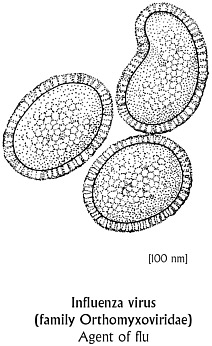
The influenza virus is a member of the Orthomyxoviridae family, whose cousins cause mumps and measles. At about 100 nanometers in diameter, it is average in size for a virus. Under an electron microscope the virus looks like a spiky cotton ball, but the fluffy-looking sphere is actually a fatty membrane. Inside its two lipid layers are the virus’s eight RNA molecules, its genetic intelligence. Studding the surface are 600 stakelike structures, like pins in a pincushion, the glycoproteins hemagglutinin (H) and neuraminidase (N), whose ever-changing antigenic raiment helps them elude detection.
Released through a sneeze or cough, the influenza virus spreads in aerosolized droplets that take at least 17 minutes to drift down from ceiling to floor and that can survive for hours on solid surfaces such as steel and plastic. Its transmissibility is legendary. In the Northern
Hemisphere, summertime epidemics on cruise ships and overland tours are increasingly part of the package, as vacationers (mostly retirees) from all over the world converge in close quarters. In a 1998 outbreak, 40,000 tourists and tourism workers caught the flu in Alaska and the Yukon Territory. Perhaps the most famous travelers’ outbreak occurred in 1977, when a jet with 54 persons aboard was grounded by engine failure. Most passengers stayed on the plane during the four-and-a-half-hour delay, including a young woman who lay prostrate across two seats in the back of the cabin, coughing and feverish with flu. Within three days 72 percent of the passengers shared her pain.
Once the virus makes contact with mucous membranes in the eyes and nose, it heads directly to the epithelial cells that line the upper respiratory tract, bronchial tubes, and trachea, where it swiftly multiplies. All the while, it mutates as it divides, donning an evolving wardrobe of subtly varied—and occasionally radically different—surface attire. Within 24 to 48 hours after the virus has entered the body, it is expelled in a sneeze or cough.
A closer look illustrates the influenza virus’s ingenuity. Its spiky proteins, made of folded strings of amino acids, help it latch onto the epithelial cells lining the nose and throat. Hemagglutinin, a triangular rod-shaped structure abundant on the surface of the virus, specializes in binding to a sugary molecule, sialic acid, on the surface of these cells (the name hemagglutinin was originally used because the virus was discovered to agglutinate red blood cells, i.e., make them clump together, a phenomenon that became the basis of an assay for flu viruses). The docking maneuver prompts the cell to engulf the
virus. Soon the influenza virus—which, like all viruses, cannot reproduce on its own—hijacks the cell’s machinery for its own purposes. First, its RNA and internal proteins invade the cell nucleus. There, viral proteins copy the virus’s RNA strands. They also make a form called messenger RNA, which can be translated into proteins by the cell’s own protein-making apparatus. Eventually, the newly made viral genes and proteins assemble themselves and bud off from the cell as fresh regiments of influenza virions. Neuraminidase, an enzyme that looks like a stalk with a mushroom-shaped head, helps free the newly minted particles from the host cell, spreading the infection.
Scientists believe that flu symptoms arise because viral growth damages colonized cells, and because the immune system, in trying to limit the damage, produces local inflammation and bodywide aches and fever. A day or so after infection, classic symptoms set in: runny or stuffed nose, dry cough, chills, fever, aches, deep fatigue, and loss of appetite. What scientists don’t understand is how the virus clobbers us from head to toe, when it multiplies only in the respiratory tract and doesn’t even swim around in the bloodstream.
There are two major types of influenza virus—A and B, categories that reflect differences in internal proteins. Influenza B mostly infects young children, causing mild respiratory illness. Influenza A is the stuff of which serious epidemics and deadly pandemics are made. Comprising 15 known subtypes of hemagglutinin and 9 of neuraminidase (numbered in the order they were identified), influenza A viruses attack many species of birds and mammals. Type A viruses are named according to the particular hemagglutinin and neuraminidase surface proteins they display, and are further categorized according to slight variants in their antigens—the parts of the virus that induce the immune system to make antibodies. The World Health Organization nomenclature system refers to the host of origin (for nonhuman flu viruses), the geographical site where it was first isolated, the strain number, and the year of isolation. Thus, for instance, A/Swine/Iowa/ 15/30 (H1N1): the classic swine strain, believed to be a close relative of the human pandemic virus of 1918.
The genius of the influenza virus is its propensity to alter itself.
Unlike a DNA virus such as the smallpox virus, whose careful genetic spell-checking minimizes mistakes when it replicates, an RNA virus uses a different polymerase enzyme to copy itself. RNA polymerase is notoriously error-prone, making every successive generation of RNA virus always at least a shade different from its predecessor. The surface proteins hemagglutinin and neuraminidase are also mutable, and because these proteins contain most of the antigenic sites that provoke, and in turn are targeted by, the immune system, an erratic guise works in their favor. Antibodies tailor-made for last year’s strain of flu—and last year’s antigens—cannot protect against this year’s variation. Indeed, in mammals, host antibodies exert a selective pressure on the virus, giving an advantage to surface mutations that help the virus evade the immune system.
The flu virus’s penchant for rapidly transforming itself in response to hostile antibodies is both an asset and a desperate survival measure. “The paradox is that this is apparently a very fragile virus,” says Edwin D. Kilbourne, dean of flu research in the United States, and now a professor at New York Medical College. “Unless it mutates, and unless a new mutant is selected, it’s going to disappear. It’s an ephemeral virus, with remarkable tenacity and adaptability.”
In general, the same subtype of human flu circulates year to year, and only one subtype circulates at a time. The H3N2 subtype, for instance, has been around since 1968. Every year, during flu season, epidemics break out because slight genetic mutations, producing small variations in the virus’s surface proteins, accumulate from the year before, in a process known as antigenic drift. New combination vaccines are annually formulated to protect against the three most threatening strains of flu. But sometimes the virus’s surface proteins undergo a radical substitution, and brand-new hemagglutinin and sometimes neuraminidase, which most people have never encountered before and against which they have no repertoire of antibodies, suddenly appears. With no defenses against the unfamiliar antigens, the human race gets blindsided. The result is a pandemic. While rare, pandemics sweep the world like wildfire. Three major ones broke out in the twentieth century: an H1N1 in 1918 (the misnamed “Spanish” flu), an H2N2 in
1957 (the “Asian” flu), and an H3N2 in 1968 (the “Hong Kong” flu, whose successor strains predominate to this day and continue to produce, in the United States, more than 20,000 “excess deaths” a year).
A mild and more perplexing pandemic took place in 1977. Dubbed the “Russian flu,” this H1N1 strain was identical in all its genes to an epidemic flu strain that circulated in 1950—a medical puzzle, since flu genes are infamously shifty. Some scientists speculate that the virus escaped from a laboratory somewhere in northern China where it had been preserved in a frozen state. The 1977 pandemic did not lead to higher death rates, as most do, nor did it supplant the preceding strain, thus canceling out the scientific dogma that only one flu subtype could circulate at a time. It has been quietly cocirculating in the shadow of H3N2 to this day.
The Barnyard Theory
Where do novel H or N molecules—the matches that light off pandemics—come from? That question has haunted Robert Webster since the 1960s, when he decided that finding the answer would be his life’s work. Webster, a tall, baldheaded, robust outdoorsman, grew up on a farm in New Zealand, surrounded by domestic animals and wild landscapes. After studying viral diseases of domestic animals, he moved to Australia in the late 1950s to pursue a Ph.D. There he was assigned to study the influenza virus and its attendant mysteries. He soon discovered that migrating bird populations were rife with asymptomatic influenza. Over the next decades he paid visits to geese in southern China, ducks in Iceland, terns on Delaware’s Cape May, muttonbirds in Australia, penguins and gulls in Antarctica, to perform the lowly task of collecting fecal samples for lab analysis. “To really understand influenza in a bird population,” he said, “you have to study it all year long, at regular intervals.”
More and more, human flu viruses seemed genetically similar to viruses in aquatic birds. By the 1960s, refining scientists’ suspicions at the time, Webster arrived at what he calls his “barnyard theory”: that the viruses in human pandemics recruit some of their genes from flu
viruses in domestic birds. Even his Australian National University colleague, W. Graeme Laver, was at first skeptical. “All my colleagues said, ‘You will never, ever be able to show that an animal influenza virus transmits to humans and causes disease,’” Webster told me, heat in his voice. “‘You’re wasting your time.’” Until the early 1970s, no one had ever searched for flu viruses in wild birds. To test the theory, Webster and Laver organized an expedition to the remote and exquisite coral islands of Australia’s Great Barrier Reef, finding antibodies to flu viruses in the blood of nesting sea birds. Several years after the 1968 influenza pandemic, with funding from the National Institutes of Health, Webster, who is now at St. Jude Children’s Research Hospital in Memphis, and Laver used the tools of molecular biology to prove that the culpable virus was, in fact, a human–bird reassortant—a genetic hybrid of human and avian viruses, incorporating the hemagglutinin of an influenza virus from a duck in central Europe. In 1972 Webster made his first research expedition to China, which became the epicenter of his work. Over the years, more evidence accumulated.
We now know that the primordial source of all flu strains is migrating aquatic birds. Wild ducks, geese, terns, gulls: these ancient creatures, which have populated the earth for at least 105 million years, harbor the full spectrum of flu viruses (so far as has been identified), H1 through H15, N1 though N9. Domestic avian species—chickens, turkeys, quail, pheasants, geese, ducks—also maintain a large reservoir of flu strains. With a few chilling exceptions, bird flus are harmless to birds, a state of host/pathogen equilibrium that suggests the virus has perfectly adapted to its host over the years, and that even the slightest nucleotide change offers no selective advantage. Ecological stasis also means that, in migrating waterfowl, flu viruses never die out; they simply keep reinfecting birds. All subtypes that have ever arisen or ever will are preserved in perpetuity, like books forever circulating in an open-stack library.
Flu is not primarily a respiratory disease in birds. In ducks, most flu strains replicate in the cells lining the intestines, as well as in the lungs and upper respiratory tract. Passing along the digestive tract, the viruses are then shed in feces. Studies of wild ducks in Canada from
1975 to 1996 showed that up to 20 percent of juvenile birds were infected with flu virus just before taking off for their southern flyways. Through fecal material in lake water, the flu virus apparently passes among feral ducks and is then transmitted to mammals as well as domestic birds, pushing along viral evolution. The passing presence of wild ducks is known to have spawned flu outbreaks in seals, pigs, horses, and domestic turkeys.
Different influenza subtypes infect different animals. Humans are vulnerable to H1, H2, and H3, pigs to H1 and H3, horses to H3 and H7, and so on. This “host range restriction” is determined in part by the virus’s hemagglutinin, which recognizes and binds only to specific kinds of molecular structures known as receptors on the surface of cells. Because different species have different kinds of receptors, they can become infected (with few exceptions) only with specific subtypes of virus. The assumption has been that, if we are hit by flu, we pretty much know what menu it came from.
In this vast gene pool, how do new flu viruses make their way to humans? One way is to boldly leap across species. Scientists have collected several examples of this rare event. In 1988, for instance, a healthy 32-year-old Wisconsin woman in her third trimester of pregnancy attended an agricultural fair—and died of an H1N1 virus that had sickened some pigs on display there. In 1991 a Maryland animal caretaker also died after being exposed to sick pigs. Slaughterhouse workers frequently exhibit antibodies to swine flu viruses, even if they don’t get sick. But pigs are not the only species to dole out influenza viruses to people. The H7N7 virus in harbor seals, for example, can cause conjunctivitis in humans. Still, when humans get infected with flu viruses from other species, for reasons not yet fully known, the infected person seldom spreads the disease to others.
More worrisome, from a public health standpoint, is the mixing of human and animal flu strains. As Webster showed, one of the hallmarks of its evolutionary brilliance is that the flu virus, with eight segmented strands of RNA, is especially prone to swap genes with another strain of flu when both infect the same host. This viral shuffling-of-the-deck produces scary hands, including the antigenic
shift that led to two of this century’s major pandemics, in 1957 and 1968. Webster’s barnyard theory also points to the most likely locale for this viral mixing and matching: the pig, which, possessing two kinds of receptors in its trachea, is uniquely susceptible to both human and avian flu viruses.
Scientists have actually made a kind of time-lapse recording of this process. In 1979, pigs in Europe became infected with an avian H1N1 virus, a strain quite different from any previous H1 strain that had ever infected humans. By 1984 that virus could latch onto both human and avian receptors, but after 1985, the virus recognized only human receptors. In other words, while multiplying in pigs, the bird virus acquired a preference for human receptors in the pig’s respiratory system. Throughout Europe, strains of human H3N2 have also made comfortable homes in pigs. If the replication machinery in the internal genes of these human strains reassorted in the pig with the novel surface proteins of the avian H1N1, it could spell trouble—as in pandemic trouble.
It may well have been in a pig that the deadly 1957 flu (H2N2) swiped two surface genes and an internal gene from a bird virus, while holding on to the remaining five genes from the then circulating human strain. And it may have been in a pig that the 1968 pandemic flu (H3N2) got its hemagglutinin and an internal gene from an avian donor, while retaining the neuraminidase and five other genes from the H2N2 then in circulation.
Any place that is a teeming home to both wild and domestic birds, and to mammals (including humans), may be an ideal breeding ground for a flu pandemic. Europe in the Middle Ages, where humans and animals lived in intimate proximity, was such a milieu; the flu epidemics of that time were probably of local vintage, not imports over the Silk Road. Today’s presumptive ground zero for novel flu strains is China. Since 1850, most flu pandemics have originated there. In China all known flu A subtypes reside in ducks and in the water they inhabit or fly over. China also has the world’s largest pig population, and one-fifth of the human race, densely crowded even in rural areas (indeed, the Chinese ideograph for “home” is a roof sheltering a pig). China,
with its wide climate variations from north to south, hosts human infections year round. And in the great rural expanses of China, pigs and ducks regularly hobnob. Ducks are an important adjunct in farming; swimming around in rice paddies, they nibble on insects and crabs but ignore rice grains, a neat ecological arrangement. And pigs are privileged members of farm households, a gauge of a rural family’s wealth. Litters of piglets may spend cold nights inside a farmhouse sleeping alongside family members. On small farms, pigs not only root in the soil for food, inhaling avian flu viruses from wild duck droppings, but are also treated to table scraps that may contain human flu viruses.
Thus, China provides the most opportunities for pigs to be co-infected with human, avian, and swine flu strains—and for flu strains to reassort into unexpected, possibly pandemic, contagions. “Influenza research is a continuing detective story, with all the intrigue of an Agatha Christie novel,” writes Kennedy Shortridge. “In the case of a pandemic virus, the H subtype of the prime suspect may be as unlikely a culprit as the vicar’s wife.” In China, Shortridge adds, influenza is always lurking; it cannot properly be called an “emerging” infection. As he presciently wrote in 1995: “‘Elusive’ might be more apt.”
H5N1
“This is how it begins.” When Keiji Fukuda, chief of the epidemiology section of the Centers for Disease Control and Prevention’s influenza branch, hung up the phone after talking to his boss, those were the first words to crystallize in his mind. When a severe epidemic breaks out in the United States, Fukuda’s job is to find out precisely where the outbreak started, how it spread, and how it can be corralled. If a pandemic were to erupt anywhere in the world, he would head the CDC team dispatched there, lending his and his group’s expertise in answering the scientific questions while helping navigate political waters during the emergency.
Fukuda has the right personality for a job that drops him into medical maelstroms: quiet, inward, a good listener, a careful speaker whose words seldom stray outside a narrow temperature range. His
close-cropped hair, round wire-rim spectacles, and refined features lend him an almost monkish aspect, a sense of calm in the midst of chaos. His mother was born in Japan, his father in San Francisco to a Japanese family. Himself born in Japan, Fukuda grew up in the picturesque town of Barre, Vermont, where as a child he got fired up reading Kipling’s books about India. Three times during college and medical school he decamped for a year to backpack around the world. During one of those jaunts he became interested in malaria, with its astounding human toll, complicated biology, and tricky international politics. Joining the CDC was Fukuda’s way of using both his brain and his conscience. Public health crises, he says, “are not intellectual issues that exist in a vacuum.”
In the middle of August 1997, Fukuda was on one of his annual sojourns to San Francisco for a few weeks of clinical work, part of his Public Health Service commitment, when he received the call from Helen Regnery, acting chief of the CDC’s influenza branch. An H5N1 virus—a pure and devastating avian flu strain—had killed a healthy three-year-old boy in Hong Kong. Regnery didn’t need to spell out the implications: the fuse for the next deadly global wave of human influenza, the fourth in the waning century, may have just been lit. He had better pack his bags.
Fukuda, 42-years-old at the time, had imagined this possibility, and in passing reveries of ambition was even eager for it. The last bona fide flu pandemic had occurred almost 30 years before, in 1968, with the worldwide debut of the H3N2 strain. The last scare had been the swine flu debacle in 1976. After Regnery’s call, and what ensued over the next half year, Fukuda would never again idly wish for the career-gilding pressure of a pandemic.
The three-year-old boy had become sick on May 10. Doctors prescribed antibiotics for the fulminant infection in his left lung. But the lung collapsed, the boy’s liver stopped working, his brain swelled (from Reye’s syndrome, caused by aspirin use), and finally his kidneys gave out. On May 21, he died. The boy’s virus was some kind of influenza A virus—but exactly which kind, the Hong Kong Department of Health lab couldn’t determine. Now, three months later, a group of
researchers in the Netherlands identified the viral culprit as an unreconstructed bird flu; the CDC confirmed the finding.
If true, the lab reports were both puzzling and alarming. The thinking had been that in order for a person to become infected with an avian flu strain, the viruses must first be passed through a pig. How did a bird virus jump directly to a human—and kill? Had there been other undiagnosed cases? Was something new going on in the tangled ecology of flu?
International media jumped on the story. The boy’s death was a “significant event,” Robert Webster told one news-service reporter. The World Health Organization’s surveillance effort for both humans and animals in China was stepped up. Researchers began working on a rapid diagnostic test for the new strain. Among flu experts around the world, the betting was that this was a case of laboratory contamination, nothing more. Fukuda quickly ruled out that comforting scenario. He also learned that the boy had always been healthy, and that no evidence showed the virus spreading through the population—no rise in deaths had occurred, no increase in the number of patients on respirators, no surge of feverish cases in emergency rooms, no jumps in other suspicious diagnoses.
To find out whether H5N1 infections had been lurking unnoticed, the CDC team tracked down blood already collected for other medical reasons, including blood from healthy donors and from children participating in studies unrelated to flu. To see whether the boy had passed on the virus to his family and others, or whether he had contracted it from someone else, investigators drew blood from everyone who had had contact with him. Finally, the team also drew blood from poultry workers. Earlier that spring, before the boy died, H5N1 infections had broken out at three chicken farms in the rural northwestern part of the New Territories (the land north of Kowloon). On two of these farms, the mortality rate among the birds was 100 percent. Authorities ordered the rest of the birds slaughtered. Exposure to poultry offered a tantalizing possibility of how the boy might have become sick. In his classroom was a “feathered pet corner,” where chicks and ducklings had died in the days just before the boy became ill.
By the end of the investigation, about 950 samples of blood had been drawn. Only seven contained antibodies indicating exposure to H5N1—five (of 29) from poultry workers, one from a classmate of the dead boy, another from a doctor caring for the boy. Of these, only the doctor recalled feeling under the weather that spring—but it was too late to prove he had actually been sickened by H5N1, much less that he had caught the virus from his young patient. Scrapings from the pet corner were negative.
By early September, after Fukuda had been in Hong Kong three-and-a-half weeks, nothing seemed clear. The scientific consensus was that the boy’s death was aberrant and inexplicable, but that it didn’t pose a problem to others because it hadn’t reassorted with a human strain of flu. Still, Fukuda kept pointing out to blasé colleagues that although H5N1 didn’t seem to be an imminent pandemic threat, it was a novel virus in humans. He sat back on the plane home, exhausted and uneasy. He had never found out how the boy had become sick. But he had seen, up close, how quickly rumors can circulate, headlines can plant panic, and institutions can be strained, even during a false alarm. If H5N1 had turned out to be the start of a new pandemic, the world wasn’t ready for it.
***
On November 6, 1997—six months after the three-year-old boy had died and two months after Fukuda had flown back to his office in Atlanta—a two-year-old boy in Hong Kong came down with a fever and sore throat and cough. The next day he entered the hospital, and doctors swabbed his nose for a sample. The boy recovered and was discharged two days later, but when lab workers tested the sample, it turned out to be H5N1. Case #2. The avian flu had once again jumped species, without a pig intermediary. Where had it hidden during the six-month lull? No one knows. Perhaps the virus had thinned out when the poultry infected in rural Hong Kong were slaughtered that spring. No infected chickens meant no chance for the virus to jump to
humans. But even if domestic poultry had been temporarily eliminated as a reservoir, the virus must have continued to thrive somewhere.
The CDC heard about the case in late November. On the night of December 6, Fukuda and a colleague in the CDC’s Epidemic Intelligence Service (EIS) arrived in Hong Kong. A medical officer from the Hong Kong Department of Health greeted them at the airport with more bad news. Just that day, H5N1 had turned up in a specimen from a 13-year-old girl who was on a respirator. Worse, a 54-year-old man had died of respiratory failure, and H5N1 was isolated in him as well. He had been sick since late November, when he first felt fever and chills, but had gone on a vacation bus tour in South Korea. On November 29 he was admitted to the hospital with severe pneumonia. The doctors were helpless. Case #4. “The second investigation started out at 100 miles an hour,” Fukuda says. “And it got faster and faster.”
It looked like the epidemic everyone had braced for in the summer. On December 4, a 24-year-old Filipina domestic helper suddenly felt feverish, headachy, and dizzy; five days later she was in critical condition with respiratory and renal failure. On December 7, a feverish five-year-old girl—whose grandmother was known in the neighborhood for scavenging dead chickens from the markets—began vomiting; three days later, she was admitted to the hospital. In a bird-worshipping culture, the new avian flu threw the city into a panic. Residents dumped pet cockatoos, pigeons, and mynah birds in front of the Society for the Prevention of Cruelty to Animals. Hong Kong’s biggest poultry market was closed for sterilization. Robert Webster speculated before the press that if a pandemic were really afoot, “There is nothing we can do to contain it.” Even the city’s director of health sounded a note of defeat. “It seems we are entering a competition with the virus,” she said. “We are working at breakneck speed.”
On December 12 events took an ominous turn. A sick two-year-old cousin of the five-year-old girl tested positive for H5N1. Shortly after, so did a four-year-old cousin. Investigators became obsessed with one question: Was the virus jumping from person to person? Word came in of another chicken farm outbreak—the fourth—in the New Territories. With each new development, the media bore down harder
and harder, and the public grew more alarmed. Why were some people getting sick and not others? Scientists already suspected that the virus was transmitted from poultry to humans. But as new cases kept surfacing, Fukuda wondered: Are other animals harboring the virus and spreading it to people? Mice? Cats? Nothing seemed too farfetched. To get answers, investigators had to interview the patients’ families and other close contacts. They often found that the aggressive Hong Kong media was one step ahead of them—besieging the relatives of infected patients with microphones and cameras. By the time EIS officers arrived to collect crucial details about victims’ activities and exposures, families refused to speak.
On December 21, Case #3, the 13-year-old girl, died. On December 23, Case #12, a 60-year-old woman, died. The tally was beginning to suggest an epidemic-in-progress. Off the record, health officials told reporters the virus was being transmitted between people. On Christmas Day, Fukuda’s mood turned black. Hospitals were reporting more flu patients. Fukuda’s mind kept returning to what he had read about the Spanish flu—the suddenly accelerating deaths that autumn, marking what in retrospect could be seen as the second wave. The pattern seemed “eerily reminiscent of 1918,” Fukuda said. “I thought this thing was beginning to explode.”
On the eve of the regular flu season, which begins in February in Hong Kong, public health officials also feared that H5N1 would swap some of its genes with the well-adapted H3N2 or H1N1 human flu viruses that were circulating, or with human viruses infecting pigs, creating a novel killer that would easily spread from person to person. Reassortment, of course, had ignited the 1957 and 1968 flu pandemics. It was a race against viral evolution. What scientists knew about the past behavior of lethal avian flus compounded their fears in Hong Kong. Influenza rarely attacks domesticated chickens, because they are sheltered indoors, away from the strains spread by feral ducks and other birds. Two previous epidemics in chicken farms, however, had showed how savage an avian flu can become away from the wild. The first took place in April 1983, when an H5N2 virus spread in vast commercial chicken operations in Pennsylvania. At first, the disease
was mild. By October, it had become vicious. The chickens had swollen, bluish combs. Their eyes and legs were bloody. They laid eggs without shells. Autopsies showed that the virus produced hemorrhaging in every type of tissue, including the brain. In 1993, H5N2 broke out in Mexican chicken farms. It too started with deceptively mild symptoms and ended with decimation.
The emerging Hong Kong H5N1 virus had stretches in its hemagglutinin protein identical to those in the Pennsylvania avian flu. And as University of Wisconsin virologist Yoshihiro Kawaoka discovered, the virus’s lethality was not limited to birds. When he injected human H5N1 isolates into mice, the virus replicated in all organs, virtually dissolved the lungs, and killed the animals. “This is the most pathogenic virus that we know of,” he says. “One infectious particle—one single infectious virion—kills mice. Amazing virus.” Could it do the same to humans? Public health officials worried that it might just be a matter of time before the virus adapted to people, mutating or reassorting in a way that reduced its human hosts to a bloody pulp.
On Sunday, December 28, the Chinese government announced that it would kill all the birds on chicken farms, wholesale markets, and live bird stalls in the territory—more than 1.5 million creatures over a three-day period—and would temporarily halt imports of birds from China. Only six months before, Hong Kong had been released from British colonial rule, and for weeks politicians had been blaming the leadership for dragging its feet. The dramatic gesture was partly meant to build confidence in the new regime, but it also sprang from the science. Just before the holiday, Robert Webster and Kennedy Shortridge had organized a team to begin testing birds in the city’s “wet” markets, where sellers washed down stalls and sidewalks twice a day with water. They found that 10 percent of chickens in the markets harbored H5N1. The virus had heavily infiltrated wholesale markets and farms. Ducks and geese also carried the virus, though these species showed no symptoms of disease.
On December 29 the slaughter began. Scuffles broke out between chicken vendors and reporters, whom the vendors blamed for exaggerating the problem. Buddhist monks held a marathon seven-day
prayer chant for the souls of the dead birds. Workers from the Agriculture and Fisheries Department—many of them deskbound functionaries—donned white coveralls and surgical masks to carry out their assignment, loading the birds into black plastic bags and pumping in carbon dioxide. When the CO2 ran out, they drew knives across the birds’ throats. With feathers and dust flying, reporters crowded in close wielding cameras and notepads. Members of the EIS team, in a smug reverie, designed a study in which they would collect timed blood samples from the intrepid media, tracking the rise in antibody levels.
Though Keiji Fukuda couldn’t know it at the time, the December surge in flu cases merely marked the onset of Hong Kong’s annual influenza season: routine cases of previously circulating strains. The last person to be diagnosed with the strange bird flu, H5N1, became ill on December 28, the day before the slaughter commenced. This 18th hospitalized victim was a 34-year-old woman with several underlying conditions. She became ill with the flu, then pneumonia, then a mean, antibiotic-resistant form of blood poisoning. In early January she died. With her death the H5N1 outbreak finally ended. But in Hong Kong, the story was not quite over.
Time Travelers
Like the 1918 flu, the brief H5N1 epidemic primarily struck down healthy people. Even modern medicine’s most powerful artillery couldn’t stop the virus. This helplessness revived a question that had long preoccupied researchers: What makes some flu viruses so catastrophic? Long before H5N1 broke out, many researchers had become convinced that if they could find a specimen of the 1918 flu virus, they could take it apart and discover what made it—and what could make future pandemics—so deadly.
Jeffery Taubenberger is not a flu man. Chief of the division of molecular pathology at the Armed Forces Institute of Pathology (AFIP), in Washington, D.C., a down-at-the-heels government lab, his primary interest is immunology, specifically how stem cells—the precursors to all kinds of blood cells—develop in bone marrow. “I’m
interested in projects that go at big questions,” he said, “knowing that the only way to get at big questions is to do one tiny thing at a time.”
In science, an inspirational spark in one specialty can make a spectacular leap to a seemingly distant domain. For Taubenberger—a short, sloe-eyed, eloquent man who composes chamber music in his off hours—the creative path to the 1918 flu virus began in 1987 on the New Jersey coast, with a die-off of bottlenose dolphins. The epidemic spread south to Florida, finally petering out in 1988. At least 10,000 animals died. At first, experts blamed the epidemic on red tide, an overgrowth of toxic algae. But when veterinary pathologists looked at the dolphins’ tissues, they concluded that the damage bore the hallmarks of a morbillivirus—a marine relative of the virus that causes distemper in dogs, and the virus that causes measles in humans. After 1987, other sea creatures—seals, porpoises, various species of dolphin—suffered similar die-offs around the world, making morbillivirus a true emerging infection in the aquatic realm. Taubenberger and a colleague wanted to track the virus’s spread in the Atlantic and the Pacific. To begin that detective work, a colleague in Taubenberger’s lab spent more than a year refining a technique for extracting the virus’s fragile RNA from tissues that were sea-logged and badly decayed.
The breakthrough solidified the lab’s unusual, if unheralded, expertise—getting genetic material out of decidedly unpristine tissue. These creative fires were stoked by a practical necessity. Unlike hospital laboratories, which analyze fresh samples, the AFIP traffics in old specimens. The institute’s predecessor—the Army Medical Museum— had been launched by order of Abraham Lincoln during the Civil War, with the far-sighted goal of collecting specimens that could be used in research on military medicine and surgery. After all, in the War Between the States, as in virtually all wars before and since, more combatants died from infectious disease than from battle wounds.
Today, the National Tissue Repository, a division of the AFIP, houses three million specimens from autopsies on soldiers and clinical records describing the progression of their diseases. Some of these samples are organs sloshing in formalin solution and packed in thick see-through plastic bags. Some are translucent slices pressed between
glass slides. And some of the oldest are slivers of tissue about the size of a thumbnail, preserved and then embedded in small blocks of paraffin wax—slivers that can still be sliced thin and peered at under a microscope. During the early 1990s, the molecular pathology lab at AFIP had quietly cornered a niche market, perfecting molecular techniques that could retrospectively diagnose infectious and genetic disease in these old specimens.
Once Taubenberger had proved it’s possible to retrieve small amounts of DNA and RNA from fixed tissue, he searched for a project that would showcase his lab’s exotic expertise. Perhaps they could genetically analyze tissue from victims of what in the Civil War was called “camp fever.” Was it caused by malnutrition? Or by typhoid, a bacterial infection caused by a strain of salmonella? When someone mentioned the 1918 flu, Taubenberger had an “Aha” moment. The AFIP has perhaps the world’s largest collection of tissue samples from victims of the pandemic: about 120 specimens from American soldiers who died of the disease. If Taubenberger’s lab could genetically sequence the virus behind that global catastrophe, it would go down in history not only as a technical feat but could presumably lead to unprecedented insights into the biology of flu.
The first step was to find tissue samples that harbored the actual virus, not just vestiges of bacterial pneumonias caused by staph, strep, and haemophilus bacilli. It wouldn’t be easy. The flu virus is a hit-and-run germ, rapidly copying itself in host cells for only a day or two after the infection, then leaving the scene of the crime. By the fifth day after infection, the virus has disappeared from lung tissue. Taubenberger was therefore searching for victims who died less than a week after first feeling ill. In an underequipped office, he jury-rigged a microscope to view microfiche copies of the World War I soldiers’ clinical records. Peering at the pale, spidery script of his grandparents’ era, he tried to discern which soldiers had succumbed to massive pulmonary edema and hemorrhage, the classic signs of acute influenza death.
Taubenberger selected the most promising samples and gave them to Ann Reid, a gifted lab technician. Reid was a true intellectual peer— every bit as methodical and creative as Taubenberger, and possessed of
what bench scientists call “good hands”: the rare ability to handle minute quantities of materials swiftly and adeptly and with fanatical precision, setting up the same experiment again and again and again. But in the rigid class hierarchies of science, Reid—a striking woman with a direct gaze and an easy manner—had little standing. Not only did she lack a Ph.D., but she was a part-time employee, arriving at 6:30 each morning and leaving at 2:30 in the afternoon. “I have to leave,” she says. “Because I have kids to pick up from school and soccer practice and piano lessons, and I do a lot of church work. There’s a whole life that takes over when I walk out this door.”
Reid’s job was to employ a technique known as RT-PCR, for reverse-transcriptase polymerase chain reaction. PCR lets scientists make millions of copies of known stretches of DNA, the ladder-like molecule that guides all biological functions. A variation of this technique, RT-PCR enables researchers to amplify RNA viruses such as the influenza virus by adding a step that converts their RNA to a form of DNA.
PCR and genetic sequencing is an endlessly recursive process. In a nutshell, Reid’s work went something like this: She started out with a tiny quantity of the virus’s genetic material from the AFIP’s most promising specimens. Then, using the benchtop PCR machine, she tried to amplify a particular nucleotide sequence that barely changes across flu strains. If she found this conserved stretch of genome, she would once again amplify it, spell out its nucleotide sequence, and confirm the finding.
For 15 months, from March 1995 to July 1996, Reid labored exclusively on the 1918 flu project and did not find a single shard of the virus’s genetic material. Then she sat down with a new sample. This time a positive result came back. Reid and Taubenberger went to a computer and entered the 50-odd base pairs into GenBank, which compared it against all other published sequences. The computer digested their request for an endless minute and flashed this response: The sequence belonged to an influenza matrix gene which, though similar to strains from the 1930s, did not perfectly match them. This meant the virus was unique. It was old. It could only have come from the 1918 flu.
Roscoe Vaughan, a 21-year-old army private at Fort Jackson, South Carolina, took ill on September 18, 1918, just after the start of the deadly fall wave. On September 26 he died. An autopsy revealed that, while his left lung showed typical signs of massive bacterial pneumonia, his right lung was inflamed only at the ends of the bronchioles and their surrounding air sacs. It was a snapshot of the influenza virus vigorously replicating in the lungs. Apparently, the right lung lagged several days behind the left in the disease process, and that unusual asynchrony worked in Taubenberger’s and Reid’s favor; of the first batch of samples examined under the microscope, only Vaughan’s contained the flu virus.
Reid started figuring out the virus’s gene sequence. So badly deteriorated was the virus’s RNA, she had to work with segments usually no more than 130 base pairs in length—in a virus that contained more than 15,000 base pairs among eight different gene segments. Reid designed primers—chemical frames—that would bind to overlapping genetic fragments, allowing her to painstakingly assemble a picture puzzle of the genome.
When Taubenberger and Reid found identifying snippets of five different genes, the highly variable hemagglutinin and neuraminidase genes tipping them off to the lineage of the virus, they decided it was time to publish. In September 1996 they sent their first paper to Nature. The manuscript came back instantly—rejected, unread. They sent it to Science. Same story. They sent the article to a third publication whose editor was interested—so interested that when he lunched with an editor at Science, he mentioned the manuscript. The Science editor’s ears perked up. “I think that came across my desk,” she said. She called Taubenberger and asked him to resubmit the paper. Six months later, in March 1997, the article in Science described the first cut at genetically sequencing the 1918 flu virus and setting it in an evolutionary scheme. The authors concluded that the virus was indeed an H1N1 virus, similar to that in swine flus.
For the first time in Taubenberger’s career, his work got noticed. It was a surreal time for the 36-year-old. Twenty phone calls a day from reporters. TV interviews. Documentary films. Tensions flared in the
lab, disgruntled colleagues feeling Taubenberger was getting more than his fair share of accolades. Flu experts from outside regarded Taubenberger as either interloper or parvenu.
In the glare of publicity, Taubenberger couldn’t ignore a problem on the horizon. The archival specimen was tiny—about the size of a thumbnail. To fully sequence the 1918 flu virus, he would need a fuller sample. Five months after their paper was published, Taubenberger and Reid recovered a second positive paraffin-embedded sample from the AFIP collection. While this second case was a boon, it was not enough. With the finish line in sight, Taubenberger and Reid would run out of material before they could reach their goal.
***
In the spring of 1997, living in San Francisco, Johan Hultin came across an article that described Taubenberger’s dramatic breakthrough in decoding the 1918 flu virus. It seemed like the culmination of his own dream—a blueprint for the virus, if not the virus itself. Not until two years after his midcentury Brevig Mission trip was the genetic code elucidated. Not until decades later could his colleagues have known that the RNA molecule making up the influenza virus is too fragile to withstand Arctic temperatures. Hultin had abandoned his dreams of becoming a great virologist and settled for a medical degree, a career in pathology, and raising a family. Along the way, he was constantly plunging into projects that tested the limits of his physical strength and literally salvaged the hidden remnants of history—locating a wagon abandoned by the ill-fated Donner Party, climbing an uncharted peak in Pakistan, restoring an ancient coastal labyrinth in Sweden.
In July 1997, he wrote to Taubenberger: “Your article in Science, March 21, 1997, and your discussion with Jim Lehrer I found most interesting. . . .” As “an entirely private undertaking,” Hultin offered to deliver to Taubenberger specimens from the frozen victims at Brevig Mission. He had once gained permission to enter the mass grave, and he was confident he could do it again.
Taubenberger had taken time off after the birth of his second child, and hadn’t seen his mail for several weeks. When he read the letter, he immediately phoned Hultin.
“When can you go?” Taubenberger asked, expecting that Hultin’s trip would take a year or so of planning.
“I can’t go this week. But I can go next week,” Hultin responded, feeling sheepish about the delay.
Taubenberger said nothing for a moment. He couldn’t believe his luck—that out of the blue, a stranger with Hultin’s credentials was offering his services. Hultin thought the silence was skepticism. He was grateful Taubenberger didn’t hang up.
August 19, 1997, was windy and rainy in Brevig Mission. In a community that was 92 percent Inuit, the majority unemployed, Hultin was a sight: a six-foot-tall Swede with white hair swept back and a white goatee—a kind of lean Colonel Sanders, without the treacle. At 4 p.m., dressed in waders and suspenders and his wife’s white floppy sun hat, he began removing squares of sod. Four young village men in jeans and baseball caps helped out. By 10 p.m., the light of the long Arctic summer still strong, they still hadn’t reached permafrost.
The next day, their shovels hit an implacable layer of otherwise dark, normal-looking ground, at a depth of four and a half feet. Permafrost at last. It was a good sign, suggesting that even in high summer, the earth had thawed only near the surface. The yield was less than spectacular—only the remains of a child and an adult, too decayed for even small tissue samples.
On August 21, at a depth of seven feet, shovels began to expose a body that looked far better than the others. The skin over the chest was hard and tough, an inch thick. When Hultin cut into it, he saw a yellowish substance with whitish gray specks—decayed fat. It was a woman between 25 and 35. A black tuft of hair sprouted from her skull. She was turned slightly to the right in her earthly resting place, an almost demure pose. Most important, from Hultin’s point of view, her lungs were not only intact but also deep dark red in cross-section, suggestive of the hemorrhaging in acute influenza death.
The next morning, Hultin used his pruning shears to open the rib
cage and remove the dry, leathery lungs. On a plywood board that had washed up on the beach, he cut slices of the lungs, placing some in formalin (for later work on cell pathology), others in either alcohol or a solution of gaunidinium thiocyanate, which saves genetic material while inactivating any live organisms—both fixatives that would preserve the virus’s precious RNA.
Later that day, resting on an overturned pail, Hultin was absentmindedly gazing at the open grave. All day long he had been turning over the same question in his mind: why was this woman’s body so beautifully preserved, unlike virtually all the other corpses, even the bodies closely flanking her, deep in the permafrost. Of 11 bodies found in the grave, only four had retained soft tissue—but none as unspoiled as this. Suddenly it dawned on him: She was obese. A layer of thick fatty skin had insulated her ravaged lungs. He named her Lucy, a tip of the hat to anthropologist Donald Johanson’s 1974 find, an ancient australopithecine and possible ancestor of humans. Hultin hoped that “Lucy,” a name derived from the Latin word for “light,” might illuminate the deadliest infection in history.
After flying back to San Francisco, Hultin meticulously wrapped the remnants of the 1918 flu. He dispatched four packages via separate carriers to Jeffery Taubenberger, ready to wait a month or so for the results. Ten days later he got a phone call from Taubenberger. Lucy tested positive for the 1918 virus. And because this frozen cache was the most abundant sample, it became the new index case against which all other samples would be compared.
***
So why was the 1918 flu so uniquely deadly? When Taubenberger began his quest, he hoped that a single genetic mutation would solve that puzzle. Perhaps the 1918 flu had a mechanism akin to the “fowl plague” flu viruses (including H5N1), which permits the hemagglutinin molecule to be cleaved—and thus made infectious—in every cell of the body, leaving a bloody pulp. But Taubenberger found that the 1918 flu virus does not have this telltale genetic glitch, or anything else
in its surface protein-coding genes that would render the virus pantropic, i.e., capable of attacking many tissues. Far from being a blueprint for the biological equivalent of St. Peter’s cathedral, it looks like the plan for a concrete parking garage.
Even when Taubenberger and Reid are able to publish the entire 1918 sequence, by 2004 or so, it may tell scientists nothing. “You can think of sequence like you think of the notes of a score,” Taubenberger said. “Music only exists as sound, so that the score to Beethoven’s Fifth Symphony is not Beethoven’s Fifth Symphony. Only when an orchestra plays it does it become Beethoven’s Fifth Symphony. That’s just like the sequence of a virus. It’s just the directions for making the virus, it’s not the virus.”
Today it appears that the virulence of the 1918 flu may stem from many factors: its ability to copy itself quickly, to inflict damage deep in the lungs, and to spread with astounding ease. These may result from interactions between the virus’s genes or between the genes and the host’s immune system. And despite the effort Taubenberger and Reid spent cracking the virus’s code, this knowledge may not protect us against the effects of the next pandemic.
All influenza viruses are not created equal. What may explain the differences is a technique just on the horizon: reverse genetics, in which scientists, knowing the full sequence of virulent and nonvirulent viruses, introduce subtle mutations into cloned genes in order to see how these affect virulence and transmissibility in mice or ferrets. Such visionary methods are risky. As Robert Webster put it, “We can’t generate 1918-style virus. We have to be careful not to create monsters.”
Taubenberger and Reid’s subsequent work has revealed a provocative fact: the 1918 flu pandemic was not set off by the same circumstances as the ones of 1957 and 1968. Those viruses had surface proteins that jumped directly from birds, coupled with human-adapted core genes. By contrast, in the 1918 virus, the surface genes are mammalian in character. Though probably originally derived from a bird, the virus had spent years adapting to life in mammals, either pigs or humans. Taubenberger estimates that the virus began making its rounds in humans in 1917, just before the pandemic’s spring wave. If
that kind of leisurely genetic adaptation happened once, it could happen again. Maybe people pick up animal flu viruses all the time. Maybe pigs aren’t the only mixing vessels. Maybe that’s the lesson of Hong Kong.
The good news: if people are catching animal viruses all the time, the circumstances behind a pandemic must truly be rare. The bad news: if people are catching animal viruses all the time, and these viruses are capable of hanging around and adapting, a pandemic is perpetually around the corner.
The Next Pandemic
So convinced are public health officials of the inevitability of a flu pandemic that they call the past 30 years’ respite the “inter-pandemic” period. A gloomy locution, like calling good health the “inter-disease” period, or marriage the “inter-divorce” period, the phrase nevertheless captures the essentially ominous quality of flu. As Kennedy Shortridge wrote in The Lancet: “Put simply, each year brings us closer to the next pandemic.”
This certainty has led to national and international influenza pandemic preparedness plans. Though spun in flat bureaucratic prose (the U.S. draft plan calls nasty vaccine side-effects “untoward and unexpected programmatic events”), these documents try to anticipate all the ways a pandemic could unroll and how modern medicine might outflank this microscopic enemy. Pandemic preparedness is provisional in nature, always subject to revision as more quirky virus behaviors come to light.
The year 1918 offers one frame of reference for a modern pandemic. That year, October was a scene out of Dante, in which deaths mounted at an alarming rate. In one week Philadelphia lost 4,500 citizens; the dead were left in gutters. At Fort Gordon, in Atlanta, soldiers’ coffins were stacked like cordwood. In Chicago police closed theaters, skating rinks, movie houses, night schools, and lodge halls. In San Francisco the order to don gauze masks outside the home was written into law.
Is that how a 1918-force epidemic would hit us today? It’s often said that we live in a world vastly different from that of 1918, that modern medicine—which has cured cancer, scoured plugged-up arteries, and planted fetal cells in aging brains—could surely handle something as trivial as flu. It’s true that today’s antimicrobials might limit secondary pneumonias, and it’s true that doctors can now treat such complications as heart and lung failure. Still, CDC officials estimate that up to 200 million Americans could sicken; 45 million could need outpatient medical care; 800,000 could be hospitalized; and up to 300,000 could die.
Our inability to help those sickened by the recent H5N1 virus— patients who had received excellent medical care—has revealed how shaky our position really is. The truth is, scientists still don’t know what biological gears drove the 1918 pandemic. Nor do they know why many who recovered had aftereffects such as Parkinson’s disease. Nor can they be assured that in our more densely populated, technology-dependent world, a severe flu pandemic wouldn’t be worse than ever. Contemporary air travel would surely hasten the global spread of a new virus, from four months in 1918 to perhaps four weeks today. (Not long after the H5N1 outbreak, Joshua Lederberg wondered how many travelers had passed through Hong Kong’s Kai Tak Airport in November and December 1997, when that epidemic hit full force. The answer: more than 4 million.) Urbanization would speed the transmission of the virus once it arrived in a new locale. Today’s antibioticresistant strains of strep, staph, and other agents of secondary infections would leave us perhaps less prepared than we were in 1957, before antibiotic use was so promiscuous. Infection with the AIDS virus would leave many flu victims with faltering immunity, raising the death rate. And the larger elderly population in the United States would raise the death rate dramatically, a trend borne out in interpandemic years. Since 1985, hospitalizations for all diseases have dropped 32 percent—the legacy of health mainenance organizations. But hospitalizations for pneumonia have risen 50 percent—the legacy of longer life expectancy.
***
All of which underscores the need for vigilant surveillance of novel flu strains. In the World Health Organization pandemic preparedness plan, national influenza centers in more than 80 countries—with their ability to quickly identify unfamiliar viruses—form the front line. If they find a strange new isolate, they send a sample to one of the four WHO Collaborating Centers for Reference and Research on influenza (including the CDC in Atlanta), where the variant can be confirmed and further studied antigenically and genetically.
Still, the politics of close surveillance is tricky. It took Robert Webster decades to build trust with his Chinese hosts, who understandably feel threatened when the West labels them the influenza epicenter of the world. Not illogically, the Chinese have adopted a certain fatalism about influenza pandemics; they know they would be the first to get slammed, and that emergency measures would arrive too late to help. The Chinese also place more priority on other diseases: hepatitis, Japanese encephalitis, AIDS, polio, and rabies. And Chinese scientists resent the fact that their country is a mecca for ambitious researchers from elsewhere in the world, who may fly to Asia solely to snare interesting viruses and earn themselves academic acclaim. Animal flus are perhaps even more difficult to report than human strains, because these diseases taint trade. Despite these problems, the monitoring of new influenza viruses and of human and animal disease is tighter in Hong Kong than anywhere else in the world. Mainland China also has excellent virologic surveillance.
Yet even in the state of red alert after H5N1, things don’t always work the way they should. In March 1999 in Hong Kong, for example, it was déjà vu all over again. Two little girls, ages one and four, caught the flu. At first, nothing about their cases seemed to stand out. They had all the usual symptoms—a sudden fever, sore throat, headache, vomiting. And even though both had medical histories that made doctors extra cautious—the one-year-old was very small and had been diagnosed with “failure to thrive,” the four-year-old suffered asthma and eczema—both recovered completely and were soon discharged from
the hospital. But when WHO laboratories in London and at the CDC analyzed the virus, they discovered that the girls had been infected with the strain H9N2. The pathogen was known to cause mild illnesses in poultry, as well as in pigeons and quail, and was antigenically similar to swine viruses isolated in Hong Kong in 1998. Never before, however, had H9N2 been isolated in people.
When Hong Kong officials announced the findings in April 1999, flu experts around the world were surprised and dismayed. Was this a reprise of H5N1? They were even more startled to hear that in August 1998—a full seven months before the two Hong Kong girls had become sick with H9N2—five China mainlanders had also fallen ill with the virus. Not until after the Hong Kong findings were broadcast did Chinese health officials publicly acknowledge the earlier cases. Initially they may have been reluctant to discuss the findings because the original samples may have been contaminated with avian viruses, a result of shoddy lab technique. News reports quoted the director of the Influenza Surveillance Center in Beijing as saying that he neglected to report the cases to WHO because there had been no signs of a large outbreak. Like the Hong Kong patients, the mainland patients were mostly small children, and all quickly recovered. But so far, no WHO labs have seen the five isolates. That worries Nancy Cox, chief of the CDC’s influenza branch. The success of the WHO collaborating laboratory system, she says, depends on “how willing people are to share their information and share their viruses at critical points in time.”
That two quizzical bird viruses—H5N1 and H9N2—jumped to humans in rapid succession has unsettled many flu specialists. Although scientific dogma states that humans don’t have the right receptors for bird flu viruses, that dogma is starting to crumble. “Common sense tells me that both the H5N1’s genome, and the H9N2, have something very special,” Webster says. “They have special characteristics that allow them to spread to humans. We think it’s related to their internal genes rather than their receptor specificity.” Indeed, Webster found that the six internal genes of the two viruses—everything except the hemagglutinin and neuraminidase genes—were virtually identical.
Today, 10 percent of the birds found in Hong Kong’s live markets
harbor H9N2. And in echoes of 1997, a new and deadly H5N1 strain in chickens forced the Hong Kong government in 2001 to order the slaughter of 1.2 million market birds. In Webster’s mind, that fact makes intensive surveillance even more critical. In human blood, what’s the baseline of antibodies to animal flu viruses? Are antibodies to, say, H9N2 rising from baseline? If so, are the viruses somehow changing and adapting to humans? Will H5N1 stage a comeback? “If we could get a handle on that before it really goes,” says Webster, “then we have an advantage in making a vaccine that would head off a pandemic.”
But Ed Kilbourne, the grand old man in American flu research, is skeptical that we can ever track a nascent pandemic. No matter how influenza smolders theoretically, we won’t know it’s caught fire until people get sick. Perhaps lethal genetic reassortment is a rare and idiosyncratic and ultimately unpredictable event. “To me,” says Kilbourne, “what’s happened with H5 and H9 strengthens the case that you can’t just have ‘alarums and excursions.’”
Kilbourne is the battle-scarred veteran of one such false threat— the February 1976 swine flu scare at Fort Dix, New Jersey. Private David Lewis, a 19-year-old recruit, previously fit and healthy, went on a forced five-mile night march while suffering what seemed like a bad cold. On February 4, he collapsed and died of pneumonia. As it turned out, the pneumonia was the aftermath of an H1N1 infection—a strain found in domestic swine, and the same subtype as the 1918 flu. Lewis was one of five military recruits from whom H1N1 was isolated. Ultimately, hundreds of recruits turned up antibodies to the virus, though only 12 became sick. The same day the Fort Dix cases were identified at the CDC, the New York Times op-ed page ran an urgent entreaty by Kilbourne. Declaring the dogma of the time about 11-year pandemic cycles, he predicted the next onslaught around 1979: “[T]hose concerned with public health had best plan without further delay for an imminent natural disaster.”
That February, the disaster seemed to have arrived early. Anticipating a new pandemic by the next winter flu season, U.S. officials ordered emergency vaccine production under government contract and a mass vaccination campaign. “Fiasco” is the word invariably ap-
pended to what happened next. First, the issue of liability stalled vaccine makers. Then, one manufacturer used the wrong virus in formulating the vaccine. That summer, a deadly outbreak at a convention of American Legion members raised panic that the new swine flu had finally appeared (the outbreak turned out to be the first known appearance of Legionnaires’ disease). Delayed by bureaucratic hurdles, the vaccination program started late. Eventually, 45 million Americans received the drug—only to learn that the inoculation raised their risk of contracting Guillain-Barré syndrome, a neurological disorder. In the middle of December, beset by controversy from the start, the vaccination program was finally terminated.
Meanwhile, no swine flu epidemic had erupted. Twenty years later, Walter Dowdle, who had served as the CDC’s laboratory chief during the swine flu scare, wrote: “It has been said that the pandemics of 1957 and 1968 were diseases in search of a vaccine. In 1976, the vaccine was in search of a disease.”
For public health officials, the lesson from Fort Dix has been that before you declare a novel virus pandemic, make sure the microbe has legs and can spread efficiently from person to person. A pandemic cannot truthfully be deemed “imminent” unless a new flu virus has caused unusually high rates of illness and death in several geographic areas, whether in the same country, several countries, or on more than one continent. The “swine flu affair” also brought up another policy dilemma: the more science uncovers potential risks, the more public health officials and government administrators must ponder how to politically address those risks—risks magnified by scare-hungry media.
***
Once a pandemic has been unleashed, the best way to curb its effects will be a vaccine. Yet formulating an effective vaccine in a hurry is akin to building a World Series contender on short notice: all the parts must work together superbly—and even then you need some luck. Two-and-a-half years after the H5N1 “index case”—the three-
year-old boy—died, the U.S. Food and Drug Administration still hadn’t approved a vaccine against the strain. The virus, which had already decimated chicken farms, also killed the embryos in laboratory eggs.
In a pandemic, pharmaceutical companies would have to embark on a crash course in producing a new vaccine, the technical difficulties of which can’t be known in advance. For more than 50 years, flu vaccine has been made by inoculating seed virus in embryonated hen’s eggs, purifying and chemically treating the harvest, knocking out the infective elements, and adjusting the concentration against reference biological standards. In some cases, because new flu strains don’t grow well in eggs, so-called high growth reassortant viruses are used. These combine the hemagglutinin and neuraminidase genes of the new strain with remaining genes from strains known to reproduce quickly in eggs. Huge vaccine-ready flocks—five million birds—must be hatched six months in advance, so that they’re mature enough to lay eggs. It takes at least half a year to prepare the annual flu vaccine, which is used only in a small proportion of people, such as the elderly or immunocompromised, who are at higher risk. In a pandemic, public health officials may need to turn to manufacturing systems that don’t depend on eggs—cultivating the suspect virus in tissue or using recombinant DNA techniques, which replace lethal stretches of the genome with benign parts.
The tenuousness of vaccine manufacture became clear in 2000, when one of the new strains making up the annual flu vaccine—a strain known as Panama A—failed to grow robustly in eggs. With this unexpected glitch, the United States caught a brief glimpse of pandemic terror. The shortfall became public that June, at a time when health officials had expected that record numbers of Americans would seek immunizations; the CDC had just lowered to 50 the age at which all individuals were advised to get a flu shot. Sure enough, flu hysteria took hold. A “gray” market in the vaccine took off, with secondary wholesalers charging outrageous prices to the highest bidders. Much of the existing vaccine went to private companies, grocery stores, chain pharmacies, big-box discount outlets, and other nonmedical establish-
ments. Doctors’ offices, hospitals, and long-term care facilities—where the drug was needed most—were left high and dry. That fall, U.S. Surgeon General David Satcher urged health care providers to “just say no” to healthy people who demanded a shot. The vaccine had become the “health equivalent of caviar,” according to one reporter. As a member of the California Medical Association put it, “Right now in San Francisco, it’s easier to buy heroin off the street than to get a flu shot from your doctor.”
One of the strongest proponents of vaccine preparedness is Edwin Kilbourne, whose lab pioneered the development of high-yielding recombinant viruses used to make vaccines. Kilbourne first saw the human side of influenza up close in 1947, when a devastating epidemic hit Fort Monmouth, New Jersey, where he was serving at a military hospital. The vaccine that year completely failed, and beds spilled into the corridors. As the assistant chief of medicine, Kilbourne frantically tried to prevent secondary meningitis and to contain a streptococcal epidemic that followed on the heels of the flu. The experience was seared into his memory as he went on to study virology at the Rockefeller Institute. Today, Kilbourne believes scientists should be fabricating high yield reassortants for all 15 hemagglutinin subtypes, before a bizarre animal virus strikes anew. “You can talk about harnessing the Red Cross and the fire department,” he says, “but in terms of specific final control of an epidemic, it’s going to depend almost entirely on vaccine.” The CDC and National Institutes of Health have carefully embarked on the process, with an H5N1 vaccine OK’d for human trials and an H9N2 precursor vaccine on the way.
Sadly, political issues still bedevil vaccine production. Who—the government or the drug companies—bears the financial risk if a pandemic fizzles out, or if a vaccine has unwelcome side effects? In a worldwide pandemic, political considerations will guide which nations get the vaccine. Within the United States, politics will decide who gets the first rationed supplies. “It’s being very hotly debated as to who the priority groups should be,” said Maine state epidemiologist Kathleen Gensheimer. “When we had our meeting in Maine, we literally almost had fistfights break out between the medical community and those on
the front line, such as firefighters and the sheriffs. Because who really is considered critical?” Thefts and a black market are likely.
In pandemic times, many seemingly scientific issues will hinge on nonscientific considerations. For instance, what will be the stated purpose of vaccine use, to prevent high-risk people from dying or to prevent the epidemic from spreading? The answer dramatically changes public health policy. Halting the pandemic means first vaccinating children, who are notorious vectors of new flu strains and everything else that’s going around, and healthy young adults. “The fires of the epidemic are fed by healthy susceptible school children, college students, and employed persons who have many daily contacts and who are more mobile,” writes Paul Glezen, epidemiologist for the Influenza Research Center at the Baylor College of Medicine. Ed Kilbourne disagrees. “On ethical grounds, you really have to target the people at risk of death,” he said. “Excess mortality, which is primarily in older subjects, is not just a matter of the old man’s friend—pneumonia—taking away those about to climb into a coffin. With increasing health in older people, these are very active, productive people.”
When he thinks back to 1997 in Hong Kong, Keiji Fukuda sees both the necessity and the shortfalls of preparedness. “On paper, it is dramatic. In real life, it’s more dramatic,” he says. “The reality is that, no matter how much we prepare, we will be unprepared. It’s kind of like getting ready for a hurricane. You can batten down the house and you can make sure that the windows don’t get blown out. But when you go through the hurricane, you’re going to know that you went through it. When you look around, you’ll think, ‘Boy, there’s an awful lot of devastation.’”
***
After Hong Kong’s H5N1 outbreak, it became clear that the virus had struck more than the 18 documented patients, of whom 6 died. During the CDC’s investigation that winter, blood samples were taken from more than 3,000 individuals. As expected, poultry workers had the highest risk of infection. Residents who passed through the city’s
live bird markets also had increased rates of antibodies. Most of these donors never knew they were infected and never felt ill.
So what to make of the fact that hundreds of people were silently infected? That question gnaws at and divides public health experts. When researchers place any large group of people under a magnifying glass, they can always find background abnormalities that never become clinically important, conditions such as “precancers” that never turn into malignancies, or “spinal abnormalities” in people who will never suffer back pain. In Hong Kong, did massive screening turn up lots of people who were subclinically infected with H5N1 but never would have become ill? Were these rates of apparent infection merely a screening artifact? Or, on the other hand, did they suggest that a dangerous H5N1 infection was acclimating itself to humans? Put another way, does the benign presence of H5N1 or H9N2 in people represent an everyday viral spark or the smoldering start of a pandemic? “Maybe this is similar to someone lighting matches and throwing them into a bunch of straw,” says Fukuda. “The matches may blow out, but sooner or later, the straw is going to catch on fire.”
If so, it means the December 1997 chicken slaughter in Hong Kong, radical as it appeared, was probably necessary. Skeptics said afterward that the virus had gone about as far as it could go. The CDC’s Nancy Cox disagrees: Because the virus was so widely disseminated in the Hong Kong markets, and because there were already so many human infections, there were probably more to come. Scientists now know that the H5N1 virus had been undergoing rapid evolution during the incident, acquiring a number of amino acids in its internal proteins that correlate with growth in the human host. Indeed, in 2001, Yoshihiro Kawaoka discovered that a single chemical base change in the PB2 gene permitted the virus to infect people. If H5N1 had begun to spread in a big way among people, there is no telling how it would have further changed. “We don’t know for sure that a pandemic would have occurred,” Cox says. “But given the fact that this is a very adaptable virus, it’s more likely that in fact it would have managed to reassort. Or it would have managed to adapt to its new host.” In the wake of
H5N1 and H9N2, Robert Webster advocates an even more drastic measure: remove the 2,200 live poultry markets from Hong Kong.
***
Flu pandemic planning is a tough sell. It’s hard to persuade government officials to get ready for an unforeseeable, if inevitable, event. During the H5N1 epidemic, the CDC was forced to ask retired flu experts to come back to work. When the scare died down, the influenza branch received only a modest increase in funding, most of it to improve surveillance in this country. Unlike diseases such as measles or hepatitis or even chronic fatigue syndrome, flu research does not enjoy congressionally mandated line-item funding. The U.S. pandemic preparedness plan laments that “Funds available for influenza-related research have declined steadily during the past decade.”
In The Forgotten Pandemic, Alfred Crosby wrote: “The Deity, jaded with omnipotence, seems to have posed Himself a paradoxical problem: just how deadly a disease can I create that humans will barely notice? His answer to His challenge was influenza.”
Ordinary flu is a trivial infection for most of us, the scapegoat for every passing fever and intestinal upset. But influenza is also a constantly emerging bug, which could set off a worldwide cull 50 years from now—or tomorrow. It springs up in startling places and moves in bewildering ways. Having declassified its genetic file, we still don’t know what makes it deadly. Having eavesdropped on its avian haunts, we still don’t know why bird strains pounce on humans. Scientists have searched for clues in the Alaskan tundra, in sultry Hong Kong markets, in dead soldiers’ tissues, in laboratory animals—and they still don’t know why the virus is so randomly vicious, where it will strike next, or how to stop it. They have circled and circled around the virus, yet it remains a mystery.
“However long I study this organism,” says the CDC’s Keiji Fukuda, “it may well be completely elusive to me in the end.” When the next pandemic comes, we may be as spellbound and helpless as the villagers of Brevig Mission.