Personal Cars and China (2003)
Chapter: 8 The Role of Government
8
The Role of Government
In every country, transport is largely in the public sector. Even vehicle manufacturing and use, the part that is commonly dominated by the private sector, is highly dependent on government services and government-provided infrastructure and is subject to government regulation and monitoring.
In China, the relationship between the government and automotive industry is in transition. Increasing uncertainty about the future structure of the industry and the growing dependence on market forces may test the relationships between industry and government and among different levels of government. Who will have responsibility for the dealing with the consequences of rapid motorization has not been clearly established. Meanwhile, cities are decentralizing, land markets are changing, and the dynamical forces involved are not well understood. The institutions dealing with motorization have limited experience with land markets, accelerating migration, and other externalities. The government will have to deal with conflicts between personal desires and the public good, between expanded vehicle ownership and equitable land use management.
STRATEGIC FRAMEWORK
Governments play a significant role in shaping the development of their domestic industries, and in determining the standards governing individual products and the impact of those products on the environment. For the automotive industry, governments around the world have used the following tools, singly or in combination:
tariff and nontariff import barriers—used by many countries, including China, to protect their domestic industry during the early stages of development
vehicle and fuel taxes—used to support or discourage the purchase and use of vehicles and fuels and to favor one technology or fuel over another
prescriptive and performance standards—used by government to force certain vehicle attributes (e.g., low emissions, good fuel economy) or technologies (e.g., air bags)
direct and indirect investment—used to assist industry with capital, tax relief, and support for research and development (e.g., the U.S. Partnership for a New Generation of Vehicles program in which government joined industry in funding research) or in building assembly plants.
One area in which most governments have intervened is reducing air pollution. Generally, a motor vehicle pollution control program seeks to reduce vehicle emissions to the degree necessary to achieve healthy air quality as rapidly as possible within the practical limits of effective technological, economic, and social constraints. A comprehensive strategy to achieve this goal usually includes four key components: increasingly stringent emissions standards for new vehicles, which require new technology; specifications for clean fuels; programs to ensure proper maintenance of in-use vehicles; and traffic and demand management (see Figure 8-1 and Box 8-1).
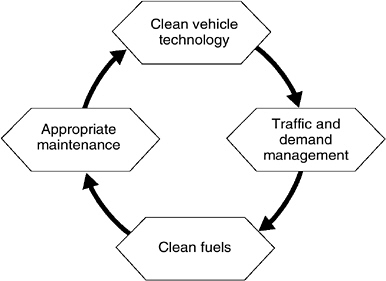
FIGURE 8-1 Elements of a comprehensive vehicle pollution control strategy. SOURCE: Michael P. Walsh.
Because vehicles are, by nature, mobile and therefore capable of being driven from one area to another, and because a proliferation of standards would be very costly to the manufacturer and to the purchaser of the product, new vehicle emissions standards are usually set by national governments to apply to a country as a whole (the state of California being a notable exception in the United States) or even to a group of countries. For similar reasons, clean fuels are mandated at the national level. The other two components, vehicle maintenance and traffic management, are usually the responsibilities of local governments and are applied in ways to respond to local air pollution problems. These can include measures such as:
restrictions on the use of vehicles, including both cars and trucks
high-occupancy vehicle lanes to encourage ride sharing
inspection and maintenance programs, including protocols and training
mandatory or voluntary retrofits of pollution control technology, with appropriate training
recycling programs
parking restrictions and parking taxes.
Details of the vehicle emissions control programs in the United States, Europe, and Japan are summarized in the next section. That summary is followed by a review of these countries’ programs to reduce fuel consumption and carbon dioxide (CO2) emissions. The chapter concludes with a brief look at inspection and maintenance programs, which is expanded in the appendix to this chapter, and, finally, a review of industry-government partnerships in the United States and Europe.
SUMMARY OF WORLDWIDE GOVERNMENT EMISSIONS STANDARDS
Because the United States, European Union (EU), and Japan each base their emissions regulations on different test procedures based on presumed typical driving patterns, it is difficult to compare precisely the stringency of those regulations. Tables 8-1 through 8-3 summarize the passenger car and heavy truck requirements in each region for nitrogen oxides (NOx) and particulate matter (PM).
Table 8-1 indicates that the NOx standards for passenger cars will become quite low in all three regions by 2005. However, the number of kilometers over which the European and Japanese governments require that vehicles in use meet emissions standards appear to be substantially lower
BOX 8-1Transportation Planning and Traffic Management Governments play an important role in effecting changes in land use that can reduce vehicle miles traveled (VMT). Over the long term, regulators should promote effective town and city land use planning that integrates mass transit options, promotes safe passage for pedestrians and cyclists, and uses design features to minimize single-occupancy vehicle use. The challenge is to make modes of living and working that reduce daily travel needs attractive to the public. The many possible options for reducing VMT in urban areas include the following:
|
|
than the actual number of kilometers accumulated during average vehicle lifetimes. A key element of the low emissions level requirements has been the shift to very low-sulfur gasoline. Japan has traditionally had very low levels, usually below 30 parts per million (ppm) sulfur, but the EU recently capped levels at 50 ppm by 2005 and the United States capped them at 80 ppm with a 30 ppm average. The EU also is in the late stages of a process that will likely cap sulfur levels for both gasoline and diesel fuel at 10 ppm.
As for diesel-powered passenger cars, it is clear that the European Union and Japan, while substantially tightening their requirements over the next several years, will maintain substantially weaker NOx requirements for diesel than for gasoline-fueled vehicles, unlike the United States (see Table 8-1 and Box 8-2). Similarly, the diesel car particulate requirements in the European Union and Japan are more lenient than those in the United States (Table 8-1). It appears that in Europe only the heavier diesel cars will require PM filters. In Japan a new round of standards will be introduced in 2005 to address particulates.
TABLE 8-1 Passenger Car Emissions Standards, Nitrogen Oxides(Gasoline and Diesel) and Particulate Matter (Diesel), United States, European Union, and Japan
BOX 8-2Diesel Cars The popularity of diesel cars varies widely worldwide, largely depending on government policies. They are found most commonly in Europe, accounting for one-third of car sales (and over half in some countries). In Japan they account for about 10 percent of sales, and in United States for only about 2 percent of light-duty vehicle sales (almost all light trucks). A comparison of diesel cars and gasoline-powered cars reveals the advantages and disadvantages of diesel. In the area of pollution, diesel engines have inherently lower carbon monoxide and hydrocarbon emissions, and inherently higher particulate matter (PM) and nitrogen oxide (NOx) emissions. In fact, Europe and Japan have adopted emissions standards that specifically allow diesel engines to emit higher levels of nitrogen oxides and particulate matter. Thanks to new technology, PM emissions from diesel engines have begun to fall dramatically, so that in future years if particulate filters are applied across the board, diesel emissions will be similar to those from gasoline engines,1 but NOx emissions from diesel engines are expected to remain higher than those from gasoline engines. Because diesel engines are inherently more energy efficient, they have lower carbon dioxide emissions than gasoline engines. In other performance characteristics, diesel engines are now roughly comparable to gasoline engines, including noise of operation. Diesel engines are somewhat more costly to manufacture than gasoline engines, but the higher costs are countered by lower fuel costs. In regions where diesel fuel prices are significantly lower than gasoline prices (a result of political and economic tax policies but not fundamental cost differences), or where vehicles are used intensively, diesel cars will have strong cost advantages. In China, diesels are likely to proliferate if diesel fuel is priced lower than gasoline (which is the case in most countries but not the United States), if stringent fuel economy standards are adopted, and if more lenient NOx standards are adopted for diesel. Otherwise, diesel cars are likely to be scarce in China. |
Great progress is being made in reducing heavy-duty vehicle diesel emissions (Tables 8-2 and 8-3). Clearly, the major countries of the world have concluded that fundamental advances in heavy truck pollution controls and post–combustion technology are both necessary and feasible. A critical precondition of emission reduction, however, will be the introduction of very low or near-zero sulfur levels in fuel.
TABLE 8-2 Heavy-duty Diesel Nitrogen Oxide (NOx) Standards, United States, European Union, Japan, 1990–2010 (grams per kilowatt-hour)
Model Year | United States | European Uniona | Japan |
1990 | 8.1 | 15.8 | n.a. |
1991 | 6.7 | 15.8 | n.a. |
1992 | 6.7 | 15.8 | n.a. |
1993 | 6.7 | 9 | n.a. |
1994 | 6.7 | 9 | 6 |
1995 | 6.7 | 9 | 6 |
1996 | 6.7 | 7 | 6 |
1997 | 6.7 | 7 | 6 |
1998 | 5.4 | 7 | 4.5 |
1999 | 5.4 | 7 | 4.5 |
2000 | 5.4 | 5 | 4.5 |
2001 | 5.4 | 5 | 4.5 |
2002 | 5.4 | 5 | 4.5 |
2003 | 2.7 | 5 | 3.38 |
2004 | 2.7 | 5 | 3.38 |
2005 | 2.7 | 3.5 | 2.0 |
2006 | 2.7 | 3.5 | 2.0 |
2007 | 0.27 | 3.5 | 2.0 |
2008 | 0.27 | 2 | 2.0 |
2009 | 0.27 | 2 | 2.0 |
2010 | 0.27 | 2 | 2.0 |
a Euro IV from 2005 and Euro V from 2008. NOTE: n.a. = not applicable. SOURCE: Daisho Yasuhiro, Waseda University. | |||
United States
As indicated in Table 8-1, a notable exception to the rule that standards are normally set for an entire country is the provision in the U.S. Clean Air Act that allows the state of California to adopt its own vehicle emissions regulations. California is considered a unique case for several reasons. First, California has consistently had the most serious motor vehicle-related air pollution problems in the United States.1 Second, Califor-
TABLE 8-3 Heavy-duty Diesel Particulate Matter (PM) Standards, United States, European Union, Japan, 1993–2010 (grams per kilowatt-hour)
Model Year | U.S. Trucks | U.S. Buses | European Uniona | Japan |
1993 | 0.3 | 0.13 | 0.4 | n.a. |
1994 | 0.13 | 0.094 | 0.4 | n.a. |
1995 | 0.13 | 0.094 | 0.4 | n.a. |
1996 | 0.13 | 0.067 | 0.15 | 0.25 |
1997 | 0.13 | 0.067 | 0.15 | 0.25 |
1998 | 0.13 | 0.067 | 0.15 | 0.25 |
1999 | 0.13 | 0.067 | 0.15 | 0.25 |
2000 | 0.13 | 0.067 | 0.1 | 0.25 |
2001 | 0.13 | 0.067 | 0.1 | 0.25 |
2002 | 0.13 | 0.067 | 0.1 | 0.25 |
2003 | 0.13 | 0.067 | 0.1 | 0.18 |
2004 | 0.13 | 0.067 | 0.1 | 0.18 |
2005 | 0.13 | 0.067 | 0.02 | 0.027 |
2006 | 0.13 | 0.067 | 0.02 | 0.027 |
2007 | 0.013 | 0.013 | 0.02 | 0.027 |
2008 | 0.013 | 0.013 | 0.02 | 0.027 |
2009 | 0.013 | 0.013 | 0.02 | 0.027 |
2010 | 0.013 | 0.013 | 0.02 | 0.027 |
a Euro IV from 2005 and Euro V from 2008. NOTE: n.a. = not applicable. SOURCE: Daisho Yasuhiro, Waseda University. | ||||
nia had already adopted its own motor vehicle pollution control program before the U.S. national program came into being, and the state has sufficiently large a market that an independent distribution system could provide unique vehicles for the rest of the country.
California adopted performance standards for vehicle exhaust emissions in 1968, the first place in the world to do so. Since then, the standards have been gradually tightened. These performance standards have resulted in a gradual reduction in emissions from cars as newer cleaner vehicles have replaced older, more polluting ones. In fact, California has taken the lead in stimulating the development and mandating the commercial introduction of advanced zero emissions technologies, including electric and fuel cells, many of which also can improve fuel efficiency.
Standards also have been established in the United States that require that specified emissions levels be maintained under special geographic conditions. For example, vehicles must be able to meet standards at both sea level and at an altitude of 1,609 meters (m).
European Union
As the pollution control program has matured in Europe, stringent vehicle emissions standards have been adopted for all 15 member states of the European Union, and Norway and Switzerland, non-EU member states, have decided to adopt identical standards. Furthermore, some of the central and Eastern European countries that have applied for EU accession, such as Poland and the Czech Republic, have already moved to adopt the EU vehicle and fuel standards.
The European Union also includes a unique provision in its directives by which member states are allowed to encourage the early introduction of vehicles that meet future emissions standards or fuel standards through the use of tax incentives. These incentives have been used successfully in both Germany and Denmark.
Japan
Japan was the first major industrialized country to eliminate the use of lead in gasoline; it introduced stringent car standards requiring catalytic converters in 1978. Since then, it has gradually tightened gasoline-fueled car standards and most recently began to move rapidly to reduce diesel-fueled vehicle standards. Before the end of 2004 sulfur levels in diesel fuel will be lowered to a maximum of 50 ppm, and it is expected that all new diesel vehicles sold in 2005 will be equipped with particulate filters.
Like some European countries, Japan is encouraging tighter vehicle standards through the use of tax incentives.
With the enforcement of new emissions standards in the major member countries of the Organisation for Economic Co-operation and Development (OECD), substantial reductions in emissions will be occurring for all on-road vehicle categories, both gasoline and diesel. In addition, fuel sulfur levels will be limited to a maximum of 50 ppm or less.
Recent Developments around the World
Most regions of the world have been significantly tightening their motor vehicle regulations. The major recent developments are described in this section.
United States
In 1998 the U.S. Environmental Protection Agency (U.S. EPA), in conjunction with the California Air Resources Board (CARB), imposed the largest enforcement action in history on the heavy engine industry.
CARB formally decided in August 1998 that diesel particulate matter is a toxic air contaminant, triggering an effort to further reduce PM emissions from urban vehicles, including retrofit where feasible.
During 1999 CARB took emissions standards to the next level, not only tightening carbon monoxide (CO), hydrocarbon (HC), NOx, and PM requirements but also establishing the principles of fuel neutrality (diesel vehicles must meet the same standards as gasoline-fueled vehicles) and usage neutrality (light trucks and sport-utility vehicles used primarily as passenger cars must meet the same standards as cars).
In December 1999 the U.S. EPA adopted light-duty vehicle standards closely modeled after the California LEV 2 (low-emission vehicle, so-called Tier 2) standards and tighter sulfur requirements for gasoline.
In December 2000 the U.S. EPA tightened its heavy-duty engine emissions requirements, with a special focus on tighter PM and NOx standards and on low-sulfur diesel fuel.
European Union
During 1998 the EU adopted directives for light-duty vehicle emissions and fuel quality that tightened emissions standards significantly (2000 and 2005), broadened the scope of coverage (e.g., cold temperature), added several important features previously missing (onboard diagnostics, in-use durability), and imposed low sulfur requirements for diesel fuel and gasoline.
The EU and the auto industry reached agreement in 1998 on a voluntary commitment to reduce by 2008 the CO2 emissions per kilometer driven by 25 percent.
In January 2000 the EU adopted the next phases of heavy-duty standards—European Emission Standard III (Euro III), IV, and V—which will likely result in particulate and NOx aftertreatment.
Asia and Eurasia
In 1999 Japan tightened its gasoline-fueled automobile standards for the first time in 20 years and introduced the next phase of diesel-fueled vehicle requirements. Also in 1999 Japan’s Ministry of International Trade and Industry (MITI) and Japanese industry reached agreement about lowering CO2 emissions from vehicles.
During 1999 China formally adopted the Euro I auto emissions standards and decided to phase out the use of leaded gasoline across the entire country by 2000.
Taipei adopted step four of its motorcycle control program in late 1999, effectively banning two-stroke motorcycles by the end of 2003.
The Supreme Court of India banned the sale of leaded gasoline in Delhi as of September 1999 and mandated that all new cars meet Euro I auto emissions standards. Similar requirements were then phased in across the entire country in 2000. Delhi adopted Euro II standards in April 2000.
SUMMARY OF WORLDWIDE GOVERNMENT FUEL ECONOMY STANDARDS
In the United States, Western Europe, and Japan—the three major markets for light-duty vehicles—the policies for improving the fuel efficiency of these vehicles have evolved in sharply different directions. In the United States from the mid-1970s to the mid-1980s, the major focus was on the Corporate Average Fuel Economy (CAFE) program, whereby annual fuel economy standards applied to each manufacturer on average across its entire fleet of light-duty vehicles, subdivided into passenger cars and light-duty trucks, with separate requirements for each of these categories. During the same period, a “gas guzzler” tax was imposed on those cars with the poorest fuel economy. More recently, the government has emphasized shared research and development (the Partnership for a New Generation of Vehicles, to be followed in 2002 by the FreedomCAR program) and tax incentives for certain high-efficiency vehicles (proposed but not yet enacted). In Europe, the European Automobile Manufacturers Association (ACEA) has proposed, and the European Union has accepted, a voluntary agreement pledging to reduce per-vehicle CO2 emissions by 25 percent between 1995 and 2008. And in Japan the national government has established a series of weight-class fuel economy standards that require about a 23 percent improvement in the fuel economy of gasoline-fueled light-duty vehicles by 2010. Each of these programs will be reviewed in the rest of this section.
United States: The CAFE Program
The United States has had a mandatory fuel efficiency program since 1975. The Energy Policy and Conservation Act (1975), which came into effect in model year 1978, amended the Motor Vehicle Information and Cost Saving Act to require new passenger cars to achieve at least 27.5 miles per gallon (mpg) or 8.55 liters per 100 kilometers (km) by 1985, as measured by U.S. EPA test procedures. Separate, and more lenient, CAFE standards were first applied to light-duty trucks, including jeeps and minivans, in 1979. The current standard, set in 1996, is 20.7 mpg.
In recent years, as fuel prices have dropped and CAFE standards have remained unchanged, vehicle manufacturers have sold a growing pro-
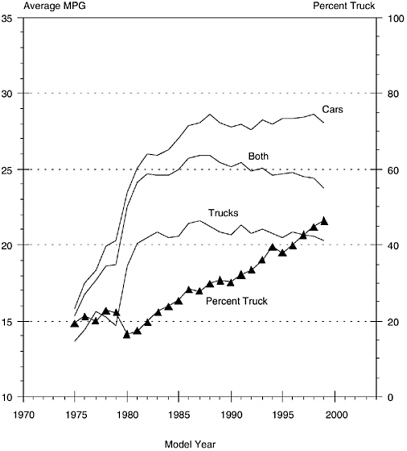
FIGURE 8-2 Miles per gallon (mpg) of trucks and cars by model year, United States. SOURCE: Hellman and Heavenrich (2001).
portion of light trucks. As a result, the overall fuel economy of new light-duty vehicles has been diminishing since 1980 (Figure 8-2).
Vehicle manufacturers are required to test a sample of all vehicles destined to be sold in the United States so that a fuel consumption rating can be assigned to each product line. The test involves both city and highway driving cycles. From these figures, a sales-weighted average fuel con-
sumption figure is calculated for all the passenger cars produced by each manufacturer. Fuel efficiency (in miles per gallon) calculated this way must exceed the CAFE standard specified for the appropriate model year.
Failure to meet the CAFE requirements can result in substantial financial penalties. For each vehicle produced, a manufacturer whose fleet-average fuel consumption does not meet the CAFE standard is fined $5 per vehicle for every 0.1 miles per gallon by which the standard is not met. These fines may be offset by credits accrued in other model years, however. Since 1983 the federal government has collected $164 million in CAFE fines.
Another policy instrument used by the U.S. government is the gas guzzler tax, paid by people who buy cars with fuel economy below a certain threshold. The threshold rose from 5 mpg (12.1 liters per 100 km) in 1984 to 21.0 mpg (11.2 liters per 100 km) in 1985, and has been set at 22.5 mpg (10.1 liters per 100 km) since 1986.
Besides the CAFE requirements and gas guzzler tax, the federal fuel efficiency program provides consumers with information about the relative efficiency of new cars. The Gas Mileage Guide published by the U.S. EPA and the Department of Energy lists the city and highway fuel economy results of each vehicle model and is intended to provide information to new-car buyers. Also required on new cars are stickers indicating the vehicle’s fuel economy as determined by the U.S. EPA, an estimate of the annual fuel cost based on 15,000 miles (24,000 km) of operation, and the range of fuel economy achieved by similar-size vehicles of other makes. U.S. EPA adjusts the measured fuel economy value downward before placing it on the sticker in an effort to give a somewhat more realistic estimate of the on-the-road fuel consumption that the owner can expect under average driving conditions. To allow a comparison of different vehicle models, U.S. EPA adjusts the mile per gallon estimates on all the new car stickers.
European Union
In the European Union, fuel economy is addressed by regulating CO2 emissions. Carbon dioxide produced by passenger cars accounts for about half of CO2 emissions from transport and about 12 percent of total CO2 emissions in the European Union.2 Under a ”business as usual” scenario, CO2 emissions from cars are expected to increase, from 1990 levels, by
about 36 percent by the year 2010. The road transport sector has stood out in recent years as one of the few EU sectors experiencing growth in CO2 emissions.
The European Union remains on track to achieve its long-standing commitment to stabilizing emissions of carbon dioxide—the main greenhouse gas responsible for manmade global climate change—at their 1990 level and then to reduce greenhouse gases by 2008. Total CO2 emissions from the 15 EU member states were 0.5 percent lower in 2000 than 10 years earlier, according to the latest emissions inventory from the European Environment Agency (2002).
Less positive, however, is the fact that EU emissions of carbon dioxide and other greenhouse gases rose between 1999 and 2000, the most recent year for which EU-wide data are available. If transport were not included, there would have been a clear downward trend in carbon dioxide, nitrous oxide, and methane emissions across the EU. However, over the decade nitrous oxide from transport about doubled and carbon dioxide increased by about 20 percent.
In the face of these concerns, the European Automobile Manufacturers Association has entered into a voluntary agreement with the European Commission to reduce CO2 emissions from new light-duty passenger vehicles, with firm fleet-wide targets of 140 grams (g) of CO2 per kilometer (about 41 mpg for gasoline) by 2008, measured under the new European test cycle (Directive 93/116/EU). This represents about a 25 percent reduction from the 1995 average of 187 g/km (about 30 mpg) for this cycle. Because the European cycle is likely to produce lower fuel economy ratings than the U.S. combined city/highway cycle, the “U.S.-equivalent” miles per gallon ratings3 of the year 2008 European fleet will likely be higher than 41 mpg if the targets are met.
Note that the goal of 140 g of carbon dioxide per kilometer is a collective target, not a target for each company. The participants in the agreement—BMW, Fiat, Ford of Europe, GM Europe, DaimlerChrysler, Porsche, PSA Peugeot Citroën, Renault, Rolls Royce, Volkswagen, and Volvo—have not publicly defined individual objectives, but before signing the agreement they discussed among themselves the likely trade-offs that would have to be made to achieve the goal. The agreement applies to light passenger vehicles classified as M1 in European Council Directive 93/116/EEC, which includes vehicles with no more than eight seats in
addition to the driver. The agreement included a promise to introduce some models emitting 120 g/km (about 48 mpg) or less by 2000, and a nonbinding 2003 target range of 165–170 g/km (about 34–35 mpg). In addition, the commitment will be reviewed in 2003, with the aim of moving toward a fleet goal of 120 g/km by 2012. Finally, ACEA agrees to monitor compliance with the agreement jointly with the commission.
In exchange for its commitment to meeting the 2008 CO2 emissions goal, the industry asked that some conditions be met:
Clean fuels availability. Because the industry believes that direct-injection engines will play a key role in achieving the targets, the agreement asks for the “full market availability” of the clean fuels needed for this technology by 2005—gasoline with 30 ppm sulfur content and less than 30 percent aromatics, diesel fuel at 30 ppm sulfur and a Cetane number greater than or equal to 58.4
Protection against unfair competition. Non-ACEA members must commit to similar goals, and the European Union will agree to try to persuade other car manufacturing countries to embrace equivalent efforts. The latter effort is designed to protect ACEA members from suffering in world market competition for their European efforts. Both the Japanese Automobile Manufacturers Association (JAMA) and the Korean Automobile Manufacturers Association (KAMA) have agreed to a revised version of the ACEA targets, with achievement of the 2008 target levels in 2009.
Regulatory cease-fire. There will be no new regulatory measures to limit fuel consumption or CO2 emissions.
Unhampered diffusion of technologies. The companies assume that the commission will take no action that would hamper the diffusion of efficiency technologies, particularly direct-injection gasoline and diesel engines. Presumably, actions the commission might take could include tighter emissions standards on nitrogen oxides and particulates.
Japan
The Japanese government has established a set of fuel economy standards for gasoline- and diesel-powered light-duty passenger and freight vehicles, with fuel economy targets based on vehicle weight classes. The
targets for gasoline-powered vehicles are to be met in 2010; 2005 is the target year for diesel-powered vehicles. The targets are to be met by each automaker for each weight class—that is, automakers cannot average across weight classes by balancing a less-than-target vehicle in one class with a better-than-target vehicle in another.
Compliance with these standards will produce by 2010 and 2005, respectively, a Japanese gasoline-fueled, light-duty passenger vehicle fleet capable of achieving 35.5 mpg and a light-duty diesel fleet able to achieve 27.3 mpg5 as measured using the Japanese 10–15 driving cycle. The Japanese 10–15 driving cycle is substantially slower than the combined U.S. city/highway cycle, and the U.S. equivalent miles per gallon for this fleet would be significantly higher.
The regulations call for civil penalties if the targets are not met, but the penalties are very small. Realistically, enforcement will be accomplished through pressure from the government and the auto companies’ desire to avoid public embarrassment, not through the financial penalties.
The fuel economy targets were selected by identifying “best-in-class” fuel economies in each weight class and demanding that the average new vehicle meet that level in the target year. The Japanese call this the “top runner” method of selecting fuel economy targets. Theoretically, this method is not “technology forcing” in that the technology has already been identified. Practically speaking, however, the standards may prove to be technology forcing because the “top runners” in each weight class must fully match their competitors in other areas of performance and amenities.
The fuel economy regulations have additional requirements over and above the actual fuel economy targets. These are:
For new vehicles, fuel economy and major efficiency technologies on board must be recorded in catalogs and displayed at exhibits.
Government is charged with providing education and other incentives for vehicle users and manufacturers, making sure that fuel economy regulation proceeds in harmony with other regulations (especially new emissions standards), reviewing manufacturers’ efforts to improve fuel economy, and trying to harmonize this regulation with similar efforts in Europe and the United States.
Manufacturers are expected to develop new efficiency technologies, design vehicles of outstanding efficiency, and help educate the pub-
lic. It is assumed that the public will select efficient vehicles and use them in an efficient manner.
INSPECTION AND MAINTENANCE (I/M) PROGRAMS
Modern vehicles depend on properly functioning components to keep pollution levels low. Minor malfunctions in the air and fuel (A/F) or spark management systems can increase emissions significantly, while major malfunctions can cause emissions to skyrocket. A relatively small number of vehicles with serious malfunctions frequently cause the majority of the vehicle-related pollution problems. Unfortunately, it is rarely obvious which vehicles fall into this category, because the emissions themselves may not be noticeable and emissions control malfunctions do not necessarily affect vehicle drivability. Effective I/M programs, however, can identify these problem cars and assure their repair. The appendix to this chapter describes the elements of an inspection and maintenance program.
INDUSTRY–GOVERNMENT PARTNERSHIPS
The United States, Europe, and Japan have supported their domestic automotive industries in a variety of ways. This section focuses on government-industry research and development (R&D) partnerships in the United States and Europe.
Research covers a wide range of activities from basic research at universities and government laboratories, to applied research activities that may involve multidisciplinary and multiorganizational collaboration, to development work by industry to create new and improved technologies for use in automobile design and production. Although there is a spectrum of research activities ranging from very basic to very practical projects, the research process is not linear and often applied research will identify new opportunities for basic research and vice versa.
Basic research is aimed at acquiring knowledge of general importance and typically has a time horizon of a decade or more for success. Only a few basic research ideas may ever reach the marketplace. However, funding for basic research is frequently a small part of overall R&D budgets. Industrially supported efforts are often associated with institutions of higher learning. Funding sources include government, foundations, and collaborations with international groups. The kinds of research capabilities that will support a strong auto industry in China might include the following areas:
clean fuels
air quality monitoring and modeling techniques
advanced propulsion systems (including fuel cells)
catalysis and separations
improved materials
advanced electrical and electronic systems
sensors and controls
advanced manufacturing processes and systems.
Applied research includes a wide range of activities, including further refinement of promising innovations identified in basic research, feasibility and assessment studies, systems analysis and planning studies, and need-driven research investigations. Typically, applied research has a time horizon of 5–15 years and involves teams of researchers with different skills and backgrounds. The cost of such research is frequently greater than that of basic research by a factor of 10, but participation of government laboratories and industrial researchers expands the resource base. Examples of applied research projects are:
innovative technology feasibility studies
automotive system design and integration
manufacturing systems
infrastructure planning (roads, fuels, mobility services)
traffic coordination and safety
life cycle assessment of alternatives
economic assessments.
Development and demonstration research activities are usually funded and conducted by industry for those technologies that appear to offer significant potential for near-term (3–5 years) commercial advantage. Significant segments of these activities are likely to be proprietary. Because large investments are needed, such projects are selected very carefully. Often they will involve collaborative work between a key component supplier and system designers. These activities also may present an opportunity among joint venture partners for personnel exchanges that will broaden the capabilities of both partners. Because of the investment requirements, some companies prefer to wait for others to make the breakthrough and then either purchase rights to the technology or adapt it to their needs. In areas in which large investment is needed to develop a new product that may not be a near-term market success (e.g., the U.S. PNGV program discussed later in this chapter), government-industry partnerships may fund the research, spreading the investment required over a number of sponsors. Here the final product may not be a commercial success, but the research will produce know-how and component technologies that may be well worth the investment.
The cost of building a strong auto research capability in China will be large. Although China may wish to let others take the lead in the longer-term research activities, it will have to maintain the capability to stay abreast of what is being done worldwide and limit its investment to areas in which a particular concept seems to offer a special advantage to the Chinese industry or in which the educational benefits are worth the investment. However, when commercial success is the end goal, it is usually best to let the industry make the choices about technologies. Government and academic researchers may offer ideas and guidance, but only the industry has the important knowledge about how individual technologies integrate into a successful car.
United States
Early Efforts
One of the earliest efforts to undertake industrial cooperative research was organized through the Inter-Industry Emission Control Program in 1972. This program was a joint effort of members of the U.S. petroleum industry, members of the Japanese automotive industry, and the Ford Motor Company. Other members of the U.S. automotive industry were prevented from participating by antitrust laws. The program, which was funded by the various participants, continued for over a decade and produced some significant technical developments. It was terminated when the emphasis of the industry turned more to fuel economy than to meeting selected emissions standards.
In the late 1970s Secretary of Transportation Brock Adams initiated a government effort to “reinvent the automobile” as the technological answer to the influx of high-efficiency small cars from Japan. The result was a government-industry program designed to emphasize basic research that would enhance the efficiency of vehicles. Annual joint funding of the Cooperative Automotive Research Program was pegged at about $100 million. All parties had signed the agreement and were preparing to launch the program when it was cancelled by the newly elected Reagan administration in 1981.
Background of the Partnership for a New Generation of Vehicles (PNGV)
In the late 1980s Congress began to restrict the ability of the National Highway Traffic Safety Administration to adopt tighter CAFE requirements, and fuel economy standards were effectively frozen. Seeking other routes toward fuel economy, the major U.S. automakers and the U.S. government, through its national laboratories, began sharing technology in-
formation and manufacturing know-how in 1993 in an effort to develop low fuel consumption technologies.
On September 29, 1993, President Bill Clinton and the chief executive officers of the major domestic automakers (Chrysler, Ford, and General Motors) announced the formation of the Partnership for a New Generation of Vehicles. The long-term goal of PNGV was to develop vehicles that would deliver up to three times the current fuel efficiency (defined as 80 mpg or energy equivalent) and would cost no more to own and operate than the current comparable vehicles. At the same time, this new generation of vehicles was to maintain the size, utility, and performance standards of contemporary vehicles (i.e., the 1994 Chrysler Concorde, Ford Taurus, and Chevrolet Lumina) and meet all mandated safety and emissions requirements.
The U.S. automobile manufacturing industry is an integral part of the U.S. economy, accounting for one out of seven U.S. jobs and 4.5 percent of the gross domestic product. The development of a new generation of vehicles was to improve U.S. competitiveness by establishing the capability for technical leadership in the production of competitively priced, highly fuel efficient, low-emission automobiles. Improvements in advanced manufacturing techniques that shorten product development times and lower costs, as well as improve product quality and durability, are essential to transfer new technologies to the marketplace affordably. The PNGV represented a departure from the historical, primarily regulatory relationship between government and the U.S. automobile industry. Because the current U.S. price of gasoline did not encourage consumer demand for high-efficiency automobiles, government support of long-term research and development for fuel efficiency technologies was considered necessary to spur activity and accelerate progress in the absence of market pull.
The achievements of the PNGV were expected to produce significant energy, environmental, and economic benefits for the nation. In view of the country’s growing population and Americans’ fondness for travel, a significant improvement in vehicle fuel efficiency would be a major step toward lessening reliance on foreign oil supplies and reducing the associated balance-of-trade deficits, which were greater than $40 billion in 1993.
PNGV was structured to achieve three mutually supportive, interactive goals:
Significantly improve national competitiveness in manufacturing for future generations of vehicles.
Improve the productivity of the U.S. manufacturing base by significantly upgrading U.S. manufacturing technology, including adopting agile and flexible manufacturing processes and reducing cost and lead
times, while also reducing negative environmental impacts and improving product quality.
Implement commercially viable innovations from ongoing research in conventional vehicles. Pursue technology advances that can lead to improvements in fuel efficiency and reductions in the emissions of standard vehicle designs, while pursuing advances to maintain safety performance.
Research focused on technologies that reduce the demand for energy from the engine and drive train. Indeed, the auto industry pledged to apply those commercially viable technologies resulting from this research that could be expected to significantly increase vehicle fuel efficiency and improve emissions.
As noted, the objective was to develop vehicles that could achieve up to three times the fuel efficiency of comparable 1994 family sedans—the Concorde, Taurus, and Lumina automobiles—with equivalent cost of ownership, and yield a revolutionary class of fuel-efficient, environmentally friendly, commercially viable vehicles that would meet or exceed safety and emission requirements. The PNGV’s target was to develop a concept vehicle by 2000 and a production prototype by 2004. This 10-year time frame for the PNGV represented a rapid development effort to produce a revolutionary change in automotive transportation.
In 1994 the auto industry identified the areas in which significant innovations were needed to meet PNGV goals: reduced vehicle weight, more efficient power trains, and reduced parasitic losses. A critical element in meeting the technical challenges in these areas was believed to be the development of manufacturing processes capable of quickly delivering high quality and volume at low cost.
Participants in the PNGV Technical Program
The Partnership for a New Generation of Vehicles was formed by the federal government and the U.S. Council for Automotive Research (USCAR), which represented the major American auto companies— Chrysler (which became DaimlerChrysler in 1998), Ford, and General Motors. The original government members of the partnership were the Departments of Commerce (designated as lead agency), Defense, Energy, Interior, and Transportation; Environmental Protection Agency; National Aeronautics and Space Administration; and National Science Foundation. Other participants in the PNGV R&D activities included industrial suppliers, universities, commercial R&D institutions, and entrepreneurs.
The PNGV organization was overseen by a steering committee of senior representatives from the three automakers and the Department of Commerce, with a rotating director. One level below the steering commit-
tee was a technical committee composed of representatives of the companies and seven government agencies. Under the technical committee were some 10 technical working groups for the major technology subsystems, staffed by engineers and scientists from industry and national labs. Most of the groups were chaired by an industry representative.
The PNGV was able to pursue an ambitious program schedule by leveraging ongoing government and industry R&D programs. Before announcement of the PNGV, the federal government and the automotive manufacturers and their suppliers had already launched cooperative research programs, and additional government-sponsored research was already being conducted in government laboratories and universities. Technology development was particularly successful in the areas of innovative power trains (hybrid vehicles, gas turbines, and fuel cells), lightweight materials (structural aluminum and magnesium and various composites), and energy storage devices (such as ultracapacitors, flywheels, and batteries). Many of these ongoing R&D programs provided the “running start” considered vital to achievement of the PNGV goals within the allotted time.
As a result of the long lead time in federal budgeting automaker and federal laboratory managers shifted a variety of existing vehicle R&D projects to the PNGV program, including about $250 million in multiyear hybrid vehicle research already in place within Ford and General Motors. The U.S. General Accounting Office estimates that federal support for the partnership averaged about $250 million a year from 1995 through 1999, but this sum overstates support for the partnership itself because about 45 percent supported activities only indirectly relevant to the partnership goals or was not coordinated through the partnership (U.S. GAO, 2000).
In addition to government-assisted research and development, automotive manufacturers maintain both proprietary and nonproprietary programs in advanced technology research in order to assure their competitive positions. Proprietary research contributions increased as the PNGV program moved through the development of concept cars and production prototype vehicles. Indeed, it was reported that industry was matching government funds with about $250 million a year, but in fact “a major portion” of the spending was in proprietary product programs (NRC, 2001:10).
In the early years, of the some $293 million a year the government was spending on PNGV, about a third went directly to the federal laboratories, about a third directly to automotive suppliers, and about a third to the three automakers. Of the third that went to the three automakers, about three-quarters was later subcontracted to suppliers (Chapman, 1996). The three automakers may have received a relatively modest amount of money, but they played a large role in determining how the money was spent and by whom.
In 1994 the federal government asked the National Research Council
to establish an independent standing committee to prepare an annual review of the PNGV program. Committee members, many of whom had automotive backgrounds, were experts on different aspects of the program. Seven reports were issued.
Evaluation of the PNGV Program
In 1997, as planned, the large set of candidate technologies that had been examined during the first years of the partnership was reduced to a few for further development. Each of the three companies selected diesel-electric hybrids as their preferred technology. In early 2000, again in line with program milestones, each of the three companies unveiled concept cars. Ford’s Prodigy, GM’s Precept, and DaimlerChrysler’s ESX3 all used lightweight materials and combined small advanced diesel engines with electric drive trains, with projected fuel economy of 60–80 mpg (NRC, 2001). As indicated in the seventh (and last) annual review of the PNGV program by the National Research Council, the automotive companies appeared to be meeting the program schedule for achieving the fuel economy goals, but they would not meet the cost goals (NRC, 2001). The efforts to meet the emissions goals are discussed later in this chapter.
The National Research Council’s seventh review of the PNGV Program made the following observations about the achievement of program goals (NRC, 2001):
At the end of 1997 PNGV made a technology selection based on assessments of system configurations for alternative vehicles. Several technology options—such as gas turbines, Stirling engines, ultracapacitors, and flywheels for energy storage—were eliminated as leading candidates. The 10-year span of the program dictated some of these choices. In its fourth review the committee agreed with PNGV’s technology selections (e.g., four stroke, internal combustion engines, fuel cells, batteries, power electronics, and structural materials). The four-stroke compression-ignition direct-injection (CIDI) engine was selected as the most likely power plant to enable the fuel economy goal to be met within the program time frame; the fuel cell power plant was retained in the program as a highly promising longer-range technology.
* * *
The second major milestone, the development of concept vehicles, was met in early 2000. Using PNGV-developed technologies and their own in-house proprietary technologies, the . . . . companies each developed separate concept vehicles with fuel economies between 70 and 80 mpg.
* * *
The power train with the highest probability of meeting the vehicle fuel-
economy target of 80 mpg by 2004 is the hybrid-electric power train powered by a CIDI engine. In 1999 approximately midway through the program, the Environmental Protection Agency promulgated Tier 2 emission standards for particulate mater and oxides of nitrogen (NOx) substantially more stringent than those at the start of the program. . . . This action brought into question the possibility of meeting these emission requirements with a CIDI engine in a production prototype by 2004. Consequently, a major portion of the program resources was reallocated to address this new development risk. Alternative power plants (e.g., homogeneous spark-ignition engines or gasoline-fueled direct-injection engines) with a higher probability of meeting the Tier 2 standards in the PNGV 2004 time frame would result in vehicles with reduced fuel economy compared with the CIDI engine.
Perhaps equally important, the program gave rise to a “boomerang effect”—that is, the existence of this program encouraged competitors to go forward more aggressively (Sperling, 2001). Apprehensive European and Japanese automakers quickly accelerated their efforts through programs such as the European Car of Tomorrow Task Force (1995) and the Japan Clean Air Program (1996), and through individual company efforts such as Toyota and then Honda’s commercialization of hybrid electric cars and Daimler-Benz’s enhanced fuel cell program. Many executives in European and Japanese companies readily concede that PNGV was clearly seen as a threat, and that it therefore served as the catalyst for increased investment in advanced propulsion technology in their companies. The competition intensified as U.S. automakers responded to the aggressive commercialization efforts by Toyota, Honda, and the Daimler side of DaimlerChrysler. As for gauging the success of the program, one might ask: Why did the PNGV effort not lead to the commercial advances envisioned in 1993, even in some cases when those advances were being actively pursued by automakers and other technology companies elsewhere the world? As noted earlier, the National Research Council evaluation suggests that the shortcoming stemmed from the initial schedule and design of the program (NRC, 2001). Indeed, it appears that PNGV formalized a very ambitious schedule with specified deliverables that led, ironically, to a conservative approach. Fearing that the time horizon that was too short to allow much development of emerging technologies, industry and government managers focused on relatively mature technologies for which fuels were available—that is, diesel-electric hybrid cars. Even then, automakers were falling far short of meeting the goal of comparable cost.
Another major issue for the PNGV program, and government-industry partnerships in general, was control of knowledge and rights to technology. The automakers, adhering to common practice in competitive industries, essentially created “firewalls” of varying permeability around
their PNGV work. Companies engaging in collaborative work with competitors in their own or related industries routinely create these walls to protect themselves against antitrust lawsuits and, more important, to ensure confidentiality. The concern is that the more government funding and competitors are involved, the more likely it is that companies will lose control of knowledge and technology.6 These firewalls work effectively with small innovations that affect a small part of the business, because the protected knowledge may not be central to the business interests of the company. But this situation was different. First, virtually all of the targeted technologies were close enough to commercialization that a company would want proprietary rights to any advances. Second, fuel cell and hybrid propulsion systems, if successfully developed, had the potential to be core technologies for these huge companies.
In any case, the PNGV experience provided the following insights and lessons. First, if properly structured, a joint program between government and industry can successfully develop new technologies of interest to the commercial sector. Second, unforeseen indirect effects (the “boomerang effect” in this case) may prove to be very important. Third, program objectives must be reexamined in light of changing conditions and objectives changed accordingly. Fourth, targeted technologies should be far from commercialization (or have large social benefits). Fifth, progress is greatest with partners wholly committed to the technology development and commercialization goals of the partnership. Finally, it is important that the government limit its participation to the noncompetitive phase of research and development and leave the final development of a marketable product to industry.
Overall, the partnership generated many successes. An important benefit has been the greater communication between industry and government and therefore less adversarial tension. The high-profile collaboration between government and the automotive industry also spurred the development of new technologies, many of which are being used to improve the efficiency of vehicle subsystems and components. The program also focused government’s advanced technology R&D efforts and highlighted, for the public and the automotive industry, the potential for major technology enhancements.
The Next Phase of Cooperation
In January 2002 the U.S. government announced a significant redirection of the PNGV program and gave it a new name: the FreedomCAR (Cooperative Automotive Research). Rather than maintaining the heavy focus on demonstration vehicles, the program will concentrate more on technology and on developing the fuel cell for passenger vehicles and a hydrogen fuel infrastructure for those vehicles. The generation of hydrogen fuel, its distribution and storage, and its storage or generation on board the vehicle, will be an important part of the program. A particular thrust of the program will be an effort to ensure more coordination among its various participants—industry suppliers, universities, and government laboratories. USCAR will continue to be the sole industry partner, and the Department of Energy will serve as the lead government agency. However, an effort will be made to expand the membership to include energy suppliers, along with automakers, their suppliers, and research groups from around the country. A procedure for external review of the program will continue, but on a biannual basis.
The European Experience
In Europe, automakers and governments have engaged in several high-profile international R&D partnerships since the mid-1980s.7 The most recent incarnation, the European Council for Automotive R&D (EUCAR), was launched in 1994, partly in response to the PNGV program. EUCAR comprises 10 automotive companies located in five countries and has its headquarters in a sixth, Belgium. From 1994 to 1999 EUCAR undertook 88 projects, of which 14 were self-funded (by EUCAR members) and 74 were cofunded with the European Union. The total budget for the 88 projects was EUR302 million, about half of which was provided by the European Union (half of that going to the automakers and the other half to suppliers, universities, and independent centers). EUCAR has created an array of technical and policy committees not unlike those associated with the PNGV program, which are aided by a skeletal administrative staff.
Interviews with a variety of senior officials from the government and automotive partners indicate that two major benefits have arisen from the EUCAR partnership: (1) automakers have gained access to European research institutes (which are similar to the U.S. national energy laborato-
ries); and (2) communication has increased across the industry and between industry and the European Union. EU funding itself was rarely cited as an important benefit. The EU provides even less public R&D funding to automakers than that provided through the PNGV program.
EUCAR, then, is principally an organization designed to share information. With the challenge of managing the politics and interests of a wide variety of countries and a broader array of companies, the “cultural” commitments of some countries to their major car companies, and the various relationships among governments, universities, and companies, it is difficult to imagine EUCAR expanding into an integrated R&D partnership. EUCAR also has played a pivotal role in maintaining communication between the European Commission (the executive arm of the European Union) and automakers about follow-up to their voluntary agreement to reduce CO2 emissions (per vehicle-kilometer) by 25 percent between 1998 and 2008.
General Lessons of PNGV and EUCAR
The PNGV and EUCAR programs can provide valuable insights and lessons for China. Partnerships can play an important role in identifying technologies that are in the public interest and also commercially viable. Moreover, they help inform the public debate about new vehicle technologies, highlight opportunities, and provide a mechanism for directing government resources. Independent research centers play an important role in accelerating development, and such research centers will be most successful when closely partnered with industry members. Government funding of universities is critical, and a principal aim should be training of engineers and scientists.
As any such partnership proceeds, the goals and programs need to be flexible and reviewed on a regular basis. The government must recognize that the companies will need to control any proprietary knowledge they develop. All companies will expect to be treated equally.
In a free market economy, decisions about commercialization must remain with the industry. Although the commercialization of advanced technology is most likely to occur in response to specific performance standards and goals or competitive market forces, R&D “partnerships” can provide important information during the pre-competitive phase of the development process. An important lesson from the PNGV experience for China is related to developing human capabilities. Even in the United States, with its massive university and national lab systems, the automotive companies concluded that “the lack of talented people is a greater handicap than the lack of adequate funding and [we] need ideas (breakthroughs) more than dollars” (NRC, 2000:9)
In the end, China will need to adjust any strategy it follows for generating and sharing knowledge and working with industry to fit its special circumstances. Such a strategy will differ from the U.S. PNGV experience because China does not have large, existing automotive-related research capabilities in its industry, universities, or government research centers. One overarching lesson learned, however, is that the partnership process, in whatever form it takes, is difficult and requires a strong commitment on both sides. Also, because reducing energy consumption and emissions is a large-scale systems problem, it is important that all of the key players be involved in any partnership process. One weakness of the PNGV program was that the energy suppliers were not partners in the effort. The overriding lesson, though, is that in this globalizing and networking world, communicating and partnering are more essential than ever. Because foreign original equipment manufacturers are highly involved in the Chinese automotive industry, the government must soon decide how much these foreign members will be allowed to participate in any government-industry program.
CONCLUSION
Governments have an important role to play in fostering improved research and development and an even more important role in determining the attributes of individual vehicles. The government’s role in research and development can vary from providing resources for basic research to stimulating the development of human resources. As for vehicle attributes, government can stimulate advanced technologies by setting performance standards or introducing strong incentives for rapid advances. It is important that those trying to leapfrog to more advanced technology pay careful attention to other important conditions that could limit their success such as assuring the availability of fuels of the appropriate quality.
APPENDIX: INSPECTION AND MAINTENANCEPROGRAMS
Effective inspection and maintenance programs can identify the cars with emission control malfunctions and assure their repair.8 Test procedures must keep pace, however, with the advances in vehicle technology.
For the most advanced vehicles, the emissions, when properly maintained, will be so low that a more sophisticated test will be required. Vehicles equipped with electronic controls of air-fuel and spark management systems and equipped with catalytic converters to reduce CO, HC, and NOx emissions are best tested using a transient test on a dynamometer that includes accelerations and decelerations typical of actual driving.
In general, I/M programs are most effective when they take the form of centralized I/M systems in which the testing of vehicles is completely separated from those carrying out repairs. These programs also cost much less overall because they tend to be high throughput.
The rest of this appendix summarizes the various test procedures that can be used in I/M programs and some of the more recent experiences with vehicle inspection and maintenance efforts.
No-Load Short Tests
The term no-load denotes all tests during which no external load is imposed and the car operates with the transmission in the neutral position.
Idle/Fast Idle Test
This test measures CO, HC, and CO2 concentrations in the raw exhaust gas at idle speed and possibly a higher engine speed, 2,000–3000 revolutions per minute (rpm). The test could last from less than one minute for a one-speed idle test without preconditioning to about 10 minutes for a two-speed test that includes a “second chance” test with preconditioning (Tierney et al., 1991; Laurikko, 1994). A garage-type nondispersive infrared (NDIR) analyzer capable of measuring CO, HC, and CO2 concentrations is sufficient for detecting the level of the pollutants.
Today, idle/fast idle tests are still widely used in I/M programs because they are the fastest, cheapest, and easiest to perform with the least possible testing equipment. For carbureted cars, they can effectively identify malfunctioning mixture preparation systems by checking the performance of the carburetor’s idle mixture orifice in the idle test and the main fuel metering orifice in the fast idle test. However, modern cars equipped with electronic fuel injection and ignition systems and three-way catalysts may have a defect—such as defective sensors and degraded catalyst efficiency (Pidgeon and Dobie, 1991)—that cannot be detected through their pollutant emissions at idle; even worse, the great bulk of emissions may be generated during transient engine operation. An additional very significant drawback is the negligible amount of NOx emissions at idle.
Idle/Fast Idle Test with Lambda Test
For catalyst-equipped cars, a lambda test may be coupled with an idle/fast idle test in order to check the performance of the mixture preparation system. Three steps are usually performed:
The fuel/air ratio is indirectly determined by measuring the CO2, CO, O2, and HC concentrations in the raw exhaust at fast idle (2,000– 3,000 rpm).
The fuel/air ratio is artificially modified by adding oxygen, propane, or recirculated exhaust gas to the intake air, and the response of the lambda control system is checked. Long response times imply that the oxygen sensor is degraded, and no response means that the lambda control system is not operating.
One or more of the characteristics of the electronic lambda control circuit are measured and compared with the auto manufacturers’ specifications.
Since December 1993, Germany has used a test that involves both test types 1 and 2. Evaluations have shown that the test performs fairly well with excess emitters. A combined idle/fast idle–lambda test (involving lambda test types 1 and 2) also is being used in Austria, where it has demonstrated satisfactory effectiveness (Pucher and Lenz, 1990).
Steady-State Loaded Tests
Because NOx emissions at no-load conditions are negligible, a loaded test is required to measure NOx emission levels, which are a critical source of urban air pollution. The simplest loaded tests involve a dynamometer with steady-state power absorption. A simulation of the car’s inertia weight is not required, because there is no transient phase in the emission test: the car is driven at constant speed and load, and pollutant concentrations (CO, HC, NOx, and CO2) are measured during the load phase.
In response to the introduction of three-way catalyst-equipped cars, the acceleration simulation mode (ASM) test was developed. For this test the car is driven on a chassis dynamometer at a constant speed and steady-state power absorption that is equal to the actual road load of the car during acceleration. Thus one can achieve a realistic simulation of the car’s load at a specific driving mode without the need of flywheels for inertia simulation. However, at high speed/high acceleration combinations the required power absorption is too high to be achieved without overheating the engine (Austin and Sherwood, 1989). Pollutant concentrations (CO, HC, NOx) are in principle measured in the raw exhaust. Each steady-state
test mode requires about 10 minutes for preparation, preconditioning, actual testing, and documentation.
Austin and Sherwood (1989) compared several ASM speed/load combinations with idle tests and already developed steady-state loaded tests as well as with a transient loaded test. The best results were obtained from the ASM 5015 test, which has a constant speed of 15 mph (24 kilometers per hours and a steady-state load equal to 50 percent of the load required to accelerate at 1.47 meters per second squared (m/s2)—the maximum acceleration rate on the Federal Test Procedure (FTP)—at a speed of 15 mph.
In the late 1980s TÜV, a German company that undertakes a great deal of government-type work, including certification of new vehicles, I/ M testing, and government research projects such as emissions factor tests, investigated a similar loaded test. The car is driven at 50 kph and at 7-kilowatt dynamometer power absorption in third gear (position “D” for cars with automatic transmission) and then idles; pollutant concentrations (CO, HC, NOx) in the raw exhaust are measured at the end of both the loaded and the idling phases (Voss et al., 1987). Vehicle preparation, preconditioning, testing, and documentation take about 10 minutes. The study concluded that the test is much more appropriate than a simple idle/fast idle test for inspecting catalyst cars.
Transient Loaded Tests
In transient tests, cars are driven on the dynamometer according to a specific driving schedule; the main differences between these tests and those used for type approval or new vehicle certification are the duration of the driving cycle and the hot start. Because exhaust gas emissions are expressed in mass units, a constant volume sampler (CVS) system and laboratory-quality analyzers are required to detect low pollutant concentrations in the diluted exhaust sample. A multiple-curve dynamometer with flywheels also is required to simulate the instantaneous road load and the power needed to accelerate the inertia masses of each car.
The CDH 226 test developed by the Colorado Department of Health (CDH) sought to achieve a high correlation with the U.S. Federal Test Procedure, especially for three-way catalyst cars. Numerous studies have demonstrated correlation coefficients (R2) of 0.79–0.96 for all three pollutants (Ragazzi et al., 1985; Austin and Sherwood, 1989; Klausmeier, 1994). Excess emission identification rates were about 90 percent for all three pollutants at 5 percent errors of commission (Ragazzi et al., 1985).
The U.S. Environmental Protection Agency, however, decided to develop a more transient alternative to the CDH 226 in order to better simulate the FTP. The result was the IM240 (Pidgeon and Dobie, 1991). The
IM240 procedure requires a constant volume sampler and laboratory-grade analyzers for carbon monoxide, hydrocarbons, nitrogen oxides, and carbon dioxide. Emissions in the diluted exhaust gas are normally derived on a mass basis with a CVS, and the test takes about 10 minutes to perform. The IM240 showed correlation coefficients of 0.89–0.97 for all three pollutants with the FTP hot start portion; another test sample showed coefficients of 0.54–0.82 with the full FTP, including cold starts (Klausmeier, 1994). This procedure evolved into the VMass test procedure, which has demonstrated very close correlation with the IM240 test but at much lower cost.
REFERENCES
Austin T. C., and L. Sherwood, 1989. Development of Improved Loaded-Mode Test Procedures for Inspection and Maintenance Programs. SAE Technical Paper No. 891120. Society of Automotive Engineers.
Chapman, R. 1996. Testimony, Hearing on Partnership for a New Generation of Vehicles (PNGV): Assessment of Program Goals, Activities and Priorities. Subcommittee on Energy and Environment of the Committee on Science, U.S. House of Representatives. 104th Cong., 2d sess. Washington, D.C.: Government Printing Office.
European Environment Agency. 2002. Annual European community greenhouse gas inventory 1990–2000 and inventory report 2002. Technical report no. 75. Online. Available at reports.eea.eu.int/technical_report_2002_75/en.f Accessed October 22, 2002.
Hellman, K. H., and R. M. Heavenrich. 2001. Light-Duty Automotive Technology and Fuel Economy Trends. EPA 420-R-01-008. Advanced Technology Division, Office of Transportation and Air Quality, U.S. Environmental Protection Agency. September.
Kenworthy, J. R., and F. B. Laube. 1999. An International Sourcebook of Automobile Dependence in Cities, 1960–1990. Boulder: University Press of Colorado.
Klausmeier R. 1994. Analysis of I/M test alternatives. Paper presented at the International Conference on Ozone Control Strategies for the Next Decade (Century), San Francisco.
LAT, Aristotle University of Thessaloniki, Greece; INRETS, France; TNO, The Netherlands; TÜV, Rheinland, Germany; and TRL, United Kingdom—in collaboration with MTC, Sweden; IVL, Sweden; VKM-Thd, Graz University of Technology, Austria. 1998. The Inspection of In-Use Cars in Order to Attain Minimum Emissions of Pollutants and Optimum Energy Efficiency. May.
Laurikko J. 1994. In-Use Vehicle Emissions Control in Finland: Introduction and Practical Experience. SAE Technical Paper No. 940930. Society of Automotive Engineers.
National Research Council (NRC). 2000. Review of the Research Program of the Partnership for a New Generation of Vehicles: Sixth Report. Washington, D.C.: National Academy Press.
———. 2001. Review of the Research Program of the Partnership for a New Generation of Vehicles: Seventh Report. Washington, D.C.: National Academy Press.
Pidgeon W. M., and N. Dobie. 1991. The IM240 Transient I/M Dynamometer Driving Schedule and the Composite I/M Test Procedure. U.S. EPA Technical Report AA-TSS-91-1. U.S. Environmental Protection Agency, Washington, D.C.
Pucher E., and H. P. Lenz. 1990. First results in testing in-use catalyst cars using air-fuel ratio measurement from the exhaust gas. ATA 905114. Paper presented at the Twenty-third FISITA Congress.
Ragazzi, R. A., J. T. Stokes, and G. L. Gallagher. 1985. An Evaluation of a Colorado Short Vehicle Emission Test (CDH-226) in Predicting Federal Test Procedure (FTP) Failures. SAE Technical Paper No. 852111. Society of Automotive Engineers.
Sperling, D. 2001. Public-private technology R&D partnerships: Lessons from U.S. Partnership for a New Generation of Vehicles. Transport Policy 8(4):254.
Tierney E. J., E. W. Herzog, and L. M. Snapp. 1991. Recommended I/M Short Test Procedures for the 1990s: Six Alternatives. U.S. EPA Technical Report AA-TSS-I/M-90. U.S. Environmental Protection Agency, Washington, D.C.
U.S. General Accounting Office (GAO). 2000. Results of the U.S.-Industry Partnership to Develop a New Generation of Vehicles. GAO/RCED-00-81. Available at www.gao.gov.
Voss H.-J., D. Hassel, H.-P. Neppel, A. Richter, N. Heckötter, and A. Friedrich. 1987. Periodic Inspection of Exhaust Emissions from Low Pollutive Otto Engine Vehicles and Diesel Engine Vehicles. SAE Technical Paper No. 871084. Society of Automotive Engineers.


